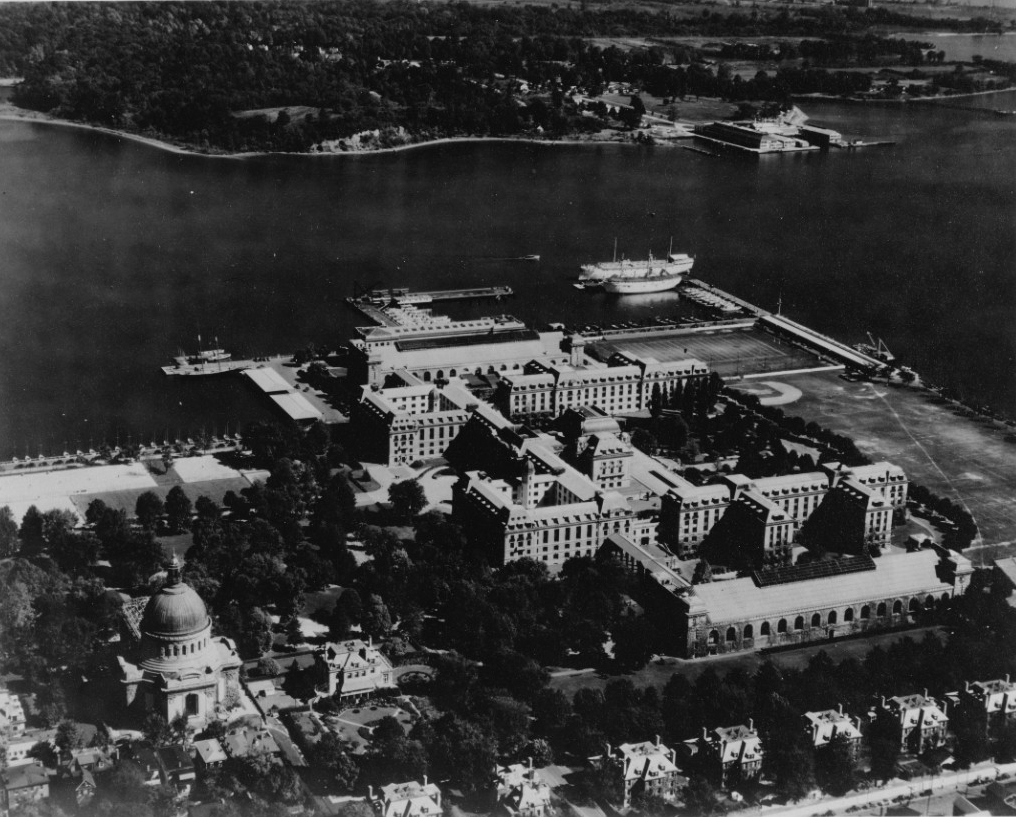
(An aerial view of the U.S. Naval Academy, looking northeast, mid-1930s)
In the tradition of Robert Timberg’s THE NIGHTINGALE’S SONG, Bill Murphy, Jr.’s IN A TIME OF WAR: THE PROUD AND PERILOUS JOURNEY OF WEST POINT CLASS 0F 2002, Rick Atkinson’s THE LONG GRAY LINE: THE AMERICAN JOURNEY OF WEST POINT CLASS OF 1966 and Joseph Waugh’s THE CLASS OF 1846 FROM WEST POINT TO APPOMATTOX: STONEWALL JACKSON, GEORGE MCCLELLAN, AND THEIR BROTHERS, Professor Emeritus at the U.S. Naval Academy, Craig L. Symonds latest book, ANNAPOLIS GOES TO WAR: THE NAVAL ACADEMY CLASS OF 1940 AND ITS TRIAL BY FIRE IN WORLD WAR II examines the graduates of one of our service academies and how they were educated, trained, and adapted to warfare. Symonds, who has taught naval history for thirty years and has authored numerous books that include THE BATTLE OF MIDWAY, NIMITZ AT WAR, LINCOLN AND HIS ADMIRALS, and OPERATION NEPTUNE has produced a poignant and disturbing story of how the Annapolis Class of 1940 experienced personal growth, pain, loss, and dedication as they participated in many noteworthy battles in the Atlantic and Pacific theaters during World War II.
The class of 1940 consisted of 456 men out of the 750 who graduated , though not everyone received a commission. Of those who did, 401 became Navy Ensigns, and 25 became Second Lieutenants in the US Marine Corps. They arrived at Annapolis as Adolf Hitler ordered the seizure of the Rhineland, the Spanish Civil War was beginning, the Japanese had already seized Manchuria, Mussolini forces were ensconced in Abyssinia, and Stalin had instituted his purges. Despite these events most of the plebes were more concerned with how they would survive the naval academy for the next four years. Symonds follows in detail a number of members of the class who would experience four transformative years, followed by four more hard years in the cauldron of war. The end result was that 76 graduates of the “forties” as the Class of 1940 was known would perish in the war, the highest death rate of any class from either Annapolis or West Point.

(Class of 1940 graduation from the US Naval Academy, June 6, 1940)
Symonds begins his narrative by introducing members of the new class and their socio-economic makeup. What is interesting to note is their diverse backgrounds, the reasons they wanted to attend the academy, and how they achieved their admission. Some were from privileged classes in terms of wealth who used their families political connections to gain an appointment. Others saw it as a free education as their families could not afford college tuition as the depression continued to impact Americans throughout the 1930s. A few saw it as a dream come true from the time they witnessed naval destroyers or cruisers at harbor when they were young men. Curiously, of the new appointees, only one was black, and one was Filipino. Symonds explores the plebes’ daily schedule that could be summed up as “reveille, formation, breakfast, class, lunch, athletics, dinner, study, lights out, repeat!”
The author does an excellent job integrating world events as he relates the experiences of his subjects. He provides important aspects of events, in depth analysis, and the possible impact of what had transpired outside the “Naval Academy bubble” on its newest class. A good example is Symonds discussion of the 1936 Army-Navy game which Navy was victorious by a score of 7-0 and the growing partnership developing between Japan and Germany which the following year would result in the anti-Comintern Pact, and the Panay Incident the following year when the Japanese attacked a US gun boat on the Yangtze River. By September 1939, the fall of Warsaw provoked a growing interest on the part of the “forties” as they could imagine war on the horizon and their renewed commitment to their training resulted.
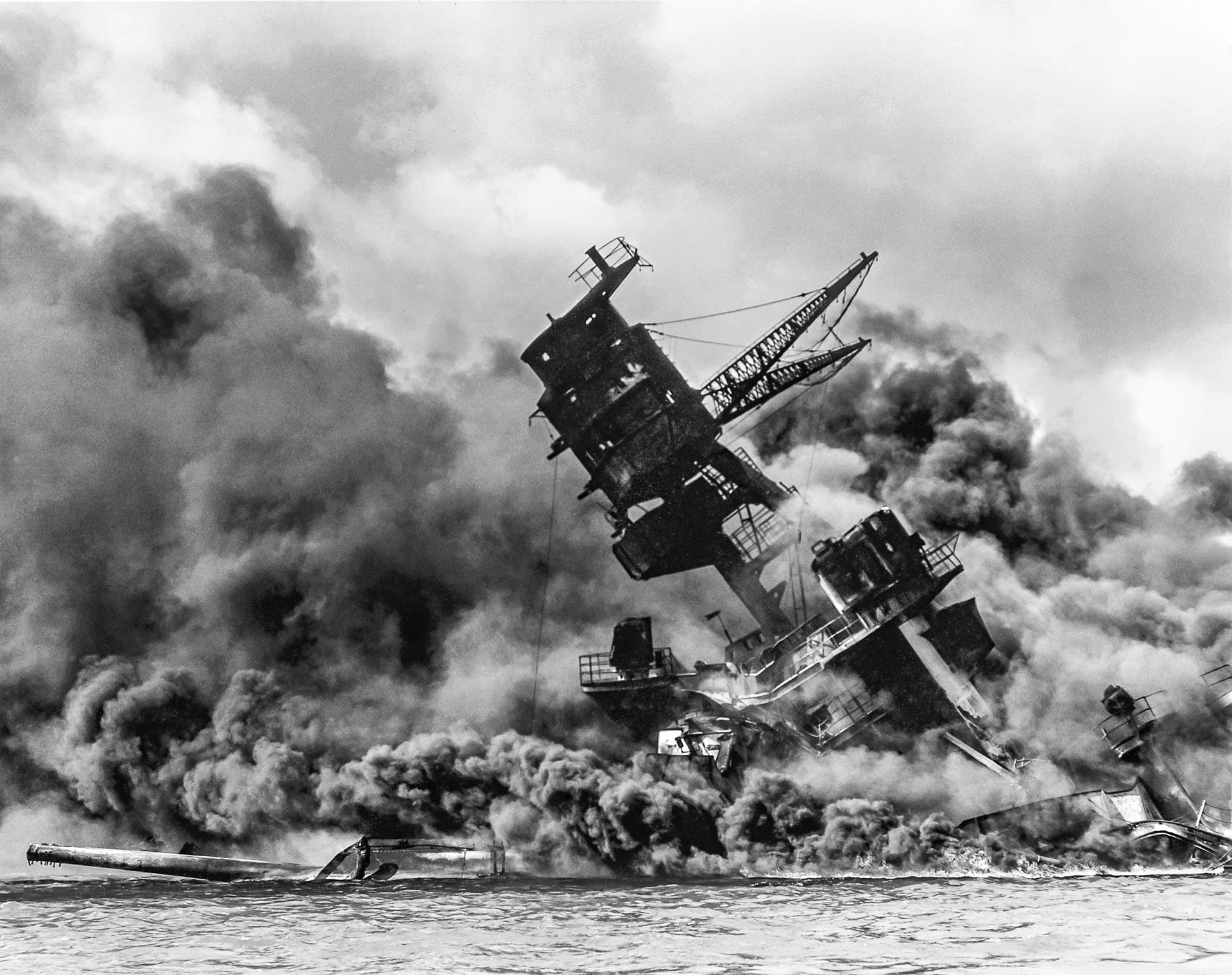
(USS Arizona, Pearl Harbor, December 7, 1941)
The narrative reflects how racist American society was during this period. Aside from racial makeup of the class, their behavior toward certain staff members of the academy was indicative of American values. For example, the “forties” would pay janitors 25 cents a week to sweep their rooms and make their bunks. They would also refer to them as “mokes” which translated to “colored corridor boy!”
Symonds intimate detail is impressive and reflects how intrusive academy regulations could be. The navy had a regulation that men could not marry until they served two years as commissioned officers at sea. Those who secretly married were dismissed from the academy and lost their commissions. However, after the Japanese attack on Pearl Harbor and the losses the United States suffered in the Pacific the need for more naval officers was acute and the regulation was changed, and men no longer had to wait two years to marry. But again, if they did so before the change was implemented they were dismissed. It did result in a number of the class of 1940 getting married before they shipped out.
_underway_at_sea_on_10_March_1963.jpg)
(USS Yorktown at sea in the Pacific)
Symonds does not devote much detail on the last three years the Class of 1940 spent at Annapolis. After about a third of the book discussing the ”forties” he jumps to graduation as the situation in Europe, England, and the Atlantic deteriorates as the Nazis become even more aggressive. Upon graduation 50 men are assigned to aircraft carriers, 167 are assigned to battleships, and another 101 are assigned to cruisers. Others transfer to the Marine Corps, submarines, and aviation services. At this time, the Atlantic was more dangerous than the Pacific as German U boats sought to cut off American shipments to England. President Roosevelt would gain passage of the Lend Lease program which expanded the navy’s role in the Atlantic. As US ships conducted search patrols as far as the Azores the navy became more engaged in an undeclared war against the Germans and naval preparation and operations increased and the training of the members of the Class of 1940 was put to use.
By September 1941 it became clear the US navy was increasingly escorting allied convoys in the Atlantic and active combat resulted as the USS Kearny was hit by a German torpedo and the USS Reuben James was sunk. Symonds as he does with the course of the growing conflict explains correctly that Hitler was careful not to push naval confrontation with the United States at this time because he wanted to defeat the Soviet Union which Germany had invaded in June 1941. The US would continue to increase its convoy role in bringing aid to England in the Atlantic, at the same time Roosevelt ratcheted up sanctions against the Japanese in the Pacific which would ultimately lead to the attack on Pearl Harbor.
Symonds description of the attack on Pearl Harbor reflects the standard account of events. What makes it more personal for the reader is how the author integrates the experiences of Class of 1940 graduates. Men like Irving Davenport and Sideny Sherwin served on the USS Oklahoma which was sunk resulting in 429 deaths. Dave Davison was the Officer of the Day on the USS Arizona as was Virgil Gex who made up two the seven “forties” with the over 1000 men who did not survive the attack. Others from the Class of 1940 like Nick Nicholson was the Officer of the Day on the USS California as were a number of others. Symonds stories of those who survived and those who did not reflect the heroism and personal sacrifice so many men experienced on December 7th.
(Photo Robert Kaufman, 97, has of the Japanese surrender ceremony, which ended the U.S.’ involvement in World War II. Kaufman is one of the few remaining Naval Academy 1940 graduates).
The author’s expertise as a naval historian dominates and enhances the monograph. His views are supported by years of research and familiarity with primary and secondary materials. Symonds relies on letters, diaries, family archives, and interviews to augment his portrayal of events and the role of the members of the Class of 1940. One example in particular stands out as he relates General Douglas MacArthur’s fears that building defenses and stockpiling food on Bataan would appear defeatist to Japan. He convinced Washington to allow him to defend all of Luzon, including Manila once the Japanese attacked. This was a grave error as the Japanese landed on Luzon on December 22 and MacArthur was forced to move his headquarters from Bataan to the small, fortified island of Corregidor. Allied forces would surrender on April 7, 1942, after fierce fighting and “Sparky” Campo, the lone Filipino in the Class of 1940 was able to escape by executing a bold torpedo attack against Japanese destroyers.
By 1942 the Class of 1940 was in the thick of combat as convoy escorts became the primary function of the Atlantic fleet. Despite tremendous losses it was decisive for the war effort because of the American ability to build new ships and filling the need to increase protection for the convoys . This increase in American shipping created the need for more naval officers which tapped a number of the 1940 Class’s members. They would fill many new staff positions; engineering, torpedo and gunnery officers, in addition to executive officers on smaller craft.
Symonds describes the difficulty and danger faced by the navy in convoying across the Atlantic. The author provides the speed and size of the convoys, their strategy designed to avoid U boats, even the inability to sleep and eat due to conditions caused by storms and high seas. Symonds zeros in on the USS Buck and USS Bristol as he relates the dangers and anxiety that naval personnel faced. The situation became even more difficult as the US began supplying lend lease aid to the Soviet Union as convoys had to transit the Arctic Ocean around northern Norway where the Nazis had an air base in their attempts to reach the Barent Sea. It became even more difficult as losses caused Roosevelt to suspend certain shipping to Russia which fed Joseph Stalin’s paranoia about the allies using Moscow as a vehicle to defeat the Nazis and at the same time destroy his country. This paranoia and anger against London and Washington would fester and cause difficulties throughout the war and even contributed to the cause of the Cold War after 1945.
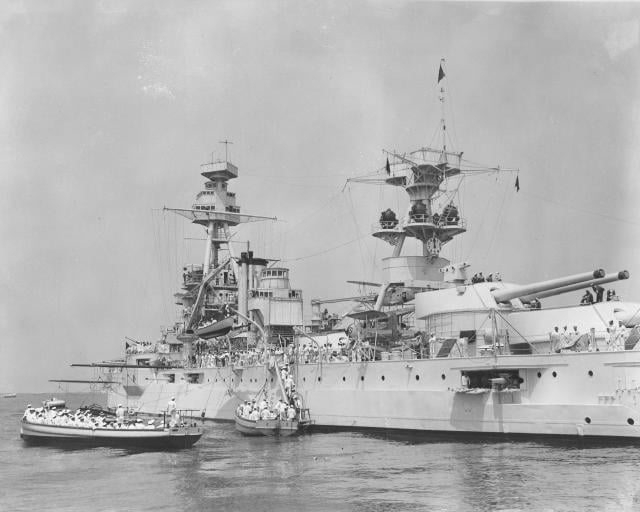
(Midshipmen go aboard the battleship Texas (BB-35) near Annapolis on 8 June 1940)
Symonds’ topic is vast because of the geography of the war. His narrative encompasses the Atlantic and Pacific theaters but also devotes his coverage to the Mediterranean theater. What stands out is the convoy support in the Atlantic which suffered tremendous losses of material and lives as we tried to supply our allies. In the Pacific, the battles of Midway and Guadalcanal dominate as the Japanese zeroed in on the USS Yorktown, an aircraft carrier at the battle of Midway at the end of May 1942. Luckily, they could not zero in on other carriers, the USS Hornet and USS Enterprise. By chance, the officer on deck was Lt. Junior Grade Peck Greenbacker of the Class of 1940 who was at the center of the storm and eventually the Yorktown could not be saved as it was repeatedly hit by Japanese torpedoes. At Guadalcanal, the US Navy suffered its worst defeat in its history as it lost the USS Quincy killing 370, the USS Vincennes with the loss of 322 men in early August 1942. In addition, more ships were lost and the death total encompassing all losses included a number from the Class of 1942 as class members were involved throughout the battles. So many ships were sunk in the waters off Guadalcanal that it soon earned the nickname, “Ironbottom Sound.”
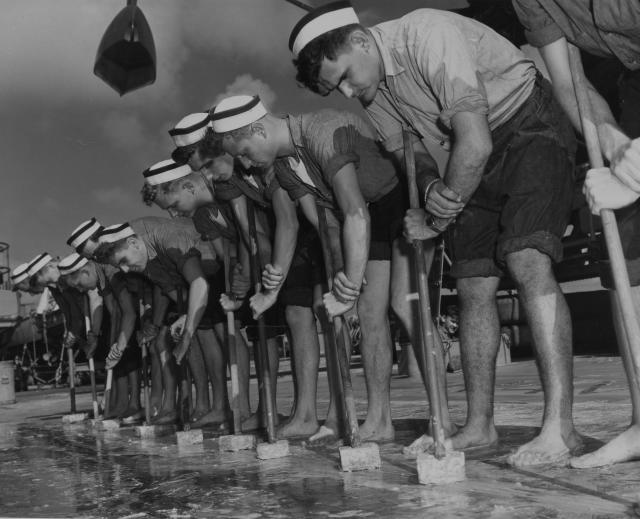
(Midshipmen holystone the deck of the USS Missouri (BB-63) during their summer training cruise)
In the Mediterranean Operation Torch became Roosevelt’s response to domestic pressure and Winston Churchill to finally take it to the Nazis. Symonds fittingly points out that General George C. Marshall feared diverting assets to North Africa would cause a postponement of any landing in France in 1943, which in the end was the result. The main obstacle to Torch was the French Vichy destroyer, Jean Bart in Casablanca Harbor. Lt. Warren Walker’s USS Massachusetts and his compatriots were able to take out the ship allowing General George Patton’s troops to invade Morocco in November 1942, and later, Walker was involved with the cruiser USS Tuscaloosa’s heavy guns which assisted allied troops as they landed at Utah Beach on D-Day. Another sailor associated with the Class of 1940 was Sam Edelsein who in early July 1943 was sent to the Mediterranean on the eve of the invasion of Sicily to supervise the installation of SG radar sets on Admiral Richard Connolly’s flagship, the USS Biscayne. Edelstein would oversee the acquisition and dissemination of radar intelligence throughout the invasion.
ANNAPOLIS GOES TO WAR is a well written account of the lives of the Class of 1940, and their contribution to the war effort. Based on impressive research his narrative encompasses the vast geography of the naval battles of World War II and in the end is an acknowledgement and salute to those who gave their lives and those who contributed to victory.

(U.S. Naval Academy at Annapolis, MD)
 Doc's Books