
(Zbigniew Brzezinski in 1987. He had considerable influence in global affairs, both before and long after his official tour of duty in the White House.Credit)
When I was a graduate student in the early 1970s I was enrolled in a 20th century diplomatic history course. The professor, a Holocaust survivor from Eastern Europe with a wicked sense of sarcasm presented deeply analytical lectures and a challenging reading list. Perhaps the most important book on the list was Zbigniew Brzezinski’s THE SOVIET BLOC: UNITY AND CONFLICT. Brzezinski’s work presented a comprehensive analysis of the relations between communist states through the late 1960s. The author focused on the process by which Eastern European countries were turned into satellites by the Soviet Union, the first signs of trouble following Stalin’s death, and the uproar unleashed by Khrushchev’s efforts to come to terms with Russia’s Stalinist legacy. In the second edition of the book, he goes on to explore the growth of “polycentrism” in Eastern Europe, particularly with the emergence of the Sino-Soviet split.
As I recall Brzezinski’s analysis it is clear he was developing the precursor to the collapse of the Soviet Union in 1989 and would be proven correct as he identified the flaws in the Soviet system. After reading Brzezinski’s later works over the years and following his career his impact on American foreign policy is obvious. There have been one major biography of President Jimmy Carter’s former National Security advisor, Justin Vaisse’s ZBIGNIEW BRZEZINKI: AMERICA’S GRAND STRATEGIST but none as well written, incisively analyzed, and researched as the Financial Times’ American correspondent, and frequent guest on MSNBC’s ”Morning Joe,” Edward Luce. The book entitled, ZBIG:THE LIFE OF ZBIGNIEW BRZEZINSKI, AMERICA’S GREAT POWER PROFIT. Luce’s monograph portrays a man who predicted the fall of the Soviet Union as an academic, then set in motion the strategy that eventually ensured its collapse. I found Luce’s book to be a fascinating study of his subject’s ideas and career, and how each influenced them in producing an important intellectual and professional biography.
Even as a young man Brzezinski had an innate sense concerning the Soviet Union. As Moscow overran Poland after the Nazis were defeated he knew “all the Poles understand this is not a liberation but simply a change in the form of terror.” Decades later, as a member of the Carter administration his view of Moscow had not changed. He still fervently believed that the Soviet Union was not a monolith and resentment of Russian colonialism would bring about the demise of Moscow’s Eastern Bloc.

(The Brzezinski family)
Luce immediately gets to the core of Brzezinski’s impact on the disintegration of the Soviet Union. The Carter administration waged ideological war against Moscow, and it was Brzezinski who laid the seeds of human rights as a weapon which encouraged hopes for independence in Eastern Europe which provided an impetus for the Solidarity Movement in Poland. Many believe that the Iron Curtain went down on November 9, 1989, when the Berlin Wall fell. But according to Luce the beginning of the breach in the Soviet Bloc occurred on June 4, 1989, when Solidarity swept Polish elections. Brzezinski played a key role in protecting Lech Walesa’s worker-intellectual alliance and nurturing it to victory. Obviously, Moscow saw him as an arch enemy due to his Polish roots and his actions as NSC head, but one thing is apparent, Brzezinski’s impact on the collapse of the Soviet Union is underappreciated even today.
There is no doubt that Brzezinski was a controversial figure. Some believed his Polish roots curtailed his objectivity and would lead to a war against the Soviet Union. Others believed he was anti-Israel and possibly antisemitic because of his Polish heritage as he argued for a two-state solution between Israel and Palestine and was a key player in the Camp David Accords. Democratic foreign policy doves also found him wanting as he supported the Vietnam War and opposed McGovernites. Further his clashes with Secretary of State Cyrus Vance resulted in the Secretary of State’s resignation as he lost battles with Brzezinski over normalizing relations with China, holding Moscow to account for treatment of dissidents, arming the Afghani resistance to the Soviet Union, and modernizing America’s nuclear arsenal. As Luce develops his narrative it is clear that his subject was his own man and never could be described as an ideologue as he did not fit any category, did not coddle up to the media like Henry Kissinger, and he was unwilling to play the Washington game which took a toll on his influence.

(President Jimmy Carter shakes hands with his national security adviser Zbigniew Brzezinski as he presents Brzezinski with the Medal of Freedom at a White House ceremony on Jan. 17, 1981)
Luce develops Brzezinski’s intellectual development throughout his narrative. Beginning with his subject’s teen years, we can see that his subject is very concerned with Eastern Europe as he writes in his diary each day. Luce does not scrimp in discussing Brzezinski’s personal development but zeroes in on his thoughts. Key aspects include how his father, Tadeuz, a career diplomat imbued in him the concept of the Polish nation that was inclusive. He stressed the role of Joseph Pilsudski who envisioned a Promethean League with Poland playing the major role as the largest player in a multinational group of smaller East European countries that together would be strong enough to resist the squeeze of Russia and Germany. Brzezinski’s World War II diaries reflect this concern and his obsession with Eastern Europe.
Brzezinski’s master’s thesis written while at McGill University at Montreal continues this fixation as his analysis points to his belief that the Soviet Union would come to an end at some point and he laid out a roadmap for defeating the Stalinist regime. He correctly argues that Soviet ideology should not be mistaken for internationalism, as it was a variant of Russian chauvinism disguised as being a champion of the proletariat. He argues further that Moscow inherited the Czarist map which included numerous ethnic groups and nationalities, he predicted that the loyalty of allies would wither away as they would see that worldwide communism only pretended to foster equality. Russia was made up of 50% non-Russians and Stalin could not dispense with his nationality problem, particularly Ukrainians which led to mass deportations. As Russo-Soviet imperialism spread throughout Eastern Europe it would be seen as worse than European colonialism. For Brzezinski, the west’s blueprint to defeat Moscow was the need to repudiate the idea that Russia had the right to a legitimate “spheres of influence” as the developing Tito-Stalin split highlighted, and the idea that Russia as a civilizing influence in the region belied the actions of Beria and his KGB.
Brzezinski’s Ph. D dissertation which eventually would be published in book form as THE PERMANENT PURGE: POLITICS IN SOVIET AUTHORITARIANISM continues his worldview that purges were endemic to Bolshevik rule and the normal tool of totalitarian states. In the absence of counterbalancing constitutional checks, purges became a substitute for politics under Stalin and the immediate years after his death. Lastly, the Soviet system was doomed because it could not reform itself even as Khruschev tried after his DeStalinization speech in February 1956, and later under Mikhail Gorbachev which set events in motion that gave us Vladimir Putin. Brzezinski would visit Russia in 1956, and he concluded “in addition to the nationalities, authoritarian sterility – not Stalinist terror – was the USSR’s long term, problem.” This view was supported by the Hungarian Revolution in November 1956 as Soviet tanks rolled into Budapest, a fate Poland was able to avoid at the last minute. This provoked Brzezinski’s rage at the President Eisenhower and Secretary of State John F. Dulles who preached “roll back” of Soviet communism but were feckless in response to Russian aggression.

(Henry Kissinger and Zbigniew Brzezinski)
The Kissinger-Brzezinski dynamic is an important aspect of Luce’s narrative. The author spends a great deal of time highlighting their relationship discussing their similarities and differences as their careers cross paths. In a sense it began with John F. Kennedy’s presidential campaign. The Massachusetts senator liked to portray himself as an intellectual and advocated bringing intellectuals into government. Brzezinski became one of Kennedy’s foreign policy advisors and wrote a number of campaign speeches and the candidate would mirror his call for greater economic engagement, cultural ties, and scientific exchanges with Eastern Bloc countries as it shifted its entire focus away from Moscow as saber rattling would only drive the Soviet Bloc closer together.
With Kennedy’s assassination Brzezinski lost a leader who had nominally adopted his Cold War strategy. His attitude toward Lyndon Johnson was not as positive as he believed his obsession with Vietnam created a missed opportunity as the Soviet grip over its satellites was looser than most believed, particularly the Sino-Soviet split, along with his belief that China, not Russia was the main sponsor of global revolution. Luce is correct pointing out that Hanoi was paranoid of China, again a missed opportunity.
Once Johnson withdrew from running for reelection in March 1968 he signed on to coordinate Hubert Humphrey’s bid for the White House. Vietnam would be his albatross and Brzezinski’s visit to Saigon reinforced his view that the war was not winnable even if the United States doubled its commitment to 1,000,000 men and any further escalation of the bombing would exacerbate the situation. Brzezinski, who liked Humphrey as a moral person, did not think he would be a good president and advised him to recalculate what victory in Vietnam would look like. He wanted to keep arming South Vietnam to prevent a communist takeover and saw the war as only benefiting Moscow. Brzezinski grew frustrated with Humphrey throughout the campaign as he dithered in his decision making and he saw little daylight with Johnson’s approach. Brzezinski’s disappointment with Humphrey and Johnson increased due to their lack of response to the Soviet invasion of Czechoslovakia during the campaign – for him it was a replay of Hungary 1956. Luce reviews the accepted analysis of Humphrey’s inability to stand up to Johnson during the campaign especially over a bombing halt until it was too late to win the election, and the Nixon campaign’s role in interfering with negotiations in Paris which Johnson was aware of but did nothing about because of his doubts concerning his Vice-President.

(Zbigniew Brzezinski, right, with Charles Schultz and Jimmy Carter in December 1976)
Vietnam underscored the differences between Kissinger and Brzezinski. For most historians Kissinger was a master manipulator who always seemed to play on both sides. During the 1968 presidential campaign Kissinger was a consultant to the State Department and funneled information concerning the Paris Peace Conference to the Nixon campaign at the same time he was advising Nelson Rockeffeler’s attempt to rest the Republican nomination from Nixon. According to Luce this was the first time the two were on opposite sides, Brzezinski favoring a bombing halt, and Kissinger working to prevent it.
The two men once colleagues at Harvard maintained a somewhat friendly-aversive relationship. As the years melted away the veneer of professionalism fades between the two. Once Kissinger became Secretary of State and National Security Advisor in the Nixon administration, Brzezinski’s criticisms of Nixon-Kissinger realpolitik increased. The issue aside from Vietnam that drove their disagreements centered on “Détente.” Kissinger attacked Brzezinski for abandoning his long-held belief in peaceful engagement and called his latest approach “a right-wing critique.” Kissinger offered a rebuttal to Brzezinski’s criticisms over SALT, preferential trade credits, failure to talk to allies, and Middle East talks. Brzezinski believed Kissinger was an amoral opportunist, and that the Soviets were exploiting Détente for ideological mischief-making. He would support Détente, but not in a one-sided way. Though their interchange was civil and bordering on friendly in private Kissinger was apoplectic and referred to his former colleague as a “whore.” In public they remained sociable, but behind the scenes as the later declassified documents show Kissinger grew angrier and angrier. Indeed, given Kissinger’s backstabbing and Brzezinski’s distaste for social niceties, it is amazing that Brzezinski managed to get as far as he did and have such a deep impact on American foreign policy. Luce argues that his success was due to his intellect, tenacity and sense of mission which he attributes to his “wounded Polishness” and overwhelming distrust of the Soviet Union.
The most important development in Brzezinski’s career was his association with Jimmy Carter. First, he became Carter’s foreign policy advisor during the 1976 presidential campaign and worked on developing the candidate’s policy “chops.” He would focus on Kissinger’s “lone ranger” approach to diplomacy and soon Ford’s Secretary of State became a campaign liability. Further, Kissinger was described as a “false pessimist” based on his forecast that the Soviet Union would probably overtake the United States as a global force in the 1980s. Carter’s speeches reflected Brzezinski’s tutoring as he described a new approach to Détente which would be “reciprocal and comprehensive.”
![June 18, 1979: U.S. Secretary of State Cyrus Vance at background, center, looks on as U.S. President Jimmy Carter, left, and General Secretary of the Communist Party of the Soviet Union Leonid Brezhnev, right, sign the Strategic Arms Limitation Talks (SALT) II Treaty in Vienna, Austria. [AP/Wide World Photo]](https://2009-2017.state.gov/cms_images/28vance_salt_600.jpg)
(June 18, 1979: U.S. Secretary of State Cyrus Vance at background, center, looks on as U.S. President Jimmy Carter, left, and General Secretary of the Communist Party of the Soviet Union Leonid Brezhnev, right, sign the Strategic Arms Limitation Talks (SALT) II Treaty in Vienna, Austria. [AP/Wide World Photo])
The competition between Kissinger and Brzezinski continued during debate preparation as Carter revived the “Kissinger issue,” and he and his tutor trapped Ford into one of greatest gaffes in presidential debate history when Ford stated and then reiterated that “there is no Soviet domination of Eastern Europe and there will never be under a Ford administration.” This error would cost Ford his reelection since the election result was so close.
There was no doubt in Carter’s mind that he wanted Brzezinski as his National Security advisor despite the opposition of Democratic Party elites like Averill Harriman, Clark Clifford, and Richard Holbrook. When Luce describes the new NSC head as having sharp elbows and not caring what others thought of him as long as he was true to his beliefs he is dead on. Carter and Brzezinski would develop a fascinating relationship. It began with Brzezinski as teacher and Carter as pupil and would evolve into a strong partnership. Brzezenski, though at times was frustrated by Carter’s indecisiveness, but admired his character as the President would do what he believed was right for the country no matter the negative political implications for his own popularity. Be it handing back the Panama Canal, aggravating the Jewish lobby over his view of the Palestinians, the need for an energy policy, or appointing Paul Volker as Chairman of the Federal Reserve knowing full well his policies would exacerbate inflation in the short run, Carter did what he believed was best for the country.
Brzezinski finally had his opportunity to be the architect of American Foreign policy. His commitment to human rights and working closely with Karol Wojtyla who would be elected as Pope Paul II in 1978 was brilliant and it sent a message to Moscow as upon assuming the presidency Carter immediately stressed human rights and a new SALT II treaty. In fact, the KGB argued that it was Brzezinski who had fixed the Papal election! Meeting with Soviet dissidents like Andrei Shakarov and Vladimir Bukofsky (in comparison to Ford who refused to meet with Alexander Sohlsenitsyn) angered Leonid Brezhnev who threatened that there would be no SALT treaty unless the US backed off from emphasizing human rights. Brzezinski was unconcerned, stressing the Russians needed a SALT treaty because their economy was in such poor condition.
.jpg)
(U.S. president Jimmy Carter, Egyptian president Anwar Sadat, and Israeli prime minister Menachem Begin shake hands after signing the Camp David Accords)
The other relationship that Luce delves into in detail is that of Secretary of State Cyrus Vance and Brzezinski. Vance, who was part of Harriman’s brain trust and the last of the Democratic elites, was against stressing human rights, believing that a new SALT treaty was imperative. Luce points to a long list of disagreement between Vance and Brzezinski that included policy disputes over allowing the Shah of Iran to enter the United States for medical treatment after American hostages were seized in 1979; prioritizing Détente instead of a more aggressive approach to Moscow; careful not to antagonize Russia by moving to close to China; and asserting a more aggressive military posture in the world. Their differing worldviews led to a climate of public diplomatic discord which at times left the impression that the administration’s foreign policy lacked coherence. Ultimately, Brzezinski’s more hawkish approach often gained prominence during critical moments, contributing to the eventual resignation of Vance in April 1980 after the failed hostage rescue mission in Iran. Luce sums up their relationship perfectly, Vance had Carter’s heart, Brzezinski had his brain!
Despite this bureaucratic infighting Carter achieved a number of diplomatic successes. The Camp David Agreements between Israel and Egypt, the bleeding of Russia by arming the mujahideen in Afghanistan, normalizing relations with China, and the return of the Panama Canal. Luce’s deep dive into these issues is particularly gripping and an important aspect of his book as he provides fascinating commentary. For example, Israeli Prime Minister Begin’s relationship with Brzezinski as both were Polish, despised Russia, and their knowledge of Jewish History. Another instance is the relationship between Deng Xiaoping and Brzezinski which translated into the turning point for the Carter administration as the President sided with his NSC advisor over Vance to normalize relations with China. Further, Luce stresses that the Russian invasion of Afghanistan was vindication for Brzezinski over the State Department which had argued repeatedly that the Soviet Union was a status quo power.

(Brzezinski and President Carter)
Despite these successes the Iranian situation overshadows all of them. Luce lays out the familiar history of the emergence of Ayatollah Khomeini as the leader in Tehran and the ongoing hostage situation. The Carter national security team was blinded on two fronts. First, they misread the potency of the mullahs and did not take Khomeini’s words seriously. Further, Brzezinski could not accept the concept of a theocratic revolution. Another error was the state of the Shah’s health. Brzezinski repeatedly called for a military crackdown and/or coup, but the Shah was in no condition to effectively deal with the security situation in his country. Luce is correct that the Carter administration’s approach to the Iranian crisis was one of complete chaos highlighted by the inability of the State Department and National Security Council to get along and the fact that there were so many leaks of information to the public. Carter could not make up his mind until it was too late.
I agree with Jonathan Tepperman’s review in the July 10, 2025, edition of the Washington Post concerning any shortfalls to Luce’s biography. “If I were to quibble, I’d have liked more of a window into Brzezinski’s private, deeper self, especially given that Luce had access to all his diaries, correspondence and other papers. But perhaps that was impossible; as Luce repeatedly points out, Brzezinski spent strikingly little time on introspection. He may not have had an inner life worth plumbing.”
In the end according to Tevi Troy in his May 13, 2025, review in the Wall Street Journal that “it was neither the Soviets nor the State Department but an inability to deal with the Iranian hostage crisis that brought about the end of the Carter administration and, apart from some consulting roles, the end of Brzezinski’s time in government. Brzezinski continued to opine on foreign policy. As Mr. Luce points out, however, he did so without being closely affiliated with either political party. Mr. Luce speculates that this independent approach is both why he never returned to government and why he never received “his full due.”
Whatever Brzezinski’s shortcomings were as a foreign policy expert, no one could challenge his intellect, his commitment to his craft and doing what he felt was best for his adopted country. In comparison to the conduct of foreign policy today with a hollowed out State Department and diplomatic core and strategies designed to assist the president in acquiring wealth and bullying allies, I long for the type of diplomacy narrated by Mr. Luce, which described a man who laid the groundwork to understand what Vladimir Putin’s goals are today.
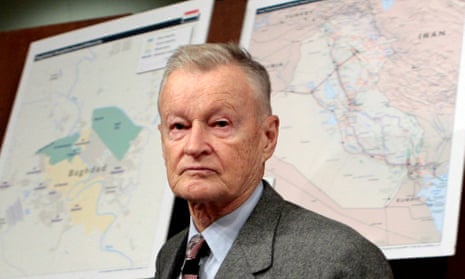
(Zbigniew Brzezinski in 2007)
 Doc's Books