
(August 1945 Trial of Marshal Petain)
In 1969, the two-part documentary film, “The Sorrow and the Pity” directed by Marcel Ophuls depicting collaboration between the French Vichy government and Nazi Germany during World War II was released. Controversial from the outset, the film explored the reasons behind the collaboration, including anti-Semitism, Anglophobia, fear of Bolshevism and Soviet invasion, and the desire to acquire and maintain power during the German occupation. By the end of the war, the entire Vichy experience fostered a deep fissures in French society and no one depicted this state of affairs more than Marshal Philippe Petain, the great World War One hero at the Battle of Verdun who led the Vichy government and after the war became the lightning rod dealing with French collective guilt and retribution.
Petain is the focal point in British historian Julian Jackson’s latest work dealing with France during World War II entitled, FRANCE ON TRIAL: THE CASE OF MARSHAL PETAIN. In his comprehensive monograph Jackson zeroes in on Petain’s three week trial after France was liberated examining the central crisis of French history in the 20th century – the collapse of France within six weeks after the Nazi invasion in April 1940; the signing of an armistice with Germany; and Vichy’s policy of collaboration.

(Pierre Laval)
Jackson begins his narrative providing a photograph of a picture of Petain and German Chancellor Adolf Hitler shaking hands on October 24, 1940, and describes the symbolic importance of that act- a propagandas coup for the Nazis and a shock for the French public. The result of that meeting meant that France was no longer a combatant in the war and was now considered neutral, though the French public assumed that the hero of Verdun must be working behind the scenes with the British or the French resistance led by General Charles de Gaulle. As Petain’s trial would show, he was not working behind the scenes with anyone and was collaborating with the Nazis no matter what his defense attorneys would argue. The word “collaboration” became controversial when used in a speech on October 11, 1945, no matter how many times Petain denied that characterization of his government, it is part of the historical record.
Jackson describes the trial which opened in Paris on July 23 and ended on August 15, 1945, in minute detail. He offers unique portraits of the major characters ranging from Petain; his lawyers, Jacques Isorni and Fernard Payen who despised each other, the prosecution led by Public Prosecutor Andre Mornet and Pierre Bouchardon; to Charles de Gaulle, Pierre Laval, and numerous other personages which include collaborators, members of the wartime resistance, and the role of past and future politicians like Paul Reynaud, Leon Blum, and Francois Mitterand. Jackson relies on trial transcripts, archival research, and most importantly to convey the mood of France during the trial and after, contemporary journalistic accounts.

(Paul Reynaud)
One of the key themes of the book was to decide whether Petain was a hero or a traitor. Each side in the debate had its own agenda. Some wanted to protect their reputations as many served the Vichy government, others wanted to maintain Petain’s reputation as the epitome of a French hero who had given his life in service to the French people. Taking place after Liberation, the trial witnessed the return of many French persons returning from deportation and forced labor and the liberation of the Nazi concentration camps. Many call this period as the “Epuration,” or purge of the French body politick as so many had worked with and for the Germans.
Jackson draws a number of important conclusions drawn from interrogations of Petain. First, his answers reflected “a mixture of evasiveness or forgetfulness, self-delusion, blame shifting or mendacity, and self-pity….,” with some believing what else could be expected from an eighty-eight year old man. Since he was quiet at the trial, witness interrogation offered a glimpse as to what his real views were. Third, Petain’s hatred for Charles de Gaulle is readily apparent, though their earlier careers saw them working together. Fourth, his lawyers were at a disadvantage as Petain provided little to create a more positive narrative for the events between 1940 and 1944. Defense attorney Isorni had to invent the Petain that he needed as he had little to work with. Fifth, rivalries among former Vich courtiers remained intense, and lastly, when evidence emerged against Petain, blame would be shifted to Pierre Laval.
The Acte d”accusation zeroed in on Petain’s responsibility for signing the armistice on June 22, 1940, and three constitutional acts promulgated on July 11, 1940, which went beyond the powers that he had previously been given which lent credence to the idea that he was involved in a plot against the Republic before the war. The second charge dealt with tracing Petain’s treason after July 1940; for example, contributing to the German war machine, allowing the Germans to use French airfields in Syria, and firing on allied troops in North Africa in November 1942. Lastly, he was charged with being fully behind the “abominable racial laws” and creation of a special section to enforce them. All in all, he was guilty of attacking the internal security of the state and colluding with the Nazis to favor his own ambition which correlated with those of the enemy.
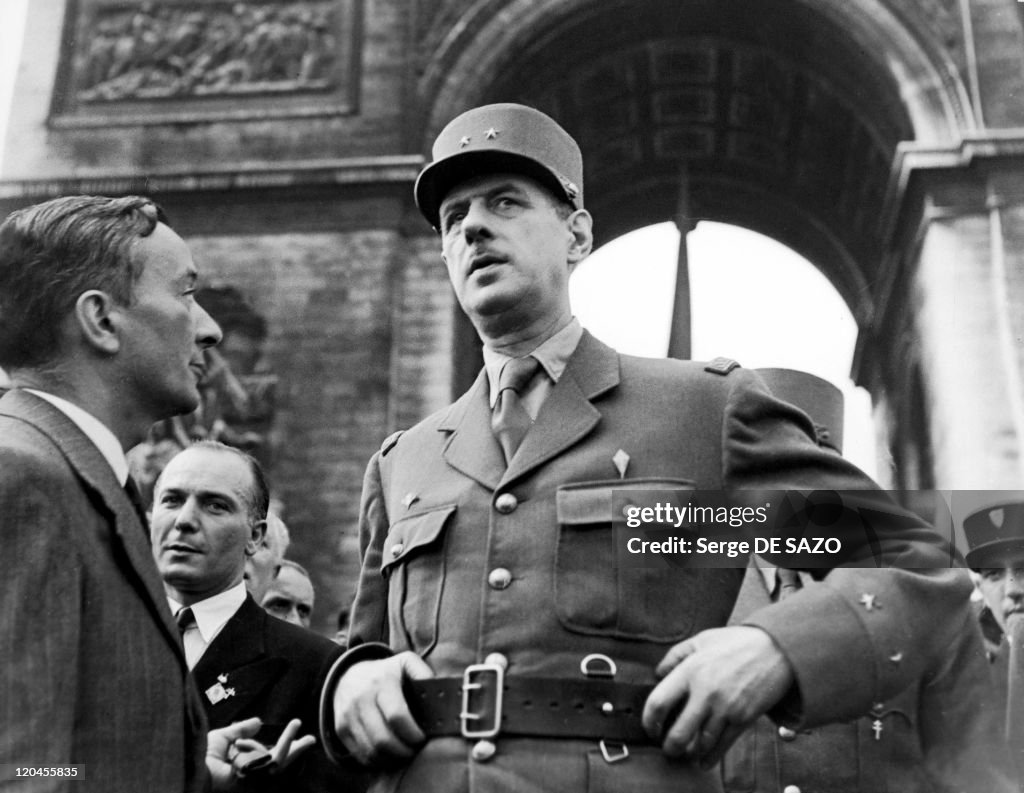
(Charles de Gaulle)
Jackson describes Petain’s demeanor during the trial which mostly appeared to be one of indifference, impassivity, as if he were in another world, though there were a few short outbursts defending himself. Petain’s defense argued that by collaborating Petain “cunningly outwitted the Germans while allowing the subordinates to pursue a secret resistance .” Further it was argued that Petain did not join the allies in North Africa after November 1942 because he believed his mission was to stay with his people. Petain was therefore a “sacrificial martyr who supposedly had secret contact with the British and secretly supported the allied landing in North Africa in November 1942. Lastly, Petain was not a “free agent,” he was answerable to Laval. In the end this defense was not effective.
As far as the fate of the Jews is concerned, very little was mentioned at trial. But, it is clear from the work of American historian Robert Paxton proves that under Vichy Jews were excluded from the civil service and other professions, the internment of Jews in the Unoccupied Zone, and the French carried out the arrest of Jews at the behest of the Germans. Interestingly, Jackson points out as occurred in other countries when Jews returned to their homes after the war the atmosphere became poisonous as they tried to reclaim their property. In fact, the Vichy Commissioner for Jewish Affairs, Louis Darquier (who Petain referred to as “the torturer), and the head of the French police during occupation, Rene Bousquet had no regrets concerning their role in sending Jews to Auschwitz and other camps.
An area of controversy discussed involves the United States which hoped to woo Vichy away from the Germans. The US had diplomatic relations with Vichy and during the trial Washington was afraid that old wounds would be brought out, particularly French distrust for the United States. Historian William Langer tried to whitewash the American relationship with Vichy, but Jackson, Paxton and others reported the truth of American complicity with Vichy.
Apart from the trial itself, Jackson vividly portrays the anguish of retribution as those who had collaborated with the Nazis found themselves spit upon, physically attacked, had their heads shaved, and criminally charged for their actions. The period following the trial makes up a quarter of the book whereby the author describes how Petain’s supporters continued to fight to resurrect his reputation and place in history, even after he died and is buried on the French island of Il’ Yeu.

(Francois Mitterand)
After the trial ended and Petain was imprisoned on the island the physical trial may have ended for Petain, but not for France. Petainists and anti-Petainists continued the arguments presented at trial through various organizations, publications, and the personal agendas of many. One of the more interesting characters was Charles De Gaulle who seemed to want the support of both sides. Isorni continued the fight trying to exhume Petain’s body and have it moved to the national cemetery at Douaumont to be buried with other heroes of Verdun and petitioning for a new trial to overturn Petain’s conviction. Petain remained a “political football” for decades after his death forcing politicians to make decisions which remained problematic as many French persons refused to let his actions go undefended.
It is clear that what is referred to as France’s “darkest hours” according to Agnes Poirier in her The Guardian, review of June 11, 2023, was one of cowardice, bad faith, dishonor and moral ambivalence.” I agree with her further characterization that “what is chilling in Jackson’s beautifully researched and meticulous account of the trial is the hopeless mediocrity of almost all people involved in it: from judges and jurors (résistants and parliamentarians) to lawyers’ prosecutors and witnesses. Everybody seemed animated by petty or self-serving feelings; they were either out of their depth or spineless, but above all most were morally ambivalent. Before it began, De Gaulle had presciently talked of Pétain’s trial as a ‘lamentable but inevitable’ event.” If you have an interest in exploring France’s greatest moral downfall in its modern history then Jackson’s comprehensive efforts should satisfy.
“As Jackson explains: “De Gaulle knew he was on thin ice when claiming that Vichy was illegal. For that reason, he generally preferred to talk about legitimacy.” In the end, the difference between Petain and De Gaulle, between Vichy and the Free French, was their idea of honor. France’s duty had been to fight on whatever the risks, whatever the sacrifices. De Gaulle and his army of resistance saved France’s honor by the skin of their teeth. And as far as this French citizen is concerned, Petain and his clique can rot in hell for eternity.”

(August 1945 Trial of Marshal Petain)
 Doc's Books