
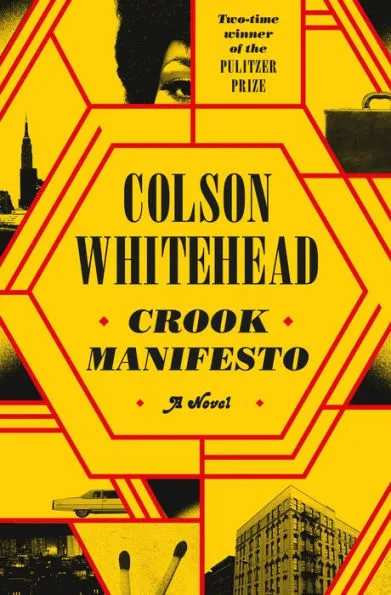
By 1971 New York was a city under siege. During the liberal Republican administration of John Lindsay New York residents experienced a transit strike, a garbage strike, rampant crime, and the daily political corruption that seemed to dominate the city. Colson Whitehead, who first addressed the plight of New York of the 1950s and 60s in his entertaining and substantive novel, HARLEM SHUFFLE returns with a sequel, CROOK MANIFESTO where Ray Carney once again has to navigate the city’s minefield. As in the first novel, Whitehead breaks down his story into three components. First, 1971 when Carney who had given up his ancillary career as a crook; 1973 focuses on Carney’s partner in crime, Pepper, and Zippo Flood, an old “colleague” of Carney who has inherited a substantial sum and is making a Blaxploitation film in Harlem; and third, how Harlem deals with the 1976 Bicentennial. Whitehead uses his novel as a vehicle to investigate a neighborhood which finds itself at a tipping point in time accurately depicting the satire of this world and immersing himself into the hearts of his characters.
As the novel opens New York is in the midst of a shooting war between the NYPD and the Black Liberation Army which wants to overthrow the existing system. Carney finds himself trying to stay legitimate as he has done for four years eschewing his “fencing” and “laundering” activities and keeping his furniture business afloat. As the novel unfolds it becomes increasingly difficult for Carney to avoid “bent” activities.
Similar to HARLEM SHUFFLE in his new endeavor, Whitehead intersperses his social commentary throughout. His first foray deals with the concept of revolution as seen by the Black Liberation Army which wants to overthrow the government and replace it with some type of socialist entity, and the Black Panthers who work partly within the system introducing social programs like free lunches and legal aid to minority communities. Police corruption still dominates the novel as Detective Munson reappears and the policy of framing blacks for crimes continues unimpeded. This led to the Knapp Commission under Lindsay to investigate police corruption and introduce Frank Serpico (the subject of a great film) to city residents. The idea that the war in Vietnam and life in America’s ghettos have similarities takes hold under Whitehead’s rendering and provides interesting food for thought. By the novel’s conclusion the depth of governmental corruption is fully laid bare.

Carney’s return to the world of crime is a function of his desire to be a loving father. His daughter May is obsessed with the Jackson Five who are appearing at Madison Square Garden, and she begs him to get tickets for the sold out performance. Desperate, Carney turns to Detective Munson who he is still paying “protection money” to try and obtain tickets. This will lead Carney back into the “life” as he gets subsumed into Munson’s corrupt world of bribery, burglary, and murder. It seems Munson and his partner Buck Webb have stolen jewels belonging to an organized crime headed by Notch Walker who also happens to be funding the Black Liberation Army. It seems Webb and Munson have been called before the Knapp Commission and realize it’s time to tap out. Munson’s plan is to screw his partner, rob an important card game created by another interesting character named Corky Bell and use Carney as his associate in return for the Jackson Five tickets. For Carney, Whitehead’s description is spot on, “He had been straight for four years, but slipped once and everybody is glad to help you slip hard. Crooked states crooked and bent stays straight, The rest is survival.”
Whitehead brings in two characters from HARLEM SHUFFLE and gives them a prominent role in the novel. Pepper, an older “thug” has developed into an older brother figure in Carney’s life serving as a sounding board, a partner in crime, and in general comes across, despite his underworld activities somewhat sympathetic. Another is Zippo Flood, a photographer that Carney had used in a revenge plot who emerges as a film maker having received a windfall from a Russian immigrant who escaped pogroms named “Heshie” who had taken a liking to him. Zippo always wanted to be a film director and he uses the money to make the film; “Secret Agent: Neferititi” which Whitehouse uses to explain how black films are made and to integrate Chink Montague, a gangster that Carney is familiar with as an investor and the subject of a possible kidnapper of the film’s star, Lucinda Cole. Once Pepper is hired by Zippo to find her the story becomes more interesting as he takes us through a “centric romp through the film industry, the Black comedy revolution, and the paradox of underground stardom.”*
Throughout the novel Carney is caught between recidivism and redemption, but as the bicentennial approaches events will catch up to him. By 1976 Harlem was burning as “firebugs” were responsible for over a third of the 12,000 blazes that occurred. Carney became distraught when he learned a young boy, Albert Ruiz, was injured in one of the fires and the furniture king decided he would find the person responsible. He employed Pepper in the task, and it would lead to an interesting conclusion involving Alexander Oakes who was running for Manhattan Borough President. It was the same Oakes that represented the best in Strivers Row and the man Elizabeth’s parents wanted her to marry, not the scum that her mother and father felt Carney represented. This aspect of the novel is highlighted by Whitehead’s explanation as to how the city operated – City Hall corruption, burned out buildings, urban renewal, federal anti-poverty funds, insurance payouts, and pyromaniacs all linked in a push to clean up the city. As I think back to growing up in the city at that time and driving a taxi in college, Whitehead’s theory makes a great deal of sense.
Jason Heller is correct when he points out that “What truly makes this series, or any series, work is the way it compels the reader to revisit its characters, to invest in them, to compel you to care enough to see their narratives through. Whitehead knows it, and CROOK MANIFESTO proves it. Ray, May, Elizabeth and Pepper in particular are by turns exasperating and aspirational. Life gets thrown at them, and they throw themselves back in return. These are people you crave to catch up with, and in Whitehead’s hands, the vast and intangible forces of society, injustice, morality, survival and love are distilled in them. ‘I want you back,’ sang the Jackson 5 so famously. It’s how Whitehead makes you feel the instant you close CROOK MANIFESTO does that mean it’s utterly necessary to go back and read (or re-read) HARLEM SHUFFLE before diving into its sequel? No. But it would be a crime not to.”*
* Jason Heller, “Crook Manifesto takes Colson Whitehead’s heist hero in search of Jackson 5 tickets,” NPR, July 18, 2023.
 Doc's Books