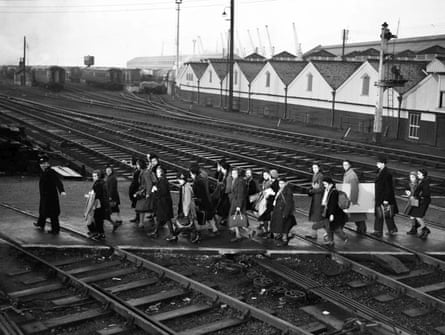
(British citizens walking into Camp Hutchinson, Peter Fleischmann is carrying an art folio)
The concept of internment was employed during World War II supposedly as a strategy to protect the national security of the countries that implemented it. The most famous example was the internment of Japanese Americans in the United States resulting in 125,284 individuals of Japanese descent rounded up and dispersed to 75 incarceration sites. A lesser known example was perpetrated by the British government for suspected German agents sent to a number of facilities on the Isle of Man. British policy is the subject of Simon Parkin’s latest book, THE ISLAND OF EXTRAORDINARY CAPTIVES: A PAINTER, A POET, AN HEIRESS, AND A SPY IN A WORLD WAR II BRITISH INTERNMENT CAMP.
Parkin’s main focus is the Hutchinson Camp which became the home of an eclectic and talented group of people. The camp was populated with over 1200 prisoners predominantly refugees from Nazi Germany who had been living in England peacefully at the time of their arrest. Parkin’s begins by exploring English paranoia concerning a “fifth column” as it appeared the Nazis were about to invade. Prime Minister Winston Churchill authorized the arrest of thousands among them were “so-called aliens” resulting in the imprisonment of teenagers who fled Germany on Kindertransport trains among them was Peter Fleischmann one of the main characters of the monograph. In an interesting description, Parkin places Fleischmann at a concert performed at Camp Hutchinson symbolizing how one could be imprisoned by one’s liberator. For Peter it was a reminder of Gestapo roundups in a world he had fled. Other prisoners included Oxbridge dons, surgeons, dentists, lawyers and scores of celebrated artists – a truly talented array of people, one of “history’s unlikeliest and most extraordinary prison populations.”
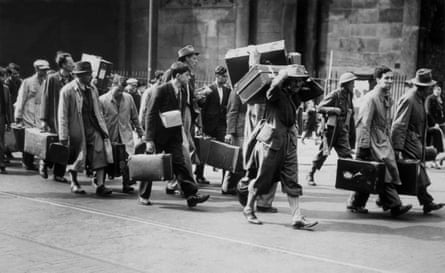
(British citizens carrying their possessions entering Camp Hutchinson)
The author launches his subject by describing the story of Herschel Grynszpan’s odyssey leading him to assassinate a German diplomat in Paris as revenge against the Nazis for seizing his parents who wound up in the no man’s land between Germany and Poland. The result was Kristallnacht launched by the Nazis in November 1938 a policy designed to terrorize Jews into leaving Germany. After discussing the impact of the beatings, seizures, and destruction of Jewish property, Parkin relates Peter’s early life after the death of his parents, living with an insensitive uncle, life in a series of orphanages, and finally his arrival in England. His story is one of abandonment and reflects British policy toward German refugees that they accepted and then arrested. British policy was clearly a haphazard one with little thought and planning as they seized thousands of people who in no way were a threat to the “empire.” Rather than carefully constructing tribunals made of knowledgeable people to make decisions they placed people totally unprepared and trained to make those decisions – the result was mass arrest. Churchill was part of the process, and he ordered all enemy aliens between the ages of 16 and 60 seized– leading to the transformation of asylum seekers into enemy suspects.
For Peter his final arrest came on July 5, 1940, and along with thousands of others were subjected to the inhumanity and indignities of how the British processed the men stealing their limited possessions, deprived them of their civil rights, and saw themselves as having survived dangerous escapes from Germany to be imprisoned by their saviors. Hitler laughed at British policy correctly pointing out how the British were copying the Nazis by rounding up so many Jews. Parkin describes a number of British facilities and for many it took months to reach Camp Hutchinson.
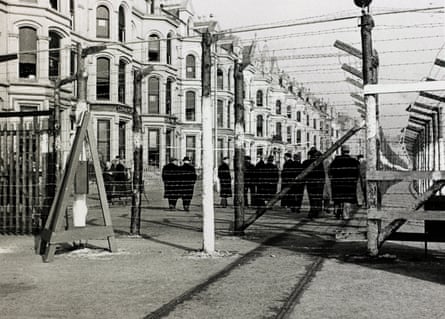
(British internment camp on the Isle of Man)
Parkin correctly points out that internment brought lingering desperation and gloom, but it also brought the creative inspiration as a vehicle for survival as the men put their substantial musical, literary, and artistic talents to use. Parkin describes concerts, classes of all types – academic to vocational, inventions, and other areas of prisoner expertise in great detail, a creative Hutchinson University. What emerges is a communal type of living where talented people mostly share their expertise with each other to make their situation tolerable.
Parkin focusses on a number of important characters throughout the book. Michael Covin, a former British journalist who survived the sinking of the refugee ship SS Arandora Star by a Nazi submarine to become a chronicler of what brought men to the camp and life under incarceration. Klaus Ernst Hinrichsen, an art historian whose writing and commentary serves as an important source for the author. Kurt Schwitters, poet and artist who served as a mentor for Peter. Bertha Bracey, a Quaker who led a refugee organization working to gain asylum for children from Germany and securing the release of those incarcerated. Ludwig Warschauer, the subject of a fascinating chapter as MI5 refused to allow his release as they correctly identified a German spy within their midst. His wife, Echen Kohsen, an heiress who had cared for Peter in Germany will finally leave him when the truth comes out. Parkin discusses many other talented prisoners and the effect prison life had on them emotionally and professionally.
Once the pressure on the Home Office grew and grew the government decided on a convoluted release policy which was almost as incompetent as their initial internment program. Parkin describes hearings and judgements which made no sense, and of course Churchill did little to circumvent it. For many like Peter the government offered release in return for joining the military. Many agreed, and many refused to be blackmailed. As many talented and influential people were released by 1941, Peter and hundreds of others remained interred.
 |
Parkin includes a final chapter in which he describes what occurred to people after release. Finally, Peter will be accepted to an art school because of recommendations by camp artists and the work of refugee organizations. This had been his life’s wish and finally he acquired people he could rely on and trust.
For the most part, Simon Parkin’s account is a riveting one reflecting a shameful chapter in British history which is also a testament to creativity and hope. At times the author gets bogged down in the details of his subjects and it would have been interesting to compare women’s internment camps, which he mentions in passing in more detail. But overall, a useful account of a forgotten category of a brutal British policy.
 Doc's Books