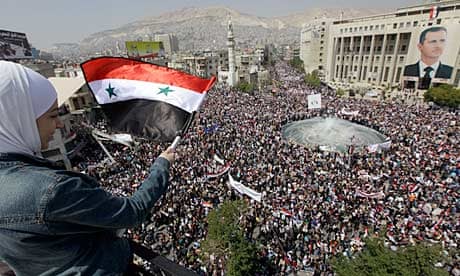
(Syrian pro-government demonstrators gather in a central square in Damascus to show their support for Bashar al-Assad’s rule)
At the time of this writing the Middle East is on the precipice of a wider war resulting from the blood stained conflict that exists in the Gaza Strip where retribution and vengeance dominates. Last week, the Palestinian terrorist group Hamas unleashed a horror laden attack on Israel and the Netanyahu government responded in kind. The result has been the utter destruction of the Gazan infrastructure, another example of how Hamas uses the Palestinian people as pawns in their war against Israel causing the deaths of thousands of their co-religionists and the maiming of others. Hamas claims to be the defender of the Palestinian people, but their modus operandi does not match their rhetoric.
The current fighting mirrors the bloody civil war that occurred in Syria as opposition forces spurred on by the Arab Spring in 2011 tried to overthrow the repressive regime of Bashir Assad who used every weapon including chemical weapons and Russian barrel bombs to cling to power. The conflict spawned a number of different radical Islamic groups that sought his overthrow including the Islamic State (ISIS). The civil war that resulted brought in Russian and American troops and produced the deaths of thousands of Syrian casualties and millions of refugees dispersed to Turkey, Jordan, and other countries. Events from the early years of the Syrian Civil War form the backdrop of David McCloskey, a former Middle East CIA operative’s first novel, DAMASCUS STATION.
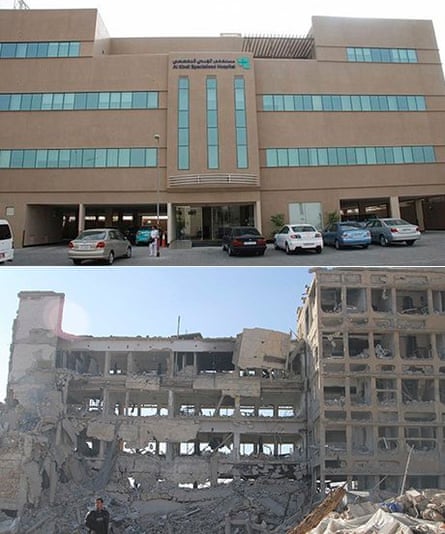
(al-Kindi hospital, Aleppo. Above in 2012 and below in 2013)
According to the author, the novel is a work of fiction that takes its inspiration from actual events that took place between 2011 and 2013 that evolved into a long drawn out civil war as insurgents buoyed by the Arab Spring sought to remove the Assad Dynasty that had ruled Syria for over five decades.
We immediately meet Sam Joseph, a CIA officer who is in Damascus to assist in the exfiltration of an asset from Syria. KOMODO, a mid-level scientist at the complex responsible for Assad’s chemical weapons program, and her handler Val Owens are trying to navigate Damascus and its environs between Assad and rebel forces. Unfortunately, Owens will be murdered by Syrian security forces changing the flow of the novel as the CIA, in particular, Sam Joseph, wants revenge. The novel coalesces around Joseph as he has three main goals. First, exact revenge against Ali Hassan who killed Owens. Second, recruit an asset in the Syrian national security structure named Mariam Haddad. Lastly, locate the sarin gas that the Assad government has moved in order to go beyond President Obama’s red line.
McCloskey has authored a remarkable novel as he navigates the intelligence community. His approach is one of realism as he integrates aspects of the spy culture throughout. The reader will become fascinated as McCloskey’s characters model actual CIA training, techniques, op preparation, and mission implementation. We are instructed about dead drops, surveillance, technology, and plain human intelligence. We are also introduced to a series of important characters such as Rustum Hassan, the leader of the Syrian Revolutionary Guard who has no compunction about killing, including thousands of victims in the Syrian Civil War. Ali Hassan, Rustum’s younger brother who he hates is in conflict over their place in Bashar al-Assad governmental hierarchy. Bouthaina Najjar, an advisor to Assad, and Rustum’s lover. Basil Mahkluf, in charge of the Revolutionary Guard’s missile and rocket program. Jamil Atiyah, an Assad henchman, a pedophile with profound influence. Sam Joseph, the CIA operative who makes the cardinal error by falling in love with an asset. The BANDITOS, Rami, Yusuf and Elias, the Kassab triplets who run surveillance for Joseph. Artemis Aphrodite Proctor, the saucy Damascus station chief. Ed Bradley, who oversaw Syrian operations from the Directorate of Operations. Mariam Haddad, a midlevel analyst who is recruited by Joseph and flips. Abu Qasim, rebel leader and bomb maker and his wife Sarya, a sniper with 142 kills. Lastly, General Volkov sent by Moscow to assist the Syrians in rooting out CIA spies in Damascus.
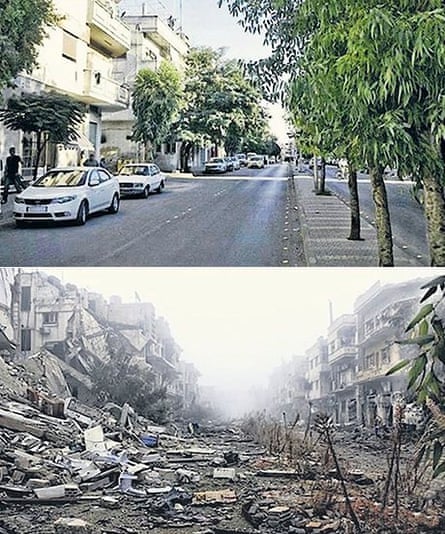
(A street in Homs, in 2011 (above) and 2014)
McCloskey develops his characters very carefully. He describes what led Abu Qasim to turn against the Assad regime and the issues and players involved in the bloody carnage of the Syrian Civil War. The author takes a deep dive into the Syrian regime, how it operated and how an individual went about surviving the internal paranoia of serving in Assad’s government. McCloskey takes the reader inside the Syrian Mukhabarat, the secret police whose who employ torture, beatings, coercing family members etc. to achieve their aims.
Sarin gas plays a key role in the story. Once its location is discovered and moved Joseph must locate the new site at the same time the Mukhabarat is after him. McCloskey describes how the gas is developed, produced, and weaponized for a trial attack against a Syrian rebel village and getting it ready for a larger statement against rebel forces. McCloskey also explores the American process in fighting the Syrian forces highlighting President Obama’s approach to the Civil War.
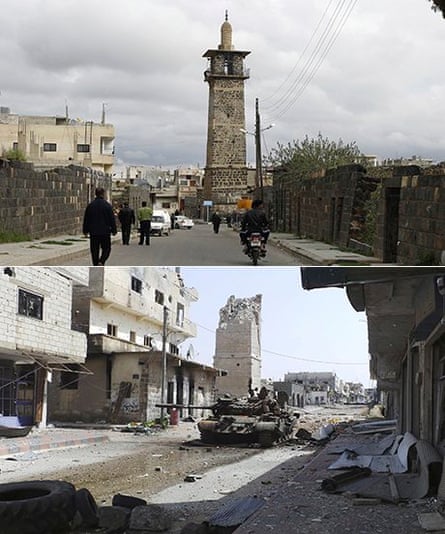
(Omari mosque in Deraa. Above in 2011 and below in 2013)
The author’s expertise is on full display as he describes Joseph’s thought process while being surveilled. Joseph analyzes his own undertaking relative to the Russian/Syrian team that watched his every movement as he prolonged the chase for hours as he was trained. For Joseph, “he could sense the hunters out there,” during this cat and mouse game – except it was no game.
Joseph’s relationship with Mariam is complex as she felt guilty about what happened to her anti-Assad cousin Razan, her betrayal of Joseph, and killing three Mukhabarat. McCloskey tries to make his characters feel like any one of us, but in reality they are tasked to serve and protect the United States and help US policymakers understand the region and the implications of certain events.
Overall, it is an authentic spy thriller set in the tumultuous Middle East that should keep the reader on the edge of their seats. Former CIA Directors Leon Panetta and David Petraeus praise the “realistic portrayal of CIA operations overseas” and that is good enough for me.

(Supporters of President Bashar al-Assad carried his portrait during a demonstration in Damascus on Monday, the day after the Arab League imposed sanctions)
 Doc's Books