

In the spring of 1994 Howie Rose’s call of Stephane Matteau’s game winning goal against the New Jersey Devils sent the New York Rangers to the finals for the Stanley Cup. This would end the Blueshirts 54 year drought and was music to every tortured Ranger fan’s ears. The season and playoff run were magical, but it would lead to another drought now reaching three decades. For Ranger fans who lost the finals to the Los Angeles Kings in 2014, it has been a rough go, but the history of the organization has improved over the last few seasons, and many believe or hope that this could be the year that the Rangers hoist the Cup once again.
Rick Carpiniello, a sports reporter for THE JOURNAL and THE ATHLETIC from 1978 to 2021 new book THE FRANCHISE: NEW YORK RANGERS. A CURATED HISTORY OF THE BLUESHIRTS brings hockey to the forefront through a series of wonderfully reported essays about the organization’s championship close calls throughout the 1970s, finally winning the Cup in 1994, and its decline until the emergence of Henrik Lundqvist as the team’s goalie in 2012, Carpiniello’s monograph is based on intimate knowledge of the franchise forged through extensive relations with the players, coaches, and other members of the organization.
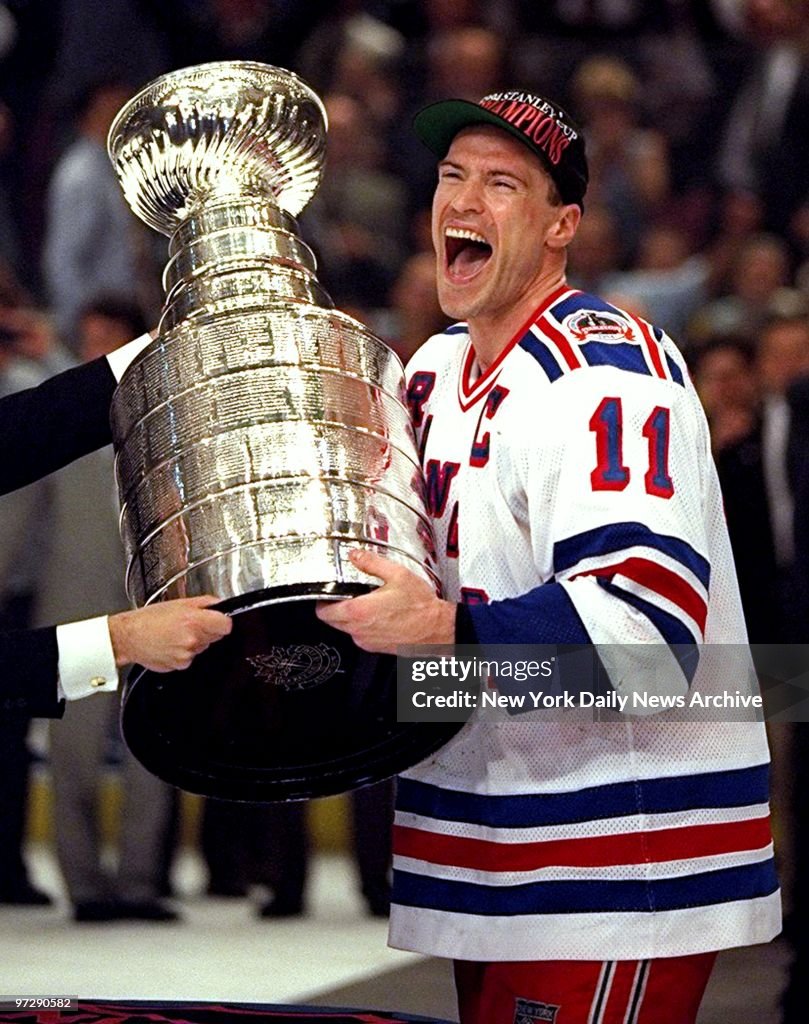
(1993-94 season the New York Rangers win the Stanley Cup)
Perhaps the most interesting aspects of Carpiniello’s book are his character studies ranging from Rangers General Manager and Coach Fred Shero, flamboyant winger, Ron Duguay to current players like Norris Trophy Winger Adam Fox and Chris Kreider. In each instance Carpiniello reaches for entertaining quotes, player opinions of different teams and players, team bonding, and the outrageous actions of different personalities.
Carpiniello begins with the famous 1978-9 season tease when it appeared the Rangers might finally break the curse that dated to 1940. They had defeated the dreaded New York Islanders in a series that created the chant Ranger fans employ to this day of “Potvin sucks.” However, despite defeating the Montreal Canadiens in the first game of the Stanley Cup finals, they went on to lose four straight providing Les Canadiens their fourth consecutive finals victory.
The author is right on as he describes the “disorganization of the organization” in the 1980s. Ownership had opportunities to trade for Wayne Gretzky and Mark Messier much earlier than they finally did and refused. They hired a series of general managers and coaches who either did not fit the profile of their jobs and made decisions which in many cases are hard to fathom. Herb Brooks, the 1980 Olympic coach was a failure, Ted Sator was in over his head, Michel Bergeron was a bust, and Hall of Famer Phil Esposito, also known as “trader Phil,” made a series of poor trades and his record as a coach was not much better. The key person was Craig Patrick who was a GM and coach but was gone by the late 1980s but drafted the likes of Brian Leetch and Mike Richter. The savior of the 1980s was John Vanbiesbrouck, an excellent goalie who was in large part responsible for the few Ranger successes during the decade.

(Ranger defenseman Brian Leetch)
Carpiniello has a knack in developing stories about some interesting/flamboyant characters in his narrative. Names like Tie Domi, Joey Kocur, Ulf Samuelsson, perhaps the dirtiest player in hockey at the time, and Jeff Beukeboom come to mind. All were fighters, who had talented upside. Other key personalities that the author weaves in and out of this monograph are Neil Smith, the GM who traded for Mark Messier and signed free agent Sadam Graves. Smith would put together the team that finally won the cup under Mike Kennan’s leadership. Kennan became head coach, when then coach Roger Neilson, another interesting personality could not get along with Messier and was fired.

(Ranger wing Adam Graves)
Carpiniello brings back many forgotten memories. A few that stand out include the switch in approach under Craig Patrick in the early 1980s from a mean fighting mentality to a skilled group of young players who were not large in stature nicknamed “the Smurfs.” Another important individual was Mike Kennan, a hard ass, controversial coach who upon arriving at MSG felt the Rangers were a soft team. Kennan immediately pushed to trade certain “soft” players who would go on to have tremendous careers with other teams. Names like Mike Gartner, Tony Almonte, Darren Turcotte, and James Patrick come to mind. No matter how much talent Kennan forced Smith to get rid of for second line players, in the end he molded the team by blending their talent and finally ending the “1940 chorus.” Despite his success, Kennan was seen as a “bastard” held beyond contempt by many in the Ranger organization. But, one must keep in mind it was Kennan who pushed Smith to acquire grinders like Matteau, Brian Noonan, and a bunch of Edmonton Oiler Stanley Cup champions.
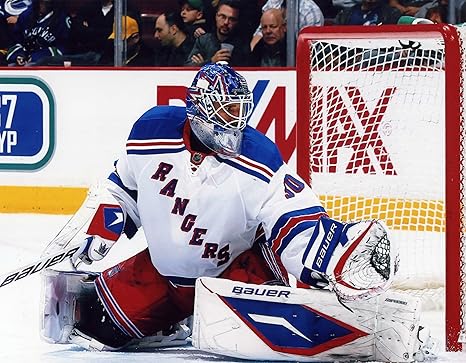
- (Ranger goalie”King” Henrik Lundquist)
The book recounts the magical playoff run that culminated in winning the cup with wonderful anecdotes and player stories. I remember exactly where I was the night they won and as many others have said “I can now die in peace!” However, it was a short dynasty as a new curse and/or drought began the next season which carries on to this day. To Carpiniello’s credit is description of the players, their talent and foibles for the next three decades is remarkable, and all I can say is god bless his memory!
The post-Cup period saw the arrival of Wayne Gretzky, but at the same time they let Messier go. Carpiniello is correct in describing the Ranger’s biggest problem as management as MSG president Dave Checketts who was in charge of the Knicks and Rangers knew nothing about hockey and it showed in his decision making.
Carpiniello digs deep into the second drought and the role of Glen Sather as GM and coach. Sather who built the Edmonton Oilers would eventually be successful with the Rangers, but not until he finally made the correct draft and trade decisions, particularly a 7th round pick named Henrik Lundqvist who would backstop the team in goal for well over a decade beginning in the 2004-05 season. During this period fascinating new characters came on the scene, particularly emblematic is Carpiniello’s description of John Tortorella, which is priceless. The turnaround for the Rangers came in 2010-11 and from then on they were a sound playoff team which flirted with a cup run in 2013-14.
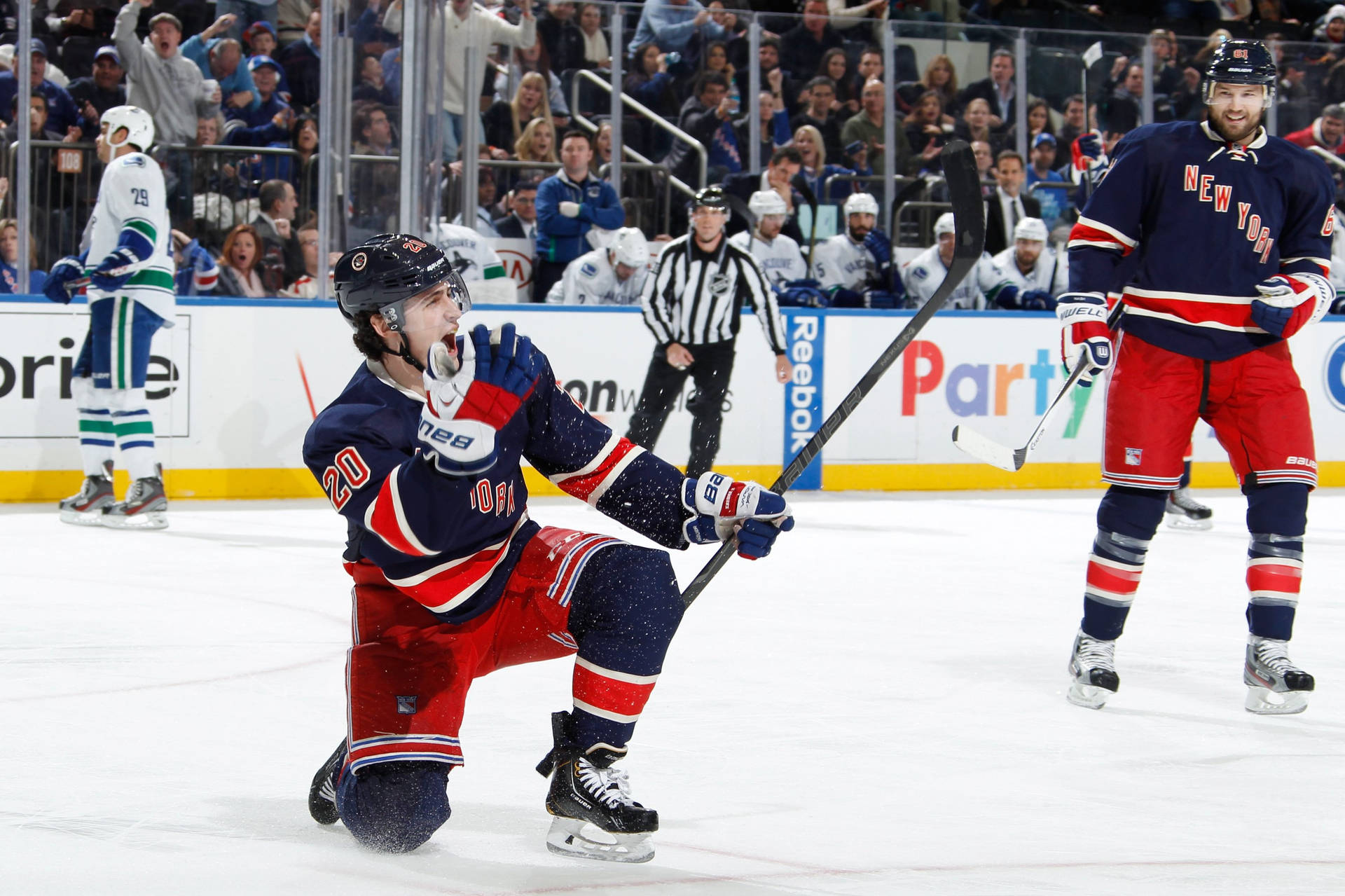
(Ranger wing Chris Kreider)
At times, the author becomes emotional about certain players and events. Perhaps the most poignant coverage deals with 9/11 and the reaction of the players and how they interacted with first responders and New Yorkers in general. This aspect of the book reflects the wonderful working relationship that the author had with Ranger players.
In the latter part of the book Carpiniello zeroes in on two of the most important and creative approaches taken by the Ranger front office that coincided with a decline in the career of Henrik Lundquist. After a successful run from the 2008-09 season to the 2013-14 Cup final season the team went through its famous rebuild underscored by “the letter” to fans explaining the course the organization was about to take. New leadership came aboard that included John Davidson as President, Jeff Gorton as GM, and David Quinn as coach. Through a series of trades, i.e., acquiring Jacob Trouba, Ryan Lindgren, Mika Zibanejad, and Adam Fox; signing free agents, i.e., Artemi Panarin; resigning Chris Kreider, and significant draft choices like K’Andre Miller and Igor Shesterkin the foundation was set for the current Ranger Roster. When the rebuild did not progress as fast as he wanted, the impulsive Ranger owner, Dolan fired the three men who was responsible for the rebuild in large part to the machinations and violence perpetrated by Washington Capitals Tom Wilson, and brought in an entire new leadership team.

(Ranger wing Artemi Panarin, “the breadman!”
Overall, the book is a wonderful stroll down memory lane for Ranger fans with Carpiniello integrating wonderful vignettes, personal insights and observations which reflect a sense of humor, vast hockey knowledge, and a writing style that is easy to read. If there is one negative in Carpiniello’s approach, at times his narrative comes across as somewhat disjointed as many of his stories and observations lack cohesiveness. However, despite this minor criticism, the book is a wonderful gift for all Ranger fans.




 Doc's Books