THE SHOWMAN: THE INSIDE STORY OF THE INVASION THAT SHOOK THE WORLD AND MADE A LEADER OUT OF VOLODYMYR ZELENSKY by Simon Shuster

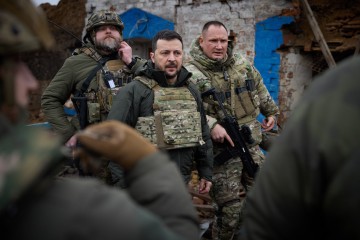
Working trip of the President of Ukraine to Zaporizhzhia, Dnipropetrovsk, Kirovohrad and Cherkasy regions

(Ukrainian President Zelensky visting troops at the front)

As the war grinds on in Ukraine, Speaker of the House Mike Johnson remains adamant that he will not bring to the House floor for a vote a bi-partisan bill negotiated by Democratic and Republican senators that would provide aid to Ukraine, Israel, Taiwan, and funds to deal with the crisis at our southern border.  It seems that Donald Trump has instructed the Speaker on how to proceed with the legislation because if it passed it would provide President Biden a political victory during our election season.  The fact that Ukraine is slowly running out of munitions and weapons has no impact on the MAGA world as its goal is to re-elect former President Trump and the consequences be damned.  Vladimir Putin sits in the Kremlin with that cheshire smile on his face laughing on the inside as he observes the political chaos in Congress and believes that anything that would return Trump to the White House would benefit Russia.  The result is that he will drag the war of attrition out further in the hope of achieving that goal. 

Meanwhile, frustration in Kyiv, NATO headquarters, European capitals, and Washington is reaching new heights as the Biden administration tries to cull a deal.  The man responsible for leading the Ukrainian people, President Volodymyr Zelensky tries his best to convince House and Senate members of the crisis that will ensue in Europe and the threats it will create should Russia prevail.  Zelensky is the key figure in the process and is the subject of Time magazine correspondent Simon Shuster’s new book THE SHOWMAN: THE INSIDE STORY OF THE INVASION THAT SHOOK THE WORLD AND MADE A LEADER OUT OF VOLODYMYR ZELENSKY which provides in intimate detail the story of Zelensky’s evolution from a professional comedian to a symbol of Ukrainian resistance to the Russian invasion of February 24, 2022 and how he has tried to rally western democracies to support his cause and bring about Russia’s defeat in Crimea and eastern Ukraine.
There are a number of important books concerning Russia’s invasion of Ukraine and Ukrainian history.  Most recent are those by Yaroslav Hrytsak, Serhii Plokhy, Owen Matthews, Joshua Yaffa, Paul D’Anieri, Christopher M. Smith, Jade McGlynn, Luke Harding, and Christopher Miller.  All are excellent monographs, but Shuster’s biography brings the life and actions of President Zelensky into greater focus than other authors.

Shuster offers an unparalleled look at what Zelensky, his wife Olena Zelenskaya, his two children, and the Ukrainian people experienced as the war drew closer, and the actual invasion and its consequences.  Shuster zeroes in on Zelinsky’s decision making, tactics to try and invigorate and reassure the Ukrainian people, and the impact of the strategic approach taken by the Ukrainian military leadership.  All aspects of the war are explored with many insights and airtight analysis.

Shuster does well in describing Zelensky’s rise from being an entertainer to a successful politician.  Among the important points he makes focuses on the characteristics and talents of the comedic world and the entertainment business that Zelinsky developed over the years and how he employed them in his transition to politics.  Many of the individuals who worked with him in his production company would find themselves as part of his “inner governing circle” once he assumed the presidency of Ukraine.

Local resident hugs a Ukrainian servicewoman after Russia's retreat from Kherson, in central Kherson

(The liberation of Kherson from Russian troops)

There are a number of interesting points that Shuster offers in dealing with Zelensky’s approach to Putin, the preparation of the domestic population for war, and the outbreak of war itself.  For a long time Zelensky was under the delusion that he could deal with Putin on a one to one basis.  He believed once he sat down with him he could rely on his personal persuasive talents to come to agreements with the former KGB operative.  This reflects Zelensky’s naivete when it came to Putin.  I am certain that Zelinsky was completely aware of Putin’s Pan Slavic beliefs, his mantra that Ukraine was part of Russia, not a separate country, and a modus operandi employing “little green men” in eastern Ukraine, Crimea.  Zelensky did get his face to face with Putin and negotiations in 2019 which in the end were a failure.  Prisoner swaps were agreed to but on issues of substance dating back to the Orange Revolution of 2014 there was no progress.  Putin was inflexible, arguing there were no Russian troops in the Donbas region so Zelinsky’s goal of Russian troop withdrawal before any elections could take place was a non-starter.

Zelensky firmly believed that war could be avoided and did his best to prevent a furtherance of a conflict that began in 2014.  He refused to accept American intelligence that the war was imminent.  He was overly careful in making war preparations fearing he would scare the Ukrainian people, would harm the domestic economy as Ukraine was dependent upon Russia for gas and oil and a significant amount of investment would be lost, and lastly, it would send the wrong message to Putin fostering an invasion.  Nationalists in the Ukrainian parliament opposed Zelensky’s stance arguing he was selling out to the Russians.

Ukrainian President Attends Wreath-Laying Ceremony At Tomb Of Unknown Soldier

(Ukraine’s First Lady Olena Zelenskaya)

Shuster is correct in that Putin was a spy who believed in subterfuge as opposed to direct combat.  A prime example is Putin’s relationship with Viktor Medvedchuk, a Ukrainian media billionaire who was Zelensky’s main political opponent.  Medvedchuk’s relationship went back decades with Putin attending his wedding and was the godfather to his daughter.  In reality Medvedchuk, a member of parliament, was Putin’s surrogate whose media empire attacked Zelensky repeatedly, particularly over his Covid vaccine policies as Putin’s “Trojan Horse.”  As Zelensky’s popularity declined in 2019 and 2020 and Medvedchuk’s political party made gains in parliament, Putin came to believe that he could achieve his takeover of Ukraine by democratic means once his surrogate replaced Zelensky.  This was not to be as Zelensky confiscated Medvedchuk’s assets which Shuster argues pushed Putin toward invasion and restore what he termed the “historical unity” between Russia and Ukraine.

Many wonder why Ukraine was able to push back the invasion within a few weeks.  The key was the battle for Kyiv which was the most significant combat in Europe since World War II.  Others have reflected on the idea that Russia relied on maps that dated to 1989, the fact that troops and certain commanders did not receive their orders until two days before the invasion, the Russian military did not train enough for the type of resistance it came upon, etc.  But the keys as Shuster points out were the purchase of Bayraktars drones from Turkey which were successful against the long Russian columns of tanks, artillery, and other equipment and supplies.  The appointment of Major-General Valery Zaluzhny as commander of Ukrainian forces as unlike senior Ukrainian officers he was not trained in the Soviet model of warfare, and he implemented a more offensive approach toward the Russians in the east.  Now they could fire back, something they had been restrained from doing before Zaluzhny took command.  Lastly, American satellite intelligence proved a boon to Ukrainian defense and offensive actions.

Valentyna Nechyporenko, 77, mourns at the grave of her 47-year-old son Ruslan, during his funeral at the cemetery in Bucha, on the outskirts of Kyiv, Monday, April 18, 2022. Ruslan was killed by Russian army on March 17 while delivering humanitarian aid to his neighbours in the streets of Bucha.

(Results of Russian atrocities in Bucha)

Shuster describes the atrocities of Bucha in intimate detail, the key battle for Mariupol, the siege at the Azovstal Steel works and the fighting in Kyiv suburbs.  He describes a leader  who seemed to find himself and employ his communication talents once the invasion began.  He kept pushing for American and European weaponry which in large part was successful as the war ground on.  One of the key elements for war on Putin’s part was the weakening of NATO and blocking Ukrainian membership in the alliance.  Putin’s goals backfired as Ukrainian military needs were met by the west.  Kyiv gave up old Soviet military weapons and systems and integrated NATO equipment into its military arsenal. The more weapons that arrived and with the training of Ukrainian forces by NATO, more and more they became a western force.  Further, to Putin’s anger, Finland and Sweden joined NATO increasing NATO’s presence on its 900 mile border with Finland.  Putin’s response was vindictive bombing of civilians and threats of nuclear war.

(Ukrainian President Volodymyr Zelensky (L) and Russian President Vladimir Putin (R) arrive to attend a meeting on Ukraine with French President and German Chancelor at the Elysee Palace, on December 9, 2019 in Paris. – Russian president will for the first time hold formal talks with his Ukrainian counterpart over the conflict in Ukraine’s east, at a much-anticipated summit in Paris)

FRANCE-RUSSIA-GERMANY-UKRAINE-POLITICS-CONFLICT-DIPLOMACY

(Ukrainian President Volodymyr Zelensky (L) and Russian President Vladimir Putin (R) arrive to attend a meeting on Ukraine with French President and German Chancelor at the Elysee Palace, on December 9, 2019 in Paris. – Russian president will for the first time hold formal talks with his Ukrainian counterpart over the conflict in Ukraine’s east, at a much-anticipated summit in Paris)

Shuster has not produced a work of hagiography as is seen by his commentary on prewar policies and digs around the corrupt oligarchs in Zelensky’s orbit.  Despite this THE SHOWMAN is a portrait of a brave, inspirational, and bold leader who did not shy away from danger, visiting troops and combat areas to share in some way what his people were experiencing. Shuster, who has been reporting from Kyiv since 2009, relies a great deal on interviews with the most important players in the Ukrainian drama.  He would interview Zelensky in 2019 as a presidential candidate and was able to become part of his inner circle and shadow him for the first year of the war.  He points to Zelensky’s limited experience as a statesman who was able to gain the trust and support from the West employing “incessant repetition” of his demands through rhetoric, his personality, and commitment to his cause.  Zelensky did resort to highhandedness at times which Shuster blames on the exigency of war, not any drive toward autocracy.

Zelensky’s transformation into a wartime leader was not predictable and he evolved  turning the conflict into one the West would take ownership of.  The problem is that as the war continues it seems the West might be losing interest, or “Ukraine fatigue,” as the Republican Congress threatens further military aid, and Donald Trump may appear on the horizon as President which would play into Putin’s hands.  This fear was reaffirmed this weakened at a Trump political rally as the ex-president pontificated on NATO warning members that if they didn’t pay enough dues he would not honor Article Five of the NATO charter.  He further stated that if that were the case he would encourage Putin to do “as he damned well pleased” and even encouraged the Russian autocrat to invade westward.  In the interim the conflict is pretty much frozen on the battlefield as both sides fight for limited territory.  The problem is should Ukraine run out of certain weapons by spring it could lead to negotiations where Putin achieves most of his demands or obtains out and out military victory and the end of a free Ukraine.
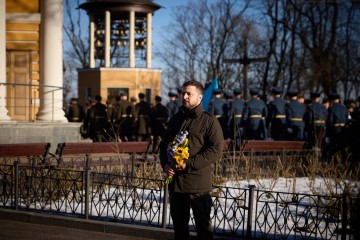
President honored the memory of the Kruty Heroes

COLD CREMATORIUM: REPORTING FROM THE LAND OF AUSCHWITZ by Josef Debreczeni

(Rail line leading into Auschwitz)

At a time when anti-Semitism is on the rise worldwide, supposedly due to the war in Gaza, which is erroneous as the phenomenon was increasing long before Hamas’ brutal attack on October 7th.  At the same time, we recognize Holocaust Remembrance day which commemorates  the annihilation of Jews during World War II.  It is fitting that at this time Josef Debreczeni’s memoir of his time in “the land of Auschwitz,” COLD CREMATORIUM: REPORTING FROM THE LAND OF AUSCHWITZ has been rereleased.

Originally published in 1950 it was never translated because of the rise of McCarthyism which rejected any pro-Soviet literature; Cold War hostilities as Stalinists refused to accept the Jews as “victims of fascism” singled out for extinction; and the rise of anti-Semitism in Eastern Europe.  However, its appearance has made an important contribution to the great works of Holocaust literature as its author points out many things that have either been forgotten or overlooked.

Jonathan Freedland writes in the Forward to the book, referring to Debreczeni as a “witness, survivor, victim, and also an analyst, offering ruminations on some of the enduring questions raised by the Holocaust among them the puzzle of how arguably the most cultured nation in Europe could have led the continent’s descent into the most brutal savagery.”  Other vital insights provided by Debreczeni include a reminder that the victims of Nazi brutality did not know their imminent fate, a crucial fact in trying to comprehend how the Final Solution was possible, and that so many others certainly did.  Debreczeni reminds us that the Holocaust may have been developed in Berlin, it relied on accomplices throughout Europe – from liberal France to anti-Semitic Poland.  Many of these individuals may have suffered from “willful blindness,” as they would later deny seeing or participating in atrocities.  The author’s account of the actions perpetrated by Kapos, many of which were Jews is disturbing and for most beyond the capacity to imagine.  In a diabolical Nazi system “the best slave driver is a slave accorded a privileged position” is an accurate and scary proposition.

(They came with the things most valuable to them unaware that everything would be taken including many of their lives)

For Debreczeni many chroniclers of the Shoah do not emphasize the economic function of Auschwitz enough.  The author describes the German corporations involved to the point that many victims would have company names printed on their striped pajama type uniforms.  The brutal conditions that victims faced were laid bare.  The illicit trade between prisoners, kitchen workers, guards is ever prevalent – a life for people denied the fundamentals needed for survival – to eat, drink, bathe are all missing with disease and lice everywhere caused by a total lack of sanitation.  People were treated like animals, and for a chance at survival the same people morphed into animalistic behavior as they completely lost their identity, self-respect, and will to love.  The end result is a slow descent into madness and suicide for many who Debreczeni comes in contact with.  For those who deny the Holocaust this memoir is a stark response.

Debreczeni has written a haunting memoir, conveyed in the precise and unsentimental style of a professional journalist whose eyewitness account is of unmatched literary quality.  The author’s writing is evocative, employing irony, sarcasm, and an acerbic humor as he prods the reader into the “the Land of Auschwitz,” a place that is intellectually incomprehensible.  What sets the book apart is the reporting that the German guards were largely absent or stayed in the background.  Instead, it is the prisoners themselves who rule over each other depending on their status which forms a window into the complex organization of the camps.

The memoir begins in January 1944 with a prisoner transport where victims are oblivious as to their location and what the immediate future might bring, ending with liberation by Soviet forces in early May 1945.  Debreczeni provides precise details of who certain prisoners were and what they experienced.  For example, Mr. Mandel, a carpenter who always had a cigarette in his hand, but once they were taken away he still raises his empty fingers to his lips – he will be the first to die on the transport or the TB riddled Frenchman, a lower level Kapo in Auschwitz who developed a semblance of humanity as he warned prisoners as to what was about to happen to them.  Debreczeni holds nothing back in describing how people of varying backgrounds cooperated with the Nazis, including Jews.  A prime example is Weisz, a low brow salesclerk from Hungary, “a low-life Jew” who wielded a truncheon.  He was “power crazed, malicious, a wild beast,” who was the epitome of the Nazi system that “the best slave driver is a slave accorded a privileged position.”  Most of these types of slave drivers came from the “lower rungs” of Jewish society before the war.  Those who came from the highest levels of Jewish society were found to be helpless in the Nazi camp hierarchy.  Another is Herman, an SS guard who had been a bartender before the war and was one of the few guards who exhibited a degree of empathy as opposed to his murderous compatriots as he would drop a half smoked cigarette to the ground for a prisoner to find.   A typical power hungry individual was Sanyi Roth, a room commander for tent #28, a notorious repeat offender, serial burglar who was put in charge of the worst tent which housed murderers, robbers, and other “creatures.”  Interestingly, after Debreczeni flatters him he begins to take him under his wing.  Perhaps the most despicable person was Moric, the foremost Kapo of all camps, whose nickname was the Fuhrer of the death camps – the sole Jew who held as much power as Nazi officials.  Another individual who stands out, but in a positive fashion is Dr. Farkas, a Jewish physician who was forced to cooperate with the SS.  But at the same time was able to display compassion and medical knowledge to treat many inmates.  In fact, without his care Debreczeni would not have survived.

(The bunks at Auschwitz II-Birkenau)

The author provides an understanding of the evil the Nazis perpetrated aside from annihilation.  He describes the genius of those who developed the Final Solution.  To achieve mass death a killing infrastructure needed to be created.  A key aspect of which was the hierarchy of power which the Nazis implemented providing certain prisoners a key role in the genocide.  The Germans kept themselves invisible behind the barbed wire as “the allocation of food, the discipline, the direct supervision of work, and the first degree of terror – in sum, executive power – were in fact entrusted to slave drivers chosen randomly from among the deportees.”   For their hideous work they received certain benefits including more food, clothing, the opportunity to steal, and power over their fellow prisoners – power over life and death, which for many was intoxicating.  They all played a role in the vertical structure that resembled a military command where each person from the highest to the lowest Kapo knew their job and what would happen to them if they didn’t carry it out.  This structure also was apparent in camp hospitals like Dornhau where Doctors, medics, nurses, and other workers had specific roles in the Nazi hierarchy.

Debreczeni offers an exceptional description of the “Land of Auschwitz” which consisted of many sub-camps in addition to the more famous areas like Birkenau or lesser labor camps like Furstenstein which the author experienced personally which was typical of other work camps who held the same characteristics.  This area consisted of a castle complex which the Nazis destroyed in order to create an underground complex for a new headquarters for Hitler, should retreat be necessary and an arms factory on the site.

German corporations do not escape Debreczeni’s withering description as they paid the Nazi regime to rent slave labor and profited immensely.  Many books have been written about this subject.  For a complete list one can be found at https://www.jewishvirtuallibrary.org/german-firms-that-used-slave-labor-during-nazi-era#google_vignette.  In Debreczeni’s case it was Sanger and Laninger who enslaved him as a tunnel digger.

There are many other elements that the author describes from the use of cigarettes as a medium of exchange which became its own underground industry.  Another medium of exchange was extracted gold crowns which many inmates did themselves to trade for food – the going rate was one crown for a weeks’ worth of soup.  The concept of the “will to live” is explored in detail with harrowing examples.  For the author, the will grew and like others he was willing to steal, fake jobs, and other strategies as a means of survival.  Debreczeni’s commentary concerning prisoner roundups is very disconcerting as prisoners were asked to volunteer for certain jobs and transport.  Many prisoners were willing to play Russian roulette to survive, most who did died, but a few would escape.

Each chapter seems more disturbing than the next and ranking the most horrifying material presented is very difficult.  Perhaps the chapters that stand out are those involving the Dornhau camp hospital which describes the Nazi approach to medical care and its sadistic treatment techniques carried out by most medical professionals.  It is this hospital that the term “cold crematorium” refers to.  Debreczeni’s recounting of the plight of his bunkmates is indescribable especially as typhus became rampant.

As Menachem Kaiser writes in his New York Times review, “How To Talk About Auschwitz,” “Debreczeni recounts his deportation to Auschwitz, and from there to a series of camps. This isn’t the sort of book you can get a sense of from a plot outline. Debreczeni suffers; he survives (or, more accurately, he does not die); he observes. His powers of observation are extraordinary. Everything he encounters in what he calls the Land of Auschwitz — the work sites, the barracks, the bodies, the corpses, the hunger, the roll call, the labor, the insanity, the fear, the despair, the strangeness, the hope, the cruelty — is captured in terrifyingly sharp detail.”

In conclusion, Debreczeni has written haunting conformation of the terror of that was the Holocaust, and the will to survive.

(Entrance to Auschwitz I)