MY BELOVED MONSTER: MASHA, THE HALF-WILD RESCUE CAT WHO RESCUED ME by Caleb Carr

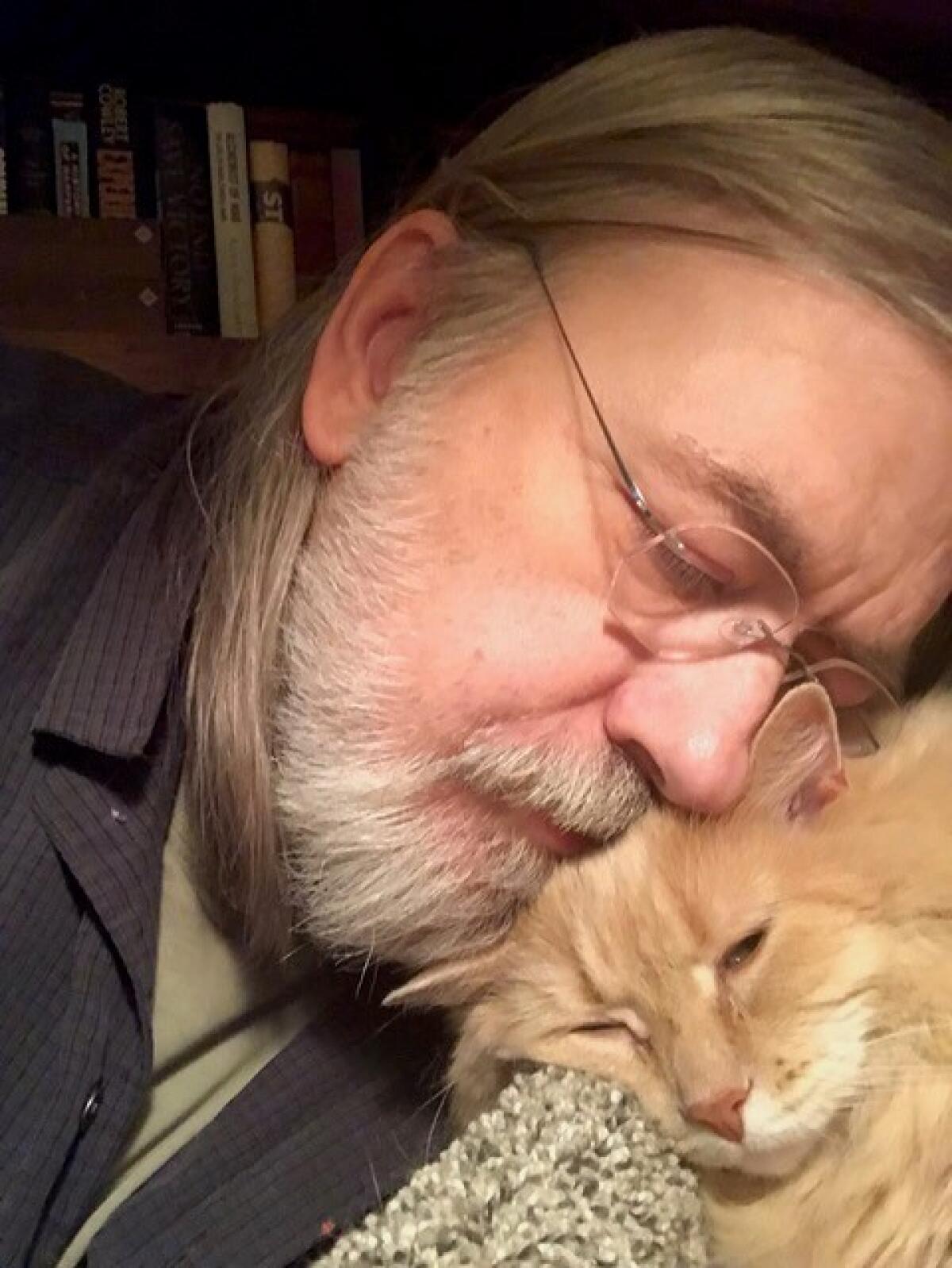
Caleb Carr, with glasses and a white beard, nestles his face on his cat's head.

(Caleb Carr considered his late cat Masha, the subject of his new book, the love of his life.)

Over the years I have enjoyed Caleb Carr’s historical fiction immensely.  THE ALIENIST, THE ANGEL OF DARKNESS, and SURRENDER  reflect his commitment to his craft integrating an accurate approach to history and exceptional character development.  His latest book is a total change from what he has written previously.  MY BELOVED MONSTER: MASHA, THE HALF-WILD RESCUE CAT WHO RESCUED ME maintains his superb writing and as far as character development it continues in his latest work, this time with a feline.  Being a cat lover myself, having had deep relations with the feline species over the years, including KC who was with me and my family for over nineteen years, and our current duo of Kota and Shelby who we rescued over ten years ago, I greatly enjoyed Carr’s dual biography of Masha and Caleb.  I have learned a great deal about Carr’s life and views on society, which makes his historical novels more interesting.  But, from a cat person’s viewpoint I learned a great deal about felines through Masha’s life story, both about Masha and my own cats.

Carr’s recounting of his relationship with Masha is presented on a number of levels.  First, it provides insights into how humans and felines bonded.  I can relate to a great deal of what Carr recounts, but he adds a dimension I have never thought off – how a cat’s neurological, heredity, and species development impacts their choice of whom to bond with and try to manipulate.  Second, if you are a cat person you realize early on that they control you, not the other way around.  As Carr explains they are able to get you to do what they want easily, but once you gain their trust you can impact their behavior as opposed to controlling it.  Third, Carr’s ability to decode much of Masha’s inner world.

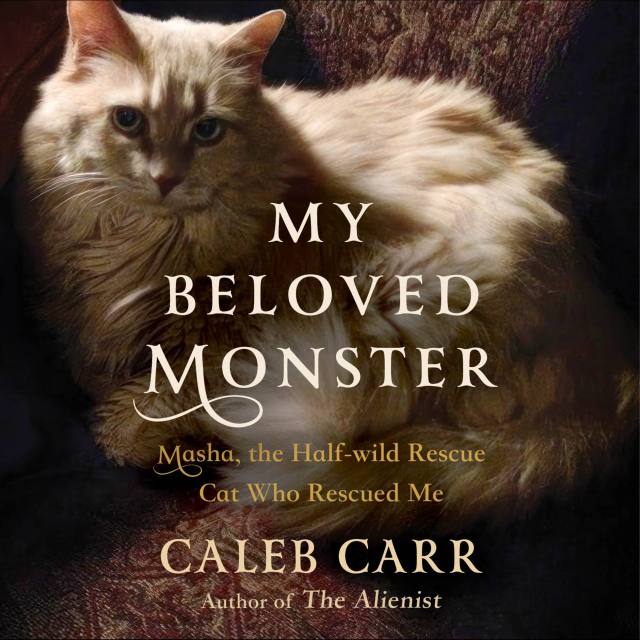
In a sense Carr has written a love story that is like no other.  He describes how each participant in the relationship projects their needs and how they are met.  Carr and Masha had been together for seventeen years and most of the time they were inseparable.  Masha is a Siberian Forest cat which presents its own issues that domesticated cats do not present.  Carr adopted her after her previous owner locked her in an apartment.  When they met, a cat’s intuition was on full display as somehow she knew that Carr was a perfect match, especially when she was taken home to a three story home in rural upstate New York.  She would have the best of two worlds; outside where her instincts could be tested; and inside where she could control her environment and also her relationship with Carr.
My Beloved Monster

Masha had to be special as she replaced Suki, Carr’s previous cat who he also had a strong relationship with.  According to Carr cats are independent and are never responsive to punishment or negative reinforcement as forms of discipline and training.  They do not need us, but rather make use of us.  “Their loyalty depended on mutual respect and decent treatment.”   Carr carefully relates how his own life, in part, paralleled that of Masha.  At a very early age he drifted away from people and forged his closest bonds with cats.  As a boy he believed he had been a cat in a previous life and wanted to return to that life.  He grew up with an abusive father with two alcoholic parents who were somewhat violent.  Carr feared his father would kill him and he evolved into a very angry person.  He would turn to cats for compassion.  Cats taught him how “to give and receive not simply a talent for survival but compassion, affection, love, and joy.”  As the two of them bonded over the years Carr expressed surprise at their shared childhood traumas, shared physical ailments that included arthritis, neuropathy probably caused by the physical violence of their younger years.  For Carr illness added a new intensity to his connection with Masha as he wondered if he would outlive his companion.  When Carr was ill he returned to Masha who like many cats knew exactly how to care for her friend.

The number of astute observations Carr makes is astounding.  Among the many that I can relate to are  cats usually bond with just one human, not several, no matter how well socialized they might be – I have witnessed this firsthand as my wife Ronni and I share two cats, Kota and Shelby.  Interestingly, Kota gravitates to me and would spend her entire day, sleeping, playing, and just keeping me company.  Shelby is attached to Ronni and is content to stay on the right side of our bed where Ronni sleeps,  and Kota dominates the left side with me – in fact, we had to buy a king size bed to accommodate all four of us!  Many cat owners believe that cats stick around so long as food is available and that cats are aloof, at times, finicky.  In fact, what they want is attention, interaction, and play – and if they do not receive it they can become lethargic and obese as food becomes their only option. 

As Chris Bohjalian writes in his Washington Post review “what makes the book so moving is that it is not merely the saga of a great cat. Libraries are filled with books like that, some better than others. It’s the 17-year chronicle of Carr and Masha aging together, and the bond they forged in decline. (As Philip Roth observed, “Old age isn’t a battle; old age is a massacre.”) He chronicles their lives, beginning with the moment the animal shelter begs Carr to bring the young lioness home because the creature is so ferocious she unnerves the staff — “You have to take that cat!” one implores.”*  Through the struggles that life presents all of us from illness, happiness, and sadness.

Trust is the key in any relationship and cats are no exception, but the trust level between Carr and Masha reaches an incredible level.  Whether Carr is discussing his own health history or that of his feline companion their synergy amazes.  How they support each other is nothing less than extremely unusual, but if you are a cat owner and have had an injury or an illness you have experienced  the sensation of being cared for by your furry friend.  I can speak to this from knee to hernia surgeries or my wife’s knee replacements – there is always a cat present to cheer one up, indirectly lessening one’s pain.

For all of Carr’s insights into Masha’s behavior there is one area I would question – her language skills.  Carr goes a little overboard when discussing his verbal interactions with Masha, particularly the idea that she is sounding out words.  I do believe cats do understand a series of words, but to go as far as a conversation between a human and a feline I have my doubts.  In the end Carr has authored a marvelous book delving into his lifelong relationship with cats and focusing on Masha in particular.  Carr has written a love story which can only bring a smile and tears to the reader.

*Chris Bohjalian. “Libraries are full of books about great cats.  This one is special.” Washington Post , April 13, 2024.

To learn more about Caleb Carr and his latest book check out the following article from the Los Angeles Times:

‘Alienist’ author Caleb Carr — grieving his late cat — reflects on his life amid battle with cancer

Caleb Carr considered his late cat Masha, the subject of his new book, the love of his life.

By Chris Vognar

April 15, 2024 3 AM PT

My Beloved Monster: Masha, the Half-wild Rescue Cat Who Rescued Me

By Caleb Carr
Little, Brown: 352 pages, $32

Caleb Carr visits the grave of his beloved Masha, whom he considers the love of his life, every day. “We have a little chat,” said Carr, best known for his 1994 crime novel “The Alienist,” during a video call from his home in upstate New York. It’s late at night — Carr is a longtime night owl who does most of his work after it gets dark — and the author, who now has a long white beard, is thinking about grief and dying — subjects that linger over his new nonfiction book, “My Beloved Monster,” and loom over what might be the final months of his life.

Masha, the beloved monster, was a Siberian forest cat whom Carr rescued from a shelter and built a life with in his mountainside home in Cherry Plain, N.Y. Animals, particularly cats, had long been a source of companionship and comfort for Carr, an antidote of sorts to a chaotic, abusive childhood in New York’s Lower East Side. As Carr writes in the new book, his father, the Beat poet, journalist and convicted manslaughterer Lucien Carr, had a habit of knocking his son down flights of stairs. “I began to understand that he was trying to kill me,” Carr writes. “And while I didn’t yet know about his past” — Lucien Carr stabbed David Kammerer to death in 1944, later claiming that Kammerer came on to him sexually and offering a “gay panic” defense — “I certainly recognized, from the horrifying and even gleeful expressions that would enter his face when he came after me, that he was capable of killing.”

“I have been living with the idea of death since I was a small kid because my father taught me about it,” he said. But death has become much more than an idea of late. Carr, 68, has cancer, which started in his prostate and has spread throughout his body.

“If I could be around when the book is published, that would be really nice,” he said in late January. “I don’t know what’s going to happen when, but it’s not going to be good. I always knew cancer moved fast, but boy, when it starts to move, it starts to eat you. Madness. Just madness.” “My Beloved Monster” will be released on Tuesday.

It was Masha’s death on April 5, 2022, and Carr’s subsequent despondence, that led him to write “My Beloved Monster,” which reads as a love story, a tribute and a reminder that, in some instances, the uncomplicated love of animals helps humans keep going.

A blond, long-haired beauty with a wild side who had been rescued from a cat hoarder, Masha initially greeted Carr, as he writes, with “one of the most communicative gazes I’d ever seen in a cat, a look facilitated by the structure of her face: the eyes were oriented fully forward, like a big cat’s rather than a domestic’s, and seemed to comprehend everything she was studying — especially me — only too well.” Carr writes about cats with a tender vividness that might make you see your own pets through new eyes.

As a child Carr lived in an environment where people couldn’t be trusted, with wild parties and everyday life descending into violence. He lived in a neighborhood so rife with drugs and prostitution that it provided the shooting location for the climax of Martin Scorsese’s “Taxi Driver.” But he always had animals: dogs, gerbils, fish, rabbits and, most to the young Carr’s liking, cats. The family cats would join him in cowering from the domestic turmoil, and comfort him as he reeled from another beating. They seemed to understand him.

Carr would go on to a career as a military historian, journalist and novelist, reaching a wide audience with “The Alienist” (and its 1997 follow-up, “The Angel of Darkness”). The books put his darkness into words as he told the story of a late 19th century forensic psychiatrist on the trail of a serial killer. But he never really forgot his four-legged friends. When he met Masha, he quickly realized he had found a soulmate.

“Animals fulfill something that was damaged in all of us when we were very young and can’t be fixed by people,” Carr said. “We can go on to have relationships with people, but those wounds need a different kind of treatment than people can provide, and that causes trouble when you have to explain that very carefully to whatever girlfriend or whatever significant other you have. I never lasted as long with a woman as I did with Masha, God knows, and no woman ever did for me what she did, which sounds crazy even to me. But it’s really true.”

Carr was actually contracted to write another “Alienist” book, but the spirit did not move him. He was deep in grief and needed to get it onto the page. He began cranking out the story of his life with Masha and sent a draft to his editor, Bruce Nichols, who was also the publisher of Little, Brown before he stepped down in March. Nichols was on board with Carr’s change in direction from serial killing to cat love.

“It was clearly a passion project for him, not only because of his medical situation but because he spent his whole life with cats and this one was very special to him,” Nichols said. “If you’re a cat lover and owner, or a dog person, I think it will resonate with you. And I don’t think it matters whether you care about historical fiction or military history or any of Caleb’s past experiences. It’s sui generis. It is what it is, and it’s an amazing book.”

Carr certainly hopes to tap into the pet community (and perhaps see if any “Alienist” fans are Catster subscribers). He also hopes to win over skeptics who might doubt whether one can love and grieve a beloved animal with the intensity usually reserved for another human.

“I’m hoping that some people will learn from this, and maybe even catch themselves almost thinking of Masha as a person,” Carr said. “That’s really what we have to do as a society much more: Think of these animals as our equals. That’s what they are.”
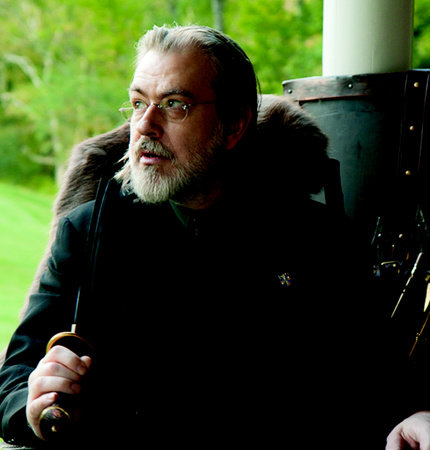
Photo of Caleb Carr

(Author, Caleb Carr)

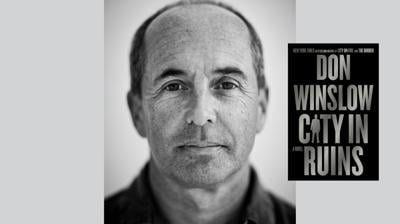
CITY IN RUINS by Don Winslow

The Bellagio Water Fountain Show on the Strip in Las Vegas.

(The Bellagio Water Fountain Show on the Strip in Las Vegas).

If one likes epic crime novels I imagine that you are a fan of Don Winslow.  The author of twenty-five books, seven of which were best sellers, Winslow has established himself as a master storyteller and a person with extensive knowledge of organized crime and drug cartels.  His latest, and I am sad to say his last novel is the final piece of his Danny Ryan trilogy entitled, CITY IN RUINS, a continuation of the story that has evolved through previous books; CITY ON FIRE and  CITY OF DREAMS.

In an April 1, 2024, interview with Benjamin J. Russell of the New York Times Winslow announced that he was retiring from writing crime fiction novels to devote more of his time to political activism.  Winslow who has excoriated Donald Trump in videos and social media posts believes that writing books would not allow him to reach a large enough audience to try and influence the American electorate.  However, his loyal readership will certainly miss him.

In the current work of fiction, Winslow states that the Danny Ryan trilogy which he worked on for over thirty years was like a homecoming.  Winslow left Rhode Island himself when he was a teenager and provides a searing crime novel, which travels through Providence, Rhode Island, Washington, D.C., Wall Street and Las Vegas.  In so doing Winslow details the seamier side of Las Vegas through characters who thought they had put their organized crime experiences in the past.

DonWinslowRollover.jpg

Danny Ryan seems to have achieved everything that life could offer, a respected businessman and a multi-millionaire.  However, his past has produced numerous enemies, a past that included being an Irish mob soldier, and a fugitive from the federal government.  Now, he craves normalcy, however his business plans rub Las Vegas power brokers the wrong way, and an FBI agent bent on revenge sees an opportunity to bring him down.

For Ryan, his prime concern is safety, and safety creates the need for power.  Ryan has power owning hotels and other business interests.  However, a number of threats emerge at the outset of the novel as Congress has created the Gambling Impact Study Commission designed to investigate the impact of gaming on the American people.  Ryan’s fear, along with other power brokers, is that the federal government would gain the power to impact the profitability of his holdings, investigate the seamier sign of his wealth, and possibly imprison him.  These other power brokers, Vern Winegard and Barry Levine were also a threat to Ryan’s position, wealth, and self-image.  Though they met monthly to discuss common issues, Winegard who was about to purchase a prime property on the Strip that Ryan coveted, and Levine who owned three mega hotels across from Ryan’s are major obstacles.  In reality, no matter how hard Winslow tries to normalize Ryan as a legitimate businessman, a loving father, and a generous person who treats those around him well, he can’t seem to break away from the fact that Ryan cannot escape his mobster past.

Winslow constructs his plot lines very carefully. First, we have the Ryan-Winegard competition for control of certain properties on the “Strip” which would allow one of them to dominate the hotel-casino business.  Second, is the role of organized crime as both Ryan and Winegard have a past that does not want to let them go.  Third, centers around Chris Columbo, a mobbed up individual who stole from his bosses, disappears, then reappears ten years later.  Fourth, a trial involving Peter Moretti, another mob figure who killed his mother and stepfather.  Fifth, the revenge sought by FBI Sub Director for Organized Crime, Regina Moneta who blames Ryan for the murder of her FBI boyfriend a decade ago.  Sixth, the ambition of Camilla Cooper, an evangelical Christian who sits on the Nevada Gaming Control Board who sees bringing down Danny Ryan as a step to gaining the governor’s mansion.  How Ryan navigates these threats and certain other situations provide the core of the novel.

Winslow is an expert at creating characters and their backgrounds which immediately spark interest in the reader.  In addition to those previously mentioned there are other important people.  Abe Stern, a 93 year old billionaire who wants no part of Vegas but decides to assist Ryan with his travails.  Stern’s son Josh also plays a vital role.  Dr. Eden Landau, a psychiatrist that Ryan falls in love with. Madeleine, Ryan’s mother who lived with Marty Ryan Dan’s father, likes to see herself as a wonderful grandmother but is heavily involved with the mob over the decades.  Marie Bouchard, the Nevada prosecutor after Peter Moretti and his lawyer Bruce Bascomb.  There are a number of organized crime “types,” throughout be it Ryan’s organization or that of Alfred “Allie Boy” Licata, an old mob boss banned from Las Vegas who years before killed Abe Stern’s brothers and his crew.

Winslow describes Las Vegas and the characters he develops accurately in terms of the historical reality of the “Strip.”  He writes; “Enough isn’t a concept in Las Vegas, an over-the-top town where too much isn’t enough, success is success, and more is always better.”  As one follows the story line each character subscribes to this credo.  Ryan tries to stay clean through most of the novel, but his old enemies keep circling. He does what he can to prevent the power struggle he has unleashed from turning violent, but through a series of miscalculations, bullets start flying, endangering not only his gambling empire but his life and the lives of those he loves.

Years ago, when Winslow first read Aeschylus, he recognized that the Greek father of literary tragedies had explored every major theme found in modern crime fiction, from murder, vengeance, and corruption to power, justice and redemption. He became obsessed, he said recently, with the idea of retelling the ancient stories in a modern-crime fiction trilogy.  In an ode to Greek tragedy Winslow refers to Virgil’s epic poem, “The Aeneid” throughout the novel and the quotes he uses to divide sections of the novel fit perfectly.

While CITY IN RUINS can be read as a standalone, readers would be best served by reading the trilogy from the outset. With his compelling characters, his vivid prose, and his exploration of universal themes, Winslow has produced a masterpiece of modern crime fiction which will not disappoint returning readers or any new audience.

City of Lights: In dramatic contrast, today's main strip in Las Vegas  is vibrantly illuminated by hotels and casinos as far as the eye can see

(Las Vegas Strip today)

THE WOMEN by Kristin Hannah

vietnam nurse reflections

The Vietnam War has sparked numerous arguments over the roles of diverse groups and vocations.  One that has been dominant is the role of nurses, particularly women.  How many served in what capacity, their experiences dealing with combat, and interactions with wounded soldiers all come to mind.  There have been a few works of non-fiction that stand out in the discussion of nurses during the war, they include; AMERICAN DAUGHTER GONE TO WAR by Winnie Smith; HEALING WOUNDS by Diane Carlson Evans; and HOME BEFORE MORNING by Lynda Van Devanter.  Recently, Kristin Hannah, the bestselling  New York Times author has published her latest novel that deals with the issues faced by American nurses during the war, entitled THE WOMEN.

Hannah’s work of fiction begins with Frances Grace McGrath, a twenty year old nursing student asking the question “why couldn’t women be heroes?” after examining the photos in her father’s study displayed on what he called his “wall of heroes.”  McGrath noticed there were no women on display, and with her brother off to fight in Vietnam she surmised that he too would soon be exhibited on the “wall.”  Tired of being primed by her parents to marry and have children, McGrath decides to enlist in the US Army Nursing Corps and join her brother in Vietnam.  Almost immediately after joining up she learns that her brother has been killed in a helicopter accident, with the Pentagon offering few if any details about how he died.

Hannah’s work returns the reader to a time in American history where faith in government was decreasing daily and people took to the streets because of war – sounds familiar.  The book chronicles the evolution of Francis McGrath from an inexperienced nurse who was raised with the values of the 1950s to an independent women who found her calling in the surgical ward in Vietnam.  Hannah’s description of operating rooms, triage, the friendships and love she found, the impact on the Vietnamese people and American GIs rings true.  McGrath would soon learn that the rules of “polite society” that she left in Cornado Island, California was unimportant in Southeast Asia.  The only way she felt she could survive was develop a “hard shell” to protect her heart.  She quickly learned to focus, tune out the noise and napalm to help the wounded in pre-Op, Post-Op, and try to recover each day from what she experienced by returning to her “hootch” and commiserate with her fellow nurses.

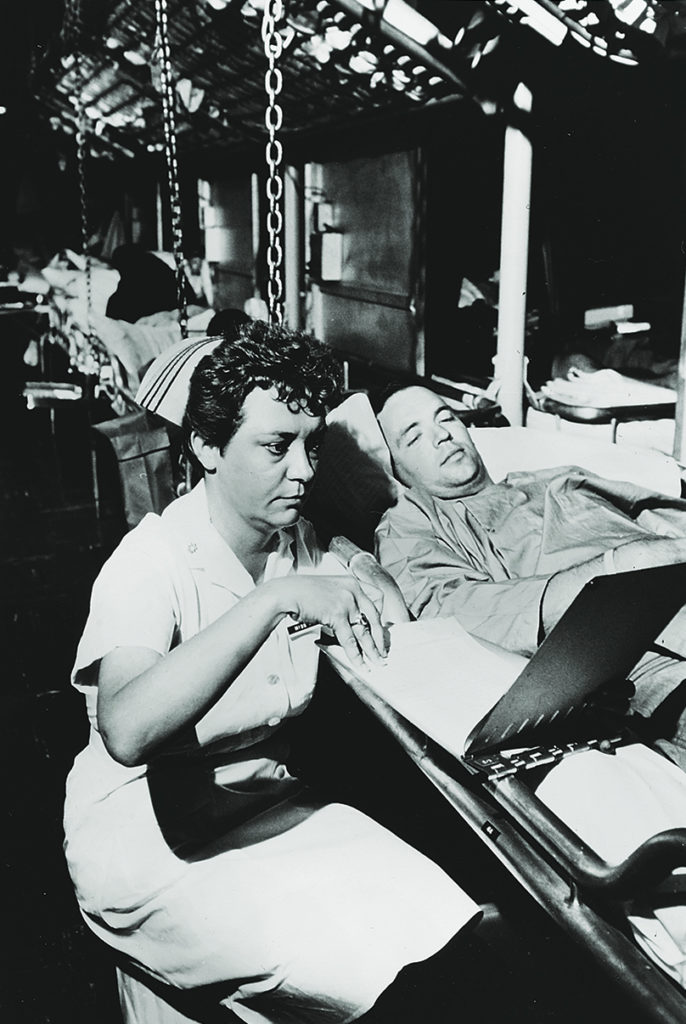
Photo of Lt. Cmdr. Dorothy Ryan, a Navy nurse, checks on a Marine aboard the Repose in 1966.

(Lt. Cmdr. Dorothy Ryan, a Navy nurse, checks on a Marine aboard the Repose in 1966).

The horrors of war are on full display in THE WOMEN.  The descriptions of injured soldiers and Vietnamese peasants are raw and for McGrath it reminded her of her brother’s death.  Hannah’s approach to the daily existence of Vietnamese peasants is accurate as she describes the effects of napalm, agent orange, the destruction of their fields, and the loss of their men.

As the novel evolves you can discern McGrath becoming more and more disillusioned with the conduct of the war and the slaughter of the Vietnamese by American bombing.  Despite these feelings McGrath will reup for a second tour as she believes that nursing in Vietnam was now her calling.

There are a number of important storylines to the novel.  First and foremost is McGrath’s growth as a person, then her world crashing down upon her return to the United States, the loss of loved ones, and the betrayal she felt fostered by others.  Her experiences in a field hospital in Pleiku made her an exceptional nurse and achieved a competency that she believed she could never attain.  But the war created demons, particularly as everyone she loved seemed to perish in the war or lied to her.  Soon she would develop an emptiness that called for alcohol, pills, and rage, especially when she returned home and was spat upon by anti-war demonstrators and the fact that even her father did not recognize her experiences in a war zone and society in general held the belief that women did not fight in Vietnam.

Hannah creates a support system for McGrath through the friendship of fellow surgical nurses; Ethel Flint from a Charlottesville, Va. farm and Barb Johnson, a black nurse from a one stoplight town in Georgia.  The bonds of friendship, emotional support, and general love for each other made the war and post-war situation almost palatable.  This relationship and other aspects of the book take the reader on an emotional rollercoaster which is common in Hannah’s other novels.  Here, at times it is a bit overblown as McGrath passes from one crisis to another suffering from PTSD, and an inability to face the truth about her feelings and relationships.

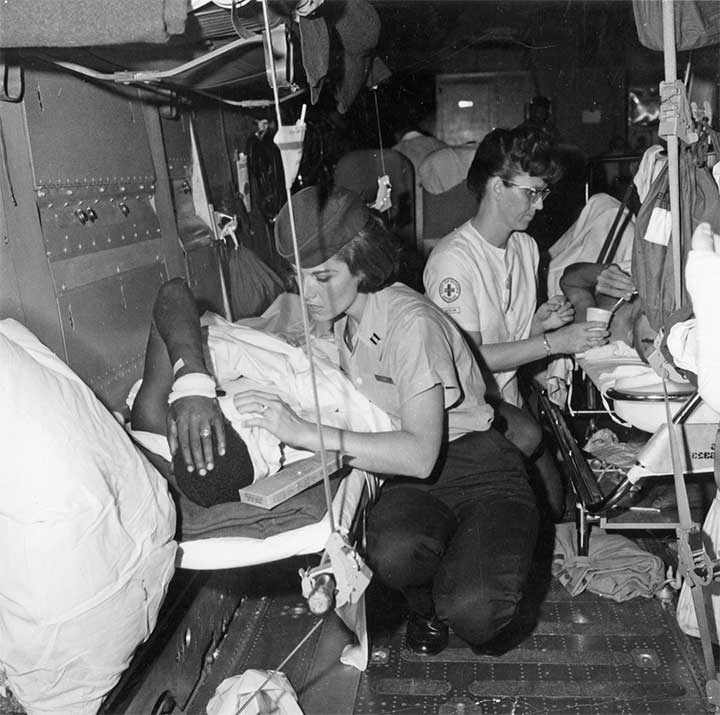
Second Lieutenant Kathleen M. Sullivan treats a Vietnamese child during Operation MED CAP, a U.S. Air Force civic action program in which a team of doctors, nurses, and aides travel to Vietnamese villages, treat the sick and teach villagers the basics of sanitation and cleanliness. Date  1967 Current location  National Archives and Records Administration, College Park Link back to Institution infobox template Still Picture Records Section, Special Media Archives Services Division (NWCS-S)

(Air Force 2nd. Lt. Kathleen Sullivan comforts a Vietnamese child as part of the military’s Medical Civic Action Program, MEDCAP, which assisted people in villages).

The book is a time capsule of the 1960s through 1970s in American history.  As a historian who has taught and studied the war for decades I found the book factual, emotional, with an accurate representation of the scars that afflicted American society at the time.  From McGrath’s experiences one sees the elements of the lies and horrors of war which I am certain still haunt thousands of Americans.  With the current situation in Gaza and the demonstrations across college campuses I found myself back in the 1966-1974 period with the Tet Offensive, anti-war demonstrations, POWS, Kent State, and it is not a comfortable feeling.

Hannah knows how to pull every emotional string a reader can feel, especially for those of the Vietnam generation.  At times, McGrath’s personal chronology seems a bit much as she experiences so much tragedy, misinformation about life, a rejection by her family, and an inability to deal with her demons. The many plot twists that Hannah creates for McGrath are analogous to what many veterans experienced when they returned home.  Hannah does not offer anything new about the war and its aftermath, but she places women at the center of her novel, playing a significant role saving the lives of American soldiers.  This is an important story which needed to be told to a wide readership, which Hannah has accomplished very well.

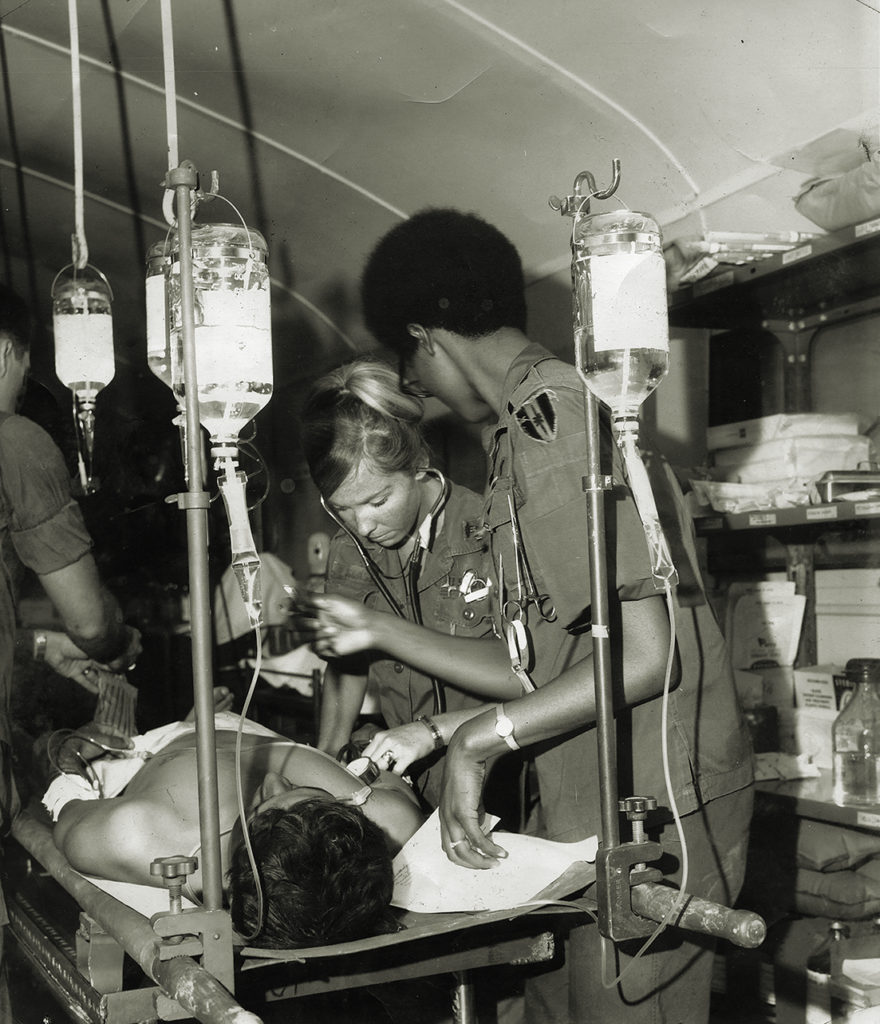
Army nurses, 93rd Evacuation Hospital, Long Binh, Vietnam, 1968. B.J. (Greenway) Rasmussen Collection, Women In Military Service For America Memorial Foundation, Inc.

(U.S. Army nurses at the 93rd Evacuation Hospital in Long Binh, near Saigon, in 1968, work to stabilize a patient. Nurses in Vietnam often faced not only intense demands for patient care but also the threat of attacks on close-by military facilities and even the hospitals themselves).