
/https://tf-cmsv2-smithsonianmag-media.s3.amazonaws.com/filer/ef/bb/efbb5d8a-01e8-4e24-b630-b0658ced847c/06b_ce16_wwiiairbattles_c46overthehump.jpg)
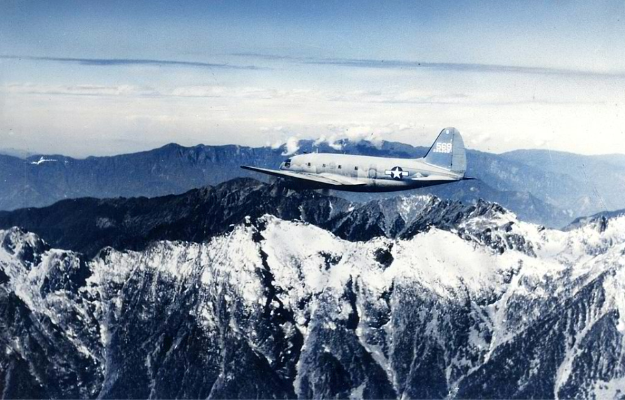
(Flying “the Hump” in World War II. The Curtiss C-46 Commando was a mainstay for those operations, conducted over the Himalayan foothills where there was no emergency landing strip.)
The term “Over the Hump” is a concept that seems lost to history. When applied properly it embodies the American effort to supply the Nationalist Chinese weapons and supplies to combat the Japanese army which by 1942 invaded Burma and captured and cut off the only ground route into China. The only way to offset Japanese progress was to supply the Nationalist Chinese by air flying over the Himalayas from India.
In her latest book, Caroline Alexander the bestselling author of THE ENDURANCE: SHACKELTON’S LEGENDARY ATLANTIC EXPEDITION and THE BOUNTY: THE TRUE STORY OF THE MUTINY ON THE BOUNTY among other works has written an exceptionally detailed narrative and analysis of the American effort to thwart the Japanese describing the dangerous flights by inexperienced pilots over the Himalayas, discussing the diplomatic agenda of the United States, England, and China, along with insightful personality studies of men like General “Vinegar” Joe Stilwell, the American officer in charge of aid to China, General Chiang Kai-Shek the leader of Nationalist China, and Claire Lee Chennault, the American officer who commanded the “Flying Tigers.” The book entitled, SKIES OF THUNDER: THE DEADLY WORLD WAR II MISSION OVER THE ROOF OF THE WORLD focuses on the newly created infrastructure for the mission, training of pilots, and the hazardous flights they engaged in. Further, Alexander delves into the allied strategy of the China-Burma Theater (C.B.I.) which was complicated by the conflicting political and military interests of Franklin D. Roosevelt, Winston Churchill, and their unreliable ally, Chiang Kai-Shek.
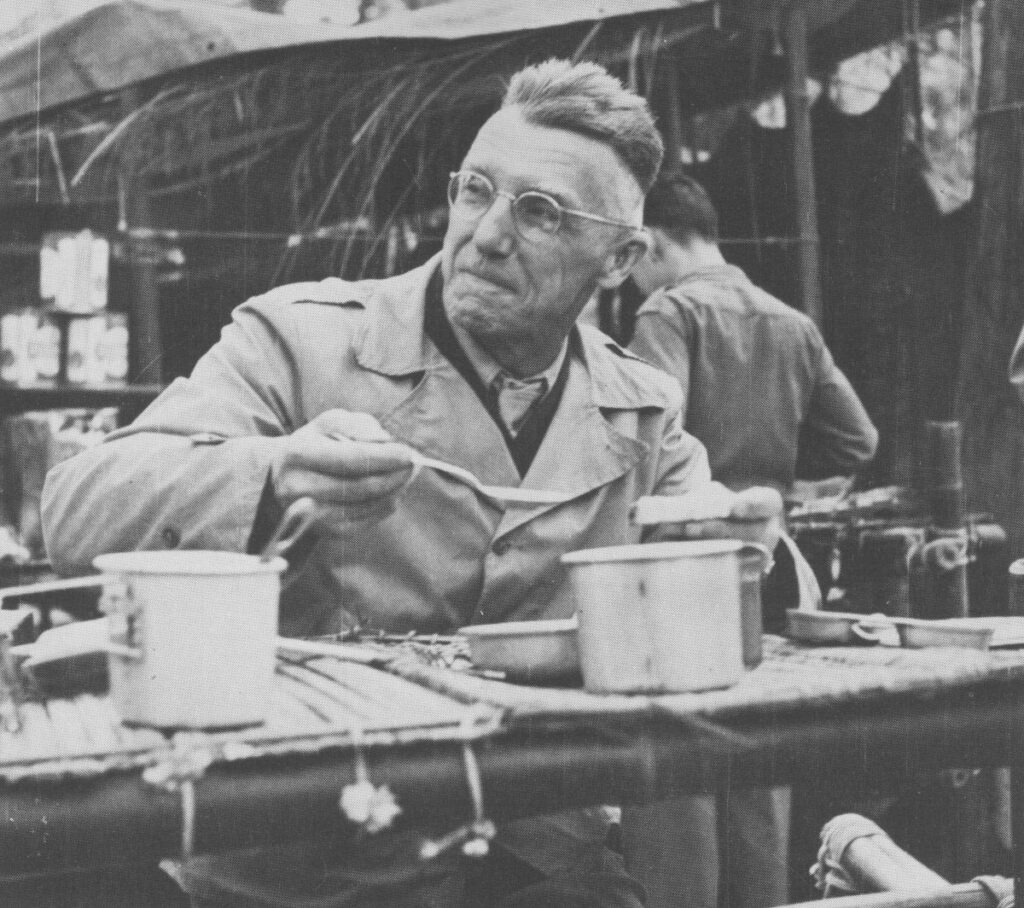
(Lieutenant General Joseph Stilwell (1883-1946) eating field rations on Christmas morning, 1943)
For Alexander, the C.B.I. was the war’s “most complicated theater” and was driven by competing interests and contradictions that exposed the fault line between the allies. For many, C.B.I. translated to “confusion, beyond imagination.”
Alexander’s riveting new work begins with the allied defeat in Burma in April 1942 sealing off the ground corridor linking India and China. This would an “ariel Burma road” to supply Chiang’s troops and allied forces. According to Alexander’s research some 600 planes and 1700 American airmen would be lost flying over Burmese jungles and mountains.
Although the supply effort was deemed a military operation, its primary goal was political, not military, a result of President Roosevelt’s desire to retain the support and boost the moral of Chiang Kai-Shek and his government and ensure a close relationship between the United States and China as Washington wanted the Nationalists to become a major player in the post-war world. The British as Alexander develops throughout the monograph were not as supportive of FDR’s raison detre and actively worked to undermine the American approach. The tension “between the practical and symbolic purpose of the Hump operation was to persist throughout the war” – a dominant theme of Alexander’s work.
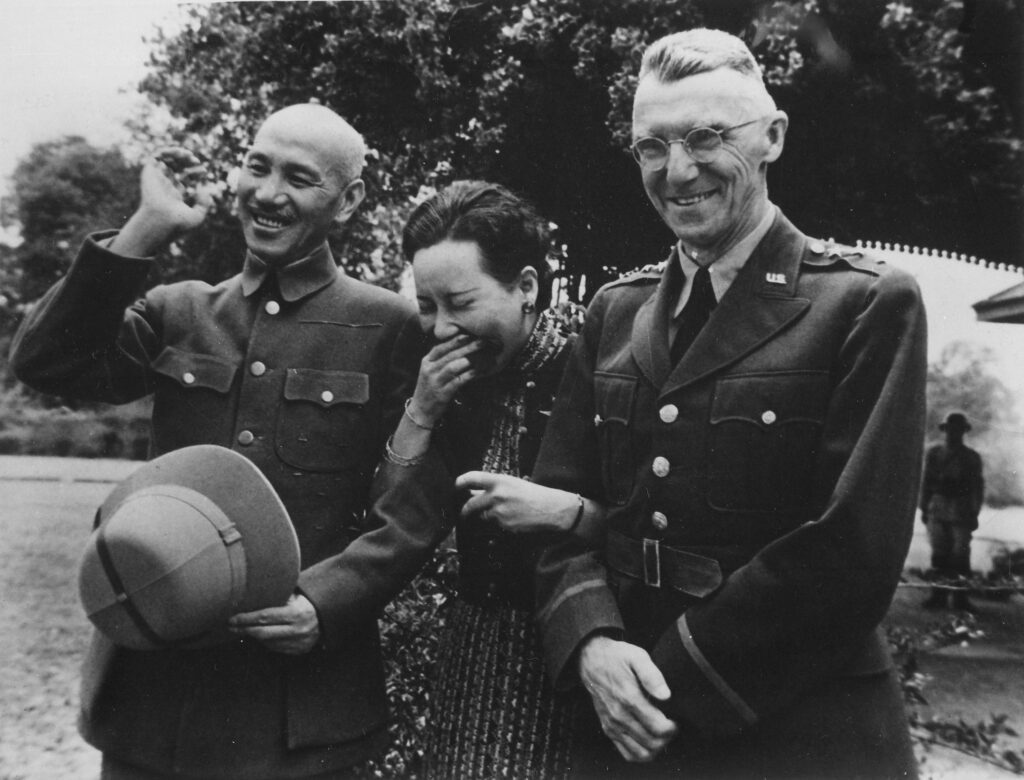
(Stilwell with Chiang Kai-shek and Chiang’s wife, Soong Mei-ling, in 1942)
Early on Alexander introduces her argument that a united front to defeat Japan would be difficult to achieve. First, Chiang hated the Chinese Communist Party because they were the only group he was unable “to buy off, absorb, liquidate, or suppress…” Second, they were the only party that was gaining popular support. Third, Chiang believed the Chinese people were incapable of governing themselves. Lastly, and most importantly the Chinese army’s military strength was not applied against Japan despite American aid and encouragement and was held back due to Chiang’s belief of the coming civil war against the Chinese Communist Party led by Mao Zedong. In all areas, negotiation, his relationship with Stilwell, and his belief in his own destiny Chiang was the major impediment to try and defeat Japan.
Alexander’s book is well sourced and researched. She carefully explains the Japanese seizure of Burma entering Rangoon in March 1942. The chaos that resulted was due to British General Archibald Wavell’s belief that the Japanese would never invade Burma through Rangoon. Alexander carefully recounts the horrors Burmese refugees suffered trying to escape the Japanese invasion through monsoons that fostered torrential rains and muddy roads.
A strength of the author is her focus on the major players in the conflict, exploring the pilot’s experiences, and the results of American efforts. Prominent figures like General “Vinegar Joe” Stillwell are examined carefully. His relationship with Chiang Kai-Shek was terrible which impacted US policy, Stilwell’s relationship with General George C. Marshall, and President Roosevelt are keys to Alexander’s analysis. In the end Stilwell’s off-putting personality, ego, and strong beliefs would lead to his recall from China in 1944 due to Chiang’s request. Marshall’s description of Stilwell as being “his own worst enemy….his pathological tactlessness and rudeness was a major factor in the troubles he had in China.” The role of Claire Lee Chennault is also vital to the story of who would contribute to the conflict and the confusion that vexed the C.B.I. theater. Over the course of the war, Chennault’s own propaganda machine increased his reputation and the air assets he commanded. He would gain great notoriety in the United States, but in the end according to the author his contribution to the success of the Burma theater is debatable. Alexander’s criticism of Roosevelt is warranted as his view of Chiang was unrealistic. His belief in his own powers of persuasion were misguided as was his evaluation and ignorance of the key logistical facts of supplying Chiang’s forces. His approach would be very detrimental to the men who built the facilities and the pilots who carried out the Burma mission. Roosevelt’s belief and promises in the amount of tonnage of supplies that could be delivered were impracticable.

(Claire Lee Chennault)
Other prominent figures that are discussed include Vice Admiral Lord Louis Mountbatten, the British commander in Burma who did not get along with Stilwell and also demanded his replacement. General Henery “Hap” Arnold, the commander of the US Air Force, British General Orde Charles Wingate, 1st Air Commander Philip Cochran, General William Slim, General Frank Merrill, among others who receive extensive coverage.
To Alexander’s credit her focus is not only on influential figures. Her descriptions of the many pilots and the weather, topography, equipment failures are exceptional. Descriptions of the environmental hazards faced by pilots are fully warranted. Weather was the most onerous aspect of flying over the Himalayas. Monsoons, ice formations, thunderstorms, jungles, mountain peaks, deserts, sandstorms all had to be overcome. Further, training could be spotty. Many pilots lacked the experience needed to confront and overcome all of the obstacles in flying and delivering their cargo. With Chiang threatening to leave the war many pilots were rushed into situations for which they were unprepared. Many of the pilots lacked any combat experience and were psychologically and mentally ill equipped to deal with the dangers they faced. The result was misreading instrument failures, the situation they found themselves confronted with, the performance of their aircraft etc. resulting in bailing out when not necessary, crashing their planes when conditions did not fully explain what had occurred. Alexander’s account puts the reader in the cockpit with pilots as they had to cope with balancing their own survival and completing their missions.
To sum up Alexander does a wonderful job telling the story of the men who risked their lives dealing with brutal terrain and horrific weather conditions to keep China in World War II. While Alexander devotes a great deal of time explaining strategic and political issues, her interest lies primarily on the variations of individual human personalities. The author tells, through clear and engaging narrative, the story of the pilots in the planes to the level of campaign overview, sometimes really from 30,000 feet.

© IWM (CB(OPS) 5008)
(Aerial reconnaissance photograph of the Sittang Bridge in southern Burma, which was destroyed in the face of the advancing Japanese on 23 February 1942)
Perhaps historian Elizabth D. Samet describes Alexander’s effort the best; “Ultimately, and rightly, the pilots — intrepid as “sailors of old” crossing “unknown oceans” — are the core of the book. Demeaned as “Hump drivers,” ostensible noncombatants at the bottom of the aviation hierarchy, they flew an inadequately charted route over baffling terrain, its surreality intensified by their frequent refusal to wear oxygen masks.
Alexander adroitly explicates technical concepts — flight mechanics, de-icing, night vision — but is at her best rendering pilots’ fear. Besides terrain, its sources included weather, enemy aircraft, insufficient training, night missions and “short rations of fuel” on the return leg. At least a pilot could depend on his plane, the beloved Douglas C-47 Skytrain, until the introduction of unreliable or unsound higher-capacity models turned the machines themselves into another source of terror.
Readers thrilled by sagas of flight will marvel at the logistics required to transport a stunning 650,000 tons of cargo by air, the audacity required to fly the Hump, the search-and-rescue operations necessitated by its hazards and the experimental use of aviation involved in the Allied recapture of Burma in 1944.

(A Chindit unit forging a Burmese River, 1943)
They will also have to reckon with Alexander’s hard-nosed conclusions about the C.B.I. Others who have chronicled its history concentrated on the strategic merits of this deeply imperfect theater or celebrated its pioneering use of air power.
The image that dominates the end of Alexander’s epic is “the aluminum trail” of wreckage — “the hundreds of crashed aircraft that still lie undiscovered in the jungles, valleys and fractured ranges beneath the Hump’s old route.”*
*Elisabeth D. Samet. ”The Scrappy World War II Pilots Who Took Flight for a Perilous Mission.” New York Times, May 14, 2024.
 Doc's Books