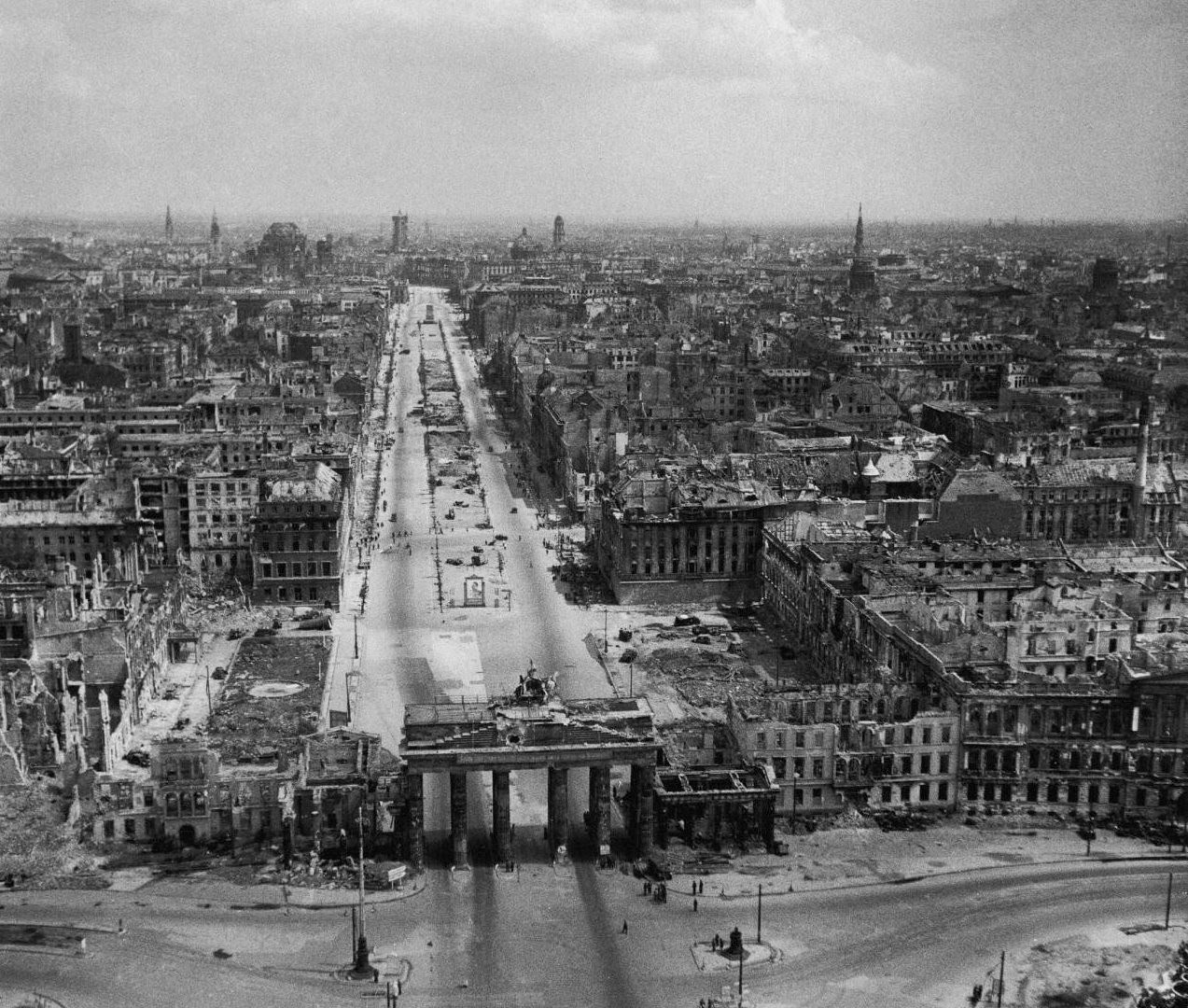
(Berlin at the end of World War II)
Today Germany finds itself as the strongest economic power in Europe, in addition to possessing major military influence due to the Russian invasion of Ukraine. Its influence in Europe is strong and many of the goals of the Nazi regime during World War II have been achieved peacefully since unification following the collapse of the Soviet Union. If one thinks back to 1945 Germany was devastated as it suffered from pervasive allied bombing be it Dresden, Berlin, Cologne, Hamburg, and other German cities. Living in one of these cities in the summer of 1945 and to imagine Germany’s dominant position in Europe today as a member of the European Union would be unthinkable. The question is how did Germans face up to their Nazi past and how did they move on, for most with no sense of responsibility or guilt for the Holocaust and other atrocities committed by the Hitlerite regime domestically and across Europe? Harald Jahner a German cultural journalist and former editor of the Berliner Zeitung focuses on the immediate postwar period in trying to determine why this happened in his book AFTERMATH: LIFE IN THE FALLOUT OF THE THIRD REICH 1945-1955.
Jahner immediately asks a series of questions which he hopes to convey the answers to. For the nine million Germans who were bombed out of their homes and evacuees, the fourteen million refugees and exiles, the ten million released from forced labor and imprisonment, and the countless millions of returning prisoners of war the question was clear; “How was this horde of ragged, displaced, impoverished and leftover people broken up and reassembled? And how did former national comrades (Volksgenossen), as German nationals were known under Nazism, gradually become ordinary citizens again?” This process would lay the foundation of the “German economic miracle” of the postwar period and as a result is an important aspect of western history for historians to explore.
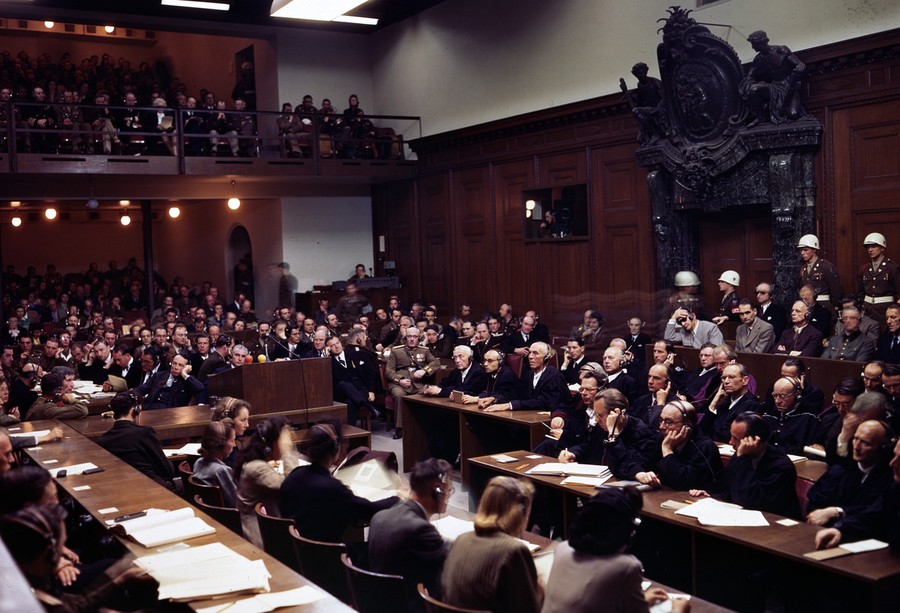
(The Nuremburg Trials)
Interestingly, the Holocaust had a negligible impact on the consciousness of most Germans during the period. Many were aware of the crimes that took place in the name of Aryan unity and lebensraum (living space in the east) and perhaps guilt about causing the war, but there was little guilt concerning the death of six million Jews. In fact, the whitewashing of the existence of the extermination camps was common even as the allies tried to confront the German people with evidence of Nazi crimes. This coverup in part was due to the prevalent view of many Germans that they were now the victims. As Jahner writes; “the survival instinct shuts out feelings of guilt.”
The postwar period was riddled with instances of imprisonments during the war for minor offenses who remained imprisoned after the war, some for years. Disturbingly, at the same time former Nazi elites, scientists, and spies emerged in the bureaucracy of the new Federal Republic and cooperated with former allies as the Cold War approached. At the same time ordinary people starved, lost their shelter, and tried to survive with the absence of authority.
Jahner begins his narrative by describing the plight of the German people. Examples abound during the early months of the postwar period of suffering of the survivors of the war, and the author concludes as far as any guilt was concerned; “forgetting was the utopia of the moment.” As a cultural historian Jahner’s main focus is how German culture evolved after the war as a tool to denazify the German people. The author’s focus is broadly encapsulating a broad realm of cultural issues including film, music, art, newspapers, literature, furniture design, clothing, architecture, etc. Jahner delves into the acceptance and rejection of certain cultural avenues following the war. In film, comedies rather than dramatizations were seen as more acceptable. The cultural leaders were concerned about the general public’s taste and understanding of art. The Third Reich had conditioned people in terms of aesthetic judgement, now they needed to break the intellectual chains of the past, i.e.; accepting modern abstract art which was seen as positive as it represented the denazification of culture.

(German soldiers returned home after WWII)
In an interesting comparison between the American and Soviet view of how to denazify and integrate the German people after the war, Jahner focuses on how the United States relied on art as a vehicle to promote democracy. Employing the CIA as a vehicle to transfer funds to promote western culture, US intelligence services funneled money to particular cultural leaders as a means of obtaining their ends. The Americans however were less likely to offer the Germans the chance of rehabilitation so soon after the war as the Soviets did. Americans had no communist theory of history that would have enabled them to view Germans as victims of Hitler. On the contrary Americans saw the average German as “a militaristic, authoritarian, hard hearted character for whom the Fuhrer’s state was the most representative form of government.” The Russian approach was simpler, purging who they felt threatened by, offering what became known as East Germans an off ramp to acceptability, and a culture that was much more digestible like “Socialist Realism.”
Jahner offers a window into how the German people coped economically on a daily basis exploring rationing, the black market, crime, exploitation, and the lack of housing which he argues would eventually lead to a market economy. He explores topics like sex, love, the plight of orphans, returning POWs, forced laborers, demobilized soldiers, and other wandering human beings who had been displaced by war. However, the most important insights he offers centers around the belief by Germans that the Nazis had humiliated them and the argument that they too were victims of Hitler. This rationalization made it easy to avoid discussion of the Holocaust after the war and any German responsibility. Hitler worshipers were “duped” rather than guilty for the events that led to war and what transpired during the war. The positive is Jahner’s belief that what he terms as “intolerable insolence” is the belief that to establish democracy in post war Germany this denialism was a necessary prerequisite because it created the foundation of a new beginning. The victim narrative reached its apex in April 1945 when the Germans were in fact liberated.
Jahners concludes that the majority of surviving Germans were so preoccupied with their own suffering that the dominant mood was one of self-pity. Since they were victims they “had the dubious good fortune of not having to think about the real ones.” As grim as Jahner’s discussion is concerning the amount of rubble that was left for the Germans to clear and live with, for many it is just punishment for a sophisticated people who succumbed so easily to the Nazi regime. The eventual robust economic recovery of the East and West was a boon, according to Jahner, “but such good fortune had nothing to do with historical justice.”
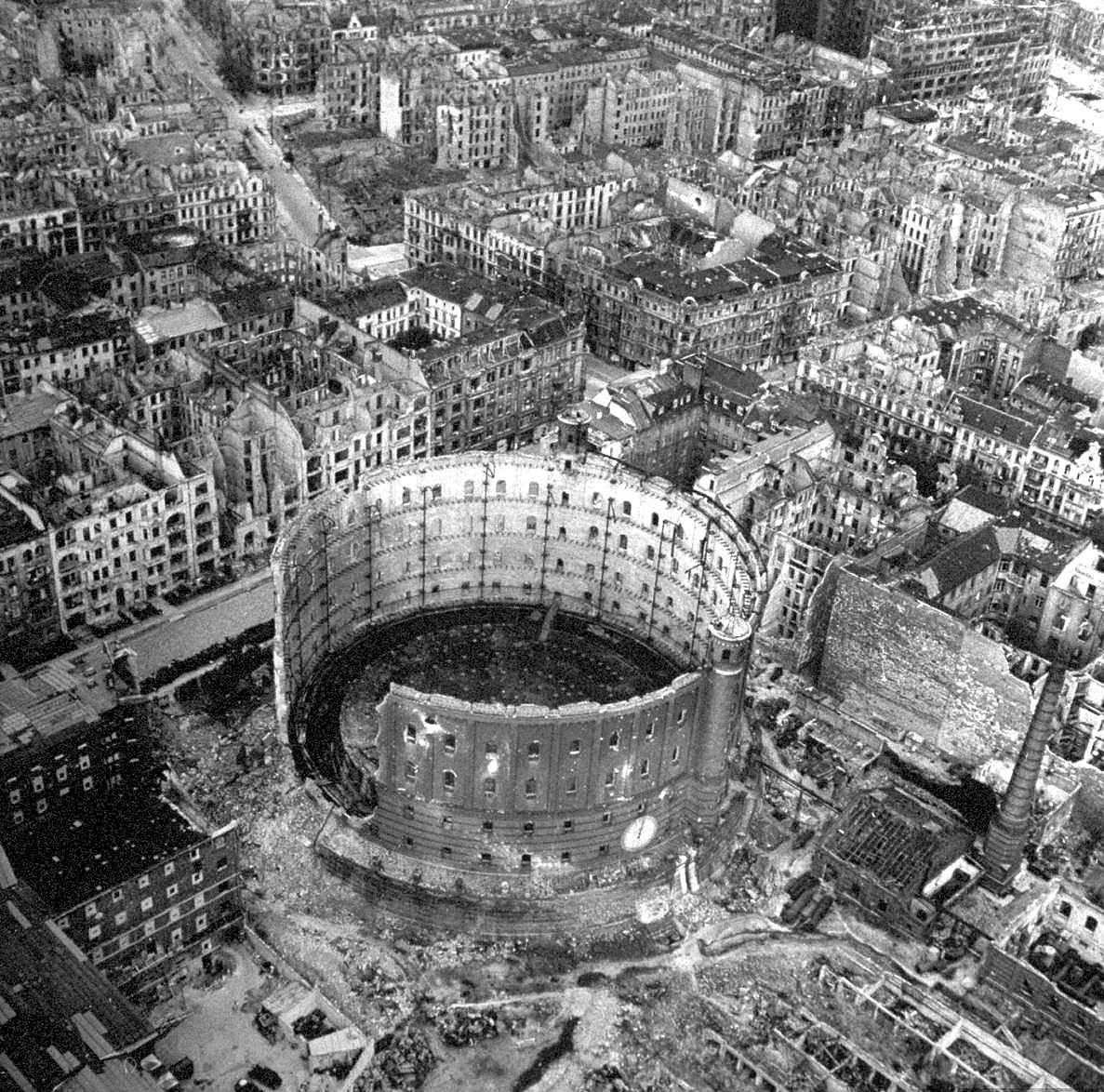
(Berlin at the end of World War II)
 Doc's Books