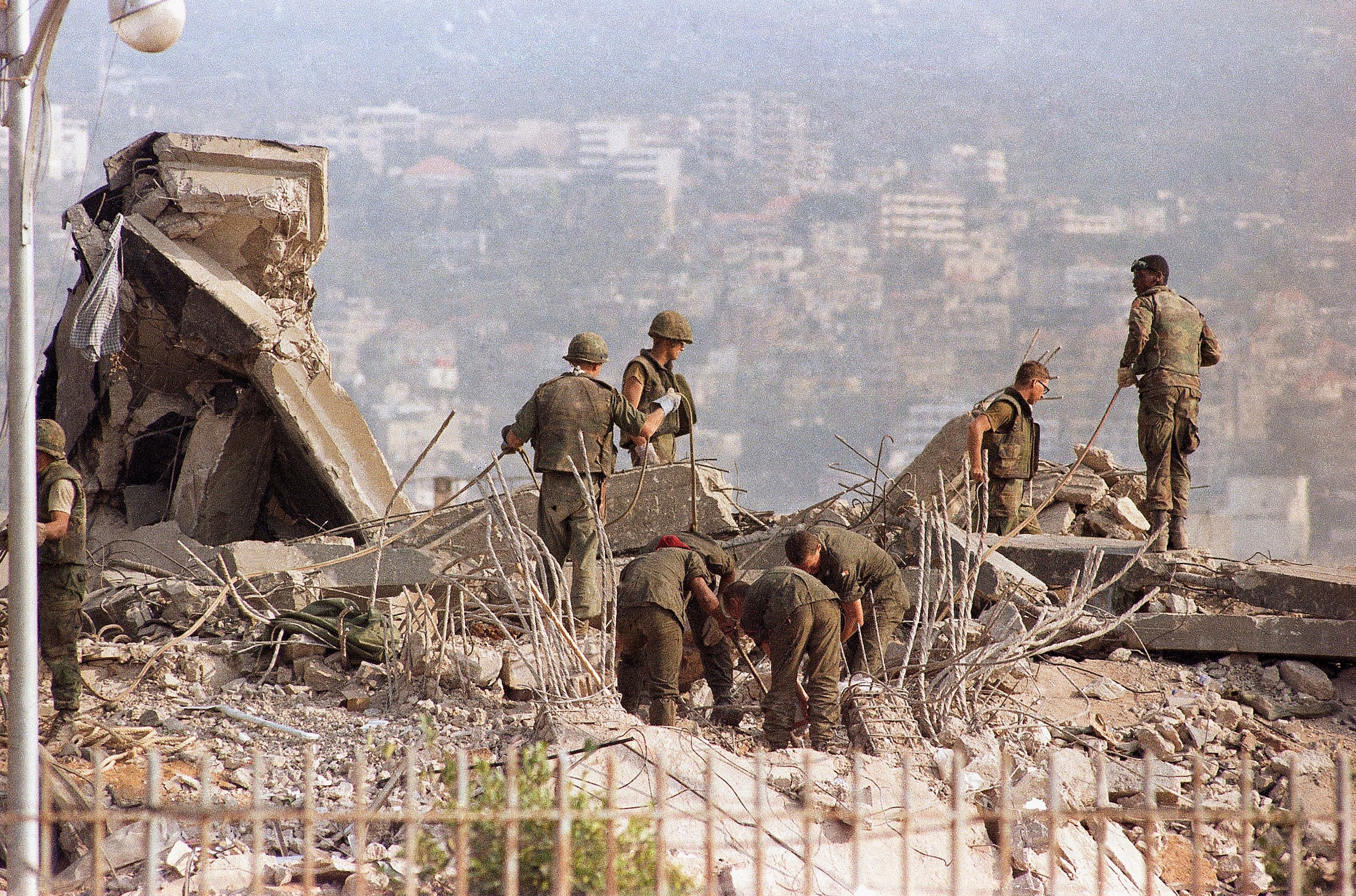
(The scene around the U.S. Marine Corps base near Beirut, Lebanon, following a massive bomb blast that destroyed the base on Oct. 23, 1983)
On October 7, 2023, Hamas launched an unspeakable terrorist attack on Israel killing over 1200 men, women, and children, and seizing over 200 hostages. The Israeli response was a brutal attack of retribution that has led to the death of tens of thousands of Palestinians and the evisceration of a significant part of the Gaza Strip. Acting as an ally of Hamas and an Iranian puppet, Hezbollah launched a campaign of rocket attacks against northern Israel which led to over 60,000 Israelis abandoning their homes in support of their ally. Recently Israel assassinated Hezbollah’s leader, Hassan Nasrallah, and a number of other officials who were set to take his place. Once Nasrallah passed from the scene Israel launched an invasion of southern Lebanon and bombed any area of Lebanon which it deemed a stronghold of Hezbollah, including Beirut.
These events remind one of the 1982 Israeli invasion of southern Lebanon as history once again repeats itself fostering the creation of Hezbollah due to Israeli military and diplomatic errors. The introduction of Hezbollah to the world scene caused by the Israeli invasion would lead to the terrorist attack against the American barracks and headquarters in Beirut which resulted in the death of 241 Marines. The full story as to how and why this occurred and its impact on American foreign policy and the Middle East region and its effect on the families of the Marines who served is the subject of a new book by Jack Carr, a former US Navy Seal sniper and author, and historian James M. Scott entitled; TARGETED BEIRUT: THE 1983 MARINE BARRACKS BOMBING AND THE UNTOLD ORIGIN STORY OF THE WAR ON TERROR.

(Marines searching for bodies after the attack)
The approach the authors pursue in relating their subject is somewhat bifurcated. The narrative is broken down into three parts. First, half and the most important part of the monograph seeks to relate the background for the attack on the Marine barracks on October 23, 1983, beginning with the attack on the American embassy on April 18, 1983, and the evolution of Washington’s “peacekeeping mission” in Lebanon designed to curtail the factional warfare between Christian and Islamic forces centered on Beirut. The authors expand their focus on American decision making, the dangers Marines confronted as they carried out their mission, and the debate as to how the United states should respond to the plethora of sniper attacks, suicide bombings, and artillery shells that landed on the Beirut airport, the location of the Marine barracks.
In the next section, Carr and Scott describe the truck bomb attack in detail that resulted in the death of 241 Marines and another 158 wounded. They focus on rescue and recovery reflecting on the horror and other emotions displayed by Marines and others who charged into the debris to try and locate survivors. The concluding section of the narrative brings into clarity the response of the Reagan administration to the calamity unfolding in Beirut and the decision making that led to the American response to the crisis. In addition, the authors describe the agony faced by families and a final evaluation of the errors perpetrated by the Reagan administration.
All in all, the book is a useful retelling of events and the response of participants, but apart from exploring the private lives of numerous Marines and their families the book does not present any new detail. The main criticism of the book is at times it rests on secondary sources to present its story. The book relies heavily on journalistic sources, particularly that of Thomas Friedman of the New York Times, and Robert Fisk, of the Times of London, among others. Once the authors move on to Reagan administration decision making and later the emotional trauma faced by surviving family members, Carr and Scott primary sourcing improves as they rely on interviews with survivors and families who for many will not get over the tragedy.

(The Marine barracks after the attack)
The key event that would lead to the massacre of the Marines was the Israeli decision to launch “Operation Peace for the Galilee,” which was supposed to remove Palestinian Liberation Organization forces from southern Lebanon and push them twenty five miles north to the Litani River. Many events altered the Israel strategy as they moved beyond the river into West Beirut. Exacerbating the situation was the assassination of Lebanese president Bashir Gemayel, a Maronite Christian from Syria and his replacement by his incompetent brother Amin. Israeli actions fostered the further radicalization of Islamic Jihad and Islamic Amal with the assistance of Iran’s Revolutionary Guards. Originally greeted as saviors from the PLO, the Shiites in southern Lebanon grew increasingly angry against Israeli occupation leading to constant violence as Maronite Christians under the guise of the Phalangists fought various Islamic factions, in addition to an ethnoreligious group, the Druze. As the horrors of war evolved an international peacekeeping force made up of Americans, French, and Italians arrived on August 25, 1982, which eventually would lead to disaster.
The authors spend a great deal of time explaining the debate in Washington as to the mission of American forces. The United States wanted to be seen as a neutral entity to try and win over certain factions to try and create a government of reconciliation. However, as the United States armed the Lebanese army, it became the victim of numerous mortar and sniper attacks placing Washington in a quandary – if it retaliated it would no longer appear neutral – if they did nothing the Marines would become “sitting ducks.” Carr and Scott delve deeply into the debate within the Reagan administration with Assistant National Security advisor Robert McFarlane and Secretary of State George Schultz advocating a forceful response after diplomatic attempts to convince Syrian president Hafez El-Assad to withdraw his forces from the Bekaa Valley failed. Secretary of Defense Casper Weinberger and Vice President George Bush opposed the use of force, and Lebanese policy became hostage to the interpersonal rivalries within the Reagan administration. Reagan and his advisors had difficulty making the tough decisions that were called for as the situation deteriorated. Historians are handicapped even after four decades as some critical meeting minutes and documentary details remain classified.

(Reagans Viewing Bombing Victims’ Coffins)
Perhaps the best sources employed by the authors are the letters written by Marines to their families in the United States. The fears and hopes of the soldiers are on full display and it lends itself to a very personal examination of the crisis. Carr and Scott try to humanize their subjects as they describe family reactions, funerals, phone calls from President Reagan, but the bottom line is the family members, members of Congress, and certain elements within the Reagan administration could not fathom how American policy in Lebanon served any purpose.
The authors delve into the lives of many individual soldiers in their narrative. Among those who stand out are Colonel Timothy Geraghty who took command of Marine operations in Beirut on May 30, 1983, who opposed changing the rules of engagement even after the American embassy bombing and the increase in factional warfare. Lieutenant John Hudson who headed medical operations with fifty naval corpsmen. Drs. Gilbert Bigelow and James Ware, dentists who would take care of the local Lebanese and did yeoman work after the attack on the Marine barracks. Rabbi Arnold Resnicoff, Father George Pucciarelli, and Chaplain Danny Wheeler did their best to maintain the spirits of the soldiers under their command and bring solace and comfort after the debacle and other situations. Hussein al-Mosur who headed Islamic Amal and Imad Mughniyeh who headed Islamic Jihad. The two organizations would unite and form Hezbollah, “the Party of God” who perpetrated the attack on the Marine compound with the assistance of Iran. Many other portraits are offered particularly after attacks and the ultimate explosion at the Marine barracks.
The authors do an excellent job conveying the angst that troops felt as they were sequestered in bunkers as rocket fire against their positions was almost constant. The anxiety is conveyed in their letters home as their compatriots were killed or wounded. An insightful example is a letter from Dr. John Hudson to his wife that reflected his anger, fears, and honesty evaluating what he experienced as useless sacrifices. Hudson believed the Marines were “sitting ducks,” particularly when the rules of engagement would not allow them to return fire. There are many other letter excerpts that reflect the untenable position the Reagan administration placed their soldiers in.

Carr and Scott alternate chapters between events on the ground in Beirut with that of decision making in Washington. The problem that comes to the fore is the lack of continuity between the two. To their credit the authors are successful in capturing the harsh reality of life in Lebanon during the period presenting heart rendering vignettes describing the lives of the Lebanese people. In the end there was to be no large-scale US military operation targeting those responsible for the bombing.
The book is an important one because of the lessons learned and those that should be learned today. The War on Terror did not begin until after September 11, 2001, however it was the 1983 bombing that was the precursor to a broader general global strategy to deal with terrorism. The attack highlighted vulnerabilities in dealing with terrorist threats and greatly influenced the evolution of Washington’s counterterrorism goals. In addition, the Israelis seem to be on the verge of repeating the errors of the early 1980s. The Netanyahu government’s actions in southern Lebanon and Beirut may seem like victory, but since there does not seem to be an end game (as is the case in Gaza), Israel will foster the next generation of Hezbollah/Hamas types that will emerge. It seems every decade or so Israel plays Whack a mole which in the real world is not a substitute for concrete policy to achieve long lasting change or at a minimum a reduction of tension.
SIGN UP NOWSections
(The scene around the U.S. Marine Corps base near Beirut, Lebanon, following a massive bomb blast that destroyed the base on Oct. 23, 1983)




 Doc's Books