Mark Sullivan’s grasp of story creation for historical fiction is exceptional. He has the ability to blend storytelling with historical facts that transport the reader to different eras seeking to understand the interplay of human relations. This talent was on full display in his previous two novels; BENEATH THE SCARLET SKY which centers on the rescue of Jews during the Holocaust guiding and transporting them across the Alps, and THE LAST VALLEY which focuses on people caught between the pincer of Nazi Germany and Stalinist Russia during World War II Ukraine. Sullivan’s remarkable story telling gift is on full display in his latest effort; ALL THE GLIMMERING STARS as two young people, Anthony Opoka and Florence Okori are kidnapped and forced into the fanatical Lord’s Resistance Army (LRA) in the early 1990s, though the story encompasses the 1987-2009 period. Sullivan describes how these two and other victims try to navigate their captivity and survive. The book is historical fiction, but it is based on the actual journey of Anthony and Florence.
Image

(LRA leader Joseph Kony)
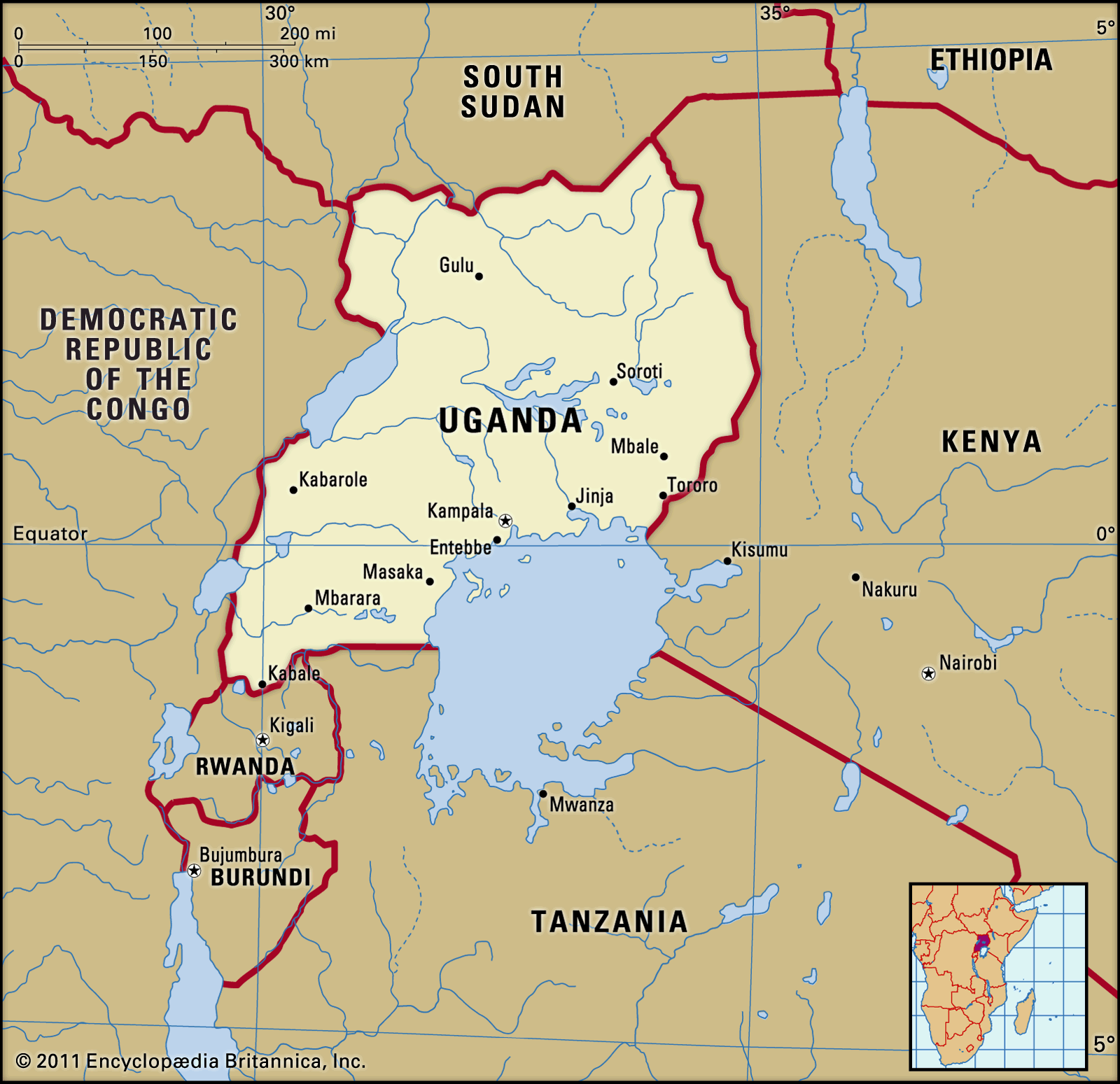
In developing his plot line, Sullivan describes the daily existence in parts of Uganda where a primitive lifestyle full of disease, poverty, and civil war is the norm. At the outset, the main characters are children. Anthony Opoka is a fifteen year old when seized by the LRA, after a wonderful life with his family, particularly his father George, who spends his time instructing his son from an early age to be a good human. Florence Okori, who lived 60 kilometers southeast of Anthony’s village comes from a family that believes in education, and she is a lover of school and her goal in life is to be a nurse. However, nomadic warriors called the Karimojong arrive at her school, strip her teachers and burn all educational facilities. Florence is devastated as she had spent two years surviving a measles epidemic and now she has lost the thing she loves.
Anthony and Florence will meet in captivity and fall in love realizing that they can never go home again. Under the threat of messianic warlord Joseph Kony and his LRA who continue to kidnap children to do their fighting, Anthony and Florence devote their lives to helping their fellow child captives escape bondage and return to their families by relying on their early education by their parents by following the stars.

(Anthony Opoka and Florence Okori)
As the story evolves Sullivan lays out the psychological imprint that the LRA strives for as it brain washes its child recruits. Joseph Kony sees himself as a messiah in the light of Jesus and his own version of Catholicism. Military and mind training are developed through Anthony’s experiences and his friend Patrick Lumumba who saves his former competitor’s life on more than one occasion. The combat experiences are vivid and hundreds of unarmed child soldiers are killed. Dealing with Anthony’s psyche on multiple levels, Sullivan brings out the hidden survival skills taught by his father as he approaches a life as “a good human.” For Anthony, who “not long ago had been a head boy, a top student, a leader, a revered son and brother, a running champion, a young man with a bright future in front of him,” all seem lost as he is absorbed into the LRA. At first, Anthony seems to try and rationalize the benefits of his situation, but after facing combat as an unarmed teenager and a fully equipped soldier his attitude become one of bitterness against Kony believing his youth and promise has been stolen by a man who ruled with merciless fear, killing children or turning children into killers for his own insane ideas.
The situation for child recruits is deplorable as they are used as cannon fodder in the LRA’s war to overthrow the Ugandan government. The back story is clearly laid out as the LRA is allied with the Sudanese government which is threatened by the Dinka tribe in southern Sudan. In return for the LRA fighting the Dinka, the Arab government supplies the LRA with weapons, money, and training. Kony’s rationale is to employ his forces to defeat the Dinka, and once that job is completed take all they have acquired and learned and overthrow the Kampala government.
The story markedly changes when Anthony and Florene are abducted. Their lives were now subject to Kony’s whims and the LRA with so many contemptible rules about all aspects of their existence. Sullivan takes the reader throughout northeast Uganda and southern Sudan as combat rages and the death count rises, particularly among the child warriors. Sullivan delves into Kony’s thought process as the guerilla leader’s goal was to create fighters out of 12 to 16 year old teenagers because their brains were not fully developed, weak, and ready to be brainwashed and trained. His rationality rested on the lack of anything good in their lives. Kony’s convoluted belief system alleged that once they made it through their training ordeal and facing the enemy without weapons they would realize their value to Kony personally and the LRA in general. They would then feel part of a family and a vision of the future which would link them to Kony forever.

(Anthony and Florence on the left, the rest are family and friends)
As time passed, Anthony was accepted into Kony’s good graces as he rose to become his communication officer. Despite his survival, Anthony grew increasingly bitter and angry toward Kony as he witnessed the seizure of thousands of child recruits and their resulting deaths. For Anthony, Kony was a cruel megalomaniac.
Sullivan’s gift is his ability to write about the horrors of events in Uganda and southern Sudan in a manner that allows the reader to tolerate their revulsion as to LRA actions. This is accomplished as Sullivan does not hammer the reader with repulsive descriptions but lays out events as “softly” as possible.
Sullivan introduces and develops a number of important characters that influence Anthony and Florence’s lives. Mr. Mabior, a shopkeeper, educated Anthony as he lay dying and imparts his wisdom concerning the “four voices of suffering;” Mr. Alonsius, Florence’s teacher whose praise created her goal of becoming a nurse; Miss Catherine, a nurse whose care saved Florence from dying from measles; Patrick Lumumba, Anthony’s racing competitor who will become his friend and guide him through the labyrinth of rules fostered by the LRA; Anthony’s father, George offered much needed advice that was the key to Anthony’s survival – “whenever you were confused about what to do, always ask – what would a good human do?” and Josca, Florence’s mother, would always say, “there is nothing stronger than the power of love – whatever the problem, it could be solved by turning to love as the answer.”
The dichotomy of Anthony and Florence’s lives are on full display before and after their abduction. Their eventual love for each other and their children will help them overcome practically anything as they both came from strong loving families, and they maintained the values their parents taught them throughout their lives. Sullivan’s recreation of their life story is at times harsh, warm, with the ability to face and overcome whatever challenges they must confront.

(Joseph Kony and his followers)
Ultimately the novel describes two people who are madly in love, resilient, and the ability to persevere, exhibit tremendous courage, with a high degree of compassion. Their upbringing, family values, and moral code allowed them to survive. It is a story of a spiritual journey taken by two people which resound throughout the novel. Sullivan has authored an impactful story and hopefully his subject matter dealing with child seizures, war, and death will end quickly in areas of Africa.
To conclude, every time I read a Mark Sullivan novel the time expended is rewarding on every level. I hope he is working on his next book which I will read with pleasure. Sullivan continues to tell stories that are inherently moving, inspiring, healing and without doubt extremely meaningful for me and his many readers.
———————————————————————————————————————————————-
After the Ugandan Civil War, Kony participated in the subsequent insurgency against president Yoweri Museveni under the Holy Spirit Movement or the Uganda People’s Democratic Army before founding the LRA in 1987. Aiming to create a Christian state based on dominion theology, Kony directed the multi-decade Lord’s Resistance Army insurgency. After Kony’s terror activities, he was banished from Uganda and shifted to South Sudan.
Kony has long been one of Africa’s most notorious and most wanted militant warlords. He has been accused by government entities of ordering the abduction of children to become child soldiers and sex slaves. Approximately 66,000 children became soldiers, and 2 million people were displaced internally from 1986 to 2009 by his forces. Kony was indicted in 2005 for war crimes and crimes against humanity by the International Criminal Court (ICC) in The Hague, but he has evaded capture. He has been subject to an Interpol Red Notice at the ICC’s request since 2006. Since the Juba peace talks in 2006, the Lord’s Resistance Army no longer operates in Uganda. Sources claim that they are in the Democratic Republic of the Congo (DRC), the Central African Republic (CAR), or South Sudan. In 2013, Kony was reported to be in poor health, and Michel Djotodia, president of the CAR, claimed he was negotiating with Kony to surrender.
By April 2017, Kony was still at large, but his force was reported to have shrunk to approximately 100 soldiers, down from an estimated high of 3,000. Both the United States and Uganda ended the hunt for Kony and the LRA, believing that the LRA was no longer a significant security risk to Uganda. As of 2022, he is reported to be hiding in Darfur.*
*https://en.wikipedia.org/wiki/Joseph_Kony

 Doc's Books