
- (Dimitri Shostakovitch)
There are many historical works that describe the Nazi siege of Leningrad during World War II. The monographs that stand out are Anna Reid’s LENINGRAD: TRAGEDY OF A CITY UNDER SIEGE, 1941-1944; Harrison Salisbury’s THE 900 DAYS: THE SIEGE OF LENINGRAD; and David M. Lantz’s BATTLE FOR LENINGRAD: 1941-1944. All reflect the military strategy pursued by the Germans and the utter devastation they employed. Further, they are well researched and reflect each author’s mastery of the material. Another piece that describes the horrors of the siege, but in a different manner is M. T. Anderson’s SYMPHONY FOR THE CITY OF THE DEAD: DIMITRI SHOSTAKOVICH AND THE SIEGE OF LENINGRAD. The book is the story of the siege, mostly through the eyes of Russian musician and composer, Dimitri Shostakovich, and its impact on his beloved city of Leningrad.
The narrative is different from other works that explore the siege and is a story according to the author “about the power of music and its meanings – a story of secret messages and double speak, and how music itself is a code; how music coaxes people to endure unthinkable tragedy; how is allows us to whisper between the prison bars when we cannot speak aloud; how it can still comfort the suffering, saying whatever has befallen you – you are not alone.”

(Dmitri Shostakovich and second wife Margarita Kainova in the Bois de Boulogne in Paris. May 1958)
Anderson educates the reader as to Shostakovich’s early years and career, reviewing his symphonies and other artistic works. He also provides the reader with the historical background that impacts Shostakovich. Beginning with World War I, the Russian Revolution, the role of Vladimir Lenin, the rise of Stalin and the implementation of the Five year plans, the resulting collectivization of the peasantry, and the purges and “show trials” that were employed to foster blame for the death of millions of peasants. Anderson is able to integrate Shostakovich’s artistic development during the period and his relationships with other intellectuals, artists, i.e., Vsevolod Meyerhold, Vladimir Mayakovsky who would commit suicide because of Stalin’s repressive regime, Boris Pasternak, and the poet Osip Mandelstam who died in a transit camp near Vladivostok.
Interestingly, the horrors that Stalin inflicted on the Russian people in the 1930s did not immediately affect Shostakovich. However, as the decade progressed and intellectuals, artists and poets were sent into internal exile or murdered he realized he would have to deal with the authorities. For Stalin, literature and the arts were the gear and screw of his propaganda machine. Anderson carefully lays out the impact of the new Soviet system on the arts and literature. He describes in detail how writers, musicians, poets, etc. were manipulated by the regime to propagandize the masses, i.e., using symphonies to depict the joys of collective farming!
Shostakovich’s problems began when Stalin attended Lady Macbeth at the Bolshoi for which he had written the score. Stalin was not pleased and complained “that’s a mess, not music.” Shostakovich became a target in Stalin’s war against culture. He was accused of “formalist” crimes which no one really understood as Stalin pushed “Socialist Realism.” Shostakovich was attacked for “being too simple, being too complex, being too light and trivial, being too gloomy and despairing, being too emotional, being too unemotional, including popular dance tunes, neglecting music of the people, tossing out the old ways of the great composers, and following the old ways of the great composers from the pre-Revolutionary past.” The government refused to allow Shostakovich to play his Fourth Symphony in public (it would remain banned for twenty-five years).

(Dmitri Shostakovich with his first wife Nina Varzar, Ivan Sollertinsky (far left), Alexander Gauk, and unidentified. Photograph from the 1930)
The effect of the Great Terror (see Robert Conquest’s book of the same title for a comprehensive look at Stalin’s murderous repression of the 1930s) on Shostakovich’s relatives and friends was immense as some were arrested, some went into internal exile, some were tortured, some were murdered. Shostakovich was listed by the NKVD as a “saboteur.” When Shostakovich’s Fifth Symphony was completed, two members of the Committee for Artistic Affairs stated the “Symphony’s success has been most scandalously fabricated.” As Shostakovich watched everyone disappear he assumed he would be next. The Great Terror was a period of insanity as Stalin even purged the military including Marshal Tukachevsky, the Soviet Union’s most talented general who was murdered. Roughly 60-70% of the Soviet officer corps were eliminated; 27,000 officers were killed or lived in exile in the east. This would come home to roost as the Nazis invaded Russia in 1941 and the Russians offered little resistance at the start.
In the end the Great Terror resulted in eight million arrests; one million shot; and seven million sent to prison camps. As Anderson chronicles the horrors – two million died in camps between 1937-8. The question is how did Shostakovich avoid arrest. First, he was an international celebrity. Second, even though the NKVD paid a great deal of attention to him, gathering a case for prosecution, once the war drew closer it diverted their attention away from him.
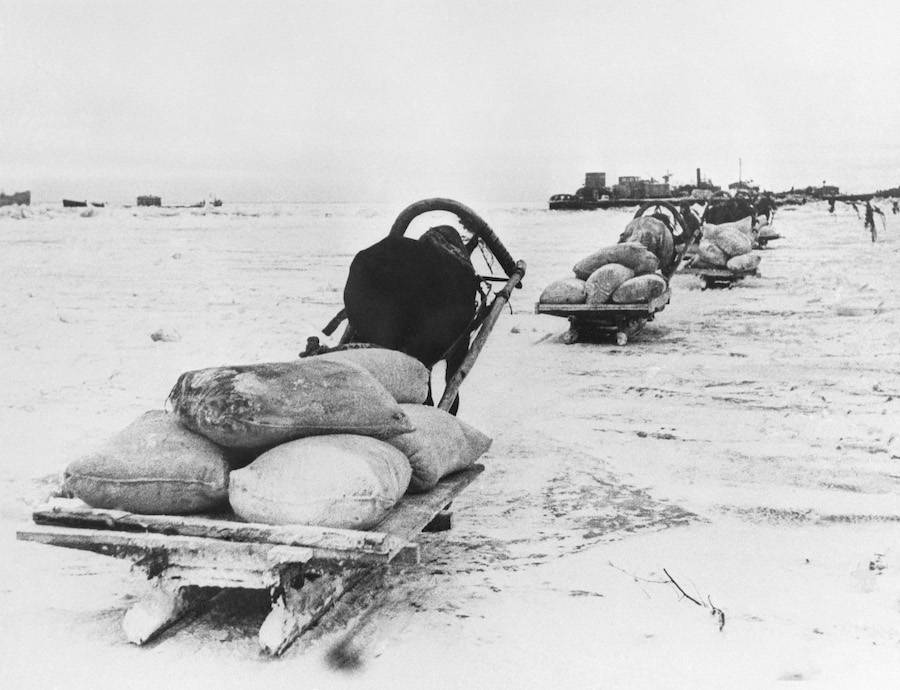
(TASS/Getty ImagesHorses transport supplies to Leningrad over the frozen Ladoga Lake, dubbed the “Street of Life.”)
In part one of the narrative Anderson prepares the reader for the coming of the Second World War. Shostakovich’s life is studied and analyzed in detail. After recounting the impact of Stalin’s terror, in Part II, the author turns his attention to Russia in June 1941 as Germany invades and ultimately Shostakovich’s beloved Leningrad is placed under siege. Anderson lays out Nazi policy toward Russia and Hitler’s desire for lebensraum or living space in the east. Stalin had read MEIN KAMPF, and like Winston Churchill believed that a German invasion was inevitable. Anderson explores Stalin’s coping strategy which culminated in the Nazi-Soviet Pact of August 1939, which failed to stop a Nazi invasion, but in Stalin’s eyes it allowed Russia over a year to prepare. Interestingly, at the same time Stalin could not believe that Hitler would go back on his word as they split Poland in two. The first days of the Nazi invasion were a massacre, and Stalin would disappear for ten days as he could not believe the Russian people would support a murderer, but in reality what they opposed even more was a German murderer. During this time Shostakovich composed music for the soldiers, dug ditches, and became a rooftop fire fighter. Shostakovich and the Russian people believed that “the Nazi barbarians seek to destroy the whole of Slavonic culture.” Shostakovich’s music was designed to remind Russians of the power and legitimacy of their own culture, so slandered by the invading German horde.
Anderson does a wonderful job mining period photographs of the war and the siege of Leningrad depicting the horrors that the Russian people were subjected to over a three year period. Famine, cannibalism, eating corpses, and other demeaning behaviors dominated the people of Leningrad as they tried to survive. Anderson’s chapter “The City of the Dead” explores the dreadful experiences of the Russian people in detail, to the point he explains the differences between cannibalism and eating dead corpses. The city’s population remained about 2.5 million, after 636,000 evacuated. The losses from starvation in part can be blamed on the incompetence of Russian leadership. For example, Andrei Zhdanov and Kliment Voroshilov, the Leningrad city bosses stored all of the city’s emergency food supply in one place, a group of thirty-eight year old wooden warehouses which made it easy for the Germans to destroy massively contributing to the city’s famine. The Nazi nutritionists figured out how much food intake the Russian people would need to survive. Once they decided that there was not enough food supply to feed the city’s residents they stopped bombing the city, implemented a siege, all to save German soldiers, and eradicate the subhuman Slavs. This would drive the Russian people to make many moral decisions dealing with who should live and who should die.
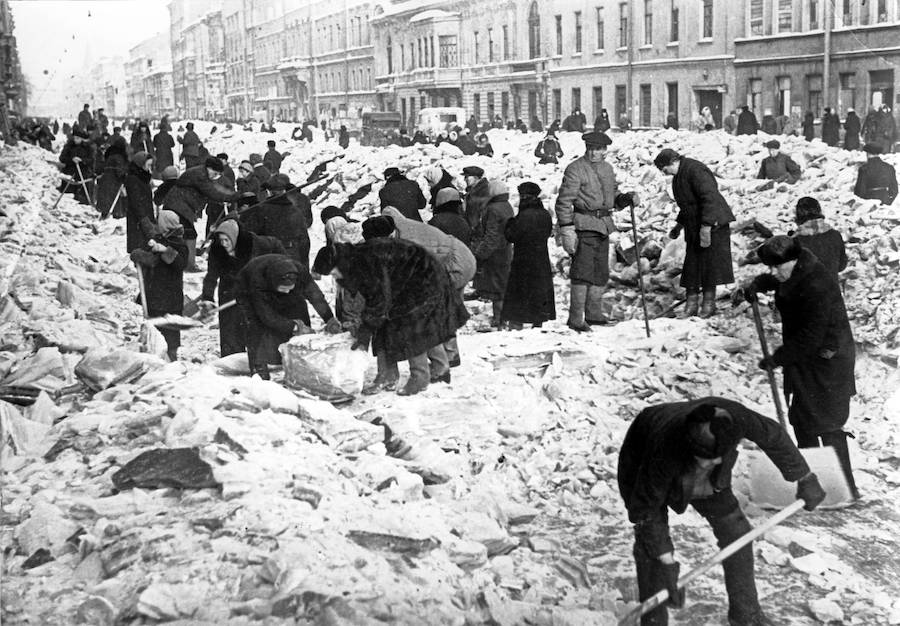
(Sovfoto/UIG/Getty ImagesResidents clearing snow and ice. The city declared a clean-up operation to prevent the spread of disease from scattered feces and unburied corpses)
Anderson follows Shostakovich’s personal journey as he fled Leningrad and settled in Kuibyshev, a Moscow suburb. He decided on his latest symphony; the 7th would be a testimonial to Leningrad’s struggle. He would broadcast for the Radio Committee and worked to raise morale, a key component in any war. This coincided with the turning point in the war as Nazi troops were finally stopped twenty miles south of Moscow, and the Japanese bombed Pearl Harbor bringing the United States into the war which provided massive amounts of equipment, planes, and weaponry. At the same time, December 1941, Shostakovich completed his 7th Symphony. As the symphony was analyzed, was it anti-Stalin, was it anti-Hitler, was it anti Stalin and Hitler or something else. From Shostakovich’s perspective it “was an abstract depiction of the bondage of the spirit; all those petty, ugly things that grow disastrously within us and lead us all in a dance of destruction.” The symphony was dedicated to the people of Leningrad. The playing of the composition had to be put off for months as it required a large orchestra, however, half the number of musicians needed were dead. Anderson’s portrayal of how the orchestra was pieced together and the impact of the concert which took place August 9, 1942, is extremely moving and important, as it showed the Russian people how committed they were to their country as they finally experienced normality for a brief period of time.
Stalin’s regime decided to use the 7th Symphony as a vehicle to cement the United States as a Russian ally and convince the American people to support the Soviet Union. At the outset of the book Anderson describes how a microfilm of the symphony was transported from Russia to the United States “across steppe, sand, sea, and jungle” in the midst of the war. Once it arrived it was performed in New York and Leningrad to try and shift the negative mood of the Russian people and even went as far as placing Shostakovich on the cover of Time magazine.
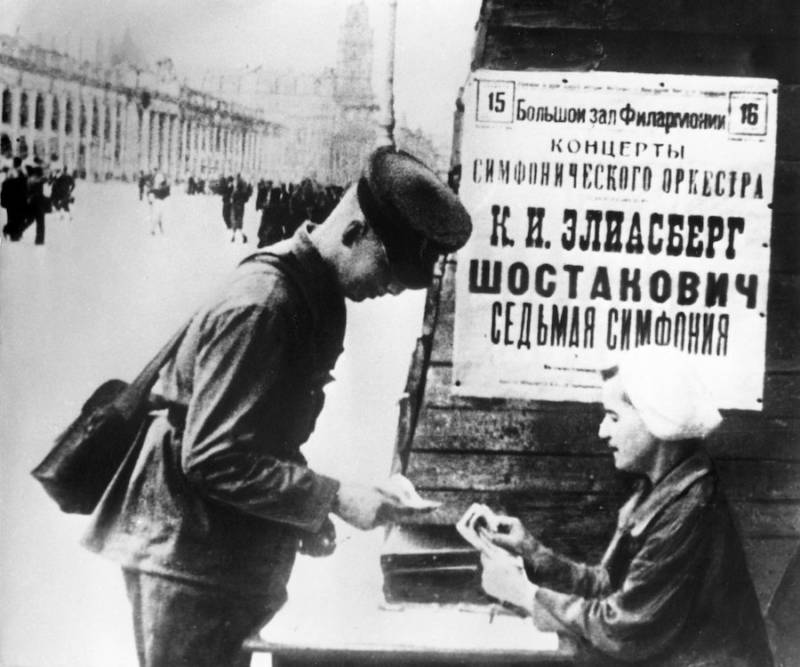
(A soldier buys a ticket for the first concert of Shostakovitch’s 7th Symphony)
If there is one area that the author could have improved upon it is his sourcing. To his credit the photos are remarkable, as are the excerpts from survivor’s diaries, and literary figures depicting the plight of the city. However, too many citations are from secondary sources which Anderson summarizes. But, there is enough primary material available so as to not rely so much on secondary works.
Anderson’s historical portrayal contains all the World War II intrigue of an Alan Furst novel. It tells of the horror of living during a three year siege and describes the physical oppression and daunting foes within and outside Leningrad. This is also a story of survival against impossible odds. Throughout, the author weaves the thread of Shostakovich’s music and the role it played in this appalling drama. Anderson’s writing flows beautifully despite his topic and is a useful tool to explore its subject matter without getting bogged down in minute detail.
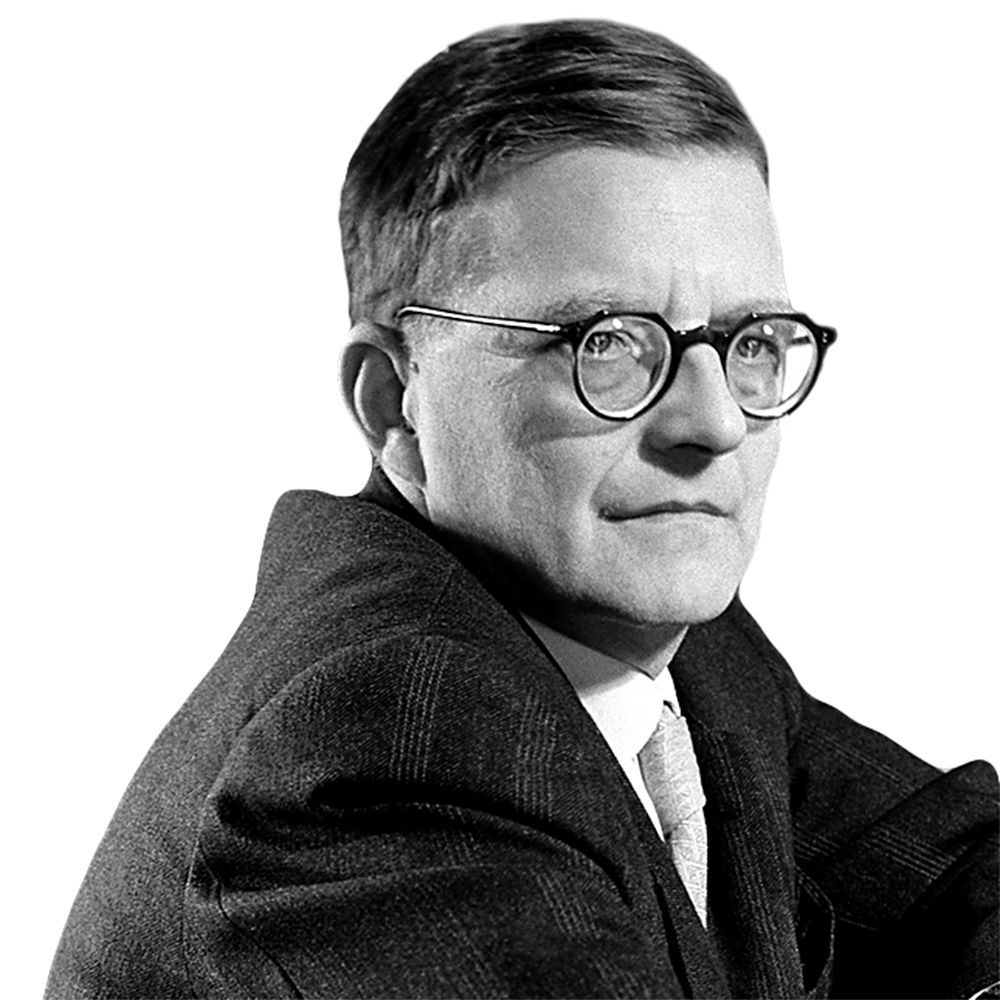
(Dimitri Shostakovitch)
 Doc's Books