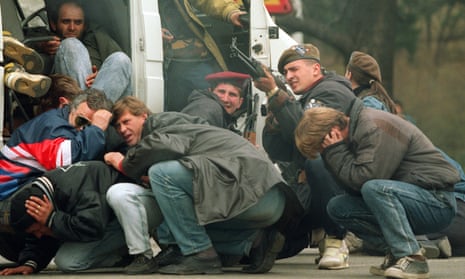
(A Bosnian soldier returns fire in downtown Sarajevo as he and civilians come under fire from Serbian snipers, April 1992)
In the 1970s CIA analysts warned that if Josip Broz Tito, the authoritarian leader of Yugoslavia died eventually the country would break apart and the result would be a nasty civil war. Tito would pass from the scene in 1980, and it took until January 1992 for the Socialist Federal Republic of Yugoslavia to cease its existence, dissolving into its constituent states. Earlier an American National Intelligence Estimate (NIE) 15-90 presented a dire warning; “Yugoslavia will cease to function as a federal state within a year and will probably dissolve within two….A full-scale interrepublic war is unlikely, but serious intercommunal conflict will accompany the breakup and will continue afterward. The violence will be intractable and bitter.”
Slovenia was the first to declare its “sovereignty” in 1990. Croatia followed in May, and in August, the Yugoslav republic of Bosnia-Herzegovina also declared itself sovereign. Soon after, Slovenia and Croatia both declared formal independence on June 25, 1991. Bosnia-Herzegovina declared its independence in May 1992, while the Serbs in Bosnia declared their own areas an independent republic.
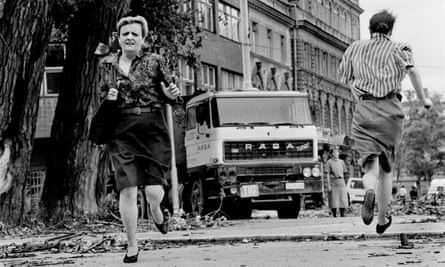
(Women run for their lives across ‘Sniper Alley’ under the sights of Serb gunmen during the siege of Sarajevo. 1992)
Serbia and Montenegro formed a new Federal Republic of Yugoslavia as a successor state to the old Yugoslavia, but the international community did not recognize its claim. Over the next three years war would ensue in Bosnia and Herzegovina claiming hundreds of thousands of lives and displaced millions from their homes, as Europe experienced the most horrific fighting since World War II. One major component of the fighting was the siege of Sarajevo which came about because the Bosnian Serbs wanted to create a new Serb state of Republika Srpska and would encircle the city, located in the southern part of Bosnia-Herzegovina. Starting in April 1992, Serbia set out to “ethnically cleanse” Bosnian territory by systematically removing all Bosnian Muslims, known as Bosniaks. Serbia, together with ethnic Bosnian Serbs, attacked Bosniaks with former Yugoslavian military equipment and surrounded Sarajevo, the capital city. The resulting blockade and the ensuing assault with artillery, tanks, and 500,000 bombs resulted in the death of 13,952 people, including 5,434 civilians. The population of Sarajevo dropped by a third because of the siege which lasted from April 5, 1992, to February 29, 1996, three times longer than the siege of Stalingrad, and a year longer than the siege of Leningrad.
The reasons behind the country’s breakup ranged from cultural and religious divisions between the ethnic groups that made up the former Yugoslavia, including Serbs, Croats, and Muslims. Sarajevo’s 1991 ethnic population consisted of a total of 527,049, including; 259,470 ethnic Muslims; 157,143 Serbs; and 34,873 Croats. In addition, the memories of World War II and the atrocities committed by all sides greatly contributed to the breakup, as did the growing nationalist forces. Another major contributing factor was following the death of Tito in 1980, the provisions of the 1974 constitution kicked in providing for the dissolution of all power away from the federal government to the republics and autonomous provinces within Serbia. The result was that the federal government maintained little control over the country.
This situation forms the background for Priscilla Morris’ evocative novel, BLACK BUTTERFLIES. The story begins as Zora, an artist and teacher, and her husband, Franjo arrive at Zora’s aged mother’s apartment to find three people squatting and refusing to leave arguing that the city government had decided that if a flat was unoccupied anyone could live there. Their daughter Dubravka was married to an Englishman and resided near Salisbury, and they decided to send her mother to visit because of the stress of the situation and her declining health, accompanied by Franjo leaving Zora alone in Sarajevo.
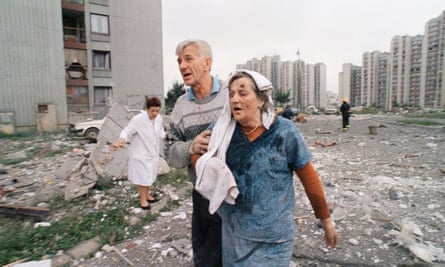
(A wounded woman is helped to get out of her apartment building after it was hit by a rocket fired from Bosnia Serb positions, June 1995)
The novel focuses on the experiences of Zora Kocovic, an artist and teacher at the National Academy of Art and her attempts at survival as Sarajevo is being pounded by artillery and sniper fire by Bosnian Serbs who want to ethnically cleanse the city of Muslims and Bosnian Serbs who do not support them. Zora’s family has left for England and Zora thought it would be safe to remain in the city, but that turned out to be a “pipe dream.” Along with her neighbors they try to navigate a situation where electricity, water, phone lines, and the airport have been cut off and it is too dangerous to walk the street to find food and water because of sniper fire. Bodies lay in the street for days and city services are non-existent.
One of Morris’ most important themes is the importance of art in wartime, particularly those who are suffering. This can be seen in numerous ways. Zora continues to instruct those students who are able to make their way to her flat, even creating an art exhibition out of any material they can employ for the neighborhood. When she runs out of paper and canvas, she and her eight year old neighbor’s daughter Una draw on the walls and paint natural scenes. To further her work, Zora takes her last few coins to purchase art supplies from the wife of an artist who has disappeared.
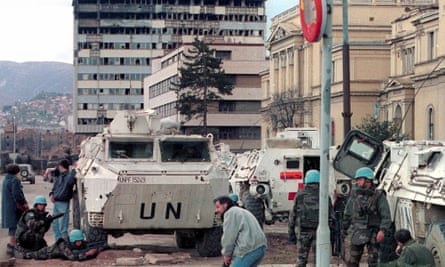
(UN peacekeepers and Sarajevo citizens take cover from gunfire on the city’s infamous ‘Sniper Alley’, March 1993)
Morris’ description of Sarajevo is vividly rendered from its cobblestone streets, grandfathers playing chess outside, the shade offered by the spires of Orthodox churches, and the minarets dating to the Ottoman era. It was a beautiful city before the siege and served as a bridge between east and west based on its multi-ethnic culture and religions. But as the siege begins to take its toll people are reluctant to leave despite the danger for fear squatters would take over their flats, stealing their possessions. Morris uses the dialogue between her characters to shine a light on the ethnic hatred that exists in the city. A comment by Zora’s neighbor Vensa, an orthodox Christian is emblematic of how people feel, she says to Zora; “But God, I’m terrified, aren’t you? Day by day, Sarajevo is becoming more Muslim.” Zora visits her Uncle Vuk who believes that the Muslims want an Islamic state, and Serbs would then be treated as if the Ottoman Empire were reconstituted. This leads to constant anxiety among her characters as she goes on to describe “Bosnian Serb snipers lying behind sandbags on the tops of buildings and taking aim at people in the street below as if they are sparrows.”
Serb nationalists cannot accept that people like Zora want to go on living with Muslims and Croats as they have always done – historically, Sarajevo was always seen as a model of tolerance. The situation is very trying for Zora. Her studio was her sanctuary, but once Bosnian nationalists banned it, she hurried to recoup as much art supplies and her paintings as possible, but they would soon run out. Zora becomes further depressed when she was promised a seat on a UN bus leaving the city and at the last minute it fell through.

In one of the most poignant scenes in the book is also its title, Zora and her neighbors are outside when it seems to be raining black puffs of paper. In reality it is paper from books that have been destroyed from the National Library by the shelling. They refer to the paper flying around as “Black Butterflies.” For Zora, her national heritage has been destroyed. She states, “Zora Kocovic, the painter, is dead.” Her survival rests on her relationship with her neighbor Mirsad, who owns a bookstore and his son Shamir, who has joined the anti-nationalist forces. Their camaraderie, along with other neighbors, becomes the core of each other’s existence. The people become their own family, and their relationships carry them through the harshest aspects of the shelling. They create a sumptuous meal for all in Zora’s flat, they work to find a phone that works so Zora can speak with her daughter in London, Zora cooks pigeons, spending money needed for art supplies to buy garlic so she can cook for all, among other examples. Even when Zora falls in love with Mirsad, which occurs after many seasons of mutual suffering, it is a love doomed to fail as the conflict rages on, as it is born out of proximity and trauma and the constant fear of loss, rather than a betrayal of her husband in England.
Morris takes a narrow approach in developing her story and toward the expanding fighting. Her focus on Zora and her compatriots allows her to keep the burgeoning war in the background as she focuses on the daily travails of her characters. According to Malavika Praseed in her August 28, 2024, book review entitled, “Rebirth Amongst Despair in “Black Butterflies” in the Chicago Review of Books; “While it is easy for a book of this nature to end either in soul-crushing despair or unrealistic optimism, Morris is savvy in her story craft and chooses neither. This is true to Zora’s character arc compared to her life arc; while the former ends, the latter must continue in new circumstances and with new knowledge of the suffering that came before. It is also true to the Bosnian genocide as a whole, which only just begins in Sarajevo and escalates to a multi-year conflict with an Islamophobic focus. Nevertheless, Black Butterflies is both a historical portrait as well as a character one, with emphasis on the latter. Morris understands her intent, to tell a single story touched by many other characters, but still unmistakably Zora’s, instead of widening her scope and losing tender moments and pinpoint detail in the process.”
Further, Bea Seaton wrote in the New York Times on September 3, 2024 ,a view I agree with wholeheartedly; “This is a dark novel that wrests beauty and hope out of suffering. It is a work of literature that transforms horror and violence into a life force.”
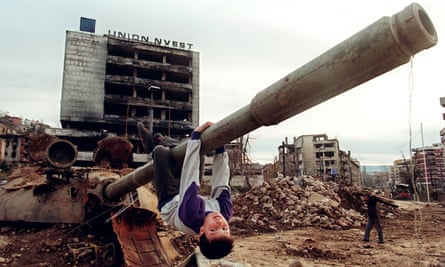
(A boy playing on a tank in the Sarajevo neighbourhood of Grbavica, April 1996)
 Doc's Books