
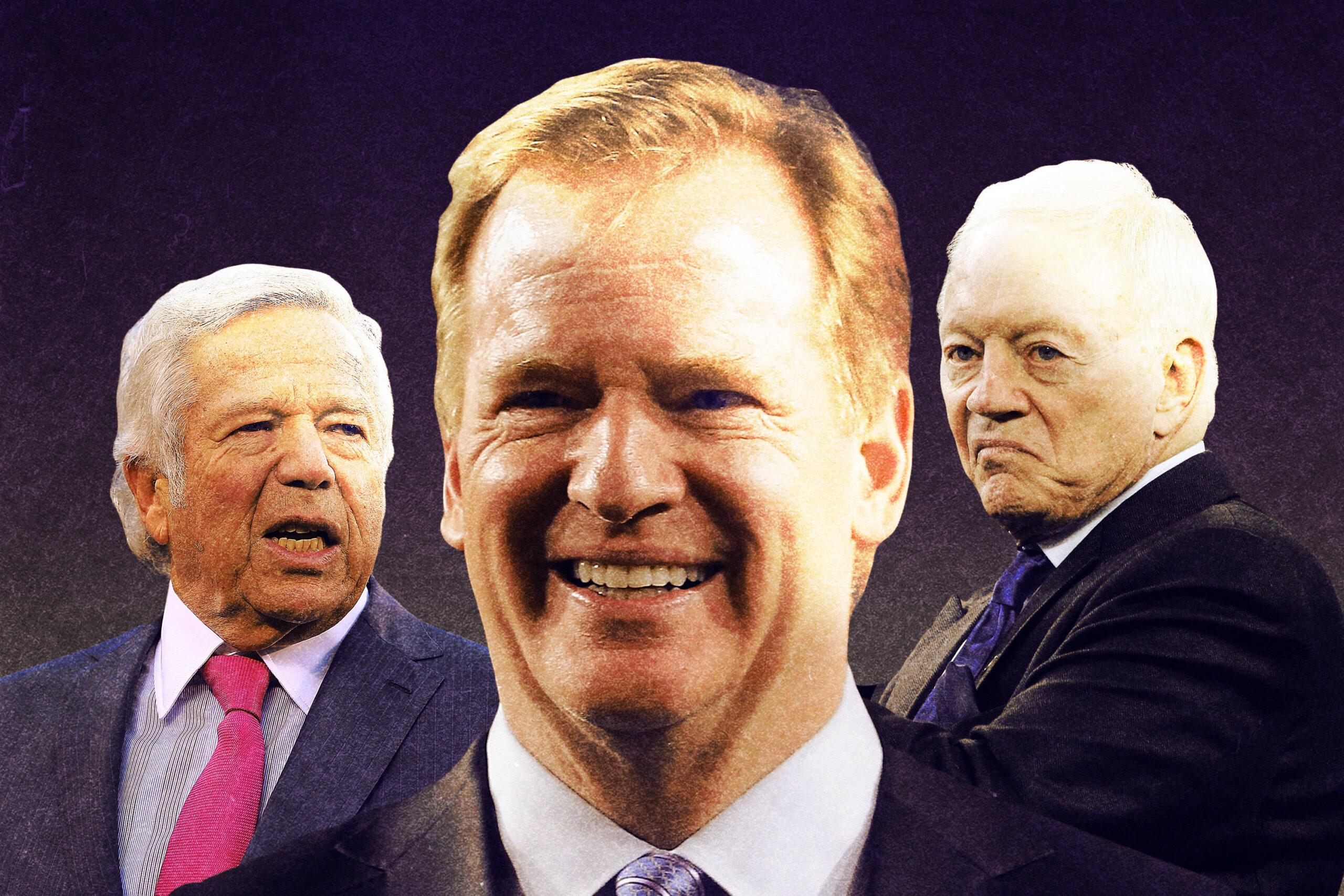
(Robert Kraft, Roger Goodell, and Jerry Jones)
Major league baseball used to be considered America’s pastime. Sometime in the early 1990s after a number of decades the National Football League overtook baseball as the dominant spectator sport in America. Professional football always seemed to be in the news, even out of season with collegiate combines, the draft, off season practices, training camps and of course the season that lasted from July through February. The coaching carousel, which today is in full swing, trade speculation, sports betting, player safety, new stadiums seem like normal dinner time conversation, in homes, bars, and elsewhere. How did football achieve this exalted position in American culture and maintain it? According to New York Times business writer, Kris Belson in his new book EVERYDAY IS SUNDAY: HOW JERRY JONES, ROBERT KRAFT, AND ROGER GOODELL TURNED THE NFL INTO A CULTURAL AND ECONOMIC JUGGERNAUT the credit falls to a group of NFL owners who remade the league by taking a low scoring game dominated by defenses into a high scoring game dominated by unheard of athletic skill and controlled violence perfectly matched with a media revolution that is constantly seeking new content. Benson’s narrative is an entertaining examination of what he has labeled “an immensely profitable American religion.”

(Paul Tagliabue and Gene Upshaw)
The book itself is more than mini-biographies of the three figures mentioned in the title. It explores the growth of the league going back to the 1960s and brings its focus to the 1980s onward emphasizing certain watershed dates and deals. Other figures aside from Jerry Jones, Robert Kraft, and Roger Goodell emerge as important to the leagues growth and success and Benson is able with his many contacts and deep research to formulate a number of important themes that dominate the book. They include a fascinating description of the evolution of NFL owner cliques that made the decisive decisions that led to the league’s unparalleled success – even describing how they fought for certain chairs at league meetings like a high school cafeteria. Certain personalities dominate but Benson’s thematic approach includes the growth of billion dollar stadiums and their financing, labor negotiations that allowed the league to take off financially, rules changes that altered the game into high scoring entertainment, and how the owners policed themselves to avoid renegades like Al Davis and Dan Snyder to impact league decision making.
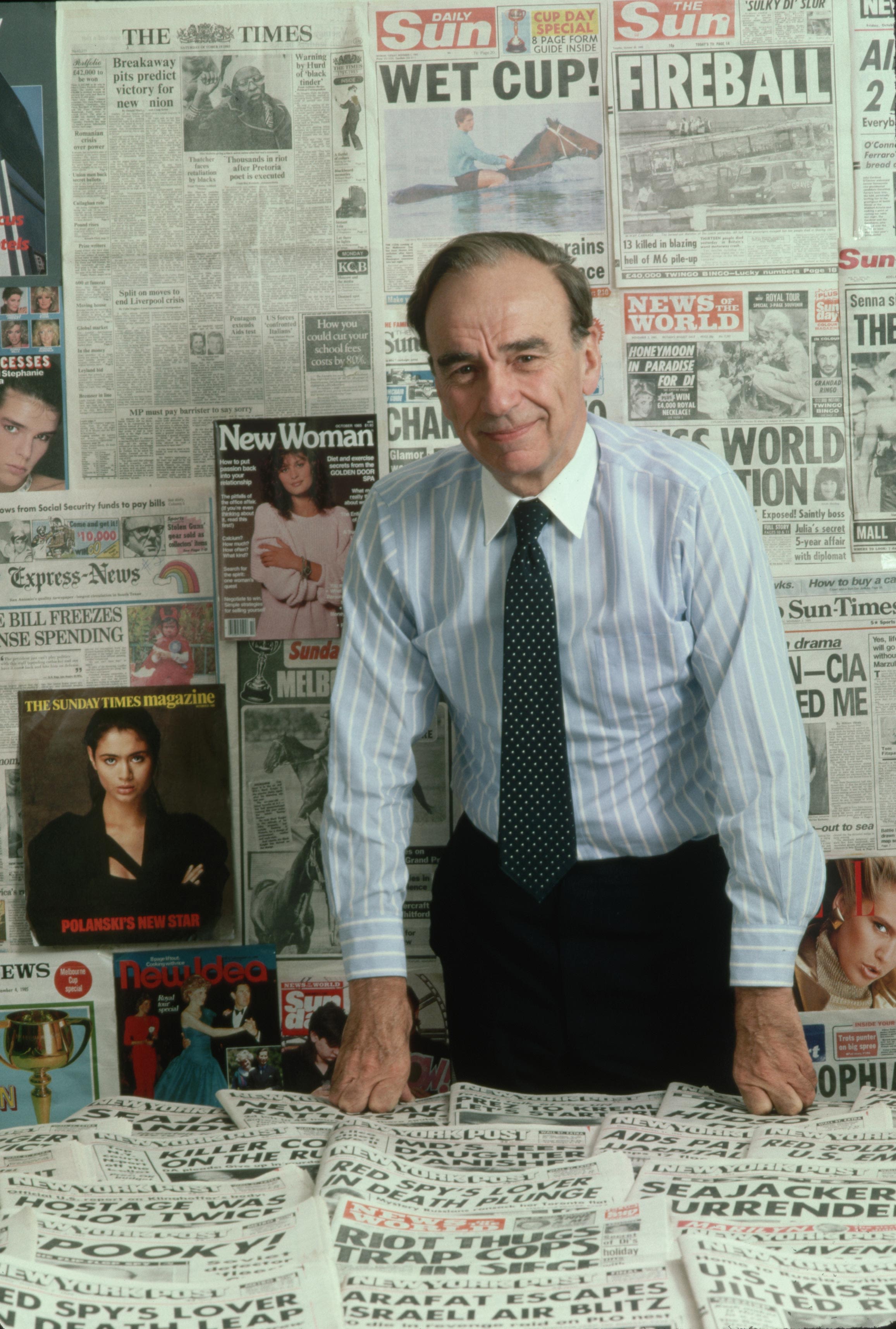
(Robert Murdoch)
Almost immediately Benson describes the NFL as more than a “sports league, it was an immensely profitable religion, complete with acolytes, pomp, and tax breaks.” Benson is correct in arguing that 1989 is a watershed date for the league as then commissioner Paul Tabliabue worked with players union head, former Oakland Raider offensive lineman, Gene Upshaw and owners like Dan Rooney of the Pittsburgh Steelers to craft a new revenue sharing agreement with a salary cap and free agency which still provides the economic foundation for the league today. It was also at this time that Jerry Jones and Robert Kraft entered the NFL as owners and over the next thirty years built their teams into two of the world’s most valuable franchises and had a hand in every financial decision the league made. Their partner in this endeavor was Roger Goodell, who craved being commissioner his entire adult life who always took a maximalist approach to growing the NFL.
Goodell and the owners have turned the league into a 365 day a year enterprise through record setting deals with networks and sponsors, and other businesses that have taken black Friday, Christmas day, and other sacrosanct holidays and turned them into NFL showcases. Further, the Draft has morphed from a sleepy event for football addicts that now draws hundreds of thousands of fans, the NFL even unveils its schedule on prime-time television – there is no off season. As a result, Benson is dead on when he states, it is highlighted by “measures of greed, corporate welfare, violence, misogyny, self-promotion, and bland officiousness.” The violence of the game and its resulting injuries that linger throughout the player’s lives is not the focus of fans as games are too much of a narcotic. Even the offseason provides drugs to feed the fan’s fix as owners created NFL films, NFL network and radio, with talking heads drawing fans in.
Benson describes in detail the labor deal of December 1992 that altered the trajectory of the league as it provided free agency for the players after five years in return for a salary cap and the credit goes to Tagliabue and Upshaw who got their constituents to agree to an almost 50/50 revenue sharing document. Of all the personalities not mentioned in the title perhaps the most impactful is Robert Murdoch the head of FOX television. It was Murdoch who watched his Sports subscription service in Britain through Sky sports showing Premier League matches and its success in attracting viewers and revenue who applied the model to the NFL, creating the FOX sports network. Benson explains how Murdoch outbid CBS, hired their football group, hired announcers like John Madden and Pat Summerall, created the glitzy pre and post-game programming in eight short months that created the foundation for the NFL to cash in on media revenue. Despite the fact, Murdoch overpaid in every area, Benso refers to him as a genius if one looks at the results of his actions.

(At & T Stadium)
Benson seems to have a handle on all the major issues that impacted the NFL over the last three decades. From spy gate and deflate gate involving Kraft’s Patriots to the problem the NFL had with women due to players like Ray Rice who was caught beating his girlfriend. Benson takes a deep dive into the misogyny that afflicted the NFL and how reluctantly they remediate the situation through suspensions and fines as it needed to tap the female market to enhance its profitability – a term that dominates everything Goodell and the league are obsessed with.
The game of musical chairs conducted by teams is a highlight of the book as owners like Art Modell sneaked his Browns out of Cleveland in the middle of the night to become the Baltimore Ravens. The movements of Al Davis’s Oakland Raiders from Oakland to Los Angeles and back, then Las Vegas is a fascinating story as are the Los Angeles Rams move to St. Louis leaving the second largest market in the United States without a football team. In the end there would be two teams in Los Angeles, expansion to Charlotte, Jacksonville, Nashville, and Cleveland which would bring the owners billions of dollars into a system that is socialist in nature. Roger Goodell, who replaced Tagliabue as commissioner in 2006 navigated the franchise game and in the end justifies a salary which approaches $60 million per year.
Perhaps the most important aspect of the monograph rests on the health of the players after they retire. The policy as with all things for the NFL was profitability. When Mike Webster died at age fifty of Chronic Brain Encephalopathy (CTE) and Junior Seau committed suicide at age forty-three the league would have to take notice. Benson argues that CTE was one of the rare existential threats to the league. His deep research into settlements and attitudes is eye opening as the NFL showed its true colors offering only $765 million to compensate players for ALS, Alzheimer’s and other illnesses without a trial or an admission of guilt. Eventually more money became available as post career disabilities other than head trauma were added. The depth of Benson’s discussion is highlighted by a 2020 discovery by lawyers that black players who filed dementia claims were denied more often than white players. The root cause was algorithms designed to estimate a players cognitive abilities years before they joined the NFL. The algorithms assumed Black players were less intelligent in theory and looked less demented later in life, so they did not qualify for restitution!
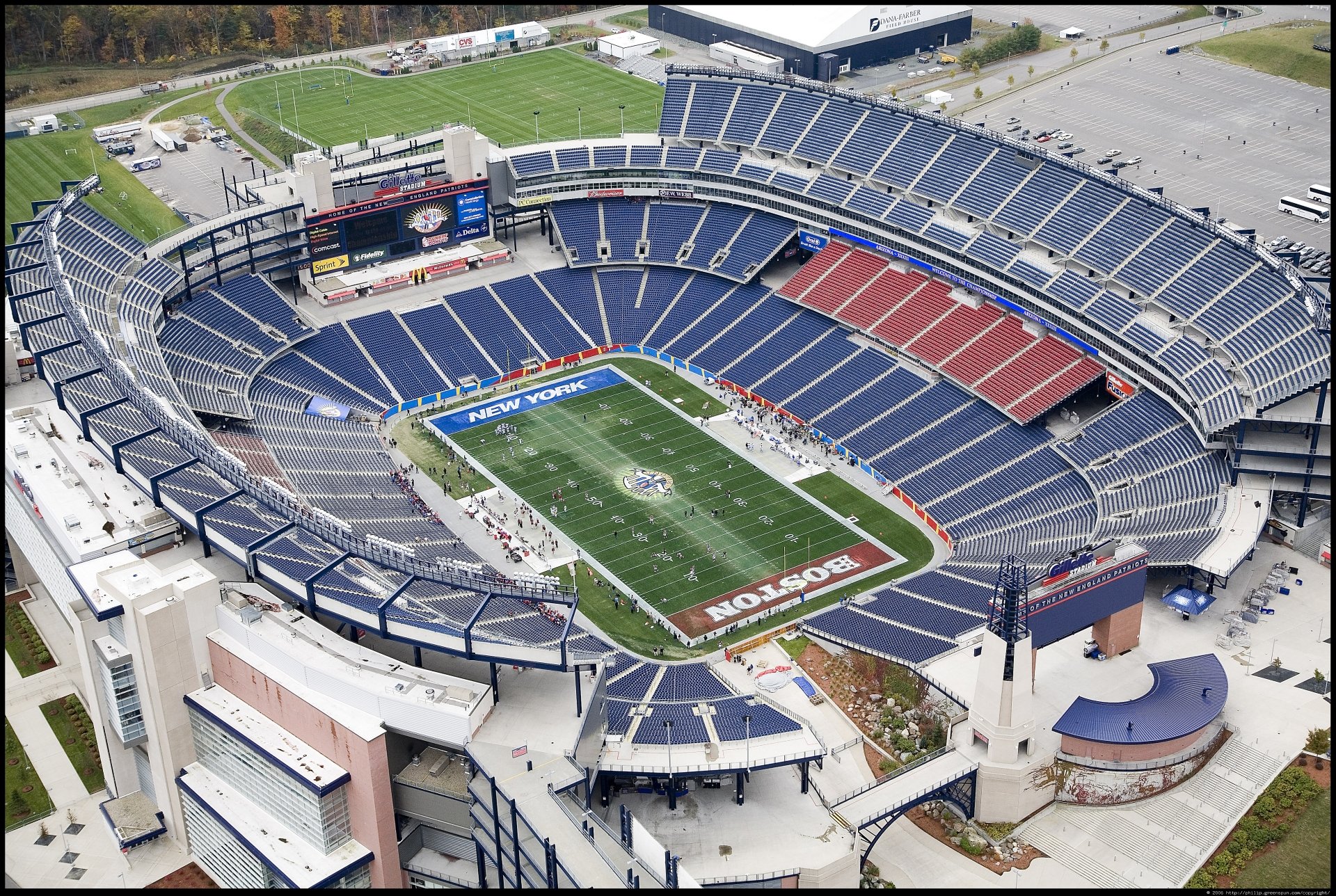
(Gillete Stadium)
Another important issue that Benson explores, second to CTE in terms of the impact on the league’s bottom line, centered on San Francisco quarterback Colin Kapernick’s protest over social injustice resulting in players kneeling when the national anthem was played. Benson’s chapter analyzing the motivations and machinations of the owners who grew very uncomfortable with the situation when President Trump injected himself into the controversy does not reflect well on league executives. Trump’s interference exacerbated the situation, and the owners were mostly concerned with the impact on their bottom line. Benson relates the important roles played by Kraft and Goodell in defusing the conflict and reaching an accommodation that resolved Kaepernick being “blacklisted” by owners who were tone deaf when it came to issues of race. As usual the resolution of the issue centered around the owner’s, as per usual, throwing money at the problem in the hope the league and the players would move on.
The league is forever seeking new streams of revenue and after years of warning players about gambling on games (the Paul Hornung and Alex Karas cases of 1963 come to mind) they are now in bed with Caesars, Draftkings, and Fanduel – which operate in a number of league stadiums. Since the league is based on an addiction to the game, another addiction to gambling as a threat does not seem to bother them. Goodell’s rationalization is that “we didn’t support making it legal…but we just have to adjust to whatever the law is.”
Benson has written a marvelous expose of the NFL and the men who drive profitability. It does more than point out the negative aspects of decisions and Benson does devote pages to charities that men like Kraft, Jones, and other owners donate to. Despite this it seems when the league donates money for spousal abuse, CTE research, civil rights issues etc. it is doing so more as a marketing strategy rather than actually alleviating a basic problem fostered by the league.
 Doc's Books