
With the recent American incursion into Venezuela to capture the country’s dictator Nicolas Maduro and President Trump’s comments that the United States was now in charge of the South American country the situation has reintroduced the terms “nation-building,” and “forever wars” into the American lexicon. This has fostered memories of our twenty year war in Afghanistan along with thoughts of loss of life and treasure. Lyse Doucet, a Canadian journalist and the BBC’s chief correspondent’s new book, THE FINEST HOTEL IN KABUL: A PEOPLE’S HISTORY explores the war in Afghanistan from a novel perspective that being the staff and guests of the luxury Hotel Inter-Continental Kabul which opened its doors in 1969. Doucet presents the views of many individuals she met after first checking into the hotel in 1988. From inside the hotels’ battered walls she experienced events until 2021 when the hotel finally shuttered its doors for good. From her perch in the hotel, she weaves together the many stories of Afghans who kept the hotel in business despite the violence, political corruption, and death that seared their lives. Doucet’s approach is richly imaginative as she narrates the war through the eyes of those people who worked in and passed through the hotel for over two decades.
Doucet first traveled to Kabul in 1988 to report on the Soviet withdrawal from Afghanistan. From that time, she developed relationships with a myriad of characters who worked at the hotel or were its guests. She reports that most people have lost old photographs, videos, or written documentation of the period because of the brutal aspects of Soviet rule, civil war and living under the Taliban. However, one thing they maintained was their memories which allowed them to relate their experiences as the hotel tried to maintain its decorum and care for its guests under rocket fire, suicide bombings, or terrorist incursions into the hotel itself.

(A waiter at the Inter-Continental Hotel in Kabul)
Doucet does a remarkable job reporting on the lives of her subjects tracing the evolution of their attachment to the hotel at the same time events transpired in Kabul and its environs which they had no control over. Doucet lets the reader know what her subjects are responding to on a daily basis, but the war itself does not overwhelm the stories of the many people who remained loyal to the Inter-Continental hotel.
Each individual that Doucet presents seems to possess the Afghan sensibility to humanity expressed by empathy and doing the best for others in situations that most would give up on. She explores the daily lives of the hotel’s staff, their families, survival, and their hopes for peace in the future. She begins with the threat of the Taliban’s return in 2021 as the United States withdraws its remaining troops under the Biden administration and the fears it produces, then she turns back the clock and begins to introduce the hotel’s staff juxtaposed to political and military events in the Kabul region.
Among the most important individuals she introduces is Hazrat, who in his early twenties comes to work at the hotel during its glory years of the 1970s. He would begin his career as a busboy who would earn a certificate from the Department of Vocational Education at the Royal Ministry of Education. Hazrat’s would be the focus of many events that Doucet reports upon. He would moonlight as a bartender, which is interesting in a Moslem country. The author follows Hazrat’s promotions within the hotel hierarchy as a tool to describe the events in Kabul throughout his five decades at the hotel. He would join the housekeeping staff in 1978 and eventually would be placed in charge of maintaining the diverse floors of the hotel. He would develop an intimate knowledge of the hotel, its repeated refurbishing and rebuilding due to the war over the decades. It would come in handy decades later in 2018 when three Taliban gunmen smuggled weapons into the hotel and proceeded to kill and maim staff and guests indiscriminately. He and two younger staffers were able to escape because of Hazrat’s knowledge of a closet with wide steel piping where they could hide.
(Guests being served at the Intercontinental Hotel)
The author integrates her mini-biographies and the attendant stories seamlessly throughout the narrative interspersing events that affected the lives of staff and the general Kabul population over the decades. She reports on the December 1979 coup that would lead to the Soviet invasion and ten years of war against Moscow and the growth of the mujahedeen armed by the United States who eventually defeated the Soviets. The brutality of the war is presented clearly, but not in the usual political and military fashion. Once Soviet Premier Mikhail Gorbahev announces in 1991 that Russia would no longer provide food and fuel to the Afghan people it would engender a decade of civil war that would produce the Taliban, a group of former mujahedeen who grew tired of the factionalism, warlordism, corruption, and violence that permeated Afghanistan during the period. 9/11 would become the watershed for the next twenty years as the United States and its Afghan allies would invade, defeat the Taliban, and install the corrupt regime of Hamid Karzai, a former mujahedeen, but a pragmatic and personal individual. Doucet keeps these events in the background as she describes the plight of the hotel staff and the hotel itself.
Doucet exhibits a sense of humor despite the horrors she reports on. A prime example is how warlord factionalism leads to so many governmental changes particularly as the Soviet took control. Afghani leaders from the 1970s onward have overseen a period of intense volatility, shifting from monarchy to republic, communist rule, civil war, Taliban fundamentalism, and democratic transition. Key figures include Daoud Khan (1973–1978), who established the first republic; the PDPA communist leaders Nur Muhammad Taraki, Hafizullah Amin, Babrak Karmal, and Mohammad Najibullah (1978–1992); Mujahideen leaders such as Ahmad Shah Massoud and Burhanuddin Rabbani (1992–1996); Taliban leaders Mullah Omar (1996–2001) and Hibatullah Akhundzada (2021–present); and post-2001 presidents Hamid Karzai and Ashraf Ghani. Each time a governmental leadership change took place the hotel workers took out hammers and nails and replaced portraits with new leadership photos which would adorn the hotel on a seemingly regular basis.

The hotel served many functions throughout. During the early 1980s about 85,000 Soviet troops fought in Afghanistan and more and more Soviet generals wanted to use the hotel as a command post. Over the years the hotel served as a base for journalists, diplomats, and even the calling of the first Afghan Loya Jirga (Grand Assembly), a traditional, large-scale national gathering of elders and leaders to make critical decisions for Afghanistan which met for the first time in decades in 2002 which elected Hamid Karzai. The hotel was also a multi-purpose site as weddings and other family events took place if the political and military situation allowed.
The author does not shy away from the damage caused by war as entire villages are levelled by the Soviet Union’s carpet bombing. Villages were then looted by rampaging rebel troops, weed tangled fields were infested by land mines, the coercive beatings and torture of local villagers, all resulting in death, lost limbs, and the destruction of the fabric of Afghan society.
The role of the mujahedeen is carefully explored paying special attention to their view of modernity as it applies to the hotel itself. The staff was used to portraying photographs, music, video, women interacting with men, and many other aspects of life that Islamists found reprehensible. The staff, like many Afghans made the best of their situations and adapted as best they could to whoever was in charge. Doucet describes how hotel staff tried to maintain decorum and service it was known for even as they were confronted by mujahedeen. The factionalism of the 1990s saw fighters repeatedly stripping the hotel of its contents as Hazrat and his compatriots mourned the perceived death of their place of employment which was their second home. Eventually Hazrat and his family were hit by rocket fire at their home resulting in severe injuries to Hazrat, the death of his brother, but the survival of his daughters.
The hotel itself was seen as a safe place after many renovations from war damage and the implementation of extensive security measures. However, no matter what precautions were taken the hotel and its staff could not escape the horrors of war. For most of the 1990s the hotel suffered damage but nothing that would close it down as by 2008 Kabul’s street had become an armed fortress. However, on June 28, 2011, nine suicide bombers hit Kabul and the hotel. The hotel was full of wedding guests with a separate security conference taking place. Ten would die and many were wounded in the carnage. It took place a month after Osama Bin-Ladin was killed and President Obama announced a timeline for American withdrawal. This attack was seared into the memories of the Hotel’s staff, which was again victimized in 2018 when three gunmen went floor to floor killing people as described by Hazrat.

(Taliban at the Intercontinental Hotel Kabul)
Doucet’s portrayal of Mohammad Aqa is an excellent source and his life is a microcosm of the hotel’s plight over the decades and Afghanistan in general. Throughout his career he was able to maintain his waiter’s graceful bearing and air of authority which no one could deprive him of, even after serving in the Afghan army between 1991 and 1994. The easy optimistic air under the leadership of Karzai beginning in 2002 would shortly give way to greed, and in 2016 further the tension which was endemic to the rule of Ashraf Ghani.
The situation in the hotel called for constant repairs. The man who would later be known as “Mr. Fix-it,” Amanullah provides a different perspective as the hotel tries to survive and outlive the fighting. For Amanullah and others, the hotel is more than mortar and steel, it is a living structure that belongs to its workers who have given their lives for its survival. Amanullah was a laborer at the hotel until serving in the Afghan army and when he returned in the early 1990s he held numerous roles including “income auditor” as there was no one else. Amanullah would graduate from the Polytechnic Institute and would marry his sweetheart, Shala in the hotel’s ballroom which ended early as there was firing from the heights above the hotel. As the war kept damaging the hotel, Amanullah was put in charge of repairs and after an Abu Dhabi businessmen financed renovations, Amanullah traveled the region securing parts and overseeing reconstruction.
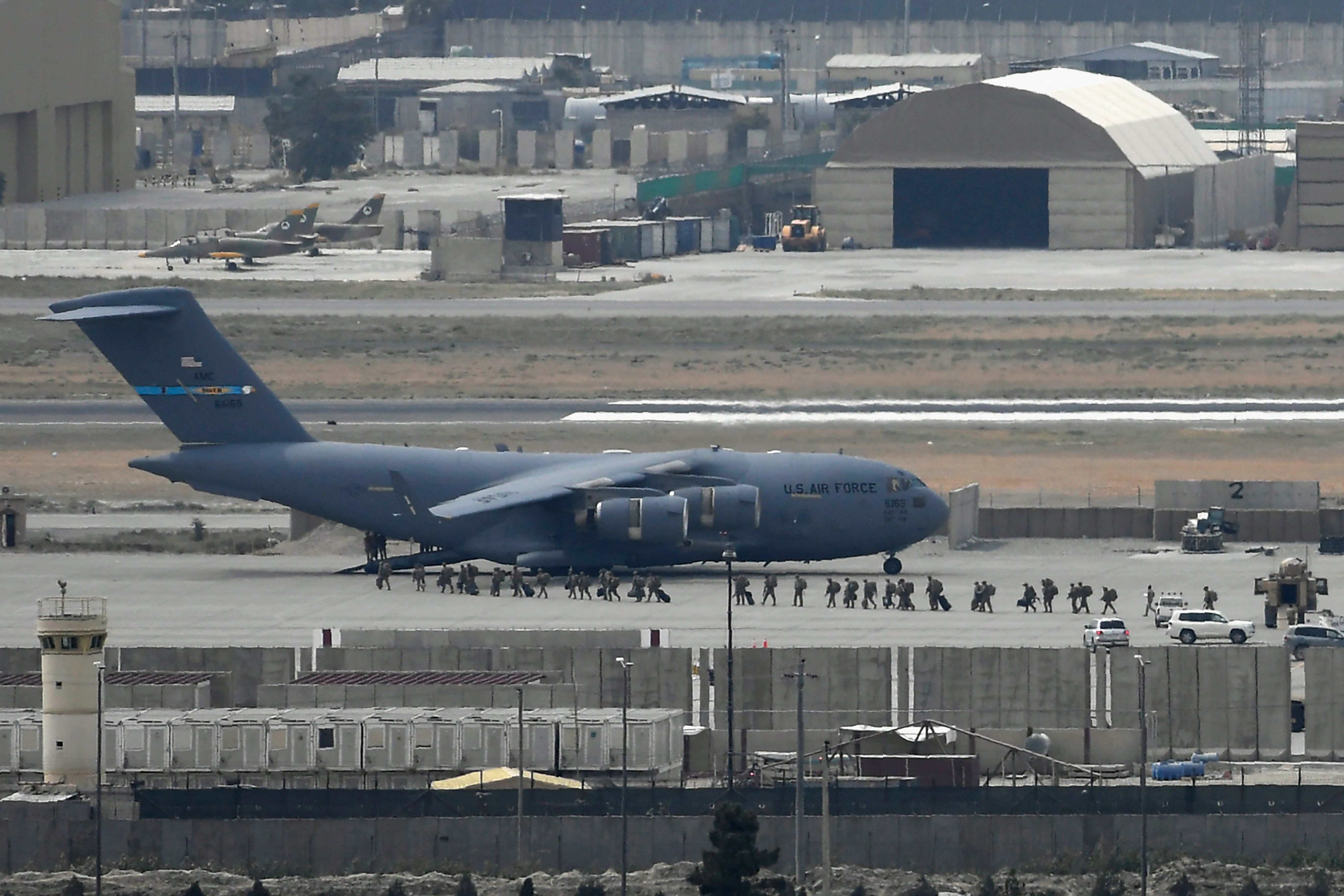
(American soldiers board a U.S. Air Force aircraft at Kabul’s international airport on Aug 30)
Doucet relates many horror stories as Afghans tried to survive. Perhaps the most poignant involved families trying to leave Kabul as the last flights out of the city took place as the Americans withdrew and the Taliban took over once again. Stories like Abida Nazuri whose life story reflects the lack of rights for women and her battle to support her family after a life with a husband who was thirty years older from an arranged marriage, the burden of supporting seven children after he died, and her quest to become a chef at the hotel are all impactful. Through Abida’s experiences we witness the chaos and inhumanity of the American withdrawal and the Taliban takeover that saw continued fighting, suicide bombers, and rocket attacks as people tried to escape the war zone for freedom. In the end Abida and her family did not escape.

The arrival of the Taliban was described by hotel staff in 1996 and again in 2021. Talibs ransacked the hotel repeatedly and the staff did their best to accommodate them. Portraits of the different Taliban leaders are presented, the most important of which is Mullah Mohammad Omar, the “commander of the faithful.” But the most important personalities in the book are the staff and Doucet does justice to the memory of those who did not survive and those who did. As Doucet writes about the 2018 attack; “in just one night, more of the hotel had been destroyed than all the war-torn decades gone by….the ruin didn’t stop at marble, wood and steel. The hotel’s people were broken.”
As Amy Waldman writes in her November 30, 2025, New York Times Book Review; “It’s those people who haunted me after I closed the book. They are at the mercy of the power hungry. They may believe their fate is in God’s hands. Yet their sheer determination to survive, to feed and house their families and keep them safe, and to improve their children’s chances, never flags. If their absence of flaws doesn’t ring completely true, Doucet’s choice to highlight their ordinary heroism in this deeply felt account is understandable.”
 Doc's Books