
(People walk in snowfall on Red Square in Moscow, Russia, on Nov. 15, 2022)
By 1991 Russian President Mikhail Gorbachev had resigned, a coup failed to bring conservatives back to power, and Boris Yeltsin would lead the new Russia through a period of corruption and kleptocracy that by the end of the 1990s saw the former Soviet Union at a precipice. Would it continue to try and improve relations with the west, or would it turn inward? However, a watershed moment took place as Russian President Yeltsin resigned on December 31, 1999, and appointed Vladimir Putin as acting head of the government. According to historians Philip Short, Steven Lee Myres, and Catherine Belton, that behind the scenes Putin, after serving as the Director of Federal Security Service (FSB) and as Secretary of the Security Council, had cut a deal to protect Yeltsin and his family from any criminal charges emanating from his presidency, and that Yeltsin resigned in order to give his protégé a leg up in the coming presidential election to insure that protection.
Once Putin was elected and took firm control Russia engaged in a series of wars, first a massive military invasion and occupation of Chechnya to restore federal control which lasted until 2009. By 2008, Putin had decided that moving closer to western economic interests was not going to be Russia’s future and invaded Georgia in support of separatist regions of South Ossetia and Abkhazia. The five day war resulted in Russian occupation of these territories which are internationally recognized as part of Georgia. According to Andrei Soldatov and Irina Borogan in their new book OUR DEAR FRIENDS IN MOSCOW: THE INSIDE STORY OF A BROKEN GENERATION by 2011Putin came to an understanding that globalization with its ideas and technologies was the major threat to Russia and him personally. Since 2011 Russia engaged in a series of actions and maneuvers to detach Moscow from the West. In 2014 in response to Euromaidan protests, Russian forces took control of the Crimean peninsula. In addition, Russia initiated a war in the Donbas region of eastern Ukraine, supporting separatist forces. On February 24, 2022, Putin unleashed a large-scale invasion of Ukraine with the goal of quickly toppling the Zelensky government in Kyiv and installing a regime that was pro-Russian and would not make any moves toward the European Union or NATO. In a few weeks, the war will enter its fourth year and no matter the pipe dreams of Donald Trump it appears Putin has no inclination toward making peace particularly as American support for Ukraine has eroded.
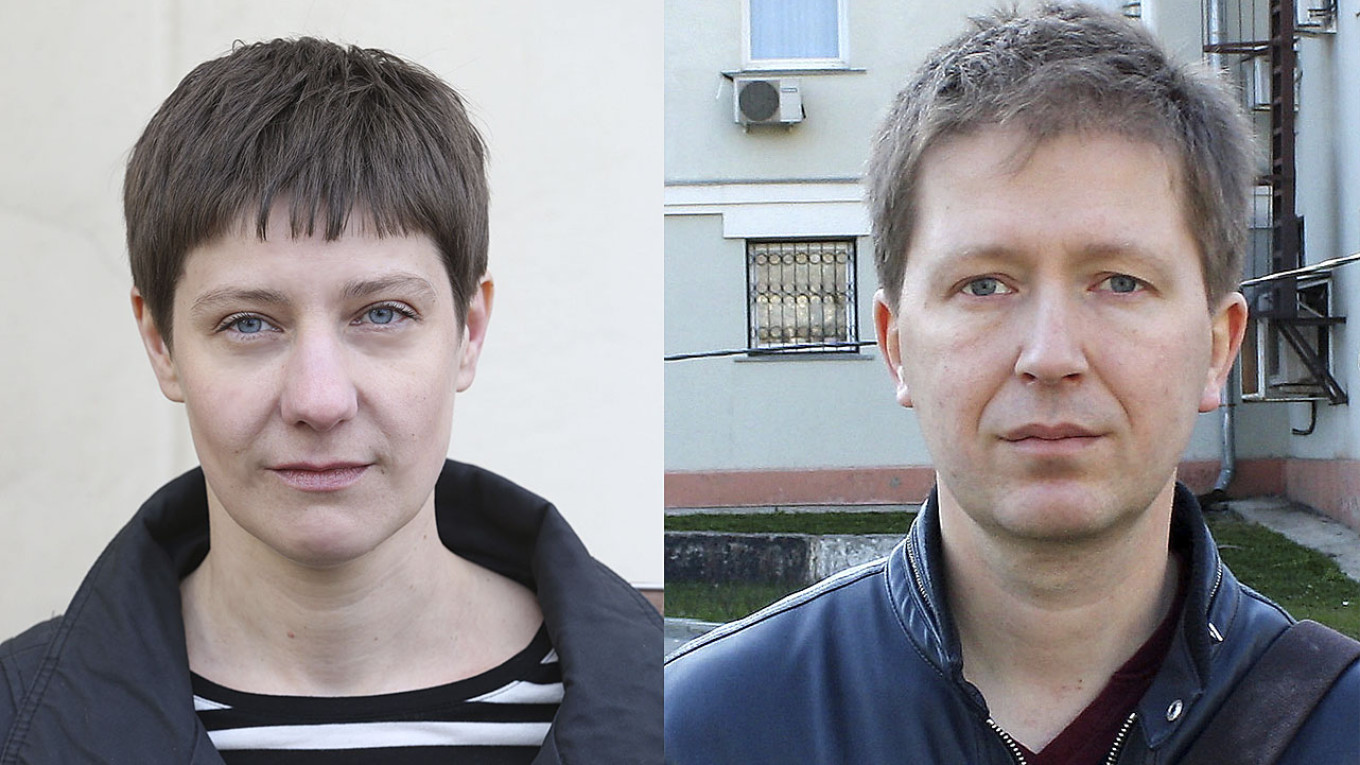
(the authors)
In their new book Soldatov and Borogan explore former friendships with people dating to the spring of 2000 following Putin’s election who met at the Russian daily newspaper, Izvestia. By 2022, some of those friends in Moscow were serving Putin in one way or another. At the same time, the authors were in exile in London separated from family and were wanted by Russian authorities. Why had those friendships which had been so close evolved in the way they had? How did former friends end up on such violently opposed sides? The answer to these questions form the core of a fascinating and heart rendering book as the authors reconnected with a few of their former friends and follow this group from the optimistic years of the early 2000s, a time of brief liberalism under Dmitry Medvedev, the annexation of Crimea and the repressions that followed between 2016-2021, and the current war in Ukraine. It is a journey that describes a soon to be global society with tremendous aspirations to “a dismal walled-in fortress.”
The authors spend the first segment of the book tracing their careers as they move from one newspaper or media outpost to the next. In their discussion they integrate a series of friendships and the belief systems of those who they see as their compatriots. Among the most important individuals that the authors discuss is Evgeny Krutikov who at one time was head of the Political Department at Izvestia and over the years developed extensive contacts in the Russian intelligence community. The authors would work with him at the newspaper. Petya Akopov emerges as another important relationship. Akopov is a scion of Moscow intelligentsia who was the chief correspondent in the Political Department at Izvestia. He and his wife Marina were always critical of the west and were against liberal values and believed Russia was a more spiritual civilization than the west. Zhenya Baranov was an intrepid war correspondent for a Russian television channel who was good friends with Akopov. Olga Lyubimova, a television host with connections to reactionary film maker Nikita Mikhalkov. Lastly, Sveta Babayeva who replaced Krutikov as head of the Political Department, an individual who had been a member of the Kremlin press pool attached to Putin.
Apart from their newspaper work Soldatov and Borogan launched a website, Agentura, “a ring of spies,” that was designed to be a community for journalists to write about security services for different newspapers. At the outset, the FSB did not interfere because it sought to improve its image and hoped to consolidate positive news reports on its actions. At the same time, they launched their website, Vladimir Putin’s presidency was experiencing difficulties. The brutal Chechen civil war which led to repeated terror attacks was ongoing; and the sinking of the nuclear submarine Kursk while Putin was on vacation in Sochi became a propaganda nightmare.

(Microphones on long booms extend out from a circle of journalists, some writing in notebooks with as a man at center ansers questions. A gridded glass roof is seen above.Journalists question Russian Prime Minister Vladimir Putin in Moscow, on Dec. 15, 2011).
At this point, the authors should have realized that they were not on the same page as their compatriots who found nothing wrong with Putin undergoing cosmetic surgery at a time when Russian sailors were drowning inside a submarine. Akopov and others blamed the west for interfering in the crisis causing the authors to realize they could no longer work at Izvestia. This would begin a journey of employment at a series of media outlets after resigning from Izvestia after a number of editorial conflicts over articles dealing with Russian security services. The authors would hook on with Versia, a weekly tabloid which had worked with the KGB in the past and they suspected was corrupt, but they needed a job. On October 23, 2002, Putin’s political problems reemerged as terrorists seized the Dubrovka Theater. Special Forces would rush the theater and three days later 130 people, 5 terrorists were killed out of 1000 hostages taken. Putin declared victory over terrorism as he did not want to appear weak despite the fact most were killed when government forces unleashed poison gas which backfired. When Soldatov and Borogan posted an article entitled, “Not True” on their website and Versia picked it up the result was an FSB raid , interrogation at the infamous Lefortovo prison and new employment. The authors would move on to the Moscow News which coincided with the Brelan school massacre in the North Caucusus which consisted of 334 dead hostages of which 186 were children. Their friend Baranov would praise Putin’s response and made a derogatory and false documentary describing the leader of Georgia. By this time, it was clear Baranov and Krutikov were propagandists working for security agencies. Shortly thereafter, the authors were let go by the Moscow News.

(Russian Minister of Culture Olga Lyubimova)
Soon the only place they could publish was on their website and a new platform, Ej.ru which was a home for anti-Putin liberals. By this time, the Russian economy was booming due to oil revenues. People began experiencing economic improvement and wealth seemed to touch a large segment of the urban population. Putin saw this as an opportunity to crack down on any opposition resulting in the assassinations of Anna Politkovskaya, an anti-Putin journalist at Novaya Gazeta, and Alexander Litvinenko, a former FSB officer. Anyone who opposed Putin was a target including Mikhail Khodorkovsky, the head of the largest energy company in Russia who was accused of tax evasion, embezzlement, and assassination and would be imprisoned for over ten years and find his wealth confiscated.
The authors do an excellent job integrating their journalistic journey with events in Russia. By 2008 Putin will invade Georgia expanding on his belief that the breakup of the Soviet Union was the worst thing that ever happened to Russia. It was the first step in a two decade long campaign to restore Moscow to its proper place in the world order. Putin would emerge from the Georgia imbroglio with an 88% popularity in Russian polls. 2008 was also a watershed year for the authors as they learned the murder of Anna Politkovskaya involved an FSB officer leading to their newspaper firing them.
Soldatov and Brogden’s thesis trying to understand how their compatriots had wound up on the other side of the political spectrum from them has a clear answer – the signs were evident from the outset of their friendships as they learned the views and backgrounds of these individuals. Akopov’s belief in the monastic traditions of the Russian Orthodox Church as an alternative to western philosophy should have been a warning sign. Even Baranov spoke of the orthodox faith as he reported on Channel One, the main Russian television station. As Putin decided to make Russian orthodoxy a national ideology, the authors should not have been surprised.
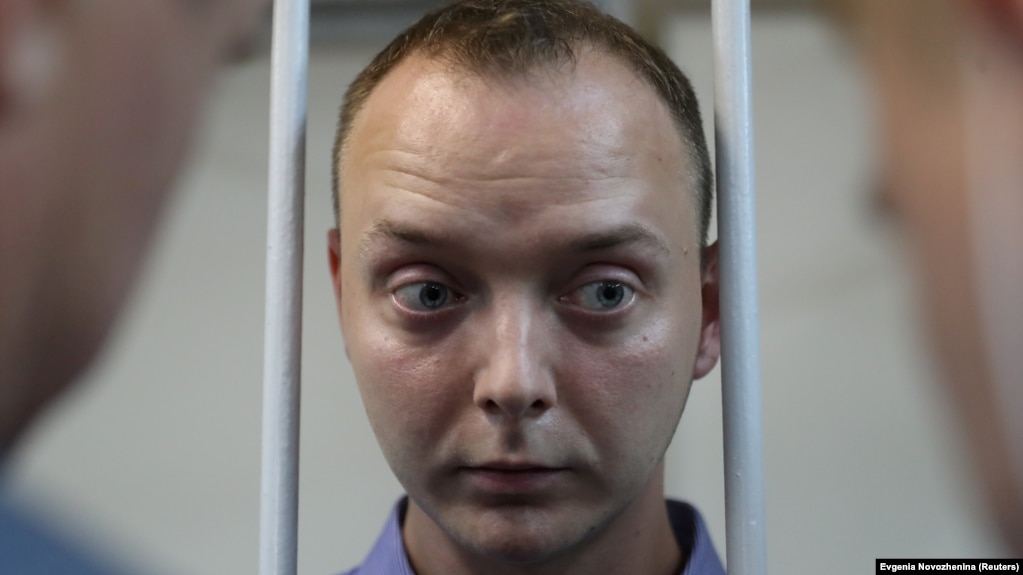
(Former Russian journalist Ivan Safronov before a court hearing on treason charges in Moscow on July 7, 1997)
Many believed the term of Dimitri Medvedev symbolized a more liberal Russia. But it was clear Putin was making the decisions in the background and would soon resume the Russian presidency. Once Putin returned and seized Crimea and attacked the Donbas region in Ukraine it was clear what his ideology was and would continue to be. Soldatov and Borogan’s disappointment in their friends would continue as they chose the path of going along with the government as their Izvestia friends showed their true colors. In 2014 Baranov was a presenter for Channel One, the Kremlin propaganda channel, pushing a narrative of Nazis in Ukraine and Nato aggression, while his wife crossed the almost non-existent line between state and press to become Deputy Minister of Culture the following year. Akopov authored a triumphalist essay, published in February 2022: ‘Putin has resolved the Ukrainian question’; it was swiftly removed from the internet when the Ukrainians stopped the Russian army outside Kyiv.
One would ask why these people made the choice of becoming government propagandists. They were well educated, intelligent people, but financial need, family, health issues carry great weight in decision making or perhaps it was nostalgia for the power of the Soviet Union – for each individual it is a personal choice once Putin’s direction was clear. Journalists had little choice if they hoped to make a decent living but to work for state media and get in line with the official ideology. Putin was suffocating the independent media and civil society that emerged in the early 2000s and by 2014 that suffocation was complete.
The depth of the author’s break with past friends is evident as Douglas Smith writes in the August 3, 2025, edition of the Wall Street Journal; “In the eyes of their friends, Mr. Soldatov and Ms. Borogan were either traitors or fools. In 2012 Mr. Akopov called them “scum” and implied they were foreign agents for their investigations into the security services. Ms. Lyubimova, who built a career making patriotic films and eventually climbed the government ranks to become the minister of culture, mocked the notion that Russia could ever be moved from its authoritarian historical foundations. Resistance was futile, submission was the only option. In what became known as the “Lyubimova Manifesto,” she stated that the way to survive was to give in, as she did, like a rape victim: “I lie on my back, spread my legs, breathe deeply, and even try to enjoy it.”
By February 24, 2022, the day Putin unleashed his attack on Ukraine the authors had already moved to London, however there was and is a target on their backs. They have been followed, warned by police that they were in danger, and in June 2022 the Russian Interior Ministry issued an arrest warrant for them. They have had to resort to what they learned about spy craft during their journalistic careers as part of their survival strategy.

(People walk in snowfall on Red Square in Moscow, Russia, 2022)
 Doc's Books