

(1981 New York City Subway Car)
In 1968 I was eighteen years old and had been driving for a few months. My mother asked me to take her to visit a friend and when we returned driving north on Ocean Parkway (Brooklyn, NY) in my father’s brand new Oldsmobile Cutlass a pink Grand Prix pulled next to us and ripped an American flag off the radio antenna which my father proudly displayed. We drove about 50 miles per hour, and a hand reached out from the Grand Prix and tried to pull my mother’s arm through the passenger window which was open. By this time, we were going 70 miles per hour, and I jerked the steering wheel into oncoming traffic to get away from our attackers. Four black men in the car laughed their asses off and pulled away. My immediate reaction was to chase after them, but my mother yelled not too as she wrote down their license plate. We drove to the nearest police precinct and were told by a detective to forget the incident ever happened as the police could do nothing even if they caught the men, a judge would not pursue any charges. I was incensed and drove to my girlfriend’s house and went into the courtyard of the school yard across the street and yelled epithets I am now ashamed of. I relate this story as I read Pulitzer Prize and Bancroft Prize winning author Heather Ann Thompson’s latest book. FEAR AND FURY: THE REAGAN EIGHTIES, THE BERNIE GOETZ SHOOTINGS, AND THE REBIRTH OF WHITE RAGE as it raises the question of what is the proper response when you consider yourself in danger.
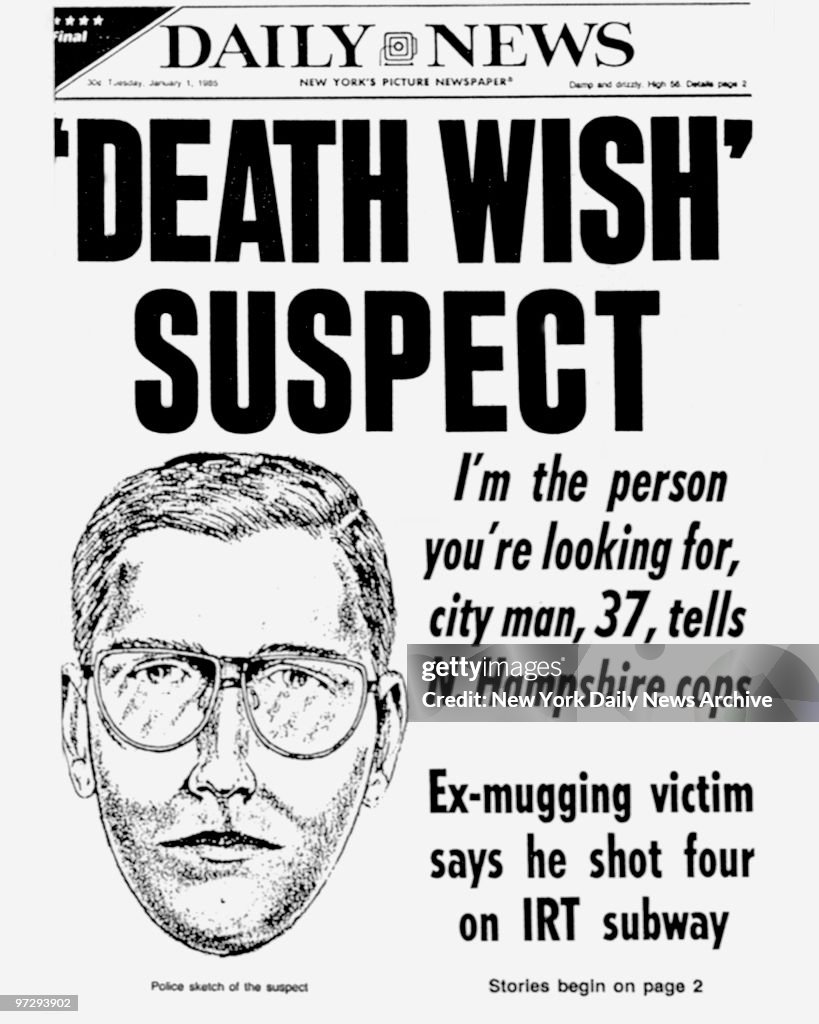
In today’s world where there are more guns than people, hidden carry laws, laws that seem to justify shooting someone for the slightest offense, and government agents shooting American citizens, it appears that shooting someone who compromises your safety is accepted by large elements of society. We have witnessed a number of examples over the years when people have shot others and got away with it. For example, the 2012 case of Trayvon Martin. George Zimmerman, a neighborhood watch captain in Florida, shot and killed 17-year-old Trayvon Martin, an unarmed Black teenager. Zimmerman claimed self-defense and was initially not arrested by local police. After significant national outcry, he was arrested and tried for second-degree murder. He was ultimately acquitted by a jury in 2013, a verdict that brought intense scrutiny to Florida’s “Stand Your Ground” law. Another example occurred in 2004 when Rodney Cox was shot and killed bya Florida homeowner later identified as a FEMA worker, who entered his FEMA trailer after a hurricane. The homeowner fired a warning shot and then shot the man after being placed in a “bear hug”. Prosecutors decided the homeowner was acting in self-defense, and he was not prosecuted. This case was a catalyst for the passage of Florida’s first “Stand Your Ground” law in 2005, which provides immunity from prosecution if an individual reasonably believes the use of force is necessary. Recently, we had the 2023 shooting of Ralph Yarl as Andrew Lester, an 84-year-old white homeowner in Kansas City, shot Yarl, a16-year-old black teenager in the head and then a second time after Yarl mistakenly knocked on his door to pick up his brothers. Lester was initially released without charges, sparking public protests. He was later charged with two counts of first-degree assault and armed criminal action, but the initial lack of charges was widely criticized by organizations like the “Equal Justice Initiative.” Perhaps the most famous example is the 1984 shooting involving Bernard Goetz, a white man in New York City who shot four young Black men on a subway after they approached him and one asked for five dollars. Goetz argued he feared for his safety. He was later acquitted of the most serious charges, including attempted murder, though he was convicted of unlawful weapons possession. The case became a national flashpoint for discussions about race, crime, and self-defense. I could list many more incidents, and it remains an issue today.

(Bernie Goetz on the second day of his 1987 trial, at which he was charged with attempted murder in the shooting of four Black teenagers)
For Thompson, the Goetz case is emblematic of the white rage that was simmering in America for decades as media mogul Rupert Murdoch exacerbated the fear and anger of Americans as his newspaper the New York Post reported on the personalities involved as overnight Goetz’s young victims would be characterized as villains, the trial which eventually took place, and Goetz’s acquittal. The book follows the reverberations of the subway shooting and their decades long impact on American society while skillfully recovering the lives of the real victims who many decided that their lives really did not matter.
One of the monograph’s many strengths is the background information that Thompson provides. The author meticulously explains her views based on superb research that includes interviews with many of the participants. She immediately sets the stage for the events that took place on December 22, 1984, by visiting the plight of New York during the 1970s and early 80s. By 1980, Ronald Reagan campaigning for the presidency visited the south Bronx stating, “he hadn’t seen anything like this since London after the blitz.” Since the late 1970s New York had sunk to new lows as newspaper headlines blared that “President Ford Tells New York to Drop Dead” as Washington refused to offer assistance for its budget and debt crisis. Thompson points out that weakening of the American economy throughout the seventies led to less federal funding resulting in services being cut, free college tuition withdrawn, city employees across the bureaucracy fired, and an increase in landlords engaging in arson to collect insurance money for their buildings which they refused to maintain.
Once Ronald Reagan assumed the presidency he set out to undo as many New Deal socio-economic policies as possible. The Berhard Goetz saga must be seen in the context of the time period in which it took place. By the early 1980s Lyndon Johnson’s War on Poverty, the Civil Rights Movement, and the liberal-progressive legislation of the 1960s was beginning to stoke the anger of working class whites in America. This anger would push many whites to leave the Democratic Party and turn their support to Ronald Reagan whose genius was his ability “to appeal to white self-interest and to exploit racial rage to greater success, convincing some of the most diehard Democratic Party voters that this was in their best interest also.” The result was the “trickle-down theory” of economics resulting in devastating consequences for minorities living in the south Bronx and other poverty stricken areas of the city. This approach to the federal budget – cutting social spending programs disproportionally hit poor urban families of which the four boys that Goetz targeted were members. The spending cuts fueled Reagan’s tax policies allowing the rate for the wealthy at certain levels +to decline from 70% to 28%.
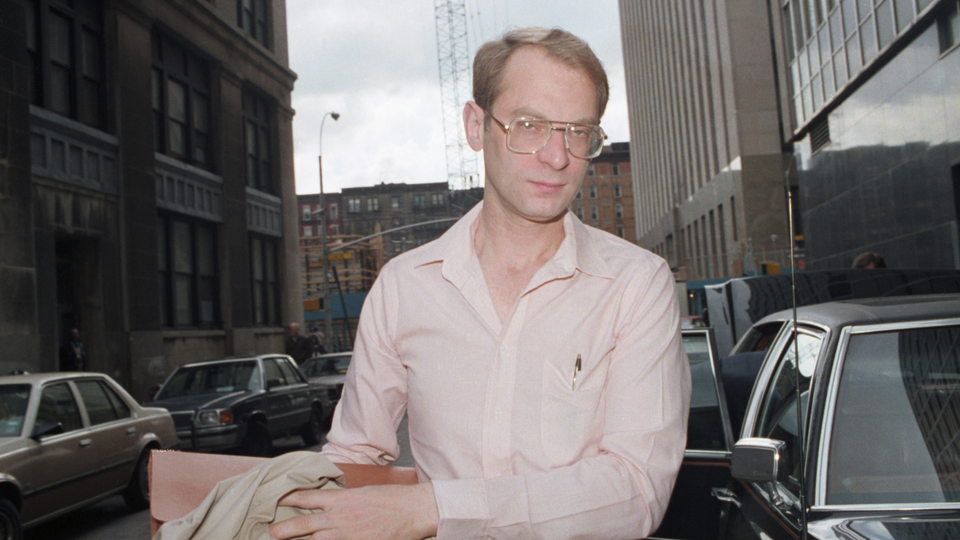
(Bernhard Goetz)
Thompson continues her excellent analysis by explaining that the lack of jobs, declining educational opportunities, and fewer public places to experience enrichment led to underprivileged teenagers hanging out on street corners, gaining easy money from selling drugs to the point that the south Bronx became known as “crack town.” Further exacerbating the situation was the HIV epidemic which was partly fostered by drug addicts exchanging infected needles. This was occurring at a time when health care resources were increasingly unavailable. Soon gang violence would result as the Reagan administration refused to confront the growing AIDS crisis.
Interestingly the 1980s became the center of what Michael Douglas stated in the film “Wall Street,” “that greed was good” enhancing the reputation and lifestyle of white New Yorkers like Donald Trump and his father. The watershed moment for New York also revolved around Rupert Murdoch’s 1976 purchase of the liberal New York Post and turning it into a tabloid that pandered to a disgruntled white audience employing the sensationalist tactics that were successful in Australia and England. With right wing columnists like Patrick Buchanan arguing that the election of Ronald Reagan was a necessity for white voters who feared the rising black crime rate, and that unlawful behavior was endemic to certain neighborhoods.
With this background Thompson creates the ingredients that led to Goetz’s behavior. The author explains the family backgrounds of Goetz and his victims, their belief systems, and the impact of society. For the four boys who were shot, the life and lack of opportunity led them on the path they chose as did Goetz’s anger at what he perceived to be the cause of crime, disease, street beggars, drug dealers, rotting garbage on the streets, and homelessness. After being a mugging victim on January 26, 1981, on Canal Street in lower Manhattan, Goetz decided to travel to Florida to purchase guns, since he could not obtain a license in New York. The more Goetz witnessed his Greenwich Village neighborhood declining his anger was compounded.
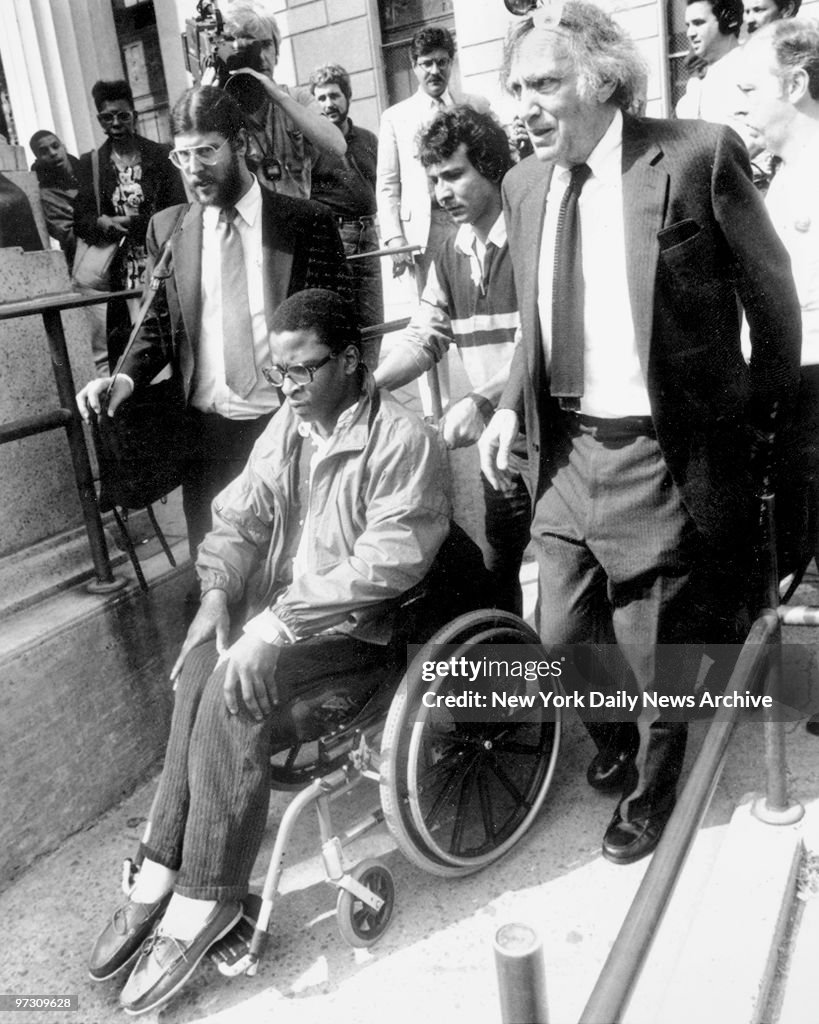
(Darrell Cabey with his lawyers William Kuntsler and Ron Kuby)
Once Thompson provides the reader with the socio-economic climate Goetz resents, she carefully takes the reader through the events on the New York City subway system of December 22, 1984. After providing the details of the shootings she emphatically states that Goetz had no right to shoot Darrell Cabey, James Ramsuel, Barry Allan, and Troy Canty as many of the witnesses in the subway car attested to.
Thompson excels at describing the legal strategies employed by the prosecution and Goetz’s defense as well as the actual trial. As he approached his day in court Goetz came to believe that he represented something very important and that the “public wasn’t going to take it anymore.” He hired Barry Slotnick as his lead attorney, and it would turn out to be an excellent choice. Slotkin had defended well known clients like Meir Kahane, John Gotti, and Manuel Noriega and his brash, uncompromising, and at times nasty approach to defending his clients were part of the reason for his success. As was evident in his defense of Goetz he would think outside of the box and badger witnesses and the judge until he was satisfied with how the case proceeded. The prosecution was led by Greg Waples, an excellent litigator, but more conventional than the opposition.
After a series of legal machinations and dubious claims by lawyers the trial would begin on December 12, 1986. Thompson presents the give and take between witnesses, lawyers, and prosecutors allowing the reader to witness a pseudo boxing match with verbal punches and counter-punches thrown on a daily basis. The author provides many insights pointing out how effective or ineffective the prosecutor and defense carried on. Slotkin in particular was very efficient in confronting one of the victims, James Ramseur, as he took him apart with a series of pointed questions, overwhelming him on a personal level, badgering him in such a manner that he became so angry he refused to cooperate with the court proceedings. Slotnick’s strategy of bullying witnesses was a gamble which in the end paid off. Perhaps Slotnick’s most brilliant move was to get the judge to allow a recreation of the crime scene in court with “large” black Guardian Angels to replicate the four victims, and gaining permission to bring the jury to a subway car at the site of the shootings which would become the key to the final outcome of the trial.
Thompson does a marvelous job dissecting the nuances of the prosecution and defense and correctly concludes that the jurors fundamentally related more to Goetz than they did to the four young men who were shot based on juror statements after the trial. Thompson’s use of juror statements explaining why they acquitted Goetz on the most serious charges is insightful. For the jury at times, it was difficult to ascertain who was on trial for Goetz or his shooting victims. The key to the views of a number of juror’s opinions was Slotnick’s ability to convince them that Darrell Cabey was not shot while seated, but standing in front of Goetz. A number of jurors believed that Goetz’s 1981 mugging was directly impactful as to how he acted on the day of the subway encounter and saw him as a “frightened man.” As to his admission of guilt to the Concord, NH police detectives they rationalized that Goetz was on the run for nine days and was “exhausted and distraught” so his statement could not be accepted as totally rational. Judge Crane’s instructions played a major role in the fact that the jury had to decide if Goetz saw himself as being in mortal danger and whether it was reasonable for him to believe he was. In addition, Slotnick did a better job than Waples. Lastly, Thompson correctly concludes that “in the 1980s climate in New York a gun-wielding loner like Goetz was more sympathetic to these jurors….than four unemployed Black teenage dropouts trying to survive and somehow thrive in the same city and country.”
The author follows up her effective coverage of the trial and appeals applying the same judicious process in presenting the civil litigation period that followed over the succeeding ten years as the Cabey family tried to gain restitution for what happened to Darrell, and Goetz’s strategy to defend himself. It is clear that the period highlighted the emergence of a new era of racialized rage and the role the Goetz trial played in its enhancement. The rape of a white woman in Central Park by five black teenagers would bring about their conviction (which was overturned years later) and labeled them as the Central Park Five, as well as the murder of Yusef Hawkins by a white mob in Bensonhurst, Brooklyn are all emblematic of the period. New York City would turn to Rudy Guliani as mayor in 1993 and along with federal legislation implemented by Bill Clinton, New York cracked down on petty crimes, expanded prison sentences, implemented harsher sentencing all of which can be related to the Goetz trial.

(Goetz’s defense attorney Barry Slotnick)
Thompson’s new historical study offers portraits of many characters from the period including Goetz and his victims, Barry Slotnick, William Kuntsler, Rudy Guliani, Curtis Sliwa, Rupert Murdoch, Donald Trump, and a host of others. She explores how the Reagan Revolution overturned New Deal and Great Society legislation leading to the “greed is good” motto of the 1980s, the conservative approach to crime of the 1990s, and the significant impact of Murdoch’s purchase of the New York Post in addition to the creation of the Fox New Network that today still reinforces the racial and economic views of a significant portion of white America and of course the Trump administration. If there is one aspect of Thompson’s presentation that is not quite supported by the past is that white rage was not endemic to the period of the Goetz trial. It exacerbated a condition that has always existed in American history whether the Reconstruction period after the Civil War, the racial movements dealing with immigration after W.W.I, the Civil Rights Movement of the 1960s and the violence it produced, to an administration that panders to white racial rage as witnessed by its “anti-brown and black” immigration and overall economic policies. Overall, Thompson’s meticulous work should be commended as she presents a painful historical theme that she dramatically demonstrates. A theme we are living through today as the news reports on racial crimes and economic inequality each and every day.
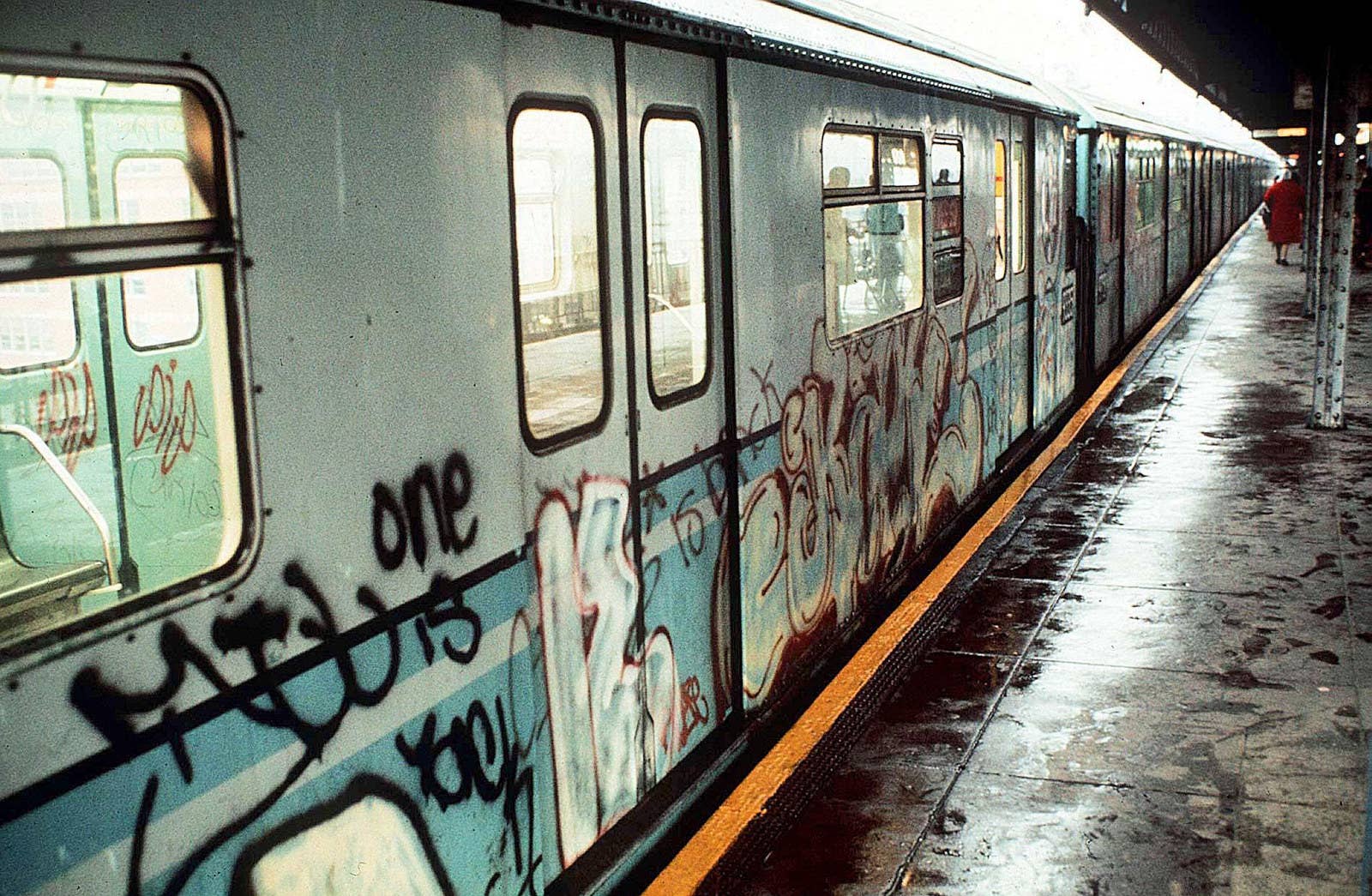
(1980s New York City Subway Car)
 Doc's Books