BLOOD AND IRON: THE RISE AND FALL OF THE GERMAN EMPIRE 1871-1918 by Katja Hoyer

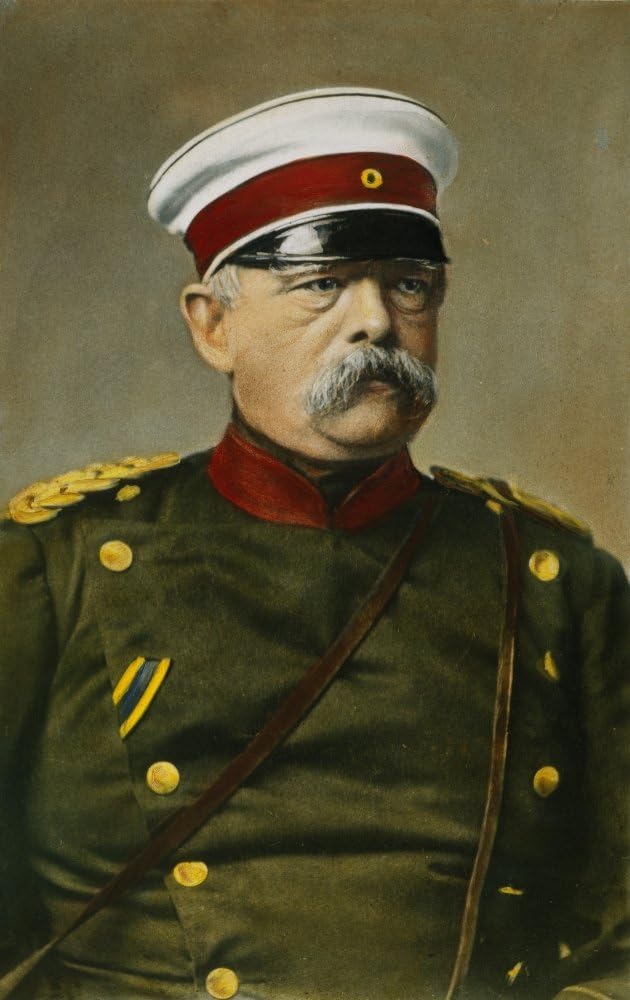
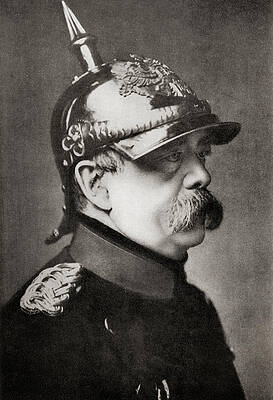
(German Chancellor Otto von Bismarck)

It might surprise most of you that Germany has only been a country since 1871.  By the mid-19th century Germany was a series of states, thirty nine to be exact.  The dominant principalities were Prussia and Bavaria, one dominated the Lutheran north, the other the Catholic south.  The question must be asked, how was it unified?  Many argue it was the work of the eventual German Chancellor, Otto von Bismarck whose brilliant realpolitik fostered wars with Denmark, Austria, culminating with the unification of the north and south through war with France.  Another important question revolves around the idea that Germany was unified because of Bismarck’s brilliance and his opponents in other countries/kingdoms were not exceptional intellects, particularly King Louis Napoleon III.  Did Bismarck lure his foreign opponents into wars, creating a nationalist movement that gave the Chancellor the opportunity to use Prussia as the cudgel to bring about the new country. 

If one has read the works of Otto Pflanze, Jonathan Steinberg, or A.J.P. Taylor it is clear that Bismarck learned an important lesson during the Revolutions of 1848 – Germany could not be unified from below – it had to be unified from above, superimposing Prussia on the rest of the German states.  It is obvious that the unification of Germany was a complex endeavor that engenders many questions, and it lends itself to an important book by Katja Hoyer, a German-British historian entitled, BLOOD AND IRON: THE RISE AND FALL OF THE GERMAN EMPIRE 1871-1918.

Photograph of an elderly Wilhelm, a bald man with side whiskers

(German Emperor Wilhelm I)

Hoyer does an excellent job of synthesis as she tackles “the Second Reich” under Wilhem I through his grandson, Wilhelm II in this short volume.  Do not let its length take away from Hoyer’s incisive analysis as she explains how Germany was unified, then remarkably how Bismarck decided that after unification, Germany was satiated and turned to domestic issues and away from further foreign wars.  He resorted to diplomacy by isolating France through a series of alliances and stole the socialist domestic thunder by adopting some of their programs.  Further, he did not want to get involved in the imperialist race for colonies since Germany’s creation had upended the European balance of power; he did not want to create enemies that would lead to war.  Hoyer argues correctly that once Bismarck passed from the scene in 1888, Wilhelm II would negate the Bismarckian realpolitik for a much more aggressive foreign policy which would eventually lead to the events of August 1914 and four years later Germany’s defeat in World War I.

Despite the fact that Hoyer’s monograph is only 239 pages, it is crammed with historical assessments, personality analysis, and a deep dive into the cause and effect of important events.  Hoyer displays a firm knowledge of sources and writes in an easy style that allows a clear understanding of information that at times can be dense.  The author offers many interesting points that seem off the beaten track, but in reality impact the course of German history.  A case in point is her discussion of the Grimm brother’s fairy tales and its impact on the unity of German culture.  Others include the relationship between Kaiser Wilhelm I, his son Friedrich III, and Wilhelm II, the Kaiser’s grandson.  The Kaiser tried to stay in the background and let Bismarck lead, Friedrich who died after 99 days on the throne was much more liberal than his father, and his son Wilhelm II was an aggressive and insecure man who would lead Germany to ruin.

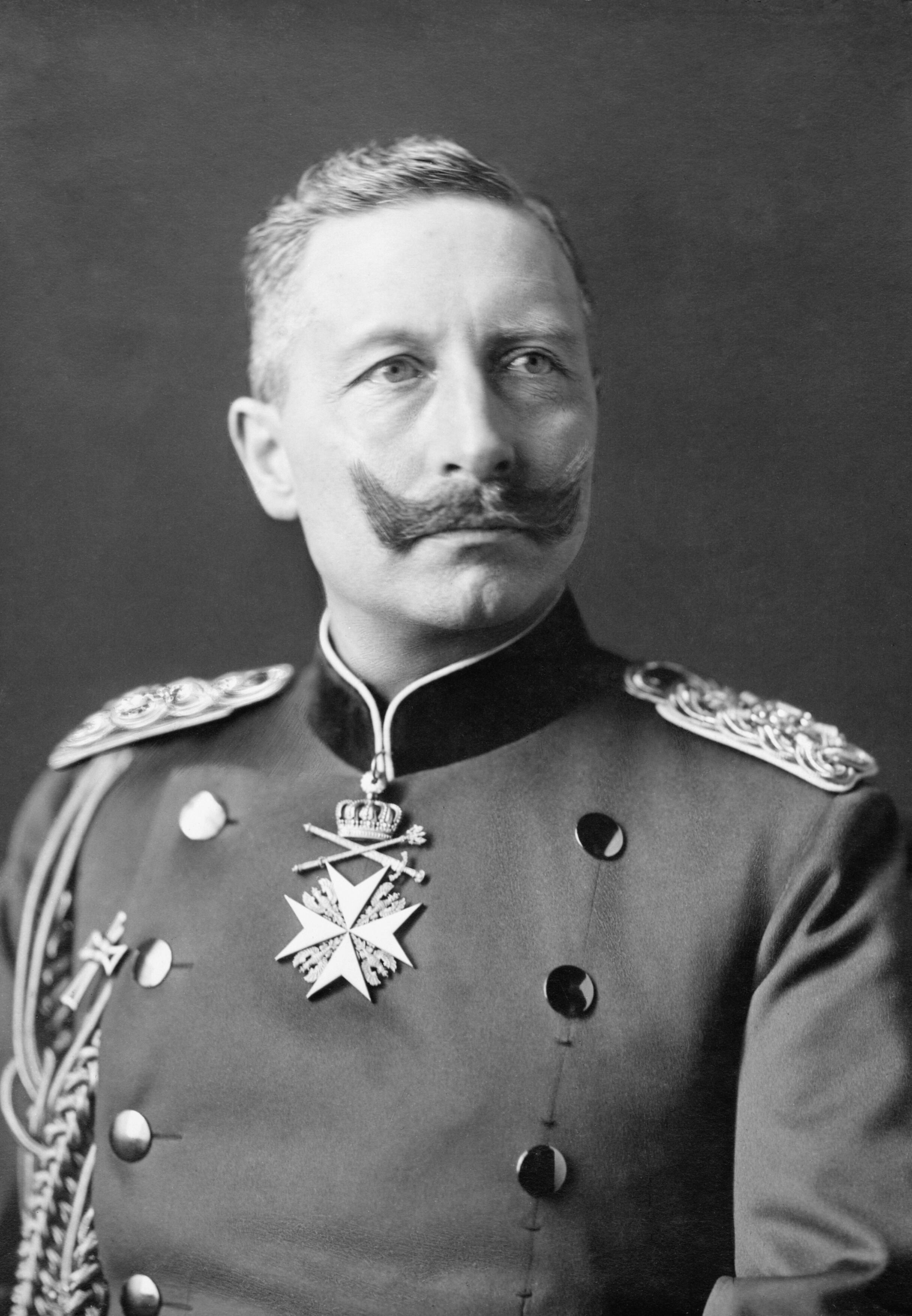
File:Kaiser Wilhelm II of Germany - 1902.jpg

(German Emperor Wilhelm II)

Hoyer carefully explains the rise of Otto von Bismarck and his relationship with Wilhelm I.  She examines his approach to domestic and foreign policy, and it is clear from her presentation that Bismarck was far more competent than anyone he dealt with as he manipulated people and events to achieve his goals.  She vociferously argues against the idea that there is a straight line in German history between Bismarck and Adolf Hitler.  She continues stating the Bismarckian system was inherently flawed, but it did not set Germany upon the inevitable path to war and genocide.  Bismarck was aware how the unity of the German states threatened the European balance of power after 1871 and was very careful not to create situations that would foster foreign intervention into German affairs.  Obviously, Bismarck used war as a political tool, but once his goals were achieved he turned more to protect unification and deal with domestic issues like the perceived socialist and Catholic threats, resulting in social legislation and the Kulturkampf which was a response to Papal overreach.

The key figure apart from Bismarck in Hoyer’s rendition of German history is Wilhelm II who saw himself as another Frederick Barbarossa who would lead Germany’s return to greatness.  According to Hoyer, Wilhelm II saw no need for Chancellors, Ministers, or political realities to mitigate his power, which was an unworkable concept at the turn of the century which only became apparent to him when it was already too late.  Wilhelm II had no comprehension of the complexity of Bismarck’s schemes in domestic and foreign affairs that held Germany together and allowed it to prosper. Despite his succumbing to flattery from certain officials resulting in cunning manipulation, feelings of insecurity, and his rejection of republicans and liberals his belief in the glory of Germany which deserved its rightful place in the world power structure was very popular with the German people.  The belief in authoritarianism and militarism is supported by a wonderful vignette dealing with an unemployed cobbler named Wilhelm Frederick Voight who acquired military costumes, dressed up as an officer and ordered soldiers and officials around as he seized Berlin City Hall with no one questioning his actions – according to Hoyer, a response to the uniform, highlighting German respect for authoritarianism and militarism.

gwimage274

(German soldiers in the trenches of World War I)

Hoyer is on point as she argues that for disparate Germans to come together they needed a sense of the common enemy, further she argues “the system fell because it was flawed from the outset, built on foundations of war, not fraternity.”  German historian Gerard DeGroot’s review sums up well what an effective job Hoyer has done; “There’s nothing particularly new in this assessment. The most impressive feature of this book is not its thesis but its brevity. Until now, I didn’t realize that it was possible to write a short book about Germany. Succinctness is an impressive and sadly undervalued quality in an author. A strict word count is a cruel tyrant; difficult decisions about what goes in have to be made and creativity inevitably curtailed. Hoyer nevertheless manages to pepper her trim narrative with some lovely frills. The mark of a really good short book is its ability to inspire curiosity. “Blood and Iron” achieves just that.  Careless historians often draw a straight line from Bismarck to Hitler. That, Hoyer argues, is “simplistic.” There’s much to admire in what Bismarck created and Wilhelm ruined. Important elements of the Second Reich survive in today’s Germany, a nation widely respected as stable, mature and responsible. What this story reveals is how easily governmental institutions can be destroyed when people are led astray by intoxicating notions of a place in the sun. That, perhaps, is a lesson for us all.”*

  • DeGroot, Gerard. “One Man, Three Wars, and the Creation of Germany,” Washington Post. January 7, 2022.
Wall Art - Photograph - Untitled 64 by © Ken Welsh

DAMASCUS STATION by David McCloskey

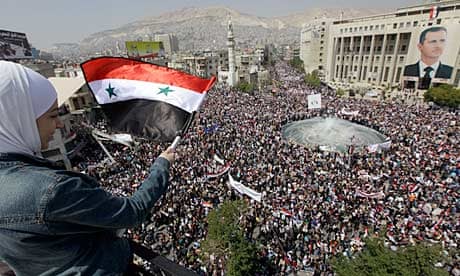
Syrian pro-government demonstrators gather in a central square in Damascus to support Assad

(Syrian pro-government demonstrators gather in a central square in Damascus to show their support for Bashar al-Assad’s rule)

At the time of this writing the Middle East is on the precipice of a wider war resulting from the blood stained conflict that exists in the Gaza Strip where retribution and vengeance dominates.  Last week, the Palestinian terrorist group Hamas unleashed a horror laden attack on Israel and the Netanyahu government responded in kind.  The result has been the utter destruction of the Gazan infrastructure, another example of how Hamas uses the Palestinian people as pawns in their war against Israel causing the deaths of thousands of their co-religionists and the maiming of others.  Hamas claims to be the defender of the Palestinian people, but their modus operandi does not match their rhetoric.

The current fighting mirrors the bloody civil war that occurred in Syria as opposition forces spurred on by the Arab Spring in 2011 tried to overthrow the repressive regime of Bashir Assad who used every weapon including chemical weapons and Russian barrel bombs to cling to power.  The conflict spawned a number of different radical Islamic groups that sought his overthrow including the Islamic State (ISIS).  The civil war that resulted brought in Russian and American troops and produced the deaths of thousands of Syrian casualties and millions of refugees dispersed to Turkey, Jordan, and other countries.  Events from the early years of the Syrian Civil War form the backdrop of David McCloskey, a former Middle East CIA operative’s first novel, DAMASCUS STATION.

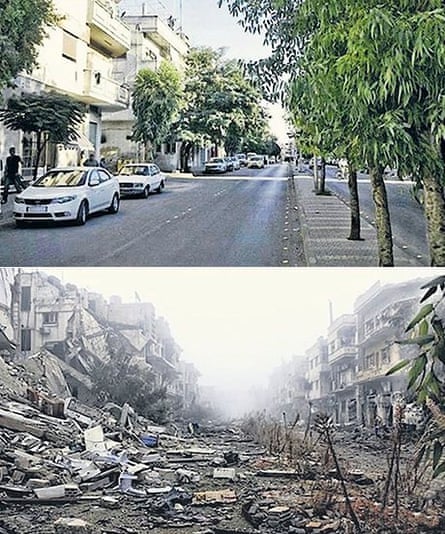
Al-Kindi hospital in Aleppo

(al-Kindi hospital, Aleppo. Above in 2012 and below in 2013)

According to the author, the novel is a work of fiction that takes its inspiration from actual events that took place between 2011 and 2013 that evolved into a long drawn out civil war as insurgents buoyed by the Arab Spring sought to remove the Assad Dynasty that had ruled Syria for over five decades.

We immediately meet Sam Joseph, a CIA officer who is in Damascus to assist in the exfiltration of an asset from Syria.  KOMODO, a mid-level scientist at the complex responsible for Assad’s chemical weapons program, and her handler Val Owens are trying to navigate Damascus and its environs between Assad and rebel forces.  Unfortunately, Owens will be murdered by Syrian security forces changing the flow of the novel as the CIA, in particular, Sam Joseph, wants revenge.  The novel coalesces around Joseph as he has three main goals.  First, exact revenge against Ali Hassan who killed Owens.  Second, recruit an asset in the Syrian national security structure named Mariam Haddad.  Lastly, locate the sarin gas that the Assad government has moved in order to go beyond President Obama’s red line.

McCloskey has authored a remarkable novel as he navigates the intelligence community.  His approach is one of realism as he integrates aspects of the spy culture throughout.  The reader will become fascinated as McCloskey’s characters model actual CIA training, techniques, op preparation, and mission implementation.  We are instructed about dead drops, surveillance, technology, and plain human intelligence.  We are also introduced to a series of important characters such as Rustum Hassan, the leader of the Syrian Revolutionary Guard who has no compunction about killing, including thousands of victims in the Syrian Civil War.  Ali Hassan, Rustum’s younger brother who he hates is in conflict over their place in Bashar al-Assad governmental hierarchy.  Bouthaina Najjar, an advisor to Assad, and Rustum’s lover.  Basil Mahkluf, in charge of the Revolutionary Guard’s missile and rocket program.  Jamil Atiyah, an Assad henchman, a pedophile with profound influence.  Sam Joseph, the CIA operative who makes the cardinal error by falling in love with an asset.  The BANDITOS, Rami, Yusuf and Elias, the Kassab triplets who run surveillance for Joseph.  Artemis Aphrodite Proctor, the saucy Damascus station chief.  Ed Bradley, who oversaw Syrian operations from the Directorate of Operations.  Mariam Haddad, a midlevel analyst who is recruited by Joseph and flips.  Abu Qasim, rebel leader and bomb maker and his wife Sarya, a sniper with 142 kills.  Lastly, General Volkov sent by Moscow to assist the Syrians in rooting out CIA spies in Damascus.

A street in Homs, Syria in 2011 and 2014

(A street in Homs, in 2011 (above) and 2014)

McCloskey develops his characters very carefully.  He describes what led Abu Qasim to turn against the Assad regime and the issues and players involved in the bloody carnage of the Syrian Civil War.  The author takes a deep dive into the Syrian regime, how it operated and how an individual went about surviving the internal paranoia of serving in Assad’s government.  McCloskey takes the reader inside the Syrian Mukhabarat, the secret police whose who employ torture, beatings, coercing family members etc. to achieve their aims. 

Sarin gas plays a key role in the story.  Once its location is discovered and moved Joseph must locate the new site at the same time the Mukhabarat is after him.  McCloskey describes how the gas is developed, produced, and weaponized for a trial attack against a Syrian rebel village and getting it ready for a larger statement against rebel forces.  McCloskey also explores the American process in fighting the Syrian forces highlighting President Obama’s approach to the Civil War.

Omari Mosque in Deraa

(Omari mosque in Deraa. Above in 2011 and below in 2013)

The author’s expertise is on full display as he describes Joseph’s thought process while being surveilled.  Joseph analyzes his own undertaking relative to the Russian/Syrian team that watched his every movement as he prolonged the chase for hours as he was trained.  For Joseph, “he could sense the hunters out there,” during this cat and mouse game – except it was no game.

Joseph’s relationship with Mariam is complex as she felt guilty about what happened to her anti-Assad cousin Razan, her betrayal of Joseph, and killing three Mukhabarat.   McCloskey tries to make his characters feel like any one of us, but in reality they are tasked to serve and protect the United States and help US policymakers understand the region and the implications of certain events.

Overall, it is an authentic spy thriller set in the tumultuous Middle East that should keep the reader on the edge of their seats.  Former CIA Directors Leon Panetta and David Petraeus praise the “realistic portrayal of CIA operations overseas” and that is good enough for me.

Supporters of President Bashar al-Assad carried his portrait during a demonstration in Damascus on Monday, the day after the Arab League imposed sanctions.

(Supporters of President Bashar al-Assad carried his portrait during a demonstration in Damascus on Monday, the day after the Arab League imposed sanctions)

COLLISION OF POWER: TRUMP, BEZOS, AND THE WASHINGTON POST by Martin Baron

US-INTERNET-MEDIA-TAKEOVER-AMAZON-WASHINGTONPOST

What do you do when your new boss is the richest man in the world, and he has just purchased your place of employment?  This is the situation that Martin Baron, then the executive editor of the Washington Post found himself seven months into his new position in 2013.  His new boss was Jeff Bezos, the founder of Amazon which created an arrangement conducive to a great deal of pressure, and to exacerbate the situation further, Donald Trump announces for president in 2015 and by 2017 resides in the White House.  Trump heightens Baron’s angst as he wages a war of unprecedented vitriol and vengeance against Bezos personally and the media, especially the Washington Post.  The period 2013 to 2021 forms the time frame of Baron’s new memoir/history of the period, COLLISION OF POWER: TRUMP, BEZOS, AND THE WASHINGTON POST.

Baron’s book is much more than a rehashing of Trump’s war against Bezos and Amazon/Washington Post.  It is a well thought out and incisive examination of a career in newspaper publishing, particularly Baron’s role as executive editor at the newspaper.  Baron who had spent nearly twelve years leading the Boston Globe, recounts how he managed the Post’s newsroom and dealt with issues ranging from domestic surveillance, the #metoo movement, vetting Supreme Court candidates, to the myriad of scandals and crisis’ that surrounded Trump, the individual in addition to his administration, two impeachment trials, an insurrection, navigating internal issues at the newspaper, in addition to the comparisons between the Post and New York Times.

When Martin Baron took the took job at The Washington Post in 2013, the company was struggling to survive. Then The Post was sold and it began to expand.

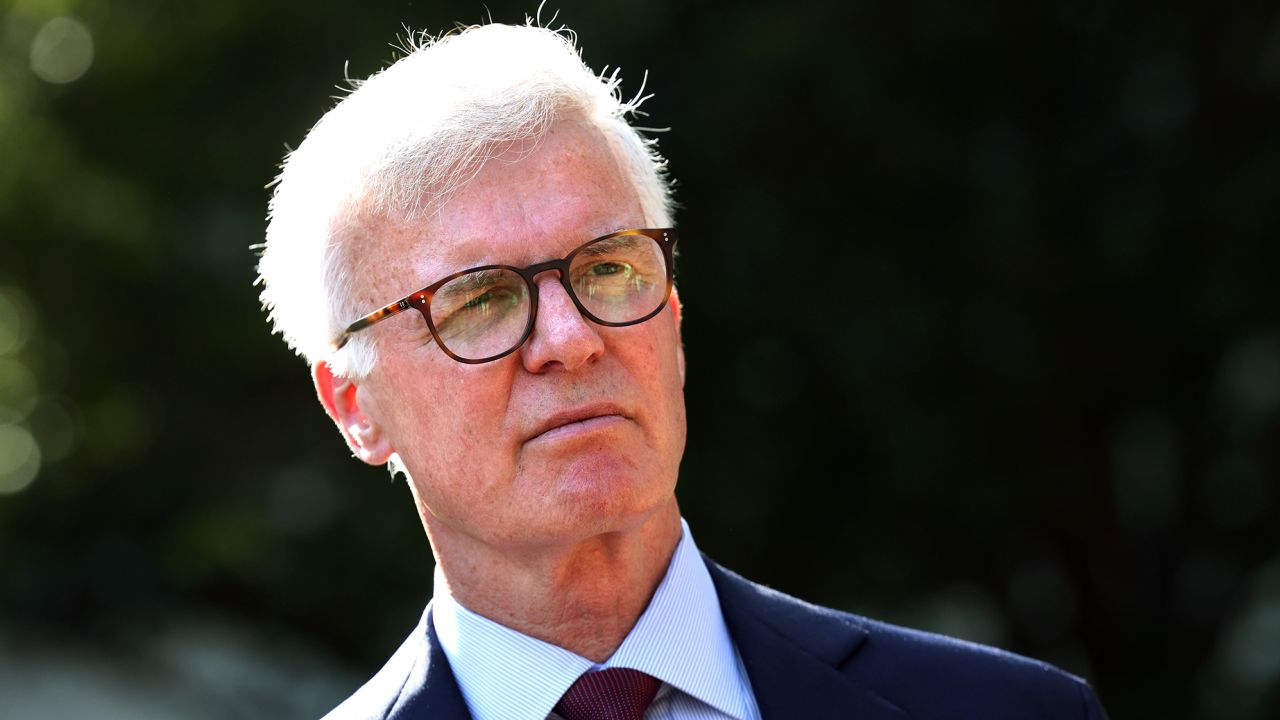
(Martin Baron, author)

It is clear from the outset that the Washington Post was a target of Trump’s.  The newspaper coverage of him personally and his campaign angered him, and he leaned on Jeff Bezos to get Baron’s newsroom to back off with their criticism which would continue after he was elected president.

Baron begins his memoir by explaining the background as to how Bezos came to buy the Washington Post.  As the narrative continues it is clear that Baron likes and respects Bezos as he believes in the essential role of journalism in a democracy as the reason he purchased the paper.  Further, Baron argues that Bezos never interfered with the paper’s coverage of Amazon, his affair and divorce, and never used his position to spread his influence.  Bezos relished the challenge of turning the paper around and moving it into the digital age.  Bezos’ greatest concern was whether his strategy of “shifting from relatively few subscribers paying a lot for a subscriptions to lots of subscribers paying fairly little for digital subscriptions – would actually work.”  Baron reviews Bezos’ approach to management and the numerous changes he implemented, i.e.; to create a nation/worldwide network of journalists who would be a free-lance force.  For Bezos it would expand the journalistic reach of the paper at “bargain basement prices.”

Martin Baron, left, and Jeff Bezos in 2016. After Mr. Bezos bought The Post in 2013, Mr. Baron had more resources and sought a bigger digital audience.

(Martin Baron, left, and Jeff Bezos in 2016. After Mr. Bezos bought The Post in 2013, Mr. Baron had more resources and sought a bigger digital audience).

As one reads on, Baron rehashes the nightmare of the Trump presidency, his refusal to accept the fact he lost the 2020 election, and the events surrounding January 6th.  There is little that is new here though the emphasis is on Trump’s obsession with Amazon which he believed manipulated newspaper coverage of him personally.  Since he blamed the Washington Post for unfair criticism he went after the retail behemoth arguing it paid no taxes, it was ripping off the US Postal system, and it engaged in unfair trade practices.  To Baron’s credit when coverage of Trump did not meet the Post’s standards he refused to publish.  A good example is his handling of the Steele Dossier that accused Trump of election cooperation with Russian interference in 2016, sexual proclivities, the attempt to build a Trump Tower in Moscow, and his relationship with Vladimir Putin.  In the end the document developed by a former British spy did not meet the standard the paper relied on for publication.  No matter what the coverage of Trump, Baron points out in his war against the media “any questions that put him on the spot was an offense.”

Baron’s chapter dealing with the death of Jamal Khashoggi is important as it highlights Trump and his allies’ war on journalists.  It is clear that Saudi Crown Prince Mohammed bin Salman was culpable in his death, and it is interesting how Baron creates links between the Saudi leadership’s approach to critical journalism and that of Trump.  Both men sought to intimidate journalists and make them live in fear.  If one follows Trump’s reaction to the murder it is clear he did not care, and interestingly after his presidency his son-in-law received a $2 billion Saudi investment in his business fund.  Salman would even go after Amazon because of the Post’s coverage of his government and referred to Bezos as “that Jew.”

Washington Post Publisher Fred Ryan.

(Washington Post Publisher Fred Ryan)

Baron should be praised for his honesty as he navigated his relationship with Bezos and allowed a focus on Amazon’s anti-union labor practices, its marketing strategies that hurt secondary vendors, and most importantly its surveillance policies – Alexa is in your home gathering intelligence against you and your family!  To Bezos’ credit he did not interfere with any of any story that involved his personal life or businesses.  Further, Baron delves into issues dealing with social media, racial practices at the paper, and objectivity that brought him into conflict with younger and black journalists.

In the end Baron grew skeptical with the reporter’s combative tweets and their airing of their social views.  A newspaper traditionalist Baron almost resigned amidst the covid crisis, and Black Lives Matter Movement as he felt reporters were putting their own opinions above those of the newspaper. In summation I agree with Sewell Chan’s conclusion presented in his New York Times review in which he states, “As Baron describes it, the job of an editor today revolves as much around spreadsheets, team building, labor negotiations and social media guidelines as it does around relationships with reporters and supervision of coverage. That Baron managed that high-wire act so successfully — The Post won 10 Pulitzers on his watch — in an era of wrenching changes in politics and journalism shows that newsroom leadership, however devoid of ease or glamour, remains essential.”*

*Sewell Chan, “At His Post,” New York Times, October 15, 2023.

THE WOUNDED WORLD: W.E.B. DU BOIS AND THE FIRST WORLD WAR by Chad Williams

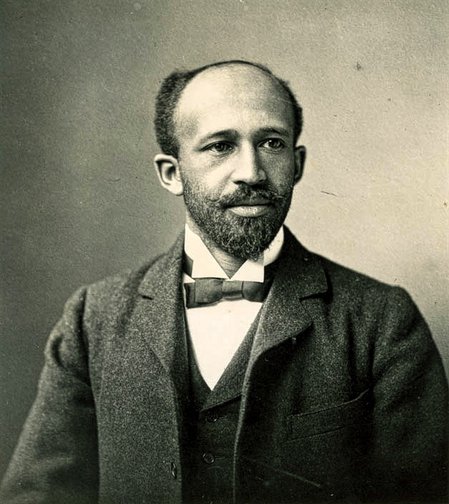
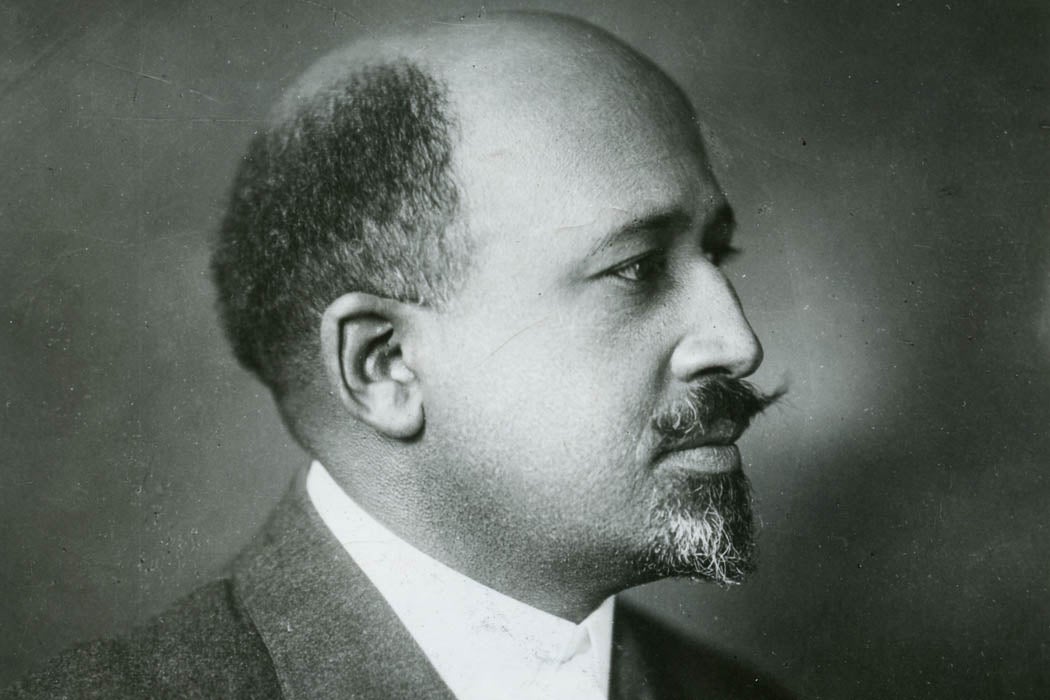
(W.E.B. Du Bois)

W.E.B Du Bois devoted his life’s work to achieving equal citizenship for all African Americans.  He worked tirelessly to achieve his goals after becoming the first African American to earn a doctorate from Harvard University and would go on to teach social sciences at Atlanta University, become one of the founders of the NAACP, edited “The Crisis” magazine which was his megaphone to the black community, lectured worldwide, promoted African and West Indian rights against colonial powers, and published a series of thought provoking books.  Du Bois was a firm believer that for African Americans to achieve full civil rights and political representation they would have to be led by a black intellectual elite – the key being advanced education that would lead to leadership.  He targeted racism, lynchings, Jim Crow laws, and all types of discrimination in his writing and public appearances.

 One of the most controversial aspects of his belief system was supporting America’s entrance into World War I, a decision he would come to regret.  He argued that if African Americans joined the American Expeditionary Force (AEF) in Europe to fight Germany and showed their talent and bravery it would raise their level of acceptance by the American people upon their return resulting in greater rights of freedom and safety.  This dream was negated by the reality of American racism , covert and overt violence, and persecution – all conditions consistent with the African American experience throughout American history.  Even US Army officials exhibited extreme racism and blatant lies as they erroneously depicted the combat experience of African American troops in Europe.

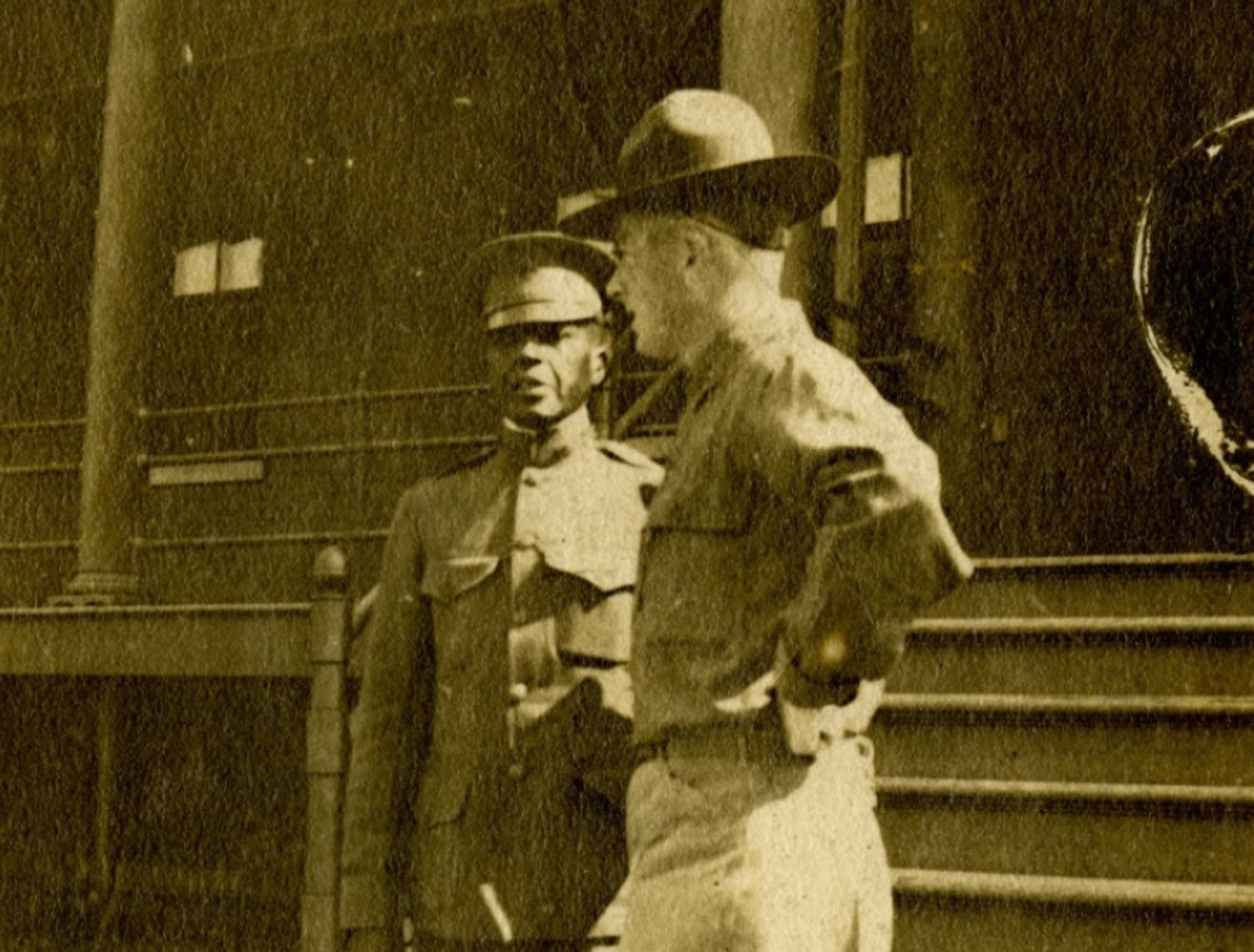
Black and white photo of African American Army officer walking downstairs passing a white Officer. Both men are wearing World War One style uniforms and hats.
(Charles Young at Camp Grant in 1919).

To atone for this grievous error in judgement, Du Bois wanted to set the historical record straight as World War I did not prove to be the catalyst for equal rights.  His strategy centered on a book he would spend nearly two decades entitled, THE BLACK MAN AND THE WOUNDED WORLD.  His effort was never completed nor published but it has become the core of an important new monograph by Chad L. Williams, THE WOUNDED WORLD: W.E.B. DUBOIS AND THE FIRST WORLD WAR.

Williams’ book is a comprehensive study of how Du Bois went about achieving his goals.  He recounts his battles with the NAACP to obtain funding and support, his battles with fellow historians who he competed with him in trying to produce the definitive study of the war, the role of his ego which did not allow him to accept enough assistance and share the limelight, his writings, particularly in the NAACP magazine, “The Crisis” which he edited, his travels worldwide promoting the Pan African world, and most importantly disseminating his ideas and research a function of his relationship with black veterans of the war, and a firm belief that American racism was destroying black progress, and the colonial European powers imprisoned people of color in a system where they could not achieve progress.

Williams’ approach is a carefully developed thesis supported by numerous excerpts from Du Bois’ writings and commentary buttressed by accounts provided by friends and foes alike, in addition to communications with black veterans and competing historians.  Williams fully explores Du Bois’ ideology which rested on his fear that if Germany were victorious in the war its racist government would negatively impact “Black folk” and brown people throughout the world.  He knew Germany well having studied at the University of Berlin providing him with firsthand knowledge of the Kaiser’s march toward autocracy, militarism, and empire.  He argued that black loyalty to England, France, and Belgium was of the utmost importance despite their colonial records. He believed an allied victory representing democracy was the only acceptable outcome in the war.  However, the result of this call to duty was dominated by racism in the military as whites refused to serve with blacks, military leaders refused to allow black officers to command black troops resulting in southern white racist officers treating black soldiers with contempt and at times violence.  Williams mentions examples of black officers like Major Charles Young, a graduate of West Point, but being an exceptional soldier did not allow him to fulfill the role Du Bois sought for him and others as the leaders of a new generation of blacks who would gain acceptance from American society.

(Over 350,000 African American soldiers served in WWI)

Williams portrays the lies put forth by military authorities when it came to black officers and their service, the performance of the 369th and 92nd divisions of the army, particularly the 368th Infantry Regiment, known as the Harlem Hell fighters, who were assigned to the French Army in April 1918. The Hell fighters saw much action, fighting in the Second Battle of the Marne, as well as the Meuse-Argonne Offensive, where black officers were blamed for the slow progress of the offensive with white officers falsely reporting on the performance of thousands of black troops.  The treatment of black soldiers carried over into their medical care during and after the war  where at first, black doctors and nurses were not allowed to treat black veterans at the new Tuskegee Institute Hospital.

When black  veterans returned home they were met with violence and race riots resulting in the deaths of over a thousand people in Tulsa, OK, Chicago, IL, Knoxville, TN, Phillips County, AK, Charleston, SC, and Washington, DC all described in detail by the author.  Further with the 1919 Red Scare many blamed black soldiers for bringing communism to America when they returned from Europe. When confronted with the reality of the African American soldier’s experience during their training, the war itself, and the reception they received upon returning from the battlefield, Du Bois committed himself to telling their story.

Williams pulls no punches in presenting Du Bois’ failed odyssey in completing his work.  First, he was overwhelmed with materials from his own travels to France  to conduct research and influence the Paris Peace Conference.  Second, he could never get a handle on the voluminous amounts of material sent to him by black veterans.  Third, his intense schedule that saw him work for Pan-African conferences and other causes.  Lastly, his other writings, lectures, and as mentioned before his ego which did not allow him to work successfully with others.  Further, he distorted his own experiences praising France for using Senegalese troops in the war and their treatment of blacks.  All one has to do is examine the French colonial experience to see how wrong he was.  Another example is his visit to the Soviet Union in 1926 and for a time believing in the “Marxist wonderland.” 

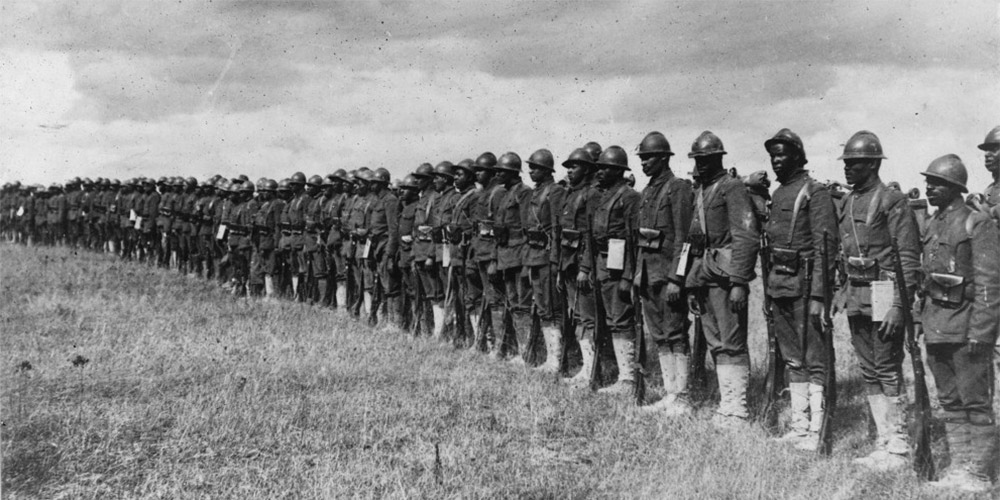
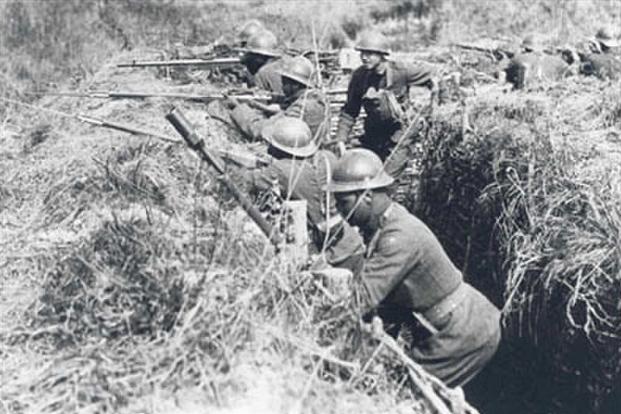
African-American soldiers (and one of their white officers) of the 369th Infantry, known as the Harlem Hellfighters, practice what they will soon experience, fighting in the trenches of the Western Front. They are wearing French helmets and using French-issued rifles and equipment, the logic being that since they were fighting under French command, it was easier to resupply them from the French system than trying to get American-issued items. (National Archives and Records Administration)

(African-American soldiers (and one of their white officers) of the 369th Infantry, known as the Harlem Hellfighters, practice what they will soon experience, fighting in the trenches of the Western Front)

In the latter part of the narrative Williams explores Du Bois’ life work particularly his realization that his World War I opus would never be completed.  The 1920s to 1945 period produced a great deal of success academically with the publication of BLACK RECONSTRUCTION, a widely accepted history of African Americans from 1850 to 1876.  In explaining Du Bois’ ideas in his books and other writings Williams traces Du Bois evolution ideologically as he argued that racism and colonization were responsible for two world wars and the failings of democracy pushing him further to the left.  As he grew older Du Bois concluded that even after World War II, African Americans were confronted with the same hostility and violence as they did in the post 1918 period.  Much to Du Bois’ dismay it was apparent that the arguments he developed for decades pertaining to racism and colonization still applied and he would work assiduously to ameliorate this situation until his death.

Throughout the two decades of preparing the book Du Bois had to overcome his “Close Ranks” editorial from the war supporting the use of African American troops in the war as a vehicle to obtain equality.  His decision was wrong, and he would pay a price professionally and personally.  Williams describes Du Bois’ effort as his most significant work to never reach the public as he struggled to finish his manuscript and the legacy of the war, however, “By rendering this story in such rich archival detail, Williams’s book is a fitting coda to Du Bois’s unfinished history of Black Americans and the First World War.”*

  • Matthew Delmont. “W.E.B. Du Bois and the Legacy – and Betrayal – of Black Soldiers,” New York Times, April 4, 2023.
W.E.B. DuBois, 1904

THE ISLAND OF EXTRAORDINARY CAPTIVES: A PAINTER, A POET, AN HEIRESS, AND A SPY IN A WORLD WAR II BRITISH INTERNMENT CAMP by Simon Parkin

Young Jewish refugees (including Peter Fleischmann, carrying large art folder) arriving in England in December 1938.

(British citizens walking into Camp Hutchinson, Peter Fleischmann is carrying an art folio)

The concept of internment was employed during World War II supposedly as a strategy to protect the national security of the countries that implemented it.  The most famous example was the internment of Japanese Americans in the United States resulting in 125,284 individuals of Japanese descent rounded up and dispersed to 75 incarceration sites.  A lesser known example was perpetrated by the British government for suspected German agents sent to a number of facilities on the Isle of Man.  British policy is the subject of Simon Parkin’s latest book, THE ISLAND OF EXTRAORDINARY CAPTIVES: A PAINTER, A POET, AN HEIRESS, AND A SPY IN A WORLD WAR II BRITISH INTERNMENT CAMP.

Parkin’s main focus is the Hutchinson Camp which became the home of an eclectic and talented group of people.  The camp was populated with over 1200 prisoners predominantly refugees from Nazi Germany who had been living in England peacefully at the time of their arrest.  Parkin’s begins by exploring English paranoia concerning a “fifth column” as it appeared the Nazis were about to invade.  Prime Minister Winston Churchill authorized the arrest of thousands among them were “so-called aliens” resulting in the imprisonment of teenagers who fled Germany on Kindertransport trains among them was Peter Fleischmann one of the main characters of the monograph.  In an interesting description, Parkin places Fleischmann at a concert performed at Camp Hutchinson symbolizing how one could be imprisoned by one’s liberator.  For Peter it was a reminder of Gestapo roundups in a world he had fled.  Other prisoners included Oxbridge dons, surgeons, dentists, lawyers and scores of celebrated artists – a truly talented array of people, one of “history’s unlikeliest and most extraordinary prison populations.”

A group of people designated as ‘enemy aliens’ on their way to an internment camp in Britain in 1940.

(British citizens carrying their possessions entering Camp Hutchinson)

The author launches his subject by describing the story of Herschel Grynszpan’s odyssey leading him to assassinate a German diplomat in Paris as revenge against the Nazis for seizing his parents who wound up in the no man’s land between Germany and Poland.  The result was Kristallnacht launched by the Nazis in November 1938 a policy designed to terrorize Jews into leaving Germany.  After discussing the impact of the beatings, seizures, and destruction of Jewish property, Parkin relates Peter’s early life after the death of his parents, living with an insensitive uncle, life in a series of orphanages, and finally his arrival in England.  His story is one of abandonment and reflects British policy toward German refugees that they accepted and then arrested.  British policy was clearly a haphazard one with little thought and planning as they seized thousands of people who in no way were a threat to the “empire.”  Rather than carefully constructing tribunals made of knowledgeable people to make decisions they placed people totally unprepared and trained to make those decisions – the result was mass arrest.  Churchill was part of the process, and he ordered all enemy aliens between the ages of 16 and 60 seized– leading to the transformation of asylum seekers into enemy suspects.

For Peter his final arrest came on July 5, 1940, and along with thousands of others were subjected to the inhumanity and indignities of how the British processed the men stealing their limited possessions, deprived them of their civil rights, and saw themselves as having survived dangerous escapes from Germany to be imprisoned by their saviors.  Hitler laughed at British policy correctly pointing out how the British were copying the Nazis by rounding up so many Jews.  Parkin describes a number of British facilities and for many it took months to reach Camp Hutchinson.

An internment camp on the Isle of Man in 1941.

(British internment camp on the Isle of Man)

Parkin correctly points out that internment brought lingering desperation and gloom, but it also brought the creative inspiration as a vehicle for survival as the men put their substantial musical, literary, and artistic talents to use.  Parkin describes concerts, classes of all types – academic to vocational, inventions, and other areas of prisoner expertise in great detail, a creative Hutchinson University.  What emerges is a communal type of living where talented people mostly share their expertise with each other to make their situation tolerable.

Parkin focusses on a number of important characters throughout the book.  Michael Covin, a former British journalist who survived the sinking of the refugee ship SS Arandora Star by a Nazi submarine to become a chronicler of what brought men to the camp and life under incarceration.  Klaus Ernst Hinrichsen, an art historian whose writing and commentary serves as an important source for the author.  Kurt Schwitters, poet and artist who served as a mentor for Peter.  Bertha Bracey, a Quaker who led a refugee organization working to gain asylum for children from Germany and securing the release of those incarcerated.  Ludwig Warschauer, the subject of a fascinating chapter as MI5 refused to allow his release as they correctly identified a German spy within their midst.  His wife, Echen Kohsen, an heiress who had cared for Peter in Germany will finally leave him when the truth comes out.  Parkin discusses many other talented prisoners and the effect prison life had on them emotionally and professionally.

Once the pressure on the Home Office grew and grew the government decided on a convoluted release policy which was almost as incompetent as their initial internment program.  Parkin describes hearings and judgements which made no sense, and of course Churchill did little to circumvent it.  For many like Peter the government offered release in return for joining the military.  Many agreed, and many refused to be blackmailed.  As many talented and influential people were released by 1941, Peter and hundreds of others remained interred.

TateImages_MA2610_preview
(Peter Fleischmann)

Parkin includes a final chapter in which he describes what occurred to people after release.  Finally, Peter will be accepted to an art school because of recommendations by camp artists and the work of refugee organizations.  This had been his life’s wish and finally he acquired people he could rely on and trust.

For the most part, Simon Parkin’s account is a riveting one reflecting a shameful chapter in British history which is also a testament to creativity and hope.  At times the author gets bogged down in the details of his subjects and it would have been interesting to compare women’s internment camps, which he mentions in passing in more detail.  But overall, a useful account of a forgotten category of a brutal British policy.

CROOK MANIFESTO by Colson Whitehouse

By 1971 New York was a city under siege.  During the liberal Republican administration of John Lindsay New York residents experienced a transit strike, a garbage strike, rampant crime, and the daily political corruption that seemed to dominate the city.  Colson Whitehead, who first addressed the plight of New York of the 1950s and 60s in his entertaining and substantive novel, HARLEM SHUFFLE returns with a sequel, CROOK MANIFESTO where Ray Carney once again has to navigate the city’s minefield.  As in the first novel, Whitehead breaks down his story into three components.  First, 1971 when Carney who had given up his ancillary career as a crook; 1973 focuses on Carney’s partner in crime, Pepper, and Zippo Flood, an old “colleague” of Carney who has inherited a substantial sum and is making a Blaxploitation film in Harlem; and third, how Harlem deals with the 1976 Bicentennial.  Whitehead uses his novel as a vehicle to investigate a neighborhood which finds itself at a tipping point in time accurately depicting the satire of this world and immersing himself into the hearts of his characters.

As the novel opens New York is in the midst of a shooting war between the NYPD and the Black Liberation Army which wants to overthrow the existing system.  Carney finds himself trying to stay legitimate as he has done for four years eschewing his “fencing” and “laundering” activities and keeping his furniture business afloat.  As the novel unfolds it becomes increasingly difficult for Carney to avoid “bent” activities.

Similar to HARLEM SHUFFLE in his new endeavor, Whitehead intersperses his social commentary throughout.  His first foray deals with the concept of revolution as seen by the Black Liberation Army which wants to overthrow the government and replace it with some type of socialist entity, and the Black Panthers who work partly within the system introducing social programs like free lunches and legal aid to minority communities.  Police corruption still dominates the novel as Detective Munson reappears and the policy of framing blacks for crimes continues unimpeded.  This led to the Knapp Commission under Lindsay to investigate police corruption and introduce Frank Serpico (the subject of a great film) to city residents.  The idea that the war in Vietnam and life in America’s ghettos have similarities takes hold under Whitehead’s rendering and provides interesting food for thought.  By the novel’s conclusion the depth of governmental corruption is fully laid bare.

Carney’s return to the world of crime is a function of his desire to be a loving father.  His daughter May is obsessed with the Jackson Five who are appearing at Madison Square Garden, and she begs him to get tickets for the sold out performance.  Desperate, Carney turns to Detective Munson who he is still paying “protection money” to try and obtain tickets.  This will lead Carney back into the “life” as he gets subsumed into Munson’s corrupt world of bribery, burglary, and murder.  It seems Munson and his partner Buck Webb have stolen jewels belonging to an organized crime headed by Notch Walker who also happens to be funding the Black Liberation Army.  It seems Webb and Munson have been called before the Knapp Commission and realize it’s time to tap out.  Munson’s plan is to screw his partner, rob an important card game created by another interesting character named Corky Bell and use Carney as his associate in return for the Jackson Five tickets.  For Carney, Whitehead’s description is spot on, “He had been straight for four years, but slipped once and everybody is glad to help you slip hard. Crooked states crooked and bent stays straight,  The rest is survival.”

Whitehead brings in two characters from HARLEM SHUFFLE and gives them a prominent role in the novel.  Pepper, an older “thug” has developed into an older brother figure in Carney’s life serving as a sounding board, a partner in crime, and in general comes across, despite his underworld activities somewhat sympathetic.  Another is Zippo Flood, a photographer that Carney had used in a revenge plot who emerges as a film maker having received a windfall from a Russian immigrant who escaped pogroms named “Heshie” who had taken a liking to him.  Zippo always wanted to be a film director and he uses the money to make the film; “Secret Agent: Neferititi” which Whitehouse uses to explain how black films are made and to integrate Chink Montague, a gangster that Carney is familiar with as an investor and the subject of a possible kidnapper of the film’s star, Lucinda Cole.  Once Pepper is hired by Zippo to find her the story becomes more interesting as he takes us through a “centric romp through the film industry, the Black comedy revolution, and the paradox of underground stardom.”*

Throughout the novel Carney is caught between recidivism and redemption, but as the bicentennial approaches events will catch up to him.  By 1976 Harlem was burning as “firebugs” were responsible for over a third of the 12,000 blazes that occurred.  Carney became distraught when he learned a young boy, Albert Ruiz, was injured in one of the fires and the furniture king decided he would find the person responsible.  He employed Pepper in the task, and it would lead to an interesting conclusion involving Alexander Oakes who was running for Manhattan Borough President.  It was the same Oakes that represented the best in Strivers Row and the man Elizabeth’s parents wanted her to marry, not the scum that her mother and father felt Carney represented.  This aspect of the novel is highlighted by Whitehead’s explanation as to how the city operated – City Hall corruption, burned out buildings, urban renewal, federal anti-poverty funds, insurance payouts, and pyromaniacs all linked in a push to clean up the city.  As I think back to growing up in the city at that time and driving a taxi in college, Whitehead’s theory makes a great deal of sense.

Jason Heller is correct when he points out that “What truly makes this series, or any series, work is the way it compels the reader to revisit its characters, to invest in them, to compel you to care enough to see their narratives through. Whitehead knows it, and CROOK MANIFESTO proves it. Ray, May, Elizabeth and Pepper in particular are by turns exasperating and aspirational. Life gets thrown at them, and they throw themselves back in return. These are people you crave to catch up with, and in Whitehead’s hands, the vast and intangible forces of society, injustice, morality, survival and love are distilled in them. ‘I want you back,’ sang the Jackson 5 so famously. It’s how Whitehead makes you feel the instant you close CROOK MANIFESTO does that mean it’s utterly necessary to go back and read (or re-read) HARLEM SHUFFLE before diving into its sequel? No. But it would be a crime not to.”*

* Jason Heller, “Crook Manifesto takes Colson Whitehead’s heist hero in search of Jackson 5 tickets,” NPR, July 18, 2023.

HARLEM SHUFFLE by Colson Whitehead

When someone begins a novel writing, “Carney was only slightly bent when it came to being crooked” you know the author knows how to engage his readers.  In this case, the author is Colson Whitehead who has already been awarded two Pulitzer Prizes  and a National Book Award  for the UNDERGROUND RAILROAD and THE NICKLE BOYS.  Colson is also the author of eight other works of fiction and non-fiction.    The prequel to his latest work, CROOK MANIFESTO recently released is HARLEM SHUFFLE which immediately introduces a fascinating and somewhat complex character in Raymond Carney, a furniture salesman who also fences jewelry and other items for his cousin Freddie.  When Freddie draws him into a larger heist the internal dilemma that always seems to rattle around in Carney’s brain takes hold between Ray the striver, and Ray the crook.

The novel is centered in Harlem in the late 1950s and early 1960s where Whitehead presents an accurate picture of the socio-economic condition of its residents.  Carney owns a furniture store on 125th street with a side door for other monetary opportunities.  Whitehead begins with an accurate description of the West Side Highway (a traffic abomination that I personally drove with my father at that time!).  Whitehead is clear about the dichotomy of downtown and uptown Manhattan into the Bronx and the types of “crooks” that exist in pinstripe suits with loafers and those who dress in a more casual style.

(125th Street, Harlem, circa 1960s)

This contrast is evident throughout the book as “negroes” living uptown strive for acceptance in white society and try and develop their own upper crust in Harlem.  The ambiance of small business during the period is emblematic of Carney’s store and other businesses and patrons he interacts with.  Whitehead expertly weaves the history of Harlem during the period throughout the novel.  The Apollo Theater, Adam Clayton Powell, Cab Callaway’s band, the Hotel Theresa, the “headquarters the Negro world” all make appearances.  Organized crime is a dominant force as the Italian Mafia makes inroads uptown and ally with local gangsters.

Whitehead delves into a series of themes that are highlighted through dialogue and actual historical events.  The racism of the period is on full display as Carney is ignored by white business types when he tries to conduct business.  Commentary dealing with light v. dark negro skin color is a harsh reflection of the self-concept of negroes as they try and fit in.  The Civil Rights movement makes an appearance through Carney’s wife, Elizabeth who works at Black Star Travel a business that tries to secure accommodation for negroes all over the country, particularly in the south.  As the book shifts to 1964 the author explores the Harlem riots and the motivations of protestors and police alike.  The violence and frustration of Harlem residents is obvious.  The split within the negro community is ever present with “uppity” negroes who control the Alexander Dumas Club which hosts the leading political and economic figures in Harlem.  It is interesting how Whitehead uses Carney’s father-in-law, Leland Jones, one of Harlem’s top accountants as the epitome of reverse negro racism as does Alma his wife who also abhors Carney and what he represents.

(Harlem, 1960s)

Corruption also dominates the novel as we see how the local mail service works.  It is made up of bribes and payoffs for protection as money is sequestered in envelopes to be delivered or picked up on a weekly basis.  This involves many policemen highlighted by Detective Munson who works with Carney.  Cops, drugs, pimps all interact as part of the “accepted system.” Political corruption is a daily occurrence under the regime of Mayor Robert Wagner and Tammany Hall as nothing seems to get done in the city without a payoff.

Other themes that come to the fore include racism in America’s segregated army during World War II reflected in Pepper’s experience in Burma.  Jewish-Black tension dealing with rents, jewelry and such though Mr. Moskowitz, a downtown jeweler seems somewhat honest as he fences gems for Carney, but also provides an education in dealing with jewels and their purveyors.

The plot goes round, and round as social commentary leaps off each page.  For Carney who has been swindled by Wilfred Duke, a banker and senior member of the Alexander Dumas Club, it is all about revenge.  However, that revenge leads him further into the nether land of Harlem’s underclass.  Further, there is poor cousin Freddie who seems to have crossed the Van Wyck family, one of New York’s finest, despite the undercurrent of bribery, and Chink Montague, a Mafia boss.  The problem is that his association with Freddie leaves Carney open to all kinds of extortion, fear, and in the end questioning if his lifestyle of half crooked and half not is worth despite its benefits.  With a successful business, a wonderful wife and two children, Carney has a lot to think about.

Overall, the novel is an extraordinary story about an ordinary man who lives a double life.  Whitehead writes with insight and humor and the story is an easy read.  Despite some mean characters, Whitehead has the ability to bring out their inner humanity, but overall, it is a story about how the straight world operated during the day and at night the bent got to work.  To sum up, Karan Mahajan in his 2021 New York Times  review states it perfectly, Whitehead rights the ship by the third section of the novel, “which focuses on another crime to which Carney is an unwilling accomplice, with potentially deadly repercussions for the people he loves. And the crime story, which had become inert, suddenly revs to life, reminding us that Whitehead, beneath all the shambling and high jinks, remains an American master.”

Colson Whitehead

(Colson Whitehead)

FRANCE ON TRIAL: THE CASE OF MARSHAL PETAIN by Julian Jackson

At the trial of Marshal Philippe P��tain (1856-1951) at Paris (France). In July 1945.

(August 1945 Trial of Marshal Petain)

In 1969, the two-part documentary film, “The Sorrow and the Pity” directed by Marcel Ophuls depicting collaboration between the French Vichy government and Nazi Germany during World War II was released.  Controversial from the outset, the film explored the reasons behind the collaboration, including anti-Semitism, Anglophobia, fear of Bolshevism and Soviet invasion, and the desire to acquire and maintain power during the German occupation.  By the end of the war, the entire Vichy experience fostered a deep fissures in French society and no one depicted this state of affairs more than Marshal Philippe Petain, the great World War One hero at the Battle of Verdun who led the Vichy government and after the war became the lightning rod dealing with French collective guilt and retribution.

Petain is the focal point in British historian Julian Jackson’s latest work dealing with France during World War II entitled, FRANCE ON TRIAL: THE CASE OF MARSHAL PETAIN.  In his comprehensive monograph Jackson zeroes in on Petain’s three week trial after France was liberated examining the central crisis of French history in the 20th century – the collapse of France within six weeks after the Nazi invasion in April 1940; the signing of an armistice with Germany; and Vichy’s policy of collaboration.

Pierre Laval

(Pierre Laval)

Jackson begins his narrative providing a photograph of a picture of Petain and German Chancellor Adolf Hitler shaking hands on October 24, 1940, and describes the symbolic importance of that act- a propagandas coup for the Nazis and a shock for the French public. The result of that meeting meant that France was no longer a combatant in the war and was now considered neutral, though the French public assumed that the hero of Verdun must be working behind the scenes with the British or the French resistance led by General Charles de Gaulle.  As Petain’s trial would show, he was not working behind the scenes with anyone and was collaborating with the Nazis no matter what his defense attorneys would argue.  The word “collaboration” became controversial when used in a speech on October 11, 1945, no matter how many times Petain denied that characterization of his government, it is part of the historical record.

Jackson describes the trial which opened in Paris on July 23 and ended on August 15, 1945, in minute detail.  He offers unique portraits of the major characters ranging from Petain; his lawyers, Jacques Isorni and Fernard Payen who despised each other, the prosecution led by Public Prosecutor Andre Mornet and Pierre Bouchardon; to Charles de Gaulle, Pierre Laval, and numerous other personages which include collaborators, members of the wartime resistance, and the role of past and future politicians like Paul Reynaud, Leon Blum,  and Francois Mitterand.  Jackson relies on trial transcripts, archival research, and most importantly to convey the mood of France during the trial and after, contemporary journalistic accounts.

Paul Reynaud

(Paul Reynaud)

One of the key themes of the book was to decide whether Petain was a hero or a traitor.  Each side in the debate had its own agenda.  Some wanted to protect their reputations as many served the Vichy government, others wanted to maintain Petain’s reputation as the epitome of a French hero who had given his life in service to the French people.  Taking place after Liberation, the trial witnessed the return of many French persons returning from deportation and forced labor and the liberation of the Nazi concentration camps.  Many call this period as the “Epuration,” or purge of the French body politick as so many had worked with and for the Germans. 

Jackson draws a number of important conclusions drawn from interrogations of Petain.  First, his answers reflected “a mixture of evasiveness or forgetfulness, self-delusion, blame shifting or mendacity, and self-pity….,” with some believing what else could be expected from an eighty-eight year old man.  Since he was quiet at the trial, witness interrogation offered a glimpse as to what his real views were.  Third, Petain’s hatred for Charles de Gaulle is readily apparent, though their earlier careers saw them working together.  Fourth, his lawyers were at a disadvantage as Petain provided little to create a more positive narrative for the events between 1940 and 1944.  Defense attorney Isorni had to invent the Petain that he needed as he had little to work with.  Fifth, rivalries among former Vich courtiers remained intense, and lastly, when evidence emerged against Petain, blame would be shifted to Pierre Laval.

The Acte d”accusation zeroed in on Petain’s responsibility for signing the armistice on June 22, 1940, and three constitutional acts promulgated on July 11, 1940, which went beyond the powers that he had previously been given which lent credence to the idea that he was involved in a plot against the Republic before the war.  The second charge dealt with tracing Petain’s treason after July 1940; for example, contributing to the German war machine, allowing the Germans to use French airfields in Syria, and firing on allied troops in North Africa in November 1942.  Lastly, he was charged with being fully behind the “abominable racial laws” and creation of a special section to enforce them.  All in all, he was guilty of attacking the internal security of the state and colluding with the Nazis to favor his own ambition which correlated with those of the enemy.

Charles De Gaulle And Georges Bidault In Paris, France On August 26, 1944 -

(Charles de Gaulle)

Jackson describes Petain’s demeanor during the trial which mostly appeared to be one of indifference, impassivity, as if he were in another world, though there were a few short outbursts defending himself.  Petain’s defense argued that by collaborating Petain “cunningly outwitted the Germans while allowing the subordinates to pursue a secret resistance .”  Further it was argued that Petain did not join the allies in North Africa after November 1942 because he believed his mission was to stay with his people.  Petain was therefore a “sacrificial martyr who supposedly had secret contact with the British and secretly supported the allied landing in North Africa in November 1942.  Lastly, Petain was not a “free agent,” he was answerable to Laval.  In the end this defense was not effective.

As far as the fate of the Jews is concerned, very little was mentioned at trial.  But, it is clear from the work of American historian Robert Paxton proves that under Vichy Jews were excluded from the civil service and other professions, the internment of Jews in the Unoccupied Zone, and the French carried out the arrest of Jews at the behest of the Germans.  Interestingly, Jackson points out as occurred in other countries when Jews returned to their homes after the war the atmosphere became poisonous as they tried to reclaim their property.   In fact, the Vichy Commissioner for Jewish Affairs, Louis Darquier (who Petain referred to as “the torturer), and the head of the French police during occupation, Rene Bousquet had no regrets concerning their role in sending Jews to Auschwitz and other camps.

An area of controversy discussed involves the United States which hoped to woo Vichy away from the Germans.  The US had diplomatic relations with Vichy and during the trial Washington was afraid that old wounds would be brought out, particularly French distrust for the United States.  Historian William Langer tried to whitewash the American relationship with Vichy, but Jackson, Paxton and others reported the truth of American complicity with Vichy.

Apart from the trial itself, Jackson vividly portrays the anguish of retribution as those who had collaborated with the Nazis found themselves spit upon, physically attacked, had their heads shaved, and criminally charged for their actions.  The period following the trial makes up a quarter of the book whereby the author describes how Petain’s supporters continued to fight to resurrect his reputation and place in history, even after he died and is buried on the French island of Il’ Yeu. 

François Mitterrand

(Francois Mitterand)

After the trial ended and Petain was imprisoned on the island the physical trial may have ended for Petain, but not for France.  Petainists and anti-Petainists continued the arguments presented at trial through various organizations, publications, and the personal agendas of many.  One of the more interesting characters was Charles De Gaulle who seemed to want the support of both sides.  Isorni continued the fight trying to exhume Petain’s body and have it moved to the national cemetery at Douaumont to be buried with other heroes of Verdun and petitioning for a new trial to overturn Petain’s conviction.  Petain remained a “political football” for decades after his death forcing politicians to make decisions which remained problematic as many French persons refused to let his actions go undefended.

It is clear that what is referred to as France’s “darkest hours” according to Agnes Poirier in her The Guardian, review of June 11, 2023, was one of cowardice, bad faith, dishonor and moral ambivalence.”  I agree with her further characterization that “what is chilling in Jackson’s beautifully researched and meticulous account of the trial is the hopeless mediocrity of almost all people involved in it: from judges and jurors (résistants and parliamentarians) to lawyers’ prosecutors and witnesses. Everybody seemed animated by petty or self-serving feelings; they were either out of their depth or spineless, but above all most were morally ambivalent. Before it began, De Gaulle had presciently talked of Pétain’s trial as a ‘lamentable but inevitable’ event.”  If you have an interest in exploring France’s greatest moral downfall in its modern history then Jackson’s comprehensive efforts should satisfy. 

“As Jackson explains: “De Gaulle knew he was on thin ice when claiming that Vichy was illegal. For that reason, he generally preferred to talk about legitimacy.” In the end, the difference between Petain and De Gaulle, between Vichy and the Free French, was their idea of honor. France’s duty had been to fight on whatever the risks, whatever the sacrifices. De Gaulle and his army of resistance saved France’s honor by the skin of their teeth. And as far as this French citizen is concerned, Petain and his clique can rot in hell for eternity.”

Petain Trial 1945

(August 1945 Trial of Marshal Petain)

THE KING’S PLEASURE: A NOVEL OF HENRY VIII by Alison Weir

Holbein - Henry VIII
(Hans Holbein the Younger, Portrait of Henry VIII, 1540, oil on wood, Palazzo Barberini, Rome)

The concept of “popular history” has proven to be a bone of contention between writers who engage in the genre and more academic historians.  According to one definition popular history is “dramatic storytelling often prevails over analysis, style over substance, simplicity over complexity, and grand generalization over careful qualification.”  In response author Alison Weir argues that history is not only for academic historians who engage in deep research and hope to uncover a new thesis that plays well in the academic community.  For Weir the author of seventeen works of historical non-fiction and fourteen works of historical fiction history belongs to all of us and if it is written in an entertaining manner based on extensive research it can be labeled “popular,” if so I am proud to be one of its practitioners!

Weir’s latest work of historical “popular” fiction is THE KING’S PLEASURE: A NOVEL OF HENRY VIII, a novel that purports to tell its reading audience the life of the outsized English monarch from his point of view.  After writing the six Tudor Queens series, individual novels which explore the lives of Katherine of Aragon, continuing with Anne Boleyn, Jane Seymour, Anna of Cleves, Katheryn Howard, and Katherine Parr, Wier decided it would be useful to present Henry’s views to balance those of his detractors.  Wier has also written a work of non-fiction about the life of Henry’s mother entitled, THE WHITE ROSE: A NOVEL OF ELIZABETH OF YORK.

Catherine Of Aragon Engraved portrait of Catherine of Aragon (1485-1536), the first queen of Henry VIII of England. She holds a bible in one hand. (Photo by Stock Montage/Getty Images)

(Katherine of Aragon)

Weir’s Henry VIII was a sensitive young man who lost his mother at the age of eleven shortly after his brother Arthur had passed away.  The loss of his mother who he truly loved plays an important role in Henry’s view of women throughout his life. 

At eleven, Henry had mastered French, Latin, and Italian and loved to engage in physical exercise and excelled at horsemanship, the longbow, fencing, jousting, wrestling, and swordsmanship.  As his humanistic education developed he showed great interest in the classics, literature, and poetry and saw himself as a true Renaissance individual.  Weir bases her novel on years of researching the history of the Tudors and though she might be considered a “popular historian” her knowledge of her subject and the detail she presents are quite impressive.  An early example involves his relationship with his father Henry VII following the death of his brother and the negotiations involved in Henry VIII marrying his widow, Katherine of Aragon.  As is her wont, Weir analyzes the political implications of the death of Queen Isabella of Spain, the debate as to whether Henry VIII can marry his brother’s widow, the relationship between father and son, particularly how Henry VIII becomes angrier and angrier at his father’s refusal to allow Henry to marry following the papal dispensation approving the marriage.

Anne Boleyn

(Anne Boleyn)

Henry VIII is seen as loving and very solicitous of Katherine for years until she is unable to meet Henry VIII’s obsession to produce a male heir when he rationalizes casting her aside because of the security needs of his kingdom.  As one reads on, the novel transports the reader to 16th century England with all major events and characters involving Henry wonderfully portrayed.  The likes of Cardinal Wolsey, Thomas Cromwell, Sir Thomas More, Francis I, Charles V, King Ferdinand, Emperor Maximillian, Pope Clement VII, and Henry’s wives are all presented in an accurate manner.  The diplomacy of the period particularly involving shifting alliances between England, France, the Holy Roman Empire, the German states, and the Papal states are all discussed in terms of the European balance of power and the significance of marriage diplomacy.  As one reads on one must keep in mind that Henry’s actions and reputation must be seen in the context of the time period in which he reigned.

The machinations at court are vividly portrayed.  The constant attempts at manipulation by many of the characters mentioned previously abound, particularly after Henry has his marriage to Katherine of Aragon annulled and he marries Anne Boleyn.  This would eventually lead to a break with Rome, Henry’s excommunication, and the creation of the Church of England, with Henry at its head.  With Lutheranism spreading in Germany conservative and reform factions emerge in England and Henry must deal with revolts in addition to worrying about the diplomatic games played by his fellow monarchs.

The author seems to enjoy relating life at court describing the entertainment, jousting, feasts, royal decorations and castles etc.  In fact, at times she seems to go overboard which detracts from more substantive events and movements.  Apart from the details of Henry’s marriages and their shortcomings in his eyes, she does relate how he stood up to Martin Luther, and  writes a book in defense of the church and Pope Leo reflecting the king’s intellect and desire to be seen as a defender of the faith.  As Henry ages, Wier presents a man who begins to realize the loss of his virility reflecting an explosive temper when it came to acts he saw as personally disloyal.  Much of his later physical deterioration is due to infections in his legs which made it difficult for him to get around.  The older he becomes, even after Jane Seymour provides an heir he becomes more and more difficult to be with.  From his viewpoint the state of health in his kingdom with sleeping sickness and plague abounding he realizes that he must produce a second heir which drove him to three more marriages, two of which did not end well.

A portrait of Jane Seymour, queen of England from 1536 to 1537 as the third wife of Henry VIII. Jane is remembered for being the only wife to provide Henry with a son and male heir (the future Edward VI). Jane died on 24 October 1537, most likely from puerperal, or childbed, fever. (Photo by Popperfoto/Getty Images)

(Jane Seymour)

Weir digs down deeply into important relationships that Henry was involved with, both men and women.  His anger at Anne Boleyn and Katheryn Howard are fully explained and from his perspective seem quite reasonable as both women knew how to successfully manipulate him until their pasts emerge humiliating and embarrassing him.  One must wonder whether Wier is correct as she plays on Henry’s own guilt when he allows both women to be executed.

In the end I believe that Weir is correct when she writes that she hoped she has provided insights “into the mid of a brilliant, autocratic, vain, intellectual, ruthless, and romantic king who changed the face and institutions of England forever and whose memory is still vividly alive five centuries after he lived.”  Whether you accept Weir’s interpretation of Henry’s life, the book is well written, an easy read, and does not get bogged down with fact after fact and dense writing offered by many historical tracts – for this she should be commended.

(Henry VIII)

GRAND DELUSION: THE RISE AND FALL OF AMERICAN AMBITION IN THE MIDDLE EAST by Steven Simon


Syrians walk along a severely damaged road in the northeastern city of Deir el-Zour, Jan. 4, 2014. (AFP)

(Syrian Civil War)

Today the Middle East borders on chaos.  In Israel, Prime Minister Benjamin Netanyahu is under indictment and as a means of retaining his administration pushes to reduce the power of the Israeli Supreme Court resulting in roughly 20% of the country taking to the streets in protest.  Further, Israeli reserve pilots have threatened to refuse missions in dissent.  The West Bank is experiencing renewed violence highlighted by a recent Israeli incursion and a continuing power struggle between Hamas and Islamic Jihad.  In Yemen, the brutal  civil war continues as Saudi Arabia and Iran are fighting a proxy war.  In Iran, the government is still dealing with domestic discontent particularly by the younger generation, exporting weapons to Hamas, Hezbollah in Lebanon, and drones and other support for the Russian war in Ukraine.  In Jordan, opposition to King Abdullah increases each time Israeli troops crack down on Palestinians.  Egypt remains a repressive autocracy.  Lastly, Saudi Arabia’s government under the leadership of Mohammad bin Salman further consolidates power of his repressive regime and spreads its wealth seemingly worldwide as it finds itself disagreeing with the Biden administration more and more. 

The above is symptomatic of a failed attempt by the United States to reorient the region toward its goals and in so doing according to Steven Simon in his new history/memoir GRAND DELUSION: THE RISE AND FALL OF AMERICAN AMBITION IN THE MIDDLE EAST, the region has undergone a forty year period whereby Washington has evolved from deep engagement to a period of retrenchment. 

PHOTO: British soldiers assist in rescue operations at the site of the bomb-wrecked U.S. Marine command center near the Beirut airport in Lebanon, Oct. 23, 1983. A bomb-laden truck drove into the center collapsing the entire four story building.

(1983 bombing of the US Marine barracks in Lebanon)

According to the author, the process began with the Iranian Revolution and the overthrow of the Shah during the Carter presidency which brought about a collapse of the American position through the final weakening of US resolve under Barack Obama.  In between the Reagan, Bush, Clinton, and Bush II administrations tried to retain American hegemony in the region, attempted to foster an Israeli-Palestinian settlement, dominate Iraq, and support Saudi Arabia.  This came to an end as Obama held Israel and the Gulf states in open contempt, failed to arm and train Syrian rebels in a civil war he referred to as “the shit show,” intervened in Libya, stalled in attempts to foster democratic transitions during the Arab spring, dealt with the Islamic State, was unable to forge a constituency for a nuclear deal with Iran, and witnessed a bitter end to the Israeli-Palestinian peace process.  Obama’s successor, Donald Trump acquiesced in this situation, periodically threatening different parties and trying to see how he could achieve political and personal gains. 

The question is how did the present situation evolve resulting in America’s propensity for self-deception and misadventure in the region particularly after 9/11 – Simon, whose career included a fifteen year career at the State Department, and service on the National Security Council staff as senior director for Middle Eastern and North African affairs provides interesting and evocative answers.

From left, Yitzhak Rabin, Bill Clinton and Yasir Arafat in 1993.

(Israeli Prime Minister Rabin, President Clinton, and PLO Chairman Arafat, 1993)

Simon has written a personal account of his diplomatic career involved in the Middle East, offering many historical observations and insightful analysis.  The monograph seems to offer two major themes.  The first, after the overthrow of the Shah in 1979 the United States changed from a period where American troops where not actively deployed in the region, instead CIA operations, vast military sales were tools used to spread influence, and Washington relied upon autocratic to achieve its goals.  Once Ronald Reagan assumed the presidency for better or worse, American troops at times  became active in the region from Lebanon, Iraq, Afghanistan, Saudi Arabia, and bases in the United Arab Emirates, and Bahrain.  In the case of Iraq, the policy has been a disaster which in the end destroyed the region’s balance of power and elevated Iran to being a major player.  This period came to an end with the final withdrawal of US troops from Iraq in 2011.  The second major theme that Simon explores was American policy toward Israel and Saudi Arabia.  Since the end of the Second World War, the United States sought to facilitate Israel’s survival in a hostile Arab world following the Holocaust and preventing any Soviet inroads involving Saudi Arabia.  Up until recently these policies have been mostly successful.  However, the emergence of a right wing Israeli government under Bibi Netanyahu and his ultra-orthodox allies, and the elevation of Mohammad bin-Salman as head of the Saudi government has led to policies that at times are designed to “get even” with President Biden’s comments during the 2020 election his cruelty and repression zeroing in opposition within Saudi society, in addition, his hope of achieving regional super power status does not bode well for the future of American success in the region.

Simon does an excellent job developing the background history for each presidential administration’s policies.  Beginning with President Carter and taking the reader up to the present, the author describes the significant issues that each occupant of the White House faced, the internal debates over policies, the personalities involved, the final execution of the decision-making process, and the ramifications once the dust cleared.  Beginning with Carter’s attempts at Camp David and the Iran hostage situation, Simon moves on to the haphazard NSC decision-making process in relation to the deployment of US Marines to Lebanon and the Iran-Contra scandal under Reagan; the debate in the first Bush administration over whether to remain in Iraq and achieve regime overthrow after Desert Storm, and the Madrid Conference designed to facilitate an Israeli-Palestinian peace;  Clinton’s need to know whether Saddam’s WMD had been catalogued and destroyed, and his inability to lure Iran to the negotiating table, as well as Clinton’s refusal to issue a presidential decision directive on the Middle East; George W. Bush facing the repercussions of 9/11 leading to an ill fated war in Iraq as well as creating a disastrous policy in Afghanistan; Obama’s attempts to reset US policy in the region, not enforcing his self-imposed red-line dealing with Syria, and achieving the Nuclear arms deal with Iran.  Next, Trump was indifferent to the mechanics of foreign policy and “his ignorance of the conduct of foreign policy clouded his occasionally sensible, if crudely formulated, impulses,” i.e.; pulling out of the Iran nuclear deal allowing Tehran to enhance its nuclear program, the Abraham Accords between Israel, the United Arab Emirates, and Bahrain, and abandoning the Kurds to Turkish President Erdogan  Lastly, President Biden who inherited unresolved conflicts with Iraq, Iran, and a Saudi relationship whereby Jared Kushner was able to ingratiate himself with Mohammad bin-Salman.  For Biden, faced with deteriorating relations with China, the issue of Taiwan, the Russian invasion of Afghanistan, and difficulties with Iran leave very little time to devote to the Middle East.  I agree with Simon’s conclusion that the Saudis and Persian Gulf states see Biden as “a speed bump on the road to a more accommodating Republican administration.”

(In this photo released by the Saudi Press Agency, Saudi Crown Prince Mohammed bin Salman and President Biden bump fists as they begin meetings in Jeddah)

Many of the major characters aside from presidents are discussed in Simon’s presentation.  Jimmy Carter employed Zbigniew Brzezinski, Cy Vance and others, though at times he was his own Secretary of State.  Under Ronald Reagan, George Schultz, Casper Wienberger, Robert McFarlane, and William Casey played significant roles.  For George H. W. Bush, James Baker, Colin Powell, Dick Cheney stand out.  President Clinton, who had little foreign policy experience relied upon Warren Christopher, Madeleine Albright, Sandy Berger, and William Cohen.  George W. Bush relied heavily on Dick Cheney, Donald Rumsfeld, Condi Rice, and to a lesser extent on Colin Powell.  Barack Obama worked well with Hillary Clinton, Susan Rice, and Robert Gates.  Donald Trump had a series of individuals who he eventually fired and brought in sycophant’s who would do his bidding.  For Biden it is too early to know the impact of those around him particularly Jake Sullivan, Lloyd Austin, and Anthony Blinken.  All of these figures play prominent roles in Simon’s presentation and analysis, and it is interesting to compare the types of people and their experience before they served their respective administrations and how impactful they were.

Simon has written a thoughtful, well-constructed work of fusion that will be useful for the professional and general audience. His viewpoints are based on years of involvement in the region and his commentary is succinct and for the most part dead on no matter which administration he is discussing.   He has done a wonderful job exploring a series of presidential administrations and how they approached the Middle East and must be commended for his ability to synthesize information as each chapter in of itself can be developed into a book of its own.

SYRIA-KURDS-CONFLICT

(Syrian Civil War)