BLUE-EYED BOY: A MEMOIR by Robert Timberg

(Author Robert Timberg during a book presentation)

As most are aware the Vietnam War has left many scars on those who fought the war and the American people in general.  With 58,000 men dead and roughly 270,000 wounded, many like the author, Robert Timberg suffered life changing injuries that affect them psychologically and physically to this day.  Mr. Timberg, a graduate of the United States Naval Academy, and a Marine Corps officer suffered second and third degree burns to his face and parts of his body on January 18, 1967 when his armored vehicle went over a North Vietnamese land mine in the vicinity of Da Dang, just thirteen days before he was to be cycled out of the war theater as his thirteen month tour was drawing to a close.  Mr. Timberg has written a long delayed memoir dealing with his experiences in Vietnam, his recovery, and his career which was a major component in trying to recapture some sort of normality.

(Timberg writing a letter home from Vietnam)

The book, BLUE-EYED BOY: A MEMOIR is written on multiple levels.  It is an emotionally captivating story by an individual who wages a courageous battle to regain some semblance of what he lost on that fateful day when delivering a payroll to another unit his vehicle hit a land mine.  The book is also a personal journey that takes him through numerous hospitals and thirty five operations with the support of two wonderful women, his first wife, Janie, who Timberg credits for his level of recovery and the family and career he is most proud of.  He readily admits that he was responsible for the end of their marriage and how poorly he treated her.  The other woman, his second wife, Kelly, allowed him to continue his recovery and develop a successful journalism career.  Unfortunately for Timberg, they too could not keep their marriage together.  The last major thread is how Timberg repeatedly lashes out against those individuals that did not go to Vietnam and as he states found, “legal and illegal ways” to avoid doing their duties as Americans.  Despite repeated denials that he is past those negative feelings and no matter how much he pushes his bitterness below the surface employing the correct verbiage of an excellent writer, his ill feelings towards a good part of his generation repeatedly bubbles to the surface.

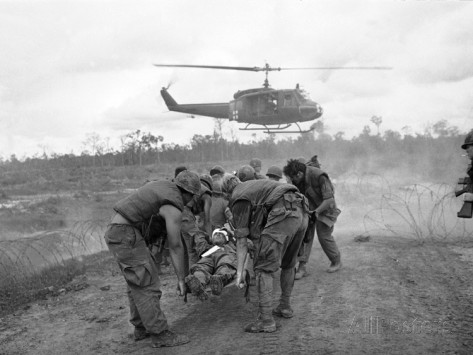
(Timberg being evacuated from Da Nang area after his vehicle hit a land mine, January 18, 1967)

This memoir is very timely in light of the type of injuries that American soldiers have sustained in Iraq and Afghanistan for the last twelve years.  It brings a message of hope for the future based on Timberg’s remarkable recovery and the success he has enjoyed as a reporter and a writer.  Our wounded veterans face a long road to recovery and Timberg’s story could be a wonderful model that they can try to emulate.  The first two-thirds of the book for me were the most interesting.  Timberg lays his life out for all to see.  His emotions which seemed to rise and fall with each sunrise and sunset are heart rendering.  His descriptions of his treatment with multiple skin grafts and surgeries are a testament to his perseverance.  His tenacity and ability to overcome most of the obstacles that were placed in front of him are truly amazing.  We learn a great deal about the Naval Academy and the United States Marine Corps and what they stand for.  Timberg takes the reader through many stages of recovery by interspersing his relationships with those who are most responsible for his making him whole, his first wife, Janie, and Dr. Lynn Ketchum, the surgeon who like a sculptor put Timberg’s facial features back together as best he could.  Despite his recovery, throughout this period his loss of identity constantly tugged at him, even as he earned the satisfaction of a successful career, but the loss of identity seemed to always be under the surface.  Once Timberg reaches the end of his period of recovery, he must leave “the cocoon of the hospital to home cycle” of constantly undergoing surgery and recovery.  For Timberg it was very difficult, but finally with Janie’s assistance he is able to overcome his fears and earn a Master’s Degree in Journalism at Stanford University and begin his career as a reporter in Annapolis.  That career would lead to a Nieman Fellowship, positions at the Baltimore Evening Standard, and the Baltimore Sun.  Timberg became a leading White House correspondent, and the author of three very important books.

The one area of the book I have difficulty accepting is the sections that deal with the germination of the ideas for the book THE NIGHTENGALE’S SONG, and how the book was finally conceived and reached fruition.  It was fascinating how Timberg pulled together such disparate personalities as John McCain, James Webb, John Poindexter, Robert McFarlane, and Oliver North to create narrative dynamic that made sense.  What sparked this dynamic was the Iran-Contra scandal that rocked President Reagan’s second term in office.  Timberg was able to parlay the scandal and the personalities just mentioned into a coherent and interesting monograph.  I remember when the book was published and after reading it I wondered if Timberg had an agenda that called for damning those who were able to avoid serving in Vietnam, and blaming the prosecution of the Iran-Contra scandal on the media and members of Congress who figured out ways to remain out of the military during the war.

Timberg’s judgment is deeply flawed in attacking, what seems to be everyone who did not fight in Vietnam for pursuing the Iran-Contra scandal.  I understand that he suffered unbelievable horrors as a result of his military service and significant emotional issues remain.  However, his inner drive to become the person he was before he was seriously wounded has clouded his judgment to the point where he deeply hurt, Janie, his first wife, the woman who was mostly responsible for making himself whole as he recovered.  His comments dealing with the need to find another woman to have sex with aside from his wife to see if he could find another person who was attracted to him is deeply troublesome.  It was thoughts like this and leaving her alone with three children for a great deal of time reflects poorly on Timberg no matter how courageous he was.  As Timberg researches and writes THE NIGHTENGALE’S SONG, his obsession with those who did not fight in Vietnam comes to the fore completely.  Though there are repeated denials in the book his understandable prejudice against “draft dodgers,” etc. is readily apparent, i.e., his convoluted logic of going after people who believe that Iran-Contra was a major crime and resulted in violation of the constitutional and legislative prerogatives of Congress, aside from the cover-up and outright lying the of the Reagan administration with a vengeance.  By explaining away the scandal by raising the question; “was Iran-Contra the bill for Vietnam finally coming due?” for me, is a bit much and cannot explain away the illegal acts that North, Poindexter, and McFarlane committed no matter how hard Timberg tries.  For the author it seems like everyone who did not go to Vietnam used money and connections to avoid serving.  Further, those who did not serve, “much of the rest of that generation came up with novel ways to leave the fighting and dying to others.”(213)  Timberg quotes from Lawrence M. Baskir and William A. Srauss’ excellent analysis of the draft, CHANCE AND CIRCUMSTANCE to buttress his arguments, however if he revisits objectively the Pentagon statistics that the authors quote he will find that not all who did not serve in Vietnam committed acts that Timberg finds reprehensible  There are millions who were involved in defense related jobs, duty in the United State Army Reserves and the National Guard, had legitimate medical deferments, or were conscientious objectors.  I agree a significant numbers did avoid service and Baskir and Strauss put the number of draft offenders at about 570,000, accused draft offenders at 209, 517, with about 3250 actually imprisoned.  We must also keep in mind that of the 26,800,000 men of the Vietnam generation, 6,465,000 served but never went to Southeast Asia, and of the 15,980,000 who never served in the military 15,410,000 were deferred, exempted or disqualified -all cannot be painted with the broad brush of being draft dodgers as Timberg seems to strongly intimate.*

Overall, Timberg is correct, Vietnam is still a raw nerve for a generation that witnessed men rallying to the flag, and men who felt the war was wrong.  As history has borne out the American people were lied to by the Johnson administration and the government in general.  I respect Mr. Timberg’s service, the wonderful career he used as a vehicle to become whole again, and I find that he is an exceptional author, who at times goes a bit overboard in his attempt to rationalize why people avoided service in the war.  The book is a superb read, deeply emotional and for my generation dredges up a great deal and provokes deep thought concerning how the experience of the Vietnam War still affects American foreign policy and the conduct of combat to this day.

*See Lawrence M. Baskir & William A. Strauss CHANCE AND CIRCUMSTANCE. New York: Alfred A. Knopf, 1978, p. 5 for an excellent chart that is reflected in the figures presented.

LIAR TEMPTRESS SOLDIER SPY: FOUR WOMEN UNDERCOVER DURING THE CIVIL WAR by Karen Abbott


(Photo of Belle Boyd, the rabid secessionist and successful Civil War spy)

When I read a title that sounds like a John Le Carre novel, I am always intrigued. Karen Abbott’s new book, LIAR TEMPTRESS SOLDIER SPY: FOUR WOMEN UNDERCOVER IN THE CIVIL WAR has many elements of the espionage master’s work and she weaves a series of wonderful stories into a historical narrative that could pass for fiction.  The book Abbott has written explores the role of women during the Civil War, an area that has not been addressed sufficiently by historians.  Her work is less about the contribution of women in general who performed domestic tasks for confederate and union forces, but mostly about the lives of four women who played prominent roles during the war; Rose O’Neal Greenhow and Belle Boyd who supported secession, and Elizabeth Van Lew and Emma Edmonds who remained loyal to the union.  All four women engaged in espionage during the war, and their lives reflect their own personal dangers in addition to the death and destruction that they witnessed during the “war between the states.”  In telling the stories of these heroines, Abbott integrates important aspects of the political and military history of the war into her narrative very effectively as each statement or document that appears is supported by by her research, though there are a number of places in the narrative when she appears to take some poetic license as she quotes from works of fiction as if they were accurate sources.

For the reader who sets out to read Abbott’s historical monograph they will find that, at times, it reads like an espionage thriller.  As they progress in the book they will meet many important historical characters, including; General Stonewall Jackson, General George McClellan, Detective Alan Pinkerton, Abraham Lincoln, Louis Napoleon III among many others.  The book is organized chronologically with alternating chapters dealing with each of the subject women.  At times this approach can be confusing, and perhaps each woman could have been dealt with separately to create greater cohesion and then a chapter or two discussing how their lives may have interacted.  None the less the book is a quick and interesting read and focuses attention on four unsung heroes who can now be seen in a new light.

(Photo of Sarah Emma Edmonds, Union spy who changed her sex identity during the Civil War)

What separates Abbott’s account of the war is her in depth portrayal of her subjects and how they used their own inner resources to place themselves at risk in promoting the cause they believed in and were willing to die for.  The first, Belle Boyd, a charismatic character, who loved the limelight and had a force of personality that dominated most situations she found herself in.  Raised in Martinsburg, Va. she was a staunch secessionist who abhorred the union.  She engaged in numerous plots to acquire intelligence for the confederacy and employed her saucy, feminine whiles with men to gain whatever she needed.  Her life is fascinating and is worthy of her own biography.  Perhaps her lowest moment in the war, aside from the defeat the south suffered was the secession of western Virginia, including her own home county of Berkley, forming the state of West Virginia.  Second we meet Emma Edmondson, Canadian women who wanted to join the union army.  The strategy she adopted was to assume the identity of a man named Frank Thompson and when she survived her physical exam she joined Company F, 2nd Michigan infantry.  She began as a male nurse and soon became a mail currier and  spy for the union.  She kept her identity secret from everyone but two soldiers she served with that she fell in love with.  She survived a great deal of combat and was very effective.  Throughout the war she feared someone above her in rank would discover her true sex more than she feared death.  Her life is also an amazing story and she did write her own memoir entitled; MEMOIRS OF A SOLDIER, NURSE AND SPY! A WOMAN’S ADVENTURES IN THE UNION ARMY.  Third, is the life of Rose O’Neal Greenhow who lived in Washington, DC and was counted on by the Confederacy to obtain as much intelligence as possible.  She was friends with Confederate General P.G.T. Beauregard and headed a spy ring prone to “indiscretions” with men.  She worshiped Southern senator, John C. Calhoun of South Carolina and mirrored his political views.  She had a number of lovers, the most important of which was Henry P. Wilson, an abolitionist Republican who was  the union Chairman of the Military Affairs Committee.  She has been credited with providing the intelligence that allowed the confederacy to defeat the union army at the first Battle of Bull Run (Manassas).  During the course of her career she was arrested a few times and served short prison sentences in Washington at the Capitol Prison.  After being exiled to the south she was sent by Jefferson Davis to England and France to try and gain recognition of the Confederacy by these nations.  On her return to the United States her blockade running ship was intercepted by the Union Navy. Lastly, and probably the most impactful of the four women on the course of the war was Elizabeth Van Lew, a wealthy society woman, and a strong unionist who lived in Richmond.  Her career as a spy was fraught with danger since most of her neighbors and politicians in the confederate capitol knew her wartime sympathies.  There were numerous attempts to try and catch her, by searching her mansion which became a union safe house, constant searches by detectives, and numerous attempts at entrapment.  Despite all of these obstacles she organized and ran the Richmond spy ring and its conduit to the Underground Railroad for escaped slaves and union soldiers to the north, and maintained a “secret room” upstairs in her mansion as a transshipment point for those fleeing the south.  General Grant, grateful for her work sent her a personal note: “you have sent me the most valuable information received from Richmond during  the war.”  Grant awarded her the position of Postmaster General of Richmond during his presidency to try and compensate her for all the  wealth that was poured into the northern cause during the war.

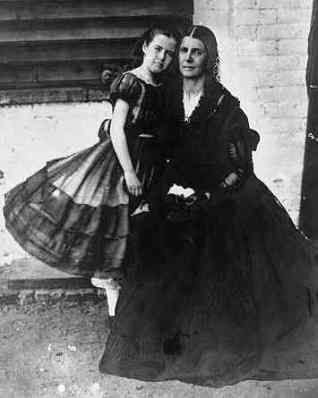
(Photo of Rose Greenhow, a Confederate spy during the Civil War and her daughter and part time currier, “Little Rose”)

It is not my purpose to recapitulate Abbott’s narrative but they are a myriad of interesting and surprising revelation that she brings to the fore.  Since women were not allowed to serve in the union army and there really was no military legal precedent for what to charge them should they be caught, union military officials would kick them out of the army under the charge of prostitution.  There were about 300-400 women in the union army during the Civil War, and Abbott tells a number of stories dealing with their plight.  In addition, the author relates the activities of Detective Alan Pinkerton who was in charge of union espionage for part of the war.  The role of detectives emerges throughout the narrative and how they interacted with Boyd, Greenhow, and Van Lew.  We witness a blend of societal graciousness and hospitality on all sides, but at the same time Abbott is letting the reader know what each character thought.  The chapter that deals with Pinkerton’s arrest of Rose Greenhow is priceless.  Abbott describes in detail the house search and how Greenhow was able to finagle documents into the hands of her eight year old daughter, “Little Rose,” as the conduit to avoid detection by Pinkerton’s agents and getting the intelligence to sources outside her home.  Even under constant surveillance Greenhow continue to spy for the Confederacy employing her daughter as her currier.  Another important vignette that Abbott discusses is how Elizabeth Van Lew, a friend of Confederate President Jefferson Davis’ wife is able to convince her to take on one of her freed slaves as a servant in the Confederate White House.  As the war turns against the Confederacy, Davis, for a time, is at a loss as to how Union spies seem to know military plans soon after he had conferred with General Robert E. Lee,  or other southern generals.  The work of Van Lew’s servant, Mary Jane, was certainly an important contribution to the Union cause.

(Photo of Elizabeth Van Lew, a Richmond socialite who spied for the Union during the Civil War.  A woman who was widely praised by General U.S. Grant)

Karen Abbott has certainly done a service to the memory of four women who were under cover during the Civil War.  It makes for an excellent read and I recommend it to Civil War buffs and those interested in an aspect of women’s history that few are familiar with.  As Elizabeth Van Lew alluded to after the war, women made major contributions to the northern victory but when it came for them to receive military pensions they had to beg men for what was due them, because they did not have the vote.

STRAWBERY BANKE: A SEAPORT MUSEUM 400 YEARS IN THE MAKING by J. Dennis Robinson

All photos from the neighborhoods of Strawbery Banke in Portsmouth, NH


A warning to readers of this review, I have just moved to the Portsmouth, NH area and I have immediately begun a love affair with the town of Portsmouth (I have shared these feelings with my spouse!) whose people are proud not to be considered a city!  A town that has a population of about 20,000 people and 22,000 restaurant seats is a wonderful concept to be enjoyed each day.  While wandering around the town I came across Strawbery Banke, the historic preservation of the Puddle Dock section of early Portsmouth.  I was enthralled about what I witnessed and being a historian I needed to know more.  The book STRAWBERY BANKE: A SEAPORT MUSEUM 400 YEARS IN THE MAKING by J. Dennis Robinson was the perfect vehicle for me to learn about Portsmouth and satisfy my curiosity about how it developed.  The book possesses a well written narrative in two parts.  First, the history of the Portsmouth region from roughly 1605 through the colonial period, the American Revolution, the 19th century, to the post World War II era.  The second half of the book is devoted to the creation and implementation of the Strawbery Banke historical site.  The book contains numerous photographs of the different characters throughout the history of the museum as well as the architecture that was saved by Strawbery Banke.  What sets Strawbery Banke apart from other historical sites, i.e., Williamsburg, VA or Sturbridge Village, MA is that the original buildings have been preserved and have not been recreated.  The book follows the long journey of historical preservation that began in 1957 and is still, flourishing today.


Apart from the general history of the Portsmouth region, what I found most interesting about the book was its discussion of the individual houses that have been preserved and the fight to take a federal urban renewal project and convert it into a historical restoration that would rekindle and refurbish a section of Portsmouth and would be a vehicle to uplift and restore the entire town.  One of my favorite mini-histories narrated in the book involves the Shapiro House that was home to Russian Jewish immigrants who left the Ukraine in the late 19th century among many who sought to escape the pogroms and persecution that existed in Russia.  What I found fascinating was that orthodox Jews would settle in Portsmouth as opposed to the majority of Jews who went to the lower east side of New York City.  The Srawbery Banke site has the original Shapiro home with the accoutrements of a Jewish family displayed accurately in its different rooms, highlighted by a woman who role plays Mrs. Shapiro in early 20th century garb.  The other aspect of the book that was very surprising was how local and federal politics and the economic issues involved had to be overcome in trying to create Strawbery Banke.

Unlike Williamsburg there was no Rockefeller benefactor to fund the project.  Strawbery Banke was funded by hundreds of local residents with some federal money and today is dependent upon donations, membership, and visitors for its survival.  The book is a wonderful read for those who are interested in a different approach to America’s settlement story of John Smith and Pocahontas that is not generally known. The book narrates and analyzes the evolution of Strawbery Banke and the town of Portsmouth and how they have evolved into cultural centers that attract thousands upon thousands of visitors each year.  To the author’s credit he tells the entire story, not just the triumphs.  Throughout its development Strawbery Banke experienced a great deal of infighting over disagreements as to what the correct path for the “outdoor museum” should take.  The disagreements are presented objectively, and Robinson also explores the less positive aspects of the museums’ expansion as over time certain neighborhoods were taken over resulting in the bitterness of those had to be relocated.  Despite these negatives, the end product of the museum seems well worth it.

Portsmouth has a certain feel to it that makes it one of the most inviting towns I have ever experienced.  It is worth a visit, and before you come read STRAWBERY BANKE, as it will be the precursor of a wonderful adventure. In addition, if you find historical preservation interesting the book explains how difficult and expensive it is to get one off the ground and maintain it in today’s economic environment.

THE FIVE OF HEARTS by Patricia O’Toole

Once in a long while friendships develop among people and remain in force throughout their adult lives. The figures involved in that relationship share their personal, intellectual, and emotional feelings resulting that at times they appear as extensions of each other. What I have just described is probably a utopian relationship; however the subject matter of THE FIVE OF HEARTS by Patricia O’Toole comes closest to achieving that ideal. The book centers on the interactions between Henry and Clover Adams, John and Clara Hay, and Charles King from the end of the Gilded Age in the late 19th century through the death of Henry Adams near the end of World War I. In her warm and intimate portrait of her characters O’Toole explores all aspects of the interactions of these five individuals who created a salon like atmosphere naming themselves the “five of hearts.” Of the five individuals it is most likely that the reader is somewhat familiar with Henry Adams and John Hay. However, the study of their lives and their spouses along with Charles King provides a much more thorough analysis of late 19th and early 20th century culture and intellectual history than if the author concentrated on Adams and Hay alone. The author provides insights into the flaws of her subjects and their impact on each other, as well as the world they touched. Throughout the book the important figures of the time period ranging from Henry James to Theodore Roosevelt appear and O’Toole offers unique perspectives that are based on thorough research and strong analytical skills. If one is interested in gaining an understanding of the intellectual and personal lives of the Adams and Hay families and the life of Charles King and their important contribution to American history THE FIVE OF HEARTS makes for a wonderful read.

THE BULLY PULPIT: THEODORE ROOSEVELT, WILLIAM HOWARD TAFT, AND THE GOLDEN AGE OF JOURNALISM by Doris Kearns Goodwin

One of the most important friendships in American History was the relationship between Theodore Roosevelt and William Howard Taft.  They had a strong bond that lasted for years and then over a short period of time their friendship began to sour resulting in a schism in the Republican Party that caused them to lose the presidential election of 1912 to the Democrat, Woodrow Wilson.  Many historians have reached numerous conclusions as to why Teddy and Will went from being the best of friends to political enemies.  In her new book, THE BULLY PULPIT: THEODORE ROOSEVELT, WILLIAM HOWARD TAFT, AND THE GOLDEN AGE OF JOURNALISM, Pulitzer Prize winning historian, Doris Kearns Goodwin goes beyond the issue of friendship between Roosevelt and Taft and has written three books in one that she masterfully integrates as she presents her narrative.  First, the reader is offered a detailed biography of Theodore Roosevelt, next we are exposed to detailed biography of William Howard Taft, and lastly, and most importantly Goodwin explores the world of investigative journalism, what Roosevelt eventually referred to as the “muckrakers,” primarily through a history of McClure’s Magazine and their well known stable of journalists.  Goodwin does a remarkable job synthesizing a vast amount of material as she merges the lives of S.S. McClure, Ida Tarbell, Ray Stannard Baker, William Allen White, Lincoln Steffens, and others throughout her narrative.  The main strength of the book is her argument that it was the influence of these investigative journalists that fostered the Progressive reform era at the turn of the twentieth century.  She argues further that Roosevelt’s colorful personality and drive allowed him to develop reciprocal relationships with these writers that fostered public pressure on a small group of conservative Senate Republicans that brought about the reforms of the Roosevelt era. Goodwin writes, “this generation of gifted reporters ushered in a new generation of investigative reporting that allowed Theodore Roosevelt to turn the presidency into the ‘bully pulpit’ to achieve reform.” (xiii)  On the other hand, Taft’s personality and laid back approach to politics did not allow him to achieve the same type of working relationships with the press and he lost the ability to codify and expand upon Roosevelt’s legacy, “underscoring the pivotal importance of the ‘bully pulpit’ in presidential leadership.” (xiv)  In the background, Goodwin tells the story of the friendship between these two men and why it did not survive the political theater of the day.

The narrative begins with the standard biographical information of both men.  In terms of Roosevelt there is nothing that is really new as this story has been well mined by the likes of Kathleen Dalton, Edmund Morris, Henry Pringle and others.  The information on Taft is more interesting in that fewer biographies of the twenty-seventh president have been written.  In terms of Goodwin’s thesis what is important at the outset is how she compares the personality traits of the two men as they mature as individuals and politicians.  We learn that as a child Roosevelt was a fragile and sickly and developed “a fierce determination to escape an invalid’s fate [that] led him to transform his body and timid demeanor through strenuous work.  Taft, on the other hand, blessed from birth with robust health, would allow his physical strength and energy to gradually dissipate over the years into a state of obesity.” (34)  At Harvard, Roosevelt was a “slender young man with side-whiskers, eyeglasses, and bright red cheeks.  While Taft’s sturdy physique, genial disposition, and emphatic manner won immediate popularity at Yale.” (42) On  the one hand was an individual who suffered from a  inferiority complex who would work his entire life striving for superiority to overcome this self-perception, while Taft developed into a secure person who he was self-aware and accepted his limitations.  According to Goodwin, these traits explain a great deal about the course of their careers and their successes and failures.

Goodwin’s frequent verbatim entries into her narrative allow the reader to feel as if they are experiencing life with Roosevelt and Taft.  Both men had the good fortune of growing up as favored children in close knit families.  Where Taft “developed an accommodating disposition to please a giving father who cajoled him to do better,” Roosevelt “forever idolized a dead father who cajoled him to do more and do better.” (48)  The correspondence that Goodwin includes between these sons and their fathers provide interesting insights into their formative years and development of their personalities.  Roosevelt learned early on in his career as a New York State Assemblyman the value of the press as he sought a journalistic alliance when he went after a corrupt judge who was a puppet of financier Jay Gould, and learned about poverty from touring tenements with Samuel Gompers.  The assembly and his stint as New York City Police Commissioner provided Roosevelt with an important education, as opposed to Taft who shunned the very spotlight that the future Rough Rider craved.  Taft favored to fight his battles from the inside, trusting logic, reason, and facts.  Taft always tried to avoid controversy, and would hardly ever compromise his principles as he tried to balance the rights of labor with the rights of capital as a superior court judge.

As both men evolved in their careers Goodwin relates the deeply personal details of their personal lives.  Goodwin does a nice job exploring Roosevelt’s emotional trauma whether dealing with the deaths of his father, mother, or his first wife Alice.  Goodwin provides intimate details reflecting a side of Roosevelt that was not open to the public.  His “recourtship” and marriage of his childhood friend, Edith Carow is especially enlightening as Roosevelt had pledged never to remarry, and reflect the author’s insights and handling of their rekindled relationship, a topic that seems missing from most biographies of Roosevelt.  For Taft, the love of his life was Nellie Herron who after their marriage would be the driving force behind her husband’s career.  At each level ranging from his role as Solicitor-General, a judgeship on the Federal 6th Circuit District Court, Governor-Generalship of the Philippines, as Secretary of War and then his presidential campaigns, Nellie was his most trusted advisor and confidante.  Later, when she suffers a stroke and is incapacitated, Taft will make a series of mistakes that greatly affect his career.

As Goodwin breezes along with the narrative through Roosevelt’s presidency, coverage is not equally distributed.  The emphasis of the first half of the book is on Roosevelt, followed by significant sections on investigative journalists, and the remainder on Taft.  From my perspective I would have liked more emphasis to have been placed on the journalistic component of the story because Goodwin brings a great detail of refreshing new material to the fore.  Her discussion of S.S. McClure, the founder of the magazine of that name is wonderful.  Throughout the book the reader is presented with an egomaniac, who suffers from manic-depression, and obsessive-compulsive disorder, but despite these “limitations,” the man is a literary genius.  McClure travels the world to find writers for his new publication with emphasis on the literary, but also investigative articles that will propel a new generation of writers to the American reading public that will foster careers allowing them entrance into the corridors of power, particularly that of Theodore Roosevelt, and engender a tremendous amount of influence as they prepare articles that support major legislative reforms.  The private lives of Tarbell, Baker, Steffens and White are chronicled as well as their personal relationship which created a family-like atmosphere at McClure’s.  Ida Tarbell’s research and writings dealing with trusts, especially John D. Rockefeller’s Standard Oil, and examination of the tariff structure in the United States are thoughtful and set the stage for Roosevelt’s reputation as a trust buster and a proponent of lower tariffs.  John Stannard Baker’s investigation into labor practices and political corruption are the basis for labor legislation and a movement to reform representative democracy.  Lincoln Steffens’ SHAME OF THE CITIES educates the American public about political bossism and corruption on the state and local level.  William Allen White served as Roosevelt’s eyes and ears in the Midwest from his perch as editor of the Emporia Gazette headquartered in the small town of Emporia, Kansas. Lastly, Upton Sinclair, who was not part of the McClure’s team, novel, THE JUNGLE sent a message to congress about conditions in the meat-packing industry that culminated in the creation of the Food and Drug Administration and regulation of the meat-packing industry, and Jacob Riis, also not part of the McClure’s family educated Roosevelt on the role of poverty in the United States.  In all cases Roosevelt established a relationship with these journalists, inviting them to the White House, sharing speeches with them in advance, and gaining their confidence that he proof read some of their articles.  This relationship, along with the publicity that McClure’s and other magazines engendered created a climate whereby the Republican conservatives in the Senate who were tied to different industrial trusts eventually had to compromise and give in. As a result Goodwin’s conclusion as to the historical importance of this group of writers cannot be underestimated.

Much of the book is focused on domestic issues but certain important foreign policy problems receive coverage.  The traditional story of the Spanish-American War and Roosevelt’s role are related and its affect on the Rough Rider’s growing political profile.  As a result of the war the United States acquired control of the Philippines and it is here that Taft reenters the picture as Governor-General of the archipelago.  It is at this juncture of his career that Taft is happiest.  He enjoys the everyday intricacies of governing and he treats the Filipino people as fairly as possible when compared to the imperialists in the United States.  It is interesting to compare Taft’s views on race with that of the social Darwinists views of Roosevelt.  Once he is recalled by Roosevelt, who succeeded to the presidency following the McKinley assassination, Taft delays his departure as long as he can until he takes over as Secretary of War.  The other major foreign policy issue that the Roosevelt administration is known for is the building of the Panama Canal, or as Roosevelt stated, “I stole it!”  Here Goodwin offers a perfunctory approach, but there is little to add to David McCullough’s THE PATHWAY BETWEEN THE SEAS.

The best way to compare how Roosevelt and Taft approached reform and used the levers of presidential power is to compare a few of the many problems that Goodwin explores in depth.  The best place to begin is to develop a definition of what progressive reform was in the eyes of Roosevelt which Goodwin does not do.  For Roosevelt all trusts were not bad, and conservation was not radical environmentalism.  In Robert Wiebe’s BUSINESS AND REFORM AND THE SEARCH FOR ORDER we learn that Roosevelt believed in the concept of “efficiency.”  If a trust was deemed to be efficient and benefited the American people and they abided by certain government strictures, Roosevelt saw no reason to go after them.  As far as conservation, Roosevelt wanted to conserve America’s land and resources for future generations, but he also allowed their development, if done in a practical manner, and benefited society as a whole.  It is interesting that most progressives were not wide eyed radicals, but mostly middle class individuals who wanted to grow the American economy for the benefit of all.  In examining Roosevelt’s anti-trust suit against the Northern Securities Company, the Beef Trust, and Standard Oil, we see an executive who uses the levers of power and the publicity generated by his investigative journalist compatriots.  In gaining passage of his reform program which turned the 59th Congress into one of the most productive in American history Roosevelt had to overcome the opposition of a small group of Republican conservative senators who could block any legislation, sound familiar!  Roosevelt fed information to Ray Stannard Baker who wrote a six part series for McClure’s, entitled, “The Railroads on Trial.”  Goodwin provides interesting excerpts of their correspondence and the information that passed between the two was essential in creating a bill to set maximum rates railroad companies could charge.  After wheeling and dealing, the Hepburn Act emerged that allowed the Interstate Commerce Commission to set maximum rates.  After reading THE JUNGLE by Upton Sinclair, Roosevelt sent investigators to Chicago, which in the end resulted in the Meat Inspection Act.  Finally, Roosevelt met with Mark Sullivan the author of a series of articles for Collier’s Magazine that described the contents of the food Americans consumed as well as industrial practices in their preparation, the result was the Pure Food and Drug Act.  As in most cases, Roosevelt would use the “bully pulpit” to gain public support for his reform legislation.  As Goodwin describes further, it was not uncommon for the president to travel across the country by railroad to educate the American public and gain their support.

In comparing Roosevelt’s approach with that of Taft after he assumed the presidency there are two glaring examples that reflect poorly on the Ohio native.   The tariff issue has dogged most presidents throughout American history.  Taft was seen as a conservative Republican who was tied to eastern corporate interests.  Taft himself wanted to lower the tariff on certain items and make it easier for the Philippines to export goods to the United States.  Taft’s approach was to gain support for legislation through personal relationships rather than “the big stick through the press.”  During the 1908 presidential campaign Taft promised tariff reform.  When Ida Tarbell wrote a series of articles explaining how high tariffs plagued the poor Taft was in a political corner.  Much like President Obama he had recalcitrant conservatives to deal with, particularly Speaker of the House Joseph Cannon.  Taft feeling he had no choice decided to support Cannon as he believed it would be very difficult to oust him from the Speaker’s chair.  The Payne-Aldrich Tariff that emerged did little to satisfy Republican insurgents who had enough with the conservative minority in Congress.  If that was not bad enough Taft’s public declaration after meeting with Cannon that the “conservative leadership’s promise to prepare an honest and thorough revision of the tariff” made him optimistic for the future reflected how weak he appeared. “Perhaps it was inevitable that Taft’s temperament-his aversion to dissension and preference for personal persuasion-would ultimately lead him to work within the system rather than mobilize external pressure from the “bully pulpit.” (588)

Another example of Taft’s political implosion in relation to his relationship with Roosevelt took place while the former president was traveling in Africa.  Gifford Pinchot, the Director of the Forest Service was a close friend of Roosevelt and shared his conservation views.  When Taft became president he replaced John Garfield as Secretary of the Interior with Richard Ballinger.  The first dust up occurred because when Roosevelt left the White House he had withdrawn 1.5 million acres of federal land along sixteen rivers in western states to prevent corporate takeovers of the land as the railroad and oil industry had done.  Upon taking office, Ballinger who was a former corporate lawyer restored the land to the public domain leading Pinchot to publicly condemn the action that he felt would result in the creation of a “waterpower trust.”  Next, Ballinger allowed a Seattle syndicate access to 5000 acres of Alaskan land for development.  It turned out that the spokesperson for the syndicate was tied to coal interests and before he was appointed as Interior Secretary Ballinger had been their legal counsel.  Goodwin explores this situation in her usual detail and points out that Ballinger may have done nothing wrong, but insurgents led by Pinchot never forgave Taft for firing John Garfield and a political scandal ensued culminating in a nasty congressional investigation.  Whether this was a true scandal is irrelevant because of the way Taft handled it.  When Louis Brandeis the attorney for the Pinchot forces learned that certain documents were predated by the Attorney General all was lost.  Taft should have fired Ballinger, but instead kept him on even after the investigation.  Goodwin is correct in stating, “The bitter struggle had consumed the attention of the country for more than a year.  Reformers’ faith in the president, already weakened by the tariff struggle, had plummeted.”  (627)  Once Roosevelt was brought up to date by Pinchot as to what had occurred the Roosevelt-Taft relationship was at the tipping point.  What would push it over the edge was the Taft administration’s filing of an anti-trust suit against U.S. Steel.   With Roosevelt’s return to the United States and his embankment on a sixteen week tour of the west, a progressive-conservative split in the Republican Party was at hand.

The U.S. Steel issue angered Roosevelt because during the Panic of 1907 it was the work of J.P. Morgan in agreement with the then president that if Morgan assisted the government his company would not be the target of an anti-trust suit.  This led to accusations and counter accusations headlined in newspapers across the United States between Roosevelt and Taft forces.  By 1912 the Republican Party rupture was complete.  Goodwin provides in depth analysis and details of the split that led Roosevelt to challenge Taft for the Republican nomination, and failing that, forming the Bull Moose Party that led to the election of Woodrow Wilson.  The campaign was extremely nasty and one could never imagine that the two former presidents would ever rekindle their relationship.  Goodwin does their relationship justice as she describes the emotional reunion before Roosevelt’s death.  In 1921, President Harding nominated Taft as Chief Justice of the Supreme Court, a position he longed for his entire career.

Goodwin’s final analysis of their Roosevelt-Taft relationship is accurate.  When she states in closing that the “two men had strikingly different temperaments [but] their opposing qualities actually proved complimentary, allowing them to forge a powerful camaraderie and rare collaboration” that during Roosevelt’s presidency brought progressive reform to the nation.  Under Taft, that legacy may seem to have been tarnished, but there were many progressive reforms that seem to have slipped past the public’s awareness.  After reading Goodwin’s encyclopedic narrative my opinion of Roosevelt remains the same, a man driven by a large ego who was responding to unconscious needs that revert back to his earlier life.  For Taft my view has changed; he was exceptionally competent in many areas, and though limited by his own personality and loyalty to what he perceived to be constitutionally correct emerges as the larger man (not physically!) than his lifelong friend.  Goodwin has mined an enormous amount of material as she has done in all her books.  If you are interested in exploring an age in American history that is rich in substance and contains many interesting characters then sit back and enjoy Goodwin’s latest work.
SASHA AND EMMA by Paul and Karen Avrich

Each day Americans are bombarded with news sound bites dealing with the actions of the National Security Administration and their machinations to keep citizens safe from terrorist attacks. The concept of terrorism has been in existence for centuries and is nothing new, but the new book by Paul and Karen Avrich, SASAH AND EMMA presents a fresh approach by exploring the rise of anarchism in America in the late 19th century. Anarchism is defined as the abolition of all government and the organization of society on a voluntary basis without resorting to force. According to Emma Goldman it is defined “as a philosophy of a new social order based on liberty, unrestricted by man-made law; the theory that all forms of government rest on violence, and therefore wrong and harmful, as well as unnecessary.” As anarchism developed in the United States part of the debate rested on whether to employ violence as a means to achieve goals, thereby using terrorism as a tactic for the overall good of humanity. In SASHA AND EMMA the reader is presented a dual biography of Alexander Berkman and Emma Goldman integrated into the context of the rise of anarchist thought and actions in turn-of-the-century America.

“Before his death in 2006, Paul Avrich, a distinguished historian of anarchism, asked his daughter Karen, a writer and editor, to complete this book. The result is an account, at once densely detailed and lively, that traces the pair from their births in what is now Lithuania to their deaths in exile in the shadow of World War II. With generous contemporary accounts and Paul Averich’s interviews with anarchists and their children, as well as Berkman’s and Goldman’s extensive writings, the book draws readers into the lives of its characters.” (New York Times, December 7, 2012, “Anarchy in the U.S.A. by Elsa Dixler) The turning point for Berkman and Goldman was the Homestead Strike in Pennsylvania in 1892 which destroyed unionization of the steel industry until 1936. Berkman, who went by the name Sasha, acted out of emotion and conviction in trying to assassinate Henry Ford Frick who operated the steel complex for Andrew Carnegie in order “to galvanize workers to revolt…..as Frick was seen as the embodiment of the capitalist class.” (57-58) For Sasha it was not an act of violence or terror, but an act to try and liberate the working class. What is apparent throughout Averich’s discussion of the Homestead Strike is how naïve Berkman was at this point in his intellectual development and some might say he was living in what Kurt Vonnegut might describe as “cloud cuckoo land!” Averich does an excellent job in describing in detail the prosecution and imprisonment of Berkman. The description of Berkman’s odyssey in prison reflects the horrendous treatment of prisoners and the utter contempt most prison officials had for their charges. In fact, there seems to have been much in common between American prisons and those of Tsarist Russia. When Berkman is released from prison fourteen years later he emerges as a “thirty-five year thoughtful adult” who has become an exceptional linguist and a master of literature and writing that he would put into good use. (183)

During the time of Berkman’s imprisonment Goldman traveled and became involved in a number of love affairs as she fine tuned her own ideology. In November, 1899 she left for Europe with the intent of attending medical school, but in the end she continued her various flirtations and grounded herself further in her anarchist beliefs. After returning to the United States Goldman was confronted with the assassination of President William McKinley. Avrich presents a thorough description of the assassination and goes on to discuss the prosecution of the “anarchist paranoia” that swept the United States. Of great importance is the author’s analysis was the developing schism that emerged within the anarchist movement as to whether the assassin, Leon Czolgosz’s actions benefited the movement or not. It is interesting to note that Goldman supported the attempt on McKinley’s life and Berkman, still in prison, opposed it. Following the assassination Goldman went by an alias as the government tried to tie her to Czolgosz actions through her writing and speeches. During this period Goldman became involved in a number of vocations apart from her propaganda work running a facial massage parlor, a restaurant, engaging in nursing as well as becoming the publisher of Mother Earth, an anarchist magazine. Goldman’s writing during the time of Berkman’s imprisonment also encompassed the literary world and you could characterize her as a true “renaissance woman!”

Avrich is on sound ground as she describes the affect prison had on Berkman. While incarcerated he had immersed himself in literature and foreign languages and “developed a feel for the written word and discovered his full potential as a writer.” (183) Berkman became the editor of Mother Earth upon his release and at the same timer wrote PRISON MEMOIRS OF AN ANARCHIST which Avrich correctly points out was remarkably successful as it “provided the stimulus for investigations into prisons and the penal system.” (212) The government would do its best to block dissemination of Berkman and Goldman’s work by using the postal system to impede sales of the book as well as Mother Earth. As World War I approached numerous stories of police brutality against labor, anarchists or anyone who spoke out against working conditions became the norm. This culminated in a plot to kill John D. Rockefeller, Jr. who owned a controlling interest in the Colorado Fuel and Iron Company. Workers went on strike against the company in 1913, a labor action that led to the famous Ludlow Massacre as the Colorado governor called out the National Guard which after weeks of harassing the workers, opened fire on April 20, 1914 killing five miners and a boy. Rockefeller spoke out vehemently in support of the National Guard thus inciting anarchist even further. The ensuing assassination plot failed due to an accidental explosion, but for Berkman who was not directly involved it became the last straw in moving away from peaceful protest to employing violence. The period witnessed numerous explosions and plots across the United States and Berkman whether warranted or not was always implicated.

The author does an exceptional job in detailing Berkman and Goldman’s movements and work throughout World War I. Both spoke out against the war and hoped to convince Washington not to enter the fighting. As the United States entered the war in April 1917 the pair continued to speak out against the fighting and were arrested and charged with violating the 1917 Espionage Act for actions taken to block conscription. Both were tried and convicted and immediately imprisoned. Soon Washington began the process that would result in their deportation. Avrich is correct in arguing that the deportation proceedings against Berkman and Goldman, as well as many others, reflected the violation of civil rights that was endemic to the Wilson presidency both during and after the war. The author provides details to support this conclusion presenting strong evidence in discussing the Palmer Raids and other aspects of the Justice Department’s persecution of those who opposed them.
Avrich’s narrative continues as she does a superb job describing their voyage to the Soviet Union and their travels throughout the country. The author goes on to explore Berkman and Goldman’s views of Bolshevik ideology and the reality of Communist repression. At the outset of their stay in the Soviet Union the pair was willing to make excuses for Bolshevik excesses in the hope of future revolution. This reflected Berkman and Goldman’s idealism, or just plain naiveté when it came to the reality of revolution in their home country for which over the years they maintained a romantic view. After four months in the Soviet Union both became disillusioned as Goldman wrote “there is no health in it….. [The State] has taken away even the little freedom the man has under capitalism and has made him entirely subjected to the whims of the bureaucracy which excuses its tyranny on the ground that all is done for the welfare of the workers.” (305) Goldman was shocked by the treatment of people as they were imprisoned for their ideas. As the pair grew more aware of the torture and murder of political prisoners they turned against the revolution. The Bolshevik massacre and arrests following the Kronstadt Rebellion saw the pair witnessing the purge of anarchists, many of whom were their closest friends. Berkman wrote in his diary, “The Bolshevik myth must be destroyed. I have decided to leave Russia,” (313) they would leave Russia shortly after the rebellion and would begin a period of wandering around Europe and Canada to find a home for the remainder of their lives.

The area that Avrich excels at is her discussion of the relationship between Berkman and Goldman. Throughout the book she describes their feelings for each other on an emotional and intellectual level that shows that no one could replace either no matter where their other relationships took them. Even when apart the poignancy of their bond and the fidelity to their cause is always apparent. Throughout the 1920s into the 1930s they lived apart both their feelings for each remained as strong as ever.

Throughout the book Avrich takes the reader on an intellectual journey as she follows Berkman and Goldman as they try to justify their own beliefs and fit them into contemporary social and political events they were exposed to. This is very apparent during the next phase of their lives as they continued to speak out and write about conditions in Russia. Goldman wrote for the public press, i.e.; The New York World and anarchist publications, while Berkman worked on a book that resulted in what can be considered the first expose of the Gulag Archipelago (the title of Alexsandr Solzhenitsyn’s three volume work published in 1973-1975 made the world aware of the camps) entitled LETTERS FROM RUSSIAN PRISONS. The next blow for that struck the core of Berkman and Goldman’s beliefs set was the trial, conviction, and execution of Sacco and Vanzetti in the United States. “Nicola Sacco, a shoe worker, and Bartolomeo Vanzetti, a fish peddler, both Italian immigrants and anarchists” were charged with the murder of two men during a robbery at a shoe factory in Massachusetts. (341) To this day the guilt or innocence of the two is open to question, but for Goldman and Berkman it fostered the realization that after years of work they were helpless in preventing the death of their compatriots. It brought back memories of Chicago and Haymarket and left them increasingly depressed.

The last part of the book follows Goldman as she tried to gain entrance into the United States. She still saw America as her home and missed it terribly. She was allowed a speaking tour in February 1934, but the US government refused to extend her visa. Later, she became involved in supporting the communist/anarchist cause during the Spanish Civil War until the Franco emerged victorious. Before her death in 1940 she was able to write her autobiography. Berkman would remain in Europe during the same period but grew increasingly ill after numerous surgeries and he would commit suicide in 1936. Karen Averich has done an amazing job in telling the story Sasha and Emma. She has integrated her father’s work and research into a cogent and personal story which at times reads as a novel. For any reader interested in the odyssey of Alexander Berkman and Emma Goldman, their relationship, their comrades, and the time period in which they lived this book offers a fresh interpretation that should foster a large readership.

1927 by Bill Bryson

If you are looking for a whirlwind journey through America during the summer of 1927 Bill Bryson’s ONE SUMMER, AMERICA, 1927 is for you.  If you are interested in the minutiae of the period and want to be entertained by some of the most important and amazing characters of the twentieth century this is a book that will be a wonderful read.  As a historian who is very familiar with most of the subject matter I found very little that was new.  There are neither citations nor footnotes and the only attempt at providing the reader any source material is a chapter by chapter brief bibliography of the most important secondary sources on a particular subject.  A part from this issue the book should prove to be very satisfactory to the general reader.


Bryson’s goal is an attempt to present the historical importance of the summer of 1927.  This he achieves as he discusses the “many notable names of that summer—Richard Byrd, Sacco and Vanzetti, Gene Tunney, even Charles Lindbergh—[who] rarely encountered now, and most of the others [who] are never heard at all.  So it is worth pausing for a moment to remember just some of the things that happened that summer:  Babe Ruth hit sixty home runs.  The Federal Reserve made the mistake that precipitated the stock market crash.  Al Capone enjoyed his last summer of eminence.  The Jazz Singerwas filmed.  Television was created.  Radio came of age.  Sacco and Vanzetti were executed.  President Coolidge chose not to run.  Work began on Mount Rushmore.  The Mississippi flooded as it never had before.  A madman in Michigan blew up a school and killed forty-four people in the worst slaughter of children in American history.  Henry Ford stopped making the Model T and promised to stop insulting Jews.  And a kid from Minnesota flew across an ocean and captivated the planet in a way it had never been captivated before.”  (427-8)


It was that kid from Minnesota, Charles Lindbergh who seems to be Bryson’s central character.   Though the book begins with a gruesome murder on Long Island dubbed the Sash Weight Murder case involving a Mr. and Mrs. Albert Snyder whose story disappears and reappears throughout the book, a device Bryson uses with all of his characters.  Once the reader’s interest is enjoined, Bryson presents one of his major themes, the history of American aviation.  Through the eyes of Charles Lindbergh and other aviators the author recounts the trials, tribulations and overwhelming success of the flyers of the period.  We are presented with intimate details as Lindbergh prepares and carries out his historical flight from New York’s Roosevelt Field to Paris.   Bryson dissects Lindbergh’s life as tries to cope with his popularity, which he did not seek, and a personality that came across as awestruck but was much more complicated.  Lindbergh’s role in the launching of the American aviation industry is not in doubt as was his hero status that soon became tainted in the 1930s as he was linked to pro-Nazi views and he pursued an extremely isolationist platform before the United States entered World War Two.  The development of eugenic theory receives coverage and it is interesting to explore these extreme racial views that were widely accepted in the 1920s and juxtapose them to those of Charles Lindbergh.


The second most important character Bryson presents is that of Babe Ruth.  The author’s discussion of the “Great Bambino” uncovers no new details of his life and baseball career.  Bryson intertwines a history of Broadway Theater in his discussion as the owner of the New York Yankees, Jacob Ruppert purchases Ruth’s contract in 1920 from Harry Frazee, the owner of the Boston Red Sox who was more of a theater impresario and needed the money to help pay off some of his loan payments.  The reader is treated to details of figures such as Al Jolson, Clara Bow, Oscar Hammerstein, the theater sensation, Show Boat and many others.  It is part of Bryson’s technique to bring up a character or topic and then fit in a number of other areas of interest that he spins off from.  So with Ruth we get the burgeoning entertainment industry with the first “talkie” film, The Jazz Singer, the rise and fall of prohibition, the growth of organized crime centering around Al Capone, and the race situation in America that grew increasing nativist in the United States and allowed the author to extrapolate on immigration and anarchism resulting in the execution of Sacco and Vanzetti that summer.  Speaking of executions, the reader is offered a mini-biography of Robert Elliot who developed the electric chair execution process making it less tortuous for its victims.  In fact, Elliot became so popular that most federal prisons competed for his services and he had the responsibility of executing most if not all of the major criminals of the era.


The summer of 1927 was also part of a period of cultural change.  We learn that the Book of the Month Club came into being the year before and was soon followed in 1927 by the Literary Guild.  Tabloid journalism reached new levels that summer as new magazines and newspapers appeared.  America seemed to be reading much more and Bryson does not neglect the likes of Ernest Hemingway, F. Scott Fitzgerald and others who influenced America’s literary culture.


The mood that existed that fateful summer of course is approached politically and economically through the lives of Herbert Hoover, Calvin Coolidge, Mayor “Big Bill Thompson of Chicago and others.  We see the lassaiz-faire capitalist approach of Hoover as he responds to the disaster that befell Middle America as the Mississippi River overflowed its banks in what John Barry describes in his book, RISING TIDE: THE GREAT MISSISSIPPI FLOOD OF 1927.  The reader witnesses decisions by economic leaders worldwide that will contribute to the collapse of the Stock Market shortly thereafter and the role, or lack of a role of government in policing the titans of Wall Street.  In fact had Alexis de Tocqueville visited America in 1927, not a century earlier, instead of writing a book entitled DEMOCRACY IN AMERICA, it may have been entitled, UNCONTROLLED LARGESS IN AMERICA.  The reader is presented the expanding manufacturing industry as new appliances, entertainment vehicles, and other inventions that enhanced the home appeared.


Bryson does include some of the most outrageous occurrences of the times.  My favorite was in discussing prohibition, under pressure from the Anti-Saloon League led by Wayne Wheeler the government put poison in random liquor bottles to enforce laws against drinking.  Bryson quoting the book, EATING IN AMERICA “that 11,700 people died in 1927 alone from imbibing drink poisoned by the government.” (161). A further example that struck me was the acceptance of certain racial views by prominent figures of the period.  Herbert Hoover was a strong believer in eugenics and even Supreme Court Justices Oliver Wendell Holmes, former president, William Howard Taft, and the liberal Louis D. Brandeis voted in favor of sterilization in Buck v. Bell.


If you are a practitioner of trivial pursuits, circa the 1920s, it would enhance your game by reading Bryson’s journey through that age.  All in all I reiterate this nook is an entertaining and at times fascinating look at the period for the general reader and I am certain as with all of Bryson’s works it will be a commercial success.