
THE ANGEL: THE EGYPTIAN SPY WHO SAVED ISRAEL by Uri Bar-Joseph

October, 1973 was a traumatic period for the Arab-Israeli conflict which greatly affected the American economy.  On October 6th, Arab armies attacked Israel on Yom Kippur morning and the ensuing war resulted in an Arab oil embargo against the United States that brought long lines at gas stations, a spike in prices, and rationing.  The situation for Israel grew dire at the outset of the conflict, but after 21 days of fighting the Israeli Defense Forces proved victorious on the battlefield, though it can be argued the war resulted in a psychological defeat. No matter how the outcome is evaluated the situation for Israel could have been a lot worse had it not been for Ashraf Marwan, an Egyptian who spied for the Mossad who happened to be Egyptian President Gamal Abdul Nasser’s son-in-law, and following Nasser’s death a close aide to his successor Anwar Sadat, which provided him with access to his country’s deepest secrets.  The story of how Marwan provided the Mossad information that should have allowed Israel to be on greater alert when the war came is effectively told by Uri Bar-Joseph, an Israeli academic with expertise in Israeli intelligence, in his new book, THE ANGEL: THE EGYPTIAN SPY WHO SAVED ISRAEL.
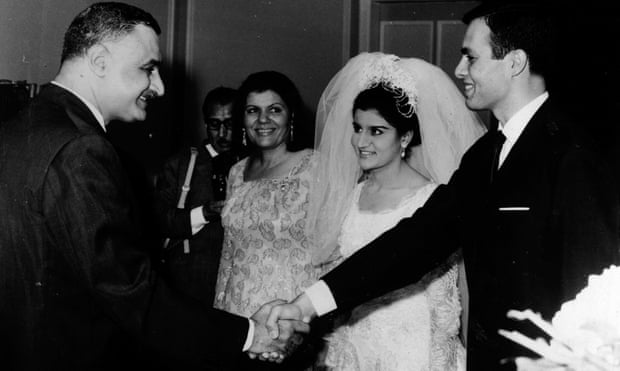
(President Gamal Abdul Nasser of Egypt, Mona, his daughter, and his son-in-law, Ashraf Marwan)

Bar-Joseph’s narrative follows Marwan from his rise to a position of power within the Egyptian government to his untimely death in 2007 when he was probably pushed over a terrace and fell to his death.  Marwan was a corrupt egoist who felt he deserved a powerful position in government.  His marriage to Nasser’s daughter was a step in achieving his goals.  The impediment was the fact that his father-in-law held a very low opinion of his son-in-law.  Intelligence sources made Nasser aware of Marwan’s avaricious lifestyle and he tried to get his daughter to divorce him.  When she refused Nasser allowed Marwan to work at a low level position in his office that he greatly resented, which in large part provided a rationale for him to turn to espionage to acquire wealth.

Bar-Joseph traces how Marwan gained access to Egyptian state secrets and analyzes why he chose to spy for Israel’s greatest enemy.  In assessing Marwan, Bar-Joseph concludes that his subject engaged in espionage for two reasons.  First, was financial.  Marwan needed money, but despite his contacts he was limited in influence because of Nasser’s Spartan approach toward his family.  If he was going to achieve the lifestyle he craved he would have to find a source of income that Nasser’s intelligence people could not uncover.  The second motive was Marwan’s ego.  Marwan craved power, but realized he was blocked by his father-in-law.  In his own mind he would show Nasser by turning to his father-in-law’s greatest enemy.  Disloyalty to Nasser was the solution for his financial and psychological crisis.

(Egyptian troops establish a beachhead in the Sinai on October 7, 1973)

Bar-Joseph does an excellent job explaining the marriage of Marwan and Israeli intelligence.  He describes in detail how Marwan offered his services and the vetting done by the Mossad.  The author takes the reader inside the Israeli intelligence community as they evaluate Marwan the person and as the relationship flourished, as well as the information that he made available.  Bar-Joseph discusses a number of important personalities, the positions they occupied, and their reactions to each other.  The key for the Israelis was to determine whether Marwan was a double agent.  Almost immediately the valuable material he provided trumped the idea he could have been playing them.  Though Bar-Joseph has a somewhat trenchant writing style, the picture he paints and many of the details he shares have never been published before and makes the book a very important work.

One of the keys to Marwan’s success was the Sadat-Marwan relationship as each needed the other.  Once Sadat assumed the Egyptian presidency he needed a link to Nasser’s family which did not think a great deal of him.  For Marwan, Sadat was a vehicle to improve his overall position in government to allow him to gain access to state secrets and new sources of wealth.  Marwan’s success was his ability to provide the Mossad Egypt’s most closely guarded secrets concerning plans to attack Israel.  For example, plans to cross the Suez Canal and establish a bridgehead in the Sinai, which came to fruition in October, 1973.  Further he provided notes of Egyptian meetings with the Soviet Union that showed that Moscow did not think Egypt was ready for war as well as the minutes of a Sadat-Brezhnev meeting in 1971 that was later shared with the United States.  Because of Marwan Israeli leaders developed a very accurate picture of Egypt’s intentions regarding war and peace, particularly that if Egypt attacked it would not be a comprehensive move to reconquer the Sinai.  Israeli military intelligence firmly believed, much to their detriment in October, 1973 that Egypt would never attack until they solved the problem of Israeli military superiority.

(Egyptian President, Anwar Sadat with senior military commanders during the Yom Kippur War)

Bar-Joseph traces the development of Sadat’s strategic thinking as he pressured the Russians to provide the necessary long rang planes, missiles, and air defense to allow an attack on Israel since he did not see a way to recover the Sinai through diplomatic means.  By August, 1973, the Russians would provide most of the necessary weaponry, leaving out SCUD missiles, a key item because Israeli military intelligence believed that Sadat would never launch an attack until he received the SCUDS.  As early as June, 1973 Marwan warned the Israelis that Sadat was changing his approach to war and decided he could attack Israel even if his forces were inferior.  The problem for Israel was that the head of its Military Intelligence branch, General Eli Zeira refused to revise his thinking and could not accept that Egypt possessed the where with all to launch an attack.  Further, Zeira refused to accept the fact that Marwan was not a double agent.  When the decision for war was made and Sadat asked the Russians to leave Egypt, Zeira believed that Sadat would now take a more defensive approach toward war, but for Sadat he had removed a major impediment to launching an attack.

The author provides the details of all the warnings that Marwan provided the Israelis as early as April 11, 1973 that Sadat had altered his thinking and an attack would come in the late spring or early summer.  Israeli military intelligence continued to mistakenly believe that Egypt would not launch an attack until it received SCUD missiles from the Soviets.  Marwan provided information of Egypt’s preparations for war as well as the developing alliance with Syria.  Throughout Marwan’s intelligence was dead on, but the Israelis did not analyze it correctly.  For Bar-Joseph his most important theme that he reiterates throughout the book is that as war finally approached by September, 1973 “Israel’s military intelligence was under the command of a group of officers whose commitment to a specific intelligence paradigm was unwavering, almost religious, even though it had been obviated by events almost a year earlier.”

What is fascinating about Bar-Joseph’s account is the detail he provides, particularly, an almost hour by hour account of the two days leading up to the war.  For example, the Israeli reaction to Marwan’s warning of October 4th that war was imminent, but the bureaucratic structure of Israel’s intelligence operations did not allow for the proper response and warnings to Golda Meir’s government.  The author does a credible job following the actions and views of all the major historical figures who were involved in the decision making on the eve of the fighting.  Even though Eli Zeira and those he influenced were unwilling to take Marwan’s warnings seriously which resulted in a spectacular intelligence failure, his information did speed up Israel’s reserve call up and other crucial decisions that saved them from an even greater military disaster than what occurred.

Once the war ended Marwan assumed a greater diplomatic role working directly with Sadat.  He became the liaison with Libya, Saudi Arabia and Syria, but also with Henry Kissinger as the United States tried to achieve a lasting ceasefire.  Even as Marwan worked to bring unity to the Arab world he was reporting to the Mossad.  Marwan’s influence then began to wane and he was forced to leave the government on March 1, 1976, but remained in the background working on a weapons consortium.  After Sadat’s assassination in 1981 he began a new chapter in his life moving to London.  Throughout he maintained his contacts with the Mossad, but after the Camp David Accords in 1979 he became a low priority for Tel Aviv.

(Israeli Defense Minister, Moshe Dayan and Israeli Prime Minister, Golda Meir during the Yom Kippur War)

Bar-Joseph spends the latter part of his study conjecturing on who outed Marwan as an Israeli spy, and how he died in 2007.  His speculations do not reach concrete conclusions on either score, but Marwan dies shortly after he was outed, leading to all kinds of conspiracy theories that the author addresses.  Overall, Bar-Joseph describes an amazing life integrating all the major players in Marwan’s career as a spy.  Though, at times the book becomes bogged down in detail and is overly wordy, it is worth exploring because it is an important story that deals with a very sensitive topic.

(Ashraf Marwan)

KILLING THE KING: THE ASSASSINATION OF YITZCHAK RABIN AND THE REMAKING OF ISRAEL by Dan Ephron

rabin

The past few weeks has witnessed an increase in violence between Palestinians and Israelis.  Palestinians have resorted to lone wolf knife attacks against innocent Israeli citizens and the Israeli response has been to kill the perpetrators on the spot.  The lack of any progress toward negotiations is part of the reason for the uptick in violence that has led to the current situation.  The current climate of violence and extremism in the region also has contributed to the lack of any progress between the two sides.  The failure of the peace process between Israel and the Palestinians since the heady days of 1993 when the Oslo Accords were signed are long gone.  It was at that time under the leadership of Prime Minister Yitzchak Rabin that the hope that the conflict might finally be settled was spreading among Israelis and Palestinians, but the assassination of Rabin on November 4, 1995 put an end to the process and led to a spiraling of events that bring us to the current impasse and violence.  Understanding the mindset that led to Rabin’s death is important in trying to make sense of the tragedy.  For the first time in Israeli history a political assassination occurred whereby an Israeli killed an Israeli.  Dan Ephron’s new book, KILLING THE KING: THE ASSASSINATION OF YITZCHAK RABIN AND THE REMAKING OF ISRAEL provides an intimate picture of the fissures that exist in Israeli society and politics.  The book would be considered a political thriller if it were fiction, the problem is that the narrative is true.

(The handshake between Israeli Prime Minister Yitzchak Rabin and Palestinian Authority Chairman Yasir Arafat that sealed the Oslo Accords on September 13, 1993)

Ephron’s premise that the assassination of Rabin put an end to any realistic peace process following his death is accurate and shifted the Israeli approach to negotiations from the pragmatists like Shimon Peres and Rabin to the ideologues like Benjamin Netanyahu.  Critics of the peace process argue that Yasir Arafat would not have delivered on his promises after the signing of Oslo II that gave the Palestinians control of seven cities in the West Bank, including Hebron, in the same way he turned down the deal offered by Ehud Barak and Bill Clinton in 2000.  It appeared that a Palestinian state in the West Bank and Gaza was very possible in November, 1995, but because of the actions of Yigal Amir, a religious extremist and ideologue, who assassinated Rabin we will never know.  Ephron a Newsweek bureau chief in Jerusalem has written an important book that describes the two years that led up to Rabin’s death and the implications for the period that followed.  A period that saw the peace process stymied by violence and intransigence from both sides of the conflict.

Ephron describes in detail the right wing reaction in Israel to the secret negotiations that resulted in the Oslo Accords of 1993 between the Israeli government and the Palestinians.  He further describes the violence that was initiated by extremists on both sides whether Hamas suicide attacks and Israeli settler actions like that of Baruch Goldstein.  The treaty signing itself is evidence how difficult future negotiations would be as Rabin was very wary of Arafat and the agreement had numerous holes in it that had to be dealt with in future negotiations.  But as talks progressed the Israeli settler movement saw it as a threat to their future existence.  It would take a long time for the people around the Israeli Prime Minister to realize that he faced extreme danger because of his authorship of the peace process with the Palestinians, once they did Rabin himself did not want to cooperate with increased protection.  One thing is clear that as soon as Oslo was made public, Yigal Amir believed that Rabin’s actions were treason.

(Yigal Amir in October, 2010, seventeen years into his life sentence for assassinating Israeli Prime Minister Yitzchak Rabin)

Amir whose family had immigrated to Israel from Yemen, grew up in an ultra-Orthodox Jewish home and attended strictly orthodox schools.  Upon graduating from high school he turned down a religious deferment and joined the Israeli Defense Force, spending his time in Gaza during the Intifada of 1988 were his belief that Arabs would kill Jews at every opportunity, was reaffirmed and that only ruthless reprisals would deter them.  Ephron does a nice job tracing the evolution of Amir’s beliefs.  He came to the conclusion in a broader theological doctrine, “one that empowered him to judge for himself – to “fathom God’s Will” – whether political leaders were honoring the Bible or violating it.” (39)  Amir believed that Jews had an obligation to settle the West Bank and Gaza rather than wait for God to secure their sovereignty over the territory and any politician who blocked this went against the will of God.  Amir would set up a group of students called, “Students for Security,” and actively worked to create a militia to defend the rights of settlers.  As rabbis began to preach that soldiers did not have to obey orders by the government to dismantle settlements arguing, “Even if the king orders you to violate the laws of the Torah, it is forbidden to obey,” fostered an already volatile situation.

Amir’s anger was also fueled by the social schisms that existed in Israeli society.  Ephron is quite accurate when he describes the resentments that existed between the Ashkenazi, Eastern European ethnicity of Israel’s ruling class up until 1977, of which Rabin was an example, with Sephardim, Jews who had emigrated from Arab countries when Israel was created who suffered many years of discrimination.  The fact that Amir’s family was from Yemen just exacerbated his feelings.  The core of Amir’s belief rests on the Talmudic argument that would justify his assassination of Rabin.  The Talmudic concept of “rodef” referred to a person who pursues another person with the intent to kill them, “rodef” means the pursuer.  “The law of   the pursuer, or “din rodef” permitted a bystander to kill the aggressor in order to save innocent victims.”  Amir rationalized that Rabin fit the definition of “rodef” as his policies were a threat to the safety of settlers in the West Bank and Gaza.  Amir also decided that Rabin “was a  ‘moser’, a person who handed Jews over to a hostile power, in this case the newly formed Palestinian Authority.” (94-5)  Amir argued that he had the right to kill Rabin on order to save the settlers.  This argument was already surfacing in the extreme religious press and among certain rabbis thereby reaffirming Amir’s beliefs.

Ephron presents a detailed narrative in how Amir stalked Rabin for three years and how he had missed at least three opportunities to kill him.  Ephron will take the reader inside the Israeli intelligence community as it belatedly came to realize the threat the religious right presented as they demonstrated and constantly referred to Rabin as a Nazi, a traitor, and murderer at rallies and sit in at his residence and the Knesset (Israeli parliament).  Ephron walks the reader through the murder in real time and once it takes place it is difficult for Israelis to accept the fact that one of their own killed the Prime Minister.  What is most disturbing about the assassination is Amir’s attitude after he is captured.  He is euphoric and proud of himself and firmly believes that he has saved Israel from its own government.  Amir details to interrogators his beliefs and exactly how he went about murdering Rabin and shows no remorse.  For Amir and his followers “Rabin had defied biblical injunctions and undermined the redemption process that messianists believed had been underway since 1967.” (161)  Following the assassination Ephron analyzes the investigations and recriminations that resulted from Rabin’s murder.  He also delves into the politics that pitted Peres against Netanyahu that saw the Likud candidate victorious in the next election thereby ending any possibility that peace talks would be successful in the future.

The book is very disturbing when one thinks about the future of peace in the region.  The current government of Benjamin Netanyahu is dependent upon the right wing settler movement for his coalition government, as was evidenced by his racial appeal during the last election.  Netanyahu was a leader of the Likud Party in 1995 and many argue assisted in stirring the pot against Rabin that resulted in his assassination.  I cannot imagine that the current Israeli government will take part in any meaningful negotiations, as if it does its coalition would likely collapse.  Ephron’s book may read like a political thriller, but it is a description of the reality of Israeli politics and society which seems split down the middle in its attitude toward peace.

(The aftermath of the assassination of Israeli Prime Minister Yitzchak Rabin on November 4, 1995)

ONE MAN AGAINST THE WORLD: THE TRAGEDY OF RICHARD NIXON by Tim Weiner

In 1972, Bruce Mazlish wrote a psychohistorical inquiry into the life of Richard Nixon, entitled, IN SEARCH OF NIXON.  Mazlish analyzed Nixon and concluded that “he project[ed] unacceptable impulses onto others.  He identified his personal interest with the national interest.  He exalt[ed] strength and fears of passivity.” (143)  These conclusions were based on a detailed exploration of Nixon’s upbringing, relationship with his parents, and his actions as an adult.  The book was written before the emergence of Watergate, and was prescient as Mazlish concluded that Nixon’s self-destructive nature would come to the fore, but he was not sure how that would manifest itself.  Historians have concluded that Richard Nixon was probably one of the most complex political figures in American history and his career has produced a myriad of books, some praiseworthy, particularly dealing with his opening with China, and detente with the Soviet Union in 1972.  However, the majority have been mostly negative in the light of events surrounding his election to the House of Representatives and the Senate, his pursuit of Alger Hiss, and the actions that brought down his presidency.  Following Nixon’s resignation from the presidency he devoted his time to resurrect his personal legacy presenting himself as a foreign policy sage and authoring a number of books on American foreign policy.  As time has receded, some revisionist accounts of his policies have been written arguing that domestically he pursued a liberal social agenda and that his foreign policy was expertly conducted.  As a result, his reputation seemed to be on the upswing.  Recently, however, a number of books have appeared reevaluating this trend, and the “old Nixon” has reemerged.  One of the books in this genre is Tim Weiner’s ONE MAN AGAINST THE WORLD: THE TRAGEDY OF RICHARD NIXON.

Weiner’s book is not a comprehensive biography but a history of Nixon’s anguished presidency that “concentrates on the intertwined issues of war and national security.”  The author’s approach to his narrative is best summarized as he writes from the outset in referring to his subject that “his gravest decisions undermined allies abroad.  His grandest delusions armed his enemies at home.” “I gave them a sword,” he said after his downfall, “and they stuck it in.”  According to Weiner his book is based mostly on recently declassified documents that were released between 2007 and 2014. Though that may be true there is very little that is new in what is presented as the author provides the reader the usual litany of crimes and near crimes that Nixon engaged in almost on a daily basis.  Weiner is selective in his coverage of the Nixon administration as he is most concerned with the abuses of power and crimes related to the war in Vietnam, and the domestic espionage conducted against what Nixon perceived to be his political enemies that culminated in Watergate.

(Illegal bombing of Cambodia, 1973)

From the outset Weiner presents a man who is obsessed with being elected to the presidency in 1968.  Nixon firmly believed that the Kennedy machine had stolen the 1960 presidential election and he would not allow that to happen again.  As the 1968 campaign began to come to a close President Lyndon Johnson, concerned with his own legacy, announced a bombing halt for Vietnam.  From July, 1968 Nixon had communicated with President Nguyen Van Thieu of South Vietnam that whatever peace deal the Democrats were offering, South Vietnam would be better served if Nixon was in the White House.  As the campaign was coming to a close Johnson was aware of the Nixon campaign’s clandestine approaches to Thieu and how he was undermining any possible political deal.  Weiner presents irrefutable evidence that Nixon was involved in treasonous activity that has been available previously, and explores the reasons that Johnson did not go public with this information.  Weiner will spend a major part of his narrative exploring Nixon’s conduct of the war, detailing the illegal bombing of Cambodia from March, 1969 through August, 1973; the illegal wiretaps designed to stop the leaking of information from the National Security Council, Pentagon, and State Department all in the name of national security; covert operations against United States Senators who opposed his conduct of the war which would result in the passage of the War Powers Act in 1973; the machinations that led to the overthrow of the democratically elected president of Chile, Salvatore Allende; the incursion into Cambodia in April, 1970 that resulted in events at Kent State University; the creation of the “plumbers” to plug leaks that would lead to the break in of Daniel Ellsberg’s psychiatrist’s office, and of course Watergate.

(The iconic photo of Mary Ann Vecchio leaning over a dead student at Kent State University after shootings by the National Guard, May 4, 1970)

The details of other abuses of power presented including the selling of ambassadorships, extorting funds from foreign governments in return for favorable American policy decisions, the employment of the IRS to deal with domestic enemies, and the use of the FBI and CIA to deal with political opposition.  Weiner covers it all, but, again nothing really new is presented.  Even in the case of Watergate the reader is exposed to familiar territory as we are taken into the White House as the plans for domestic espionage are laid out.  The familiar names of John Dean, H.R. Haldeman, John Ehrlichman, John Mitchell, Charles Colson, Alexander Butterfield, Jeb Magruder, and on and on all make their appearance.  The reader is exposed to Henry Kissinger and his role in Vietnam policy formulation and domestic espionage.  The former Secretary of State is as complicit in many of the crimes propagated in the conduct of the war in Southeast Asia and domestic spying, but aside from a few lawsuits has gotten away scot free and today is seen by many as the eminence grist of American foreign policy.

(Construction workers from the World Trade Center accosting people as they march up Broadway on May 8, 1970)

On a personal level, in May, 1970 I witnessed one of Nixon’s plans to weaken the antiwar movement that was burgeoning in response to his actions in Vietnam and Cambodia.  On May 8, 1972, a few days after the shootings at Kent State, according to Weiner, Charles Colson, one of the Nixon officials in charge of “dirty tricks,” communicated with the New York City construction union council led by Peter J. Brennan to arrange a march up Broadway of construction workers, then building the World Trade Center.  As hundreds of these workers marched they assaulted anyone that seemed to be opposed to the war.  I was a student at Pace University on that day and was chased and attacked by two workers as New York City’s “finest” stood idly by.  Little did I know the culpability of the Nixon administration in these attacks.  The irony was that the next day, as a member of the United States Army Reserves I was activated to control student unrest at St. John’s University in Queens, NY.  Later, interestingly, Peter J. Brennan was appointed Secretary of Labor in the Nixon administration.

(Watergate Hotel)

To Weiner’s credit he has written a breezy and well written catalogue of Nixon’s crimes that summarizes a period of American history whose remnants of which we are still dealing with today.  In evaluating Nixon we must recognize the psychological flaws that lent themselves to limiting a self-destructive personality, who because of his abuse of power overshadowed remarkable accomplishments in diplomacy in negotiating with China and the Soviet Union.  But, as Bruce Mazlish predicted in 1972, his presidency would not end well.