
QUEEN ESTHER by John Irving

Introducing the Head of School Search Committee

My journey with John Irving began my freshman year in college when I read SETTING FREE THE BEARS.  I have enjoyed his quirky sense of humor, his support for those ostracized by elements in society, and the incredible scenes he has created.  Perhaps my favorite scene comes from the novel, THE FOURTH HAND, where the main character, a journalist’s ex-wife, employs a lacrosse stick as a pooper scooper for her dog.   This unusual tool in a memorable, somewhat bizarre scene, highlights Irving’s style of blending the absurd with profound themes that have carried forth through some of my favorite Irving novels that include THE WORLD ACCORDING TO GARP, THE HOTEL NEW HAMPSHIRE, A PRAYER FOR OWEN MEANY, THE CIDER HOUSE RULES, and TRYING TO SAVE PEGGY SNEED.  My journey is very personal as I have taught at a university in New Hampshire, in addition to an elitist boarding school in New England.  Further my son played lacrosse at the boarding school and Harvard.  In addition, my daughter, son-in-law and two grandchildren are Mainers.  So, you can see why I have the affinity for the types of novelistic themes and characters that Irving has created.  Now that I am a senior citizen it seems that my adulthood is bookended with Irving’s writings and just when I needed an absurdist fix to deal with the reality of living in a Trumpist world he has produced his latest, QUEEN ESTHER, a book which is wonderful at times, and then disappointing at times.

In QUEEN ESTHER, Irving brings back Dr. Wilbur Larch from CIDER HOUSE RULES after four decades managing adoptions at St. Clouds Orphanage where he is the physician and Director.  Larch performs abortions for women who have no alternatives and is as cantankerous as ever.  The novel starts out in the early 20th century and revolves around Esther Nacht who was born in Vienna in 1905, the only Jewish orphan raised at St. Clouds.  On her voyage from Bremerhaven to Portland, ME her father died of pneumonia aboard ship.  Later, her mother will be murdered by anti-Semites in Portland.  Dr. Larch realizes that the abandoned child is not only aware that she is Jewish, but also she is familiar with the biblical Queen Esther after whom she was named.  Dr. Larch realizes it will not be easy to find a Jewish family to adopt her, soon he is aware that he will never find any family to adopt her.

At the outset, the novel focuses on the Winslow family who date to 1620 arriving on the Mayflower.  The Winslow’s reside in Pennacook, New Hampshire, a town which is the home of Pennacook Academy, an independent boarding school for boys founded in 1781.  One of its students was James Winslow, a faculty brat and the grandson of the most revered member of the school’s English Department, Thomas Winslow.  Since Jimmy’s mother, Esther was an orphan he could not be considered a “blue blood.”  The townspeople had difficulties with his mother’s adoption and as Irving develops the novel they were correct as Esther was the caretaker for Thomas and his wife Constance Winslow’s fourth daughter, Honor.  Jimmy’s birth was the result of the “pact” between Esther and Honor; Esther would become pregnant and give the child to Honor who detested the idea of birthing a child.  So begins a novel that is typical Irving; layered, funny, heartbreaking, and full of the strange humanity he always captures.

Irving in 2010

(John Irving in 2010)

The adoption of Esther by Thomas and Constance is important because it allows Irving to delve into societal issues related to abortion.  When the Winslow’s set out to adopt a caretaker for their daughter they were clear that they did not want to adopt someone from an orphanage run by nuns or linked to the Christian faith – they could not bear any religious affiliation.  After considering a French-Canadian orphanage as too religious they settled on St. Cloud’s where they found Esther, a Jewish child of fifteen who was born in Vienna.  As the Winslow’s searched for what turned out to be Esther, Irving presents his pro-abortion views focusing on people who opposed abortion but did not consider the child who would wind up in an orphanage, as it seemed they just wanted to punish the mother.  As in all examples of societal issues Irving will present a brief history of the topic and the fact that abortion was not considered illegal from 1620 to the mid-19th century.  Irving argues it became illegal as Doctor’s resented midwives who performed them making money at their expense.  

Since Esther was Jewish the issue of anti-Semitism soon became the focus of Irving’s characters and thereby his views.  He subtly integrates the issue as he believes that New Englanders are covertly anti-Semitic as witnessed by the reaction to Thomas’ lectures on abortion and the adoption of Esther.  It is clear that it would be difficult to find parents for Esther because she was Jewish, but since the Winslow’s were a philanthropic, non-Jewish eccentrically non-believing New Hampshire couple, they would be the type open to adopting a teenager like Esther.

The novel spans the 20th century from 1905 to 1981 and at the outset you get the feeling it is about Esther, but in reality it is mostly about Jimmy Winslow, the son who was the center of the “pact.”  Esther herself considered her “Jewishness” as the mainstay of her identity, but was not religious, though she could read Hebrew she did not believe in God.  Her main goal eventually was to move to Israel as she was consumed by the exile of the Jews from the land of Israel and the diaspora of the Jewish people.  Her outlook on life could be summed up from a quote from JANE EYRE which in true Irving fashion was tattooed between her breasts.  She traveled to Europe in 1934 with the goal of getting pregnant to honor the “pact” where she would meet Moshe Kleinberg, a Greco-Roman wrestler in the lightweight class who even had a picture taken with General Paul von Hindenburg when he was President of Germany!   Moshe, whose nickname was “the little mountain” would become Jimmy’s father but would never meet him which creates another path for Irving to expound upon as Jimmy has many identity issues because of his background.

Queen Ester by John Irving

As Jimmy matured his grandfather exposed him to literary figures, particularly Charles Dickens that factored into his decision to become a writer.  Jimmy believed in his intrinsic foreignness and was determined to see himself as an orphan, no matter how his grandparents tried to raise him.  In 1963 we find Jimmy in Vienna seeking his roots and a desire to learn German.  Esther will find him a German Jewish tutor who of course he falls in love with.  Jimmy’s other issue is the Vietnam War and the draft in the United States.  His mother, Honor, sent him to Vienna to meet someone, get them pregnant, keep the baby and in this way he would be draft exempt.  If that couldn’t take place she wanted him to wrestle with the hope of damaging his leg also making him draft exempt.  In the background everyone wonders about Esther who has gone to Palestine – is she a member of the Haganah, a Jewish defense force or something similar to defend Jews and facilitate their immigration to Palestine.  Another plot line that is an undercurrent for Jimmy is his goal of being a novelist, and of course the name of the book is THE DICKENS MAN.

In all subjects that Irving integrates into the novel he has excellent command of the history of the topic.  Apart from abortion and anti-Semitism Irving expounds on Jewish history, GREAT EXPECTATIONS by Charles Dickens, films like “From Here to Eternity,” a history of circumcision, the rise of the Nazis, the Holocaust, the Cuban Missile Crisis, the assassination of John F. Kennedy, the Cold War era in general, and Israeli politics and society.  It is clear Irving has conducted meticulous research for his novel and should be commended as he immerses himself in his subjects until every detail feels authentic even if it meant visiting wrestling gyms, hospitals or tattoo parlors.  Further as he constructs his background history he does it in a concise and meaningful manner where the subject matter just blends seamlessly into the story.

Though the novel seems to focus mostly on Jimmy, the progression of Esther in the background until she emerges at the end of the book is powerful, especially in light of what Israel seems to have become and the arguments put forth by Palestinians and Israelis alike.  The reviews for QUEEN ESTHER have been mixed and as usual in interviews Irving does not seem to care what is said about his work.  Some have panned the novel but his sarcasm, sense of the absurd, character development, and ability to provide scenes that no one else could create make the book a worthwhile read, and of course along with his unique style of writing.

MY FRIENDS by Hisham Matar

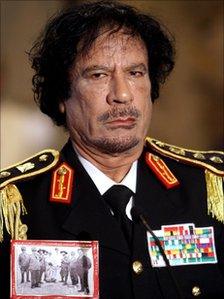
Muammar Gaddafi in Rome - 10 June 2009

(Libyan Dictator Muammar Qaddafi)

The history of Libya from 1969 which saw Colonel Muammar Qaddafi seize power through the 2011 Arab Spring that resulted in his demise was wrought with murder, torture, assassinations, persecution, terrorism, lack of freedom, poverty, and victimization to a cult of personality.  Those years produced many significant dates, all of which stand out for varying degrees of horror.  On April 17, 1984. a crowd of anti-Qaddafi demonstrators gathered across the street from the Libyan embassy in London.  During the demonstrations shots were fired from the embassy at demonstrators killing a London police officer and wounding 11 protestors.  On April 5, 1986, Qaddafi was deemed responsible for the terrorist attack on a West Berlin discotheque that killed three and injured 229.  Ten days later the United States retaliated striking military targets in Tripoli and Benghazi.  On December 21, 1988, two Libyan intelligence officers planted a bomb that  blew up Pan Am Flight 103 over Lockerbie, Scotland killing 243 passengers and 16 crew members.  On December 21, 2012, following the overthrow of Qaddafi an attack by Ansar al-Sharia on the American diplomatic compound in Benghazi resulted in the death of US Ambassador J. Christopher Stevens and 3 others and injured 10.  This would lead to a partisan  congressional investigation that Republicans used to damage Hilliary Clinton’s presidential campaign.  It is clear that during these years Libya was not a place where free thought and democracy existed, and today remains a failed state.

Libyan author Hisham Matar’s latest novel, MY FRIENDS tackles this time period focusing on the 1984 London shooting as the emotional center of the story.  The book is narrated by a Libyan exile named Khaled Abd Hady, who left Benghazi in 1983 to study English literature at Edinburgh University and remained in London for thirty-two years.  Khaled had been one of the demonstrators on that 1984 day alongside two men who would become his closest friends, Hosam Zowa, a writer who had decided to live in San Francisco with his family before moving to Paris, London and other venues, and Mustafa al Touny, a fellow student at Edinburgh.  Matar, born in New York City to Libyan parents, and winner of the 2017 Pulitzer Prize for his memoir, THE RETURN, has authored a quiet novel that examines how the bonds of friendship are forged and fray over a lifetime.

Anti Gaddafi demonstrations outside the Libyan embassy, London 17th April 1984

(Libyan exiles demonstrating against the Qaddafi regime on April 17, 1984)

MY FRIENDS focuses on the relationship among three Libyan men whose lives intersect over more than three decades, from the mid-1980s through the aftermath of the 2011 Arab Spring that deposed Muammar Qaddafi after 42 years. The narrator, Khaled Abd al Hady, who left Libya to study English literature at the University of Edinburgh was inspired to pursue those studies by an enigmatic short story authored by Zowa, who vanished from the literary world after publishing a single story collection.

(It has been almost 40 years since Pc Yvonne Fletcher was murdered outside the Libyan Embassy. ‘She said, “good morning, what a beautiful day”, and five minutes later she was shot’) 

There are a number of themes that dominate the novel.  The concepts of liberation, exile, moral ambiguity, and friendship are all integrated into the story. Employing the musing of Khaled, Matar focuses on related themes asking the following; was it possible to live a happy life away from home, without one’s family?  Second, is it true that all one has to do to survive is to endure each day, and gradually, minute by minute, brick by brick, will time build a wall?  Third, What was it like to be a human being in a world where people are willing to crush each other?

These themes follow Khaled’s life for decades as he navigates the twin crises of exile and loneliness.  Matar follows the interactions of Khaled and Mustafa, following their emotional, intellectual, and political development.  Soon Hosam reappears out of nowhere which becomes the watershed moment in the novel.    We follow the lives of the three exiles in beautiful detail as Matar is an exceptional writer who knows how to construct meaningful dialogue and scenery.  Khaled will leave the university and wind up in London.  After a few years he travels to Paris to be with his friend Ranan who leaves Libya for brain surgery in Paris.  It is while he is in Paris that the man behind the desk at his hotel turns out to be Hosam rekindling their friendship.  Along with Mustafa, Hannah, Khaled’s girlfriend, and Claire, Hosam’s significant other they form an engaging group whose dialogue absorbs the reader’s attention as they lay out their personal beliefs and how it relates to events in their home country.

By 2011, the Arab Spring broke out in Tunisia and soon spread to Tahrir Square in Egypt, and Benghazi and Tripoli in Libya.  Mustafa who had been in exile for decades after witnessing the 1984 Embassy shooting cries at the possibility of ending Qaddafi’s tyranny and decides to return to Libya to fight for the emerging revolution.  Khaled, despite the urging of his friend, refuses to return and fight as he is still traumatized by the wounds suffered at the embassy shooting.  Matar creates many poignant scenes including Khaled’s father’s visit to convince him to return home, and Mustafa’s conversations with his mother as he fights for Qaddafi’s overthrow. 

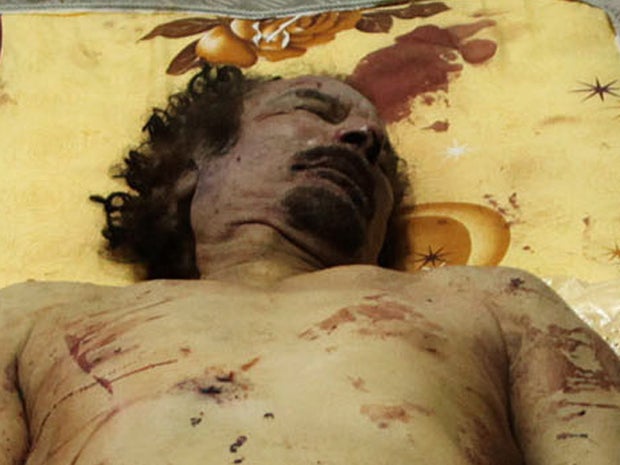
muammar_qaddafi_closeup_AP111021125286.jpg

(Qaddafi’s body after being killed by Libyan revolutionaries)

Matar’s novel provides a vivid picture of Qaddafi’s rule which consisted of paranoia on the part of Libyan exiles living in Europe, and Libyan citizens who remained at home.  A tight fisted dictatorship evolved into a “cult of personality” that the Libyan people were forced to endure.  Torture, violence, harassment, loss of employment, poverty, assassinations in foreign counties were all elements of Qaddafi’s bag of tricks.  This background forms the basis of Khaled’s fear of returning home, Mustafa’s transformation into a revolutionary soldier, and Hosam’s off and on writing which is responsible for the origins of their friendship.

Other important characters are developed. Dr. Henry Walbrook, Khaled’s literature professor becomes his friend and confidant.  Mahammed Mustafa Ramada, the voice of the BBC Arabic World Service and journalist who read Hosam’s short story that fascinated and captured Khaled.  Hosam Rajab Zowa, Hosam’s father who had been a supporter of Qaddafi and believed the embassy shooting was correct.  What happens to these characters greatly impacts the lives of the three exiled friends.

Soldiers loyal to the head of Libya's Government of National Unity, Abdulhamid al-Dbeibah, sit in the back of a truck in Tripoli, Libya

(Fighting between the two most powerful factions in the capital could pose significant risks today, 2023)

Matar uses Hosam to present various literary ideas.  Being a bibliophile, my favorite comments include Hosam’s remarks that “there was no point in owning a book unless one intended to reread it multiple times.”  Further, he states “to have an endless number of books sit on the shelf just because one has read them or might one day read them is absurd.”  However, I agree with his final commentary on books “like Montaigne, you believe that the very presence of books in your room cultivates you, that books are not only to be read but to be lived with.” What Hosam secretly found troubling was not the sight of a large number of books but the stability that such an acquisition assumes, which for him was very difficult to accept.

Matar brings closure to his story as the Libyan chapter of the Arab Spring takes hold.  Khaled was afraid to return to Benghazi as he feared he would not be able to reconstitute his life, which had taken so long to accomplish after three decades in exile.  He was afraid he would lose the security, emotional grounding and dependable relationships he had developed which his parents could not understand, producing a great deal of guilt.  Mustafa did not suffer from these doubts as he returned and immediately joined revolutionary forces to fight to end Qaddafi’s tyranny.  Hosam on the other hand will return to bury his father and please his mother.  He still refuses to return to his writing and he falls in love as decides he must join the fight.

As Peter Baker writes in his New York Times book review Matar focus is on  “the experience of Libyans seeking safety in exile. Matar — himself one such exile — picks apart their psyches, analyzing at a microscopic level how violence and migration have altered how they think and feel and relate to the people closest to them. He has returned to this cluster of topics as if it’s a house he’s obsessed with, examining it from different angles, sneaking inside and finding new rooms, even new wings.”  “Readers encountering Matar for the first time will find in “My Friends” a masterly literary meditation on his lifelong themes. For those who already know his work, the effect is amplified tenfold. In the dark house Matar continues to explore, the rooms are full of echoes: The further in you go, the louder they get.”*

*Peter Baker, In ‘My Friends’ an Exile Finds Himself Outside Libya, but Never Far Away, New York Times, January 10, 2024.

(Libyan Dictator Mummar Qaddafi)

THE ZHIVAGO AFFAIR: THE KREMLIN, THE CIA, AND THE BATTLE FOR A FORBIDDEN BOOK by Peter Finn and Petra Couvee

I remember years ago when I saw David Lean’s film “Dr. Zhivago,” leaving the theater with the name Lara rebounding in my psyche.  This led me to read the novel that just floored me.  Now so many years later I have read Peter Finn and Petra Couvee’s monograph THE ZHIVAGO AFFAIR: THE KREMLIN, THE CIA, AND THE BATTLE OVER A FORBIDDEN BOOK that choreographs Boris Pasternak’s journey from poetry to fiction, the Kremlin’s attempt to prevent its dissemination within and outside the Soviet Union, and the role of the CIA in trying to weaponize the novel as a vehicle in the Cold War.  The book itself appears professionally researched but there are a number of gaps, i.e., Pasternak’s experience during World War II is covered in a page or two, among others.  Overall, the book is well conceived, but I believe the authors could have done more with the topic.

The authors have written a segmented narrative which begins with a biographical profile of Pasternak including his professional relationships, marriages, affairs, which were many, and his poetic development.  They then move on to the evolution of Pasternak’s work from his poetry to his life’s work, DR. ZHIVAGO, a novel that he himself argued brought personal closure and satisfaction.  The authors offer an important dissection of the intellectual community under Joseph Stalin focusing on the purges and show trials of the 1930s which produced 24,138,799 books that were deemed “political damaging…and of no value to the Soviet reader” by the state censor resulting that these works were turned into pulp. World War II appears as an afterthought, but to their credit Finn and Couvee dissect the relationship between Stalin and Pasternak and explain why the novelist was able to survive while over 1500 of his compatriots perished.  They concluded it was because of his international status but more so by “Stalin’s interested observation of the poet’s unique and sometimes eccentric talent.”  Pasternak himself could never figure out why he survived.

(Olga Ivinskaya and Boris Pasternak)

An interesting aspect of the narrative revolves around the completion of the novel and its publication in the west.  Relying on communications between Giangiacomo Feltrinelli, a young Milanese publisher, and Pasternak; Feltrinelli and Soviet officials; the Kremlin and Pasternak; internal Kremlin debate, and other western sources the reader is presented with a reasonably clear picture as to how the book was published.  What emerges is a nasty campaign waged by the Kremlin to deny publication in the west despite the “cultural thaw” that evolved after the death of Stalin and Nikita Khrushchev’s de-Stalinization  speech of February 20, 1956 (though the book states it was February 25th).

Another component of the narrative centers on the role of the CIA in publishing the novel and distributing it throughout Europe and the Soviet Union.  Finn and Couvee describe how the CIA was engaged in relentless global political warfare with the Kremlin throughout the 1950s.  To counter Soviet propaganda, and challenge Soviet influence the CIA believed in the power of ideas – news, art, music, and literature that could slowly erode the authority of the Soviet state and its influence in its Eastern European satellites.  The authors trace surreptitious CIA activity focusing on the dissemination of western materials to the Russian people through Radio Free Europe; the American Committee for Liberation; the Free Europe Committee and others.  The CIA purchased books and rights from numerous publishers and did its best to make them available throughout the Soviet bloc.  In 1956 it would create its own publishing company, the Bedford Publishing Company to translate Western literary works and publish them in Russian.  Further it became involved in obtaining an original of Pasternak’s manuscript, making it available inside Russia through the Brussel’s World’s Fair in 1958.  It is a fascinating story in that the novel would be distributed by the Vatican exhibit to 500 Russian visitors who would transport it home.  The program had the full support of the Eisenhower White House and by 1970 the Bedford Company would distribute over one million books to Russian readers.

TIME Magazine Cover: Boris Pasternak -- Dec. 15, 1958

Finn and Couvee correctly point out that Soviet authorities created their own “monster” because if they had allowed the novels publication inside the Soviet Union it would have probably attracted a small literary audience, but by pursuing a strategy of repression it fostered worldwide surreptitious distribution creating a massive readership.  The Kremlin’s pressure on Pasternak almost drove him to suicide as they even went as far as to deprive him of his Nobel Prize which was awarded more for his poetry than DR. ZHIVAGO.  After accepting the prize Pasternak was subjected to a coordinated attack by newspapers, magazines, and radio, a loss of friends and colleagues, overt surveillance by the KGB, resulting in his decision to decline the award.  The Soviet literary tradition was clear, literature could either serve the revolution or the perceived enemies of the state.  One of the authors best descriptions of literature under Stalin was “formulaic drek,” which in Yiddish means “shit.”

The authors do a wonderful job discussing the numerous characters that impacted Pasternak’s life.  Relationships with his lover Olga Ivinskaya, discussions with Stalin himself and other Soviet officials, the work of Giangiacomo Feltrinelli, the Dulles Brothers, and numerous others read like its own novel.  The authors take a story that has many moveable parts and turned into somewhat of an intellectual thriller which is hard for us to relate to under our system of government where it seems everything whether true or not can be published on social media.  If there is a tragic character it is Ivinskaya, who was harassed, tried, and imprisoned after Pasternak’s death. If the authorities failed to get Pasternak, they sought revenge against his lover who they accused of currency fraud and being the real author of DR. ZHIVAGO.  In the end DR. ZHIVAGO was not a great piece of literature and perhaps the authors should have spent more time evaluating the literary value of the novel as opposed to its propaganda value.

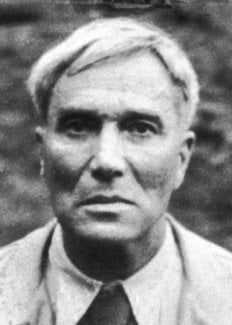
Boris Pasternak
(Boris Pasternak)