NAZIS, ISLAMISTS AND THE MAKING OF THE MODERN MIDDLE EAST by Barry Rubin and Wolfgang Schwanitz

(Hajj Amin al-Husaini and Adolf Hitler)

As we witness the increasing level of anti-Semitism in Europe exemplified by recent attacks against Jews in Paris the role of Islamist ideology appears ever present.  The perpetrators of the attacks were of Mideast origin and claimed to be associated with the Islamic State or ISIS.  With renewed interest in the role of anti-Semitism and Islamist radicalism in Europe it is important to seek out the origins of these movements.  Some political commentators point to the actions of Israel against the Palestinians, particularly its war against Hamas last summer resulting in the carnage caused by repeated missile launches to and from the Gaza Strip.  Others, like historians, the late Barry Rubin and Wolfgang Schwanitz, acknowledge the role of Israel, but point out in their new book, NAZIS, ISLAMISTS AND THE MAKING OF THE MODERN MIDDLE EAST that the historical and ideological roots of the latest conflict between Israelis and Arabs goes much deeper.  Citing the recent release of Nazi and Arab documents dealing with World War II from American and Russian archives, a more complete account of the interactions between Arabs, Muslims and Germans can now be presented.

To support their views the authors bring together a number of key elements.  First, they explore the German role in the Middle East dating back to the late 19th century.  Beginning with the beliefs of Kaiser Wilhelm II, the ideological, political, and strategic goals of Germany are presented by analyzing the intellectual and practical development of employing Islam and jihad as a vehicle for German expansion in the region which would continue through the reign of Adolf Hitler.  Secondly, after the collapse of Nazi Germany in 1945 the alliance forged with these Middle East groups during the war would have long term ramifications.  These groups would experience political victories over their European masters and over more moderate Arab and Muslim rivals.  “Their success was so thorough that liberal democratic forces-not uncommon in the Arab speaking world before the 1930s-do not emerge again as contenders for power” until the Arab spring in 2011.  Today, we are in the midst of another round in the conflict between revolutionary Islamism, one of the movements that cooperated with Imperial Germany through the end of World War I.  Its cooperation would continue with Nazi Germany up until 1945, then reemerge to challenge its former partner Arab nationalism, that had crushed it in the 1950s.  I agree with the authors that an “Islamist spring” has emerged today that spews its anti-Semitism and hatred of the west and it can only be understood by examining the role of the Nazi-Islamist alliance that culminated during World War II.

The narrative begins in June, 1942 as SS Chief Heinrich Himmler prepares for visitors at the Sachsenhausen concentration camp.  Earlier in 1941 the facility had tested new camouflaged gas chambers with four new crematoria which proved very successful.  At that time, the Arab visitors witnessed the results and they planned to build their own facilities near Tunis, Baghdad, and Jericho.  The authors then present a letter from Amin al-Husaini, the Palestinian political and religious leader, to Adolf Hitler in January 1941 that asked the Nazi leader to “assist the Arabs in solving their Jewish problem the way it was carried out in Germany.”  The introduction of al-Husaini, who was also the Grand Mufti of Jerusalem is critical to the author’s arguments.  During the First World War, the Kaiser tried to foment a jihad to encourage Muslim support during the war.  His plan was doomed to failure as relying the Sultan of the Ottoman Empire as his spokesperson was not sound, as most Muslims did recognize him as the religious leader of the Middle East (or caliph).  By 1933, with Hitler’s ascension to power al-Husaini offered his services to the German Chancellor to carry out his plan against the Jews laid out in MEIN KAMPF.  Thus, the relationship and alliance between the Fuhrer and the Grand Mufti began.  Throughout the 1930s the Nazis supplied weapons and money to be employed in the 1936 Intifada against the Jews in Palestine, a people that al-Husaini referred to as “scum and germs.”  al-Husaini saw himself as the leader of the Arab world and in return for Germany’s assistance in eradicating the Middle East of its Jewish population, and supporting his goal for the creation of a unified Arab state in the Middle East under his leadership, he would work to bring Muslims and Arabs into an alliance with Germany, spread Nazi ideology and wage terror against England and France.  As a result of al-Husaini’s cooperation Germany was able to establish a special relationship with the Muslim Brotherhood, the Ba’ath Party and other radical groups in Syria, Iraq, and Palestine, which still exist today.  The author’s provide a detailed history of al-Husaini’s activities throughout his career as the self-styled political and religious leader of the Arab world.  The evidence presented affirms the similarities between al-Husaini’s beliefs and those of the Nazis.  To further their critique the authors offer a list created by al-Husaini that offers “parallels between the Islamic world view and National Socialism.”  The list highlights eight parallels, with al-Husaini “backing each assertion with quotes from al-Qur’an and Muhammad’s sayings.”  Views presented deal with the hatred of Jews, belief in a single powerful leader, the role of woman, and holy war. (182-183)

(Hajj Amin al-Husaini and Heinrich Himmler in Berlin, 1942)

The documentation that the authors present is extensive in dealing with al-Husaini’s paramount role in Hitler’s vision for the Middle East.  One aspect that they discuss even places some level of the blame for the Holocaust on the Grand Mufti.  Up until 1941 the Nazis had not decided on the Final Solution and the Hitlerite regime concentrated on expelling Jews from Germany.  The problem for al-Husaini was that most of those Jews would wind up in Palestine.  Since part of the agreement with the Nazis was to close Palestine’s doors to Jewish immigration, that process was stopped.  With one of the last places Jews could be sent now closed the Nazi regime moved on to plan the Final Solution.  The timing of the Wannsee Conference in January 1942 and al-Husaini’s activities including a conversation with Adolf Eichmann, “who had prepared the background briefing for the genocide discussion at Wannsee, was ordered to be give[n] to al Husaini….before any high-ranking Germans.” (163)  As the war progressed and the German hierarchy realized the conflict was lost, they began to try to soften their role in the Holocaust and began trying to arrange the exchange of Jews for prisoners of war and low level war material.  When al-Husaini learned of these activities in Bulgaria, Rumania, Hungary and Turkey he immediately interfered to put an end to them.  As a result, even more Jews perished in the ovens, all because of his hatred of Jews.

The critique of al-Husaini continues after the war and the evidence offered reflects al-Husaini’s role in the 1947-8 war that saw the creation of the state of Israel.  After W.W.II, al-Husaini and his cohorts, many of which were Nazi collaborators worked to prepare for the next war, i.e.; uncovering Nazi weapons hidden since 1942, using Nazi funds to purchase new weapons, and employing escaped Nazis to train and lead Arabs.  “Without al-Husaini’s presence as the Palestinian Arabs’ and transnationalist Islamist leader there might have been other options.” (200) The author’s conjecture that had moderate Arab leaders not bowed down to al-Husaini’s radical Arabism, and perhaps had the allies treated him as a war criminal as they should have the course of Middle Eastern history might have been different.  Whether things would have progressed in another fashion is fine to speculate about but American, British and French fears of losing Arab support, the need for oil, and the emergence of the Cold War was more important and al-Husaini was allowed to proceed with his machinations for the rest of his life.

Another fascinating aspect that the authors address is the relationship between former Nazis and the Arab world following W.W.II.  A detailed chapter is put forth that explores the role of ex-Nazis in Arab governments, particularly that of Nasser’s Egypt.  Cairo became a haven for escaped Nazis and many were employed in Egyptian industries, intelligence operations, and military training to enhance Nasser’s national security apparatus.  Another home for these men was Syria, under the Ba’athist regime, an Arab version of National Socialism, that mimicked Egypt to a lesser scale, but did hid the likes of Alois Brunner, who Nazi hunter, Simon Wiesenthal labeled as “Eichmann’s right-hand man with brains.”  In addition, he accompanied al-Husaini on his tour of Auschwitz around June, 1943. (225)  Another important individual was Francois Genoud, al-Husaini’s personal banker since 1933, who worked with German military intelligence during the war.  Later, he would finance the ODESSA network and bankroll the Ayatollah Komeini when he was in Paris until he came to power in 1979, and later helped fund al-Qaida and Hamas, until his operations were shut down after 9/11.

What is especially relevant about the author’s narrative is how they link the actions of al-Husaini and his radical Islamist allies to today’s political situation in the Middle East.  As the authors explain, Nazi ideology may have died in defeat in 1945, but its basic concepts changed surprisingly little as practiced by radical Islamists today.  Just substitute the word “Israel” for “Jew” and the similarities are clear.  It is the belief in many Nazi principles by Islamists and Pan Arabs today that contribute to the inability to solve the Arab-Israeli conflict.  A case in point are the comments made by Iranian Foreign Minister Mohammad Javad Zarif on March 8, 2015 that “Israel should be annihilated.”  These sentiments were offered earlier in November,, 2014 by the Supreme Leader of Iran, Ayatollah Ali Khameini that the fate of Jewish state should be “elimination and annihilation.”  If one examines the beliefs of Osama bin-Laden, Saddam Hussein, the Assad rulers, spokespersons for Hamas and Hezbollah, and of course ISIS, their comments have a certain familiar tone.  But if we return to the earlier period, the speeches of Gamal Abdul Nasser and Yasir Arafat, who was a distant relative of al-Husaini and a disciple, we hear the same ring of Nazi ideology.  It is fascinating to me that al-Husaini would only accept the leadership of an Arab state because of violence, in 2000, Arafat refused what many consider a reasonable deal with Israel because he too could not accept a Palestinian state unless it germinated from violent revolution.  They are many more examples offered, the most important of which is the Muslim Brotherhood, that supposedly moderate organization that came to power in Egypt in 2011 during the “Arab spring.”  I agree with the author’s assessment that “any effort to persuade the West that it should tolerate the Muslim Brotherhood requires erasing its legacy of cooperation with the Nazis, and of equal importance, the ideological parallels between the Nazis and the Brotherhood, as well as Islamists generally.” (250)  However, what   cannot be denied is that currently Europe and the Middle East are witnessing an increase in violent anti-Semitism, and Islamist anti-western hatred, that had its origins in the calls for jihad dating back to World War I.

There is much more to Rubin’s and Schwanitz’s effort including the intellectual development of many individuals and groups throughout the period under discussion.  The range from Wilhelm I to Adolf Hitler to radical Islamist proponents today, for many will be startling.  However, if one examines this scholarly and well researched monograph any doubts of their linkage will disappear.  I would recommend this book to all who have an interest in the Middle East, and in general, the peace that seems so elusive.

Other books you might wish to consult:

Achar, Gilbert. THE ARABS AND THE HOLOCAUST (New York: Picador, 2010).

Dalin, David G.; Rothmann, John F. ICON OF EVIL (New York: Random House, 2008).

Motadel, David. ISLAM AND NAZI GERMANY’S WAR (Cambridge: Harvard University Press, 2014).

When Books Went to War by Molly Guptill Manning

(The most popular book read by American GIs during WWII)

As a professed bibliophile I was intrigued when I learned of the publication of When Books Went to War by Molly Guptill Manning.  The concept of the book was fascinating and it seemed to me that the topic, the impact of reading on American military personnel during World War II has never been given much attention.  Now, with Manning’s monograph we have a short history of the role of books during the Second World War ranging from Nazi book burnings, the ideological war between Nazism and Democracy, the diversion provided to American soldiers that allowed them to endure, and the impact on the publishing industry that led to the production of the mass market paperback.   Manning has written a wonderful book as she integrates her theme in relation to the important events that took place during the war.

(Nazi book burning, May 10, 1933)

According to Manning there was no escape from the fear of dying during World War II.  Whether on land, sea, or in the air American GIs faced the likelihood that they or someone very close to them would not survive.  Any diversion from the anxiety that soldiers faced on an everyday basis was welcomed.  As Manning describes it, “the days were grinding, the stress was suffocating, and the dreams of home were often fleeting.  Any distraction from the horrors of war was cherished.  The men treasured mementos from home.  Letters from loved ones were rare prizes.  Card games, puzzles, music, and the occasional sports game helped pass the hours waiting for action or sleep to come.  Yet mail could be frustratingly irregular—sometimes taking as long as four or five months to arrive—and games and the energy to play them could not always be mustered after a long day of training or fighting.  To keep morale from sinking, there needed to be readily available entertainment to provide some relief from war.” (xiii-xiv)  The answer that evolved was the creation of book editions designed for soldiers; portable and accessible for those in combat, rehabilitation, or other wartime situations.

Manning begins her narrative with a Nazi book burning rally on May 10, 1933.  The purpose of the rally organized by Adolf Hitler’s Minister of Public Enlightenment, Joseph Goebbles was “to ensure the purity of German literature” and rid Germany of ideas “antagonistic to German progress.” (2)  The works of Sigmund Freud, Emile Ludwig, Thomas Mann, Erich Maria Remarque, among many others were tossed into the fire, no longer available to German students.  Thousands of book burnings took place nationwide including major universities.  It is estimated that the Nazis burned over 100 million books during their reign of terror.  This set the stage for an aspect of the war that was apart from the battlefield as Hitler fought to eliminate democracy and free thought.  The American Library Association (ALA) described Nazi actions against intellectual freedom as a “bibliocaust,” their weapon of choice was to encourage Americans to read, and once the United States became an active belligerent supply books to American soldiers.

(An American GI relaxing with a book in Guadalcanal)

Manning reviews the history of how America organized the distribution of books to American soldiers.  Beginning with conscription and the military training that followed the ALA and other organizations were created to gather and distribute books to American GIs.  At first, the effort was based on collecting donations from the public at large, but when that was deemed inadequate; because of the increasing number of men in the military, the fact that hardcover books which had been the staple of the American publishing industry before the war were much too heavy to be taken into combat, also, the supply of books was being exhausted, and finally many books that were donated did not meet the needs of the troops.  The Victory Book Campaign (VBC) which had been in charge of book donations turned to the American publishing industry to solve the problem as one company, Pocket Books had already begun publishing paperbacks.  The magazine industry had developed miniature editions for servicemen and they were very successful, so why not the book industry.

The key for infantry soldiers and those near the front was to travel as light as possible, and at the same time meet the needs of soldiers who craved reading to make the non-combat time go quickly.  Manning provides details how the paperback volume evolved and how it caused a revolution in American publishing.  Publishers joined together to create the “Armed Services Edition” (ASEs) of hundreds of titles under the auspices of the Council of Books in Wartime.  Problems did develop in the production and distribution of these volumes but once these problems were solved millions of books came off the presses and were distributed overseas and to military facilities at home.  One of the more interesting insights that Manning provides centers on unpopular books before the war that would emerge as best sellers later on.  F. Scott Fitzgerald’s The Great Gatsby and Betty Smith’s A Tree Grows in Brooklyn are cases in point.  The impact of these books on soldiers was profound.  Manning includes numerous letters written by GIs during the war extolling the virtues of the books they read, and the need they filled.  GIs were interviewed after the war and expressed similar feelings.

As men waited on Landing Craft in the English Channel for the D Day landing, many turned to books.  A.J. Liebling, a war correspondent for New Yorker magazine wrote that one infantry man told him “these little books are a great thing.  They take you away.” (99) Many soldiers developed a relationship with the authors they read.  Katherine Anne Porter’s Short Stories touched the hearts of many soldiers and she received over 600 letters.  Betty Smith, the author of A Tree grows in Brooklyn received 1500 letters a year and answered each one.  As one private wrote, “Books are often the sole means of escape for GIs….I haven’t seen many a man who never before had the patience or inclination to read a book, pick up one of the Council’s and become absorbed and ask for more.” (111)  In fact many soldiers would become lifelong readers because of their experiences during the war.  Manning deftly captures the emotions that soldiers felt as they identified with the literature they read.  It brought them home and gave them hope for the future, and helped them deal with the present.  Manning must have scoured many sources to come up with the letters she integrates into the narrative and it provides tremendous insight for the reader into the minds of the soldiers who fought. The program to supply books did provoke some controversy, particularly as the 1944 Presidential election approached.  Senator Robert Taft amended the Soldier Voting Act which created a partisan battle over the ballots that soldiers would use.  Taft’s amendment, titled Article V stated no book could be sent to soldiers funded by government funds that “…contained[ed] political argument or political propaganda of any kind designed or calculated to affect the result of any election.” (136-7) The Council responsible for choosing titles and the War Department afraid to run afoul of the legislation trimmed the approved list and books such as Charles Beard’s The Republic, Catherine Drinker Bowen’s Yankee from Olympus, and E.B. White’s One Man’s Meat, along textbooks for military education courses were no longer available.  The Council led the opposition arguing that books available in the United States now were not available overseas for American soldiers.  Manning characterizes the conflict as nothing more than a Republican attempt to hold down Roosevelt’s vote since 69% of GIs polled said they would vote for a fourth term.  Whether accurate or not Manning presents both sides of the argument, as Republicans were forced to amend the legislation, ostensibly overturning Article V.

Once the war ended there was an obvious correlation between the success of the Council on Books in Wartime and postwar developments.  Under the GI Bill of Rights veterans were allowed a free college education.  Eventually 7.8 million veterans took advantage of this opportunity and many did so because of the reading habits they developed during the war.  For those who were not avid readers before the war, the Victory Book Campaign was responsible for showing men they could thrive at book learning and studying after the war.  “After all, if they could read and learn burrowed in a foxhole between shell bursts, surely they could handle a course of study in the classroom.”  Further the American publishing industry continued publishing paperbacks revolutionizing the industry.  Numerous publishers began producing paperbacks and sales went from 40 million in 1942 to 270 million in 1952, and by 1959 hardback sales were overtaken by those of paperbacks, changes directly related to the ASE’s of the war. (191)

Molly Manning has examined a different aspect of World War II and its influence on post war America.  Her thoughtful approach and reasoned analysis has produced a wonderful story that needed to be told.  It is a reflection of American values and deserves to be read by a wide audience.

EICHMANN BEFORE JERUSALEM: THE UNEXAMINED LIFE OF A MASS MURDERER by Bettina Stangneth

(Adolf Eichmann in the witness box during his trial in Jerusalem, April, 1961)

Bettina Strangneth new book, EICHMANN BEFORE JERUSALEM: THE UNEXAMINED LIFE OF A MASS MURDERER offers a major reassessment of how we should interpret the life of the man whose work was integral to the extermination of six million Jews during World War II.  After his capture by the Israeli Mossad in 1960, Adolf Eichmann tried to convince people that he was a small cog in the Nazi bureaucracy and that he was not a mass murderer.  He tried to present himself as a man who was always in the background during his Nazi career and was not involved in any major decision making.  In 1963 following the Eichmann trial in Jerusalem, Hannah Arendt published her work, EICHMANN IN JERUSALEM: A REPORT ON THE BANALITY OF EVIL where she argued that her subject was nothing more than a bureaucrat who performed his tasks as best as he could, like a good civil servant who wanted to further his career.  He went to work each day and tried to meet the goals that his job demanded.  If his work involved “evil,” that doesn’t take away from the fact that he was just carrying out what his superiors expected of him.  Arendt’s line of thinking was very controversial at the time and it went against the generally accepted idea that, in fact, Eichmann was guilty, and was not an ordinary man who was turned into a thoughtless murderer by a totalitarian regime.  Following his escape after the war Eichmann claims to have been “an empty shell,” an apolitical person who tried to enjoy a normal life with his family while before his capture by the Israelis and his trial in Jerusalem.   In the last few years documents have surfaced in several archives that contain “Eichmann’s own notes made in exile and [they] can be examined in conjunction with the taped and transcribed conversations known as the Sassen interviews.”  These materials (about 1300 pages) reflect that “not once during his escape and exile did Eichmann seek the shadows or try to act in secrecy.  He wanted to be visible in Argentina and he wanted to be viewed as he once had been:  as the symbol of a new age.” (xx)  Employing this perspective, and making excellent use of the Sassen interviews, also referred to as the Argentina papers, Bettina Strangneth has written a fascinating book that disproves Arendt’s line of thinking and shows without a doubt that Eichmann was a major cog in the Nazi extermination apparatus and the persona he presented in Israel during his trial was nothing more than an act to gain sympathy from his captors and as lenient a sentence as possible.

Strangneth states from the outset that her goal is to uncover what was the “Eichmann phenomenon,” how and why did it develop, what people thought of him and when, and how he reacted to what people thought and said about him.  Strangneth succeeds in unmasking Eichmann who throughout his career assumed different roles; as a subordinate, a superior officer, perpetrator, fugitive, exile, and finally a defendant.  The only one of his roles that has become well known is that of a defendant at his trial in Jerusalem.  His intention was obvious, to remain alive and justify his actions.  For Strangneth, we must return to the period before Eichmann’s arrival in Jerusalem to see the real Eichmann.  The author effectively accomplishes her mission by examining a myriad of primary and secondary sources in a number of languages, and she uses Eichmann’s own words that were taped and written as part of interviews conducted by Willem Sassen, a Dutch Nazi collaborator and member of the SS journalist corps during the war and was the organizer and host for the interviews and discussions with Eichmann in 1957.   Once the Argentina papers surfaced and Eichmann was brought to trial it created a number of problems for a West German state that sought a smooth transition to becoming a new nation free of its past.  In addition to officials in Bonn, other Nazi officials who escaped after W.W.II, former Nazis who were free and serving in the West German government, and the Vatican prelates all feared what Eichmann might say.

(Reinhardt Heydrich, Chief of Reich Main Security Office and Eichmann’s superior in 1942)

The first section of the book, “My Name Became a Symbol,” focuses on Eichmann’s argument in Jerusalem that he was not an important figure in the Nazi regime and had little to do with the Holocaust.  Strangneth methodically refutes Eichmann’s arguments by examining his career from 1934, when he joined the Nazi Party through his successful escape from Europe by boarding the Giovanni C in Genoa’s harbor in June, 1948.  The author delineates Eichmann’s attempt to accumulate power as he worked his way up through the Nazi hierarchy and his success in making his name known, and establishing relationships with key Nazi figures.  For example, Reinhard Heydrich,  chief of Reich Main Security Office that included the Gestapo and SD, and making himself an expert on the Jewish people and their religion.  The author traces Eichmann’s movements during the prewar period as he set up emigration offices in Berlin, Vienna, and Prague, and the war itself as he employed his emigration, transportation, and organizational skills to implement the Final Solution.  Eichmann’s creation of excessive publicity around his own name is in sharp contrast to the “shadow” figure he presents in his jail cell in Israel.  The author ends the first section by determining the accuracy of the myths surrounding Eichmann’s escape from Europe and details how he arranged his travel and settlement in Buenos Aires.

(while in exile in Argentina, Eichmann managed a rabbit farm)

In 1953 he was able to bring his family to Buenos Aires and it was clear there was very little interest in pursuing Eichmann and bringing him to justice. At the time, Konrad Adenauer, the West German Chancellor announced to the Bundestag: “In my opinion, we should call a halt to trying to sniff out Nazis.”(146)  While in Buenos Aires Eichmann grew angry that many of his accomplices and colleagues used their relationship with him to obtain lighter sentences.  He wanted to defend his honor.  On his arrival in Argentina, Eichmann had been taken in by the Durer group, led by Willem Sasser and Eberhard Fritsch, who published right wing magazines.  As Eichmann’s anger at former cohorts increased he wanted to set down his ideas in a book with the assistance of Sassen and Fritsch.

(Willem Sassen, a member of the Durer group who interviewed Eichmann for the Sassen/Argentina Papers)

1955 became a watershed year for Eichmann.  His personal circumstances changed as his wife Vera gave birth to their fourth son and he turned fifty years old.  In addition, the Peron government that had assisted Nazi exiles since the end of the war was overthrown in a coup resulting in an unstable political situation that placed Nazi escapees in the dark as to their futures.  Other events became public during the course of the year that concerned those who sought a resurgence of National Socialism when Austria signed the Independence Treaty; military occupation of West Germany ended and it was allowed to join NATO and form its own military, and represent its own interests abroad.  With Nazi exiles failing to influence West German elections, and with Moscow releasing German POWs, any hopes of a Nazi resurgence appeared dim at best.  Along with these events during 1955 the first major historical works and documentaries began appearing that described in intricate detail the role of “the Grand Inquisitor without magic, Adolf Eichmann.” (176)  The wealth of information and documentation that included Nazi letterhead, signatures, and other evidence could not be dismissed as Jewish propaganda.  It began to dawn on many of the doubters in the German community in Argentina, that Nazi denials about the Holocaust were lies.  This community led by Sasser, Fritsch and others needed someone with knowledge of what really happened to refute the books, articles and other media.  For them, Eichmann was the answer, and this project gave birth to the Sassen interviews.

(Eichmann reading in an Israeli prison)

Stangneth effectively argues that when Eichmann was in Argentina he did not live a solitary life and he talked about his career incessantly.  Sassen began to record Eichmann sometime around April, 1957 as Eichmann wanted to correct the historical record that was being presented in the burgeoning Holocaust literature.  Eichmann’s writing in Argentina was prodigious and the Sassen transcripts would reach 1000 pages, plus another 100 pages that Eichmann had written before the interviews began.  Strangneth spends a great deal of time analyzing Eichmann’s writing and convoluted logic, as he saw himself as a victim of malicious defamation, and misrepresentation.  For Eichmann, he was the irrefutable witness as all the other leading Nazis were dead.  The Durer group obtained all the leading books and articles pertaining to the Final Solution and examined each book with a fine tooth comb.  This process allowed Eichmann to see what the rest of the world believed and he would use that knowledge to prepare his arguments to refute it.  This approach was very helpful when he was imprisoned in Israel as he had practiced the major arguments against his position for years.  Strangneth points out that he “presents us with his irrefutable truth in an accusatory tone, with the self-assurance of a demagogue.” (215)

The author provides descriptions of the tapes that recorded Eichmann’s views and she speculates about dates and who was in attendance.  The author provides numerous verbatim comments by Eichmann; i.e., “The only good enemy of the Reich was a dead one….when I received an order, I always carried out this order with the executioner, and I am proud of that to this day.  If I had not done this, they would not have gone to the butcher.” (267)  Stangneth’s thoroughness is exceptional and through her analysis of the Sassen transcripts she provides insights into Eichmann’s thought process that culminates with his closing remarks where he confesses as to what was his real role in the Final Solution.  This is a far cry from the Eichmann in Jerusalem who presented himself as the “cautious bureaucrat.”

The Sassen papers developed a life of their own and Strangneth recounts in detail the road the papers take once Sassen learns of Eichmann’s abduction.  They seem to travel from Buenos Aires to Eichmann’s half brother Robert in Austria, then to be stolen from his office.  Sassen sells part of the material to ­Life and Stern magazines who publish excerpts from the material.  The most complete transcript fell into the hands of Polityka, a Polish magazine, but when published it did not create much interest.  The Israeli prosecution team in Jerusalem acquired a great deal of information, but most of it was ruled as inadmissible in court because their copies were of such poor quality, and the tapes that could have been used to show how disingenuous Eichmann’s testimony was, were not in their possession.

Strangneth brings her monograph to a close by examining the accuracy of books that were published after the trial that purported to use the Sassen documents and admonishes some for not living up to high academic standards, something that she has done throughout her work.  EICHMANN BEFORE JERUSALEM, can be somewhat dry in spots but overall it is an amazing study of a subject that needed clarification and it brings to the fore primary documents that will assist future historians.  One can only hope that documents that have not been released pertaining to the Sassen papers, as well as documents held by the German government will soon be made available for historical research so we can obtain an even more accurate picture of what the Nazis perpetrated throughout Europe during W.W.II.

THE BOYS IN THE BOAT by Daniel James Brown

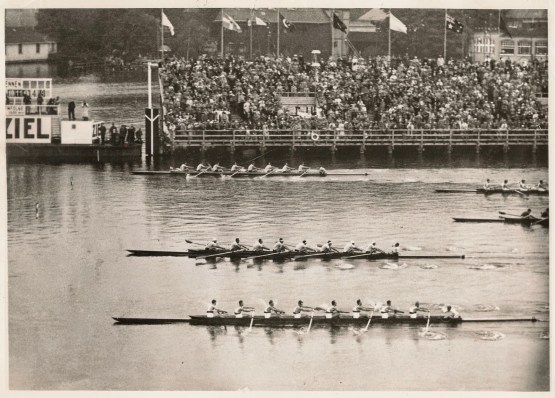
(1936 University of Washington rowers who won gold at the Berlin Olympics)

THE BOYS IN THE BOAT by Daniel James Brown is nothing short of a labor of love.  In describing the journey of the University of Washington rowing team from their blue collar origins, facing numerous financial obstacles, and confronting well funded opponents as they sought to represent the United States in the 1936 Olympic games in Berlin, the author has presented a riveting narrative that will touch the reader on many levels.  In addition to the personal stories that are described, Brown writes of the poetry that is a necessity for a rowing team to be successful.  The story is told through the eyes of many of the participants in their quest for rowing perfection, but a number of characters stand out.  The coaches;  Al Ulbrickson, a quiet taskmaster who keeps his emotions inside, his freshman coach, Tom Bolles, who develops many of the rowers; to Joe Rantz, who must overcome poverty and abandonment by his family, to George Pocock, the British craftsman who lovingly constructed the shells that the rowers would use on their way to Berlin and after.   The story begins in the Seattle area in the midst of the Great Depression and its impact on the region in general and the young men whose futures depend on making the University of Washington’s rowing team.

The story focuses on the life of Joe Rantz whose mother died of throat cancer when he was a nine and was sent to Pennsylvania to live with an aunt.  Later, his father remarries and when Joe returns to his family he does not get along with his knew step mother.  Eventually Joe’s father must make a choice between his son and his second wife and the family they were building.  After the family home burns down Joe is exiled to live in a school house away from the family for a period of time, when finally Joe’s father informs him that the family was moving away and that he had to remain and fend for himself at the age of fifteen.  For the next few years Joe employs the survival skills his father has taught him, and skills he developed on his own like poaching salmon and stealing alcohol for resale to overcome the obstacles he faces.  Finally, he is taken in by his married older brother and is able to graduate from high school and gain admittance to the University of Washington.  After being recruited by the freshman rowing coach, Joe realizes the ticket to his future was to make the rowing team.  Joe had little money and few clothes and lived in a room at the YMCA.  He took a number of menial jobs and fit them in around his studies and the torturous grind that was college rowing.  Brown follows the trials that Joe must overcome as he draws the reader into the narrative to the point that you do not want to put the book down.

I have read a number of books of the 1936 Berlin Olympics.  David Clay Large’s, THE NAZI GAMES: THE OLYMPICS OF 1936, and BERLIN GAMES: HOW THE NAZIS STOLE THE OLYMPIC DREAM by Guy Walters stand out, but Brown’s effort surpasses anything I have read for its detail, understanding the human emotion of sport, and how world events, particularly the rise of Nazi Germany impinged on the athletic stage.  Brown does a wonderful job of integrating the history of the time period into his narrative.  The reader is exposed to the devastation caused by the depression in the mid 1930s.  The unemployment and resulting poverty and their effect on families as fathers are forced to leave their children in order to seek a job elsewhere.  The Dust Bowl that blankets the Midwest at first and then destroys top soil throughout the United States resulting in the destruction of a major part of American agricultural production is reviewed in detail.  Overseas, the rise of Adolf Hitler to power is explained and the resulting violence against Gypsies, Jews, and Catholics is presented.  On a more personal level, Brown discusses the hatred between Joseph Goebbels, the Nazi Minister of Propaganda, and Leni Riefenstahl, Hitler’s chosen film maker as they fight over how the message of the Nazi ideal should be presented to the world.  The reader witnesses the laying of the foundation of what will grow into the Holocaust after the Olympic Games are completed.  The reader is made aware of the political infighting in the United States as President Roosevelt tries to deal with the problem of Nazi expansion.  In exploring these avenues, Brown places the Olympic Games in their proper historical context, and the importance of a Jesse Owens and the many athletes who sought to show Nazi racial theory for what it really was.

Apart from the personal stories of the nine men who will emerge from the rowing competitions from 1933 to 1936 in regattas such those on the Pacific coast, Poughkeepsie, New York, and the Olympic trials in Princeton, New Jersey what truly surprised me was the training that the rowers were exposed to.  I confess my knowledge of rowing is nil, but after reading Brown’s narrative I at least have some understanding of what the athletes went through.  The author’s description of “pain” cuts to the core of what these men accomplished.  For Brown the common denominator for the rower is that pain is “part and parcel” of the learning experience.  “It’s not a question of whether you will hurt, or how much you will hurt; it’s a question of what you will do, and how well you will do it, while pain has her wanton way with you.” (40) Brown’s discussion of the mechanics of rowing is important for the novice reader to understand what it means to have a successful “boat.”  In the case of the University of Washington’s first boat, “every one of them had come from humble origins or had been humbled by the ravages of the hard times in which they had grown up.  Each in his own way had learned that nothing could be taken for granted in life…..The challenges they had faced together had taught them humility—the need to subsume their individual egos for the sake of the boat as a whole—humility was the common gateway through which they were able to come together and begin to do what they had not been able to do before.” (241)

(US rowers win gold at the 1936 Berlin Olympic games)

The unbelievable demands of training, the fear of not having enough money for tuition each semester, feeling of anxiety, were among the many things that each rower had to overcome.  They knew the odds were stacked against them as their chief western competitor; the University of California had better facilities and financial support as did the eastern Ivy League schools.  Brown raises the important issue of social class in explaining the opponents the rowers had to contend with.  The ivy rowers mostly came from prep schools, had parents who were bankers and lawyers, and did not have to worry about their futures.  On the other hand, as Brown eloquently describes Joe Rantz and his team mates were blue collar in origin, and poverty was their life’s norm.  Brown’s rendition of the important characters in his narrative is sensitive and honest and as the story progresses the reader is rooting for “U Wash,” and as the author explains strategy, motivation, and the details of each race you feel as if you are sitting in the shell with the rowers, or you are inside the head of Bobby Moch, the coxswain, planning his next move as the rowing process has a very important cerebral component.

The author presents the pageantry and ostentation that was the 1936 Nazi Olympics in great detail.  He describes the hiding of any evidence of what Nazism was in reality; from removing the Gypsies, to taking down all evidence of anti-Semitism, and the vicious articles in the Nazi newspaper Der Sturmer, magically disappearing.  Brown describes the first six rowing competitions in which the Germans won five gold medals.  He reserves his best for the final race involving the nine on nine competition that all looked forward to.  It is interesting how the US boat was placed in the worst lane, when having won the preliminary race they should have had the best one.  Needless to say, the US rowers were at a disadvantage from the outset.  Brown’s overall description of the race is amazing as the reader can hear his voice as if he were rendering the race’s description vocally as a play by play on the radio that millions across America were listening to.  The US would win the race by six-tenths of a second over Italy and one second over Germany as Hitler stood up and immediately walked out.  After reading Brown’s rendition of the race I immediately found a You Tube film on my lap top and watched the emotion of the rowers at the race’s conclusion over and over.  THE BOYS IN THE BOAT is a wonderful story, and what makes it better is that it is shows the triumph of the human spirit and though it is a “sports” book, it is one that can be enjoyed by all.

OPERATION PAPERCLIP by Annie Jacobsen

At the conclusion of her new book, OPERATION PAPERCLIP: THE SECRET INTELLIGENCE PROGRAM THAT NAZI SCIENTISTS BROUGHT TO AMERICA, Annie Jacobsen discusses her battles with American military and intelligence authorities in trying to obtain documents relating to the employ of Nazi scientists by the United States Army and other government agencies following World War II.  In her discussion a common theme reaches fruition in 2012 as the Department of Defense finally declassified a 1945 list of Nazi doctors who were sought for “mercy killings and medical murder cases.”  On that list were seven Nazi doctors who were employed by the U.S. government even though “U.S. Army intelligence knew all along that these doctors were implicated in murder yet chose to classify the list and hire the doctors.” (437)  These doctors were hired as part of Operation Paperclip a postwar program designed to use the technological and medical knowledge of Nazi scientists for the benefit of American policy as the Cold War was burgeoning.  This raises a number of moral questions, the most important of which is when does a government draw the line in working with individuals who are guilty of directly or indirectly causing the death of tens of thousands of concentration camp victims, slave laborers, or innocent civilians.  In the case of the United States following World War II that line was invisible no matter what evidence existed that the individuals that the government was interested in had either engaged directly or indirectly in genocide.  For American officials following the war it was easy to dismiss evidence because in their eyes American national security interests trumped any documents that might interfere with their goal of using Nazi technological and medical advances to further the American agenda against the Soviet Union.

Anne Jacobsen has written a detailed and deeply researched study that raises numerous moral and philosophical questions as she explores the origin, implementation, and eventual downfall of Operation Paperclip.  She leaves no stone unturned as she ferrets out the stories and experiences relating to Wernher von Braun, the director of the German Army’s V2 rocket program and headed the Mittelbau-Dora Planning Office that oversaw experiments that resulted in the death of 30,000 out of 60,000 slave laborers he “hired” from the SS.  Other subjects include, Dr. Walter Schreiber, the Surgeon General of the Third Reich who carried out medical experiments on concentration camp victims for gas and bacterial warfare; Georg Rickhey, the General manager of the Mittlewerk slave labor facility; Otto Ambros, chemist and co discoverer of sarin gas and manager of IG Farben’s slave labor factory at Auschwitz; Dr. Kurt Blome, Deputy Surgeon General of the Reich; Major General Walter Dornberger who was in charge of V-weapons development and the technical officer in the Nordhausen slave labor tunnels; and Dr. Hubertus Strughold the wartime director for aviation research for the Reich.  These are just a few of the individuals that Jacobsen’s narrative exposes.  All are war criminals, and all participated in Operation Paperclip and developed important programs that the US military came to rely on during the Cold War, for example, Kurt Debus, an ardent Nazi and V-weapons flight test director who later became the first director of NASA’s Kennedy Space Center.

Jacobsen follows Operation Paperclip from its inception in 1945 as American authorities had to decide what to do with Hitler’s former scientists and engineers.  Proponents of Operation Paperclip decided to use Nazi scientists to assist in the war against Japan.  However, once the Japanese threat ended in August, 1945 and relations with the Soviet Union began to deteriorate the race to acquire as many scientists and technological experts before the Soviet Union could capture them gained momentum.  Jacobsen does an excellent job describing certain Nazi scientists and why their particular specialty was so important to the United States.  US policy for hiring German scientists was supposed to be based on the condition that “provided they were not known or alleged war criminals,” however this caveat was easily overlooked.  I found the mini-biographies that Jacobsen provides to be fascinating.  The author discusses many individuals that people with knowledge of World War II will easily recognize, i.e.; Hermann Goering, Albert Speer, and Heinrich Himmler, but the character studies of those not easily recognizable are the most fascinating.  Dr. Leopold Alexander, a Boston psychiatrist and German Jew left Germany in 1933 for a fellowship in China and never returned to his homeland.  He ended up working in a mental hospital outside Boston in 1934 and returned to Germany after the war to try and determine which of his former colleagues and students were guilty.  Alexander was shocked by the deviance of Nazi science and noted they did not practice science, but a “really depraved pseudoscientific criminality.”  Dr. Alexander also investigated crimes committed in the name of neuropsychiatry and neuropathology and in this capacity he came face to face with the odious Nazi belief of “untermenschen” that was the core of Hitler’s ideological framework and those individuals who implemented the murder thousands under the Law for the Prevention of Genetically Diseased Offspring carried out by Dr. Karl Kleist, a former neurology professor of Alexander.  We also meet Americans such as John J. McCloy who was in charge of setting up war crimes programs, but also coordinated policy regarding the transfer of Nazi scientists to the United States which he supported at the end of the war and later when he became High Commissioner for the American occupation zone replacing General Lucius Clay in 1949.  Not all Americans that Jacobsen integrates into the narrative were guilty of facilitating Operation Paperclip.  There were people like John Dolibois, a G2 Army intelligence officer who was sent to Dachau after its liberation to interrogate Nazi suspects and to investigate whether any important Nazis were hiding among the general prison population.  Dolibois was shocked by the reaction of the men he interrogated as they could not believe they were being prosecuted and they used the excuse that they “were only following orders.”  To their credit many State Department functionaries argued repeatedly to keep Nazi scientists who were proven criminals out of the United States, but the military establishment was difficult to defeat.

Jacobsen’s discussion of IG Farben and their development of sarin and tabun gases are eye opening especially when the same scientists are the ones who helped develop it for the United States.  Farben’s research reflects the depravity of the Nazi scientists, the same men whose expertise the US would use, rather than having these men face the prosecution and punishment they deserved.  It was not just chemists the US was interested in.  When the Washington Post uncovered “freezing experiments” conducted at Dachau were by men would be tortured, then frozen for a period of time, then Nazi doctors would try and revive them.   The fact that the Nazi biologists involved were already working for the US was kept from the public.  Throughout Operation Paperclip officials had to work just as hard recruiting scientists as they did keeping information away from Congress and the American public.  This led to covert programs to smuggle scientists into the United States or the American zone in what became West Germany on many occasions.

Perhaps the most interesting and disturbing chapter was entitled, “Science at Any Price,” which explained how the military was able to maneuver the State Department out of the business of approving visa for the Nazi scientists that they opposed admitting to the United States.  From that point on the Joint Intelligence Objective Agency (JIOA) that had been created by the War Department was in charge of Operation Paperclip and the policy became; any scientist the Russians were interested in would be of interest to the US.  By October, 1946 there were 233 German scientists in US military custody.  At the same time the New York Times made the public aware of Operation Paperclip, the army had to go on a charm offensive by bringing out the most “wholesome looking German scientists they had working for them.” (250)

Jacobsen artfully describes army cover-up tactics when one of their “new” employees had their Nazi past catch up to them, i.e., Georg Rickhey who oversaw production and the hanging of prisoners at Nordhausen, a rocket factory housed in a salt mine.  When Rickhey was arrested he was acquitted in the Dora-Nordhausen trial as the judges were military and the future of the American missile program took precedence.  Jacobsen weaves her narrative nicely with the use of trial transcripts and documents to support her thesis and reflects American angst that the Soviet Union was ahead in the “chemical warfare race.”  In fact Karl Krauck, IG Farben’s head chemist and Goering’s main advisor on chemicals was being recruited by the US at the same time he was on trial.  America’s rational was simple, “when working with ardent Nazis American handlers appear to have developed the ability to look the other way.  Others…..looked straight at the man and saw only the scientist, not the Nazi.” (300)

The Berlin Crisis that began on June 24, 1948 gave Operation Paperclip further momentum as the newly created CIA joined forces with the JIOA and led to the employ of Major General Reinhard Gehlen, the former head of  Nazi intelligence operations against the Soviet Union.  The US made a deal with the devil and put Gehlen’s organization at the forefront of the Cold War and made the Major General head of the entire American anti-communist intelligence operation.  Jacobsen also zeroes in on the cases of Otto Ambros, Dr. Walter Schreiber, and Dr. Kurt Blome exploring their Nazi past, their involvement in war crimes, and how they came to work for the United States.  Jacobsen follows that discussion with that of John J. McCloy’s commutation of Ambros’ and others sentences when he became High Commissioner, in part because of pressure from West German Chancellor Konrad Adenauer, and the outbreak of the Korean War.  A new shift in US policy evolved as it was now more important to be anti-communist as opposed to anti-Nazi.

The saga of Dr. Walter Schreiber as described by Jacobsen is emblematic of the American governments experience with former Nazi scientists after the war.  Schreiber was involved with medical experiments at Ravensbruck among his other crimes, but yet he was never prosecuted at Nuremberg.  In fact he became a Russian witness against his former colleagues at the trial.  His journey to the United States and his final eviction in 1952 is a twisted voyage that brings to the surface the role of the Air Force, CIA and other agencies that did everything they could bureaucratically to allow him to remain in the United States so that we could employ his knowledge of Nazi and Soviet chemical experiments.  In 1952 when his presence in Texas reached the Boston press and went national, the fear of scandal that could reach the highest levels of the Truman administration finally saw the government force him to emigrate to Argentina with his family.  What is evident is that being an anti-communist trumped being a Nazi war criminal.   If you could assist in the Cold War battle any past crimes could be glossed over and explained away in the name of national security.

Jacobsen completes her study by discussing the case of Arthur Rudolph, a man who oversaw slave labor at the Dora-Nordhausen complex where he was involved in working prisoners to death and a number of public hangings.  Rudolph had worked for the US military and NASA for thirty-eight years when he was finally expelled, but even as his role in the Third Reich became known in 1983 there were elements in NASA who claimed the Justice Department was engaged in a witch hunt.   Jacobsen’s magnificent study concludes by asking “What does last?  The desire to seek the truth? Or, in the words of Jean Michel, the ability to take a stand against the monstrous distortion of history when it gives birth to false, foul and suspect myths?”  This for me is the epitaph of Operation Paperclip, one of the most disturbing policies that the United States government has ever pursued.

HITLER’S SPY CHIEF: THE WILHELM CANARIS BETRAYAL by Richard Bassett

Wilhelm Canaris’ role as the head of the Abwehr, German military espionage, before and during World War II has been openly debated since his execution by the Nazis in 1945. Some historians argue that he supported the Nazi regime when it was convenient and others who argue he was always in opposition to Adolf Hitler and saw himself as trying to save western civilization from the twin evils of Nazism and Communism. Richard Bassett posits in HITLER’S SPY CHIEF: THE WILHELM CANARIS BETRAYAL that Canaris had a tremendous impact on the course of the war by building an efficient intelligence system that refused to engage in the evil practices of the Gestapo and SS; further he should be credited for altering the course of the war through his support of General Franco against Hitler’s goal of seizing Gibraltar, thereby saving the Mediterranean Sea for the British navy; and lastly, his deliberate over-estimation of British forces available in his intelligence estimates after Dunkirk being the vital factor in delaying and cancelling the Nazi invasion of England and ultimately causing the defeat of Germany. There is an element of truth in all of these assertions, however they rest on somewhat dated sources and should be grounded in further research. The author presents many theories in the form of conjecture, and to his credit he tries to present both points of view, but then does not reach totally viable conclusions, i.e.; Canaris’ role in possibly achieving an Anglo-German demarche in 1943. After reading the book I am not certain how pro-Nazi Canaris really was and to what level did his anti-Semitism reach. Despite these drawbacks there are aspects of the book that are praiseworthy.

Bassett does an excellent job exploring the ideological and policy fissures that developed between Carnais and the Head of the SD, Reinhard Heydrich. Their relationship takes up a significant portion of the book ranging from Heydrich’s attempt to foment military purges in the Soviet Union in 1937 that resulted in Carnaris questioning the goals and tactics employed by the Nazis. Bassett follows their competition for control of the German military intelligence community that pitted the Abwehr against the SD closely as Carnaris saw himself as the antithesis of “the Butcher of Prague” who would be assassinated by Czech and Slovak agents working for the British in 1942. The author’s discussion of Canaris’ relationship with Winston Churchill is important and the conclusion seems to be had the British Prime Minister followed Carnaris’ lead perhaps the war could have been prevented in 1938 or at least ended in 1943. These suggestions are supported somewhat, but are not totally convincing. Another area of interest is Canaris’ interactions with “C,” Sir Stewart Menzies, the Head of British Intelligence during the war. Bassett alludes to a close relationship that impacted strategy, but does put forth enough supporting evidence to make his assumptions totally viable. Overall the book is an interesting read, but the author should rely on more up to date secondary sources and greater primary materials in support of his theories to gain further credibility.

HITLER’S HANGMAN: THE LIFE OF HEYDRICH by Robert Gerwath

Until 1942, the year of his assassination Reinhard Heydrich was the chief of the Nazi Criminal Police, the SS Security Service and the Gestapo. He played a significant role in the planning of the “Final Solution” and was responsible for many of the atrocities implemented by the Nazi hierarchy until his death. In this new biography, HITLER’S HANGMAN: THE LIFE OF HEYDRICH by Robert Gerwath, the Director of the Center for War Studies at the University College Dublin,the reader is presented with the most complete study of this perpetrator of evil that has been written to date. Heydrich was the “complete” ideological Nazi. One who grew up in a privileged middle class family and the narrative and analysis follows his career progression to the point of becoming one of Hitler’s most trusted policy makers. Gerwath presents the inner workings of the Gestapo and other Nazi police organs. The reader witnesses the complexities of the Nazi secret police, the personal conflicts and power struggles and the resulting affects on its victims. It is a study that explores the personal and public character of its subject and leaves no doubt that the Holocaust was greatly facilitated by the former overlord of Bohemia and Moravia. His assassination (the topic of a fascinating new novel, HHH by Laurent Binet) by a Slovak and a Czech recruited by the British secret service in 1942 did the world a service by ending the cruelty of the “butcher of Prague.” The book is designed for the general reader as well as an academic audience and is very well written and well worth the time if one is interested in this type of subject matter.

HITLERLAND by Andrew Nagorksi

Hitlerland, by Andrew Nagorski is a useful survey of the attitudes expressed by Americans who witnessed the rise of the Nazis to power from the 1920s onward and their reactions to Nazi policies in the 1930s. The author integrates a number of important Americans, ie; US Ambassador Wiiliam Dodd, the journalist William L. Shirer, George Kennan, Dorothy Thompson etc in ascertaining what Americans thought concerning the events that they witnessed. If you want to get a flavor of what it was like for Americans in Germany as World War II approached and reactions to the rising anti-semitism under the Nazi regime this book should be of interest.

HHhH by Laurent Binet

Recently I read Robert Gerwath’s HITLER’S HANGMAN: THE LIFE OF HEYDRICH. It was an amazing biography of a person described as “Himmler’s Brain.” Reinhard Heydrich was the Chief of the Nazi Criminal Police, the SS Security Service and the Gestapo, also the ruthless overlord of Nazi-occupied Bohemia and Moravia during World War II. In addition he was the leading organizer of the “Final Solution” until May 27, 1942 as well as the “host” for the Wannsee Conference that many believe set up the infrastructure for the Holocaust, quite a resume! Heydrich was one of the most important figures in the Nazi hierarchy and quite possibly would have worked his way up to be Hitler’s successor had he not been assassinated by a Czech and a Slovak as part of a British secret service plot in May, 1942. Since Heydrich was such an important historical figure I was fascinated by Laurent Binet’s remarkable book, HHhH translated from French into English by Sam Taylor and published last year. Binet’s work is a combination of historical fiction and historical narrative, a process he describes as an “infranovel.”

This book is an unusual combination of impeccable historical research and prose. The author seems to meditate over his material as he presents it in the form of a conversation with himself. His application of subtle sarcasm exists throughout and his descriptions of his characters are hauntingly accurate. The first half of the book presents the background in the form of a bio-fiction of Heydrich’s life and then the author moves on to discuss his main concern the assassination of the “Butcher of Prague.” The reader is provided an interesting portrayal of Jozef Gabcik and Jan Kubis the British trained assassins, who are parachuted into the Prague area in May, 1942. The reader is taken for a chilling ride with these partisans as they carry out their mission, the Nazi reprisals resulting in the massacre of the Czech town of Lidice, their own deaths and the eventual extermination of all individuals who are linked to the plot by the Germans. Binet is irreverent in his descriptions, be it social situations or ideological debates to the point that some of the scenes seem farcical. The author’s blend of historical accuracy and fictional musings draw the reader in with his commentary, i.e.; in dealing with Anglo-French sellout of Czechoslovakia in September, 1938 he states, “at this level of political stupidity, betrayal becomes almost a work of art.” The book is truly an accurate portrayal of history presented in the form of a novel. As a historian I wish he could have provided footnotes and a bibliography!