THE SYMPATHIZER by Viet Thanh Nguyen

(American Embassy, Saigon, South Vietnam, April 30, 1975)

THE SYMPATHIZER is a unique first novel by Viet Thanh Nguyen.  The story is told from the perspective of a narrator who allows the reader to delve into the mind of a Vietnamese person experiencing the end of the Vietnam War in the spring of 1975, and the aftermath of the fighting focusing on a possible counter-revolution, and how Hanoi is integrating the south into its political agenda.  The narrator highlights the duality that is present throughout the novel.  The protagonist’s own lineage is a case study in ethnic diversity as he himself is considered a half-caste or bastard in Vietnamese society.  He is the illegitimate son of a teenage Vietnamese mother, and a French Catholic priest.  The narrator loves his mother and hates his father, and throughout the novel these feelings are portrayed through a number of poignant vignettes.  The book itself is very important because there are few novels about the war that provide a vehicle for the Vietnamese to speak about their experiences and feelings.  Nguyen’s effort fills that gap in an emotionally charged novel that alternates between the light and the dark aspects of war.

The narrator’s character fits the duality theme in the sense that it is divided by at least two component parts.  First, he is obsessed with guilt as he tries to navigate the demands of being a spy for the north and living in the United States.  He is educated in an American university and after the war he is assigned by his handlers to shadow, “the general,” a former commander in the South Vietnamese secret police who has escaped Saigon, and is set up by the CIA in Southern California to organize the retaking of his country.  The narrator, a Captain and interrogator in the secret police is living a much better lifestyle than his compatriots who did not escape the North Vietnamese and Viet Cong when Saigon fell.  He suffers from tremendous “guilt, dread, and anxiety” concerning his worthiness as compared to his countrymen.  Further guilt is evidenced as he repeatedly flashes back to his role in the assassination of the “crapulent major,” who was suspected of spying for the north, and the murder of Sonny, a Vietnamese who began his own newspaper in Southern California that was seen as a threat by the general.  In the second component part of the narrator’s personality, we witness his movement away from his “sympathizer mode” and carries on as a revolutionary consumed with his role as a police interrogator following instructions from Man and his Aunt in Paris, both who are his handlers, to provide information as to events and political patterns that are being shaped in the United States.  Throughout the novel, the narrator’s role confusion is evident as regrets many of his actions committed during and after the war in the name of revolution.  His anguish evolves to the point that he begins to doubt his beliefs and tries to make amends to those he hurt.

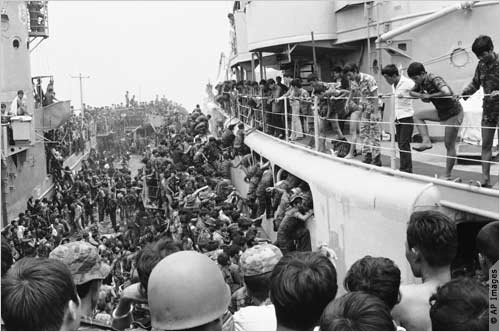
S.  Vietnamese in Da Nang struggle to climb aboard ships that will evacuate them to Cam Ranh Ba

(South Vietnamese struggle to board ship in Da Nang to escape North Vietnamese forces, April. 1975)

The texture of the book is evident from the outset as Nguyen describes the horrific scenes that took place in Saigon as the city was about to fall.  The description puts the reader outside the American embassy and Saigon airfields as frightened Vietnamese who worked for, and, cooperated with the United States sought to escape before North Vietnamese troops took the city.  The narrator returns to his childhood when he, Man, and Bon, three friends become blood brothers for life.  As the novel unfolds we follow the relationship between the three that is rather complex since Man becomes a Commissar for the north, Bon is a soldier in the South Vietnamese army, and the narrator suffers from the duality of being a spy for the north and a police interrogator for the south.

Many important themes are developed in the novel.  The conflict between east and west or occidental and the orient are deeply explored in the dialogue between the characters.  The moral dilemma of what is right and wrong in our daily actions hovers over each page, and how a person tries to cope with their own divided heart. The author’s sarcasm is at times humorous, but also very disturbing as the narrator tries to understand the history of his country and the demands it makes upon him.  The history of the war is explored in the context of certain important decisions by the United States, the Hanoi government, and the remnants of the Saigon regime.  Nguyen descriptions are intense and very pointed, i.e., as the narrator explores who invented the concept of the “Eurasian;” he states “that claim belongs to the English in India who found it impossible not to nibble on dark chocolate.  Like pith-helmeted Anglos, the American Expeditionary Forces in the Pacific could not resist the temptations of the locals.  They, too, fabricated a portmanteau word to describe my kind, the Amerasian.  Although a misnomer when applied to me, I could hardly blame Americans for mistaking me as one of their own, since a small nation could be founded from the tropical offspring of the American GI.  This stood for Government Issue, which is also what the Amerasians are.” (19-20)

The Sympathizer 

The author creates a number of interesting and complex characters that carry the storyline nicely.  The right wing Congressman from Orange County, California who wants to fund and train the South Vietnamese counter-revolution, the Hollywood producer who is making his own movie version combining the Green Berets and Apocalypse Now, the northern commandant who tries to purify the revolution through the reeducation of those who have gone astray, and many others.  The narrator’s plight is very important as he tries to integrate his memories of his country in a heartfelt manner throughout the novel.  Whether he discusses Vietnamese geography, culture, or his family and friends, he seems adrift when in America, and then adrift again, when he returns to Vietnam.

The book is a triumph as a first novel, but at times it can be very dark.  I suppose that is acceptable based on the historical background of the war and the story it tells.  It is a unique approach to trying to understand a war that ended over forty years ago, but that had been fought since the late 19th century when the French first imposed their colonial regime.  The history of the war and the scenes that are presented seem authentic and should satisfy those interested in the literature of the war and how people tried to cope and survive the trauma it caused.

THE LAST BOOKANEER by Matthew Pearl

The Last Bookaneer: A Novel

In Matthew Pearl’s latest historical thriller, THE LAST BOOKANEER he raises the question of what is a  “book’a-neer’ (bŏŏk’kå-nēr’), n. a literary pirate; an individual capable of doing all that must be done in the universe of books that publishers, authors, and readers must not have a part in.” Further he states that it is a person who was part of “the mostly invisible chain of actors that links authors to readers.” These definitions provide the basis for Pearl’s continued ability to design and develop plot lines that bibliophiles find endearing and all consuming.  After his successes with THE DANTE CLUB, THE POE SHADOW and THE LAST DICKENS his latest effort finds the reader engrossed in a tale centered in the Samoan Islands in the early 1890s involving a supposed last novel from the pen of Robert Louis Stevenson.  In fact, in 1890 Stevenson did purchase a 400 acre tract of land in Upolu in Samoa where he built his estate in the village of Vailima where he would live until his death in 1894. A major part of the novel is centered on the estate and the surrounding area encompassing its topography and the lives of the Samoan people.  What makes the novel a success is Pearl’s continued ability to place the reader in the 19th century and creating a wonderful literary yarn that reeks of a possible reality.

The story evolves as Edgar Fergins, an English bookseller imparts the history of bookaneers beginning in 1790 and the first American laws that governed copyrights that left out foreign authors, causing foreign countries to withdraw the protection of American authors.  What resulted was the plundering of literature on both sides of the Atlantic.  Publishers resorted to hiring covert agents to scour the world for manuscripts in the hope of publishing important items first.  Employing spying and intimidation these individuals were a focal point of the publishing industry.  Pearl provides a number of bookaneers for the reader to engage with.  Whiskey Bill and Kitten reappear from previous novels, but it is the American, Penrose Davenport, employing Edgar Fergins in his quest to seize Stevenson’s last manuscript, THE SHOVELS OF NEWTON FRENCH that dominate the story along with their arch enemy in the chase, Benjamin Lott, better known as Belial.  As countries moved toward an international agreement on copyright laws in the last quarter of the 19th century, the livelihood of bookaneers was threatened with extinction.  The background for the story is served by Davenport and Belial’s fear that the race for Stevenson’s manuscript would be the last such adventure that they would ever engage in.  This leads to a story that centered on lies and deception, with vengeance and guilt not far from the surface.

Pearl’s love of books emerges through his diverse characters as Fergins remarks, “For readers, books are a universal salve.  When we are hot, we read to feel cooler, when we are cold, we read to warm up; tired, books wake us; anxious, they calm us.” (142)  The keeper of a bookstall has insights that no one else has.  “From the type of cracks in the spine and the edges of pages, I can tell at a glance a book that is well read from a book that has been abused….books are not just words on the page, but the blots and the dog-earned corners, the buttery thumbprints and pipe ash we leave on them.  Books are written over with names, dates, romantic and business propositions, gift dedications, the pages could be pressed onto flowers, keys and notes.  A book can unfold moments or generations.…how odd it must be to go through life believing that a book [is only] a book.” (289)

Previous Upolu island – its jungle interior

Sopo’aga Waterfall, north of Lotofaga along the eastern cross-islands road.

Next
Sopo'aga Falls view

The story is narrated by Fergins in large part as he conveys his experience in Samoa and the literary industry in general to a dining car waiter he has met in New York named Clover.  Later in the novel Clover will take over as the second narrator as the plot takes a most unusual twist.  Through his characters Pearl provides the reader with an exquisite description of the Samoan Islands and its people.  We see the beauty of their customs and the loyalty they express.  At this time the natives are caught in a crossfire between German and English interests on the islands that creates an indigenous civil war that they must contend with.  There are parts of the novel that remind us of Joseph Conrad’s HEART OF DARKNESS which also examined civilized vs. primitive societies.  Through the portrayal of Stevenson’s bohemian lifestyle we witness a somewhat civilized society, while on the other hand we see the savageness of the bookaneer in the characters of Davenport and Belial, while the local Samoans seem to be the epitome of the purity of the human soul.

If you enjoyed Pearl’s previous historical mysteries, his current effort will not disappoint.  The plot continuously shifts and offers numerous surprises.  It calls forth emotions in the characters as well as the reader and Pearl’s style as he describes “Tusitala” (Stevenson’s Samoan name) reign as a chieftain in the Pacific as we witness a contented man who has escaped the industrialized world for the simplicity and freedom that he yearned for.   

Come and visit the Shapiro House at the Strawbery Banke Museum in Portsmouth, NH. You never know who will greet you at the door as you enter!

eShapiro

Shapiro House was the home of Abraham and Sarah Shapiro, Russian Jewish immigrants, and their American-born daughter Mollie, from 1909 to 1928. It is furnished and interpreted to 1919, to show how the Shapiros sought to balance their strong cultural identity with new opportunities in America. While Shapiro House is specifically about the Russian Jewish experience, it also reflects the early 20th-century multi-ethnic community at Puddle Dock, when half of its 600 residents were foreign born. The Shapiro story is a case study of the process of becoming Americans shared by all immigrants. It is a story of struggle and success, tragedy and triumph.

Between 1880 and 1920, more than 23 million immigrants came to America. Many came from Eastern, Central, and Southern Europe seeking freedom, work, adventure, property, and self-determination, in short, better lives for themselves and their children. The majority stayed in large urban areas – New York, Chicago, Boston – but about 25% chose smaller cities and towns, including Portsmouth, New Hampshire. At the turn of the twentieth century, immigrants from Ireland, England, Canada, Italy, Poland, and Russia lived in and around the Puddle Dock neighborhood, alongside native-born residents. Abraham and Sarah were part of a complex network of international families within the community. Born in Ukraine, Abraham Millhandler and Sarah Tapper emigrated to America as young, single adults to reunite with family members who had come earlier. Abraham changed his name to Shapiro, as had his older brothers, Simon and Samuel. In 1905 he married Sarah, his sister-in-law, reinforcing kinship ties that had been established in Russia, even as they made new lives in America.

Part of a small Russian Jewish community, these families relied on each other for financial assistance, jobs, and emotional strength. With other families they established a Hebrew School for their children, opened kosher shops, and founded the Temple of Israel to serve their traditional cultural and religious needs. They established new businesses, particularly the scrap metal yards which flourished at Puddle Dock into the 1950’s. They became retail clothing merchants and shoe manufacturers. For most of his life, Abraham Shapiro worked in shoe shops and factories, loosely organized by kinship ties, that stretched from Lynn, Haverhill, and Newburyport, Massachusetts to Portsmouth and Epping, New Hampshire. In the late 1910’s he owned a pawnshop that catered to sailors stationed at the Portsmouth Naval Shipyard. When he could, Abraham also invested in real estate – sometimes in cooperation with his brothers – a privilege denied Jews in Russia. The Shapiro brothers were also active in Temple of Israel affairs from its founding in 1905. In 1912 Abraham was a leader in the negotiations to buy and convert the Methodist Church into a synagogue. Only a block from the Puddle Dock neighborhood, Temple of Israel was the social and religious center of the community. Like many Puddle Dock Jews, Abraham was an enthusiastic Zionist, and was frequently involved in fund raising for local, national and international Jewish causes.

Sarah Shapiro worked at home, taking care of their only child Mollie, maintaining a kosher home, and looking after a series of boarders, many of whom were newly arrived immigrants. Sarah’s daily activity focused on her home, family, friends, and neighbors. Immigrant butchers, bakers, and grocers in and around Puddle Dock provided nearly everything she needed to observe strict kosher dietary laws and to celebrate the Sabbath rituals with her husband and daughter. Mollie Mary Shapiro was born in 1909 into an extended family of aunts, uncles and cousins. As as American-born child of immigrant parents she played a critical role in acculturating her parents, exposing them to new ideas and relationships, and developing her own identity as a Jewish-American. Education was an intergral part of the American Dream in the Shapiro household, as it was in many immigrant homes. In 1920, when Mollie was 11 years old, virtually all of the immigrant children at Puddle Dock were attending school. Mollie excelled in public school, completing high school and graduating from the University of New Hampshire. As an only child, she was the focus of all her parents’ hopes and dreams. They hoped she would maintain her religious cultural heritage as she grew up with an American identity. She worked hard in Hebrew School, as her worn-out textbooks attest, and learned to play the piano, a skill considered particularly American by many working class immigrants.

When the Shapiros purchased the house in 1909, it was well over 100 years old, like many neighboring houses. In fact, immigrants were first drawn to Puddle Dock because of these older buildings’ affordable rents. While the Shapiors certainly had the financial support of their families to buy a home, they were not unique. Of the 30 Russian Jewish immigrant households at Puddle Dock in 1920, half were owner occupied. The house was built in 1795 by Dr. John Jackson a physician and apothecary. After Dr. Jackson’s death in 1834, his widow continued to live in their home. By 1890 the house has been divided into a two-family dwelling and was probably a rental property. In 1909 when the Shapiros moved in, surprisingly few changes had been made to the 18th-century building. The original two-over-two room plan was intact, although the original small ell has been expanded twice by the end of the 19th-century to accommodate an updated kitchen. In 1911 a fire destroyed most of the ell, and when the Shapiros rebuilt it, they expanded it to the full width of the original house and added a small bathroom. After 1928, when the Shapiros sold the house, significant changes were made to the building. The 1795 stairway and chimney stack were removed, the parlor expanded, and the second floor plan reconfigured to create a third bedroom and a bath. In 1996 and 1997, Strawbery Banke staff restored the house to its 1919 appearance. The restoration, exhibit and program, Becoming Americans: The Shapiro Story, 1898-1928 was made possible by generous support from the National Endowment for the Humanities, private foundations, and individual donors.

Strawbery Banke Museum
PortsmouthNH.com

A Memorial to Jewish Small-Town Immigration

It also spilled into cities like Portsmouth, where Abraham and Shiva Shapiro settled in 1905 and reared a daughter alongside the predominantly Yankee descendants of the Colonial period.

An exhibit at the Strawbery Banke Museum’s Shapiro House, which opened today, focuses on Jewish small-town immigrants and has given their descendants a new understanding. ”It explodes the myth that all of these old New England locations were then populated only by descendants of the Mayflower,” said Sharon Kotok, coordinator of the exhibit.

Gov. Jeanne Shaheen spoke at ceremonies marking the opening of the exhibit, and Judge Joseph A. DiClerico Jr. of the Federal District Court in New Hampshire naturalized 20 more immigrants of diverse background. The Shapiro House, part of the museum’s 10-acre property on historic Strawbery Banke, has been restored to the way it appeared in 1919.

Abraham Shapiro immigrated here from Annopol, near Kiev, Ukraine, in 1903, when that country was part of czarist Russia. Shiva, who also was from Ukraine, immigrated in 1905 and married Abraham the same year.

At the time, Portsmouth was a city of 10,600 people, full of shoe shops and breweries and economically tied to the Navy shipyard across the Piscataqua River in Kittery, Me.

When Abraham arrived here, he had $12 in his pocket, said his grandson, Dr. Bert Wolf of Portland, Me., a dentist. Deeds and records show that Abraham, a pawnbroker, bought the house for $400 and paid it off in seven years. The Shapiros had only one child, Mollie, and she was ”the apple of their eye,” Ms. Kotok said. Mollie married and had a son, but she died at the age of 24.

The Shapiros were part of the more than 23 million immigrants who spilled into the United States at the turn of the century, fleeing discrimination and poverty.

”Nearly half the people in the U.S. can trace their relatives to immigrants who came here during this era,” said Susan Montgomery, curator of the Strawbery Banke Museum.

While most of the Russian Jews went directly to New York, Chicago, Boston and other large urban centers, ”fully one quarter of them selected homes in smaller communities,” Ms. Montgomery said.

Elaine Krasker, 70, a former New Hampshire State Senator who was born in Portsmouth and is a granddaughter of Abraham’s older brother, Shepsel, said that before the restoration project she had only a slight knowledge of the family’s past.

”The most exciting thing is that we’re bringing the family to life,” Mrs. Krasker said. ”I had only the bare outlines of their lives in Russia.”

Her grandfather Shepsel arrived in 1898 and started a scrap metal business. Simon Shapiro, another brother, arrived four years later.

Simon’s grandson, Sumner Shapiro, 71, of McLean, Va., is a retired rear admiral and a former director of naval intelligence. He, too, is fascinated by the family’s past.

”I heard about the neighborhood and house as a kid,” Admiral Shapiro said. ”My grandfather lived in a house around the corner. What makes this important is that many people think the Jews settled only in large urban areas. Not so.”

Speaking of the Shapiro House, Ms. Kotok said: ”It’s not glamorous. When you walk in this house, it will rattle some bones and shake some cages about who really lived in these old New England towns back then.”

ONE OF US: THE STORY OF ANDERS BREIVIK AND THE MASSACRE IN NORWAY by Asne Seierstad

Anders Behring Breivik

(Anders Behring Breivik the right wing extremist convicted of killing 77 people and wounding 244 in Oslo and Vtoya, Norway on July 22, 2011)

On May 15, 2015 the jury in the Boston bombing case voted the death penalty for Dzhokhar Tsarnaev for his role in the massacre at the April 15, 2013 Boston Marathon.  Tsarnaev acted out of an ideology that was the antithesis of Anders Behring Breivik, the self-proclaimed commander of the Norwegian anti-communist resistance movement who in July, 2011 sought to rid Europe of what he perceived to be its Islamization and, secondly to make a statement about what cultural diversity, and the feminist movement were doing to Norwegian society.  By blowing up the Norwegian Parliament building resulting in 8 deaths, and massacring 69 teenagers and wounding 244 more at a Labour Party youth gathering at its Vtoya camp retreat, Breivik hoped to rally Europe to his demented cause.

The use of hindsight as a lens to dissect human tragedy is very common.  Twenty-twenty hindsight exposes errors in judgement and outright mistakes.  What took place in Norway probably could have been avoided or at least the casualties could have been markedly reduced.  The warning signals seemed to be in plain sight and were overlooked, resulting in a disaster that could have been mitigated and was not in the case of Anders Breivik’s horrific actions on July 22, 2011 in Oslo and Vtoya.  The planning and execution of this atrocity and the life stories of the perpetrator and many of his victims have been extensively researched and chronicled in Asne Seierstad’s 2013 book, recently translated into English, ONE OF US: THE STORY OF ANDERS BREIVIK AND THE MASSACRE IN NORWAY. The book is a powerful story of how the development of hatred in one person can expose an entire society to his violent agenda.   Seierstad’s book begins with Breivik having already killed 22 people, coming upon 11 other teenagers, and how he proceeded to shoot them one by one.  Every few seconds a gun blast was heard, and as Breivik moved on to complete his task he said, “you will die today Marxists.”  Later, Breivik would explain that he wanted “to kill the party leadership of tomorrow.”*

Norway Terror

(The bomb blast at the Norwegian government building site on July 22, 2011)

There are a number of chapters in Seierstad’s narrative that stand out.  The discussion of Breivik’s upbringing and the dysfunctional nature of family life greatly contributed to his lack of self-confidence and loner lifestyle.  His mother, Wenche suffered from mental illness and abrupt mood swings, and when Anders was four she yelled at him that she “wished he were dead.”  As a little boy Anders tortured pet rats and little girls were afraid of him.  His inability to gain acceptance as a teenager, young adult, and adulthood was manifested in trying to make a reputation for himself as a “graffiti artist,” the inability to gain support for a position with the right wing Progress Party, the failure of his e commerce business, rejection for a city council seat nomination in his home town, and inability to become a Freemason all reflect a pattern of failure.  He spent a great deal of his time playing hardcore computer games like “World of Warcraft” and “Call to Duty: Modern Warfare,” in which his violent nature was refined.  The author integrates the political changes in Norway, the rise of the Labour Party and its left wing social agenda and how it provided a scapegoat for Breivik who develops a strong resentment for the number of “brown” refugees that are accepted by the Norwegian government.  As Breivik’s ideological views evolve he becomes convinced that the problem for Norway and Europe is the infiltration of Islam and his belief that what stood in the way of their deportation was in large part the Labour Party and its “feminist leadership” under former Prime Minister, Gro Harlem Brundtland. Seierstadt’s chapter “Patriots and Tyrants,” delineates Breivik’s ideas in a 1,518 page written manifesto, much the same way as did Hitler in Mein Kampf, and in retrospect it is a scary document.

Seierstadt’s chapters dealing with the families is both endearing and poignant.  The Rashid family emigrated from Iraq to escape the mounting sectarian violence after the American invasion.  Their story and how they tried to integrate into Norwegian society is important and sad as in the end their children found themselves in a situation that could only mirror their experiences in Kurdistan.  The Saebo family were native Norwegians whose children continued their parent’s liberal beliefs and their son Simon became a leader in the AUF movement (the youth wing of the Labour Party).  The family typifies the liberal sector of Norwegian society and how they worked with refugees and the poor.  Other personal biographies are presented and when the reader is confronted with the massacre on Vtoya Island they feel as if they know the victims of the terror.

Norway Terror

(The carnage at Vtoya Island, Norway on July 22, 2011)

What is most disturbing about the book is the discussion of what can only be described as police incompetence in many instances as the terror situation began to unfold.  The lack of equipment, poor communication, and overall weak preparation for a disaster of this kind probably substantially increased the death and wounded totals.  I realize it is easy to connect the dots after the fact, but in this case misplaced messages or ignoring important information are directly responsible for a great deal of what occurred after the Parliament building bombing.  The fact that only one helicopter was available at the time and the lack of water transport was appalling.  In reading the author’s description one wonders how safe Norwegian citizens were in 2011.  The Norwegian police response in the immediate aftermath of the Parliament building bombing looked as if the “keystone kops” were in control.  For those who were in charge of keeping Oslo safe, the events of July 22nd are scandalous, as a “2012 official investigation found that the police and security forces’ response during the attack was seriously flawed.”*

In addition to the personality portraits and defense strategies, Seierstadt provides a unique opportunity into the mind of Anders Beirik, especially in her discussion of his trial and sentencing.  Beirik believed in a three step plan, the bombing, the massacre at the island, and a trial that would serve as his platform for his ideas. He repeatedly stated that he expected to be caught, and tried to surrender a number of times during the massacre (another blot on police procedure) so he would not be killed, thus preserving his opportunity to educate the public about Islamization.  He achieved his goals as the Norwegian legal system worked to his advantage.  First, his message was broadcast nationwide.  Second, the court had to determine if he was sane or a political terrorist.  Third, no matter the verdict, he could only be sentenced to twenty one years in prison, and possibly more if he was still deemed a threat to society after his sentence was served.  Two teams of psychiatrists examined Beirik, one found him to be insane and suffering from paranoid schizophrenia and the other found that he suffered from a “dissocial personality disorder with narcissistic traits….with a grandiose perception of his own importance…. possessing a vast appetite for praise, success and power….totally lacking in emotional apathy, remorse or affective expression.”  At trial he was deemed to be sane, something that Beirik desperately wanted so his “movement” would gain legitimacy in his own mind.

Norway Terror

(The arrival of Norwegian swat teams at Vtoya Island….too late)

The author’s exploration of Beirik’s motives, preparation, implementation, and post-massacre thought processes is reported to the last detail and provides insights into the most horrific domestic event in Norwegian history.  The book reads like a novel, but it is not.  The translation by Sarah Death is flawless, and after reading the narrative the reader will gain tremendous knowledge and insights into the events of July 22, 2011, and how most or at least part of what took place may have been avoided.

Norway Terror

(What hatred in one man’s mind can lead to)

*”Norway: Two Faces of Extremism” by Hugh Eakin, New York Review of Books, March 5, 2015, 55-57.

The Lady from Zagreb (Bernie Gunther Series #10)

THE LADY FROM ZAGREB is the tenth book in Philip Kerr’s Bernie Gunther series.  Gunther a former homicide detective before the rise of Nazism, an ideology that he finds abhorrent, is a character in absorbing historical thrillers that are set in Germany in the 1930s, World War II, and the Cold War.  Gunther is a very self-effacing and likeable individual who is one-quarter Jewish and has a propensity to offer humorous wisecracks that cut to the core of a German history between 1933 and 1945, a time frame that has destroyed the lives of millions of people.  In Kerr’s current effort we find Gunther in the French Riviera circa, 1956 reminiscing about World War II, and his relationship with a beautiful German actress, Dalia Dresner.  The novel binds together a number of plot lines.  We find Dr. Joseph Goebbles, the head of the Nazi Ministry of Propaganda and National Enlightenment with his own policy and sexual agenda; a series of murders, one happening to have been a client of Gunther; the intrigue of wartime Switzerland with spies ranging from the head of the Office of Strategic Services, Allen W. Dulles to SS Brigadefuhrer Walter Schellenberg who would become the head of Nazi foreign intelligence; a Hitlerite plan to invade Switzerland, and a plot to prevent such an invasion in the name of bringing about negotiations to end the war; the barbarity and cruelty of the Balkans that fifty years later would explode in Yugoslavia; and of course the machinations of Detective Gunther with his constant cynicism and sarcasm.

Kerr is a talented writer who weaves important historical characters and events throughout his story.  The narrative involves numerous historical figures that include Dr. Goebbles; Nazi Foreign Minister Joachim von Ribbentrop; SS Reichsfuhrer Heinrich Himmler, in charge of the Nazi genocide of the Jews; SS Obergruppenfuhrer Ernst Kaltenbrunner, Chief of the Reich Main Security Office; SS Brigadefuhrer Schellenberg; SS Obergruppenfuhrer Reinhard Heydrich, one of the main architects of the Holocaust and Chief of the Reich Main Security Office before his assassination; SS Gruppenfuhrer Arthur Nebbe, Gunther’s boss and a mass murderer in Bialystok during the war; Allen W. Dulles; Anten Pavelic, Croatian leader of the murderous Ustase; Hajj Amin al-Husseini, the Grand Mufti of Jerusalem and Nazi ally; and many other important figures.  Historical events are also not neglected as the Russian genocide of Polish officers at the Katyn Forest; the destruction of the Czech village of Lidice as punishment for the assassination of Heydrich; the allied bombings of Dresden and Hamburg; the slaughter in the Balkans; and Nazi war plans are all integrated into the novel.

(Joseph Goebbles Nazi Propaganda Minister)

Gunther’s personality, wit, cynicism and charm remain the same in Kerr’s latest effort.  His pointed historical commentary are as irreverent as always.  Finding himself in Croatia and a witness to the slaughter between Croats, Serbs and Muslims as he searches for Dalia Dresner’s father, who supposedly is living in a monastery, brings about the question as to “how does a Franciscan monk get to be an Ustase Colonel?” The answer offered is “by being an efficient killer of Serbs.” In describing Goebbles, Gunther said that while he was wearing a white summer suit, he looked “exactly like a male nurse in an insane asylum, which was perhaps not so very far from the truth.”    In addition, upon meeting the Grand Mufti’s guards, Gunther wondered why Hitler hated Jews and not Arabs.  “After all, some Jews are just Muslims with better tailors.”  In thinking about his own experiences on the eastern front and now facing the realities of the Holocaust, Gunther explores the competition inside the Nazi bureaucracy between the SS and SD, the Gestapo and the SD, Goebbles and Goering, Kalternbrunner and Himmler, the SS and the Nazi Party, the Luftwaffe and the Wehrmacht, and the role of German businesses.  In particular, Gunther is confronted by the use of slave labor by Siemens and Daimler-Benz during the war and he hopes that in the future historians will research what they have done and inform the public.  Recently in the case of Siemens his request was answered by Sarah Helm’s new book RAVENSBRUK, and in the case of Daimler-Benz, Neil Gregor and Bernard Bellon have exposed their crimes, though neither corporation has ever admitted their guilt or paid the appropriate compensation to their victims.  Further, as he is confronted by death seemingly at every turn, Gunther ponders whether German crimes are the worst in history.  Referencing the Turkish genocide of the Armenians, the British in India, Belgians in the Congo, Spain in the New World, and Russia under Stalin in the 1930s, the detective surmises that Germany is in good company when it comes to historical atrocities.

(Swiss-German border)

Gunther is an excellent detective that seems to find trouble no matter the situation.  At the outset Gunther, who has been transferred to the Third Reich War Crimes Department (Kerr really has a sense of the absurd), is forced to make a speech at a police convention.  From that point on the story begins to evolve.  Gunther begins to investigate the murder of a former client at the same time as Goebbles assigns him to find Dalia’s father.  On this mission Gunther becomes entangled with the Swiss police and other spies.  In addition, Gunther learns that there is an effort to try and bring about negotiations to end the war and that certain SS officials are buying barracks from the Swiss to use in concentration camps.  All of these situations come together, while at the same time Gunther tries to follow his conscience and accomplish his goals while working within the Nazi system.  As Kerr has written he does not like heroes who behave heroically, and in Bernie Gunther he has created just such a protagonist. The dialogue between the characters is very entertaining and Kerr manages to repeatedly raise the issue of morality in the context of Gunther’s actions, a very difficult task.

Without going into any further detail of the story, Kerr has once again created a successful mystery that will keep the reader fascinated and entertained as they are taken to another time and place.  If you enjoyed the previous offerings in the Bernie Gunther novels, THE LADY FROM ZAGREB will not disappoint.  As far as Bernie Gunther’s future is concerned in a recent interview Kerr said he was already planning for the eleventh book in the series.

RAVENSBRUCK: LIFE AND DEATH IN HITLER’S CONCENTRATION CAMP FOR WOMEN by Sarah Helm

(The barracks at Ravensbruck)

It has been seventy years since the liberation of the Nazi concentration camps at the end of World War II. One would think that there would be very little to learn about what occurred during the Nazi genocide of European Jews and persecution of other minorities and groups during the war, but that is not the case. In Sarah Helm’s new work, RAVENSBRUCK: LIFE AND DEATH IN HITLER’S CONCENTRATION CAMP FOR WOMEN, the author reconstructs the history of the camp whose documentation was mostly hidden from the west during the Cold War. Once the “iron curtain” was lifted in 1989 more and more documents and other materials have been released from East German and Soviet archives. This allowed the author to provide the inmates of long ago a voice from “the special camp” created by Heinrich Himmler for women, a place ethnologist and survivor Germaine Tillion describes as “a place of slow extermination.” The camp, located fifty miles north of Berlin opened in May, 1939 and was liberated by the Russians six years later. The camp was not designated exclusively for Jews who made up about 10% of its inmates, but Jewish prisoners represented roughly 20% of those who perished. According to Helm’s, at its peak the site housed 45,000 prisoners and by the end of the war roughly 130,000 women passed through its gates to “be beaten, starved, worked to death, poisoned, executed, and gassed.” Because of the paucity of records the final death toll is estimated at between 30,000 and 90,000, but we will never be sure. Wholesale destruction of records has kept the story somewhat obscure, but due to Helm’s relentless and assiduous research we have the most accurate and complete history of what took place there.

Ravensbruck, as most concentration camps was not built at the start as an extermination center, it evolved. It began as a place to house women arrested for various crimes, including statements that were deemed as offensive to Adolf Hitler, working for the resistance of foreign countries, espionage, or just being in the wrong place at the wrong time. At the outset prisoners were categorized as political, asocial, Jews, and Jehovah’s Witnesses and the camp was broken down into blocks to separate these groups. Himmler’s plan was to make the camp self-sufficient and have the prisoners police themselves as much as possible. The Nazi SS chose individuals to be Kapos to supervise slave labor and carry out administrative tasks to minimize the cost of running the camps and freeing up SS personnel. The Kapos were appointed as barracks heads and many were worse than the SS guards themselves. The narrative parallels the course of World War II and as it does we can see how the mission of the camp changes from a prison, to a sterilization and medical experiment facility, a training ground for female guards and personnel to administer other camps that came on line like Auschwitz, a source for slave labor in munitions factories that created sub camps for German corporations like Siemens, Heinkel, and Daimler-Benz, and finally an extermination camp.

(Work team at Ravensbruck)

As Helms weaves the war narrative she explores the daily lives of those imprisoned at Ravensbruck. She provides a detailed description of the day to day struggle that inmates had to endure. By including the life story of many individuals, whether communists, resistance fighters, prostitutes, physicians, nurses, or average people the reader gains insights into how individuals were treated and the coping mechanisms they developed as they confronted slave labor, deportations, beatings, medical experiments, and torture that resulted in so many deaths. One of the most interesting chapters describes the plight of women seized in Lublin, a Polish city which was overrun by the Germans during the summer of 1941. Helms follows the lives of these women as they traveled by train to Germany, and at each stop more prisoners are seized. Women named Wanda, Krysia, Grazyna, Pola and Maria are followed as they finally arrive at Ravensbruck were they first encounter the Chief female guard, described as “the Giantess and her hounds.” One of their most poignant observations was that the people they saw “don’t seem to have faces,” and years later all they could remember was the “din of the constant screaming of the giantess.” (165) As they adapted to their surroundings they became part of the camp social hierarchy and they developed ingenious ways to create normalcy in order to survive. Another group that Helms describes in detail were Red Army doctors and nurses that were captured. Under the leadership of one of the nurses, Yevgenia Lazarevna Klemm, whose survival strategy was to stress that her group were POWS, not typical inmates, and had rights under the Geneva Convention. She constantly reinforced the concept to the woman that loyalty to each other was paramount, and that they should not “break the [their] circle” in their dealings with the SS and Kapos. This was successful to a point, and when they were forced to engage in slave labor at a sub-camp for Siemens she instructed her people to sabotage the munitions they were forced to work on. This approach allowed a number of these women to survive, and to this day they praise the leadership of Yevgenia Klemm.

Sadist: Dorothea Binz, who became chief of Ravensbruck, enjoyed handing out beatings and torturing the inmates

Throughout the book we meet the likes of Dr. Walter Sonntag, a brutal individual who was charged by Himmler to conduct sterilization experiments and research on inmates to determine how to wipe out the sub-humans who were deemed a threat to the Aryan race as purported by Hitler and his henchman. Dr. Friedrich Mennecke a Nazi psychiatrist was brought in to determine how to choose candidates for euthanasia as these people were not worthy of life in the Nazi world view. Himmler was obsessed with “useless mouths” who did not carry their own weight and they were to be given “special treatment” as designed by Nazi doctors like Herta Oberheuser, an expert in “lethal injections.” Other doctors conducted experiments on “rabbits,” specially chosen women, to determine the best way to counter bacteria by injecting it into the bodies of inmates or removing body parts to see how people would respond. The narrative does not focus totally on Nazi medical practices and hygiene, but it is important that Helms presents this material to offset any belief that Ravensbruck was just for the incarceration of its women.

Helms describes in detail how the camp administrative hierarchy carried out Himmler’s orders and its impact on the daily lives of the inmates. The inmates are the key to the narrative as Helms was able to track down numerous survivors of the camps and interview them. Many in their late eighties and nineties remember amazing details of their experiences that enhances our understanding of what they went through. Helm’s “combed through the transcripts of postwar trials of camp officials and guards and found archival material that were opened after the fall of Communism…… During the past 15 years a few other books about Ravensbruck have been published, but none as focused on as many prisoner groups as Helm’s.” (New York Times, April 7, 2015, ‘’RAVENSBRUCK” by Walter Reich) Helms’ is to be commended for her tenacity in uncovering documents that previous historians have been unaware existed. In so doing she includes excerpts of letters inmates were able to smuggle out and even mail home. In addition there are transcripts from underground radio broadcasts that provided evidence for the inmates that there messages were reaching beyond the barbed wire and watch towers that controlled their lives.

Perhaps the most disturbing aspect of the book were the chapters dealing with the International Committee of the Red Cross in Berlin and Geneva (ICRC). Headed by art historian, Jacob Burkhardt, they were fully aware of what went on in the concentration, labor, and extermination camps. Many letters and other documents were provided to them by resistance groups and governments, but they always had excuses not to take action. They refused to give out Red Cross parcels, make broadcasts, help with visas and transportation for individuals to escape, work behind the scenes, and try and influence certain Nazis that were wavering as the war went against Germany. The lack of action of the ICRC was appalling and their ever present excuse that the camps were “not subject to the rules of the Geneva Convention of 1929,” and they had to maintain their neutrality to be effective was not acceptable. In addition the perpetrator of the atrocities at Ravensbruck, Karl Gebhardt, “was a close associate of Ernst Grawitz, president of the German Red Cross, the most powerful medical figure in the Third Reich.” (333) When inquiries were made to the ICRC in Geneva they “gave the same stock answer: the Committee had no access to the camps and couldn’t intervene.” (436) We all recognize that the Red Cross was in a compromising position, but any effort on their part would have been appreciated by the inmates. Finally in April, 1945 with Sweden taking the lead in rescue measures, Burkhardt, concerned with his legacy arranged a prisoner swap of 299 French women held at Ravensbruck for 450 Germans held in France.

Evil: Ravensbruck concentration camp guards Helene Massar, Marga Löwenberg and one other out rowing on the Schwedtsee lake

(Ravensbruck concentration camp guards Helene Massar, Marga Löwenberg and one other out rowing on the Schwedtsee lake)

As the war turned against the Nazis more and more prisoners were seized and sent to Ravensbruck. By fall, 1944 as the Russians advanced across Poland, Hitler was forced to shut down Auschwitz, Majdanek, and other camps moving camp inmates westward. Further, with the destruction of the Warsaw ghetto more and more people arrived from the east at Ravensbruck. With the allied landing at Normandy, the fall of Paris saw prisoners sent eastward furthering the health and logistical nightmare at Ravensbruck. To make matters even worse Hitler’s decree to empty Hungary of its Jews and exterminate them furthered the spread of typhus throughout the camp. If squalor and disease was not bad enough, late 1944 saw the arrival of Rudolph Hoss, the former Commandant of Auschwitz, Otto Moll, Auschwitz’s “gassing expert,” Carl Clauberg, the mastermind of Himmler’s sterilization program, and other unemployed Nazi murderers at Ravensbruck. Helms states further that “it is no coincidence that just before these men arrived, Himmler issued a new directive requiring an immediate, massive increase in the rate of killing and construction of a gas chamber to carry it out.” Himmler’s order read: “In your camp, with retrospective effect for six months, 2000 people monthly have to die…” (469) Himmler’s reasons for issuing the order are clear, Ravensbruck was out of control with typhus and other diseases spreading and an influx of women from Auschwitz and other areas increasing. For the first time, Ravensbruck would have its own extermination facility, “becoming the scene of the last major extermination by gas carried out in the Nazi camps before the end of the war.”(654) By winter, 1945 it was decided that the camp was to be liquidated and all evidence of its existence to be destroyed. Since the building of crematorium and its components could not keep up with the demands of eradicating all inmates thousands of prisoners were sent to Bergen-Belsen, Sachsenhausen, Buchenwald, Mauthausen, Dachau and Flossenburg to be gassed, while others were force marched to their deaths as Hitler ordered that no prisoners were to be left alive when the Russians arrived. The evidence exists that killings at Ravensbruck would continue until late, April, 1945.

Women's concentration camp victims, rescued.
(Liberated prisoners at Ravensbruck)

Helm’s has prepared the definitive biography of Ravensbruck and has done a remarkable job in compiling the stories of the women who perished and those who survived. There are a few things the author could have addressed more, i.e.; providing better documentation for the quotations that she cites, improved referencing of her sources and interviews, and trying to create a tighter narrative so the story of the camp is easier to follow. To read Helm’s book is to find oneself in a place that cannot be imagined or understood, but thanks to the author the evidence of its existence is there for all to witness. What is most important is that Helm’s narrative has allowed the victims of the Nazi horrors a means to communicate from the grave.

BASEBALL MAVERICK: HOW SANDY ALDERSON REVOLUTIONIZED BASEBALL AND REVIVED THE METS by Steve Kettmann

(Citi Field, the home of the New York Mets…brings back memories of Ebbetts Field)

When Sandy Alderson agreed to become general manager of the New York Mets in 2010 he was somewhat aware of their financial situation.  He was cognizant of their ownership involvement with the Bernie Madoff Ponzi scheme scandal, but not the depth of their financial losses.  Believing that accepting the job was a career challenge, plus it would bring joy to his father who lived in Florida, Alderson accepted the position.  What Alderson did not know was that the Wilpon family, who owned the Mets invested over $500 million dollars with Madoff and counted on a constant 10% return to run the team.  Once the scandal broke that money was gone, and they no longer had the funds to pay off the debt from their 2002 purchase of the team from Nelson Doubleday, Jr.  The team was in such bad shape that baseball commissioner, Bud Selig agreed to an immediate short term loan of $25 million so the team could meet payroll expenses, and convinced Alderson to take over as general manager.  On top of that one of the trustees involved with the Madoff investigation sued the Wilpons for being “willfully blind” in dealing with the “Ponzi master” for $300 million.  The suit was finally settled on March 20, 2012, for $162 million, in addition the Mets had lost $70 million in the 2011 season.  When Alderson came aboard the Mets had reduced their payroll from $140 to $85 million in one year, the highest percentage salary reduction in baseball history.  This is what Alderson had to deal with during his first few years at the helm.  The debacle that had encompassed the Mets and Alderson’s plan to restore confidence in the team as well as rebuilding their baseball operation is told in Steve Kettmann’s new book, BASEBALL MAVERICK: HOW SANDY ALDERSON REVOLUTIONIZED BASEBALL AND REVIVED THE METS.  The book is not your typical sports narrative.  It is more of an intellectual biography of Alderson where the author weaves the Mets’ general manager’s life story that saw him as a Dartmouth and Harvard Law graduate, a Marine officer in Vietnam, in addition to his baseball successes as he applied his analytical, “moneyball” approach to rescue the franchise.

The reader gains insights into Alderson’s personality and approach to organization during his tour in Vietnam, when he goes over the head of his commanding officer who passed him over for a position because he had once disagreed with a decision that involved the constant rotation of company commanders in his unit.  As a Marine, normally this was not acceptable behavior.  However, in this case, Alderson used a seldom employed Marine tradition for officers and “requested mast,” the right to go over the head of a commanding officer to the regimental commander, who in this case was Colonel P.X. Kelley, Commander of the First Marines, a formidable figure who would later become the Commandant of the Marine Corps.  Kelly agreed with Alderson and gave him a plum position in intelligence.  Following a description of Alderson’s eight month tour in Vietnam, Kettman traces his journey from a law office in San Francisco, his education as a baseball administrative novice, to his present position.

(Sandy Alderson, General Manager of the NY Mets after a loss)

Alderson’s first step toward a career in baseball occurred when Roy Eisenhardt, an attorney in the firm that Alderson worked for asked him to oversee a major deal.  Eisenhardt’s father-in-law was Walter A. Haas, Jr. Chairman of Levi Strauss who wanted to purchase the Oakland A’s from Charley Finley and save the team for the Oakland area.  Along with Haas’s son, Wally, Alderson oversaw the purchase from the inimitable “Charlie O.” and the result was that he could not avoid being “bitten by the baseball bug.”   Kettman provides an ideological history of sabermetrics going back to Branch Rickey, who hired Allan Roth who developed the “on base percentage.”  Kettman next introduces, Eric Walker a young sabermatrician who prepared “The Oakland Athletics: A Quantitative Analysis by Mathematical Methods.”  Alderson hired Walker and their friendship would continue for years.  Oakland became Alderson’s baptism under fire as he employed his analytical or sabermetric approach to evaluating personnel and aspects of being a successful general manager.  Alderson’s baseball philosophy can be summed up as, “once you established a correlation between on-base percentage and slugging percentage with run production, then you also established a correlation between gross run production and win-loss percentage, and it became apparent that the best approach was on-high base percentage and hit the ball out of the ballpark, as opposed to batting average, as opposed to the hit-and-run and bunting.” (78)  Many baseball lifers had difficulty accepting “computerball,” but since Alderson was trained as a Marine military officer and a lawyer he had no difficulty adjusting.  If things made sense from an analytical and organizational perspective Alderson was on board.  Alderson applied this approach in Oakland and took Charlie Finley’s run down operation and turned the A’s into a World Series team between 1988 and 1990 under Tony La Russo, and winning it all by sweeping the San Francisco Giants in the “earthquake series” in 1989.

(Sandy Alderson, NY Mets general manager after a win)

Kettman explores a number of important issues in baseball apart from Alderson’s organizational successes.  The author provides insights into the life of a sportswriter.  The task of attending mostly boring baseball meetings, having your newspaper columns evaluated by how many “tweets” it generates, the lack of time to think and reflect on subjects they are investigating, and the rhythms of spring training are all described.  Kettman goes on to explain the controversy concerning steroids in baseball.  The issue created a great deal of controversy, particularly for the A’s since two of their best players, Mark McGuire and Jose Canseco, the “bash brothers” were users.  The question that Kettman asks was should someone as smart as Alderson have known about it, but with no testing, no punishment, and no official baseball PED policy, how could he be accountable.  Another interesting aspect of the book is the relationship between Alderson and Billy Beane, a former New York Mets prospect who finished an uneventful career in Oakland.  Beane became Alderson’s protégé and eventually he became assistant general manager in 1993.  Beane is described as a younger version of his mentor and when Alderson left the A’s, Beane took over complete control and if you have seen the film or read the book Moneyball, the relationship proved very successful.

Before taking over the Mets in 2010, Alderson did a stint with the San Diego Padres and worked with Major League baseball in the Dominican Republic to internationalize the game.  The book is essentially a case study in leadership and Alderson’s approach to restoring the Mets to prominence bears that out.  First, Kettman describes how Alderson constructed his organizational team.    Hiring two former general managers, Paul DePodesta and J.P. Ricciardi, and keeping John Ricco, the Mets assistant general manager reflects Alderson’s own personal security and his vision in employing individuals who have their own expertise in creating a superb front office.  Each had their own special talents that blended together nicely.  Their approach toward grooming younger players, signing free agents, dealing with player representatives, i.e.; Scott Boras and Jay Z, and creating a winning culture in the locker room should provide encouragement for despondent Mets’ fans for the future.

(Alderson during his tour of Vietnam)

Alderson’s approach in dealing with young players with great potential is fascinating.  Kettman uses Zach Wheeler, a young phenom that Alderson acquired in a trade for Carlos Beltran, Jacob deGrom, a former short stop who was National League rookie of the year in 2014, and Lucas Duda, who the Mets could not decide whether to trade or not, as case studies in how to develop players.  He explores when to promote a player to the major leagues, the burden placed on a young player who seemingly is seen as a major part of the future success of the franchise, how a young player deals with their own development, balancing fan expectations, handling a prospects first big league appearance, and how a young player adjusts to playing on the major league level, particularly with the distractions that playing in New York can bring.  In Wheeler’s case it worked well, until a few weeks ago when he succumbed to “Tommy John” surgery, for deGrom and Duda the 2015 season has begun very nicely.

Kettman analyzes how Alderson puts together a roster in conjunction with his staff as well as how they went about trades with other teams.  Currently, the Mets on the precipice of actually having a winning season.  If in the end the Mets finally become financially sound on the field and off, Alderson will be declared a “genius,” if not despite his past resume he will be roasted as a failure in the New York tabloids.  Overall, Kettman has delivered a strong “baseball book,” that has applications for leadership in other venues.  If you enjoy baseball and how a thoughtful and intelligent person goes about creating a winning culture for success, this book is a wonderful read.

MENACHEM BEGIN: A LIFE by Avi Shilon

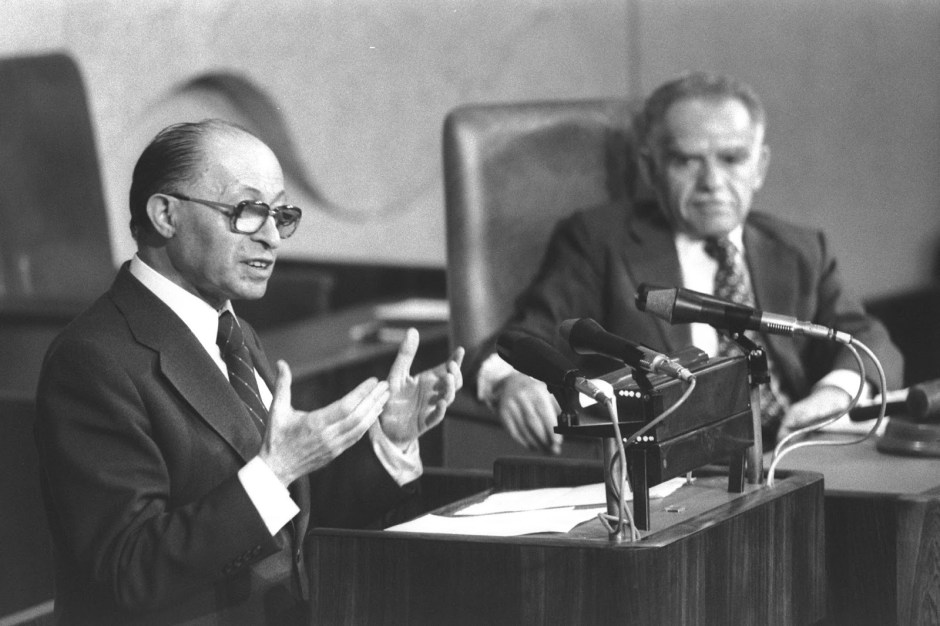
(Israeli Prime Minister Menachem Begin speaking to the Israeli parliament, the Knesset advocating acceptance of the Camp David accords, March 20, 1979.  Future Israeli Prime Minister, Yitzchak Shamir is seated to his right.)

In exploring the creation of the state of Israel over the last 67 years the dominant figure that emerges is David Ben-Gurion.  The head of the Jewish Agency before and after World War II, Ben-Gurion guided the nascent Israeli state and dominated its politics for decades.  However, another transformative figure emerged during the same time period that many outside Israel seem to avoid giving him his due, Menachem Begin.  Whether speaking about Begin’s leadership of the Irgun and the pressure he placed on the British to relinquish its Palestinian mandate; his political leadership that brought about his election to the Prime Minister’s office in 1977 which fundamentally realigned Israeli politics to this day; or his evolution as a terrorist or freedom fighter to a respected politician, depending on your viewpoint, in negotiating the Camp David Accords, the first peace treaty with an Arab state that recognized the state of Israel and altered the balance of power in the Middle East, Begin’s life has left an indelible mark on the Israeli people.  The latest example of Begin’s profound ideological influence on Israel are the recent elections that returned Benjamin Netanyahu to the Prime Minister’s office, leading the Likud bloc that Begin helped create in the 1970s.  The most complete biography of Begin’s life and career is written by Israeli historian, Avi Shilon, MENACHEM BEGIN: A LIFE that mines the Israeli archives and reflects numerous interviews in producing a complete picture of Begin in all aspects of his long career, in addition to providing an interesting analysis that delves into his personality and the motivations for the actions he took.  Daniel Gordis has written the most recent biography of Begin, entitled, MENACHEM BEGIN: THE BATTLE FOR ISRAEL’S SOUL, in which the author admits he is not concerned with all aspects of Begin’s life but “the story he evoked in Jews, of what he said to the world about Jewish history and the Jewish people and the legacy he bequeathed to the state he was instrumental in creating,” as well as looking at his life “through the lens of the passion he still evokes.” (Xiv-xv)  However, Gordis does not come close to Shilon’s book published in English in 2012 in scope and depth of analysis.

The common theme in Shilon’s life of Begin was his pride in being Jewish, a pride that would shape his entire life.  He idealized his father who was a committed Zionist who raised his children with a blend of Jewish tradition and the ideas of Ze’ev Jabotinsky, a leading figure in the movement to establish a Jewish homeland in Palestine.  Begin’s father was his life’s role model as a man living in a Polish village named Brisk, who would use an axe to open a synagogue to allow Theodore Herzl to speak when the head rabbi refused to allow the founder of Zionism to address his congregation.  Further, he would confront anti-Semitic Polish soldiers who almost shot him in front of his son.  Ze’ev-Dov, Begin’s father encouraged his children to go to Palestine and was a model of persistence or stubbornness who would perish along with Begin’s mother and sister in the Holocaust.  Begin’s father stressed the solidarity of the Jewish people and vigorously opposed those who disagreed with him.   Along with his exposure to Judaism as a child, the actions of his father that he witnessed, and the events of the Shoah are all mirrored throughout Begin’s career and the development of his worldview.

(The arrival of Egyptian president, Anwar Sadat in Israel alongside Prime Minister Begin, November 19, 1977)

When discussing Menachem Begin, opinions range from the beloved leader that impacted Israel greatly as a statesman and a man of the people, or a stubborn individual who has authoritarian tendencies with an acerbic tongue and supported violence to achieve his aims.  Shilon comes down between the two extremes as he develops a fascinating portrait of Begin.  From the outset Shilon traces Begin’s ideological roots back to his enrollment in the Beitar Movement that stressed the ideas of Ze’ev Jabotinsky at the age of sixteen.  The movement called on Jews to hold their heads up high, stressed nationalistic issues, and the power of the Jewish people to achieve a future in Israel.  The young Begin was greatly influenced by Jabotinsky, but also Marshall Jozef Pilsudki who led the Polish nationalist movement after World War I, and Guiseppi  Garibaldi, the Italian nationalist who worked to achieve the unification of Italy in the 1860s.  By the time Begin entered his twenties his worldview was formulated as Shilon accurately points out, he “applied Polish nationalistic concepts to his perception of Jewish nationalism – especially regarding the importance of using military means to expand territory – and to this notion he added the spiritual nationalistic anchor – Jewish tradition.” (12)  These themes would be evident in all aspects of Begin’s life’s work.

Shilon’s chronological narrative focuses a great deal on the ideological rifts that developed as Begin worked his way up in the Beitar movement to positions of leadership, the implementation of the Irgun’s war against the British, his time in opposition after the creation of the state of Israel, and his period as Prime Minister.  As Begin rose to prominence in the Beitar movement he would disagree with Jabotinsky in a number of areas, most importantly over the use of terror and cooperation with the British.  During the Irgun years the issue was the application of violence and whether to go along with the Jewish Agency, led by David Ben-Gurion and his strategy.  After independence Begin was adamant about not negotiating with the West German government over reparations as the Holocaust impacted him so severely, and once in power the issue of returning territories won in the 1967 war forced him to change his position of never returning territory that was part of “Eretz Yisroel.”  However, no matter the situation, Shilon credits Begin with his courage and his ability to discern the mood of the public in any decision he made.

(The Beitar Movement that Begin joined at the age of 16, he is seated in the center)

The most controversial part of Begin’s career was his leadership of the Irgun, which the British labeled as a terrorist group before, during, and after World War II.  Begin’s raison detre was to rebel against the British.  At the outset, Begin had no knowledge about leading an underground organization and planning and carrying out operations.  He rose to leadership in the Irgun based on his European background, particularly his training in the Polish army, and his fluency in a number of languages.  As in most cases during his career, Begin let his ideas that many felt were beyond reality, and his oratorical ability to carry the day, and left military planning to experts, a concept that appears over and over during his career.  Begin saw the British refusal to allow Holocaust refugees into Palestine as enough of a reason to declare war on them.  He strongly believed that the British were solely responsible for blocking the creation of the state of Israel.  Begin believed the employment of terror against the British mandate during and after World War II would force them out of the region, buttress the confidence of the Yishuv, damage British prestige, and arouse international public opinion, especially in the United States.  One must ask was terror a successful strategy to accomplish ones goals?  In Bruce Hoffman’s new book ANONYMOUS SOLDIERS: THE STRUGGHLE FOR ISRAEL 1917-1947, the author asks, does terror work?  Based on historical events and the creation of Israel in 1948, his conclusion is that it does.  Shilon does not skirt over the controversial actions taken by the Irgun, the bombing of the King David Hotel, the hanging of the British sergeants, the Deir Yassin massacre, the Altalena Affair, and other events are explored in detail and the author does not hold back any criticism in discussing Begin’s actions.

The contentious relationship and almost hatred between David Ben-Gurion and Begin is a common theme throughout the narrative.  Ben-Gurion always feared Begin’s popularity among the young and wanted to prevent him from gaining any political power.  Shilon points to the fact that Ben-Gurion and Begin shared many characteristics, including a propensity to act in an authoritative manner.  Begin never could accept an Israeli democracy under Ben-Gurion’s control.   For Begin, Ben-Gurion was too secular, and Begin believed in a Hebrew republic that distinguished between the state and religion – a dichotomy that still exists today when one listens to Netanyahu’s repeated call for a “Jewish state.” The integration of the arguments into the narrative between the two in the Knesset and the Israeli media enhances an understanding of the two men as well as providing insights into why they disagreed over policy and their personality differences.  For Begin, religion was the unifying principle of the Jewish people.  For him, the Israeli national concept was based on the Jewish people in its biblical version, and pursuing the military path was a legitimate means to a desired end.

(Israeli Prime Minister, David Ben-Gurion, Begin’s political rival/enemy)

Shilon’s use of primary materials to reflect on Begin’s relationships is important in gaining an accurate view of how he dealt with people.  Begin always respected military men, particularly those he felt were “warriors.”  His relationship with Moshe Dayan, who was a member of the Labour coalition reflects Begin’s ability to compromise when necessary.  His relationship with Ariel Sharon, another military hero is important in addition to his up and down relationship with Ezer Weizmann, an Air Force hero who represented the younger generation that at times would revere Begin because of his background.  In overseeing the dismantling of the Irgun after independence we witness a distraught Begin as he must pursue realpolitik to further his Herut party politically.  The discussions and overt hostility that arises between Begin and his Irgun fighters is important as it reflects the evolution of Begin as a politician and what he sees as the best interests of the Israeli people.

Shilon does an excellent job in analyzing three events that form turning points in Begin’s rise to power in 1977.  The first, in 1952 is his opposition to accepting reparations payment from the West German government, highlighting the impact of the Holocaust in every decision Begin made.  Occurring at a time when his Herut party was in decline it provided a platform for Begin to touch the soul of Israel.  Later in his career when German Chencellor Helmut Schmidt stated on a state visit to Saudi Arabia in 1981 that Germany had a moral obligation toward the Palestinians because it was Germany that was responsible for their plight due to the Holocaust.  An incensed Begin responded at a political rally that, “He is greedy….he seeks two things.  To buy oil cheaply and sell weapons dearly.  He talks about moral obligation to the Arabs?  The obligation to the Jews will never end.” (337)  the second event, the 1967 Six Day War brought Begin into a unity government as a minister without portfolio.  Here the Labour government was following Begin’s approach in dealing with Israeli security and resulted in the capture of the West Bank, or as Begin referred to as Judea and Samaria, Jerusalem, Gaza, the Sinai, and the Golan Heights.  This period of Israeli euphoria is well chronicled and leads to the third event that brings Begin to power, the 1973 Yom Kippur War.  The soul searching that followed the war would lead to the coalition of Herut and two other parties to form the Likud bloc that would produce the election of Begin as Prime Minister in May, 1977.  Shilon’s analysis and questions pertaining to Begin’s rise are valid and thought provoking.
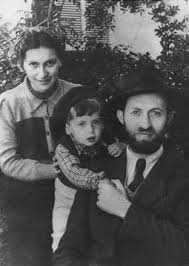
(Begin in disguise as a rabbi during his years underground.  His wife Aliza and daughter Chasia are also pictured)

The final section of the book culminates with a shift in Begin’s approach to foreign policy.  His view was that the Sinai and Golan Heights were not part of the promise land that God gave to the Jewish people, therefore he was willing to negotiate their return.  This would allow him to reduce international pressure over Jerusalem, Judea and Samaria, Gaza, and the settlement program.  This shift in his thinking allowed Begin to go to Camp David and reach an accord with Egyptian president, Anwar Sadat, but being very careful not to give into demands concerning the Palestinians.  For Begin the autonomy agreement that was reached was nothing more than papering over a problem and pushing it into the future when Begin accurately predicted there would be a massive influx of Soviet Jews to Israel alleviating the demographic challenges that Israel faced with the Arabs. Begin’s biggest mistake as Prime Minister was his invasion of southern Lebanon as a means of destroying the Palestine Liberation Organization.  As Robin Wright, the Middle East historian has noted, this became Israel’s Vietnam, and it would take a number of years after Begin retired to extricate itself from.  For Begin the decision to invade Lebanon has been fraught with controversy.  The role of then Defense Minister, Ariel Sharon is at the center of the debate whether he exceeded instructions approved by the Israeli cabinet and pursued his own agenda while keeping Begin in the dark.  According to Shilon, the Prime Minister was “detached from what was happening on the ground,” and though he supported Sharon’s actions, he was culpable for the disasters that followed, including the Shatila and Sabra refugee camp massacre, the increasing Israeli casualty rate, and the eventual emergence of Iranian backed Hezbollah.

Foreign policy was Begin’s bailiwick, and social and economic issues did not create the same interest.  However, he would take advantage of the poverty that recent immigrants from the Arab countries and Ethiopia endured as they tried to assimilate into Israeli society.  He would pit these Sephardic Jews against the ruling Ashkenazis to gain their political support and enhance Likud’s popularity.  Further, he would employ a populist message to gain the support of workers and the middle class to reflect an image of fighting for those who did not benefit from the Labour government’s policies.  Begin would make economic policy pronouncements to assist the poor, but losing interest, he would as he always said, would turn implementation of those policies to the experts.

Shilon’s effort and the excellent translation from Hebrew by Danielle Zilberberg and Yoram Sharett should stand as the preeminent biography of Begin for a great while.  Though at times somewhat wordy, the author has captured the essence of who Begin was, and what his place in history has become.  Today he remains as one of the most popular figures in Israeli history and if Bruce Hoffman is to be believed Begin showed that the use of terror in certain situations can be successful, and that even a rigid ideologue can evolve and have a positive impact on his people.
CHICKENHAWK by Robert Mason

(Bell AH-1 Cobra)

One of the most iconic sounds that people relate to the Vietnam War is the “womp, woosh” of American Huey helicopters.  Whether watching a film like Apocalypse Now or reading a book on the war those sounds will reverberate in the reader’s mind.  During the war about 12,000 helicopters were deployed by the United States military.  Of that number 7,013 were Hueys, almost all of which were US Army.  The total number of helicopter pilots killed in Vietnam was 2202, and total non-pilot crew members who died were 2704.  The most accurate estimate of the number of helicopter pilots who served in the war was roughly 40,000. (www.vhpa.org/heliloss.pdf)  As we think about these statistics we can only admire the bravery and fortitude of the men called upon to undertake the many diverse missions these pilots engaged in.  One of the pilots, Robert Mason has written one of the most important accounts of the war available in his memoir, CHICKENHAWK.  Mason’s account is probably one of the most accurate and realistic accounts we have about the American serviceman’s experience in Vietnam.  From the vantage point of a helicopter pilot, Mason explores his daily life during his tour of duty.  Mason’s approach to his memoir is simple, clear, and honest.  As he completes basic training, advanced individual training, and two attempts at passing preflight training, he comments that he never “suspected that the army taught people how to fly helicopters the same way they taught them to march and shoot.  But they did.” (23)  He realized early on that if you washed out of the flight program you would wind up as a PFC in the infantry.  Mason’s journey begins in 1964 and carries him through 1968, a time when the United States, under President Lyndon B. Johnson was ramping up the American commitment to save South Vietnam from communism.  Mason’s insights echo those of historians that were written years later.  Mason’s memoir was first published in 1983, and was reissued in 2005 with a new afterword describing how the war affected his life for decades following his service.

06 Returning Fire

(American “slick” with a machine gun mount)

Mason’s experience in Vietnam was much diversified. Even as a warrant officer he engaged in the activities of a typical grunt rooting out tree stumps, digging fox holes, filling sand bags, and building a perimeter for his assault division.  Mason’s primary activity was flying a Huey helicopter that involved him in support of troops in the Bon Song Valley and Ia Drang Valley where in November, 1965 the United States won its first large scale encounter with the North Vietnamese.  Though it appeared to be a victory, Mason questions what American strategy was as we killed the enemy at an increasing rate, but we would withdraw and not hold the land taken.  Mason points out repeatedly, that later American troops would fight to retake the same territory as it had won earlier, but at an increasing cost for the United States.  Mason’s buddy, Connors summed it up well, “Why the fuck don’t they keep some troops out there.  This is like trying to plug fifty leaks with one finger.” (351)  This is not the only thing that Mason questions.  He did some reading before he went to Vietnam, Bernard Fall’s Street without Victory having had the most impact on him as it describes the political situation in South Vietnam, the corruption of the Saigon regime, and the lack of commitment on the part of the South Vietnamese peasants who just wanted to till their own soil.  The poor training and refusal to fight on the part of the ARVN (South Vietnamese army), the fear in the eyes of South Vietnamese he came in contact with bothered Mason a great deal.  The resentment between ARVN and American officers was readily apparent.   At times when ferrying ARVN troops to a landing zone Mason had to be careful that once on the ground they would not turn and fire on his Huey.  For Mason, there were many times that he questioned why he was in Vietnam.

14 My Chair

(the author in Dak To during his tour)

In exploring the Vietnam War from the lens of a Huey pilot the reader will experience with Mason a myriad of situations. Mason provides an excellent description of how he learned how to fly helicopters.  He also provides a useful amount of technical information about the problems that pilots faced and how they could maneuver their Hueys out of many tough situations.   He engaged in spraying defoliants to eliminate ground cover for the VC (Viet Cong, South Vietnamese communists), not knowing what havoc these chemicals would reap in the future.  Mason’s primary activities centered on transporting troops, wounded, and bodies to and from the battlefield, but he was also involved with relocating refuges, to training missions, as a mail courier, to picking up and delivering supplies to combat areas and rear compounds.  But there were other missions of importance, the pickup and delivery of tons of ice so the officer’s club would be stocked and if any was not needed it would be traded for appliances from other units.  Further, the transport of small groups of officers on their own “secret” missions, as well as using the Hueys to visit friends a hundred miles away.  Some of these tasks were obviously would not be considered “militarily relevant,” but to maintain the sanity of people who have flown over 1000 missions they were none the less very important.

18 Preacher Camp

(the author walking along a trench by his, as he calls it, “spiffy digs”)

Throughout the narrative Mason supplies the reader the historical context of what was occurring on the ground in Vietnam.  The intensity of Mason’s descriptions of his flights and what he observed provides the reader the feel and the smell of war.  Supply shortages were constant in his unit, particularly chest armor that was a necessity for Huey pilots.  Mason highlights it further after he transfers to another unit that is overflowing in chest armor.  A recurrent them is the weakness of American intelligence, provoking Connors to comment after a fire fight that “the intelligence branch must have read their maps upside down, [and was] getting its information from smuggled Chinese fortune cookies.” (146)  Early on Mason was led to believe the reason the French had been forced out of Vietnam was because they weren’t “air mobile.”  Once the American Air Cavalry arrived it was supposed to change the course of the war.  For Mason at times he believed the United States was winning, then doubts would creep in based on his experiences in combat.  It led to a discussion with  his co-pilot, Gary Resler as they tried to determine their attitude toward the war; where they afraid or “chicken,” or after seeing the constant pile of dead American bodies they wanted revenge, making them “hawks.” Their conclusion was a combination of the two, hence, they were “chickenhawks.”

17 Washing Out the Blood

(Cleaning the chopper from the blood and other aspects of war)

Mason provides the reader insights to his thinking about his personal feelings.  He left his wife, Patience, and young son, Jack in the United States, and he integrates his personal letters to his family throughout the narrative.  His feelings of guilt are present as he is honest about his activities during R & R in Saigon, Taipei, and Hong Kong.  It should be obvious that Mason suffered from PTSD before he left Vietnam.  Constant nightmares, anxiety, and fear centered on the murder of VC prisoners, the use of napalm and the damage it caused, and the casualties he witnessed drove him to use medication after his missions in order to complete his tour of duty.  In addition, he pours his heart out about what he witnesses and cannot cope with.  Chickenhawk, though written over twenty years ago provides lessons for future soldiers, and it is an exceptional Vietnam memoir that has stood the test of time.

GAZA: A HISTORY by Jean-Pierre Filiu

(Explosions from Israeli air strikes over Gaza City this past summer during the Hamas-Israel War of 2014)

Last week newly reelected Israeli Prime Minister Benjamin Netanyahu backtracked from his election eve statement that he opposed a two-state solution for the Israeli-Palestinian conflict.  Though he seems to have walked back that statement because of American pressure the issue still remains, will there be any movement toward a dialogue for peace between the Israelis and Palestinians in the near future?  At this juncture the answer appears to be a resounding no.  In the absence of a clear diplomatic path it is useful to explore a major component to any future deal.  In 2005, then Israeli Prime Minister, Ariel Sharon disappointed his right wing Likud Party partners and set forth a unilateral Israeli withdrawal from the Gaza Strip.  Tired of the cycle of violence with terrorist attacks and counter-terrorist reprisals, Sharon decided it was not worth the cost of maintaining an area that is 139 square miles (the same as Detroit) with a population of about 1.8 million Palestinians.

As Palestinian politics have evolved over the last ten years Hamas, seen as a Moslem extremist party and terrorists by both the United States and Israel, assumed power over Gaza, and the “more moderate” Palestinian Authority is in charge of administering the West Bank.  This situation came about through a bloody civil war between the two parties and the electoral process.   On January 25, 2006 the Hamas Party won the Palestinian legislative election resulting in the nomination of Hamas leader, Ismail Haniyeh as Prime Minister within a Palestinian National unity government with Fatah, the largest Palestinian political party.  This unity dissipated quickly when Hamas and Fatah effectively engaged in a civil war, the results of which have left two separate ruling bodies in the Palestinian territories.  In recent years, of the two territories, the Palestinians in Gaza have suffered the most.  Last summer, in what seems to be a bi-annual war between Israel and Hamas resulted in the death of over 2100 Palestinians and 73 Israelis.  The causes of the war center on Hamas’ frustration at its lack of progress in achieving a Palestinian state, and the belief that they had nothing to lose by launching missiles into Israel to provoke an invasion.  The background for these events are explored in Jean-Pierre Filiu’s new book GAZA: A HISTORY, a comprehensive study of Gaza from roughly 18th century BC to the end of 2011.  The book is important because it fills a gap on the literature pertaining to Gaza since most Middle East scholarship tends to focus on the endless attempts to solve the Israeli-Palestinian conflict.  In addition, the book provides a useful guide to events that led to the carnage of last summer.

The author summarizes the early history of Gaza and what becomes clear from at least the12th century BC is that the region is repeatedly conquered by external forces.  Be it the Assyrians, Babylonians, Persians, Romans, Byzantines, Crusaders, Mongols, Mamelukes, Ottomans, French, British, and eventually Israelis, Gazans were rarely in charge of their own destiny.  They would be forced to believe in paganism, Christianity and finally Islam.  Important historical figures are presented from Alexander the Great, Salah ad-Din, Gamal Nasser, to present day politicians all of which possess their own agendas that did not necessarily bode well for Gaza.  According to Filiu Theodore Herzl and his early 20th century Zionist movement did not consider Gaza as part of the land of Israel as Gaza’s land owners refused to provide the Jews land purchases the way the Arabs had in central Palestine, thereby limiting any Jewish incursion into Gaza.  From that point on Filiu reviews the history of the region exploring the diplomacy of World War I, the 1929 Arab riots, the Arab rebellion of 1936, and the effect of World War II on the area.  In addition he does a good job discussing the dynastic rivalries that existed among Palestinians throughout the period and their impact on Gaza.  In doing so Filiu forgets to explore the 1939 British White Paper, I believe in part because it doesn’t necessarily support his Palestinian bias that is present in many of the areas that he explores. Once the narrative approaches the creation of the state of Israel in 1948 Filiu zeros in on the Israeli-Palestinian conflict which makes up over three-quarters of the narrative.

(The Israeli Iron Dome Missile Shield developed by Israel.  It was employed last summer to protect Israel from the thousands of Hamas rocket launches.)

Filiu spends an inordinate amount of time describing what seems to be each and every act of terror and counter-terror committed by both sides in the conflict.  I understand the importance of many of these actions and counter-actions but at times it becomes tedious and can overwhelm the reader with detail.  Of course, many of these attacks lead to changes in policy or military action, particularly by the Israelis but it would benefit the reader if this could be condensed and the author could concentrate more on analysis of events rather than direct reporting of who died, how many died, and who survived.  The horror of the plight of the Palestinian refugees cannot be denied, and Filiu does a superb job providing the reader with an understanding of their plight.  Discussions of the life and politics in the Kan Younes, Jabaliya, Rafah, Nuseirat, Bureji, and Deir al-Balah camps are important because from these camps the varying leadership and shock troops of the militant Palestinian groups emerge.

Perhaps the most interesting aspect of the book is Filiu’s description of the rise of Yassir Arafat to leadership of the Palestine Liberation Organization and Fatah, its political wing in 1964.  The author follows the evolution of Arafat as a “freedom fighter/terrorist” who is faced with increasing opposition from other Palestinian elements as the history of the region evolves from Israeli “punishment” of Gaza for attacks on its settlements to outright war.  We witness an Arafat who must balance himself between the many Palestinian factions that emerge over the years and by 1990 he begins to engage in the diplomatic process with Israel and the United States leading to the Oslo Accords in 1993 and the failure of the Camp David talks in 2000.  Next to Arafat, the man who receives the most attention from the author is Sheik Ahmed Yassin who became the leader of the Moslem Brotherhood in Gaza in 1966.  Later, in 1973 he would set up an organization called the Mujamma designed to meet the social service and educational needs of the Palestinians in Gaza.  In response to the 1987 Intifada of the younger generation of Palestinians against Israel he founded Hamas (the Movement of Islamic Resistance).  It is here that Filiu does his best work as he describes the ideological differences between the various groups that vie to represent the Palestinians.  He explores the ideologies and strategies that Fatah, the Muslim Brotherhood (that eventually evolves into Hamas), Islamic Jihad, and the Popular Front for the Liberation of Palestine in detail, and how they hope to achieve Israeli withdrawal from Gaza, and explains the reasons Hamas emerged as the dominant force in Gaza today.

(Destruction in Gaza caused by the Israeli invasion)

The importance of Filiu’s work lies in his discussion of the escalation of violence that took place in 2001 as Hamas and its allies expanded their attacks from targeting Israeli settlements inside Gaza to the territory of Israel itself.  This would lead to Israel’s application of an “iron fist” in response and a cycle of violence that would continue until Israel’s withdrawal from Gaza in 2006.  Hamas would launch its first home made Qassam rockets, employ its first female suicide bombers, and reject all calls to demilitarize the second Intifada.  Throughout the period not a day went by when there wasn’t an assassination, air strikes, suicide bombings, or destruction of Gaza’s homes and infrastructure.  By 2006, Hamas’ strategy concerning elections would change by first running in municipal elections, then parliamentary contests which in the end brought them to political power. However, instead of using their victory as a positive force they engaged in a fratricidal war with Fatah.  But as Donald Macintyre suggests in the The Independent it would have been interesting if Filiu provided greater analysis of these events and the actions of the Bush administration, as well as the lack of action by the European Union as they sabotaged any chance of an international agreement with Hamas by the policies they pursued. (The Independent, September 11, 2014)  What is even more troubling than missing an opportunity after the election of 2006 to pursue some sort of diplomatic demarche, is the author’s description of the fighting between Hamas and Fatah between 2006 and 2011 that can only be characterized as savage.  Further this brutality was taking place at the same time as Israel pursued “Operation Cast Lead,” its punishment of Gaza for the militant’s seizure of Gilad Shalit, a nineteen year old Israeli soldier on June 25, 2006.

Earlier I mentioned that Filiu at times is not totally objective in his presentation.  A few cases in point; in discussing casualties in various attacks and counter attacks, the author provides minute details of Palestinians and then glosses over Israeli casualties.  The reader is presented with the Grand Mufti, Hajj Amin al-Husani as a leader of the Palestinian people, but Filiu skirts over his alliance with Nazi Germany during the war, and his work to help Nazis accused in the Holocaust to escape to the Middle East.*  In discussing the outbreak of the Suez War, Filiu makes it appear that Nasser nationalized the Suez Canal in response to the Israeli assassination of his intelligence chief.  In point of fact, Nasser’s anger was due to the withdrawal of the Aswan loan guarantee by the United States, their refusal to sell him weapons to counter Israeli attacks, and their policy of trying to create a Middle East Defense Organization geared against the Soviet Union.  In 1967, the author suggests that Nasser ordered the UN forces out of Sharm el-Sheik to take Arab pressure off of him for restraining Fedayeen attacks against Israel.  In fact the Russians kept feeding Egypt information about the coming Israeli attack and that he should take action.  Perhaps as Isabella Ginor and Gideon Remez suggest in FOXBATS OVER DIMONA, the Soviets wanted to provoke a war in order for them to interfere in support of the Arabs and destroy the Israeli nuclear reactor in the Negev Desert.  In discussing the Yom Kippur War he emphasizes the “air bridge that brought in supplies provided by the United States” to Israel, but makes no mention of the “air bridge” that the Soviets provided the Arabs.  Perhaps Professor Filiu should have explored Nasser’s true feelings about the Palestinians, who behind closed doors was repeatedly heard to make derogatory remarks describing them.  In his discussion of the outbreak of the 1987 Intifada, the author should explain the demographic and financial inequalities in the Arab world that in part led to the outbreak of violence, and perhaps mention that though Arafat took credit for the revolt, it caught him by surprise just as it had the Israelis.  I find the documentation that Filiu uses rather selective at times, concentrating on United Nations Documents and mostly pro-Arab secondary sources.  I am not suggesting these sources are wrong, however one should employ a myriad of sources to assure objectivity.

(Hamas tunnel complex used to smuggle materials into Gaza and fight against Israel)

(Israeli soldier discovers Hamas tunnel opening during the fighting last summer)

Despite these flaws Filiu has prepared a remarkable book that fills the historiographical gap that is apparent with the paucity of historical monographs that examine Gaza.  I would hope that the author would prepare an updated edition of the book that carries his story through the events that led to the Hamas-Israel war of last summer, and the horrifying result for the people of Gaza, as opposed to Hamas’ leadership, that appears to have emerged unscathed.

  • See Rubin, Barry; Schwanitz, Wolfgang G. Nazis, Islamists, and the Making of the Modern Middle East. New Haven: Yale University Press, 2014.