THE SAMARITAN’S SECRET by Matt Benyon Rees

(The city of Nablus on the West Bank)

Matt Benyon Rees’ third installment in his Omar Yussef mysteries, THE SAMARITAN’S SECRET, attains the same level of character development, stimulating plot line, and insight into the political and social conditions that form the basis of the Palestinian-Israeli conflict as his first two novels in the series.  The story begins in the city of Nablus, located on the West Bank, which was captured by Israel in the 1967 Six Day War.  Nablus remained under Israeli occupation until it was returned to the Palestinian Authority, which has governed it since 1995.  Nablus has been a hotbed of radical Palestinian nationalism, with a strong Hamas presence which continued even after it split with the Palestinian Authority in 2006.  For the Palestinians, even after it was granted autonomy it still felt like they were being occupied by the Israeli army with its numerous checkpoints that had to be navigated on a daily basis.

The Samaritan's Secret (Omar Yussef Series #3)

Omar Yussef, a fifty-seven year old, physically unfit history teacher in the Dehaisha refugee camp travels to Nablus to attend the wedding of his friend Lieutenant Sami Jaffari, a Nablus policeman when a robbery is reported at the Samaratin synagogue, a repository for the religious sect’s historical documents.  The Samaritans claimed to be descendants from the biblical Israelites and remained in Nablus after many of their brethren were exiled to Babylon.  While investigating the break-in, which they learn had already been solved, a murder is reported on Mount Terzim, near the Samaritan temple.  It turns out that the murder victim, Ishaq was the son of Jibril Ben-Tabia, the head priest of the Samaritan people.  The victim also worked for the Palestinian Authority as the unofficial advisor for the deceased “old man,” a.k.a Yasir Arafat.  When in power, Arafat’s financial policy was remarkably medieval, based on the head of the Palestinian Authority doling out funds as he saw fit.  It was a corrupt system that members of the younger Palestinian generation and radical elements within the community vehemently opposed, as they hoped to install modern financial institutions once Israel granted them total independence.  After Arafat’s death, Ishaq went to work for Amin Kannan, one of the richest men in Arab Palestine.

Hamas politics permeate the novel.  For example, a wedding was planned for fifteen couples which would allow a radical sheik to address the guests.  In reality this was nothing more than a political rally to spread Hamas’ propaganda. Further, the corrupt political establishment of Nablus had far reaching tentacles and Lt. Jaffari feared if he continued his investigation into Ishaq’s murder he might be returned to Gaza, where he was once exiled.  Jaffari also feared that his fiancé, Meisour would be denied the necessary papers to travel from Gaza for their wedding.  With Jaffari’s reticence to follow leads it fell to Omar Yussef to figure out why Ishaq was murdered, and who was behind it.

Rees does a commendable job exploring the political and economic realities that pervade the city of Nablus and other towns under the auspices of the Palestinian Authority.  The role of radical clerics, Hamas, and the Israeli army are all major factors in the everyday life of the Palestinian people, and the author integrates them throughout the novel.  But for the Palestinians, the corruption endemic to the Arafat regime comes home to roost as the World Bank threatens to cut off aid unless millions of dollars that Arafat dispersed was not recovered- as the money was geared toward building hospitals, schools, and infrastructure projects.  To protect the future Palestinian state, the money had to be found.

The Palestinian Authority-Hamas civil war keeps resurfacing as the story unfolds and what seems obvious at certain point’s turns out to be totally untrue.  Rees is a master story teller and has an excellent feel for the plight of the Palestinian people.  He has written a crime mystery, but in reality it is a window into what is truly the historical tragedy of the Palestinian people.

(Nablus, the commercial center of the West Bank)

UNITED STATES OF JIHAD: INVESTIGATING AMERICA’S HOMEGROWN TERRORISTS by Peter Bergen


United States of Jihad: Investigating America's Homegrown Terrorists

(Among the topics discussed by Mr. Bergen is the Boston Marathon, April, 2013)

Peter Bergen, prolific author, and CNN national security analyst has written a number of important books dealing with terrorism.  They include monographs on Osama Bin-Laden and three others which were New York Times best sellers.  His latest work UNITED STATES OF JIHAD: INVESTIGATING AMERICA’S HOMEGROWN TERRORISTS is an important addition to two other recent books, Scott Shane’s OPERATION TROY and Charlie Savage’s POWER WARS: INSIDE OBAMA’S POST 9/11 PRESIDENCY.  Bergen builds on the work of these authors in trying to explain why American citizens have engaged in treason against their country by engaging in, or planning acts of terrorism.  Bergen further explores how American institutions and the Moslem community have responded to the terror threat and how this threat on American soil has changed us.  One could argue that Bergen’s book is a who’s who of American jihadism, beginning with the Muslim cleric Anwar al-Awlaki, Omar Hamami who grew up in Alabama and fought for al-Shabaab in Somalia, David Coleman Headley who helped plan and carry out the Mumbai massacre, and numerous others.

Bergen concentrates on the 330 militants who have been arrested and charged with terrorism crimes in the United States, 80% of which are American citizens or legal permanent residents.  He argues that they appear to be as average, well educated, and emotionally stable as typical Americans.  According to Bergen their average age is 29, more than a third are married – many with children, and one out of six are women.  There is nothing particularly special about them as they are just ordinary people.  If this is so, then why have so many engaged in terrorism, and why is the “home grown” threat a major source of concern in the intelligence community?  Bergen argues forcefully that it is due to a number of criteria.  First, Moslem outrage at United States foreign policy in the Middle East is a dominant theme.  Anger about American wars in Iraq, Afghanistan, American drone strikes in Yemen causing tremendous collateral damage, the bombing of Syria, and U.S. support for Israel all contribute to this feeling.  Secondly, jihadism offers people an opportunity to be somebody, and at the same time belong to something bigger than themselves. What is interesting about this threat to the American homeland is that since 9/11, 45 Americans have been killed by Islamic terrorists, but at the same time 48 Americans have been killed by right wing extremists.

(Anwar al-Awlaki, American born Islamic cleric, October 4, 2001)

Bergen examines a wide range of terrorists who originated on American soil drawing on his vast network of sources in the intelligence world.  He argues that most are second generation immigrants who did not start out as observant Muslims.  However, once they became devout they often left their mosques because what was being preached was not radical enough.  In addition, they would congregate with like-minded individuals and bond by watching jihadi videos, and simulate combat by playing “paint-ball.”  Bonding activities are extremely important in creating a jihadist community with an ultra-fundamentalist outlook. Bergen also dispels a number of myths in dealing with his subject by arguing that most of these jihadist had no formal links to outside terror organizations, further most terrorists began their education in a secular environment, not madrassas.  In reviewing their studies it is clear that there is a strong link between their technical education and their terrorist activities, as 50% of them attended college.  Overall, social bonds between jihadists were more important than ideology.

In presenting his thesis Bergen explores the activities of numerous terrorists, many of which are known to those who follow the news.  The individual who takes up more time than any other is the American born cleric Anwar al-Awlaki who was the mentor to Umar Farouk Abdulmutallab, the “underwear bomber” who tried to take down a Northwest Airliner over Detroit Christmas day, 2009.  Awlaki is also linked to Nidal Hassan, the Fort Hood killer and numerous others.  Awlaki stands out as a sophisticated individual who used his American upbringing and cultural knowledge with his social media savvy to recruit jihadist in the United States and eventually was killed by an American drone in Yemen authorized by President Obama which had sparked an intense debate as to whether it was legal for the United States government to assassinate one of its citizens.  Scott Shane’s book explores this controversy in greater detail than Bergen, but the author does a good job summarizing the most salient points in the debate and points out that “t follow the trail of Awlaki’s influence is to trace the post 9-11 evolution in evolving Americans.”  Of the 330 jihadists charged or convicted in the United States, more than 80 had Awlakis writing and sermons in their possession, and another 7 more corresponded with him or traveled to Yemen to meet him.

(Tsarnaev brothers at the Boston Marathon, April, 2013)

Bergen labels these American terrorists as “lone wolves.”  One of these individuals described is Carl Bledsoe, a native of Memphis, TN who was self-radicalized and wound up killing one marine and wounding another at a marine recruiting center in Little Rock, AK on June 1, 2009.  He follows this with an in depth exploration of the motivations and actions of Major Nidal Hassan, a military psychiatrist whose conversion to fundamentalism differed from Bledsoe in that he was already a Muslim.  But their radical journey had many similarities including their gradual isolation from their families, preoccupation with piety, and what was considered to be a true Muslim.  They both embraced Salafist ideas and practices as do most jihadists, and as they looked at US foreign policy they became obsessed with the idea of Jihad to defend Islam.

26/11: How terror struck Mumbai
The gruesome terror attacks began on 26th November and continued till 29th November, where Indian security services killed 9 out of 10 terrorists and captured Ajmal Amir Kasab, alive to regain control of South Mumbai terror sites i.e. the Leopold Café, the Chhatrapati Shivaji Terminus, the Taj Mahal, the Oberoi & Trident, Cama Hospital and Nariman House.(AP photo)
26/11: How terror struck Mumbai
Mumbai was witnessing one of the worst terrorist attacks in the history of India. Leopold Cafe in Colaba was attacked first when five terrorists opened fire at the cafe.(AFP photo)
26/11: How terror struck Mumbai
The attack left behind indelible scars… bullet marks on the walls and counter; the mirrors broken; doors with holes and a mini-crater on the marbled floor, caused by the grenade attack.(AFP photo)
26/11: How terror struck Mumbai
This was perhaps one of the most heartbreaking scenes for any Mumbaikar. Images tell the story of the barbaric assault by terrorists who held the Taj Mahal hotel to ransom for 58 hours.(AFP photo)
26/11: How terror struck Mumbai


Bergen reviews the close calls that have occurred since 9-11 discussing the case of Najibullah Zazi, who along with two others tried to replicate the London underground bombing of 2005 on the New York City subway system.  He was thwarted by the FBI after receiving a tip from the British intelligence.  Another case is that of Faisal Shazad, who drove a bomb laden van into Times Square in Manhattan on May 1, 2010.  Trained by the Pakistani Taliban, the bomb did not explode due to poor components.  The focal point was not any intelligence, but US drones over Pakistan that did not allow for sufficient training.  The key for Bergen is that these individuals fit the profile he discusses which was also accepted by American intelligence analysts.  But in fairness to law enforcement, Bergen points out the difficulties in tracking lone wolves.

(arrest of Najibullah Zazi who attempted to set of a bomb in Times Square, Manhattan on May 1, 2010)

One of the most interesting aspects of the book is how the Obama administration has approached the domestic terror threat.  Soon after the failure of the “underwear bomber” over Detroit, President Obama ordered a vast increase in the use of drones and NSA surveillance programs, the most controversial of which was the bulk collection of American telephone Meta data.  After the Edward Snowden fiasco this program was rolled back and Bergen argues it had little effect on preventing terrorism and traditional approaches to intelligence were more reliable.  Today, Republican presidential candidates describe Obama’s approach to the war on terror as rather feckless, however if one examines his role as commander and chief one sees a continued involvement in Afghanistan and Iraq, and a marked increase in the use of drones as compared to the Bush administration.  According to conservative estimates, by the end of 2015 the Obama administration had presided over the killing between 3-4,000 people in drone strikes in Pakistan and Yemen. Bergen aptly summarizes his view as Obama dryly remarked, “Turns out I’m really good at killing people.”  Didn’t know that was going to be a strong suit of mine.”  If you are interested in an in depth analysis of Obama administration practices and their legalities consult Charlie Savage’s POWER WARS.

Another important aspect of Bergen’s narrative is the approach taken by American intelligence agencies.  We witness the development of the NYPD’s separate intelligence department that is almost up to par with the CIA and FBI.  We also witness the continued issue of sharing intelligence and acting in concert for the greater good of the American people.  The major change in the FBI’s approach to terrorism after 9/11 would be its transformation from a crime solving organization into entities whose primary mission was to prevent terrorist attacks.  The NYPD’s creation of a separate intelligence component allowed it to pursue a similar approach.  Over the last decade and a half over 15,000 informants have been employed, and numerous sting operations of suspected terrorists designed to root out terror plots, but this has resulted in an increasing number of complaints of entrapment.  In addition, in 2004 the National Counterterrorism Center was created to connect “the dots” between all intelligence agencies.  Bergen provides an astute analysis of American intelligence policies including their concrete successes, ”near misses,” and failures, including a useful chapter on the Tsarnaev brothers who were responsible for the Boston Marathon bombing in April, 2013.

Bergen correctly arguing that the older of the brothers, Tamerlan fit the NYPD terror profile and radicalized his younger brother, Jahar who was extremely secular and Americanized.  The bombing could have been prevented if not for another case of missed signals, and of a lack of communication between U.S. law enforcement agencies.  If FBI allegations are correct, Tamerlan was involved in a triple murder in Waltham, MA in 2011 and was a dangerous killer long before April, 2013; one must ask how did he not appear on the “no-fly list,” particularly after warnings from Russian intelligence in 2011? Tamerlan would fly to Dagestan in the Caucasus and try and join the Union of the Just, an anti-American Islamist group to fight the Russians, as well as attending Salafist mosque.  By his return to the United States in July, 2012 Tamerlan was fully radicalized.  Both Tamerlan and Jahar came to believe that 9/11 was engineered by the US government to create mass hatred of Muslims.   With these beliefs, it is not surprising they carried out their attack.

The rise of ISIS is not explored until the final chapter of the book.  Here Bergen reviews and synthesizes much of the material that has been presented by Joby Warrick, Michael McCants, Jessica Stern, J.M. Berger, Michael Weiss, and Hassan Hassan.  The use of social media and the virtual world has allowed ISIS to be the next generation of al-Qaeda and attract over 30,000 foreign fighters and claim to have established a caliphate, successes that Osama Bin-Laden could never fathom because of his world view.  Bergen dissects American fears of an ISIS attack in the United States, and despite what occurred in San Bernardino he correctly argues that “lone wolf” attacks are a threat, but they are a minimal threat because of the safeguards that have been put in place.  We must realize that we can never be 100% secure and that there always will be a low level threat in the United States for years to come.   But as Bergen shows in his closing argument, presenting the wife of a murdered victim of the Fort Hood massacre, and her support of an organization created by Nidal Hassan’s cousin to foment better understanding and relationships between Muslim and non-Muslim Americans, there are many ways to fight terrorism.  Bergen has written another excellent book that should be read by all who want to try and understand the problems that contribute to the enlistment of jihadists in America and how that has changed our country.

(Boston Marathon Bombing, April, 2013)

OPERATION THUNDERBOLT: FLIGHT 139 AND THE RAID ON ENTEBBE AIRPORT, THE MOST AUDACIOUS HOSTAGE RESCUE MISSION IN HISTORY by Saul David

(Well wishers at Ben-Gurion Airport to welcome the return of hostages from Entebbe)

After recent events in Paris and San Bernardino the world’s heightened awareness of possible terrorist attacks has been raised ever further.  We have all heard about failed attempts to blow up airplanes by the “shoe bomber,” and the “underwear bomber,” and of course 9/11.  We live in a world where fears of flying have increased, but it is not a unique feeling as is evidenced by Saul David’s new book OPERATION THUNDERBOLT: FLIGHT 139 AND THE RAID ON ENTEBBE AIRPORT, THE MOST AUDACIOUS HOSTAGE RESCUE MISSION IN HISTORY that recounts the hijacking of Air France’s Flight 139 on June 27, 1976 originating in Tel Aviv, with a stopover in Athens and a final destination in Paris.  The flight spawned the Israeli rescue of 102 people out of an original total of 253 passengers and flight crew after the plane was diverted from Athens, where the hijackers boarded and forced the pilots to fly to Benghazi, Libya before proceeding to Entebbe Airport outside Kampala, Uganda.  The reader should remember that the hijacking of Flight 139 was not an isolated event as the 1970s witnessed terror attacks across Britain and Ireland, as well as those related to the Middle East and Africa.   At the time Uganda was led by the dictator Dr. Idi Amin Dada, a former paratrooper in the British army, who had come to power by a coup in 1971, and was in cahoots with the hijackers.    Like today, the passengers of Flight 139 were quite aware of a possible terrorist attack if the plane stopped in Athens, but like most, they threw caution to the wind resulting in the Israeli raid and the death of four of the hostages, one Israeli commando, Yoni Netanyahu, the brother of current Israeli Prime Minister Benjamin Netanyahu, 45 Ugandan soldiers and the hijackers.

(Defense Minister Shimon Peres congratulating Israeli Defense Force members for their successful raid)

The plane was seized by an offshoot of the Popular Front for the Liberation of Palestine (PFLP), a group that had pioneered the hijacking of airplanes as a means of striking Israel, which did not bode well for a passenger list dominated by Jews and Israelis. David present a day by day, and at times, hour by hour description of the hijacking allowing the reader to enter the mindset of the passengers as the plane was seized, flown to Entebbe, and their incarceration in the old terminal at the airport.  We witness the feelings and emotions of the hostages as they were separated by Jews/Israelis and others, and as they dealt with the release of 40 hostages, then another 100 or so, leaving just Jews and Israelis to face their fate.  The hostages go through many highs and lows during their detention and David provides many insights into how they tried to cope with their situation.  David takes the reader inside the Israeli government as they debated their response to terrorist demands for the release of 53 prisoners, 40 of which were held in Israel and other countries.  What emerges is a major disagreement between Israeli Prime Minister Yitzhak Rabin, who favored negotiations with the terrorists if a military response was not available, and Defense Minister Shimon Peres, who advocated for a rescue mission and no negotiations.  Rabin was placed in a quandary because he wanted to limit concessions but there was a precedent for a prisoner swap dating back to the Yom Kippur War when Israel traded imprisoned terrorists for Israeli war corpses.  Feeling the pressure of the hostage’s families, how could Israel not trade prisoners for people that were alive?

(Lt. Colonel Yoni Netanyahu, the brother of current Israeli Prime Minister, Benjamin Netanyahu, who was killed leading the raid on Entebbe)

David presents a detailed description of how the Israeli intelligence community and military ferreted out information and went about planning the rescue mission.  We meet a number of important characters led by Major Muki Bester, the head of Sayeret Matkal (the Unit), Israel’s most efficient reconnaissance unit that had previously trained Ugandan soldiers, Yoni Netanyahu, the Unit commander, Brigadier-General Dan Shomron, one of the major architects of the rescue, Lieutenant-Colonel Ehud Barak, another Unit commander and future Prime Minister of Israel among numerous others.  The major problem that military planners faced was refueling.  The Hercules C-130 airplanes needed to refuel because of the distance between Israel and Kampala, in addition, the weight of equipment and soldiers made it impossible for the planes to fly roundtrip.  After a few tense days, the Kenyan government agreed to allow the Israeli planes to refuel in Nairobi because the Mossad, Israel’s intelligence arm had foiled an attempted shoot down of an El Al airliner over Nairobi Airport, and their desire to get even with Amin who was smuggling weapons across the Kenyan-Ugandan border.  The key to the crisis came on July 2 when Amin, who enjoyed the attention, announced that the deadline for a decision regarding the prisoner swap would be extended three days while he chaired a meeting of the Organization of African Unity in Mauritius.  This gave the Israeli military a window to plan, train, and implement a rescue attempt.

(Ugandan dictator, Dr. Idi Amin Dada, who cooperated with the Palestinian and German hijackers)

David provides an almost minute by minute account of the raid from takeoff in Sharm el-Sheik at Israel’s southern tip all the way to Entebbe.  As the first Hercules landed things did not go as planned as Netanyahu insisted on taking out two Ugandan sentries, thus forgoing the element of surprise. However, the IDF was able to improvise, and in the end the raid was an overall success.  All the terrorists were killed, as were numerous Ugandan soldiers, but with five casualties, including a number of wounded.  Once the hostages were secure as part of their agreement with the Kenyan government the Israelis destroyed 11 Soviet Migs of the Ugandan air force parked in front of the old terminal as a concession to the Kenyan government for its cooperation.  Once the planes landed in Nairobi, they were refueled and the wounded were taken care of.  David provides an aftermath explaining to the reader some of the interesting ramifications of the rescue operation.  As one could have been expected the United Nations condemned Zionist aggression.  Idi Amin had Dora Bloch, an elderly hostage who had been hospitalized and was not freed, was murdered by Amin in an act of revenge.  The French worried about their position in Africa and the Arab world remained very subdued in its public statements following the operation.  Idi Amin was overthrown in 1979 and was provided with a “golden parachute” by the Saudi Arabian government.  Lastly, and most importantly it showed the world what could be done to stop terrorism, and a number of western countries developed their own version of the Unit.

Although the Entebbe raid has been explored by many books, three full length movies, and a number of documentaries, military historian, Saul David has written an engrossing narrative that encapsulates all aspects of the seizure and raid.  David interviewed numerous hostages and has full command of government sources and other materials.  The result is a carefully constructed book that reads like fiction.  The problem is that it is a true story that hopefully will not be repeated in our current climate of fear and terrorist operatives.

(Wounded Israeli hostage carried by stretcher upon arriving in Tel Aviv following the raid on Entebbe)

KILLING THE KING: THE ASSASSINATION OF YITZCHAK RABIN AND THE REMAKING OF ISRAEL by Dan Ephron

rabin

The past few weeks has witnessed an increase in violence between Palestinians and Israelis.  Palestinians have resorted to lone wolf knife attacks against innocent Israeli citizens and the Israeli response has been to kill the perpetrators on the spot.  The lack of any progress toward negotiations is part of the reason for the uptick in violence that has led to the current situation.  The current climate of violence and extremism in the region also has contributed to the lack of any progress between the two sides.  The failure of the peace process between Israel and the Palestinians since the heady days of 1993 when the Oslo Accords were signed are long gone.  It was at that time under the leadership of Prime Minister Yitzchak Rabin that the hope that the conflict might finally be settled was spreading among Israelis and Palestinians, but the assassination of Rabin on November 4, 1995 put an end to the process and led to a spiraling of events that bring us to the current impasse and violence.  Understanding the mindset that led to Rabin’s death is important in trying to make sense of the tragedy.  For the first time in Israeli history a political assassination occurred whereby an Israeli killed an Israeli.  Dan Ephron’s new book, KILLING THE KING: THE ASSASSINATION OF YITZCHAK RABIN AND THE REMAKING OF ISRAEL provides an intimate picture of the fissures that exist in Israeli society and politics.  The book would be considered a political thriller if it were fiction, the problem is that the narrative is true.

(The handshake between Israeli Prime Minister Yitzchak Rabin and Palestinian Authority Chairman Yasir Arafat that sealed the Oslo Accords on September 13, 1993)

Ephron’s premise that the assassination of Rabin put an end to any realistic peace process following his death is accurate and shifted the Israeli approach to negotiations from the pragmatists like Shimon Peres and Rabin to the ideologues like Benjamin Netanyahu.  Critics of the peace process argue that Yasir Arafat would not have delivered on his promises after the signing of Oslo II that gave the Palestinians control of seven cities in the West Bank, including Hebron, in the same way he turned down the deal offered by Ehud Barak and Bill Clinton in 2000.  It appeared that a Palestinian state in the West Bank and Gaza was very possible in November, 1995, but because of the actions of Yigal Amir, a religious extremist and ideologue, who assassinated Rabin we will never know.  Ephron a Newsweek bureau chief in Jerusalem has written an important book that describes the two years that led up to Rabin’s death and the implications for the period that followed.  A period that saw the peace process stymied by violence and intransigence from both sides of the conflict.

Ephron describes in detail the right wing reaction in Israel to the secret negotiations that resulted in the Oslo Accords of 1993 between the Israeli government and the Palestinians.  He further describes the violence that was initiated by extremists on both sides whether Hamas suicide attacks and Israeli settler actions like that of Baruch Goldstein.  The treaty signing itself is evidence how difficult future negotiations would be as Rabin was very wary of Arafat and the agreement had numerous holes in it that had to be dealt with in future negotiations.  But as talks progressed the Israeli settler movement saw it as a threat to their future existence.  It would take a long time for the people around the Israeli Prime Minister to realize that he faced extreme danger because of his authorship of the peace process with the Palestinians, once they did Rabin himself did not want to cooperate with increased protection.  One thing is clear that as soon as Oslo was made public, Yigal Amir believed that Rabin’s actions were treason.

(Yigal Amir in October, 2010, seventeen years into his life sentence for assassinating Israeli Prime Minister Yitzchak Rabin)

Amir whose family had immigrated to Israel from Yemen, grew up in an ultra-Orthodox Jewish home and attended strictly orthodox schools.  Upon graduating from high school he turned down a religious deferment and joined the Israeli Defense Force, spending his time in Gaza during the Intifada of 1988 were his belief that Arabs would kill Jews at every opportunity, was reaffirmed and that only ruthless reprisals would deter them.  Ephron does a nice job tracing the evolution of Amir’s beliefs.  He came to the conclusion in a broader theological doctrine, “one that empowered him to judge for himself – to “fathom God’s Will” – whether political leaders were honoring the Bible or violating it.” (39)  Amir believed that Jews had an obligation to settle the West Bank and Gaza rather than wait for God to secure their sovereignty over the territory and any politician who blocked this went against the will of God.  Amir would set up a group of students called, “Students for Security,” and actively worked to create a militia to defend the rights of settlers.  As rabbis began to preach that soldiers did not have to obey orders by the government to dismantle settlements arguing, “Even if the king orders you to violate the laws of the Torah, it is forbidden to obey,” fostered an already volatile situation.

Amir’s anger was also fueled by the social schisms that existed in Israeli society.  Ephron is quite accurate when he describes the resentments that existed between the Ashkenazi, Eastern European ethnicity of Israel’s ruling class up until 1977, of which Rabin was an example, with Sephardim, Jews who had emigrated from Arab countries when Israel was created who suffered many years of discrimination.  The fact that Amir’s family was from Yemen just exacerbated his feelings.  The core of Amir’s belief rests on the Talmudic argument that would justify his assassination of Rabin.  The Talmudic concept of “rodef” referred to a person who pursues another person with the intent to kill them, “rodef” means the pursuer.  “The law of   the pursuer, or “din rodef” permitted a bystander to kill the aggressor in order to save innocent victims.”  Amir rationalized that Rabin fit the definition of “rodef” as his policies were a threat to the safety of settlers in the West Bank and Gaza.  Amir also decided that Rabin “was a  ‘moser’, a person who handed Jews over to a hostile power, in this case the newly formed Palestinian Authority.” (94-5)  Amir argued that he had the right to kill Rabin on order to save the settlers.  This argument was already surfacing in the extreme religious press and among certain rabbis thereby reaffirming Amir’s beliefs.

Ephron presents a detailed narrative in how Amir stalked Rabin for three years and how he had missed at least three opportunities to kill him.  Ephron will take the reader inside the Israeli intelligence community as it belatedly came to realize the threat the religious right presented as they demonstrated and constantly referred to Rabin as a Nazi, a traitor, and murderer at rallies and sit in at his residence and the Knesset (Israeli parliament).  Ephron walks the reader through the murder in real time and once it takes place it is difficult for Israelis to accept the fact that one of their own killed the Prime Minister.  What is most disturbing about the assassination is Amir’s attitude after he is captured.  He is euphoric and proud of himself and firmly believes that he has saved Israel from its own government.  Amir details to interrogators his beliefs and exactly how he went about murdering Rabin and shows no remorse.  For Amir and his followers “Rabin had defied biblical injunctions and undermined the redemption process that messianists believed had been underway since 1967.” (161)  Following the assassination Ephron analyzes the investigations and recriminations that resulted from Rabin’s murder.  He also delves into the politics that pitted Peres against Netanyahu that saw the Likud candidate victorious in the next election thereby ending any possibility that peace talks would be successful in the future.

The book is very disturbing when one thinks about the future of peace in the region.  The current government of Benjamin Netanyahu is dependent upon the right wing settler movement for his coalition government, as was evidenced by his racial appeal during the last election.  Netanyahu was a leader of the Likud Party in 1995 and many argue assisted in stirring the pot against Rabin that resulted in his assassination.  I cannot imagine that the current Israeli government will take part in any meaningful negotiations, as if it does its coalition would likely collapse.  Ephron’s book may read like a political thriller, but it is a description of the reality of Israeli politics and society which seems split down the middle in its attitude toward peace.

(The aftermath of the assassination of Israeli Prime Minister Yitzchak Rabin on November 4, 1995)

(Abu Mu’sab al-Zarqawi, the man who laid the foundation for ISIS)

If one were to read one book to gain an understanding of how the Islamic State (ISIS) was able to conquer a land mass that is as big as Israel and Lebanon, it should be Joby Warrick’s new monograph, BLACK FLAGS: THE RISE OF ISIS.  Warrick, a Pulitzer Prize winning reporter for the Washington Post writes in a clear style that allows the reader to gain insight and understanding of the many important points he makes.  What separates Warrick’s effort from the myriad of works on ISIS that have appeared in the last year is the perspective he brings.  A major part of the book presents the rise of ISIS from the Jordanian point of view.  Concentrating on King Abdullah II of Jordan, the reader is exposed to the inner workings of the Hashemite Kingdom as they try to cope with what is occurring on two sides of their border.  The book opens with attempts to negotiate the release of the downed Jordanian pilot Muath al-Kasabeh with ISIS, and the plight of Sajida Rishawi, a convicted ISIS terrorist who is facing execution for trying to unleash a horrendous attack in Amman.  In the end al-Kasabeh is burned alive, creating revulsion throughout the Muslim world, and Rishawi is executed.

In addition to being led inside the Jordanian national security bureaucracy through the work of Abu Haytham, a senior officer in the Jordanian counterterrorism division; the author concentrates on the role of American Ambassador to Syria, Robert S. Ford; and Mouazi Moustafa, a Syrian immigrant who became a veteran Capitol Hill staffer who lobbied hard to assist the Syrian people and arm moderate elements who were opposed to Syrian president, Bashir el-Assad in explaining events and policies that evolved before and after the American invasion of Iraq in 2003.  Apart from discussing policy decisions as ISIS develops, Warrick spends the first two-thirds of the book presenting a biography of Abu Mus’ab al-Zarqawi who is credited with creating the foundation of the Islamic State.  We meet an uneducated street thug who fought in Afghanistan and was eventually imprisoned in Jordan.  Warrick and others point to Zarqawi’s imprisonment as attending “Jihadi University” as many like-minded individuals came together and became radicalized.  Further, after the United States invaded Iraq it set up Camp Bucca which will become another branch of the “Jihadi University” as over 26,000 prisoners lived in communal tents according to their own sectarian identification.  The result is that the camp created the nucleus of the ISIS leadership as men like the future self-proclaimed Caliph, Abu Bakr al-Baghdadi was also in residence.

(King Abdullah II of Jordan who personally led air stikes against ISIS)

The author explores the developing story that culminated in Vice President Dick Cheney’s charge that Zarqawi met with Saddam Hussein to discuss access to chemical weapons which was false, but was used as one of the excuses to invade Iraq.  Further, Warrick does an excellent job synthesizing the information that reflects the “head in the sand” approach taken by the Bush administration in dealing with post-invasion Iraq.  After declaring victory on the USS Abraham Lincoln, President Bush faced a developing insurgency by the end of August, 2003 that his administration refused to face up to.  This lack of accepting the reality of events in Iraq left a vacuum that allowed Zarqawi to take advantage of and fill.  Warrick describes Zarqawi’s approach to the insurgency and his disagreements with Osama Bin-Ladin nicely, and what emerges is a ruthless individual who justifies his murderous action with the cover of his own Koranic interpretation.

(President Bush places a medal around the neck of Paul Bremer III….it could not have been for his actions taken in Iraq!)

Another important perspective that Warrick presents is the analysis offered by Nada Bakos, a CIA operative who became the agencies “targeter” whose function was to concentrate on Zarqawi until the United States killed him.  Bakos takes us inside the CIA as they try to develop a coherent strategy to deal with the “Sheik of Slaughterers” as he referred to himself.  Warrick also exposes one of the most disturbing aspects of American actions in Iraq.  Warrick describes the arrogance and incompetence of Paul Bremer III, the Bush appointed head of the Coalition Provisional Authority in 2004.  King Abdullah II had warned the U.S. repeatedly against the invasion of Iraq as well as deBathification of the army, intelligence, and government agencies which were in charge of the country’s infrastructure once the invasion took place.  After detailing Zarqawi’s massive plot to set off what would have been a “dirty bomb” in Amman in March, 2004, Abdullah II met with Bremer as Warrick reports, to appeal once again not to deBathize Iraq.  Bremer’s reply was brusque, “I know what I am doing.  There’s going to be some sort of compensation.”  I’ve got it all in hand, thank you very much.” (148)

 (US Ambassador to Syria, Robert S. Ford)

The last third of the book is devoted to the disintegration of Syria and the opportunity those events presented for ISIS.  Warrick dissects Assad’s reaction to the Arab Spring of 2011 and how he hoped to manipulate the rebellion against him by releasing jihadis from Syrian prisons to enhance the revolution against him.  This was done to show the west that he was fighting an Islamic insurgency, rather than a civil war.  Warrick examines the approach taken by the Obama administration in dealing with Syria and the rise of ISIS.  His analysis is not very complementary as he discusses the schisms within the administration as Secretary of State Hillary Clinton, Secretary of Defense Leon Panetta, and CIA head David Petraeus tried to convince the president to provide more than humanitarian aid to moderate elements opposing Assad. Finally, when Assad employs chemical weapons against the rebels, Obama launches an air campaign that is ongoing.  The effectiveness of this campaign has been hotly debated and with the Russian entrance into the war to prop up its ally with cruise missiles and bombing runs the situation is growing more precarious each day.  Warrick does explain Obama’s thinking throughout the period as he is sorely limited in terms of options with Iran and Russia providing money and weapons to Assad, and the United Nations not an option because of Moscow’s opposition.

Warrick has written an important work as he synthesizes much of the material dealing with Zarqawi and how the Islamic State declared itself a Caliphate in July, 2014.  It is clearly written for the lay person and should enhance any reader’s understanding of what is probably the most dangerous situation American foreign policy has faced in decades.  After reading this book the reader will wonder what the United States could have done differently based on events, not the partisan harangues that emanate from Congress.  It is important for all to pay attention to what is occurring as people in the region wait for the next shoe to drop.  One can only feel trepidation for King Abdullah of Jordan as he tries to maneuver his way in a region that is a tinderbox.

(Abu Mus’ab al-Zarqawi)

(Caliph Ibrahim, or Abu Umar al-Bahgdadi, the leader of the Islamic State)

Since 2014 a number of interesting works have appeared that try to explain the background history of the rise of the Islamic State (ISIS) and why it has been successful to date.  William McCants, the Director of the Project on U.S. relations with the Islamic World at the Brookings Institution has added his new book, THE ISIS APOCALYPSE: THE HISTORY, STRATEGY AND DOOMSDAY VISION OF THE ISLAMIC STATE to that genre.  What separates McCants monograph from the others is his emphasis on the role of Islamic messianism in the policies pursued by the Islamic State, and the differences between the Islamic State and Osama Bin-Laden’s al-Qaeda’s view of jihadism, and how and when to establish an Islamic caliphate.

In his introduction McCants presents himself with a challenge as he takes the reader on a tour of the Islamic State.  He tells the reader that they will be exposed to explanations concerning obscure allusions to Islamic history and theology, in addition the reader will be able “to appreciate how the Islamic State thinks of itself, and how its self-understanding has affected its political fortunes, and what will happen if those fortunes change again.” (2)  Having completed McCants’ tour, as a reader I believe he has accomplished his goals.  At the outset he does a nice job explaining the origins of ISIS by exploring the relationship and differences that existed between Abu Mus’ab al-Zarqawri and Osama bin-Laden, and the creation and failure of ISIS by 2008.  McCants discusses the different historical figures and events that influenced ISIS as well as the current leadership in the different jihadi movements.

(An english speaking ISIS member leads a mass execution)

The most important aspect of the book is how McCants delves into the role of messianism in Islam and how it affected the rise of ISIS and the policies it pursues.  The prophecies of Islam play a major role for ISIS.  The concept of the Mahdi, “the rightly guided one,” is important because according to Islamic prophecy he would appear at the end of time to lead the final battle against the infidels.  The similarities between the Abbasid Dynasty and ISIS is treated carefully and presents an interesting dichotomy for the reader.  The popularity of the Dabiq prophecy attracted foreign fighters as the prophecy called for the conquering and cleansing of this small town near the Syrian-Turkish border before a caliphate flag could be raised.  Aspects of Islamic prophecy hold today that before the final apocalypse, sectarian conflict must precede it, as it took place following the death of Mohammad.  Each sect is trying to complete the task of killing the infidel, but first they must destroy each other to achieve the honor of doing so.  The apocalyptic message that ISIS employed along with the restoration of the caliphate that ended after World War I, and revolution are the core of its principles.  However, Osama Bin-Laden refused to accept this.  The al-Qaeda leader believed that the needs of the people must be taken care of first and the United States had to leave Iraq and Afghanistan before a caliphate could be declared, something he believed would not take place in his lifetime.

McCants is accurate in his explanation as to why ISIS was able to expand so easily and acquire the territory that would provide legitimacy to its restoration of the caliphate.  Bashir al-Assad’s policies in Syria facilitated ISIS’ task by funneling hundreds of jihadists into Iraq to fight the U.S., and releasing numerous prisoners to foster the chaos that allowed him to crack down on opposition to his rule.  Assad chose not to fight ISIS but concentrate on domestic opposition thus allowing ISIS to expand into eastern Syria, and with the issues attendant to Iraq they could easily capture western Iraq giving them a stronghold that encompassed Mosul to Aleppo.  McCants is also on firm ground as he detailed the rise of Abu Umar al-Bahgdadi within ISIS and the announcement of the restoration of the “caliphate in accordance with the prophetic method,” in addition to declaring himself caliph.  McCants explores the opposition by al-Qaeda and others to this move explaining that the trappings of a caliphate do not make it a caliphate.

(ISIS takes villagers hostage in Syria)

The book is a slim volume, but McCants certainly maximizes the space.  He explores events in Yemen and the rise of al-Qaeda in the Arabian Peninsula (AQAP) as well as other al-Qaeda affiliates in North Africa and the Horn of Africa.  He points to their differences with ISIS, but also areas of support.  The influence of the Arab Spring is discussed in relation to ISIS ideology and its role in the apocalyptic narrative that ISIS spins.

Everyone seems to want to know why ISIS was so successful between 2013 and 2014 – it is a simple answer – they were pretty much left alone.  When Sunni rebels try to overthrow Assad, ISIS concentrated on setting up a state in the Syrian hinterland.  It filled its leadership with ex-Ba’athists from Saddam Hussein’s military and intelligence branches and attracted thousands of foreign fighters “by using a propaganda mix of apocalypticism, puritanism, sectarianism, ultraviolence, and promises of a caliphate.” (153)  all of these aspects of ISIS are fully explored by the author in creating an important addition in trying to understand the success of ISIS and where we go in the future.

OBJECTIVE TROY by Scott Shane

(Anwar al-Awlaki taken from his online magazine Inspire)

Scott Shane is a New York Times national security reporter whose new book OBJECTIVE TROY explores the evolution of the American use of unmanned aerial vehicles (drones) as its main weapon to counter Islamic terrorism.  After invading Afghanistan and Iraq and having both incursions turn out poorly the Obama administration came into office with the fervent belief to avoid further use of “boots on the ground” in any large number in the Middle East.  Events in the region did not necessarily cooperate with President Obama’s vision and threats from the region necessitated a shift in strategy.  The choice was rather simple; let the jihadists have their way and do nothing or reassert American troop strength.  A middle road emerged, that of applying drones to the shifting balance of power in the Middle East and Southwest Asia to decapitate the leadership of groups that threatened the United States in Afghanistan, Pakistan, and Yemen.  The implementation of the drone strategy successfully decimated al-Qaeda leadership in Pakistan, but the United States was confronted with a new enemy in Yemen, al-Qaeda in the Arabian Peninsula (AQAP).  One of the ramifications of this new geo-political threat was the emergence of Anwar al-Awlaki, an American citizen educated in the United States and Yemen, who headed three separate mosques in America emerging as a radicalized jihadist who would be killed by a drone attack in 2011.

The book centers on whether the U.S. government has the constitutional right to assassinate an American citizen if it deems them a threat to its national security.  Shane explores the rise of al-Awlaki as a person who opposed the 9/11 attacks in 2001, seeing himself as a bridge between Islam and America.  However, by 2005, after the U.S. invasion of Iraq, U.S. support for Yemeni dictator Ali Abdullah Saleh, and his stay in London where his students were much more radical than those in the United States, al-Awlaki grew increasingly radicalized and became a jihadi spokesperson who by 2007 was calling for attacks against the United States as he concluded that his religious beliefs and the ummah (community of believers in Islam) took precedence over his loyalty to his country.  After fleeing the United States because the FBI had learned he was not following his own moral code by engaging his sexual appetites he grew increasingly strident in calling for jihad against America.  Once he was linked to Nidal Hasan’s attack at Fort Hood, TX, and Abdulhakim Mujahid Muhammad’s attempt to blow up an airplane with 289 passengers as it approached Detroit’s Metro Airport at Christmas in 2009, the Obama White House realized what a threat he had become.  Further examination brought the realization in the Justice Department that it seemed no matter what the incident, be it 9/11, or other operations, Anwar al-Awlaki’s name seem to come up.  The question for President Obama was how to counter act the growing threat.

Shane explores the evolution of Obama’s thought process and the Justice Department’s reasoning as to the legality of killing an American citizen and the morality of killing by remote control.  He discusses Obama’s comments as a law professor, state senator, and United States Senator to formulate how to deal with extremism.  He approved of the attacks on al-Qaeda and the Taliban after 9/11, but was against President Bush’s detention, rendition, and interrogation program which he immediately eliminated upon assuming the presidency.  However he did not do away with the drone program.  Obama was not an ideologue as some on the right have painted him, but a ruthless pragmatist when it came to the use of drones.  Obama’s Justice Department’s finding concluded that al-Awlaki could be targeted because he posed “a continued and imminent threat” to American national security.

In 2008 al-Awlaki set up a web site that markedly expanded his exposure “as his Islamic teaching was kindling volatile emotions across the English speaking world.” (177)  His lectures appeared on You Tube and the Internet reaching everyone interested in his message, a message that was successful because of American actions in Iraq and Pakistan.  His further success was due to his command of English and his knowledge of Arabic sacred texts, along with his disarming informal way of speaking.  He employed the motivating power of religion with the universal quest of the young for identity as he created an attractive message for disaffected Muslims who saw him as their spokesperson, and many were willing to answer his call for jihad.

(Nidal Hassan, convicted FT. Hood,TX killer)

Perhaps al-Awlaki’s most successful propaganda tool was his creation of Inspire, an online magazine that was written in a breezy style to promote suicide bombings and other terror tactics.  Shane discusses its slick presentation and internet appeal providing instructions on how to make a bomb and calling for attacks against the west.  Shane goes on to discuss the effect Inspire had on jihadi recruitment, future attacks, and how the western intelligence community tried to figure out how to respond.

(Anwar al-Awlaki, killed by an American drone in 2011)

Shane does an exceptional job summarizing the constitutional arguments for and against the use of drones.  He also discusses the legal arguments that were pursued by Anwar’s father, Nasser al-Awlaki who went to federal court to try and get his son removed from the drone “kill list.”  Shane is very effective in discussing the legal nuances and reasoning whenever he brings up the constitutionality of whether an American citizen could become an assassination target by its government.

By 2010 AQAP was a greater threat to the United States than al-Qaeda.  With the links between the Detroit bomber and Fort Hood killings it was just a matter of time before the United States would kill al-Awlaki.  In the end al-Awlaki has probably had a greater impact on the Jihadi world in death than when he was alive.  His life, writings, and speeches continue to carry a great deal of influence on the web where he has an achieved a “prophetic martyrdom.”  All you have to do is point to the Boston Marathon bombers-the Tsarnaev brothers who learned how to make a bomb from a pressure cooker on al-Awlaki’s website.

(US drone firing a missile over Yemen)

Shane has written a very useful book that provides a great deal of insight into Obama and al-Awlaki and their approach to dealing with events in the Middle East.  Further, he has provided a strong narrative for the reader to understand the future legal implications of what Obama has done by targeting the Muslim preacher.  If there is a major criticism I can offer concerning the book it would be the illogical chronological approach that Shane presents.  Approaching al-Awlaki’s life by offering his middle years first, leads to repetition as he discusses the other stages of his development.  A straight chronology would have greatly benefited the reader in understanding the main subject of the book.  Apart from that, I recommend Objective Troy to anyone who wants to understand the constitutional, social media, and world political issues that confront the United States in a region that brought us the “Arab spring,” but continues to fall into chaos.

ALLY: MY JOURNEY ACROSS THE AMERICAN-ISRAELI DIVIDE

(March 5, 2015, the smiles between Israeli Prime Minister Benjamin Netanyahu and President Obama can be deceiving)

The deadline for a nuclear agreement with Iran passed on June 30th and the odds of eventually coming to an accommodation remain up in the air.  The American realpolitik to reach a consensus dates back to the election of Barack Obama who has stressed the diplomatic card in dealing with Iran since his inauguration, and at the same time offered that “all options were on the table.”  Iran’s nuclear development in addition to the correct approach in dealing with the Palestinians form the major disagreements between the United States and Israel as is related in Michael Oren, who served as former Israeli ambassador to the United States from 2009 to 2013 new memoir ALLY: MY JOURNEY ACROSS THE AMERICAN-ISRAELI DIVIDE.  Oren’s main goal is to impart to the reader his struggle to maintain the “special relationship” between the two countries, and the difficulties he encountered in trying to do so.  The key was to keep the “day light” between the positions of the two allies to a minimum.  As Oren relates this proved to be very difficult with a new President who had his own agenda for the Middle East.  For Barack Obama, diplomacy and economic sanctions were effective tools in dealing with the ayatollahs in Teheran.  Opposing Israeli settlement expansion and alluding to the pre-1967 borders for a Palestinian state became his mantra.  Throughout his memoir, Oren repeatedly argues why these positions were untenable from an Israeli security perspective and how he went about dealing with an administration that seemed to alternate between pressuring Israel, at times ignoring her needs, and then supporting Tel Aviv when the need arose.  The book also explores in depth the relationship between Obama and Israeli Prime Minister Benjamin Netanyahu, a relationship that was fraught with land mines.

(Prime Minister Netanyau, President Obama, and Palestinian President Mahmoud Abbas-their faces tell the story)

ALLY is more than a justification for Israeli policies and trying to get along with an American administration that was difficult to trust.  Oren delves into his own background of being born an American and the dual nature of his outlook.  Seeing himself as part American and part Israeli, Oren is conflicted at times as he tries to reconcile the differences between the two countries that form his dual persona.  Oren’s description of growing up in New Jersey, attending Columbia, and finally making aliya (emigration) to Israel is often clouded by a vision of becoming his own version of an Israeli sabra (Israeli born national).  His idealism as it pertains to Israel and Jewish history strongly reeks of a Leon Uris novel.  Every harsh event or training he undergoes, be it as a paratrooper or as private citizen is seen in the context of Jewish history in which he places himself.  I realize this is a memoir, but this approach can be tiresome.  While studying at Princeton in 1983 Oren realized the community of fate that existed between the United States and Israel and the need for a close alliance between the two.  It was at this time that Oren was exposed to the toxicity of leftist’s historians and politicians who saw Israel as a bridgehead of western imperialism in the Middle East.  It seemed to have made a deep impression on Oren and would be a major theme in his memoir – the hypocritical nature of excoriating Israel and treating the Arabs paternalistically.  Oren’s anger is clear as his distress in dealing with the revisionist writings of Israeli historians who question the mythology associated with the 1948 and 1967 wars.

(Israeali Ambassador to the United States, Michael Oren, 2009-2013)

While touring the United States for the Israeli government in 2008, Oren wrote an article where he predicted that should Obama be elected president problems would arise between Tel Aviv and Washington.  Obama had revealed his opposition to Israeli settlement building and his support for Palestinian rights as Oren writes that “Obama might be expected to show deeper sympathy for the Palestinian demand for a capital in Jerusalem…and greater flexibility in including Hamas in negotiations,” he further stated that Obama would call for “less saber-rattling and more direct diplomacy and pledged to engage with Syria and Iran.” (44)  As Oren details in his memoir these fears came to fruition as soon as Obama was inaugurated.  Once ensconced in the oval office according to Oren the appointment of George Mitchell, the former Maine Senator as America’s top Middle East negotiator did not bode well for Israel as in the past he had exonerated Yasir Arafat from any involvement in the Second Intifada.  Further, Obama appointed Jim Jones as his National Security Advisor who had been very critical of Israel when he was the Department of State enjoy to the region in 2007.  In addition, Obama’s first presidential interview was with Al Arabiya, where he emphasized his Moslem family connections and the desire to restore relations in the region to “where they were twenty or thirty years ago.” (49)  In dealing with Iran as the IAEA reported they had produced enough low-enriched uranium to produce one nuclear weapon, but instead the United States concentrated on Israel to suspend all settlement construction and endorse a two state solution at the same time Palestinian Prime Minister Mahmoud Abbas, turned down Israeli Prime Minister Ehud Olmert’s offer for Palestinian statehood.  It seemed to Oren that Obama’s mind was preset no matter what circumstances might hold.  In 2009, Oren was chosen Israeli ambassador to the United States and many labeled him as “Bibi’s mouthpiece” in Washington.  As any ambassador, Oren presented the position of his government as best he could.  Portraying himself as somewhat of a referee between Obama and Netanyahu the reader is presented with a window into the Israeli Prime Minister’s background and belief system, and how he went about bridging the gap between these two diverse men.

Oren offers numerous examples of disagreements, anger, and outright hostility between Israel and the United States during his ambassadorship.  Condemnation of Israeli actions in Gaza, but none against Assad’s murderous policy in Syria or Iran’s crackdown on the Green Revolution was viewed from Tel Aviv as hypocritical.  The overriding issue for Obama was to obtain a settlement freeze to bring Abbas to the negotiating table.  For Oren, Obama was doing Abbas’s dirty work because the President would pressure Israel, but the Palestinian leader would offer nothing in return.  Obama rarely addressed Israeli sensitivities and seemed to always criticize Israeli actions, be it in Gaza or elsewhere, but he never mentioned Hamas rockets that were landing in Israel.  Overall, for Oren, Obama, either did not care to learn, or just chose to ignore the nuances needed in dealing with conflict in the Middle East.  An excellent example would be the Obama administration’s response to the Arab spring.  For the president events in Tunisia and Egypt were a call for democratic government, living in the region, Israel saw events through a different lens as they felt the Arab reaction was due to humiliation and a loss of dignity.  The resulting elevation of the Moslem Brotherhood, a ”political cousin” to Hamas, and American comments supporting the new Egyptian President Mohammad Morsi who immediately began supplying weapons to Hamas was unacceptable to Israel.  Further, Obama stated on May 18, 2011 that “We believe the borders of Israel and Palestine should be based on the 1967 lines with mutually agreed swaps,” raising the question in Israel as to why the Palestinian Authority was being rewarded when they had stonewalled negotiations for two years.

(Ambassador Oren, a reserve officer in the Israeli Defense Force)

Perhaps Oren’s best chapter is entitled, “the Years of Affliction.”  The year 2011 had been rife with crisis.  The flotilla incident with Turkey as Islamic jihadists had joined a supply flotilla designed to arm and supply Hamas forces in Gaza resulted in the death of Turkish nationals when Israeli forces tried to board a ship and were met with gunfire.  A year later, to assuage Obama, Netanyahu agreed to apologize to Turkish Prime Minister Recip Tayyip Erdogan.  When all seemed under control and the apology was issued, the Turkish president responded by bragging how he humiliated Israel and would break the blockade of Gaza by force.  The Iranian nuclear controversy grew more and more heated throughout the year and Obama pressed for a diplomatic solution employing sanctions and the Israelis worried that there window to stop Iran was fast closing.  More and more Israel felt its “Qualitative Military Edge” over its enemies was narrowing, while Washington, who historically was committed to its maintenance disagreed.  On the Israeli domestic side, the Carmel forest fire was a threat to Haifa and was finally controlled, this time with American aid.  For the United States, its funding of the Iron Dome weapons system to protect Israel from Hamas rockets was enough support, and it refused to condemn Hamas even when it used human shields to protect its launch sites.

Oren’s chapter dealing with Israel’s portrayal in the American media is very interesting.  He sees this as a matter of Israeli national security and spends a great deal of time parsing how Israel is presented.  He is concerned there is an anti-Israel bias that has become so pervasive that even the New York Times, Washington Post, and 60 Minutes seem to be purveyors of an image of Israel that their enemies have created.  He points to a 60 Minutes feature that accuses Israel of persecuting Christians.  The details Oren provides are explicit and argues against the myth that Jews control the American media as even reporters like Thomas Friedman have been inadvertently coopted into this cabal.  If in fact this is true, Oren might be on to something or perhaps Israel has become a victim of the new digital world, and the recent media sophistication of its enemies.

The question as to whether the Obama administration would defend Israel against an Iranian nuclear attack is a major theme in the book and encompasses Netanyahu’s frustration with the president.  This carries over to Obama’s second term when he replaced what Oren viewed as a fairly pro-Israeli group headed by Secretary of State Hillary Clinton and Secretary of Defense Leon Panetta with Chuck Hagel, who refused to label Hezbollah as a terrorist group, and John Kerry who Oren believes has a soft spot for the Palestinians.  Whether Oren’s observations are true or not is beside the point, this is an Israeli perception that affects the relationship with the only democratically elected government in the Middle East.  It is obvious that it is very difficult to work with Benjamin Netanyahu at times, as highlighted by his reelection campaign, but the American-Israeli relationship is extremely important in terms of the national security interests of both countries.  At times it seems that Oren goes overboard and is a bit polemical, but that can be the nature of a memoir.  Perhaps Oren should stick to narrative history as his books; JUNE, 1967 and POWER, FAITH, AND FANTASY: AMERICA IN THE MIDDLE EAST are excellent.  Overall, this a provocative “kiss and tell” memoir, and is important in understanding how Israel thinks of their plight living in the midst of a hostile neighborhood.

MENACHEM BEGIN: A LIFE by Avi Shilon

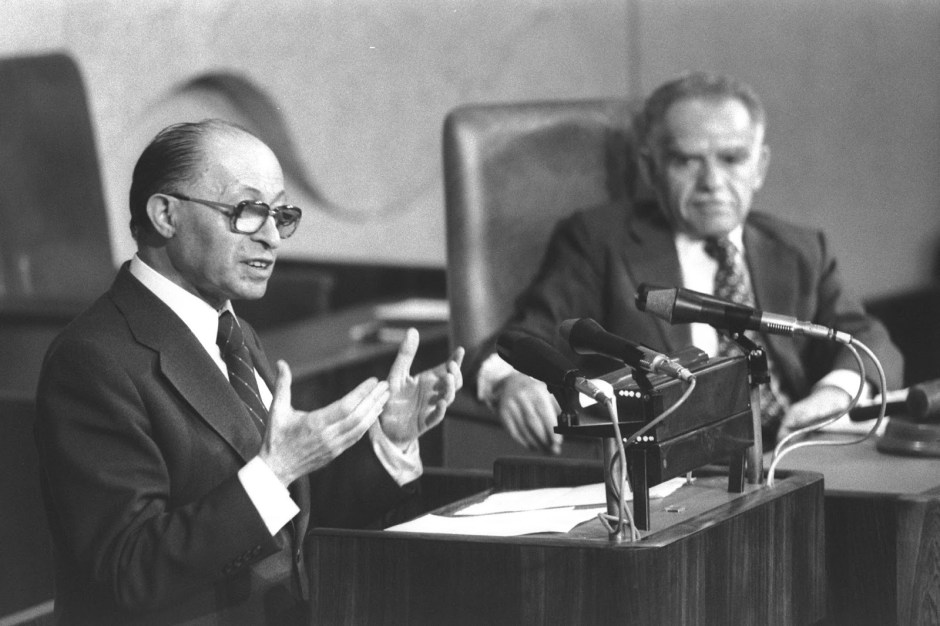
(Israeli Prime Minister Menachem Begin speaking to the Israeli parliament, the Knesset advocating acceptance of the Camp David accords, March 20, 1979.  Future Israeli Prime Minister, Yitzchak Shamir is seated to his right.)

In exploring the creation of the state of Israel over the last 67 years the dominant figure that emerges is David Ben-Gurion.  The head of the Jewish Agency before and after World War II, Ben-Gurion guided the nascent Israeli state and dominated its politics for decades.  However, another transformative figure emerged during the same time period that many outside Israel seem to avoid giving him his due, Menachem Begin.  Whether speaking about Begin’s leadership of the Irgun and the pressure he placed on the British to relinquish its Palestinian mandate; his political leadership that brought about his election to the Prime Minister’s office in 1977 which fundamentally realigned Israeli politics to this day; or his evolution as a terrorist or freedom fighter to a respected politician, depending on your viewpoint, in negotiating the Camp David Accords, the first peace treaty with an Arab state that recognized the state of Israel and altered the balance of power in the Middle East, Begin’s life has left an indelible mark on the Israeli people.  The latest example of Begin’s profound ideological influence on Israel are the recent elections that returned Benjamin Netanyahu to the Prime Minister’s office, leading the Likud bloc that Begin helped create in the 1970s.  The most complete biography of Begin’s life and career is written by Israeli historian, Avi Shilon, MENACHEM BEGIN: A LIFE that mines the Israeli archives and reflects numerous interviews in producing a complete picture of Begin in all aspects of his long career, in addition to providing an interesting analysis that delves into his personality and the motivations for the actions he took.  Daniel Gordis has written the most recent biography of Begin, entitled, MENACHEM BEGIN: THE BATTLE FOR ISRAEL’S SOUL, in which the author admits he is not concerned with all aspects of Begin’s life but “the story he evoked in Jews, of what he said to the world about Jewish history and the Jewish people and the legacy he bequeathed to the state he was instrumental in creating,” as well as looking at his life “through the lens of the passion he still evokes.” (Xiv-xv)  However, Gordis does not come close to Shilon’s book published in English in 2012 in scope and depth of analysis.

The common theme in Shilon’s life of Begin was his pride in being Jewish, a pride that would shape his entire life.  He idealized his father who was a committed Zionist who raised his children with a blend of Jewish tradition and the ideas of Ze’ev Jabotinsky, a leading figure in the movement to establish a Jewish homeland in Palestine.  Begin’s father was his life’s role model as a man living in a Polish village named Brisk, who would use an axe to open a synagogue to allow Theodore Herzl to speak when the head rabbi refused to allow the founder of Zionism to address his congregation.  Further, he would confront anti-Semitic Polish soldiers who almost shot him in front of his son.  Ze’ev-Dov, Begin’s father encouraged his children to go to Palestine and was a model of persistence or stubbornness who would perish along with Begin’s mother and sister in the Holocaust.  Begin’s father stressed the solidarity of the Jewish people and vigorously opposed those who disagreed with him.   Along with his exposure to Judaism as a child, the actions of his father that he witnessed, and the events of the Shoah are all mirrored throughout Begin’s career and the development of his worldview.

(The arrival of Egyptian president, Anwar Sadat in Israel alongside Prime Minister Begin, November 19, 1977)

When discussing Menachem Begin, opinions range from the beloved leader that impacted Israel greatly as a statesman and a man of the people, or a stubborn individual who has authoritarian tendencies with an acerbic tongue and supported violence to achieve his aims.  Shilon comes down between the two extremes as he develops a fascinating portrait of Begin.  From the outset Shilon traces Begin’s ideological roots back to his enrollment in the Beitar Movement that stressed the ideas of Ze’ev Jabotinsky at the age of sixteen.  The movement called on Jews to hold their heads up high, stressed nationalistic issues, and the power of the Jewish people to achieve a future in Israel.  The young Begin was greatly influenced by Jabotinsky, but also Marshall Jozef Pilsudki who led the Polish nationalist movement after World War I, and Guiseppi  Garibaldi, the Italian nationalist who worked to achieve the unification of Italy in the 1860s.  By the time Begin entered his twenties his worldview was formulated as Shilon accurately points out, he “applied Polish nationalistic concepts to his perception of Jewish nationalism – especially regarding the importance of using military means to expand territory – and to this notion he added the spiritual nationalistic anchor – Jewish tradition.” (12)  These themes would be evident in all aspects of Begin’s life’s work.

Shilon’s chronological narrative focuses a great deal on the ideological rifts that developed as Begin worked his way up in the Beitar movement to positions of leadership, the implementation of the Irgun’s war against the British, his time in opposition after the creation of the state of Israel, and his period as Prime Minister.  As Begin rose to prominence in the Beitar movement he would disagree with Jabotinsky in a number of areas, most importantly over the use of terror and cooperation with the British.  During the Irgun years the issue was the application of violence and whether to go along with the Jewish Agency, led by David Ben-Gurion and his strategy.  After independence Begin was adamant about not negotiating with the West German government over reparations as the Holocaust impacted him so severely, and once in power the issue of returning territories won in the 1967 war forced him to change his position of never returning territory that was part of “Eretz Yisroel.”  However, no matter the situation, Shilon credits Begin with his courage and his ability to discern the mood of the public in any decision he made.

(The Beitar Movement that Begin joined at the age of 16, he is seated in the center)

The most controversial part of Begin’s career was his leadership of the Irgun, which the British labeled as a terrorist group before, during, and after World War II.  Begin’s raison detre was to rebel against the British.  At the outset, Begin had no knowledge about leading an underground organization and planning and carrying out operations.  He rose to leadership in the Irgun based on his European background, particularly his training in the Polish army, and his fluency in a number of languages.  As in most cases during his career, Begin let his ideas that many felt were beyond reality, and his oratorical ability to carry the day, and left military planning to experts, a concept that appears over and over during his career.  Begin saw the British refusal to allow Holocaust refugees into Palestine as enough of a reason to declare war on them.  He strongly believed that the British were solely responsible for blocking the creation of the state of Israel.  Begin believed the employment of terror against the British mandate during and after World War II would force them out of the region, buttress the confidence of the Yishuv, damage British prestige, and arouse international public opinion, especially in the United States.  One must ask was terror a successful strategy to accomplish ones goals?  In Bruce Hoffman’s new book ANONYMOUS SOLDIERS: THE STRUGGHLE FOR ISRAEL 1917-1947, the author asks, does terror work?  Based on historical events and the creation of Israel in 1948, his conclusion is that it does.  Shilon does not skirt over the controversial actions taken by the Irgun, the bombing of the King David Hotel, the hanging of the British sergeants, the Deir Yassin massacre, the Altalena Affair, and other events are explored in detail and the author does not hold back any criticism in discussing Begin’s actions.

The contentious relationship and almost hatred between David Ben-Gurion and Begin is a common theme throughout the narrative.  Ben-Gurion always feared Begin’s popularity among the young and wanted to prevent him from gaining any political power.  Shilon points to the fact that Ben-Gurion and Begin shared many characteristics, including a propensity to act in an authoritative manner.  Begin never could accept an Israeli democracy under Ben-Gurion’s control.   For Begin, Ben-Gurion was too secular, and Begin believed in a Hebrew republic that distinguished between the state and religion – a dichotomy that still exists today when one listens to Netanyahu’s repeated call for a “Jewish state.” The integration of the arguments into the narrative between the two in the Knesset and the Israeli media enhances an understanding of the two men as well as providing insights into why they disagreed over policy and their personality differences.  For Begin, religion was the unifying principle of the Jewish people.  For him, the Israeli national concept was based on the Jewish people in its biblical version, and pursuing the military path was a legitimate means to a desired end.

(Israeli Prime Minister, David Ben-Gurion, Begin’s political rival/enemy)

Shilon’s use of primary materials to reflect on Begin’s relationships is important in gaining an accurate view of how he dealt with people.  Begin always respected military men, particularly those he felt were “warriors.”  His relationship with Moshe Dayan, who was a member of the Labour coalition reflects Begin’s ability to compromise when necessary.  His relationship with Ariel Sharon, another military hero is important in addition to his up and down relationship with Ezer Weizmann, an Air Force hero who represented the younger generation that at times would revere Begin because of his background.  In overseeing the dismantling of the Irgun after independence we witness a distraught Begin as he must pursue realpolitik to further his Herut party politically.  The discussions and overt hostility that arises between Begin and his Irgun fighters is important as it reflects the evolution of Begin as a politician and what he sees as the best interests of the Israeli people.

Shilon does an excellent job in analyzing three events that form turning points in Begin’s rise to power in 1977.  The first, in 1952 is his opposition to accepting reparations payment from the West German government, highlighting the impact of the Holocaust in every decision Begin made.  Occurring at a time when his Herut party was in decline it provided a platform for Begin to touch the soul of Israel.  Later in his career when German Chencellor Helmut Schmidt stated on a state visit to Saudi Arabia in 1981 that Germany had a moral obligation toward the Palestinians because it was Germany that was responsible for their plight due to the Holocaust.  An incensed Begin responded at a political rally that, “He is greedy….he seeks two things.  To buy oil cheaply and sell weapons dearly.  He talks about moral obligation to the Arabs?  The obligation to the Jews will never end.” (337)  the second event, the 1967 Six Day War brought Begin into a unity government as a minister without portfolio.  Here the Labour government was following Begin’s approach in dealing with Israeli security and resulted in the capture of the West Bank, or as Begin referred to as Judea and Samaria, Jerusalem, Gaza, the Sinai, and the Golan Heights.  This period of Israeli euphoria is well chronicled and leads to the third event that brings Begin to power, the 1973 Yom Kippur War.  The soul searching that followed the war would lead to the coalition of Herut and two other parties to form the Likud bloc that would produce the election of Begin as Prime Minister in May, 1977.  Shilon’s analysis and questions pertaining to Begin’s rise are valid and thought provoking.
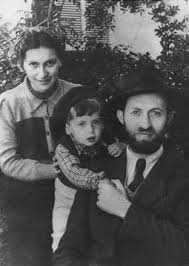
(Begin in disguise as a rabbi during his years underground.  His wife Aliza and daughter Chasia are also pictured)

The final section of the book culminates with a shift in Begin’s approach to foreign policy.  His view was that the Sinai and Golan Heights were not part of the promise land that God gave to the Jewish people, therefore he was willing to negotiate their return.  This would allow him to reduce international pressure over Jerusalem, Judea and Samaria, Gaza, and the settlement program.  This shift in his thinking allowed Begin to go to Camp David and reach an accord with Egyptian president, Anwar Sadat, but being very careful not to give into demands concerning the Palestinians.  For Begin the autonomy agreement that was reached was nothing more than papering over a problem and pushing it into the future when Begin accurately predicted there would be a massive influx of Soviet Jews to Israel alleviating the demographic challenges that Israel faced with the Arabs. Begin’s biggest mistake as Prime Minister was his invasion of southern Lebanon as a means of destroying the Palestine Liberation Organization.  As Robin Wright, the Middle East historian has noted, this became Israel’s Vietnam, and it would take a number of years after Begin retired to extricate itself from.  For Begin the decision to invade Lebanon has been fraught with controversy.  The role of then Defense Minister, Ariel Sharon is at the center of the debate whether he exceeded instructions approved by the Israeli cabinet and pursued his own agenda while keeping Begin in the dark.  According to Shilon, the Prime Minister was “detached from what was happening on the ground,” and though he supported Sharon’s actions, he was culpable for the disasters that followed, including the Shatila and Sabra refugee camp massacre, the increasing Israeli casualty rate, and the eventual emergence of Iranian backed Hezbollah.

Foreign policy was Begin’s bailiwick, and social and economic issues did not create the same interest.  However, he would take advantage of the poverty that recent immigrants from the Arab countries and Ethiopia endured as they tried to assimilate into Israeli society.  He would pit these Sephardic Jews against the ruling Ashkenazis to gain their political support and enhance Likud’s popularity.  Further, he would employ a populist message to gain the support of workers and the middle class to reflect an image of fighting for those who did not benefit from the Labour government’s policies.  Begin would make economic policy pronouncements to assist the poor, but losing interest, he would as he always said, would turn implementation of those policies to the experts.

Shilon’s effort and the excellent translation from Hebrew by Danielle Zilberberg and Yoram Sharett should stand as the preeminent biography of Begin for a great while.  Though at times somewhat wordy, the author has captured the essence of who Begin was, and what his place in history has become.  Today he remains as one of the most popular figures in Israeli history and if Bruce Hoffman is to be believed Begin showed that the use of terror in certain situations can be successful, and that even a rigid ideologue can evolve and have a positive impact on his people.
GAZA: A HISTORY by Jean-Pierre Filiu

(Explosions from Israeli air strikes over Gaza City this past summer during the Hamas-Israel War of 2014)

Last week newly reelected Israeli Prime Minister Benjamin Netanyahu backtracked from his election eve statement that he opposed a two-state solution for the Israeli-Palestinian conflict.  Though he seems to have walked back that statement because of American pressure the issue still remains, will there be any movement toward a dialogue for peace between the Israelis and Palestinians in the near future?  At this juncture the answer appears to be a resounding no.  In the absence of a clear diplomatic path it is useful to explore a major component to any future deal.  In 2005, then Israeli Prime Minister, Ariel Sharon disappointed his right wing Likud Party partners and set forth a unilateral Israeli withdrawal from the Gaza Strip.  Tired of the cycle of violence with terrorist attacks and counter-terrorist reprisals, Sharon decided it was not worth the cost of maintaining an area that is 139 square miles (the same as Detroit) with a population of about 1.8 million Palestinians.

As Palestinian politics have evolved over the last ten years Hamas, seen as a Moslem extremist party and terrorists by both the United States and Israel, assumed power over Gaza, and the “more moderate” Palestinian Authority is in charge of administering the West Bank.  This situation came about through a bloody civil war between the two parties and the electoral process.   On January 25, 2006 the Hamas Party won the Palestinian legislative election resulting in the nomination of Hamas leader, Ismail Haniyeh as Prime Minister within a Palestinian National unity government with Fatah, the largest Palestinian political party.  This unity dissipated quickly when Hamas and Fatah effectively engaged in a civil war, the results of which have left two separate ruling bodies in the Palestinian territories.  In recent years, of the two territories, the Palestinians in Gaza have suffered the most.  Last summer, in what seems to be a bi-annual war between Israel and Hamas resulted in the death of over 2100 Palestinians and 73 Israelis.  The causes of the war center on Hamas’ frustration at its lack of progress in achieving a Palestinian state, and the belief that they had nothing to lose by launching missiles into Israel to provoke an invasion.  The background for these events are explored in Jean-Pierre Filiu’s new book GAZA: A HISTORY, a comprehensive study of Gaza from roughly 18th century BC to the end of 2011.  The book is important because it fills a gap on the literature pertaining to Gaza since most Middle East scholarship tends to focus on the endless attempts to solve the Israeli-Palestinian conflict.  In addition, the book provides a useful guide to events that led to the carnage of last summer.

The author summarizes the early history of Gaza and what becomes clear from at least the12th century BC is that the region is repeatedly conquered by external forces.  Be it the Assyrians, Babylonians, Persians, Romans, Byzantines, Crusaders, Mongols, Mamelukes, Ottomans, French, British, and eventually Israelis, Gazans were rarely in charge of their own destiny.  They would be forced to believe in paganism, Christianity and finally Islam.  Important historical figures are presented from Alexander the Great, Salah ad-Din, Gamal Nasser, to present day politicians all of which possess their own agendas that did not necessarily bode well for Gaza.  According to Filiu Theodore Herzl and his early 20th century Zionist movement did not consider Gaza as part of the land of Israel as Gaza’s land owners refused to provide the Jews land purchases the way the Arabs had in central Palestine, thereby limiting any Jewish incursion into Gaza.  From that point on Filiu reviews the history of the region exploring the diplomacy of World War I, the 1929 Arab riots, the Arab rebellion of 1936, and the effect of World War II on the area.  In addition he does a good job discussing the dynastic rivalries that existed among Palestinians throughout the period and their impact on Gaza.  In doing so Filiu forgets to explore the 1939 British White Paper, I believe in part because it doesn’t necessarily support his Palestinian bias that is present in many of the areas that he explores. Once the narrative approaches the creation of the state of Israel in 1948 Filiu zeros in on the Israeli-Palestinian conflict which makes up over three-quarters of the narrative.

(The Israeli Iron Dome Missile Shield developed by Israel.  It was employed last summer to protect Israel from the thousands of Hamas rocket launches.)

Filiu spends an inordinate amount of time describing what seems to be each and every act of terror and counter-terror committed by both sides in the conflict.  I understand the importance of many of these actions and counter-actions but at times it becomes tedious and can overwhelm the reader with detail.  Of course, many of these attacks lead to changes in policy or military action, particularly by the Israelis but it would benefit the reader if this could be condensed and the author could concentrate more on analysis of events rather than direct reporting of who died, how many died, and who survived.  The horror of the plight of the Palestinian refugees cannot be denied, and Filiu does a superb job providing the reader with an understanding of their plight.  Discussions of the life and politics in the Kan Younes, Jabaliya, Rafah, Nuseirat, Bureji, and Deir al-Balah camps are important because from these camps the varying leadership and shock troops of the militant Palestinian groups emerge.

Perhaps the most interesting aspect of the book is Filiu’s description of the rise of Yassir Arafat to leadership of the Palestine Liberation Organization and Fatah, its political wing in 1964.  The author follows the evolution of Arafat as a “freedom fighter/terrorist” who is faced with increasing opposition from other Palestinian elements as the history of the region evolves from Israeli “punishment” of Gaza for attacks on its settlements to outright war.  We witness an Arafat who must balance himself between the many Palestinian factions that emerge over the years and by 1990 he begins to engage in the diplomatic process with Israel and the United States leading to the Oslo Accords in 1993 and the failure of the Camp David talks in 2000.  Next to Arafat, the man who receives the most attention from the author is Sheik Ahmed Yassin who became the leader of the Moslem Brotherhood in Gaza in 1966.  Later, in 1973 he would set up an organization called the Mujamma designed to meet the social service and educational needs of the Palestinians in Gaza.  In response to the 1987 Intifada of the younger generation of Palestinians against Israel he founded Hamas (the Movement of Islamic Resistance).  It is here that Filiu does his best work as he describes the ideological differences between the various groups that vie to represent the Palestinians.  He explores the ideologies and strategies that Fatah, the Muslim Brotherhood (that eventually evolves into Hamas), Islamic Jihad, and the Popular Front for the Liberation of Palestine in detail, and how they hope to achieve Israeli withdrawal from Gaza, and explains the reasons Hamas emerged as the dominant force in Gaza today.

(Destruction in Gaza caused by the Israeli invasion)

The importance of Filiu’s work lies in his discussion of the escalation of violence that took place in 2001 as Hamas and its allies expanded their attacks from targeting Israeli settlements inside Gaza to the territory of Israel itself.  This would lead to Israel’s application of an “iron fist” in response and a cycle of violence that would continue until Israel’s withdrawal from Gaza in 2006.  Hamas would launch its first home made Qassam rockets, employ its first female suicide bombers, and reject all calls to demilitarize the second Intifada.  Throughout the period not a day went by when there wasn’t an assassination, air strikes, suicide bombings, or destruction of Gaza’s homes and infrastructure.  By 2006, Hamas’ strategy concerning elections would change by first running in municipal elections, then parliamentary contests which in the end brought them to political power. However, instead of using their victory as a positive force they engaged in a fratricidal war with Fatah.  But as Donald Macintyre suggests in the The Independent it would have been interesting if Filiu provided greater analysis of these events and the actions of the Bush administration, as well as the lack of action by the European Union as they sabotaged any chance of an international agreement with Hamas by the policies they pursued. (The Independent, September 11, 2014)  What is even more troubling than missing an opportunity after the election of 2006 to pursue some sort of diplomatic demarche, is the author’s description of the fighting between Hamas and Fatah between 2006 and 2011 that can only be characterized as savage.  Further this brutality was taking place at the same time as Israel pursued “Operation Cast Lead,” its punishment of Gaza for the militant’s seizure of Gilad Shalit, a nineteen year old Israeli soldier on June 25, 2006.

Earlier I mentioned that Filiu at times is not totally objective in his presentation.  A few cases in point; in discussing casualties in various attacks and counter attacks, the author provides minute details of Palestinians and then glosses over Israeli casualties.  The reader is presented with the Grand Mufti, Hajj Amin al-Husani as a leader of the Palestinian people, but Filiu skirts over his alliance with Nazi Germany during the war, and his work to help Nazis accused in the Holocaust to escape to the Middle East.*  In discussing the outbreak of the Suez War, Filiu makes it appear that Nasser nationalized the Suez Canal in response to the Israeli assassination of his intelligence chief.  In point of fact, Nasser’s anger was due to the withdrawal of the Aswan loan guarantee by the United States, their refusal to sell him weapons to counter Israeli attacks, and their policy of trying to create a Middle East Defense Organization geared against the Soviet Union.  In 1967, the author suggests that Nasser ordered the UN forces out of Sharm el-Sheik to take Arab pressure off of him for restraining Fedayeen attacks against Israel.  In fact the Russians kept feeding Egypt information about the coming Israeli attack and that he should take action.  Perhaps as Isabella Ginor and Gideon Remez suggest in FOXBATS OVER DIMONA, the Soviets wanted to provoke a war in order for them to interfere in support of the Arabs and destroy the Israeli nuclear reactor in the Negev Desert.  In discussing the Yom Kippur War he emphasizes the “air bridge that brought in supplies provided by the United States” to Israel, but makes no mention of the “air bridge” that the Soviets provided the Arabs.  Perhaps Professor Filiu should have explored Nasser’s true feelings about the Palestinians, who behind closed doors was repeatedly heard to make derogatory remarks describing them.  In his discussion of the outbreak of the 1987 Intifada, the author should explain the demographic and financial inequalities in the Arab world that in part led to the outbreak of violence, and perhaps mention that though Arafat took credit for the revolt, it caught him by surprise just as it had the Israelis.  I find the documentation that Filiu uses rather selective at times, concentrating on United Nations Documents and mostly pro-Arab secondary sources.  I am not suggesting these sources are wrong, however one should employ a myriad of sources to assure objectivity.

(Hamas tunnel complex used to smuggle materials into Gaza and fight against Israel)

(Israeli soldier discovers Hamas tunnel opening during the fighting last summer)

Despite these flaws Filiu has prepared a remarkable book that fills the historiographical gap that is apparent with the paucity of historical monographs that examine Gaza.  I would hope that the author would prepare an updated edition of the book that carries his story through the events that led to the Hamas-Israel war of last summer, and the horrifying result for the people of Gaza, as opposed to Hamas’ leadership, that appears to have emerged unscathed.

  • See Rubin, Barry; Schwanitz, Wolfgang G. Nazis, Islamists, and the Making of the Modern Middle East. New Haven: Yale University Press, 2014.