QUEEN ESTHER by John Irving

Introducing the Head of School Search Committee

My journey with John Irving began my freshman year in college when I read SETTING FREE THE BEARS.  I have enjoyed his quirky sense of humor, his support for those ostracized by elements in society, and the incredible scenes he has created.  Perhaps my favorite scene comes from the novel, THE FOURTH HAND, where the main character, a journalist’s ex-wife, employs a lacrosse stick as a pooper scooper for her dog.   This unusual tool in a memorable, somewhat bizarre scene, highlights Irving’s style of blending the absurd with profound themes that have carried forth through some of my favorite Irving novels that include THE WORLD ACCORDING TO GARP, THE HOTEL NEW HAMPSHIRE, A PRAYER FOR OWEN MEANY, THE CIDER HOUSE RULES, and TRYING TO SAVE PEGGY SNEED.  My journey is very personal as I have taught at a university in New Hampshire, in addition to an elitist boarding school in New England.  Further my son played lacrosse at the boarding school and Harvard.  In addition, my daughter, son-in-law and two grandchildren are Mainers.  So, you can see why I have the affinity for the types of novelistic themes and characters that Irving has created.  Now that I am a senior citizen it seems that my adulthood is bookended with Irving’s writings and just when I needed an absurdist fix to deal with the reality of living in a Trumpist world he has produced his latest, QUEEN ESTHER, a book which is wonderful at times, and then disappointing at times.

In QUEEN ESTHER, Irving brings back Dr. Wilbur Larch from CIDER HOUSE RULES after four decades managing adoptions at St. Clouds Orphanage where he is the physician and Director.  Larch performs abortions for women who have no alternatives and is as cantankerous as ever.  The novel starts out in the early 20th century and revolves around Esther Nacht who was born in Vienna in 1905, the only Jewish orphan raised at St. Clouds.  On her voyage from Bremerhaven to Portland, ME her father died of pneumonia aboard ship.  Later, her mother will be murdered by anti-Semites in Portland.  Dr. Larch realizes that the abandoned child is not only aware that she is Jewish, but also she is familiar with the biblical Queen Esther after whom she was named.  Dr. Larch realizes it will not be easy to find a Jewish family to adopt her, soon he is aware that he will never find any family to adopt her.

At the outset, the novel focuses on the Winslow family who date to 1620 arriving on the Mayflower.  The Winslow’s reside in Pennacook, New Hampshire, a town which is the home of Pennacook Academy, an independent boarding school for boys founded in 1781.  One of its students was James Winslow, a faculty brat and the grandson of the most revered member of the school’s English Department, Thomas Winslow.  Since Jimmy’s mother, Esther was an orphan he could not be considered a “blue blood.”  The townspeople had difficulties with his mother’s adoption and as Irving develops the novel they were correct as Esther was the caretaker for Thomas and his wife Constance Winslow’s fourth daughter, Honor.  Jimmy’s birth was the result of the “pact” between Esther and Honor; Esther would become pregnant and give the child to Honor who detested the idea of birthing a child.  So begins a novel that is typical Irving; layered, funny, heartbreaking, and full of the strange humanity he always captures.

Irving in 2010

(John Irving in 2010)

The adoption of Esther by Thomas and Constance is important because it allows Irving to delve into societal issues related to abortion.  When the Winslow’s set out to adopt a caretaker for their daughter they were clear that they did not want to adopt someone from an orphanage run by nuns or linked to the Christian faith – they could not bear any religious affiliation.  After considering a French-Canadian orphanage as too religious they settled on St. Cloud’s where they found Esther, a Jewish child of fifteen who was born in Vienna.  As the Winslow’s searched for what turned out to be Esther, Irving presents his pro-abortion views focusing on people who opposed abortion but did not consider the child who would wind up in an orphanage, as it seemed they just wanted to punish the mother.  As in all examples of societal issues Irving will present a brief history of the topic and the fact that abortion was not considered illegal from 1620 to the mid-19th century.  Irving argues it became illegal as Doctor’s resented midwives who performed them making money at their expense.  

Since Esther was Jewish the issue of anti-Semitism soon became the focus of Irving’s characters and thereby his views.  He subtly integrates the issue as he believes that New Englanders are covertly anti-Semitic as witnessed by the reaction to Thomas’ lectures on abortion and the adoption of Esther.  It is clear that it would be difficult to find parents for Esther because she was Jewish, but since the Winslow’s were a philanthropic, non-Jewish eccentrically non-believing New Hampshire couple, they would be the type open to adopting a teenager like Esther.

The novel spans the 20th century from 1905 to 1981 and at the outset you get the feeling it is about Esther, but in reality it is mostly about Jimmy Winslow, the son who was the center of the “pact.”  Esther herself considered her “Jewishness” as the mainstay of her identity, but was not religious, though she could read Hebrew she did not believe in God.  Her main goal eventually was to move to Israel as she was consumed by the exile of the Jews from the land of Israel and the diaspora of the Jewish people.  Her outlook on life could be summed up from a quote from JANE EYRE which in true Irving fashion was tattooed between her breasts.  She traveled to Europe in 1934 with the goal of getting pregnant to honor the “pact” where she would meet Moshe Kleinberg, a Greco-Roman wrestler in the lightweight class who even had a picture taken with General Paul von Hindenburg when he was President of Germany!   Moshe, whose nickname was “the little mountain” would become Jimmy’s father but would never meet him which creates another path for Irving to expound upon as Jimmy has many identity issues because of his background.

Queen Ester by John Irving

As Jimmy matured his grandfather exposed him to literary figures, particularly Charles Dickens that factored into his decision to become a writer.  Jimmy believed in his intrinsic foreignness and was determined to see himself as an orphan, no matter how his grandparents tried to raise him.  In 1963 we find Jimmy in Vienna seeking his roots and a desire to learn German.  Esther will find him a German Jewish tutor who of course he falls in love with.  Jimmy’s other issue is the Vietnam War and the draft in the United States.  His mother, Honor, sent him to Vienna to meet someone, get them pregnant, keep the baby and in this way he would be draft exempt.  If that couldn’t take place she wanted him to wrestle with the hope of damaging his leg also making him draft exempt.  In the background everyone wonders about Esther who has gone to Palestine – is she a member of the Haganah, a Jewish defense force or something similar to defend Jews and facilitate their immigration to Palestine.  Another plot line that is an undercurrent for Jimmy is his goal of being a novelist, and of course the name of the book is THE DICKENS MAN.

In all subjects that Irving integrates into the novel he has excellent command of the history of the topic.  Apart from abortion and anti-Semitism Irving expounds on Jewish history, GREAT EXPECTATIONS by Charles Dickens, films like “From Here to Eternity,” a history of circumcision, the rise of the Nazis, the Holocaust, the Cuban Missile Crisis, the assassination of John F. Kennedy, the Cold War era in general, and Israeli politics and society.  It is clear Irving has conducted meticulous research for his novel and should be commended as he immerses himself in his subjects until every detail feels authentic even if it meant visiting wrestling gyms, hospitals or tattoo parlors.  Further as he constructs his background history he does it in a concise and meaningful manner where the subject matter just blends seamlessly into the story.

Though the novel seems to focus mostly on Jimmy, the progression of Esther in the background until she emerges at the end of the book is powerful, especially in light of what Israel seems to have become and the arguments put forth by Palestinians and Israelis alike.  The reviews for QUEEN ESTHER have been mixed and as usual in interviews Irving does not seem to care what is said about his work.  Some have panned the novel but his sarcasm, sense of the absurd, character development, and ability to provide scenes that no one else could create make the book a worthwhile read, and of course along with his unique style of writing.

THE ZORG: A TALE OF GREED AND MURDER THAT INSPIRED THE ABOLITION OF SLAVERY by Siddharth Kara

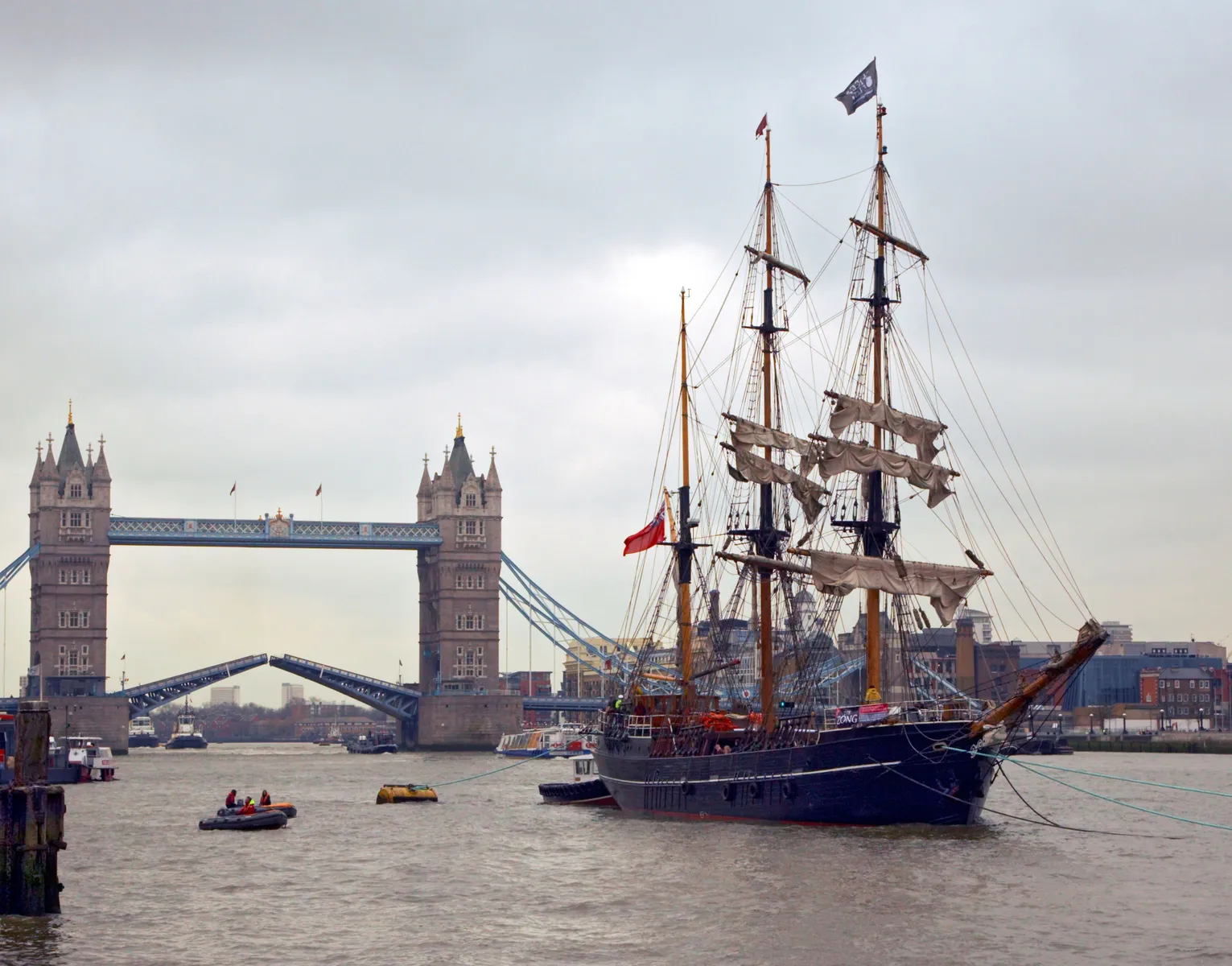
(Reproduction of a handbill advertising a slave auction in Charleston, British Province of South Carolina)

As the current administration guts the Department of Education, coerces universities to adhere to what they think should be taught in classes, and pressures public schools to rewrite their curriculum to reflect its view of history it is important to examine books that tell the truth about history as opposed to a fantasy that makes certain elements in our society feel better.  Banning books, censorship, and curtailing funding is no way to examine our past – something from which we should learn!  Just because someone write or says something that is critical of American history does not mean it did not happen or is a threat in our current environment.  Remembering our past is a precursor to the present and is a necessity and must be carefully examined as we should learn not to repeat previous errors.  It is in this context that Siddharth Kara’s latest book, THE ZORG: A TALE OF GREED AND MURDER THAT INSPIRED THE ABOLITION OF SLAVERY must be explored.

Kara’s narrative history portrays his subject with compassion, and accuracy based on exceptional research depicting the harsh realities of the 18th century slave trade involving Africa, the Caribbean, and the American colonies providing lessons we should never ignore.  This may come across to some as “wok,” but history is something that should never be dismissed or degraded.

A painting entitled "The Slave Ship" by J. M. W. Turner. In the background, the sun shines through a storm while large waves hit the sides of a sailing ship. In the foreground, enslaved Africans are drowning in the water, while others are being eaten by large fish.

(The Slave Ship (1840), J. M. W. Turner‘s representation of the mass killing of enslaved people, inspired by the Zong killings)

The narrative that Kara presents reads as a work of fiction, but it is not.  It is a work that is based on fact and presents an accurate picture of the events he describes.  Each chapter ends with a hint of what is to come next.  Each important observation is related to what will take place in the future and how it will affect his storyline.  Kara provides a very detailed history of the Zorg and its ill-fated voyage, describing in mesmerizing detail the story’s evolution as it embarked on a violent Atlantic crossing.  A British privateer captured the Zorg during the Anglo-Dutch War in early 1781, and the ship would sail from the Gold Coast of Africa to Kingston, Jamaica, with its ‘etween deck’ loaded with 442 slaves, including women and children, and a small crew which was not sufficient to care for them.  Even the Captain was problematical, a former slave ship surgeon, who had little navigational experience, hired by a rich Liverpool slave merchant.

There are a number of important characters that garner the author’s attention.  First, Luke Collingwood, Captain of the Zorg and a former slave ship physician who must have been considered competent since his mortality rate for the crew and slaves was considered below average, however he was not trained in navigation and would become a disastrous choice.  William Gregson, underwrote the cost of the Zorg and was considered one of Liverpool’s most prominent slave merchants.  James Kelsall, was second in command to Collingwood on the Zorg, and was the only knowledgeable navigator apart from the captain.  Robert Stubbs, one of the British governors for the Company of Merchants Trading for Africa (CMTA) was a scoundrel who sold slaves, pocketed the profit, and made decisions out of avarice that would end up in disaster.  He was eventually fired but wound up on the Zorg as it made its way to Jamaica.  William Llewellin, the captain of the British privateer, Alert, who captured the Zorg, which at the time had 120 slaves.  He would capture the Dutch slaving ship, Eendracht, and would add its 124 slaves to the Zorg.  Richard Hanley, one of the leading slave captains in Liverpool.  John Roberts, another CMTA governor who clashed with Stubbs.  Amoonay Coomah, the Ashante King who sold his people into slavery.  Olaudah Equiano, captured by slave traders at age eleven, he survived the two Middle Passages having been shipped to shipped to Virginia, served as an officer’s slave on British battle ships.  In 1766 he would buy his freedom and later would play an important role in trying to free slaves.  Lastly, Granville Sharp who early in career witnessed a scene were a black teenager was beaten, sold, and kidnapped and was outraged.  Sharp would work to gain the teenager’s freedom and spend his remaining career as an abolitionist developing arguments against slavery.  In addition, Kara introduces a series of English abolitionists who assiduously to end the slave trade in the late 18th and early 19th century.

(The Zorg, a replica)

Kara provides excellent background for the reader to gain a true understanding of what life was like on a slave ship.  He points to the difficulties in staffing a ship’s crew.  It was a daunting task since men new that Guinea voyages had high mortality rates, offered poor wages, required to complete unpleasant tasks, including guarding and feeding hundreds of captive slaves.  Many of the crew hired were impressed or had to work off debts acquired while they were drunk.  Most crews that were hired were not experienced enough for a successful voyage.

Kara offers a useful description of the British slave infrastructure in Africa, i.e., forts, factories, supply networks, the dungeons slaves were kept in, and the personalities or governors who were in charge.  It is eye opening because the of the horrors the Africans faced even before they were forced to board the slave ships.  He makes a series of insightful observations.  One of the most important is that once Africans were forced into a dungeon or on to a slave ship they had no concept of what was about to happen to them.  The dungeon the British built was indicative of the horrors that awaited the Africans.  It was built below the Cape Coast Castle designed to house over 1,000 Africans at a time.  Kara introduces Ottobah Cugoano who has written a biographical account of his experience in the dungeon, and his Atlantic crossing on a slave ship.  Years later, after obtaining his freedom he would become an important voice in England’s abolitionist movement.

The chapter entitled “Coffles” is an important one as it describes the process by which Africans were either seized by Europeans or sold by Ashante tribal leaders into the slave trade from the interior of the Gold Coast.  The inhuman treatment was abhorrent as they marched over 150 miles to the coast with little food and water.  Once again they did not know where they were going and what awaited them.  To highlight this experience Kara develops the name, Kojo to replicate what an African experienced.  Kojo would march for six months as part of this process.  Later, he would be forced onto the Zorg and along with the other 442 slaves who would be branded to show ownership. 

As Kara writes, “it is impossible to know what emotions the Africans experienced as they passed through the ‘door of no return.’  Was it anxiety, dread, anger, bitterness, hopelessness…perhaps even relief to be out of the dungeon?  Most Africans from the inland regions had never seen the ocean before.  What impact might first sight of the infinite blue have had on them?  Many surely feared they were heading for their doom.

Once Collingswood, Stubbs, and Kelsall overstuffed the Zorg with 442 slaves it was a disaster waiting to happen because the ship’s capacity was around 250.  The expected two month “Middle Passage” with a crew of 17 was clearly insufficient to care for their cargo.  In addition, supplies would not cover their needs.  Once the ship departed for Jamaica on September 7, 1781, a nightmare of dysentery would permeate the ‘etween deck’, the crew  would also suffer from scurvy, measles, typhus, measles, and malaria in steerage, as did the captain in his cabin.  Kara places the blame clearly; poor planning, a lack of organization and administration led to a shortage of supplies, particularly water, and to exacerbate the situation those in charge of the voyage made numerous navigational errors.  The key event occurred when Collingwood became so ill he could not continue in command.  He appointed his friend Stubbs, who had experience navigating slave ships, but had not done so in sixteen years, instead of the first mate Mr. Kelsall, who probably would have made better decisions and saved a significant number of lives.

Desperation set in as scurvy became rampant.   Kara describes the step by step physical and mental deterioration of the crew and cargo on a ship commanded by Stubbs, who was considered a passenger, in addition to the myriad of poor decisions which would result in disaster.  To solve the problem of disease and overcrowding a consensus was reached to throw away large numbers of slaves overboard.  By November 29, 1781, 122 individuals were tossed off the ship. Mostly women and children providing sharks with a culinary treat as they were shoved out of a window in the captain’s cabin.  Kara is correct that this action was a result of hoping to save enough slaves to recoup as much of a profit as possible once they reached Jamaica,  Another possibility was to collect insurance payments for the lost freight!  When the Zorg arrived in Jamaica on December 22, 1781, only 208 slaves remained, after roughly 224 slaves were thrown overboard.  A year later William Gregsonn would file an insurance claim of 30 pounds per head lost, arguing an ominous situation left the crew with no choice but to throw Africans overboard.

(Diagram of a slave ship from the Atlantic slave trade. From an Abstract of Evidence delivered before a select committee of the House of Commons in 1790 and 1791)

Kara describes the legal battle once the insurers refused to pay as Gregson sued the insurance company in February 1783.  The court found for the ship owner resulting in an appeal with England’s Chief Justice believing that the deaths were caused by the crews incompetence, Gregson would withdraw the suit.  Finally, Granville Sharpe would publicize the case as a means of forcing the government to abolish the slave trade.

The Zorg reflects a remarkable work of history despite the lack of sources.  The author does his best poring over what is available at the Royal African Company’s materials and has reproduced some key documents that highlight his narrative.  The most historically important one is an anonymous letter sent to the Morning Chronicle and London Advertiser which Kara reprints in full which would light a fire under abolitionist efforts in England that would not be extinguished until all slaves were free. The author should also be commended for integrating the 1783 court transcripts into the narrative which went along way to present the true facts pertaining to the events on the Zorg.   Kara’s contribution to the historical record concerning anti-slave movement cannot be denied as he has written a sophisticated account reflecting his moral compass.

(Enslaved Africans in chains marched to the East coast of Africa by Arab slavers)

THE BOOKSHOP: A HISTORY OF THE AMERICAN BOOKSTORE by Evan Fliss

(The Strand Book Store, 12th and Broadway, NYC)

When I first graduated from college in 1971 I worked at a small family owned publishing firm in lower Manhattan called T.Y. Crowell and Company.  It introduced me to the process of book publishing and afforded me enough of a salary that every Friday when I was paid I would walk to Broadway and 12th Street in Manhattan, the home of the Strandbook store.  I would proceed to blow half my paycheck on remaindered/used books and have a falafel sandwich from the food truck in front of the store.  This behavior continued for about a year when Crowell was sold to Dunn and Bradstreet and moved the firm to 666 Fifth Avenue (the building the Saudis bailed out Jarad Kushner with $2 billion!) and the doom of sleaze of corporate America.  This led to my resignation when the office manager, affectionately labeled by my boss as “silly bitch” refused to allow me to hang my Bob Dylan poster on the wall.  I proceeded to graduate school to earn a Ph. D in history.

The thing I carried with me from this experience was my love of books.  Today I own a library of about 8500 volumes which has created a family problem when trying to downsize.  Over the decades I have spent an inordinate amount of time browsing and buying in bookshops.  The Strand, despite its commercialization since COVID remains my favorite.  As my wife and I have traveled across Europe and other places I make it a habit to visit a bookstore and purchase a book in every city visited.  Perhaps my favorite is Bertrand Bookstore located in Lisbon, Portugal, supposedly the oldest book establishment in Europe.  Strolling on Charing Cross Street in London also produces many bookshops which I have fond memories of.  In the United States among my favorites include Powell Books in Portland and Chicago; Haslams Books in St. Petersburg, Titcomb’s Books in East Sandwich located on Cape Cod, the Harvard Bookstore in Cambridge, MA, Water Street Books in Exeter,  NH, Douglas Harding Rare Books in Wells, ME, Old Number 6 Book Depot in Henniker, NH, Toadstool Bookstore in Peterborough, NH, and of course there are numerous others that I could list!

Powell's Books City of Books on Burnside

(Powell’s Bookstore, Portland, OR)

As I have spent so much time in bookshops I have developed a love for the ambiance, smell, and contact with other book buyers who share my affliction as a book-a-holic as I cannot leave a bookshop without a purchase.  Over the years I have looked for the best history of American bookstores.  Recently, I believe I have found it, Evan Friss’ latest endeavor, THE BOOKSHOP: A HISTORY OF THE AMERICAN BOOKSTORE

Friss has authored an ode or perhaps a love song to his subject – a warm historical recounting of the personalities, challenges, historical perspective, and pleasure people derive from frequenting these establishments.  Friss introduces his topic by describing a small bookshop located in New York City’s West Village which opened in the 1970s.  This marked his entrance into the wonderful world of books that I have loved since my early teenage years.

Over the years independent bookstores have been disappearing.  According to Friss, in 1993 there were 13,499 bookstores in America, in 2021 just 5,591.  Friss is correct in that, “if bookstores were animals, they’d be on the list of endangered species.”

Land vehicle, Automotive parking light, Automotive tire, Automotive exterior, Automotive lighting, Alloy wheel, Fender, Rim, Town, Vehicle door,

(Books are Magic Bookstore in Cobble Hill, Brooklyn, NY owned by author Emily Staub and her husband)

Friss lays out his monograph in chapters set in a series of book establishments that includes itinerant book people who used carriages pulled by horses in the 18th century onward, trucks filled with books, kiosks on streets, book delivery trucks (long before Amazon), and of course a brick and mortar shops.  These establishments produced amazing personalities that include Toby, the owner of Three Lives Bookstore, located in the West Village; Benjamin Franklin’s Bookshop in Philadelphia in the 1770s, Old Corner Books run by B. H. Ticknor, a friend of Nathaniel Hawthorne; George Harrison Mifflin and E.P. Dutton who also owned bookshops during this period; James T. Fields who also published The Atlantic Monthly, Marcella Hahner who supervised Marshall Field’s Department store large book section and greatly impacted the role of women as book sellers through book fairs, author presentations (i.e.; Carl Sandburg’s books on Lincoln), she could make a book’s success if she endorsed and ordered it – a 1920s Oprah!; Roger Mifflin who drove a truck selling books, as did Helen McGill.   Frances Steloff developed the Gotham Book Mart that specialized in literature that dominated the New York book scene including publishing for decades including World War II.  Ann Patchett, bestselling author opened Parnassus      Books in Nashville, as the city was losing bookshops and she believed with her partner Karen Hayes that the city needed an indie bookstore that thrived as she saw herself protecting an endangered species.  Lesley Stahl called Patchett “the patron saint of independent bookstores.” Lastly, how could you author a book about bookshops and not provide a mini biography of Jeff Bezos and how Amazon tried to take over the book trade.

Friss is correct that when entering a bookstore, it is a “sensory experience” – The scent of a book known as “bibliosmia” which I love while holding a book cannot be replicated with a Kindle.  These experiences have been greatly impacted through our sectionalist history.  Since most books published in the United States before the Civil War were in the northeast, authors have to avoid any discussion of slavery for fear of lost sales below the Mason-Dixon line.  This did not stop Tickner and Fields from publishing UNCLE TOM’S CABIN.  Soon Ticknor was taken over by E.P. Hutton and merged with Houghton, Mifflin.

  • NH – EXETER – WATER STREET BOOKSTORE – DOUBLE AWNING ENTRANCE - OPEN
  • (Water Street Books, Exeter, NH)

The role of book buyers is carefully laid out by the author.  It is in this context that Paul Yamazaki is discussed and his San Francisco bookshop  It was during the late 19th century that traveling bookstores emerged from Cape Cod to Kennebunkport, Northport to Middlebury, all the way to Lake Placid.  They would drive their carts, carriages, trucks all over making customers and friends. Yamazaki would order appropriate books and deliver them to his customers – especially important in rural areas.

Friss uncovers many tantalizing stories about the book business, particularly the relationships between booksellers and the evolution of how these interactions would later lead to the forming of publishing companies that set the market with book buyers of what was available for the public to read and purchase. Perhaps the best stories are presented in his chapter on The Strand Bookshop as it brought me back to 1971 and browsing their stacks.  The picture of the shop that Friss includes from the 1970s is exactly as I remember it..  The narrowness of the aisles, the smell of used books, and the store’s ambiance were perfect.  For me going downstairs where the 50% off publisher copies is located was my favorite.  Friss includes personality studies of Burt Britton and Benjamin Bass who owned and operated Strand for years.  Friss’ focus is on the evolution of the Strand from its 4th avenue Book Row location to 12th and Broadway.  Due to Covid and  Amazon the shop went under a more commercial transformation (it now offers pastries and “Strand blend coffee”) but it remains an iconic bookshop and tourist attraction, but it has lost some of its roots from the 1960s and 70s.

Friss correctly points out that bookshops had a significant role in American foreign policy aside from its domestic influence.  The Aryan Book store opened in Los Angeles in 1933 and evolved into the center of American Nazism managed by Paul Themlitz.  Book shops were also caught up in the anti-communist movement with over 100 stores run by the Communist Party of the United States.  Wayne Garland managed a successful socialist bookstore in Manhattan called the Worker’s Bookshop and also fought against Fransico Franco in the Spanish Civil War as part of the Abraham Lincoln Battalion.  Congress even held hearings in the 1930s about these stores, particularly the growing communist movement.  This would lead to further issues during the McCarthy period in the early 1950s as government officials believed that if you frequented certain types of bookstores it was an indicator of your politics and threat level.  Apart from the right components of the book trade Fliss nicely integrates the other spectrum, recounting counterculture shops.

(Author and ownerof Parnassus Books in Nashville, TN, Ann Patchett)

Fliss doesn’t miss any angle when presenting his history of bookshops as he discusses the life of Craig Rodwell who was known as the “sage of gay bookselling.”  Rodewell would open the Oscar Wilde Bookshop in Greenwich Village in 1967 with the store serving as the front line of activism after the NYPD launched  the Stonewall Raid which would lead to the gay pride movement.  All of these types of bookshops are important to American culture which today is under attack as more and more state legislatures are producing legislation to ban books.  Interestingly, freedom of speech does not seem to be part of the right wing interpretation of the constitution.

One of the most interesting aspects of Fliss’ research is the impact of the killing of George Floyd on the book market.  As the “Black Lives Matter” movement spread the increase in book sales to black owned bookshops skyrocketed.  Fliss provides a concise history of black owned bookshops dating back to the 19th century and his conclusions are quite thoughtful.

Fliss devotes the last section to the growth of large chain bookstores like B. Dalton, Borders, Waldenbooks, Doubleday, and the goliath of stores created by Barnes and Noble.  By 1997 Barnes and Noble and Borders accounted for 43.3% of all bookstore sales.   By 2007 Barnes and Noble had $4.65 billion in book sales and the competition was slowly withering away.  Fliss explains that 2019 what once was a battle between indie bookstores and the large chains evolved into a war between in-person bookstores and Amazon.  Barnes and Noble’s massive growth had stalled, and an investor group controlled by Waterstones, Britain’s largest bookstore chain, poured money into Barnes and Noble, who like others had significant issues caused by Covid.  Its resurgence in its fight with Amazon was led by James Daunt, known as a “bookstore whisperer” in England – his goal was to make Barnes and Noble more like an independent store.  Daunt has been very successful in recreating Barnes and Noble and Fliss correctly concludes that the fate of the chain is “intertwined with the fate of American bookselling and maybe even the fate of reading itself” as Amazon is always hovering over what we read and where we buy.

Fliss has authored a phenomenal book tracing the development of bookshops for centuries culminating with the threat of Amazon and Jef Bezos who wanted to put “anyone selling physical books out of a job.”  The situation grew worse with the Kindle resulting in 43% of indie shops being driven out of business and by 2015 with its $100 billion in books sales.  By 2019 Amazon sold 50% of the books purchased in the United states.  What is clear from Fliss’ somewhat personal monograph, bookstores were a public good – the benefit was the experience – the browse, interaction with others, a place of comfort and rejuvenation.  Fliss’ work is a treasure for anyone who loves books, and possibly for those who don’t!

Strand Book Store 1 Bookstores Greenwich Village

(The Strand Bookstore)

THE WAR OF PRESIDENTS: LINCOLN VS. DAVIS by Nigel Hamilton

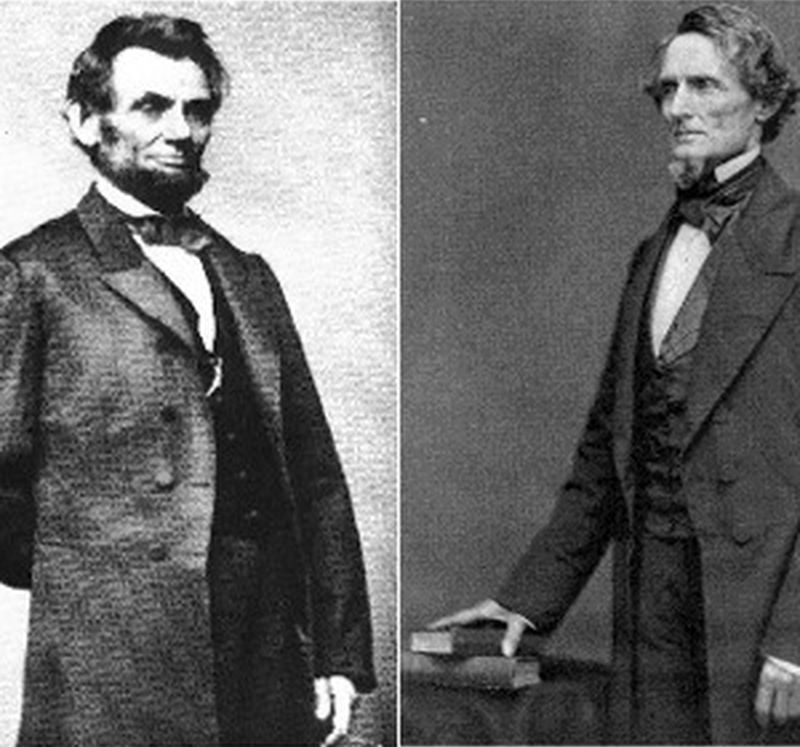
(Confederate President Jefferson Davis and President Abraham Lincoln)

One might ask if we need another book about the Civil War.  What angle might an author take that would appear new and consequential?  It appears that presidential historian  Nigel Hamilton, the author of a trilogy focusing on the presidency of Franklin D. Roosevelt, another on Bill Clinton, and finally one on John F. Kennedy has done so.  Further, Hamilton has also written a monumental multi-volume biography of British General Bernard “Monty” Montogomery and seems to have found his Civil War niche.  Hamilton’s latest effort entitled THE WAR OF PRESIDENTS: LINCOLN VS. DAVIS focuses on presenting a comparative biography of Abraham Lincoln and Jefferson Davis zeroing in on the first two years of the war and their viewpoints and actions.  Hamilton’s goal as he states in the preface is “to get into their warring minds and hearts – hopefully supplying enough context, meanwhile : to judge their actions and decisions, both at the time and in retrospect.” 

From the outset Hamilton raises an important question; how did the “rail-splitter” from Illinois grow into his critical role as Commander-in-Chief, and manage to outwit his formidable opponent, Jefferson Davis who was a trained soldier and Mexican War hero, while Lincoln, a country lawyer had served only briefly in the militia?  The answer  to this question is fully addressed by the author as he reaches a number of important conclusions, none more important than Lincoln’s refusal to name slavery as a cause and goal for the war in order to maintain border state loyalty and encourage a reunion with the Confederacy.  This was Lincoln’s mindset for two years as Hamilton relates his personal moral equation in dealing with slavery as he ultimately will change his policy and issue the Emancipation Proclamation in January 1863 freeing 3.5 million slaves without which the south could not fund their armed insurrection.  Once Lincoln made it clear the war was being fought over slavery European support for the south and diplomatic recognition necessary for the survival of the Confederacy would not be forthcoming – sealing the defeat of the south and the failure of Davis’s presidency.

William Seward

(Secretary of State William Henry Seward)

Hamilton’s methodology is to alternate chapters following the lives of both men.  From Davis’s arrival in the first Confederate capital in Montgomery, Alabama to Lincoln’s tortuous voyage avoiding assassination plots as he arrived in Washington, DC.  The key topics that Hamilton explores include a comparison of each president’s personality, and his political and moral beliefs including events, strategies, and individuals who played a significant role leading up to and the seizure of Fort Sumter.  These figures encompass role of Major Robert Anderson who commanded the fort and General Winfield Scott, who headed northern forces, the role of Lincoln’s cabinet particularly Secretary of State William H. Seward, who was seen by some as committing treason for his actions, Postmaster General Montogomery Blair who was against the war, and Secretary of War Edwin M. Stanton.  Hamilton goes on to lay out the catastrophe that was General George McClellan and his paranoia and refusal to take advantage of his overwhelming military resources and his incompetent “Peninsula Campaign.”

Hamilton does a wonderful job digging into the personalities of the major historical figures and how their actions influenced Lincoln and Davis and the course of the war.  The roles of McClellan, Fremont, Scott have been mentioned but the author also delves into the mindset of important military leaders such as Generals Joe Johnston, Pierre Beauregard, Stonewall Jackson, Irvin McDowell, and others.  Further, Hamilton also introduces a number of important sources that other historians have not mined as carefully.  For example, the diaries of State Department translator Count Adam Gorowski, a Polish aristocrat whose negative opinions of Lincoln are striking as it seemed Lincoln was unable to enforce the powers of his office and lack of military competence would have drastic consequences.  London Times war correspondent William Howard Russell’s opinions are explored in detail, in an addition to Elizabeth Keckley, a formerly enslaved woman who first served as a seamstress to Davis’s wife Varina, and later to Mary Todd Lincoln, and John Beauchamp Jones, a War Department clerk from Maryland who supported the Confederacy.

George McClellan, Portrait, Brady

(Commander of Northern forces, General George Brinton McClellan)

Hamilton’s view of Lincoln is rather negative for the first two years of the war as he writes, Lincoln, “had really no idea what he must do to win the war – or how to reconstruct a civil society in the slaveholding south, so dependent upon cotton, if he ever did.”  Interestingly, Davis wanted a defensive war to protect the deep south, he never favored a full blown civil war with the seizure of Washington, but was forced into it when more states seceded, he was called upon to protect them as they moved the Confederate capital to Richmond, Va.  Davis’ strategy was to bluff Lincoln until it was clear that McClellan’s Peninsula Campaign was foolish, then he went on the offensive. 

What sets Hamilton’s work apart from others is his writing style.  His narrative prose flows evenly and makes for a comfortable read.  His sourcing is excellent adding the latest documents and secondary sources available.   His integration of letters, diary excerpts, and other materials creates an atmosphere where the reader is party to conversations and actions between the main characters, i.e., Lincoln-McClellan interaction in person and in writing among many others.  Hamilton’s approach provides for subtle analysis, but he does not hold back, particularly in providing evidence for Lincoln’s mediocre performance as a military leader, who is overly worried about political issues.  This is evident in his approach to McClellan’s Peninsula campaign when the overland option driving south toward Richmond made much more sense than a complex amphibious strategy designed to go ashore in southern Virginia and drive north toward the Confederate capital.  By 1861 Hamilton argues that Lincoln seemed out of his depth as a military commander and appeared reluctant to make military decisions.  His reaction to John C. Fremont’s Emancipation Proclamation in Missouri is a case in point as he forced the General to rescind the order which was consistent with his refusal to have the issue of slavery affect the fighting.

Engraved portrait of John C. Frémont

(John C. Fremont- “The Pathfinder”)

Davis’ strategy was a simple one.  Fight a defensive war and gain European recognition for the Confederacy.  His problem was slavery was viewed negatively in European diplomatic circles.  Davis hoped that the need for cotton, necessitating England and France breaking through the northern blockade, would become more important than moral stances related to the enslavement of three and half million people.

Lincoln had difficulty accepting the fact it was slavery that allowed the Confederacy to fight as cotton provided the wealth to purchase weapons, slaves provided food to survive, and the overall manpower to run plantations when southern whites went off to fight.  Davis was fully aware of Confederate weaknesses; southern planters were against taxation, European recognition was not forthcoming, 5.5 million v. 23 million people, the extra expense and manpower to defend Kentucky and Virginia spreading his lines thinner and thinner until McClellan’s refusal to engage with superior forces provided Davis with a solution.

Perhaps Hamilton’s most important theme is “Lincoln’s eventual recognition in extremis, of his blunder would compel him, belatedly, to change his mind and agree to make the Confederacy’s use of millions of enslaved Black people – almost half the Southern population – a war issue.”  By doing so Lincoln poked holes through Davis’s southern fiction that the Confederacy had “a legal justification for mounting armed insurrection: defense of soil and family.”

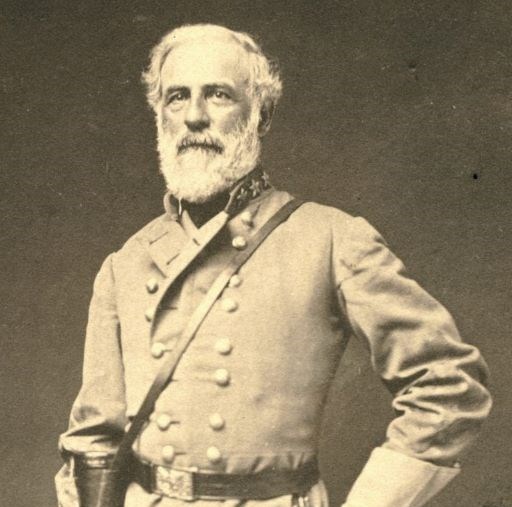
Robert E. Lee in a Confederate uniform.

(General Robert E. Lee, pictured here in 1863, never wore the Confederate uniform in this house. Three days after his resignation from the US Army, he was appointed commander in chief of Virginia’s military)

Hamilton argues that Davis did not defeat Lincoln because of hubris in the person of General Robert E. Lee who took Confederate troops north in 1862, and Davis’s failure to stop him.  Once the southern argument of self-defense was lost, Lincoln could finally pivot to his strongest position – emancipation.  Once the war became a conflict to end slavery, accepted by enough of the north, the south would lose hope of diplomatic recognition by European powers hungry for cotton.  The book will conclude on January 1, 1863, with the announcement of the Emancipation Proclamation.

Historian Louis P. Masur October 31, 2024, Washington Post book review of Hamilton’s work hits the nail right on the head as he writes: “Lincoln too would dramatically transform his side’s military strategy. Much to the dismay of abolitionists, and biographer Hamilton as well, Lincoln initially refused to take direct action to emancipate the enslaved in the Confederacy. Radical Republicans were especially enraged when, in September 1861, Lincoln forced Gen. John C. Frémont to rescind Frémont’s unauthorized order declaring martial law and freeing the enslaved in Missouri. Lincoln offered the legal and political argument that the order stood outside military necessity and served only to alienate the four slave states remaining in the Union, of which Missouri was one. Within a year, though, he decided on an Emancipation Proclamation that would liberate most of the enslaved people in the Confederacy; the multifaceted story of how he changed his mind, pieces of which are told in Hamilton’s book, is one of the most absorbing in all of Lincoln scholarship.

[BLANK]

(Secretary of War, Edwin M. Stanton)

“In truth,” Hamilton writes, “Lincoln had really no idea what he must do to win the war.” But “Davis had had no idea how to win the war, either.” These thoughts capture a truism — much of what we think about the past comes from understanding it backward. Neither Lincoln nor Davis, in the moment, knew what might work or what needed to be done or how to do it. This is why counterfactuals are so prominent in considerations of war. What if Lincoln had fired McClellan earlier? What if Davis had stopped Lee from invading Maryland? What if Lincoln had acted sooner against slavery? Hamilton is keenly attuned to the way hindsight can both enlighten and obscure, and he peppers the narrative with questions and retrospective speculations, sometimes excessively so.

There have been scores of books on Lincoln and Davis, but few that examine them jointly. Hamilton’s uncommon approach helps illuminate an observation once made by the historian David Potter, who suggested that “if the Union and the Confederacy had changed presidents with one another, the Confederacy might have won its independence.” The statement invites us to identify the qualities that distinguished Lincoln from Davis. There are many, but none more instructive than this: Over the course of four years, Lincoln grew into the job of president and commander in chief, whereas Davis remained set in his ways. This sweeping dual biography succeeds in dramatizing the reasons one triumphed and the other failed.”

(Mary Todd Lincoln and Varina Davis)

It is clear from Hamiliton’s monograph that the turning point in the Civil War did not take place on the battlefield per se.  Hamilton developed the Confederate strategy that in the end resulted in an invasion of the north through Maryland and an obnoxious Proclamation on the part of General Robert E. Lee.  Expecting Marylanders and Kentuckians to rally around the Confederacy, Lee and Davis were surprised when that did not come to fruition.  Once the south invaded the north, the rationale that the Confederacy was a victim of northern oppression was no longer valid and acceptable to European diplomats.  With the invasion of Maryland, Lincoln was driven into a corner and finally was willing to do something about slavery being the foundation for the Confederacy’s economy and military strength. Lincoln “bit the bullet” by employing the issue of millions of enslaved people as a military and moral issue.

His strategy was clear, the Emancipation Proclamation, freeing 3.5 million slaves as of January 1, 1863.  This would result in Europeans refusing to recognize the Confederacy with the war now being fought over slavery.  For Davis, it appeared the war would eventually be lost.  But it would be his decision to allow Lee to invade Maryland that drove Lincoln to the war of attrition.

 Hamilton has completed a remarkable work of narrative history with a unique approach which should be welcome to historians and Civil War buffs alike.

TARGETED BEIRUT: THE 1983 MARINE BARRACKS BOMBING AND THE UNTOLD ORIGIN STORY OF THE WAR ON TERROR by Jack Carr and James M. Scott

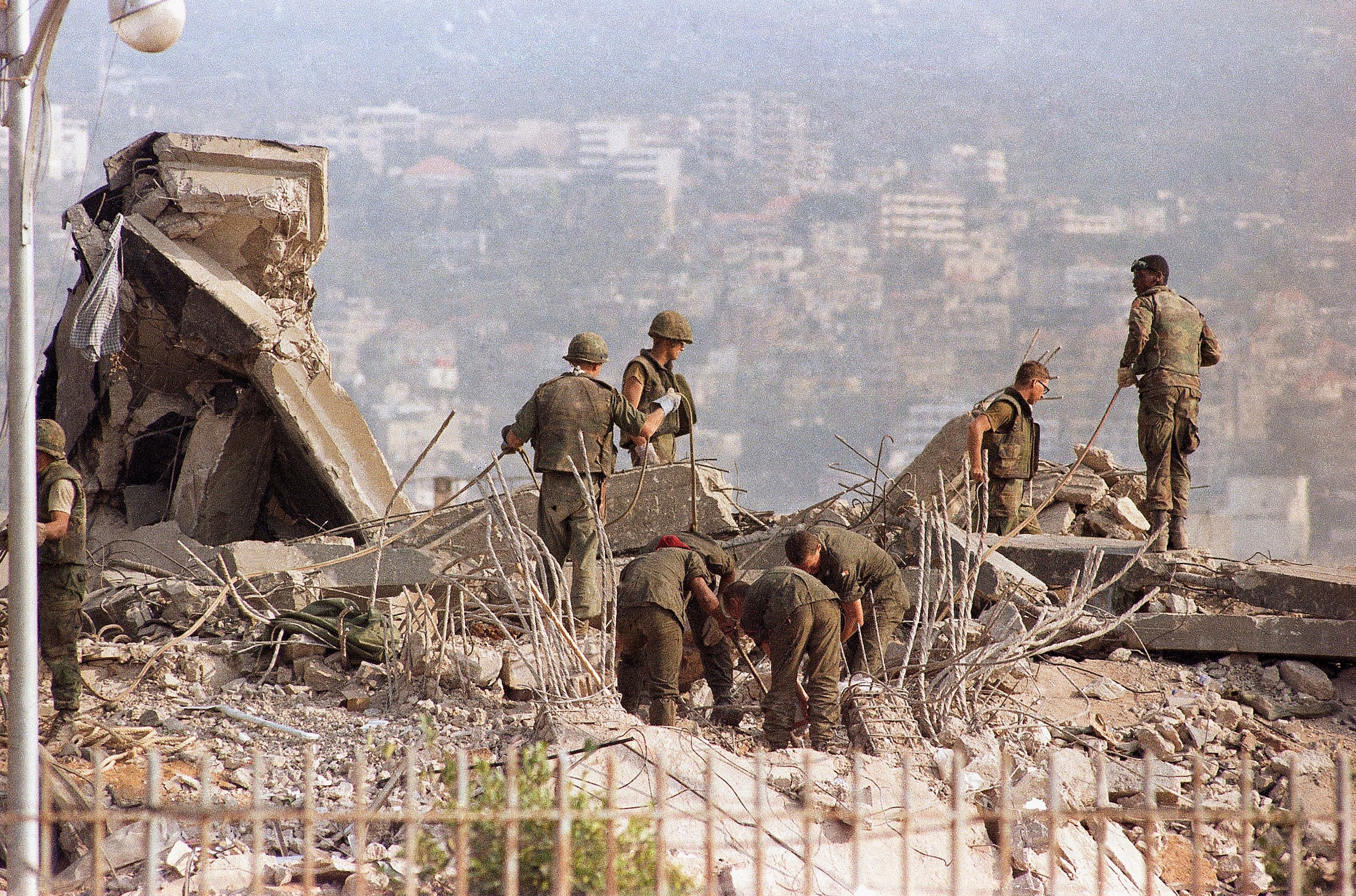
(The scene around the U.S. Marine Corps base near Beirut, Lebanon, following a massive bomb blast that destroyed the base on Oct. 23, 1983)

On October 7, 2023, Hamas launched an unspeakable terrorist attack on Israel killing over 1200 men, women, and children, and seizing over 200 hostages.  The Israeli response was a brutal attack of retribution that has led to the death of tens of thousands of Palestinians and the evisceration of a significant part of the Gaza Strip.  Acting as an ally of Hamas and an Iranian puppet, Hezbollah launched a campaign of rocket attacks against northern Israel which led to over 60,000 Israelis abandoning their homes in support of their ally.  Recently Israel assassinated Hezbollah’s leader, Hassan Nasrallah, and a number of other officials who were set to take his place.  Once Nasrallah passed from the scene Israel launched an invasion of southern Lebanon and bombed any area of Lebanon which it deemed a stronghold of Hezbollah, including Beirut. 

These events remind one of the 1982 Israeli invasion of southern Lebanon as history once again repeats itself fostering the creation of Hezbollah due to Israeli military and diplomatic errors.  The introduction of Hezbollah to the world scene caused by the Israeli invasion would lead to the terrorist attack against the American barracks and headquarters in Beirut which resulted in the death of 241 Marines.  The full story as to how and why this occurred and its impact on American foreign policy and the Middle East region and its effect on the families of the Marines who served  is the subject of a  new book by Jack Carr, a former US Navy Seal sniper and author, and historian James M. Scott entitled; TARGETED BEIRUT: THE 1983 MARINE BARRACKS BOMBING AND THE UNTOLD ORIGIN STORY OF THE WAR ON TERROR.

American Marines search for survivors and bodies in the rubble, all that was left of their barracks head quarters in Beirut, after a terrorist...

(Marines searching for bodies after the attack)

The approach the authors pursue in relating their subject is somewhat bifurcated.  The narrative is broken down into three parts.  First, half and the most important part of the monograph seeks to relate the background for the attack on the Marine barracks on October 23, 1983,  beginning with the attack on the American embassy on April 18, 1983, and the evolution of Washington’s “peacekeeping mission” in Lebanon designed to curtail the factional warfare between Christian and Islamic forces centered on Beirut.  The authors expand their focus on American decision making, the dangers Marines confronted as they carried out their mission, and the debate as to how the United states should respond to the plethora of sniper attacks, suicide bombings, and artillery shells that landed on the Beirut airport, the location of the Marine barracks.

In the next section, Carr and Scott describe the truck bomb attack in detail that resulted in the death of 241 Marines and another 158 wounded.  They focus on rescue and recovery reflecting on the horror and other emotions displayed by Marines and others who charged into the debris to try and locate survivors.  The concluding section of the narrative brings into clarity the response of the Reagan administration to the calamity unfolding in Beirut and the decision making that led to the American response to the crisis.  In addition, the authors describe the agony faced by families and a final evaluation of the errors perpetrated by the Reagan administration.

All in all, the book is a useful retelling of events and the response of participants, but apart from exploring the private lives of numerous Marines and their families the book does not present any new detail.  The main criticism of the book is at times it rests on secondary sources to present its story.  The book relies heavily on journalistic sources, particularly that of Thomas Friedman of the New York Times, and Robert Fisk, of the Times of London, among others.  Once the authors move on to Reagan administration decision making and later the emotional trauma faced by surviving family members, Carr and Scott primary sourcing improves as they rely on interviews with survivors and families who for many will not get over the tragedy.

An American Marine Second Lieutenant stands with his back to rescue workers swarming the ruins of the American embassy after a suicide bomber...

(The Marine barracks after the attack)

The key event that would lead to the massacre of the Marines was the Israeli decision to launch “Operation Peace for the Galilee,” which was supposed to remove Palestinian Liberation Organization forces from southern Lebanon and push them twenty five miles north to the Litani River.  Many events altered the Israel strategy as they moved beyond the river into West Beirut.  Exacerbating the situation was the assassination of Lebanese president Bashir Gemayel, a Maronite Christian from Syria and his replacement by his incompetent brother Amin.  Israeli actions fostered the further radicalization of Islamic Jihad and Islamic Amal with the assistance of Iran’s Revolutionary Guards.  Originally greeted as saviors from the PLO, the Shiites in southern Lebanon grew increasingly angry against Israeli occupation leading to constant violence as Maronite Christians under the guise of the Phalangists fought various Islamic factions, in addition to an ethnoreligious group, the Druze. As the horrors of war evolved an international peacekeeping force made up of Americans, French, and Italians arrived on August 25, 1982, which eventually would lead to disaster.

The authors spend a great deal of time explaining the debate in Washington as to the mission of American forces.  The United States wanted to be seen as a neutral entity to try and win over certain factions to try and create a government of reconciliation.  However, as the United States armed the Lebanese army, it became the victim of numerous mortar and sniper attacks placing Washington in a quandary – if it retaliated it would no longer appear neutral – if they did nothing the Marines would become “sitting ducks.”  Carr and Scott delve deeply into the debate within the Reagan administration with Assistant National Security advisor Robert McFarlane and Secretary of State George Schultz advocating a forceful response after diplomatic attempts to convince Syrian president Hafez El-Assad to withdraw his forces from the Bekaa Valley failed.  Secretary of Defense Casper Weinberger and Vice President George Bush opposed the use of force, and Lebanese policy became hostage to the interpersonal rivalries within the Reagan administration.  Reagan and his advisors had difficulty making the tough decisions that were called for as the situation deteriorated.  Historians are handicapped even after four decades as some critical meeting minutes and documentary details remain classified.

President Ronald and Nancy Reagan view the coffins of victims killed in a bomb explosion at the United States Embassy in Beirut, Lebanon.

(Reagans Viewing Bombing Victims’ Coffins)

Perhaps the best sources employed by the authors are the letters written by Marines to their families in the United States.  The fears and hopes of the soldiers are on full display and it lends itself to a very personal examination of the crisis.  Carr and Scott try to humanize their subjects as they describe family reactions, funerals, phone calls from President Reagan, but the bottom line is the family members, members of Congress, and certain elements within the Reagan administration could not fathom how American policy in Lebanon served any purpose. 

The authors delve into the lives of many individual soldiers in their narrative.  Among those who stand out are Colonel Timothy Geraghty who took command of Marine operations in Beirut on May 30, 1983, who opposed changing the rules of engagement even after the American embassy bombing and the increase in factional warfare.  Lieutenant John Hudson who headed medical operations with fifty naval corpsmen.  Drs. Gilbert Bigelow and James Ware, dentists who would take care of the local Lebanese and did yeoman work after the attack on the Marine barracks.  Rabbi Arnold Resnicoff, Father George Pucciarelli, and Chaplain Danny Wheeler did their best to maintain the spirits of the soldiers under their command and bring solace and comfort after the debacle and other situations.  Hussein al-Mosur who headed Islamic Amal and Imad Mughniyeh who headed Islamic Jihad.  The two organizations would unite and form Hezbollah, “the Party of God” who perpetrated the attack on the Marine compound with the assistance of Iran.  Many other portraits are offered particularly after attacks and the ultimate explosion at the Marine barracks.

The authors do an excellent job conveying the angst that troops felt as they were sequestered in bunkers as rocket fire against their positions was almost constant.  The anxiety is conveyed in their letters home as their compatriots were killed or wounded.  An insightful example is a letter from Dr. John Hudson to his wife that reflected his anger, fears, and honesty evaluating what he experienced as useless sacrifices.  Hudson believed the Marines were “sitting ducks,” particularly when the rules of engagement would not allow them to return fire.  There are many other letter excerpts that reflect the untenable position the Reagan administration placed their soldiers in.

Vehicles destroyed in the bombing of the armed motorcade of former Lebanese Prime Minister Rafik al-Hariri, sit on a street Monday, February 14 in...

Carr and Scott alternate chapters between events on the ground in Beirut with that of decision making in Washington.  The problem that comes to the fore is the lack of continuity between the two. To their credit the authors are successful in capturing the harsh reality of life in Lebanon during the period presenting heart rendering vignettes describing the lives of the Lebanese people.  In the end there was to be no large-scale US military operation targeting those responsible for the bombing.

The book is an important one because of the lessons learned and those that should be learned today.  The War on Terror did not begin until after September 11, 2001, however it was the 1983 bombing that was the precursor to a broader general global strategy to deal with terrorism.  The attack highlighted vulnerabilities in dealing with terrorist threats and greatly influenced the evolution of Washington’s counterterrorism goals.  In addition, the Israelis seem to be on the verge of repeating the errors of the early 1980s.  The Netanyahu government’s actions in southern Lebanon and Beirut may seem like victory, but since there does not seem to be an end game (as is the case in Gaza), Israel will foster the next generation of Hezbollah/Hamas types that will emerge. It seems every decade or so Israel plays Whack a mole which in the real world is not a substitute for concrete policy to achieve long lasting change or at a minimum a reduction of tension.

SIGN UP NOWSections

(The scene around the U.S. Marine Corps base near Beirut, Lebanon, following a massive bomb blast that destroyed the base on Oct. 23, 1983)

THE FRANCHISE: NEW YORK RANGERS, A CURATED HISTORY OF THE BLUESHIRTS by Rick Carpiniello

NCAA HOCKEY: JAN 11 Rivalry on Ice - Yale v Harvard

In the spring of 1994 Howie Rose’s call of Stephane Matteau’s game winning goal against the New Jersey Devils sent the New York Rangers to the finals for the Stanley Cup.   This would end the Blueshirts 54 year drought and was music to every tortured Ranger fan’s ears.  The season and playoff run were magical, but it would lead to another drought now reaching three decades.  For Ranger fans who lost the finals to the Los Angeles Kings in 2014, it has been a rough go, but the history of the organization has improved over the last few seasons, and many believe or hope that this could be the year that the Rangers hoist the Cup once again.  

Rick Carpiniello, a sports reporter for THE JOURNAL and THE ATHLETIC  from 1978 to 2021 new book THE FRANCHISE: NEW YORK RANGERS. A CURATED HISTORY OF THE BLUESHIRTS brings hockey to the forefront through a series of wonderfully reported essays about the organization’s championship close calls throughout the 1970s, finally winning the Cup in 1994, and its decline until the emergence of Henrik Lundqvist as the team’s goalie in  2012,  Carpiniello’s monograph is based on intimate knowledge of the franchise forged through extensive relations with the players, coaches, and other members of the organization.

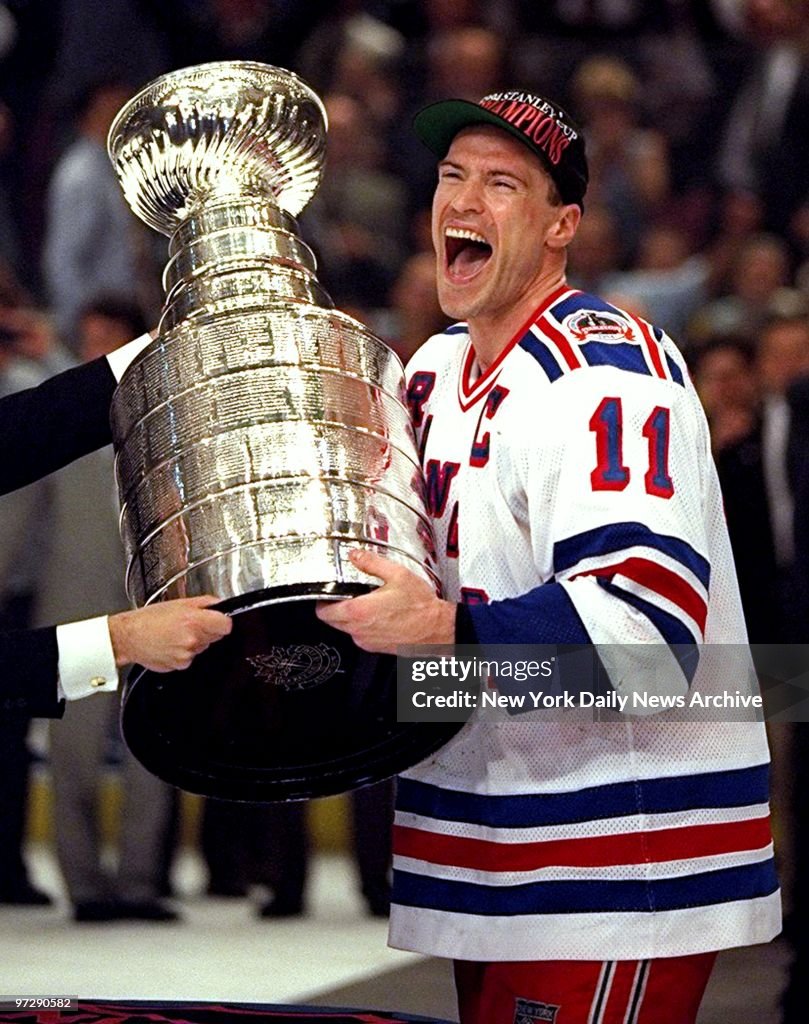
Captain Mark Messier receives the Stanley Cup after the Rang

(1993-94 season the New York Rangers win the Stanley Cup)

Perhaps the most interesting aspects of Carpiniello’s book are his character studies ranging from Rangers General Manager and Coach Fred Shero, flamboyant winger, Ron Duguay to current players like Norris Trophy Winger Adam Fox and Chris Kreider.  In each instance Carpiniello reaches for entertaining quotes, player opinions of different teams and players, team bonding, and the outrageous actions of different personalities.

Carpiniello begins with the famous 1978-9 season tease when it appeared the Rangers might finally break the curse that dated to 1940.  They had defeated the dreaded New York Islanders in a series that created the chant Ranger fans employ to this day of “Potvin sucks.”  However, despite defeating the Montreal Canadiens in the first game of the Stanley Cup finals, they went on to lose four straight providing Les Canadiens their fourth consecutive finals victory.

The author is right on as he describes the “disorganization of the organization” in the 1980s.  Ownership had opportunities to trade for Wayne Gretzky and Mark Messier much earlier than they finally did and refused.  They hired a series of general managers and coaches who either did not fit the profile of their jobs and made decisions which in many cases are hard to fathom.  Herb Brooks, the 1980 Olympic coach was a failure, Ted Sator was in over his head, Michel Bergeron was a bust, and Hall of Famer Phil Esposito, also known as “trader Phil,” made a series of poor trades and his record as a coach was not much better.  The key person was Craig Patrick who was a GM and coach but was gone by the late 1980s but drafted the likes of Brian Leetch and Mike Richter.  The savior of the 1980s was John Vanbiesbrouck, an excellent goalie who was in large part responsible for the few Ranger successes during the decade.    

New York Rangers vs New Jersey Devils

(Ranger defenseman Brian Leetch)

Carpiniello has a knack in developing stories about some interesting/flamboyant characters  in his narrative.  Names like Tie Domi, Joey Kocur, Ulf Samuelsson, perhaps the dirtiest player in hockey at the time, and Jeff Beukeboom come to mind. All were fighters, who had talented upside.  Other key personalities that the author weaves in and out of this monograph are Neil Smith, the GM who traded for Mark Messier and signed free agent Sadam Graves.  Smith would put together the team that finally won the cup under Mike Kennan’s leadership.  Kennan became head coach, when then coach Roger Neilson, another interesting personality could not get along with Messier and was fired.

Adam Graves New York Rangers Autographed Game Action 8x10 Photo

(Ranger wing Adam Graves)

Carpiniello brings back many forgotten memories.  A few that stand out include the switch in approach under Craig Patrick in the early 1980s from a mean fighting mentality to a skilled group of young players who were not large in stature nicknamed “the Smurfs.”   Another important individual was Mike Kennan, a hard ass, controversial coach who upon arriving at MSG felt the Rangers were a soft team.  Kennan immediately pushed to trade certain “soft” players who would go on to have tremendous careers with other teams.  Names like Mike Gartner, Tony Almonte, Darren Turcotte, and James Patrick come to mind.  No matter how much talent Kennan forced Smith to get rid of for second line players, in the end he molded the team by blending their talent and finally ending the “1940 chorus.”  Despite his success, Kennan was seen as a “bastard” held beyond contempt by many in the Ranger organization.  But, one must keep in mind it was Kennan who pushed Smith to acquire grinders like Matteau, Brian Noonan, and a bunch of Edmonton Oiler Stanley Cup champions.  

  • HENRIK LUNDQVIST NEW YORK RANGERS 8X10 SPORTS ACTION PHOTO (Y)
  • (Ranger goalie”King” Henrik Lundquist)

The book recounts the magical playoff run that culminated in winning the cup with wonderful anecdotes and player stories.  I remember exactly where I was the night they won and as many others have said “I can now die in peace!”  However, it was a short dynasty as a new curse and/or drought began the next season which carries on to this day.  To Carpiniello’s credit is description of the players, their talent and foibles for the next three decades is remarkable, and all I can say is god bless his memory! 

The post-Cup period saw the arrival of Wayne Gretzky, but at the same time they let Messier go.  Carpiniello is correct in describing the Ranger’s biggest problem as management as MSG president Dave Checketts who was in charge of the Knicks and Rangers knew nothing about hockey and it showed in his decision making.

Carpiniello digs deep into the second drought and the role of Glen Sather as GM and coach.  Sather who built the Edmonton Oilers would eventually be successful with the Rangers, but not until he finally made the correct draft and trade decisions, particularly a 7th round pick named Henrik Lundqvist who would backstop the team in goal for well over a decade beginning in the 2004-05 season.  During this period fascinating new characters came on the scene, particularly emblematic is Carpiniello’s description of John Tortorella, which is priceless.  The turnaround for the Rangers came in 2010-11 and from then on they were a sound playoff team which flirted with a cup run in 2013-14.

Chris Kreider Cam Talbot NY Rangers Wallpaper

(Ranger wing Chris Kreider)

At times, the author becomes emotional about certain players and events.  Perhaps the most poignant coverage deals with 9/11 and the reaction of the players and how they interacted with first responders and New Yorkers in general.   This aspect of the book reflects the wonderful working relationship that the author had with Ranger players.

In the latter part of the book Carpiniello zeroes in on two of the most important and creative approaches taken by the Ranger front office that coincided with a decline in the career of Henrik Lundquist.  After a successful run from the 2008-09 season to the 2013-14 Cup final season the team went through its famous rebuild  underscored by “the letter” to fans explaining the course the organization was about to take.  New leadership came aboard that included John Davidson as President, Jeff Gorton as GM, and David Quinn as coach.  Through a series of trades, i.e., acquiring Jacob Trouba, Ryan Lindgren, Mika Zibanejad, and  Adam Fox; signing free agents, i.e., Artemi Panarin; resigning Chris Kreider, and significant draft choices like K’Andre Miller and Igor Shesterkin the foundation was set for the current Ranger Roster.  When the rebuild did not progress as fast as he wanted, the impulsive Ranger owner, Dolan fired the three men who was responsible for the rebuild in large part to the machinations and violence perpetrated by Washington Capitals Tom Wilson, and brought in an entire new leadership team.

(Ranger wing Artemi Panarin, “the breadman!”

Overall, the book is a wonderful stroll down memory lane for Ranger fans with Carpiniello integrating wonderful vignettes, personal insights and observations which reflect a sense of humor, vast hockey knowledge, and a writing style that is easy to read.  If there is one negative in Carpiniello’s approach, at times his narrative comes across as somewhat disjointed as many of his stories and observations lack cohesiveness.  However, despite this minor criticism, the book is a wonderful gift for all Ranger fans.            

New York City Economy


FRANCE ON TRIAL: THE CASE OF MARSHAL PETAIN by Julian Jackson

At the trial of Marshal Philippe P��tain (1856-1951) at Paris (France). In July 1945.

(August 1945 Trial of Marshal Petain)

In 1969, the two-part documentary film, “The Sorrow and the Pity” directed by Marcel Ophuls depicting collaboration between the French Vichy government and Nazi Germany during World War II was released.  Controversial from the outset, the film explored the reasons behind the collaboration, including anti-Semitism, Anglophobia, fear of Bolshevism and Soviet invasion, and the desire to acquire and maintain power during the German occupation.  By the end of the war, the entire Vichy experience fostered a deep fissures in French society and no one depicted this state of affairs more than Marshal Philippe Petain, the great World War One hero at the Battle of Verdun who led the Vichy government and after the war became the lightning rod dealing with French collective guilt and retribution.

Petain is the focal point in British historian Julian Jackson’s latest work dealing with France during World War II entitled, FRANCE ON TRIAL: THE CASE OF MARSHAL PETAIN.  In his comprehensive monograph Jackson zeroes in on Petain’s three week trial after France was liberated examining the central crisis of French history in the 20th century – the collapse of France within six weeks after the Nazi invasion in April 1940; the signing of an armistice with Germany; and Vichy’s policy of collaboration.

Pierre Laval

(Pierre Laval)

Jackson begins his narrative providing a photograph of a picture of Petain and German Chancellor Adolf Hitler shaking hands on October 24, 1940, and describes the symbolic importance of that act- a propagandas coup for the Nazis and a shock for the French public. The result of that meeting meant that France was no longer a combatant in the war and was now considered neutral, though the French public assumed that the hero of Verdun must be working behind the scenes with the British or the French resistance led by General Charles de Gaulle.  As Petain’s trial would show, he was not working behind the scenes with anyone and was collaborating with the Nazis no matter what his defense attorneys would argue.  The word “collaboration” became controversial when used in a speech on October 11, 1945, no matter how many times Petain denied that characterization of his government, it is part of the historical record.

Jackson describes the trial which opened in Paris on July 23 and ended on August 15, 1945, in minute detail.  He offers unique portraits of the major characters ranging from Petain; his lawyers, Jacques Isorni and Fernard Payen who despised each other, the prosecution led by Public Prosecutor Andre Mornet and Pierre Bouchardon; to Charles de Gaulle, Pierre Laval, and numerous other personages which include collaborators, members of the wartime resistance, and the role of past and future politicians like Paul Reynaud, Leon Blum,  and Francois Mitterand.  Jackson relies on trial transcripts, archival research, and most importantly to convey the mood of France during the trial and after, contemporary journalistic accounts.

Paul Reynaud

(Paul Reynaud)

One of the key themes of the book was to decide whether Petain was a hero or a traitor.  Each side in the debate had its own agenda.  Some wanted to protect their reputations as many served the Vichy government, others wanted to maintain Petain’s reputation as the epitome of a French hero who had given his life in service to the French people.  Taking place after Liberation, the trial witnessed the return of many French persons returning from deportation and forced labor and the liberation of the Nazi concentration camps.  Many call this period as the “Epuration,” or purge of the French body politick as so many had worked with and for the Germans. 

Jackson draws a number of important conclusions drawn from interrogations of Petain.  First, his answers reflected “a mixture of evasiveness or forgetfulness, self-delusion, blame shifting or mendacity, and self-pity….,” with some believing what else could be expected from an eighty-eight year old man.  Since he was quiet at the trial, witness interrogation offered a glimpse as to what his real views were.  Third, Petain’s hatred for Charles de Gaulle is readily apparent, though their earlier careers saw them working together.  Fourth, his lawyers were at a disadvantage as Petain provided little to create a more positive narrative for the events between 1940 and 1944.  Defense attorney Isorni had to invent the Petain that he needed as he had little to work with.  Fifth, rivalries among former Vich courtiers remained intense, and lastly, when evidence emerged against Petain, blame would be shifted to Pierre Laval.

The Acte d”accusation zeroed in on Petain’s responsibility for signing the armistice on June 22, 1940, and three constitutional acts promulgated on July 11, 1940, which went beyond the powers that he had previously been given which lent credence to the idea that he was involved in a plot against the Republic before the war.  The second charge dealt with tracing Petain’s treason after July 1940; for example, contributing to the German war machine, allowing the Germans to use French airfields in Syria, and firing on allied troops in North Africa in November 1942.  Lastly, he was charged with being fully behind the “abominable racial laws” and creation of a special section to enforce them.  All in all, he was guilty of attacking the internal security of the state and colluding with the Nazis to favor his own ambition which correlated with those of the enemy.

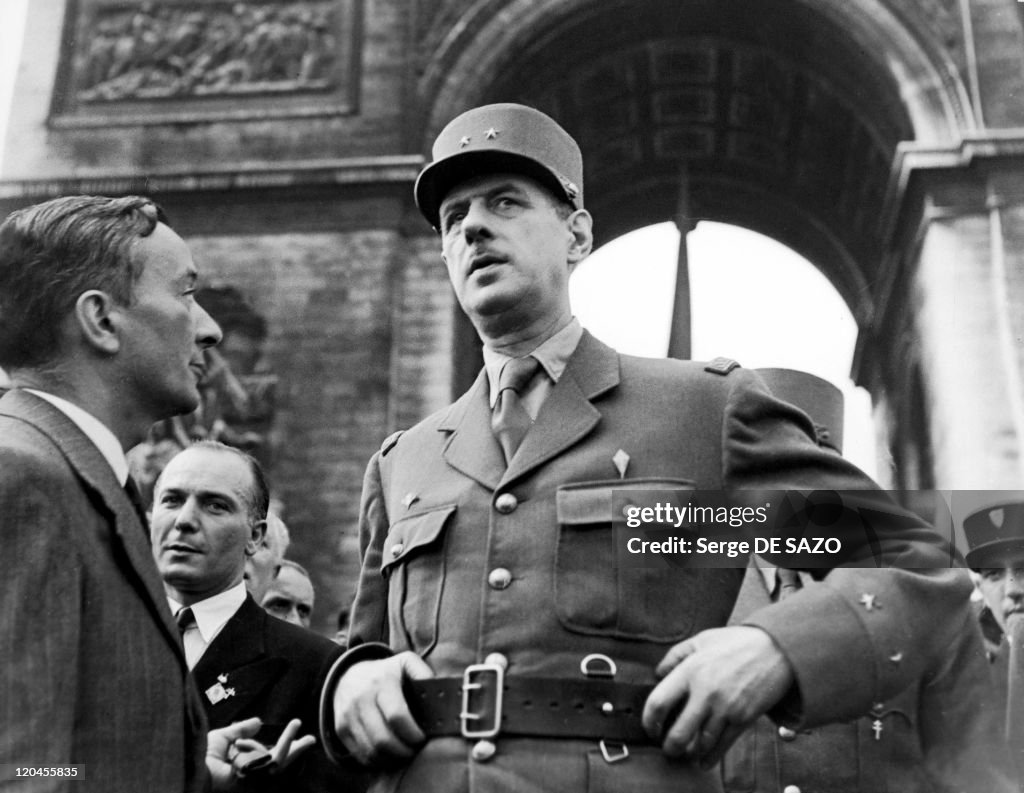
Charles De Gaulle And Georges Bidault In Paris, France On August 26, 1944 -

(Charles de Gaulle)

Jackson describes Petain’s demeanor during the trial which mostly appeared to be one of indifference, impassivity, as if he were in another world, though there were a few short outbursts defending himself.  Petain’s defense argued that by collaborating Petain “cunningly outwitted the Germans while allowing the subordinates to pursue a secret resistance .”  Further it was argued that Petain did not join the allies in North Africa after November 1942 because he believed his mission was to stay with his people.  Petain was therefore a “sacrificial martyr who supposedly had secret contact with the British and secretly supported the allied landing in North Africa in November 1942.  Lastly, Petain was not a “free agent,” he was answerable to Laval.  In the end this defense was not effective.

As far as the fate of the Jews is concerned, very little was mentioned at trial.  But, it is clear from the work of American historian Robert Paxton proves that under Vichy Jews were excluded from the civil service and other professions, the internment of Jews in the Unoccupied Zone, and the French carried out the arrest of Jews at the behest of the Germans.  Interestingly, Jackson points out as occurred in other countries when Jews returned to their homes after the war the atmosphere became poisonous as they tried to reclaim their property.   In fact, the Vichy Commissioner for Jewish Affairs, Louis Darquier (who Petain referred to as “the torturer), and the head of the French police during occupation, Rene Bousquet had no regrets concerning their role in sending Jews to Auschwitz and other camps.

An area of controversy discussed involves the United States which hoped to woo Vichy away from the Germans.  The US had diplomatic relations with Vichy and during the trial Washington was afraid that old wounds would be brought out, particularly French distrust for the United States.  Historian William Langer tried to whitewash the American relationship with Vichy, but Jackson, Paxton and others reported the truth of American complicity with Vichy.

Apart from the trial itself, Jackson vividly portrays the anguish of retribution as those who had collaborated with the Nazis found themselves spit upon, physically attacked, had their heads shaved, and criminally charged for their actions.  The period following the trial makes up a quarter of the book whereby the author describes how Petain’s supporters continued to fight to resurrect his reputation and place in history, even after he died and is buried on the French island of Il’ Yeu. 

François Mitterrand

(Francois Mitterand)

After the trial ended and Petain was imprisoned on the island the physical trial may have ended for Petain, but not for France.  Petainists and anti-Petainists continued the arguments presented at trial through various organizations, publications, and the personal agendas of many.  One of the more interesting characters was Charles De Gaulle who seemed to want the support of both sides.  Isorni continued the fight trying to exhume Petain’s body and have it moved to the national cemetery at Douaumont to be buried with other heroes of Verdun and petitioning for a new trial to overturn Petain’s conviction.  Petain remained a “political football” for decades after his death forcing politicians to make decisions which remained problematic as many French persons refused to let his actions go undefended.

It is clear that what is referred to as France’s “darkest hours” according to Agnes Poirier in her The Guardian, review of June 11, 2023, was one of cowardice, bad faith, dishonor and moral ambivalence.”  I agree with her further characterization that “what is chilling in Jackson’s beautifully researched and meticulous account of the trial is the hopeless mediocrity of almost all people involved in it: from judges and jurors (résistants and parliamentarians) to lawyers’ prosecutors and witnesses. Everybody seemed animated by petty or self-serving feelings; they were either out of their depth or spineless, but above all most were morally ambivalent. Before it began, De Gaulle had presciently talked of Pétain’s trial as a ‘lamentable but inevitable’ event.”  If you have an interest in exploring France’s greatest moral downfall in its modern history then Jackson’s comprehensive efforts should satisfy. 

“As Jackson explains: “De Gaulle knew he was on thin ice when claiming that Vichy was illegal. For that reason, he generally preferred to talk about legitimacy.” In the end, the difference between Petain and De Gaulle, between Vichy and the Free French, was their idea of honor. France’s duty had been to fight on whatever the risks, whatever the sacrifices. De Gaulle and his army of resistance saved France’s honor by the skin of their teeth. And as far as this French citizen is concerned, Petain and his clique can rot in hell for eternity.”

Petain Trial 1945

(August 1945 Trial of Marshal Petain)

Can Democracy be Saved? Comparing the 1917-1921 and 2017-2021 Periods

I will be teaching a mini-course dealing with the above title. If anyone is interested I have posted this course description and brief bibliography.

Steven Z. Freiberger, Ph.D

www.docs-book.com

George Santayana has stated: “Those who cannot remember the past are condemned to repeat it,” it is as true today as it has been at any time in our history. Catastrophic warfare, plague, racism, anti-immigration, political divisions bordering on violence are all present today, but it is not an aberration in American history. The purpose of this class is to explore a unique comparison between our current situation and a similar one that existed roughly a century ago. Subjects such as World War I, the presidency of Woodrow Wilson, anti-immigration attitudes resulting in violence, lynchings, political repression involving over 1000 arrests, people accused of treason etc., sound familiar? All will be compared to our contemporary life and how America emerged from this cataclysm a hundred years ago, and hopefully how can be reengaged and overcome what we face today. While lecture-based, the course will rely on a great deal of class discussion.

Classes:

April 19, 2023      1917-1921: Woodrow Wilson’s administration, World War I and its Aftermath,           

                               and the Rise of Intolerance in American Politics and Society.

April 26, 2023      2017-2021: Donald Trump’s administration, the Bifurcation of America, and its             

                               Impact for the Future.

May 10, 2023      Psychological Profile of Donald Trump

BRIEF BIBLIOGRAPHY:

Abutaleb, Yasmeen; Paletta, Damian. NIGHMARE SCENARIO: INSIDE THE TRUMP ADMINISTRATION’S RESPONSE TO THE PANDEMIC THAT CHANGED HISTORY

Akerman, Kenneth D. THE YOUNG J. EDGAR HOOVER, THE RED SCARE, AND THE ASSAULT ON CIVILIBERTIES

Alexander, Dan. WHITE HOUSE, INC.: HOW DONALD TRUMP TURNED THE PRESIDENCY INTO A BUSINESS

Avrich, Paul. SACCO AND VANZETTI: THE ANARCHIST BACKGROUND

Avrich, Paul and Karen. SASHA AND EMMA

Baker, Peter; Glasser, Susan. THE DIVIDER: TRUMP IN THE WHITE HOUSE 2017-2021

Barnes, Harper. NEVER BEEN A TIME: THE 1917 RACE RIOT THAT SPARKED THE CIVIL RIGHTS MOVEMENT

Berg, Scott. WILSON.

Brands, H.W. WOODROW WILSON

Coben, Stanley. A. MITCHELL PALMER: POLITICIAN

Cooper, John Milton, Jr. WOODROW WILSON

Davis, Julie Hirschfeld; Shear, Michael D. BANNED: INSIDE TRUMP’S ASSAULT ON IMMIGRATION

Draper, Robert. WEAONS OF MASS DELUSION: WHEN THE REPUBLICAN PARTY LOST ITS MIND

Fleming, Thomas. THE ILLUSION OF VICTORY: AMERICA IN WORLD WAR I

Ginger, Ray. THE BENDING CROSS: A BIOGRAPHY OF EUGENE VICTOR DEBS

Guerrero, Jean. HATEMONGER: STEPHEN MILLER, DONALD TRUMP AND THE WHITE NATIONALIST AGENDA

Haberman, Maggie. CONFIDENCE MAN: THE MAKING OF DONALD TRUMP AND THE BREAKING                    OF AMERICA.

Heckshear, August. WOODROW WILSON: A BIOGRAPHY

Hochschild, Adam. AMERICAN MIDNIGHT: THE GREAT WAR, A VIOLENT PEACE, AND DEMOCRACY’S FORGOTTEN CRISIS

House Judiciary Committee. THE JANUARY 6TH REPORT

Isikoff, Michael; Corn, David. RUSSIAN ROULETTE: THE INSIDE STORY OF PUTIN’S WAR ON AMERICA AND THE ELECTION OF DONALD TRUMP

Johnston, David Cay. THE MAKING OF DONALD TRUMP

Krehbiel, Randy, TULSA 1921

Lee, Brandy, M.D. THE DANGEROUS CASE OF DONALD TRUMP

Lee, Phyllis Lee. EDITH AND WOODROW: THE WILSON WHOTE HOUSE

Lemire, Jonathan. THE BIG LIE: ELECTION CHAOS, POLITICAL OPPORTUNISM, AND THE STATE OF AMERICAN POLITICS AFTER 2020

Leonnig, Carol; Rucker. I ALONE CAN FIX IT: DONALD J. TRUMP’S CATASTROPHIC FINAL YEAR

Madigan, Tim. THE BURNING: MASSACRE, DESTRUCTION, AND THE TULSA RIOT OF 1921

MacMillan, Margaret. PARIS 1919: THE SIX MONTHS THAT CHANGED THE WORLD

McAdams, Dan P. THE STRANGE CASE OF DONALD J. TRUMP: A PSYCHOLOGICAL RECKONING

McLaughlin, Malcom. POWER, COMMUNITY AND RACIAL KILLING IN EAST ST. LOUIS

Miller, Nathan. NEW WORLD COMING: THE 1920S AND THE MAKING OF MODERN AMERICA.

Murray, Robert K. THE RED SCARE: A STUDY IN NATIONAL HYSTERIA, 1919-1920

Okrent, Daniel. THE GUARDED GATE: BIGOTRY, EUGENICS AND THE LAW THAT KEPT TWO GENERATIONS OF JEWS, ITALIANS, AND OTHER EUROPEAN IMMIGRANTS OUT OF AMERICA

O’Brien, Tim. TRUMP NATION: THE ART OF BEING THE DONALD

O’Toole, Patricia. WOODROW WILSON AND THE WORLD HE MADE. 

Schier, Steven. THE TRUMP EFFECT: DISRUPTION AND ITS CONSEQUENCES FOR US POLITICS AND GOVERNMENT                                                      

Schmidt, Michael. DONALD TRUMP: THE UNITED STATES: INSIDE THE STRUGGLE TO STOP A PRESIDENT

Stelter, Brian. HOAX: FOX NEWS AND THE DANGEROUS DISTORTION OF TRUTH

Unger, Craig. THE HOUSE OF TRUMP THE HOUSE OF PUTIN

Washington Post. THE MUELLER REPORT

Weissmann, Andrew. WHERE LAW ENDS: INSIDE THE MUELLER INVESTIGATION

Woodward, Bob, Costa, Robert. PERIL

THE WAR IN UKRAINE: A PRELIMINARY BIBLIOGRAPHY

Building in Mykolaiv, Ukraine, have been severely damaged by Russian shelling.
(Mykolaiv, Ukraine)

This Fall I will be teaching a course for OLLIE, part of the University of New Hampshire extension program.  The class will deal with the current war in Ukraine and will explore the Collapse of the Soviet Union; Vladimir Putin: A Profile; the Expansion of NATO; and the current war in Ukraine.  I am preparing a bibliography and I am posting it in case anyone might be interested.

Applebaum, Anne RED FAMINE: STALIN’S WAR ON UKRAINE

Aron, Leon YELTSIN: A REVOLUTIONARY LIFE

Ben-Ghiat, Ruth STRONGMEN: MUSSOLINI TO THE PRESENT

Belton, Catherine PUTIN’S PEOPLE: HOW THE KGB TOOK BACK RUSSIA AND THEN TOOK ON THE WEST

Browder, Bill FREEZING ORDER: A TRUE STORY OF MONEY LAUNDERING, MURDER, AND SURVIVING VLADIMIR PUTIN’S WRATH

__________. RED NOTICE: A TRUE STORY OF HIGH FINANCE, MURDER AND ONE MAN’S FIGHT FOR JUSTICE

Burgis, Tom KLEPTOPIA

Colton, Timothy J. YELTSIN: A LIFE

Dawisha, Karen PUTIN’S KLEPTOCRACY

Clover, Charles BLACK WIND, WHITE SNOW: THE RISE OF RUSSIA’S NEW NATIONALSIM

D’ Anieri, Paul UKRAINE AND RUSSIA: FROM CIVILIZED DIVORCE TO UNCIVIL WAR

Feifer Gregory THE GREAT GAMBLE: THE SOVIET WAR IN AFGHANISTAN

Freeland, Chrystia THE SALE OF THE CENTURY: THE INSIDE STORY OF THE RUSSIAN REVOLUTION

Gessen, Masha THE MAN WITHOUT A FACE: THE UNLIKLEY RISE OF VLADIMIR PUTIN

____________. THE FUTURE IS HISTORY: HOW TOTALITARIANISM CLAIMED RUSSIA

____________. SURVIVING AUTOCRACY

Goldman, Marshall L. PETROSTATE: PUTIN, POWER, AND THE NEW RUSSIA

A woman attends military training for reservists
(Ukrainaian civilians fight)

Gorbachev, Mikhail MEMOIRS

Hill, Fiona THERE IS NOTHING FOR YOU HERE: FINDING OPPORTUNITIES IN THE                          21ST CENTURY.

Hill, Fiona; Gaddy, Clifford G. MR. PUTIN: OPERATIVE IN THE KREMLIN

Judah, Ben FRAGILE EMPIRE: HOW RUSSIA FELL IN AND OUT OF LOVE WITH VLADIMIR PUTIN

Knight, Amy ORDERS TO KILL: THE PUTIN REGIME AND POLITICAL MURDER

Koffler, Rebekah PUTIN’S PLAYBOOK: RUSSIA’S SECRET PLAN TO DEFEAT AMERICA

Myers, Steven L. THE NEW TSAR: THE RISE AND REIGN OF VLADIMIR PUTIN

Plokhy, Serhii THE GATES OF EUROPE: A HISTORY OF THE UKRAINE

___________.­­­THE LAST EMPIRE: THE FINAL DAYS OF THE SOVIET UNION

Pomerantsev, Peter NOTHING IS TRUE AND EVERYTHING IS POSSIBLE

Sarotte, M. E. NOT ONE INCH: AMERICA, RUSSIA, AND THE MAKING OF THE POST-WAR STALEMATE

Service, Robert KREMLIN WINTER: RUSSIA AND THE SECOND COMING OF VLADIMIR PUTIN

Stent, Angela PUTIN’S WORLD: RUSSIA AGAINST THE WEST AND WITH THE REST

Short, Philip PUTIN* (to be published July 26, 2022)

Stent, Angela PUTIN

Snyder, Tim BLOODLANDS: EUROPE BETWEEN HITLER AND STALIN

____________. THE ROAD TO UNFREEDOM: RUSSIA, EUROPE, AMERICA

____________. ON TYRANNY

Taubman, William GORBACHEV: HIS LIFE AND TIMES

Yaffaf, Joshua BETWEEN TWO FIRES: TRUTH, AMBITION, AND COMPROMISE IN

PUTIN’S RUSSIA

Volkogonov, Dmitri AUTOPSY FOR AN EMPRE: THE SEVEN LEADERS WHO BUILT THE SOVIET REGIME

Vindman, Alexander HERE, RIGHT MATTERS: AN AMERICAN STORY

Yovanovitch, Marie LESSONS FROM THE EDGE: A MEMOIR

Zhadan, Serhiy MESOPOTAMIA

_____________.  THE ORPHANAGE

Zubok, Vladisslav M. A FAILED EMPIRE: THE SOVIET UNION IN THE COLD WAR FROM STALIN TO GORBACHEV_____________. COLLAPSE: THE FALL OF THE

(Irpin, Ukraine)