AMERICA’S WAR FOR THE GREATER MIDDLE EAST: A MILITARY HISTORY by Andrew Bacevitch

(Statue of Saddam Hussein in Baghdad, following the US invasion of 2003)
As a student of history over the years I have studied and taught the 100 Years War between England and France in the 14th and 15th centuries, the 30 Years War in western and central Europe in the 17th century, and now Andrew Bacevitch suggests the 40 Years War in the Middle East that began in the 20th century and continues to this day.  Bacevitch, a former career soldier and professor of history at Boston University, has written a number of important books on American foreign and military policy including BREACH OF TRUST, WASHINGTON RULES, AND THE LIMITS OF POWER explains in his new book, AMERICA’S WAR FOR THE GREATER MIDDLE EAST: A MILITARY HISTORY that the United States has been engaged in a war in the region that dates back to 1979 and is still ongoing.  He has labeled this continuous struggle, the 40 Years War in which the United States has been involved in conflict in Iran, Iraq, Afghanistan, the Balkans, Somalia, Libya, and Yemen.  After reading his latest work two questions come to mind.  First, over the period discussed in the book, did the United States ever have an actual strategy?  Second, did American military supremacy obviate the need for a strategy?  After exploring Bacevich’s narrative the answer is a resounding no to the first question, and yes to the second as successive administrations relied on the latest military technology to achieve its goals as it careened from one crisis in the region to the next.  For example, Bacevich describes President Clinton’s policy in the Balkans in the 1990s as “intervention by inadvertence,” and the NATO air campaign in the same region as “military masturbation.”  Further, after discussing President George H.W. Bush’s approach to dealing with Saddam Hussein after forcing the Iraqi dictator out of Kuwait in 1991, Bacevitch describes United States policy as “occupation by air,” setting up “no-fly zones” rather than instituting a realistic approach to dealing with the situation on the ground.

A handout photo of Saddam Hussein after his capture is seen December 14 2003 in Iraq US troops captured Saddam Hussein near his home town of Tikrit...

(Saddam Hussein after his capture in 2003)

Bacevitch’s work is provocative and reflects the ability to synthesize a great deal of information in developing sound conclusions.  The author constructs a narrative that encompasses the period 1979 to the present as he explains the origins of American involvement in the region and how it fostered the “Greater War in the Middle East.”  As he does so he develops his arguments like a prosecutor at an evidentiary hearing as he dissects the approach taken by five presidential administrations.  He carefully crafts his thesis in a step by step approach as each event builds on the next and how they are linked to produce the idiocy of American policy.  As each building block is presented, Bacevitch digresses to compare policy decisions for the Middle East with other somewhat comparative situations in American history from the American Revolution, the Civil War, Spanish-American War, World War I and II, and the Vietnam War creating interesting parallels.  What is clear from Bacevitch’s narrative is that in many cases American decision makers repeatedly reached conclusions in a vacuum that reminds one of Kurt Vonnegut’s “cloud cuckoo land.”

As the author traces America’s “War for the Greater Middle East” what becomes clear is the lack of a coherent strategy.  Administration after administration succumbed to fallacies of their own making.  Jimmy Carter hoped to develop a new foreign policy agenda of alleviating Third World poverty, resolving the Arab-Israeli conflict, and eliminating nuclear weapons.  This agenda would be shattered by the Iranian revolution and a president who “lacked guile, a vulnerability that, once discovered, his adversaries at home and abroad did not hesitate to exploit.”  Bacevitch provides an astute analysis of Carter’s overall foreign policy, focusing mostly on Iran and Afghanistan.  Carter concerned for his own reelection would auger in the “Greater War in the Middle East” by announcing the Carter Doctrine which stated that “an attempt by any outside force to gain control of the Persian Gulf region will be regarded as an assault on the vital interests of the United States of America, and such an assault will be repelled by any means necessary, including military force.”  Wonderful in theory, but American fecklessness was on full display in the Iranian Desert in April 1980 as it seemed that American planes and helicopters were playing bumper cars.

Iran hostage crisis - Iraninan students comes up U.S. embassy in Tehran.jpg

(Iranian students seize the American Embassy in Teheran, 1979)

The problem with the Carter Doctrine and subsequent American policy under Ronald Reagan is that it was based on the false premise that the Soviet Union coveted the Persian Gulf and possessed the will and capacity to seize it.  The American response was the creation of a new command for the region called CENTCOM.  Though created to deal with the Soviet threat, CENTCOM would provide the United States with a platform to launch and continue its wars in the region.  What was also very troubling is that CENTCOM paid little attention to the Shi’ite-Sunni divide, the Arab-Israeli conflict, and the climate of the region in its planning.  As the Cold War drew to a close, the Reagan administration shifted its focus from the Soviet Union to Iraq as public enemy number one, and did not take into account that state actors were not the only enemies that confronted the United States.  For Reagan, Afghanistan seemed like a major victory as we contributed to the defeat of the Soviet Union.  Another victory was supposedly achieved as we backed both sides in the First Persian Gulf War between Iran and Iraq, a policy we would pay heavily for in the future.  But in endorsing the Carter Doctrine in stepping up American military activity in the region we achieved little of lasting benefit and over time we created an incubator for terrorism that drew the United States into a quagmire later on.  As Bacevitch points out, by supporting the Mujahidin we helped foster Islamic radicalism and with our support Pakistan became a nuclear power.  Further, by meting out punishment to Libyan dictator Moamar Gaddafi it led to bombings in Berlin killing American soldiers and German civilians and the downing of Pan Am flight 103 over Scotland and the death of hundreds of Americans.  The Reagan administration was not just content with an erroneous approach in Afghanistan and Libya, its policy toward Lebanon was hard to fathom resulting in two separate incursions into the Beirut area resulting in further radicalizing Hezbollah and causing the death of 241 Marines.  When the United States withdrew from Lebanon and engaged in the Iran-Contra scandal it reflected American ignorance, ineptitude, and a lack of staying power that Islamists would take note of for the future.

(President Obama’s weapon of choice, drone aircraft over Afghanistan firing Hellfire missiles)

Bacevitch is correct in arguing that the end of the Cold War provided the United States with a freedom of action that it had not enjoyed since the mid-1940s allowing George H.W. Bush to expel Saddam Hussein from Kuwait.  The second Persian Gulf War, was a proxy war against a past to eradicate feelings of inadequacy induced by Vietnam.  This was reflected in the rhetoric surrounding the conflict and commentary evaluating America’s technological and military superiority as we crushed Saddam’s forces.  As much as the war seemed a success American intervention would produce conditions that were conducive to further violence and disorder.  Once Saddam was expelled the United States had no real plan for the post-war situation.  Substantial elements of the Republican Guard remained intact, and Shi’ites and Kurds rose up against Saddam.  Bacevitch points out that a myth developed concerning the 1990s as a relatively peaceful decade for the United States in the region.  This myth was fostered by the supposed success of “Operation Desert Storm.”  However, almost immediately the plight of the Kurds led to a “no-fly zone” in the north, and Saddam’s revenge against Shi’ites led to a “no-fly zone in the south.”  In effect the United States occupied Iraq in the air and flew thousands upon thousands of sorties in the 1990s to control Saddam’s forces.  Once Bush left office Bill Clinton continued the Bush approach of the gap between raw military power and political acuity.  In confronting events in the Balkans and Somalia, the United States widened the “Greater War for the Middle East.”  The United States sought to protect Muslims in Bosnia and Kosovo from the Serbs, as well as the Somali people from murdering warlords, but as in most instances the “commitment of raw military power might get things off to a good start, a faulty grasp of underlying political dynamics leaves the United States susceptible to ambush, both literal and figurative.”

Bacevitch digs deep in his analysis integrating American military strategy, the theoretical arguments between military men and their civilian overseers, as well as the application of strategies developed for the battlefield.  Bacevitch explains military concepts in a very understandable manner and the conclusion one reaches is that conceptually American military planners were repeatedly off base in their approach.  Bacevitch’s description of the cast of characters involved is very important and insightful.  Whether discussing Generals Norman Schwarzkopf, Tommy Franks, Stanley McChrystal, David Petraeus, or others, the reader is exposed to personalities and egos that dominated military policy planning and implementation in an overly honest and blunt fashion.

(February, 1993 bombing of the World Trade Center in New York City)

Bacevitch leaves his most scathing analysis of American policy for the George W. Bush and Barrack Obama administrations.  As the 1990s evolved with terrorist spectaculars at the World Trade Center in 1993, Khobar Towers in Saudi Arabia in 1996, attacks in Kenya and Tanzania in 1998, the outgoing Clinton administration explained that these events resulted from American leadership responsibilities in the world, and because we acted to advance peace and democracy.  This explanation as most offered by the government during the period under discussion were “designed not to inform but to reassure and thereby to conceal.”  The “Greater War for the Middle East” now widened to include Osama Bin-Laden and al Qaeda.  As the United States exaggerated the threat it posed, it ignored the underlying circumstances that created it.  What developed was a pattern, if we could decapitate al Qaeda and kill Bin-Laden all problems would be solved.  We tried that with Saddam Hussein in Iraq and Moamar Gaddafi in Libya and look what resulted.  For the United States “policy formulation was becoming indistinguishable from targeting.”
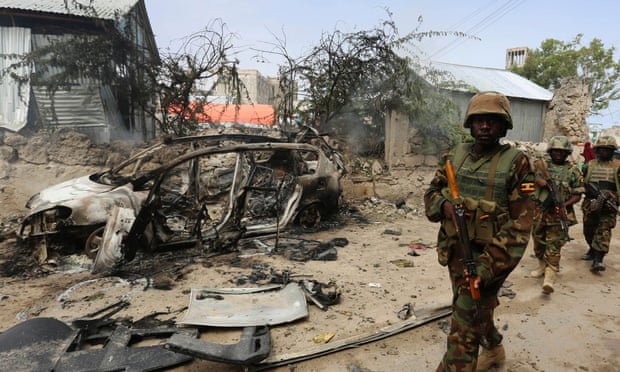
(US bombing of al Shabaab, an al Qaeda offshoot in Somalia)

After 9/11 the United States immediately shifted from crushing al Qaeda and the Taliban in Afghanistan to the invasion of Iraq.  Bacevitch argues that the Bush administration was fixated on Saddam Hussein, and did not accept or ignored the fact that the battle in Afghanistan was far from over.  Afghanistan reverted to the back burner, another “phony war” that the United States ignited, but failed to carry to fruition and let simmer.  Many have pondered why the United States invaded Iraq – was it about oil, weapons of mass destruction, or humanitarianism?  Bacevitch correctly places these reasons aside and concentrates on the American intent on establishing the efficacy of preventive war.  Washington was going to assert the prerogative that no other country had – overthrowing any government the United States found wanting or as it is better known as, the Bush Doctrine.  This premise was based on the fallacious conclusion that the Islamic world could easily adapt to democracy, limited government, a market economy, and respect for human and woman’s rights no matter what their opponents argued.  For the Bush administration Saddam and Iraq fit this paradigm perfectly.  The United States invaded Iraq not because of the danger it posed, but because of the opportunity it presented.  Bacevitch explores in detail all the key aspects of the war from its outset, to the capture of Saddam, the Shi’ite-Sunni civil war, to the “surge,” and again what is clear is American incompetence be it the fault of Bush, Cheney, Rumsfeld, Bremmer, Franks, or others.

Bacevitch’s overall evaluation of the Obama administration’s Middle East policy is harsh, but extremely accurate as the President seemed to continue Bush policies. First, Obama was committed to the withdrawal of American troops by the end of the 2011 deadline that Bush had negotiated with the Iraqi government.  However, as troops returned home from Iraq, many made a “U-turn” and were sent to Afghanistan, or for many who were redeployed once again to Afghanistan!  During the Obama years the “Greater War for the Middle East” was confronted by three important changes that had major implications.  First, after almost 40 years of war, an “Iraqi Syndrome” developed with the reluctance to put American troops in harm’s way.  Second, the turmoil from the Arab Spring.  Lastly, the chasm that developed in American-Israeli relations.  Obama has had a great deal of difficulty navigating these changes.  A surge was tried that accomplished little but increasing American casualties.  Support for aspects of the Arab Spring resulted in little improvement in Egypt and other Arab autocracies.  Problems with Israel became a partisan political football in both countries and an inability of leaders to work with each other.  Further, the Obama administration resorted to decapitation in Libya that has been disastrous.  Finally, the administration dithered over the civil war in Syria and looked foolish when it did little to enforce its own “red line.”  It seems that Obama’s strategy is wrapped up in special operations and drone attacks, not really conducive to improving America’s reputation in the region and the overall Islamic world.

In closing, Bacevitch has written an extremely important book that policy makers should consult very carefully.  Granted, the author has had the benefit of historical hindsight in preparing his arguments.  But one cannot negate the intelligent conclusions he puts forth.  If you would like to gain insight and understanding of the 40 Year War, consult Bacevitch’s narrative because as events in Libya, Syria, and Yemen continue, it does not seem as if this war is going to end in the foreseeable future.  As Bacevitch states in his conclusion; the perpetuation of the “War for the Greater Middle East” is not enhancing American freedom or security.  It is accomplishing the opposite, but hopefully one day the American people will wake up from their slumber regarding its prosecution.  Until that time the wars in the region will not come to an end.

(Statue of Saddam Hussein in Baghdad after US invasion of Iraq in 2003)
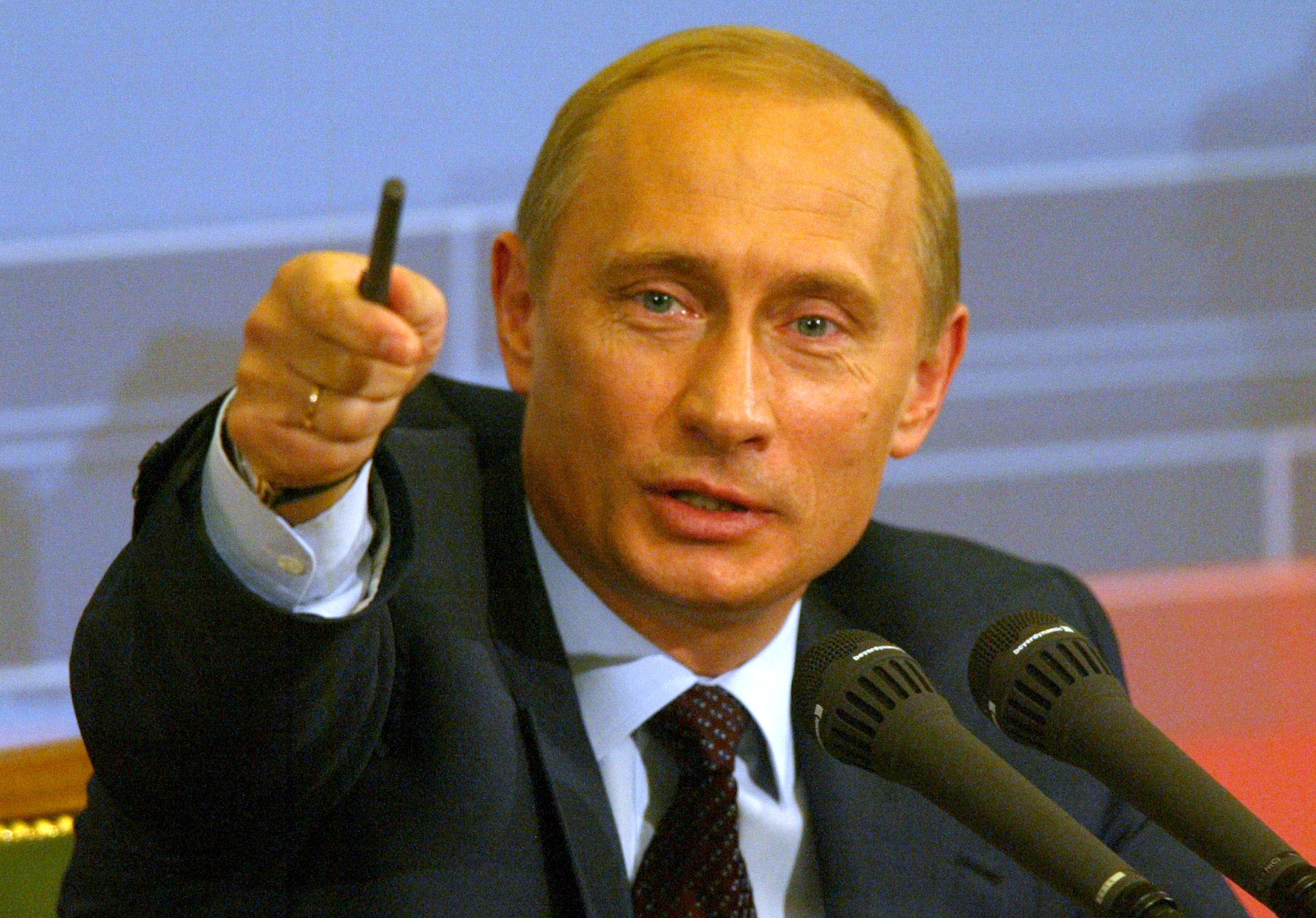
THE NEW TSAR: THE RISE AND REIGN OF VLADIMIR PUTIN by Steven Lee Myers

If you are seeking an explanation for Russian President Vladimir Putin policies, domestically and externally, you should consult Steven Lee Myers recent book THE NEW TSAR: THE RISE AND REIGN OF VLADIMIR PUTIN.  According to Myers it was the Ukrainian Presidential election of 2004, coming on the heels of the Beslan school massacre of September 3, 2004 that pushed Putin to recalibrate his plans.  When Chechen terrorists seized close to 1000 people on the first day of the school year, resulting in the death of 334 hostages, 186 of which were children, Putin was beside himself.  With repeated Chechen terror attacks inside Russia, and a war that was not going well, Putin resorted to his predictable stonewalling excuses.  Outside Russia events did not go Putin’s way either. Already resentful of what he perceived to be western encroachment in the traditionally Russian sphere of influence in the Baltic, along with the election of Viktor Yushchenko as the Ukrainian president, a man who favored NATO membership and closer ties to the west, the Russian leader was forced to face another uncomfortable situation fostering a drastic shift in Russian policy.  Myers, a New York Times reporter spent seven years in Moscow during the period of Putin’s consolidation of power, has written a remarkably comprehensive biography of the Russian president that should be considered the standard work on this subject.

The books title, “The New Tsar” is a correct description of Putin’s reign that even included a Tsarevitch, Dimitri Medvedev, as Putin’s handpicked successor as President of Russia in 2008.  For Putin the greatest catastrophe of the 20th century was the collapse of the Soviet Union, a belief that provides tremendous insight into his policies.  Emerging from the corruption and incompetence of the presidency of Boris Yeltsin, Russia by 1998 was in deep trouble economically and politically.  Yeltsin also hand-picked his successor, a former KGB operative, who was stationed in Dresden, East Germany in 1989, Vladimir Putin.  Meyers presents an objective approach to Putin’s life before the Berlin Wall came down.  Putin would grow up listening to stories of his father, Vladimir, fighting on the western front during World War II and being wounded by the Germans.  His mother, Maria survived the siege of Leningrad and escaped into the countryside.  The harrowing experiences of his parents left an indelible impression on the young Putin.  His father suffered with a limp after the war, and his mother was overly protective of her son.  Putin had a slight build as a child and turned to the martial arts to deal with bullies.  His success at Judo provided Putin with a certain toughness and a means of asserting himself.  Putin craved orthodoxy and rules, neither of which he found in religion and politics.

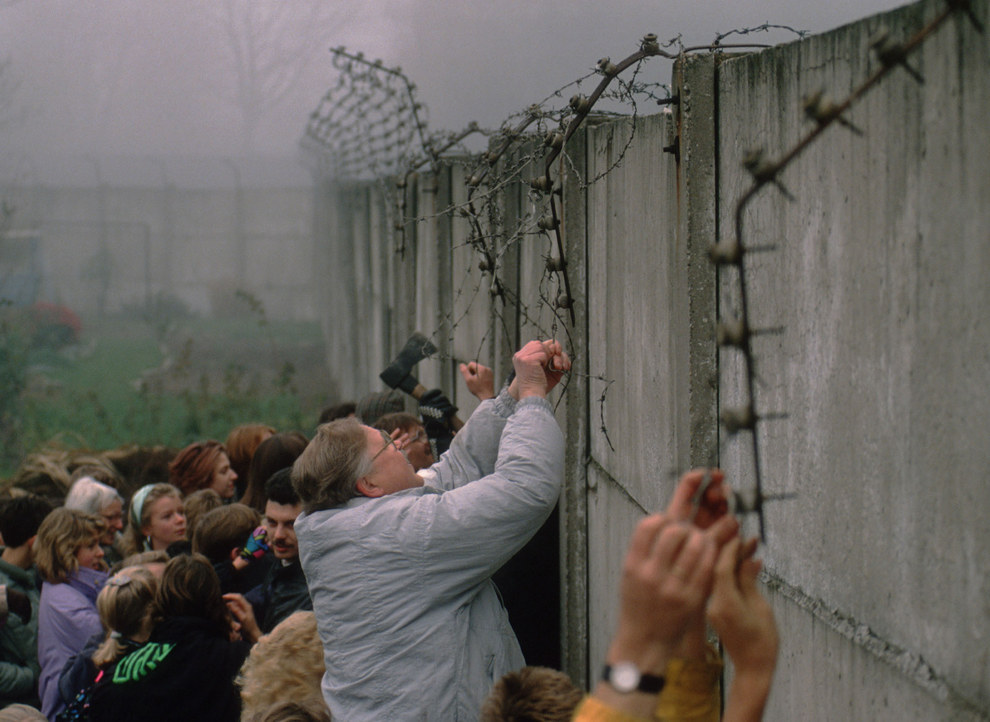
(People tearing down the Berlin Wall, November, 1989)

Myers stresses Putin’s education in economics and law school, but more importantly he points to Putin’s time in the KGB when he was stationed in Dresden.  While being posted to East Germany Putin was exposed to the Stasi and their practices.  Putin was involved in intelligence operations, counter intelligence analysis, and scientific and technical espionage.  The KGB’s goal in East Germany was to gather intelligence and recruit agents who had access to the west, especially individuals who had relatives near American and NATO military bases.  Putin was heavily involved in recruiting and running agents to determine East German support for the Soviet Union.  In 1987, Putin who was very popular with his superiors was promoted to Lieutenant Colonel and the Dresden Station Chief’s senior assistant, or enforcer.  Myers traces Putin’s actions as Mikhail Gorbachev instituted Glasnost and Perestroika and his reaction to events in November, 1989 as the Berlin Wall came down.  Two years later, the Soviet Union finally gave way after a failed coup against Gorbachev, and Yeltsin emerged as the dominant political figure in Russia.  Putin’s reaction to events led him to resign from the KGB.   The future “Tsar” was now cast adrift.

In contemplating Putin’s career one must ask, how he progressed from being a former intelligence operative to President of Russia in seven years.  Myers does an excellent job framing Putin’s behavior and beliefs following the collapse of the Soviet Union.  Rising to the position of Deputy Mayor of Leningrad he attached himself to the coattails of a former law professor at his alma mater, Anatoly Sobchak.  It was during Sobchak’s administration that Putin, because of his economics background negotiated no bid contracts with newly created corporations that involved numerous kickbacks and extensive fraud.  Leningrad’s treasury was almost empty and casino gambling was seen as a source of revenue.  This would lead to organized crime and the emergence of the new corporate oligarchs controlling the local economy.  Myers points to rumors of Putin’s involvement, but can’t make a definitive case.   It was at this time that a number of these new oligarchs that emerged under Yeltsin, businessmen like Yuri Kovalchuk and Vladimir Yakunin whose metal company received licenses to export aluminum and non-ferrous metals grew very close to Putin, and years later would become titans of Russian industry.  Putin’s role in Leningrad’s economy increased under Sobchak and more and more cronies from his KGB past were given prominent positions in the city’s government.  Myers refers to these men as the “St. Petersburg boys,” who would emerge as important players when Putin assumed power.  Sobchak’s goal was to make his city the friendliest to foreign investment in the entire country.  Putin’s goal was to help create a new “window to the west,” the first major transformation of its kind since Peter the Great.  Putin would operate in the background with no fanfare and little emotion.  He knew how to slice through the bureaucracy and Russia’s opaque laws and used his Leningrad experience as a primer on how to get things done.

(Russian President Boris Yeltsin)

Putin would remain in Leningrad until 1996 when Sobchak was not reelected mayor.  Putin was without a job, but Yeltsin would be his savior.  Yeltsin’s own support in the presidential election of 1996 were the bankers, media moguls, and industrialists who had acquired controlling interests in major industries in return for keeping Yeltsin’s government afloat.  Putin was appointed to the Presidential Property Management Directorate to oversee the legal issues as he was in charge of reasserting the government’s control over certain properties and dispensing with others.  Seven months later Putin was put in charge of investigating abuses of Russian property and restoring order, and ending the corrupt schemes that were destroying the Russian economy.  Putin’s work brought him into contact with the FSB (really a new KGB with another name!) and earned a graduate degree with a thesis focusing on Russia’s natural resources.  More and more Putin believed that the state had to reassert its control over its own natural resources that were being pilfered by “oligarchs.”  This belief would form the basis of Putin’s economic policy once in power as he would use Russia’s vast energy resources as a tool against the west and former Soviet republics that did not conform to his vision of Russia’s spheres of influence.

Putin had gained a reputation as a competent, hard-working individual who did not press a particular agenda on Yeltsin.  With the corruption in the FSB, the economy imploding, Yeltsin appointed Putin as the head of the intelligence agency, Putin had come full circle.  Myers description of Yeltsin’s reign as president is one of economic disaster, corruption on a scale not imagined by many in his inner circle, and navigating from one crisis to another.  Throughout it all Putin was loyal and conducted himself in a ruthless and efficient manner that made him essential to Yeltsin’s political survival and he rewarded Putin with the leadership of the Security Council in addition to his duties as Director of the FSB.

Myers successfully integrates the second Chechen war into the narrative on top of Yeltsin’s domestic troubles.  This occurred at the same time NATO was bombing Serbia because of its actions in Kosovo, and the Russian leadership was powerless to support its Slavic brothers and  greatly feared that the west could do the same in Chechnya.  Yeltsin could not run for reelection in 2000, so he needed an heir that he trusted.  He offered Putin the office of Prime Minister and then he would resign before the election, to provide the little publicly known Putin a leg up on the presidency.  Myers does a superb job describing these machinations that resulted in Putin’s elevation.  One of his first moves upon assuming office in September, 1999, was to send Russian forces back into Chechnya, after four attacks in and around Moscow that killed over 300 people, a move he would stand by for years despite negative results.

(Russian troops bring out the dead and wounded after their assault on the Moscow theater to free hostages from Chechen terrorists, October 23, 2002)

Myers discussion of Putin’s reign is sharp and focused and explains many of the problems that the United States faces today with the Russian leader.  Putin’s approach to government is his version of the “dictatorship of law” or “managed democracy,” which may reflect some of the trappings of democracy, but are fixed or manipulated to accomplish certain ends.  Putin was aided by the strong recovery in energy markets after his election in 2000.  With increasing funds in the Kremlin coffers, Putin prosecuted his war in Chechnya in a vicious fashion.  This would produce a series of terrorist attacks that would cost Moscow dearly.  When Putin’s leadership and tactics were questioned during terrorist attacks at a movie theater on October 23, 2002 in southeast Moscow that resulted in the death of 130 hostages, and the terrorist siege of a school in Breslan in North Ossetia, the Russian President stonewalled any explanations for his military responses.  This was Putin’s pattern in a crisis, as was evidenced earlier when the nuclear submarine Kursk sank in 2000 with the loss of 118 men.  Despite these disasters and the Chechen war that was turning into a quagmire, Putin’s popularity could not be questioned, in large part because reporters, commentators, or politicians who raised issues or made negative comments about Putin, tended to disappear.  Putin had a carefully crafted image supported by his media friends who would not pursue the truth concerning the assassinations of Anna Politkoyskaya, a journalist critical of Putin, Alexsandr Litvinenko, a former FSB operative who exposed corruption and bribery in the agency, among numerous others.

Myers does a commendable job explaining the second “rape” of the Russian economy, the first under Yeltsin that produced the first wave of oligarchs, the second under Putin.  Names like Yukos, Gazprom, Rosneft, and their CEO’s are explored in detail and the reader acquires an inside look at how Putin dealt with economic threats to his regime as he sought to recover the state’s assets.  However, at the same time he allowed many of the “St. Petersburg boys” access to new wealth, creating a second wave of “new” oligarchs.  The trial of Mikhail Khodorkovsky, the head of Yukos, the largest oil company in Russia is emblematic as to how Putin operated.  The end result is that Putin gained control of all aspects of the Russian economy, and of course with the attendant corruption, his own wealth accumulated tremendously, estimated at about $40 billion by Russian journalists and the CIA.  As an editorial in Kommersant opined, “the state has become, essentially a corporate enterprise that the nominal owners, Russian citizens no longer control.”

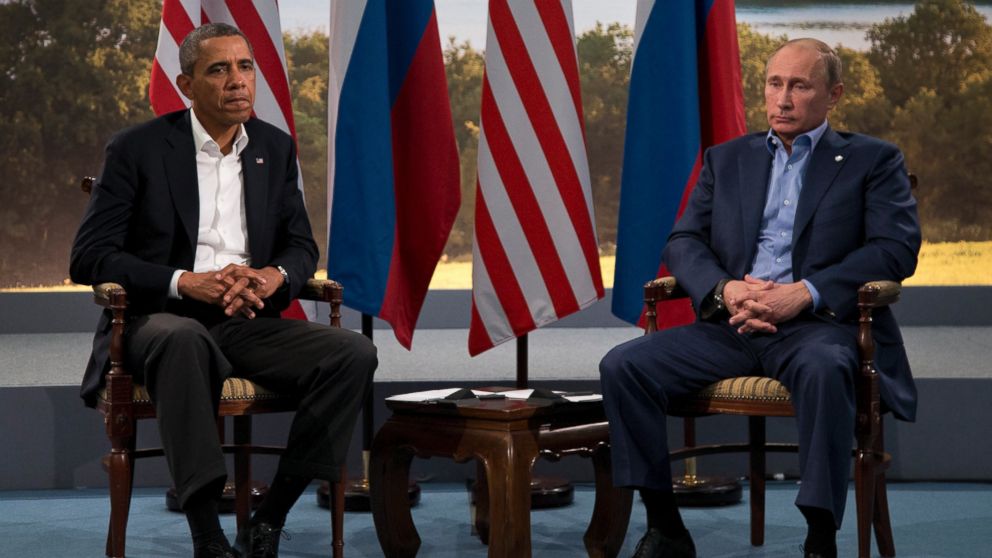
(the nature of American-Russian relations is obvious from the faces of Presidents Obama and Putin)

When Putin first rose to power many hoped a strong relationship between the United States and Russia would result. Putin was very supportive following 9/11 and approved of American military bases in former Soviet republics to conduct the war against al-Qaeda and the Taliban.  After meeting Putin for the first time, President George W. Bush had a positive reaction as he said, “I looked the man in the eye, I found him to be very straight forward and trustworthy…..I was able to get a sense of his soul; a man deeply committed to his country and the best interests of his country.”  Bush was either naïve or uninformed about Putin and the course he pursued.  Putin grew angry at the United States when the Bush administration refused to alter provisions of the 1972 Anti-Ballistic Missile Treaty (ABM), and the eventual American withdrawal from the treaty.  Further, Putin was against the American invasion of Iraq and the overthrow of Saddam Hussein, and this was capped off with the Ukrainian election of 2004 where reformers and government protestors wanted to move closer to the west and become members of NATO.  Putin’s frustration and anger at the United States further increased when President Bush decided to negotiate with Poland and the Czech Republic for bases for a Missile Defense System.  This led to the February, 2007 Putin speech at the Munich Security Conference where the Russian president excoriated the Bush administration in what Myers describes as similar to Winston Churchill’s Iron Curtain speech.  With the economic collapse of 2008 and its effect on the Russian economy, Putin would only blame the United States.  Further, the election of Barrack Obama, the Russian invasion of Georgia, trade disagreements, events in the Ukraine and Crimea, and the current Syrian crisis, it is not surprising that it seems we are now witnessing a second Cold War.

Putin could not run for reelection in 2008, but as Myers points out, like Yeltsin he also had an heir, Dimitri Medvedev, a former head of Gazprom, and an individual who appeared to be easier to deal with.  However, with Putin as Prime Minister pulling the strings, Kremlin policy remained the same, accept with a softer face.  During his presidency Medvedev was consistently forced into the background be it the 2009 economic crisis, the Russian invasion of Georgia, and other issues-Putin just could not stay in the background.  Medvedev’s speeches were vetted by Putin and it was demeaning for the Russian president as he was now overshadowed by his Prime Minister.

After reading Myers’ book, the reader should have a handle of who Putin is and what he believes in.  I agree with Gal Beckerman’s description of Putin as a man who represents his country, represents stability, and “stands against the chaos of the street; one man who still believes in the unique power of the state personifies its sovereignty and its prerogative to defend its interests; one man who embodies calm, measured authority resists the emotional swell of undisciplined, angry people, and understands that the appearance of forcefulness and obstinacy can be as powerful as an actual show of force.”  After digesting Myers’ narrative of Putin moving from crisis to crisis, some self-created and some external to Russia, it becomes clear that he simply believes that “he’s the last one standing between order and chaos,” whether he is dealing with protesters challenging his return to the presidency during and after the 2012 elections, “Chechen separatists, E.U.-loving Ukrainian politicians or the West as a whole, working through nefarious pro-gay N.G.O.’s or NATO.” (New York Times, November 2, 2015)

(Demonstration against Ukrainian government in Independence Square, Kiev, February 2, 2014)

Putin’s greatest gamble according to Myers was his illegal seizure of the Crimea in reaction to the violence in Kiev on February 2, 2014.  Protestors had taken to the streets forcing Ukrainian President Viktor Yanukovych to flee the capitol.  Putin was presiding over the closing ceremonies of the Sochi Winter Olympics and saw events in the Ukraine as a western plot to deny Russia the accolades that it deserved because of the success of the games.  Incensed, Putin met privately with a few trusted advisors and planned to foster the breakup of the Ukraine by seizing the Crimea.  The Russian invasion began on February 27, 2014 negating the argument he employed against President Obama about unilaterally invading countries as the US had done in Afghanistan, Iraq, and Libya.  Putin correctly calculated that since that the west would not react as it had in 1990 removing Saddam Hussein’s forces from Kuwait, as it had not acted against the Russian invasion of Georgia in 2008.  Putin’s fait accompli would not be reversed and his rationale of protecting “ethnic Russians” was domestically popular and would later be used to justify Russian military moves in Eastern Ukraine.  Even after the dubious referendums in Crimea, Donetsk, and Luhansk; in addition to the Russian shoot down of a Malaysian airliner, Putin was convinced the west would do nothing, and he would rally his country against the foreign conspiracy to isolate Russia politically, and hurt her economically with sanctions.  Not only did Putin not worry about western actions, it seemed he no longer cared as is evidenced by the current situation in Syria as Russian planes continue bombing to prop up the regime of Hafez el-Assad, as opposed to his public position of fighting ISIS.

Myers conclusion that Putin no longer cared to rule pragmatically as he had done during his first two terms in office, and would focus on reasserting Russia’s power with or without the recognition of the west, is correct.  Myers should be commended for his work and anyone interested in understanding, the “new tsar” should consult it.

UNITED STATES OF JIHAD: INVESTIGATING AMERICA’S HOMEGROWN TERRORISTS by Peter Bergen


United States of Jihad: Investigating America's Homegrown Terrorists

(Among the topics discussed by Mr. Bergen is the Boston Marathon, April, 2013)

Peter Bergen, prolific author, and CNN national security analyst has written a number of important books dealing with terrorism.  They include monographs on Osama Bin-Laden and three others which were New York Times best sellers.  His latest work UNITED STATES OF JIHAD: INVESTIGATING AMERICA’S HOMEGROWN TERRORISTS is an important addition to two other recent books, Scott Shane’s OPERATION TROY and Charlie Savage’s POWER WARS: INSIDE OBAMA’S POST 9/11 PRESIDENCY.  Bergen builds on the work of these authors in trying to explain why American citizens have engaged in treason against their country by engaging in, or planning acts of terrorism.  Bergen further explores how American institutions and the Moslem community have responded to the terror threat and how this threat on American soil has changed us.  One could argue that Bergen’s book is a who’s who of American jihadism, beginning with the Muslim cleric Anwar al-Awlaki, Omar Hamami who grew up in Alabama and fought for al-Shabaab in Somalia, David Coleman Headley who helped plan and carry out the Mumbai massacre, and numerous others.

Bergen concentrates on the 330 militants who have been arrested and charged with terrorism crimes in the United States, 80% of which are American citizens or legal permanent residents.  He argues that they appear to be as average, well educated, and emotionally stable as typical Americans.  According to Bergen their average age is 29, more than a third are married – many with children, and one out of six are women.  There is nothing particularly special about them as they are just ordinary people.  If this is so, then why have so many engaged in terrorism, and why is the “home grown” threat a major source of concern in the intelligence community?  Bergen argues forcefully that it is due to a number of criteria.  First, Moslem outrage at United States foreign policy in the Middle East is a dominant theme.  Anger about American wars in Iraq, Afghanistan, American drone strikes in Yemen causing tremendous collateral damage, the bombing of Syria, and U.S. support for Israel all contribute to this feeling.  Secondly, jihadism offers people an opportunity to be somebody, and at the same time belong to something bigger than themselves. What is interesting about this threat to the American homeland is that since 9/11, 45 Americans have been killed by Islamic terrorists, but at the same time 48 Americans have been killed by right wing extremists.

(Anwar al-Awlaki, American born Islamic cleric, October 4, 2001)

Bergen examines a wide range of terrorists who originated on American soil drawing on his vast network of sources in the intelligence world.  He argues that most are second generation immigrants who did not start out as observant Muslims.  However, once they became devout they often left their mosques because what was being preached was not radical enough.  In addition, they would congregate with like-minded individuals and bond by watching jihadi videos, and simulate combat by playing “paint-ball.”  Bonding activities are extremely important in creating a jihadist community with an ultra-fundamentalist outlook. Bergen also dispels a number of myths in dealing with his subject by arguing that most of these jihadist had no formal links to outside terror organizations, further most terrorists began their education in a secular environment, not madrassas.  In reviewing their studies it is clear that there is a strong link between their technical education and their terrorist activities, as 50% of them attended college.  Overall, social bonds between jihadists were more important than ideology.

In presenting his thesis Bergen explores the activities of numerous terrorists, many of which are known to those who follow the news.  The individual who takes up more time than any other is the American born cleric Anwar al-Awlaki who was the mentor to Umar Farouk Abdulmutallab, the “underwear bomber” who tried to take down a Northwest Airliner over Detroit Christmas day, 2009.  Awlaki is also linked to Nidal Hassan, the Fort Hood killer and numerous others.  Awlaki stands out as a sophisticated individual who used his American upbringing and cultural knowledge with his social media savvy to recruit jihadist in the United States and eventually was killed by an American drone in Yemen authorized by President Obama which had sparked an intense debate as to whether it was legal for the United States government to assassinate one of its citizens.  Scott Shane’s book explores this controversy in greater detail than Bergen, but the author does a good job summarizing the most salient points in the debate and points out that “t follow the trail of Awlaki’s influence is to trace the post 9-11 evolution in evolving Americans.”  Of the 330 jihadists charged or convicted in the United States, more than 80 had Awlakis writing and sermons in their possession, and another 7 more corresponded with him or traveled to Yemen to meet him.

(Tsarnaev brothers at the Boston Marathon, April, 2013)

Bergen labels these American terrorists as “lone wolves.”  One of these individuals described is Carl Bledsoe, a native of Memphis, TN who was self-radicalized and wound up killing one marine and wounding another at a marine recruiting center in Little Rock, AK on June 1, 2009.  He follows this with an in depth exploration of the motivations and actions of Major Nidal Hassan, a military psychiatrist whose conversion to fundamentalism differed from Bledsoe in that he was already a Muslim.  But their radical journey had many similarities including their gradual isolation from their families, preoccupation with piety, and what was considered to be a true Muslim.  They both embraced Salafist ideas and practices as do most jihadists, and as they looked at US foreign policy they became obsessed with the idea of Jihad to defend Islam.

26/11: How terror struck Mumbai
The gruesome terror attacks began on 26th November and continued till 29th November, where Indian security services killed 9 out of 10 terrorists and captured Ajmal Amir Kasab, alive to regain control of South Mumbai terror sites i.e. the Leopold Café, the Chhatrapati Shivaji Terminus, the Taj Mahal, the Oberoi & Trident, Cama Hospital and Nariman House.(AP photo)
26/11: How terror struck Mumbai
Mumbai was witnessing one of the worst terrorist attacks in the history of India. Leopold Cafe in Colaba was attacked first when five terrorists opened fire at the cafe.(AFP photo)
26/11: How terror struck Mumbai
The attack left behind indelible scars… bullet marks on the walls and counter; the mirrors broken; doors with holes and a mini-crater on the marbled floor, caused by the grenade attack.(AFP photo)
26/11: How terror struck Mumbai
This was perhaps one of the most heartbreaking scenes for any Mumbaikar. Images tell the story of the barbaric assault by terrorists who held the Taj Mahal hotel to ransom for 58 hours.(AFP photo)
26/11: How terror struck Mumbai


Bergen reviews the close calls that have occurred since 9-11 discussing the case of Najibullah Zazi, who along with two others tried to replicate the London underground bombing of 2005 on the New York City subway system.  He was thwarted by the FBI after receiving a tip from the British intelligence.  Another case is that of Faisal Shazad, who drove a bomb laden van into Times Square in Manhattan on May 1, 2010.  Trained by the Pakistani Taliban, the bomb did not explode due to poor components.  The focal point was not any intelligence, but US drones over Pakistan that did not allow for sufficient training.  The key for Bergen is that these individuals fit the profile he discusses which was also accepted by American intelligence analysts.  But in fairness to law enforcement, Bergen points out the difficulties in tracking lone wolves.

(arrest of Najibullah Zazi who attempted to set of a bomb in Times Square, Manhattan on May 1, 2010)

One of the most interesting aspects of the book is how the Obama administration has approached the domestic terror threat.  Soon after the failure of the “underwear bomber” over Detroit, President Obama ordered a vast increase in the use of drones and NSA surveillance programs, the most controversial of which was the bulk collection of American telephone Meta data.  After the Edward Snowden fiasco this program was rolled back and Bergen argues it had little effect on preventing terrorism and traditional approaches to intelligence were more reliable.  Today, Republican presidential candidates describe Obama’s approach to the war on terror as rather feckless, however if one examines his role as commander and chief one sees a continued involvement in Afghanistan and Iraq, and a marked increase in the use of drones as compared to the Bush administration.  According to conservative estimates, by the end of 2015 the Obama administration had presided over the killing between 3-4,000 people in drone strikes in Pakistan and Yemen. Bergen aptly summarizes his view as Obama dryly remarked, “Turns out I’m really good at killing people.”  Didn’t know that was going to be a strong suit of mine.”  If you are interested in an in depth analysis of Obama administration practices and their legalities consult Charlie Savage’s POWER WARS.

Another important aspect of Bergen’s narrative is the approach taken by American intelligence agencies.  We witness the development of the NYPD’s separate intelligence department that is almost up to par with the CIA and FBI.  We also witness the continued issue of sharing intelligence and acting in concert for the greater good of the American people.  The major change in the FBI’s approach to terrorism after 9/11 would be its transformation from a crime solving organization into entities whose primary mission was to prevent terrorist attacks.  The NYPD’s creation of a separate intelligence component allowed it to pursue a similar approach.  Over the last decade and a half over 15,000 informants have been employed, and numerous sting operations of suspected terrorists designed to root out terror plots, but this has resulted in an increasing number of complaints of entrapment.  In addition, in 2004 the National Counterterrorism Center was created to connect “the dots” between all intelligence agencies.  Bergen provides an astute analysis of American intelligence policies including their concrete successes, ”near misses,” and failures, including a useful chapter on the Tsarnaev brothers who were responsible for the Boston Marathon bombing in April, 2013.

Bergen correctly arguing that the older of the brothers, Tamerlan fit the NYPD terror profile and radicalized his younger brother, Jahar who was extremely secular and Americanized.  The bombing could have been prevented if not for another case of missed signals, and of a lack of communication between U.S. law enforcement agencies.  If FBI allegations are correct, Tamerlan was involved in a triple murder in Waltham, MA in 2011 and was a dangerous killer long before April, 2013; one must ask how did he not appear on the “no-fly list,” particularly after warnings from Russian intelligence in 2011? Tamerlan would fly to Dagestan in the Caucasus and try and join the Union of the Just, an anti-American Islamist group to fight the Russians, as well as attending Salafist mosque.  By his return to the United States in July, 2012 Tamerlan was fully radicalized.  Both Tamerlan and Jahar came to believe that 9/11 was engineered by the US government to create mass hatred of Muslims.   With these beliefs, it is not surprising they carried out their attack.

The rise of ISIS is not explored until the final chapter of the book.  Here Bergen reviews and synthesizes much of the material that has been presented by Joby Warrick, Michael McCants, Jessica Stern, J.M. Berger, Michael Weiss, and Hassan Hassan.  The use of social media and the virtual world has allowed ISIS to be the next generation of al-Qaeda and attract over 30,000 foreign fighters and claim to have established a caliphate, successes that Osama Bin-Laden could never fathom because of his world view.  Bergen dissects American fears of an ISIS attack in the United States, and despite what occurred in San Bernardino he correctly argues that “lone wolf” attacks are a threat, but they are a minimal threat because of the safeguards that have been put in place.  We must realize that we can never be 100% secure and that there always will be a low level threat in the United States for years to come.   But as Bergen shows in his closing argument, presenting the wife of a murdered victim of the Fort Hood massacre, and her support of an organization created by Nidal Hassan’s cousin to foment better understanding and relationships between Muslim and non-Muslim Americans, there are many ways to fight terrorism.  Bergen has written another excellent book that should be read by all who want to try and understand the problems that contribute to the enlistment of jihadists in America and how that has changed our country.

(Boston Marathon Bombing, April, 2013)

THE GEORGETOWN SET: FRIENDS AND RIVALS IN COLD WAR WASHINGTON by Greg Herken

(Joseph and Stewart Alsop,  journalists who greatly impacted American foreign policy during the Cold War)

When one discusses the value of real estate one usually encounters the phrase “location, location, location.”  This could be the theme of Greg Herken’s THE GEORGETOWN SET: FRIENDS AND RIVALS IN COLD WAR WASHINGTON, a book centered on a Georgetown, Washington, D.C. neighborhood after World War II, whose residents included the Alsop brothers, Jack and Jaqueline Kennedy, Ben and Tony Bradlee, Allen and Clover Dulles, Dean and Alice Acheson, Philp and Katherine Graham, Averill and Marie Harriman, Frank and Polly Wisner among others.  Within the group you had a future president and Secretary of State, the head of the CIA and other operatives, two ambassadors to the Soviet Union, influential journalists, and the owner and editor of the Washington Post. The neighbors who were known as the “Georgetown Set,” were at the forefront of American policy as the Cold War began and evolved, as Dean Acheson entitled his memoirs, they were PRESENT AT CREATION, and a few of them lived to see the curtain fall on the conflict with the communist world.  These individuals were not only neighbors, for the most part, they were close friends.  They had attended the same boarding schools and universities and “believed that the United States had the power—and the moral obligation—to oppose tyranny and stand up of the world’s underdogs.”  They held a sense of duty and the belief in the “rightness of the country and its causes—which were, more often than not, their own.”

Unlike today, it was a time of consensus in foreign policy in dealing with the Soviet Union, partisanship was an afterthought.  The outset of the Cold War produced the Marshall Plan, the Truman Doctrine, Point Four, and NATO, but the mindset of these individuals would also lead to mistakes embodied in the disastrous coups of the Eisenhower era, the Bay of Pigs, and the Vietnam War.  Greg Herken tells the story of these influential people, how their ideas dominated American policy, and what the ramifications of that influence were.  The reader is exposed to intimate details and tremendous insights as these power brokers are examined, and it makes for a fascinating read.

(Katharine Graham, owner and editor of the Washington Post)

The narrative focuses on the most important foreign policy debates of the 20th century, where the residents of Georgetown aligned themselves, and how their views affected the success or failure of presidential decision making.  Once the Nazis and the Japanese were defeated in 1945, the foreign policy debate focused on the communist threat and the motives of the Soviet Union.  The debate was symbolized by George Kennan, who at one point was head of the Policy Planning Staff in the State Department as well as stints as ambassador to the Soviet Union and Yugoslavia; and Paul Nitze, former Secretary of the Navy, and author of NSC-68 which along with Kennan’s “X Article” formed the basis of American policy toward Russia for well into the 1980s.  The debate centered on “whether it was America’s moral example or material power that kept the Russians at bay” during the Cold War.   Many other individuals draw Herken’s discerning eye during the period, the most important of which were Joseph and Stewart Alsop, the journalism brothers who advised presidents, and helped articulate positions on Vietnam and Cuba that some would argue pushed our nation’s chief executives into making unwise policy choices.

At times the book reads like a biography of the Alsop brothers as Herken develops their careers as the centerpiece of the monograph.  Of the two, Joseph Alsop dominated their relationship and developed numerous sources within the national security apparatus in presidential administrations from Truman through Nixon.  Joseph Alsop had his own agenda and his columns created enough pressure on Lyndon Johnson that many believe forced him to consider Alsop’s readership when making decisions about Vietnam, a subject that Alsop seemed obsessed with and had difficulty accepting any information that contradicted what he believed.  The Alsops hosted numerous dinner parties that were used as conduits to different presidential administrations as conversations yielded information that turned up in their newspaper columns.  Herken almost makes the reader as if they are invited guests to the Sunday night gatherings among the “Georgetown Set” and at times the reader might feel like a “fly on the wall” as you witness history being made.  In addition to the Alsops, the inner sanctum of the Washington Post is laid bare as great events are reported.  We see the newspaper under the stewardship of Philip Graham at the outset of the Cold War until his suicide, when his wife Katharine takes the reigns of the paper and turns it into a strong competitor to the New York Times. Reporting on Watergate, My Lai and other issues reflected Katharine Graham’s growth as the head of a major newspaper and her dominant role in Washington politics.

(Frank Wisner II, the son of an OSS and CIA operative who developed and implemented numerous covert operations during the Cold War.  Wisner II developed his own diplomatic career and did not follow the career path of his father)

The book also centers on the evolution of the American intelligence community from the Office of Strategic Services (OSS) during World War II to the creation of the Central Intelligence Agency (CIA).  Herken focuses most of his attention on Allen W. Dulles, who worked under Wild Bill Donavan who headed the OSS, and would later head the CIA under President Eisenhower and for a short time under John F. Kennedy; and Frank Wisner, an OSS and CIA operative who was known for his outlandish covert plans, i.e.; trying to overthrow the government of Albania, dropping propaganda leaflets and intelligence operatives behind the “iron curtain” among many of his projects.  CIA involvement in Vietnam, Iran, Cuba, and Guatemala are dissected in detail and Herken correctly points to current issues that date back to Dulles, Wisner, and numerous other individuals in the intelligence community, and how they negatively affected American foreign policy for decades.

(President John F. Kenndy and First Lady Jacqueline Kennedy were frequent visitors in the “salons” of Georgetown)

The books serves as an important window into the lives of people who dominated the American foreign policy establishment throughout the Cold War.  Herken seems to assess all of the major decisions that were made during the period, as well as evaluating each of the characters presented and how their lives affected the course of American history.  Many of the individuals that Herken discusses are well known, but others are brought out of the shadows.  One of the most interesting aspects of the book is when Herken muses about the lives of the children of the “Georgetown Set,” and how the generation gap that developed in response to the civil rights and anti-war movements of the 1960s affected the next “Georgetown” generation.

Herken writes with flair and has exceptional command of his material and sources and has offered a unique approach to the causes and results of the Cold War that should satisfy academics as well as the general reader.

DISCIPLES: THE WORLD WAR II MISSIONS OF THE CIA DIRECTORS WHO FOUGHT FOR WILD BILL DONOVAN by Douglas Waller

(William Donovan, the man who headed the Office of Strategic Services  during World War II)

At a time when people are concerned with government spying on its citizens, it is useful to examine how two world wars and the Cold War led to the creation of the Central Intelligence Agency.  Douglas Waller, a former correspondent for Time and Newsweek, and the author of WILD BILL DONOVAN: THE SPYMASTER WHO CREATED THE OSS AND MODERN AMERICAN ESPIONAGE has revisited the origins of the CIA by examining the men that William Donovan trained as intelligence operatives who went on to head America’s foremost spy agency.  In his new book, DISCIPLES: THE WORLD WAR II MISSIONS OF THE CIA DIRECTORS WHO FOUGHT FOR BILL DONOVAN, Waller follows the careers of Allen W. Dulles, William Casey, Richard Helms, and William Colby, and their interactions with Donovan as their careers  culminated in Langley, Va.  When I first picked up the book I was concerned that Waller would rehash a great deal of the same material he covered in his biography of Donovan.  To my satisfaction this is not the case.  There is some repetition, but the book can stand on its own merits as Waller has written a wonderful adventure story that weaves together the experiences of the “disciples.”  Based on archival material, the most prominent secondary sources, and pertinent memoirs the book is an excellent read for spy buffs and the general public.

Waller begins the book with short biographical sketches of each individual and the similarities in their backgrounds.  Waller points out that there was a common thread that ran through Dulles, Casey, Helms, and Colby.  Each was smart, intellectual, and “voracious readers, thoughtful, and creatures of reason….these were strong, decisive, supremely confident men of action, doers who believed they could shape history rather than let it control them.”  When one follows their careers Waller’s description appears extremely accurate.  Though their personalities differed; Dulles comes across with a much larger ego who rubbed many in power the wrong way; Casey, more of an introvert who worked behind the scenes and new how to navigate the bureaucratic morass of government; Helms and Colby, more adventurous and hands on, the result of which was they all would ascend the intelligence ladder at different rates to finally emerge as leaders in their own right.  All had important relationships with Donovan; some more testy, particularly Dulles who wanted Donovan’s job as head of the Organization of Strategic Services (OSS) during World War II, but in the end they worked together and laid the foundation for America’s post war intelligence operations.

(Allen W. Dulles, headed American intelligence operations against Germany during WWII and as CIA Director under Eisenhower launched numerous covert operations)

Waller traces the career of each of the disciples and what stands out is their roles during World War II.  Donovan was charged by President Franklin D. Roosevelt to create an espionage operation during the war by choosing him as the Coordinator of Information, a position that would morph into the head of the OSS.  Waller examines the rise of Allen Dulles first, tracing his career from World War I, his experiences as a diplomat at Versailles, and his relationship with his brother, John Foster, and their law firm Sullivan and Cromwell.  Dulles emerges as a self-confident individual who sought total control of all operations. Posted to Berne, Switzerland during the war, Dulles developed important sources though he was at times over the top with his predictions.  On a number of occasions he resented Donovan, but in the end went along with his boss.  William Casey’s education as a spy began as a lawyer in the 1930s where he became an expert on the tax code dealing with War Department contracts.  This attracted Donovan interest and he would recruit Casey for the OSS in 1943.  Casey, an organizational expert was sent to London where he worked under David Bruce, and implemented a management style that would lead him to oversee intelligence assets and commando operations in France and Germany.  Richard Helms joined the navy after Pearl Harbor and worked on strategies to deal with German submarine warfare.  By 1943 he was forced into OSS Psyops and by the end of the war he was sent to London to organize operations in Germany for the post war period.  William Colby, the most liberal of the four and a supporter of FDR, studied in France in the late 1930s, witnessed the Spanish Civil War, and developed a hatred for communism.  He would become a commando during the war and showed tremendous physical courage behind enemy lines in France and Norway.

(Richard Helms after a career in intelligence dating back to WWII became CIA Director in the 1960s and was eventually fired by President Nixon)

One of the most interesting aspects of the book is how Waller introduces individuals who interacted with the OSS, and in particular the “disciples” during the war.  FBI Head, J. Edgar Hoover despised Donovan seeing him as a threat and unleashed his own agents to spy on the OSS.  We meet Julia Child, later known as “the cooking guru” for woman in the 1950s.  Along the way Arthur Goldberg emerges as a link to European labor movements, who would later serve on the Supreme Court.  British spymasters come and go throughout the book, particularly William Stephenson who at one time had an office next to Dulles in Rockefeller Center.  Fritz Kolbe, the OSS’ most important agent who allowed Dulles to penetrate the German Foreign Office in Berlin and whose work saved the lives of many allied soldiers takes a prominent role.  These and many other individuals and their own stories lend a great deal to Waller’s narrative.

(William Colby was a trained commando during World War II and parachuted into France and Norway who later became CIA Director under Richard Nixon and Gerald Ford)

Waller does a nice job showing how the careers of the “disciples” intersected with Donovan during the war.  For example, Donovan’s visitations to commando training, witnessing Colby’s preparation for parachuting into France.  Dulles and Casey intersected as both were smuggling agents into France to link up with and supply the French resistance.  Casey was in charge of monitoring commando drops like Colby’s into France.  Casey also funneled Dulles’ intelligence reports to Washington, and in a number of cases felt that they were highly exaggerated. Helms finally left for London in early 1945 and was supposed to organize Dulles’ mission for Germany, but because of Hitler’s last ditch effort in France in the Ardennes, he never carried out the assignment and wound up with Casey overseeing agents in Germany.  In fact Casey and Helms shared an apartment in London at the time!   Colby and Casey would meet at General George S. Patton’s headquarters in September, 1944 as Casey became Donovan’s eyes in Europe and eventually would replace David Bruce as head of London operations, an appointment that Dulles greatly resented.  Donovan felt that Dulles was a poor administrator and lacked the leadership skills that Casey possessed.

Waller spends a great deal of time on the actions of American commandos behind German lines.  He describes Colby’s training in detail and takes the reader along with these men as they parachute into France and Germany, exhibiting courage and discipline as they try to reinforce the French resistance, and later gather intelligence in Germany to try and bring the conflict to a faster conclusion.  Waller also spends a great deal of time discussing the infighting among the “disciples” and their private lives.  By doing so the reader gains insights into each of these men and it helps explains how their post-World War II careers would evolve into directorships of the CIA.

The final section of Waller’s narrative focuses on American intelligence policies and actions during the Cold War as the OSS evolves into the CIA and focuses its attention on the communist threat.  Once President Truman forces Donovan into retirement Dulles takes over the newly created CIA and his reputation for mismanagement will result in what Blanch Wiesen Cook, in her book DECCLASSIFIED EISENHOWER, refers to as the “coup presidency.”  Dulles would launch covert operations in Iran, Guatemala, Cuba, and the disastrous U-2 Incident, all resulting in his eventual downfall.  Dulles was succeeded by Helms, who unlike his predecessor believed in tight organizational control.  His mantra was “that there should be no surprises on his watch” and he was very popular within the agency.  Helms would be fired by Richard Nixon in part because he refused to cooperate with break-ins and cover ups associated with Watergate.  Colby’s tenure as director is most remembered for his testimony before the Church Committee in 1974 as leaked CIA documents called for congressional action.  Colby was the most politically liberal of all the “disciples” and this played a role in his cooperation with Congress which he was vilified for by Helms and Casey.  But, as Waller correctly points out his testimony probably saved the CIA from a wholesale reorganization that would have ruined its effectiveness.  The last of the “disciples,” William Casey took over the agency under Ronald Reagan and he tried to create the atmosphere that existed under his hero, William Donovan, who like his mentor “kept the door open to all ideas for operations, even the wacky ones.”  Casey wanted to recreate the can do culture of the OSS from WWII for the 1980s, focusing on the communist menace instead of the Nazis.  This would result in repeated machinations in dealing with Afghanistan, Central America, and the Iran-Contra scandal in particular.

(William Casey was a successful “spy master” during World War II who became CIA Director under Ronald Reagan)

Waller has written a fascinating account of the men who followed Donovan as leaders in American intelligence, and current implications for some of the policies they pursued.   Today we are faced with the ramifications of Edward Snowden’s leaks and issues over NSA and other surveillance.  It would be interesting to speculate how these gentlemen would respond to these issues.

(Major General William J. Donovan who led America’s intelligence operations during World War II)


PACIFIC: SILICON CHIPS AND SURFBOARDS, CORAL REEFS AND ATOM BOMBS, BRUTAL DICTATORS, FADING EMPIRES, AND THE COMING COLLISION OF THE WORLD’S SUPERPOWERS by Simon Winchester

Simon Winchester’s latest book, PACIFIC: SILICON CHIPS AND SURFBOARDS, CORAL REEFS AND ATOM BOMBS, BRUTAL DICTATORS, FADING EMPIRES, AND THE COMING COLLISION OF THE WORLD’S SUPERPOWERS reinforces why I am such a fan and admirer of this eclectic social scientist.  No matter what topic Mr. Winchester takes on he has the uncanny ability to unwind what is a standard interpretation or history of a well-known topic and ferret out little known details to make something that is quite interesting, fascinating.  The list of Winchester’s books are impressive, whether he is exploring the history of the Atlantic, the men responsible for the creation of the English Oxford Dictionary, the annihilation of the volcano island of Krakatoa, or the story of the geologist, William Smith and how he geologically mapped the underside of the earth, and many more, the reader emerges educated and entertained by a master story teller.

In his current venture, Winchester explores historical aspects of the Pacific Ocean or in contemporary parlance the Pacific Rim.  Winchester is a social scientist par excel lance, employing history, political science, geography, and geology as he explores his diverse topics.  Where else can a reader learn about such a conglomeration of stories?  He begins his journey by describing a flight over the Pacific beginning in Hawaii and immediately provides a history of the international dateline and the importance of this massive ocean on our daily lives.  The blue expanse of the Pacific dominates the planet and encompasses one-third of the earth’s surface and forty-five percent of the planet’s surface waters.  Despite its beauty and hidden treasures Winchester describes how the Pacific has been a dumping ground throughout modern history.  America and its allies have conducted nuclear tests in the Marshall and Gilbert Islands among other locations.  Biological testing has contaminated numerous islands and two million gallons of Agent Orange are stored near the Johnson Atoll Islands and rockets carrying atomic weapons have exploded in the region.  What has been created is an ecological nightmare in many places.  It is a shame as Winchester correctly points out that “the Pacific Ocean is the inland sea of tomorrow’s world,” much in the same way the Mediterranean Sea was in the Ancient world, and the Atlantic Ocean was for the modern world.  Therefore improving our knowledge of the ocean and preserving it as best we can is so important.

Winchester concentrates his narrative from 1950 to 2014 as he describes the Pacific Ocean as an “atomic ocean” because of all the nuclear testing.  The narrative of events that he presents in each chapter seem unrelated, but taken as a whole we witness an important history of the Pacific.  Winchester’s first self-contained chapter describes the story of the Bikini Islands and the effects of the testing of the hydrogen bomb.  He then moves on to the invention of the transistor radio in the 1960s and its impact on society.  Winchester then introduces us to the film Gidget as an introduction to the importance of surfing and the industry it spawned to the Pacific culture.  We next meet the “hermit kingdom” of North Korea and revisit the Pueblo Affair of 1968 and other incidents that make the Pyongyang government so dangerous, even today.  Those interested in Australia will visit her history and her evolution from a backward, racist society to a more enlightened one in the 1970s and its reversion to its former “Crocodile Dundee” reputation after 1989 as it can’t seem to make up its mind as to whether it wants to be a Pan Pacific version of Canada and the United States or a backward mulish and racist country that cannot decide if it wants to accept non-whites as immigrants for their country.  Another issue that is extremely important for Australia is its approach to its coral reefs that have been damaged and are threatened with disappearance sooner than scientists ever imagined.  As Winchester aptly points out, the Australian government must decide what is more important, mining interests or the natural ecology of its coastline.

(Mt. Pitubo eruption in the Philippines on June 15, 1991)

Winchester dissects weather patterns, natural resources, plant life, tectonic mayhem, ecology, i.e.; describing areas of the Pacific as “garbage gyres,” through various discoveries and how they affect us. Of course, no history of the Pacific could be complete without a discussion of China’s evolution into a major economic and military power and what that means for the future of the Pacific region and the planet in general.  This evolution is reported in pure Winchesteresque manner as the author relates the Mount Pitubo volcanic eruption in the Philippines on June 15, 1991, the second largest volcanic eruption of the last century, to the decline of the American naval presence in the Pacific to the emergence of the Chinese goal of projecting a deep blue water navy.  The eruption resulted in the loss of the Subic Bay Naval and Clark Airforce bases in the region and created a military vacuum that the Chinese have been eager to fill.  Winchester describes numerous examples of how the Chinese have projected their newly acquired naval power in the South China Sea, the Yellow Sea, and the East China Sea and what it has meant to its Asian neighbors and has resulted in a number of close encounters with American ships and planes.

(the author, Simon Winchester)

There are so many interesting and insightful tidbits that Winchester puts forth in the narrative, that readers of many different interests will be satiated.  The role of the Soviet spy Klaus Fuchs and President Truman’s decision to allow thermonuclear testing in the Pacific in 1950 and its implication for our world is most important.  Winchester’s descriptions of the Marshallese people and the destruction of their culture is never talked about by historians. As a young boy I used to listen to New York Yankee baseball games on a small Sony transistor radio under my pillow never thinking about how it got there.  The chapter on Akio Morita and Masaru Ibuka and their discoveries that morphed into the Sony Corporation is fascinating as the consumer electronics industry that was born in Tokyo is detailed and finally explains what was hidden under my pillow for many baseball calendars.  With the transistor radio in hand Winchester moves on to the art of surfing.  Known as “wave gliding” for over a century Winchester describes how the release of an “unexceptional film” in conjunction with the discovery of new materials created the polyurethane surf board that took a Polynesian invention and transformed it into a worldwide sport and industry.  Perhaps one of the most important aspects of the book is Winchester’s discussion of the relationship between the creation of the 38trh parallel after World War II separating North and South Korea, the seizure of the USS Pueblo, and the sinking of the RMS Queen Elizabeth and how their intertwining leads the reader to the explanation of the end of the colonization of Hong Kong and its emergence under Chinese control in 1997.  The Alvin, a three person submersible is described as it allowed scientists from Woods Hole, MA to locate many of the most significant deep-seas structures and assisted in the undersea mapping of the Pacific’s mid-ocean range system causing armies of geophysicists to uncover amazing discoveries.  Along the way Winchester introduces us to many inventors, political figures, scientists, and everyday people that have impacted our daily lives, yet most of us will have never run across them.  These and many other aspects of the book, particularly Winchester’s discussion of the interplay between Polynesian culture and the west will provide hours of entertainment and thought for any reader.

Simon Winchester not only is an excellent social scientist, he is a wonderful stylist and his writing is very easy to digest as your eyes fly across the pages.  PACIFIC is a fascinating work of many social sciences and is the type of book that should produce a wide audience, I give it five stars!

DESTINY AND POWER: THE AMERICAN ODYSSEY OF GEORGE HERBERT WALKER BUSH by Jon Meacham

(Presidents George Herbert Walker Bush, George W. Bush, and former Florida Governor Jeb Bush)

With the rollout of Pulitzer Prize winning biographer Jon Meacham’s new book DESTINY AND POWER: THE AMERICAN ODYSSEY OF GEORGE HERBERT WALKER BUSH what emerged in the media was the elder Bush’s criticisms of Donald Rumsfeld and Dick Cheney’s poor service in the administration of his son.  Many pundits have questioned the senior Bush’s judgement since another son, Jeb is in the midst of his own presidential campaign.  Whatever motivated the senior Bush it has created a great deal of buzz around Meacham’s latest biography.  After successful histories of Andrew Jackson, Thomas Jefferson, and the relationship between Winston Churchill and Franklin D. Roosevelt, Meacham’s latest effort is not quite on the level of his previous work.  In Meacham’s defense it is difficult to write a critical biography of a subject that is still alive, and as time has separated him from his presidency he has become more popular than ever.  George H.W. Bush was a lifetime Republican who served in Congress, the head of the Republican National Committee, held a number of important jobs in the Nixon and Ford administrations, and later served as Ronald Reagan’s Vice President.  Always a loyal party man he never could quite gain the confidence of the conservative wing of his party.  He was always seen as a Rockefeller eastern liberal Republican and he constantly had to prove his bonafides to conservatives.  If he were a candidate for office today, Bush would be relegated to the junior varsity on the debate stage on many issues.  To Bush’s credit as Meacham points out repeatedly in his narrative, he embraced compromise in public life and engaged his foes in the passage of important legislation as he was willing to buck his own party to do what he believed was right.

(Former Secretary of Defense Donald Rumsfeld, President George W. Bush, Vice President Dick Cheney; Bush 41 referred to them as “iron asses.”

After reading Meacham’s description of Bush’s childhood in Connecticut, Kennebunkport, and South Carolina it is obvious what former Texas Governor Anne Richards meant about Bush’s presidential candidacy in 1988, when she stated at the Democratic National Convention that “for eight straight years George Bush hasn’t displayed the slightest interest in anything we care about.  And now that he’s after a job that he can’t be appointed to, he’s like Columbus discovering America.  Poor George, he can’t help it-he was born with a silver foot in his mouth.” (334-35) The Bush children of the 1930s were insulated from want, but they were raised to feel a sense of obligation to others.  According to Meacham, the Bush family code was to disguise one’s ambition, and hunger to win.  For years I had difficulty accepting Bush’s authenticity and sincerity as I watched him “flip flop” on issues in order to get elected in 1980 and 1988 and avoid the charge that he was an eastern establishment Republican.  I must admit that for over half of Meacham’s narrative I became somewhat convinced that my view was harsh after reading the intimate details of Bush’s patriotism leaving his privileged education to become a naval pilot during World War II and how he reacted and handled being shot down in the Pacific with the loss of his radioman and tail gunner.  We see Bush as the supporting husband taking care of a spouse dealing with depression. Further, we are privy to Bush as a father and family man dealing with the passing of his daughter Robin at the age of three from leukemia, witnessing a distraught person who exhibits the traits we would all hope to have in a similar situation.

(Bush 41 must like Meacham’s bioghraphy!)

The book comes across as a conversation between the author and the reader.  At times one gets the feeling that Meacham is interviewing the former president conveying Bush’s view of his life, issues, and historical perspectives.  We are exposed to the major events in American history from 1964 on as they are intertwined with Bush’s political career.  The weakness is that part of the narrative comes across as an extensive magazine article intertwined with a degree of analysis.  Meacham for the most part is content with explaining Bush’s motivations for his decisions without delving deeply enough into their ramifications.  A case in point is Bush’s vote against the 1964 Civil Rights Act, but a few pages later we learn he voted for the 1968 Fair Housing Act, as if the later vote canceled out the weakness of character reflected in the first vote.  We read a great deal about Bush’s personality and his commitment to the family ethos as represented by his father, Prescott Bush, but not enough of what can be described as the “edginess of politics” and its cut throat nature.  As I read the first few hundred pages I wondered how such a “nice person” became such a duplicitous politician who would lie about his knowledge concerning the Iran-Contra deal (apart from the Nicaraguan aspect), the use of the Willie Horton commercial in 1988 and his alliance with the likes of Lee Atwater and Roger Ailes, his reversals on abortion, taxes, and other issues to make him palatable to be Ronald Reagan’s running mate.  What I gathered from Meacham’s narrative is that Bush according to the family credo was that winning was most important, but that is covered up by a political pragmatism rather than following what the author presents as his core principles.

Meacham does a credible job discussing the major aspects of Bush’s career.  His successful run for the House of Representatives and defeat as he tries to win a Senate seat in the 1960s.  We learn of his stint as UN Ambassador under Richard Nixon, envoy to China, and CIA Head under Gerald Ford, highlighting the domestic and international machinations of each.  The reader is placed inside his campaign against Ronald Reagan in 1980 and the development of their working relationship since Ronald and Nancy Reagan did not think much of the Bushes at the outset.  Meacham constantly points to Bush’s winning personality as his key asset and we can see how effective he is in winning over the President and developing a strong personal relationship during the Reagan administrations. The reader has an insider’s view of the White House during the first Reagan administration and the role that Bush played.  Then, the second administration seems to disappear in the narrative except for a discussion of Iran-Contra and the duplicitous role played by Bush.  By 1988 Bush must earn his next governmental position, the presidency, something he seems to have sought since his entrance into politics in the 1960s, because there are no longer any appointments coming his way because of the networking that had rewarded him for decades in business and politics.

(Part of 1988 Presidential campaign ad devised by Lee Atwater and Roger Ailes)

Meacham’s focus and analysis seems to take a sharper turn as he deals with the 1988 presidential campaign as he examines the mistaken choice Bush admits to in choosing Dan Quayle as his running mate.  We follow the campaign and the errors of the Dukakis team as we see the former Massachusetts governor foolishly riding in a tank in New Jersey and is forced to deal with the prison furlough program that brought about the Willie Horton ad.  Once elected, Meacham accurately explores Bush’s successes in foreign policy and the difficulties he faced in dealing with Congress over domestic legislation during his term in office.

I am very familiar with Bush’s personal belief that he thought that he should receive the major credit for winning the Cold War, and I am certain that believers in the Reagan cult would beg to differ.  However, Bush senior must be commended for the way he handled the fall of the Berlin Wall and the personal relationship he was able to develop with Mikhail Gorbachev that fostered arms control and a lessening of tensions between the former Cold War competitors.  Meacham takes us from the night the Wall was breached through the difficult diplomacy that resulted in the reunification of Germany.  Though the definitive account of those heady days have yet to be written, Meacham’s narrative praising Bush for his calm and steady approach to events and his diplomacy, particularly with the Soviet Union and NATO members forms an excellent summary.  Bush has the reputation of overseeing a strong foreign policy that resulted in his words, “a new world order,” where the bipolar Cold War was replaced by a new unipolar world.  This characterization can be easily argued, but Meacham chooses not to in the same way as he glances over the American invasion of Panama to replace Manuel Noriega.  Perhaps if he would have delved into the background relationship between the American national security establishment and the drug trafficking Panamanian dictator the reader would be provided a clearer picture.  Further, Meacham leaves out some important details in the run up to the American invasion of Iraq after Saddam Hussein invaded Kuwait.  The reader is provided with a detailed account of Bush’s handling of the crisis, but what is missing is an accurate description of the messages we sent to the Iraqi dictator at the end of July, 1990 right before the invasion.  To his credit, Meacham explores the meetings between Saddam and American Ambassador to Iraq, April Glaspie whose career took a strong hit after the invasion took place.  Perhaps if the administration would have laid out clearer instructions, Glaspie’s messages to Saddam would not have been so misinterpreted to the point where he believed that the United States would not remove his forces from Kuwait militarily.  Bush is to be credited with putting together an international coalition against Saddam, and unlike his son he realized the vacuum that would be created if American troops marched on Baghdad in March, 1991 and that once the predictable civil war between Shi’ites and Sunni would evolve, Iran would emerge as the true winner.  Another aspect that Meacham should have explored closely is the Bush family’s relationship with the Saudi royal family and what impact it had on American policy.  Craig Unger’s HOUSE OF BUSH HOUSE OF SAUD is worth consulting.

(George Herbert Walker Bush as Navy pilot during World War II)

Meacham correctly points out that Bush did have a domestic agenda as he repeatedly refers to Bush’s diaries to support the idea that the president wanted to improve the lives of everyday Americans.  His successes include a raising of educational standards and enhancements for the Head Start program, amendments to the Clean Air Act, and the Americans for Disability Act.  However, once Bush had to deal with economic policy as the American economy fell into recession he ran up against a conservative wall in Congress led by Newt Gingrich.  Once he decided to turn away from his famous “read my lips” promise when he won the Republican presidential nomination and agreed to raise federal taxes to deal with the budget crisis he just reaffirmed the belief of conservatives that he was not one of them.  Again, to Bush’s credit he put political pragmatism and his country ahead of those in his party who may have pursued the actions of the Ted Cruz’s of today.  Meacham hits the nail on the head when states that Bush “could mold an international coalition, but he could not convince his own party to back their president.” (448)

Meacham provides an in depth account of the 1992 presidential campaign and the rivalry with the egoistic Ross Perot that resulted in the election of Bill Clinton.  The author puts the reader on the debate stage as Bush stares too long at his watch and has difficulty remembering the price of hamburger.  For Bush it was very difficult for a member of the greatest generation to lose the presidency to someone who he then characterized as a “draft dodger.”  However, Meacham is correct in pointing out that the reason Bush lost the election was that he did not seem to be that committed to his own election victory.  Time and again Meacham pointed to Bush’s diaries that expressed doubts as to whether he should have run.

Once out of office, Bush could theoretically relax, reflect, and enjoy his family.  For the most part he did, but he was worried about the course of his son’s presidency and the tone set by Bush 43’s administration commentary.  Overall, Meacham received unparalleled access to Bush 41 on a personal level as well as the availability to his diaries and many of those who served his political career and administration.  Meacham has written what appears to be an authorized biography that will be well received, but could have been a bit more incisive and balanced.

(Presidents Bush 41 and 43)

THE GOOD SPY: THE LIFE AND DEATH OF ROBERT AMES, by Kai Bird


(The US Embassy, Beirut, Lebanon after the bombing, April, 1983)

As I write, rockets continue to be launched from the Gaza Strip by the militant group, Hamas, and Israel continues to retaliate with massive bombing and ground forces.  As this tragedy continues to unfold, Kai Bird’s latest work that deals with the Arab-Israeli conflict, THE GOOD SPY: THE LIFE AND DEATH OF ROBERT AMES is extremely timely.  When one thinks of the CIA operatives who have impacted the Middle East, the names of Miles Copeland, Kermit Roosevelt, and William Eveland come to mind, but usually not Robert Ames.  However, when one calculates the impact of these operatives on events in the region, Ames’ name should emerge near the top of the list.    Bird, who during his teenage years was a neighbor of Ames, recounts his private and shadow life as a CIA operative in great detail, but what he has written is more than a general biography.  He places Ames’ career that encompassed the years 1962 through 1983 in the context of events throughout the Middle East concentrating on the Palestinian-Israeli Conflict and the Lebanese Civil War that raged between 1975 and 1983.  What separates Ames’ work from others who have attempted to facilitate peace in the region is that he was the individual who “brought the Palestinians in from the cold” through his relationship with Yasir Arafat’s intelligence chief, Ali Hassan Salameh. (15)  The book opens at the White House with a smiling President Clinton cajoling Yitzchak Rabin and Arafat into signing the 1993 accord granting the Palestinians a degree of self-government in Gaza and the West Bank.  Bird argues throughout that this agreement would not have been possible without Ames, and that his death during the American embassy bombing in Beirut in 1983 was a blow to the peace process because of Ames’ ability to empathize with Palestinians, gain their trust, and behind the scenes work to establish a relationship between the Palestine Liberation Organization and the US government in order to foster negotiations with Israel for a permanent peace.

During his first posting in 1962 in Dhahran, Saudi Arabia Ames became the protégé of Richard Helms who later would become the Director of the CIA.  Like Helms, Ames came to believe in human intelligence, not splashy technical operations or the application of force which tends to bring too much attention to CIA operations.  Ames wanted to remain in the “shadows” gathering intelligence from his contacts in making recommendations for policy.  For Ames “violence was usually impractical, ineffective, and costly.” (37)  In the early 1960s the CIA came to place a high value on officers who could develop human resources.  To do so they recruited agents who could remain anonymous, apply discretion and ironclad secrecy in cultivating sources.  These qualities were difficult to find, but along with “commonsensical powers of observation,” Robert Ames was the perfect operative.  Employing these skills for over two decades from postings in Saudi Arabia, Iran, Kuwait, Yemen, Lebanon, and Langley, Va., Ames developed numerous sources that allowed him to alter American Middle East policy and work to find a solution to the many conflicts in the region.

Bird does an excellent job explaining the background history of the Palestinian-Israeli Conflict as well as the Lebanese Civil War through the lives of the most important historical characters.  He focuses on many individuals but zeroes in on those who interacted with Ames the most.  The two most important people are Ali Hassan Salameh, who followed in his father’s footsteps by fighting for Palestinian statehood and eventually he was recognized as one of the top two Palestinian military commanders and the eventual successor to Yasir Arafat.  The second was Mustafa Zein, educated in the US and was a very successful business consultant in Beirut.  Zein had many contacts in the Arab world and believed he could help bridge the political and cultural divide between America and the Arabs.  Ames would develop genuine friendships with these individuals and would work behind the scenes using Zein’s contacts to foster a strong relationship with Salameh.  Bird details how Ames was able to ingratiate himself with a man so close to Arafat and once he is able to do so, what the implications of that relationship were.  Though Salameh was seen as a terrorist by the US and Israeli governments, Ames were able to convince CIA and other national security officials in Washington of the benefits of establishing some sort of tie to the PLO.   At the time the PLO was labeled a terrorist group by the US and officials were banned from having any contact with them. In the early 1970s Ames relationship with Salameh established a back channel for PLO-US communication that President Nixon and Henry Kissinger were aware of, and Arafat approved.  With the Jordanian Civil War and the formation of Black September resulting in the Munich Olympic massacre in 1972 Ames worked through Zein to establish further links with Salameh who grew distant at times when elements other than Ames within the CIA tried to officially recruit him.  Ames realized that would make Salemeh a candidate for elimination by radical elements and just wanted to maintain his “friendship” with him.  The book at times is a dual biography of Ames and Salameh and stresses how their lives interacted as each tried to use each other for the benefit of the causes they believed in.

(Robert Ames)

Bird does a superb job explaining the intricacies of the political rivalries within the Arab world and how the US could take advantage of it.  He explores the relationship between the CIA and the Israeli Mossad and the conflict that usually remained dormant between these two intelligence groups.    The Mossad resented Ames’ work with Salameh who they blamed for the Munich massacre.  On a number of occasions Ames warned his source about assassination attempts against him, in part because of his friendship, and in part because he was so integral to what Ames was trying to achieve.  As their relationship progresses it becomes clear that Ames is not objective when it came to the Palestinians.  He developed an emotional attachment to them and in a number of ways reminded me of an American version of T.E. Lawrence.  As Bird writes, “to say that Bob Ames was sympathetic to the Palestinian cause would be an understatement.  He empathized with them deeply and admired Ali Hassan to a degree that is hard to explain.  He knew that Salameh had done some terrible things” and he wrote his wife Yvonne, “It is hard to believe our friend was what he was.”  But, being that Ames was the CIA’s only conduit to the PLO he was given great latitude and to his credit usually his subjectivity was not an impediment to his work.

The most important parts of the book aside from development of the Ames-Salameh partnership was Bird’s description of the Lebanese Civil War from 1975-1983.  Bird explains the different Lebanese factions and how they came to be and how they impacted events.  Bird also explores in detail the connection between events in Lebanon and the development of a plan in the early Reagan years to use Arafat as a vehicle for peace.  Ames was directly involved in negotiating an Arafat-US rapprochement, especially after he and his fighters were forced out of southern Lebanon and were given safe haven in Tunisia.  Bird’s description of the harrowing bombing of the US embassy in Beirut in 1983 that killed Ames and the bombing of the US Marine barracks shortly thereafter are very accurate.  As he does throughout the narrative Bird relies on his firm grasp of history and numerous sources within each government and movement.

The last section of the book focuses on who might have been responsible for the various acts of terror that occurred in Lebanon and an exploration of the role of Iran and its allies in the bombings.  Bird’s conclusion is that the perpetrator of these acts is currently living comfortably in the US under CIA protection is very disturbing.  Bird also reiterates his thesis that Ames laid the ground work for the 1993 accords and conjunctures as to what might have been accomplished had Ames not perished in the 1983 embassy bombing.  Bird’s writing is crisp and his conclusions reflect a great deal of thought and are usually very accurate.  The book is an important addition to the literature of its subject, and if one would like another perspective in trying to understand what is currently presented on the news each hour, then Bird’s book is for you.

THE WRONG ENEMY: AMERICA IN AFGHANISTAN 2001-2014 by Carlotta Gall


As presidential election results in Afghanistan are being counted one must ask the question; how much better off is Afghanistan today, as compared to the period before the American invasion following 9/11?  Further one must ask; what is the future outlook for Afghanistan as the United States and its NATO allies are about to withdraw by the end of the year?  Carlotta Gall, a New York Times reporter who has worked in Afghanistan and Pakistan for more than ten years attempts to answer these questions and many others in her new book, THE WRONG ENEMY, AMERICA IN AFGHANISTAN 2001-2014.  A number of  books have been written about America’s role in Afghanistan and its relationship with Pakistan the best of which are Steven Coll’s GHOST WARS, Ahmed Rashid’s DESCENT INTO CHAOS, and Barnet R. Rubin’s AFGHANISTAN FROM THE COLD WAR THROUGH THE WAR ON TERROR, but what sets Gall’s apart is her knowledge of the region and her ability to coax interviews with villagers, mujahideen, Taliban fighters, government officials, intelligence sources, and major decision makers involved on both sides of this never ending war.  Gall takes the reader inside councils held by the Taliban, government meetings in Kabul, decision making within Pakistan’s chief spy agency, the Directorate for Inter-Services Intelligence, or ISI, and discussions among village elders as they try to cope with the threats they face on a daily basis.  Gall’s premise is that the United States has failed to confront the real enemy in its Afghani war, Pakistan.  Gall argues that the Pakistani governments, including its presidents over a period of time and the ISI have pursued a duplicitous policy by publicly claiming to be an ally in the war on terror with the United States, but privately creating and supporting the Taliban as a means of manipulating events in Afghanistan and controlling its government in Kabul.  These conclusions are sound, well argued, and supported by abundant research and sources that only she has had access to.

From the outset Gall writes from the perspective of the victims and does not claim to be objective.  She argues persuasively that the ISI is the real power in Pakistan and controls its press and media.  By December, 2001 after the Taliban’s leadership misjudged the strength of the American attack, and their standing with the Afghani people, thereby forcing them to flee to the safety of Peshawar across the Pakistani border.  Soon after, Taliban commanders convened a council of war which included Afghan Taliban commanders, their Pakistani allies from the Pashtun border areas, and Pakistani militant and religious leaders to discuss how they should respond to the American attack.  Watching from the sidelines, but present at these meetings were representatives from the ISI and Pakistani Special Forces who had been involved with the Afghan resistance against the Soviet Union in the 1980s.  Also in attendance was the son of the powerful Taliban commander and minister, Jalaluddin Haqqani, a stalwart against the Soviet Union and a favorite of Pakistani intelligence and Arab donors.  The goal of the Taliban was to create an Islamic Emirate in Afghanistan would now be continued as a guerilla war against the United States and its western allies.  The goal for Pakistan was to continue to employ “proxy forces, Afghan mijahideen, Taliban in Afghanistan, and Kashmiri militants against India to project its influence beyond its border.”(21) As Seth Jones, the author of IN THE GRAVEYARD OF EMPIRES: AMERICA’S WAR IN AFGHANISTAN wrote in the New York Times on April 10, 2014, “Islamabad’s rationale for supporting Afghan insurgents is straightforward and, in many ways, understandable.  Hemmed in by its archenemy, India, to the east, Pakistan wants an ally in the west.  It doesn’t have one at the moment.  Instead, New Delhi has a close relationship with the Afghan government.  Feeling strategically encircled by India, Islamabad has resorted to proxy warfare to replace the current Afghan government with a friendlier regime.”

Gall follows the war as the United States pursued its neocon agenda of the Bush administration and shifted important resources from Afghanistan to support its ill conceived invasion of Iraq in 2003.  This left open the door for the Taliban to try and recapture its position in Afghanistan.  Many have asked why the United States chose Hamid Karzai to head the government in Kabul.  Gall concludes that he was a compromise candidate as he was Pashtun and acceptable in the northern part of the country.  Gall accurately concludes further that Karzai was the problem from the outset.  For the next thirteen years Karzai would oversee the most corrupt country in the world as stated in the “Transparency International Scale”, as  it was tied with Myanmar,” with only Somalia lower. (216)  the key to the Taliban resurgence would be their “friends and supporters in power in Pakistan’s border provinces.” This would allow Mullah Omar, the Taliban leader to emerge in February 2003 and publicly call on all Afghans to wage holy war against American forces. (67)

Galls details the Taliban resurgence and Pakistan’s role in their successes and points out the flaw in American policy towards Afghanistan.  According to Bruce Riedel, a former CIA official who wrote a strategic review on Afghanistan for the incoming Obama administration in 2009, the Bush administration considered the Taliban irrelevant once they were defeated.  In addition, the Bush White House never gave instructions to its intelligence officials in Pakistan to follow the Taliban and CIA officials in Pakistan saw the Taliban as a “spent force.” (75)  The road was open for the Taliban to succeed especially when the ISI forced many Taliban exiles that fled to Pakistan to join the insurgency.  Gall describes the situations in northern and southern Waziristan were foreign militants were sheltered in tribal areas and foreign journalists were banned by the Pakistani government from traveling.  Gall explores the role of President Pervez Musharraf and his double dealing with the United States.  He would feign being an ally and turn over a few Taliban wanted by Washington, but in reality was training, supplying, and encouraging the insurgency to the detriment of Afghanistan who he needed to control because of his fears of India.

Gall correctly argues that America’s approach in dealing with counter terrorism through the use of massive bombing was self defeating.  It alienated the Afghan villagers and turned the Afghan people further against what they viewed as their corrupt government in Kabul that was allied with the United States.  In 2004 the United States supported the reelection of Karzai, but despite his reelection his policies under the heavy handedness of his brother, Ahmed Wali Karzai, who was in charge of the southern part of the country further alienated the Afghan people and did little to counter the onslaught of the Taliban.  With the economy in dire straits and little hope for improvement, “young unemployed men were going to Pakistan in search of work and being recruited by the Taliban….who paid $175 a month to join and fight.” (133)

Gall makes many important observations in her narrative.  It was clear that America’s NATO allies were not very successful.  With only 2000 Canadian troops in the south the task for the Taliban to seize control of the Kandahar region was made easier.  The U.S. asked its allies for further troop commitments, but they refused.  Exacerbating the problem was the increase in suicide bombings in 2006, many of which were in the south.  Gall accurately describes the voyage of young men to madrassas to receive suicide bombing indoctrination and the final committing of the act.  Most were traced back to Pakistan were Islamic cells functioned quite freely.  Afghan intelligence would share information with NATO allies, who would forward the information to the ISI, which was like warning the suicide cells and resulted in the torture and death of Afghan informers.  The nexus of Pakistani support for the Taliban was Quetta and other border areas.  “The madrassas are a cover, a camouflage,” a Pashtun legislator told the author, “behind the curtain, hidden in the shadows, lurked the ISI.” (159)  From Gall’s extensive interviews in the border region her contention that the ISI played the major role in the Taliban success is well founded.

Some of Gall’s most interesting chapters deal with militant blow back in Pakistan as the ISI periodically would lose some control and then recover, a cycle that went on for years; how close the Taliban came to conquering the south as they reached the outskirts of Kandahar; and the role of Ahmed Karzai.  Many Americans have grown tired of Karzai’s act over the years believing he was ungrateful for the sacrifices and support given by the United States.  However, despite his antics Karzai’s point of view is important in understanding the events of the last thirteen years.  Gall does a remarkable job presenting Karzai’s perspective and making sense out of his statements and actions.  Granted his government was corrupt and appointments were based on tribal membership or political faction, but the United States was aware of the political culture around him from the outset.  But as Gall correctly points out that when a society functions “on patronage, a duty to help your relatives and clans comb[ined] with Karzai’s poor management and the influx of vast sums of assistance, often poorly administered by donors, [it] created the most corrupt regime Afghans had ever seen.” (216)  By 2010, $900 million in loans disappeared implicating Karzai’s family.  The problem is that Karzai is not personally corrupt, yet he has tolerated and benefited from it.  Karzai would brush off complaints “as a necessary way of doing business in cash strapped country.” (217)

By 2009, after the United States mistakenly bombed a wedding party in eastern Afghanistan and Washington’s failure to deal with Pakistan, Karzai became convinced that the US was not going to defeat the Taliban. As Pakistan continued to ignore American requests to reign in the Taliban, Karzai’s bitterness increased and he decided the only way forward that made sense was to negotiate peace with the Taliban and Pakistan.  Richard C. Holbrooke, the US Special envoy for Afghanistan and Pakistan began back channel contacts with the Taliban.  Holbrooke realized the difficulty Karzai faced and realized further that peace with Pakistan was the key; as he summed up the situation in 2010, “we may be fighting the wrong enemy in the wrong country.” (222)

In 2009 the Obama administration also announced a “surge” of 30,000 troops in the south as Kandahar was in danger of falling to the Taliban.  The joint operation with Afghan and Canadian troops lifted the Taliban siege and Gall’s description of the fighting as she went on patrol with US troops brought the reader to the battlefield.   The IEDs, the mines, the booby traps, the rigged houses provide insight into Taliban tactics and what American and Afghan troops faced and have to undo.  However, the Taliban hold in the south was broken.  Over the next three years the Taliban would be kept at bay, but a new crisis developed with Pakistan over the capture and killing of Osama Bin Laden.  Gall has an excellent chapter on the raid and Pakistan’s culpability in having Bin Laden seized from under its nose.  From Gall’s interviews it is clear that Pakistani officials were involved with Bin Laden’s presence in Abbottabad.  Whether it was military or ISI involvement is not totally clear, but it’s beyond the pale to imagine that the Pakistani government was not involved.

Gall closes her book with a somewhat optimistic chapter about the future of Afghanistan, however the threat from Pakistan remains constant and they must be reined in.  At the outset of this review I asked whether Afghanistan was in a better position since the pre-9/11 period.  One thing is clear the United States has brought modernity, rebuilding and bright educated graduates in every government office, but “the fundamentals of Afghanistan’s predicament remain the same: a weak state, prey to ambitions of its neighbors and extremist Islamists.” (286)  2014 is a perfect storm for Afghanistan, NATO and US forces are withdrawing, the election of a new president and the appointment of a new government, and the handover of security to Afghan forces in the middle of the summer fighting season.  What will the future hold?  I would be naive to think that once the US withdraws the security situation will not collapse, but we will see.  For those who are interested in reaching an educated guess about Afghanistan’s future I would read Carlotta Gall’s powerful new book.