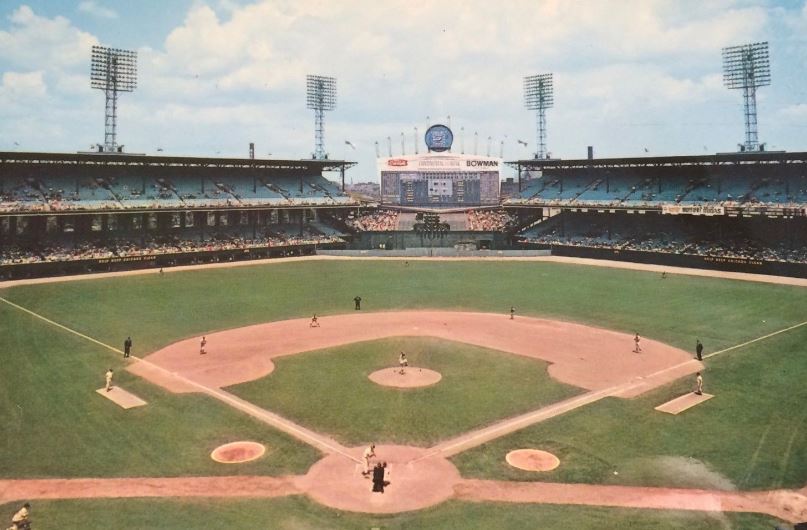
(Comiskey Park, Chicago, IL)
By 1933 the United States had arrived at a crossroad. The country was in the midst of the depression with unemployment at 25% and breadlines blocks long in major American cities like Chicago where despite Franklin Roosevelt’s implementing a New Deal people were growing desperate. Overseas Benito Mussolini embarked on his imperialist goals, Adolf Hitler consolidated power and opened Dachau, and Japan had seized parts of Manchuria two years earlier.
As the American people sought hope to overcome their economic troubles they elected Franklin D. Roosevelt as president to replace the growing hatred toward Herbert Hoover, a man who seemed to lack empathy for the masses. Two days before his inauguration Roosevelt survived an assassination attempt while visiting Miami, however the man who shared his automobile, the mayor of Chicago was killed. As things seemed to go from bad to worse even one of America’s opportunities for escapism, baseball was also experiencing a severe downturn.
As the situation in the United States grew increasingly dire a newspaperman developed the idea of playing a baseball game with the best players competing against each other as part of Chicago World’s Fair. It would offer people something to take their minds off their troubles, even if it was only a few hours. In THE FIRST ALLSTAR GAME: BABE RUTH, FDR, AND AMERICA AT THE CROSSROADS, historian Randall Sullivan explores how the game came about as he weaves together the storied characters and personalities that dominated the news cycle at the time. Sullivan’s monograph is a blend of economic, social, and political history with baseball’s development up to 1933. The author blends the most important aspects of the depression integrating the roles of important figures such as Franklin D. Roosevelt, Judge Kenesaw Mountain Landis, John McGraw, Connie Mack, and of course Babe Ruth and a host of others.
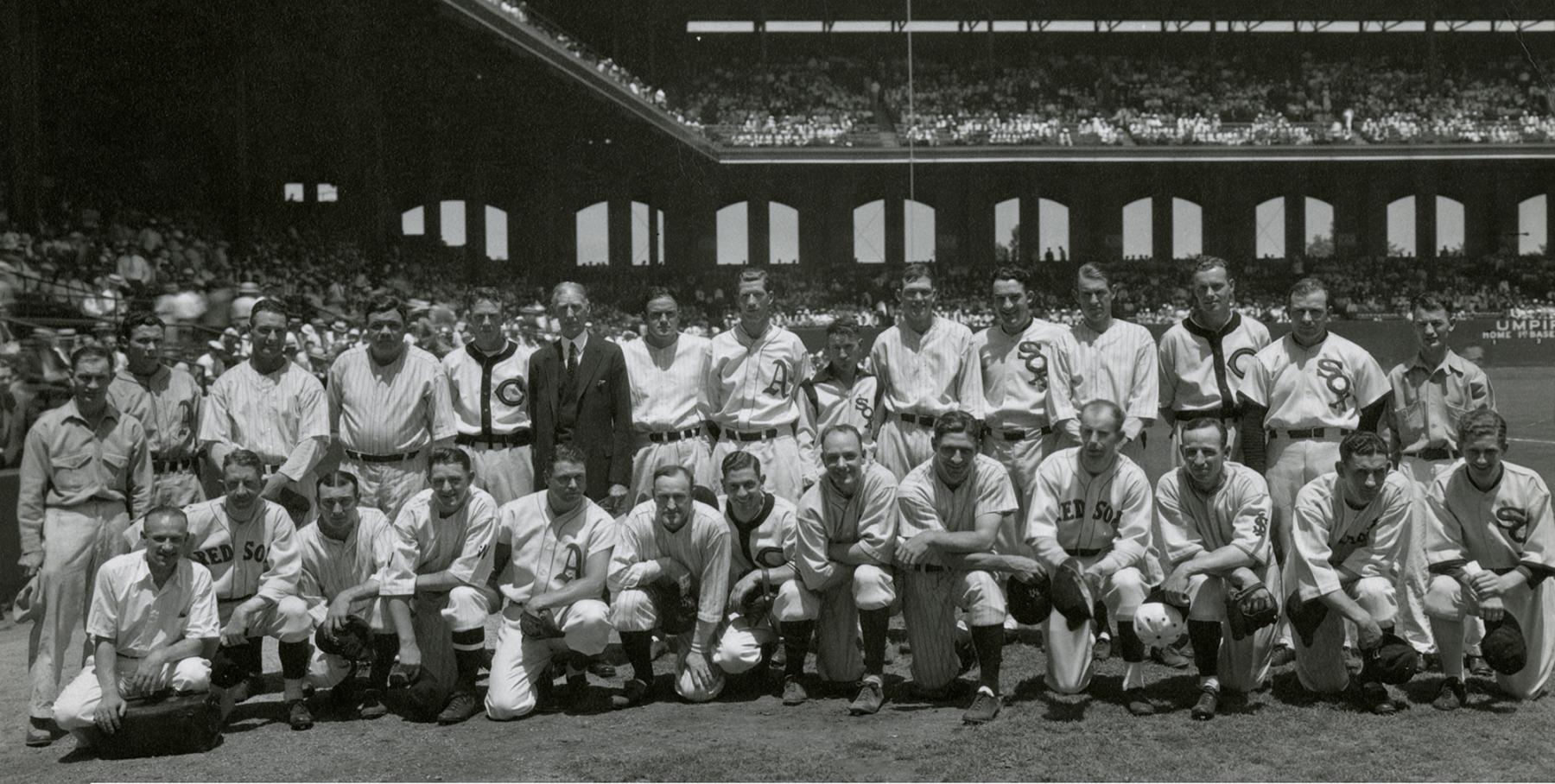
(The American League prevailed in the first AL vs. NL All-Star Game on July 6, 1933, in Chicago, defeating the NL 4-2. The man in the suit is Arch Ward)
Sullivan brings a sharp focus on the city of Chicago and how it navigated through the depression. The author astutely points out that Chicago had overcome a Depression before as the crash of 1873 which continued on and off into the 1890s with the Chicago World’s Fair of 1893. The story begins with the introduction of the role of Franklin Roosevelt whose reforms were pushed through Congress zeroing in on the crisis in banking, unemployment, farm foreclosures, industrial production and labor. Next we are introduced to Arch Ward, a journalist for the conservative Chicago Tribune owned by Colonel Robert McCormack, who as a sportswriter and promoter came up with the idea of presenting an Allstar game. Lastly, we are introduced to Judge Kenesaw Mountain Landis, a federal judge who became Commissioner of baseball following the 1919 Black Sox scandal as eight players on the Chicago White Sox threw the World Series against Cincinnati.
Sullivan’s monograph is deeply researched with wonderful vignettes concerning the major personalities of the period. The author carefully introduces each character by presenting a brief biographical sketch and integrating the lives he discusses with the economic and societal forces that dominated the period. Sullivan also explores a number of important aspects of his subject that are critical to his story but seem ancillary, but quite entertaining and important. One that comes to mind is the discussion of whether Babe Ruth was of “black” ancestry. In a chapter devoted to race the reader after learning all about Ruth’s life earlier in the book learns that Ruth was one of the few white ball players willing to play with blacks be it on barnstorming tours or other exhibition games. Sullivan discusses in detail the growth of negro baseball dating back to the 19th century introducing men like Cool Papa Bell, Oscar Charleston, Satchel Paige and Josh Gibson and whether black players were equal in performance to those in the white major leagues. Later in his career, Ruth was castigated for his interactions with blacks especially by Commissioner Landis, who was a known racist who suspended Ruth for two months at the outset of the 1925 season.

(Lou Gehrig and Babe Ruth)
Apart from t players, the careers of John McGraw and Connie Mack are exceptionally important to the development of baseball. Sullivan describes McGraw’s flawed personality, “will to win,” and overbearing personality all subsumed in an amazing career. Mack’s ownership of the Philadelphia Athletics provides a window into the economic impact of the depression and a championship baseball team that Mack had to repeatedly take apart selling his players to meet the bills and then reconstituting his team as a champion and taking it apart again. As we are exposed to other aspects of baseball history men like Ty Cobb, Jimmy Foxx, Lefty Grove, Lefty Gomez, Frankie Fritsch, Al Simmons, Lou Gehrig, Carl Hubbel, Bill Terry and Pepper Martin, Mickey Cochrane, Hack Wilson among those discussed are integrated into the larger story of the Allstar game and make for wonderful reading for any baseball historian or aficionado.
When you pick up the book and explore its title the reader gets the impression he or she is about to embark on a sports journey. However, Sullivan does an excellent job broadening his topic to create a panorama of the United States from the early twentieth century to 1933. Whether the author is discussing the economic greed and poor decision making that led to the depression, its impact on the economics of baseball, the desegregation of the sport, or the special impact on the American population whether dealing with the Dust Bowl or putting food on the table and locating shelter Sullivan portrays his topic vividly and insightfully.

If there is a criticism to be made it centers on Sullivan’s proclivity spending too much time on “social banditry” or “criminal anti-heroes” introducing Pretty Boy Floyd, Al Capone, Bonnie and Clyde, John Dillinger, among others. I understand the societal element that made these personalities important, but it does not deserve the time the author devotes to it. Further, the discussion of the Black Sox scandal is too drawn out, but upon reflection I understand why Sullivan dug deeply into that aspect of the sport since a number of players including Ty Cobb and others bet heavily on games during the period.
As for the game itself which took place on Thursday, July 7, 1933, before 49,000 excited fans at Comiskey Park, Lefty Grove came on in the seventh inning to toss three scoreless innings of relief and earn the save for the victorious American League, 4-2. Fittingly, and to the fans’ uncontained delight, the aging Ruth’s two-run third-inning home run provided the victory margin.
Despite a few flaws, Sullivan has written an incredibly interesting book, but whether you come at it from the perspective of a baseball fan, an American history buff, or simply someone looking for an enjoyable, but at the same time thought provoking read, Randall Sullivan’s effort is a book well worth reading.
(Connie Mack and John McGraw)
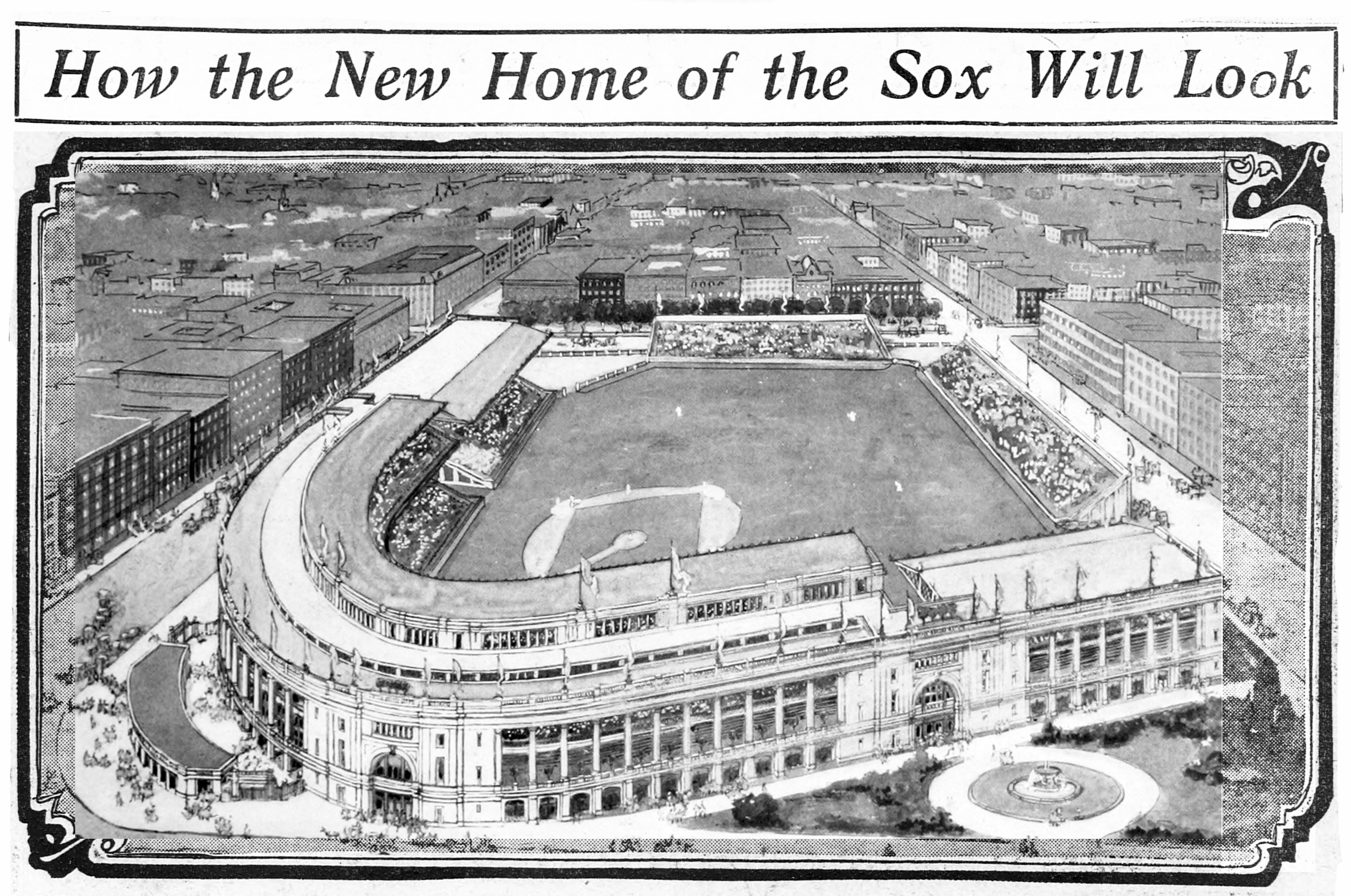
(Comiskey Park, Chicago, IL)
 Doc's Books