
(Churchill and Eisenhower)
Jonathan W. Jordan has written a superbly blended dual biography of Dwight D. Eisenhower and Winston S. Churchill entitled IKE AND WINSTON:WORLD WAR, COLD WAR, AN EXTRAORDINARY FRIENDSHIP. He focuses on their relationship from the time they met in 1941 carrying through World War II and the Cold War. It is carefully researched and written for the general reader rather than the professional historian as there is little that is new, though to the author’s credit he highlights the most important components of their relationship. The monograph explores their enduring and complex relationship as disagreements abounded, but they always seemed to come together exhibiting a genuine respect for each other. The differences center on their backgrounds as Eisenhower was an amiable man from the Midwest, Abilene, Kansas who could also exhibit a cold and ruthless drive to achieve his goals which could be hidden by genial facial expressions. Churchill, on the other hand, was a charismatic aristocrat who often came across as a 19th century figure as he did his best to preserve the British Empire. Despite differences in approach to war and diplomacy they worked closely together to defeat Nazism and deal with the crisis that emanated from the Cold War, but in all cases they seem to have their own agendas.
At the outset Churchill held the upper hand as Prime Minister of England as a wartime leader who held his country together in its darkest moments fighting Nazi Germany. Eisenhower was a career military officer who worked his way up the bureaucratic chain of command behind a desk and never held a military command. As World War II evolved their positions in the hierarchy of power and influence shifted dramatically as Churchill became more dependent on the United States to defeat Nazism, and Eisenhower with the support of General George C. Marshall became the Supreme Allied Commander in Europe who developed the ability to say no to Churchill’s whims and desires. At times there was great tension between the two particularly over Eisenhower’s refusal to kowtow to Churchill’s wishes in Greece as the Prime Minister believed Eisenhower owed him deference because of his previous support for the general. They would also come to larger heads over planning for an invasion of France to create a two front war and how to approach Russia as it conquered Eastern Europe as its army moved west.
Jordan delves into the bureaucratic machinations associated with Operation Overlord, the Normandy invasion deftly as Eisenhower wanted to use a bombing campaign near the beaches to block any German reinforcements in the area. Eisenhower wanted to make the landings as safe as possible by preventing the Nazis from strengthening their positions in the area. The problem was the thousands of French citizens who would be collateral damage which Churchill refused to agree to fearing for the postwar hatred of the French toward England. Jordan presents the different personalities and arguments accurately as Churchill unhappily gave in to Eisenhower who was willing to sacrifice French lives to save the lives of American soldiers to win the war. His view was clear – if the bombing did not take place even more French citizens would be killed by the Germans. As the debate unfolded Eisenhower was dumbfounded by Churchill’s opposition.
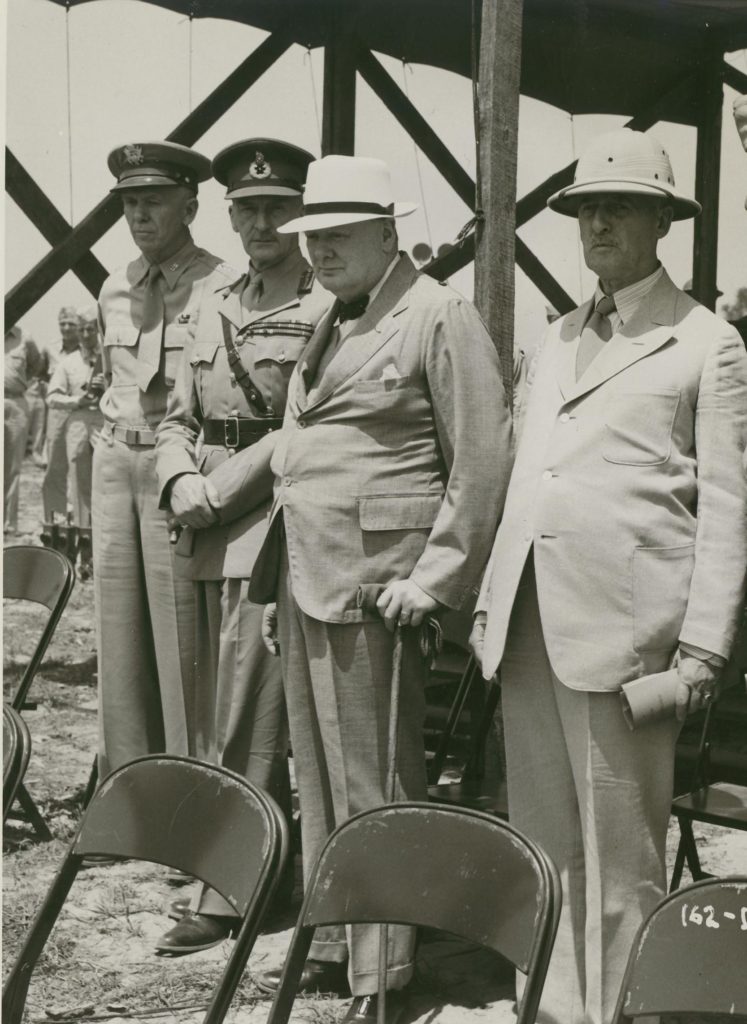
(George C.Marshall, Field Marshal Sir John Dill, Churchill, and Secretary of War Henry Stimson viewing airborne training at Fort Bragg, NC).
Throughout IKE AND WINSTON Jordan pits “Winston the romantic against Ike the realist.” Eventually Churchill would admit a grudging respect for Eisenhower, recognizing he possessed “a great creative, constructive and combining genius.” However, Churchill was often angered and puzzled over Eisenhower’s analytical coldness in his decision making. Eisenhower’s refusal to take the Greek Island of Rhodes in 1943 facilitating Churchill’s overall view of the Balkans was a case in point as Eisenhower viewed it as a distraction and unnecessarily as it withdrew troop strength from Italy.
Jordan should be commended for his ability to describe the private lives of his two main characters, their numerous meetings and conversations, and their overall opinions of each other. He takes the reader inside their relationship providing a greater understanding as to how they interacted and reached the decisions they did. Many insights are offered as at first Eisenhower would develop exceptional physical and intellectual stamina to keep up with Churchill whose daily schedule was the opposite of most people. As the war progressed and Churchill began to realize that the United States might take over Britain’s preeminent position in the world he needed a voice to influence Roosevelt and Marshall, and that would be Eisenhower. An interesting insight is offered as Churchill believed Eisenhower was out of his depth in dealing with the French be its Generals Henri Giroud, Francois Darlan, and Charles De Gaulle in 1942, so he sent Harold MacMillan to advise Eisenhower and steer him the right way. If we fast forward to the Suez Crisis of 1956 it would be Eisenhower who would help install MacMillan as English Prime Minister after the failures of Anthony Eden. From the time Churchill sent MacMillan to be at Eisenhower’s side in 1942, the two men would develop a strong friendship.
World War II produced a number of outsized personalities Eisenhower had to deal with aside from Churchill. Chief among them was Field Marshal Bernard Law Montgomery whose ego knew no bounds. Montgomery believed that he should be in charge of all land forces in Europe and was not shy about complaining to Churchill and others that he was not. Once the Ardennes Forest (Battle of the Bulge) fiasco took place in December 1944 it provided Montgomery with the fuel to go after Eisenhower’s command once again. His letters and other correspondence with Eisenhower were demeaning and insulting constantly, accusing Eisenhower of “failure.” Eisenhower resented Montgomery’s ill treatment of General Omar T. Bradley and finally read the British general the riot act. Eventually a contrite Montgomery would back off, but he never would change his opinion of the Allied Supreme Commander.
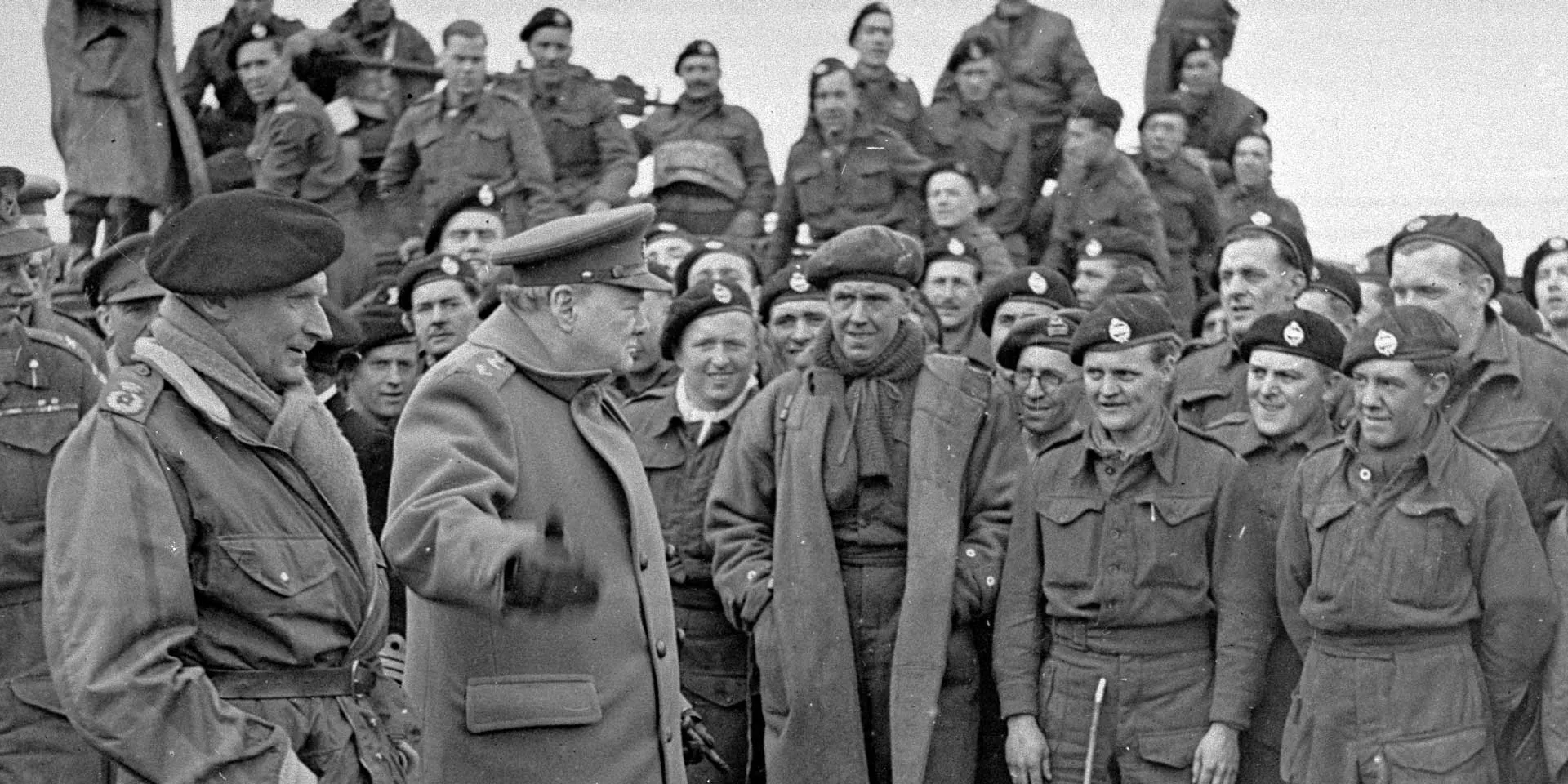
(Winston Churchill and Montgomery visiting 79th Armoured Division after the Rhine crossings, 1945)
In terms of ego, it is hard to discern whose was larger Montgomery or the leader of the French Free forces, General Charles De Gaulle. Eisenhower repeatedly had to deal with disagreements with De Gaulle especially over the French city of Strasbourg. When Eisenhower would not cave to De Gaulle’s wishes the French general threatened that he would pull the First French Army out of the allied fold and fight on its own. Eisenhower had vowed never to shortcut military objectives to please political leaders, and when Eisenhower threatened to cut De Gaulle’s supplies, a compromise was reached.
Jordan argues that the most important disagreement between Eisenhower and Churchill emerged at the end of the war over who should seize the city of Berlin. Churchill wanted to beat the Russians to Berlin and seize as much eastern territory as possible. The issue became a bone of contention when Eisenhower decided to halt his army at the Elbe River. Churchill was fresh from the Yalta Conference, and his distrust of Stalin was growing, fearing for the post-war world. Eisenhower’s viewpoint was purely military, arguing that the most efficient way to finish off the Nazis was to drive through Leipzig and Bavaria. Churchill had no choice but to back off and despite his anger he would defend Eisenhower from criticism from the British Joint Chiefs as no matter how many riffs existed Churchill valued Eisenhower’s friendship and usual support. Despite these feelings Churchill never got over Eisenhower’s Berlin decision as he knew it signaled trouble for the future.
Jordan does not deal with the post war era in as much detail apart from Churchill’s Iron Curtain speech on March 5, 1946, in Fulton, Missouri, and a few other events. He picks up their relationship substantively as Churchill returns to 10 Downing Street on October 26, 1951. He had concerns about Eisenhower in that his supporters for the presidency were bankers, lawyers, and corporate types who were more concerned about money and profits as opposed to military matters. Further, he believed he did not trust John Foster Dulles and his moralistic approach to foreign policy. Lastly, he feared he would not be able to maintain the special relationship with his wartime ally.
The main point of contention between Eisenhower and Churchill would center on the Prime Minister’s obsession with having a summit meeting with the Russian leadership, a recreation of the “Big Three” especially after Stalin died in March 1953 and Eisenhower assumed the presidency. Eisenhower would refuse any summit until the Russians took steps to lessen tensions in Austria and Eastern Europe. When Churchill tried to go it alone and meet with the Chairman of the Soviet Council of Ministers, Georgy Malenkov, Eisenhower rejected his plan. Churchill would blame Dulles for manipulating the President and the two held very low opinions of each other. The idea that Dulles was the most prominent architect of US foreign policy is a misnomer. In my own research for my monograph DAWN OVER SUEZ: THE RISE OF AMERICAN POWER IN THE MIDDLE EAST 1953-1957 documents clearly show that Eisenhower was in charge and at times had to rein in his Secretary of State.
.jpg)
(Sir Anthony Eden)
If there was an area that the two agreed it was over events in Iran. When Iranian Prime Minister Mohammad Mossedegh nationalized the Anglo-Iranian Oil Company in 1953 an Anglo-American coup took place as it was feared that Mossadegh was creating inroads for Russia in the region. However, the summit issue with Russia would drive them apart as did Eisenhower’s new approach to defense. “The New Look” would rely less on conventional weapons due to their expense and put the emphasis on covert operations by the CIA and arguing that threats of small nuclear weapons would save money. Churchill was horrified as he believed if it came to a nuclear showdown with Moscow, London would be one of the first Russian targets. The Prime Minister would argue with Eisenhower over the possible use of weapons of mass destruction repeatedly. More and more Eisenhower saw Churchill “as a man past his prime. A cavalier in an atomic age….Winston is a curious mixture of belligerence and caution, sometimes amounting to almost hysterical fear.” Churchill could not accept he had lost his influence over Eisenhower and continued to blame Dulles.
Jordan correctly delves into the ideological split between the two men which rested on the issue of “colonialism.” Eisenhower feared that Moscow was taking advantage by promising to break the chains of old world oppression – chains forged by England and France. To keep Moscow from exploiting populist rage, the United States needed to show support for independence movements and self-determination when speaking in public. England was seen as the epitome of underdeveloped world bullying. The example of Egypt and the Suez Canal reflected this reputation as Egyptian President Gamal Nasser was able to use American pressure on England to agree to the “Heads of Agreement” to gain greater control of the Canal, a topic that Jordan does not discuss in enough detail. As far as French colonialism is concerned, events in Vietnam which produced the disaster at Dienbienphu, and the deterioration of their Algerian colony created hatred for France throughout the underdeveloped world. Eisenhower would have to navigate a public stance of sympathy for colonialist oppression and in private he would engage what Blanche Wessen Cooke argues in her book DECLASSIFIED EISENHOWER being ”the coup president,” as was seen in Iran in 1953 and Guatemala in 1954.
Churchill finally agreed to leave office and turn 10 Downing Street over to his Foreign Secretary Anthony Eden in April 1955. Jordan will recount the Suez Crisis in detail reflecting how Eisenhower refused to go along with the Sevres Agreement whereby England, France, and Israel agreed on a plot to recover the Suez Canal which Nasser had nationalized. Eden believed he would have Eisenhower’s support and twisted their communications to reinforce this pipe dream. Jordan discusses the main aspects of the crisis and the final pressure by Eisenhower that would force the three conspirator countries to withdraw from Egypt by March 1957. What he leaves out is the hypocrisy of the Eisenhower administration which had its own coup planned for Syria at the end of October 1956 the same week the Israeli invasion of Egypt took place. At that point, the coup had to be called off. Further in December 1956 Eisenhower would work behind the scenes for Harold MacMillan to replace Eden as Prime Minister when Eden was visiting Jamaica. Some might call it a coup! It is clear that the US was actively working to replace English domination of the Middle East with American control. With the issuance of the Eisenhower Doctrine in January 1957 which would be first tested in Lebanon the transfer was complete.
In evaluating Jordan’s work, he has produced a wonderful synthesis of the Eisenhower-Churchill relationship, one in which remained a true friendship despite the lack of agreement on a myriad of issues over the years. The book is written in a style that the general reader would enjoy, and I recommend it to anyone who is interested in one of the most important personal relationships of the 20th century.
 |
(Churchill and Eisenhower)