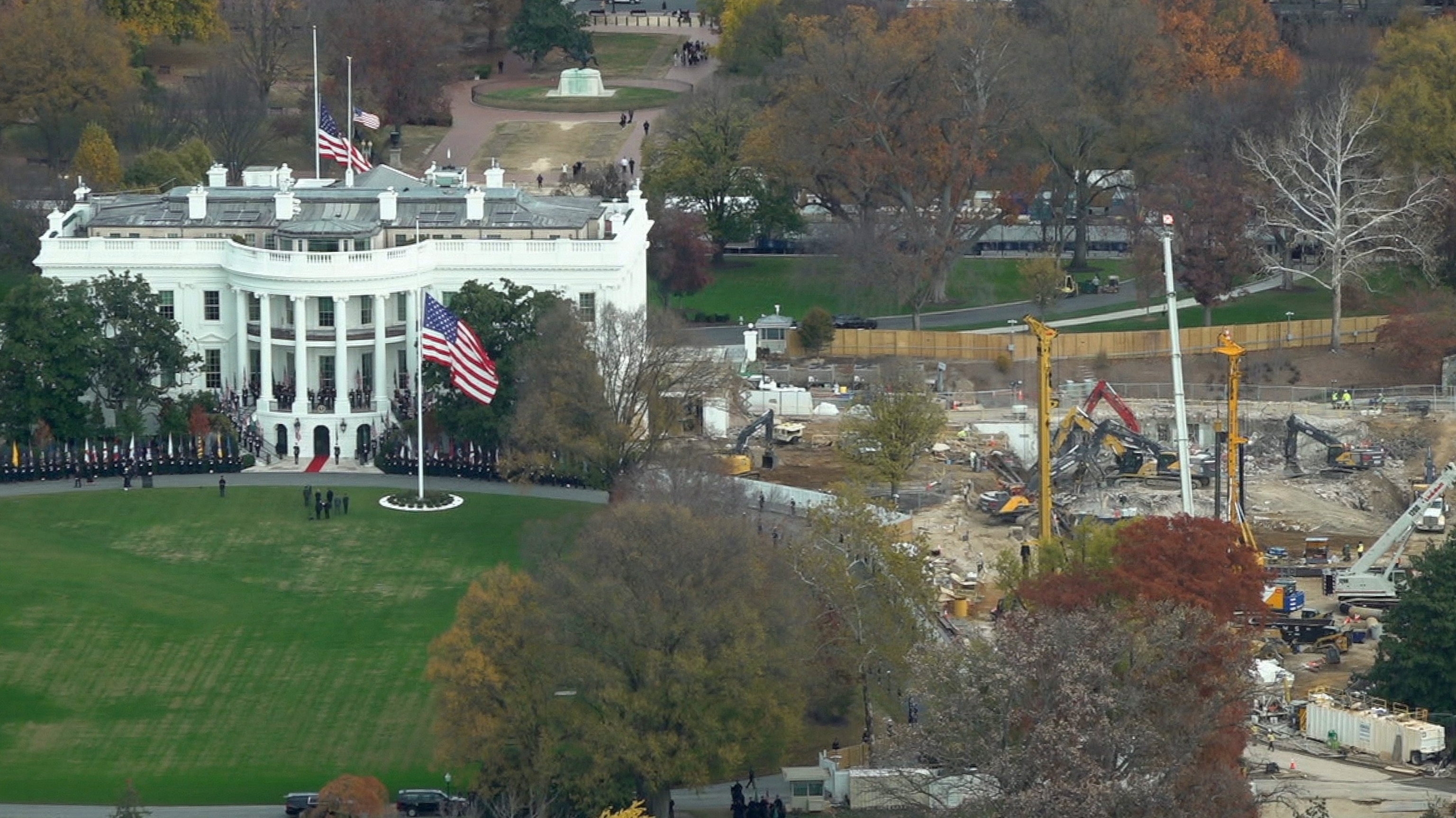
(The construction for the ballroom on the White House’s East Wing as seen from the top of the Washington Monument, Nov. 17, 2025).
When Donald Trump announced his goals to justify his war on Iran he described it as an “excursion” and regime change was on the top of his list. Fast forward three months and it appears the United States defeated Iran militarily but lost the geo-strategic battle as Tehran has emerged victorious as it now controls the Gulf of Hormuz and can negatively impact the world economy at will, something that did not exist before Trump’s “excursion.” Further, Iran’s theocratic regime remains intact, the government maintains its missile capabilities and retains thousands of drones. It is clear from the recently signed Memorandum of Understanding that the United States has lost the peace. It appears Trump has grown tired of the war and needs to put it behind him because of the upcoming mid-term elections. As a result, he has agreed to lift oil sanctions on Iran, allow Iran to control the Strait of Hormuz, promised billions of dollars in rebuilding funds a.k.a. reparations, and the release frozen Iranian assets. In addition, nothing has been agreed to pertaining to Iran’s nuclear assets. One must ask, how did this situation come to fruition so quickly? Many of the answers to these questions and other aspects of the Trump administration’s policies can be found in New York Times’ journalists, Maggie Haberman and Jonathan Swan’s new book, REGIME CHANGE: INSIDE THE IMPERIAL PRESIDENCY OF DONALD TRUMP.
From the book’s title one would gather the narrative focuses on Iran, but that is just one component as the authors focus on the Epstein Files, Trump’s revenge tour against perceived enemies, immigration policy and the actions of ICE, foreign influence, the enriching of the Trump family, corruption, and the overriding concept of loyalty which dominates any relationship with Trump and his administration. The authors also engage in analyzing why Trump behaves as he does. From the outset they argue that Trump has always created his own reality and then proceeds to force others to submit to his version of events. Trump lies constantly and absurdly; but what began as fantasies often blurred and morphed into a reality of his own making. With increasing frequency, and the help of sycophants, Trump spoken word is truth. Trumps adamant refusal to accept reality laid the foundation for his comeback in 2024. His obsession over the election of 2020, his ability to draw many into his mindset that the election was stolen, and that January 6th rioters were patriots out for a “Sunday stroll” dominate his world view and if you do not succumb to the gestalt you are not allowed into his world and administration.
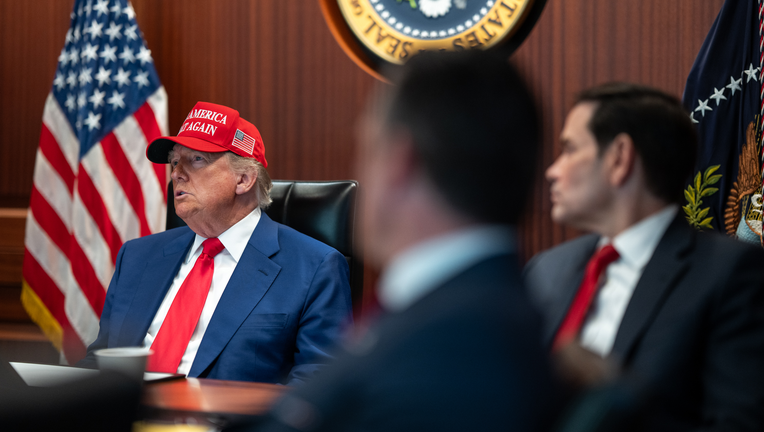
(President Donald Trump (L), Defense Secretary Pete Hegseth (C), and Secretary of State Marco Rubio monitor the U.S. strikes on three Iranian nuclear enrichment sites from the White House Situation Room on June 21, 2025)
Regime change is normally associated with foreign countries. However, based on the use of executive power what we are now experiencing in our country is regime change when one examines administration policies and actions, and Trump’s rule by his “gut.” The monograph is very concerning in that it is well researched and sourced. One could not imagine the types of events, personalities, and actions that are described, but they are part of our political fabric and policies that makes one wonder what the future holds.
In reading REGIME CHANGE it is difficult to discern which event or policies are the most disconcerting. But what is most important is the issue of accuracy. To this point there has been little push back from Trump administration supporters concerning the narrative. There are the usual criticisms focusing on personal attacks against the authors but little if any questioning of the substance of what the authors present. The most important criticism voiced by Tunku Varadarajan in his June 26, 2026, review of the book in the Wall Street Journal states that “the book relies largely on sources who spoke exclusively on ‘deep background,’ journalism jargon for the pinky-swear promise of eternal anonymity. We’re asked to trust the writers but have no means to verify their disclosures, some of these purportedly from the very heart of the presidency.” If this criticism is accurate why has no one questioned the core of what has been uncovered? Further, based on the record of honesty associated with the Trump administration who should we believe?

(Senior White House policy adviser Stephen Miller watches President Donald Trump speak in the Oval Office. Emails leaked to the Southern Poverty Law Center appear to reveal Miller’s familiarity with white nationalist texts and thinkers).
The book itself is a cornucopia of the last 365 days. If you are a news junky like I am I was pretty aware of most of what the book discusses. What I wasn’t cognizant of were the deep sourcing taking the reader inside meetings, arguments, and written components of the topics at hand. This is where the Trump administrations actions become unsettling which is due in large part by Trump himself but also the characters around him who have been given power. Chief among them is Stephen Miller who has risen to be Deputy Chief of Staff for policy and the keeper of all executive orders, placing him in charge of domestic policy. He has become the most powerful White House staffer in modern history. He is laser focused on cutting through the traditional bureaucratic obstacles in the federal government to push through Trump’s agenda. He has recruited lawyers who stretch the law to illegalities to implement Trump’s wishes – clean out the federal work force from “Trump haters.” Miller was in charge of the flurry of executive orders at the outset of the administration by overwhelming the opposition as to their number be it ending birthright citizenship or pausing funding of federal agencies. In the realm of immigration, Miller has set daily quotas to round up and deport people to the tune of 3000 per day. The promise was that only criminals would be seized and deported, but to reach the one million per year that Miller sought regular people, some of whom are citizens and others who are here legally have been rounded up by ICE. It was clear racial profiling was used which went along with Miller’s view of race and wanting to facilitate the creation of a white republic. The authors delve into Greg Bovino, Dan Bongino, Tom Homan, Kristi Noem, Pam Bondi and others who have facilitated this process.
Another character portrait which is beyond the pale centers on Elon Musk who spent $300 million to get Trump elected in 2024. He created DOGE, the Department of Governmental Efficiency and began to gut the federal work force and certain programs. With little knowledge of the labyrinthine federal system, nor how the budget functioned, with even less interest in the Constitution, he sought to reengineer the government as he imagined. He usurped the powers of Congress; impounded billions already appropriated and overrode cabinet members. A case in point was getting rid of USAID, the heart of American soft power overseas which probably caused the death of thousands by slashing funding for medicines and other aspects of disease control. Further he even blocked funding for an ISIS prison that held over 300 terrorists.

(ARLINGTON, VIRGINIA – MARCH 02: U.S. Secretary of War Pete Hegseth speaks during a news conference at the Pentagon on March 2, 2026 in Arlington, Virginia. Secretary Hegseth and Chairman of the Joint Chiefs of Staff)
The list of characters associated with the implementation of Trump’s agenda is long and disheartening especially on the domestic front with the use of ICE, and the deployment of the military to try and occupy certain cities – all of which are heavily minority and democratic. The first test case was Los Angeles, then Chicago, Washington, DC, and of course the fiasco that resulted in the death of two American citizens in Minneapolis.
The authors present the rationale for other programs including the unleashing of tariff wars as Trump maintains the 1950s belief that doing so would bring back manufacturing to the United States. Trump’s tariff policy rekindled the horrors of the Hawley-Smoot tariffs of 1930 which greatly contributed to the Great Depression but free trade once the hallmark of the Republicans just melted away. It began a trade war with our allies, a process that would also include Trump’s agenda to rely less on traditional allies, break up NATO, and force them to recalibrate any reliance on Washington. This also had a negative effect on the economy as by increasing tariffs the result is an increase in the cost of consumer goods resulting in higher inflation. Trump blames inflation on the Biden administration, or he rationalizes that it would only be a short time problem as tariffs would produce great revenues to offset the pain for the consumer.
Haberman and Swan’s discussion of Trump’s domestic agenda are disturbing enough but his foreign policy has been a disaster. According to Trump he would end the war in Ukraine in 24 hours. His kowtowing to Vladimir Putin is part of the historical record. His treatment of Volodymyr Zelenskyy has been abhorrent particularly the scene in the Oval office in February 2025 as Trump tried to force the Uranian president to give into all of Putin’s demands. The treatment of NATO allies is well known as is Trump’s obsession with obtaining Greenland and the obnoxious tactics pursued. But it is the current situation in Iran and how we went to war which is most disturbing.
It is clear that Israeli Prime Minister Benjamin Neteyahu was able to convince Trump to go along with the plan to attack Iran. The June 2025 Israel attacks in Lebanon and Iran showed Trump what success could look like and since he always wants to be associated with a winner, so he joined Israel in going after Iran’s hidden nuclear capabilities. After the success against Venezuela’s President Nicolas Maduro Trump thought he could decapitate Iran’s leadership, and a new regime would give into his whims. We all know how that turned out with Iran controlling the Gulf of Hormuz and Trump succumbing with his Memorandum of Understanding, a strategic victory for Iran, though a military victory for the United States.

(General Dan Caine, Chairman Joint Chiefs of Staff)
Apart from domestic and foreign policies Haberman and Swan’s research into the accumulation of Trump family wealth and those of the presidents friends are unprecedented. Deals for Jared Kushner, Steve Wycoff and his son, Erick and Donald Jr. have brought in billions from drone contracts, crypto deals, and other projects. Donations based on coercion of Corporate CEOs have brought in billions to Trump’s political actions committees to fund some of his outlandish desires reflecting the fear Trump has instilled. Yesterday, in fact it was announced that Trump had earned over $2 billion of personal wealth during his first term. The media has been no exception as Trump wants to remake how news is reported. If that is not enough Trump wants to change how we view our history – the author’s discussion of the Smithsonian is a case in point.
The scariest section of the book is entitled “Retribution” in which the authors recount how Trump has gone after anyone he feels criticized him in the past. If you did not agree with the 2020 election conspiracy or the categorization of the January 6th participant there was a target on your back. Law firms, former Homeland Security or FBI officials, universities, newscasters, nighttime comedians, Letitia James, Alvin Bragg, John Bolton, John Brennan, James Comey and his daughter, and Federal reserve Chair, Jerome Powell all fit this criteria as do a host of others.
One would think that the MAGA world would never oppose any action or inaction taken by Trump, but the Epstein Files finally created an opposition which to this day has not gone away. The work of Pam Bondi and Todd Blanche to block the release of the files is well known and the authors sprinkle in greater detail. Especially intriguing is the chronicling of the Situation Room meetings to develop a strategy to deal with the Epstein files that included Vice President Vance, Susie Wiles, and many other important figures.

(Donald J. Trump with Todd Blanche outside Manhattan Criminal Court, where Mr. Blanche was the president-elect’s defense lawyer in the hush money case. The two bonded over the several weeks of the trial)
The depth of detail in Haberman and Swan’s narrative amazes. From their description of Trump as an interior decorator with his gold touches, to Trump’s annoyance at Vice President Vance’s position on Iran (maybe that is why he was put in charge of negotiations to end the war!) to reactions to the killing of Charlie Kirk, to how Mark Zuckerberg, Jeff Bezos and others ingratiated themselves with Trump, to a myriad of other examples the authors take the reader inside an unimaginable world. Significantly, Vance and Miller wanted to use the murder of Charlie Kirk as an excuse to go after anyone they perceived to be enemies of the administration. Thery issued a National Security Presidential Memo/NSPM-7 which was designed to label all leftist elements in American politics as a terrorist threat arguing that most violent acts were committed by leftists while the facts reflect it was the American right which was most responsible.
The authors provide many keen observations in the run up to the attack on Iran. They focus on the debates within the administration as to what action should be taken. The focus on CIA Head John Ratcliffe and Joint Chiefs of Staff Chairman Dan Caine are most disconcerting. Ratcliffe warned Trump that Netanyahu’s presentation to justify war and his objectives did not pass the smell test, and others described them as “bullshit.” The Israeli Prime Minister had his own agenda separate from the United States and was able to convince Trump of a quick and relatively easy victory. Cain warned Trump that war would heavily deplete America’s weapons and munitions stockpiles presenting the cost of an Iranian drone v. US missiles as a case in point. This would lead to Defense Secretary Pete Hesgeth’s repeated lies about America’s inventory once a ceasefire was agreed to. The authors unequivocably state that at no point during the deliberations that resulted in war did Caine tell Trump that war with Iran was a terrible idea, “though some of Caine’s colleagues believed that was exactly what he thought.” In the end, as per usual, Trump went with his “gut” and did what he wanted expecting a second Venezuela result.
One could never write a Hollywood script to describe a presidency that people would believe if it were based on this book. However, until someone proves that what these authors have written is false we as a nation have a president who puts himself, his legacy, his wealth, and his “gut” feelings ahead of the needs of the American people.
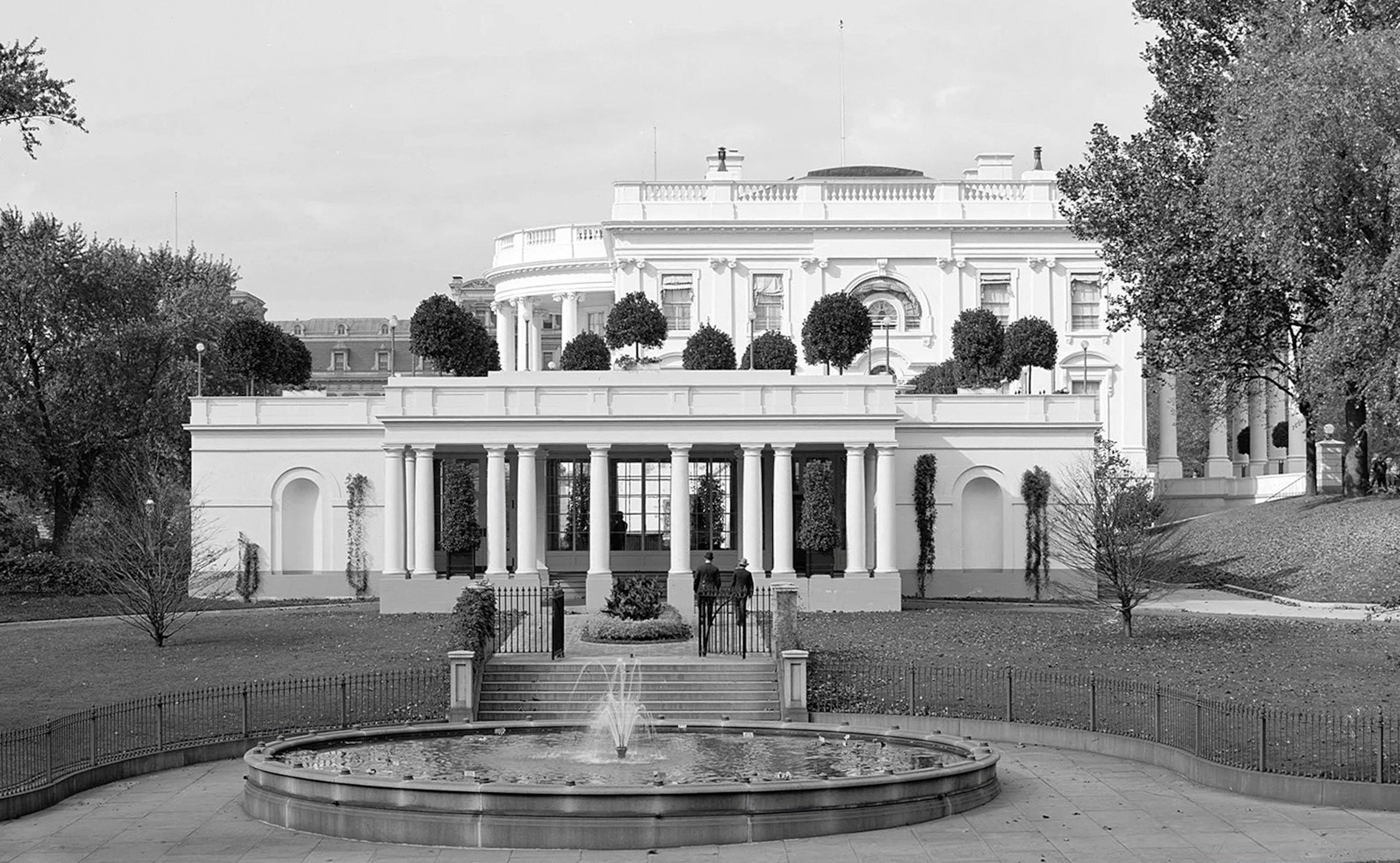
(A general view of the White House East Wing entrance in Washington in 1906).

