ISIS: THE STATE OF TERROR by Jessica Stern and J.M. Berger

ISIS: The State of Terror

At a time when we see images of Iraqi forces backed by Iranian supported Shi’a militias trying to retake Saddam Hussein’s home of Tikrit from the Islamic States of Iraq and Syria (ISIS), and we witness young girls leaving their homes in London and make their way through Turkey to join the jihad in Syria, it raises enumerable questions for politicians and the public worldwide.  Foremost, is how did we arrive at this point with ISIS, ISIL, IS or whatever their name is at the moment.  In addition, how culpable is the United States for the situation that it finds itself in today; returning troops to Iraq, engaging in a major bombing campaign in Iraq and Syria, spending millions, if not billions of dollars on an Iraqi army that when confronted with ISIS soldiers months ago fled in fear and left behind enough weaponry and equipment to enhance ISIS’ already burgeoning military machine.  The answers to these questions can be found in Jessica Stern and J.M. Berger’s new book, ISIS: THE STATE OF TERROR, one of the first books that seriously attempts to analyze the rise of ISIS; concentrating on the fallout from the American invasion of Iraq in 2003, its evolution under al-Qaeda and its eviction from that organization, to its announcement  of the new Islamic caliphate, and its employment of technology and advanced propaganda strategies to attract foreigners to fight and organize their new state.

Beginning with the horrific beheading of journalist James Foley on August 19, 2014 the authors begin to unravel the rise of ISIS and why the United States did not see the latest jihadi organization coming.  The origin of ISIS emerged from the mind of Abu Musab al Zarqawi, a Jordanian who joined the insurgency against the Soviet Union in Afghanistan as it was drawing to a close in 1989.  Partially radicalized by Sheik Abu Muhammad al Maqdisi, the architect of jihadi Salafism, Zarqawi would spend the greater part of the 1990s in a Jordanian prison where he was further drawn to Islamic extremism.  Zarqawi brought a sectarian approach to his understanding of jihad, and the United States gave his beliefs a purpose when they invaded Iraq in 2003.  Zarqawi was able to develop al-Qaeda in Iraq (AQI) because of American policy errors.  When Paul Bremer, head of the Coalition Provisional Authority disbanded the Iraqi military and fired all of Saddam Hussein’s Ba’ath Party members from civil service positions there were few trained people left to maintain government services, and it produced thousands of angry Sunnis who had military and civil training.  The result has been the development of an insurgency that the US was unprepared for.  The authors correctly argue that the US created the environment for Zarqawi’s brutal tactics and rabid sectarianism.  The second major error the US committed was throwing its support behind Nuri al-Maliki, a supposedly moderate Shi’a Muslim to be Prime Minister in 2006.  Maliki would prove to be a very divisive figure with strong ties to Iran.  His policies turned Sunni Iraqis against his government as promises of political power and integration into the military never came to fruition.  By 2006 a full scale sectarian war had broken out resulting in the death of Zarqawi by an American air strike, and months later a coalition of jihadi insurgents announcing the creation of the Islamic State of Iraq (ISI) under the leadership of Abu Omar al Baghdadi.  As Maliki cracked down on Sunni leadership and purged them from positions of power.  Sunnis, fearful of their government and Shia militias had no place to turn to, hence they looked to ISI.

Once the authors explained the origins of ISIS they move on to provide a detailed description of how ISI expanded and eventually moved into Syria, changing their name to the Islamic State if Iraq and Syria.  The authors review ISIS’ relationship with al-Qaeda and Osama Bib-Laden, exploring their differences in strategy, organization, and interpretation of the Qur’an.  ISIS took advantage of events in Syria and expanded their violent millenarian view of Islam and by February, 2014 Ayman al Zawahiri, who had taken over leadership of al-Qaeda after Bin-laden was killed, disassociated his organization from ISIS over their extreme tactics and their presence in Syria.  With Maliki’s partisan Shia approach to governance more and more Sunnis joined ISIS, many of which were Saddam’s generals.  The result was that by June 2014, ISIS had captured Fallujah, Mosul, and Tikrit.  On June 29, 2014, ISIS declared the Islamic Caliphate, an action designed to subsume all jihadi organizations, including al-Qaeda under their leadership.  ISIS abhorrent approach to human life continued, but their sophisticated messaging now included a vision of the type of society it wanted to create.

About half way through the book the authors switch their approach from a historical narrative supported by many keen insights to a sociological-psychological dimension.  Chapters dealing with the importance of how ISIS employs technology and social messaging, including how twitter, Facebook, YouTube, and other social media are used to  recruit foreigners to join the new Caliphate, and spread their influence throughout the Middle East and beyond.  The authors explore how ISIS presents a strange dichotomy of ultra-violence and civil disorder as it streamed its propaganda and vision of society that went beyond the violence of jihadism, i.e, governing and social services.  The sophistication of ISIS’ approach to the media and the digital film world are detailed.  ISIS professionalization of film making and messaging are designed to attract fighters, but also “middle management.”  In effect what ISIS is engaged in is “cyber jihad” with electronic brigades that allow them to create new opportunities to expand their “brand.”  The authors examine the new psychology of terrorism and how it is used to influence their enemies and maintain control of other jihadi organizations world-wide.  The main problem they export is “disproportionate dread,” and the manipulation of perception that the west has yet to counter.

According to Stern and Berger ISIS’ message differed from the approach that was offered by al-Qaeda whom they saw as defeatist because they never believed that the Caliphate would be achieved in their lifetime.  Their message is one of extremism itself, but purified.  They offer no rationalizations of self-defense against the west, just revenge.  No longer will there be subtle assumptions of weakness, just aggression and shocking violence and strength.  No more talking about a generational conflict, the Caliphate had been proclaimed.  Their “combination of successful strategy, aggressive messaging, and an appeal to strength over weakness has proven unequally powerful and energized at least tens of thousands of ardent supporters.” (197)

The latter part of the book explores the current state of ISIS as of early January, 2015 and the authors are fully cognizant that things may have changed since the book went to press.  Stein and Becker offer advice as to how to deal with ISIS and suggest that a different approach than has been used in the past should be implemented.  Military action to decapitate the leadership of a country does not always prove successful.  Once the leadership is gone we are then faced with situations that have existed in Iraq since 2004, and more recently in Libya after the overthrow of Moammar Gadhafi.  President Obama may call for the defeat and destruction of ISIS, but what we must accept is that this has become a generational problem as the authors point to the indoctrination of children by ISIS, so that once the current leadership has passed a new generation will take over.  The book also includes a detailed appendix dealing with Islamic thought and history that nicely supplements the main text.  Explaining the differences between Shi’a and Sunni Islam, Salafism and Wahhabism, and the different interpretations of jihad are important to understanding what has occurred and where we go from here.  The book is based on interviews and secondary sources and at this point, is one of the two best monographs on the topic.  The other, ISIS: INSIDE THE ARMY OF TERROR by Michael Weiss and Hassan Hassan will be presented in my next review.

COLONEL HOUSE: A BIOGRAPHY OF WOODROW WILSON’S SILENT PARTNER by Charles E. Neu

(President Woodrow Wilson and Colonel Edward House, campaigning in 1912)

One of the most tragic endings to any presidency in American history is that of Woodrow Wilson.  Elected twice the former president of Princeton University and Governor of New Jersey continued progressive reform that had marked the earlier administrations of Theodore Roosevelt and Howard Taft.  In addition, Wilson guided the United States through the Great War and developed a plan to make it “the war to end all wars.”  However, Wilson suffered a stroke while trying to sell his postwar plan to the American people as he battled to overcome partisan congressional opposition to the League of Nations and never regained the emotional balance to compromise with his detractors.  In the end Wilson became a bitter man and the fight over the League of Nations overshadowed the positive impact his presidency had on American history.  During Wilson’s administration a “counselor” emerged who had no official title or rank but has often been labeled as Wilson’s “silent partner.”  This individual helped shepherd through Wilson’s domestic agenda through congress, but he remained in the background throughout that process.  It was in the arena of foreign affairs that he became known to the general public.  The man, Edward House was a wealthy Texas politician and businessman who was fascinated by the organizational side of politics, rather than the achievement political power in of itself.  Nicknamed the “Colonel” based on an honorary National Guard rank the governor of Texas bestowed upon him, Colonel House became one of the most powerful and controversial presidential advisers in history.  Until now the literature on House lacked a comprehensive and masterful biography, with the publication of Charles E. Neu’s COLONEL HOUSE: A BIOGRAPHY OF WOODROW WILSON’S SILENT PARTNER that void has been filled.

Neu has written a biography that should remain the definitive source on Colonel House for years to come.  The book is based on assiduous research that includes the leading secondary works on all aspects of American history that House was a part of.  It took Neu years to research and write and it is reflected in the primary materials he examined, particularly the over 3000 page diary that House prepared on a daily basis until 1921 when the Versailles Conference ended.  Neu points out that throughout his life that House was most interested in the “process rather than the substance of politics, fascinated with tactics and personalities.” (11)  As he worked his way through Texas politics he created what he referred to as “our crowd,” a group of advisors and sycophants who would remain with him throughout his career.  In his relationship with Wilson he took on many tasks that the President found distasteful.  Wilson, whom was not a warm individual saw in House an individual that possessed the capacity for human relations that he lacked and relied upon his “counselor” to smooth the way for legislation as well as diplomatic relationships.  One would think that Wilson and House would have spent a great deal of time together during the course of their friendship, but Neu reveals that most of their communication was by letter and telephone.  Fortunately House’s diaries have provided historians a record of their warm feelings for each other that today might be categorized as a “bromance!”

(President Wilson and his cabinet)

Neu correctly develops the theme that House’s greatest contribution to his relationship with the president was his assessment of European events as he repeatedly traveled to Europe between 1913 and 1917 as the United States tried to navigate a policy of neutrality during World War I.  House became the key to American mediation efforts, though his judgment was often clouded by his enamourment with England and its Foreign Secretary Sir Edward Grey and the policies of Lloyd George.  Wilson relied on House as his “personal emissary” but at times House missed the larger historical forces that shaped the policies of the European powers as the war continued.  House’s relationship began with Wilson in 1911 as he grew tired of the policies offered by the Republican Party.  For a number of years through the prism of Texas and national politics he searched for a progressive Democrat who was electable.  The search brought him in contact with Governor Wilson of New Jersey and their relationship blossomed.  With the disarray in the Republican Party in 1912 whoever secured the Democratic nomination was likely to be elected president.  Neu provides a detailed summary of the 1912 election and correctly concludes that it was “one of the most intense campaigns on both a personal and intellectual level that has ever occurred in American political history.” (66)  After the election House had to reinvent himself from the Texas politician who focused on the acquisition of power, relying on personal loyalty, patronage and the manipulation of the system to an advisor dealing with a progressive agenda.  House made the conversion easily and his relationship with Wilson would continue to blossom until the president’s first wife passed away.

 (President Woodrow Wilson, his second wife, Edith Bolling Galt, and Colonel Edward House)

Wilson’s relationship and remarriage to Edith Bolling Galt in 1915 altered Wilson’s relationship with House.  What amazed me was the intimate relationship the two men shared until Wilson remarried.  Neu includes numerous excerpts from letters the two sent to each other in the narrative and the sincerity and emotional nature of their correspondence reflects how dependent they were on each other, i.e., on Christmas day, 1914 Wilson and House exchanged telegrams.  “I wish, I could see brought into your life some happiness and blessing equal to those you have brought into mine by your wonderful friendship.  You have kept faith and strength in me.”  House replied, “Your message has made the day a happy one for me.  May God’s blessings fall upon you and yours abundantly during the coming years.” (164)   Once Edith Galt, a controlling woman entered the picture the relationship between the two men would suffer.  Neu conjectures that despite Wilson’s efforts, Galt was not inclined to share her love for him with another person and her attitude from the start toward House was negative, as she told the president that “I know I am wrong but I can’t help feeling he is not a very strong character….he does look like a weak vessel and I think that he writes like one very often.” (201)   Galt’s relationship with House would be glossed over by her husband but it would never be the same.  Neu does a remarkable job cataloguing the relationship throughout the war and the peace process and concludes that once Wilson suffered a stroke in 1919 her influence on the president was detrimental to the country as she reinforced his negativity that was in part caused by his illness.

Neu does an exceptional job describing the diplomatic and military events dealing with World War I.  He deftly examines the major political and military characters involved and makes numerous insightful comments.  He integrates House’s role in mediation efforts and policy decisions nicely and correctly concludes that in most situations House had an overblown sense of his own importance and influence that at times led to inaccurate reports back to Washington.  This inflated estimate of himself, in part was the fault of Wilson who had a habit of dispatching House on his European missions with only vague instructions and carelessly monitored his negotiations.   Neu has an excellent command over the details of House’s ventures overseas be it to mediate the war before US entrance or managing the allied coalition once the US became a combatant.  A case in point was House’s mediation effort after Wilson was reelected in 1916.  Neu’s analysis of London and Berlin seem very credible and he seems to have mastered the military and political nuances in each capital.  In Berlin, Generals Ludendorff and von Hindenburg views on strategy and implementation of U-boat warfare and the declining influence of Chancellor Bethmann Hollweg are accurately presented by the author.  Neu goes on to state that House’s evaluation of Lloyd George and Arthur Balfour led him to believe that he understood the war better than the president.  House also believed that Wilson was not preparing the country for war, which he believed was inevitable, also setting him apart from the president.  Despite these differences it appears that House had Wilson’s full support as he had him prepare for a post war peace conference which would take place after Germany’s defeat

(Colonel Edward House, Secretary of State Robert Lansing, President Woodrow Wilson)

Neu’s knowledge of war events is especially useful as he places the Wilson-House relationship in the context of events overseas.  Whether discussing the diplomacy dealing with Germany’s U-boat policy, events in Russia as the Czarist regime collapses, the disintegration of the Austro-Hungarian Empire, or the policy of unconditional surrender the author’s narrative is impeccable.  Once the war ends Neu spends a great deal of time on the evolution of the negotiations in Paris and points out the errors that were made.  First, having the conference in Versailles instead of a neutral site like Geneva; having Wilson as the head of the American delegation, and not bringing a prominent Republican as a member of the American commission.  All these errors that House relayed to Wilson are discussed and their negative effect on the final outcome embodied in the Treaty of Versailles are examined.  Wilson’s stubbornness and inflexibility are ever present, but so is House’s inability to convey an accurate portrayal of what was to be expected before negotiations began.  The relationship between the two men would not survive the conference as House was not given a prominent role in the day to day diplomacy as Wilson put him in charge of writing a constitution for the future League of Nations.  However, when Wilson returned to the United States to deal with Republican opposition to the League, House’s role in territorial negotiations is enhanced.  However once Wilson returned to Paris he felt that while he was away that House overly accommodated the French and Italians violating the principle of self-determination.  This heightened their disagreements over policy and House’s illusions about his own effectiveness resulted in his failure to carry out some of Wilson’s wishes embodied in the Fourteen Points, “succumbing to Clemenceau’s flattery and his own conviction that he was the master of the negotiating process.” (422)

Apart from the sections on diplomacy and war, Neu examines many important relationships and personal views of the major historical figures that House dealt with.  House’s relationship to other key administration figures is explored especially Secretary of State William Jennings Bryan, who both Wilson and House lacked respect for and his replacement, Robert Lansing who was seen as weak and whose opinions were repeatedly bypassed.  Both the President and House had little use for US ambassador to England, Walter Hines Page and the feelings were mutual.  House’s use of the term “love” in describing his opinion of French President Georges Clemenceau and English Foreign Secretary Edward Grey reflects a lack of objectivity that is very bothersome.  In addition, House’s views of Jews comes across as very anti-Semitic as he speaks about Supreme Court Justice Louis Brandeis and Bernard Baruch, who skills Wilson employed in organizing the United States domestically for war.  Military figures such as General John J. Pershing, Sir Alexander Haig, and General Joseph Joffre are all explored.  American politicians like Henry Cabot Lodge, Warren G. Harding, John W. Davis and many others are also painted by Neu’s historical brush as the politics of peace and presidential campaigns are rendered in detail.

(President Woodrow Wilson visiting London in February, 1918)

Once the issues of the war are settled, Neu describes House’s career and retirement in the last section of the book.  What is most interesting is House’s obsession with his place in history and he how he established a warm working relationship with Yale University historian Charles Seymour who would edit his private papers into four volumes.  As House grew older he repeatedly reexamined the break with Wilson, accepting no responsibility he blamed it on Edith Galt and her coterie of advisors that surrounded the stricken president.  The book may come across as encyclopedic to some readers, but Neu’s ability to turn a phrase and write clear and concise sentences will allow the novice historian to enjoy the results of years of the author’s work in creating a superb biography of one of the most important figures in 20th century American political history.  The key to Neu’s success is that he lets House’s record as a private advisor and diplomat tell its own story and the reader can judge for themselves how important House may have been to the era in which he lived.

ACT OF WAR by Jack Cheevers

(The USS Pueblo in January, 1968)

Recent events between the United States and North Korea cast a long shadow over relations between these countries.  The “supposed” computer hacking of Sony pictures by North Korea, the disagreement over North Korean attempts to develop nuclear weapons, and a host of other issues like North Korean attacks against South Korean ships makes the appearance of Jack Cheevers’ ACT OF WAR rather timely.  Cheevers, a former political reporter for the Los Angeles Times presents a comprehensive study of the North Korean seizure of the USS Pueblo, an American spy ship trolling international waters in January, 1968.  Today we worry about North Korean threats to South Korea and Japan, but in the 1960s the United States was in the midst of the Cold War and only a decade out from the end of the Korean War.  Embroiled in Vietnam, the United States continued to spy on the Soviet Union, Communist China, and North Korea throughout the period.  One might wonder why the North Koreans would seize an American ship at that time.  The answer probably rests with North Korean dictator, Kim Il-Sung’s hatred for the United States, and when presented an opportunity to give Washington a “black eye,” Kim could not resist, especially with the United States caught up in the quagmire of Vietnam.

According to Cheevers, American loses while spying in the region were not uncommon before the Pueblo was seized.  Between 1950 and 1956, seven American reconnaissance aircraft were shot down over the Sea of Japan or near Siberia, resulting in the loss of forty-six US airmen, with another sixteen lost to a typhoon. (2)  The Pueblo was part of a top secret Navy program to pack refurbished US freighters with advanced electronics to keep tabs on the Soviet Union’s expanding Pacific and Mediterranean fleets.  The program called for seventy ships, but only three were built, one of which was the Pueblo.  The loss of the ship with its sophisticated surveillance gear, code machines, and documents was one of the worst intelligence debacles in American history.  Subsequent congressional and naval investigations revealed “appalling complacency and short sightedness in the planning and execution of the Pueblo mission.” (3)  The goal was to determine how much of a threat existed for South Korea, since North Korea’s Stalinist leaders were committed to unifying the peninsula, an area were 55,000 American troops stood in the way of a possible invasion.  This book is important as we continue to unleash covert operations worldwide, as it shows what can happen when things do not proceed as planned.

(Capt. Loyd Bucher and his crew seized by North Korea in January, 1968)

Cheevers offers a detailed description of the planning of the mission and what emerges is that Captain Lloyd Bucher was given command of a ship that was not in the best condition and was overloaded with top secret documents, many of which were not needed for the mission.  A full description of the seizure of the ship, the incarceration of the crew, their torture and interrogation, their final release, and the Naval and Congressional investigations that’s followed are presented.  The ship was supposedly conducting “oceanic research,” and many of the crew were not fully cognizant of the Pueblo’s spy mission.  What separates Cheevers’ work from previous books on the subject is his access to new documentation, particularly those of the Soviet Union, and American naval archives.  Further, he was able to interview a large number of the Pueblo’s original crew.  This leads to a narrative that at times reads like a transcript or movie script of many important scenes, particularly the North Korean seizure of the ship, the interactions of the crew during their imprisonment, and the Navy Court of Inquiry which was formed to determine if Capt. Bucher and his crew had conducted themselves appropriately.

The first surprising aspect of the book is the lack of training the crew experienced, and how they should respond if attacked.  Bucher was told by naval officials not to worry because he would always remain in international waters beyond the twelve mile limit the North Koreans claimed.  Further, Bucher was not given the appropriate equipment to destroy sensitive documents and equipment, even though he requested it.  In addition, the two linguists assigned to the mission hadn’t spoken Korean in a few years and confessed that they needed dictionaries to translate radio intercepts or documents, and in addition, the overall crew was very inexperienced.  The bottom line is that there was no real contingency plan to assist the Pueblo should North Korea become a problem.  It was clear no naval assistance would be forthcoming in the event of an attack, and Bucher would be on his own.  Once the attack occurred it appears Bucher did his best, knowing the United States would not entertain a rescue operation.

(The Pueblo crew in captivity)

The seizure of the ship compounded problems for the Johnson administration.  The Tet offensive was a few weeks away, the Marine fire base at Ke Sanh was isolated, the anti-war movement in the United States was growing, and the South Korean President, Park Chung Hee wanted to use the situation to launch an attack on North Korea.  Cheevers reviews the mindset of the American government as well as the public’s reaction to the seizure and accurately describes President Johnson’s reluctance to take military action.  The United States did deploy battle groups to the Sea of Japan as a show of force, but with no plan to use it, it was a hollow gesture.  A far bigger problem was reigning in President Park, whose palace was almost breached by North Korean commandos shortly before the Pueblo was seized.  Cheevers’ dialogue between Cyrus Vance, Johnson’s emissary and Park is eye opening as was the meeting between Johnson and Park later in the crisis.  If Park could not gain American acquiescence for a military response, he requested hundreds of millions of dollars of military hardware instead.  There were 30,000 South Korean troops fighting in Vietnam, and Park had promised another 11,000, and Johnson wanted to make sure that Park did not renege on his commitment.  Cheevers does a commendable job always placing the Pueblo crisis in the context of the war raging in Southeast Asia.

Cheevers’ absorbing description of how the Americans were treated in captivity is largely based on interviews of the crew.  The brutality of their treatment and the psychological games their captures subjected Bucher and his crew was unconscionable.  The beatings, outright torture, lack of hygiene and malnutrition the crew suffered through are catalogued in detail.  The pressure on the Johnson administration domestically increased throughout the incarceration until a deal was finally reached.  The issue revolved around the North Korean demand of an apology which was finally papered over by a convoluted strategy that produced a US admission of spying at the same time they offered a strong denial.

Perhaps the most interesting part of the book is Cheevers’ coverage of the hero’s welcome Bucher and his crew received and how the Navy investigated who was to blame for the ship’s seizure.  The fact that Bucher surrendered his ship without a fight to save his crew did not sit well with naval history purists.  For the Navy, the men were expendable, but the intelligence equipment and documents were not.  The details of the Naval Court of Inquiry headed by five career admirals, three of which had commanded destroyers during World War II and the Korean War concluded that Bucher should be court-martialed, but were overruled because of public opinion.  The questions and answers from the trial reflect how difficult a task it was to investigate the seizure and find a scapegoat for the Navy.  Throughout, Bucher never lost the respect of his crew and his leadership allowed his men to bond, which in large part is responsible for their survival.

Cheevers should be commended for his approach to the crisis, the important questions he raises, and the reconstruction of testimony both Naval and Congressional.  ACT OF WAR seems to me the definitive account of the seizure of the Pueblo and its ramifications for the Navy, the intelligence community, and politicians.  It is an excellent historical narrative that reads like a novel in sections of the book.  It is a great read and a superb work of investigative reporting.

NO GOOD MEN AMONG THE LIVING by Anand Gopal

(Kandahar Air Base, Kandahar Province, Afghanistan-American Air Base)

As we approach the “supposed” end of the American presence in Afghanistan it is useful to examine what might have been had the United States followed a somewhat different path.  How did the war in Afghanistan go so terribly wrong?  After a promising beginning with progress on Afghani infrastructure and some democratic improvements it has become a “Potemkin country” whereby health and educational improvements touted by the government are a sham.  President Obama has promised that American troops would exit the Afghani Theater completely; however based on events in Iraq and the performance of Iraqi forces against ISIS (the Islamic State) the Pentagon is now going to leave a residual force of about 13,000 troops in Afghanistan.  Based on the current situation on the ground Anand Gopal’s book, No Good Men among the Living is a timely reevaluation of the American mission to Afghanistan, and what is important about the book is that it tries to examine what seems to have gone wrong through Afghani eyes.

It is generally accepted that the first major error the United States made in Afghanistan was taking our eyes off our mission and redeploying American forces for the invasion of Iraq in 2003.  An invasion that resulted in the removal of Saddam Hussein, but little else, based on the current plight of that country.  Had the United States not turned away from Afghanistan and devoted its resources and talents to that country it is possible the situation we face today, the fear that once we withdraw the Taliban will continue its war on the Kabul government and eventually replace it might be different.  As 2014 comes to a close the Taliban has resurrected itself in the south and it seems that only Kabul is under government control.  Did events have to evolve as they have, perhaps not, as Gopal suggests.

(Former Afghanistan President Hamid Karzai)

Anand Gopal, a journalist who has covered Afghanistan, Egypt and Syria for a number of important newspapers, and other news outlets attempts to explain what has gone wrong by following three people; a Taliban commander, an American supported warlord, and a village housewife who tries to remain neutral.  By pursuing this approach Gopal provides the reader unique perspectives from which they can discern what the truth is concerning America’s attempt at nation building in Afghanistan.  Gopal provides a brief history of Afghanistan dating back to 1972.  He jumps to the Soviet invasion and summarizes the war conducted by the mujahedeen against Soviet troops.  Gopal continues with greater depth in confronting events as the United States ignored the emerging civil war that took place between 1992 and 1996 and turned away from Afghanistan to pursue other interests.  Gopal’s discussion of the Taliban’s refusal to turn over Osama Bin-Laden after 9/11 receives detailed treatment as does the American invasion and the evolution of the war in Afghanistan through 2013.  Gopal’s historical treatment is insightful on its own, but what separates his approach from others is his concentration on the indigenous perspective.

The first individual we meet is Mullah Cable, whose real name is Akbar Gul, a Taliban disciplinarian before 9/11 who fought against the Northern Alliance.  Gopal asks how such a person declared war against the United States.  He goes on to say that “in his tale I found a history of America’s war on terror itself…a glimpse of how he and thousands like him came to…become our enemy.” (9-10) Gul witnessed the excesses of the Taliban and turned away from its leader Mullah Omar.  He also witnessed the power of American air strikes and the devastation they caused.  Unsure of what to do he would escape to Karachi, Pakistan.  The second character Gopal concentrates on is Jan Muhammad who was imprisoned and beaten by the Taliban for over a year.  A former mujahedeen commander against the Soviet Union, he emerged as the governor of Uruzgam province after the American invasion.  He befriended Hamid Karzai and eventually grew to be a powerful war lord and ally of the United States.  The third character, Heela, is perhaps the most important of Gopal’s choices.  A woman who faced Taliban extremism, the murder of her husband, maintained her dignity throughout a tumultuous period and emerges as a member of the Afghani Senate in 2011.  All three provide a different perspective that is integrated throughout the narrative as Gopal discusses events in a non-chronological fashion, and how they might have been different had the United States pursued a more enlightened policy.

(The author)

Gopal’s central argument is very simple.  American officials believed that jihadi terrorism could be defeated through the military occupation.  In the wake of 9/11 that seemed feasible.  But when one traveled through the southern Afghani countryside a different interpretation emerges.  The contradiction is embodied in the sprawling jumble of what was Kandahar Airfield, the home of Burger King, barbed wire, and internment cages.  It was the nerve center of American operations in southern Afghanistan.  Gopal points out that “a military base in a country like Afghanistan is also a web of relationships, a hub for the local economy, and a key player in the political ecosystem.” (107)  The US developed relationships with warlords throughout the region and began relying on them for intelligence.  These were mostly the same warlords who were responsible for the atrocities during the 1990s.  The problem emerged that these warlords cared more about their own power as it related to other warlords so they provided intelligence designed to get rid of their own enemies, not intelligence that would effective against the Taliban.  What repeatedly occurred was that individuals and villages that were anti-Taliban and pro-American were arrested and bombed by the Americans.  The internment cages and resulting torture that ensued resulted in little intelligence and at times the release of those individuals by the Americans with a slight apology.  Instead of building relationship that could foster confidence, in the end the US and its allies drove people into the arms of the Taliban.  A good example is Jan Muhammad, who used the United States to settle scores with tribal enemies and enrich himself and secure his own power by feeding the US false intelligence.  The US would kill, arrest, torture Muhammad’s enemies, in a sense doing his dirty work, and as long as he was loyal he could carry on under the auspices of the United States. The US conducted raids against anyone it understood to have been remotely connected to the previous Taliban regime, even after they had put down their weapons and gone home.

(Afghani refugees outside Kabul)

Gopal describes in detail the American justice and prison system developed at the Kandahar and Bagram air bases, and how they were linked to Guantanamo.  Interrogators made little attempt to reconcile existing intelligence with any fresh information that was obtained.  If you entered this system your jailers became further and further removed from the battlefield as you would be taken from place to place.  Some of the charges bordered on the absurd, i.e., being accused of supporting the Northern Alliance, an American ally.  Poor intelligence, poor coordination between different commands, and basic bureaucratic incompetence plagued American administration of the region.  This was exacerbated by being manipulated by certain “warlord types” resulting in the arrest, torture, and imprisonment of many who were actually pro-American and working for the Karzai government.  It was no wonder that by 2005 the Taliban experienced resurgence as the American presence was seen as an occupation and the Karzai government, a venal and vicious puppet of Washington.

By 2007 the United Nations “estimated that the Taliban had reclaimed control of more than half of rural Pashtun territory countrywide.  By year’s end, officials had logged more than five thousand security incidents-roadside bombings, kidnappings, assassinations, ambushes.” (207)  As we approached 2009, following his election, President Obama launched a mini-surge that was somewhat effective, but as we approach the end of the American commitment we must ask was it worth it.   For years we have known that the Karzai government was extremely corrupt and a road block for our mission, even though as we have seen, American patronage was ultimately responsible for the mess.  Gopal finds that we are repeating our errors as we try and circumvent the central government “and deal with local power brokers, unwittingly cultivating a new generation of strongmen,” who have their own agendas. (274)  By 2013 there were roughly 60-80,000 armed private security employees in the country, “almost all of them working for Afghan strongmen.  Add to this 135,000 Afghan army soldiers, 110,000 police, and tens of thousands of private militiamen working for the Afghan government, the US Special Forces, or the CIA, and you have more than 300,000 armed Afghan men all depending on US patronage.  You can’t help but wonder:  What happens when the troops leave, the bases close, and the money dries up?” (276)  You should also ask:  What would have happened had the US understood the provincial culture of the Afghan countryside better and made different decisions?

The major criticisms of Gopal’s book do not take away from its overall importance.  He spends little time on the role of Pakistan and ISI, its intelligence service that fostered Taliban terror as it pursued its own agenda in Afghanistan, while at the same time publicly supporting its ally, the United States.  The recent Taliban massacre of the school house in Peshawar shows that their double game can often bite them.  Next, the Taliban, at times comes across as a virtuous movement of oppressed ethnic Pashtuns, who are fighting a just cause against a corrupt government and an invading force.  As Kim Barker points out in her New York Times review of the book on April 25, 2014, “the sole serious Taliban massacre comes nearly three-quarters of the way through, in an account of how Talibs slaughtered a busload of Afghans on their way to find work in Iran.”

You may not agree with all of Gopal’s findings and analysis, however he presents a unique approach to his research and is well worth a read for those still trying to figure out what went wrong, and what the future of Afghanistan might be.

A WORLD ON FIRE: BRITAIN’S CRUCIAL ROLE IN THE AMERICAN CIVIL WAR by Amanda Foreman

A WORLD ON FIRE: BRITAIN’S CRUCIAL ROLE IN THE AMERICAN CIVIL WAR by Amanda Foreman is an amazing book.  The breadth of knowledge and research in a narrative that encompasses over 800 pages of text and 100 pages of footnotes is to be praised and warmly received.  There are numerous books written about the Civil War, but few that focus solely on the role the British played in the conflict.  The story treats the diplomacy of the war in depth ranging from the interplay between Secretary of State William Henry Seward to British Foreign Secretary Lord John Russell and British Prime Minister Henry John Temple Palmerston.  Included, are lesser figures in each country’s foreign policy establishment, the most important being Charles Francis Adams, the American Minister in London, and Richard Bickerton Pemell, Lord Lyons, the head of the British legation in Washington.  Apart from the diplomacy of the war the role of propaganda in the United Kingdom is dealt with in detail and the major characters involved who worked assiduously to try and gain British recognition of the new Confederate government on the one hand, and opponents who tried to lower the temperature between the Lincoln administration and Palmerston government.  Other important components of the book are the role of British volunteers in both Union and Confederate militaries, and the forced conscription of British citizens.  Foreman’s sources are enhanced by her use of letters and diaries from Britons who were involved in key battles and discussions during the war and it offers a different flavor that many books on the conflict seem to miss.  Forman’s work is impeccable, however at times it can be a bit drawn out and one gets the feeling that every piece of minutiae involving the British has to be included in the text.

(Union forces shelling the port city of Charleston, SC, in 1863.  Frank Vizetelly illustrator)

The author integrates all major components of the war into her narrative, but what separates her approach is her reliance on the personal stories of men like Francis Dawson, a British volunteer who joined the Confederate navy, and later army who was also present Gettysburg, and the Wilderness campaigns and was wounded during the last month of the war; Frank Vizetelly, an artist and reporter for the Illustrated London News, whose drawings permeate the entire book and was present at almost every important occurrence during the conflict.  Others whose letters and diaries proved to be wonderful source material include; Francis Charles Lawley, the pro-Confederate reporter for the London Times, Dr. Charles Mayo, a British surgeon who traveled to the United States to gain further surgical experience and wound up at Vicksburg and other major battles and whose reports reflect the death and mutilation that resulted from the intensity of the fighting.  Two other soldiers stand out in Foreman’s narrative, Sir Percy Wyndham, an English soldier of fortune who had served with Garibaldi in Italy, joined McClellan’s staff during the Peninsula campaign and later was involved in other major actions; second was Major John Fitzroy De Courcy, a former British magistrate and Crimean War veteran who Seward promoted to Colonel and fought with the 16th Ohio Volunteers.

The driving force behind the books preparation was Foreman’s goal to ascertain why progressive classes in the United Kingdom, journalists, university students, actors, social reformers and clergy felt that the Confederacy had the moral advantage over the Union during the Civil War.  Lord Palmerston summed up British opinion of the United States nicely in an 1857 comment to Lord Clarendon, “The Yankees are most disagreeable Fellows to have to do anything about any American Question….They are on the Spot, strong….totally unscrupulous and dishonest and determined somehow or other to carry their point.” (19)  Foreman’s greatest strength is her descriptive prose that captivates the reader.  She is able to ply historical details and integrate her stories into the narrative at a marvelous rate as each page has portrayed on it another wonderful vignette.  She is able to tell a story that has been told in parts by previous books, but she is able to synthesize her information in creating an immensely readable account that is very fluid and keeps the reader engaged despite the book’s length.

The first few chapters form a review of Anglo-American relations from the conclusion of the War of 1812 through the election of Abraham Lincoln.  Figures as diverse as Charles Dickens, Fanny Trollope, Harriet Beecher Stowe; and numerous politicians such as Charles Sumner and John Bright make their appearance.  Each provides their opinion of Britain or the United States and the tension that existed between the two countries.  What clearly emerges is that most Americans despised the British who they saw as an empire in decline.  From the British perspective, they looked down upon their former countrymen and what seemed to drive British opinion before the war and during its conduct was its hatred of slavery.  British hypocrisy is fully evident since their importation of cotton fueled the profitability of the south’s “peculiar institution.”

(by Frank Vizetelly)

It is clear throughout the book despite certain episodes that Palmerston’s cabinet was united and felt it was imperative for Britain to stay out of the conflict in America once Lincoln was elected.  The Palmerston government had to fight off intense pressure from southern lobbyists and certain British business men and members of Parliament to retain neutrality during the war.  British shipping interests built a number of ships for the south, including the CSS Alabama that in two years “captured or destroyed a total of sixty five U.S. ships, causing more than $5 million worth of losses to the Northern merchant marine trade.” (624)  Throughout the war the British government had to try and prevent blockade runners and ramming ships that were sold to the south from leaving British ports to be turned over to the Confederate navy.  British shipping and Union blockading of the south formed two issues that frustrated all sides and on occasion almost brought England into the conflict or at the very least recognition of the Confederacy.  The Union seizure of two southern diplomats from a British vessel in the Trent Affair was another episode that breeded great distrust between Washington and London.  Once both sides, as in most cases, realized that a working relationship between the Union and the British was much more conducive to the success of their economies accommodations were reached.

Plots abound in Foreman’s presentation.  Smuggling of ships, weapons, food, and supplies from English ports involved numerous characters ranging from the work of James Bulloch, the Chief Confederate secret service agent in England and the architect of Confederate plans to fulfill the needs of the Confederacy to Jacob Thompson, a Colonel in the Confederate army, and the head of clandestine operations in Canada.  Thompson largest operation came in November, 1864 when he wanted to purchase a steamer and convert it into a warship in Guelph, Ontario.  John Yates Beall who conducted terror raids against the north earlier in the war, would captain the ship, renamed the CSS Georgia and would try and sink the USS Michigan and create havoc along Lake Erie against undefended cities from Buffalo to Detroit. The plot failed when Lord Monck, the British Governor-General of Canada had the ship seized and a number of conspirators arrested.  Not to be considered defeated, Thompson when on with another operation this time to set fire to New York City in retaliation for Union army’s torching of buildings in the south.  The operation did set fire to a few hotels and created some panic, but overall it must be categorized as a failure.  Propaganda played a major role in the conflict and the Confederacy supplied millions of dollars to Henry Hotze, sent to London in 1862 and became the editor of the pro-Southern Index to convince the British people and government to recognize and supply the Confederacy.  He was able to befriend William Gladstone, a member of Palmerston’s cabinet and leader of the British opposition to the Tory government as well as the future Prime Minister, who became the Confederate voice for recognition within the British cabinet.  Foreman has a number of detailed descriptions of the spy operations that existed, particularly from the southern point of view.  This material is interesting and entertaining and reflects a different aspect of the war that most do not think about.

(Southern refugees encamped outside Vicksburg, July 1863, by Frank Vizetelly)

Foreman describes all the major battles and their political implications between the states, as well as how they affected British policy toward the war.  Much of this has been told in other monographs, but Foreman’s use of British citizens and their involvement in these battles presents a new and interesting perspective.  Examples include the battlefield and naval illustrations of Frank Vizetelly of Charleston’s harbor channel as Confederates deployed torpedoes, or his illustration of the fall of Fort Fisher as Wilmington fell to union forces, in addition to the many Punch cartoons that are interspersed in the narrative; as well as the opinions offered by William Howard Russell of The Times as he described the southern mindset as one of delusion and naiveté as they dealt with their prospects of victory.  Dr. Charles Mayo’s descriptions of the injuries sustained at Antietam and Gettysburg provide further insights into the concept of total and technological warfare that did not exist before 1861.  On April 2, 1863, Francis Lawley unburdened himself to in a letter to a British MP concerning the bread riots in Richmond.  “The Confederate capital was a microcosm of the many hardships being endured in the south; hunger, and disease were spreading.  Smallpox had invaded the poorer neighborhoods as more refugees arrived…” (424) Lawley further stated after a brief visit to Charleston after the battle of Wilmington, “that the empty streets reminded him of Boccaccio’s description of Florence after the Black Death.” (726)

Federal troops retreating at the first battle of Bull Run, 1861, by Frank Vizetelly)

Foreman delves into the thought processes and analysis of the major characters in the conflict.  She spends a great deal of time trying to explain the actions of Secretary of State Seward as he seemed to alternate between bellicosity and conciliation on a daily basis in dealing with the British.  Less time is spent on Lincoln than in most studies and there is little that is new here, but her portrayal of Jefferson Davis is intriguing as she delves into his personal life and fears as realized by the Spring of 1864 that his policies that were based on achieving British recognition, the pressure from British labor who were suffering because of lost jobs due to a lack of cotton, and the expectation that Robert E. Lee would deliver military victories that would result in independence had all fallen by the wayside.  Foreman has an excellent chapter dealing with Davis’ support for changing northern opinion by raids from Canada that would also provoke a war between the Union and England.  This did not pan out as Palmerston withstood pressure from Parliament to at least mediate the war that would have allowed the south to maintain slavery.  But, it was the slavery issue that the south could never overcome, though Davis, desperate after Sherman had ravaged Savannah and Wilmington was about to collapse on December 27, 1864 sent an emissary to London to offer to abolish slavery in return for recognition of the South.  In reality, the offer was moot once the U.S. House of representatives ratified the 13th Amendment abolishing slavery on all American soil on January 21, 1865.

Foreman brings her narrative to a successful conclusion by providing an update on the lives her main characters following the Civil War.  Further, she goes on to discuss the outstanding issues that remained between the United States and Great Britain.  The negotiations between the two nations were at times contentious but because of the work of Charles Francis Adams and his cohorts settlements were reached.  First, the Treaty of Washington, signed on February 24, 1871  “established two tribunals, one to arbitrate the claims of private individuals against the United States for actions committed during the Civil War, the other to rule on the Alabama claims.” (802)  On September 14, 1872 the tribunal ruled that Britain owed $15.5 million plus interest for the damage caused by Confederate cruisers built and facilitated by the British.   According to Foreman, A WORLD ON FIRE was an attempt “to balance the vast body of work on Anglo-American history in the 1860s with the equally vast material left behind by witnesses and participants in the war—to depict the world as it was seen by Britons in America, Americans in Britain, during a defining moment not just in U.S. history but in the relations between the two countries,” (806)  it is quite obvious that the author has achieved her goal.

LINCOLN IN THE WORLD: THE MAKING OF A STATESMAN AND THE DAWN OF AMERICAN POWER by Kevin Peraino

The opening narrative of Kevin Peraino’s new book, LINCOLN IN THE WORLD: THE MAKING OF A STATESMAN AND THE DAWN OF AMERICAN POWER finds the Lincolns at Ford’s theater with Mary Todd Lincoln resting her hand on her husband’s knee.  The author points out that this type of “tender” behavior was not the norm as Mrs. Lincoln was prone to spells of anger where she exhibited rather obnoxious and nasty behavior toward her husband which at times belittled him verbally for not having the wealth to take her to Europe.  She would, at times, further taunt him that her next husband would have the means to allow her to travel abroad.  In reality, Lincoln wanted to spend time “moving and traveling” overseas once his term in office was complete.  Lincoln had always wanted to visit Britain and fervently believed that the Civil War had tremendous global implications as the “Union effort was to prove to the world that popular government is not an absurdity.”  Lincoln further believed that the United States was a great empire and stood “at once the wonder and admiration of the whole world.”(1-2)

When one contemplates Lincoln’s presidency we usually point to his role in leading the North to victory on the battlefield, not any expertise or having a major impact on foreign affairs.  Peraino challenges that perception by arguing that despite the fact that his diplomatic team was frowned upon at best in European circles, Lincoln himself gave credence to that view by saying to a European diplomat at a state dinner that, “I don’t know anything about diplomacy….I will be very apt to make blunders.”  Lincoln’s State Department was able to avoid “European intervention on behalf of the Confederacy, which well have led to a Southern victory.”(5)  For all that has been written about Lincoln little has been put to paper about his conduct of diplomatic affairs.  Perhaps the best study appeared in 2010 with Howard Jones’ BLUE AND GRAY DIPLOMACY: A HISTORY OF UNION AND CONFEDERATE DIPLOMACY which is n in depth monograph encompassing most aspects of Civil War diplomacy.  Peraino’s study focuses almost exclusively on Lincoln’s role in world affairs and despite some organizational issues and awkward attempts to connect him to a number of world events and people the book is a useful addition to any Lincoln library.

Peraino conveys a great deal of interesting and informative details concerning Lincoln’s diplomatic escapades and sprinkles his narrative with some pointed analysis.  The book is thoroughly researched and posses an impressive bibliography.  Further the endnotes that are provided are exceptional resources for materials and information that are not present in the main narrative.  However, the author’s approach contain a number of drawbacks principally the way the chapters are sectioned.  The chapters are divided by pitting Lincoln against a different subject, be it English Prime Minister Lord Palmerston, Secretary of State William Seward, Karl Marx, Louis Napoleon III, and Lincoln himself.  The book makes no attempt at presenting itself as a comprehensive history of Civil War diplomacy as it focuses totally on Lincoln, but the detailed mini-biographies of each of the president’s “opponents” shifts attention away from the president and the author also has an annoying technique of trying to link each “oppositional” relationship by providing a ‘tease’ in the last paragraph of each chapter.

I agree with Peraino that the Mexican War was a turning point in Lincoln’s maturity as a diplomatic thinker and in a larger sense America’s place in the world.  Nothing in Lincoln’s background prepared him for the “donnybrook” that developed over his war views.  The election of 1844 was a referendum on American expansionism and a foreign policy awakening for Lincoln who would later favor the war effort when he later ran for Congress.  The major changes in technology preceding this period proved to be the” facilitator of American nationalism and continental ambition” that seemed to dominate the political discourse throughout the 1840s.(35)  Lincoln found himself in a quandary as he did not want to upset the sectional balance that existed between the free and slave states, but he could not ignore the war’s popularity.  Upon his election Lincoln joined the congressional opposition to the war.  He believed that the Mexicans had not done anything to provoke war and that President James Polk’s actions were unconstitutional as the power to declare war rested with the legislative branch.  Lincoln introduced his controversial “Spot Resolution” to determine exactly where the incident that launched the war was located, strongly suggesting that the war was caused by an American provocation.  For Lincoln the war resulted in a major problem, the addition of new territory that the south could claim for slavery thus undoing the balance of free and slave states, and the continued heated debate that over slavery that preceded the Civil War.  By the time Lincoln left Congress after one term he had learned a series of lessons.  He realized he needed a more nuanced approach to foreign affairs because territorial expansion would continue thus fostering the need to constantly rebalance the ratio of free and slave states.  Further, Lincoln believed that Polk had overstepped the bounds of executive authority in going to war.  It would take the Civil War for Lincoln to realize that in extraordinary circumstances the president must employ a strong hand.

When Lincoln assumed office European foreign ministers held a very low opinion of the new American president.  In fact the Russian envoy to the United States, Eduard de Stoeckl’s view of Lincoln was quite representative of his colleagues when he said, “Mr. Lincoln does not seem to posses the talent and energy that his party attributed to him when it named him its candidate for the presidency….Even his supporters admit that he is a man of unimpeachable integrity but of a poor capacity.”(103)  Opinions of Lincoln did not change his approach to foreign affairs as he was immediately faced with the issue of foreign intervention or recognition once the Confederacy was launched. The southern cotton trade was a delicate issue since Britain was so dependent on southern cotton for its mills.  Lincoln chose to blockade the southern coast and do nothing to aggravate any European power as a means of promoting their neutrality.

(Lincoln’s Secretary of State, William Henry Seward)

Lincoln’s Secretary of State William Seward agreed with this policy though Lincoln tended to have to reign in his remarks at times.  Peraino’s depiction of the Lincoln-Seward relationship does not really add anything new to the history of the period.  When Lincoln assumed office he needed Seward for the State Department as he viewed the office as critical for his cabinet to have legitimacy.  At the outset Seward believed that he should have been elected president and he was superior to Lincoln in experience and that he would make policy through the president.  With so many issues to confront almost immediately, i.e., instituting a blockade of the south, pursuing neutrality with Spain over Santo Domingo, reigning in abolitionists in order not to cause the border states to secede, the president and Secretary of State’s views began to converge and in a relatively short period of time Seward grew to respect Lincoln, and Lincoln’s trust in Seward increased markedly.

Perhaps the most interesting chapter in the book involves Lincoln’s relationship with Lord Palmerston.  Lincoln believed that swift military success would block any British attempt at interference in American affairs.  However, this was not to be and Lincoln’s fallback position was to develop a strong navy and institute a firm blockade to send a message to the British Prime Minister.  Peraino provides a brief biography of Palmerston and elaborates on his low opinion of Americans and Lincoln in particular.  The situation was exacerbated when an American ship stopped the HMS Trent in Caribbean waters and seized two Confederate diplomats, John Slidell and James Mason.  Lincoln’s approach was to calm the situation by drawing it out and letting the British let off steam.  This episode is presented in detail and both sides came to the realization that a war between the two would prove disasterous to both nations.  Lincoln had decided to release the two men, but took his time to prepare those in the United States who wanted to stand up to the British no matter the consequences.  Peraino’s analysis is dead on in quoting Oxford scholar, Jay Sexton in that “the creditor-debtor relationship of Britain and the United States bonded the two nations together and gave them the common interest of avoiding war.  Succumbing to momentary passions or old grudges would prove counterproductive.”(127)

(British Prime Minister Lord Palmerston)

Peraino correctly credits Lincoln with a number of innovations that contributed to the Union victory.  With the North facing bleak finances by the second year of the war and with European banks refusing to grant credit, Lincoln and his cabinet decided to issue a national paper currency, that Congress eventually approved by passing the Legal tender Act.  Further a national income tax was implemented easing monetary issues as well as the creation of a new National Bank in 1863.  “These sweeping modernizations of the nation’s financial system were critical prerequisites to America’s rise to world power.”(163)  The other major innovation was the building of the Monitor, the first iron clad naval vessel that the United States launched causing “the London Times [to worry] that the innovation had made Britain’s fleet of 149 ‘first class warships’ obsolete.”(165)

The chapter dealing with Karl Marx is really a stretch since the two never interacted directly.  Lincoln may have read some of Marx’s articles in the New York Herald Tribune for whom he wrote opinion pieces but it was not necessary to bring in a mini-Marx biography and integrate his views on slavery and revolution into the narrative.  At the outset of the war Lincoln was concerned with keeping border states neutral.  This concern also helped formulate his views on free labor and American commerce.  Comparing Marx’s views to Lincoln does not enhance the narrative nor do events that lead up to the Emancipation Proclamation.  Marx had no influence on Lincoln’s decision making leading up to the issuing of the document.  The “pseudo” Union success at Antietam as a vehicle to exhibit Northern military prowess for Britain to keep her neutral was much more important.  Lincoln came to view the Emancipation Proclamation as a vehicle to gain the support of British workers who believed that they worked for slave wages.  Lincoln went so far as sending funds to help organize British worker rallies in support of the northern cause.  Any fears that the proclamation might provoke intervention were really offset by events in Europe as Prussia invaded the duchies of Schleswig and Holstein,  Austria and Italy were in the midst of a major conflict, and Polish revolutionaries were active with the support of the French against Russian rule, but this does not stop Peraino from insisting that the proclamation led Louis Napoleon III to intervene in Mexico in 1863.  Linking the proclamation and the French Emperor’s actions is another connection that does not measure up to sound historical analysis.

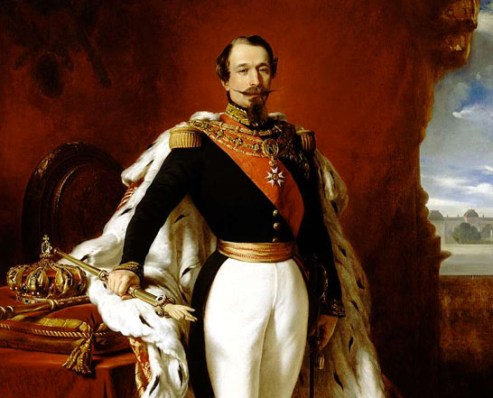
(French Emperor, Louis Napoleon III)

Peraino’s chapter that deals with Louis Napoleon III’s unfortunate attempt to revisit French holdings in the new world by placing Austrian Arch Duke Maximlian on a Mexican throne has little if any relationship to Lincoln’s issuance of the Emancipation Proclamation.  The author’s discussion of Louis’s ego and delusions concerning French power is spot on though there is an over reliance on Jasper Ridley’s dual biography of Louis and his wife, Eugenie in cataloguing his life before he seized power.*  Louis never believed that the North could force the South to return to the federal union so he decided to take advantage of the Mexican debt situation to rekindle his long held goal of reestablishing French colonies in the new world.  What is most interesting is that Louis’ actions fostered a movement to bring the Confederacy back into the fold through a joint expedition to evict the French from Mexico.  This actually led to a meeting between Lincoln, Seward, and Alexander Stephens, the Confederate Vice President on February 2, 1865 that came to naught.  These types of details make Peraino’s narrative exciting, but overall his linkage to Lincoln’s emancipation announcement on January 1, 1863 does little to foster historical accuracy.  The key for Lincoln and the Union was success on the battlefield, which Sherman’s March through Georgia provided, leading to Lincoln’s reelection which forced Louis’ to reduce his support for his Mexican venture.  In fact, by this time Louis had almost totally abandoned Maximilian as he began to withdraw French troops, and ultimately the Austrian Arch Duke was captured and shot by Mexican forces.

(Lincoln and his secretary and confidante, John Hay)

Peraino’s final chapter is a misnomer, Lincoln v. Lincoln is a summary of Lincoln’s legacy through the post Civil War career of John Hay.  The chapter examines John Hay’s career in some detail and concludes with Hay’s belief that the roots of American power lay in a healthy economy and a brisk trade,” an idea that was consistently held by Henry Clay, Abraham Lincoln, and of course William McKinley’s Secretary of State.  My one suggestion for Mr. Peraino would be to consult the latest biography of Hay written by John Taliaferro, ALL THE GREAT PRIZES: THE LIFE OF JOHN HAY FROM LINCOLN T0 ROOSEVELT  for the latest analysis  concerning Hay’s growth as a diplomat and foreign policy thinker.

Lincoln’s handling of the Mexican fiasco reflects his command of the diplomatic game.  Peraino’s analysis is accurate as he points out that there was a natural tension in “Lincolnian foreign policy.  On the one hand, Lincoln’s moral vision represented American idealism” as he realized that slavery diminished American prestige abroad.  But at the same time he instituted a patient and cautious approach, a middle ground in his pursuit of diplomatic advantages.  Lincoln was a diplomat who knew when to threaten and then soften his pronouncements.  He knew when to be magnanimous, but at the same time putting his foot down and letting his opponent know what he would not continence as in his dealing with Louis Napoleon III.  Lincoln was the consummate balancer, effectively controlling domestic interference in the conduct of his foreign policy by members of his own party and the copperheads who sought to make peace with the south enabling them to maintain slavery.  Lincoln did an excellent job taking the measure of and preparing the American public for changes that were about to take place in administration actions, i.e., dealing with Palmerston over the Trent Affair or dealing with the French incursion into Mexico.  Lincoln should be a role model for future presidents to study how to deal with domestic and foreign policy crises and to Peraino’s credit he provides a narrative that would allow our politicians to study and learn from.

*Peraino also relies heavily on Jasper Ridley’s LORD PALMERSTON for background on the English Prime Minister.

THIRTEEN DAYS IN SEPTEMBER by Lawrence Wright

(Egyptian President Anwar Sadat, President Jimmy Carter, and Israeli Prime Minister Menachem Begin at Camp David Summit in September, 1978)

On November 19, 1977 Egyptian President Anwar Sadat made a momentous journey when he visited Jerusalem.  First, it led to the Camp David Agreement between Egypt and Israel, effectively removing Israel’s strongest enemy from the battlefield.  Second, it cost the Egyptian leader his life as he was assassinated by Islamic extremists on October 6, 1981.  Sadat’s removal from the diplomatic scene was a blow to the peace process from that point on.  Motivated by the needs of the Egyptian economy, poverty, and the condition of his military, Sadat, known for bold moves sought peace as a solution to his nation’s ills.   Because he chose peace at Camp David it precluded another round of war between Egypt, Syria, and Israel.  Not since William B. Quandt’s CAMP DAVID: PEACEMAKING AND POLITICS has the reading public been exposed to what happened over the two week period in the fall of 1978 when an Arab country finally made peace with Israel.  Lawrence Wright, a Pulitzer prize winning author for his work the LOOMING TOWER, has just completed THIRTEEN DAYS IN SEPTEMBER: CARTER, BEGIN, AND SADAT AT CAMP DAVID, a work of historical synthesis that tries to explain the origins and course of the Arab-Israeli conflict, and how the Camp David Accords fit into the diplomatic equation.  Wright is a marvelous purveyor of narrative history.  He has an excellent knack for integrating past history, be it, dealing with Biblical myths or recent political and military conflicts into his narrative.  The book is quite readable and he tries to untangle the web of inconclusive negotiations and wars between Israel and the Arab states dating back to World War II.  In so doing, he explores the Camp David process on a daily basis examining the personalities involved, the political landscape that each participant risked, the diplomatic minutia that Israeli Prime Minister Menachem Begin and Anwar Sadat engaged in, and the effect that failure or success might have on the summits results.

The book ostensibly is the story of three flawed men who came together at the 140 acre presidential retreat that lies inside Maryland’s heavily wooded Catoctin Mountain Park sixty miles north of the White House.  Jimmy Carter “was fueled by his religious belief that God had put him in office in part to bring peace to the Holy Land,” and unlike previous American presidents he was willing to risk the prestige of his office to pursue his goal. (285) Carter had been warned by his former campaign manager, Hamilton Jordan of the domestic political consequences, particularly among American Jews, should it be perceived that he pressured Israel into making a settlement, but Carter was determined to make the effort.  Anwar Sadat realized how weak Egypt was becoming due to the state of their economy and his goal was to try and “supplant Israel as America’s best friend in the region”.  Peace was a highly desirable outcome as it would bring with it American economic assistance and European investment, but more importantly if the summit failed because of Israeli intransigence, it would boost Egypt’s standing with the United States.  Begin agreed to attend believing it was a necessity because of Carter’s personal invitation.  He believed it would only last a few days, and that nothing of substance would be accomplished other than the promise of future talks.  Begin’s main goal was to avoid being blamed for the summits failure, but as Wright accurately describes, the only way that could be achieved was making sure it succeeded.

Wright does an exceptional job locating information that was heretofore not commonly known.  An interesting example is the CIA’s profiles of Begin and Sadat that were requested by Carter as he prepared for the summit.  Based on Wright’s narrative of the tense and at times vitriolic negotiations, the CIA’s analysis of each was quite accurate.  Sadat “saw himself as a grand strategic thinker blazing like a comet through the skies.”  The CIA noted his penchant for publicity, terming it the “Barbara Walters Syndrome,” by the time the summit began; it was upgraded to Sadat’s “‘Noble Peace Prize Complex.”  Begin was seen as “secretive, legalistic, and leery of radical change.  History, for Begin, was a box full of tragedy; one shouldn’t expect to open it without remorse.”(9)  When under pressure Sadat resorted to generalities, Begin to minutiae, creating a situation Carter did not anticipate.  Carter had hoped to avoid interjecting an American proposal to discussions, and allow Begin and Sadat to talk face to face, expecting they would reach an agreement with American nudging.  This strategy was a failure, as Carter could not leave them alone in the same room.  What became clear by the sixth day of the conference was that the Begin-Sadat relationship, was at best “prickly,” and their interchanges were overly charged in dealing with things like who won the 1973 War and the amount of oil Israel was pumping from the Sinai.  If they argued bitterly over minor issues what would happen when territorial problems were discussed, the status of Jerusalem, and the Palestinian problem.  As Ezer Weitzmann, the Israeli Minister of Defense has related, “Anyone observing the two men could not have overlooked their profound divergence in their attitudes.  Both desired peace.  But whereas Sadat wanted to take it by storm….Begin preferred to creep forward inch by inch.  He took the dream of peace and ground it into the fine, dry powder of details, legal clauses, and quotes from international law.”(98)  After taking his guests for a visit to the Gettysburg National Battlefield, Carter shifted his approach from a facilitator to a catalyst in conducting the talks.  This change along with Carter’s doggedness and commitment are in large part responsible for the final success of the summit.

Wright provides the reader with brief biographies of each of the participants.  Based on Carter’s engineering mindset and the skills he had developed over the years he was able to parse the language of written documents and make them mostly acceptable.  His religious background drove him until he could achieve his goals.  Begin was a prisoner of his past, be it his imprisonment in Siberia, the Holocaust, fighting the British after World War II as the leader of the Irgun, as all played into his narrow world view.  From childhood onward, Sadat believed he was special and history had a place for him to accomplish great things, as he was open to all challenges whether allying with the Nazis during World War II, his own imprisonment, or unlikely political rise.  Wright separates his narrative by employing chapters for each day of the conference.  As he explains the daily events he integrates background history so the reader can understand the importance of each issue.  If the contemporary history is not enough, Wright then goes on to discuss the Biblical stories and explanations that pertain to each issue.  Wright also enjoys tackling different myths associated with the conflict, i.e.; he argues that Israel actually was not outnumbered by the Arab armies during the 1948 War; he also argues that David Ben-Gurion and the Haganah were involved with the bombing of the King David Hotel in 1947 killing 81 people and that Begin agreed to place the blame for the attack on the Irgun.

Egyptian soldiers firing on Egyptian President Anwar Al-Sadat in 1981.

Makaram Gad Alkareem  /  AFP – Getty Images, file

(Assassins posing as Egyptian soldiers fire on President Anwar Al-Sadat in Cairo on Oct. 6, 1981.)

Wright tells his story and makes his arguments in a very concise manner and the narrative is very readable and provides the basis for understanding a great deal about issues that remain unresolved today.  If there are areas that Wright could improve upon I would suggest he integrate greater use of primary sources into his work.  He relies overly on secondary sources.  I commend his command of these sources but at times he draws conclusions from the monographs he uses that are incorrect.   In discussing the Suez Crisis of 1956 he leaves out important points, i.e.; when Nasser nationalized the Suez Canal he makes it sound as if it came out of the blue, and there is no mention of the fact that he was reacting to the withdrawal of the American loan to build the Aswan Dam.  Further, I feel that at times the author gets bogged down in his repeated rendering of Biblical stories.  I would rather have had him delve further into the negotiations and provide his analysis which was for the most part excellent.

Overall, Wright’s contribution to the literature of the Arab-Israeli conflict is to be applauded.  The analysis he presents in his Epilogue is dead on as the summit papered over the Palestinian problem and it can be argued that this failure contributed greatly to recent events in Gaza.  What is also important as Wright points out is that Camp David took Egypt out of the equation and “without a powerful Arab champion, Palestine became a mascot for Islamists and radical factions who could only do further damage to the prospects of a peaceful and just response to the misery of an abandoned people.”(288)

JAPAN, 1941 by Eri Hotta

(December 7, 1941, Japanese attack Pearl Harbor)

The last half of 19th century was a period when European nationalism flourished and began to spread its influence eastward.  The lessons of nationalism were absorbed in Asia, and Japan became an excellent pupil of western industrialization and expansion.  Following the Meiji Restoration of 1868, Japan slowly remade itself by emulating the west.  Unlike China, Japan had no difficulty in assimilating western institutions in order to develop into what they perceived to be a great power.  By the 1890s Japan was able to defeat China in the Sino-Japanese War, and in the following decade she surprised Russia in the Russo-Japanese War, the first time a non-white power defeated a Caucasian power.  Japan continued its program of making Asia safe for Asians and projecting themselves as a power on par with the west.  During World War I it asserted its rights to expansion with its Twenty-One Demands to gain suzerainty over parts of China, and in 1931 it invaded Manchuria and set up the “puppet state” of Manchukuo. Japan continued its attempts to dominate China in 1937 by precipitating an attack that justified an invasion.  From 1937-1941 Japan fought to defeat the nationalist forces of Chiang Kai-Shek, but despite repeated military victories it was unable to gain total control as Chiang’s army retreated into the interior.  The war in China used tremendous resources and brought Japan into conflict with the United States.  At a time when the long drawn out war in China was reaching a stalemate, why would Japan contemplate a war against the United States?  In her new book, JAPAN, 1941, Eri Hotta seeks to answer that question.

Hotta’s work is a marvelous work of historical synthesis that seeks to explain how the Japanese government reached the decision to attack the United States at Pearl Harbor on December 7, 1941.  Many are familiar with the works of Gordon Prange, Robert Stinnet, Walter Lord, Herbert Feis, and Roberta Wohlstetter.  The story has been told by many; whether from the American diplomatic viewpoint, the intelligence breakthroughs, the military story, and conspiracy theories concerning Franklin D. Roosevelt.  However, no one has attempted to mine the Japanese sources extensively and try and understand how the Japanese bureaucracy and government officials reached decisions that would ultimately result in the destruction of their country by 1945.  This is the task that Hotta takes on and with excellent command of the primary materials and the internal working of the Japanese government from 1931 onward reaches the conclusion that Japanese “leaders, after numerous official conferences, made a conscious and collaborative decision to go to war with the West.  Having talked themselves into believing that they were victims of circumstances rather than aggressors, they discarded less heroic but more rational options and hesitantly yet defiantly propelled the country on a war course.” (15)  Hotta’s conclusion is presented in a thoughtful narrative, and supported by a well reasoned thesis.

Hotta’s approach is an interesting one.  Though she devotes most of her time to discussing the bureaucratic machinations of Japanese diplomatic and military politics by integrating the major figures involved, ranging from Prime Minister Konoe Fumimaro; Tojo Hideki, who served as army minister in Konoe’s cabinet and later Prime Minister; Matsuoka Yosuke, Konoe’s Foreign Minister; Kido Koichi, Emperor Hirohito’s closest advisor; Shimada Shigetaro, navy minister; Yamamoto Isoroku, who planned the attack on Pearl Harbor; and Emperor Hirohito among many government and military officials.  The author also discusses the role of Japanese citizens outside of government service.  For example, the integration of the thoughts of the novelist Nagai Kofu, who represented, in part the anti-militarist sentiment in segments of Japanese society, providing insights into the private thoughts of Japanese citizens who were afraid to make their feelings known publicly.  The work of Richard Sorge, a German journalist based in Tokyo, who was also a Russian spy and was good friends with the German ambassador to Japan is also fascinating.  In addition, the mini-biography of Soldier U, who in 1941 in his late thirties was recalled to military service and sent to China, and later to Indo China has a story that could be a separate book in of itself.  These individuals and others present a well rounded picture of all aspects of Japanese society, as their government was privately was planning on expanding their war for control of Asia.

What separates Hotta’s work from others is that aside from presenting the Japanese viewpoint, she also includes intimate details of the rifts that existed on personal and diplomatic levels between the major players in the Japanese government, i.e.; Prime Minister Konoe and Foreign Minister Matsuoka.  The reader is given a snapshot into the decision making process as Hotta relies heavily on liaison meetings of the Japanese government throughout the book.  These meetings included the most important senior officials, both civilian and military.  She singles out the most influential figures and allows the reader to understand the reasoning behind the decision-making process of each person as debate evolved throughout 1941 as to whether war was the only option, or should diplomatic avenues have been explored further. The positions of men like Konoe, Tojo, Nagano and the bakuryo  officers, (mid-level bureaucrats who prepared most of the positions taken) are analyzed and one can witness how difficult it was to achieve any consensus on policy in this environment.  However, once a consensus was reached, no matter how convoluted the decision making process and delusionary some of the ideas of policy makers were it was almost impossible to alter or change the course toward war.  Hotta proves without a shadow of a doubt that the Japanese leadership suffered from self-delusion as they constantly came up with arguments to buttress themselves against the sound reasoning that a war against the United States was futile.  In large part, Japanese pride and belief in their own superiority led them to take such a huge national gamble.

Hotta makes many astute observations as she points out the Japanese goal of creating a Greater East Asian Co-Prosperity sphere under Tokyo’s leadership was very similar to how the United States approached the Monroe Doctrine in the Western Hemisphere.  For Japanese policy makers what was the difference between theirs and the American approach to expansion.  Further, Hotta spends a great deal of time discussing Japanese perceptions of their own inferiority visa vie the west.  They saw it through the lens of racial discrimination that clouded their judgment when making decisions.  As Alfred Adler pointed out in his studies of the inferiority complex; that people (and nations?) who perceive themselves to be inferior; to overcome that self-perception must strive to be superior.  A case in point is the reaction to a note from American Secretary of State Cordell Hull on November 27, 1941.  It was seen by Japanese leaders as a provocation and a disgrace as they felt they were being bullied and humiliated.  The note itself was taken as an ultimatum, which it was not.

(Japanese Emperor Hirohito)

Hotta is able to review the history of Japanese modernization and expansion that led to World War II very nicely, but she does it  in such a way that she able to dissect the all too human characteristics of Japanese leaders that were torn by doubt in the months preceding Pearl Harbor, but could not overcome their own need to save face, and finally pushed Japan into a war because of their own incompetence and lack of political will.  The reader should gain a great deal from reading Hotta’s narrative which is enhanced by her integration of the words of the characters she employs.  JAPAN, 1941, as of now is the best work dealing with the Japanese viewpoint and decision making process leading to war with the United States, and should remain so for a long time to come.

HARD CHOICES by Hillary Rodham Clinton

(Hillary Clinton testifying before the Senate Foreign Relations Committee on Benghazi)

When Hillary Clinton launched her recent book tour promoting her memoir of her State Department tenure the political pundits concluded that this was the launch of her 2016 presidential campaign.  While that may be accurate the book, HARD CHOICES should be evaluated as to whether it provides greater understanding of American foreign policy during the first Obama administration.  The answer lies somewhere in the middle.  The book has many components.  It is Clinton’s attempt to justify the course of action taken during her years as Secretary of State, provide explanations to counter the myriad Republican criticisms that seem to emerge no matter what the issue or situation at that time, project a softer image for the American public, offer advice as to what tools American diplomacy should employ during the “digital age,” and discuss non-traditional topics that normally do not take up a great deal of space in political memoirs, i.e.; environmental and economic policy.  For Clinton the conduct of foreign policy seeks a balance of “smart” and the hard power of projecting military might.  For the former Secretary “smart power” needs to be “integrated with the traditional tools of foreign policy—diplomacy, developmental assistance, and military force—while tapping the energy and ideas of the private sector and empowering citizens, especially the activists, organizers, and problem solvers we call civil society, to meet their own challenges and shape their own futures.”  (pp. x-xi)  In doing so America’s strengths can be employed to develop more partners and fewer adversaries by sharing responsibility and becoming involved in fewer conflicts.  This includes reaching out to the people of whatever country policy is being developed, promoting jobs and less poverty, and expanding the middle class to lift people up with less damage to the environment.

At a time when President Obama’s foreign policy decision making is under attack, especially over events in Iraq, Afghanistan, and the Ukraine, Clinton’s memoir is a useful tool to see how decisions were reached, particularly the background considerations.  The “pivot” toward Asia was pronounced as soon as Clinton entered the State Department and currently it is seen by opponents as a failure because of the unrest in the Middle East.  The other major pronouncement was a “reset” with Russia that has fallen under scrutiny as Vladimir Putin has used events in the Ukraine to seize the Crimea and threaten the eastern part of the former Soviet republic.  Clinton spends a great deal of time providing the rational for these policy changes and makes the case that the results have not been perfect but were worth the effort.  In the case of the “pivot” toward Asia, Clinton called for broadening our relationship with China.  To accomplish this a sophisticated strategy was needed to encourage China to be “a responsible member of the international community, while [we] stood firm in defense of our values and interests.” (42)  At the same time the United States needed to strengthen our treaty alliances in the region to provide a counterbalance to China’s growing power.  A third goal was to “elevate and harmonize the alphabet soup of regional multilateral organizations” and use these venues “for all nations of the region to work together on shared challenges, resolve disagreements, establish rules and standards of behavior, reward responsible countries with legitimacy and respect, and help hold accountable those who violated the rules.” (44)  Clinton admits that the jury is still out as to whether this emphasis on Asia was a success, but with the growing influence the region has on the world economy, demand for energy, and the many disagreements on trade, human rights, boundaries, and the environment, the effort was well worth it and in the long run should yield positive results.  In the case of the reset with Russia the jury remains out.  When Putin left office and was replaced by Dmitry Medvedev as Russian Prime Minister in 2009 the world witnessed greater cooperation between Moscow and Washington.  The “reset” produced a strategic arms agreement, use of Russian soil to supply American forces in Afghanistan, Russian support for a no-fly zone in Libya, bringing Russia into the World Trade Organization, the expansion of counterterrorism cooperation, and Russian support for economic sanctions against Iran and North Korea.  This was in contrast to the intransigence of US-Russian relations under Putin that returned when the former KGB officer returned to his role as Prime Minster after Medvedev served his term.  Putin believes in restoring Russia to its preeminent role in world politics that it experienced before the collapse of the Soviet Union.  He is a Slavic nationalist who does not believe in the concept of “smart power,” for him it is a reflection of weakness.  Further, he blames the United States for the economic crisis begun in 2008 and believes the United States hood winked Moscow in gaining support for a UN resolution in dealing with Libya and then turned into strong military action that resulted in the overthrow of Muammar Qaddafi.  Many of President Obama’s critics blame him for events in the Ukraine and the Russian seizure of the Crimea, but based on Putin’s belief system and ambitions there was little that could have been done to deter him.  The question remains what should the United States do in response and Clinton is clear that economic sanctions can work as they did with Iran, but for those who want immediate gratification the time it takes to have an impact will not be satisfied.


(Vladimir Putin contemplates the next step for the Ukraine)

Clinton organizes her memoir around specific issues and problems rather than a chronological approach to her term as Secretary of State.  She does an effective job of providing the background history of the subjects she chooses to address and to her credit she continues to explain her viewpoint pertaining to those issues during the period after she resigned. The most interesting chapters deal with events in Afghanistan, the ongoing crisis in Syria, the difficulties dealing with Pakistan, the inability to achieve any progress in the Israeli-Palestinian conflict, the effects of the Arab spring, relations with Iran, and of course Benghazi. It was fascinating to read about the internal discussions in the Obama administration in deciding whether to launch a “surge” in Afghanistan the way President Bush had done in Iraq.  Vice President Biden was against the “surge,” and Richard Holbrooke who was in charge of the Afghanistan-Pakistan portfolio in the State Department was very skeptical that a surge could prove effective.  Clinton supported President Obama’s decision to send another 30,000 troops to Afghanistan believing that if nothing was done the Taliban would continue to seize more of the country, making it harder for the United States to conduct counterterrorism operations.

The Obama administration has been very careful in dealing with Syrian rebels who oppose the Assad regime and has drawn a great deal of criticism.  The fear has always been if weapons were supplied how we could guarantee that they would reach the moderate elements in the fractious grouping of rebels who were fighting Damascus and eventually would be used against the United States as occurred in Afghanistan.  I disagree with the pronouncement of “red lines” that once crossed would produce American military action, if none was intended. However, the United States has provided a tremendous amount of non-military aide, and it is obvious from polling that the American people do not want to intervene with “boots on the ground.”

Pakistan also presents a difficult problem and an obstacle to peace.  Clinton supports the conclusions of Carlotta Gall in her recent book, THE WRONG ENEMY that the Pakistani intelligence service (ISI) which has had a long running relationship with the Taliban is one of the major obstacles for peace.  They have provided safe haven for insurgents inside Pakistan and worked behind the scenes to prevent President Karzai from making a separate peace with the Taliban.  Clinton is right on the mark when she argues that the Pakistanis need to become invested in the future of Afghanistan and that they have more to gain from peace than a continuation of the current military conflict.  Pakistan has its own national security fears in dealing with India and events and its attitude toward Afghanistan must be seen from that perspective.  As in all cases Clinton provides comments about the individuals she is dealing with especially Afghani President Hamid Karzai who she describes as a proud man who believed that the Taliban was not his primary opponent, it was Pakistan and he was reluctant to use his own forces against the Taliban.  He believed the United States and coalition forces should conduct the “lion’s share of the fighting against Pakistan, while he negotiated with his fellow Pashtuns in the Taliban. (145)

(Clinton and Netanyahu in Israel)

In dealing with the Middle East Clinton provides a detailed history of the Israeli-Palestinian conflict and her relationships with the main players, particularly Benjamin Netanyahu and Ehud Barack in Israel and Mahmoud Abbas the leader of the Palestinian Authority.  Since the memoir appears to be the launching of a presidential campaign the reader will witness the obligatory support for Israel that is a necessity for any Democratic candidate.  Clinton chooses her words very carefully in supporting a two-state solution for the conflict and her opposition to Hamas and the role of Hezbollah in Lebanon in dealing with Israeli security needs.  I commend Clinton’s attempt to mediate a solution to the conflict but from the outset it was apparent that the odds of success were remote.  With Netanyahu’s support for the continued construction of settlements on the West Bank, being hamstrung by the religious right of his own governing coalition, success was doubtful.  Clinton’s advice to Netanyahu concerning the burgeoning Palestinian birth rate as being the greatest threat to Israeli security in the future was also very timely.

As soon as excerpts of the book were released in advance of publication the pundit world jumped on the Benghazi episode.  There is really nothing new presented here that has not come out in the numerous congressional hearings dealing with the crisis.  Clinton correctly points out that “the total elimination of risk is a non-starter for U.S. diplomacy, given the need for the U.S. government to be present in places where stability and security are often most profoundly lacking and host government support is sometimes minimal to non-existent.” (385)  The criticism dealing whether the attack was incited by a disrespectful video dealing with Mohammad should not be the center piece of what might have gone wrong.  State Department and Congressional investigations have shown that the mob was provoked by the video and terrorists took advantage of the situation to launch its attack.  Another criticism of Clinton centers around her leaving her office the night of the crisis and going home, a home that was outfitted with the same intelligence and communication equipment as her State Department office.  Clinton took responsibility for events before a Senate committee; perhaps others who have created many of the issues in the region today might do the same.

Clinton is at her best when she is describing the reality of the diplomatic process.  The machinations behind the scene are ever present and some of her details are fascinating.  A good example was the attempt to create a coalition of NATO and Arab League members to thwart Qaddafi’s troops as they marched on Benghazi.  Maintaining relations with the United Arab Emirates after Bahrain was criticized for using Saudi troops to help crush domestic descent, Franco-Turkish relations were sour because French President Sarkozy had opposed Turkey’s membership in NATO, Italian-French competition to lead the coalition against Libya, gaining Russian and Chinese support for a UN resolution, and President Obama’s goal of having the US take a more limited role in any action all had to be balanced.  Opponents called this “leading from behind,” Clinton answers her critics by stating, “That’s a silly phrase.  It took a great deal of leading from the front, side, and every other direction, to authorize and accomplish the mission and to prevent what might have been the loss of tens of thousands of lives.” (375)

Clinton concentrates a great deal on her experiences in Africa and Latin America.  She details crises in Kenya and Somalia in Africa, and crises in Honduras and El Salvador in Latin America.  Her discussion of the future role of Brazil is important as is her poignant chapter dealing with the earthquake in Haiti that took place on January 12, 2010.  Her coverage of poverty sets her memoir apart from others.  She devotes a significant part of her book to the role of American foreign aid as a vehicle to assist those countries in need.  She debunks the view that foreign aid is a significant part of the federal budget, some believing it is as high as 25%, when in reality it is less than 1%.  Clinton’s emphasis on assisting countries through economic aid, education, human rights, and medical assistance is part of her goal of using what she terms as “soft power” to improve the lives of those in need and uplifting America’s image in the world.

Apart from the traditional discussion of policy and planning, Clinton lets the reader see her softer side.  Whether it is to improve her image as a presidential candidate or not her she is able to integrate personal moments into her narrative.  Her emotions related to her daughter Chelsea’s marriage and her moniker “M.O.T.B,” short for mother of the bride while negotiating with the Chinese is revealing.  Her feelings dealing with Chelsea’s pregnancy and her new role as a grandmother are very heartening.  She talks about her own honeymoon a number of times and refers to her husband as her best friend. Her emphasis on the role of woman in diplomacy is important as she argues that women pursue a different approach than men and are less likely to employ the military in solving crises.  Clinton has an excellent chapter on the role of the environment and its relation to current economic issues and the health of future generations is well put.  Pundits search for differences with President Obama, but in large part they agreed on policy and when disagreements took place her views were aired and any issues going back to the 2008 presidential campaign were easily overcome.  If she strongly disagreed with policy she had no difficulty in saying so, i.e.; when asked to attack Sarah Palin during the 2008 campaign she refused arguing she would not criticize a woman for trying to attract women voters.  Clinton, unlike other politicians admitted her vote to support the war in Iraq was wrong and she realizes how that war has hurt the United States, particularly with events in Iraq as of this writing.

(Chelsea Clinton’s wedding Photo!)

If one reads HARD CHOICES you should come to the conclusion that Clinton has wide-ranging experience on national security and foreign policy issues, however, if one followed the news carefully during her time at the State Department there is very little that is new in the book.  If you are interested in a female perspective on world events during her tenure as Secretary of State, the book will come across as fascinating and informative and will provide you with the background for events, explain why certain policies were pursued, and suggest what might occur in the future.

EMPEROR OF LIBERTY: THOMAS JEFFERSON’S FOREIGN POLICY by Francis D. Cogliano

As a retired educator I enjoyed having students debate whether Thomas Jefferson was a realist or an idealist when discussing his foreign policy.  Many believed he was an ideologue who rarely strayed from his principles that usually pitted him against Alexander Hamilton.  In EMPEROR OF LIBERTY, Francis D. Cogliano revisits this debate and concludes that Jefferson consistently implemented a pragmatic approach to foreign affairs no matter the situation.  The book is a concise recapitulation of Jefferson’s diplomatic decision making tracing his raison d’être from his service as Governor of Virginia during the American Revolution, American Minister to France following the revolution, Secretary of State during George Washington’s first administration, and as President of the United States.  The issues he faced included a number of bouts with the Barbary pirates, Algiers, Tripoli, and Morocco; a series of issues with the British, including impressment and commercial interests among many; policy toward the French Revolution; the purchase of Louisiana; and finally his effort to remain neutral during the Napoleonic War.  In all cases Cogliano employs precise language and command of the relevant secondary and primary source material.  But as a historian I must ask, is there anything that has not been written before?

In each instance Cogliano presents the views of those historians who argue that Jefferson’s actions must be explained from the ideological perspective.  For the author Jefferson’s motivations are clear from the time he was Governor of Virginia that his vision for the United States was an empire of liberty that would be brought about primarily through peaceful expansion.  Jefferson favored an agrarian republic that rested on the ability of Americans to trade freely in the world.  For Jefferson, a threat to commerce was a threat to the republic.  He was not totally against the use of force as many maintain.  Once he perceived that American commercial interests were threatened he would employ the navy as he did against the Barbary pirates to achieve his goals.  He could also use the “veiled fist” as he did with Spain before the United States acquired the Louisiana territory.  That acquisition which married commerce to an avenue to the Atlantic Ocean was Jefferson’s greatest triumph.  Jefferson had always favored westward expansion as a vehicle of spreading republican principles going back to when he was Governor of Virginia when he dispatched George Rogers Clark to explore the territory.  Jefferson’s vision for the American empire was quite simple.  If the republic was to succeed it would have to expand to absorb its growing population.  For liberty to survive the republic would need to be a nation of small farmers.  In order for the United States to flourish they would have to export their produce requiring unfettered access to international markets.  “The United States would be an empire of liberty because liberty could not thrive without expansion.  If liberty were extinguished in the United States, the republican experiment would fail.  In Jefferson’s mind the growth of the ‘empire of liberty’ and the success of the American republic were one and the same thing.  As president, Jefferson sought to realize this vision of an expansionist American republic.” (5)

(map circa 1800, Barbary States)

Throughout his diplomatic career Jefferson made careful note of strategies that were effective and mirrored his beliefs.  As governor of Virginia he felt that the state’s decentralized constitutional arrangement hampered his ability to deal with the constant threat of British encroachment.  From this experience he realized a strong executive was needed to conduct an effective foreign policy even if it meant exceeding constitutional limits as long as he received legislative approval after the policy was implemented.  Employing the case study approach Cogliano does not present a comprehensive study of Jeffersonian foreign policy, but he chooses the most salient examples.  Jefferson had to deal with the issue of the seizure of American ships and imprisoning American sailors on a number of occasions during his career.  Whether it was as Secretary of State or President, Jefferson believed that the Barbary corsairs threatened American trade, therefore liberty.  Jefferson was fully aware that the United States projected weakness to foreign powers, which is why the Barbary States targeted American shipping.  Until a navy could be developed Jefferson employed diplomatic threats, support for overthrown leaders, and the creation of alliances to achieve his goals.  In 1791 the US would wind up paying tribute, but by 1802, the American navy taught Tripoli a lesson.  For Jefferson, diplomacy was the first resort, but force at times was proven necessary.  Jefferson’s greatest diplomatic accomplishment was the purchase of Louisiana from Napoleon.  Some argue this came about due to the defeat of the French in Saint Domingue and her inability to protect Louisiana as the Peace of Amiens in Europe broke down.  Whatever the case the purchase was made by exceeding his constitutional powers and Jefferson obtained the western territory, control of the Mississippi, and New Orleans at the same time.  Following precedent, Jefferson obtained Congressional approval after the fact.  I agree with Cogliano’s premise that Jefferson was a pragmatist when it came to foreign relations as all his examples seem to reflect.

In dealing with England Jefferson was at a disadvantage since commercial interests were his prime concern and his position was weak. Cogliano lays out the different scenarios that Jefferson could employ; war, embargo, or be patient and hope things would calm down.  A great deal of attention is focused on the issue of impressment and British Orders in Council that hindered American commercial interests.  After the Chesapeake-Leopard affair it appeared that the United States would declare war against England, but fearing the repercussions of war Jefferson chose an embargo. In Jefferson’s eyes the embargo was the best option that he had.   According to Cogliano the policy was not defective; it was its implementation as Jefferson did not rally the American people to support the embargo, resulting in smuggling and other strategies to undermine its effectiveness.  The policy was an economic disaster for the US and was the greatest failure of Jefferson’s presidency.

Overall, the book has a great deal of interesting sidelights, i.e., the fact that the British were so desperate in its war against Napoleonic France it bombed Copenhagen when the Danes refused to turn over its navy to them. Also, Cogliano begins the book with a discussion of autocracy and Jefferson’s positive views of the new Russian Tsar, Alexander, a discussion I found interesting and somewhat surprising.  If you are looking for a readable study of Jeffersonian foreign policy then Cogliano’s work fits the bill, however, if you are well versed in the subject the narrative will qualify as an excellent review of information and events.