THE GHOST WAR by Alex Berenson

Alex Berenson’s sequel to THE FAITHFUL SPY continues to develop the character of John Wells, the CIA operative who penetrated al-Qaeda where he remained for almost ten years.  During that time he rejected western religion and converted to Islam.  In THE GHOST WAR we find Wells in a much different situation that does not quite measure up to his character development in the previous novel.  The story begins at a rotting pier in Inchon, South Korea, an industrial port fifty miles west of Seoul.  Ted Beck, another CIA operative is scanning the horizon looking for a “cigarette boat” called the Phantom that is to be used to extract Dr. Sung Kwan, a North Korean scientist essential to their nuclear program who had been flipped by the CIA.  The rescue attempt does not go smoothly and the CIA counter intelligence group is brought in to investigate as the narrative unfolds.

The story line has a number of threads that are drawn together in an interesting web of intelligence that needs thorough development.  To Berenson’s credit he pulls it off flawlessly.  The reader is presented with the improved offensive capacity of the Taliban in Afghanistan.  Further, a CIA mole in the office of counter-intelligence dealing with East Asia is ever present.  Former Russian Spetsnaz (Special Forces) are discovered after Wells is brought into the story.  A Chinese general on the Politburo’s Standing Committee develops a scenario involving confrontation with the United States to seize power.  China and Iran enter into an alliance as part of the plot, and the United States and China are brought to the brink of war.  All of these threads fit nicely as the plot evolves and Wells is inserted at strategic points to solve a number of problems.

Members of THE FAITHFUL SPY cast of characters reappear.  Wells’ girlfriend and handler, Jennifer Exley plays a prominent role as does Ellis Shafer, Exley’s CIA boss, plus Vinny Duto, now Director of the CIA, who despite Wells’ success in stopping a major terrorist attack at Times Square still has little respect for his talents.  New characters are added including George Tyson, a rather large and brusque Deputy Director of Counter Intelligence, Henry Williams, the Commander of the USS Decateur, General Li Ping, and Chief of the People’s Liberation Army and a host of spies and other types, including former Iranian President Mahmoud Ahmadinejad.

Within the many story lines there are a number of secondary situations that emerge that are interesting.  In tracking the enhanced training of the Taliban and their new inventory of weapons, a Russian prisoner taken in a cave in Afghanistan is linked to a rich arms dealer who among his many residences are one in East Hampton, Long Island where Wells recruits the Chief of Police to assist him in breaking into the arms dealer’s compound.   The Chinese-Iranian rapprochement is also interesting and the analysis that Berenson presents as to why it was beneficial to both sides is very worrisome when thinking about the current nuclear negotiations with Iran and the slowing of Chinese economic growth.  Berenson also offers accurate insights into Chinese politics, as well as the plight of the poor and the overall internal domestic situation in China.  As he did in his previous novel, Berenson is not shy about sharing his opinion of American foreign policy under the Bush administration as he weaves historical issues that we confront today back to the invasion of Iraq in 2003.

Overall, THE GHOST WAR is a very entertaining novel, but I expected more of the John Wells character.  Perhaps building upon his conversion to Islam which he now appears to have moved away from, and more of the internal division that exists in the US foreign policy and intelligence community might improve the narrative.  Despite this disappointment I look forward to reading the third installment of the John Wells series, THE SILENT MAN and I do recommend THE GHOST WAR to those who enjoy this genre.

THE ALEXANDRIA LINK by Steve Berry

(The Sinai Desert, the possible location of the lost Library of Alexandria, Egypt)

What if the biblical basis for the Israeli state was incorrect?  What if the real evidence for the creation of the Jewish state was in western Saudi Arabia?  What if the ancient translations that led to the writing of the Old Testament from old Hebrew and Greek were open to an interpretation that could destabilize both Israel and Saudi Arabia and reorient the geopolitics of the Middle East?  Intertwine the writings of St. Augustine and St. Jerome; add some nefarious characters that would stand to enhance their power and monetary profit, and sprinkle in American politics and you have the basic premise of Steve Berry’s novel, THE ALEXANDRIA LINK.

The book is part of Berry’s series featuring Cotton Malone, a retired member of the U.S. Justice Department’s elite Magellan Billet who lives in Copenhagen and operates a bookstore.  The story begins with a scene from April, 1948, when the British gave up their mandate over Palestine realizing that they no longer have the power to broker a peace between the Arabs and Jews.  We meet George Haddad, a nineteen year old Palestinian who grows frustrated interrogating a man who had come to speak with his father.  The man came with ideas pertaining to a peace settlement, but two weeks before the man’s visit his father had been killed.   Haddad was in no mood to chat with another peace messenger in the midst of the nakba, “the catastrophe,” and executed his prisoner.

The novel quickly shifts to contemporary Copenhagen where Cotton Malone is confronted by his estranged wife, Pam informing him that their son Gary was kidnapped.  The ransom for Gary’s release is the “Alexandria Link,” something only Malone and a few others have knowledge of.  The result is a bombing of Malone’s bookstore and violent confrontation that leads to Gary’s release.  Despite this release the plot begins to further evolve as Malone realizes that he must uncover the “Alexandria Link,” which is the location of an ancient Egyptian library supposedly located in Alexandria.  According to George Haddad, now a grown man, a philosopher and theologian, within the library lays evidence that God’s covenant with Israel delineated in the Bible may be mistaken.  The Israeli and Saudi governments do not want this information to become public knowledge and their security services work to block any progress in discovering the library and its artifacts.  In the United States the Vice President is allied with a European syndicate, called the Order of the Golden Fleece, whose chair, Alfred Hermann is determined to destabilize the Mideast for the economic and political benefit of his cabal.

The plot brings Malone from Copenhagen, to London, Lisbon, the Sinai with his new companion his ex-wife Pam.  Characters from previous novels have major roles; Henrik Thorvaldsen, a Jewish Danish billionaire and close friend of Malone; Stephanie Nelle his former boss in the Justice Department; and Cassiopeia Vitt, an art historian and well trained in the military arts.  New additions include the previously mentioned Alfred Hermann; Dominick Sabre, an operative hired by Hermann who later in the book goes by the alias James McCollum who has his own agenda when it comes to the “Alexandria Link;” Larry Daley, a presidential advisor with his own plans; Attorney-General Brent Green who seems to support a number of positions; and President Robert Edward Daniels, Jr.

As with all of Berry’s novels in the Malone series the reader must pay careful attention as the author integrates legitimate, theoretical, and counter-factual history with contemporary events and politics.  Historical figures permeate the narrative as they are interwoven to support or discredit what the fictional characters deem important.  The plot line concerns power politics and wealth but Berry tries to base much of his action on uncovering “knowledge” as a weapon in the geopolitics of the Middle East.  In this case the knowledge rests on the concept that God’s promise to Abraham for a Jewish homeland in Canaan as written in the Torah is not accurate, thereby debunking the major argument in the Jewish religion for Israel’s existence.

As the story progresses we witness Mossad agents enter and leave.  Further an assassination plot to remove the President of the United States seems to be on the table.  A proposed deal between al-Qaeda and elements in Washington is in place.  Saudi assassins seem to appear everywhere.  There is even an interesting visit by David Ben-Gurion to the Alexandria library and a host of other interesting historical occurrences that may or may not have ever occurred.  Thankfully Berry provides an addendum at the end of the book to inform the reader as to what he has made up and what actually took place.  But what cannot be denied is that he has chosen a topic that has tremendous relevance to current geopolitics in the Middle East.  There is no doubt that the books opening scene displaying the hatred between Palestinians and Jews still remains in place today.  All we have to do is point to the events of last summer between Israel and Hamas.  Though a very good yarn, Berry does provide some important contemporary issues to contemplate.

Berry has written numerous historical novels and though I have only read three, I look forward to continuing to explore his Cotton Malone series as they are interesting, educational, and very entertaining.

EVA’S EYE by Karin Fossum

3228197

Karin Fossum’s first novel in Her Inspector Sejer series, entitled EVA’S EYE is more than a murder mystery.  In a sense it is a morality play as a young divorced woman who suffers from extreme poverty must make a number of choices that she hopes will better her life, her aged father, and her seven year old daughter.

The story opens in a Norwegian town as Eva Marie Magnus and her daughter Emma are sitting by a river contemplating the depths of the water and a possible visit to McDonalds.  While chatting they notice a face floating in the water, then the entire body of a man comes to the surface.  To Eva, it appears that the body has been in the water for a prolonged period of time.  Instead of immediately calling the police, Eva dials her father.  Shortly thereafter, a woman does phone the police and an officer is dispatched to the scene.  The officer pulls the partially decomposed body from the water and Inspector Konrad Sejer takes over the crime scene as a man, Emil Einarsson, missing for over six months, seems to have turned up.

The investigation starts off simply with the widowed Inspector Sejer trying to unravel the case.  Coincidentally,   another murder had taken place a few days before Mr. Einarsson had disappeared.  The core of the novel surrounds the exploration of Sejer’s lonely existence and how he tries to link the two murders, Einarsson, and a prostitute named Maja Durban.  As he approaches the investigation, Sejer befriends the eight year old son of the murdered man, Jan Henry.  As a character, Sejer appears as a very warm and sensitive person, not the somewhat typical wise cracking cop that often is presented in crime mysteries.  Sejer cares for the boy and his own mother who is institutionalized with dementia.

Fossum does a wonderful job developing her characters, particularly the females.  The reader is exposed to the world of prostitution, poverty, and the inability of people to overcome situations that they themselves have created.  In addition, though a crime novel, Fossum lends insights into the lonely lives of the elderly and how they try to get by on a daily basis.  Perhaps the most interesting aspect of the book is how the protagonist tries to rationalize her decisions, which most would categorize as immoral, as a means of overcoming poverty and improving the lives of her family members.  The story is told from the protagonist’s female perspective and is intriguing as the story evolves.

Fossum’s first Inspector Sejer novel is fast moving, even though whatever violence is present is subsumed to the moral dilemmas that constantly emerge.  This is a very quick and captivating read, and I look forward to reading the second volume in Fossum’s Inspector Sejer series.

ANOTHER TIME ANOTHER LIFE by Leif G.W. Persson

(April 24, 1975 Baader-Meinhof Gang seizure and explosion of the West German Embassy in Sweden)

When I first read Leif G.W. Persson’s BETWEEN SUMMER LONGING AND WINTER’S END I was thoroughly impressed with his plot and character development.  Now, having completed his second novel, ANOTHER TIME, ANOTHER LIFE my respect for his ability to develop a complex story line that builds from the first few pages has been raised to another level.  Persson brings back Lars Martin Johannson, now head of a special new operations division within the Swedish Security Police (SePo).  He also develops other characters that are both witty and knowledgeable on the one hand, and other characters that can be described as plain “fucking idiots,” by Johannson’s friend and impeccable inspector, Bo Jarnebring.

The opening of the novel revisits April 24, 1975 as six terrorists, who appear to be members of the Baader-Meinhof Group, sneak into the West German Embassy in Stockholm.  During the occupation two German bureaucrats, one thrown out of a window, the other shot in a stairwell are murdered.  The Swedish forces who confront the situation are ill equipped and poorly trained to deal with the situation.  The end result is an explosion, with everyone surviving, but one individual.  What follows is a “keystone kop” operation among different government officials as to how to handle the investigation.  At the top levels of government a decision is reached to return the surviving terrorists to Berlin before they can be thoroughly interrogated, thereby sabotaging any investigation.  The head of homicide is completely frustrated and the final report on the incident is totally sanitized.

Fifteen years later, Bo Jarnebring and his new partner, Anna Holt are called in to investigate the murder of Kjell Goron Eriksson, a bureaucrat at the Central Bureau of Statistics.  From this point on the novel gains momentum as the new murder investigation does not proceed smoothly and is led by the previously mentioned, “fucking idiot,” Chief Investigator Evert Backstrom and his equally incompetent partner, Inspector Wiijnbladh.  Predictably, the murder is not solved and is filed away.

In the interim the Berlin Wall comes down and the Soviet bloc is freed from the remnants of Stalinist oppression.  Persson provides an accurate summation of the historical events that led up to, and the final collapse of Erich Honaker’s East German regime.  Enter, the STASI, the CIA, and Swedish national security interests adding another layer to an already complex story.  Always in the background is the 1986 unsolved assassination of Swedish Prime Minister Olaf Palme and possible links to certain characters.  As a SePo task force is created under Chief Inspector Wiklander and STASI and other registered files are examined a new element to the plot is added.  What emerges is what role could Swedish citizens have played in the 1975 terrorist seizure and explosion of the West German Embassy.

What separates Persson from other political novelists is his ability to tie together a number of story lines together forming a complex plot developed layer upon layer.  In the present example; how does the terrorist attack on the West German Embassy, the murder of a Swedish bureaucrat, the 1989 collapse of the Berlin Wall*, and the vetting of an undersecretary in the Swedish defense ministry for a possible cabinet position relate to each other.

Persson weaves a trail of intrigue over a twenty-five year period.  It involves numerous characters and important historical events.  Along the way we witness the death of a number of individuals central to the plot line.  Persson creates a number of enigmatic characters from the incompetent Backstrom; Anna Holt and two other talented female colleagues; Mike Liska, a CIA agent posted to Sweden in November, 1989 who predicted the exact moment when the Berlin Wall would fall; and of course the well respected Lars Martin Johannson.  The author does a commendable job providing insights into the Swedish National Security establishment and develops a number of interesting scenarios.

As attempts to tie events into one conceivable case that can be prosecuted the protagonists are up against a twenty-five year statute of limitations that is about to expire.  The question arises that higher ups in the Swedish government may be placing road blocks in their path.  In addition, what is the role of the STASI, CIA, and SePo?  Did the Swedish security and defense industry interests and perhaps the American intelligence community leak information to prevent a leftist leaning candidate for a cabinet position relating to defense from assuming office?  Do certain disappearances of former officials play into the story?  All of these questions add to the depth of the narrative.

Paul Norlern’s translation from the Swedish does not detract from Persson’s tightly written novel.  In fact, my only criticism is Persson’s somewhat sexist approach to female investigators that are woven into the story.  Overall, Persson has written another successful novel, and I look forward to reading his latest, FREE FALLING AS IF IN A DREAM.

*see The Collapse: The Accidental Opening of the Berlin Wall,Oct 7, 2014, by Mary Elise Sarotte

reviewed in http://www.docs-books.com

THE FARM by Tom Rob Smith

(The southern Swedish rural countryside in winter)

When I began reading THE FARM, Tom Rob Smith’s new book I had certain expectations having read his trilogy of thrillers dealing with the Soviet Union; CHILD 44, THE SECRET SPEECH, and AGENT 6.  From the first paragraph I grew curious, but very surprised.  The story line was nothing like his previous books.  This effort begins with a phone call from Chris, living in rural Sweden calling his son, Daniel who resides in London.  Daniel’s parents had lived in London, but because their finances had succumbed to the 2008 recession they had taken what funds remained and purchased a small farm in Sweden, hoping to live out their retirement in that idyllic setting.  Chris informs Daniel that his mother, Tilde was on her way to London, having been released from a psychiatric hospital.  Chris had taken her there because of her strange behavior and he wanted to warn his son that doctors felt she was suffering from a psychosis and she was not to be believed once she arrived at Heathrow Airport.  Each character seems to have a number of secrets that emerge during the course of the story.  For Daniel, it was the fact that he was gay and living with his partner Mark.  Daniel had been unable to tell his parents, which was why he had not visited them since their departure for Sweden.  Once Tilde arrives, Daniel is faced with the core of the novel, was his mother mentally ill, or where her suspicions against his father true.  Who was he to believe?

Most of the story is told by Tilde as she reads to Daniel from her Journal. She maintained the journal while she suspected that Chris and another farmer, Hakan Greggson, and others were involved in a criminal cover-up that she had investigated.  Tilde argues that there was a conspiracy against her which is why she left Sweden, feeling the only one she could turn to was her son.  As the narrative evolves Daniel questions whether he really knows either parent based on his mother’s strange presentation.  He blames himself for neglecting his parents as he sees that the situation he is confronted with holds a great deal of information he was unaware of.  Daniel wonders that if he had paid greater attention to what was occurring while he was growing up he would be able to make sense of what was now happening.  Once his father follows his mother to London the novel becomes even more seductive as it draws the reader further into its plot.

The question throughout is whether Tilde is mentally incapacitated.  But one must ask, is her behavior abnormal, or is the situation she has been placed in abnormal.  As the existential phenomenologist, Thomas Szaz argued, it is not the person who is ill, but the environment that they must survive in that is responsible.  Perhaps, Tilde is just behaving as she is as a coping mechanism to survive an emotionally debilitating situation.  The reader doesn’t really know as they continue the journey that the author has prepared for them.  It has been suggested by another review that some of what Smith has created is based on his own experiences.  Be that as it may, the narrative is in part suspenseful, and in part deeply distressing.  I will stop here as to not delve any deeper because the story will continue with many twists and turns as Daniel tries to come to some sort of closure as to how he feels about his parents, and what is the truth.  In a sense the book is all about truth and the journey to find peace.  It is a superb story and Tom Rob Smith has provided further evidence as to what a talented writer he has become.  I read the book in two sittings; if you open its cover, and turn the pages you should experience the same desire to read on.

I AM PILGRIM by Terry Hayes

(Bodrum, Turkey where much of the novel takes place)

If you are a devotee of suspense and thrills I AM PILGRIM is for you.  If you enjoy fast action and an ever changing plot, Terry Hayes’ first novel is for you.  If you want to become engrossed in a story that has well developed characters, with interesting backgrounds, with an author who has written award winning screenplays, then this book is for you.  If you react well to a story line that constantly is shifting and has tremendous depth, then you cannot go wrong with I AM PILGRIM.  It has been a long time since I have read a spy thriller that has grabbed my attention the way Terry Hayes has done.  A screen play writer with many credits, Hayes’ has done an exceptional job with his first effort at fiction.  The book centers on a number major plot lines.  One, as the book opens the reader is presented with a murder in a fleabag hotel in Manhattan.  The main character has many aliases and I will refer to him as the narrator, has a theory dealing with the homicide that is outside the traditional investigative box.  Second, is the relationship that develops between the narrator and Ben Bradley, a New York detective, who was badly injured in the attacks on the World Trade Center.  Third, is the development of a strain of smallpox that bypasses the available vaccine that is created by an Islamic fundamentalist physician, referred to as the Saracen, who fought against the Soviet Union in Afghanistan, and has grown to hate Saudi Arabia and the United States. 

There are other stories within the major story; the narrator’s relationship with his parents is important as he witnessed the death of his mother at a very young age and was adopted by a rich Greenwich, CT couple.  Bill and Grace Murdoch were not especially warm parents, particularly Grace who did not want the child, and made him quite aware of her feelings.  Bill was able to create an emotional bond with the boy and the narrator developed great respect for him.  The narrator explains that growing up in this environment and attending a New England prep school was great experience for developing “other identities” needed for his survival upon graduating Harvard and being recruited by intelligence services.   The Saracen’s life history explains why he evolves into a terrorist.   He was born in Saudi Arabia to a father who hated the United States.  A zoologist who was considered moderate by Saudi  standards was arrested and executed by Saudi officials for criticizing the royal family.  The Saracen witnessed the hanging and left his family as a teenager and was radicalized in a mosque and became a hero fighting against the Soviet Union.  He attended medical school and using his role as a physician developed his “small pox strain” to seek revenge by unleashing a pandemic in the United States that would force the US to withdraw support for the Saudis.  Lastly, the investigative techniques employed by the narrator as he tries to link the murder in New York with the actions of the Saracen.

One of the major keys to the story is a book that the narrator had written on modern investigative techniques.  It seems that the murderer in New York read the book and planned her homicide using the narrator’s ideas on how to avoid detection and commit the perfect crime.  For the narrator, 9/11 is the turning point in his life as he realized that because of the intelligence mistakes made the “entire intelligence structure would be torn apart.  It had to be rebuilt.  Nothing in the secret world would ever be the same again…people in government would only have interest in secretly policing the covert world; they would only be interested in secretly policing the Islamic world.” (53)  The narrator felt he did not fit in the new world and decided to retire.  Hayes’ views on contemporary issues come through clearly as the novel progresses and the current debate over the Senate report on torture and the CIA would certainly have been woven into the story had it been available when the book was written.  The author’s attack on the 9/11 intelligence failures and the role of our politicians is very accurate and is food for thought.  Hayes’ thriller may be the basis of a future screen play as its constant movement from one geographic region and time frame to another would play well on a movie screen.  Eventually the narrator is called upon to try and head off a biological catastrophe and forgoes retirement.

Hayes’ has an excellent command of the geo-politics of the Middle East and the historic subtleties that he describes concerning Islamic culture and the radicalization presented through the eyes of the Saracen.  As the story progresses it is easy to understand his hatred toward the west and the Saudi regime and why he chose the life path he pursued.  Hayes does a superb job developing the overall storyline, but also the subplots that accompany the larger ones, i.e.; Scott Murdoch and Jude Garrett were the same person.  Hayes jumps back and forth between the activities of the narrator and the Saracen, but his approach makes sense and it is easy to follow.  The author deftly develops the narrator’s characters whether it is Scott, Murdoch, Peter Campbell or other that were used during his career in “the shadows.”  Hayes’ insights into the “dark world” of intelligence are interesting as the narrator states “how the secret world never leaves you—it’s always waiting in the darkness, ready to gather its children back again.”  The narrator tried to live a normal life but as a former participant in “the shadows” he comes to realize that it might never be possible.  Based on our current relationship with Turkey and its indirect support for ISIS, the author’s characterization of the Turkish government and its police and intelligence services is on the mark.  By using a Turkish detective and staging a second homicide in a Turkish city, Hayes has the opportunity to provide the reader many insights into the Turkish government’s mindset in dealing with threats to their security.

 Surprises abound throughout the book and the ending is surreal as torture, psychological warfare,  plot lines and major characters all come together.   For a first effort Hayes has done a remarkable job and I look forward to his next book, THE YEAR OF THE LOCUST, due to be released in June, 2015.  I assume a year later the film version of I AM PILGRIM will be released!

I AM PILGRIM by Terry Hayes

(Bodrum, Turkey where much of the novel takes place)

If you are a devotee of suspense and thrills I AM PILGRIM is for you.  If you enjoy fast action and an ever changing plot, Terry Hayes’ first novel is for you.  If you want to become engrossed in a story that has well developed characters, with interesting backgrounds, with an author who has written award winning screenplays, then this book is for you.  If you react well to a story line that constantly is shifting and has tremendous depth, then you cannot go wrong with I AM PILGRIM.  It has been a long time since I have read a spy thriller that has grabbed my attention the way Terry Hayes has done.  A screen play writer with many credits, Hayes’ has done an exceptional job with his first effort at fiction.  The book centers on a number major plot lines.  One, as the book opens the reader is presented with a murder in a fleabag hotel in Manhattan.  The main character has many aliases and I will refer to him as the narrator, has a theory dealing with the homicide that is outside the traditional investigative box.  Second, is the relationship that develops between the narrator and Ben Bradley, a New York detective, who was badly injured in the attacks on the World Trade Center.  Third, is the development of a strain of smallpox that bypasses the available vaccine that is created by an Islamic fundamentalist physician, referred to as the Saracen, who fought against the Soviet Union in Afghanistan, and has grown to hate Saudi Arabia and the United States.

There are other stories within the major story; the narrator’s relationship with his parents is important as he witnessed the death of his mother at a very young age and was adopted by a rich Greenwich, CT couple.  Bill and Grace Murdoch were not especially warm parents, particularly Grace who did not want the child, and made him quite aware of her feelings.  Bill was able to create an emotional bond with the boy and the narrator developed great respect for him.  The narrator explains that growing up in this environment and attending a New England prep school was great experience for developing “other identities” needed for his survival upon graduating Harvard and being recruited by intelligence services.   The Saracen’s life history explains why he evolves into a terrorist.   He was born in Saudi Arabia to a father who hated the United States.  A zoologist who was considered moderate by Saudi  standards was arrested and executed by Saudi officials for criticizing the royal family.  The Saracen witnessed the hanging and left his family as a teenager and was radicalized in a mosque and became a hero fighting against the Soviet Union.  He attended medical school and using his role as a physician developed his “small pox strain” to seek revenge by unleashing a pandemic in the United States that would force the US to withdraw support for the Saudis.  Lastly, the investigative techniques employed by the narrator as he tries to link the murder in New York with the actions of the Saracen.

One of the major keys to the story is a book that the narrator had written on modern investigative techniques.  It seems that the murderer in New York read the book and planned her homicide using the narrator’s ideas on how to avoid detection and commit the perfect crime.  For the narrator, 9/11 is the turning point in his life as he realized that because of the intelligence mistakes made the “entire intelligence structure would be torn apart.  It had to be rebuilt.  Nothing in the secret world would ever be the same again…people in government would only have interest in secretly policing the covert world; they would only be interested in secretly policing the Islamic world.” (53)  The narrator felt he did not fit in the new world and decided to retire.  Hayes’ views on contemporary issues come through clearly as the novel progresses and the current debate over the Senate report on torture and the CIA would certainly have been woven into the story had it been available when the book was written.  The author’s attack on the 9/11 intelligence failures and the role of our politicians is very accurate and is food for thought.  Hayes’ thriller may be the basis of a future screen play as its constant movement from one geographic region and time frame to another would play well on a movie screen.  Eventually the narrator is called upon to try and head off a biological catastrophe and forgoes retirement.

Hayes’ has an excellent command of the geo-politics of the Middle East and the historic subtleties that he describes concerning Islamic culture and the radicalization presented through the eyes of the Saracen.  As the story progresses it is easy to understand his hatred toward the west and the Saudi regime and why he chose the life path he pursued.  Hayes does a superb job developing the overall storyline, but also the subplots that accompany the larger ones, i.e.; Scott Murdoch and Jude Garrett were the same person.  Hayes jumps back and forth between the activities of the narrator and the Saracen, but his approach makes sense and it is easy to follow.  The author deftly develops the narrator’s characters whether it is Scott, Murdoch, Peter Campbell or other that were used during his career in “the shadows.”  Hayes’ insights into the “dark world” of intelligence are interesting as the narrator states “how the secret world never leaves you—it’s always waiting in the darkness, ready to gather its children back again.”  The narrator tried to live a normal life but as a former participant in “the shadows” he comes to realize that it might never be possible.  Based on our current relationship with Turkey and its indirect support for ISIS, the author’s characterization of the Turkish government and its police and intelligence services is on the mark.  By using a Turkish detective and staging a second homicide in a Turkish city, Hayes has the opportunity to provide the reader many insights into the Turkish government’s mindset in dealing with threats to their security.

Surprises abound throughout the book and the ending is surreal as torture, psychological warfare,  plot lines and major characters all come together.   For a first effort Hayes has done a remarkable job and I look forward to his next book, THE YEAR OF THE LOCUST, due to be released in June, 2015.  I assume a year later the film version of I AM PILGRIM will be released!

MYSTERY ON THE ISLES OF SHOALS by J. Dennis Robinson

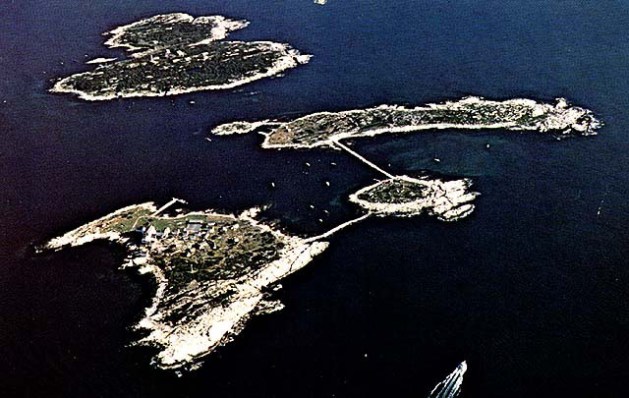
(Aerial picture of the Isles of Shoals about eight miles off the Portsmouth, NH coastline)

A few nights ago I had the pleasure of listening to J. Dennis Robinson speak at a local bookstore near my home in Portsmouth, NH.  I am a recent resident of the area and have been following Mr. Robinson’s “history” column in the Portsmouth Herald since my arrival.  These articles and the book STRAWBERY BANKE: A SEAPORT MUSEUM 400 YEARS IN THE MAKING also written by Mr. Robinson have educated me and sparked my interest in the rich history of the seacoast region.   His new monograph MYSTERY ON THE ISLES OF SHOALS has further broadened my knowledge of the area, as he has produced a first class “whodunit” about a story that everyone with knowledge of this 1873 murder knows the outcome.  Robinson in his recent talk claimed not to be a historian, but a history writer.  As a retired historian myself I believe I have the background to recognize and praise a true historian, which is certainly the case with Robinson.  His literary training has certainly assisted his prose and writing style, but the research techniques and historical knowledge are a wonderful combination that has produced an exceptional monograph that should interest a wide ranging audience apart from the seacoast region.

Robinson begins by reviewing the history of the various theories and myths that have emerged years after the murder of two Norwegian immigrant women, Karen and Anne Christiansen by a Prussian immigrant, Louis Wagner.  The author points to the novel and Hollywood film that distort the facts of the case, but a significant part of the public seems to accept as truth.  For Robinson the alternative history of events is incorrect and he takes on the task of setting the historical record straight.  In his examination of events and evidence, Robinson leaves no stone unturned in uncovering the truth.  Since a key part of the story involves the ability of someone to row from the mainland to Smuttynose Island, a considerable distance in 1873, Robinson provides numerous historical examples to prove that the distance traveled by Wagner the evening of the murder was easily accomplished.  In fact, during his talk last week, he introduced a seventy five year old fisherman who had accomplished the task last June.

(Louis Wagner and the murder weapon)

Robinson’s monograph is more than a history of the murder of the two Norwegian women.  It explores the pre-crime activities of the characters involved, the arrest, trial, and execution of the murderer.  It is a history of the seacoast region as far north as Thomaston, Maine and south to the Portsmouth region.  The author takes the reader back 6000 years when Native Americans thrived in the waters that make up the Gulf of Maine.  He describes how glaciers created the nine islands that make up the Isles of Shoals among the 3000 or more islands that are located along the jagged coast of Maine. (13)  Robinson describes the arrival of John Smith in 1614 and the settlement of New Hampshire in 1623.  Robinson’s history obviously concentrates on the history of the then “crime of the century” and the characters involved, but he also takes on the lives of the participants in the story after Wagner’s execution following them until they pass on.

Robinson focuses on immigration, the development of the islands, and the state of fishing in the region as he sets the stage for the reader.  The most important characters are Louis Wagner the perpetrator of the crime and his victims.  But Robinson also spends a great deal of time developing the other main characters that include John and Maren Hontvets, whom Wagner was trying to rob before his victims got in the way, with Maren escaping and emerging as the most important witness at the trial.  The reader is also introduced to the local politicians involved, the prosecution and defense attorneys, key witnesses, prison officials, and many more.  In doing so the reader gets to know all involved and because of Robinson’s captivating prose they almost feel they have become part of the story.  Throughout, Robinson has a fine eye for detail, be it discussing the history of the murder weapon, an ax that in part resides in the Portsmouth Atheneum, an old membership library on Market Square in Portsmouth.  Robinson goes on to provide a history of the ax as tool in American history, as well as showing that the use of one as a murder weapon was not unique.  This is the type of detail that the author repeatedly interjects into the narrative enhancing the reader’s experience.

For the layman who is interested in the plight of the New England fishing industry during the second half of the nineteenth century, Robinson lays out the problems that the industry faced in detail.  He explores how the sources of fish were being depleted and the need to locate new fishing grounds which drove fisherman up and down the coast to locate new sources.  The problem was that those regions grew scarcer and scarcer necessitating the use of larger and larger boats that local fisherman could ill afford.  One of the few who could was John Hontvets, who purchased long trawl lines and built a sturdy schooner in order to survive.  It was the jealousy that Wagner felt towards John Hontvets that probably drove him on the night of March 5, 1873 to steal a dory and row out to the Hontvets’ home on Smuttynose Island expecting to find only three women present to steal what he thought was between $600 and $1000 hidden somewhere on the premises.  Robinson describes in minute detail the murder and succeeding events leading up to Wagner’s capture in Boston.  Robinson zeroes in on the conversations that Wagner had before and after the crime throughout the book.  It reflects an inordinate amount of research and command of the material.  What is interesting is that Wagner repeatedly provided oral snippets of what Robinson describes as “confessional outbursts,” that puts the reader inside Wagner’s thought processes and leads us to believe he subconsciously wanted to be caught and convicted.

Robinson plays special attention to the personalities of the attorneys involved and the strategies they pursued.  The trial is reviewed very carefully and the material that is available from the trial transcript is mined very carefully by Robinson as he integrates a degree of sarcasm and humor as he dissects the myths and alternate histories that emerged after Wagner’s conviction.  Robinson takes the reader into Wagner’s jail cell, his escape and recapture, and after all the legal wrangling dealing with the death penalty and which state, Maine or New Hampshire had jurisdiction over the case, to the execution of Louis Wagner on June 25, 1875.

For those interested in the economic development of the Isles of Shoals at this time great detail is provided.  The building of tourist hotels, the attraction of Boston literary types and the wealthy are delineated carefully, particularly Cecilia Thaxter who grew up and lived on Smutty nose, who gained fame as a poet and writer.  Her article in the Atlantic Magazine, “A Memorable Murder,” “was something risky and powerful when it appeared in 1875,” but she has been “credited as a founder of true crime literature.”  (301)  “Like a great poet, the crime writer must also replicate the tempest that rages inside the mind of the killer tapping into his jealousy, vengeance, ambition, and hatred,” as nineteenth century essayist, Thomas De Quincy has written, something that Thaxter easily accomplished.  According to Robinson, her article could have served as a model for Truman Capote’s In Cold Blood, and Norman Mailer’s The Executioner’s Song.

Robinson concludes the last section of the monograph by following the history of the main characters after Wagner’s execution.  The reader learns of the fate of Celia Thaxter, the legacy of the Hontvets family and Ivan Christiansen whose wife was murdered, as well as the deathbed confession hoax that tried to shift the blame for the crime onto Maren Hontvets.  Not to be excluded are a number of key witnesses as well as the prosecution team of George Yeaton and Attorney General Harris M. Plaisted and Wagner’s intrepid lawyer Judge Rufus Tapley.

As the books comes to a close, Robinson dissects the pseudo-historical novel based on the murders, Anita Shreve’s Weight on the Water and the Hollywood film of the same name based on the book.  Despite the presence of Sean Penn and a $16 million budget, the film was essentially a flop, though it seems to be downloaded more and more today by those interested.  However, for Shreve the novel made her a literary talent as she has a film based on her book added to her many publications.  Lastly, Robinson includes extensive author’s notes that are a treasure trove of information that for those interested, can lead to wonderful new discoveries. Overall, considering that many people who are drawn to this subject matter are already privy to the story and its outcome, Robinson has done a remarkable job of synthesis creating an interesting compilation of information some old, but much that is new.  I recommend it highly for those who are interested in a scintillating murder story, but more so an overall history of the seacoast region in the latter part of the nineteenth century.
BLACK OUT by John Lawton

(British Prime Minister Winston Churchill surveying damage to London caused by Nazi bombers on September 10, 1940)

I have been a fan of Alan Furst for years.  His evocative approach to espionage and his character development made his World War II noirs exciting and hard to put down.  Now, I have discovered another master of that genre, John Lawton.  The first book in Lawton’s Frederick Troy series entitled BLACK OUT features the intrepid Frederick Troy and his cohorts in Scotland Yard and an amazing array of individuals, who live in London in February, 1944, and a number of them who will also turn up in Berlin during the 1948 airlift  The mystery opens with a dog digging around in the trash and seizing an object, then runs with it in its mouth and drops it in front of a boy, the object is a human arm.  The night before this incident an American soldier gets his throat cut at Trafalgar Square.  Once an investigation begins Detective Sergeant Troy starts to connect a murder that took place a year earlier to the “arm” victim and the American soldier.  Troy is friends with another “copper” from Scotland Yard, George Bonham who lives in a house that rents apartments, and a Peter Wolinski, who worked at the George V dockyard, has turned up missing for unknown reasons.  Wolinski supposedly had taught college in Germany until Hitler forced him to leave and was a close friend of Bonham.  Once the investigation commences we begin to meet a series of interesting characters that include Ladislaw Kolankiewicz, who since 1934 had been the senior pathologist in Herndon.  Cooperating with Kolankiewicz, Troy pieces together the possibility that the two deaths and another missing person are all linked.  Troy, whose uncle Nikolai Rodyonavich worked with a team of scientists at the Imperial College in the Applied Physics Department provides a photograph to augment Troy’s suspicions.  When a socialite, Diane Ormond-Brack is seen leaving Wolinski’s apartment with a copy of the same photograph that Nikolai had shown Troy, suspicions are further aroused.  What Troy gathers is that these individuals may have been developing “lightweight alloys, tough, non-corrodable, and thin.  And they were also on to what that is-on to chemical propulsion,” rockets.(88)  When Troy visits N.A.G. Pym at MI5, and a Colonel Zelig at American headquarters in London to obtain answers he is stonewalled by both and gets nowhere, reaffirming his suspicions that all three incidents are linked to rocket development by the Germans.  In laying out the plot Lawton has drawn the reader into his web of British accents and language, espionage, and a case that is definitely beyond Inspector Troy’s pay grade.

Frederick Troy is a wonderful character to build a World War II and post war noir around.  His family emigrated from Russia after Stalin took control.  Troy’s older brother is an RAF pilot and in 1936 Troy was a raw recruit from the countryside who was taken in my George Bonham and his wife and shown the ropes concerning survival in London and pursuing police work in a city that had been ravaged by the Luftwaffe for five years.  What Troy strongly suspects is that after a fourth murder that an American Major Jimmy Wayne, an Office of Strategic Services (OSS-precursor to the CIA) agent is involved with all of them.  His investigation seems reflect Wayne’s guilt,  but evidence is circumstantial.  Troy is joined by his protégé Jack Wildeve, and his commander at Scotland Yard, Stan Onions in seeking the truth.  Two women are also present to confuse and cajole Troy.  First, we revisit Diane Ormond-Brack,  a girl friend of Major Wayne who later will become Troy’s lover.  Second, is M/SGT Larissa Tosca, seemingly Colonel Zelig’s secretary, but even while she is bedding Troy has an interesting shadow life that he is unaware of.  The novel places the reader in the heart of London right before D Day, June 6, 1944.  Characters have to deal with shortages of food and other staples.  In addition, we witness the underground community that lives beneath London subways to escape years of bombing, and English resentment of American soldiers who seem to have taken over their country and especially their women.  At this time the United States and the Soviet Union, realizing that the end of Nazi Germany will soon be at hand engage in a race to bring out of Germany as many scientists and intelligence assets that they can.*  The story changes focus once the war ends and shifts to post war Berlin which is enduring the 1948 air lift.

The novel is exceptionally written and Lawton’s integration of events is very helpful for the reader in developing historical context.  Throughout the narrative the author merges his own opinion of certain historical figures that are not only humorous at times, but very accurate.  For example, Lawton references General Dwight D. Eisenhower as Troy has grown increasingly frustrated when OSS Colonel Zelig claims that the D Day commander that a meeting with Major Wayne was an alibi to block Troy’s suspicions. Describing Zelig and Eisenhower, Lawton writes, “The rain was beginning to soak through his overcoat.  He went quickly back to the car.  Was it worth a try?  One bald-headed American was probably much the same as any other bald-headed American.  The only difference lay in the amount of scrambled egg on the cap.  Though, being fair, Troy felt Ike had better table manners.”(106)  Along with numerous astute observations, Lawton regales the reader by placing certain literary figures throughout the narrative as an intellectual tease.  The relationship between the OSS and MI5 is explored in detail and British distrust for that “pernicious organization” is readily apparent.  For the Americans they had had it with British, “procedure and protocol.”  Lawton also introduces Soviet espionage in the last part of the novel that reorients both Troy and the reader.

Troy  finds himself in the middle of turf battles of allied intelligence agencies throughout the book.  His investigation is blocked by both agencies and his fight to solve, what he thinks are four murders in the shadowy background of D Day and after is fascinating.  The author’s conclusion tying pre and post war espionage is calculating and keeps the reader guessing.  Lawton first installment of Detective Troy is a great read and I look forward to engaging the entire series.

  • See “The Nazis Next Door,” by Eric Lichtblau reviewed by Deborah Lipstadt,  New York Times  October 31, 2014.

THE MARCO EFFECT by Jussi Adler-Olsen


(Copenhagen Police Headquarters)

The story begins in the remote Bantu village of Somolarmo during the autumn of 2008.  Louis Fon who was in charge of a Danish development project in the Dja jungle of Cameroon notices two men approaching; a white man, and Mbomo Ziem who was an errand boy for Danish government officials.  Later, Louis noticed that Mbomo was giving bags of alcohol to pygmy Bantu villagers, and that substantial sums of money were missing from the project he oversaw.  Shortly thereafter, Mbomo approached Fon with a machete, forcing him to flee.  As fast as he ran he could not escape, and as he was dying from his wounds he was able to send a text message on his cell phone.  This is how Jussi Adler-Olsen’s latest novel that employs “Department Q” of the Copenhagen police force entitled, THE MARCO EFFECT begins.  As in the four previous books in the series the reader’s attention is captured almost immediately.

The plot centers around Kannebaek Bank, one of Denmark’s leading financial institutions.  With the bank about to go under because of the 2008 economic meltdown, its chairman, Jens Brage-Schmidt along with two other bank officials hatch an embezzlement scheme involving the Danish Evaluation Department for Developmental Assistance to make the bank solvent.  Problems develop when a civil servant named William Stark is sent to Cameroon to investigate Fron’s sudden disappearance learns that his final text message read, “corruption dans l’aide de development Dja.”  This knowledge places a number of individuals, including Stark in grave danger leading to a series of murders.

As with all of Adler-Olsen’s “Department Q” novels there are a number of plot lines that eventually seem to merge together.  The current mystery is no exception as in addition to the Danish bank fraud, the author introduces the role of a gypsy type clan, and the remnants of an old case that still causes difficulty for Carl Morck, the head of Department Q.  Marco Jamison is a twelve year old boy who rebels against his clan leader named Zola, who is also his uncle.  The clan operates on a number of levels including murder, pick pocketing, injury scams, and other mechanisms to exploit the general population.  When Marco decides he no longer wishes to remain part of the clan, he runs away and hides from Zola’s henchmen.  While in hiding, Marco comes across a corpse buried on the side of the road.  Finally, Marco eludes Zola’s search party and wanders the streets of Copenhagen for over three years working and living with a gay couple who took him in off the streets.  Then out of nowhere, the clan caught up with him.  Due to the curiosity of Assad; a member of Detective Morck’s Department Q, who also seems to have been a Syrian intelligence operative before immigrating to Denmark, and Rose, who suffers from periodic episodes of multiple personality, the death of William Stark, the missing civil servant turns up on Morck’s desk.  From this point on the novel gains momentum as the author doubles down on his plot.

Adler-Olsen introduces a number of new characters into the series.  A number appear from previous books; Mika and Morten; a gay couple who lives in Morck’s house, and care for Hardy, a colleague of Morck’s who was paralyzed in a shootout investigating a previous case; Mona Ibsen, now Carl’s ex-girlfriend, who he had hoped to marry; and Lars Bjorn who is elevated to head the Homicide Division replacing, the now retired Marcus Jacobsen.  The major new character is an intern who was attending law school by the name of Gordon Thomas, who is also sexually obsessed with Rose, and becomes a thorn in Morck’s side.  The important characters that are unique to THE MARCO EFFECT include; Zola, the head of the gypsy type clan; Rene Eriksen, Head of the Danish Evaluation Department for Developmental Assistance; Teis Snap, manager of Kannebaek Bank; Jens Brage-Schmidt, Chairman of Kannebaek Bank; and Marco Jameson, who tried to sever all connections with the Zola’s clan and begin a new life.  The roles of Assad and Rose continue to develop as their insight and acumen involving the case places them in a position of importance as the plot unfolds.

Parts of the book fits the description of a thriller as those pages seem to drip with tension as different forces try and capture Marco.  At first, the repeated chases and escapes are effective, however, after what seem like repeated “Houdini type” escapes it seemed overdone.  Perhaps Marco’s plight could have been couched differently as the novel progresses.  As usual Adler-Olsen has a great deal to say about problems in Danish society be it Copenhagen’s underworld, issues dealing with immigration, corporate corruption, and civil servants who abscond with government funds. In all cases it is not difficult to ascertain the author’s viewpoint and he provides hints how these problems could be solved.

In conclusion, THE MARCO EFFECT measures up well to the previous novels in the series.  All the elements of an excellent mystery are present, including a rather unsuspecting ending.  If you have enjoyed Adler-Olsen’s previous work, his current effort will not disappoint.