THE ANGEL: THE EGYPTIAN SPY WHO SAVED ISRAEL by Uri Bar-Joseph

October, 1973 was a traumatic period for the Arab-Israeli conflict which greatly affected the American economy.  On October 6th, Arab armies attacked Israel on Yom Kippur morning and the ensuing war resulted in an Arab oil embargo against the United States that brought long lines at gas stations, a spike in prices, and rationing.  The situation for Israel grew dire at the outset of the conflict, but after 21 days of fighting the Israeli Defense Forces proved victorious on the battlefield, though it can be argued the war resulted in a psychological defeat. No matter how the outcome is evaluated the situation for Israel could have been a lot worse had it not been for Ashraf Marwan, an Egyptian who spied for the Mossad who happened to be Egyptian President Gamal Abdul Nasser’s son-in-law, and following Nasser’s death a close aide to his successor Anwar Sadat, which provided him with access to his country’s deepest secrets.  The story of how Marwan provided the Mossad information that should have allowed Israel to be on greater alert when the war came is effectively told by Uri Bar-Joseph, an Israeli academic with expertise in Israeli intelligence, in his new book, THE ANGEL: THE EGYPTIAN SPY WHO SAVED ISRAEL.
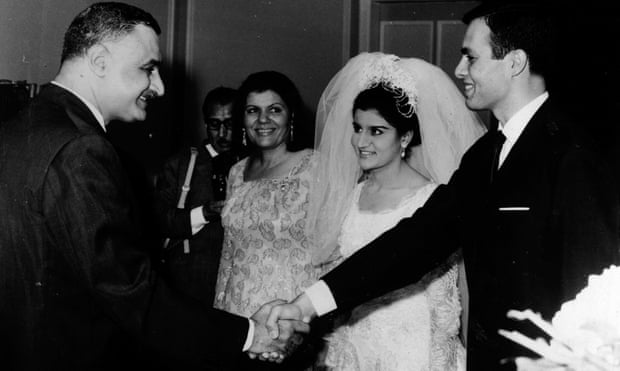
(President Gamal Abdul Nasser of Egypt, Mona, his daughter, and his son-in-law, Ashraf Marwan)

Bar-Joseph’s narrative follows Marwan from his rise to a position of power within the Egyptian government to his untimely death in 2007 when he was probably pushed over a terrace and fell to his death.  Marwan was a corrupt egoist who felt he deserved a powerful position in government.  His marriage to Nasser’s daughter was a step in achieving his goals.  The impediment was the fact that his father-in-law held a very low opinion of his son-in-law.  Intelligence sources made Nasser aware of Marwan’s avaricious lifestyle and he tried to get his daughter to divorce him.  When she refused Nasser allowed Marwan to work at a low level position in his office that he greatly resented, which in large part provided a rationale for him to turn to espionage to acquire wealth.

Bar-Joseph traces how Marwan gained access to Egyptian state secrets and analyzes why he chose to spy for Israel’s greatest enemy.  In assessing Marwan, Bar-Joseph concludes that his subject engaged in espionage for two reasons.  First, was financial.  Marwan needed money, but despite his contacts he was limited in influence because of Nasser’s Spartan approach toward his family.  If he was going to achieve the lifestyle he craved he would have to find a source of income that Nasser’s intelligence people could not uncover.  The second motive was Marwan’s ego.  Marwan craved power, but realized he was blocked by his father-in-law.  In his own mind he would show Nasser by turning to his father-in-law’s greatest enemy.  Disloyalty to Nasser was the solution for his financial and psychological crisis.

(Egyptian troops establish a beachhead in the Sinai on October 7, 1973)

Bar-Joseph does an excellent job explaining the marriage of Marwan and Israeli intelligence.  He describes in detail how Marwan offered his services and the vetting done by the Mossad.  The author takes the reader inside the Israeli intelligence community as they evaluate Marwan the person and as the relationship flourished, as well as the information that he made available.  Bar-Joseph discusses a number of important personalities, the positions they occupied, and their reactions to each other.  The key for the Israelis was to determine whether Marwan was a double agent.  Almost immediately the valuable material he provided trumped the idea he could have been playing them.  Though Bar-Joseph has a somewhat trenchant writing style, the picture he paints and many of the details he shares have never been published before and makes the book a very important work.

One of the keys to Marwan’s success was the Sadat-Marwan relationship as each needed the other.  Once Sadat assumed the Egyptian presidency he needed a link to Nasser’s family which did not think a great deal of him.  For Marwan, Sadat was a vehicle to improve his overall position in government to allow him to gain access to state secrets and new sources of wealth.  Marwan’s success was his ability to provide the Mossad Egypt’s most closely guarded secrets concerning plans to attack Israel.  For example, plans to cross the Suez Canal and establish a bridgehead in the Sinai, which came to fruition in October, 1973.  Further he provided notes of Egyptian meetings with the Soviet Union that showed that Moscow did not think Egypt was ready for war as well as the minutes of a Sadat-Brezhnev meeting in 1971 that was later shared with the United States.  Because of Marwan Israeli leaders developed a very accurate picture of Egypt’s intentions regarding war and peace, particularly that if Egypt attacked it would not be a comprehensive move to reconquer the Sinai.  Israeli military intelligence firmly believed, much to their detriment in October, 1973 that Egypt would never attack until they solved the problem of Israeli military superiority.

(Egyptian President, Anwar Sadat with senior military commanders during the Yom Kippur War)

Bar-Joseph traces the development of Sadat’s strategic thinking as he pressured the Russians to provide the necessary long rang planes, missiles, and air defense to allow an attack on Israel since he did not see a way to recover the Sinai through diplomatic means.  By August, 1973, the Russians would provide most of the necessary weaponry, leaving out SCUD missiles, a key item because Israeli military intelligence believed that Sadat would never launch an attack until he received the SCUDS.  As early as June, 1973 Marwan warned the Israelis that Sadat was changing his approach to war and decided he could attack Israel even if his forces were inferior.  The problem for Israel was that the head of its Military Intelligence branch, General Eli Zeira refused to revise his thinking and could not accept that Egypt possessed the where with all to launch an attack.  Further, Zeira refused to accept the fact that Marwan was not a double agent.  When the decision for war was made and Sadat asked the Russians to leave Egypt, Zeira believed that Sadat would now take a more defensive approach toward war, but for Sadat he had removed a major impediment to launching an attack.

The author provides the details of all the warnings that Marwan provided the Israelis as early as April 11, 1973 that Sadat had altered his thinking and an attack would come in the late spring or early summer.  Israeli military intelligence continued to mistakenly believe that Egypt would not launch an attack until it received SCUD missiles from the Soviets.  Marwan provided information of Egypt’s preparations for war as well as the developing alliance with Syria.  Throughout Marwan’s intelligence was dead on, but the Israelis did not analyze it correctly.  For Bar-Joseph his most important theme that he reiterates throughout the book is that as war finally approached by September, 1973 “Israel’s military intelligence was under the command of a group of officers whose commitment to a specific intelligence paradigm was unwavering, almost religious, even though it had been obviated by events almost a year earlier.”

What is fascinating about Bar-Joseph’s account is the detail he provides, particularly, an almost hour by hour account of the two days leading up to the war.  For example, the Israeli reaction to Marwan’s warning of October 4th that war was imminent, but the bureaucratic structure of Israel’s intelligence operations did not allow for the proper response and warnings to Golda Meir’s government.  The author does a credible job following the actions and views of all the major historical figures who were involved in the decision making on the eve of the fighting.  Even though Eli Zeira and those he influenced were unwilling to take Marwan’s warnings seriously which resulted in a spectacular intelligence failure, his information did speed up Israel’s reserve call up and other crucial decisions that saved them from an even greater military disaster than what occurred.

Once the war ended Marwan assumed a greater diplomatic role working directly with Sadat.  He became the liaison with Libya, Saudi Arabia and Syria, but also with Henry Kissinger as the United States tried to achieve a lasting ceasefire.  Even as Marwan worked to bring unity to the Arab world he was reporting to the Mossad.  Marwan’s influence then began to wane and he was forced to leave the government on March 1, 1976, but remained in the background working on a weapons consortium.  After Sadat’s assassination in 1981 he began a new chapter in his life moving to London.  Throughout he maintained his contacts with the Mossad, but after the Camp David Accords in 1979 he became a low priority for Tel Aviv.

(Israeli Defense Minister, Moshe Dayan and Israeli Prime Minister, Golda Meir during the Yom Kippur War)

Bar-Joseph spends the latter part of his study conjecturing on who outed Marwan as an Israeli spy, and how he died in 2007.  His speculations do not reach concrete conclusions on either score, but Marwan dies shortly after he was outed, leading to all kinds of conspiracy theories that the author addresses.  Overall, Bar-Joseph describes an amazing life integrating all the major players in Marwan’s career as a spy.  Though, at times the book becomes bogged down in detail and is overly wordy, it is worth exploring because it is an important story that deals with a very sensitive topic.

(Ashraf Marwan)

THE DEVILS OF CARDONA by Matthew Carr

(Philip II of Spain and Hapsburg Emperor)

Toward the end of the late 16th century the reign of Philip II of Spain and ruler of the Hapsburg lands of Central Europe seemed threatened by external and domestic forces.  Externally, Queen Elizabeth of England worked to undermine his kingdom by supporting pirates and the armies of William of Orange as the Dutch continued their revolt against the Spanish monarch.  Across the Pyrenees, the King of France also did his best to cause difficulties for Philip.  Internally, Phillip had to deal with Moriscos, Moslems or Moors who had converted to Catholicism to avoid the punishment of the Inquisition.  This time period serves as the backdrop for Matthew Carr’s wonderful new novel, THE DEVILS OF CARDONA, an exploration of the social, economic, and political forces at work in Philip II’s kingdom through a plot centering on the murder of a despised Catholic priest, Padre Juan Panalle in the Belmar de la Sierra, an area in north eastern Spain near the French border.  Panalle was a despicable character who used his flock, mostly converted Moslems, to meet his sexual and economic needs.  Officials in Madrid had grown increasingly concerned about the Moslem threat and ordered Licenciado Bernardo Francisco Baldini de Mendoza a young judicial official to travel from his home in Valladolid in Castile to the site of the murder in Aragon and arrest and convict the guilty party.

Mendoza is a fascinating character who had witnessed the work of the Inquisition as a youngster and was still subjected to nightmares as an adult.  He never imagined that he would be part of the legal system that the Inquisition dominated during his career.  The instructions he received seemed clear, but as his work began his charge seemed much more complex than he was led to believe.  First, he had to deal with the goals of the Inquisition and its emissary, Mercader.  Second, was the government’s jurisdiction in Belmar, which fell under the auspices of the Countess of Cardona who had full jurisdiction over her kingdom that included Inquisitors and his Majesty’s own officials dating back to 1085, and recently renewed by Charles V in 1519.  Many of her vassals were Moriscos and she believed in bringing her subjects to Catholicism through acts of kindness, not the hammer blows of the Inquisition.  Mercader is convinced that the Countess is secretly allowing her subjects to maintain their Islamic faith, a charge that she vehemently denies.  Third, upon traveling to Cardona, Mendoza learned of the murder of three brothers which seemed to be an act of revenge perpetrated by Moslems. Fourth, a vicious plot perpetuated by one of Philip II’s counselors who sought to enrich himself by acquiring the Cardona estates.  Lastly, Mendoza was exposed to the threat of a supposed Moslem “redeemer,” who sought to avenge the work of the Inquisition and retake Spain from Philip II and reinstitute Islamic rule.

Carr does a magnificent job of capturing the essence of late 16th century Spain.  The cultural conflict between the Castilian and Aragonese regions is presented accurately as is the corrupt nature of the clergy, as well as the political and religious machinations of Philip II’s kingdom that greatly contribute to the novel’s plot.  The religious conflict between the Catholic Church and Islam dating back to the first half of the 16th century and the political problems between Castile and Aragon in particular are explored nicely through the many colorful characters Carr creates.  The plot is further enhanced as the Countess of Cardona, a widow whose extensive holdings are sought by many men who see their own power and wealth threatened by her marriage status.  By integrating “marriage diplomacy” into his story line, Carr heightens the reader’s understanding of events by placing them in their proper historical context.

As the novel progresses Mendoza finds himself in a jurisdictional fight with Mercader and the Inquisition.  Mercader has his own agenda that would allow him to rid Spain of the Moriscos and elevate himself in the eyes of Philip II.  Murders keep piling up and the conflicts between vested interests dominate the novel as evidence of a real redeemer emerge, particularly when  a Moslem family is massacred by a Catholic smuggling ring, creating further confusion.  As Mendoza’s investigation continues it takes a number of unexpected turns that will capture the reader’s attention to the point they cannot put the book down.  If you enjoy a good mystery enhanced by the sights and sounds of 16th century Spain, Carr’s effort will fascinate you.

The Devils of Cardona

67 SHOTS: KENT STATE AND THE END OF AMERICAN INNOCENCE by Howard Means

(Mary Ann Vecchio kneeling over the body of Jeffrey Miller, May 4, 1970-the most iconic photo of the tragedy)

On May 4th, 1970, 28 people died in actions related to the war in Vietnam; 24 on the actual battlefield, and 4 on the campus of Kent State University.  My memories of that day are quite clear as I was a student at Pace University in New York City.  A day or two later I joined a demonstration against the war as Mayor John Lindsay ordered the flag at City Hall Park to be flown at half-staff in remembrance of the 4 student who died at Kent State.  Almost immediately construction workers who were working on the World Trade Center site marched up Broadway beating anyone who seemed to be against the war, while New York City’s finest did nothing to stop them.  The next day my US Army Reserve unit was activated on the St. John’s University campus in Queens to deal with demonstrations.  My experience reflects the split in American society at the time and the total deterioration that existed between generations, and the attitude of many toward the Nixon administration.  Howard Means’ new book 67 SHOTS: KENT STATE AND THE END OF AMERICAN INNOCENCE captures that time period as he reevaluates events leading up to the shootings, the actual shootings themselves, and how people reacted and moved forward following the resulting casualties.

(National Guard use of tear gas on May 4, 1970 at Kent State)

The climate at Kent State was heated long before President Richard Nixon went on television on April 30, 1970 to announce the American “incursion” into Cambodia to root out North Vietnamese sanctuaries that were used to attack American troops.  This announcement exacerbated tensions between the administration and the anti-war movement that was labeled as “bums” by Nixon and his Vice President Spiro T. Agnew.  Means was able to reconstruct events at Kent State through numerous interviews of many of the actual participants as well as conducting research at Kent State’s archive.  This allowed Means to weave his narrative encompassing the actions of students and members of the National Guard and try and determine whether the Guardsmen were under enough of a threat to open fire on the students, or did the climate that existed on campus from May 1-4 make the tragedy inevitable.

Tension on campus was brought to a head when students burned down the ROTC building on May 2nd, and later that day the National Guard was summoned by Governor James Rhodes and deployed on campus.  One of the most important questions that Means explores was why was the Guard was called upon when it lacked the training in crowd control, and the use of M1 rifles, when the Ohio Highway Patrol was trained and ready to intervene.  Means places a great deal of the blame for events on Governor James Rhodes who was running for the US Senate against Congressman Robert Taft, Jr. and wanted to strike a tough persona to enhance his election bid as he stated on the morning of 5/3 when things seemed to be calming down, that he “would eradicate the disease of student unrest, not merely treat the symptoms.”

(National Guard shoot a Kent State student, May 4, 1970)

The inevitability of a crisis at Kent State resulted from disparate forces-the high spirits of the student body (about 4,000 of 21,000 students who participated in the demonstrations), the spring like weather, the war in Vietnam, Nixon’s Cambodia speech, campus radicalism (about 300 students), the exhortations of Jerry Rubin, local anxiety, the generational divide, and growing tensions between the town and the university.  Means argues effectively that outside agitators were not responsible for May 4th, as events were fostered by Kent State’s student body.  Supporters of the National Guard argue that SDS was responsible for organizing students which was not true.  Means presents a frame by frame picture of May 4th and concludes that the shootings did not have to take place.  The National Guard spokespersons argued that there was a snipper who threatened the soldiers, but there was no evidence that one existed.  Further, the students did not rush the soldiers who claimed their lives were in danger.  The problem throughout the crisis was the lack of communication and coordination between the National Guard, the university, and town officials.  Means based his conclusions on evaluating the statements of the main participants and the interviews he conducted over many years.  For Means it is clear that the National Guard was not protecting itself from “imminent danger, instead, there seems to have been a strange mix of intentionality, horrific judgement, terrible luck, preventability and inevitability.”  The generation gap, the Age of Aquarius, all came together on May 4, 1970.

(The 4 students killed at Kent State)

Means describes the moods of students and guardsmen and the shock and outrage that followed the shootings.  He points to the heroes, like Major Don Manley of the Ohio Highway Patrol who convinced the National Guard commander, General Robert Canterbury to allow faculty marshals additional time to convince students to disperse, before further damage could be done.  Other heroes include Geology professor Glenn Frank, a former marine who convinced students to leave when the National Guard reformed and were getting ready to fire again.  However, most townspeople and guardsmen felt that the students brought the shootings on themselves and they got what they deserved.  It is amazing that the actual firing took 13 seconds to unleash 67 bullets!

Means does an excellent job describing the actions and statements of the Nixon administration as well as taking the reader into the White House.  He argues that Nixon became unmoored by events at Kent State that led to his famous 2:00am visit to the Lincoln Memorial to engage young people.  Means also examines the culpability of all the major players in this drama; from university president, Robert White; Kent mayor, Leroy Satron; Governor James Rhodes, and National Guard Commander Robert Canterbury and his officers.  Means explores the legal actions that followed and the Scranton Commission that investigated the shootings.  What emerges is that the death of 4 students and 9 wounded should not have occurred.  It was due to poor training, a lack of communication, and a political climate that was on edge.  Means has written a well-documented account of events and for anyone interested in one of the most iconic tragedies of the Vietnam era, this book is well worth consulting.

(Mary Ann Vecchio leaning over the body of Jeffrey Miller, May 4, 1970)

FICTION IN A NARCISSIST’S MIND


I have been trying to hold my tongue when thinking about the coming election.  However, last night the egoist from Manhattan just went too far.  Having studied the Middle East for over 40 years I am fully aware of the errors that President Obama has made in dealing with Iraq and Syria, but too blame him for being the “founder” of ISIS reflects the total lack of historical knowledge that the egoist is guilty of.  Perhaps the narcissist should read a book or consult documents dealing with the Middle East.  Perhaps he might learn that ISIS morphed from al-Qaeda in Iraq.  Perhaps he would learn that Abu Musa al-Zarqawi began the process as early as 2005.  Perhaps he would learn that the Bush administration destabilized Iraq to the point of creating the vacuum that Iran and ISIS have filled.  Perhaps he would learn that Paul Bremer was incompetent.  Perhaps he would learn that “Debathization” was one of the worst decisions the Bush administration ever made.  Perhaps he would learn that many of ISIS’ officer corps and leaders rose from the Iraqi Sunni military population.  I could go on, but I know “perhaps” doesn’t apply to Mr. Trump, as well as historical fact.  I apologize in advance if this rant bothers some, but I do not “tweet” so this is my vehicle for political therapy.


THE BLACK WIDOW by Daniel Silva

(ISIS overruns Raqqa, Syria)

While discussing his new book THE BLACK WIDOW in the Music Hall in Portsmouth, NH author Daniel Silva pointed out that the Paris bombing described in his sixteenth installment of his Gabriel Allon series was a complete fabrication.  In light of actual events that seem to coincide with the book’s publication, Silva seems clairvoyant, a trait that allows him to create plausible scenarios when compared to real events.  In part, this characteristic is responsible for the popularity of his work, along with the development of the Gabriel Allon character over the years.  In THE BLACK WIDOW, Allon is about to become the head of the “Office,” the nickname for Israeli intelligence when a bomb explodes in the Marais section of Paris, known for its Jewish population.  The attack was centered on a conference organized by Hanna Weinberg, the head of the Isaac Weinberg Center for the study of Anti-Semitism in France. The jihadi attack is successful and we learn about a man who goes by the nomenclature of Saladin.

What follows is one of Silva’s best books as the author presents an accurate reality that hopefully will never visit America.  Through Silva’s characters the reader is exposed to an accurate history of the Islamic State or ISIS and the background presented affords the reader the expertise that Silva has tapped in preparing his novel.  Many names will be familiar to Silva’s audience as they were developed in previous Allon books.  However, a new person emerges as one of the most important that Silva has ever created.  Her name is Natalie Mizrahi, a physician who immigrated to Israel because of the treatment of Jews in France, a subject that Silva treats as he argues that Islamic terror is a serious problem for Jews in France, and that the French government has been very laissez faire in dealing with it.  Dr. Mizrahi is recruited by Allon and trained to penetrate ISIS and gather intelligence concerning Saladin’s plans.  Saladin is a former officer and intelligence operator in the Saddam Hussein’s Iraq.  Once the United States invaded Iraq and defeated Saddam’s forces Washington pursued the mistaken policy of “debathization.”  Because of this error hundreds of Saddam’s Sunni officer core had nowhere to turn.  Saladin, like many others joined al-Qaeda in Iraq under Abu Musab al-Zarqawi which eventually morphed into ISIS.

Sixth and I - July 2013

(author, Daniel Silva)

Throughout the novel Silva makes many astute judgements that currently affect the war on terror.  For example, the Brussels’ neighborhood of Molenbeek is presented as an ISIS oasis in the middle of the Belgian capitol.  Silva critiques President Obama’s Middle East policy (without mentioning his name) and statements concerning ISIS that he totally disagreed with.  The state of French-Israeli relations, the bureaucratic battles within the Israeli intelligence community are delved into, as is the sour relationship between Washington and Tel Aviv.  It is obvious that Silva has done a great deal of research in preparing his novel.  As I was reading the dialogue I had the feeling that I was reading from the works of Scott Shane, Michael Weiss, and Joby Warrick who have written extensively on ISIS and the war on terror, and lo and behold when I read Silva’s acknowledgements he cited these excellent journalist/historians.

What is fascinating about Silva’s approach is how realistic and believable his scenarios and characters are.  His description of turning Dr. Mizrahi into the Israeli agent Leila Hawadi is eye opening.  Further, the Mizrahi/Hawadi character’s indoctrination by ISIS is very disturbing as she witnesses the caliphate up close and what their raison detre is, as well as the actions they are planning.  Silva takes the reader on a thrilling voyage that I fear someday might come to pass.  If you are a fan of Silva’s previous efforts, you should find THE BLACK WIDOW a very satisfying read.

(ISIS overruns Raqqa, Syria)

THE ENGLISH SPY by Daniel Silva

The ENGLISH SPY, the latest in the long line of Gabriel Allon mysteries by Daniel Silva centers on a plot to kill the venerated Israeli intelligence operative and art restorer.  Allon has numerous enemies, but one in particular is very upset that a plan to get the English Prime Minister to sign over lucrative North Sea drilling rights to a Kremlin owned Energy Corporation has gone array – so revenge is at the forefront.  A further inducement to be rid of Allon revolves around the future accession of Israel’s most effective assassin as head of the “Office,” the Jewish state’s intelligence agency.  Silva reintroduces a number of important characters from previous books, most important of which is Christopher Keller, a former British SAS agent, now a professional assassin.  Keller, who has his own agenda, becomes Allon’s partner in hunting down a number of individuals who are linked to the plot.  Because of Keller’s background, Silva will weave the “Irish Problem” into his story as a number of his characters were deeply involved in IRA violence in Northern Ireland.

The English Spy (Gabriel Allon Series #15)
(FSB-the successor to the Soviet KGB headquarters in Moscow)

The story begins as the former princess and recently divorced wife of the future king of England is killed while vacationing on a British yacht.  Allon is called in by the Head of MI6, Graham Seymour to uncover the truth concerning the princess’ death.  Allon is convinced it is no accident.  Israeli intelligence assures him that the chef on the boat, a Colin Hernandez is responsible for the explosion, and it turns out that Hernandez is none other than Eamon Quinn, a former IRA bomber.  After peace in Northern Ireland was achieved, Quinn became a free-lancer whose record of employment included; Hezbollah, Hamas, al-Qaeda, and Iranian intelligence.  Years earlier the Israelis had offered to kill Quinn, and now Seymour finally takes them up on their offer.

Allon and Keller track Quinn and his accomplice, Anna Huber, a Russian agent trained from her time in an orphanage, until they are led to a bombing at Brompton Road in London.  Keller and Allon escape death, but Allon is convinced that the princess’ demise and the bombing are linked in a plot to kill him.  From this point on Silva introduces a number of important new characters as he constructs a scenario that has great relevance to the international scene at the time of the book’s release.  The Iranian nuclear negotiations are front and center of the story and the policy goals of the United States, Russia, Iran, and Israel are played out in an accurate fashion.  Silva maintains the clipped dialogue and sarcastic humor that were on display in his previous work and those new to Silva’s approach will find that they soon will become engrossed in the story.  The problem for readers who are familiar with the Allon series is that it seems a bit formulaic as Silva constructs the novel in a somewhat predictable fashion, though the story has a number of surprising twists and turns it does not grab the reader like earlier works.

Allon will stage his own death as a means of catching Quinn and the people who are behind him, resulting in a number of interesting situations.  The character development remains strong as we are introduced to Reza Nazari, an Iranian turned Israeli spy who is part of the Iranian negotiating team; Madeline Hart, a former Russian sleeper agent that has come over to the British side; and Alexei Rozanov, an SVR agent who has been dispatched by the Russian “Tsar” to eliminate Allon.  Other Allon associates appear including the irascible Ari Shamron, the twice former director-general of Israeli intelligence and Allon’s mentor.

Throughout the novel Silva presents background history of individuals and places, be it a snow covered Vienna neighborhood that the Nazis emptied during the war or description of the lives of his characters, like Madeline Hart who was orphaned almost at birth and trained in spy craft and sexual matters in a Russian orphanage to be used as a weapon against powerful men.  Speaking of background history, as the book progresses more and more Allon is convinced that Rozanov and Quinn played a major role in, or actually were responsible for the explosion that killed his son Dani, and resulted in institutionalization of his wife Leah, a number of years before.

Overall, the book is a typical Allon yarn, with some commentary pertaining to the real world of terror and espionage.  New readers will be satisfied and will want to move on to the next book in the series, THE BLACK WIDOW, while returning readers might have to think twice.

BOBBY KENNEDY: THE MAKING OF A LIBERAL ICON by Larry Tye

(Robert Francis Kennedy)

Early in the morning on June 6, 1968 I got out of bed and turned on the news and learned that Robert F. Kennedy had been assassinated.  Kennedy had just won the California primary and as a college freshman I was convinced that had he lived he would have been elected president.  For me, the “what ifs” of American history applied, particularly because of the path taken by the Nixon administration.  I often wonder what would have been the course of American history had Bobby Kennedy lived – Civil rights?  Vietnam?  Income equality?  But counterfactuals are an intellectual exercise, not reality.  There have been numerous books written about Robert Kennedy and one must be careful to look at the entire picture, not just the last few years of his life when he evolved into a liberal icon.    A new biography by Larry Tye entitled, BOBBY KENNEDY: THE MAKING OF A LIBERAL ICON is a major contribution to the RFK literature as it is a very nuanced analysis of the former Attorney General and relies on a vast array of materials, interviews, and newly released documents from the Kennedy Library that results in a fresh approach to examining the life of the third Kennedy brother.

The key to Tye’s narrative is that he is able to effectively chart Robert Kennedy’s transformation from a rabid cold warrior who had been counsel to Senator Joseph McCarthy, plotted the elimination of Fidel Castro, wiretapped Martin Luther King, supported the war in Vietnam to the liberal hero who was on the precipice of the Democratic Party presidential nomination in 1968 when he was struck down by Sirhan Sirhan in Los Angeles.  The question that emerges is could he “have stitched back together a divided land whose vision seems at best as resonant in today’s polarized America?”  It is hard to forget the violence and hatreds that the upheavals of the 1960s wrought with Robert Kennedy at its center; as Attorney General and his brother’s main advisor on domestic and foreign policy, and as a senator from New York.  Many argue had he lived the latter part of the 20th century would have been quite different, but it was not to be. Tye’s work is impactful because of the attention he devotes to the earliest, hardest-edge part of Kennedy’s career and how his conservative roots fostered his later transformation.  In addition, the author has the ability to unearth, then describe the senator’s unabashed humanity and empathy for others no matter the color of their skin or their religious beliefs.

Of all the Kennedy children, Bobby was most like his father, Joseph P. Kennedy.  He took to heart his father’s adage that family came first, and in a crunch, it was only your parents and siblings that you could count on.  Like his father he would see life in terms of “black and white,” and eventually he was able to prove to his father that he had another able son who could carry on the work of his brothers.  Tye’s organizes his book into a series of chapters highlighting the most important aspects of Bobby’s career.  Beginning with his service on McCarthy’s Permanent Sub-Committee on Investigations we see evidence of how his reputation as a ruthless and vindictive operative developed, a reputation that would stay with him for most of his life.  Tye describes the relationship with the Wisconsin senator in detail and we see how the concept of loyalty developed in Kennedy’s mind.  Tye provides incisive analysis of their relationship and why they remained friends until the senator’s death in 1957.

(Jimmy Hoffa flips off Robert Kennedy during hearings into Teamsters and organized crime)

Tye examines the often told story of the Kennedy-Jimmy Hoffa feud.  He relies on the usual documentation as well as a new book by James Neff, VENDETTA that explores the war between the two men in detail.  What is interesting is that Tye argues that part of the reason the war between the two men intensified over the years was their similar personalities, i.e., tenaciousness, competitiveness, and the refusal to lose.  What is also interesting is that over the three years of hearings Robert Kennedy received more press that his brother Jack, and more importantly it allowed him to emerge from behind his father’s shadow as well as his brother.  Employing many of the tactics he used working with McCarthy, the Hoffa hearings were extremely beneficial to Bobby’s career.  The feud will remerge once Bobby becomes Attorney General and Tye provides numerous anecdotes based on his research of conversations between the two men, as well as legal transcripts.  The Hoffa war was integral to Bobby’s expansion of the Justice Departments war on organized crime.  This expansion also carried over into the Civil Rights division, adding lawyers and federal marshalls which became the basis of the Kennedy administration’s attempt to harness the civil and voter rights issues that exploded in the early 1960s.  Tye covers the standard material dealing with events in Mississippi and Alabama, but what makes his approach unique is that we see events through the prism of the President’s brother and the strategy they pursued.  In the end the events in the south would be so impactful that it helped Kennedy further understand the poverty and lack of rights that black American citizens suffered.

Robert Kennedy’s evolution in foreign policy is on full display as he was his brother’s most trusted advisor.  This is abundantly clear during the Bay of Pigs fiasco and the Cuban Missile Crisis as Bobby becomes obsessed with getting even with Fidel Castro, a major error that he would come to realize later as he let his vendetta against the Cuban dictator get in the way of broader goals and values, just as he had done with his Hoffa campaign.  Further, Tye is correct to point out that the book THIRTEEN DAYS, an account by Robert Kennedy of the missile crisis is not an honest appraisal of Bobby’s role, but what is really important is that Kennedy gained a new perspective on the nuclear world he lived in, and how accommodation was just as important as sabre rattling to achieve the nation’s national security goals.

For Tye, Robert Kennedy does not emerge as a complete person until the assassination of his brother.  Having earned the respect of his father during the 1960 presidential campaign, he would begin to evolve into being his own man during the Cuban crisis, but it took the death of John F. Kennedy for him to complete the process.  He would assume greater family responsibilities for his own children and those of his brother.  He became the person the family could lean on, but he himself grew depressed and lost his focus concerning his future.  He was able to recover in part by jumping into the New York senatorial race in 1964 and his burgeoning political and personal war with Lyndon Johnson.  Bobby viewed the president as the usurper of the Kennedy throne, and Johnson who suffered from an Adlerian inferiority complex when it came to the Kennedys, despised the man he referred to as that “grandstanding little runt.”  The relationship would only spiral downward as past slights and two extremely divergent personalities dominated the relationship as is described in greater detail in Jeff Shesol’s book MUTUAL CONTEMPT: LYNDON JOHNSON, ROBERT KENNEDY AND THE FEUD THAT DEFINED A DECADE.

(Freedom Rider bus attacked in Mississippi in 1961)

Robert Kennedy’s reputation was enhanced during the 1963 Freedom Rides summer and his election to the Senate, a move that would provide the therapy to deal with the loss of his brother.  Once ensconced on Capitol Hill he threw himself into his work as he traveled to the Mississippi Delta and experienced the ills of poverty first hand.  Further he took a major interest in the Bedford-Stuyvesant section of Brooklyn, NY where he witnessed the effects of white flight from urban areas and the resulting racial tension and poverty.  Though he was a senator, it was the Kennedy name that allowed him to confront the federal bureaucracy to try to mitigate social, economic, and racial problems that he confronted.  The key to burnishing his new found liberal reputation was his changing opinion on Viet Nam.  Tye examines the evolution of Kennedy’s cold warrior view of the war in Southeast Asia, beginning in 1951 and sees the change in his perception coinciding with Johnson’s expansion of the war in 1965.  At the outset Bobby was careful not to alienate the President, because so many Kennedy appointees were part of the Johnson administration.  However, after witnessing the corruption of the South Vietnamese regime by February, 1967 he called for a middle way when he was informed by a French diplomat that Hanoi was open to negotiation in return for an unconditional bombing halt.  Tye includes a number of LBJ-RFK conversations in his narrative and it is clear that their relationship had hit rock bottom, particularly when Bobby went public with his views.  From this point on Tye takes the reader inside Kennedy’s thought process as he enters the 1968 presidential race.   Kennedy’s motivations become clear as the campaign unfolds and the reader will begin to feel that they are a part of a new crusade to alleviate poverty in America and end the war in Vietnam.

(Robert Kennedy and Lyndon Johnson campaigning together in New York in 1964 despite their extreme distaste for each other)

Tye confronts all the major myths and rumors associated with the Kennedys and Bobby in particular in a reasoned and thoughtful manner.  Be it their proclivity toward affairs, getting even with people who opposed them, or just plain everyday matters, he breaks each controversy down into what is real and what is imagined and comes to acceptable conclusions or argues what could be possible, and what never happened.  However, Tye’s evolutionary theme as to how Robert Kennedy grew as a person is clear and accurately portrayed.  For Tye, the “good Bobby,” outweighs the “bad Bobby,” in this important new biography of a man, who had he lived might have greatly altered the world in which we live today.

(Robert Francis Kennedy)

AND AFTER THE FIRE by Lauren Belfer

(Weimar, Germany-where the story begins)

The author Lauren Belfer has written two excellent works of historical fiction; A FIERCE RADIANCE and THE CITY OF LIGHT.  Both center on murders related to important scientific discoveries, one deals with hydroelectric power outside Buffalo, and the other the development of penicillin during World War II.  Both novels exhibit Belfer’s capacity to intertwine fictional and non-fictional characters that create historical realism and accuracy.  Belfer’s third novel, recently released AND AFTER THE FIRE breaks new ground as she creates a story that revolves around an original cantata of Johann Sebastian Bach that incorporates the Holocaust, Jewish society and the growing anti-Semitism of 18th, 19th, and 20th century Berlin, the niece of a man haunted by his actions at the end of World War II, and a contemporary debate and mystery surrounding what should be done with the sheet music that turns up after the man who took the cantata’s sheet music after World War II commits suicide.

The novel begins in May, 1945 as two Jewish American GIs are making their way back to a military base outside Weimar when they arrive in a well preserved German town located near Buchenwald, the Nazi concentration camp.  They decide to enter what appears to be an abandoned house when one of the GIs, Henry Sachs decides to take the sheet music that is inside a piano bench.  Upon doing so a disheveled German teenage girl appears with a gun and a shooting transpires resulting in the wounding of the second GI, Peter Galinsky, and the death of the girl.

American troops, including African American soldiers from the Headquarters and Service Company of the 183rd Engineer Combat Battalion, 8th Corps, US 3rd Army, view corpses stacked behind the crematorium during an inspection tour of the Buchenwald concentration camp. Among those pictured is Leon Bass (the soldier third from left). Buchenwald, Germany, April 17, 1945.

(American troops encounter Nazi savagery at Buchenwald in May, 1945)

At this point Belfer moves the story to June, 2010 in New York City where we meet Susannah Kessler, the Executive Director of the Barstow Family Foundation, where she coordinates grants designed to assist the city’s poor children.  Susannah’s life will radically change that summer as her marriage ends in divorce after she is sexually assaulted in an ally on the way home from work.  As she tries to cope with her failed marriage and the attack she learns that her Uncle Henry who had greatly impacted her life has committed suicide.  Susanna must now deal with another painful loss and learns from her Uncle’s suicide note what happened to him at the end of the war.  Her inheritance includes the sheet music he had taken which may be an original from Johann Sebastian Bach.  The note asks Susannah to determine if the sheet music is original and to do with it what she deems appropriate.  From this point on I became hooked on the storyline as Belfer introduces a number of important new characters both historical and fictitious.

We meet Wilhelm Friedemann Bach the son of the famous composer and music teacher of Sarah Itzig, who is Jewish and the daughter of Daniel Itzig, Frederick the Great’s Jew who was a financial genius who assisted the Prussian monarch as he launched his aggressive foreign policy.  What plays out among these characters and their families is the moral issue faced by German Jews of the time period- should they assimilate into the larger German society or remain committed to their Jewish identity.  This problem will result in many Jews converting to Christianity or hiding who they really are. Through Susanna we meet other important characters including Daniel Erhardt, an academic expert on Bach, Scott Schiffman, the curator of music manuscripts at the MacLean Library in New York, and Frederic Augustus Fournier, a Yale Centennial Professor who has his own agenda when it comes to the sheet music under question.  Susanna turns to each man to try and solve the riddle of the possible Bach cantata.

Belfer structures the book by alternating chapters and historical periods.  She moves easily from 18th and 19th century Berlin as she explores the Itzig family history and its relationship to Bach’s music, and Susanna’s quest to ascertain the legitimacy of the cantata. The role of anti-Semitism and the Holocaust are just below the surface throughout the story.  The problem is that the cantata in question contains anti-Semitic lyrics that conform to Lutheran theology and prevalent beliefs of prominent Prussians at the time.  Belfer does an excellent job discussing upper class Jewish society of the period and how they tried to cope with the developing racist ideology that surrounded them.  In addition, the author does a wonderful job capturing Berlin’s attempt at developing into a cultural center following the reign of Frederick the Great, particularly salons, but also the undercurrent of anti-Semitism of the Prussian aristocracy that is dependent upon Jewish bankers.

Belfer possesses an elegant writing style that enhances her story telling and character development.  She does a superb job explaining the structure of Bach’s music to the novice.  She breaks down his work and the cantata in question so the reader can understand its importance whether it is real, or as a historical document that lends insight into German the social and intellectual milieu of the time period covered in the novel. In conclusion, Belfer has written a wonderful book that is surely her best and I believe it will satisfy a wide audience.

And After the Fire: A Novel

GOING TO EXTREMES by Joe McGinniss

Recently I was in a bookstore in Anchorage, Alaska and came across a book by Joe McGinniss entitled, GOING TO EXTREMES. Having read his THE SELLING OF THE PRESIDENT 1968 about the attempt to repackage Richard Nixon for the 1968 presidential campaign, and CRUEL DOUBT which centers on a society murder in a small North Carolina town in 1988, I was intrigued.  After reading the introduction to the new edition written in 2010, as the original was published in 1981, I learned that McGinniss had thanked Sarah Palin for the inspiration to revisit Alaska after the 2008 Republican Convention and how the state had impacted him in the mid-1970s.  The book itself is part memoir, geographical guide, and history of the 49th state that was admitted to the United States sixteen years before what McGinniss describes in his own thought provoking and humorous style as the transformation of Alaska due to the domination of “big oil.”

A few weeks ago while standing below a section of the Alaska pipeline outside Fairbanks I learned that 85% of the state’s revenue is a result of oil and that each Alaskan resident receives a check for $2-3,000 a year as a tax rebate depending on the whims of politicians and oil production.  The money pays college tuition and numerous other costs for Alaska’s citizens and one cannot imagine where Alaska would be today without the money stream from “big oil.” McGinniss’ main motivation in visiting Alaska in 1975 was to experience the awesome beauty of its primal wilderness and mountains, for what he feared might be the last days of the last frontier America would ever have.

(Denali, over 20,000 feet above sea level, the highest peak in North America)

McGinniss would spend a year traveling and living among the native Eskimos and local citizens trying to get to the core of what it meant to be an Alaskan native, and those characters who settled in Alaska by choice for many diverse and unusual reasons.  The book describes a state that in many parts seems to be a world where things remain just as they had been forty or four hundred years before.  However, with the political and economic pressures fostered by the Alaskan pipeline they were about to change radically as I witnessed on my recent visit a few weeks ago.

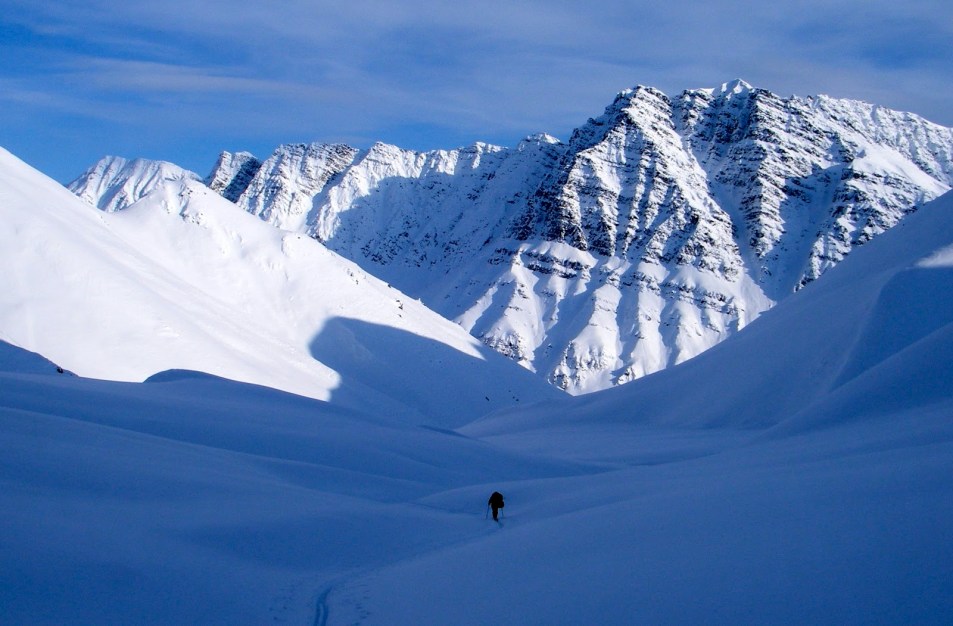
The reader accompanies the author as he crosses the state from an amazing trek through the Brooks Range as he describes the Oolah Pass, part of the Continental Divide not between east and west, but the Arctic Divide.  Below this point water flowed south, emptying into the Pacific Ocean.  Beyond the Pass it drained into the Arctic Ocean!  We meet many fascinating characters who lived in the wilderness, towns, villages, and cities, from the state capitol in Juneau which cannot be reached by road, to Barrow which lies 330 miles above the Arctic Circle in the north, Seward in the south, and Denali* in the center.  Alaska’s topography make it a necessity for people to have pilot’s license if they are to survive the state’s rugged terrain, and in fact one out of every six residents do.  The need for air transport also serves as a time machine as you fly from Anchorage to Fairbanks to the north and on to coastal areas that seem fifty years behind.

(Oolah Pass, the Arctic Divide)

McGinniss spends a great deal of time exploring the impact of western technology and the coming of the white culture.  It has had a particularly devastating effect on younger Eskimos who were not set in the ways of the older generation.  What emerges is that Eskimo culture is being destroyed as they confront the Americanization of Alaska brought on by the wealth produced by the oil pipeline.  They are migrating to cities in great number seeking welfare aid, taking jobs on the pipeline earning money that they have no clue on how to deal with, or trying to survive in their villages.

In his trek throughout state, McGinniss meets a cavalcade of individuals unique in character and possess outlandish life stories that seem to culminate in Alaska.  World War II veterans abound, Grateful “Deadheads,” policemen from Denver, former businessmen and educators, writers, bureaucrats, and many who are recently divorced and trying to put their lives back together.  Others are seeking freedom, adventure, or just to get rich quick from the oil boom.  We meet people who arrive from Seattle on a barge in what appears to be a “hippie coup” of a small village as they take over the radio station, newspaper, and school library.  The descriptions and stories abound like Duncan Pyle, a former bestselling Canadian author who for a time was the Chairman of the Language Department at the Inupiat University of the Arctic, a university housed in a shack.  As Olive Cook who grew up in Bethel which is located at the confluence of the Bering Sea and the Yukon River who left for a job in Washington, D.C., but she could never reconcile her Eskimo culture and white technological society.  We also meet Eddie the Basque, a pipefitter from Idaho who hoped to make enough money from the pipeline to retire, however, by the time he arrived the pipeline was almost completed.

(The Alaska Oil Pipeline outside Fairbanks)

It seems that everyone that the author meets left the lower forty eight states for Alaska without any knowledge of what they were getting themselves into.  A case in point is Tom and Marie Brennan who left newspaper jobs in Worcester, MA and set out in their International Harvester Travel All pulling a houseboat on wheels.  After traveling 5000 miles they eventually reached Anchorage were they got jobs on the Anchorage Times and witness the spectacular growth of Alaska’s largest city, and Tom, who escaped Massachusetts, would soon become the Public relations Head for Atlantic Richfield and the oil pipeline!

McGinniss’ description of Fairbanks is as if it did not exist on earth, “but on a distant planet; a planet that was much farther from the sun.”  In fact, many of the author’s descriptions have that out of the earth’s universe feel to it as Alaska is not like any other area in our union, particularly the winters.  Many stark descriptions of the landscape are offered, but despite these comments, the sheer beauty of Alaska’s bareness comes through, from the Kahiltna Glacier 7200 feet above sea level which is the staging area for hikers to climb Denali or the Yukon River that flows from the Bering Sea all the way across Alaska into Canada.

GOING TO EXTREMES is a unique look at our 49th state, a view that is hard to accept for many natives because of the way their lives have changed.  However, for the Alaska novice like myself in conjunction with my recent visit it was eye opening what the oil boom has done to the state and its people.  Whether you are a conservationist, an individual who believes in the development of Alaska’s natural resources, or someone who wishes that the government would just leave Alaskans alone there is something worthwhile to be taken from McGinniss’ narrative.

*The name of the highest mountain in North America became a subject of dispute in 1975, when the Alaska Legislature asked the U.S. federal government to officially change its name from Mount McKinley to Denali. The mountain had been unofficially named Mount McKinley in 1896 by a gold prospector, and officially by the United States government in 1917 to commemorate William McKinley, who was president of the United States from 1897 until his assassination in 1901. (Wikipedia)