![Hunchback of Notre Dame [Studio Cast Recording]](https://i0.wp.com/prodimage.images-bn.com/pimages/0791558148220_p0_v2_s272x272.jpg)

The author Lauren Belfer has written two excellent works of historical fiction; A FIERCE RADIANCE and THE CITY OF LIGHT. Both center on murders related to important scientific discoveries, one deals with hydroelectric power outside Buffalo, and the other the development of penicillin during World War II. Both novels exhibit Belfer’s capacity to intertwine fictional and non-fictional characters that create historical realism and accuracy. Belfer’s third novel, recently released AND AFTER THE FIRE breaks new ground as she creates a story that revolves around an original cantata of Johann Sebastian Bach that incorporates the Holocaust, Jewish society and the growing anti-Semitism of 18th, 19th, and 20th century Berlin, the niece of a man haunted by his actions at the end of World War II, and a contemporary debate and mystery surrounding what should be done with the sheet music that turns up after the man who took the cantata’s sheet music after World War II commits suicide.
The novel begins in May, 1945 as two Jewish American GIs are making their way back to a military base outside Weimar when they arrive in a well preserved German town located near Buchenwald, the Nazi concentration camp. They decide to enter what appears to be an abandoned house when one of the GIs, Henry Sachs decides to take the sheet music that is inside a piano bench. Upon doing so a disheveled German teenage girl appears with a gun and a shooting transpires resulting in the wounding of the second GI, Peter Galinsky, and the death of the girl.

(American troops encounter Nazi savagery at Buchenwald in May, 1945)
At this point Belfer moves the story to June, 2010 in New York City where we meet Susannah Kessler, the Executive Director of the Barstow Family Foundation, where she coordinates grants designed to assist the city’s poor children. Susannah’s life will radically change that summer as her marriage ends in divorce after she is sexually assaulted in an ally on the way home from work. As she tries to cope with her failed marriage and the attack she learns that her Uncle Henry who had greatly impacted her life has committed suicide. Susanna must now deal with another painful loss and learns from her Uncle’s suicide note what happened to him at the end of the war. Her inheritance includes the sheet music he had taken which may be an original from Johann Sebastian Bach. The note asks Susannah to determine if the sheet music is original and to do with it what she deems appropriate. From this point on I became hooked on the storyline as Belfer introduces a number of important new characters both historical and fictitious.
We meet Wilhelm Friedemann Bach the son of the famous composer and music teacher of Sarah Itzig, who is Jewish and the daughter of Daniel Itzig, Frederick the Great’s Jew who was a financial genius who assisted the Prussian monarch as he launched his aggressive foreign policy. What plays out among these characters and their families is the moral issue faced by German Jews of the time period- should they assimilate into the larger German society or remain committed to their Jewish identity. This problem will result in many Jews converting to Christianity or hiding who they really are. Through Susanna we meet other important characters including Daniel Erhardt, an academic expert on Bach, Scott Schiffman, the curator of music manuscripts at the MacLean Library in New York, and Frederic Augustus Fournier, a Yale Centennial Professor who has his own agenda when it comes to the sheet music under question. Susanna turns to each man to try and solve the riddle of the possible Bach cantata.

Belfer structures the book by alternating chapters and historical periods. She moves easily from 18th and 19th century Berlin as she explores the Itzig family history and its relationship to Bach’s music, and Susanna’s quest to ascertain the legitimacy of the cantata. The role of anti-Semitism and the Holocaust are just below the surface throughout the story. The problem is that the cantata in question contains anti-Semitic lyrics that conform to Lutheran theology and prevalent beliefs of prominent Prussians at the time. Belfer does an excellent job discussing upper class Jewish society of the period and how they tried to cope with the developing racist ideology that surrounded them. In addition, the author does a wonderful job capturing Berlin’s attempt at developing into a cultural center following the reign of Frederick the Great, particularly salons, but also the undercurrent of anti-Semitism of the Prussian aristocracy that is dependent upon Jewish bankers.
Belfer possesses an elegant writing style that enhances her story telling and character development. She does a superb job explaining the structure of Bach’s music to the novice. She breaks down his work and the cantata in question so the reader can understand its importance whether it is real, or as a historical document that lends insight into German the social and intellectual milieu of the time period covered in the novel. In conclusion, Belfer has written a wonderful book that is surely her best and I believe it will satisfy a wide audience.


Recently I was in a bookstore in Anchorage, Alaska and came across a book by Joe McGinniss entitled, GOING TO EXTREMES. Having read his THE SELLING OF THE PRESIDENT 1968 about the attempt to repackage Richard Nixon for the 1968 presidential campaign, and CRUEL DOUBT which centers on a society murder in a small North Carolina town in 1988, I was intrigued. After reading the introduction to the new edition written in 2010, as the original was published in 1981, I learned that McGinniss had thanked Sarah Palin for the inspiration to revisit Alaska after the 2008 Republican Convention and how the state had impacted him in the mid-1970s. The book itself is part memoir, geographical guide, and history of the 49th state that was admitted to the United States sixteen years before what McGinniss describes in his own thought provoking and humorous style as the transformation of Alaska due to the domination of “big oil.”
A few weeks ago while standing below a section of the Alaska pipeline outside Fairbanks I learned that 85% of the state’s revenue is a result of oil and that each Alaskan resident receives a check for $2-3,000 a year as a tax rebate depending on the whims of politicians and oil production. The money pays college tuition and numerous other costs for Alaska’s citizens and one cannot imagine where Alaska would be today without the money stream from “big oil.” McGinniss’ main motivation in visiting Alaska in 1975 was to experience the awesome beauty of its primal wilderness and mountains, for what he feared might be the last days of the last frontier America would ever have.

(Denali, over 20,000 feet above sea level, the highest peak in North America)
McGinniss would spend a year traveling and living among the native Eskimos and local citizens trying to get to the core of what it meant to be an Alaskan native, and those characters who settled in Alaska by choice for many diverse and unusual reasons. The book describes a state that in many parts seems to be a world where things remain just as they had been forty or four hundred years before. However, with the political and economic pressures fostered by the Alaskan pipeline they were about to change radically as I witnessed on my recent visit a few weeks ago.
The reader accompanies the author as he crosses the state from an amazing trek through the Brooks Range as he describes the Oolah Pass, part of the Continental Divide not between east and west, but the Arctic Divide. Below this point water flowed south, emptying into the Pacific Ocean. Beyond the Pass it drained into the Arctic Ocean! We meet many fascinating characters who lived in the wilderness, towns, villages, and cities, from the state capitol in Juneau which cannot be reached by road, to Barrow which lies 330 miles above the Arctic Circle in the north, Seward in the south, and Denali* in the center. Alaska’s topography make it a necessity for people to have pilot’s license if they are to survive the state’s rugged terrain, and in fact one out of every six residents do. The need for air transport also serves as a time machine as you fly from Anchorage to Fairbanks to the north and on to coastal areas that seem fifty years behind.
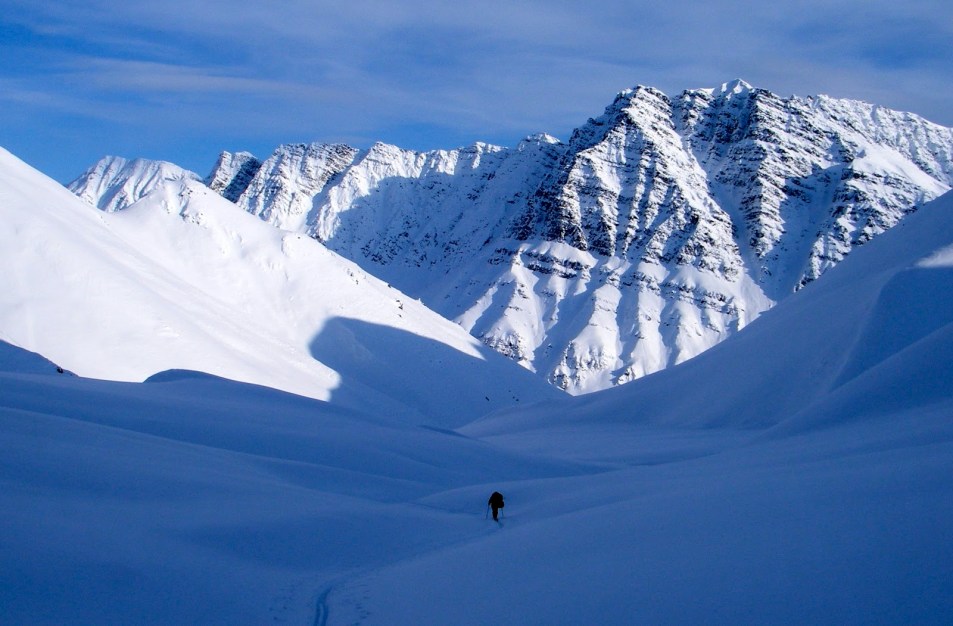
(Oolah Pass, the Arctic Divide)
McGinniss spends a great deal of time exploring the impact of western technology and the coming of the white culture. It has had a particularly devastating effect on younger Eskimos who were not set in the ways of the older generation. What emerges is that Eskimo culture is being destroyed as they confront the Americanization of Alaska brought on by the wealth produced by the oil pipeline. They are migrating to cities in great number seeking welfare aid, taking jobs on the pipeline earning money that they have no clue on how to deal with, or trying to survive in their villages.
In his trek throughout state, McGinniss meets a cavalcade of individuals unique in character and possess outlandish life stories that seem to culminate in Alaska. World War II veterans abound, Grateful “Deadheads,” policemen from Denver, former businessmen and educators, writers, bureaucrats, and many who are recently divorced and trying to put their lives back together. Others are seeking freedom, adventure, or just to get rich quick from the oil boom. We meet people who arrive from Seattle on a barge in what appears to be a “hippie coup” of a small village as they take over the radio station, newspaper, and school library. The descriptions and stories abound like Duncan Pyle, a former bestselling Canadian author who for a time was the Chairman of the Language Department at the Inupiat University of the Arctic, a university housed in a shack. As Olive Cook who grew up in Bethel which is located at the confluence of the Bering Sea and the Yukon River who left for a job in Washington, D.C., but she could never reconcile her Eskimo culture and white technological society. We also meet Eddie the Basque, a pipefitter from Idaho who hoped to make enough money from the pipeline to retire, however, by the time he arrived the pipeline was almost completed.

(The Alaska Oil Pipeline outside Fairbanks)
It seems that everyone that the author meets left the lower forty eight states for Alaska without any knowledge of what they were getting themselves into. A case in point is Tom and Marie Brennan who left newspaper jobs in Worcester, MA and set out in their International Harvester Travel All pulling a houseboat on wheels. After traveling 5000 miles they eventually reached Anchorage were they got jobs on the Anchorage Times and witness the spectacular growth of Alaska’s largest city, and Tom, who escaped Massachusetts, would soon become the Public relations Head for Atlantic Richfield and the oil pipeline!
McGinniss’ description of Fairbanks is as if it did not exist on earth, “but on a distant planet; a planet that was much farther from the sun.” In fact, many of the author’s descriptions have that out of the earth’s universe feel to it as Alaska is not like any other area in our union, particularly the winters. Many stark descriptions of the landscape are offered, but despite these comments, the sheer beauty of Alaska’s bareness comes through, from the Kahiltna Glacier 7200 feet above sea level which is the staging area for hikers to climb Denali or the Yukon River that flows from the Bering Sea all the way across Alaska into Canada.
GOING TO EXTREMES is a unique look at our 49th state, a view that is hard to accept for many natives because of the way their lives have changed. However, for the Alaska novice like myself in conjunction with my recent visit it was eye opening what the oil boom has done to the state and its people. Whether you are a conservationist, an individual who believes in the development of Alaska’s natural resources, or someone who wishes that the government would just leave Alaskans alone there is something worthwhile to be taken from McGinniss’ narrative.
*The name of the highest mountain in North America became a subject of dispute in 1975, when the Alaska Legislature asked the U.S. federal government to officially change its name from Mount McKinley to Denali. The mountain had been unofficially named Mount McKinley in 1896 by a gold prospector, and officially by the United States government in 1917 to commemorate William McKinley, who was president of the United States from 1897 until his assassination in 1901. (Wikipedia)


THE WARLORD’S SON by Don Fesperman is an amalgam of tribal machinations, hidden agendas, and conflicting personalities played out in the border region between Pakistan and Afghanistan, Peshawar, Pakistan, and tribal areas of Afghanistan. The story is about complex relations among tribal families, a budding relationship between a man and a woman that goes against tradition, the interests of a number of warlords, and two shadowy Americans who seem to manipulate many of the main characters.
The three main characters are Najeeb Azam, a Pakistani educated in the United States who has been banned from his tribe by his father. Najeeb’s life has been limited following 9/11 by US Consular officials and his father’s decree. To survive he hires himself out as a guide and interpreter to western reporters who crave information about Pakistan, the Taliban, and the course of events inside Afghanistan. The second major protagonist is Stanford Kelly, better known as Skelly, a burned out journalist from the American Midwest who seeks to rekindle his career in southwest Asia. He links up with Najeeb as a means of getting back in the “game,” and the course of their relationship and what they experience form the core of the novel. The third character, Daliya Qadeer goes against her family’s wishes by becoming involved with Najeeb and she will take any risk to be with him.
Fesperman conveys the brutal dichotomy that is Musharraf’s Pakistan following 9/11. The Pakistani ISI (Interservices Intelligence) that helped create the Taliban is deeply involved in Najeeb’s life, as are two Americans who seem to be working with the ISI, but it is not really clear what they are up to until the novel’s conclusion. Skelly was part of a wave of American journalists who descended on Pakistan and Afghanistan after 9/11 as the war between the United States and the Taliban exploded. At first Najeeb and Skelly are wary of each other, but soon develop a comfort level as they both seemed to be looking for somewhere to take root as their lives seemed to converge.
The author does a superb job providing the sights and smells of the region from Peshawar to the many villages of Afghanistan. In addition, the archine and duplicitous ISI is introduced and integrated accurately into the story as the “midwife” of the Taliban and the ally of the United States. The author is dead on when he points out that the ISI’s main security concern is India, and that the Taliban is a tool in that strategy no matter how close or how much aid it receives from the United States.
The most interesting aspect of the novel is how Najeeb’s life seems to come full circle. Fesperman revisits his childhood and his relationship with his warlord father and an uncle who seems to take care of him. His father sent him to America for his education for his own reasons and when he returned their relationship collapsed. To control his son, the ISI would keep him in line. Because of his relationship with Skelly, and the reporter’s obsession to uncover a major newspaper story, Najeeb will revisit his childhood haunts as he deals with the machinations of the ISI, his father, his uncle, and other warlords as he tries to survive.
Fesperman’s writing is sensitive to the “underworld” that exists in Pakistani and Afghan society, particularly in the tribal areas that abuts Afghanistan where many refugees seek shelter from the Taliban. Najeeb joins Skelly on a caravan into Afghanistan as the American reporter tries to land one last scoop to satisfy the journalistic blood that pulses in his veins. The result is a series of mishaps, surprises, and shifting alliances that threaten their lives.
Numerous questions arise as the book unfolds. What role do Sam Hartley, an American businessman and Arlen Pierce, a cultural attaché from the State Department play? Is there a strategy that is being developed to capture Osama Bin-Laden? Can Najeeb’s father be trusted? What is the ISI really after? Among numerous questions. The end result will surprise the reader and the books conclusion is somewhat disconcerting.
This is my second go at one of Don Fesperman’s novels, and I look forward to reading others in the future.


One night along the Cuban coast that adjoins the United States naval base at Guantanamo a body washes ashore. The body that of an American serviceman is found by a Cuban police officer on patrol. The officer rushes down the hill to chase away an iguana, recognizes that the body he has located is American and realizes how important his find is. So begins Dan Fesperman’s THE PRISONER OF GUANTANAMO, a book that will capture the reader’s attention immediately and maintain interest as the plot continues to unfold.
Fesperman’s main character is a former Marine and FBI agent named Revere Falk who was fluent in Arabic and was employed by the Pentagon as an interrogator at Guantanamo. After introducing the reader to the interrogator’s craft, Fesperman discusses a Yemeni detainee named Adran al-Hamdi, who Falk has worked very hard to establish a working relationship with in order to obtain what he believes to be important intelligence. Al-Hamdi was captured in Afghanistan by the Northern Alliance and was considered a major “head case.”
Once the American corpse is identified as SGT Earle Ludwig, the Pentagon asks Falk for assistance with the investigation into his death. Falks’s running commentary throughout the novel provides interesting insights into the American approach at GITMO to obtain intelligence and the relationship between the various US intelligence agencies. As the story progresses Falk is forced to revisit his past, particularly an error he made as a young Marine dealing with Cuban intelligence in Havana. As Falk’s investigation into Ludwig’s death develops it appears that he may have been murdered. At this point a number of new characters are introduced. Pam Cable, Falk’s girlfriend and fellow interrogator, Tim Bokamper, an old friend and FBI agent, and Gonzales Rubiero, an American who lived in Miami Beach, but spied for the Cubans. Each of these characters plays an important role in addition to the two representatives that the Department of Homeland Security dispatches to GITMO forcing the story in a different direction.
Fesperman provides a number of important insights as the novel builds. The reader is taken inside al-Hamdi’s head to experience how detainees reacted to their imprisonment. In addition, Fesperman examines Cuban-American relations particularly in the post 9/11 world. “Little Havana,” in Miami Beach is explored in the context of the post-Cold War period and is very accurate.
The key aspect of the novel is how its component parts fit together. How does Falk’s career as a young Marine fit into the investigation of Ludwig’s death and the reaction of other federal agencies? How does Ludwig’s death relate to Falk’s interrogation of al-Hamdi? What role does Cuban intelligence play in the events surrounding Ludwig’s death and what is their interest in al-Hamdi? Finally, why do people close to Falk’s investigation begin to disappear? Fesperman weaves his answers very carefully as the reader tries to make sense of certain aspects of the novel that seem to unfold in a world of jihadists, Cubans, and other misshapen secrets. For example, were there “higher ups” in Washington looking for links between Fidel Castro and al-Qaeda as a pretext for who knows what? The problem for Falk is that every time he feels he has figured out what was going on the tables are turned and he grows even more confused.
This was my first experience reading one of Fesperman’s novels and as a result he has created a new fan! I am looking forward to reading THE WARLORD’S SON another of his books as soon as I can.

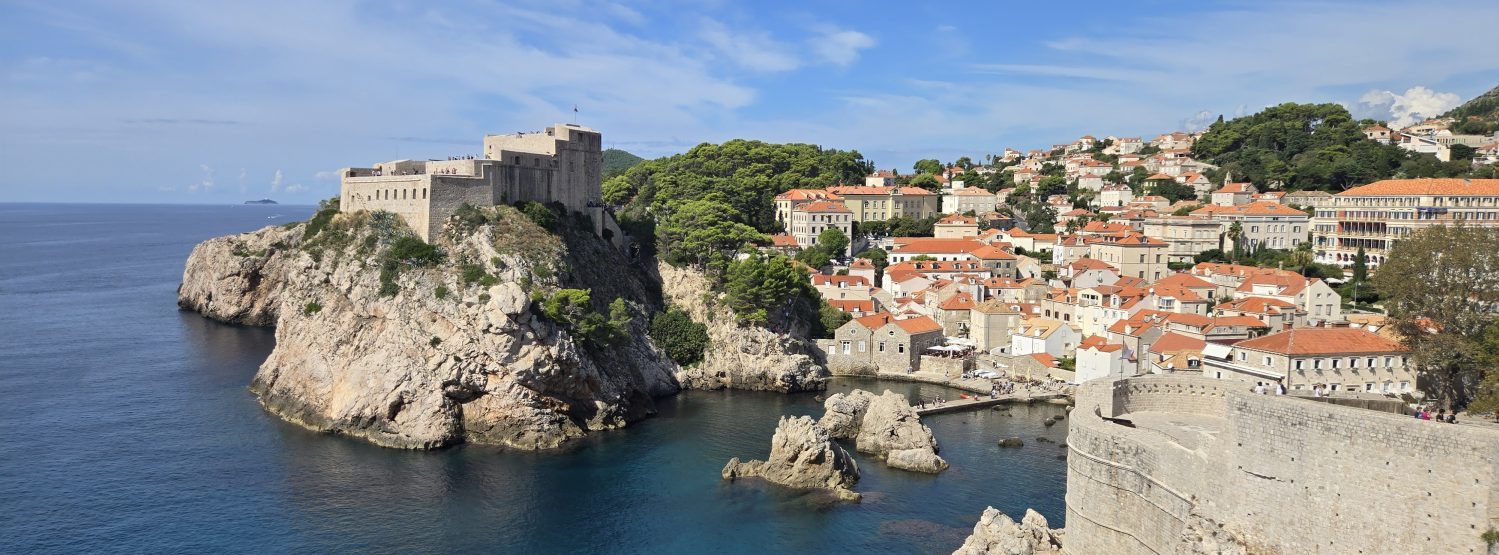
(GITMO, the home of many individuals, both terrorists and non-terrorists)

(Benedict Arnold and George Washington)
By May of 1780 the Continental Army under the command of George Washington had reached a point of no return. According to Joseph Plumb Martin, the son of a minister from Milford, CT, and a soldier who seems to appear at most major Revolutionary War battles, “here was the army starved and naked.” The situation had evolved because of the horrendous winter in Morristown, NJ, the lack of support and funding by the Continental Congress, and the weak infrastructure that plagued Washington’s army. Most Americans were unaware how poorly the American military was outfitted and how the men were forced to live and fight under intolerable conditions for a good part of the American Revolution. This theme is one of the many that Nathaniel Philbrick argues in his new book VALIENT AMBITION: GEORGE WASHINGTON, BENEDICT ARNOLD, AND THE FATE OF THE AMERICAN REVOLUTION. Those who are familiar with Philbrick’s earlier works like the MAYFLOWER AND IN THE HEART OF THE SEA will not be disappointed with his latest effort. Philbrick continues his narrative works dealing with the American Revolution and has written another evocative and fascinating historical monograph that should be attractive to the general public and professional historians. Philbrick’s approach rests on the exploration of the personalities, military capabilities, and the “valiant ambitions” of George Washington and Benedict Arnold. In addition, Philbrick weaves into the narrative the economic hardships, societal relationships, and battlefield experiences of the lower classes who fought the war.

(The young Benedict Arnold)
The book builds up to a situation where one of Washington’s greatest generals came to decide that the cause to which he had given almost everything no longer deserved his loyalty.” Of course that general is Benedict Arnold, a brilliant military tactician on land and sea, but also a person who possessed an ego that surpassed most people of his age. His sense of entitlement knew no bounds and after his leg was shattered in battle and many of his investments did not bear fruit he contemplated how he could recoup much of his wealth that he claimed was lost in support of the revolution. Further exacerbating his psyche was his infatuation and love for Peggy Shippen, whose father Edward was a wealthy loyalist and to win her hand in marriage he had to create the wealth that she had grown accustomed to. Politics also played into Arnold’s bitterness toward the colonial government in that Joseph Reed, the President of Pennsylvania’s Supreme Executive Council and the most powerful man in the state launched an investigation into Arnold’s conduct as military governor of Philadelphia. This would lead to Arnold’s trial which on top of previous episodes of fighting for his proper rank made Arnold ripe for treason. Philbrick does a masterful job following Arnold’s path to becoming a spy and integrated many primary documents to highlight all aspects of Arnold’s overblown sense of his own importance and the resulting trial and court-martial.

(Peggy Shippen, the love of Benedict Arnold’s life!)
Philbrick effectively contrasts General Arnold with George Washington a man who did not measure up to Arnold as a military tactician, but was the type of individual who eventually would learn from his mistakes. The Washington that Philbrick presents is a man who must fight his “inner demons” which were his naturally aggressive tendencies. By the spring of 1777 Washington argued for a “War of Posts,” a defensive strategy that made perfect sense against the British. However, he would repeatedly violate this strategy by assuming the offensive at Brandywine and Germantown which resulted in the British occupying Philadelphia for eight months. As a result Washington finally learned to control his offensive instincts and do what was best for his army and country. Washington had been placed in the untenable position by the Continental Congress that put him in command of the army to prosecute the war, but would not allow him to choose his own officers, on which he had to depend on most. To his credit Washington realized the limitations that were placed on him were due to the politicization of the war and decided to deal with the situation as best he could. On the hand Arnold was emotional and impulsive at times, but was a sound military thinker who, unlike his commander, had the ability to outthink his opposition and take advantage of the topography available to him. I agree with Philbrick that Arnold’s “narcissistic arrogance that enabled him to face the gravest danger on the battlefield without a trace of fear had equipped him to be a first-rate traitor.” It is interesting to note that had the Continental Congress headed Washington’s advice concerning Arnold’s promotion and seniority he might have gone down in history as one of the immortals, not someone who has been labeled a traitor.

(Joseph Reed, whose evaluation of Arnold was dead on!)
Philbrick’s narrative is not a complete history of the American Revolution, but he assimilates the most important battles into the narrative, the strategies employed by Generals Burgoyne, Howe, and others for the British, in addition to Generals Horatio Gates, Philip Schuyler and others for the Americans. The book is enriched by the competition between these men, in particular Gates’ attempt to seize command of the army from Washington. Further, the reader is exposed to sectional political machinations between the New England, Atlantic, and southern states that fostered much of the domestic and internal military hostility that existed during the fighting. Philbrick is a meticulous researcher and this is reflected in his unique story telling ability and novelistic detail. However, if there is an area that Philbrick could have developed further, it is the lack of interactions between Washington and Arnold, particularly during the first half of the book. The author could have spent less time describing battle details, though highlighted with excellent maps, and devoted greater emphasis on the two main characters in the narrative, how they interacted with each other, and the ramifications of those interactions.
Philbrick reaches an interesting conclusion in that Arnold did the young nation a tremendous service through his treason. During almost five years of fighting the Continental Congress was rather disjointed, rivalries between regions detracted from any hope of unity, and the military situation was poor. Arnold’s treason galvanized the American people against him and created a sense of common purpose. Though the people had come to revere George Washington as a hero, it was not sufficient to bring the people together, but now they had a despised villain to accomplish that goal. The real enemy for the young nation was not Great Britain but those Americans who sought to undercut their fellow citizens’ commitment to one another. Philbrick’s argument is rather interesting and a bit overstated, but he argues it quite well. VALIENT AMBITION is a fascinating study and will make a wonderful addition to any library of the American Revolution.

(George Washington and Benedict Arnold)

(Tule Lake Japanese internment camp in Northern, CA during World War II)
ALLEGIANCE is an interesting novel by Kermit Roosevelt* that explores a number of issues, most important of which is the power of the presidency and the federal government during wartime. Roosevelt, a professor of constitutional law at Pennsylvania’s Law School and a former Supreme Court clerk is eminently qualified to explore this topic and provides interesting insights into the legal arguments, interpersonal relationships, and issues of national security that still reverberate today.
The novel opens with the bombing of Pearl Harbor and its aftermath as Casewell “Cash” Harrison, a law student at Columbia University, and many of his generation contemplate their future – to join up or wait to be drafted. Cash, a scion of rich Philadelphia society tries to balance loyalty to his country and devotion to his fiancé, Suzanne as he tries to come to grips with the Japanese attack. He decides to enlist, disregarding the advice of his parents, Suzanne, and her father who is a federal judge, but is rejected and is classified 4-F. Soon his life takes a major turn as he is offered a clerkship with Supreme Court Justice, Hugo Black. Upon arriving in Washington, Cash witnesses a capitol city mobilizing for war and he suffers tremendous guilt that so many of his friends and men his age are off to war, and he is dealing with writs of certiorari or certs involving lower courts being ordered to deliver its record in a case so a higher court, in this case the Supreme Court may review it.
There seem to be a number of story lines that intersect throughout the novel. First, Cash must balance pressure from his fiancée, her father, and his own family in Philadelphia to leave his clerkship and return home. Second, Cash’s fears that he is being followed and spied upon which relates to the certs that Supreme Court clerks review. Third, the issue presented in the Supreme Court case, Hirabayashi v. United States which involves whether the “military can confine citizens to their homes, and then later order them to leave those homes, to leave the states in which they have always lived.” It involves executive power and whether the “constitution protects civilians from military authority outside an active theater of war.” In all three story lines, Cash believes that he is in danger, and as the novel evolves his position becomes increasingly precarious. In developing the novel Roosevelt does a fine job integrating many important historical figures such as members of the Supreme Court, Felix Frankfurter and Hugo Black in particular, Attorney General Francis Biddle, FBI Director J. Edgar Hoover, Solicitor General Charles Fahy and Karl Bendetson, an aid to General Dewitt, the head of Japanese “relocation centers,” who was a specialist on the threat posed by enemy aliens and native fifth columns. These figures seem to come alive as Roosevelt includes legal documents that reflect their opinions and arguments, in addition to historical vignettes about the justices. The author also creates fictional characters, the most important of which are Cash and his fellow clerks, Gene Gressman, Clara Watson, John Hall, the liaison between the War and Justice Departments, and Colonel Bill Richards of the Anti-Federalist Society.

(Supreme Court Justice Hugo Black)
From the outset Cash thinks he is being shadowed by the FBI or others and grows concerned. After he is beaten up he and Gressman try to flush out why the people who are after him call him a traitor. The conclusion they reach is that there is something underhanded taking place in the way that individuals are chosen as clerks for certain justices, particularly when chosen clerks are drafted and replaced by secondary choices. They reason that information about certs are leaked to business interests providing inside information about which cases will be heard by the court and knowledge of how the decisions will be rendered. Obviously, if business interests have this information then they will trade stocks in a certain manner before a decision comes down. When it appears that one of the clerks has been murdered Cash decides to forgo returning to Philadelphia and joins the Justice Department in his quest to uncover what is transpiring within the court. Roosevelt creates another major story line as Cash moves to work under Attorney General Biddle in the Aliens Enemy Unit.

(General John L. Dewitt, in charge of Japanese internment camps)

(Documentation that negated the need to remove Japanese-American citizens to internment camps during World War II)
Cash’s work for the Aliens Enemy Unit fosters a visit to the Tule Lake Relocation Camp and crystalizes the issues that confronts the Justice Department. Cash immediately learns that the War Department has been lying since Pearl Harbor concerning the Japanese domestic threat and they have a mole within the Justice Department and this impacts Supreme Court cases dealing with the evacuation of Japanese into camps. Cash’s job is to justify the evacuation of the Japanese, but he cannot bring himself to do so. This battle over the camps reflects tremendous research as the characters narrative seems to reflect the opinions of the day and members of the Supreme Court, the F.B.I. head and others reappear with their own agendas. Cash’s dilemma is how does his work on the Alien Enemies Unit relate to the death of a Supreme Court clerk, and how does he deal with the danger of going against the War Department as he visits the Tule Lake facility a second time. It appears that each cover-up led to a new crime, and Cash is trying to discern what is happening.
(Attorney General Francis Biddle)
Roosevelt has written a novel about an important subject however at times the development of the story leads to some stilted dialogue, and over description of certain scenes and characters that make the plot seem overblown. At times the plot is difficult to follow and should have been a bit tighter to avoid confusion on the part of the reader. The book has a great deal of potential because of the nature of the subject matter, but the story is somewhat uneven and could have been streamlined. For those who want a realistic presentation of the difficulties the government faced, from a legal and moral perspective in dealing with Japanese internment during World War II Roosevelt’s work will be satisfactory, but keep in mind there will be some obstacles to overcome, but in the end they may be well worth it.
*Kermit Roosevelt is the great-great- grandson of President Theodore Roosevelt and the great-grandson of Kermit Roosevelt, the main CIA operative in the Middle East that overthrew the Iranian government in 1953 and placed the Shah on the throne-depicted in his book COUNTERCOUP. Further his great-grandfather was probably involved with placing Gamal Abdul Nasser in power in Egypt.

(Tule Lake Japanese internment camp in Northern, CA during World War II)

(Mark Twain)


(Mark Twain and his benefactor, H.H. Rogers)

(Mark Twain)
(Mark Twain)
(Mark Twain, Olivia Livy Twain and their three daughters, Clara, Jean, and Susy)
(Mark Twain and his friend and benefactor, H.H. Rogers)
(Mark Twain)

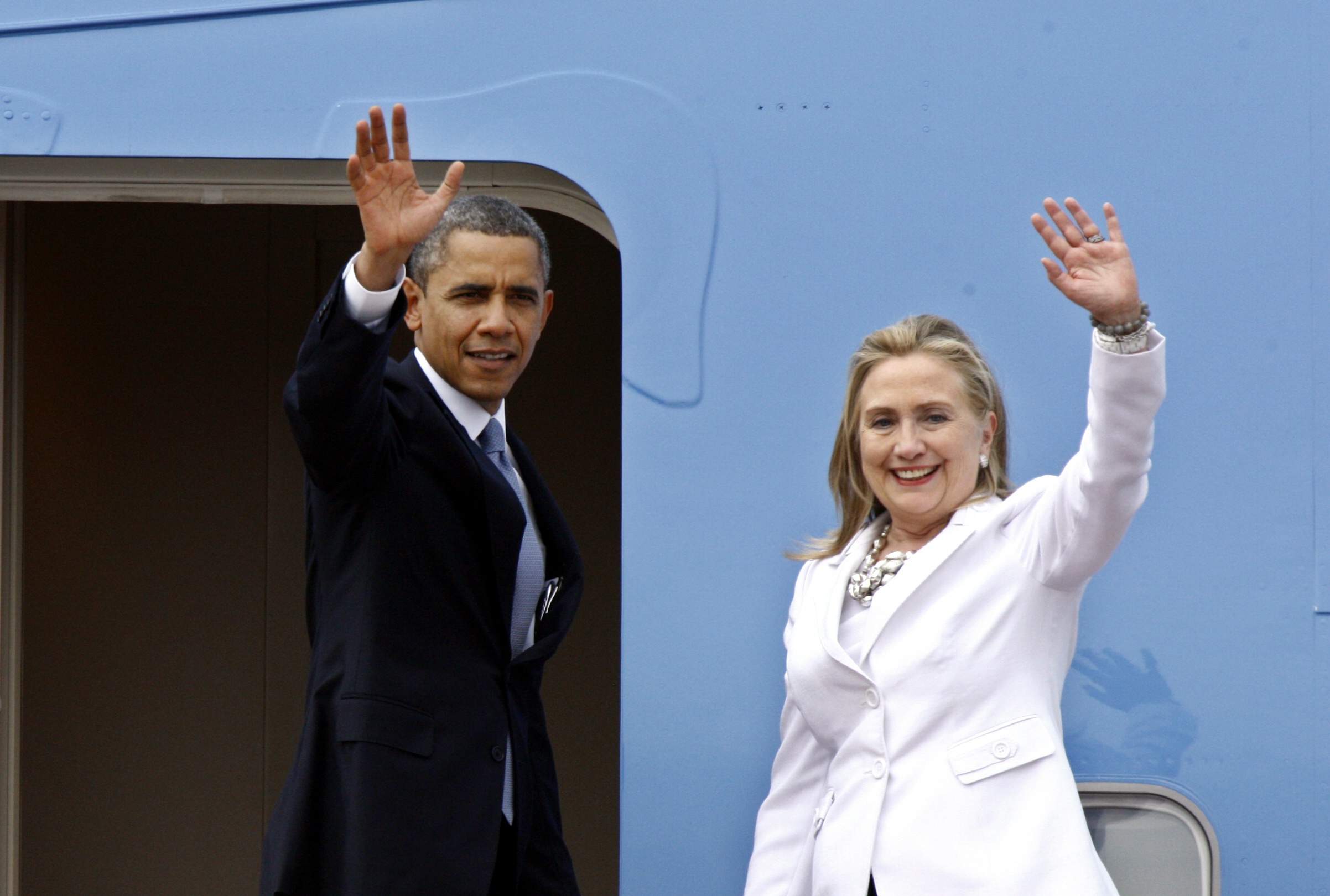
(President Barack Obama and Secretary of State Hillary Clinton)
Following his victory in the 2008 presidential election Barack Obama chose Hillary Clinton as his Secretary of State. Many pundits conjectured as to why Obama made this selection. They argued that he was following the path of Abraham Lincoln by placing his opponents in his cabinet so he could keep an eye on them and control any opposition. This view is wonderfully presented in Doris Kearns Goodwin’s TEAM OF RIVALS: THE POLITICAL GENIUS OF ABRAHAM LINCOLN, but one must ask could Goodwin’s thesis actually represent Obama’s motivation. In his new book, ALTER EGOS: HILLARY CLINTON, BARACK OBAMA, AND THE TWILIGHT STRUGGLE OVER AMERICAN POWER Mark Landler, a New York Times reporter compares Obama and Clinton’s approach to the conduct of foreign policy and how it has affected America’s position in the world. In do so Landler explores in detail their relationship on a personal, political, and ideological level. Landler delves into the differences in their backgrounds that reflect how they came to be such powerful figures and why they pursue the realpolitik that each believes in. In so doing we learn a great deal about each person and can speculate on why Obama chose what really can only be characterized as his political enemy throughout the 2008 campaign trail as his Secretary of State. What is even more interesting is their differences that can be summed up very succinctly; for Obama the key to conducting a successful foreign policy was “Don’t do stupid shit,” for Clinton, “great nations need organizing principles…don’t do stupid stuff is not an organizing principle.”
Since we are in the midst of a presidential election and it appears that Hillary Clinton will be the Democratic nominee it is important to evaluate and understand her approach to foreign relations. Landler does the American electorate a service as his book is a useful handbook in understanding and getting an idea how she would approach the major foreign policy issues that America currently faces should she assume the oval office. By comparing her with Obama we gain important insights into her thinking and how she would implement her ideas. It is clear during Obama’s first term that Clinton was the “house hawk” within his administration as she supported increases in troop deployments to Afghanistan which Obama reluctantly agreed to, but only with a set time limit; she wanted to leave a large residual force in Iraq after American withdrawal which Obama did not do; she favored funneling weapons to rebels in Syria fighting Assad as well as the creation of a no fly zone which Obama opposed; and lastly, she favored the overthrow of Muammar al-Qaddafi and the bombing of Libya when he threatened to destroy Benghazi which Obama reluctantly agreed to. Their difference are clear, Obama believes that the United States is too willing to commit to military force and intervene in foreign countries, a strategy that has been a failure and has led to a decline in America’s reputation worldwide, a reputation he promised to improve and has been partly successful with the opening to Cuba and the nuclear deal with Iran. For Clinton the calculated employment of American military power is important in defending our national interests, and that our intervention does more good than harm, especially in exporting development programs and focusing on human rights. Obama arrived on the scene as a counterrevolutionary bent on ending Bush’s wars and restoring America’s moral standing. He no longer accepted the idea that the U.S. was the world’s undisputed “hegemon” and shunned the language of American exceptionalism. Clinton has a much more conventional and political approach, “she is at heart a ‘situationist,’ somebody who reacts to problems piecemeal rather than fitting them into a larger doctrine.” Her view is grounded in cold calculation with a textbook view of American exceptionalism.
 (President Obama, an Illinois State Senator in 2002 speaking against the war in Iraq)
|
Landler describes the difficulties that Clinton had adapting to the Obama White House that is very centralized in decision-making and she had difficulty penetrating Obama’s clannish inner circle. The author also does an excellent job explaining the main players in Hillaryland and the Obama world that include Obama’s whiz kids, Denis McDonough and Ben Rhodes, and Clinton’s staffers Jake Sullivan and Huma Abedin. Since Obama was a self-confident president who had a tight grip on foreign policy, Clinton spent most of her time implementing the strategy set by the White House. During the first two years of the Obama administration Clinton pursued a global rehabilitation tour to patch up the mess that Bush left. During her second two years she did more of the heavy lifting on sensitive issues like Syria, Libya, Iran, China, and Israel which Landler dissects in detail. From her UN women’s conference address in Beijing during her husband’s administration, her lackluster attempts at bringing peace between the Palestinians and Israel, developing and implementing sanctions against Iran, her support for the rebels in Syria, and the overthrow of Qaddafi, we get unique insights into Clinton’s approach to foreign policy.
The fundamental difference or fault line between Obama and Clinton was Clinton’s vote in favor of the invasion of Iraq on October 2, 2002, a vote that Obama opposed as a state senator in Illinois. Landler does a marvelous job comparing their backgrounds and the influence of their personal experience on their worldview. Obama’s divided heritage of Hawaii, Kenya, and especially Indonesia defined him from the outset. For him Indonesia highlighted the ills of the oil companies, western development programs, and American power as it supported repressive military dictatorships to further its Cold War agenda. Obama was an anti-colonialist and could put himself in the place of third world cultures in his decision-making. Clinton on the other hand was rooted in Midwestern conservatism and her interests after law school was to try and alleviate poverty and defend the legal rights of children. Landler is correct when he states that “Clinton viewed her country from the inside out; Obama from the outside in.”

(Special envoy Richard Holbrooke)
Landler presents a number of important chapters that provide numerous insights into the Obama-Clinton relationship. Particularly important is the chapter that focuses on Richard Holbrooke, a career diplomat that dated back to Vietnam and ended with his death in 2010. A swash buckling man who did not fit into the Obama mold was brilliant, self-promoting and usually very effective, i.e., the Dayton Accords in 1995 that ended the fighting in Bosnia. He hoped as Clinton’s special envoy for Pakistan and Afghanistan to help mediate and bring some sort of closure to the conflict with the Taliban. Holbrooke rubbed Obama the wrong way and was seen as the epitome of everything Obama rejected in a diplomat and Clinton who had a very strong relationship with Holbrooke going back many years spent a great deal of time putting out fires that he caused. Another important chapter focuses on administration attempts to mediate the Palestinian-Israeli conflict. For Clinton it was a no win situation for a person who represented New York in the Senate and planned to seek the presidency on her own. Obama would force her to become engaged in the process along with special envoy, George Mitchell, and she spent a great deal of time trying to control the animosity between Obama and Israeli Prime Minister Benjamin Netanyahu. Landler’s discussion of the Obama-Netanyahu relationship is dead on as the Israeli Prime Minister and his right wing Likud supporters represented the colonialism that Obama despised. For Netanyahu, his disdain for the president was equal in kind. In dealing with the Middle East and the Arab Spring Clinton argued against abandoning Egyptian President Hosni Mubarak as she believed in the stability and loyalty to allies, Obama wanted to be “on the right side of history,” and in hindsight he was proven to be totally wrong. These views are polar opposites and helps explain Obama and Clinton’s frustration with each other that form a major theme of Landler’s narrative.
Obama’s drone policy was another source of disagreement between the President and Secretary of State. For Obama “targeted killings” was a better strategy that the commitment of massive numbers of American troops. The primacy of employing drones is the key to understanding Obama’s foreign policy. For Clinton regional stability, engagement, and the United States military is the key to a successful foreign policy. As Vasil Nasr states, Obama believes that “we don’t need to invest in the Arab Spring. We don’t need to worry about any of this; all we need to do is to kill terrorists. It’s a different philosophy of foreign policy. It’s surgical, it’s clinical, and it’s clean.”
Perhaps Landler’s best chapter deals with the evolution of Syrian policy. Internally Clinton favored aid to the Syrian rebels which Obama opposed during the summer of 2012. However, when Obama decided to walk back his position on the “Red Line” that if crossed by Assad through the use of chemical weapons, the US would respond with missile attacks. Once this policy changed to seeking Congressional approval for any missile attack, the United States gave up any hope in shaping the battlefield in Syria which would be seized by others eventually leading to ISIS. Obama needed Clinton’s support for this change. Though privately Clinton opposed the move, publicly at her own political risk she supported the president. This raises the question; how much difference was there in their approach to foreign policy? It would appear that though there were differences, Clinton was a good team player, even out of office, though as the 2016 presidential campaign has evolved she has put some daylight between her and the president. From Obama’s perspective, though he disagreed with his Secretary of State on a number of occasions he did succumb to her position on a series of issues, particularly Libya, which he came to regret. The bottom line is clear, Clinton kept casting around for solutions for the Syrian Civil War, however unrealistic. Obama believed that there were no solutions – at least none that could be imposed by the U.S. military. Another example of how the two worked together was in dealing with Iran’s nuclear program. They both agreed on the approach to be taken, a two track policy of pressure and engagement. Clinton played the bad cop enlisting a coalition of countries to impose punishing sanctions while the President sent letters to the Supreme Leader and taped greetings to the Iranian people on the Persian New Year as the good cop! But, once again they appeared to be working in lock step together.

(Secretary of State Hillary Clinton and Burmese pro-democracy leader, Aung San Suu Kyi in 2012)
The question proposed at the outset of this review was whether President Obama chose Hillary Clinton so he could keep her within the “tent” as Abraham Lincoln did. After reading ALTER EGOS there is no concrete conclusion that one can arrive at. Even at the end of Clinton’s term as Secretary of State two major diplomatic moves were made; the groundwork that would lead to a restoration of relations with Havana and an opening with Burma took place. In both cases the President and Clinton were on the same page, therefore one must conclude that though there were some bumps in the road, publicly, Obama and Clinton pursued a similar agenda and were mostly in agreement. As a result, it would appear that they are more similar than different and that the “team of rivals” concept may not fit. It seems the title ALTER EGOS could give way, perhaps to THE ODD COUPLE, a description that might be more appropriate.
(President Barack Obama and Secretary of State Hillary Clinton)

 Doc's Books