FINALE: A NOVEL OF THE REAGAN YEARS by Thomas Mallon

As the presidential election season unfolds Republicans are faced with a candidate that calls for a major shift away from its roots that emerged in the 1980s.  During the primary season when candidates fought for the mantle of Ronald Reagan, another candidate introduced us to Trumpism.  What Trumpism purports to be is anyone’s guess, but it certainly does not conform to the ideology that was the core of Reaganism.   Thomas Mallon’s latest historical novel and ninth book, FINALE: A NOVEL OF THE REAGAN YEARS explores the last few years of the Reagan administration focusing on the Gorbachev-Reagan relationship and nuclear diplomacy, the developing Iran-Contra scandal, and the domestic politics of the period.  In doing so Mallon has conducted a tremendous amount of research that produces a novel, aside from a few fictional characters that is essentially historically accurate.  Mallon writes in a breezy manner that captures Washington’s political and social world and allows the reader to experience hard ball politics, cattiness, and all the emotions that are on display on a daily basis as the Reagan administration and its supporters and detractors strive to achieve their agenda.

FINALE is a wonderful blend of history and fiction that begins with Richard Nixon watching the 1976 Republican national convention on television offering negative comments about Nelson Rockefeller, Gerald Ford, Henry Kissinger, and Ronald Reagan.  Mallon immediately introduces us to the former president who only two years after resigning his office is calculating how to restore his reputation.  Mallon focuses a great deal of attention on Nixon as he tries to influence the nuclear diplomacy of the period through a wonderful fictional character, Anders Little, an Assistant Director, Arms Control, National Security Council, who on the one hand becomes Nixon’s mole throughout the nuclear talks at Reykjavik, Iceland, and on a personal level is trying to figure out his own sexuality.  Nixon comes across as a very solicitous husband in dealing with his wife Pat’s health who experienced two strokes over a short period of time.  But when one thinks of how Nixon treated her during most of their marriage I wonder if Mallon was trying to humanize the disgraced president or pose comic relief.

(Pamela Harriman)

Mallon does not miss a beat as his characters take verbal swipes at each other throughout the dialogue.  Nancy Reagan, who can only be described as a self-centered nasty individual who cares only for what is best for her husband.  Mrs. Reagan seems to despise a number of people, particularly her husband’s Chief of Staff, Donald Regan, former president Jimmy Carter and his family, and most everyone else except for Merv Griffin who is her confidante.  Nancy, known as “mommy,” within her small circle plans her husband’s trips, negotiations, and politics by consulting her “astrological” advisor and the description offered is extremely accurate.  Mallon’s writing drips with wit and sarcasm, particularly in describing the “gaze,” that appears each time she looks over at her “Ronnie.”  Her rivalry with Pamela Harriman, the wife of former Ambassador to the Soviet Union, Averill Harriman who recently passed away, is fascinating as two powerful women with different agendas describe each other in a rather petty fashion, and it appears that each has their own enemies list.  Richard Nixon’s petty hatreds are also present for all to observe as he rehashes his past enemies list.

The novel seems to center on arms control talks with the developing relationship between Ronald Reagan and Mikhail Gorbachev as the key component to producing a successful treaty.  Many familiar historical figures are present; Secretary of State George Schultz, Secretary of Defense Casper Weinberger, NSC Head John Poindexter, arms negotiators like Paul Nitze and others are intermingled with a number of fictitious characters, like Anders Little and Anne Macmurray, divorced from a failed politician who has ties to the Contras in Nicaragua, as well as being an anti-nuclear activist.    Aside from the arms talks, Mallon integrates many actual historical events of the period.  The Senate vote concerning sanctions against South Africa, the Florida Senate race between Governor Bob Graham and Senator Paula Hawkins, parole hearings for John Hinckley, and constant allusions to the aids epidemic among the history of the period that is intertwined in the story.  However, the most important issue that emerges are the events leading up to the Iran-Contra scandal.

A number of the historical and fictional characters are involved with illegal aid to the Contras who are fighting the Sandinistas for control of Nicaragua.  Oliver North and company make their appearance and a few fictitious individuals will inadvertently become involved.  The history of the scandal Mallon describes follows the pattern of historical accuracy tinged with fictional dialogue.  To enhance the novel Mallon employs Christopher Hitchens, an English journalist for the Spectator, who recently passed away from cancer as a vehicle to uncover information dealing with events and as a foil for a number of characters that moves the novel forward.  In addition, British Prime Minister Margaret Thatcher appears to “buck up Ronnie” when things don’t go her way.

(Christopher Hitchens)

Obviously the protagonist of the novel is the Republican Party’s patron saint, Ronald Reagan.  Throughout the novel Reagan’s legacy seems to be on the line, as Nancy Reagan reminds us throughout the book.  There is a sense of panic within Reagan’s inner circle as events lead up to arms talks in Reykjavik at the same time the Iran-Contra scandal is brewing.  The reader is presented with a 40th president who either bordering on issues is related to later Alzheimer’s or is a very effective and shrewd negotiator.  As the novel progresses it is interesting to think of Reagan as a “Teflon president,” because a number of his actions were illegal, but so soon after Nixon the country did not have the stomach to endure another impeachment process.  Reagan’s propensity to always see the positive is repeatedly used by Mallon.   As Robert Draper describes in his New York Times review, Mallon makes a virtue out of Reagan’s opacity.  “Is the principal character, as one observer in the book puts it, an idiot or an idiot savant?  Mallon all but dares us to consider him to be the former.” (NYT, September 16, 2015)

Overall, the book is a fascinating read as Mallon provides real and fictional glimpses into how historical events evolved in 1986 and 1987.  For history buffs the material will satisfy, and for general readers it is a tight and revealing portrait of personal relationships of the powerful and how they conducted themselves with so much on the line developing around them.

AMERICA’S WAR FOR THE GREATER MIDDLE EAST: A MILITARY HISTORY by Andrew Bacevitch

(Statue of Saddam Hussein in Baghdad, following the US invasion of 2003)
As a student of history over the years I have studied and taught the 100 Years War between England and France in the 14th and 15th centuries, the 30 Years War in western and central Europe in the 17th century, and now Andrew Bacevitch suggests the 40 Years War in the Middle East that began in the 20th century and continues to this day.  Bacevitch, a former career soldier and professor of history at Boston University, has written a number of important books on American foreign and military policy including BREACH OF TRUST, WASHINGTON RULES, AND THE LIMITS OF POWER explains in his new book, AMERICA’S WAR FOR THE GREATER MIDDLE EAST: A MILITARY HISTORY that the United States has been engaged in a war in the region that dates back to 1979 and is still ongoing.  He has labeled this continuous struggle, the 40 Years War in which the United States has been involved in conflict in Iran, Iraq, Afghanistan, the Balkans, Somalia, Libya, and Yemen.  After reading his latest work two questions come to mind.  First, over the period discussed in the book, did the United States ever have an actual strategy?  Second, did American military supremacy obviate the need for a strategy?  After exploring Bacevich’s narrative the answer is a resounding no to the first question, and yes to the second as successive administrations relied on the latest military technology to achieve its goals as it careened from one crisis in the region to the next.  For example, Bacevich describes President Clinton’s policy in the Balkans in the 1990s as “intervention by inadvertence,” and the NATO air campaign in the same region as “military masturbation.”  Further, after discussing President George H.W. Bush’s approach to dealing with Saddam Hussein after forcing the Iraqi dictator out of Kuwait in 1991, Bacevitch describes United States policy as “occupation by air,” setting up “no-fly zones” rather than instituting a realistic approach to dealing with the situation on the ground.

A handout photo of Saddam Hussein after his capture is seen December 14 2003 in Iraq US troops captured Saddam Hussein near his home town of Tikrit...

(Saddam Hussein after his capture in 2003)

Bacevitch’s work is provocative and reflects the ability to synthesize a great deal of information in developing sound conclusions.  The author constructs a narrative that encompasses the period 1979 to the present as he explains the origins of American involvement in the region and how it fostered the “Greater War in the Middle East.”  As he does so he develops his arguments like a prosecutor at an evidentiary hearing as he dissects the approach taken by five presidential administrations.  He carefully crafts his thesis in a step by step approach as each event builds on the next and how they are linked to produce the idiocy of American policy.  As each building block is presented, Bacevitch digresses to compare policy decisions for the Middle East with other somewhat comparative situations in American history from the American Revolution, the Civil War, Spanish-American War, World War I and II, and the Vietnam War creating interesting parallels.  What is clear from Bacevitch’s narrative is that in many cases American decision makers repeatedly reached conclusions in a vacuum that reminds one of Kurt Vonnegut’s “cloud cuckoo land.”

As the author traces America’s “War for the Greater Middle East” what becomes clear is the lack of a coherent strategy.  Administration after administration succumbed to fallacies of their own making.  Jimmy Carter hoped to develop a new foreign policy agenda of alleviating Third World poverty, resolving the Arab-Israeli conflict, and eliminating nuclear weapons.  This agenda would be shattered by the Iranian revolution and a president who “lacked guile, a vulnerability that, once discovered, his adversaries at home and abroad did not hesitate to exploit.”  Bacevitch provides an astute analysis of Carter’s overall foreign policy, focusing mostly on Iran and Afghanistan.  Carter concerned for his own reelection would auger in the “Greater War in the Middle East” by announcing the Carter Doctrine which stated that “an attempt by any outside force to gain control of the Persian Gulf region will be regarded as an assault on the vital interests of the United States of America, and such an assault will be repelled by any means necessary, including military force.”  Wonderful in theory, but American fecklessness was on full display in the Iranian Desert in April 1980 as it seemed that American planes and helicopters were playing bumper cars.

Iran hostage crisis - Iraninan students comes up U.S. embassy in Tehran.jpg

(Iranian students seize the American Embassy in Teheran, 1979)

The problem with the Carter Doctrine and subsequent American policy under Ronald Reagan is that it was based on the false premise that the Soviet Union coveted the Persian Gulf and possessed the will and capacity to seize it.  The American response was the creation of a new command for the region called CENTCOM.  Though created to deal with the Soviet threat, CENTCOM would provide the United States with a platform to launch and continue its wars in the region.  What was also very troubling is that CENTCOM paid little attention to the Shi’ite-Sunni divide, the Arab-Israeli conflict, and the climate of the region in its planning.  As the Cold War drew to a close, the Reagan administration shifted its focus from the Soviet Union to Iraq as public enemy number one, and did not take into account that state actors were not the only enemies that confronted the United States.  For Reagan, Afghanistan seemed like a major victory as we contributed to the defeat of the Soviet Union.  Another victory was supposedly achieved as we backed both sides in the First Persian Gulf War between Iran and Iraq, a policy we would pay heavily for in the future.  But in endorsing the Carter Doctrine in stepping up American military activity in the region we achieved little of lasting benefit and over time we created an incubator for terrorism that drew the United States into a quagmire later on.  As Bacevitch points out, by supporting the Mujahidin we helped foster Islamic radicalism and with our support Pakistan became a nuclear power.  Further, by meting out punishment to Libyan dictator Moamar Gaddafi it led to bombings in Berlin killing American soldiers and German civilians and the downing of Pan Am flight 103 over Scotland and the death of hundreds of Americans.  The Reagan administration was not just content with an erroneous approach in Afghanistan and Libya, its policy toward Lebanon was hard to fathom resulting in two separate incursions into the Beirut area resulting in further radicalizing Hezbollah and causing the death of 241 Marines.  When the United States withdrew from Lebanon and engaged in the Iran-Contra scandal it reflected American ignorance, ineptitude, and a lack of staying power that Islamists would take note of for the future.

(President Obama’s weapon of choice, drone aircraft over Afghanistan firing Hellfire missiles)

Bacevitch is correct in arguing that the end of the Cold War provided the United States with a freedom of action that it had not enjoyed since the mid-1940s allowing George H.W. Bush to expel Saddam Hussein from Kuwait.  The second Persian Gulf War, was a proxy war against a past to eradicate feelings of inadequacy induced by Vietnam.  This was reflected in the rhetoric surrounding the conflict and commentary evaluating America’s technological and military superiority as we crushed Saddam’s forces.  As much as the war seemed a success American intervention would produce conditions that were conducive to further violence and disorder.  Once Saddam was expelled the United States had no real plan for the post-war situation.  Substantial elements of the Republican Guard remained intact, and Shi’ites and Kurds rose up against Saddam.  Bacevitch points out that a myth developed concerning the 1990s as a relatively peaceful decade for the United States in the region.  This myth was fostered by the supposed success of “Operation Desert Storm.”  However, almost immediately the plight of the Kurds led to a “no-fly zone” in the north, and Saddam’s revenge against Shi’ites led to a “no-fly zone in the south.”  In effect the United States occupied Iraq in the air and flew thousands upon thousands of sorties in the 1990s to control Saddam’s forces.  Once Bush left office Bill Clinton continued the Bush approach of the gap between raw military power and political acuity.  In confronting events in the Balkans and Somalia, the United States widened the “Greater War for the Middle East.”  The United States sought to protect Muslims in Bosnia and Kosovo from the Serbs, as well as the Somali people from murdering warlords, but as in most instances the “commitment of raw military power might get things off to a good start, a faulty grasp of underlying political dynamics leaves the United States susceptible to ambush, both literal and figurative.”

Bacevitch digs deep in his analysis integrating American military strategy, the theoretical arguments between military men and their civilian overseers, as well as the application of strategies developed for the battlefield.  Bacevitch explains military concepts in a very understandable manner and the conclusion one reaches is that conceptually American military planners were repeatedly off base in their approach.  Bacevitch’s description of the cast of characters involved is very important and insightful.  Whether discussing Generals Norman Schwarzkopf, Tommy Franks, Stanley McChrystal, David Petraeus, or others, the reader is exposed to personalities and egos that dominated military policy planning and implementation in an overly honest and blunt fashion.

(February, 1993 bombing of the World Trade Center in New York City)

Bacevitch leaves his most scathing analysis of American policy for the George W. Bush and Barrack Obama administrations.  As the 1990s evolved with terrorist spectaculars at the World Trade Center in 1993, Khobar Towers in Saudi Arabia in 1996, attacks in Kenya and Tanzania in 1998, the outgoing Clinton administration explained that these events resulted from American leadership responsibilities in the world, and because we acted to advance peace and democracy.  This explanation as most offered by the government during the period under discussion were “designed not to inform but to reassure and thereby to conceal.”  The “Greater War for the Middle East” now widened to include Osama Bin-Laden and al Qaeda.  As the United States exaggerated the threat it posed, it ignored the underlying circumstances that created it.  What developed was a pattern, if we could decapitate al Qaeda and kill Bin-Laden all problems would be solved.  We tried that with Saddam Hussein in Iraq and Moamar Gaddafi in Libya and look what resulted.  For the United States “policy formulation was becoming indistinguishable from targeting.”

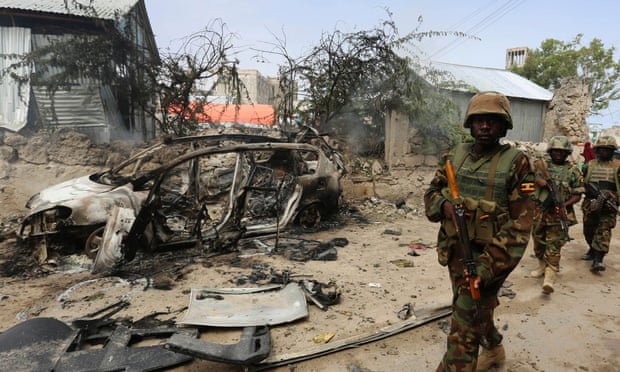
(US bombing of al Shabaab, an al Qaeda offshoot in Somalia)

After 9/11 the United States immediately shifted from crushing al Qaeda and the Taliban in Afghanistan to the invasion of Iraq.  Bacevitch argues that the Bush administration was fixated on Saddam Hussein, and did not accept or ignored the fact that the battle in Afghanistan was far from over.  Afghanistan reverted to the back burner, another “phony war” that the United States ignited, but failed to carry to fruition and let simmer.  Many have pondered why the United States invaded Iraq – was it about oil, weapons of mass destruction, or humanitarianism?  Bacevitch correctly places these reasons aside and concentrates on the American intent on establishing the efficacy of preventive war.  Washington was going to assert the prerogative that no other country had – overthrowing any government the United States found wanting or as it is better known as, the Bush Doctrine.  This premise was based on the fallacious conclusion that the Islamic world could easily adapt to democracy, limited government, a market economy, and respect for human and woman’s rights no matter what their opponents argued.  For the Bush administration Saddam and Iraq fit this paradigm perfectly.  The United States invaded Iraq not because of the danger it posed, but because of the opportunity it presented.  Bacevitch explores in detail all the key aspects of the war from its outset, to the capture of Saddam, the Shi’ite-Sunni civil war, to the “surge,” and again what is clear is American incompetence be it the fault of Bush, Cheney, Rumsfeld, Bremmer, Franks, or others.

Bacevitch’s overall evaluation of the Obama administration’s Middle East policy is harsh, but extremely accurate as the President seemed to continue Bush policies. First, Obama was committed to the withdrawal of American troops by the end of the 2011 deadline that Bush had negotiated with the Iraqi government.  However, as troops returned home from Iraq, many made a “U-turn” and were sent to Afghanistan, or for many who were redeployed once again to Afghanistan!  During the Obama years the “Greater War for the Middle East” was confronted by three important changes that had major implications.  First, after almost 40 years of war, an “Iraqi Syndrome” developed with the reluctance to put American troops in harm’s way.  Second, the turmoil from the Arab Spring.  Lastly, the chasm that developed in American-Israeli relations.  Obama has had a great deal of difficulty navigating these changes.  A surge was tried that accomplished little but increasing American casualties.  Support for aspects of the Arab Spring resulted in little improvement in Egypt and other Arab autocracies.  Problems with Israel became a partisan political football in both countries and an inability of leaders to work with each other.  Further, the Obama administration resorted to decapitation in Libya that has been disastrous.  Finally, the administration dithered over the civil war in Syria and looked foolish when it did little to enforce its own “red line.”  It seems that Obama’s strategy is wrapped up in special operations and drone attacks, not really conducive to improving America’s reputation in the region and the overall Islamic world.

In closing, Bacevitch has written an extremely important book that policy makers should consult very carefully.  Granted, the author has had the benefit of historical hindsight in preparing his arguments.  But one cannot negate the intelligent conclusions he puts forth.  If you would like to gain insight and understanding of the 40 Year War, consult Bacevitch’s narrative because as events in Libya, Syria, and Yemen continue, it does not seem as if this war is going to end in the foreseeable future.  As Bacevitch states in his conclusion; the perpetuation of the “War for the Greater Middle East” is not enhancing American freedom or security.  It is accomplishing the opposite, but hopefully one day the American people will wake up from their slumber regarding its prosecution.  Until that time the wars in the region will not come to an end.

(Statue of Saddam Hussein in Baghdad after US invasion of Iraq in 2003)

HIGH DIVE by Jonathan Lee

The Grand Hotel in Brighton, after a bomb attack by the IRA, 12th October 1984. British Prime Minister Margaret Thatcher and many other politicians were staying at the hotel during the Conservative Party conference, but most were unharmed.

(The Grand Hotel, Brighton, England IRA bombing , October 12, 1984 designed to assassinate British Prime Minister Margaret Thatcher)

HIGH DIVE by Jonathan Lee is an interesting historical novel that develops a number of fascinating characters as it unfolds.  The novel seems to travel on two tracks, the first are the Eriksonian identity crisis’ that evolve as each character is forced to ponder their roles in society, their life’s work, and what the future holds.  The second are the ever present problems that infect the Irish-British relationship that have gone on for centuries.  What makes the novel impactful is that behind the interaction of each character with their environment is the proposed visit of British Prime Minister, Margaret Thatcher to the Grand Hotel, a resort in Brighton, England in 1984, and a possible assassination attempt on her life.  The politics of the era are integrated in an accurate fashion as Thatcher’s Conservative Party record is dissected in terms of its onerous effect on Catholics in Northern Ireland and the poor of England in general.  The setting is historically accurate as Thatcher did visit Brighton in 1984 and there was an IRA assassination attempt on her life.  What Lee tries to do is explore IRA planning involving the real assassin, Patrick J. Magee and the fictitious character, Dan, who is created to be his assistant in planting the bomb with its timing device a few weeks before the visit.

The novel opens with Dan, a handyman-electrician type meeting Dawson McCartland, an IRA operative who tests him whether he is worthy enough for “the cause.”  Once he passes his initiation, Dan’s new life has begun as a freedom fighter for the Republican army against the British and their Protestant allies in Ulster.  The evolution of Dan’s character is extremely important first using the alias of Roy Walsh, and later in the novel as Lee explains Dan’s relationship with his mother and provides insight into what it was like to grow up dealing with the RUC (Royal Ulster Constabulary) raids and beatings at home and on the street.  As the “Thatcher” mission is planned and implemented we witness a person who experiences doubts about his actions and who he is, and has become.  Dan interacts a great deal with Freya Finch, a nineteen year old girl, who has a crush on him, and is trying to break away from her father, but is confused about what path to take.  She is very bright and her father wants her to enroll in the university, but she is uncertain.  Her parents divorced when she was very young and has been raised by her father with whom she has a strong bond.  She spends her summers working at the hotel, but that is not enough for her.    Her father, Peter Finch, whose nickname is “Moose” runs the Grand Hotel after giving up a career in teaching and must deal with his own identity issues.  He grew up as a champion athlete and still practices his high dives in the hotel pool.  His entire life is wrapped up in the everyday details of the resort as he tries to fight off his personal demons that date back to Vivienne, the wife who left him.  A few weeks before Thatcher’s visit he has a heart attack and must reassess his life.  There are many other characters that provide the glue that holds the novel together from surfer John, IRA operatives, and the hotel staff, but it is the three mentioned that form the core of the plot.

Lee has a very distinctive approach in his writing.  He can be humorous, sarcastic, and serious all within the same few sentences of dialogue as he describes the plight of Catholics in Northern Ireland.  For example, “The whole of your life in Belfast was organized around light and dark, visibility and invisibility, silence and sound, information and secrecy, the private rubbing up against the public and making you feel tired.”  Lee repeatedly comments about the politics that infect the “the Irish problem,” as Ireland “at night was a repeated dream,” as well the everyday existence of even famous people, by his reference the birth of Prince Henry, and stating “the baby prince looked tricksy, sardonic, chubby, blotchy, and would hopefully cheer up his sad eyed mum.”  Lee also provides an interesting description and insights into how a large resort is managed and what they prepare for such an important VIP visit.  Further, Lee offers an account of the Conservative party gathering when many self-important people went about trying to impress their peers. In addition, Lee goes inside the planning of the terrorist attack, from its inception and actual implementation.  Once the bomb is placed in the hotel, it seems that the story begins to creep along at a much slower pace as Lee returns to the crisis’ that affect each major character, and at times you feel that the story should speed up and see if the attack will be successful.

British Conservative prime minister Margaret Hilda Thatcher, addressing the Tory Party Conference in Brighton, following the bombing of The Grand Hotel, where many delegates were staying.

(British Prime Minister Margaret Thatcher)

The book is more than a recreation of an IRA terrorist planting a bomb at the Grand Hotel.  It plies the depth of class disappointment that is the core of Irish Catholic hatred of the British government, and particular the policies of the Conservative party and its Irish Protestant allies.  It is more a reflection of the daily humiliation an oppressed people must cope with and its psychological impact.  Dan is a key character who at age 24 learns he will be involved with the assassination plot.  Dan describes his past as the paras killed his father and on a number of occasions barged into his house and beat his mother, or forced him to dance a “jig” as they attacked a local pub.  These events are more than enough to put Dan over the edge and turn him into a terrorist.  Having lived in southeast London while conducting research at the Public Records Office in 1987 I witnessed the hatred of the poor against the Thatcher government as each night in this working class neighborhood, men would pour out their hearts at their local pubs.  It is easy to understand their frustration and why many turn to violence.

HIGH DIVE is a remarkable read as Lee captures the tension that existed in early 1980s Ulster.  He creates sincere characters, and a part from some pacing issues it should be a positive experience for those who put aside the time to engage the story.

The Grand Hotel Brighton, soon after the IRA bombing during the Tory conference.

(The Grand Hotel, October 12, 1984 following the IRA bombing)

SPAIN IN OUR HEARTS: AMERICANS IN THE SPANISH CIVIL WAR, 1936-1939 by Adam Hochschild

(Anarchist workers in the Spanish revolution)

Years ago I saw the film, The Prime of Miss Jean Brodie about a teacher in a Scottish girl’s school who strayed from the school curriculum by praising Adolf Hitler and Benito Mussolini while romanticizing the Spanish Civil War.  The arguments she used in her classroom reappear in Adam Hochschild’s new book SPAIN IN OUR HEARTS: AMERICANS IN THE SPANISH CIVIL WAR, 1936-1939 as the author presents the positions of multiple sides engaged in the fight for Republican Spain.  The title leads one to believe that the books main focus is on the American experience, but in reality Hochschild paints a much wider canvas that includes Spaniards, French, Italian, German, Russian, in addition to American actors.  Hochschild is a prolific author whose work includes KING LEOPOLD’S GHOST, BURY THE CHAINS, and the award winning TO END ALL WARS.  He begins his latest effort in striking style as two naked American volunteers fighting for the Spanish Republic against the fascists emerge from the Ebro River as they flee Francisco Franco’s forces.  Fortunately for them, they run into Herbert Matthews, a New York Times reporter and Ernest Hemingway, who at the time is a free-lance writer for a newspaper syndicate covering the civil war.  The reader is immediately hooked as Hochschild begins to narrate a conflict that many historians describe as the precursor of World War II as Nazi Germany and Fascist Italy allied with Franco’s forces as a testing ground for new weapons and allowing their soldiers to gain significant combat experience.  It became very difficult for the Republican government to gain support outside of Spain.  England and France were in the midst of appeasement after allowing Hitler’s troops to seize the Rhineland.  In the United States, Franklin D. Roosevelt facing reelection refused to provide aid as not to anger isolationist forces who preached neutrality.  This left only Stalin’s Soviet Union as a source of weapons and soldiers which for the Republican government became a “devil’s bargain” with the Russian dictator.

(Fascist dictator Francisco Franco)

Hochschild does a superb job describing all the major aspects of the war.  He details the ideological conflicts that exited in Republican ranks; those who supported the Comintern, better described as the Communist Party of the Soviet Union; anarchists who were to the left of the communists; and the Partido Obrero de Unificacion Marxista, or Spanish communists.  The conflicts between these groups greatly hindered creating a united front against Franco’s forces. Aside from the ideological battle on the left, another existed among the journalists who covered the war.  Among New York Times reporters was William P. Carney who admired Franco and his reports from the front mirrored fascist propaganda.  Herbert Matthews a Times colleague sparred with Carney repeatedly as he refused to give up on the Republican cause.  Another important journalist was Louis Fischer, married to a Russian woman, was in the Stalinist camp, even after witnessing the purges in the Soviet Union.  Literary figures abound in the narrative as we encounter George Orwell, who would be wounded fighting for the British Battalion, in addition to Virginia Cowles, Ernest Hemingway and others.  The actual fighting is covered in detail as Hochschild describes the enormity of the conflict.  The amount of aid and troops poured in by Hitler and Mussolini is staggering and as a portent for the future the author describes the new weaponry that is tested that will be staples for the Nazi Germany and Fascist Italy during World War II.  Franco never could have been victorious without the aid of Germany and Italy.

(Male and female militia fighters who fought against Franco)

The title of the book intimates the role of Americans in the war and here Hochschild does not disappoint.   We meet a number of Americans, married couples and single individuals who played a prominent role in the war and provided new sources of material for the author.  The story that Hochschild narrates from the battle front and operations in the rear and the efforts to end American neutrality come from Charles and Lois Orr, economics instructors in California who as socialists believed that democracy could be attained peacefully, not like in the Soviet Union.  They will arrive in Barcelona in September, 1939 and help describe the disaster that will eventually evolve in that Catalonian city.  Bob and Marion Merriman, had lived in the Soviet Union, and witnessed the disaster of collectivization and would have a major impact on the International Brigade, particularly the Lincoln-Washington Brigade of American soldiers.  The intensity of the fighting is often told through the eyes of Bob Merriman who became one of the commanders of the International Brigade.  One of the most important documents that turned up at least fifty years after the fighting was a diary kept by James Neugass, an American ambulance driver for Dr. Edward Barsky, an American surgeon who seemed to operate twenty-four hours a day.  Neugass’ diary depicts the paucity of medical supplies and physicians that attended to American volunteers.  The diary also describes the International Brigades’ retreat as Franco’s forces split the Republicans in two as they reached the Mediterranean Sea.  Another important aspect of the war that Hochschild presents his description of the fighting in and around Madrid that will end up as a siege of the Spanish capitol.  Hochschild places the reader inside the city and is witness to the horrors that ensued.

(International volunteers for the Republic)

Perhaps the most disturbing part of the book aside from the horrors of war was the role played by Texaco and the blinders that the Roosevelt administration employed in order to not make political waves that could endanger elections.  Texaco was headed by the Norwegian born Torkid Rieber who rose from very little to become the top executive of the oil company.  Rieber was an admirer of Hitler and early on in the fighting switched supplying oil from the Republican government to Franco’s armies.  Further, Rieber allowed Franco to purchase the oil on credit.  This violated American law and if Roosevelt had wanted to he could have almost stopped the fighting by enforcing US statutes. Roosevelt, fearing a catholic backlash in the 1936 election refused to do so.  Not only did Texaco supply the oil for Franco’s victory, they also supplied over 12,000 trucks and Firestone tires that were extremely scarce as well as providing important shipping intelligence to Franco pertaining to oil deliveries to Republican forces.  All told Texaco provided over $200 million worth of oil in over 300 deliveries. (343)  the role of the papacy in the war gains Hochschild’s attention as Spanish priests with the approval of the Pope supported Franco’s war to the hilt.  Many Spanish priests supported the execution of their brethren who did not support Franco in addition to the execution of Republican soldiers.  Further, they were apoplectic when the Republican government implemented land reform and church properties were given to peasants, a major reason for their support of the Spanish dictator.

The civil war itself exhibited the Spanish class struggle and Hochschild delves into the economic and moral implications of Spanish land policies.  One of the most important points the author puts forth is that “while much [the civil war] of that feels distant now, other aspects of the 1930s Spain still seem all too similar to many countries today; the great gap between rich and poor, and the struggle between an authoritarian dictatorship and millions of powerless people long denied their fair share of land, education, and so much more.  These things make Spain of the 1930s, a crucial battleground of its time, a resonant for ours as well.” (xix-xx)  Hochschild has written an important book that revisits the Spanish Civil War integrating a number of new sources that previous authors had not uncovered.  For those interested in the topic, you will not find a better read.

(Workers who supported the Republic)

THE OTHER SIDE OF SILENCE by Philip Kerr

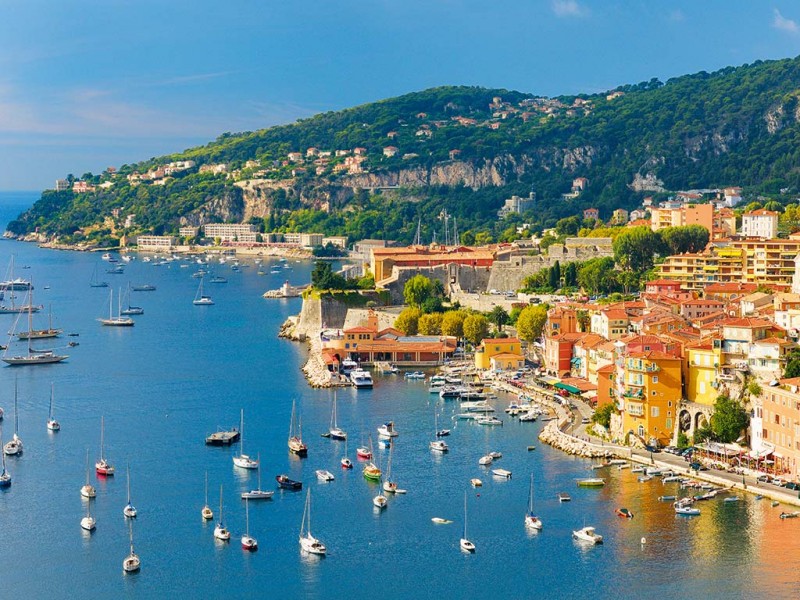
Map of Côte d'Azur

(The site of Philip Kerr’s new novel, the French Reviera)

The Other Side of Silence (Bernie Gunther Series #11)

In the eleventh installment of Philip Kerr’s thoughtful and entertaining Bernie Gunther series, we find our protagonist ensconced on the French Riviera contemplating suicide.  For those familiar with Gunther’s odyssey through World War I, World War II and the post war world you will not be surprised by his behavior.  Gunther is bored with his life and misses Berlin since he exiled himself to France, and became employed as a concierge at the Grand Hotel du Saint-Sean-Cap.  Gunther’s problem is that he misses his life as a detective, but his exile is about to change when a guest named Harold Heinz Hebel checks into the hotel.  The problem is that Hebel is an alias for Harold Hennig, a former Captain in the Nazi SD Security service, and an accomplished murderer.  It is that recognition by Gunther that Kerr’s new novel THE OTHER SIDE OF SILENCE pivots.  From that point on as Kerr develops his plot the reader is exposed to Gunther’s sarcastic humor and comments about a range of historical figures from Leopold II, to Gauguin, to numerous Nazi henchmen and British intelligence figures.

Kerr has created a number of scenarios that he develops with his usual skill as a writer and a practitioner of conspiracies.  They begin when Gunther meets the nephew of the British writer, W. Somerset Maugham who is being blackmailed by none other than Harold Hennig.  Maugham, a known homosexual finds out that Hennig has obtained a picture of him with three British spies who were turned by Soviet intelligence, Anthony Blunt, Guy Burgess, and David MacLean.  The picture is extremely compromising sexually and Maugham, even at eighty two years of age is worried about his reputation in England where homosexuality is illegal, and in the United States which is in the throes of the McCarthy hearings.  He asks Gunther to be his agent with Hennig to make sure the transaction is carried out so he has nothing further to worry about.  To show Maugham what he is dealing with, Gunther describes a situation that occurred in Berlin in 1938 when Gunther, no longer a German police detective, is approached by Captain Achim von Frisch, a man who saved his live in Turkey during the Great War.  Frisch is also being blackmailed, by you guessed it, the same Harold Hennig.  It seems that there is a political and military shakeup going on within the Nazi command structure, and another officer, General Freiheir von Fritsch is being accused of being a homosexual.  Frisch, who previously was blackmailed by Hennig to the point of poverty is privy to important information that would clarify the situation.  However, he is afraid, and wants Gunther to investigate and determine how high up in Hitler’s regime this plot reaches before he comes forward.  In the end Hitler achieved his goals and took over as the head of the Reich’s military by stepping over any body that got in his way.

Kerr goes back and forth between Berlin in 1938, Konigsberg in 1944, and the south of France in 1956.  For Gunther they are all related in some manner and they seem to all involve Harold Hennig.  The events that took place for Gunther go a long way in explaining his sarcastic and cynical view of people and life in general.  Apart from the plot, Kerr’s command of German history is excellent, though he does make a minor error by stating that Frederick III built a hunting lodge in Konigsberg in 1690, when in fact he did not assume the throne until 1888.  However, his description of historical figures like Erich Koch, Erich Mielke, Guy Burgess, and the sinking of the MV Wilhelm Gustloff in early 1945, and the use by the CIA and KGB of former Nazis is right on, as is his integration of the 1956 Suez crisis as historical background.

Throughout the book Kerr is at his deceptive best as the novel reeks of disinformation, misdirection, spies, and counterspies, and of course conspiracies enveloped within other conspiracies.  The intricacies of the plot are based upon Maugham’s actual experiences as a British spy during the late 1930s and World War II as the myriad of scenarios keeps the reader engrossed.  Who is really behind the blackmail?  Is it the Russian KGB, is it remnants of the Third Reich, is Hebel acting alone, or is it something else?  Is the British intelligence community the real target? MI5 or MI6?  Does the United States have a role to play?  How does W. Somerset Maugham fit in?  How about the Cambridge Five that was penetrated by Russian intelligence during and after World War II?  How does Bernie Gunther fit into these complex questions?  Why was Gunther’s bridge partner murdered?  Does that fit into the paradigm?  The answers will keep the reader riveted to THE OTHER SIDE OF SILENCE, and it makes one look forward to Kerr’s next Bernie Gunther novel, PRUSSIAN BLUE.

(The French Rviera, the site of Philip Kerr’s new novel)

THE RIGHT WRONG MAN: JOHN DEMJANJUK AND THE LAST GREAT NAZI WAR CRIMES TRIAL

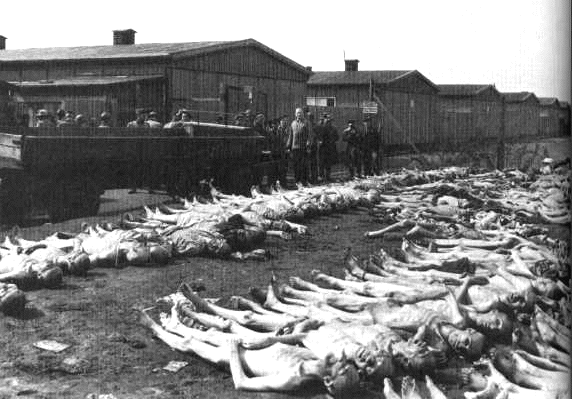
(Sobibor Death Camp)

As Lawrence Douglas, an Amherst College law professor describes in his new book, THE RIGHT WRONG MAN: JOHN DEMJANJUK AND THE LAST GREAT NAZI WAR CRIMES TRIAL, the former Ford Motor employee was “little more than a peon at the bottom of the Nazis exterminatory hierarchy.”  However, what makes him important is the legal odyssey he navigated from 1975 to his death in 2012.  Demjanjuk survived a number of major trials; denaturalization hearings in the United States, prosecution in Israel, and his final legal confrontation in Germany.  Throughout the process Demjanjuk lied, acted, obfuscated, as he tried to avoid conviction.  The end result was finally being found guilty of “crimes against humanity” in 2011, after having previous convictions overturned because of prosecution errors and the failure of memory on the part of Holocaust survivors.

Demjanjuk’s biography is quite amazing.  During the outset of the war Demjanjuk was a soldier in the Red Army.  After being captured by the Germans he volunteered to be a guard at the Sobibor death camp.  Once the war ended, he was able to immigrate to the United States by lying on his application associated with the Truman administrations 1948 Displaced Persons Act.  He settled in Cleveland and became a machinist at a Ford Motor plant, and was able to hide his Holocaust related activities for years, until 1975 when American officials first learned of his possible wartime activities.

(Demjanjuk’s wartime pass placing him in Nazi occupied Poland; discovered in 2002 by the United States)

Douglas provides intricate detail and analysis of Demjanjuk’s legal journey.  He dissects the strategies pursued by defense attorneys, prosecutors, and judges as they try to convict Demjanjuk of being Ivan Grozny, “Ivan the Terrible” for his sadistic acts at Treblinka.  Further, Douglas explores the gaps in the legal systems that tried to bring him to justice and how previous trials, Nuremberg, and Eichmann in particular impacted legal strategies.  The problem that emerges is that Demjanjuk was misidentified and was not Ivan Grozny, but a man who served at Sobibor and contributed to the death of thousands of Jews for which he was finally convicted.  Demjanjuk’s legal battles began in 1975 and continued until later in the decade when he would be identified as the former Treblinka guard, “Ivan the Terrible.”  Demjanjuk was stripped of his citizenship and extradited to Israel.  In 1988 he was convicted and sentenced to death by an Israeli court.  After numerous appeals and the emergence of new evidence, the Israeli Supreme Court ruled that the government had the wrong Ivan.  He was returned to the United States and his citizenship was restored.

Demjanjuk may not have been at Treblinka, but earlier testimony seemed to place him at Sobibor, another Nazi death camp.  In 2001 he lost his US citizenship for a second time and in 2009 he was dispatched to Germany for trial.  On May 12, 2011 he was found guilty by a German court for assisting in the murder of 28,060 Jews.  Before his death sentence could be carried out he died, ending one of the last prosecutions of perpetrators of the Holocaust.  Douglas’ book is an important contribution to the legal issues that have surrounded the prosecution of Nazi war criminals.  Douglas raises many important subjects including; the justice of trying old men for superannuated crimes, the nature of individual responsibility in the orchestration of state-sponsored crimes, the nature and causes, and possible justifications of collaboration in the perpetuation of atrocities, and how three different legal systems went about creating legal alloys to master the challenges posed by the Nazi genocide.

(Demjanjuk stated he was too ill to sit up at his trial in Munich)

Douglas points out that Nazi crimes were so great that retributive justice based on didactic exercises organized around survivor testimony was not enough.  What was needed was to use trials as a means of historical education, present history through the eyes of survivor memory as what done at the Eichmann trial.  However, even this noble ideal was fraught with holes as was seen in the prosecution of Demjanjuk.  What was needed according to Douglas was to develop the role of historians to assist in the preparation and prosecution of Nazi crimes.  One of the major drawbacks in the prosecutorial process was the lack of historical context that only historians could provide.  This gap was overcome in Demjanjuk’s Munich case as historians came into play in every aspect of the case from drafting of the indictment to the core of the court’s judgement.  For the first time a new type of Holocaust trial emerged: the Holocaust as History.

These developments overcame many of the obstacles that were evident in earlier prosecutions. In the United States turf battles between the Justice Department and other agencies, difficulties handling atrocity cases with routine prosecutory tools, the lack of linguistic skills on the part of lawyers, and little or no training in historical research all hindered the development of sound cases against war criminals.  Douglas traces the evolution of new techniques and approaches to these types of cases beginning with the Nuremberg Trials, the Eichmann Trial, and the prosecution of the real Ivan Grozny, Fedor Fedorenko that culminated in the final conviction of Demjanjuk.

(At his trial in Munich, Demjanjuk claimed that file #1627 in the Russian archives would prove his innocence)

Douglas asks the important question as to the benefits to mankind that emerged from the Demjanjuk case.  “First, it yielded a modified theory of culpability, directly ‘connected to the exterminatory process.’  This disposed once and for all of the defense ‘I was no more than a cog in the machine…I was obeying orders.’  A machine cannot run without its small constituent parts.”  As a result it was now enough to prove that a defendant worked in a death factory to obtain a conviction because without the numbers of these types of defendants the Holocaust could not have reached the magnitude that it did.  Further, this allowed for the further prosecution of lower-level war criminals and permitted three separate judicial systems to learn from past errors and instill confidence in this type of judicial process.  (New York Times, February 26, 2016)

Douglas astute dissection of the Demjanjuk case and the application of his analysis to the overall problem of culpability for war crimes is a major contribution to this type of literature.  Though at times it is written in legalese, overall it should be easily understood by the layman resulting a satisfying reading experience.

(October 14, 1943, Sobibor Death Camp following a failed revolt)

THE IMMORTAL IRISHMAN: THE IRISH REVOLUTIONARY WHO BECAME AN AMERICAN HERO by Timothy Egan

(Thomas Francis Meagher during the Civil War)

Biography is an exceptional art form especially when a unique life story is represented.  In the case of Thomas Francis Meagher, author Timothy Egan, a Pulitzer Prize winning reporter for the New York Times has unearthed a somewhat obscure, but remarkable historical figure, who impacted the course of Irish history in a remarkable way.  Meagher, a man who like a cat seemed to have had nine lives left Ireland in 1848 after being arrested and tried for treason by the British government.  He was imprisoned in a remote area of Australia where he escaped in 1852 and landed in New York City where he stood against the anti-immigrant and anti-Catholic Know Nothing Party and later led an Irish brigade against the south during the Civil War.  If that was not enough for one lifetime, he concluded his astonishing career as the territorial governor of Montana.

Egan’s THE IMMORTAL IRISHMAN: THE IRISH REVOLUTIONARY WHO BECAME AN AMERICAN HERO presents a wonderful narrative about a man who seems to be everywhere.  Though Meagher had reached hero status among the Irish people, he seemed to encounter enemies everywhere he turned.  The British saw him as a fugitive, politicians in the United States viewed him as an abolitionist, vigilantes in Montana felt he was a traitor.  Meagher was a man who escaped death repeatedly.  He escaped the English gallows, Tasmanian sharks missed their opportunity as he swam away from Australia, and survived the Battle of Bull Run.  But in 1867 when he was trying to organize a democratic government in the Montana territory, was his fall from a Mississippi steam boat an accident, or did his luck finally run out when he may have been pushed.


“Digging for potatoes” from the London Illustrated News, 1849:

“‘Searching for Potatoes’ is one of the those occupations of those who cannot obtain outdoor relief. It is gleaning in a potato field, and how few are left after the potatoes are dug, must be known to everyone whohas ever seen the field cleared. What the people were digging and hunting for, like dogs after truffles, I could not imagine, till I went into the field, and then I found them patiently turning over the whole ground, in the hopes of finding the few potatoes the owner might not have overlooked. Gleaning ina potato field seems something like shearing hogs, but it is theonly means by which the gleaners could hope to geta meal.”

Egan has created a somewhat literary approach to his subject as he constantly weaves his and other Irish poets and their work throughout his story.  The author tells a tale encompassing the plight of the Irish throughout their enslavement by the British culminating in the Great Famine of the 1840s.  At a time when the potato blight led to the starvation and immigration of millions of Irish poor, the British government exported the Irish crops that could have fed their people overseas for profit.  The lassaiz-faire trade policy was a death knell for the Irish people that even brought certain British officials to admit they were engaged in genocide.  The overt ethnic cleansing of the Irish people led men like Thomas Francis Meagher to stand up against this holocaust and organize a revolt against the London government.  The slow limiting of civil rights through penal laws and the presence of the British navy and soldiers made it impossible for the “Young Ireland” movement for Irish independence to have any chance for success.

Meagher himself did not come from a poor family.  His father was a Member of Parliament, he himself attended Stonyhurst where the “tried to squeeze the Irish out of him,” and grew up in a mansion in Waterford.  Meagher quickly gained a reputation as a debater and his reputation as an orator preceded him everywhere.  Egan reviews the other 19th century historical figures who worked for Irish independence as the potato famine spread.  The author does a wonderful job providing the reader a feel for the disastrous blight that ravaged Ireland and the English government’s complicity in its catastrophic results.  For London, the blight presented an opportunity to populate Canada and Australia which were in dire need of cheap labor, and at the same time solve their Irish problem.  As Egan discusses Meagher’s situation he weaves in the story of the founding and development of Australia, and with the presence of the Irish down under Australia’s independence was eventually achieved!

(Meagher and his wife Libby dubbed this cabin as the governor’s mansion when the Irish hero was became acting governor of the Montana territory after the Civil War)

Once he arrived in New York City, Meagher was greeted as a hero and his popularity presented Egan with the opportunity to develop the history of that city, where one in four people were Irish.  To make a living Meagher went on a series of speaking tours and argued that he did not oppose slavery because it was the law of the land, what he opposed was breaking up the union.  After Fort Sumter and secession, Meagher changed his mind, as he realized that the plight of southern slaves and Irish peasants were one and the same.  Meagher’s irresistible story continues as he went against the majority opinion of his own people to fight against slavery as he helped lead an Irish brigade against the Confederate at Bull Run, that later in the war brought the union general, William Tecumseh Sherman, who hated Meagher, to heap praise on the Irish for their bravery in battle.

In times of peace, Meagher could not maintain his level of popularity and his life went into decline.  During his life Meagher witnessed much too much of the underside of history.  Eventually the price to be paid was a later life where he was plagued by alcoholism, financial issues, and loneliness.  He ended his career as the Secretary of the Montana Territory and tried to bring law and order to a very unruly area.  It was because of this governmental service that Meagher died, not by falling off a riverboat while drunk, but as Egan argues, was captured by Montana vigilantes and thrown off the ship’s deck to his death.  As Egan tells his story we see an imperfect protagonist, but one who never backed away from a fight and never turned away from his core principles.  THE IMMORTAL IRISHMAN is an exceptional work of history, even though at times Egan’s prose can be become somewhat flowery, a need for more specific citations, and a few minor historical errors.  But overall, the work of Timothy Egan is exceptional, as he turns a sound historical work into something that reads like a well thought out novel.

PSYCHOHISTORY READING LIST

PSYCHOHISTORY READING LIST:

Abrahamsen, David.  NIXON VS. NIXON

Beisel, David R. THE SUICIDAL EMBRACE: HITLER, THE ALLIES, AND THE ORIGINS OF THE SECOND WORLD WAR.

Binion, Rudolph.  HITLER AMONG THE GERMANS

Brodie, Fawn M.  THOMAS JEFFERSON

Brodie, Fawn M.  THADDEUS STEVENS

Burlingame, Michael.  THE INNER WORLD OF ABRAHAM LINCOLN

Clinch, Nancy G.  THE KENNEDY NEUROSIS

De Mause, Lloyd.  FOUNDATIONS OF PSYCHOHISTORY

De Mause, Lloyd.  REAGAN’S AMERICA

De Mause, Lloyd; Ebel, Henry.  JIMMY CARTER AND THE AMERICAN FANTASY

Erikson, Erik.  CHILDHOOD

Erikson, Erik.  DIMESNSIONS OF A NEW IDENTITY

Erikson, Erik. LIFE HISTORY AND THE HISTORICAL MOMENT

Erikson, Erik.  GANDHI’S TRUTH

Erikson, Erik.  YOUNG MAN LUTHER

Fromm, Erich.  THE ANATOMY OF HUMAN DESTRUCTIVENESS

Freud, Sigmund; Bullitt, William.  WOODROW THOMAS WILSON

Gonen, Jay.  A PSYCHOHISTORY OF ZIONISM

Hershman, D. Jablow.  POWER BEYOND REASON: THE MENTAL COLLAPSE OF LYNDON JOHNSON

Kovel, Joel.  WHITE RACISM: A PSYCHOHISTORY

Langer, Walter.  THE MIND OF ADOLF HITLER

Levin, Jerome D.  THE CLINTON SYNDROME: THE PRESIDENT AND THE SELF-DESTRUCTIVE NATURE OF SEXUAL ADDICTION

Lifton, Robert J.  REVOLUTIONARY IMMORTALITY

Lifton, Robert J.  HOME FROM THE WAR

Lifton, Robert J. DEATH AS IN LIFE

Lifton, Robert J. THOUGHT REFORM AMD THE PSYCHOLOGY OF TOTALISM

Lowenberg, Peter.  DECODING THE PAST

Marwick, Elizabeth.  CARDINAL RICHELIEU

Mazlish, Bruce.  HENRY KISSINGER

Mazlish, Bruce.  IN SEARCH OF NIXON

Mazlish, Bruce.  THE REVOLUTIONARY ASCETIC

McAdams, Dan P.  GEORGE W. BUSH: AND THE INTERPRETIVE DREAM-A PSYCHOLOGICAL PORTRAIT

Neumayer, Anton.  DICTATORS: IN THE MIRROR OF MEDICINE

Post, Jerrold M.  THJE PSYCHOHISTORICAL ASSESSMENT OF POLITICAL LEADERS (SADDAM HUSSEIN AND BILL CLINTON)

Pye, Lucien.  MAO TSE-TUNG

Rancour-Lafferiere, Saniel.  THE MIND OF STALIN

Renshon, Stanley A.  IN HIS FATHER’S SHADOW: THE TRANSFORMATION OF GEORGE W. BUSH

Rogan, Michael.  FATHERS AND SONS

Steinberg, Blema S. SHAME AND HUMILIATION: PRESIDENTIAL DECISION MAKING AND VIETNAM

Volkan, Vamik D.; Itzkowitz, Norman.  THE IMMORTAL ATATURK: A PSYCHOBIOGRAPHY

Waite, Robert.  HITLER: THE PSYCHOPATHIC GOD

Waite, Robert. KAISER AND FUHRERE: A COMPARATIVE STUDY OF PERSONALITY AND POLITICS

Weinstein, Edwin.  WOODROW WILSON: A MEDICAL AND PSYCHOLOGICAL BIOGRAPHY

Weisberg, Jacob.  THE BUSH TRAGEDY

Wolfenstein, E.  THE REVOLUTIONARY PERSONALITY

Zalampas, Sherre Owens, ADOLF HITLER: A PSYCHOLOGICAL INTERPRETATION OF HIS VIEWS ON ARCHITECTURE ART AND MUSIC

THE GATES OF THE ALAMO by Stephen Harrigan

(The Alamo)

The story of the Alamo is clouded in myths and counter myths.  Your personal belief is probably dependent upon your high school social studies education.  It is a story that most Americans know because of the countless books and films on the subject.  What is clear is that, it forms a major component of Texas history.  In Stephen Harrigan’s THE GATES OF THE ALAMO we are presented with a new approach to the story through the eyes of fictional characters; Edmund McGowan, a loner dedicated to botanical research; Mary Mott, a widowed innkeeper trying to keep what remains of her family together; her son Terrell, who grows and matures into manhood as the novel evolves.  This epic story has been told before, but not in this manner, a blend of astute historical research and fictional imagination that should satisfy all who are interested in the topic.

Harrigan begins by introducing Terrell Mott as a ninety-one year old survivor of the Alamo and former mayor of San Antonio attending the 75th commemoration of the battle.  From here, Harrigan takes the reader on a journey that integrates many historical and fictional characters as he constructs a fairly objective account of the events leading up to the battle, the battle itself, and what transpired after the bloodshed.  The reader is exposed to the Mexican viewpoint through historical characters such as; Colonel Juan Almonte, a member of general Santa Anna’s staff, the dictator himself, Primer Sargento Blas Angel Montoya, a member of the Mexican northern army; to fictional characters, Telesfero Villasena, a Lieutenant in an engineer battalion and Santa Anna’s map maker, and Isabella, a Mayan girl seized by Mexican officers.  Among the American settlers aside from McGowan and the Motts the story is conveyed through historical figures like; Jim Bowie, a drunkard and fortune seeker, Sam Houston, a rather two faced politician and Andrew Jackson wan bee, Stephen F. Austin, the most reasonable of the independence movement leadership, Davey Crockett, a Tennessee politician and Indian fighter, and William Barrett Travis, a young man thrust into leadership beyond his capabilities.

(Sam Houston)

One of the things that most Americans do not realize is that three-fifths of the continental United States was taken from Mexico during the Mexican War between 1846 and 1848.  The issues that led up to the war stem from American colonists who were invited by the Mexican government to settle in Texas in the 1820s.  The invitation was contingent upon settler acceptance of abiding by the catholic faith, obeying Mexican law, and not transporting slaves to the new territory.  By the 1830s the settlers began to chafe under Mexican restrictions setting the backdrop for Harrigan’s novel.

The first half of the book seems as if a storm is brewing.  The storm is Santa Anna’s goal of blunting the Texas independence movement.  As Harrigan proceeds with his story he does a commendable job; developing his characters, particularly the emergence of a strong bond between Mary Mott and Edward McGowan.  In a time period when death is predominant, two lonely people, who have suffered deep personal trauma come together to try and make sense of their surroundings. For Mary, it is the loss of her husband and daughter, and fears about losing her son.  For Edmund, it is the creation of a shell around himself because of childhood events and trying to find solace in a world of plants, a world that fills the emotional void in his life.

(Davey Crockett)

THE GATES OF THE ALAMO is historical fiction at its best.  The historical characters integrated among those created provide a realistic account of events as Harrigan leads the reader to the fall of San Antonio de Bexar and rebel control of the former Spanish mission, the Alamo.  Both the characters and the reader are aware that in a few months’ time Santa Anna will bring a large army to retake it, which dominates the second half of the novel.  The rebels do their best to make the mission an impregnable fort, but as history has shown, they failed.

Harrigan places the reader inside the Alamo as the Mexican bombardment pounds the fort.  His descriptions are extremely realistic and the plight of the Alamo’s residents is clear.  He leaves out few details, even integrating Mexican music that was designed to unsettle those imprisoned inside the Alamo, just waiting for the next cannonball.

One of the most interesting aspects of the novel is Harrigan’s recreation of character dialogue that occurs when decisions are made.  We are inside Santa Anna’s headquarters as he consults with his generals.  The reader is a witness to Travis and Crockett trying to figure a way out of their predicament, but whatever they try, is doomed to failure.

(General Santa Anna)

Harrigan’s novel is a work of fiction, but he must be applauded for the voluminous research undertaken to recreate his subject.  Obviously, there is a great deal that he has imagined, but embedded in the dialogue and narrative is a fairly accurate portrayal of events.  Further, he does a remarkable job discussing the Mexican and rebel viewpoints, and as things unfold he tries to remain as objective as possible.  Most people know how the story concludes in terms of the Alamo, but what they do not know is the fate of the key characters.  For this reason alone, Harrigan has produced an air of suspense that should hold the reader, a bonus, because the historical presentation alone makes Harrigan’s effort extremely worthwhile.

(The Alamo)