A WORLD ON FIRE: BRITAIN’S CRUCIAL ROLE IN THE AMERICAN CIVIL WAR by Amanda Foreman

A WORLD ON FIRE: BRITAIN’S CRUCIAL ROLE IN THE AMERICAN CIVIL WAR by Amanda Foreman is an amazing book.  The breadth of knowledge and research in a narrative that encompasses over 800 pages of text and 100 pages of footnotes is to be praised and warmly received.  There are numerous books written about the Civil War, but few that focus solely on the role the British played in the conflict.  The story treats the diplomacy of the war in depth ranging from the interplay between Secretary of State William Henry Seward to British Foreign Secretary Lord John Russell and British Prime Minister Henry John Temple Palmerston.  Included, are lesser figures in each country’s foreign policy establishment, the most important being Charles Francis Adams, the American Minister in London, and Richard Bickerton Pemell, Lord Lyons, the head of the British legation in Washington.  Apart from the diplomacy of the war the role of propaganda in the United Kingdom is dealt with in detail and the major characters involved who worked assiduously to try and gain British recognition of the new Confederate government on the one hand, and opponents who tried to lower the temperature between the Lincoln administration and Palmerston government.  Other important components of the book are the role of British volunteers in both Union and Confederate militaries, and the forced conscription of British citizens.  Foreman’s sources are enhanced by her use of letters and diaries from Britons who were involved in key battles and discussions during the war and it offers a different flavor that many books on the conflict seem to miss.  Forman’s work is impeccable, however at times it can be a bit drawn out and one gets the feeling that every piece of minutiae involving the British has to be included in the text.

(Union forces shelling the port city of Charleston, SC, in 1863.  Frank Vizetelly illustrator)

The author integrates all major components of the war into her narrative, but what separates her approach is her reliance on the personal stories of men like Francis Dawson, a British volunteer who joined the Confederate navy, and later army who was also present Gettysburg, and the Wilderness campaigns and was wounded during the last month of the war; Frank Vizetelly, an artist and reporter for the Illustrated London News, whose drawings permeate the entire book and was present at almost every important occurrence during the conflict.  Others whose letters and diaries proved to be wonderful source material include; Francis Charles Lawley, the pro-Confederate reporter for the London Times, Dr. Charles Mayo, a British surgeon who traveled to the United States to gain further surgical experience and wound up at Vicksburg and other major battles and whose reports reflect the death and mutilation that resulted from the intensity of the fighting.  Two other soldiers stand out in Foreman’s narrative, Sir Percy Wyndham, an English soldier of fortune who had served with Garibaldi in Italy, joined McClellan’s staff during the Peninsula campaign and later was involved in other major actions; second was Major John Fitzroy De Courcy, a former British magistrate and Crimean War veteran who Seward promoted to Colonel and fought with the 16th Ohio Volunteers.

The driving force behind the books preparation was Foreman’s goal to ascertain why progressive classes in the United Kingdom, journalists, university students, actors, social reformers and clergy felt that the Confederacy had the moral advantage over the Union during the Civil War.  Lord Palmerston summed up British opinion of the United States nicely in an 1857 comment to Lord Clarendon, “The Yankees are most disagreeable Fellows to have to do anything about any American Question….They are on the Spot, strong….totally unscrupulous and dishonest and determined somehow or other to carry their point.” (19)  Foreman’s greatest strength is her descriptive prose that captivates the reader.  She is able to ply historical details and integrate her stories into the narrative at a marvelous rate as each page has portrayed on it another wonderful vignette.  She is able to tell a story that has been told in parts by previous books, but she is able to synthesize her information in creating an immensely readable account that is very fluid and keeps the reader engaged despite the book’s length.

The first few chapters form a review of Anglo-American relations from the conclusion of the War of 1812 through the election of Abraham Lincoln.  Figures as diverse as Charles Dickens, Fanny Trollope, Harriet Beecher Stowe; and numerous politicians such as Charles Sumner and John Bright make their appearance.  Each provides their opinion of Britain or the United States and the tension that existed between the two countries.  What clearly emerges is that most Americans despised the British who they saw as an empire in decline.  From the British perspective, they looked down upon their former countrymen and what seemed to drive British opinion before the war and during its conduct was its hatred of slavery.  British hypocrisy is fully evident since their importation of cotton fueled the profitability of the south’s “peculiar institution.”
(by Frank Vizetelly)

It is clear throughout the book despite certain episodes that Palmerston’s cabinet was united and felt it was imperative for Britain to stay out of the conflict in America once Lincoln was elected.  The Palmerston government had to fight off intense pressure from southern lobbyists and certain British business men and members of Parliament to retain neutrality during the war.  British shipping interests built a number of ships for the south, including the CSS Alabama that in two years “captured or destroyed a total of sixty five U.S. ships, causing more than $5 million worth of losses to the Northern merchant marine trade.” (624)  Throughout the war the British government had to try and prevent blockade runners and ramming ships that were sold to the south from leaving British ports to be turned over to the Confederate navy.  British shipping and Union blockading of the south formed two issues that frustrated all sides and on occasion almost brought England into the conflict or at the very least recognition of the Confederacy.  The Union seizure of two southern diplomats from a British vessel in the Trent Affair was another episode that breeded great distrust between Washington and London.  Once both sides, as in most cases, realized that a working relationship between the Union and the British was much more conducive to the success of their economies accommodations were reached.

Plots abound in Foreman’s presentation.  Smuggling of ships, weapons, food, and supplies from English ports involved numerous characters ranging from the work of James Bulloch, the Chief Confederate secret service agent in England and the architect of Confederate plans to fulfill the needs of the Confederacy to Jacob Thompson, a Colonel in the Confederate army, and the head of clandestine operations in Canada.  Thompson largest operation came in November, 1864 when he wanted to purchase a steamer and convert it into a warship in Guelph, Ontario.  John Yates Beall who conducted terror raids against the north earlier in the war, would captain the ship, renamed the CSS Georgia and would try and sink the USS Michigan and create havoc along Lake Erie against undefended cities from Buffalo to Detroit. The plot failed when Lord Monck, the British Governor-General of Canada had the ship seized and a number of conspirators arrested.  Not to be considered defeated, Thompson when on with another operation this time to set fire to New York City in retaliation for Union army’s torching of buildings in the south.  The operation did set fire to a few hotels and created some panic, but overall it must be categorized as a failure.  Propaganda played a major role in the conflict and the Confederacy supplied millions of dollars to Henry Hotze, sent to London in 1862 and became the editor of the pro-Southern Index to convince the British people and government to recognize and supply the Confederacy.  He was able to befriend William Gladstone, a member of Palmerston’s cabinet and leader of the British opposition to the Tory government as well as the future Prime Minister, who became the Confederate voice for recognition within the British cabinet.  Foreman has a number of detailed descriptions of the spy operations that existed, particularly from the southern point of view.  This material is interesting and entertaining and reflects a different aspect of the war that most do not think about.

(Southern refugees encamped outside Vicksburg, July 1863, by Frank Vizetelly)

Foreman describes all the major battles and their political implications between the states, as well as how they affected British policy toward the war.  Much of this has been told in other monographs, but Foreman’s use of British citizens and their involvement in these battles presents a new and interesting perspective.  Examples include the battlefield and naval illustrations of Frank Vizetelly of Charleston’s harbor channel as Confederates deployed torpedoes, or his illustration of the fall of Fort Fisher as Wilmington fell to union forces, in addition to the many Punch cartoons that are interspersed in the narrative; as well as the opinions offered by William Howard Russell of The Times as he described the southern mindset as one of delusion and naiveté as they dealt with their prospects of victory.  Dr. Charles Mayo’s descriptions of the injuries sustained at Antietam and Gettysburg provide further insights into the concept of total and technological warfare that did not exist before 1861.  On April 2, 1863, Francis Lawley unburdened himself to in a letter to a British MP concerning the bread riots in Richmond.  “The Confederate capital was a microcosm of the many hardships being endured in the south; hunger, and disease were spreading.  Smallpox had invaded the poorer neighborhoods as more refugees arrived…” (424) Lawley further stated after a brief visit to Charleston after the battle of Wilmington, “that the empty streets reminded him of Boccaccio’s description of Florence after the Black Death.” (726)

Federal troops retreating at the first battle of Bull Run, 1861, by Frank Vizetelly)

Foreman delves into the thought processes and analysis of the major characters in the conflict.  She spends a great deal of time trying to explain the actions of Secretary of State Seward as he seemed to alternate between bellicosity and conciliation on a daily basis in dealing with the British.  Less time is spent on Lincoln than in most studies and there is little that is new here, but her portrayal of Jefferson Davis is intriguing as she delves into his personal life and fears as realized by the Spring of 1864 that his policies that were based on achieving British recognition, the pressure from British labor who were suffering because of lost jobs due to a lack of cotton, and the expectation that Robert E. Lee would deliver military victories that would result in independence had all fallen by the wayside.  Foreman has an excellent chapter dealing with Davis’ support for changing northern opinion by raids from Canada that would also provoke a war between the Union and England.  This did not pan out as Palmerston withstood pressure from Parliament to at least mediate the war that would have allowed the south to maintain slavery.  But, it was the slavery issue that the south could never overcome, though Davis, desperate after Sherman had ravaged Savannah and Wilmington was about to collapse on December 27, 1864 sent an emissary to London to offer to abolish slavery in return for recognition of the South.  In reality, the offer was moot once the U.S. House of representatives ratified the 13th Amendment abolishing slavery on all American soil on January 21, 1865.

Foreman brings her narrative to a successful conclusion by providing an update on the lives her main characters following the Civil War.  Further, she goes on to discuss the outstanding issues that remained between the United States and Great Britain.  The negotiations between the two nations were at times contentious but because of the work of Charles Francis Adams and his cohorts settlements were reached.  First, the Treaty of Washington, signed on February 24, 1871  “established two tribunals, one to arbitrate the claims of private individuals against the United States for actions committed during the Civil War, the other to rule on the Alabama claims.” (802)  On September 14, 1872 the tribunal ruled that Britain owed $15.5 million plus interest for the damage caused by Confederate cruisers built and facilitated by the British.   According to Foreman, A WORLD ON FIRE was an attempt “to balance the vast body of work on Anglo-American history in the 1860s with the equally vast material left behind by witnesses and participants in the war—to depict the world as it was seen by Britons in America, Americans in Britain, during a defining moment not just in U.S. history but in the relations between the two countries,” (806)  it is quite obvious that the author has achieved her goal.

LINCOLN IN THE WORLD: THE MAKING OF A STATESMAN AND THE DAWN OF AMERICAN POWER by Kevin Peraino

The opening narrative of Kevin Peraino’s new book, LINCOLN IN THE WORLD: THE MAKING OF A STATESMAN AND THE DAWN OF AMERICAN POWER finds the Lincolns at Ford’s theater with Mary Todd Lincoln resting her hand on her husband’s knee.  The author points out that this type of “tender” behavior was not the norm as Mrs. Lincoln was prone to spells of anger where she exhibited rather obnoxious and nasty behavior toward her husband which at times belittled him verbally for not having the wealth to take her to Europe.  She would, at times, further taunt him that her next husband would have the means to allow her to travel abroad.  In reality, Lincoln wanted to spend time “moving and traveling” overseas once his term in office was complete.  Lincoln had always wanted to visit Britain and fervently believed that the Civil War had tremendous global implications as the “Union effort was to prove to the world that popular government is not an absurdity.”  Lincoln further believed that the United States was a great empire and stood “at once the wonder and admiration of the whole world.”(1-2)

When one contemplates Lincoln’s presidency we usually point to his role in leading the North to victory on the battlefield, not any expertise or having a major impact on foreign affairs.  Peraino challenges that perception by arguing that despite the fact that his diplomatic team was frowned upon at best in European circles, Lincoln himself gave credence to that view by saying to a European diplomat at a state dinner that, “I don’t know anything about diplomacy….I will be very apt to make blunders.”  Lincoln’s State Department was able to avoid “European intervention on behalf of the Confederacy, which well have led to a Southern victory.”(5)  For all that has been written about Lincoln little has been put to paper about his conduct of diplomatic affairs.  Perhaps the best study appeared in 2010 with Howard Jones’ BLUE AND GRAY DIPLOMACY: A HISTORY OF UNION AND CONFEDERATE DIPLOMACY which is n in depth monograph encompassing most aspects of Civil War diplomacy.  Peraino’s study focuses almost exclusively on Lincoln’s role in world affairs and despite some organizational issues and awkward attempts to connect him to a number of world events and people the book is a useful addition to any Lincoln library.

Peraino conveys a great deal of interesting and informative details concerning Lincoln’s diplomatic escapades and sprinkles his narrative with some pointed analysis.  The book is thoroughly researched and posses an impressive bibliography.  Further the endnotes that are provided are exceptional resources for materials and information that are not present in the main narrative.  However, the author’s approach contain a number of drawbacks principally the way the chapters are sectioned.  The chapters are divided by pitting Lincoln against a different subject, be it English Prime Minister Lord Palmerston, Secretary of State William Seward, Karl Marx, Louis Napoleon III, and Lincoln himself.  The book makes no attempt at presenting itself as a comprehensive history of Civil War diplomacy as it focuses totally on Lincoln, but the detailed mini-biographies of each of the president’s “opponents” shifts attention away from the president and the author also has an annoying technique of trying to link each “oppositional” relationship by providing a ‘tease’ in the last paragraph of each chapter.

I agree with Peraino that the Mexican War was a turning point in Lincoln’s maturity as a diplomatic thinker and in a larger sense America’s place in the world.  Nothing in Lincoln’s background prepared him for the “donnybrook” that developed over his war views.  The election of 1844 was a referendum on American expansionism and a foreign policy awakening for Lincoln who would later favor the war effort when he later ran for Congress.  The major changes in technology preceding this period proved to be the” facilitator of American nationalism and continental ambition” that seemed to dominate the political discourse throughout the 1840s.(35)  Lincoln found himself in a quandary as he did not want to upset the sectional balance that existed between the free and slave states, but he could not ignore the war’s popularity.  Upon his election Lincoln joined the congressional opposition to the war.  He believed that the Mexicans had not done anything to provoke war and that President James Polk’s actions were unconstitutional as the power to declare war rested with the legislative branch.  Lincoln introduced his controversial “Spot Resolution” to determine exactly where the incident that launched the war was located, strongly suggesting that the war was caused by an American provocation.  For Lincoln the war resulted in a major problem, the addition of new territory that the south could claim for slavery thus undoing the balance of free and slave states, and the continued heated debate that over slavery that preceded the Civil War.  By the time Lincoln left Congress after one term he had learned a series of lessons.  He realized he needed a more nuanced approach to foreign affairs because territorial expansion would continue thus fostering the need to constantly rebalance the ratio of free and slave states.  Further, Lincoln believed that Polk had overstepped the bounds of executive authority in going to war.  It would take the Civil War for Lincoln to realize that in extraordinary circumstances the president must employ a strong hand.

When Lincoln assumed office European foreign ministers held a very low opinion of the new American president.  In fact the Russian envoy to the United States, Eduard de Stoeckl’s view of Lincoln was quite representative of his colleagues when he said, “Mr. Lincoln does not seem to posses the talent and energy that his party attributed to him when it named him its candidate for the presidency….Even his supporters admit that he is a man of unimpeachable integrity but of a poor capacity.”(103)  Opinions of Lincoln did not change his approach to foreign affairs as he was immediately faced with the issue of foreign intervention or recognition once the Confederacy was launched. The southern cotton trade was a delicate issue since Britain was so dependent on southern cotton for its mills.  Lincoln chose to blockade the southern coast and do nothing to aggravate any European power as a means of promoting their neutrality.

(Lincoln’s Secretary of State, William Henry Seward)

Lincoln’s Secretary of State William Seward agreed with this policy though Lincoln tended to have to reign in his remarks at times.  Peraino’s depiction of the Lincoln-Seward relationship does not really add anything new to the history of the period.  When Lincoln assumed office he needed Seward for the State Department as he viewed the office as critical for his cabinet to have legitimacy.  At the outset Seward believed that he should have been elected president and he was superior to Lincoln in experience and that he would make policy through the president.  With so many issues to confront almost immediately, i.e., instituting a blockade of the south, pursuing neutrality with Spain over Santo Domingo, reigning in abolitionists in order not to cause the border states to secede, the president and Secretary of State’s views began to converge and in a relatively short period of time Seward grew to respect Lincoln, and Lincoln’s trust in Seward increased markedly.

Perhaps the most interesting chapter in the book involves Lincoln’s relationship with Lord Palmerston.  Lincoln believed that swift military success would block any British attempt at interference in American affairs.  However, this was not to be and Lincoln’s fallback position was to develop a strong navy and institute a firm blockade to send a message to the British Prime Minister.  Peraino provides a brief biography of Palmerston and elaborates on his low opinion of Americans and Lincoln in particular.  The situation was exacerbated when an American ship stopped the HMS Trent in Caribbean waters and seized two Confederate diplomats, John Slidell and James Mason.  Lincoln’s approach was to calm the situation by drawing it out and letting the British let off steam.  This episode is presented in detail and both sides came to the realization that a war between the two would prove disasterous to both nations.  Lincoln had decided to release the two men, but took his time to prepare those in the United States who wanted to stand up to the British no matter the consequences.  Peraino’s analysis is dead on in quoting Oxford scholar, Jay Sexton in that “the creditor-debtor relationship of Britain and the United States bonded the two nations together and gave them the common interest of avoiding war.  Succumbing to momentary passions or old grudges would prove counterproductive.”(127)

(British Prime Minister Lord Palmerston)

Peraino correctly credits Lincoln with a number of innovations that contributed to the Union victory.  With the North facing bleak finances by the second year of the war and with European banks refusing to grant credit, Lincoln and his cabinet decided to issue a national paper currency, that Congress eventually approved by passing the Legal tender Act.  Further a national income tax was implemented easing monetary issues as well as the creation of a new National Bank in 1863.  “These sweeping modernizations of the nation’s financial system were critical prerequisites to America’s rise to world power.”(163)  The other major innovation was the building of the Monitor, the first iron clad naval vessel that the United States launched causing “the London Times [to worry] that the innovation had made Britain’s fleet of 149 ‘first class warships’ obsolete.”(165)

The chapter dealing with Karl Marx is really a stretch since the two never interacted directly.  Lincoln may have read some of Marx’s articles in the New York Herald Tribune for whom he wrote opinion pieces but it was not necessary to bring in a mini-Marx biography and integrate his views on slavery and revolution into the narrative.  At the outset of the war Lincoln was concerned with keeping border states neutral.  This concern also helped formulate his views on free labor and American commerce.  Comparing Marx’s views to Lincoln does not enhance the narrative nor do events that lead up to the Emancipation Proclamation.  Marx had no influence on Lincoln’s decision making leading up to the issuing of the document.  The “pseudo” Union success at Antietam as a vehicle to exhibit Northern military prowess for Britain to keep her neutral was much more important.  Lincoln came to view the Emancipation Proclamation as a vehicle to gain the support of British workers who believed that they worked for slave wages.  Lincoln went so far as sending funds to help organize British worker rallies in support of the northern cause.  Any fears that the proclamation might provoke intervention were really offset by events in Europe as Prussia invaded the duchies of Schleswig and Holstein,  Austria and Italy were in the midst of a major conflict, and Polish revolutionaries were active with the support of the French against Russian rule, but this does not stop Peraino from insisting that the proclamation led Louis Napoleon III to intervene in Mexico in 1863.  Linking the proclamation and the French Emperor’s actions is another connection that does not measure up to sound historical analysis.

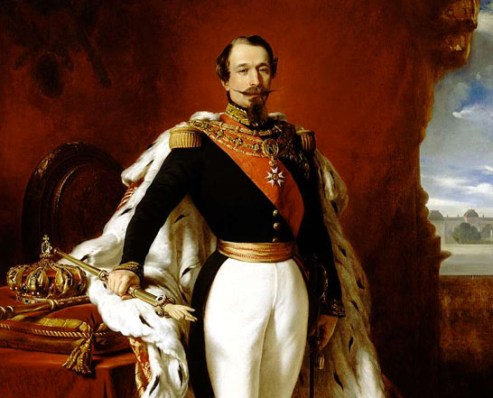
(French Emperor, Louis Napoleon III)

Peraino’s chapter that deals with Louis Napoleon III’s unfortunate attempt to revisit French holdings in the new world by placing Austrian Arch Duke Maximlian on a Mexican throne has little if any relationship to Lincoln’s issuance of the Emancipation Proclamation.  The author’s discussion of Louis’s ego and delusions concerning French power is spot on though there is an over reliance on Jasper Ridley’s dual biography of Louis and his wife, Eugenie in cataloguing his life before he seized power.*  Louis never believed that the North could force the South to return to the federal union so he decided to take advantage of the Mexican debt situation to rekindle his long held goal of reestablishing French colonies in the new world.  What is most interesting is that Louis’ actions fostered a movement to bring the Confederacy back into the fold through a joint expedition to evict the French from Mexico.  This actually led to a meeting between Lincoln, Seward, and Alexander Stephens, the Confederate Vice President on February 2, 1865 that came to naught.  These types of details make Peraino’s narrative exciting, but overall his linkage to Lincoln’s emancipation announcement on January 1, 1863 does little to foster historical accuracy.  The key for Lincoln and the Union was success on the battlefield, which Sherman’s March through Georgia provided, leading to Lincoln’s reelection which forced Louis’ to reduce his support for his Mexican venture.  In fact, by this time Louis had almost totally abandoned Maximilian as he began to withdraw French troops, and ultimately the Austrian Arch Duke was captured and shot by Mexican forces.

(Lincoln and his secretary and confidante, John Hay)

Peraino’s final chapter is a misnomer, Lincoln v. Lincoln is a summary of Lincoln’s legacy through the post Civil War career of John Hay.  The chapter examines John Hay’s career in some detail and concludes with Hay’s belief that the roots of American power lay in a healthy economy and a brisk trade,” an idea that was consistently held by Henry Clay, Abraham Lincoln, and of course William McKinley’s Secretary of State.  My one suggestion for Mr. Peraino would be to consult the latest biography of Hay written by John Taliaferro, ALL THE GREAT PRIZES: THE LIFE OF JOHN HAY FROM LINCOLN T0 ROOSEVELT  for the latest analysis  concerning Hay’s growth as a diplomat and foreign policy thinker.

Lincoln’s handling of the Mexican fiasco reflects his command of the diplomatic game.  Peraino’s analysis is accurate as he points out that there was a natural tension in “Lincolnian foreign policy.  On the one hand, Lincoln’s moral vision represented American idealism” as he realized that slavery diminished American prestige abroad.  But at the same time he instituted a patient and cautious approach, a middle ground in his pursuit of diplomatic advantages.  Lincoln was a diplomat who knew when to threaten and then soften his pronouncements.  He knew when to be magnanimous, but at the same time putting his foot down and letting his opponent know what he would not continence as in his dealing with Louis Napoleon III.  Lincoln was the consummate balancer, effectively controlling domestic interference in the conduct of his foreign policy by members of his own party and the copperheads who sought to make peace with the south enabling them to maintain slavery.  Lincoln did an excellent job taking the measure of and preparing the American public for changes that were about to take place in administration actions, i.e., dealing with Palmerston over the Trent Affair or dealing with the French incursion into Mexico.  Lincoln should be a role model for future presidents to study how to deal with domestic and foreign policy crises and to Peraino’s credit he provides a narrative that would allow our politicians to study and learn from.

*Peraino also relies heavily on Jasper Ridley’s LORD PALMERSTON for background on the English Prime Minister.

ON HIS OWN TERMS: A LIFE OF NELSON ROCKEFELLER by Richard Norton Smith

Original caption: 9/16/1976– Binghamton, NY- Vice President Nelson Rockefeller gives a crowd of young hecklers an upraised middle finger gesture at the Broome County Airport during a brief stop here Sept. 16, while on a campaign trip with Vice Presidential candidate Bob Dole (L, Background, out of focus)

Today the term “Rockefeller Republican” is still considered a negative characterization to most members of the Republican Party.  The term stands for moderate republicanism that calls for fiscal prudence, but also a social conscience.  In the current political environment when a large number of Republicans are calling for the disassembling of major components of the federal government and are trying to limit people’s voting rights the ideas of Nelson Rockefeller fall on deaf ears.  For the former four time governor of New York bipartisanship and an all inclusive party were a major part of his political agenda for most of his time in office.  As most of the Rockefeller platform is unacceptable today, it suffered a similar fate in 1964 as Barry Goldwater became the Republican standard bearer against Lyndon Johnson.  Many would argue that the hatred for “Rockefeller Republicanism” by Goldwater voters was the precursor of today’s Tea Party.  If so a number of important questions must be asked.  First, how did Rockefeller’s brand of moderate Republicanism come to the fore? Second, why was it so successful in New York and rejected nationwide? Lastly, why did it provoke such an extreme reaction in 1964 that continues to this day?  In his new book, IN HIS OWN TERMS, a major new biography of Nelson Rockefeller, Richard North Smith attempts to answer these and other questions as he explores a career that included the governorship of New York, the Vice Presidency, coordinator of Inter-American affairs under Franklin Roosevelt, and one of the most generous and widely renown philanthropists of his era.

(New York Governor Nelson Rockefeller trying to address the 1964 Republican National Convention)

The portrait that Smith presents is a complex one.  Rockefeller comes across as an ideological follower of Franklin D. Roosevelt’s New Deal for a major part of his political career.   Later he would adopt a more conservative political agenda as he continued to seek the presidency on at least three separate occasions.  He comes across as a generous individual who uses his wealth to reward and assist others, but at the same time he could be a stubborn vindictive person who set out to get even with those who disagreed with him.  Domestically, Rockefeller pursued a liberal agenda, but in foreign policy he was a cold warrior, fearful of the communist threat he supported the Vietnam War for most of his political career.  On a personal level Smith describes a man who could be a caring father, but at the same time he appears as a serial philanderer.  His first marriage failed after thirty years, and after remarrying, he seemed to dote on the children of his second marriage angering those of his first.  The author explores in detail these aspects of the Rockefeller persona and career, and has written an almost encyclopedic biography of one of the most interesting political figures of the twentieth century.

Smith describes his thirteen year odyssey in writing this biography.  Its coverage is impressive as he conducted numerous interviews and thoroughly mined the attendant secondary and primary sources.  The result is extensive coverage of his subject that brings the reader into the Rockefeller family dating back to its founder John D. Rockefeller.  We witness the wealth that was available to Nelson Rockefeller and how he employed it to satisfy his almost obsessive need to acquire art, design and build numerous residences and public buildings, caring for his many associates and friends when they were in need, and of course, procure his own election as governor on four separate occasions.  Rockefeller was a “serial” believer in forming committees and/or commissions made up of the leading experts on whatever topic was of interest to him.  Each role he was tasked, be it, as coordinator for Latin American affairs under FDR, an emissary for Richard Nixon to Latin America, a study to ascertain the best way to rebuild Albany, NY, develop a way to improve the welfare system in New York as well as well as nationally, along with numerous others, Rockefeller in most cases funded these activities with his own money and many of the solutions that emerged, i.e., revenue sharing and enhancing John F. Kennedy’s Alliance for Progress were adopted by different presidential administrations.

In a book of this length there are many themes and storylines.  One that seems to dominate is the evolution of Nelson Rockefeller from a liberal approach to social policy, whereby he was willing to push through increases in taxes, fees and other sources of revenue to implement them.  Rockefeller supported a myriad of social programs from improvements in Medicaid, purification of water resources, women’s rights, the first state minimum wage law, to the implementation of civil rights legislation.  Rockefeller’s approach to executive leadership and legislative tactics are reviewed as well as his philosophy of government.  What emerges is the type of governor that New York hadn’t seen since FDR.  With the message of taking responsibility for developing problems for the future, he would tackle issues in the present so they would not become problems down the road.  The issue was his overly ambitious approach to executive leadership always risked alienating conservatives west of the Hudson River.  With a strategy that would evolve from a “pay as you go” philosophy that would bring revenues into line with expenditures, “thereby eliminating costly borrowing and setting the stage for renewed economic growth,” Rockefeller evolved into to a governor who blew up the state budget to meet the needs of his massive infrastructure and building expenses in addition to the budget shortfalls of New York City by borrowing and floating different bond proposals.  By the time Rockefeller reached the end of his third term in office and was elected to his fourth term he became increasingly fiscally conservative as he faced opposition from the state legislature and probably realized that the political current of the late sixties and early seventies would not help any presidential ambitions he might have if he did not change.  Another major storyline that dominated Rockefeller his entire life that permeates the book was his life long battle with dyslexia.  The governor was not aware that he suffered from this affliction, but whether he was attending the Lincoln School in New York, Dartmouth College, or just trying to keep up with the massive amount of reading that a state executive engaged in it was always a battle.  With his wealth as a cushion, Rockefeller was able to employ numerous individuals to assist in this process whether in preparation of legislation or developing auditory strategies to overcome his reading difficulties.

There are a number of fascinating aspects to Smith’s approach to his subject as he prepared  expansive footnotes at the bottom of each page providing the reader with ancillary information that was not available in the text.  Rockefeller’s private opinions of the likes of John Lindsay and Richard Nixon emerge in a very “colorful” fashion which made the mining of these footnotes quite entertaining.  Smith’s discussion of deeply personal issues is not blanched over.  The breakup of Rockefeller’s marriage to Mary Todhunter Clark (Tod) was detailed and very fair as was the coverage of his remarriage to Margaretta “Happy” Murphy.  The loss of his son Michael during an expedition to collect primitive art in a remote part of New Guinea shows a father who has to deal emotionally with a loss of a son.  The relationship of the Rockefeller brothers and their children receives a great deal of attention and produces many interesting insights into the dynamic of such a public family.  Importantly, Smith does not mince words or coverage in dealing with Rockefeller’s numerous extracurricular activities with numerous women throughout his marriages.  In fact we witness a scandal at the site of Rockefeller’s death as to how his body was treated by those who were with him and the medical papers that were prepared to spare the family any embarrassment.

Aside from the personal aspects of the Rockefeller story, Smith devotes a great deal of effort in explaining what drove Rockefeller.  He was an avid and meticulous collector of modern and primitive art and he set as a goal the creation of a museum to house modern art that he would proudly help establish with the creation of the Museum of Modern Art (MoMA).  The second area that fascinated Rockefeller was politics and how it could be used to help people and better his country, a career path that would dominate his life for over forty years.  The fact that Rockefeller realized that as a scion of wealth he did not have to worry about “ordinary things,” therefore he was motivated to pursue the extraordinary.  Rockefeller’s battles to create MoMA were his trial by fire, a learning course in the art of political infighting.  This would also be the case in the creative process and building of Rockefeller Center as he would take lessons  learned from these confrontations and apply them in the future in his fights with the legislature, opponents such as New York Mayors John Lindsay and Robert Wagner, as well as national political battles.  In dealing with transit and garbage strikes, prison issues including the riots and death at Attica, infrastructure and other building projects, Rockefeller’s learning curve was applied to many crises.

Rockefeller’s other area of interest was foreign policy, and Latin America in particular.  His approach to western hemispheric issues was ahead of his time.  It began as a strategy to block Nazi Germany’s inroads in Mexico and South America.  He agreed with FDR that hemispheric solidarity was the key to changing the perception that the United States was seen as a colonizer in the region.  In 1942 Rockefeller unveiled his “Basic Economy Program” that called for improvement in the region’s public health problems.  Rockefeller arranged training for hundreds of professional nurses to assist in creating medical clinics in outlying areas.  Further,  he worked to export penicillin to offset disease in the region.  “In four years, Rockefeller agents trained more than ten thousand in-service workers, nurses, doctors, midwives, sanitary engineers, and home demonstration agents.”(164)  Rockefeller engaged in a fierce bureaucratic battle with “Wild” Bill Donavan, the head of the Office of Strategic Services at the end of the war over policy toward Latin America.  After the war facing the fight against communism, Rockefeller was a proponent of foreign aid to the region, but his approach was geared to offset the sensibilities of the countries receiving it to avoid the charactiture of “Yankee Imperialism” that OSS policy seemed to engender.  Rockefeller’s sensitivity toward third world countries should not take away from his fervent anticommunism, particularly in dealing with Vietnam where he was a strong supporter of Lyndon Johnson and was able to develop a close working relationship with the president.

Smith does yeoman’s work in describing Rockefeller’s campaigns for governor and president.  In both areas Rockefeller’s wealth and ability to obtain the necessary support for his candidacies was ever present.  The elective success he experienced in New York could not be replicated on the national stage as the Republican Party shifted to the right throughout the nineteen sixties.  His battle against Goldwater in 1964 made him an enemy to conservative republicans and his indecision in 1968 cost him any hope of wresting the republican nomination away from Richard Nixon, which also destroyed any candidacy for 1972.  His hopes improved after he was chosen vice-president by Gerald Ford following the resignation of Richard Nixon, but any hope of influencing the Ford presidency was offset by major disagreements with Ford’s Chief of Staff, Donald Rumsfeld who would block Rockefeller at every turn over policy and political decisions.  Any hope of higher office was dashed in 1976 as Rockefeller’s support for civil rights and the Voting Rights Act made him a political liability with conservative republicans in the south and resulted in the candidacy of Robert Dole for Vice-President on the 1976 Republican presidential ticket.

Overall, Nelson Rockefeller enjoyed an amazing life.  Art connoisseur, benefactor to countless individuals, a mostly progressive governor, and an influential and sometimes polarizing national figure for decades.  Richard Norton Smith gives attention to all these aspects of Rockefeller’s life and has written an in depth and informative biography that I am certain will be the definitive work on an illustrious career for many years to come.

BLACK OUT by John Lawton

(British Prime Minister Winston Churchill surveying damage to London caused by Nazi bombers on September 10, 1940)

I have been a fan of Alan Furst for years.  His evocative approach to espionage and his character development made his World War II noirs exciting and hard to put down.  Now, I have discovered another master of that genre, John Lawton.  The first book in Lawton’s Frederick Troy series entitled BLACK OUT features the intrepid Frederick Troy and his cohorts in Scotland Yard and an amazing array of individuals, who live in London in February, 1944, and a number of them who will also turn up in Berlin during the 1948 airlift  The mystery opens with a dog digging around in the trash and seizing an object, then runs with it in its mouth and drops it in front of a boy, the object is a human arm.  The night before this incident an American soldier gets his throat cut at Trafalgar Square.  Once an investigation begins Detective Sergeant Troy starts to connect a murder that took place a year earlier to the “arm” victim and the American soldier.  Troy is friends with another “copper” from Scotland Yard, George Bonham who lives in a house that rents apartments, and a Peter Wolinski, who worked at the George V dockyard, has turned up missing for unknown reasons.  Wolinski supposedly had taught college in Germany until Hitler forced him to leave and was a close friend of Bonham.  Once the investigation commences we begin to meet a series of interesting characters that include Ladislaw Kolankiewicz, who since 1934 had been the senior pathologist in Herndon.  Cooperating with Kolankiewicz, Troy pieces together the possibility that the two deaths and another missing person are all linked.  Troy, whose uncle Nikolai Rodyonavich worked with a team of scientists at the Imperial College in the Applied Physics Department provides a photograph to augment Troy’s suspicions.  When a socialite, Diane Ormond-Brack is seen leaving Wolinski’s apartment with a copy of the same photograph that Nikolai had shown Troy, suspicions are further aroused.  What Troy gathers is that these individuals may have been developing “lightweight alloys, tough, non-corrodable, and thin.  And they were also on to what that is-on to chemical propulsion,” rockets.(88)  When Troy visits N.A.G. Pym at MI5, and a Colonel Zelig at American headquarters in London to obtain answers he is stonewalled by both and gets nowhere, reaffirming his suspicions that all three incidents are linked to rocket development by the Germans.  In laying out the plot Lawton has drawn the reader into his web of British accents and language, espionage, and a case that is definitely beyond Inspector Troy’s pay grade.

Frederick Troy is a wonderful character to build a World War II and post war noir around.  His family emigrated from Russia after Stalin took control.  Troy’s older brother is an RAF pilot and in 1936 Troy was a raw recruit from the countryside who was taken in my George Bonham and his wife and shown the ropes concerning survival in London and pursuing police work in a city that had been ravaged by the Luftwaffe for five years.  What Troy strongly suspects is that after a fourth murder that an American Major Jimmy Wayne, an Office of Strategic Services (OSS-precursor to the CIA) agent is involved with all of them.  His investigation seems reflect Wayne’s guilt,  but evidence is circumstantial.  Troy is joined by his protégé Jack Wildeve, and his commander at Scotland Yard, Stan Onions in seeking the truth.  Two women are also present to confuse and cajole Troy.  First, we revisit Diane Ormond-Brack,  a girl friend of Major Wayne who later will become Troy’s lover.  Second, is M/SGT Larissa Tosca, seemingly Colonel Zelig’s secretary, but even while she is bedding Troy has an interesting shadow life that he is unaware of.  The novel places the reader in the heart of London right before D Day, June 6, 1944.  Characters have to deal with shortages of food and other staples.  In addition, we witness the underground community that lives beneath London subways to escape years of bombing, and English resentment of American soldiers who seem to have taken over their country and especially their women.  At this time the United States and the Soviet Union, realizing that the end of Nazi Germany will soon be at hand engage in a race to bring out of Germany as many scientists and intelligence assets that they can.*  The story changes focus once the war ends and shifts to post war Berlin which is enduring the 1948 air lift.

The novel is exceptionally written and Lawton’s integration of events is very helpful for the reader in developing historical context.  Throughout the narrative the author merges his own opinion of certain historical figures that are not only humorous at times, but very accurate.  For example, Lawton references General Dwight D. Eisenhower as Troy has grown increasingly frustrated when OSS Colonel Zelig claims that the D Day commander that a meeting with Major Wayne was an alibi to block Troy’s suspicions. Describing Zelig and Eisenhower, Lawton writes, “The rain was beginning to soak through his overcoat.  He went quickly back to the car.  Was it worth a try?  One bald-headed American was probably much the same as any other bald-headed American.  The only difference lay in the amount of scrambled egg on the cap.  Though, being fair, Troy felt Ike had better table manners.”(106)  Along with numerous astute observations, Lawton regales the reader by placing certain literary figures throughout the narrative as an intellectual tease.  The relationship between the OSS and MI5 is explored in detail and British distrust for that “pernicious organization” is readily apparent.  For the Americans they had had it with British, “procedure and protocol.”  Lawton also introduces Soviet espionage in the last part of the novel that reorients both Troy and the reader.

Troy  finds himself in the middle of turf battles of allied intelligence agencies throughout the book.  His investigation is blocked by both agencies and his fight to solve, what he thinks are four murders in the shadowy background of D Day and after is fascinating.  The author’s conclusion tying pre and post war espionage is calculating and keeps the reader guessing.  Lawton first installment of Detective Troy is a great read and I look forward to engaging the entire series.

  • See “The Nazis Next Door,” by Eric Lichtblau reviewed by Deborah Lipstadt,  New York Times  October 31, 2014.

THE COLLAPSE: THE ACCIDENTAL OPENING OF THE BERLIN WALL by Mary Elise Sarotte

(The day after the Berlin Wall was opened the German people celebrate on the section of the Wall that abuts the Brandenburg Gate, November 10, 1989)

In German history it seems that November 9th commemorates many important twentieth century dates.  In 1918, following the defeat of Germany in World War I, Kaiser Wilhelm II abdicated the Hohenzollern throne.  In 1923, Adolf Hitler launched his failed Beer Hall Putsch in trying to seize power in Munich.  In 1938, the Nazis unleashed Kristallnacht (the Night of the Broken Glass) against the Jews of Germany.  Finally, November 9, 1989, the Berlin Wall came down which is the topic of Mary Elise Sarotte’s informative and interesting new monograph, THE COLLAPSE: THE ACCIDENTAL OPENING OF THE BERLIN WALL.  Sarotte’s thesis is evident in the title of her book.  She argues in a clear and evocative manner that the opening of the Berlin Wall was not planned and it came as a dramatic surprise when “a series of accidents, some of them mistakes so minor that they might otherwise have been trivialities, threw off sparks into the supercharged atmosphere of the autumn of 1989 and ignited a dramatic sequence of events that culminated in the unintended opening of the Berlin Wall.”  The purpose of the book according to its author was to examine not only the sparks, but the friction in East Germany that produced them in the first place; the rise of a revolutionary but nonviolent civil resistance movement; and the collapse of the ruling regime.”(xx)  Sarotte argues further that the wall did not come down on November 9th because of the actions of the superpowers, and the figures that brought down the wall were not internationally known.  The book is an important contribution to the literature on the subject because on the night of November 9, 1989, a peaceful civil resistance movement overcame a dictatorial regime.  “It is all too seldom that such a peaceful process happens at all, let alone leaves a magnificent collection of evidence and witnesses scattered broadly behind itself for all to see.”(xxv)

Sarotte has written a carefully constructed narrative as she tries to ascertain why the Berlin Wall came down when it did.  The book is cogently written, well thought out, and impeccably researched.  The reader is drawn into the reasons behind events leading up to November 9 and almost half the narrative is spent explaining what led up to the opening of the wall that evening.  The first half of the book describes the gradual growth of opposition in the German Democratic Republic (East Germany, GDR) regime under Erich Honecker and his replacement, Egon Krenz.  Sarotte lays out her argument carefully as the civil opposition movement gains the confidence and support it needed in order to confront the regime.  The reader is witness to the growing opposition that relied on churches in Leipzig and East Berlin to host prayer meetings that throughout the summer of 1989 continuously grew in attendance that in the weeks leading up to November 9 saw crowds of upwards of 500,000 people leave the churches and take to the streets.  These demonstrations were a key as dissidents adopted a peaceful approach in matching government repression and violence.  Sarotte effectively explores the leadership on both sides, analyzing their strategies and actions to determine why events evolved as they did.

(President Reagan tells Soviet Premier Gorbachev to “tear down this wall,” on June 12, 1987 in a speech in Berlin by the Brandenburg Gate)

The three most important elements leading up to November 9 appear to be the dissident and church leadership during prayer meetings; the strategy, or lack of thereof by officials of the GDR government in trying to defuse the opposition by issuing looser travel restrictions into the Federal Republic of Germany (West Germany, FRG); and decisions made during the course of November 9 that led to the unexpected opening of the Berlin Wall.  The most important characters in this process were a pair of dissident filmmakers and their contacts in West Berlin, church leaders in Leipzig and East Berlin, the intransigent attitudes of Honecker and Krenz, and the draft of a new travel law by Gerhard Lauter, head of the GDR Interior Ministry that led to the uncertainties that resulted in the opening of the wall.  We must be kept in mind is that none of this could have taken place without the actions, or inaction by Soviet Premier Mikhail Gorbachev.  The Russian economy was in dire condition and Gorbachev made the decision that the Soviet Union could no longer afford to keep 380,000 troops in the GDR.  What is fascinating as Sarotte points out is that throughout the period leading up to and including November 9, the Soviet Embassy remained ignorant of what Lauter and his colleagues had drawn up.  Moscow thought that a “hole variant,” allowing one exit gate with severe restrictions was the policy that they approved of.  But in reality, that policy was obsolete and was replaced by a much more liberal plan.

The most interesting and surprising aspect of the book is Sarotte’s presentation dealing with the GDR Politburo meeting when Krenz announces the new travel plan and there is no opposition to it.  Following the meeting, Gunter Schabowski, a member of the GDR Politburo holds a live broadcast news conference in which he announces that “private trips to foreign countries may, without presenting justifications—reasons for trips connections to relatives—be applied for.  Approvals will be distributed in a short time frame.”(117)  This included emigration and short trips and when pressed on when this would take effect, Schabowski replied, “right away.”  What is incredible about the press conference that ended around 7:00 pm on November 9th is that Schabowski never read the new travel law before he made his presentation.  This lack of communication is a dominant theme throughout the book and as evening took over on November 9, border guards and other officials were taken aback as they had no clarification as to what to do when thousands of people approached different parts of the wall.  GDR officials tried to contact their counterparts in Moscow, but the Soviet Union was just completing a holiday and no one in authority was available.

Sarotte concludes her book with the reactions in Moscow, London, Washington, and Bonn to events and she is very clear that western officials and intelligence officers were taken completely by surprise.  Sarotte brings her monograph to a close with an epilogue in which she examines the reunification of Germany as a year after the wall fell five new states that were carved out of the GDR were able to join West Germany on October 3, 1990.  Sarotte points out that West German Chancellor Helmut Kohl had moved quickly for fear of a Soviet change of heart based on hard line opposition to the reform policies of Mikhail Gorbachev.  Sarotte goes on to update the reader on the lives of the major participants in the drama she described, one of which was Vladimir Putin who was a KGB officer stationed in Dresden at the time, who returned to Russia full of regret of how the Soviet Union had lost its position in Europe.  This would lead to his political career fueled by the desire to restore Russia to what he believed to be its rightful place in Europe.  The issues of justice also emerge as well as memorials to celebrate the events she describes.  One interesting aspect in closing is that there are more “wall memorials” in the United States than there are in Germany.  Sarotte’s monograph is an excellent tool for anyone who is interested in understanding why the Berlin Wall fell when it did and why it was so significant

EDGE OF ETERNITY by Ken Follett

(The Berlin Wall, 1961-1989 as it snakes through the divided city)

In EDGE OF ETERNITY, the third volume of Ken Follett’s 20th century trilogy, the author continues to amaze his readers with his lengthy fictional history of the last hundred years through the prism of five interconnected families that he developed in “FALL OF THE GIANTS, AND “WINTER OF THE WORLD.”  The construct of the Russian, English, Welsh, German, and American families continues as the novel opens with Rebecca Hoffman, a Russian language teacher at the Friedrich Engels Polytechnic Secondary School being summoned to an East German police station to be questioned by the Stasi.  Upon entering the Stasi office in East Berlin she learns that her husband is a spy and that their marriage was a sham resulting in the end of her marriage, and a Stasi officer husband who would pursue a revengeful course against Rebecca and her family for years to come.  With the first strand of the novel laid out, Follett develops the character of George Jakes, a young black lawyer who has just graduated from Harvard Law School.  Jakes agrees to take part in the Freedom Bus Rides then embarking for Alabama.  The result is white backlash and violence against the Freedom Riders as southern law officials stand by.  Jakes’ journey following his experience in Alabama leads him to a position in the Justice Department in Washington, working with Attorney General Robert F. Kennedy.  By presenting these two historical threads Follett begins to unravel his narrative by juxtaposing the lack of freedom in the “communist world,” represented by East Berlin and the lack of freedom in the “democratic world” in the American south.  A third thread leads the reader into the political machinations of the Kremlin through the characters of Dimka Dvorkin, an aide to Soviet Premier Nikita Khrushchev, and his twin sister, Tanya, a reporter for the TASS news agency.

The evolution of these characters, in conjunction with numerous others will take the reader through the 1960s and culminates with the downing of the Berlin Wall with an epilogue featuring the inauguration of Barack Obama as president of the United States.  During the journey, the reader will become engrossed in the Cuban Missile Crisis, the Civil Rights Movement, the Berlin Crisis, the Vietnam War; the assassinations of John F. Kennedy, Martin Luther King, and Robert F. Kennedy, the Soviet invasion of Czechoslovakia, the Soviet dissident movement, the rise of Solidarity, the Iran-Contra affair, and the development of rock music during the period.  Throughout, Follett links characters from the first two volumes in his trilogy to create further continuity with the current volume.  Based on the length of the narrative and the complexity of the different plot lines Follett must have engaged in a great deal of historical research and I would love to see the sources he consulted.

Follett’s representation of historical events is mostly accurate though there are a few missteps.  He does a superb job discussing the 1961 Vienna Summit between John F. Kennedy and Nikita Khrushchev as he agrees with the standard account that the Soviet Premier walked out of the summit firmly believing that he could push the young American president around.  He follows this part of the narrative employing Dvorkin and other aides to powerful Kremlin figures in highlighting the debate concerning the exodus of people from East Berlin to the west and finally coming to the solution of building a wall to divide the city.  The reader is then lead through an account of the Cuban Missile Crisis.  Many of the well known details of the crisis are available to the reader but some of the debate within the Kremlin and Kennedy’s cabinet seem general and lacking credibility.  For example, placing a young aide to Khrushchev to be in charge of riding heard on the conservative forces in the Soviet Defense Ministry as a main component of the narrative is hard to fathom even if we accept the artistic license of historical fiction.  The evolution of Dimka Dvorkin to such a position of power is very difficult to accept. In addition, Follett’s chronology dealing with the crisis is somewhat confusing.  The author is not clear about the Soviet downing of a U-2 plane, first alluding to the 1960 incident of Francis Gary Powers, and then finally mentioning the downing of a U-2 plane during the crisis.  More importantly it takes Follett more than half the book to allude to the role that Communist China played in the geopolitical world.  He forgoes any mention of the competition between Mao Zedong and Khrushchev for the hearts and minds of the third world.  Further, Follett’s elevation of George Jakes to being a primary aide to Robert Kennedy so quickly is also hard to accept as is the author’s integration of JFK’s sexual peccadilloes into the narrative, but leaving out his role in the assassination of South Vietnamese President Ngo Dinh Diem.  Again, I accept that this is a work of fiction and there are certain needs that have to be met to draw the reader’s attention, but let’s at least stay the historical course.

Follett does a much better job detailing the Civil Rights Movement through his fictional characters.  We witness an accurate portrayal of Martin Luther King and the portrayal captures other civil rights leaders and the political roadblocks that needed to be overcome very nicely.  We see the waffling of the Kennedy administration over civil rights and the fear of how it will impact the 1964 presidential election.  Follett seems to favor Lyndon Johnson as a civil rights president after Kennedy is assassinated.  One of the most interesting aspects of the book is how Follett weaves a “mini” history of rock music in the 1960s into the narrative by developing characters that go through the process of discovery, writing music, performing in the midst of the Cold War.  Follett also does an exceptional job developing the dissident movement in the Soviet Union through the character of Vasili Yenkov, an Alexander Solzhenitsyn type character who is exiled to Siberia and has his writings smuggled out of the Soviet Union through East Germany.  Once Follett’s narrative dealing with the Kennedys is complete the book seems to be on firmer ground and becomes a much better read.  We have the Jane Fonda type character in Edie Williams, the Angela Davis type character in Verena Marquand, the G. Gordon Liddy type in Tim Tedder, and for baby boomers it is fun to try and pick out which characters are replicating actual historical figures.

As previously mentioned, perhaps the most interesting aspect of the novel deals with rock music.  Employing the characters of Walli Franck and David Williams, Follett provides the evolution of a rock band in the context of the Cold War.  The character of Walli is especially important because it is intertwined with the situation in East Germany and a family that is haunted and harassed by a Stasi agent, Hans Hoffman, who is also Rachel’s husband.  We witness Walli’s escape to West Berlin as did his sister Rachel and her boyfriend before him.  Walli’s story is especially poignant.  He will escape East Berlin but his pregnant girlfriend refuses to leave.  It takes over twenty five years for Walli to finally be reunited with his daughter Alice.  The juxtaposition of Walli’s drug addiction and music career to events in Germany and Eastern Europe is accomplished successfully, and enhances the storyline as the novel comes to a conclusion, with the uniting of the Franck family as the Berlin Wall comes down.

(June 26, 1963, John F. Kennedy’s “Ich bin ein Berliner” in West Berlin)

The conclusion of Follett’s “century trilogy,” accomplishes a great deal.  It takes the reader through the most important events of the Cold War in Europe and the United States culminating in the end of communism as we knew it in 1989.  For those who are historically curious about this period they will emerge very satisfied with the characters and the role they play in Follett’s historical novel.  Events are fairly accurate considering this is a work of fiction and if one pays attention; the author provides his own analysis as the reader moves through the story.  Follett’s own view is clear as Tim Tedder, the former CIA operative watches the opening of the Berlin Wall and provides a toast to the end of communism, “Everything we did was completely ineffective.  Despite all our efforts Vietnam, Cuba, and Nicaragua became Communist countries.  Look at other places where we tried to prevent Communism: Iran, Guatemala, Chile, Cambodia, Laos…None of them does us much credit.  And now Eastern Europe is abandoning Communism with no help from us.” (1093)

(The Berlin Wall comes down, November 9, 1989)

BLUE-EYED BOY: A MEMOIR by Robert Timberg

(Author Robert Timberg during a book presentation)

As most are aware the Vietnam War has left many scars on those who fought the war and the American people in general.  With 58,000 men dead and roughly 270,000 wounded, many like the author, Robert Timberg suffered life changing injuries that affect them psychologically and physically to this day.  Mr. Timberg, a graduate of the United States Naval Academy, and a Marine Corps officer suffered second and third degree burns to his face and parts of his body on January 18, 1967 when his armored vehicle went over a North Vietnamese land mine in the vicinity of Da Dang, just thirteen days before he was to be cycled out of the war theater as his thirteen month tour was drawing to a close.  Mr. Timberg has written a long delayed memoir dealing with his experiences in Vietnam, his recovery, and his career which was a major component in trying to recapture some sort of normality.

(Timberg writing a letter home from Vietnam)

The book, BLUE-EYED BOY: A MEMOIR is written on multiple levels.  It is an emotionally captivating story by an individual who wages a courageous battle to regain some semblance of what he lost on that fateful day when delivering a payroll to another unit his vehicle hit a land mine.  The book is also a personal journey that takes him through numerous hospitals and thirty five operations with the support of two wonderful women, his first wife, Janie, who Timberg credits for his level of recovery and the family and career he is most proud of.  He readily admits that he was responsible for the end of their marriage and how poorly he treated her.  The other woman, his second wife, Kelly, allowed him to continue his recovery and develop a successful journalism career.  Unfortunately for Timberg, they too could not keep their marriage together.  The last major thread is how Timberg repeatedly lashes out against those individuals that did not go to Vietnam and as he states found, “legal and illegal ways” to avoid doing their duties as Americans.  Despite repeated denials that he is past those negative feelings and no matter how much he pushes his bitterness below the surface employing the correct verbiage of an excellent writer, his ill feelings towards a good part of his generation repeatedly bubbles to the surface.

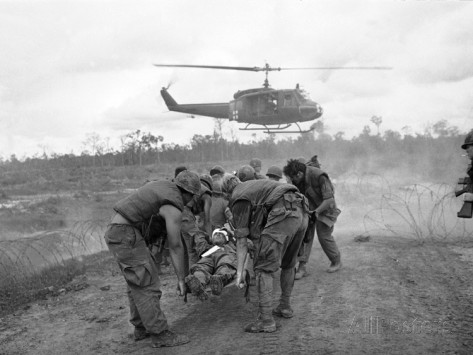
(Timberg being evacuated from Da Nang area after his vehicle hit a land mine, January 18, 1967)

This memoir is very timely in light of the type of injuries that American soldiers have sustained in Iraq and Afghanistan for the last twelve years.  It brings a message of hope for the future based on Timberg’s remarkable recovery and the success he has enjoyed as a reporter and a writer.  Our wounded veterans face a long road to recovery and Timberg’s story could be a wonderful model that they can try to emulate.  The first two-thirds of the book for me were the most interesting.  Timberg lays his life out for all to see.  His emotions which seemed to rise and fall with each sunrise and sunset are heart rendering.  His descriptions of his treatment with multiple skin grafts and surgeries are a testament to his perseverance.  His tenacity and ability to overcome most of the obstacles that were placed in front of him are truly amazing.  We learn a great deal about the Naval Academy and the United States Marine Corps and what they stand for.  Timberg takes the reader through many stages of recovery by interspersing his relationships with those who are most responsible for his making him whole, his first wife, Janie, and Dr. Lynn Ketchum, the surgeon who like a sculptor put Timberg’s facial features back together as best he could.  Despite his recovery, throughout this period his loss of identity constantly tugged at him, even as he earned the satisfaction of a successful career, but the loss of identity seemed to always be under the surface.  Once Timberg reaches the end of his period of recovery, he must leave “the cocoon of the hospital to home cycle” of constantly undergoing surgery and recovery.  For Timberg it was very difficult, but finally with Janie’s assistance he is able to overcome his fears and earn a Master’s Degree in Journalism at Stanford University and begin his career as a reporter in Annapolis.  That career would lead to a Nieman Fellowship, positions at the Baltimore Evening Standard, and the Baltimore Sun.  Timberg became a leading White House correspondent, and the author of three very important books.

The one area of the book I have difficulty accepting is the sections that deal with the germination of the ideas for the book THE NIGHTENGALE’S SONG, and how the book was finally conceived and reached fruition.  It was fascinating how Timberg pulled together such disparate personalities as John McCain, James Webb, John Poindexter, Robert McFarlane, and Oliver North to create narrative dynamic that made sense.  What sparked this dynamic was the Iran-Contra scandal that rocked President Reagan’s second term in office.  Timberg was able to parlay the scandal and the personalities just mentioned into a coherent and interesting monograph.  I remember when the book was published and after reading it I wondered if Timberg had an agenda that called for damning those who were able to avoid serving in Vietnam, and blaming the prosecution of the Iran-Contra scandal on the media and members of Congress who figured out ways to remain out of the military during the war.

Timberg’s judgment is deeply flawed in attacking, what seems to be everyone who did not fight in Vietnam for pursuing the Iran-Contra scandal.  I understand that he suffered unbelievable horrors as a result of his military service and significant emotional issues remain.  However, his inner drive to become the person he was before he was seriously wounded has clouded his judgment to the point where he deeply hurt, Janie, his first wife, the woman who was mostly responsible for making himself whole as he recovered.  His comments dealing with the need to find another woman to have sex with aside from his wife to see if he could find another person who was attracted to him is deeply troublesome.  It was thoughts like this and leaving her alone with three children for a great deal of time reflects poorly on Timberg no matter how courageous he was.  As Timberg researches and writes THE NIGHTENGALE’S SONG, his obsession with those who did not fight in Vietnam comes to the fore completely.  Though there are repeated denials in the book his understandable prejudice against “draft dodgers,” etc. is readily apparent, i.e., his convoluted logic of going after people who believe that Iran-Contra was a major crime and resulted in violation of the constitutional and legislative prerogatives of Congress, aside from the cover-up and outright lying the of the Reagan administration with a vengeance.  By explaining away the scandal by raising the question; “was Iran-Contra the bill for Vietnam finally coming due?” for me, is a bit much and cannot explain away the illegal acts that North, Poindexter, and McFarlane committed no matter how hard Timberg tries.  For the author it seems like everyone who did not go to Vietnam used money and connections to avoid serving.  Further, those who did not serve, “much of the rest of that generation came up with novel ways to leave the fighting and dying to others.”(213)  Timberg quotes from Lawrence M. Baskir and William A. Srauss’ excellent analysis of the draft, CHANCE AND CIRCUMSTANCE to buttress his arguments, however if he revisits objectively the Pentagon statistics that the authors quote he will find that not all who did not serve in Vietnam committed acts that Timberg finds reprehensible  There are millions who were involved in defense related jobs, duty in the United State Army Reserves and the National Guard, had legitimate medical deferments, or were conscientious objectors.  I agree a significant numbers did avoid service and Baskir and Strauss put the number of draft offenders at about 570,000, accused draft offenders at 209, 517, with about 3250 actually imprisoned.  We must also keep in mind that of the 26,800,000 men of the Vietnam generation, 6,465,000 served but never went to Southeast Asia, and of the 15,980,000 who never served in the military 15,410,000 were deferred, exempted or disqualified -all cannot be painted with the broad brush of being draft dodgers as Timberg seems to strongly intimate.*

Overall, Timberg is correct, Vietnam is still a raw nerve for a generation that witnessed men rallying to the flag, and men who felt the war was wrong.  As history has borne out the American people were lied to by the Johnson administration and the government in general.  I respect Mr. Timberg’s service, the wonderful career he used as a vehicle to become whole again, and I find that he is an exceptional author, who at times goes a bit overboard in his attempt to rationalize why people avoided service in the war.  The book is a superb read, deeply emotional and for my generation dredges up a great deal and provokes deep thought concerning how the experience of the Vietnam War still affects American foreign policy and the conduct of combat to this day.

*See Lawrence M. Baskir & William A. Strauss CHANCE AND CIRCUMSTANCE. New York: Alfred A. Knopf, 1978, p. 5 for an excellent chart that is reflected in the figures presented.

BOY ON ICE: THE LIFE AND DEATH OF DEREK BOOGAARD, by John Branch

(Derek Boogaard’s hockey card as a member of the Minnesota Wild, 2005-2006)

The first time I looked at the dust jacket of John Branch’s new biography of former hockey player Derek Boogaard, entitled, BOY ON ICE: THE LIFE AND DEATH OF DEREK BOOGAARD I was struck by what a large figure Boogaard presented.  Here was an individual who stood almost seven feet tall on skates and weighed around 275 pounds, however after reading Branch’s fine narrative of his life I was struck by how gentle and unassuming a person he was, and in many ways his behavior and thoughts were that of a boy, at times simple, and at times complex.

Derek Boogaard grew up in a small prairie town in northern Saskatchewan where hockey was something that boys engaged in as almost a religion.  If you had any talent or perhaps the size it became a way of life.  Boogaard fit right into this formula.  He was always the largest boy for his age and though he was not the swiftest skater or the most proficient stick handler, he had what many coaches say cannot be taught, size.  From his earliest days in organized hockey his role became clear, defend his smaller teammates, and make opponents feel uncomfortable whenever he was on the ice.  John Branch does an exceptional job following Boogaard’s development as a person and a hockey player from a very young age and traces his career from its lowest level when kids follow the puck like swarming bees, through his teenage years as a Bantam, through junior hockey, various levels of minor league hockey, until he finally reached the pinnacle, the National Hockey League.  In each instance, thanks to the cooperation of the Boogaard family, close friends, professional hockey careerists, and finally notes that Derek left about his childhood, Branch is able to explain what his subject went through and was thinking at each level of his career.

(Derek Boogaard engaging in his role on the ice as a member of the Minnesota Wild)

Boogaard’s official role as a hockey player was that of an “enforcer,” a role that consisted of intimidating opponents on the ice and if need be to fight the person who filled the same role for the opposing team.  Branch does a marvelous job of tracing the history of violence in hockey and the evolution of the “enforcer.”  He discusses the impact of that role on the sport, the reactions of players and coaches, and the rationalizations offered by team general managers, owners, and National Hockey League officials when it was becoming increasingly obvious that the constant violence, that at times dominated the sport, was resulting in the deterioration of the medical health of a number of hockey players in retirement, and who were still on the ice.

Branch does a superb job analyzing the sub culture that surrounds the “enforcer” in hockey.  For most of the men who adopt the role it is their only “meal ticket” to play the sport professionally.  Though some possess some hockey sense and/or skills, most do not, and are labeled as “goons.”  These men do not enjoy fighting and in many ways approach their role as nothing more than a job.  In Derek’s case off the ice he was a very sweet person who tried to care for everyone, was very giving of himself, and his generosity with his time and money new no bounds.  However, when Derek was challenged on the ice, it seemed as if a light switch was turned on and he would try and pummel his opponent(s) into submission.  Once the fight was over he would skate to the penalty box without engaging in the histrionics that other enforcers engaged in as they fed off the crowd in the arena.  For years, enforcers liked what they earned from fighting, respect and a career that paid them well.  However, they were not aware of the hidden costs.  For Derek, with strength and power, with the ability to win fights and gain recognition, he basically did not enjoy beating others up.  “He enjoyed it when he needed it, but some of it weighed on him.”  The pressure was enormous, one lost fight, a broken bone or injury and the team could send him back to the minors, a lucrative career, over.  It was difficult never knowing what a game would bring as “shift by shift, enforcers had to be ready to fight at a moment’s notice.”(154)  If you didn’t want to do it, there were many others who would gladly take your roster spot.  “Even as Derek arrived, the line of NHL enforcers was littered with broken lives.  Alcohol and pain killers especially became the antidotes to the pain and pressure.” (155)


(Derek and his dad, Len who was a member of the Royal Canadian Mounted Police)

Branch catalogued many of Derek’s fights as if he were a ring announcer covering a fight broadcast from Las Vegas.  The toll of his hockey career led to numerous injuries, broken noses, ripped tissue that never healed on his knuckles, torn shoulder muscles and constant back pain. For Derek and many others they thought their only recourse to maintain their jobs was pain killers.  Branch delineates the prodigious amount of pain killers that Derek ingested over his four year hockey career.  Vicodin, oxycodone, Percocet, oxycontin, et al was the elixir that dulled the pain.  Team doctors would prescribe medications, many never kept records of what was provided, and if doctors would not cooperate, Derek, who had the funds found illegal ways to acquire his drugs.  Two attempts at rehabilitation failed and what was increasingly clear was that the constant pounding that Derek’s brain experienced led to countless concussions that he was unaware of.  He exhibited textbook characteristics of post concussion syndrome-mood swings, depression, loneliness, disorientation, and memory loss.  It was clear when he over dosed accidently mixing alcohol and pain killers that had he not died at the age of twenty-nine, that his ensuing years would have witnessed the onset of dementia at a very young age.  Derek’s brain was donated to science and the findings are very scary in terms of individuals who have suffered constant blows to the head.  Since these blows are cumulative, each concussion, or whiplash movement will create the nausea, headaches, and other symptoms repeatedly.  In Derek’s case it is especially sad because according to those close to him, he did not have a mean bone in his body.

(Derek Boogaard during happier times)

Branch has done a service by presenting a wonderful biography, placing it in the context of a national epidemic dealing with brain injuries.  Research is an ongoing avocation, but Branch’s book should raise the eyebrows of parents and anyone involved in contact sports, no matter the level, that we must do more to protect the athletes who are involved.  If that means raising the curtain that sports officials at all levels have refused to raise, to change some of the rules, especially around fighting and unnecessary violence so be it-I am certain it will not detract from the skill and beauty of the sports involved, but it will save lives and improve the quality of life for athletes after they retire.  This book is not your typical sports biography, as a father of a son who played prep school hockey and college lacrosse I wonder how many times he had “his bell rung.”  Branch’s book is a wake up call, hopefully the right people will be listening.


LIAR TEMPTRESS SOLDIER SPY: FOUR WOMEN UNDERCOVER DURING THE CIVIL WAR by Karen Abbott


(Photo of Belle Boyd, the rabid secessionist and successful Civil War spy)

When I read a title that sounds like a John Le Carre novel, I am always intrigued. Karen Abbott’s new book, LIAR TEMPTRESS SOLDIER SPY: FOUR WOMEN UNDERCOVER IN THE CIVIL WAR has many elements of the espionage master’s work and she weaves a series of wonderful stories into a historical narrative that could pass for fiction.  The book Abbott has written explores the role of women during the Civil War, an area that has not been addressed sufficiently by historians.  Her work is less about the contribution of women in general who performed domestic tasks for confederate and union forces, but mostly about the lives of four women who played prominent roles during the war; Rose O’Neal Greenhow and Belle Boyd who supported secession, and Elizabeth Van Lew and Emma Edmonds who remained loyal to the union.  All four women engaged in espionage during the war, and their lives reflect their own personal dangers in addition to the death and destruction that they witnessed during the “war between the states.”  In telling the stories of these heroines, Abbott integrates important aspects of the political and military history of the war into her narrative very effectively as each statement or document that appears is supported by by her research, though there are a number of places in the narrative when she appears to take some poetic license as she quotes from works of fiction as if they were accurate sources.

For the reader who sets out to read Abbott’s historical monograph they will find that, at times, it reads like an espionage thriller.  As they progress in the book they will meet many important historical characters, including; General Stonewall Jackson, General George McClellan, Detective Alan Pinkerton, Abraham Lincoln, Louis Napoleon III among many others.  The book is organized chronologically with alternating chapters dealing with each of the subject women.  At times this approach can be confusing, and perhaps each woman could have been dealt with separately to create greater cohesion and then a chapter or two discussing how their lives may have interacted.  None the less the book is a quick and interesting read and focuses attention on four unsung heroes who can now be seen in a new light.

(Photo of Sarah Emma Edmonds, Union spy who changed her sex identity during the Civil War)

What separates Abbott’s account of the war is her in depth portrayal of her subjects and how they used their own inner resources to place themselves at risk in promoting the cause they believed in and were willing to die for.  The first, Belle Boyd, a charismatic character, who loved the limelight and had a force of personality that dominated most situations she found herself in.  Raised in Martinsburg, Va. she was a staunch secessionist who abhorred the union.  She engaged in numerous plots to acquire intelligence for the confederacy and employed her saucy, feminine whiles with men to gain whatever she needed.  Her life is fascinating and is worthy of her own biography.  Perhaps her lowest moment in the war, aside from the defeat the south suffered was the secession of western Virginia, including her own home county of Berkley, forming the state of West Virginia.  Second we meet Emma Edmondson, Canadian women who wanted to join the union army.  The strategy she adopted was to assume the identity of a man named Frank Thompson and when she survived her physical exam she joined Company F, 2nd Michigan infantry.  She began as a male nurse and soon became a mail currier and  spy for the union.  She kept her identity secret from everyone but two soldiers she served with that she fell in love with.  She survived a great deal of combat and was very effective.  Throughout the war she feared someone above her in rank would discover her true sex more than she feared death.  Her life is also an amazing story and she did write her own memoir entitled; MEMOIRS OF A SOLDIER, NURSE AND SPY! A WOMAN’S ADVENTURES IN THE UNION ARMY.  Third, is the life of Rose O’Neal Greenhow who lived in Washington, DC and was counted on by the Confederacy to obtain as much intelligence as possible.  She was friends with Confederate General P.G.T. Beauregard and headed a spy ring prone to “indiscretions” with men.  She worshiped Southern senator, John C. Calhoun of South Carolina and mirrored his political views.  She had a number of lovers, the most important of which was Henry P. Wilson, an abolitionist Republican who was  the union Chairman of the Military Affairs Committee.  She has been credited with providing the intelligence that allowed the confederacy to defeat the union army at the first Battle of Bull Run (Manassas).  During the course of her career she was arrested a few times and served short prison sentences in Washington at the Capitol Prison.  After being exiled to the south she was sent by Jefferson Davis to England and France to try and gain recognition of the Confederacy by these nations.  On her return to the United States her blockade running ship was intercepted by the Union Navy. Lastly, and probably the most impactful of the four women on the course of the war was Elizabeth Van Lew, a wealthy society woman, and a strong unionist who lived in Richmond.  Her career as a spy was fraught with danger since most of her neighbors and politicians in the confederate capitol knew her wartime sympathies.  There were numerous attempts to try and catch her, by searching her mansion which became a union safe house, constant searches by detectives, and numerous attempts at entrapment.  Despite all of these obstacles she organized and ran the Richmond spy ring and its conduit to the Underground Railroad for escaped slaves and union soldiers to the north, and maintained a “secret room” upstairs in her mansion as a transshipment point for those fleeing the south.  General Grant, grateful for her work sent her a personal note: “you have sent me the most valuable information received from Richmond during  the war.”  Grant awarded her the position of Postmaster General of Richmond during his presidency to try and compensate her for all the  wealth that was poured into the northern cause during the war.

(Photo of Rose Greenhow, a Confederate spy during the Civil War and her daughter and part time currier, “Little Rose”)

It is not my purpose to recapitulate Abbott’s narrative but they are a myriad of interesting and surprising revelation that she brings to the fore.  Since women were not allowed to serve in the union army and there really was no military legal precedent for what to charge them should they be caught, union military officials would kick them out of the army under the charge of prostitution.  There were about 300-400 women in the union army during the Civil War, and Abbott tells a number of stories dealing with their plight.  In addition, the author relates the activities of Detective Alan Pinkerton who was in charge of union espionage for part of the war.  The role of detectives emerges throughout the narrative and how they interacted with Boyd, Greenhow, and Van Lew.  We witness a blend of societal graciousness and hospitality on all sides, but at the same time Abbott is letting the reader know what each character thought.  The chapter that deals with Pinkerton’s arrest of Rose Greenhow is priceless.  Abbott describes in detail the house search and how Greenhow was able to finagle documents into the hands of her eight year old daughter, “Little Rose,” as the conduit to avoid detection by Pinkerton’s agents and getting the intelligence to sources outside her home.  Even under constant surveillance Greenhow continue to spy for the Confederacy employing her daughter as her currier.  Another important vignette that Abbott discusses is how Elizabeth Van Lew, a friend of Confederate President Jefferson Davis’ wife is able to convince her to take on one of her freed slaves as a servant in the Confederate White House.  As the war turns against the Confederacy, Davis, for a time, is at a loss as to how Union spies seem to know military plans soon after he had conferred with General Robert E. Lee,  or other southern generals.  The work of Van Lew’s servant, Mary Jane, was certainly an important contribution to the Union cause.

(Photo of Elizabeth Van Lew, a Richmond socialite who spied for the Union during the Civil War.  A woman who was widely praised by General U.S. Grant)

Karen Abbott has certainly done a service to the memory of four women who were under cover during the Civil War.  It makes for an excellent read and I recommend it to Civil War buffs and those interested in an aspect of women’s history that few are familiar with.  As Elizabeth Van Lew alluded to after the war, women made major contributions to the northern victory but when it came for them to receive military pensions they had to beg men for what was due them, because they did not have the vote.

EICHMANN BEFORE JERUSALEM: THE UNEXAMINED LIFE OF A MASS MURDERER by Bettina Stangneth

(Adolf Eichmann in the witness box during his trial in Jerusalem, April, 1961)

Bettina Strangneth new book, EICHMANN BEFORE JERUSALEM: THE UNEXAMINED LIFE OF A MASS MURDERER offers a major reassessment of how we should interpret the life of the man whose work was integral to the extermination of six million Jews during World War II.  After his capture by the Israeli Mossad in 1960, Adolf Eichmann tried to convince people that he was a small cog in the Nazi bureaucracy and that he was not a mass murderer.  He tried to present himself as a man who was always in the background during his Nazi career and was not involved in any major decision making.  In 1963 following the Eichmann trial in Jerusalem, Hannah Arendt published her work, EICHMANN IN JERUSALEM: A REPORT ON THE BANALITY OF EVIL where she argued that her subject was nothing more than a bureaucrat who performed his tasks as best as he could, like a good civil servant who wanted to further his career.  He went to work each day and tried to meet the goals that his job demanded.  If his work involved “evil,” that doesn’t take away from the fact that he was just carrying out what his superiors expected of him.  Arendt’s line of thinking was very controversial at the time and it went against the generally accepted idea that, in fact, Eichmann was guilty, and was not an ordinary man who was turned into a thoughtless murderer by a totalitarian regime.  Following his escape after the war Eichmann claims to have been “an empty shell,” an apolitical person who tried to enjoy a normal life with his family while before his capture by the Israelis and his trial in Jerusalem.   In the last few years documents have surfaced in several archives that contain “Eichmann’s own notes made in exile and [they] can be examined in conjunction with the taped and transcribed conversations known as the Sassen interviews.”  These materials (about 1300 pages) reflect that “not once during his escape and exile did Eichmann seek the shadows or try to act in secrecy.  He wanted to be visible in Argentina and he wanted to be viewed as he once had been:  as the symbol of a new age.” (xx)  Employing this perspective, and making excellent use of the Sassen interviews, also referred to as the Argentina papers, Bettina Strangneth has written a fascinating book that disproves Arendt’s line of thinking and shows without a doubt that Eichmann was a major cog in the Nazi extermination apparatus and the persona he presented in Israel during his trial was nothing more than an act to gain sympathy from his captors and as lenient a sentence as possible.

Strangneth states from the outset that her goal is to uncover what was the “Eichmann phenomenon,” how and why did it develop, what people thought of him and when, and how he reacted to what people thought and said about him.  Strangneth succeeds in unmasking Eichmann who throughout his career assumed different roles; as a subordinate, a superior officer, perpetrator, fugitive, exile, and finally a defendant.  The only one of his roles that has become well known is that of a defendant at his trial in Jerusalem.  His intention was obvious, to remain alive and justify his actions.  For Strangneth, we must return to the period before Eichmann’s arrival in Jerusalem to see the real Eichmann.  The author effectively accomplishes her mission by examining a myriad of primary and secondary sources in a number of languages, and she uses Eichmann’s own words that were taped and written as part of interviews conducted by Willem Sassen, a Dutch Nazi collaborator and member of the SS journalist corps during the war and was the organizer and host for the interviews and discussions with Eichmann in 1957.   Once the Argentina papers surfaced and Eichmann was brought to trial it created a number of problems for a West German state that sought a smooth transition to becoming a new nation free of its past.  In addition to officials in Bonn, other Nazi officials who escaped after W.W.II, former Nazis who were free and serving in the West German government, and the Vatican prelates all feared what Eichmann might say.

(Reinhardt Heydrich, Chief of Reich Main Security Office and Eichmann’s superior in 1942)

The first section of the book, “My Name Became a Symbol,” focuses on Eichmann’s argument in Jerusalem that he was not an important figure in the Nazi regime and had little to do with the Holocaust.  Strangneth methodically refutes Eichmann’s arguments by examining his career from 1934, when he joined the Nazi Party through his successful escape from Europe by boarding the Giovanni C in Genoa’s harbor in June, 1948.  The author delineates Eichmann’s attempt to accumulate power as he worked his way up through the Nazi hierarchy and his success in making his name known, and establishing relationships with key Nazi figures.  For example, Reinhard Heydrich,  chief of Reich Main Security Office that included the Gestapo and SD, and making himself an expert on the Jewish people and their religion.  The author traces Eichmann’s movements during the prewar period as he set up emigration offices in Berlin, Vienna, and Prague, and the war itself as he employed his emigration, transportation, and organizational skills to implement the Final Solution.  Eichmann’s creation of excessive publicity around his own name is in sharp contrast to the “shadow” figure he presents in his jail cell in Israel.  The author ends the first section by determining the accuracy of the myths surrounding Eichmann’s escape from Europe and details how he arranged his travel and settlement in Buenos Aires.

(while in exile in Argentina, Eichmann managed a rabbit farm)

In 1953 he was able to bring his family to Buenos Aires and it was clear there was very little interest in pursuing Eichmann and bringing him to justice. At the time, Konrad Adenauer, the West German Chancellor announced to the Bundestag: “In my opinion, we should call a halt to trying to sniff out Nazis.”(146)  While in Buenos Aires Eichmann grew angry that many of his accomplices and colleagues used their relationship with him to obtain lighter sentences.  He wanted to defend his honor.  On his arrival in Argentina, Eichmann had been taken in by the Durer group, led by Willem Sasser and Eberhard Fritsch, who published right wing magazines.  As Eichmann’s anger at former cohorts increased he wanted to set down his ideas in a book with the assistance of Sassen and Fritsch.

(Willem Sassen, a member of the Durer group who interviewed Eichmann for the Sassen/Argentina Papers)

1955 became a watershed year for Eichmann.  His personal circumstances changed as his wife Vera gave birth to their fourth son and he turned fifty years old.  In addition, the Peron government that had assisted Nazi exiles since the end of the war was overthrown in a coup resulting in an unstable political situation that placed Nazi escapees in the dark as to their futures.  Other events became public during the course of the year that concerned those who sought a resurgence of National Socialism when Austria signed the Independence Treaty; military occupation of West Germany ended and it was allowed to join NATO and form its own military, and represent its own interests abroad.  With Nazi exiles failing to influence West German elections, and with Moscow releasing German POWs, any hopes of a Nazi resurgence appeared dim at best.  Along with these events during 1955 the first major historical works and documentaries began appearing that described in intricate detail the role of “the Grand Inquisitor without magic, Adolf Eichmann.” (176)  The wealth of information and documentation that included Nazi letterhead, signatures, and other evidence could not be dismissed as Jewish propaganda.  It began to dawn on many of the doubters in the German community in Argentina, that Nazi denials about the Holocaust were lies.  This community led by Sasser, Fritsch and others needed someone with knowledge of what really happened to refute the books, articles and other media.  For them, Eichmann was the answer, and this project gave birth to the Sassen interviews.

(Eichmann reading in an Israeli prison)

Stangneth effectively argues that when Eichmann was in Argentina he did not live a solitary life and he talked about his career incessantly.  Sassen began to record Eichmann sometime around April, 1957 as Eichmann wanted to correct the historical record that was being presented in the burgeoning Holocaust literature.  Eichmann’s writing in Argentina was prodigious and the Sassen transcripts would reach 1000 pages, plus another 100 pages that Eichmann had written before the interviews began.  Strangneth spends a great deal of time analyzing Eichmann’s writing and convoluted logic, as he saw himself as a victim of malicious defamation, and misrepresentation.  For Eichmann, he was the irrefutable witness as all the other leading Nazis were dead.  The Durer group obtained all the leading books and articles pertaining to the Final Solution and examined each book with a fine tooth comb.  This process allowed Eichmann to see what the rest of the world believed and he would use that knowledge to prepare his arguments to refute it.  This approach was very helpful when he was imprisoned in Israel as he had practiced the major arguments against his position for years.  Strangneth points out that he “presents us with his irrefutable truth in an accusatory tone, with the self-assurance of a demagogue.” (215)

The author provides descriptions of the tapes that recorded Eichmann’s views and she speculates about dates and who was in attendance.  The author provides numerous verbatim comments by Eichmann; i.e., “The only good enemy of the Reich was a dead one….when I received an order, I always carried out this order with the executioner, and I am proud of that to this day.  If I had not done this, they would not have gone to the butcher.” (267)  Stangneth’s thoroughness is exceptional and through her analysis of the Sassen transcripts she provides insights into Eichmann’s thought process that culminates with his closing remarks where he confesses as to what was his real role in the Final Solution.  This is a far cry from the Eichmann in Jerusalem who presented himself as the “cautious bureaucrat.”

The Sassen papers developed a life of their own and Strangneth recounts in detail the road the papers take once Sassen learns of Eichmann’s abduction.  They seem to travel from Buenos Aires to Eichmann’s half brother Robert in Austria, then to be stolen from his office.  Sassen sells part of the material to ­Life and Stern magazines who publish excerpts from the material.  The most complete transcript fell into the hands of Polityka, a Polish magazine, but when published it did not create much interest.  The Israeli prosecution team in Jerusalem acquired a great deal of information, but most of it was ruled as inadmissible in court because their copies were of such poor quality, and the tapes that could have been used to show how disingenuous Eichmann’s testimony was, were not in their possession.

Strangneth brings her monograph to a close by examining the accuracy of books that were published after the trial that purported to use the Sassen documents and admonishes some for not living up to high academic standards, something that she has done throughout her work.  EICHMANN BEFORE JERUSALEM, can be somewhat dry in spots but overall it is an amazing study of a subject that needed clarification and it brings to the fore primary documents that will assist future historians.  One can only hope that documents that have not been released pertaining to the Sassen papers, as well as documents held by the German government will soon be made available for historical research so we can obtain an even more accurate picture of what the Nazis perpetrated throughout Europe during W.W.II.