FRAGILE EMPIRE: HOW RUSSIA FELL IN AND OUT OF LOVE WITH VLADIMIR PUTIN by Ben Judah

Vladimir Putin is shown. | AP Photo/RIA-Novosti, Dmitry Astakhov, Presidential Press Service

(Vladimir Putin, King of All Sports!)

As Vladimir Putin denies the Russian presence in the current Ukrainian crisis, but at the same time makes statements that he “could take Kiev in two weeks,” and that the world needs to remember that Russia is a nuclear power one wonders how we got here.  President Obama’s threats of further sanctions against Russia seem to accomplish little as European allies do not have the stomach to hit the Russians where it would hurt the most, their energy sector.  As Russian troops invaded eastern Ukraine and tilted the conflict in favor of the pro-Russian rebels, the west at last week’s NATO conference in Wales could not bring themselves to use the term invasion or maybe incursion, so I ask again how did we arrive at this impasse?  Ben Judah’s 2013 book, FRAGILE EMPIRE is a wonderful guide to understanding recent events in Ukraine and the state of Putin’s Russia domestically.  Had Judah published his book a year later he would have found further evidence to buttress his argument that Russia had fallen in and out of love with Putin and what the future may hold for a country that is overly dependent economically, socially, and politically on the price of oil; where corruption is the main tool for Putinism’s survival; and a social fabric that is being torn apart by emigration of many of Russia’s most talented people, a declining longevity rate, and a population that is decreasing each year.  Judah who is a superb reporter and political scientist has traveled to most areas of Russia and seems to predict that the weight of Putinism will eventually will lead to its collapse, however the current Ukrainian crisis has improved his popularity among the Russian people as he appeals to Russian nationalism and feeds the paranoia many in Russia feel when compared with the west.

(Obama and Putin at the G8 Summit, July 17, 2013)

Judah begins his study in explaining Putin’s background and rise to political power, concentrating on his main theme that he has written “a study of Putin’s triumph as a politician and his failure to build a modern state.” (2)  Putin was born in post-war Leningrad in 1952 and experienced a childhood of mostly poverty living in a cramped apartment with a communal kitchen and bathroom.  At the age of eleven he went to a local KGB office and asked to join and being politely rebuffed he grew obsessed with patriotic spy films and the martial arts.  The youthful Putin’s world view was a product of a double disaster.  At first he worked for the KGB in Dresden, East Germany, a failed authoritarian state.  He followed that experience as a senior official in St. Petersburg, in a failed democracy.  After the collapse of the Soviet Union, the winter of 1992 witnessed fears of hunger that had not existed in urban areas since Stalin’s reign as the Russian GDP had fallen by 44%, deeper than the United States in the 1930s.  Judah describes Putin as being from the lost generation of the 1990s.  Putin and his contemporaries had grown up under communist indoctrination; its collapse produced “a generation of cynicism as their world view.”  “Putin, like millions of Russians who dedicated their lives  to the Soviet state, found themselves irrelevant, mocked for having a ‘Soviet mentality;’ those in the KGB were shunned and told they had been the ‘enemy of the people’ all along.” (14)  It is from this environment that Putin emerged with St. Petersburg becoming his springboard to power.

According to Judah, the West liked the idea that Boris Yeltsin surrounded himself with young reformers, but in fact he brought the military and FSB into government.  Under Gorbachev they made up only 5% of government positions, by 1998 under Yeltsin it had climbed to 46%. (18)  Judah describes in detail how during Yeltsin’s reign the oligarchs emerged and ostensibly stole the Russian economy as ordinary Russians were losing their life’s savings.  With many feeling Russia was close to collapse the men around Yeltsin needed a protector who could win the next election.  This was the Kremlin that Vladimir Putin, then a young, impressive former KGB bureaucrat from St. Petersburg, first started to work in.  As Russian oil production declined by 50% and oil prices dropped by 60% state revenues were collapsing resulting in the default of Russian debt at a time when 40% of Russians were below the poverty line.  At the same time oligarchs threw money around resulting in an expansion of an urban middle class particularly in Moscow and consumerism that allowed politicians to reach their constituency.  A further stress on Yeltsin’s rule was the war in Chechnya as the election of 2000 approached.  The invasion of Chechnya catapulted Putin from a nobody into one of the most popular politicians in the country.  A series of domestic bombings furthered the need for a strong leader, who in this case was chosen by the Kremlin, Vladimir Putin, who “acted the part of a macho-savior in front of the cameras and his popularity exploded.” (33)  Putin was swept into power atop a shaky wave of nationalist fear and economic distress.

Putin’s first term was shaped by Yeltsin’s legacy and the problems he inherited, according to Judah he appeared as a “Sisyphean,” but it was Putin’s luck to take over just as an economic boom took off.  His first year in office saw a 10% growth rate thanks to a 75% lower exchange rate that fueled Russian exports and consumer spending.  In addition a tax reform program benefited business as did the recovery of the energy sector produced sustained GDP growth of 7% annually through 2008. (40-41)  At the same time as liberal economic reform was implemented the Kremlin clamped down on television, what Judah describes as the creation of a “videocracy” that projected Putin as a Russian hero and that Russia could never survive without him.  Putin would go to war with media oligarchs who he felt were a threat and by 2008 he controlled 90% of the Russian media.  According to Judah television created a cult of Putin as 98% of the population had no satellite or internet by 2008.  Telepopulism created a Putin majority and Putin was packaged as the “generous Putin” who paid for the “budgetniki,” people who were reliant on state salaries, pensions, and other benefits.  In a country where 53% of the people were on the state payroll in one form or another, Putin’s cult flourished.  In the midst of this process Putin turned more authoritarian as he imposed his version of consensus on the oligarchs, particularly in the energy sector, as oligarchs blocked any increase in taxes on oil profits.  Putin had little choice if he was to maintain his popularity through social spending as he needed the $2 billion in taxes that the oil oligarchs avoided paying.  A further threat to Putin was Mikhail Khodorkovsky, who in 2003 was considered the richest man in Russia.  When Khodorkovsky entered politics and railed against the corruption that was built into the Russian economic system (30% of the state budget was lost to corruption).  Putin viewed this as a personal threat and imposed his will on all oligarchs, and in particular private oil production would fall from 90% to 45%, and by 2005 83.9% of all oil company profit went to the state.  Putin’s message was clear; oligarchs should stay out of politics.  Russia saw itself as the northern energy super power and that energy would now be used for geopolitical goals, an effective strategy today as the European countries refuse to risk a Russian energy cut off if they push too hard over the “invasion” of the Ukraine.  By 2008 Putin’s “authoritarian project” was in place as all funds that oligarchs had used to oppose Putin where now part of state revenues.  Despite Putin’s political success, corruption, terrorism, and bureaucratic incompetence remained.

As described, Judah has done an exceptional job explaining Putin’s origins and how he rose to power.  Further, he allows the reader to understand that once in power Putin was able to crush any hope of liberal economic reform or political change.  Judah is correct that as long as the energy sector flourished the Russian economy would do well, but if a crisis developed, Russia and Putin would be in trouble. No matter what the short term economic success Russia experienced, the cancer of corruption would dominate the Russian economic model and undermine any successes.  2008 brought a foreign policy success that would rattle the West and be a precursor of current events in the Ukraine.  A crisis arose in Russian areas of Georgia that provoked Russian military action.  The underlying cause of Russian action as described by John J. Mearsheimer in his new article in Foreign Affairs, “Why the Ukraine Crisis is the West’s fault,” is that the United States and Europe by expanding NATO membership to Russia’s doorstep overstepped the bounds that Putin could accept.  After the Baltic States gained NATO membership, Georgia and the Ukraine were seen as next.  What the West failed to realize is that the birthplace of Stalin, Georgia, and the Ukraine have historically been part of Russia and those areas had been seen as vital since the Tsarist times.  Putin’s successful occupation of Georgian territory only enhanced Putin’s reputation and popularity.  At the same time Putin decided not to run for reelection and allowed Dimitry Medvedev to assume the presidency.  Medvedev grew up in the “Putin political family” and had no other politically meaningful professional experience.” (170)  As 2008 was coming to an end it appeared that Putin was in total control of Russia and despite the lack of freedom, he brought the stability that Russians cherished.

(2011 Moscow demonstrations after Putin announced he would replace Medvedev as President)

That stability was broken in September, 2008 with the collapse of Lehman Brothers in the United States and the resulting economic ripple that encompassed the world economy.  Russia’s situation was exacerbated because of the corruption that permeated Putin’s system.  Putin blamed the United States for Russia’s economic plight.  By 2009, the Russian economy had contracted by 8.9% as the Russian stock market lost 80% of its value, and oil prices temporarily declined by 70%. (175)  Medvedev identified Russia’s structural economic problems but could not do anything to modernize the system.  “By 2010 indicators showed that Russia was as corrupt as Papua New Guinea, with property rights of Kenya, as competitive as Sri Lanka.”  Russia was a society where everything had a price tag. (177)  Medvedev and Putin faced further problems when the government proved incompetent to deal with forest fires outside of Moscow.  What became Putin’s “Katrina,” highlighted a government that had “become a vertical of loyalty intertwined with a vertical corruption.” (185)  Putin’s sytem removed any incentive to be efficient and the government was unable to implement its policies beyond Moscow as it was over centralized.  On September 24, 2011 it was announced that Medvedev would not seek reelection and Putin would return.  This would spark a brief period of oppositional demonstrations who labeled Putin’s United Russia party as “the party of crooks and thieves.”  Though the slogan may have been accurate the newborn protest movement was “not ready to run into the Kremlin, as it could barely walk.  Without structure, without a policy plateform, it was not resistance ready to break through” and demand a recount when Putin was reelected by an inflated vote count of 15-20%. (248)

Judah provides a wonderful portrait of the Russian electorate and the different factions that existed.  As Luke Hardin wrote in The Guardian on June 27, 2013 “Moscow isn’t Russia: it is an affluent mega-city disconnected from the impoverished small towns where most Russians live.”  Judah feels that there is a degree of condescension in the opposition that helps explain their inability to gain support outside of Moscow.  Judah also includes a wonderful chapter entitled, “Moscow the Colonialist” where he describes in detail how Russians residing outside of their capital feel about their government and the lack of state resources that are afforded to them. Putin fought back with a conservative culture war.  Having lost the most advanced part of the nation, Putin would direct his energies to winning over the most backward part of the nation.  Judah describes Putin’s spending as that of a “Gulf Sheik,” as 53% of the country was on the state payroll as pensioners, state employees, factory workers, war veterans and bureaucrats, he had no choice but to meet their needs.  Pensions rose by 10%, $613 billion was allocated for a ten year military program, and another $160 billion worth of giveaways.” (261)  The question is how long can Putin maintain such a system when a drop in oil or gas prices could cripple the economy.  If one thinks of the current Ukrainian crisis as a vehicle to take people’s attention away from economic issues it makes even more sense.  Putin travels all over Russia visiting areas liberal politicians would never have thought of.  He has snuffed out “a not-quite revolution,” and sees little support outside Moscow for a move away from his program of economic stability.  Judah is correct in stating that the mass consent Putin enjoyed his first two terms as President is gone forever, but as Luke Harding has concluded, “Russians have fallen out of love with Putin but are unpersuaded that the opposition can deliver anything better.”  Judah concludes that sooner or later an earthquake may bring down the fragile Kremlin.  But then again, it might not happen at all.  If one wants to make some sense out of Putin’s reign, Judah’s marvelous work of political science is well worth a look.

IN THE KINGDOM OF ICE by Hampton Sides

Hampton Sides is a very engaging writer who has taken his readers through a number of diverse adventures.  Whether hunting down James Earl Ray for the assassination of Martin Luther King; detailing the mission of US Army Rangers in January 1945 behind Japanese lines in the Philippines; ; or exploring the role of Kit Carson in the American west, Sides has always been able to break down each topic to capture the attention of his readers.  His latest effort, IN THE KINGDOM OF ICE, is no exception as he tells the story of the USS Jeannette which set sail from San Francisco in July, 1879.  Sides describes the origins of the voyage and its place in navigational history and he produces what might be his finest book yet.

The narrative traces the development of the idea that there was a warm water path through the Arctic ice flows that would enable an expedition to reach the North Pole.  The story begins with the disappearance of the Polaris, a ship Captained by Charles Hall, that was sailing north off of Greenland in 1872 and the failed rescue mission that was attempted by the “Little Juniata,” a much smaller ship.  The rescue boat had traveled over 400 miles through large chunks of ice broken off icebergs and was Captained by George DeLong, an Annapolis graduate, who upon returning to New York explained to his wife Emma what he experienced and she realized that “the polar virus was in George’s blood to stay.” (10)    DeLong knew he was bitten by the “arctic fever,” and began to seek funding for a return trip to the Arctic region in search of a passage to the North Pole.  As Delong planned he came in contact with a number of important and colorful characters including James Gordon Bennett, Jr., the publisher, editor in chief and sole owner of the New York Herald, the largest and most influential newspaper in the world.  Bennett was also the third richest man in America and believed that newspapers should not merely report stories, but should create them.  His most famous involved sending a correspondent, Henry Stanley to Africa to locate Dr. David Livingstone, which took people by storm.  Bennett believed that an Arctic voyage would create even more interest and newspaper sales.  Another major figure was Professor August Heinrich Petermann, a German theoretician who concluded that the Open Polar Sea Theory was valid.  Petermann believed that “the ice pack as a whole forms a mobile belt on whose polar side the sea is more or less ice free.” (60)  Petermann also published numerous maps of the Arctic and Siberian region and was seen as the most reliable source of information for any polar excursion.  Much to DeLong’s chagrin later in the narrative, the German theorist’s ideas were all wrong resulting in disastrous consequences.  Once Bennett is convinced to finance a new voyage with DeLong in command the reader follows the preparation of a new vessel that is rechristened the Jeannette (named after Bennett’s estranged sister), the detailed planning, and the choosing and training of the crew.

As a back drop to the exploratory adventure, Sides reminds the reader of the major technical and scientific advances of the day by describing the 1876 Central Exposition in Philadelphia which was attended by the likes of George Eastman, Alexander Graham Bell, George Westinghouse, and Thomas Alva Edison (whose invention, arc lighting would be a total failure during the Jeannette’s voyage).  The author describes major new inventions and products including Heinz ketchup and Hires Root Beer as people came to observe from all over the world.  The US Navy, politicians and the business community all favored the expedition and it became a cause célèbre in the United States.

The ship departed San Francisco on July 8, 1879 under the command of George DeLong.  Its crew is made up of experts in all nautical fields and is very optimistic on departure.  As the USS Jeanette steamed north toward the Bering Strait, scientists and bureaucrats digested new data from ships returning from the Arctic region, and they discerned that Petermann’s ideas that DeLong was basing his path on did not exist.  “The portal DeLong was aiming for offered no real gate of entrance into the Arctic Ocean….the North Pacific Ocean, has practically speaking, no northern outlet; Bering Strait is but a cul de sac. (143)  By September, 1879, DeLong realized that the “thermometric gateway to the North Pole [was] a delusion and a snare.” (162). at this point on Sides describes how the Jeanette becomes imprisoned in the ice for almost a year, though because of the ice flow the ship does not remain stagnant.  The crew will remain in high spirits but ultimately when the ship is released from the ice the ship has to deal with loose chunks of ice and poor weather.  DeLong is not certain of his path and sends his chief engineer, George Melville on a dangerous reconnaissance mission when land is located.  While Melville is gone lead poison overtakes the crew.  By June, 1880 another ship is sent by the US Navy to learn what has happened to the Jeannette.   Captained by Calvin Hooper, with the naturalist John Muir as part of the crew, the USS Corwin is unsuccessful in locating the missing vessel.  Circumstances become dire for the Jeannette as it is encased in ice for another year and it finally will sink in June 1881.  The crew will escape and split up into three boats and make for Siberia to try and survive.

Sides is at his best as he describes the perilous journey as weather, unkind geography, and loneliness set in.  The author offers a unique and often amazing description of DeLong and his crew as they sail and trek across the ice, slush, and open water as they sought the Siberian land mass.  Details of the topography they dealt with, their physical strength and will power all place the reader among the crew as they tried to overcome the hand that Mother Nature had dealt them as each day became a separate battle for survival.  DeLong and his men were always up against the Arctic clock, when would the warm weather end?  By August 1881, DeLong had to burn the sleds that pulled his boats, making the remainder of their journey that more difficult.  By September 19, 1881 they were down to four days worth of provisions.  The remainder of the story is one of human will against the elements.  The three boats split up, never to be rejoined again.  DeLong sends his two best men ahead to try and reach a settlement to find aid.  It is when these two men reach Yakutsk, a Siberian village of 5000 people they are reunited with George Melville and a few men from the second boat.  It is with the aid of the Russian Governor-General, George Tchernieff who states that unlike today, “that Russia has your back.”  Melville launches an expedition to return to the ice to look for DeLong and his men and by March, 1882 he will uncover DeLong’s “ice journals,” maps, and other writings that were last dated in October, 1881.  Needless to say, shortly thereafter the bodies of these men were found.

The conclusion that Sides reaches is that courage and loyalty dominated the mission of the USS Jeannette under the leadership of Captain DeLong.  The capacity of George Melville’s commitment and identification with his captain and friend are compelling and explain his dogged determination to rescue DeLong and his crew once he reaches the safety of Yakutsk.  Sides goes on to describe Melville’s commitment to DeLong’s widow, Emma and the mission that he would carry to his grave.  Sides’ research and documentation is impeccable and there is little to question about his account as he has access to all of DeLong’s papers and other important materials.  He presents a work of history that reads like the best adventure fiction that I have read in a long time, and the book should spark interest for all who seek a story about the triumph and loss of the human spirit.

BACK CHANNEL by Stephen L. Carter

Whether reading Stephen L. Carter’s THE EMPEROR OF OCEAN PARK and the novels that follow that genre to his historical novel, THE IMPEACHMENT OF ABRAHAM LINCOLN I have always felt very satisfied and contented when completing one of his books.  After reading his latest effort at altering American history by recreating a fictional account of the Cuban Missile Crisis in BACK CHANNEL, I did not complete my reading with the same feeling.  To his credit Mr. Carter has complete command of the events that led up to the 1962 crisis, the diplomatic machinations between the Soviet Union and the United States, as well as the domestic pressure that was exerted within each government.  In a useful afterword, Carter explains the differences between his version of events and those that actually occurred allowing the reader to compare the two, and hopefully emerge with an accurate accounting for what took place.  The book is not even counter-factual history, it is more a fantasy that if you were not cognizant of actual events then you might fall into the trap and be engrossed with the plot.  It was difficult to accept the story line that Carter creates at the outset those American intelligence officials would employ a nineteen year old, black college student at Cornell University as a companion for chess champion Bobby Fischer at a competition in Varna, Bulgaria.  It seems at a previous match the Soviet champion had told Fischer that in Varna he would provide further information about Soviet intentions in Cuba.  From this point on the college student, Margo Jensen is involved in a whirlwind of espionage that will lead her to become the back channel conduit between Alexandr Fomin, a KGB Colonel, representing Soviet Premier Nikita Khrushchev, and President John F. Kennedy.  For those familiar with actual events you will remember there was a back channel during the crisis as Mr. Fomin met with ABC News reporter John Scali.  The substitution of Miss Jensen for Scali and the narrative that the author creates does not create a gripping tale for this reader.

Jensen meets a number of interesting characters in her journey ranging from State Department intelligence types, CIA agents, KGB Counter Intelligence officers, along with important historical figures like McGeorge Bundy, Kennedy’s National Security advisor and others.  We witness Jensen’s growth from an untrained college student in the art of espionage to one who will amaze those who have to deal with her.  The plot thickens as the missiles are discovered and the Soviet Union and the United States are brought to the brink of war.  On the Soviet side we meet Viktor Borisovich Vaganian, a KGB Captain in Counter Intelligence who is trying to discover who on the Soviet side leaked the information identifying what Moscow hoped to accomplish in Cuba.  His ally is a rogue American who is working for a domestic group that believes that Kennedy does not have the back bone to deal with the Russians.

As the book evolves the Cuban Missile Crisis is recounted with a number of historical details that are missing, rearranged, or created anew as it becomes clear that there is a war party in the United States who want to use the crisis as a vehicle to destroy the Soviet Union while the United States held the military advantage.  In the Soviet Union, Khrushchev must deal with his own war party who favors striking during the crisis because they believe that if the opportunity is allowed to pass they will have lost any hope of defeating the United States whose technological future was much brighter than Moscow.  Each war party tries to undo the back channel that involves Jensen, putting herself and those involved with her in repeated danger.

To Carter’s credit we are taken inside the Ex Comm national security meetings in Washington and the viewpoints of the participant run fairly close to what actually occurred.  The rendering of Generals Maxwell Taylor and Curtis Le May seems to hit the spot as are the views of Robert Kennedy, McGeorge Bundy, Robert McNamara and others.  Once the crisis is settled Carter presents two scenes that ring very true for the future.  In a conversation between Bundy and Kennedy, the president now satisfied the crisis is over turns his attention to what should be done about Vietnam as the administration begins to gear up for the 1964 election.  Secondly we witness a conversation between a CIA type, who Carter describes as a “traveling salesman of the clandestine world,” and Jensen, who is afraid what Kennedy’s domestic enemies might do in the future, the intelligence agent states that, “Still, if I were president, I suppose I’d watch my back.”  A strong reference to future conspiracy theories involving those who felt Kennedy was soft on Cuba leading to his assassination in 1963.

There are other moments in the narrative that move away from the crisis and involve Jensen’s family, particularly her father who was killed during World War II.  She learns that he was a hero and was blown up in order to avoid being captured by the Nazis as he ran agents during the war, and did not die, as she was previously led to believe in a motor vehicle accident.  The issue of course was that he was black, and the intelligence community did not employ such people during the war.  Because of this slight, Carter presents Jensen as the daughter who carries on her father’s work and her tenaciousness and character stem from his DNA.  We also meet other characters from Carter’s previous novels, i.e.; her grandmother, Claudia Jensen, Major Madison, Jack Ziegler, Vera Madison, and Agent Stilwell among others.  They are all integrated seamlessly and fit into the story line nicely.

(Soviet Premier Nikita Khrushchev and President John F. Kennedy chatting in Vienna, June 4, 1961)

The story began in a Conflict Theory class at Cornell taught by a former/current spy named Lorenz Nieymeyer and his prize student Margo Jensen.  Their relationship formed a secondary plot that is evident throughout the narrative as Margo is confronted with an adventure she never could have expected.  In an area of the book’s strength, Carter allows their personal and intellectual relationship to evolve and he closes his story by having the two meet, this time Miss Jensen holds the moral and intellectual high ground, and because of her ordeal she held her former professor in much lower esteem.  Had Carter written a novel centering more about their relationship with the Cuban Missile Crisis in the back ground it might have made for a stronger narrative and a more believable one?

CHASING SHADOWS: THE NIXON TAPES, THE CHENNAULT AFFAIR, AND THE ORIGINS OF WATERGATE by Ken Hughes

(Richard M. Nixon boarding a helicopter at the White House on August 9, 1974 after he resigned the presidency)

During the summer of 1973, while in graduate school, I found myself transfixed by the Watergate hearings that were broadcast live each day.  For me it became almost a soap opera with the revelations of Nixon administration misdeeds.  Once Nixon resigned, the battle for the Watergate tapes continued. After the 37th president passed away, the federal government gradually released more of the Nixon tapes resulting in a thorough record of what went on in the Nixon White House between February 16, 1971 and July 12, 1973 when over 3432 hours of tapes were produced.  What we learned before Ken Hughes new book CHASING SHADOWS: THE NIXON TAPES, THE CHENNAULT AFFAIR, AND THE ORIGINS OF WATERGATE was disconcerting enough for the American public, but now as Mr. Hughes, a journalist who is a researcher at the University of Virginia’s Miller Center Presidential Program, since 2000 culled these documents reaching the conclusion that is even more damning concerning Nixon’s abuse of power than the original tapes that were released in the 1970s.  In October, 1969, Joseph McGuinnis wrote in his book, THE SELLING OF THE PRESIDENT 1968 about the “new” Nixon, and the “old Nixon.”  According to Mr. McGinnis, the “new” Nixon was prepackaged as a candidate to avoid the “out bursts” and other political errors the former Vice-President had made in past elections that represented the “old” Nixon.  What emerges from Hughes detailed study is the reemergence of the “old Nixon on steroids,” as his political paranoia, hatred for those who made him look bad, anti-Semitism, and general nastiness is invariably documented on each page.

At the outset the author asks the question that after 40 years what we could possibly not have been exposed to concerning Watergate.  Hughes concludes “that the origins of Watergate extend deeper than we previously knew to encompass a crime committed to elect Nixon in the first place.” (x)  The first section of the book focuses on the Chennault Affair which by any standard was an act of treason against the American people.  At the time rumors abounded in Washington after the election of 1968 that there were members of the Nixon campaign, and probably Nixon himself who interfered with the Vietnam peace negotiations then in progress in Paris.   President Johnson wrestled with the idea of an unconditional bombing halt since March 31, 1968 when he announced he would not seek reelection.  Negotiations in Paris focused on the details of such a bombing halt and the Nixon campaign feared an “October Surprise,”[i] a few days before the election that would allow Vice-President Hubert Humphrey to defeat Nixon, who had led by 18 points in the polls in September, 1968.  According to Hughes, who produces records of conversations and other damning evidence describing meetings and phone calls between members of the Nixon campaign staff and Bui Diem, the South Vietnamese Ambassador to the United States, whereby they promised South Vietnam’s President, Nguyen Van Thieu a better deal if he would muck up the negotiations and wait until Nixon was President.  During the week before the election North Vietnamese negotiators in Paris actually move slightly closer to the Johnson administration position on the bombing pause and it seemed as if a deal was at hand.  Suddenly, Thieu informed Washington that there were aspects of the deal he could not support thus causing the deal to collapse.  Hughes provides proof that the emissary between the Nixon campaign and the South Vietnamese government was Anna Chan Chennault, (the spouse of Lt. General Claire L. Chennault who during World War II was the American leader of a volunteer air group, the Flying Tigers that defended China against Japanese invaders) whose relationship with Nixon went back to the China Lobby of the late 1940s and 1950s when Republicans accused the Truman administration of losing China to the Communists, a charge that the then Congressman Nixon used to vault himself into the Senate in 1948.  Hughes offers an almost daily description of the Paris peace talks with North Vietnam from right after Labor Day until the election.  The reader will learn from the documentary evidence the details of Johnson’s conversations with candidates Humphrey and Nixon.  What emerges is LBJ’s disappointment with the Democratic candidate who he feels is soft concerning a bombing halt and belief that despite Nixon’s duplicitous nature he would be a stronger president concerning Vietnam.  Late in the campaign Johnson learned of Nixon campaign machinations concerning talks in Paris, but he held back releasing it which would have most likely thrown the election to Humphrey.  Johnson warned Nixon very subtly that he knew what was occurring and the Republican candidate feigned surprise and reaffirmed support for the president’s policies.  Throughout the book, Hughes integrates verbatim transcripts to support his points, and there can be no doubt of Nixon and his staff’s culpability in treasonous activities.  The question remains why didn’t LBJ expose the actions of the Nixon campaign.  The answer probably rests with LBJ’s national security concerns, fear of weakening the presidency, and prolonging a war he desperately wanted to end to assure his historical legacy.

(Anna Chennault, the conduit for the Nixon campaign to the South Vietnamese government flanked by Richard Nixon and Henry Kissinger)

If Hughes description of the Chennault Affair is not disturbing enough then his exploration of other aspects of Nixon administration internal policy certainly is.  When Nixon arrives in the White House he immediately ordered his Chief of Staff, H.R. Haldeman to get hold of all the documents that LBJ had accumulated during the presidential campaign, i.e.; NSA intercepts from Ambassador Diem to Saigon, wiretaps of Chennault, CIA bugs overseas etc.  Haldeman tasked Tom Charles Huston to obtain the material.  Huston claimed that the Department of Defense Office of Internal Security Affairs had a report of all events leading to the bombing halt and it was located at the Brookings Institution.  Nixon obviously was concerned that should these documents become public his campaign organization and he himself personally would appear to have violated the Logan Act of 1799 that “prohibits as treasonous activity any interference by American citizens with the negotiations of the US government.” (38)  Nixon’s concern is readily apparent as he stated on June 17, 1971 in reference to the Brookings file.  “Now you remember the Huston’s Plan?[ii]  Implement it; I want it implemented on a thievery basis.  Goddamn it, get in and get those files.  Blow the safe and get it.” (68)

As one reads on it becomes surreal as Nixon becomes obsessed with anyone that appears to be his enemy.  His reaction to the leaking of the Pentagon Papers and the actions of Daniel Ellsberg reflect a heightened paranoia on the part of Nixon as he created the Special Investigative Unit (SIU), known as the “Plumbers” to deal with leaks and what he perceived to be domestic terrorism located in the basement of the White House. “The creation of the SIU violated both criminal law and the US Constitution.”  Nixon created a unit to commit crimes-like burglarizing the Brookings Institution, Daniel Ellsberg’s psychiatrist’s office, and later Democratic Party Headquarters at the Watergate Hotel.  Further, it specifically violated the Fourth Amendment that protected “the right of the people to be secure in their persons, houses, papers, and effects, against unreasonable searches and seizures.” (130)  

What was most disturbing to me apart from Nixon’s criminal offenses was his rationale for his actions and his virulent anti-Semitism.  “The leading conspiracy theorist in the White House was the President.  Nixon’s theory centered on three groups: Jews, intellectuals, and Ivy Leaguers.” (122)  He feared a “Jewish cabal” was out to get him arguing that Ellsberg, Morton Halperin (a member of Henry Kissinger’s staff who was wiretapped), and Leslie Gelb all who opposed him were Jews.  Hughes concludes that Nixon spoke about Jews in the NSC and the defense and State Departments as if they were security risks simply because of their religious background.  National security policy was not the only area that the Jews in Nixon’s eyes were out to get him.  Harold Goldstein who was an employment analyst at the Bureau of Labor Statistics for over twenty four years and served democratic and republic presidents going back to Truman, in Nixon’s view was publicizing unemployment statistics to make him look bad as he approached reelection.  This for Nixon was part of the “cabal” and he had Goldstein exiled to a regional office in Montana.   In dealing with Arthur Burns, the Head of the Federal Reserve Board, Nixon believed that Burns monetary and fiscal policy did not support his reelection, and  on July 24, 1971, he remarked to Haldeman, “there’s a Jewish cabal, you know, running through this, working with people like Burns and the rest, and they all-they all only talk to Jews.” (143)

(Daniel Elleberg, who leaked the Pentagon Papers)

Hughes develops his story that culminates in Watergate and includes some new documents concerning the break-in that had not been previously released.  It really does not change the outcome or the course of history it just reaffirms Nixon’s acute paranoia and as Bruce Mazlish wrote before the 1968 election in his psychological analysis, IN SEARCH OF NIXON, that there was a personality flaw that existed and no matter what success Nixon might have achieved, his self-destructive mechanism would undo it.  When Nixon resigned the presidency on August 8, 1974 and left the White House the next day, Mazlish’s prediction came true.


(What would a review of a book on Richard Nixon be without a picture of the Watergate Hotel?)

[i] The title of a book by Gary Sick written after the election of Ronald Reagan accusing the Reagan campaign of interfering with negotiations to obtain the release of American hostages in Iran between the Carter administration and the Iranian government.  The Reagan people were very concerned that Iran would agree to release the hostage’s right before the election, thus swinging the American electorate over to President Carter.

[ii] In June, 1971 the secret Huston Plan was designed to expand government break-ins, wiretaps, and mail openings in the name of fighting domestic terror.

FIERCE PATRIOT: THE TANGLED LIVES OF WILLIAM TECUMSEH SHERMAN by Robert L. O’Connell


(The Shermanesque  Stance!)

According to Robert L. O’Connell in his new book AMERICAN PATRIOT: THE TANGLED LIVES OF WILLIAM TECUMSEH SHERMAN, the life of the Civil War hero should not be portrayed in the traditional fashion by preparing a chronological narrative because its results would be too cumbersome.  Instead, the author has produced a fascinating book that consists of three parts that add up to a biography, but is organized in a rather confusing manner.  What the author has written is a “pseudo-biography” that covers Sherman’s life in excellent detail with a great deal of analysis.  I understand that historians are always looking for a fresh approach toward their subjects that have been dealt with previously, but at times they should not try and reinvent the wheel.  Again, let me reiterate, I enjoyed the book and took away a great deal, but at times I would have hoped the material in the last section of the narrative could have been included in the lengthy first section to form greater coherence.

O’Connell begins by arguing that Sherman’s life brings with it an enormous amount of documentary material stemming from his own writing, an extensive oral record of his statements, and the voluminous material produced by the Civil War.  The author concludes that it is almost impossible to produce a definitive one volume biography of Sherman.  In addition, the difficulty is enhanced because of the many myths associated with Sherman from the accusation of being a war criminal, a racist, and a very class conscious individual who supported the business classes.  The author concludes that there is evidence for each of these myths, but there is also material that disproves them, particularly when we apply twenty-first century standards to nineteenth century figures.  For O’Connell, Sherman falls into a category below Washington, Jefferson, Lincoln, and FDR as individuals who were responsible for furthering American growth and making transcontinental consolidation possible, and the author’s resulting effort accurately proves that point.

In preparing the book O’Connell has decided to portray three story lines.  The first, “if Jefferson was the architect of continental expansion, Sherman would become his general contractor.” (xviii)  By the time Sherman retired from the army in 1884, he “had become virtually a human embodiment of Manifest destiny.  Florida, California, reclaiming the Confederacy, winning the west.” (xix)  Second, the co-evolution of the army of the west and Sherman as its commander as he taught legions of men “the most valued of military skills: the ability to adapt,” and the ability to adjust on the fly after much trial and error.  Thirdly, Sherman created a model “of how to grab and hold on to fame in America, one that still works today.” (xx)  For O’Connell, Sherman’s life boils down to a three ring circus, each fascinating, but they must be dealt with separately or components of his life become too distracting.  As a result he sticks to a section describing Sherman as a military strategist, another as a general, and he concludes with a section of Sherman as a human being after retirement.  My problem is that these sections continuously overlap and there are parts of the book that the reader is told that what he is writing about will become much clearer later.  I admire O’Connell’s effort, but John F. Marszalek’s SHERMAN: A SOLDIER’S PASSION FOR ORDER did an admirable job of creating what O’Connell discounts.

O’Connell begins by lecturing the reader on the concept of military strategy and concludes that Sherman’s ultimate career goal was national consolidation of the central bond of the North American continent and Manifest Destiny.  He further concludes that he never wanted to be in total command during his military career, as it was difficult enough being in charge of strategy.  These conclusions are well supported in the first two-thirds of the book that make up section one.  O’Connell is on firm ground with his theme and goes on to support his argument as he takes the reader through Sherman’s career at West Point, the Second Seminole War of 1835-1842, a stint at on the Sullivan Islands across the harbor from Charleston, South Carolina, as a recruiting officer in the Pittsburgh region, a stationing in California, and investigating corruption in New Orleans.  What should be apparent is that the most important activity of this time period was the Mexican War, which Sherman missed out on, while others from his graduating class at West Point began to earn their reputations.  As a strategist what was most important for Sherman at this juncture of his life was his discovery of the importance of the Mississippi which fit his world view as he would describe the region as the “spinal column of America.”  Sherman’s love for geography and topography was born at this time and along with a photographic memory for detail.  This would allow him to remember almost every aspect from each area that he transverses in his career fostering the development of a data base that in part explains his success as a strategist during the Civil War.

(The Union siege of Vicksburg, July, 1863)

It is O’Connell’s discussion of the Civil War that is the strongest part of the book.  O’Connell does pepper this section with details concerning his upbringing, his relationship with the Ewing family, his marriage and raising a family all of which are important enough, but detail later in the book clarifies a great deal of what is discussed here.  In a sense the Civil War saved Sherman’s career.  By the early 1850s Sherman leaves the army and tries his hand in the private sector.  His father-in-law, Thomas Ewing, a cabinet officer, politician, and wealthy individual wanted him to take over  a Salt Mine he owned near his home in Lancaster, Ohio which became part of a tug of war between the Ewing family and his wife Ellen, and what Sherman wanted to do with his life.  The Ewing-Sherman relationship at times dominates the narrative as Sherman tries to be his own man and continually win over his wife.  The period preceding the Civil War was probably the worst period for Sherman.  His career as a New York banker ended with the crash of 1857.  He returned to California as a banker but due to the economy the venture was a failure.  He finally gives into Thomas Ewing’s urging and runs one of the the family businesses in Leavenworth, Ka.  It became increasingly clear to Sherman the only arena that he felt comfortable in was the military and after the election of Lincoln he rejoins the army and with secession his career is saved.

The author spends a prodigious amount of time discussing the major battles that Sherman was involved in.  The reader witnesses how Sherman trains and develops the army of the west and making it into one of the best fighting forces in American history by the end of the war.  We witness how Sherman cultivated his soldiers to believe in him and how he developed his command.  The knowledge of American geography is applied and we see his strategy unfold.  O’Connell delves into the egos of the period, be it Sherman, Henry Halleck, Simon Cameron, Edwin Stanton, Ulysses S. Grant and others and the personality conflicts that were readily apparent.  Sherman’s logistical genius greatly assisted Grant in Tennessee resulting in the Sherman-Grant relationship that was based on mutual trust.  Sherman was content to being Grant’s “wing man” or second in command and the relationship flourished.  Sherman suffered from depression and Grant tended to imbibe a bit too much as Sherman described their relationship, “he stood by me when I was crazy and I stood by him when he was drunk, now sir we stand by each other always.” (95)

For Sherman the battle of Shiloh in April, 1862 was a major turning point.  Shiloh was a success because Sherman was able to blunt the south’s effort to recover the initiative in the Mississippi Valley and opened the way for a rendering of the military balance in the west and securing Sherman’s reputation.  The theme of securing the Mississippi so crucial to Sherman’s thinking is explored in the run up to and final battle at Vicksburg a year later, culminating in a union victory in July, 1863.  Sherman’s audacious strategy was key and as 1864 approached Sherman was aware of the south’s tenacity so he convinced Grant that the best way to defeat the south was “to attack southern morale and its relationship to crushing the rebellion….Both understood the psychological effect of their blue-clad armies barging across the landscape, taking what they wanted, and wrecking anything that looked Confederate,” (132) they would engage the Confederate field armies and destroy them, killing rebels, and getting into their heads.  Grant would be the battering ram in the East, and Sherman would employ his mastery of operations and strategy as he marched toward Atlanta.  O’Connell’s discussion of the march to the sea is excellent.  We are placed inside Sherman’s mind as well as the Confederates he fought.  The detail is exquisite and is one of the major highlights of the book.  The burning of Atlanta, the seizure of Savannah, and the march into South Carolina for revenge against the heart of the enemy as it burns Columbia rather than Charleston and the move into North Carolina where Sherman softens his approach are all described.  The success was based on foraging and living off the land as well as engineering genius, but as with other topics there is greater detail about the “bummers” (foragers) in a later part of the book.  The author concludes this section of the book with a discussion of Sherman’s post war role in implementing the transcontinental rail road, a goal that he had set earlier in his career and fit right in with his belief of continental expansion.

The final third of the book is broken down into two parts.  The first explores Sherman’s soldiers and their relationship to him.  O’Connell describes the intricacies of the army of the west and its conduct during the Civil War.  We learn what fighting was like at Shiloh and Vicksburg.  We learn what it was like marching 120 miles on the way to Atlanta, and fighting an insurgency through the eyes of the participants.  Shiloh is explained through the vision of a seventeen year old drummer boy, and the life of a “bummer” is explored through their own eyes as they faced the difficulty of locating food for an entire army.  The author also explains the role of the new technology developed during the war and how it affected Sherman’s strategy and how his soldiers adapted to it.  Basically, this section is a history of the army of the west from its inception, training, skill set and application in battle, all information that could have been integrated more effectively in the first section of the book.

(Statue of William T. Sherman, by Augustus Saint-Gaudens, located at 59th Street and 5th Avenue entrance to Central Park, NYC)

O’Connell brings his narrative to a close by describing the difficulties that marrying into the Ewing family presented.  His wife Ellen’s constant pressure to have Sherman convert to Catholicism irked the general and made him feel as if there was a papist plot against him.  Ellen’s need to spend meant that throughout their marriage there was always pressure on Sherman to make a great deal of money.  The competition between the legacy of Thomas Ewing and Sherman’s career path is a key component as to what drove Sherman a good part of his life, when finally after the Civil War he could feel that he was finally the dominant figure in the eyes of his wife.  O’Connell weaves in at least two of the affairs that Sherman was involved in during his marriage, but concludes the thirty year bond between Ellen and her husband always remained strong.  The author closes with a discussion of Sherman’s “rock star” career after the Civil War and how the public fed his need for approval.  There are components in the book that border on “psychohistory,” but the author’s conclusions in that area are a bit flimsy.  Overall the book is quite interesting and if one can deal with its organizational flaws it is well worth reading.

50 CHILDREN by Steven Pressman


(Gil and Eleanor Kraus and the 50 children they saved)

One of the most controversial aspects of the Nazi Holocaust against the Jews during World War II is whether the United States could have been done more to rescue the eventual victims of this genocide.  Historians have pointed to the lack of sympathy for the plight of Jews or the outright anti-Semitism in the State Department, the immigration quotas that existed going back to the 1924 legislation, and the political approach that the Roosevelt administration took towards the problem as it did not want to upset certain segments of the American electorate.  While all of these road blocks to save European Jewry existed many did find a way to assist in saving Jewish lives and were able to maneuver and overcome the numerous obstacles that were placed in their path.  Two individuals, Gilbert and Eleanor Kraus, whose story is told in Steven Pressman’s new book, 50 CHILDREN, took upon themselves the challenge of confronting Nazi persecution in Germany and Austria in 1939 and were able to succeed where others failed in obtaining fifty exit visas to allow fifty children to escape their plight and come to the United States in May, 1939.  The book is based on the writings of Eleanor Kraus, interviews with those involved who are still alive, and a degree of historical research.  The story that is told is a remarkable one and should be praised as such.  However, as a historical monograph, much could have been added.  Since the book goes hand in hand with the excellent HBO documentary, 50 Children: The Rescue Mission of Mr. and Mrs. Kraus, which aired in April, 2013, it should be seen as an addendum to the program.

The story itself is a sobering one.  Pressman provides general details of events in Europe that affected their Jewish populations and integrates them into his narrative.  The most important would be the union of Germany and Austria, or Anschluss that took place in March, 1938, and Krystallnacht, the night of the broken glass that occurred in November of the same year.  These two events reflect that there was no future for European Jewry.  The Nuremberg Blood Laws that existed in Germany since 1935 were now applicable to Austria and after the pogrom of November, 1938 took place Herman Goering fined the Jewish community 400 million marks for the damage the Nazi thugs were responsible for.  Pressman’s description of these events are accurate, but he could have gone into greater detail and analysis in applying their repercussions as Gil Kraus developed and implemented his plan to save Jewish children.  After a discussion with Louis Levine, the head of the national Jewish fraternal organization called Brith Sholom, Kraus, a successful Philadelphia lawyer developed his plan to rescue fifty Viennese Jewish children in response to the events of 1938.

Pressman tells the story of how Kraus enlisted his wife Eleanor to take care of the massive bureaucratic paper work involved, and Robert Schless, a Philadelphia pediatrician, to accompany him to Vienna to carry out his plan.  What stands out a part from the Nazi persecution of Jews was the obstacles that Kraus and his cohorts had to overcome.  American immigration policy became the back bone of the opposition to allowing Jews to immigrate to the United States.  That policy was enforced by the State Department, particularly by certain officials such as Breckinridge Long, an Assistant Secretary of State, who sent a secret internal memo to members of the Foreign Service “to put every obstacle in the way and to require additional evidence and to resort to various administrative devices, which would postpone and postpone and postpone the granting of visa.” (136)  Long’s instructions were followed carefully as we see the obstacles that were placed in front of the Kraus’.  From nitpicking affidavits, raising financial issues, outright lies and denials, many in the State Department did their best to make sure that the Kraus’ mission to Austria failed.  If it were not for the cooperation of George Messersmith, another Assistant Secretary of State who had served in Berlin during Hitler’s rise to power, and Raymond Geist, a Foreign Service officer serving in Berlin during the Kraus’ visit in 1939, the Kraus mission would have failed.  Pressman correctly points out that Messersmith and Geist, though sympathetic to the cause of saving the children covered themselves by manipulating documents to reflect their implementation of immigration policies.  Pressman citations of his sources are rather scant in this section of the narrative.  He seems to rely on one book, Henry Feingold’s THE POLITICS OF RESCUE, written in 1970 for much of his background information.  I would have suggested to the author that he consult David Wyman’s THE ABANDONMENT OF THE JEWS, 1933-1939, Richard Breitman and Alan Lichtman’s FDR AND THE JEWS, and Erik Larson’s IN THE GARDEN OF BEASTS for a deeper and more recent understanding of State Department policy during that period.

Pressman does a wonderful job describing how the children were chosen.  The interviews that the Kraus’ conducted with the children and their families was heartwarming.  The transcript of these conversations was important for the reader to witness to gain insights into what parents were going through by sending their children to a foreign country, not knowing if they would ever see them again.   Another area that Pressman should be commended for was his discussion of the opposition from within the Jewish community for what the Kraus’ hoped to achieve.  This subject touches a nerve as many historians have noted throughout the Holocaust that different factions within the American Jewish community worked at cross purposes to the detriment of the victims of Hitler’s death camps.  Pressman also spends a great deal of time exploring the social and political climate in the United States during the Depression.  He discusses the hostile environment as people feared an influx of Jews at a time when jobs were at a premium.  He goes on to explore the depths of isolationist feeling that dated back to World War I, in addition to the undercurrent of anti-Semitism that scared American Jews who did not want to rock the boat by overtly supporting Jewish immigration.

When the author sticks to the plight of the children and the plan to save them he is at his best.  However, at times he strays from the story to bring in what appears to be a more human interest component.  Constant references to Eleanor Kraus’ feelings, wardrobe, and vignettes about her experiences detract from the overall narrative as do other examples.  The historical narrative of the Kraus mission and the obstacles they overcame are more than enough to carry the story, anything that detracts from it should not have made their way into the book.

Pressman concludes the narrative by tracing the lives of 37 out of the 50 children that were saved and what became of them and their families.  Overall, the book is well written and presents an unimaginable and heroic adventure that saved many lives and told a story that needs to be retold over and over so we will not forget the lessons of the Holocaust.  For the general audience the book will prove to be a quick and satisfactory read, but for those who would like more insight and documentation I think the book is somewhat lacking.

THE BOYS IN THE BOAT by Daniel James Brown

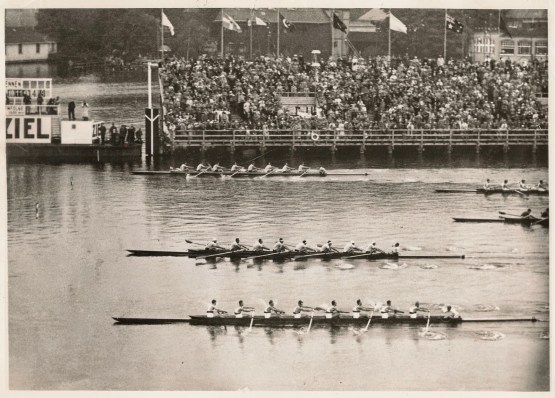
(1936 University of Washington rowers who won gold at the Berlin Olympics)

THE BOYS IN THE BOAT by Daniel James Brown is nothing short of a labor of love.  In describing the journey of the University of Washington rowing team from their blue collar origins, facing numerous financial obstacles, and confronting well funded opponents as they sought to represent the United States in the 1936 Olympic games in Berlin, the author has presented a riveting narrative that will touch the reader on many levels.  In addition to the personal stories that are described, Brown writes of the poetry that is a necessity for a rowing team to be successful.  The story is told through the eyes of many of the participants in their quest for rowing perfection, but a number of characters stand out.  The coaches;  Al Ulbrickson, a quiet taskmaster who keeps his emotions inside, his freshman coach, Tom Bolles, who develops many of the rowers; to Joe Rantz, who must overcome poverty and abandonment by his family, to George Pocock, the British craftsman who lovingly constructed the shells that the rowers would use on their way to Berlin and after.   The story begins in the Seattle area in the midst of the Great Depression and its impact on the region in general and the young men whose futures depend on making the University of Washington’s rowing team.

The story focuses on the life of Joe Rantz whose mother died of throat cancer when he was a nine and was sent to Pennsylvania to live with an aunt.  Later, his father remarries and when Joe returns to his family he does not get along with his knew step mother.  Eventually Joe’s father must make a choice between his son and his second wife and the family they were building.  After the family home burns down Joe is exiled to live in a school house away from the family for a period of time, when finally Joe’s father informs him that the family was moving away and that he had to remain and fend for himself at the age of fifteen.  For the next few years Joe employs the survival skills his father has taught him, and skills he developed on his own like poaching salmon and stealing alcohol for resale to overcome the obstacles he faces.  Finally, he is taken in by his married older brother and is able to graduate from high school and gain admittance to the University of Washington.  After being recruited by the freshman rowing coach, Joe realizes the ticket to his future was to make the rowing team.  Joe had little money and few clothes and lived in a room at the YMCA.  He took a number of menial jobs and fit them in around his studies and the torturous grind that was college rowing.  Brown follows the trials that Joe must overcome as he draws the reader into the narrative to the point that you do not want to put the book down.

I have read a number of books of the 1936 Berlin Olympics.  David Clay Large’s, THE NAZI GAMES: THE OLYMPICS OF 1936, and BERLIN GAMES: HOW THE NAZIS STOLE THE OLYMPIC DREAM by Guy Walters stand out, but Brown’s effort surpasses anything I have read for its detail, understanding the human emotion of sport, and how world events, particularly the rise of Nazi Germany impinged on the athletic stage.  Brown does a wonderful job of integrating the history of the time period into his narrative.  The reader is exposed to the devastation caused by the depression in the mid 1930s.  The unemployment and resulting poverty and their effect on families as fathers are forced to leave their children in order to seek a job elsewhere.  The Dust Bowl that blankets the Midwest at first and then destroys top soil throughout the United States resulting in the destruction of a major part of American agricultural production is reviewed in detail.  Overseas, the rise of Adolf Hitler to power is explained and the resulting violence against Gypsies, Jews, and Catholics is presented.  On a more personal level, Brown discusses the hatred between Joseph Goebbels, the Nazi Minister of Propaganda, and Leni Riefenstahl, Hitler’s chosen film maker as they fight over how the message of the Nazi ideal should be presented to the world.  The reader witnesses the laying of the foundation of what will grow into the Holocaust after the Olympic Games are completed.  The reader is made aware of the political infighting in the United States as President Roosevelt tries to deal with the problem of Nazi expansion.  In exploring these avenues, Brown places the Olympic Games in their proper historical context, and the importance of a Jesse Owens and the many athletes who sought to show Nazi racial theory for what it really was.

Apart from the personal stories of the nine men who will emerge from the rowing competitions from 1933 to 1936 in regattas such those on the Pacific coast, Poughkeepsie, New York, and the Olympic trials in Princeton, New Jersey what truly surprised me was the training that the rowers were exposed to.  I confess my knowledge of rowing is nil, but after reading Brown’s narrative I at least have some understanding of what the athletes went through.  The author’s description of “pain” cuts to the core of what these men accomplished.  For Brown the common denominator for the rower is that pain is “part and parcel” of the learning experience.  “It’s not a question of whether you will hurt, or how much you will hurt; it’s a question of what you will do, and how well you will do it, while pain has her wanton way with you.” (40) Brown’s discussion of the mechanics of rowing is important for the novice reader to understand what it means to have a successful “boat.”  In the case of the University of Washington’s first boat, “every one of them had come from humble origins or had been humbled by the ravages of the hard times in which they had grown up.  Each in his own way had learned that nothing could be taken for granted in life…..The challenges they had faced together had taught them humility—the need to subsume their individual egos for the sake of the boat as a whole—humility was the common gateway through which they were able to come together and begin to do what they had not been able to do before.” (241)

(US rowers win gold at the 1936 Berlin Olympic games)

The unbelievable demands of training, the fear of not having enough money for tuition each semester, feeling of anxiety, were among the many things that each rower had to overcome.  They knew the odds were stacked against them as their chief western competitor; the University of California had better facilities and financial support as did the eastern Ivy League schools.  Brown raises the important issue of social class in explaining the opponents the rowers had to contend with.  The ivy rowers mostly came from prep schools, had parents who were bankers and lawyers, and did not have to worry about their futures.  On the other hand, as Brown eloquently describes Joe Rantz and his team mates were blue collar in origin, and poverty was their life’s norm.  Brown’s rendition of the important characters in his narrative is sensitive and honest and as the story progresses the reader is rooting for “U Wash,” and as the author explains strategy, motivation, and the details of each race you feel as if you are sitting in the shell with the rowers, or you are inside the head of Bobby Moch, the coxswain, planning his next move as the rowing process has a very important cerebral component.

The author presents the pageantry and ostentation that was the 1936 Nazi Olympics in great detail.  He describes the hiding of any evidence of what Nazism was in reality; from removing the Gypsies, to taking down all evidence of anti-Semitism, and the vicious articles in the Nazi newspaper Der Sturmer, magically disappearing.  Brown describes the first six rowing competitions in which the Germans won five gold medals.  He reserves his best for the final race involving the nine on nine competition that all looked forward to.  It is interesting how the US boat was placed in the worst lane, when having won the preliminary race they should have had the best one.  Needless to say, the US rowers were at a disadvantage from the outset.  Brown’s overall description of the race is amazing as the reader can hear his voice as if he were rendering the race’s description vocally as a play by play on the radio that millions across America were listening to.  The US would win the race by six-tenths of a second over Italy and one second over Germany as Hitler stood up and immediately walked out.  After reading Brown’s rendition of the race I immediately found a You Tube film on my lap top and watched the emotion of the rowers at the race’s conclusion over and over.  THE BOYS IN THE BOAT is a wonderful story, and what makes it better is that it is shows the triumph of the human spirit and though it is a “sports” book, it is one that can be enjoyed by all.

THE HEIST by Daniel Silva

CaravaggioContarelli.jpg

(Caravaggio’s, “The Calling of St. Matthew,” 1599-1600)

It seems that each time a Daniel Silva novel involving Gabriel Allon, the master art restorer/Israeli special operations practitioner is published conflict in the Middle East region flares to a new level.  This summer is no exception as Israel trades rockets with Hamas in Gaza; ICIS has taken over large swaths of territory in Syria and Iraq, and the mass killings by the Assad regime in Syria continues.  Silva’s current volume, THE HEIST is a typical Allon yarn with periodic references to world events interspersed.  The book opens with the murder of a former British spy turned art middleman named Jack Bradshaw whose body is found in Lake Como, Italy by one of Allon’s circle of friends, the London art impresario, Julian Isherwood.  From that point on the plot is a bit different from the normal Allon escapade.  It centers on an art scam concocted by Allon to recover the Italian Renaissance painting, Nativity with St. Francis and St. Lawrence, by Michelangelo Merisi da Caravaggio.  As the initial plot unfolds characters from previous novels make their appearance, some with major roles.  Those familiar with previous works by Silva will recognize the assassin, Christopher Keller; Don Aton Orsati, the Corsican mobster; and the Swiss NDB counterterrorism expert, Christoph Bittel.  After reading about two-fifths of the novel the first plot comes to a conclusion and we are exposed to the second that is more in line with the previous formula used by Silva in his Allon series.

(the carnage that is the current civil war in Syria)

During the first part of the novel the reader is exposed to the underworld of the high end art trade that exists, particularly in Europe.  Allon emerges from this section of the story uncovering an ingenious way to preserve wealth that leads to the Assad family in Syria.  Silva’s thesis, based on significant contemporary research seems quite accurate, that the Assad family and their allies have hidden billions of dollars in wealth in banks in many parts of the world.  Realizing that some of this wealth has been frozen by certain governments and more might be in the future, the Assad dynasty uses stolen art as a hedge against any future loss of wealth that might detract from any exile should the dictator of Damascus be overthrown.  At the conclusion of the first plot, Allon realizes that art is a conduit to Assad’s wealth and he has squirreled away billions of Euros across the globe.  Allon designs an intricate sting to try and make Assad’s wealth vanish.  The usual suspects make up Allon’s team; again many have appeared in previous novels.  We welcome Eli Lavon, now an archeologist; Uzi Navot, soon to be replaced as the head of Israeli intelligence; Allon’s now pregnant wife, Chiara; Viktor Orlov, the London based former Russian oligarch; and Nigel Whitcomb and Graham Seymour, both of MI6 among others.  There are a number of new characters as Silva weaves his way through the underside of the European banking system and the intricacies of Syrian intelligence.

It took me a little longer than usual to get hooked on Silva’s plot line, but once I did it kept me in its grip.  To Silva’s credit, he avails himself of any chance to integrate the true background history of the story whenever he can.  In introducing the character of Jihan Nawaz whose family was killed by the regime of Hafez al-Assad in the massacre of Hama in 1982, Silva provides a mimi-biography of the dictator who ruled Syria from 1970 to his death in 2000 and his attempt to wipe out the Moslem Brotherhood who opposed his regime.  When speaking about Russian support for the current leader of Syria, Bashir al-Assad, Silva explains the Russian-Syrian connection and the role of Putin, and the recent Russian seizure of the Crimea.  In fact, had Silva waited a few months and postponed publication he could have worked in further developments in the ongoing Syrian civil war and Putin’s attempts to seize eastern Ukraine and his role in the downing of the Malaysian passenger air plane a few weeks ago.  If you have followed the previous thirteen Allon mysteries, the current episode should be satisfying, but I wonder after fourteen books if Silva’s formula is becoming a little stale.

WARBURG IN ROME by James Carroll

(Vatican City, Italy)

As a person who has enjoyed James Carroll’s work over the years whether he was presenting his history of the Church and Jews in CONSTANTINE’S SWORD; the difficulties of a father and son relationship during the Vietnam War in AN AMERICAN REQUIEM; or an exploration of the Pentagon and the expansion of American power in HOUSE OF WAR, I have grown to expect an absorbing read each time I pick up one of his books.  Carroll, who is an ordained Catholic priest who left the priesthood to become a writer, is also a novelist and his newest book, WARBURG IN ROME did not disappoint.  Carroll’s historical research and clerical background allowed him to explore numerous plots in his latest effort as he struggled with the role of the Catholic Church and its bureaucracy during and after World War II.   The story centers on David Warburg, a Yale University trained lawyer who worked in the Treasury Department and is assigned to head the War Refugee Board (WRB) in Rome in 1943.  We learn that the reason Secretary of the Treasury, Robert Morgenthau, Jr. appointed him was that he believed he was part of the Jewish Warburg banking family which would solve a number of political problems for the Roosevelt administration.  The fact is Warburg is from Burlington, VT which came as a surprise to many politicians and bureaucrats.  Since the appointment could not be withdrawn, the New England as opposed to the New York Warburg headed off to Rome to facilitate the removal of Jews from Nazi extermination camps.

The title WARBURG IN ROME is a misnomer as there are a number of characters who are as important to Carroll’s story as the new head of the WRB.  The story traces Warburg’s own personal voyage of faith and rediscovering his Jewish roots.  Driven by the world’s insensitivity to the plight of thousands of Jews who remained in European deportation camps following the war; with Palestine closed by the British, the United States closed by the State Department, Warburg’s journey progresses from casting his father’s tallit to opening his heart to a new found Judaism.  Warburg resigns from the WRB and begins working illicitly with the Jewish Defense Committee to break the “ratline” that Himmler had set up to assist Nazi higher ups attempted to flee Europe and reach Argentina.  Marguerite d’Erasmo in 1943 was the head of the Women’s and Children’s Committee for Italy.  After the Nazis seized Rome after Mussolini fell she worked in Red Cross refugee camps and hid records of Jews the remainder of the war to save them from extermination.  D’Erasmo personal voyage is as important as Warburg’s.  Her journey begins as a devout Catholic in Rome, morphing into a partisan fighter in Yugoslavia.  After witnessing the horrors of Croatian anti-Semitism and murder, she goes on to try and save women and children in a Nazi detention camp.  Failing to free these people from the grip of the Nazis she moves to Palestine and converts to Judaism.  Upon her return to Rome she gather’s intelligence to block Himmler’s escape route from Vienna, through Rome, on to Argentina using the Vatican as its conduit.  Other characters emerge that are part of the novel’s core; Father Kevin Deane, sent by Archbishop Spellman of New York to Rome to oversee aid to refugees.  Giacomo Lionni, a partisan fighter in the Balkans nicknamed, “Jocko” devotes his life to saving Jews. General Peter Masters, at the outset a friend of Warburg, works at cross purposes with the WRB as he represents American intelligence agencies that are cooperating with the Vatican, Nazis, and Croats against the Soviet Union as relations with Stalin continued to deteriorate.  There are a number of characters who are part of the Vatican bureaucracy, Monsignor Tardini, the Director of the Pontifical Relief Committee, Cardinal Maglione, the pro-Nazi Secretary of State for the Vatican, and of course, Pope Pius XII who hated communism and did not want a victory against Hitler to be turned into a defeat by Stalin.


Carroll’s novel spends a great deal of time exploring the role of the Vatican after World War II.  The church did hide and assist many Jews, but it also hid many Nazis and facilitated their escape from allied hands.  The church was vehemently anti-communist and was involved in trying to over turn the allied policy of “unconditional surrender,” and make a separate peace with Germany in order to restore a Catholic Danubian Federation under the Hapsburgs as a bulwark against communism.  After the federation failed, the church worked to restore members of the Ustashe, the Croat Nazis to power in a new Catholic Croatian state that would be anti-Tito.  What stands out in Carroll’s narrative and dialogue between characters is that the reader is witnessing history and in a sense what the author has created is a history of the refugee crisis, the flight of the Nazis, and Vatican machinations to create an anti-communist coalition during and after World War II wrapped up in a novel.  Carroll’s book is sound historically and reflects tremendous research and through his characters presents the dilemmas facing allied policymakers after World War II in coping with the remnants of the Holocaust and how to deal with an emerging world power in the Soviet Union.

(Heinrich Himmler, the mentor for Father Ricardo Lehmann)

Carroll does a splendid job exploring the contradictions and diverse viewpoints following the war.  For example, Warburg and Mates clash over the probable Irgun bombing of the British embassy in Rome following Prime Minister Atlee’s expansion of refugee camps for Jews on Cyprus, as Jews were denied entrance into Palestine.  Warburg is incensed that the WRB is shut down because of Mates’ OSS (precursor of the CIA) accused him of only working for Jews.  Mates offers the usual anti-Semitic rationale that Jews were most likely to be communist and a security risk as refugees, so they should not be allowed into the United States or Palestine.  Understanding Carroll’s storyline is like peeling an onion as layer after layer of the plot and the background of each character is laid bare.  We see Father Ricardo Lehmann, a German priest assigned to the Vatican whose mentor was Heinrich Himmler.  Following Himmler’s suicide Lehmann works to maintain the “road out” using Vatican documents that allowed Nazi war criminals to travel from Vienna to Buenos Aires, with an assist from the Croatian Catholic network of Franciscan monks.

(Father Maglione, Vatican Secretary of State who assisted Nazis fleeing Europe after World War II)

The story itself presents numerous moral decisions that characters must make, decisions that in real life have been explored by historians for decades to try and ascertain the true motivation of historical figures during and after the Holocaust.  Carroll makes a valiant attempt at doing so through his own characters as he has done in previous works of non-fiction.  As the story draws to a close, Father Deane realizes that because of Vatican machinations many church officials were “in bed with Nazis.”  Deane tries to deal with what he has witnessed and cries out, “ Pavelic, Lehmann, Strangl the Treblinka commandant, for the love of God!  Living in our religious houses.  Nazis in monasteries and convents.  Vichy collaborators protected.  The protectors promoted.  Gestapo killers with Vatican passports.  The church welcoming them in Argentina.” (353)  He prepares a report of Vatican culpability, and he knows it will go nowhere as he must submit it to Vatican authorities, raising moral questions he cannot deal with and comes to the conclusion that the church itself is not guilty, but church officials are.  The book provokes a great deal of thought on many levels and I wondered what Vatican policy might have been during this time period, if the current head of the Papacy, Pope Francis had been in office.  WARBURG IN ROME is an exceptional read.

THE GOOD SPY: THE LIFE AND DEATH OF ROBERT AMES, by Kai Bird


(The US Embassy, Beirut, Lebanon after the bombing, April, 1983)

As I write, rockets continue to be launched from the Gaza Strip by the militant group, Hamas, and Israel continues to retaliate with massive bombing and ground forces.  As this tragedy continues to unfold, Kai Bird’s latest work that deals with the Arab-Israeli conflict, THE GOOD SPY: THE LIFE AND DEATH OF ROBERT AMES is extremely timely.  When one thinks of the CIA operatives who have impacted the Middle East, the names of Miles Copeland, Kermit Roosevelt, and William Eveland come to mind, but usually not Robert Ames.  However, when one calculates the impact of these operatives on events in the region, Ames’ name should emerge near the top of the list.    Bird, who during his teenage years was a neighbor of Ames, recounts his private and shadow life as a CIA operative in great detail, but what he has written is more than a general biography.  He places Ames’ career that encompassed the years 1962 through 1983 in the context of events throughout the Middle East concentrating on the Palestinian-Israeli Conflict and the Lebanese Civil War that raged between 1975 and 1983.  What separates Ames’ work from others who have attempted to facilitate peace in the region is that he was the individual who “brought the Palestinians in from the cold” through his relationship with Yasir Arafat’s intelligence chief, Ali Hassan Salameh. (15)  The book opens at the White House with a smiling President Clinton cajoling Yitzchak Rabin and Arafat into signing the 1993 accord granting the Palestinians a degree of self-government in Gaza and the West Bank.  Bird argues throughout that this agreement would not have been possible without Ames, and that his death during the American embassy bombing in Beirut in 1983 was a blow to the peace process because of Ames’ ability to empathize with Palestinians, gain their trust, and behind the scenes work to establish a relationship between the Palestine Liberation Organization and the US government in order to foster negotiations with Israel for a permanent peace.

During his first posting in 1962 in Dhahran, Saudi Arabia Ames became the protégé of Richard Helms who later would become the Director of the CIA.  Like Helms, Ames came to believe in human intelligence, not splashy technical operations or the application of force which tends to bring too much attention to CIA operations.  Ames wanted to remain in the “shadows” gathering intelligence from his contacts in making recommendations for policy.  For Ames “violence was usually impractical, ineffective, and costly.” (37)  In the early 1960s the CIA came to place a high value on officers who could develop human resources.  To do so they recruited agents who could remain anonymous, apply discretion and ironclad secrecy in cultivating sources.  These qualities were difficult to find, but along with “commonsensical powers of observation,” Robert Ames was the perfect operative.  Employing these skills for over two decades from postings in Saudi Arabia, Iran, Kuwait, Yemen, Lebanon, and Langley, Va., Ames developed numerous sources that allowed him to alter American Middle East policy and work to find a solution to the many conflicts in the region.

Bird does an excellent job explaining the background history of the Palestinian-Israeli Conflict as well as the Lebanese Civil War through the lives of the most important historical characters.  He focuses on many individuals but zeroes in on those who interacted with Ames the most.  The two most important people are Ali Hassan Salameh, who followed in his father’s footsteps by fighting for Palestinian statehood and eventually he was recognized as one of the top two Palestinian military commanders and the eventual successor to Yasir Arafat.  The second was Mustafa Zein, educated in the US and was a very successful business consultant in Beirut.  Zein had many contacts in the Arab world and believed he could help bridge the political and cultural divide between America and the Arabs.  Ames would develop genuine friendships with these individuals and would work behind the scenes using Zein’s contacts to foster a strong relationship with Salameh.  Bird details how Ames was able to ingratiate himself with a man so close to Arafat and once he is able to do so, what the implications of that relationship were.  Though Salameh was seen as a terrorist by the US and Israeli governments, Ames were able to convince CIA and other national security officials in Washington of the benefits of establishing some sort of tie to the PLO.   At the time the PLO was labeled a terrorist group by the US and officials were banned from having any contact with them. In the early 1970s Ames relationship with Salameh established a back channel for PLO-US communication that President Nixon and Henry Kissinger were aware of, and Arafat approved.  With the Jordanian Civil War and the formation of Black September resulting in the Munich Olympic massacre in 1972 Ames worked through Zein to establish further links with Salameh who grew distant at times when elements other than Ames within the CIA tried to officially recruit him.  Ames realized that would make Salemeh a candidate for elimination by radical elements and just wanted to maintain his “friendship” with him.  The book at times is a dual biography of Ames and Salameh and stresses how their lives interacted as each tried to use each other for the benefit of the causes they believed in.

(Robert Ames)

Bird does a superb job explaining the intricacies of the political rivalries within the Arab world and how the US could take advantage of it.  He explores the relationship between the CIA and the Israeli Mossad and the conflict that usually remained dormant between these two intelligence groups.    The Mossad resented Ames’ work with Salameh who they blamed for the Munich massacre.  On a number of occasions Ames warned his source about assassination attempts against him, in part because of his friendship, and in part because he was so integral to what Ames was trying to achieve.  As their relationship progresses it becomes clear that Ames is not objective when it came to the Palestinians.  He developed an emotional attachment to them and in a number of ways reminded me of an American version of T.E. Lawrence.  As Bird writes, “to say that Bob Ames was sympathetic to the Palestinian cause would be an understatement.  He empathized with them deeply and admired Ali Hassan to a degree that is hard to explain.  He knew that Salameh had done some terrible things” and he wrote his wife Yvonne, “It is hard to believe our friend was what he was.”  But, being that Ames was the CIA’s only conduit to the PLO he was given great latitude and to his credit usually his subjectivity was not an impediment to his work.

The most important parts of the book aside from development of the Ames-Salameh partnership was Bird’s description of the Lebanese Civil War from 1975-1983.  Bird explains the different Lebanese factions and how they came to be and how they impacted events.  Bird also explores in detail the connection between events in Lebanon and the development of a plan in the early Reagan years to use Arafat as a vehicle for peace.  Ames was directly involved in negotiating an Arafat-US rapprochement, especially after he and his fighters were forced out of southern Lebanon and were given safe haven in Tunisia.  Bird’s description of the harrowing bombing of the US embassy in Beirut in 1983 that killed Ames and the bombing of the US Marine barracks shortly thereafter are very accurate.  As he does throughout the narrative Bird relies on his firm grasp of history and numerous sources within each government and movement.

The last section of the book focuses on who might have been responsible for the various acts of terror that occurred in Lebanon and an exploration of the role of Iran and its allies in the bombings.  Bird’s conclusion is that the perpetrator of these acts is currently living comfortably in the US under CIA protection is very disturbing.  Bird also reiterates his thesis that Ames laid the ground work for the 1993 accords and conjunctures as to what might have been accomplished had Ames not perished in the 1983 embassy bombing.  Bird’s writing is crisp and his conclusions reflect a great deal of thought and are usually very accurate.  The book is an important addition to the literature of its subject, and if one would like another perspective in trying to understand what is currently presented on the news each hour, then Bird’s book is for you.