CHASING THE LAST LAUGH: MARK TWAIN’S RAUCOUS AND REDEMPTIVE ROUND-THE-WORLD COMEDY TOUR by Richard Zacks

(Mark Twain)

In 1896 Mark Twain faced a debt of $79,704.80 to assorted creditors with his publishing firm Charles L. Wilson and Company and his investment in a new style of typesetting as being his most egregious.  The debt was substantial and would calculate to roughly $2,220,474.90 in today’s dollars.  This large amount served as the motivating force behind Twain’s round-the-world-stand-up comedy tour between 1895 and 1896.  In the appendix of Richard Zacks’ new book, CHASING THE LAST LAUGH: MARK TWAIN’S RAUCOUS AND REDEMPTIVE ROUND-THE WORLD COMEDY TOUR Twain’s debts are listed individually and one gets the feeling that this iconic and brilliant observer of the human condition was a rather poor investor.   Twain would travel across the American west, Australia, New Zealand, Tasmania, India, Ceylon, and South Africa in an attempt to take his fees and eradicate as much of the debt as possible.  This global journey which at times reads like a Rick Steeves travelogue is described in delicious detail by Richard Zacks who allows Twain’s own words, recorded in letters, newspaper accounts, and his own notebooks tell the story of their journey.  The journey concluded in England where he wrote a travel book about his experiences in another attempt to reduce his debt.

Twain who hated to perform on stage was America’s highest paid author and one of America’s biggest investment losers.  He would perform 122 nights in 71 different cities, in addition to spending 98 nights at sea of which he was afflicted with a myriad of illnesses including repeated bouts with painful carbuncles during his tour as he used a number of pre-modern and modern conveyances to earn enough money to “talk his way out of hell and humiliation” of losing his entire fortune and a good part of his wife Livy, a coal heiress’ wealth also.

Zacks describes the initial success of his publishing company publishing the memoirs of Ulysses S. Grant and other works, but this profitability succumbed to embezzlement, poor choices of publications, and the death of Henry Ward Beecher before he could complete his memoirs.  Compounding Twain’s problem was that the United States was in the gripe of the Depression of 1893 creating the fear that Twain could not only loose his publishing house, but also the copyrights to his writings, his life’s blood.  Twain also faced loses on Wall Street after sinking money into inventions that proved to be expensive failures.

Zacks does a nice job reviewing Twain’s financial machinations and his relationship with H.H. Rogers, a partner in Standard Oil who befriended the insolvent author and tried to “bring Mr. Clemens” to some sort of financial solvency, the key to which was declaring bankruptcy for his publishing company, and transferring his copyrights and other assets to his wife Olivia Livy as a means of hanging on to his life’s work.


(Mark Twain, Olivia Livy Twain and their three daughters, Clara, Jean, and Susy)

After spending the first part of the book describing Twain’s financial travails Zacks prepare what appears to be an annotated travelogue of Twain, his wife Olivia and their daughter Clara as they work their way across the western United States and board ship for Australia and beyond.  Twain’s humiliation was complete before he left on his journey as the New York State Supreme Court pronounced a judgement against him of $31, 986, and Twain grew ill from the idea that he was a pauper and thanked god that no laws against the indigent existed in the Empire State.  Once the journey commences Zacks does a commendable job integrating Twain’s written material and comments into the narrative as he performs on tour.*  Twain grew stressed when certain audiences expected a comedy routine as opposed to his normal literary and societal aspects of his presentations.  Though negative comments and reviews were few and he was broadly praised throughout, Twain was very sensitive to criticism though his approach of just “chatting” with his audiences as technique was very successful.  Throughout the journey Twain grew depressed he would never be able to repay his debts, but his wife Livy and Rogers were able to temper his feelings and control his finances.

The best description of Twain during his journey was offered by Carlyle Smythe, his agent in India, he states that Twain is “a sedate savant who has been seduced from the path of high seriousness by a fatal sense of the ridiculous.”  When the arduous tour finally came to an end, Twain was overjoyed stating “that the slavery of it….is so exacting and so infernal’ and hoped never to experience it again.


(Mark Twain and his friend and benefactor, H.H. Rogers)

Twain’s observations throughout the book are interesting as his comments range from the ecology of Australia, the wonders of India, especially their “colorful costumes,” to the Anglo-Boer conflict raging in South Africa.  What is surprising is that Twain, known in the United States as an anti-imperialist had nothing but praise for the British Empire, particularly as it related to India causing him to be blind to the oppressions and the humiliations of English rule.  To Twain’s credit he did comment negatively concerning the machinations of Cecil Rhodes and British policy in South Africa.  The book also served as a form of therapy for Twain when his daughter Susy died of spinal meningitis in the United States while he was writing and he could not be with her or attend the funeral.  He castigated himself for creating the debt that forced the family to separate for the world tour to earn enough money to rectify the family’s financial situation.

Overall the book makes for a fascinating read about one of America’s most important humorists and literary figures and zeroes in on the trials and tribulations that Twain and his family suffered very late in his career.  Twain was able to overcome his debt situation thanks to his good friend H. H. Rogers, an executive for Standard Oil, and in the end pay he would pay off all of his debts and live a life free of financial worries.

*For those interested in researching Twain’s life in detail the University of California press has published over 2000 pages of Twain’s daily dictations written between 1907 and 1909 encompassing his entire life in the form of an autobiography.  The three volumes are edited by Benjamin Griffin and Harriet Elinor Smith and are the first comprehensive edition of all Mark Twain’s work fully annotated by the editors of the Mark Twain Project at the University of California.

(Mark Twain)

THE GEORGETOWN SET: FRIENDS AND RIVALS IN COLD WAR WASHINGTON by Greg Herken

(Joseph and Stewart Alsop,  journalists who greatly impacted American foreign policy during the Cold War)

When one discusses the value of real estate one usually encounters the phrase “location, location, location.”  This could be the theme of Greg Herken’s THE GEORGETOWN SET: FRIENDS AND RIVALS IN COLD WAR WASHINGTON, a book centered on a Georgetown, Washington, D.C. neighborhood after World War II, whose residents included the Alsop brothers, Jack and Jaqueline Kennedy, Ben and Tony Bradlee, Allen and Clover Dulles, Dean and Alice Acheson, Philp and Katherine Graham, Averill and Marie Harriman, Frank and Polly Wisner among others.  Within the group you had a future president and Secretary of State, the head of the CIA and other operatives, two ambassadors to the Soviet Union, influential journalists, and the owner and editor of the Washington Post. The neighbors who were known as the “Georgetown Set,” were at the forefront of American policy as the Cold War began and evolved, as Dean Acheson entitled his memoirs, they were PRESENT AT CREATION, and a few of them lived to see the curtain fall on the conflict with the communist world.  These individuals were not only neighbors, for the most part, they were close friends.  They had attended the same boarding schools and universities and “believed that the United States had the power—and the moral obligation—to oppose tyranny and stand up of the world’s underdogs.”  They held a sense of duty and the belief in the “rightness of the country and its causes—which were, more often than not, their own.”

Unlike today, it was a time of consensus in foreign policy in dealing with the Soviet Union, partisanship was an afterthought.  The outset of the Cold War produced the Marshall Plan, the Truman Doctrine, Point Four, and NATO, but the mindset of these individuals would also lead to mistakes embodied in the disastrous coups of the Eisenhower era, the Bay of Pigs, and the Vietnam War.  Greg Herken tells the story of these influential people, how their ideas dominated American policy, and what the ramifications of that influence were.  The reader is exposed to intimate details and tremendous insights as these power brokers are examined, and it makes for a fascinating read.

(Katharine Graham, owner and editor of the Washington Post)

The narrative focuses on the most important foreign policy debates of the 20th century, where the residents of Georgetown aligned themselves, and how their views affected the success or failure of presidential decision making.  Once the Nazis and the Japanese were defeated in 1945, the foreign policy debate focused on the communist threat and the motives of the Soviet Union.  The debate was symbolized by George Kennan, who at one point was head of the Policy Planning Staff in the State Department as well as stints as ambassador to the Soviet Union and Yugoslavia; and Paul Nitze, former Secretary of the Navy, and author of NSC-68 which along with Kennan’s “X Article” formed the basis of American policy toward Russia for well into the 1980s.  The debate centered on “whether it was America’s moral example or material power that kept the Russians at bay” during the Cold War.   Many other individuals draw Herken’s discerning eye during the period, the most important of which were Joseph and Stewart Alsop, the journalism brothers who advised presidents, and helped articulate positions on Vietnam and Cuba that some would argue pushed our nation’s chief executives into making unwise policy choices.

At times the book reads like a biography of the Alsop brothers as Herken develops their careers as the centerpiece of the monograph.  Of the two, Joseph Alsop dominated their relationship and developed numerous sources within the national security apparatus in presidential administrations from Truman through Nixon.  Joseph Alsop had his own agenda and his columns created enough pressure on Lyndon Johnson that many believe forced him to consider Alsop’s readership when making decisions about Vietnam, a subject that Alsop seemed obsessed with and had difficulty accepting any information that contradicted what he believed.  The Alsops hosted numerous dinner parties that were used as conduits to different presidential administrations as conversations yielded information that turned up in their newspaper columns.  Herken almost makes the reader as if they are invited guests to the Sunday night gatherings among the “Georgetown Set” and at times the reader might feel like a “fly on the wall” as you witness history being made.  In addition to the Alsops, the inner sanctum of the Washington Post is laid bare as great events are reported.  We see the newspaper under the stewardship of Philip Graham at the outset of the Cold War until his suicide, when his wife Katharine takes the reigns of the paper and turns it into a strong competitor to the New York Times. Reporting on Watergate, My Lai and other issues reflected Katharine Graham’s growth as the head of a major newspaper and her dominant role in Washington politics.

(Frank Wisner II, the son of an OSS and CIA operative who developed and implemented numerous covert operations during the Cold War.  Wisner II developed his own diplomatic career and did not follow the career path of his father)

The book also centers on the evolution of the American intelligence community from the Office of Strategic Services (OSS) during World War II to the creation of the Central Intelligence Agency (CIA).  Herken focuses most of his attention on Allen W. Dulles, who worked under Wild Bill Donavan who headed the OSS, and would later head the CIA under President Eisenhower and for a short time under John F. Kennedy; and Frank Wisner, an OSS and CIA operative who was known for his outlandish covert plans, i.e.; trying to overthrow the government of Albania, dropping propaganda leaflets and intelligence operatives behind the “iron curtain” among many of his projects.  CIA involvement in Vietnam, Iran, Cuba, and Guatemala are dissected in detail and Herken correctly points to current issues that date back to Dulles, Wisner, and numerous other individuals in the intelligence community, and how they negatively affected American foreign policy for decades.

(President John F. Kenndy and First Lady Jacqueline Kennedy were frequent visitors in the “salons” of Georgetown)

The books serves as an important window into the lives of people who dominated the American foreign policy establishment throughout the Cold War.  Herken seems to assess all of the major decisions that were made during the period, as well as evaluating each of the characters presented and how their lives affected the course of American history.  Many of the individuals that Herken discusses are well known, but others are brought out of the shadows.  One of the most interesting aspects of the book is when Herken muses about the lives of the children of the “Georgetown Set,” and how the generation gap that developed in response to the civil rights and anti-war movements of the 1960s affected the next “Georgetown” generation.

Herken writes with flair and has exceptional command of his material and sources and has offered a unique approach to the causes and results of the Cold War that should satisfy academics as well as the general reader.

VENDETTA: BOBBY KENNEDY VERSUS JIMMY HOFFA by James Neff

(Robert F. Kennedy and Jimmy Hoffa, 1957)

The title VENDETTA of James Neff’s new book that deals with Robert F. Kennedy’s quest to bring Jimmy Hoffa to justice is chilling from the perspective of how unions, organized crime, and businesses colluded to defraud union members, the government, and the general public.  Neff begins his story with the assassination of President John F. Kennedy on November 22, 1963 that provoked a reaction from his brother Bobby, “there’s so much bitterness, and I thought they’d get one of us….I thought it would be me.” (6)  At the time Robert Kennedy was the Attorney General and was in the midst of his Justice Department’s prosecution of Hoffa for witness tampering, real estate, and pension fraud.  This would culminate in Hoffa’s conviction in early 1964 that ended a seven year journey for Robert Kennedy to bring the corrupt Teamster President to justice.  Despite the conviction, Kennedy remained unsettled because he could never be sure that Hoffa, who danced on his desk and shouted with glee when learning of the president’s assassination, was not behind his brother’s death.

Neff, a Pulitzer Prize winning investigations editor at the Seattle Times has written a comprehensive and engrossing history of the relationship between the Kennedy brothers and Jimmy Hoffa.  He explores all the major characters who were involved in that relationship and presents an objective and well written account of a very important aspect of American labor history.  Neff introduces both protagonists with short biographies of each and we learn that Robert Kennedy saw himself as a crusader against what he perceived to be labor injustice, and Jimmy Hoffa, who believed he was a victim of a class war by the rich Kennedy’s as he was convinced that he was unjustly persecuted for seven years until they finally nailed him.  During that time the author leads the reader through RFK’s appointment to the staff of the Senate Sub-Committee on Organized Crime headed by Alabama Senator John L. McClellan.  RFK’s brother was also a member of the committee and wanted to use it as a stepping stone to enhance his presidential credentials.  RFK zeroed in on the influence of organized crime and their infiltration of labor unions, and made Jimmy Hoffa his target as the epitome of what he was trying to prove that would hopefully lead to strong congressional legislation to weaken the criminal hold on American labor.  Neff describes an obsessed Robert Kennedy over a seven year period trying to prosecute Hoffa and put him behind bars.  Their conflict was epic and after a few committee hearings Hoffa was convinced he was being unjustly targeted which was the source of their personal vendetta.

(Robert Kennedy and John F. Kennedy during the Senate McClellan Committee hearings into organized crimes influence on labor unions)

Neff provides the reader with intricate details employing committee transcripts and analysis as the McClellan hearings evolve.  The reader is present in the Senate chambers and can easily grasp the hatred between the two men.  Neff discusses each character that is mentioned in detail whether it is Edward Bennett Williams, the suave and sophisticated Capitol Hill lawyer who defended Hoffa; Bernard Spindel, a New York veteran from World War II trained in electronics who developed advanced eavesdropping devices for Hoffa; Walter Sheridan, RFK’s alter ego at the Justice Department who led the prosecution of the union leader; to David Beck, the crooked Teamster President who preceded Hoffa.  These are just a few of the important players in the narrative, and Neff is able to weave many more into the story.  As you read on it appears that Neff has left no stone unturned in his research.  He explores legal strategy, mob participation, intimidation tactics, and the stretching of constitutional guarantees by the Justice Department.  Neff takes us into strategy sessions, Hoffa’s labor meetings, and Kennedy’s office as we learn how each component of the overall story will unfold.

Kennedy’s obsession led to the “Hoffa Strike Force” once his brother convinced him to become Attorney General.  It is here that Neff recounts conversations and other details as the hatred between Kennedy and Hoffa comes to a head.  We witness how slippery Hoffa was to prosecute and convict and for seven years Kennedy was almost at a loss as to his failure.  Hoffa was elected Teamster president and his overall influence and popularity among union members could not be broken.  One of the most interesting aspects of the book was the 1960 Presidential election.  Recounting Hoffa strategy to block John F. Kennedy’s nomination the underside of politics is in full view.  The use of union funds, members, and other assets were fully employed by Hoffa first in the Democratic primaries and then in the general election as the teamsters were deployed in full to bring about the election of Richard Nixon, who in true Nixonian fashion promised Hoffa to protect him from the Justice Department once he was elected.  Another fascinating part of the book is the limited role FBI Director Herbert Hoover played in RFK’s quest.  Hoover was more interested in his own agenda who was not averse to using his own intelligence against the Kennedy’s, particularly their sexual escapades.

(Part of Hoffa’s strategy to get the Justice Department off his back was to use his union truckers to get out the message he was being persecuted by Robert Kennedy)

Perhaps the most important section of the book involves how the Justice Department finally is able to convict Hoffa of jury tampering and pension fraud in 1964.  Using a former Hoffa ally as a plant in return for a plea deal, RFK’s people are able to surprise Hoffa during the first trial for witness tampering and destroy his defense.  Once convicted his next trial for pension fraud was easier to prosecute.  Attempts to appeal failed as the Supreme Court ruled against him and Hoffa would be imprisoned until pardoned by Nixon in 1971.   Hoffa would suffer the same fate as Robert Kennedy as he is murdered in a Detroit suburb in 1975, probably a mob hit, but to this day we are not sure since a body has never been found.

Neff’s skill as a narrative historian allows the reader to immerse themselves in the story and I will admit it was difficult to put down.  The book reads like a crime novel, but in reality it is the sordid history of the Teamsters Union over decades culminating in the reign of Jimmy Hoffa.  The book is an excellent read and numerous interesting and surprising things will emerge in what really can be categorized as a courtroom thriller.

DAYS OF RAGE: AMERICA’S RADICAL UNDERGROUND, THE FBI, AND THE FORGOTTEN AGE OF REVOLUTIONARY VIOLENCE by Bryan Burroughs

As I sat down to prepare a review of Bryan Burrough’s latest work, DAYS OF RAGE: AMERICA’S RADICAL UNDERGROUND, THE FBI, and THE FORGOTTEN AGE OF REVOLUTIONARY VIOLENCE I learned that today a gunman had opened fire on a Navy and Marine Reserve Center in Chattanooga, Tenn., leaving four Marines dead, and a recruiter wounded.  These types of what appear to be “lone gunman attacks” symbolize the increase in domestic terrorism in the United States, attacks that I fear will continue and be further exacerbated by the call for even more violence by the likes of the Islamic State.  I hate to say that Burrough’s book is timely as it takes the reader back to a time period in American history when domestic attacks against targets that symbolized the government, in addition to banks, corporations, and other venues was very common.  Over forty years ago the United States went through a period of domestic terror that it had never experienced in its history.  Groups like the Weathermen, Weather Underground, the Symbionese Liberation Army (SLA), the Black Liberation Army (BLA), the Black Panthers, and the Fuerzas Armades de Liberacion Nacional Puertorriquena (FALN) as well as a number of freelance operators conducted bombings, murder, prison escapes, and robberies.  Though they seemed to concentrate on New York, Chicago, San Francisco, Oakland, Washington, and Detroit, their targets were as far flung as Maine and Oregon.  Many of the names will be familiar; Bernardine Dohrn, Bill Ayers, Mark Rudd, Huey Newton, Eldridge Cleaver, Patty Hearst, Donald DeFreeze, and Mutulu Shakur.  However, Burrough’s assiduous research has turned up the work of many lesser known radicals whose deadly campaign caused much greater damage and impact than those mentioned.  What is fascinating is that many people have forgotten how violent this period in our history was.

Burrough’s is to be commended for putting together an exceptional history of the 196o’s through the early 1980s concentrating on the rise of domestic radicalism in the United States that began as a movement against the Vietnam War, but included demonstrations against racism, discrimination against blacks, the unequal distribution of wealth, and a movement for Puerto Rican independence.  Burrough’s contribution to this enormous topic is an almost encyclopedic narrative of every important radical group that appeared during the time period under discussion.  He seems to have interviewed every important radical who would speak to him that is still alive, and spent a great deal of time researching the response of the FBI and New York Police Department to situations that they had a great deal of difficulty containing.  What emerges is a complex story of bombing operations, including planning and implementation; sexual triangles among the radicals; sources of funding from surprising groups in society, particularly radical leftist lawyers; and a federal government that turned to many illegal weapons, from wiretaps, breaking and entering, and other methods to try and control the violence.  The book is not an easy read because of the somewhat disjointed way that it is organized.  There are chapters dealing with the rise of the Students for a Democratic Society and its split with the Weathermen, then it jumps to the development of the Black Panthers and the split that fostered the BLA, then returns to the Manhattan Townhouse bombing that killed a number of Weathermen.  Further, after ending a discussion of the Weather Underground, Burroughs moves on to the SLA, then after discussing the Hearst kidnapping, the Weathermen return.

(William Ayers and Bernadette Dorhn today)

Perhaps the most interesting aspect of the book revolves around the rise of the Puerto Rican independence movement that existed for decades before the FALN emerged as the most dangerous radical group that the FBI and assorted urban police forces had to deal with.  The biographies of, Oscar Lopez and Carlos Torres, the leaders of the FALN, and Guillermo “Willie” Morales, the FALN bomb maker are fascinating as well as disturbing.  The reader is exposed to two young FBI agents, Don Wofford and Lou Vizi, who were tasked to investigate the group, but the government had very little information to work with.  Both men pursued their prey for years, but had little to show for it for a long time.

Throughout the radical “movement” there was a great deal of disagreement.  The leftist underground was more concerned with the plight of black Americans than being against the Vietnam War.  Burroughs discusses the rise of a new generation of black militants who were influenced by Malcom X, the Cuban Revolution, and in particular the work and writing of Che Guevara.  He also spends a great deal of time detailing the split between the Black Panthers and the rising Black Liberation Army.  Black militants had a jaundiced view of the Weathermen because they saw them as white bourgeois types who were not militant enough.  Burroughs explains the different factions within the Weathermen (later underground) movement and how its split with the SDS hindered their growth.  All the important personalities are examined, including their relationships both personal and as soldiers in the “movement.”  What is most obvious about the majority of underground radicals is that these young people, as Burroughs points out “fatally misjudged America’s political winds and found themselves trapped in an unwinnable struggle they were too proud or stubborn to give up.”

(Fuerzas Armadas de Liberacion Nacional (FALN)

Julio, Andrés, and Luis Rosado, with Pedro Archuleta refused to testify before NY grand jury investigating the FALN in 1978.)

Most of Burrough’s work is a narrative of what seems to be every major “action” taken by these radical groups which can make reading parts of the book a grind.  However, throughout the book there are a series of nuggets that are very important.  For example, in 1970, 23 states had little or no regulation for the sale of dynamite.  It will amaze the reader how easy it was to purchase dynamite and other components to assemble a bomb, steal dynamite from construction sites, and the lack of security that existed at banks, corporations, and government venues that allowed radicals easy access to scope out their targets, and leave their explosives in bathrooms, elevators, and empty offices.  Another interesting detail involves the FBI as they created the 47 Squad to try and capture and control the radicals who were determined to overthrow the American government.  The tactics employed were ordered by the Nixon administration at the same time they were involved with dealing with the Watergate break in and investigation.  Despite the resources and the illegal tactics employed, the FBI made little headway in arresting these people, and any successes they experienced were more the result of luck than good police work.  Perhaps the most surprising thing that Burroughs unearthed was the makeup of the radical groups, particularly the SLA, BLA, and FALN.  Many of their members were criminals who had served time in Soledad, Attica, and San Quentin.  Some escaped, others paroled, but a significant number of “ex-cons” made up the membership of radical groups.  They had meshed in prison and they became a working network of soldiers to carry out operations in what they perceived to be a revolutionary struggle.

At times the narrative comes across as a “Bonnie and Clyde” type movement.  Operations were funded by robbing banks, explosives are stolen, and planning takes place in a network of safe houses nationwide.  Burroughs presents the major characters through mini-biographies, as well as their foot soldiers.  There is really no over ridding theme to the book other than the “rage against the system” that all radicals seem to believe in.  There are attempts to link some of the groups discussed and how they interacted, but in many cases it does not work.  For me the material is too bifurcated at times, but overall, Burroughs has written the definitive work on his topic, particularly because of his access to many of the participants forty years later.  If you are interested in this topic this book will be very satisfying, but keep in mind it is not an easy read.

Come and visit the Shapiro House at the Strawbery Banke Museum in Portsmouth, NH. You never know who will greet you at the door as you enter!

eShapiro

Shapiro House was the home of Abraham and Sarah Shapiro, Russian Jewish immigrants, and their American-born daughter Mollie, from 1909 to 1928. It is furnished and interpreted to 1919, to show how the Shapiros sought to balance their strong cultural identity with new opportunities in America. While Shapiro House is specifically about the Russian Jewish experience, it also reflects the early 20th-century multi-ethnic community at Puddle Dock, when half of its 600 residents were foreign born. The Shapiro story is a case study of the process of becoming Americans shared by all immigrants. It is a story of struggle and success, tragedy and triumph.

Between 1880 and 1920, more than 23 million immigrants came to America. Many came from Eastern, Central, and Southern Europe seeking freedom, work, adventure, property, and self-determination, in short, better lives for themselves and their children. The majority stayed in large urban areas – New York, Chicago, Boston – but about 25% chose smaller cities and towns, including Portsmouth, New Hampshire. At the turn of the twentieth century, immigrants from Ireland, England, Canada, Italy, Poland, and Russia lived in and around the Puddle Dock neighborhood, alongside native-born residents. Abraham and Sarah were part of a complex network of international families within the community. Born in Ukraine, Abraham Millhandler and Sarah Tapper emigrated to America as young, single adults to reunite with family members who had come earlier. Abraham changed his name to Shapiro, as had his older brothers, Simon and Samuel. In 1905 he married Sarah, his sister-in-law, reinforcing kinship ties that had been established in Russia, even as they made new lives in America.

Part of a small Russian Jewish community, these families relied on each other for financial assistance, jobs, and emotional strength. With other families they established a Hebrew School for their children, opened kosher shops, and founded the Temple of Israel to serve their traditional cultural and religious needs. They established new businesses, particularly the scrap metal yards which flourished at Puddle Dock into the 1950’s. They became retail clothing merchants and shoe manufacturers. For most of his life, Abraham Shapiro worked in shoe shops and factories, loosely organized by kinship ties, that stretched from Lynn, Haverhill, and Newburyport, Massachusetts to Portsmouth and Epping, New Hampshire. In the late 1910’s he owned a pawnshop that catered to sailors stationed at the Portsmouth Naval Shipyard. When he could, Abraham also invested in real estate – sometimes in cooperation with his brothers – a privilege denied Jews in Russia. The Shapiro brothers were also active in Temple of Israel affairs from its founding in 1905. In 1912 Abraham was a leader in the negotiations to buy and convert the Methodist Church into a synagogue. Only a block from the Puddle Dock neighborhood, Temple of Israel was the social and religious center of the community. Like many Puddle Dock Jews, Abraham was an enthusiastic Zionist, and was frequently involved in fund raising for local, national and international Jewish causes.

Sarah Shapiro worked at home, taking care of their only child Mollie, maintaining a kosher home, and looking after a series of boarders, many of whom were newly arrived immigrants. Sarah’s daily activity focused on her home, family, friends, and neighbors. Immigrant butchers, bakers, and grocers in and around Puddle Dock provided nearly everything she needed to observe strict kosher dietary laws and to celebrate the Sabbath rituals with her husband and daughter. Mollie Mary Shapiro was born in 1909 into an extended family of aunts, uncles and cousins. As as American-born child of immigrant parents she played a critical role in acculturating her parents, exposing them to new ideas and relationships, and developing her own identity as a Jewish-American. Education was an intergral part of the American Dream in the Shapiro household, as it was in many immigrant homes. In 1920, when Mollie was 11 years old, virtually all of the immigrant children at Puddle Dock were attending school. Mollie excelled in public school, completing high school and graduating from the University of New Hampshire. As an only child, she was the focus of all her parents’ hopes and dreams. They hoped she would maintain her religious cultural heritage as she grew up with an American identity. She worked hard in Hebrew School, as her worn-out textbooks attest, and learned to play the piano, a skill considered particularly American by many working class immigrants.

When the Shapiros purchased the house in 1909, it was well over 100 years old, like many neighboring houses. In fact, immigrants were first drawn to Puddle Dock because of these older buildings’ affordable rents. While the Shapiors certainly had the financial support of their families to buy a home, they were not unique. Of the 30 Russian Jewish immigrant households at Puddle Dock in 1920, half were owner occupied. The house was built in 1795 by Dr. John Jackson a physician and apothecary. After Dr. Jackson’s death in 1834, his widow continued to live in their home. By 1890 the house has been divided into a two-family dwelling and was probably a rental property. In 1909 when the Shapiros moved in, surprisingly few changes had been made to the 18th-century building. The original two-over-two room plan was intact, although the original small ell has been expanded twice by the end of the 19th-century to accommodate an updated kitchen. In 1911 a fire destroyed most of the ell, and when the Shapiros rebuilt it, they expanded it to the full width of the original house and added a small bathroom. After 1928, when the Shapiros sold the house, significant changes were made to the building. The 1795 stairway and chimney stack were removed, the parlor expanded, and the second floor plan reconfigured to create a third bedroom and a bath. In 1996 and 1997, Strawbery Banke staff restored the house to its 1919 appearance. The restoration, exhibit and program, Becoming Americans: The Shapiro Story, 1898-1928 was made possible by generous support from the National Endowment for the Humanities, private foundations, and individual donors.

Strawbery Banke Museum
PortsmouthNH.com

A Memorial to Jewish Small-Town Immigration

It also spilled into cities like Portsmouth, where Abraham and Shiva Shapiro settled in 1905 and reared a daughter alongside the predominantly Yankee descendants of the Colonial period.

An exhibit at the Strawbery Banke Museum’s Shapiro House, which opened today, focuses on Jewish small-town immigrants and has given their descendants a new understanding. ”It explodes the myth that all of these old New England locations were then populated only by descendants of the Mayflower,” said Sharon Kotok, coordinator of the exhibit.

Gov. Jeanne Shaheen spoke at ceremonies marking the opening of the exhibit, and Judge Joseph A. DiClerico Jr. of the Federal District Court in New Hampshire naturalized 20 more immigrants of diverse background. The Shapiro House, part of the museum’s 10-acre property on historic Strawbery Banke, has been restored to the way it appeared in 1919.

Abraham Shapiro immigrated here from Annopol, near Kiev, Ukraine, in 1903, when that country was part of czarist Russia. Shiva, who also was from Ukraine, immigrated in 1905 and married Abraham the same year.

At the time, Portsmouth was a city of 10,600 people, full of shoe shops and breweries and economically tied to the Navy shipyard across the Piscataqua River in Kittery, Me.

When Abraham arrived here, he had $12 in his pocket, said his grandson, Dr. Bert Wolf of Portland, Me., a dentist. Deeds and records show that Abraham, a pawnbroker, bought the house for $400 and paid it off in seven years. The Shapiros had only one child, Mollie, and she was ”the apple of their eye,” Ms. Kotok said. Mollie married and had a son, but she died at the age of 24.

The Shapiros were part of the more than 23 million immigrants who spilled into the United States at the turn of the century, fleeing discrimination and poverty.

”Nearly half the people in the U.S. can trace their relatives to immigrants who came here during this era,” said Susan Montgomery, curator of the Strawbery Banke Museum.

While most of the Russian Jews went directly to New York, Chicago, Boston and other large urban centers, ”fully one quarter of them selected homes in smaller communities,” Ms. Montgomery said.

Elaine Krasker, 70, a former New Hampshire State Senator who was born in Portsmouth and is a granddaughter of Abraham’s older brother, Shepsel, said that before the restoration project she had only a slight knowledge of the family’s past.

”The most exciting thing is that we’re bringing the family to life,” Mrs. Krasker said. ”I had only the bare outlines of their lives in Russia.”

Her grandfather Shepsel arrived in 1898 and started a scrap metal business. Simon Shapiro, another brother, arrived four years later.

Simon’s grandson, Sumner Shapiro, 71, of McLean, Va., is a retired rear admiral and a former director of naval intelligence. He, too, is fascinated by the family’s past.

”I heard about the neighborhood and house as a kid,” Admiral Shapiro said. ”My grandfather lived in a house around the corner. What makes this important is that many people think the Jews settled only in large urban areas. Not so.”

Speaking of the Shapiro House, Ms. Kotok said: ”It’s not glamorous. When you walk in this house, it will rattle some bones and shake some cages about who really lived in these old New England towns back then.”

When Books Went to War by Molly Guptill Manning

(The most popular book read by American GIs during WWII)

As a professed bibliophile I was intrigued when I learned of the publication of When Books Went to War by Molly Guptill Manning.  The concept of the book was fascinating and it seemed to me that the topic, the impact of reading on American military personnel during World War II has never been given much attention.  Now, with Manning’s monograph we have a short history of the role of books during the Second World War ranging from Nazi book burnings, the ideological war between Nazism and Democracy, the diversion provided to American soldiers that allowed them to endure, and the impact on the publishing industry that led to the production of the mass market paperback.   Manning has written a wonderful book as she integrates her theme in relation to the important events that took place during the war.

(Nazi book burning, May 10, 1933)

According to Manning there was no escape from the fear of dying during World War II.  Whether on land, sea, or in the air American GIs faced the likelihood that they or someone very close to them would not survive.  Any diversion from the anxiety that soldiers faced on an everyday basis was welcomed.  As Manning describes it, “the days were grinding, the stress was suffocating, and the dreams of home were often fleeting.  Any distraction from the horrors of war was cherished.  The men treasured mementos from home.  Letters from loved ones were rare prizes.  Card games, puzzles, music, and the occasional sports game helped pass the hours waiting for action or sleep to come.  Yet mail could be frustratingly irregular—sometimes taking as long as four or five months to arrive—and games and the energy to play them could not always be mustered after a long day of training or fighting.  To keep morale from sinking, there needed to be readily available entertainment to provide some relief from war.” (xiii-xiv)  The answer that evolved was the creation of book editions designed for soldiers; portable and accessible for those in combat, rehabilitation, or other wartime situations.

Manning begins her narrative with a Nazi book burning rally on May 10, 1933.  The purpose of the rally organized by Adolf Hitler’s Minister of Public Enlightenment, Joseph Goebbles was “to ensure the purity of German literature” and rid Germany of ideas “antagonistic to German progress.” (2)  The works of Sigmund Freud, Emile Ludwig, Thomas Mann, Erich Maria Remarque, among many others were tossed into the fire, no longer available to German students.  Thousands of book burnings took place nationwide including major universities.  It is estimated that the Nazis burned over 100 million books during their reign of terror.  This set the stage for an aspect of the war that was apart from the battlefield as Hitler fought to eliminate democracy and free thought.  The American Library Association (ALA) described Nazi actions against intellectual freedom as a “bibliocaust,” their weapon of choice was to encourage Americans to read, and once the United States became an active belligerent supply books to American soldiers.

(An American GI relaxing with a book in Guadalcanal)

Manning reviews the history of how America organized the distribution of books to American soldiers.  Beginning with conscription and the military training that followed the ALA and other organizations were created to gather and distribute books to American GIs.  At first, the effort was based on collecting donations from the public at large, but when that was deemed inadequate; because of the increasing number of men in the military, the fact that hardcover books which had been the staple of the American publishing industry before the war were much too heavy to be taken into combat, also, the supply of books was being exhausted, and finally many books that were donated did not meet the needs of the troops.  The Victory Book Campaign (VBC) which had been in charge of book donations turned to the American publishing industry to solve the problem as one company, Pocket Books had already begun publishing paperbacks.  The magazine industry had developed miniature editions for servicemen and they were very successful, so why not the book industry.

The key for infantry soldiers and those near the front was to travel as light as possible, and at the same time meet the needs of soldiers who craved reading to make the non-combat time go quickly.  Manning provides details how the paperback volume evolved and how it caused a revolution in American publishing.  Publishers joined together to create the “Armed Services Edition” (ASEs) of hundreds of titles under the auspices of the Council of Books in Wartime.  Problems did develop in the production and distribution of these volumes but once these problems were solved millions of books came off the presses and were distributed overseas and to military facilities at home.  One of the more interesting insights that Manning provides centers on unpopular books before the war that would emerge as best sellers later on.  F. Scott Fitzgerald’s The Great Gatsby and Betty Smith’s A Tree Grows in Brooklyn are cases in point.  The impact of these books on soldiers was profound.  Manning includes numerous letters written by GIs during the war extolling the virtues of the books they read, and the need they filled.  GIs were interviewed after the war and expressed similar feelings.

As men waited on Landing Craft in the English Channel for the D Day landing, many turned to books.  A.J. Liebling, a war correspondent for New Yorker magazine wrote that one infantry man told him “these little books are a great thing.  They take you away.” (99) Many soldiers developed a relationship with the authors they read.  Katherine Anne Porter’s Short Stories touched the hearts of many soldiers and she received over 600 letters.  Betty Smith, the author of A Tree grows in Brooklyn received 1500 letters a year and answered each one.  As one private wrote, “Books are often the sole means of escape for GIs….I haven’t seen many a man who never before had the patience or inclination to read a book, pick up one of the Council’s and become absorbed and ask for more.” (111)  In fact many soldiers would become lifelong readers because of their experiences during the war.  Manning deftly captures the emotions that soldiers felt as they identified with the literature they read.  It brought them home and gave them hope for the future, and helped them deal with the present.  Manning must have scoured many sources to come up with the letters she integrates into the narrative and it provides tremendous insight for the reader into the minds of the soldiers who fought. The program to supply books did provoke some controversy, particularly as the 1944 Presidential election approached.  Senator Robert Taft amended the Soldier Voting Act which created a partisan battle over the ballots that soldiers would use.  Taft’s amendment, titled Article V stated no book could be sent to soldiers funded by government funds that “…contained[ed] political argument or political propaganda of any kind designed or calculated to affect the result of any election.” (136-7) The Council responsible for choosing titles and the War Department afraid to run afoul of the legislation trimmed the approved list and books such as Charles Beard’s The Republic, Catherine Drinker Bowen’s Yankee from Olympus, and E.B. White’s One Man’s Meat, along textbooks for military education courses were no longer available.  The Council led the opposition arguing that books available in the United States now were not available overseas for American soldiers.  Manning characterizes the conflict as nothing more than a Republican attempt to hold down Roosevelt’s vote since 69% of GIs polled said they would vote for a fourth term.  Whether accurate or not Manning presents both sides of the argument, as Republicans were forced to amend the legislation, ostensibly overturning Article V.

Once the war ended there was an obvious correlation between the success of the Council on Books in Wartime and postwar developments.  Under the GI Bill of Rights veterans were allowed a free college education.  Eventually 7.8 million veterans took advantage of this opportunity and many did so because of the reading habits they developed during the war.  For those who were not avid readers before the war, the Victory Book Campaign was responsible for showing men they could thrive at book learning and studying after the war.  “After all, if they could read and learn burrowed in a foxhole between shell bursts, surely they could handle a course of study in the classroom.”  Further the American publishing industry continued publishing paperbacks revolutionizing the industry.  Numerous publishers began producing paperbacks and sales went from 40 million in 1942 to 270 million in 1952, and by 1959 hardback sales were overtaken by those of paperbacks, changes directly related to the ASE’s of the war. (191)

Molly Manning has examined a different aspect of World War II and its influence on post war America.  Her thoughtful approach and reasoned analysis has produced a wonderful story that needed to be told.  It is a reflection of American values and deserves to be read by a wide audience.

MYSTERY ON THE ISLES OF SHOALS by J. Dennis Robinson

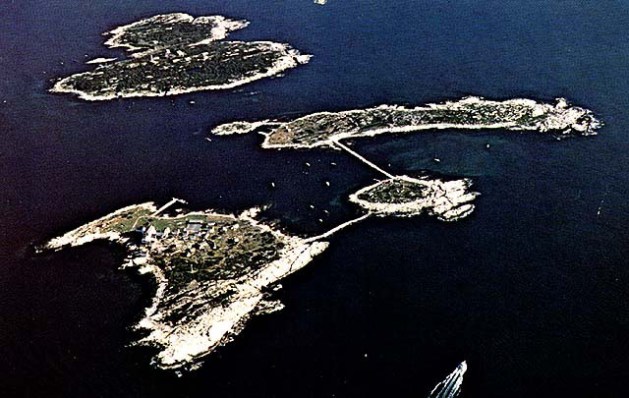
(Aerial picture of the Isles of Shoals about eight miles off the Portsmouth, NH coastline)

A few nights ago I had the pleasure of listening to J. Dennis Robinson speak at a local bookstore near my home in Portsmouth, NH.  I am a recent resident of the area and have been following Mr. Robinson’s “history” column in the Portsmouth Herald since my arrival.  These articles and the book STRAWBERY BANKE: A SEAPORT MUSEUM 400 YEARS IN THE MAKING also written by Mr. Robinson have educated me and sparked my interest in the rich history of the seacoast region.   His new monograph MYSTERY ON THE ISLES OF SHOALS has further broadened my knowledge of the area, as he has produced a first class “whodunit” about a story that everyone with knowledge of this 1873 murder knows the outcome.  Robinson in his recent talk claimed not to be a historian, but a history writer.  As a retired historian myself I believe I have the background to recognize and praise a true historian, which is certainly the case with Robinson.  His literary training has certainly assisted his prose and writing style, but the research techniques and historical knowledge are a wonderful combination that has produced an exceptional monograph that should interest a wide ranging audience apart from the seacoast region.

Robinson begins by reviewing the history of the various theories and myths that have emerged years after the murder of two Norwegian immigrant women, Karen and Anne Christiansen by a Prussian immigrant, Louis Wagner.  The author points to the novel and Hollywood film that distort the facts of the case, but a significant part of the public seems to accept as truth.  For Robinson the alternative history of events is incorrect and he takes on the task of setting the historical record straight.  In his examination of events and evidence, Robinson leaves no stone unturned in uncovering the truth.  Since a key part of the story involves the ability of someone to row from the mainland to Smuttynose Island, a considerable distance in 1873, Robinson provides numerous historical examples to prove that the distance traveled by Wagner the evening of the murder was easily accomplished.  In fact, during his talk last week, he introduced a seventy five year old fisherman who had accomplished the task last June.

(Louis Wagner and the murder weapon)

Robinson’s monograph is more than a history of the murder of the two Norwegian women.  It explores the pre-crime activities of the characters involved, the arrest, trial, and execution of the murderer.  It is a history of the seacoast region as far north as Thomaston, Maine and south to the Portsmouth region.  The author takes the reader back 6000 years when Native Americans thrived in the waters that make up the Gulf of Maine.  He describes how glaciers created the nine islands that make up the Isles of Shoals among the 3000 or more islands that are located along the jagged coast of Maine. (13)  Robinson describes the arrival of John Smith in 1614 and the settlement of New Hampshire in 1623.  Robinson’s history obviously concentrates on the history of the then “crime of the century” and the characters involved, but he also takes on the lives of the participants in the story after Wagner’s execution following them until they pass on.

Robinson focuses on immigration, the development of the islands, and the state of fishing in the region as he sets the stage for the reader.  The most important characters are Louis Wagner the perpetrator of the crime and his victims.  But Robinson also spends a great deal of time developing the other main characters that include John and Maren Hontvets, whom Wagner was trying to rob before his victims got in the way, with Maren escaping and emerging as the most important witness at the trial.  The reader is also introduced to the local politicians involved, the prosecution and defense attorneys, key witnesses, prison officials, and many more.  In doing so the reader gets to know all involved and because of Robinson’s captivating prose they almost feel they have become part of the story.  Throughout, Robinson has a fine eye for detail, be it discussing the history of the murder weapon, an ax that in part resides in the Portsmouth Atheneum, an old membership library on Market Square in Portsmouth.  Robinson goes on to provide a history of the ax as tool in American history, as well as showing that the use of one as a murder weapon was not unique.  This is the type of detail that the author repeatedly interjects into the narrative enhancing the reader’s experience.

For the layman who is interested in the plight of the New England fishing industry during the second half of the nineteenth century, Robinson lays out the problems that the industry faced in detail.  He explores how the sources of fish were being depleted and the need to locate new fishing grounds which drove fisherman up and down the coast to locate new sources.  The problem was that those regions grew scarcer and scarcer necessitating the use of larger and larger boats that local fisherman could ill afford.  One of the few who could was John Hontvets, who purchased long trawl lines and built a sturdy schooner in order to survive.  It was the jealousy that Wagner felt towards John Hontvets that probably drove him on the night of March 5, 1873 to steal a dory and row out to the Hontvets’ home on Smuttynose Island expecting to find only three women present to steal what he thought was between $600 and $1000 hidden somewhere on the premises.  Robinson describes in minute detail the murder and succeeding events leading up to Wagner’s capture in Boston.  Robinson zeroes in on the conversations that Wagner had before and after the crime throughout the book.  It reflects an inordinate amount of research and command of the material.  What is interesting is that Wagner repeatedly provided oral snippets of what Robinson describes as “confessional outbursts,” that puts the reader inside Wagner’s thought processes and leads us to believe he subconsciously wanted to be caught and convicted.

Robinson plays special attention to the personalities of the attorneys involved and the strategies they pursued.  The trial is reviewed very carefully and the material that is available from the trial transcript is mined very carefully by Robinson as he integrates a degree of sarcasm and humor as he dissects the myths and alternate histories that emerged after Wagner’s conviction.  Robinson takes the reader into Wagner’s jail cell, his escape and recapture, and after all the legal wrangling dealing with the death penalty and which state, Maine or New Hampshire had jurisdiction over the case, to the execution of Louis Wagner on June 25, 1875.

For those interested in the economic development of the Isles of Shoals at this time great detail is provided.  The building of tourist hotels, the attraction of Boston literary types and the wealthy are delineated carefully, particularly Cecilia Thaxter who grew up and lived on Smutty nose, who gained fame as a poet and writer.  Her article in the Atlantic Magazine, “A Memorable Murder,” “was something risky and powerful when it appeared in 1875,” but she has been “credited as a founder of true crime literature.”  (301)  “Like a great poet, the crime writer must also replicate the tempest that rages inside the mind of the killer tapping into his jealousy, vengeance, ambition, and hatred,” as nineteenth century essayist, Thomas De Quincy has written, something that Thaxter easily accomplished.  According to Robinson, her article could have served as a model for Truman Capote’s In Cold Blood, and Norman Mailer’s The Executioner’s Song.

Robinson concludes the last section of the monograph by following the history of the main characters after Wagner’s execution.  The reader learns of the fate of Celia Thaxter, the legacy of the Hontvets family and Ivan Christiansen whose wife was murdered, as well as the deathbed confession hoax that tried to shift the blame for the crime onto Maren Hontvets.  Not to be excluded are a number of key witnesses as well as the prosecution team of George Yeaton and Attorney General Harris M. Plaisted and Wagner’s intrepid lawyer Judge Rufus Tapley.

As the books comes to a close, Robinson dissects the pseudo-historical novel based on the murders, Anita Shreve’s Weight on the Water and the Hollywood film of the same name based on the book.  Despite the presence of Sean Penn and a $16 million budget, the film was essentially a flop, though it seems to be downloaded more and more today by those interested.  However, for Shreve the novel made her a literary talent as she has a film based on her book added to her many publications.  Lastly, Robinson includes extensive author’s notes that are a treasure trove of information that for those interested, can lead to wonderful new discoveries. Overall, considering that many people who are drawn to this subject matter are already privy to the story and its outcome, Robinson has done a remarkable job of synthesis creating an interesting compilation of information some old, but much that is new.  I recommend it highly for those who are interested in a scintillating murder story, but more so an overall history of the seacoast region in the latter part of the nineteenth century.

THE SECRET HISTORY OF WONDER WOMAN by Jill Lepore

When I was teaching I used to show excerpts of The Wizard of Oz to my students.  My goal was to provoke discussion to ascertain whether its author, L. Frank Baum purposely created the story as a parable for monetary reform in the 1890s expressing some of the ideas of three time presidential candidate, William Jennings Bryan.  The question often arose as to whether the film actually represented a historical analysis or observation of the then contemporary events. After thinking about this concept for many years I am still not certain.  In reading Jill Lepore’s newest book, The Secret History of Wonder Woman I have some of the same uncertainties, but as Baum had done, Lepore proposes many ideas that should provoke animated discussion.  Lepore’s thesis revolves around the life of William Moulton Marston, the creator of Wonder Woman, the character he developed, and the ideas that he put forth.  According to Lepore this comic strip character is central to the development of feminism.  “She is the missing link in a chain of events that begins with woman suffrage campaigns in the 1910s and ends with the troubled place of feminism fully a century later.  Feminism made Wonder Woman.   And then Wonder Woman remade feminism, which hasn’t been altogether good for feminism.”  Wonder Woman was not an ordinary comic book character, “she was at the center of the histories of science, law, and politics…..Wonder Woman’s debt is to the fictional feminist utopia and to the struggle for woman’s rights.” (xiii)  For Lepore, “Wonder Woman has been fighting for woman’s rights for a very long time, battles fought but never won. [It] is the story of her origins-the stuff of wonders and of lies.” (xiv)  For me it is difficult to accept the argument that a comic strip character was central to the development of feminism and that Wonder Woman is the missing link in understanding the struggle for woman’s rights.   Lepore presents the reader with a unique approach, and having read a number of her previous works I was interested in pursuing her latest effort in which she posits a thesis that is both unique and intellectually challenging, making it seriously worth considering.

The Secret History of Wonder Woman is a well researched monograph that is part biography of William Moulton Marston and a socio-political history of his life time that produces Wonder Woman.  To the author’s credit she weaves Wonder Woman cartoons from the 1940s throughout the monograph relating how a given comic strip fits into the pattern of events in Marston’s life and his unique family structure.  The book also contains a colorful insert of numerous Wonder Woman comic strips side by side with a narrative that explains each, and places them within a historical context.  Characters in the comic strips are paired with actual historical figures and events that they supposedly represent that further Lepore’s argument, but I leave it to the reader to determine if the author achieves her goal.

Throughout the book Wonder Woman is interfaced with the history of feminism, whether it is the work of Margaret Sanger fighting for birth control or Emmeline Pankhurst’s struggle to achieve woman’s suffrage.  The man she credits for creating Wonder Woman, William Moulton Marston is an interesting and eccentric character in his own right who earned a Ph.D in Psychology from Harvard, but during his career he failed to maintain academic posts at American, Tufts, and Columbia universities.  His own research centered on the systolic blood pressure test that became one of the components of the modern polygraph test, though he claims to have invented the lie detector.  He was convinced about the connection between emotion and blood pressure and how men and woman react differently to the same situation.  Marston was also committed to woman’s rights and he lived a somewhat bohemian lifestyle as he was married to Elizabeth Holloway, who shared his research and writings and was certainly his intellectual equal, but he also lived with his former graduate student and researcher, Olive Byrne.  He fathered two children with each, but Bryne’s children were told that their father had died and they all lived together in the same household, so in a sense Marston had two wives.

( Left to right: Marjorie Wilkes Huntley, O.A. Byrne, Pete Marston,  William Moulton Marston, Olive Byne, Donn Marston ,Sadie Elizabeth Holloway)

Lepore also produces a history of the comic book industry dating back to 1933 including the role that Marston and his wife/wives played.  It was at this time that Charles Gaines, the publisher of Superman magazine hired Marston as a consulting psychologist who convinced Gaines that what he needed to counter attacks on comics was a female super hero.  The period of 1920 through the 1960s is often seen as a dormant period in feminist history by some.  For Lepore in the 1940s “there was plenty of feminist agitation in the pages of Wonder Woman.” In a 1944 issue of Wonder Woman a biography of Susan B. Anthony was contained calling her the “liberator of Womankind.”  The issue also contained the story “Battle for Womanhood,” The story and drawings mirrored the suffragist’s use of war as they had in the 1910s.  “In the First World War, suffragists suggested that war was keeping women in a state of slavery.  In the Second World War, Marston suggested that women’s contributions to the war effort were helping emancipate them….there are eight million American women in war activities-by 1944 there will be eighteen million!” reports one of the characters, dragging a ball and chain. (225)  Marston strongly intimates should woman achieve equality or even power over men, war will end.

Marston saw himself as a scholar and that his Harvard background and life’s work lent itself to consider that Wonder Woman and the research behind her creation was a scholarly enterprise.  This belief ran into strong opposition from the academic community, but one should strongly consider that there is a strong element of scholarship in Marston’s work that Lepore describes in detail.  Further, if one can see past Marston’s unusual approach and high powered ego you can see the work of a genius that has not achieved much recognition.   However, his rationale for creating Wonder Woman as he wrote is American Scholar magazine in 1943 is very convincing; “not even girls want to be girls so long as our feminine archetype lacks force, strength, and power.  Not wanting to be girls, they don’t want to be tender, submissive, peace loving as good woman are.  Women’s strong qualities have become despised because of their weakness.  The obvious remedy is to create a feminine character with all the strength of Superman plus all the allure of good and beautiful women.”

Lepore’s narration of the important figures in twentieth century feminist history is important as it places Marston’s story in the proper historical context.  Lepore’s succinct and snappy prose tells the story well as she goes from Marston’s life to his use of Greek mythology to justify the creation of his super hero.  Marston may come across as a “bit different” than most people of his profession, but that difference was probably his genius and that’s what it took to foster the creation a comic book character, whose origin in Greek mythology could explain and work towards fulfilling the goal of achieving women’s equality.  Following Marston’s death from cancer in 1947 Holloway tried to take over the preparation and writing of the comic strip.  She was rejected by the publisher and with subsequent writers Wonder Woman’s popularity declined only to reemerge again in the 1970s.  Lepore follows the feminist movement throughout the 1970s and 1980s as it splintered and seemed to pass into the background.  What makes her monograph important is that she was able to unlock the secret of Wonder Woman’s origins, as she points out that it was a history that was waiting to be written, and whether you accept her findings or not, it is a story that is well told.

If Wonder Woman could return to her 1940s persona she could comment on why certain politicians opposed the Lily Ledbetter Fair Pay Act of 2009, guaranteeing equal pay for women, as it was an issue in the recent midterm elections.  If Marston was alive today, I am certain what words he would have put in her mouth.  Lepore has written an important historical work through the life of William Moulton Marston, his family, and those who worked with and against him.  The question remains should he be considered a major player in the woman’s movement, the question is an open one, but Lepore should be praised for presenting an interesting and challenging monograph that delves deeply into the question.  As Gloria Steinem has written in the initial issue of Ms. Magazine in 1972, “looking back now at these Wonder Woman stories from the 40s, I am amazed by the strength of their feminist message.”

ON HIS OWN TERMS: A LIFE OF NELSON ROCKEFELLER by Richard Norton Smith

Original caption: 9/16/1976– Binghamton, NY- Vice President Nelson Rockefeller gives a crowd of young hecklers an upraised middle finger gesture at the Broome County Airport during a brief stop here Sept. 16, while on a campaign trip with Vice Presidential candidate Bob Dole (L, Background, out of focus)

Today the term “Rockefeller Republican” is still considered a negative characterization to most members of the Republican Party.  The term stands for moderate republicanism that calls for fiscal prudence, but also a social conscience.  In the current political environment when a large number of Republicans are calling for the disassembling of major components of the federal government and are trying to limit people’s voting rights the ideas of Nelson Rockefeller fall on deaf ears.  For the former four time governor of New York bipartisanship and an all inclusive party were a major part of his political agenda for most of his time in office.  As most of the Rockefeller platform is unacceptable today, it suffered a similar fate in 1964 as Barry Goldwater became the Republican standard bearer against Lyndon Johnson.  Many would argue that the hatred for “Rockefeller Republicanism” by Goldwater voters was the precursor of today’s Tea Party.  If so a number of important questions must be asked.  First, how did Rockefeller’s brand of moderate Republicanism come to the fore? Second, why was it so successful in New York and rejected nationwide? Lastly, why did it provoke such an extreme reaction in 1964 that continues to this day?  In his new book, IN HIS OWN TERMS, a major new biography of Nelson Rockefeller, Richard North Smith attempts to answer these and other questions as he explores a career that included the governorship of New York, the Vice Presidency, coordinator of Inter-American affairs under Franklin Roosevelt, and one of the most generous and widely renown philanthropists of his era.

(New York Governor Nelson Rockefeller trying to address the 1964 Republican National Convention)

The portrait that Smith presents is a complex one.  Rockefeller comes across as an ideological follower of Franklin D. Roosevelt’s New Deal for a major part of his political career.   Later he would adopt a more conservative political agenda as he continued to seek the presidency on at least three separate occasions.  He comes across as a generous individual who uses his wealth to reward and assist others, but at the same time he could be a stubborn vindictive person who set out to get even with those who disagreed with him.  Domestically, Rockefeller pursued a liberal agenda, but in foreign policy he was a cold warrior, fearful of the communist threat he supported the Vietnam War for most of his political career.  On a personal level Smith describes a man who could be a caring father, but at the same time he appears as a serial philanderer.  His first marriage failed after thirty years, and after remarrying, he seemed to dote on the children of his second marriage angering those of his first.  The author explores in detail these aspects of the Rockefeller persona and career, and has written an almost encyclopedic biography of one of the most interesting political figures of the twentieth century.

Smith describes his thirteen year odyssey in writing this biography.  Its coverage is impressive as he conducted numerous interviews and thoroughly mined the attendant secondary and primary sources.  The result is extensive coverage of his subject that brings the reader into the Rockefeller family dating back to its founder John D. Rockefeller.  We witness the wealth that was available to Nelson Rockefeller and how he employed it to satisfy his almost obsessive need to acquire art, design and build numerous residences and public buildings, caring for his many associates and friends when they were in need, and of course, procure his own election as governor on four separate occasions.  Rockefeller was a “serial” believer in forming committees and/or commissions made up of the leading experts on whatever topic was of interest to him.  Each role he was tasked, be it, as coordinator for Latin American affairs under FDR, an emissary for Richard Nixon to Latin America, a study to ascertain the best way to rebuild Albany, NY, develop a way to improve the welfare system in New York as well as well as nationally, along with numerous others, Rockefeller in most cases funded these activities with his own money and many of the solutions that emerged, i.e., revenue sharing and enhancing John F. Kennedy’s Alliance for Progress were adopted by different presidential administrations.

In a book of this length there are many themes and storylines.  One that seems to dominate is the evolution of Nelson Rockefeller from a liberal approach to social policy, whereby he was willing to push through increases in taxes, fees and other sources of revenue to implement them.  Rockefeller supported a myriad of social programs from improvements in Medicaid, purification of water resources, women’s rights, the first state minimum wage law, to the implementation of civil rights legislation.  Rockefeller’s approach to executive leadership and legislative tactics are reviewed as well as his philosophy of government.  What emerges is the type of governor that New York hadn’t seen since FDR.  With the message of taking responsibility for developing problems for the future, he would tackle issues in the present so they would not become problems down the road.  The issue was his overly ambitious approach to executive leadership always risked alienating conservatives west of the Hudson River.  With a strategy that would evolve from a “pay as you go” philosophy that would bring revenues into line with expenditures, “thereby eliminating costly borrowing and setting the stage for renewed economic growth,” Rockefeller evolved into to a governor who blew up the state budget to meet the needs of his massive infrastructure and building expenses in addition to the budget shortfalls of New York City by borrowing and floating different bond proposals.  By the time Rockefeller reached the end of his third term in office and was elected to his fourth term he became increasingly fiscally conservative as he faced opposition from the state legislature and probably realized that the political current of the late sixties and early seventies would not help any presidential ambitions he might have if he did not change.  Another major storyline that dominated Rockefeller his entire life that permeates the book was his life long battle with dyslexia.  The governor was not aware that he suffered from this affliction, but whether he was attending the Lincoln School in New York, Dartmouth College, or just trying to keep up with the massive amount of reading that a state executive engaged in it was always a battle.  With his wealth as a cushion, Rockefeller was able to employ numerous individuals to assist in this process whether in preparation of legislation or developing auditory strategies to overcome his reading difficulties.

There are a number of fascinating aspects to Smith’s approach to his subject as he prepared  expansive footnotes at the bottom of each page providing the reader with ancillary information that was not available in the text.  Rockefeller’s private opinions of the likes of John Lindsay and Richard Nixon emerge in a very “colorful” fashion which made the mining of these footnotes quite entertaining.  Smith’s discussion of deeply personal issues is not blanched over.  The breakup of Rockefeller’s marriage to Mary Todhunter Clark (Tod) was detailed and very fair as was the coverage of his remarriage to Margaretta “Happy” Murphy.  The loss of his son Michael during an expedition to collect primitive art in a remote part of New Guinea shows a father who has to deal emotionally with a loss of a son.  The relationship of the Rockefeller brothers and their children receives a great deal of attention and produces many interesting insights into the dynamic of such a public family.  Importantly, Smith does not mince words or coverage in dealing with Rockefeller’s numerous extracurricular activities with numerous women throughout his marriages.  In fact we witness a scandal at the site of Rockefeller’s death as to how his body was treated by those who were with him and the medical papers that were prepared to spare the family any embarrassment.

Aside from the personal aspects of the Rockefeller story, Smith devotes a great deal of effort in explaining what drove Rockefeller.  He was an avid and meticulous collector of modern and primitive art and he set as a goal the creation of a museum to house modern art that he would proudly help establish with the creation of the Museum of Modern Art (MoMA).  The second area that fascinated Rockefeller was politics and how it could be used to help people and better his country, a career path that would dominate his life for over forty years.  The fact that Rockefeller realized that as a scion of wealth he did not have to worry about “ordinary things,” therefore he was motivated to pursue the extraordinary.  Rockefeller’s battles to create MoMA were his trial by fire, a learning course in the art of political infighting.  This would also be the case in the creative process and building of Rockefeller Center as he would take lessons  learned from these confrontations and apply them in the future in his fights with the legislature, opponents such as New York Mayors John Lindsay and Robert Wagner, as well as national political battles.  In dealing with transit and garbage strikes, prison issues including the riots and death at Attica, infrastructure and other building projects, Rockefeller’s learning curve was applied to many crises.

Rockefeller’s other area of interest was foreign policy, and Latin America in particular.  His approach to western hemispheric issues was ahead of his time.  It began as a strategy to block Nazi Germany’s inroads in Mexico and South America.  He agreed with FDR that hemispheric solidarity was the key to changing the perception that the United States was seen as a colonizer in the region.  In 1942 Rockefeller unveiled his “Basic Economy Program” that called for improvement in the region’s public health problems.  Rockefeller arranged training for hundreds of professional nurses to assist in creating medical clinics in outlying areas.  Further,  he worked to export penicillin to offset disease in the region.  “In four years, Rockefeller agents trained more than ten thousand in-service workers, nurses, doctors, midwives, sanitary engineers, and home demonstration agents.”(164)  Rockefeller engaged in a fierce bureaucratic battle with “Wild” Bill Donavan, the head of the Office of Strategic Services at the end of the war over policy toward Latin America.  After the war facing the fight against communism, Rockefeller was a proponent of foreign aid to the region, but his approach was geared to offset the sensibilities of the countries receiving it to avoid the charactiture of “Yankee Imperialism” that OSS policy seemed to engender.  Rockefeller’s sensitivity toward third world countries should not take away from his fervent anticommunism, particularly in dealing with Vietnam where he was a strong supporter of Lyndon Johnson and was able to develop a close working relationship with the president.

Smith does yeoman’s work in describing Rockefeller’s campaigns for governor and president.  In both areas Rockefeller’s wealth and ability to obtain the necessary support for his candidacies was ever present.  The elective success he experienced in New York could not be replicated on the national stage as the Republican Party shifted to the right throughout the nineteen sixties.  His battle against Goldwater in 1964 made him an enemy to conservative republicans and his indecision in 1968 cost him any hope of wresting the republican nomination away from Richard Nixon, which also destroyed any candidacy for 1972.  His hopes improved after he was chosen vice-president by Gerald Ford following the resignation of Richard Nixon, but any hope of influencing the Ford presidency was offset by major disagreements with Ford’s Chief of Staff, Donald Rumsfeld who would block Rockefeller at every turn over policy and political decisions.  Any hope of higher office was dashed in 1976 as Rockefeller’s support for civil rights and the Voting Rights Act made him a political liability with conservative republicans in the south and resulted in the candidacy of Robert Dole for Vice-President on the 1976 Republican presidential ticket.

Overall, Nelson Rockefeller enjoyed an amazing life.  Art connoisseur, benefactor to countless individuals, a mostly progressive governor, and an influential and sometimes polarizing national figure for decades.  Richard Norton Smith gives attention to all these aspects of Rockefeller’s life and has written an in depth and informative biography that I am certain will be the definitive work on an illustrious career for many years to come.

BLUE-EYED BOY: A MEMOIR by Robert Timberg

(Author Robert Timberg during a book presentation)

As most are aware the Vietnam War has left many scars on those who fought the war and the American people in general.  With 58,000 men dead and roughly 270,000 wounded, many like the author, Robert Timberg suffered life changing injuries that affect them psychologically and physically to this day.  Mr. Timberg, a graduate of the United States Naval Academy, and a Marine Corps officer suffered second and third degree burns to his face and parts of his body on January 18, 1967 when his armored vehicle went over a North Vietnamese land mine in the vicinity of Da Dang, just thirteen days before he was to be cycled out of the war theater as his thirteen month tour was drawing to a close.  Mr. Timberg has written a long delayed memoir dealing with his experiences in Vietnam, his recovery, and his career which was a major component in trying to recapture some sort of normality.

(Timberg writing a letter home from Vietnam)

The book, BLUE-EYED BOY: A MEMOIR is written on multiple levels.  It is an emotionally captivating story by an individual who wages a courageous battle to regain some semblance of what he lost on that fateful day when delivering a payroll to another unit his vehicle hit a land mine.  The book is also a personal journey that takes him through numerous hospitals and thirty five operations with the support of two wonderful women, his first wife, Janie, who Timberg credits for his level of recovery and the family and career he is most proud of.  He readily admits that he was responsible for the end of their marriage and how poorly he treated her.  The other woman, his second wife, Kelly, allowed him to continue his recovery and develop a successful journalism career.  Unfortunately for Timberg, they too could not keep their marriage together.  The last major thread is how Timberg repeatedly lashes out against those individuals that did not go to Vietnam and as he states found, “legal and illegal ways” to avoid doing their duties as Americans.  Despite repeated denials that he is past those negative feelings and no matter how much he pushes his bitterness below the surface employing the correct verbiage of an excellent writer, his ill feelings towards a good part of his generation repeatedly bubbles to the surface.

(Timberg being evacuated from Da Nang area after his vehicle hit a land mine, January 18, 1967)

This memoir is very timely in light of the type of injuries that American soldiers have sustained in Iraq and Afghanistan for the last twelve years.  It brings a message of hope for the future based on Timberg’s remarkable recovery and the success he has enjoyed as a reporter and a writer.  Our wounded veterans face a long road to recovery and Timberg’s story could be a wonderful model that they can try to emulate.  The first two-thirds of the book for me were the most interesting.  Timberg lays his life out for all to see.  His emotions which seemed to rise and fall with each sunrise and sunset are heart rendering.  His descriptions of his treatment with multiple skin grafts and surgeries are a testament to his perseverance.  His tenacity and ability to overcome most of the obstacles that were placed in front of him are truly amazing.  We learn a great deal about the Naval Academy and the United States Marine Corps and what they stand for.  Timberg takes the reader through many stages of recovery by interspersing his relationships with those who are most responsible for his making him whole, his first wife, Janie, and Dr. Lynn Ketchum, the surgeon who like a sculptor put Timberg’s facial features back together as best he could.  Despite his recovery, throughout this period his loss of identity constantly tugged at him, even as he earned the satisfaction of a successful career, but the loss of identity seemed to always be under the surface.  Once Timberg reaches the end of his period of recovery, he must leave “the cocoon of the hospital to home cycle” of constantly undergoing surgery and recovery.  For Timberg it was very difficult, but finally with Janie’s assistance he is able to overcome his fears and earn a Master’s Degree in Journalism at Stanford University and begin his career as a reporter in Annapolis.  That career would lead to a Nieman Fellowship, positions at the Baltimore Evening Standard, and the Baltimore Sun.  Timberg became a leading White House correspondent, and the author of three very important books.

The one area of the book I have difficulty accepting is the sections that deal with the germination of the ideas for the book THE NIGHTENGALE’S SONG, and how the book was finally conceived and reached fruition.  It was fascinating how Timberg pulled together such disparate personalities as John McCain, James Webb, John Poindexter, Robert McFarlane, and Oliver North to create narrative dynamic that made sense.  What sparked this dynamic was the Iran-Contra scandal that rocked President Reagan’s second term in office.  Timberg was able to parlay the scandal and the personalities just mentioned into a coherent and interesting monograph.  I remember when the book was published and after reading it I wondered if Timberg had an agenda that called for damning those who were able to avoid serving in Vietnam, and blaming the prosecution of the Iran-Contra scandal on the media and members of Congress who figured out ways to remain out of the military during the war.

Timberg’s judgment is deeply flawed in attacking, what seems to be everyone who did not fight in Vietnam for pursuing the Iran-Contra scandal.  I understand that he suffered unbelievable horrors as a result of his military service and significant emotional issues remain.  However, his inner drive to become the person he was before he was seriously wounded has clouded his judgment to the point where he deeply hurt, Janie, his first wife, the woman who was mostly responsible for making himself whole as he recovered.  His comments dealing with the need to find another woman to have sex with aside from his wife to see if he could find another person who was attracted to him is deeply troublesome.  It was thoughts like this and leaving her alone with three children for a great deal of time reflects poorly on Timberg no matter how courageous he was.  As Timberg researches and writes THE NIGHTENGALE’S SONG, his obsession with those who did not fight in Vietnam comes to the fore completely.  Though there are repeated denials in the book his understandable prejudice against “draft dodgers,” etc. is readily apparent, i.e., his convoluted logic of going after people who believe that Iran-Contra was a major crime and resulted in violation of the constitutional and legislative prerogatives of Congress, aside from the cover-up and outright lying the of the Reagan administration with a vengeance.  By explaining away the scandal by raising the question; “was Iran-Contra the bill for Vietnam finally coming due?” for me, is a bit much and cannot explain away the illegal acts that North, Poindexter, and McFarlane committed no matter how hard Timberg tries.  For the author it seems like everyone who did not go to Vietnam used money and connections to avoid serving.  Further, those who did not serve, “much of the rest of that generation came up with novel ways to leave the fighting and dying to others.”(213)  Timberg quotes from Lawrence M. Baskir and William A. Srauss’ excellent analysis of the draft, CHANCE AND CIRCUMSTANCE to buttress his arguments, however if he revisits objectively the Pentagon statistics that the authors quote he will find that not all who did not serve in Vietnam committed acts that Timberg finds reprehensible  There are millions who were involved in defense related jobs, duty in the United State Army Reserves and the National Guard, had legitimate medical deferments, or were conscientious objectors.  I agree a significant numbers did avoid service and Baskir and Strauss put the number of draft offenders at about 570,000, accused draft offenders at 209, 517, with about 3250 actually imprisoned.  We must also keep in mind that of the 26,800,000 men of the Vietnam generation, 6,465,000 served but never went to Southeast Asia, and of the 15,980,000 who never served in the military 15,410,000 were deferred, exempted or disqualified -all cannot be painted with the broad brush of being draft dodgers as Timberg seems to strongly intimate.*

Overall, Timberg is correct, Vietnam is still a raw nerve for a generation that witnessed men rallying to the flag, and men who felt the war was wrong.  As history has borne out the American people were lied to by the Johnson administration and the government in general.  I respect Mr. Timberg’s service, the wonderful career he used as a vehicle to become whole again, and I find that he is an exceptional author, who at times goes a bit overboard in his attempt to rationalize why people avoided service in the war.  The book is a superb read, deeply emotional and for my generation dredges up a great deal and provokes deep thought concerning how the experience of the Vietnam War still affects American foreign policy and the conduct of combat to this day.

*See Lawrence M. Baskir & William A. Strauss CHANCE AND CIRCUMSTANCE. New York: Alfred A. Knopf, 1978, p. 5 for an excellent chart that is reflected in the figures presented.