THE GEORGETOWN SET: FRIENDS AND RIVALS IN COLD WAR WASHINGTON by Greg Herken

(Joseph and Stewart Alsop,  journalists who greatly impacted American foreign policy during the Cold War)

When one discusses the value of real estate one usually encounters the phrase “location, location, location.”  This could be the theme of Greg Herken’s THE GEORGETOWN SET: FRIENDS AND RIVALS IN COLD WAR WASHINGTON, a book centered on a Georgetown, Washington, D.C. neighborhood after World War II, whose residents included the Alsop brothers, Jack and Jaqueline Kennedy, Ben and Tony Bradlee, Allen and Clover Dulles, Dean and Alice Acheson, Philp and Katherine Graham, Averill and Marie Harriman, Frank and Polly Wisner among others.  Within the group you had a future president and Secretary of State, the head of the CIA and other operatives, two ambassadors to the Soviet Union, influential journalists, and the owner and editor of the Washington Post. The neighbors who were known as the “Georgetown Set,” were at the forefront of American policy as the Cold War began and evolved, as Dean Acheson entitled his memoirs, they were PRESENT AT CREATION, and a few of them lived to see the curtain fall on the conflict with the communist world.  These individuals were not only neighbors, for the most part, they were close friends.  They had attended the same boarding schools and universities and “believed that the United States had the power—and the moral obligation—to oppose tyranny and stand up of the world’s underdogs.”  They held a sense of duty and the belief in the “rightness of the country and its causes—which were, more often than not, their own.”

Unlike today, it was a time of consensus in foreign policy in dealing with the Soviet Union, partisanship was an afterthought.  The outset of the Cold War produced the Marshall Plan, the Truman Doctrine, Point Four, and NATO, but the mindset of these individuals would also lead to mistakes embodied in the disastrous coups of the Eisenhower era, the Bay of Pigs, and the Vietnam War.  Greg Herken tells the story of these influential people, how their ideas dominated American policy, and what the ramifications of that influence were.  The reader is exposed to intimate details and tremendous insights as these power brokers are examined, and it makes for a fascinating read.

(Katharine Graham, owner and editor of the Washington Post)

The narrative focuses on the most important foreign policy debates of the 20th century, where the residents of Georgetown aligned themselves, and how their views affected the success or failure of presidential decision making.  Once the Nazis and the Japanese were defeated in 1945, the foreign policy debate focused on the communist threat and the motives of the Soviet Union.  The debate was symbolized by George Kennan, who at one point was head of the Policy Planning Staff in the State Department as well as stints as ambassador to the Soviet Union and Yugoslavia; and Paul Nitze, former Secretary of the Navy, and author of NSC-68 which along with Kennan’s “X Article” formed the basis of American policy toward Russia for well into the 1980s.  The debate centered on “whether it was America’s moral example or material power that kept the Russians at bay” during the Cold War.   Many other individuals draw Herken’s discerning eye during the period, the most important of which were Joseph and Stewart Alsop, the journalism brothers who advised presidents, and helped articulate positions on Vietnam and Cuba that some would argue pushed our nation’s chief executives into making unwise policy choices.

At times the book reads like a biography of the Alsop brothers as Herken develops their careers as the centerpiece of the monograph.  Of the two, Joseph Alsop dominated their relationship and developed numerous sources within the national security apparatus in presidential administrations from Truman through Nixon.  Joseph Alsop had his own agenda and his columns created enough pressure on Lyndon Johnson that many believe forced him to consider Alsop’s readership when making decisions about Vietnam, a subject that Alsop seemed obsessed with and had difficulty accepting any information that contradicted what he believed.  The Alsops hosted numerous dinner parties that were used as conduits to different presidential administrations as conversations yielded information that turned up in their newspaper columns.  Herken almost makes the reader as if they are invited guests to the Sunday night gatherings among the “Georgetown Set” and at times the reader might feel like a “fly on the wall” as you witness history being made.  In addition to the Alsops, the inner sanctum of the Washington Post is laid bare as great events are reported.  We see the newspaper under the stewardship of Philip Graham at the outset of the Cold War until his suicide, when his wife Katharine takes the reigns of the paper and turns it into a strong competitor to the New York Times. Reporting on Watergate, My Lai and other issues reflected Katharine Graham’s growth as the head of a major newspaper and her dominant role in Washington politics.

(Frank Wisner II, the son of an OSS and CIA operative who developed and implemented numerous covert operations during the Cold War.  Wisner II developed his own diplomatic career and did not follow the career path of his father)

The book also centers on the evolution of the American intelligence community from the Office of Strategic Services (OSS) during World War II to the creation of the Central Intelligence Agency (CIA).  Herken focuses most of his attention on Allen W. Dulles, who worked under Wild Bill Donavan who headed the OSS, and would later head the CIA under President Eisenhower and for a short time under John F. Kennedy; and Frank Wisner, an OSS and CIA operative who was known for his outlandish covert plans, i.e.; trying to overthrow the government of Albania, dropping propaganda leaflets and intelligence operatives behind the “iron curtain” among many of his projects.  CIA involvement in Vietnam, Iran, Cuba, and Guatemala are dissected in detail and Herken correctly points to current issues that date back to Dulles, Wisner, and numerous other individuals in the intelligence community, and how they negatively affected American foreign policy for decades.

(President John F. Kenndy and First Lady Jacqueline Kennedy were frequent visitors in the “salons” of Georgetown)

The books serves as an important window into the lives of people who dominated the American foreign policy establishment throughout the Cold War.  Herken seems to assess all of the major decisions that were made during the period, as well as evaluating each of the characters presented and how their lives affected the course of American history.  Many of the individuals that Herken discusses are well known, but others are brought out of the shadows.  One of the most interesting aspects of the book is when Herken muses about the lives of the children of the “Georgetown Set,” and how the generation gap that developed in response to the civil rights and anti-war movements of the 1960s affected the next “Georgetown” generation.

Herken writes with flair and has exceptional command of his material and sources and has offered a unique approach to the causes and results of the Cold War that should satisfy academics as well as the general reader.

THE CHURCHILL FACTOR: HOW ONE MAN MADE HISTORY by Boris Johnson

(English Prime Minister Winston Churchill, August 27, 1941)

If you are looking for a personal, breezy hagiography of Winston Churchill then Boris Johnson’s THE CHURCHILL FACTOR: HOW ONE MAN MADE HISTORY will be of interest.  Johnson’s effort is not a traditional biography of the former occupant of 10 Downing Street, but a manifesto imploring the reader to consider the genius and greatness of Churchill.  Johnson is concerned that as time has passed fewer and fewer of the non-World War II generation have forgotten or are not aware of Churchill’s accomplishments as he states at the outset “we are losing those who can remember the sound of his voice, and I worry that we are in danger….of forgetting the scale of what he did.”  For the author, World War II would have been lost, if not for Churchill, and he further argues that the resident of Chartwell House and Blenheim Palace saved civilization and proved that one man can change history.

Johnson’s writing is very entertaining.  His phrasing is both humorous and poignant, i.e., “the French were possessed of an origami army! They just keep folding with almost magical speed.”  In his description of Churchill, he looked “like some burley and hung over butler from the set of Downton Abbey.  However, aside from the humor presented, Johnson has a serious purpose as he seems to want to align himself with Churchill as a means of furthering his own political career.  The question is what do we make of Johnson’s THE CHURCHILL FACTOR?  Many who are familiar with Johnson’s career can foresee this Member of Parliament, mayor of London, former editor of The Spectator, and columnist for the Daily Telegraph pursuing the leadership of the Conservative Party, and at some point attaining the position of Prime Minister.  By manipulating Churchill’s legacy as a comparison to certain aspects of his own life, Johnson may have hit upon a vehicle for his own political ascendency.  Johnson suggests certain similarities with his hero, but then upon reflection he negates them, but for those who are familiar with the British political system, Johnson’s ambitions are clear.

Johnson’s thesis rests on rehabilitating the less savory aspects of Churchill’s personality and politics, at the same time presenting him as the genius who saved the world from Nazism.  Johnson strongly suggests when reviewing the political choices that existed in England as the Dunkirk rescue was ongoing in May, 1940 there was no alternative to Churchill.  Neville Chamberlain and Lord Halifax were both appeasers and wanted to make a separate peace with Germany.  Johnson reviews Churchill’s career as a journalist, soldier, and social reformer to reflect on his preparation for taking on Hitler, and does not find him wanting in any area.  The author tackles the opposition to Churchill within the Conservative party and why he was a lightning rod for his opponents.  Johnson explains why he was so despised by many head on.  He argues that Churchill, like his father Randolph, suffered from a lack of party loyalty and we see that both followed their own path when it came to shifting parties and then returning to the conservative fold.  In addition, Churchill helped bring on ill will by always being a self-promoter and political opportunist.  Churchill made a number of errors during World War I and later, in his career.   The following come to mind: the fiasco at Antwerp in October, 1914, and Gallipoli in September, 1915 that forced many to question his ability as a military strategist when he was First Lord of their Admiralty. Further, Churchill’s ill-fated plan to block the Bolshevik victory in Russia after World War I, as well as fighting to prevent Indian self-government where not well thought out.  Lastly, Churchill’s support for Edward VIII’s desire for a divorce and forfeiture of his throne angered many conservative back benchers.

(Churchill’s March 5, 1946 “Iron Curtain Speech” at Westminster College, Fulton, MO)

Johnson presents Churchill’s bonifedes as a military leader by spending a good amount of time reflecting on Churchill’s bravery.  He discusses Churchill’s love of planes and desire to develop an air force.  He reviews his combat experience in the Sudan, the Boer War, India and the trenches of World War I.  He concludes that Churchill’s own personal bravery allowed him to ask whether other candidates in 1940 had the experience and demeanor to lead England against the Nazis.  Johnson also tackles some of the negative charges against Churchill.  For Johnson, Churchill is a social reformer in the context of being a capitalist and a free trader.  He argues that next to his mentor, Lloyd George, Churchill had great concern for workers and the lower classes.  For Churchill, workers were the bedrock of the British Empire and without them the empire would collapse.  Johnson points to Churchill’s championing of Labour exchanges, a Trade Board Bill to enforce minimum wages for certain jobs, unemployment insurance with worker, government and employer contributions, a 20% tax on land sales in order to fund progressive programs and redistribute wealth.  Churchill was concerned that if the needs of the workers were not met, unrest could “scuttle” British power overseas.  One might argue that Churchill was somewhat of a hypocrite based on some of his racist and imperialist goals, Johnson would say that he was nothing more than being politically pragmatic.  Perhaps Churchill’s “compassionate conservatism” was years ahead of George W. Bush.

The author rests much of his argument on Churchill’s amazing work ethic and the motor of his exceptional brain.  Johnson offers a great deal of evidence to support his claim, i.e., Churchill’s prodigious writing that earned him a Nobel Peace Prize for Literature at the age of seventy-five.  Churchill’s work developing tank technology during World War I, his role in creating the boundaries for the Middle East, the partition of Ireland, and diplomacy during World War II to save England from the Nazis and rallying his own people.   Lastly, the use of his personal charm to “drag” the United States into World War II.  Once out of power Churchill sought to warn the west about Stalinist expansionism.  His “Iron Curtain” speech in 1946 made public his concerns, but Churchill had internally warned his cabinet and FDR at least a year earlier.  As in the 1930s when he warned about Nazism, as World War II came to a close he was seen as a war mongerer by many.  Despite the fact that he was correct in both cases, this did not help him politically at home or in his relationship with President Truman, as he was soon out of office.  Once he returned to power in 1951, and with the death of Stalin in 1953, Churchill worked for a summit of the great powers as he was deathly afraid of a thermonuclear war.  Though he did not achieve his goal, after he left office for good in 1955, a four power summit did take place.  For Johnson, in the end, Churchill’s ideas prevailed, from his speech in Fulton, MO in 1946 to the final collapse of the Berlin Wall in 1989.  Churchill had called for rapprochement between France and Germany, and a united Europe all of which was eventually achieved.

(Cairo Conference, 1921, Churchill is on the left, Gertrude Bell in the center, and T.E. Lawrence on the right)

One of the major blemishes that exists in dealing with Churchill’s career lies in the sands of the Middle East.  As Colonial Secretary he had to undue the negative results of the Hussein-McMahon Correspondence, the Sykes-Picot Agreement, and the Balfour Declaration all issued during World War I making very contradictory promises that Johnson describes as “Britain sold the same camel three times.”  The story of the Cairo Conference and Churchill’s influence on the creation of Iraq, Transjordan, Syria, and Palestine has been told many times, but even Johnson must acknowledge that what Churchill had created, though it lasted for decades was bound to come a cropper.  Further Churchill’s optimism concerning Jewish-Palestinian relations was ill-conceived.  Johnson, as his want, does not blame Churchill, but the selfishness of both sides, particularly the lack of Arab leadership, a rationalization to deflect away from Churchill anything the author finds unacceptable.     Despite his errors the author proposes that Churchill, even in old age, was a man ahead of his times, and based on his amazing career who is to say that Johnson was wrong.

(Potsdam Conference, July, 1945, Churchill, Truman, and Stalin)

Perhaps the major criticism one can offer is how the author presents his material.  I for one enjoy objective biography, not subjective hero worship, particularly when there are so many instances of a lack of source material to support the author’s conclusions.  However, if one is interested in a fast read encompassing Churchill’s entire career, Johnson’s effort could prove to be intellectually challenging, and entertaining.

PACIFIC: SILICON CHIPS AND SURFBOARDS, CORAL REEFS AND ATOM BOMBS, BRUTAL DICTATORS, FADING EMPIRES, AND THE COMING COLLISION OF THE WORLD’S SUPERPOWERS by Simon Winchester

Simon Winchester’s latest book, PACIFIC: SILICON CHIPS AND SURFBOARDS, CORAL REEFS AND ATOM BOMBS, BRUTAL DICTATORS, FADING EMPIRES, AND THE COMING COLLISION OF THE WORLD’S SUPERPOWERS reinforces why I am such a fan and admirer of this eclectic social scientist.  No matter what topic Mr. Winchester takes on he has the uncanny ability to unwind what is a standard interpretation or history of a well-known topic and ferret out little known details to make something that is quite interesting, fascinating.  The list of Winchester’s books are impressive, whether he is exploring the history of the Atlantic, the men responsible for the creation of the English Oxford Dictionary, the annihilation of the volcano island of Krakatoa, or the story of the geologist, William Smith and how he geologically mapped the underside of the earth, and many more, the reader emerges educated and entertained by a master story teller.

In his current venture, Winchester explores historical aspects of the Pacific Ocean or in contemporary parlance the Pacific Rim.  Winchester is a social scientist par excel lance, employing history, political science, geography, and geology as he explores his diverse topics.  Where else can a reader learn about such a conglomeration of stories?  He begins his journey by describing a flight over the Pacific beginning in Hawaii and immediately provides a history of the international dateline and the importance of this massive ocean on our daily lives.  The blue expanse of the Pacific dominates the planet and encompasses one-third of the earth’s surface and forty-five percent of the planet’s surface waters.  Despite its beauty and hidden treasures Winchester describes how the Pacific has been a dumping ground throughout modern history.  America and its allies have conducted nuclear tests in the Marshall and Gilbert Islands among other locations.  Biological testing has contaminated numerous islands and two million gallons of Agent Orange are stored near the Johnson Atoll Islands and rockets carrying atomic weapons have exploded in the region.  What has been created is an ecological nightmare in many places.  It is a shame as Winchester correctly points out that “the Pacific Ocean is the inland sea of tomorrow’s world,” much in the same way the Mediterranean Sea was in the Ancient world, and the Atlantic Ocean was for the modern world.  Therefore improving our knowledge of the ocean and preserving it as best we can is so important.

Winchester concentrates his narrative from 1950 to 2014 as he describes the Pacific Ocean as an “atomic ocean” because of all the nuclear testing.  The narrative of events that he presents in each chapter seem unrelated, but taken as a whole we witness an important history of the Pacific.  Winchester’s first self-contained chapter describes the story of the Bikini Islands and the effects of the testing of the hydrogen bomb.  He then moves on to the invention of the transistor radio in the 1960s and its impact on society.  Winchester then introduces us to the film Gidget as an introduction to the importance of surfing and the industry it spawned to the Pacific culture.  We next meet the “hermit kingdom” of North Korea and revisit the Pueblo Affair of 1968 and other incidents that make the Pyongyang government so dangerous, even today.  Those interested in Australia will visit her history and her evolution from a backward, racist society to a more enlightened one in the 1970s and its reversion to its former “Crocodile Dundee” reputation after 1989 as it can’t seem to make up its mind as to whether it wants to be a Pan Pacific version of Canada and the United States or a backward mulish and racist country that cannot decide if it wants to accept non-whites as immigrants for their country.  Another issue that is extremely important for Australia is its approach to its coral reefs that have been damaged and are threatened with disappearance sooner than scientists ever imagined.  As Winchester aptly points out, the Australian government must decide what is more important, mining interests or the natural ecology of its coastline.

(Mt. Pitubo eruption in the Philippines on June 15, 1991)

Winchester dissects weather patterns, natural resources, plant life, tectonic mayhem, ecology, i.e.; describing areas of the Pacific as “garbage gyres,” through various discoveries and how they affect us. Of course, no history of the Pacific could be complete without a discussion of China’s evolution into a major economic and military power and what that means for the future of the Pacific region and the planet in general.  This evolution is reported in pure Winchesteresque manner as the author relates the Mount Pitubo volcanic eruption in the Philippines on June 15, 1991, the second largest volcanic eruption of the last century, to the decline of the American naval presence in the Pacific to the emergence of the Chinese goal of projecting a deep blue water navy.  The eruption resulted in the loss of the Subic Bay Naval and Clark Airforce bases in the region and created a military vacuum that the Chinese have been eager to fill.  Winchester describes numerous examples of how the Chinese have projected their newly acquired naval power in the South China Sea, the Yellow Sea, and the East China Sea and what it has meant to its Asian neighbors and has resulted in a number of close encounters with American ships and planes.

(the author, Simon Winchester)

There are so many interesting and insightful tidbits that Winchester puts forth in the narrative, that readers of many different interests will be satiated.  The role of the Soviet spy Klaus Fuchs and President Truman’s decision to allow thermonuclear testing in the Pacific in 1950 and its implication for our world is most important.  Winchester’s descriptions of the Marshallese people and the destruction of their culture is never talked about by historians. As a young boy I used to listen to New York Yankee baseball games on a small Sony transistor radio under my pillow never thinking about how it got there.  The chapter on Akio Morita and Masaru Ibuka and their discoveries that morphed into the Sony Corporation is fascinating as the consumer electronics industry that was born in Tokyo is detailed and finally explains what was hidden under my pillow for many baseball calendars.  With the transistor radio in hand Winchester moves on to the art of surfing.  Known as “wave gliding” for over a century Winchester describes how the release of an “unexceptional film” in conjunction with the discovery of new materials created the polyurethane surf board that took a Polynesian invention and transformed it into a worldwide sport and industry.  Perhaps one of the most important aspects of the book is Winchester’s discussion of the relationship between the creation of the 38trh parallel after World War II separating North and South Korea, the seizure of the USS Pueblo, and the sinking of the RMS Queen Elizabeth and how their intertwining leads the reader to the explanation of the end of the colonization of Hong Kong and its emergence under Chinese control in 1997.  The Alvin, a three person submersible is described as it allowed scientists from Woods Hole, MA to locate many of the most significant deep-seas structures and assisted in the undersea mapping of the Pacific’s mid-ocean range system causing armies of geophysicists to uncover amazing discoveries.  Along the way Winchester introduces us to many inventors, political figures, scientists, and everyday people that have impacted our daily lives, yet most of us will have never run across them.  These and many other aspects of the book, particularly Winchester’s discussion of the interplay between Polynesian culture and the west will provide hours of entertainment and thought for any reader.

Simon Winchester not only is an excellent social scientist, he is a wonderful stylist and his writing is very easy to digest as your eyes fly across the pages.  PACIFIC is a fascinating work of many social sciences and is the type of book that should produce a wide audience, I give it five stars!

DESTINY AND POWER: THE AMERICAN ODYSSEY OF GEORGE HERBERT WALKER BUSH by Jon Meacham

(Presidents George Herbert Walker Bush, George W. Bush, and former Florida Governor Jeb Bush)

With the rollout of Pulitzer Prize winning biographer Jon Meacham’s new book DESTINY AND POWER: THE AMERICAN ODYSSEY OF GEORGE HERBERT WALKER BUSH what emerged in the media was the elder Bush’s criticisms of Donald Rumsfeld and Dick Cheney’s poor service in the administration of his son.  Many pundits have questioned the senior Bush’s judgement since another son, Jeb is in the midst of his own presidential campaign.  Whatever motivated the senior Bush it has created a great deal of buzz around Meacham’s latest biography.  After successful histories of Andrew Jackson, Thomas Jefferson, and the relationship between Winston Churchill and Franklin D. Roosevelt, Meacham’s latest effort is not quite on the level of his previous work.  In Meacham’s defense it is difficult to write a critical biography of a subject that is still alive, and as time has separated him from his presidency he has become more popular than ever.  George H.W. Bush was a lifetime Republican who served in Congress, the head of the Republican National Committee, held a number of important jobs in the Nixon and Ford administrations, and later served as Ronald Reagan’s Vice President.  Always a loyal party man he never could quite gain the confidence of the conservative wing of his party.  He was always seen as a Rockefeller eastern liberal Republican and he constantly had to prove his bonafides to conservatives.  If he were a candidate for office today, Bush would be relegated to the junior varsity on the debate stage on many issues.  To Bush’s credit as Meacham points out repeatedly in his narrative, he embraced compromise in public life and engaged his foes in the passage of important legislation as he was willing to buck his own party to do what he believed was right.

(Former Secretary of Defense Donald Rumsfeld, President George W. Bush, Vice President Dick Cheney; Bush 41 referred to them as “iron asses.”

After reading Meacham’s description of Bush’s childhood in Connecticut, Kennebunkport, and South Carolina it is obvious what former Texas Governor Anne Richards meant about Bush’s presidential candidacy in 1988, when she stated at the Democratic National Convention that “for eight straight years George Bush hasn’t displayed the slightest interest in anything we care about.  And now that he’s after a job that he can’t be appointed to, he’s like Columbus discovering America.  Poor George, he can’t help it-he was born with a silver foot in his mouth.” (334-35) The Bush children of the 1930s were insulated from want, but they were raised to feel a sense of obligation to others.  According to Meacham, the Bush family code was to disguise one’s ambition, and hunger to win.  For years I had difficulty accepting Bush’s authenticity and sincerity as I watched him “flip flop” on issues in order to get elected in 1980 and 1988 and avoid the charge that he was an eastern establishment Republican.  I must admit that for over half of Meacham’s narrative I became somewhat convinced that my view was harsh after reading the intimate details of Bush’s patriotism leaving his privileged education to become a naval pilot during World War II and how he reacted and handled being shot down in the Pacific with the loss of his radioman and tail gunner.  We see Bush as the supporting husband taking care of a spouse dealing with depression. Further, we are privy to Bush as a father and family man dealing with the passing of his daughter Robin at the age of three from leukemia, witnessing a distraught person who exhibits the traits we would all hope to have in a similar situation.

(Bush 41 must like Meacham’s bioghraphy!)

The book comes across as a conversation between the author and the reader.  At times one gets the feeling that Meacham is interviewing the former president conveying Bush’s view of his life, issues, and historical perspectives.  We are exposed to the major events in American history from 1964 on as they are intertwined with Bush’s political career.  The weakness is that part of the narrative comes across as an extensive magazine article intertwined with a degree of analysis.  Meacham for the most part is content with explaining Bush’s motivations for his decisions without delving deeply enough into their ramifications.  A case in point is Bush’s vote against the 1964 Civil Rights Act, but a few pages later we learn he voted for the 1968 Fair Housing Act, as if the later vote canceled out the weakness of character reflected in the first vote.  We read a great deal about Bush’s personality and his commitment to the family ethos as represented by his father, Prescott Bush, but not enough of what can be described as the “edginess of politics” and its cut throat nature.  As I read the first few hundred pages I wondered how such a “nice person” became such a duplicitous politician who would lie about his knowledge concerning the Iran-Contra deal (apart from the Nicaraguan aspect), the use of the Willie Horton commercial in 1988 and his alliance with the likes of Lee Atwater and Roger Ailes, his reversals on abortion, taxes, and other issues to make him palatable to be Ronald Reagan’s running mate.  What I gathered from Meacham’s narrative is that Bush according to the family credo was that winning was most important, but that is covered up by a political pragmatism rather than following what the author presents as his core principles.

Meacham does a credible job discussing the major aspects of Bush’s career.  His successful run for the House of Representatives and defeat as he tries to win a Senate seat in the 1960s.  We learn of his stint as UN Ambassador under Richard Nixon, envoy to China, and CIA Head under Gerald Ford, highlighting the domestic and international machinations of each.  The reader is placed inside his campaign against Ronald Reagan in 1980 and the development of their working relationship since Ronald and Nancy Reagan did not think much of the Bushes at the outset.  Meacham constantly points to Bush’s winning personality as his key asset and we can see how effective he is in winning over the President and developing a strong personal relationship during the Reagan administrations. The reader has an insider’s view of the White House during the first Reagan administration and the role that Bush played.  Then, the second administration seems to disappear in the narrative except for a discussion of Iran-Contra and the duplicitous role played by Bush.  By 1988 Bush must earn his next governmental position, the presidency, something he seems to have sought since his entrance into politics in the 1960s, because there are no longer any appointments coming his way because of the networking that had rewarded him for decades in business and politics.

(Part of 1988 Presidential campaign ad devised by Lee Atwater and Roger Ailes)

Meacham’s focus and analysis seems to take a sharper turn as he deals with the 1988 presidential campaign as he examines the mistaken choice Bush admits to in choosing Dan Quayle as his running mate.  We follow the campaign and the errors of the Dukakis team as we see the former Massachusetts governor foolishly riding in a tank in New Jersey and is forced to deal with the prison furlough program that brought about the Willie Horton ad.  Once elected, Meacham accurately explores Bush’s successes in foreign policy and the difficulties he faced in dealing with Congress over domestic legislation during his term in office.

I am very familiar with Bush’s personal belief that he thought that he should receive the major credit for winning the Cold War, and I am certain that believers in the Reagan cult would beg to differ.  However, Bush senior must be commended for the way he handled the fall of the Berlin Wall and the personal relationship he was able to develop with Mikhail Gorbachev that fostered arms control and a lessening of tensions between the former Cold War competitors.  Meacham takes us from the night the Wall was breached through the difficult diplomacy that resulted in the reunification of Germany.  Though the definitive account of those heady days have yet to be written, Meacham’s narrative praising Bush for his calm and steady approach to events and his diplomacy, particularly with the Soviet Union and NATO members forms an excellent summary.  Bush has the reputation of overseeing a strong foreign policy that resulted in his words, “a new world order,” where the bipolar Cold War was replaced by a new unipolar world.  This characterization can be easily argued, but Meacham chooses not to in the same way as he glances over the American invasion of Panama to replace Manuel Noriega.  Perhaps if he would have delved into the background relationship between the American national security establishment and the drug trafficking Panamanian dictator the reader would be provided a clearer picture.  Further, Meacham leaves out some important details in the run up to the American invasion of Iraq after Saddam Hussein invaded Kuwait.  The reader is provided with a detailed account of Bush’s handling of the crisis, but what is missing is an accurate description of the messages we sent to the Iraqi dictator at the end of July, 1990 right before the invasion.  To his credit, Meacham explores the meetings between Saddam and American Ambassador to Iraq, April Glaspie whose career took a strong hit after the invasion took place.  Perhaps if the administration would have laid out clearer instructions, Glaspie’s messages to Saddam would not have been so misinterpreted to the point where he believed that the United States would not remove his forces from Kuwait militarily.  Bush is to be credited with putting together an international coalition against Saddam, and unlike his son he realized the vacuum that would be created if American troops marched on Baghdad in March, 1991 and that once the predictable civil war between Shi’ites and Sunni would evolve, Iran would emerge as the true winner.  Another aspect that Meacham should have explored closely is the Bush family’s relationship with the Saudi royal family and what impact it had on American policy.  Craig Unger’s HOUSE OF BUSH HOUSE OF SAUD is worth consulting.

(George Herbert Walker Bush as Navy pilot during World War II)

Meacham correctly points out that Bush did have a domestic agenda as he repeatedly refers to Bush’s diaries to support the idea that the president wanted to improve the lives of everyday Americans.  His successes include a raising of educational standards and enhancements for the Head Start program, amendments to the Clean Air Act, and the Americans for Disability Act.  However, once Bush had to deal with economic policy as the American economy fell into recession he ran up against a conservative wall in Congress led by Newt Gingrich.  Once he decided to turn away from his famous “read my lips” promise when he won the Republican presidential nomination and agreed to raise federal taxes to deal with the budget crisis he just reaffirmed the belief of conservatives that he was not one of them.  Again, to Bush’s credit he put political pragmatism and his country ahead of those in his party who may have pursued the actions of the Ted Cruz’s of today.  Meacham hits the nail on the head when states that Bush “could mold an international coalition, but he could not convince his own party to back their president.” (448)

Meacham provides an in depth account of the 1992 presidential campaign and the rivalry with the egoistic Ross Perot that resulted in the election of Bill Clinton.  The author puts the reader on the debate stage as Bush stares too long at his watch and has difficulty remembering the price of hamburger.  For Bush it was very difficult for a member of the greatest generation to lose the presidency to someone who he then characterized as a “draft dodger.”  However, Meacham is correct in pointing out that the reason Bush lost the election was that he did not seem to be that committed to his own election victory.  Time and again Meacham pointed to Bush’s diaries that expressed doubts as to whether he should have run.

Once out of office, Bush could theoretically relax, reflect, and enjoy his family.  For the most part he did, but he was worried about the course of his son’s presidency and the tone set by Bush 43’s administration commentary.  Overall, Meacham received unparalleled access to Bush 41 on a personal level as well as the availability to his diaries and many of those who served his political career and administration.  Meacham has written what appears to be an authorized biography that will be well received, but could have been a bit more incisive and balanced.

(Presidents Bush 41 and 43)

1944: FDR AND THE YEAR THAT CHANGED HISTORY by Jay Winik

(The liberation of Dachau, April 29, 1945)

According to Jay Winik, the author of two bestselling works of history, APRIL, 1865 and THE GREAT UPHEAVAL, during World War II every three seconds someone died.  This should not be surprising based on the myriad of books that have been written about the war that fostered mass killing on a scale that had never been seen before.  The Nazis perpetuated the industrialization of death almost until they ran out of victims.  In the skies the combatants laid waste to civilian areas fostering terror and destruction unknown to mankind before the war.  It is with this backdrop that Winik tells the story of World War II focusing on the role of Franklin D. Roosevelt’s decision making and his inability or refusal to lift a finger to assist the victims of Hitler’s Final Solution until it was too late.  The book is entitled 1944: FDR AND THE YEAR THAT CHANGED HISTORY, but the title is misleading, because instead of focusing on the watershed year of 1944, the book seems to be a comprehensive synthesis of the wartime events that the author chooses to concentrate on.  Winik opens his narrative by describing the Teheran Conference of November, 1943 which most historians argue was the most important wartime conference as the major outline of post war decision making took place.  Here we meet Roosevelt, Churchill, and Stalin, before Winik switches to the massive allied bombardment of Berlin that would shatter the faith of the German people in their government, as it could no longer protect them from the developing superiority of allied might.

(President Franklin D. Roosevelt who refused to pressure the State Department when he knew that they were blocking Jews from immigrating to the United States during WWII)

The author offers very little if anything that is new dealing with the war.  Its strength lies in its synthesis of the massive secondary literature that the war has produced.  Winik has mined a voluminous amount of material, but very little of it is primary and one must ask the question; what purpose does the book have if it adds little that is not already familiar for bibliophiles of the war?  I believe the author’s goal is to produce a general history of the conflict that allows the reader inside some of the most important decisions related to the war.  Winik writes in an engrossing manner that creates a narrative that is accurate with sound analysis of the major characters and events discussed.  The monograph is not presented in chronological order as the author organizes the book by concentrating on the period that surrounds the Teheran Conference of November, 1943 through D-Day and its immediate aftermath for the first 40% of the narrative, and then he shifts his focus on to the Final Solution that by D-Day was almost complete.  Most of the decisions involving major battles are discussed in depth ranging from D-Day, the invasions of North Africa and Sicily, to biographies of lesser known characters like, Rabbi Stephen Wise, a leader of the American Jewish community, but also a friend of FDR; Rudolph Vrba and Eduard Schulte who smuggled out evidence of the Holocaust as early as November 1942 and made their mission in life to notify the west what was transpiring in the concentration camps with the hope that it would prod the allies to take action to stop it, or at least, lessen its impact.

(Assistant Secretary of State Breckenridge Long who did all he could to prevent Jews from immigrating to the United States during WWII)

Much of the narrative deals with the history of Auschwitz and its devastating impact on European Jewry, and Roosevelt’s refusal to take any concrete action to mitigate what was occurring, despite the evidence that he was presented.  Winik delves deep into the policies of the State Department, which carried an air of anti-Semitism throughout the war.  The attitude of the likes of Breckenridge Long are discussed and how they openly sought to prevent any Jewish immigration to the United States.  When the issue of possibly bombing Auschwitz is raised we meet John J. McCloy who at first was in charge of rounding up Japanese-Americans and routing them to “relocation centers” in the United States, and is in charge of American strategic bombing in Europe who refuses to consider any air missions over Auschwitz arguing it was not feasible, when in fact allied planes were bombing in the region and had accidentally hit the camp in late 1944.  Roosevelt was a political animal and refused to use any of his political capital, no matter how much pressure to assist the Jews.  FDR was fully aware of what was taking place in the camps and did create some window dressing toward the end of the war with the creation of the War Refugees Board that did save lives, but had it been implemented two years earlier might have saved hundreds of thousands of lives.

Much of Winik’s descriptions and analysis has been written before and he has the habit of discussing a particular topic with an overreliance on a particular secondary source.  A number of these works appear repeatedly, i.e.; Martin Gilbert’s Auschwitz and the Allies, David Wyman’s THE ABANDONMENT OF THE JEWS, Richard Breitman and Alan J. Lichtman’s FDR AND THE JEWS, James MacGregor Burns’ SOLDIER OF FREEDOM, and Ian Kershaw’s two volume biography of Hitler.  There are a number of areas where Winik’s sources have been replaced by more recent monographs of which he should be familiar, i.e., when discussing Hitler’s invasion of Russia in June, 1941 the main source seems to be Kershaw, but David Murphy’s WHAT STALIN KNEW, Andrew Roberts’ STALIN’S WARS, and Evan Mawdsley’s THUNDER IN THE EAST would have enhanced the discussion.  In addition, there are many instances when endnotes were not available, leaving the reader to wonder what they have just read is based on.

(John J. McCloy, in charge of strategic bombing in Europe at the end of the war who refused to allow American planes to bomb Auschwitz)

To Winik’s credit his integration of the state of FDR’s health throughout the book is very important.  We see a Roosevelt who is clearly dying at a time when many momentous decisions must be made, but the president feels that he was in office when the war began, and he must complete his task.  The effect of FDR’s health on decision making and the carrying out of policy has tremendous implications for the history of the time period.  One of the more interesting aspects of Winik’s approach to his subject matter is how he repeatedly assimilates the plight of the Jews with other facets of the war.  It seems that no matter the situation the author finds a way to link the Holocaust to other unfolding decisions and events, particularly during 1944 and after.  The author also does a superb job describing the human element in his narrative.  The plight and fears of deportees to Auschwitz, the anxiety of soldiers as they prepare for Operation Overlord, the chain smoking General Eisenhower as he awaits news of battles, and the fears and hopes of FDR on the eve of D-Day are enlightening and provide the reader tremendous insights into historical moments.

To sum up, if Winik’s goal was to write a general history of the Second World War, centering on the role of Franklin Roosevelt he is very successful as the book is readable and in many areas captivating for the reader.  If his goal was to add an important new interpretation of the wartime decision making centering on FDR and 1944 as the turning point in the war, I believe he has failed.  Overall, this is an excellent book for the general reader, but for those who are quite knowledgeable about World War II you might be disappointed.

ONE MAN AGAINST THE WORLD: THE TRAGEDY OF RICHARD NIXON by Tim Weiner

In 1972, Bruce Mazlish wrote a psychohistorical inquiry into the life of Richard Nixon, entitled, IN SEARCH OF NIXON.  Mazlish analyzed Nixon and concluded that “he project[ed] unacceptable impulses onto others.  He identified his personal interest with the national interest.  He exalt[ed] strength and fears of passivity.” (143)  These conclusions were based on a detailed exploration of Nixon’s upbringing, relationship with his parents, and his actions as an adult.  The book was written before the emergence of Watergate, and was prescient as Mazlish concluded that Nixon’s self-destructive nature would come to the fore, but he was not sure how that would manifest itself.  Historians have concluded that Richard Nixon was probably one of the most complex political figures in American history and his career has produced a myriad of books, some praiseworthy, particularly dealing with his opening with China, and detente with the Soviet Union in 1972.  However, the majority have been mostly negative in the light of events surrounding his election to the House of Representatives and the Senate, his pursuit of Alger Hiss, and the actions that brought down his presidency.  Following Nixon’s resignation from the presidency he devoted his time to resurrect his personal legacy presenting himself as a foreign policy sage and authoring a number of books on American foreign policy.  As time has receded, some revisionist accounts of his policies have been written arguing that domestically he pursued a liberal social agenda and that his foreign policy was expertly conducted.  As a result, his reputation seemed to be on the upswing.  Recently, however, a number of books have appeared reevaluating this trend, and the “old Nixon” has reemerged.  One of the books in this genre is Tim Weiner’s ONE MAN AGAINST THE WORLD: THE TRAGEDY OF RICHARD NIXON.

Weiner’s book is not a comprehensive biography but a history of Nixon’s anguished presidency that “concentrates on the intertwined issues of war and national security.”  The author’s approach to his narrative is best summarized as he writes from the outset in referring to his subject that “his gravest decisions undermined allies abroad.  His grandest delusions armed his enemies at home.” “I gave them a sword,” he said after his downfall, “and they stuck it in.”  According to Weiner his book is based mostly on recently declassified documents that were released between 2007 and 2014. Though that may be true there is very little that is new in what is presented as the author provides the reader the usual litany of crimes and near crimes that Nixon engaged in almost on a daily basis.  Weiner is selective in his coverage of the Nixon administration as he is most concerned with the abuses of power and crimes related to the war in Vietnam, and the domestic espionage conducted against what Nixon perceived to be his political enemies that culminated in Watergate.

(Illegal bombing of Cambodia, 1973)

From the outset Weiner presents a man who is obsessed with being elected to the presidency in 1968.  Nixon firmly believed that the Kennedy machine had stolen the 1960 presidential election and he would not allow that to happen again.  As the 1968 campaign began to come to a close President Lyndon Johnson, concerned with his own legacy, announced a bombing halt for Vietnam.  From July, 1968 Nixon had communicated with President Nguyen Van Thieu of South Vietnam that whatever peace deal the Democrats were offering, South Vietnam would be better served if Nixon was in the White House.  As the campaign was coming to a close Johnson was aware of the Nixon campaign’s clandestine approaches to Thieu and how he was undermining any possible political deal.  Weiner presents irrefutable evidence that Nixon was involved in treasonous activity that has been available previously, and explores the reasons that Johnson did not go public with this information.  Weiner will spend a major part of his narrative exploring Nixon’s conduct of the war, detailing the illegal bombing of Cambodia from March, 1969 through August, 1973; the illegal wiretaps designed to stop the leaking of information from the National Security Council, Pentagon, and State Department all in the name of national security; covert operations against United States Senators who opposed his conduct of the war which would result in the passage of the War Powers Act in 1973; the machinations that led to the overthrow of the democratically elected president of Chile, Salvatore Allende; the incursion into Cambodia in April, 1970 that resulted in events at Kent State University; the creation of the “plumbers” to plug leaks that would lead to the break in of Daniel Ellsberg’s psychiatrist’s office, and of course Watergate.

(The iconic photo of Mary Ann Vecchio leaning over a dead student at Kent State University after shootings by the National Guard, May 4, 1970)

The details of other abuses of power presented including the selling of ambassadorships, extorting funds from foreign governments in return for favorable American policy decisions, the employment of the IRS to deal with domestic enemies, and the use of the FBI and CIA to deal with political opposition.  Weiner covers it all, but, again nothing really new is presented.  Even in the case of Watergate the reader is exposed to familiar territory as we are taken into the White House as the plans for domestic espionage are laid out.  The familiar names of John Dean, H.R. Haldeman, John Ehrlichman, John Mitchell, Charles Colson, Alexander Butterfield, Jeb Magruder, and on and on all make their appearance.  The reader is exposed to Henry Kissinger and his role in Vietnam policy formulation and domestic espionage.  The former Secretary of State is as complicit in many of the crimes propagated in the conduct of the war in Southeast Asia and domestic spying, but aside from a few lawsuits has gotten away scot free and today is seen by many as the eminence grist of American foreign policy.

(Construction workers from the World Trade Center accosting people as they march up Broadway on May 8, 1970)

On a personal level, in May, 1970 I witnessed one of Nixon’s plans to weaken the antiwar movement that was burgeoning in response to his actions in Vietnam and Cambodia.  On May 8, 1972, a few days after the shootings at Kent State, according to Weiner, Charles Colson, one of the Nixon officials in charge of “dirty tricks,” communicated with the New York City construction union council led by Peter J. Brennan to arrange a march up Broadway of construction workers, then building the World Trade Center.  As hundreds of these workers marched they assaulted anyone that seemed to be opposed to the war.  I was a student at Pace University on that day and was chased and attacked by two workers as New York City’s “finest” stood idly by.  Little did I know the culpability of the Nixon administration in these attacks.  The irony was that the next day, as a member of the United States Army Reserves I was activated to control student unrest at St. John’s University in Queens, NY.  Later, interestingly, Peter J. Brennan was appointed Secretary of Labor in the Nixon administration.

(Watergate Hotel)

To Weiner’s credit he has written a breezy and well written catalogue of Nixon’s crimes that summarizes a period of American history whose remnants of which we are still dealing with today.  In evaluating Nixon we must recognize the psychological flaws that lent themselves to limiting a self-destructive personality, who because of his abuse of power overshadowed remarkable accomplishments in diplomacy in negotiating with China and the Soviet Union.  But, as Bruce Mazlish predicted in 1972, his presidency would not end well.

STALIN’S DAUGHTER: THE EXTRAORDINARY AND TUMULTUOUS LIFE OF SVETLANA ALLILUYEVA by Rosemary Sullivan

(Stalin and Svetlana during her early teens)

When one thinks about the demonic characters that dominated the twentieth century most people do not focus on the impact their lives have had on their offspring.  But with Rosemary Sullivan’s remarkable new biography, STALIN’S DAUGHTER: THE EXTRAORDINARY AND TUMULTUOUS LIFE OF SVETLANA ALLILUYEVA we have just such a book.  Sullivan’s narrative and analysis is thoughtful and reasoned and by the conclusion of her 623 page effort the reader will feel they have entered a surreal world that explored not only Stalin’s child, but the author of the cult of personality that dominated Russian history from 1924 until his death in 1953.  What emerges is a portrait of a child who is raised in the ultimate dysfunctional family.  Svetlana had to endure the suicide of her mother, Nadya in 1932, the erratic emotional roll a coaster that was her father, and the demands of being the daughter of a man who was responsible either directly or indirectly for the deaths of between 20 and 40 million people. This leads to a flawed adulthood that saw four marriages, countless love affairs, and a wandering nature that saw her abandon her own children when she first defected to the United States in 1967, later returning to the Soviet Union in 1984 and again in 1986, then traveling to England and finally dying in the United States in 2011.

Sullivan has done an extraordinary job in piecing together Svetlana’s life.  Relying on her subject’s own published writings and private papers, interviews, and other documents she has prepared an incredible story that would be difficult to imagine.  Sullivan begins by describing Svetlana’s defection to the United States which she correctly begins a pattern of escapism and the need to fill an emotional hole in her psyche that is repeated throughout her life.  From this point on Sullivan successfully transitions to a description of a childhood growing up in the Kremlin and her interactions with her mother, Nadya, a deeply flawed woman who finally succumbed to the pressures of dealing with an abusive husband by committing suicide when her daughter was only six.  What amazed me was Sullivan’s description of the environment which Svetlana was raised.  Stalin’s household mirrored that of Tsarist royalty that the Bolshevik revolution was designed to replace.  Nannies, special schools, summer homes, pseudo palaces, tennis courts were all part of the picture.  Svetlana spent little time with her mother, and Sullivan remarks that her father was more affectionate toward her than her mother.  The result was that Svetlana became an emotionally needy child, a state of mind that would dominate her actions for the remainder of her life.

Sullivan is able to weave the major events of the Stalinist regime into her biography.  Purges, collectivization, show trials of the 1930s, the Nazi invasion of June, 1941, the devastation caused by World War II, and the Cold War are all portrayed in detail through the lens of Stalin’s daughter and the effect they had on her life.  The disappearance of family members and others who made her childhood secure made it very difficult for Svetlana as she had no idea why things were happening.  Her mother’s suicide was especially difficult, and once she learned the truth as to what occurred during the war her view of her father radically changed and she began to perceive him as the monster that he was.  Stalin’s impact on his daughter’s emotional life was profound as he prevented her from pursuing certain relationships, forced her to attend Kremlin events with his cronies late at night in the Kremlin and perform for them, forced her to attend certain schools, but most importantly played a game of withholding his parental love on and off throughout her childhood.

(Svetlana defects to the United States in 1967)

It is not surprising that Svetlana evolved into a very confused and emotionally flawed individual prone to impulsive actions to fill the vacuum in her life.  “Her first love, the prominent screenwriter Aleksei Kapler, was sent to labor camps when Stalin learned of their courtship.  Her half-brother Yakov, with whom she was close, perished in a German P.O.W. camp after Stalin refused a prisoner exchange to save him.  Her remaining brother, Vasili, died of alcoholism two days short of his 41st birthday.” (New York Times, “Stalin’s Daughter,” by Rosemary Sullivan, by Olga Grushin, June 12, 2015) Svetlana married Grigori Morozov, a Jewish college student when she was eighteen.  Stalin hated Jews as he always believed that there was a Jewish conspiracy against him throughout his life.  There was no marriage celebration and Stalin did not meet him before the wedding.  By eighteen, Svetlana was pregnant.  As her marriage deteriorated and she went through three painful abortions she sought the emotional support of her father that was not there.  In this instance and others, Sullivan points out that Svetlana “grew disparate as she did not know how to be alone.  Alone she felt totally exposed.  She thought she would be safe if only she could entwine her life in another, but then, once she had achieved this, she would feel suffocated, a pattern that would take decades to break, if she ever succeeded.” (136)

When her father finally died in 1953, Svetlana’s unstable psychological profile produces feelings of guilt that she was not a good daughter and that she could have done more to help their relationship.  Grief can distort one’s feelings and true to her nature her own willful blindness distorted her view of reality.  Following her father’s death Svetlana disavowed politics and tried to keep herself as anonymous as possible.  However, this goal was constrained by the fact that she was deemed as “state property” by the new government.  People’s reactions to her would always be filtered by their view of her father.  A greater impact on her life was Nikita Khrushchev’s “DeStalinization Speech” on February 25, 1956 before the Twentieth Party Congress in which the Soviet leader laid bare Stalin’s crimes.  Svetlana was terrified that she would be identified with her father and hated, so as usual she withdrew into isolation.  By 1957 she would change her name from Stalina to her mother’s maiden name, Alliluyeva.  She would become a gossip target because of her failed marriages and sexual affairs, reflecting the contempt that developed in Soviet society for her father.  Svetlana suffered from a compulsive need to turn each love affair into marriage.  No matter how many bad relationships she suffered she always held on to the belief that marriage would provide a bulwark against inevitable loss.  Sullivan is correct in arguing that “at core she was an emotional orphan with a tragic frailty that always threatened to sink her.” (222)

Sullivan explores the most important aspects of Svetlana’s journey as she prepares her first memoir TWENTY LETTERS TO A FRIEND.  The book explores her “cruel bereavements,” disappointments and losses as she describes her childhood and personal relationships.  The book revealed no state secrets and had no political agenda apart from condemning the Stalinist regime.  The book would become her financial ticket for the future, especially after she falls in love with Brajesh Singh, an Indian raj who was chronically ill.  They would marry, and Svetlana’s desire to return his ashes to India after he died leads her to defect to the United States.  The author’s discussion of Svetlana’s defection to the United States after visiting India are fascinating.  The diplomatic machinations among the Indian, Italian, Swiss and US governments reflect the political dynamite she represented visa vie the Soviet Union.  The work of George Kennan, the esteemed American diplomat and historian, who oversaw Svetlana’s life for decades is accurately described as he locates a publisher for her work and deals with the fallout from her defection and the complexity of her plight.  Sullivan’s analysis of Svetlana’s psyche are credible as she describes all aspects of her journey from abandonment of her family in Russia, to her settlement in the United States , and the Soviet campaign to defame her as a capitalist who was playing on her father’s name to become rich.

(Svetlana speaks to reporters in New York in 1967, not long after her defection)

Svetlana’s journey throughout this period was rife with emotional and financial failure as she had no clue how to manage her life.  This inability to control herself would lead to numerous personal disasters that make the reader feel a great deal of pity for Svetlana.  Sullivan’s descriptions of Svetlana’s many love affairs from the prism of her constant anxieties and fear of loneliness is eye opening.  She examines each love affair whether with the Princeton historian Louis Fischer or her four husbands and their impact on her personality and self-worth.  The most devastating relationship was her marriage to William Wendell Peters, an architect who was tied to the Frank Lloyd Wright Foundation at Taliesan located in Arizona, a communal situation controlled by a cult leader, Olgivanna Wright, the famed architect’s wife.  Svetlana’s marriage would result in financial ruin, a daughter, Olga, and divorce.  Svetlana’s life after Peters was dominated by how to raise her daughter which contributed to her wanderings that would eventually lead her to England, a return to the Soviet Union, back to England, and eventually the US.

Throughout the book the image of her father seems to dominate.  The author’s discussion of Svetlana’s second book ONLY ONE YEAR encapsulates her situation as she continued her struggle to maintain her reputation against Soviet attacks.  The book is more than a recapitulation of her voyage from India to the US.  She revisits her past as she excoriates her father’s actions and makes the argument that her father was solely responsible for events.  She lays part of the blame with those who cooperated without whom the events of the 1930s could not have occurred.  She commits the blasphemy in Soviet Communist Party eyes of linking her father’s behavior with Lenin, who she argues created the atmosphere for Stalin’s crimes to be carried out.  It is interesting to witness how the Soviet government’s attitude toward Svetlana evolves throughout the 1980s and 1990s as Mikhail Gorbachev tried to implement glasnost and perestroika.  Even as leaders of the Soviet Union devote less and less attention to Svetlana’s situation over time, she remains paranoid about what they might do to her to the extent that when she is approaching the end of her life she wants to make sure that the Russian government cannot take advantage of her demise.

(Svetlana at a roadside near her home in Wisconsin a year before she died)

Sullivan describes a woman who is caught in a cycle of emotional disasters throughout her life as she tries to establish meaningful relationships.  Svetlana rebounds from one crisis to another as her confidence suffers from extreme highs and lows.  Her impulsive nature and naiveté born of a need to fill the emotional abyss that dates back to her mother’s suicide appears to the underlying psychic motivation of her erratic behavior.  For Svetlana setting the historical record straight concerning her life’s story came to dominate her life once her marriage to Peters collapsed. In the end Svetlana’s perceptive nature in dealing with Russian history is offered as she correctly warns the west of who Vladimir Putin really is and what he hoped to achieve.  From her viewpoint, a restoration of Russian power by appealing to Russian nationalism, a prediction made in the late nineties and early two thousands that has come to pass.  In the end Svetlana Alliliuyeva’s life can be seen as a tragedy born of events and personalities that she could neither control nor understand.  Sullivan has written an exceptional biography dealing with another victim of Joseph Stalin’s reign of terror, his own daughter.

BASEBALL MAVERICK: HOW SANDY ALDERSON REVOLUTIONIZED BASEBALL AND REVIVED THE METS by Steve Kettmann

(Citi Field, the home of the New York Mets…brings back memories of Ebbetts Field)

When Sandy Alderson agreed to become general manager of the New York Mets in 2010 he was somewhat aware of their financial situation.  He was cognizant of their ownership involvement with the Bernie Madoff Ponzi scheme scandal, but not the depth of their financial losses.  Believing that accepting the job was a career challenge, plus it would bring joy to his father who lived in Florida, Alderson accepted the position.  What Alderson did not know was that the Wilpon family, who owned the Mets invested over $500 million dollars with Madoff and counted on a constant 10% return to run the team.  Once the scandal broke that money was gone, and they no longer had the funds to pay off the debt from their 2002 purchase of the team from Nelson Doubleday, Jr.  The team was in such bad shape that baseball commissioner, Bud Selig agreed to an immediate short term loan of $25 million so the team could meet payroll expenses, and convinced Alderson to take over as general manager.  On top of that one of the trustees involved with the Madoff investigation sued the Wilpons for being “willfully blind” in dealing with the “Ponzi master” for $300 million.  The suit was finally settled on March 20, 2012, for $162 million, in addition the Mets had lost $70 million in the 2011 season.  When Alderson came aboard the Mets had reduced their payroll from $140 to $85 million in one year, the highest percentage salary reduction in baseball history.  This is what Alderson had to deal with during his first few years at the helm.  The debacle that had encompassed the Mets and Alderson’s plan to restore confidence in the team as well as rebuilding their baseball operation is told in Steve Kettmann’s new book, BASEBALL MAVERICK: HOW SANDY ALDERSON REVOLUTIONIZED BASEBALL AND REVIVED THE METS.  The book is not your typical sports narrative.  It is more of an intellectual biography of Alderson where the author weaves the Mets’ general manager’s life story that saw him as a Dartmouth and Harvard Law graduate, a Marine officer in Vietnam, in addition to his baseball successes as he applied his analytical, “moneyball” approach to rescue the franchise.

The reader gains insights into Alderson’s personality and approach to organization during his tour in Vietnam, when he goes over the head of his commanding officer who passed him over for a position because he had once disagreed with a decision that involved the constant rotation of company commanders in his unit.  As a Marine, normally this was not acceptable behavior.  However, in this case, Alderson used a seldom employed Marine tradition for officers and “requested mast,” the right to go over the head of a commanding officer to the regimental commander, who in this case was Colonel P.X. Kelley, Commander of the First Marines, a formidable figure who would later become the Commandant of the Marine Corps.  Kelly agreed with Alderson and gave him a plum position in intelligence.  Following a description of Alderson’s eight month tour in Vietnam, Kettman traces his journey from a law office in San Francisco, his education as a baseball administrative novice, to his present position.

(Sandy Alderson, General Manager of the NY Mets after a loss)

Alderson’s first step toward a career in baseball occurred when Roy Eisenhardt, an attorney in the firm that Alderson worked for asked him to oversee a major deal.  Eisenhardt’s father-in-law was Walter A. Haas, Jr. Chairman of Levi Strauss who wanted to purchase the Oakland A’s from Charley Finley and save the team for the Oakland area.  Along with Haas’s son, Wally, Alderson oversaw the purchase from the inimitable “Charlie O.” and the result was that he could not avoid being “bitten by the baseball bug.”   Kettman provides an ideological history of sabermetrics going back to Branch Rickey, who hired Allan Roth who developed the “on base percentage.”  Kettman next introduces, Eric Walker a young sabermatrician who prepared “The Oakland Athletics: A Quantitative Analysis by Mathematical Methods.”  Alderson hired Walker and their friendship would continue for years.  Oakland became Alderson’s baptism under fire as he employed his analytical or sabermetric approach to evaluating personnel and aspects of being a successful general manager.  Alderson’s baseball philosophy can be summed up as, “once you established a correlation between on-base percentage and slugging percentage with run production, then you also established a correlation between gross run production and win-loss percentage, and it became apparent that the best approach was on-high base percentage and hit the ball out of the ballpark, as opposed to batting average, as opposed to the hit-and-run and bunting.” (78)  Many baseball lifers had difficulty accepting “computerball,” but since Alderson was trained as a Marine military officer and a lawyer he had no difficulty adjusting.  If things made sense from an analytical and organizational perspective Alderson was on board.  Alderson applied this approach in Oakland and took Charlie Finley’s run down operation and turned the A’s into a World Series team between 1988 and 1990 under Tony La Russo, and winning it all by sweeping the San Francisco Giants in the “earthquake series” in 1989.

(Sandy Alderson, NY Mets general manager after a win)

Kettman explores a number of important issues in baseball apart from Alderson’s organizational successes.  The author provides insights into the life of a sportswriter.  The task of attending mostly boring baseball meetings, having your newspaper columns evaluated by how many “tweets” it generates, the lack of time to think and reflect on subjects they are investigating, and the rhythms of spring training are all described.  Kettman goes on to explain the controversy concerning steroids in baseball.  The issue created a great deal of controversy, particularly for the A’s since two of their best players, Mark McGuire and Jose Canseco, the “bash brothers” were users.  The question that Kettman asks was should someone as smart as Alderson have known about it, but with no testing, no punishment, and no official baseball PED policy, how could he be accountable.  Another interesting aspect of the book is the relationship between Alderson and Billy Beane, a former New York Mets prospect who finished an uneventful career in Oakland.  Beane became Alderson’s protégé and eventually he became assistant general manager in 1993.  Beane is described as a younger version of his mentor and when Alderson left the A’s, Beane took over complete control and if you have seen the film or read the book Moneyball, the relationship proved very successful.

Before taking over the Mets in 2010, Alderson did a stint with the San Diego Padres and worked with Major League baseball in the Dominican Republic to internationalize the game.  The book is essentially a case study in leadership and Alderson’s approach to restoring the Mets to prominence bears that out.  First, Kettman describes how Alderson constructed his organizational team.    Hiring two former general managers, Paul DePodesta and J.P. Ricciardi, and keeping John Ricco, the Mets assistant general manager reflects Alderson’s own personal security and his vision in employing individuals who have their own expertise in creating a superb front office.  Each had their own special talents that blended together nicely.  Their approach toward grooming younger players, signing free agents, dealing with player representatives, i.e.; Scott Boras and Jay Z, and creating a winning culture in the locker room should provide encouragement for despondent Mets’ fans for the future.

(Alderson during his tour of Vietnam)

Alderson’s approach in dealing with young players with great potential is fascinating.  Kettman uses Zach Wheeler, a young phenom that Alderson acquired in a trade for Carlos Beltran, Jacob deGrom, a former short stop who was National League rookie of the year in 2014, and Lucas Duda, who the Mets could not decide whether to trade or not, as case studies in how to develop players.  He explores when to promote a player to the major leagues, the burden placed on a young player who seemingly is seen as a major part of the future success of the franchise, how a young player deals with their own development, balancing fan expectations, handling a prospects first big league appearance, and how a young player adjusts to playing on the major league level, particularly with the distractions that playing in New York can bring.  In Wheeler’s case it worked well, until a few weeks ago when he succumbed to “Tommy John” surgery, for deGrom and Duda the 2015 season has begun very nicely.

Kettman analyzes how Alderson puts together a roster in conjunction with his staff as well as how they went about trades with other teams.  Currently, the Mets on the precipice of actually having a winning season.  If in the end the Mets finally become financially sound on the field and off, Alderson will be declared a “genius,” if not despite his past resume he will be roasted as a failure in the New York tabloids.  Overall, Kettman has delivered a strong “baseball book,” that has applications for leadership in other venues.  If you enjoy baseball and how a thoughtful and intelligent person goes about creating a winning culture for success, this book is a wonderful read.

MENACHEM BEGIN: A LIFE by Avi Shilon

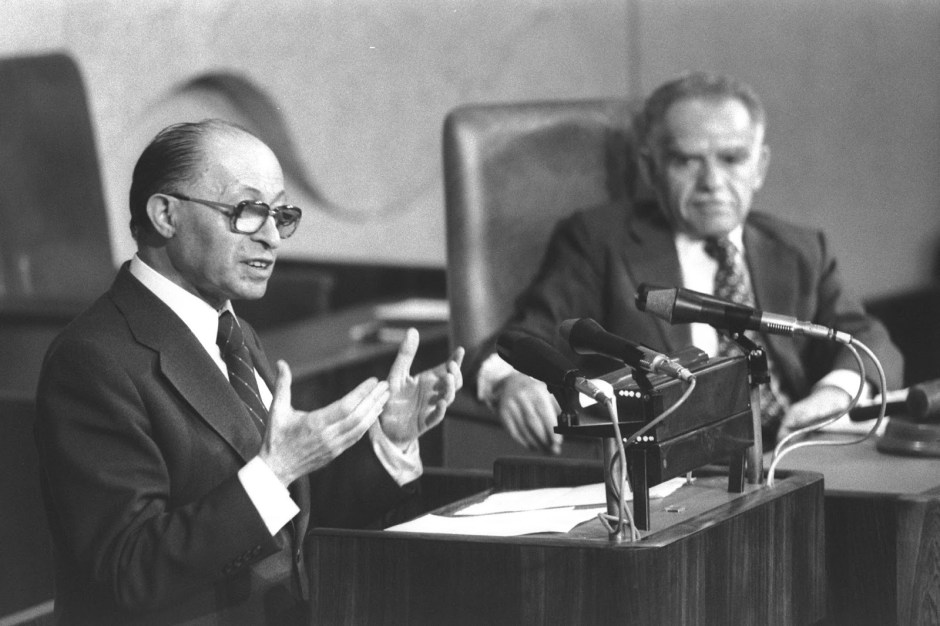
(Israeli Prime Minister Menachem Begin speaking to the Israeli parliament, the Knesset advocating acceptance of the Camp David accords, March 20, 1979.  Future Israeli Prime Minister, Yitzchak Shamir is seated to his right.)

In exploring the creation of the state of Israel over the last 67 years the dominant figure that emerges is David Ben-Gurion.  The head of the Jewish Agency before and after World War II, Ben-Gurion guided the nascent Israeli state and dominated its politics for decades.  However, another transformative figure emerged during the same time period that many outside Israel seem to avoid giving him his due, Menachem Begin.  Whether speaking about Begin’s leadership of the Irgun and the pressure he placed on the British to relinquish its Palestinian mandate; his political leadership that brought about his election to the Prime Minister’s office in 1977 which fundamentally realigned Israeli politics to this day; or his evolution as a terrorist or freedom fighter to a respected politician, depending on your viewpoint, in negotiating the Camp David Accords, the first peace treaty with an Arab state that recognized the state of Israel and altered the balance of power in the Middle East, Begin’s life has left an indelible mark on the Israeli people.  The latest example of Begin’s profound ideological influence on Israel are the recent elections that returned Benjamin Netanyahu to the Prime Minister’s office, leading the Likud bloc that Begin helped create in the 1970s.  The most complete biography of Begin’s life and career is written by Israeli historian, Avi Shilon, MENACHEM BEGIN: A LIFE that mines the Israeli archives and reflects numerous interviews in producing a complete picture of Begin in all aspects of his long career, in addition to providing an interesting analysis that delves into his personality and the motivations for the actions he took.  Daniel Gordis has written the most recent biography of Begin, entitled, MENACHEM BEGIN: THE BATTLE FOR ISRAEL’S SOUL, in which the author admits he is not concerned with all aspects of Begin’s life but “the story he evoked in Jews, of what he said to the world about Jewish history and the Jewish people and the legacy he bequeathed to the state he was instrumental in creating,” as well as looking at his life “through the lens of the passion he still evokes.” (Xiv-xv)  However, Gordis does not come close to Shilon’s book published in English in 2012 in scope and depth of analysis.

The common theme in Shilon’s life of Begin was his pride in being Jewish, a pride that would shape his entire life.  He idealized his father who was a committed Zionist who raised his children with a blend of Jewish tradition and the ideas of Ze’ev Jabotinsky, a leading figure in the movement to establish a Jewish homeland in Palestine.  Begin’s father was his life’s role model as a man living in a Polish village named Brisk, who would use an axe to open a synagogue to allow Theodore Herzl to speak when the head rabbi refused to allow the founder of Zionism to address his congregation.  Further, he would confront anti-Semitic Polish soldiers who almost shot him in front of his son.  Ze’ev-Dov, Begin’s father encouraged his children to go to Palestine and was a model of persistence or stubbornness who would perish along with Begin’s mother and sister in the Holocaust.  Begin’s father stressed the solidarity of the Jewish people and vigorously opposed those who disagreed with him.   Along with his exposure to Judaism as a child, the actions of his father that he witnessed, and the events of the Shoah are all mirrored throughout Begin’s career and the development of his worldview.

(The arrival of Egyptian president, Anwar Sadat in Israel alongside Prime Minister Begin, November 19, 1977)

When discussing Menachem Begin, opinions range from the beloved leader that impacted Israel greatly as a statesman and a man of the people, or a stubborn individual who has authoritarian tendencies with an acerbic tongue and supported violence to achieve his aims.  Shilon comes down between the two extremes as he develops a fascinating portrait of Begin.  From the outset Shilon traces Begin’s ideological roots back to his enrollment in the Beitar Movement that stressed the ideas of Ze’ev Jabotinsky at the age of sixteen.  The movement called on Jews to hold their heads up high, stressed nationalistic issues, and the power of the Jewish people to achieve a future in Israel.  The young Begin was greatly influenced by Jabotinsky, but also Marshall Jozef Pilsudki who led the Polish nationalist movement after World War I, and Guiseppi  Garibaldi, the Italian nationalist who worked to achieve the unification of Italy in the 1860s.  By the time Begin entered his twenties his worldview was formulated as Shilon accurately points out, he “applied Polish nationalistic concepts to his perception of Jewish nationalism – especially regarding the importance of using military means to expand territory – and to this notion he added the spiritual nationalistic anchor – Jewish tradition.” (12)  These themes would be evident in all aspects of Begin’s life’s work.

Shilon’s chronological narrative focuses a great deal on the ideological rifts that developed as Begin worked his way up in the Beitar movement to positions of leadership, the implementation of the Irgun’s war against the British, his time in opposition after the creation of the state of Israel, and his period as Prime Minister.  As Begin rose to prominence in the Beitar movement he would disagree with Jabotinsky in a number of areas, most importantly over the use of terror and cooperation with the British.  During the Irgun years the issue was the application of violence and whether to go along with the Jewish Agency, led by David Ben-Gurion and his strategy.  After independence Begin was adamant about not negotiating with the West German government over reparations as the Holocaust impacted him so severely, and once in power the issue of returning territories won in the 1967 war forced him to change his position of never returning territory that was part of “Eretz Yisroel.”  However, no matter the situation, Shilon credits Begin with his courage and his ability to discern the mood of the public in any decision he made.

(The Beitar Movement that Begin joined at the age of 16, he is seated in the center)

The most controversial part of Begin’s career was his leadership of the Irgun, which the British labeled as a terrorist group before, during, and after World War II.  Begin’s raison detre was to rebel against the British.  At the outset, Begin had no knowledge about leading an underground organization and planning and carrying out operations.  He rose to leadership in the Irgun based on his European background, particularly his training in the Polish army, and his fluency in a number of languages.  As in most cases during his career, Begin let his ideas that many felt were beyond reality, and his oratorical ability to carry the day, and left military planning to experts, a concept that appears over and over during his career.  Begin saw the British refusal to allow Holocaust refugees into Palestine as enough of a reason to declare war on them.  He strongly believed that the British were solely responsible for blocking the creation of the state of Israel.  Begin believed the employment of terror against the British mandate during and after World War II would force them out of the region, buttress the confidence of the Yishuv, damage British prestige, and arouse international public opinion, especially in the United States.  One must ask was terror a successful strategy to accomplish ones goals?  In Bruce Hoffman’s new book ANONYMOUS SOLDIERS: THE STRUGGHLE FOR ISRAEL 1917-1947, the author asks, does terror work?  Based on historical events and the creation of Israel in 1948, his conclusion is that it does.  Shilon does not skirt over the controversial actions taken by the Irgun, the bombing of the King David Hotel, the hanging of the British sergeants, the Deir Yassin massacre, the Altalena Affair, and other events are explored in detail and the author does not hold back any criticism in discussing Begin’s actions.

The contentious relationship and almost hatred between David Ben-Gurion and Begin is a common theme throughout the narrative.  Ben-Gurion always feared Begin’s popularity among the young and wanted to prevent him from gaining any political power.  Shilon points to the fact that Ben-Gurion and Begin shared many characteristics, including a propensity to act in an authoritative manner.  Begin never could accept an Israeli democracy under Ben-Gurion’s control.   For Begin, Ben-Gurion was too secular, and Begin believed in a Hebrew republic that distinguished between the state and religion – a dichotomy that still exists today when one listens to Netanyahu’s repeated call for a “Jewish state.” The integration of the arguments into the narrative between the two in the Knesset and the Israeli media enhances an understanding of the two men as well as providing insights into why they disagreed over policy and their personality differences.  For Begin, religion was the unifying principle of the Jewish people.  For him, the Israeli national concept was based on the Jewish people in its biblical version, and pursuing the military path was a legitimate means to a desired end.

(Israeli Prime Minister, David Ben-Gurion, Begin’s political rival/enemy)

Shilon’s use of primary materials to reflect on Begin’s relationships is important in gaining an accurate view of how he dealt with people.  Begin always respected military men, particularly those he felt were “warriors.”  His relationship with Moshe Dayan, who was a member of the Labour coalition reflects Begin’s ability to compromise when necessary.  His relationship with Ariel Sharon, another military hero is important in addition to his up and down relationship with Ezer Weizmann, an Air Force hero who represented the younger generation that at times would revere Begin because of his background.  In overseeing the dismantling of the Irgun after independence we witness a distraught Begin as he must pursue realpolitik to further his Herut party politically.  The discussions and overt hostility that arises between Begin and his Irgun fighters is important as it reflects the evolution of Begin as a politician and what he sees as the best interests of the Israeli people.

Shilon does an excellent job in analyzing three events that form turning points in Begin’s rise to power in 1977.  The first, in 1952 is his opposition to accepting reparations payment from the West German government, highlighting the impact of the Holocaust in every decision Begin made.  Occurring at a time when his Herut party was in decline it provided a platform for Begin to touch the soul of Israel.  Later in his career when German Chencellor Helmut Schmidt stated on a state visit to Saudi Arabia in 1981 that Germany had a moral obligation toward the Palestinians because it was Germany that was responsible for their plight due to the Holocaust.  An incensed Begin responded at a political rally that, “He is greedy….he seeks two things.  To buy oil cheaply and sell weapons dearly.  He talks about moral obligation to the Arabs?  The obligation to the Jews will never end.” (337)  the second event, the 1967 Six Day War brought Begin into a unity government as a minister without portfolio.  Here the Labour government was following Begin’s approach in dealing with Israeli security and resulted in the capture of the West Bank, or as Begin referred to as Judea and Samaria, Jerusalem, Gaza, the Sinai, and the Golan Heights.  This period of Israeli euphoria is well chronicled and leads to the third event that brings Begin to power, the 1973 Yom Kippur War.  The soul searching that followed the war would lead to the coalition of Herut and two other parties to form the Likud bloc that would produce the election of Begin as Prime Minister in May, 1977.  Shilon’s analysis and questions pertaining to Begin’s rise are valid and thought provoking.
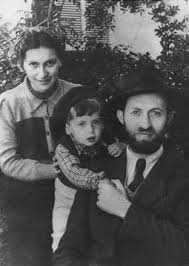
(Begin in disguise as a rabbi during his years underground.  His wife Aliza and daughter Chasia are also pictured)

The final section of the book culminates with a shift in Begin’s approach to foreign policy.  His view was that the Sinai and Golan Heights were not part of the promise land that God gave to the Jewish people, therefore he was willing to negotiate their return.  This would allow him to reduce international pressure over Jerusalem, Judea and Samaria, Gaza, and the settlement program.  This shift in his thinking allowed Begin to go to Camp David and reach an accord with Egyptian president, Anwar Sadat, but being very careful not to give into demands concerning the Palestinians.  For Begin the autonomy agreement that was reached was nothing more than papering over a problem and pushing it into the future when Begin accurately predicted there would be a massive influx of Soviet Jews to Israel alleviating the demographic challenges that Israel faced with the Arabs. Begin’s biggest mistake as Prime Minister was his invasion of southern Lebanon as a means of destroying the Palestine Liberation Organization.  As Robin Wright, the Middle East historian has noted, this became Israel’s Vietnam, and it would take a number of years after Begin retired to extricate itself from.  For Begin the decision to invade Lebanon has been fraught with controversy.  The role of then Defense Minister, Ariel Sharon is at the center of the debate whether he exceeded instructions approved by the Israeli cabinet and pursued his own agenda while keeping Begin in the dark.  According to Shilon, the Prime Minister was “detached from what was happening on the ground,” and though he supported Sharon’s actions, he was culpable for the disasters that followed, including the Shatila and Sabra refugee camp massacre, the increasing Israeli casualty rate, and the eventual emergence of Iranian backed Hezbollah.

Foreign policy was Begin’s bailiwick, and social and economic issues did not create the same interest.  However, he would take advantage of the poverty that recent immigrants from the Arab countries and Ethiopia endured as they tried to assimilate into Israeli society.  He would pit these Sephardic Jews against the ruling Ashkenazis to gain their political support and enhance Likud’s popularity.  Further, he would employ a populist message to gain the support of workers and the middle class to reflect an image of fighting for those who did not benefit from the Labour government’s policies.  Begin would make economic policy pronouncements to assist the poor, but losing interest, he would as he always said, would turn implementation of those policies to the experts.

Shilon’s effort and the excellent translation from Hebrew by Danielle Zilberberg and Yoram Sharett should stand as the preeminent biography of Begin for a great while.  Though at times somewhat wordy, the author has captured the essence of who Begin was, and what his place in history has become.  Today he remains as one of the most popular figures in Israeli history and if Bruce Hoffman is to be believed Begin showed that the use of terror in certain situations can be successful, and that even a rigid ideologue can evolve and have a positive impact on his people.
COLONEL HOUSE: A BIOGRAPHY OF WOODROW WILSON’S SILENT PARTNER by Charles E. Neu

(President Woodrow Wilson and Colonel Edward House, campaigning in 1912)

One of the most tragic endings to any presidency in American history is that of Woodrow Wilson.  Elected twice the former president of Princeton University and Governor of New Jersey continued progressive reform that had marked the earlier administrations of Theodore Roosevelt and Howard Taft.  In addition, Wilson guided the United States through the Great War and developed a plan to make it “the war to end all wars.”  However, Wilson suffered a stroke while trying to sell his postwar plan to the American people as he battled to overcome partisan congressional opposition to the League of Nations and never regained the emotional balance to compromise with his detractors.  In the end Wilson became a bitter man and the fight over the League of Nations overshadowed the positive impact his presidency had on American history.  During Wilson’s administration a “counselor” emerged who had no official title or rank but has often been labeled as Wilson’s “silent partner.”  This individual helped shepherd through Wilson’s domestic agenda through congress, but he remained in the background throughout that process.  It was in the arena of foreign affairs that he became known to the general public.  The man, Edward House was a wealthy Texas politician and businessman who was fascinated by the organizational side of politics, rather than the achievement political power in of itself.  Nicknamed the “Colonel” based on an honorary National Guard rank the governor of Texas bestowed upon him, Colonel House became one of the most powerful and controversial presidential advisers in history.  Until now the literature on House lacked a comprehensive and masterful biography, with the publication of Charles E. Neu’s COLONEL HOUSE: A BIOGRAPHY OF WOODROW WILSON’S SILENT PARTNER that void has been filled.

Neu has written a biography that should remain the definitive source on Colonel House for years to come.  The book is based on assiduous research that includes the leading secondary works on all aspects of American history that House was a part of.  It took Neu years to research and write and it is reflected in the primary materials he examined, particularly the over 3000 page diary that House prepared on a daily basis until 1921 when the Versailles Conference ended.  Neu points out that throughout his life that House was most interested in the “process rather than the substance of politics, fascinated with tactics and personalities.” (11)  As he worked his way through Texas politics he created what he referred to as “our crowd,” a group of advisors and sycophants who would remain with him throughout his career.  In his relationship with Wilson he took on many tasks that the President found distasteful.  Wilson, whom was not a warm individual saw in House an individual that possessed the capacity for human relations that he lacked and relied upon his “counselor” to smooth the way for legislation as well as diplomatic relationships.  One would think that Wilson and House would have spent a great deal of time together during the course of their friendship, but Neu reveals that most of their communication was by letter and telephone.  Fortunately House’s diaries have provided historians a record of their warm feelings for each other that today might be categorized as a “bromance!”

(President Wilson and his cabinet)

Neu correctly develops the theme that House’s greatest contribution to his relationship with the president was his assessment of European events as he repeatedly traveled to Europe between 1913 and 1917 as the United States tried to navigate a policy of neutrality during World War I.  House became the key to American mediation efforts, though his judgment was often clouded by his enamourment with England and its Foreign Secretary Sir Edward Grey and the policies of Lloyd George.  Wilson relied on House as his “personal emissary” but at times House missed the larger historical forces that shaped the policies of the European powers as the war continued.  House’s relationship began with Wilson in 1911 as he grew tired of the policies offered by the Republican Party.  For a number of years through the prism of Texas and national politics he searched for a progressive Democrat who was electable.  The search brought him in contact with Governor Wilson of New Jersey and their relationship blossomed.  With the disarray in the Republican Party in 1912 whoever secured the Democratic nomination was likely to be elected president.  Neu provides a detailed summary of the 1912 election and correctly concludes that it was “one of the most intense campaigns on both a personal and intellectual level that has ever occurred in American political history.” (66)  After the election House had to reinvent himself from the Texas politician who focused on the acquisition of power, relying on personal loyalty, patronage and the manipulation of the system to an advisor dealing with a progressive agenda.  House made the conversion easily and his relationship with Wilson would continue to blossom until the president’s first wife passed away.

 (President Woodrow Wilson, his second wife, Edith Bolling Galt, and Colonel Edward House)

Wilson’s relationship and remarriage to Edith Bolling Galt in 1915 altered Wilson’s relationship with House.  What amazed me was the intimate relationship the two men shared until Wilson remarried.  Neu includes numerous excerpts from letters the two sent to each other in the narrative and the sincerity and emotional nature of their correspondence reflects how dependent they were on each other, i.e., on Christmas day, 1914 Wilson and House exchanged telegrams.  “I wish, I could see brought into your life some happiness and blessing equal to those you have brought into mine by your wonderful friendship.  You have kept faith and strength in me.”  House replied, “Your message has made the day a happy one for me.  May God’s blessings fall upon you and yours abundantly during the coming years.” (164)   Once Edith Galt, a controlling woman entered the picture the relationship between the two men would suffer.  Neu conjectures that despite Wilson’s efforts, Galt was not inclined to share her love for him with another person and her attitude from the start toward House was negative, as she told the president that “I know I am wrong but I can’t help feeling he is not a very strong character….he does look like a weak vessel and I think that he writes like one very often.” (201)   Galt’s relationship with House would be glossed over by her husband but it would never be the same.  Neu does a remarkable job cataloguing the relationship throughout the war and the peace process and concludes that once Wilson suffered a stroke in 1919 her influence on the president was detrimental to the country as she reinforced his negativity that was in part caused by his illness.

Neu does an exceptional job describing the diplomatic and military events dealing with World War I.  He deftly examines the major political and military characters involved and makes numerous insightful comments.  He integrates House’s role in mediation efforts and policy decisions nicely and correctly concludes that in most situations House had an overblown sense of his own importance and influence that at times led to inaccurate reports back to Washington.  This inflated estimate of himself, in part was the fault of Wilson who had a habit of dispatching House on his European missions with only vague instructions and carelessly monitored his negotiations.   Neu has an excellent command over the details of House’s ventures overseas be it to mediate the war before US entrance or managing the allied coalition once the US became a combatant.  A case in point was House’s mediation effort after Wilson was reelected in 1916.  Neu’s analysis of London and Berlin seem very credible and he seems to have mastered the military and political nuances in each capital.  In Berlin, Generals Ludendorff and von Hindenburg views on strategy and implementation of U-boat warfare and the declining influence of Chancellor Bethmann Hollweg are accurately presented by the author.  Neu goes on to state that House’s evaluation of Lloyd George and Arthur Balfour led him to believe that he understood the war better than the president.  House also believed that Wilson was not preparing the country for war, which he believed was inevitable, also setting him apart from the president.  Despite these differences it appears that House had Wilson’s full support as he had him prepare for a post war peace conference which would take place after Germany’s defeat

(Colonel Edward House, Secretary of State Robert Lansing, President Woodrow Wilson)

Neu’s knowledge of war events is especially useful as he places the Wilson-House relationship in the context of events overseas.  Whether discussing the diplomacy dealing with Germany’s U-boat policy, events in Russia as the Czarist regime collapses, the disintegration of the Austro-Hungarian Empire, or the policy of unconditional surrender the author’s narrative is impeccable.  Once the war ends Neu spends a great deal of time on the evolution of the negotiations in Paris and points out the errors that were made.  First, having the conference in Versailles instead of a neutral site like Geneva; having Wilson as the head of the American delegation, and not bringing a prominent Republican as a member of the American commission.  All these errors that House relayed to Wilson are discussed and their negative effect on the final outcome embodied in the Treaty of Versailles are examined.  Wilson’s stubbornness and inflexibility are ever present, but so is House’s inability to convey an accurate portrayal of what was to be expected before negotiations began.  The relationship between the two men would not survive the conference as House was not given a prominent role in the day to day diplomacy as Wilson put him in charge of writing a constitution for the future League of Nations.  However, when Wilson returned to the United States to deal with Republican opposition to the League, House’s role in territorial negotiations is enhanced.  However once Wilson returned to Paris he felt that while he was away that House overly accommodated the French and Italians violating the principle of self-determination.  This heightened their disagreements over policy and House’s illusions about his own effectiveness resulted in his failure to carry out some of Wilson’s wishes embodied in the Fourteen Points, “succumbing to Clemenceau’s flattery and his own conviction that he was the master of the negotiating process.” (422)

Apart from the sections on diplomacy and war, Neu examines many important relationships and personal views of the major historical figures that House dealt with.  House’s relationship to other key administration figures is explored especially Secretary of State William Jennings Bryan, who both Wilson and House lacked respect for and his replacement, Robert Lansing who was seen as weak and whose opinions were repeatedly bypassed.  Both the President and House had little use for US ambassador to England, Walter Hines Page and the feelings were mutual.  House’s use of the term “love” in describing his opinion of French President Georges Clemenceau and English Foreign Secretary Edward Grey reflects a lack of objectivity that is very bothersome.  In addition, House’s views of Jews comes across as very anti-Semitic as he speaks about Supreme Court Justice Louis Brandeis and Bernard Baruch, who skills Wilson employed in organizing the United States domestically for war.  Military figures such as General John J. Pershing, Sir Alexander Haig, and General Joseph Joffre are all explored.  American politicians like Henry Cabot Lodge, Warren G. Harding, John W. Davis and many others are also painted by Neu’s historical brush as the politics of peace and presidential campaigns are rendered in detail.

(President Woodrow Wilson visiting London in February, 1918)

Once the issues of the war are settled, Neu describes House’s career and retirement in the last section of the book.  What is most interesting is House’s obsession with his place in history and he how he established a warm working relationship with Yale University historian Charles Seymour who would edit his private papers into four volumes.  As House grew older he repeatedly reexamined the break with Wilson, accepting no responsibility he blamed it on Edith Galt and her coterie of advisors that surrounded the stricken president.  The book may come across as encyclopedic to some readers, but Neu’s ability to turn a phrase and write clear and concise sentences will allow the novice historian to enjoy the results of years of the author’s work in creating a superb biography of one of the most important figures in 20th century American political history.  The key to Neu’s success is that he lets House’s record as a private advisor and diplomat tell its own story and the reader can judge for themselves how important House may have been to the era in which he lived.