MENACHEM BEGIN: A LIFE by Avi Shilon

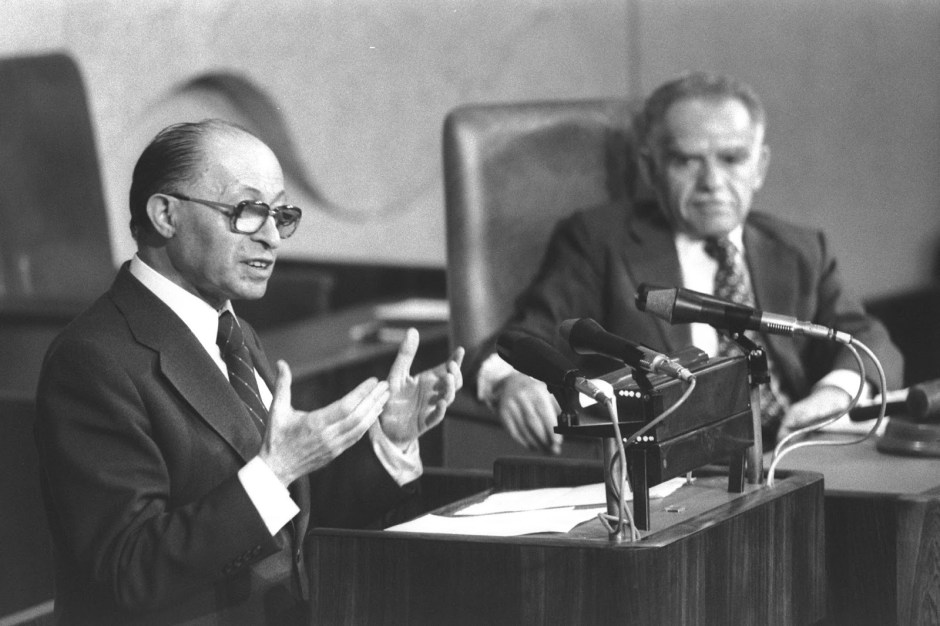
(Israeli Prime Minister Menachem Begin speaking to the Israeli parliament, the Knesset advocating acceptance of the Camp David accords, March 20, 1979.  Future Israeli Prime Minister, Yitzchak Shamir is seated to his right.)

In exploring the creation of the state of Israel over the last 67 years the dominant figure that emerges is David Ben-Gurion.  The head of the Jewish Agency before and after World War II, Ben-Gurion guided the nascent Israeli state and dominated its politics for decades.  However, another transformative figure emerged during the same time period that many outside Israel seem to avoid giving him his due, Menachem Begin.  Whether speaking about Begin’s leadership of the Irgun and the pressure he placed on the British to relinquish its Palestinian mandate; his political leadership that brought about his election to the Prime Minister’s office in 1977 which fundamentally realigned Israeli politics to this day; or his evolution as a terrorist or freedom fighter to a respected politician, depending on your viewpoint, in negotiating the Camp David Accords, the first peace treaty with an Arab state that recognized the state of Israel and altered the balance of power in the Middle East, Begin’s life has left an indelible mark on the Israeli people.  The latest example of Begin’s profound ideological influence on Israel are the recent elections that returned Benjamin Netanyahu to the Prime Minister’s office, leading the Likud bloc that Begin helped create in the 1970s.  The most complete biography of Begin’s life and career is written by Israeli historian, Avi Shilon, MENACHEM BEGIN: A LIFE that mines the Israeli archives and reflects numerous interviews in producing a complete picture of Begin in all aspects of his long career, in addition to providing an interesting analysis that delves into his personality and the motivations for the actions he took.  Daniel Gordis has written the most recent biography of Begin, entitled, MENACHEM BEGIN: THE BATTLE FOR ISRAEL’S SOUL, in which the author admits he is not concerned with all aspects of Begin’s life but “the story he evoked in Jews, of what he said to the world about Jewish history and the Jewish people and the legacy he bequeathed to the state he was instrumental in creating,” as well as looking at his life “through the lens of the passion he still evokes.” (Xiv-xv)  However, Gordis does not come close to Shilon’s book published in English in 2012 in scope and depth of analysis.

The common theme in Shilon’s life of Begin was his pride in being Jewish, a pride that would shape his entire life.  He idealized his father who was a committed Zionist who raised his children with a blend of Jewish tradition and the ideas of Ze’ev Jabotinsky, a leading figure in the movement to establish a Jewish homeland in Palestine.  Begin’s father was his life’s role model as a man living in a Polish village named Brisk, who would use an axe to open a synagogue to allow Theodore Herzl to speak when the head rabbi refused to allow the founder of Zionism to address his congregation.  Further, he would confront anti-Semitic Polish soldiers who almost shot him in front of his son.  Ze’ev-Dov, Begin’s father encouraged his children to go to Palestine and was a model of persistence or stubbornness who would perish along with Begin’s mother and sister in the Holocaust.  Begin’s father stressed the solidarity of the Jewish people and vigorously opposed those who disagreed with him.   Along with his exposure to Judaism as a child, the actions of his father that he witnessed, and the events of the Shoah are all mirrored throughout Begin’s career and the development of his worldview.

(The arrival of Egyptian president, Anwar Sadat in Israel alongside Prime Minister Begin, November 19, 1977)

When discussing Menachem Begin, opinions range from the beloved leader that impacted Israel greatly as a statesman and a man of the people, or a stubborn individual who has authoritarian tendencies with an acerbic tongue and supported violence to achieve his aims.  Shilon comes down between the two extremes as he develops a fascinating portrait of Begin.  From the outset Shilon traces Begin’s ideological roots back to his enrollment in the Beitar Movement that stressed the ideas of Ze’ev Jabotinsky at the age of sixteen.  The movement called on Jews to hold their heads up high, stressed nationalistic issues, and the power of the Jewish people to achieve a future in Israel.  The young Begin was greatly influenced by Jabotinsky, but also Marshall Jozef Pilsudki who led the Polish nationalist movement after World War I, and Guiseppi  Garibaldi, the Italian nationalist who worked to achieve the unification of Italy in the 1860s.  By the time Begin entered his twenties his worldview was formulated as Shilon accurately points out, he “applied Polish nationalistic concepts to his perception of Jewish nationalism – especially regarding the importance of using military means to expand territory – and to this notion he added the spiritual nationalistic anchor – Jewish tradition.” (12)  These themes would be evident in all aspects of Begin’s life’s work.

Shilon’s chronological narrative focuses a great deal on the ideological rifts that developed as Begin worked his way up in the Beitar movement to positions of leadership, the implementation of the Irgun’s war against the British, his time in opposition after the creation of the state of Israel, and his period as Prime Minister.  As Begin rose to prominence in the Beitar movement he would disagree with Jabotinsky in a number of areas, most importantly over the use of terror and cooperation with the British.  During the Irgun years the issue was the application of violence and whether to go along with the Jewish Agency, led by David Ben-Gurion and his strategy.  After independence Begin was adamant about not negotiating with the West German government over reparations as the Holocaust impacted him so severely, and once in power the issue of returning territories won in the 1967 war forced him to change his position of never returning territory that was part of “Eretz Yisroel.”  However, no matter the situation, Shilon credits Begin with his courage and his ability to discern the mood of the public in any decision he made.

(The Beitar Movement that Begin joined at the age of 16, he is seated in the center)

The most controversial part of Begin’s career was his leadership of the Irgun, which the British labeled as a terrorist group before, during, and after World War II.  Begin’s raison detre was to rebel against the British.  At the outset, Begin had no knowledge about leading an underground organization and planning and carrying out operations.  He rose to leadership in the Irgun based on his European background, particularly his training in the Polish army, and his fluency in a number of languages.  As in most cases during his career, Begin let his ideas that many felt were beyond reality, and his oratorical ability to carry the day, and left military planning to experts, a concept that appears over and over during his career.  Begin saw the British refusal to allow Holocaust refugees into Palestine as enough of a reason to declare war on them.  He strongly believed that the British were solely responsible for blocking the creation of the state of Israel.  Begin believed the employment of terror against the British mandate during and after World War II would force them out of the region, buttress the confidence of the Yishuv, damage British prestige, and arouse international public opinion, especially in the United States.  One must ask was terror a successful strategy to accomplish ones goals?  In Bruce Hoffman’s new book ANONYMOUS SOLDIERS: THE STRUGGHLE FOR ISRAEL 1917-1947, the author asks, does terror work?  Based on historical events and the creation of Israel in 1948, his conclusion is that it does.  Shilon does not skirt over the controversial actions taken by the Irgun, the bombing of the King David Hotel, the hanging of the British sergeants, the Deir Yassin massacre, the Altalena Affair, and other events are explored in detail and the author does not hold back any criticism in discussing Begin’s actions.

The contentious relationship and almost hatred between David Ben-Gurion and Begin is a common theme throughout the narrative.  Ben-Gurion always feared Begin’s popularity among the young and wanted to prevent him from gaining any political power.  Shilon points to the fact that Ben-Gurion and Begin shared many characteristics, including a propensity to act in an authoritative manner.  Begin never could accept an Israeli democracy under Ben-Gurion’s control.   For Begin, Ben-Gurion was too secular, and Begin believed in a Hebrew republic that distinguished between the state and religion – a dichotomy that still exists today when one listens to Netanyahu’s repeated call for a “Jewish state.” The integration of the arguments into the narrative between the two in the Knesset and the Israeli media enhances an understanding of the two men as well as providing insights into why they disagreed over policy and their personality differences.  For Begin, religion was the unifying principle of the Jewish people.  For him, the Israeli national concept was based on the Jewish people in its biblical version, and pursuing the military path was a legitimate means to a desired end.

(Israeli Prime Minister, David Ben-Gurion, Begin’s political rival/enemy)

Shilon’s use of primary materials to reflect on Begin’s relationships is important in gaining an accurate view of how he dealt with people.  Begin always respected military men, particularly those he felt were “warriors.”  His relationship with Moshe Dayan, who was a member of the Labour coalition reflects Begin’s ability to compromise when necessary.  His relationship with Ariel Sharon, another military hero is important in addition to his up and down relationship with Ezer Weizmann, an Air Force hero who represented the younger generation that at times would revere Begin because of his background.  In overseeing the dismantling of the Irgun after independence we witness a distraught Begin as he must pursue realpolitik to further his Herut party politically.  The discussions and overt hostility that arises between Begin and his Irgun fighters is important as it reflects the evolution of Begin as a politician and what he sees as the best interests of the Israeli people.

Shilon does an excellent job in analyzing three events that form turning points in Begin’s rise to power in 1977.  The first, in 1952 is his opposition to accepting reparations payment from the West German government, highlighting the impact of the Holocaust in every decision Begin made.  Occurring at a time when his Herut party was in decline it provided a platform for Begin to touch the soul of Israel.  Later in his career when German Chencellor Helmut Schmidt stated on a state visit to Saudi Arabia in 1981 that Germany had a moral obligation toward the Palestinians because it was Germany that was responsible for their plight due to the Holocaust.  An incensed Begin responded at a political rally that, “He is greedy….he seeks two things.  To buy oil cheaply and sell weapons dearly.  He talks about moral obligation to the Arabs?  The obligation to the Jews will never end.” (337)  the second event, the 1967 Six Day War brought Begin into a unity government as a minister without portfolio.  Here the Labour government was following Begin’s approach in dealing with Israeli security and resulted in the capture of the West Bank, or as Begin referred to as Judea and Samaria, Jerusalem, Gaza, the Sinai, and the Golan Heights.  This period of Israeli euphoria is well chronicled and leads to the third event that brings Begin to power, the 1973 Yom Kippur War.  The soul searching that followed the war would lead to the coalition of Herut and two other parties to form the Likud bloc that would produce the election of Begin as Prime Minister in May, 1977.  Shilon’s analysis and questions pertaining to Begin’s rise are valid and thought provoking.

(Begin in disguise as a rabbi during his years underground.  His wife Aliza and daughter Chasia are also pictured)

The final section of the book culminates with a shift in Begin’s approach to foreign policy.  His view was that the Sinai and Golan Heights were not part of the promise land that God gave to the Jewish people, therefore he was willing to negotiate their return.  This would allow him to reduce international pressure over Jerusalem, Judea and Samaria, Gaza, and the settlement program.  This shift in his thinking allowed Begin to go to Camp David and reach an accord with Egyptian president, Anwar Sadat, but being very careful not to give into demands concerning the Palestinians.  For Begin the autonomy agreement that was reached was nothing more than papering over a problem and pushing it into the future when Begin accurately predicted there would be a massive influx of Soviet Jews to Israel alleviating the demographic challenges that Israel faced with the Arabs. Begin’s biggest mistake as Prime Minister was his invasion of southern Lebanon as a means of destroying the Palestine Liberation Organization.  As Robin Wright, the Middle East historian has noted, this became Israel’s Vietnam, and it would take a number of years after Begin retired to extricate itself from.  For Begin the decision to invade Lebanon has been fraught with controversy.  The role of then Defense Minister, Ariel Sharon is at the center of the debate whether he exceeded instructions approved by the Israeli cabinet and pursued his own agenda while keeping Begin in the dark.  According to Shilon, the Prime Minister was “detached from what was happening on the ground,” and though he supported Sharon’s actions, he was culpable for the disasters that followed, including the Shatila and Sabra refugee camp massacre, the increasing Israeli casualty rate, and the eventual emergence of Iranian backed Hezbollah.

Foreign policy was Begin’s bailiwick, and social and economic issues did not create the same interest.  However, he would take advantage of the poverty that recent immigrants from the Arab countries and Ethiopia endured as they tried to assimilate into Israeli society.  He would pit these Sephardic Jews against the ruling Ashkenazis to gain their political support and enhance Likud’s popularity.  Further, he would employ a populist message to gain the support of workers and the middle class to reflect an image of fighting for those who did not benefit from the Labour government’s policies.  Begin would make economic policy pronouncements to assist the poor, but losing interest, he would as he always said, would turn implementation of those policies to the experts.

Shilon’s effort and the excellent translation from Hebrew by Danielle Zilberberg and Yoram Sharett should stand as the preeminent biography of Begin for a great while.  Though at times somewhat wordy, the author has captured the essence of who Begin was, and what his place in history has become.  Today he remains as one of the most popular figures in Israeli history and if Bruce Hoffman is to be believed Begin showed that the use of terror in certain situations can be successful, and that even a rigid ideologue can evolve and have a positive impact on his people.

COLONEL HOUSE: A BIOGRAPHY OF WOODROW WILSON’S SILENT PARTNER by Charles E. Neu

(President Woodrow Wilson and Colonel Edward House, campaigning in 1912)

One of the most tragic endings to any presidency in American history is that of Woodrow Wilson.  Elected twice the former president of Princeton University and Governor of New Jersey continued progressive reform that had marked the earlier administrations of Theodore Roosevelt and Howard Taft.  In addition, Wilson guided the United States through the Great War and developed a plan to make it “the war to end all wars.”  However, Wilson suffered a stroke while trying to sell his postwar plan to the American people as he battled to overcome partisan congressional opposition to the League of Nations and never regained the emotional balance to compromise with his detractors.  In the end Wilson became a bitter man and the fight over the League of Nations overshadowed the positive impact his presidency had on American history.  During Wilson’s administration a “counselor” emerged who had no official title or rank but has often been labeled as Wilson’s “silent partner.”  This individual helped shepherd through Wilson’s domestic agenda through congress, but he remained in the background throughout that process.  It was in the arena of foreign affairs that he became known to the general public.  The man, Edward House was a wealthy Texas politician and businessman who was fascinated by the organizational side of politics, rather than the achievement political power in of itself.  Nicknamed the “Colonel” based on an honorary National Guard rank the governor of Texas bestowed upon him, Colonel House became one of the most powerful and controversial presidential advisers in history.  Until now the literature on House lacked a comprehensive and masterful biography, with the publication of Charles E. Neu’s COLONEL HOUSE: A BIOGRAPHY OF WOODROW WILSON’S SILENT PARTNER that void has been filled.

Neu has written a biography that should remain the definitive source on Colonel House for years to come.  The book is based on assiduous research that includes the leading secondary works on all aspects of American history that House was a part of.  It took Neu years to research and write and it is reflected in the primary materials he examined, particularly the over 3000 page diary that House prepared on a daily basis until 1921 when the Versailles Conference ended.  Neu points out that throughout his life that House was most interested in the “process rather than the substance of politics, fascinated with tactics and personalities.” (11)  As he worked his way through Texas politics he created what he referred to as “our crowd,” a group of advisors and sycophants who would remain with him throughout his career.  In his relationship with Wilson he took on many tasks that the President found distasteful.  Wilson, whom was not a warm individual saw in House an individual that possessed the capacity for human relations that he lacked and relied upon his “counselor” to smooth the way for legislation as well as diplomatic relationships.  One would think that Wilson and House would have spent a great deal of time together during the course of their friendship, but Neu reveals that most of their communication was by letter and telephone.  Fortunately House’s diaries have provided historians a record of their warm feelings for each other that today might be categorized as a “bromance!”

(President Wilson and his cabinet)

Neu correctly develops the theme that House’s greatest contribution to his relationship with the president was his assessment of European events as he repeatedly traveled to Europe between 1913 and 1917 as the United States tried to navigate a policy of neutrality during World War I.  House became the key to American mediation efforts, though his judgment was often clouded by his enamourment with England and its Foreign Secretary Sir Edward Grey and the policies of Lloyd George.  Wilson relied on House as his “personal emissary” but at times House missed the larger historical forces that shaped the policies of the European powers as the war continued.  House’s relationship began with Wilson in 1911 as he grew tired of the policies offered by the Republican Party.  For a number of years through the prism of Texas and national politics he searched for a progressive Democrat who was electable.  The search brought him in contact with Governor Wilson of New Jersey and their relationship blossomed.  With the disarray in the Republican Party in 1912 whoever secured the Democratic nomination was likely to be elected president.  Neu provides a detailed summary of the 1912 election and correctly concludes that it was “one of the most intense campaigns on both a personal and intellectual level that has ever occurred in American political history.” (66)  After the election House had to reinvent himself from the Texas politician who focused on the acquisition of power, relying on personal loyalty, patronage and the manipulation of the system to an advisor dealing with a progressive agenda.  House made the conversion easily and his relationship with Wilson would continue to blossom until the president’s first wife passed away.

 (President Woodrow Wilson, his second wife, Edith Bolling Galt, and Colonel Edward House)

Wilson’s relationship and remarriage to Edith Bolling Galt in 1915 altered Wilson’s relationship with House.  What amazed me was the intimate relationship the two men shared until Wilson remarried.  Neu includes numerous excerpts from letters the two sent to each other in the narrative and the sincerity and emotional nature of their correspondence reflects how dependent they were on each other, i.e., on Christmas day, 1914 Wilson and House exchanged telegrams.  “I wish, I could see brought into your life some happiness and blessing equal to those you have brought into mine by your wonderful friendship.  You have kept faith and strength in me.”  House replied, “Your message has made the day a happy one for me.  May God’s blessings fall upon you and yours abundantly during the coming years.” (164)   Once Edith Galt, a controlling woman entered the picture the relationship between the two men would suffer.  Neu conjectures that despite Wilson’s efforts, Galt was not inclined to share her love for him with another person and her attitude from the start toward House was negative, as she told the president that “I know I am wrong but I can’t help feeling he is not a very strong character….he does look like a weak vessel and I think that he writes like one very often.” (201)   Galt’s relationship with House would be glossed over by her husband but it would never be the same.  Neu does a remarkable job cataloguing the relationship throughout the war and the peace process and concludes that once Wilson suffered a stroke in 1919 her influence on the president was detrimental to the country as she reinforced his negativity that was in part caused by his illness.

Neu does an exceptional job describing the diplomatic and military events dealing with World War I.  He deftly examines the major political and military characters involved and makes numerous insightful comments.  He integrates House’s role in mediation efforts and policy decisions nicely and correctly concludes that in most situations House had an overblown sense of his own importance and influence that at times led to inaccurate reports back to Washington.  This inflated estimate of himself, in part was the fault of Wilson who had a habit of dispatching House on his European missions with only vague instructions and carelessly monitored his negotiations.   Neu has an excellent command over the details of House’s ventures overseas be it to mediate the war before US entrance or managing the allied coalition once the US became a combatant.  A case in point was House’s mediation effort after Wilson was reelected in 1916.  Neu’s analysis of London and Berlin seem very credible and he seems to have mastered the military and political nuances in each capital.  In Berlin, Generals Ludendorff and von Hindenburg views on strategy and implementation of U-boat warfare and the declining influence of Chancellor Bethmann Hollweg are accurately presented by the author.  Neu goes on to state that House’s evaluation of Lloyd George and Arthur Balfour led him to believe that he understood the war better than the president.  House also believed that Wilson was not preparing the country for war, which he believed was inevitable, also setting him apart from the president.  Despite these differences it appears that House had Wilson’s full support as he had him prepare for a post war peace conference which would take place after Germany’s defeat

(Colonel Edward House, Secretary of State Robert Lansing, President Woodrow Wilson)

Neu’s knowledge of war events is especially useful as he places the Wilson-House relationship in the context of events overseas.  Whether discussing the diplomacy dealing with Germany’s U-boat policy, events in Russia as the Czarist regime collapses, the disintegration of the Austro-Hungarian Empire, or the policy of unconditional surrender the author’s narrative is impeccable.  Once the war ends Neu spends a great deal of time on the evolution of the negotiations in Paris and points out the errors that were made.  First, having the conference in Versailles instead of a neutral site like Geneva; having Wilson as the head of the American delegation, and not bringing a prominent Republican as a member of the American commission.  All these errors that House relayed to Wilson are discussed and their negative effect on the final outcome embodied in the Treaty of Versailles are examined.  Wilson’s stubbornness and inflexibility are ever present, but so is House’s inability to convey an accurate portrayal of what was to be expected before negotiations began.  The relationship between the two men would not survive the conference as House was not given a prominent role in the day to day diplomacy as Wilson put him in charge of writing a constitution for the future League of Nations.  However, when Wilson returned to the United States to deal with Republican opposition to the League, House’s role in territorial negotiations is enhanced.  However once Wilson returned to Paris he felt that while he was away that House overly accommodated the French and Italians violating the principle of self-determination.  This heightened their disagreements over policy and House’s illusions about his own effectiveness resulted in his failure to carry out some of Wilson’s wishes embodied in the Fourteen Points, “succumbing to Clemenceau’s flattery and his own conviction that he was the master of the negotiating process.” (422)

Apart from the sections on diplomacy and war, Neu examines many important relationships and personal views of the major historical figures that House dealt with.  House’s relationship to other key administration figures is explored especially Secretary of State William Jennings Bryan, who both Wilson and House lacked respect for and his replacement, Robert Lansing who was seen as weak and whose opinions were repeatedly bypassed.  Both the President and House had little use for US ambassador to England, Walter Hines Page and the feelings were mutual.  House’s use of the term “love” in describing his opinion of French President Georges Clemenceau and English Foreign Secretary Edward Grey reflects a lack of objectivity that is very bothersome.  In addition, House’s views of Jews comes across as very anti-Semitic as he speaks about Supreme Court Justice Louis Brandeis and Bernard Baruch, who skills Wilson employed in organizing the United States domestically for war.  Military figures such as General John J. Pershing, Sir Alexander Haig, and General Joseph Joffre are all explored.  American politicians like Henry Cabot Lodge, Warren G. Harding, John W. Davis and many others are also painted by Neu’s historical brush as the politics of peace and presidential campaigns are rendered in detail.

(President Woodrow Wilson visiting London in February, 1918)

Once the issues of the war are settled, Neu describes House’s career and retirement in the last section of the book.  What is most interesting is House’s obsession with his place in history and he how he established a warm working relationship with Yale University historian Charles Seymour who would edit his private papers into four volumes.  As House grew older he repeatedly reexamined the break with Wilson, accepting no responsibility he blamed it on Edith Galt and her coterie of advisors that surrounded the stricken president.  The book may come across as encyclopedic to some readers, but Neu’s ability to turn a phrase and write clear and concise sentences will allow the novice historian to enjoy the results of years of the author’s work in creating a superb biography of one of the most important figures in 20th century American political history.  The key to Neu’s success is that he lets House’s record as a private advisor and diplomat tell its own story and the reader can judge for themselves how important House may have been to the era in which he lived.

(George C. Marshall was chosen as TIMES man of the year in 1943)

When one thinks of the great World War II generals the names George S. Patton, Omar Bradley, Dwight D. Eisenhower, Douglas Mac Arthur, and Bernard Montgomery seem to always enter the conversation.  However, one of the most important military figures of the war never seems to be mentioned, that individual is George C. Marshall.  The former Chief of Staff under Franklin Roosevelt and Secretary of State and Defense under Harry Truman had a tremendous impact during and after the war, and even has his name placed on one of the most important initiatives taken by the United States after 1945 to help rebuild Europe, the Marshall Plan.  Marshall never did command troops on the battlefield but his impact on the military was substantial and his role has been the subject of a great deal of debate among historians.  The latest effort is a new biography written by Debi and Irwin Unger with the assistance of Stanley Hirshson.  The book, GEORGE MARSHALL is a comprehensive examination of Marshall’s career and a detailed analysis of Marshall’s role in history.

In the January 3, 1944 issue of Time magazine, Marshall’s photo adorns the cover as “man of the year.”  The article that accompanied the photo stated that George C. Marshall was the closest person in the United States to being the “indispensable man” for the American war effort.  One must ask the question, was this hyperbole justified?  According to the Unger’s the answer is a qualified no.  After analyzing Marshall’s policies they conclude that his shortcomings outweigh his successes ranging from his poor judgment of the individuals he placed in command positions to his underestimating the number of troops necessary to fight the war, particularly in providing replacements for men killed or wounded in combat.  In addition, they criticize Marshall for his approach to training and preparing American soldiers for combat which was painfully obvious during the North African campaign and other major operations during the war.  The authors argue their case carefully supporting their views with the available documentation, though there is an over reliance on secondary sources.

Everyone who has written about Marshall and came in contact with him all agree that he epitomized the characteristics of a Virginia gentleman.  He presented himself as aloof and honest, and though a rather humorless and direct person no one ever questioned his character.  This persona remained with Marshall throughout his career and emerged during policy decisions, diplomatic negotiations, or his dealings with the divergent personalities that he had to work with.  The narrative points out the importance of Marshall’s association with General John J. Pershing during World War I and the first major example of Marshall losing his temper over policy, and having the target of his tirade take him under their wing.  The story follows Marshall’s career in the post-World I era and his association with men like Douglas Mac Arthur, Dwight Eisenhower and others who he would enter in his notebook as people to watch for in the future.  The majority of the book deals with Marshall’s impact on American military planning.  In the 1930s he worked to train National Guard units, but he also worked with the Civilian Conservation Corps which brought him to the attention of President Roosevelt.  From this point on his career takes off.  By 1938 he becomes Deputy Chief of Staff at the same time the situation in Europe continued to deteriorate.  By 1939, after an overly honest conversation with Roosevelt about the state of US military preparedness, the president impressed with Marshall’s seriousness appointed him Chief of Staff.

The author’s integrate the major events in Europe and the Far East up to and including the Japanese attack on Pearl Harbor, but they do not mine any new ground.  As the book analyzes the major components of Marshall’s career, the authors have a habit of presenting the negative, then produce some positives, and finally concluding their analysis with the mistakes that Marshall supposedly made.  A number of examples come to mind.  Roosevelt haters for years have tried to blame the president for the events of December 7, 1941 and the authors examine Marshall’s culpability for how unprepared the US was for the attack.  The Ungers examine numerous investigations of the attack on Pearl Harbor and seem disappointed that more of the blame did not fall on Marshall.  They seem to conclude as they comment on his appearance at a Congressional hearing that “Marshall’s demeanor may also reveal a degree of self-doubt-indeed pangs of conscience-at his own imperfect performance in the events leading to Pearl Harbor.”   The Congressional investigation criticized Marshall and Admiral Harold Stark for “insufficient vigilance in overseeing their subordinates in Hawaii……[and] deplored Marshall’s failure on the morning of the attack to send a warning to Short on a priority basis.” (367)

(Marshall announced the European Recovery Program that bears his name at a commencement speech at Harvard on June 5, 1947)

It is painfully obvious based on the author’s narrative that the United States was totally unprepared for war.  They credit Marshall for doing his best to lobby Congress to expand the American military and institute a draft and then extend it.  In 1942 Roosevelt wanted to strike at North Africa, but Marshall believed that the American needs in the Pacific and plans to assist the British in Iceland and Northern Ireland would create man power shortages if the strike in North Africa went forward.  The authors criticize Marshall for not presenting his case forcefully enough to Roosevelt which would cause manpower issues later on in the war.  In planning for the war Marshall argued that a force of 8,000,000 men and 90 divisions would be sufficient to win the war.  Throughout the war there were constant worries that certain strategic decisions would not be successful for lack of manpower.   The author’s point to the cross channel invasion of France, having enough troops to take on the Japanese once the Germans were defeated, and the landing at Sicily to make their case.  They do praise Marshall for trying to reform the military command structure by always placing one general in charge in each war theater, be it D-Day, Torch, or other operations.  They also praise Marshall for trying to reform the training of American troops, but at the same time they criticize him for the lack of morale of American soldiers and their supposed lack of commitment to defeat the enemy.   Marshall would partly agree with the authors conclusions as he admitted that the soldiers sent to North Africa “were only partly trained and badly trained.” (168)

As mentioned before, Marshall maintained a list of men he though would be invaluable in leading American troops during the war.  The authors have difficulty with some of his choices and argue that he was a poor judge of character in others.  “On the one hand we note the names of fighting generals George S. Patton, Robert Eichelberger, Courtney Hodges, J. Lawton Collins, and Lucian Truscott,” and administrators like Dwight Eisenhower and Brehon Somervell, but on the other hand we find the likes of Lloyd Fredendall and Mark Clark, which provoked a respected military correspondent like Hanson Baldwin of the New York Times to have written “the greatest American military problem was leadership, the army he concluded, had thus far failed to produce a fraction of the adequate officer leadership needed.” (208)

(Marshall in conversation with General Dwight D. Eisenhower)

Many of the criticisms that the authors offer have some basis, but their critique goes a bit too far by suggesting that Marshall was indirectly responsible for the death of his step son, Allen at Anzio as he had placed him in range of peril because he facilitated his transfer to North Africa after he completed Armored Force School at Fort Knox.  The most effective historical writing is one of balance and objectivity, but at times the Ungers become too polemical as they try to downgrade Marshall’s reputation.  Granted Marshall had never led troops in combat, but as a logistician, administrator, and diplomat he deserves to be praised.  Marshall’s ability to deal with British generals and their egos was very important to the allied effort.  His ability to work with Winston Churchill and argue against the English Prime Minister’s goals of a Mediterranean strategy and movement in the Balkans as part of retaining the British Empire merits commendation.  His ability to navigate American politics and strong personalities was also a key to victory.

Once the authors have completed their discussion of the war they turn to Marshall’s role as Secretary of State.  They correctly point out that it took Marshall some time to realize that Stalin could not be trusted and had designs on Eastern Europe.  They are also correct in pointing out that the European Recovery Program that bears his name was not developed by the Secretary of State but by a talented staff that included the likes of George Kennan, Chip Bohlen, Dean Acheson, Dean Rusk, and Robert Lovett.  Marshall’s importance was lobbying Congress to gain funding for the program.  The authors also give Marshall credit for trying to work out a rapprochement between the Kuomintang and the Chinese Communists after the war, a task that was almost impossible. The authors describe the heated debate over the creation of the state of Israel that Marshall vehemently opposed based on the national security needs of the United States and dismissed the political and humanitarian calculations of Clark Clifford and President Truman. A position the authors feel that when looked upon from today’s perspective was quite accurate.   Finally, the authors give Marshall a significant amount of credit for the creation of NATO.

(Marshall greets President Truman at the conclusion of World War II)

f Marshall’s term as Secretary of State is deemed successful by the authors his one year stint as Secretary of Defense is seen as flawed.  The main criticism of Marshall deals with Douglas MacArthur and the Korean War.  After taking the reader through the North Korean attack on South Korea and the successful Inchon landing the authors describe in detail the dilemma of how far to pursue North Korean troops.  The question was should United Nations forces cross the 38th parallel into the north and how close should American bombing come to the Yalu River that bordered on Communist China.  According to the authors when the Communist Chinese troops entered the war it was not totally the fault of MacArthur because of the unclear orders that Marshall gave.  According to the authors Marshall’s orders were “tentative and ambiguous,” thus confusing the American commander.(464)  The limits on what the President allowed were very clear and when General Matthew Ridgeway, who replaced MacArthur as American commander was asked “why the chiefs did not give MacArthur categorical directions the general responded “what good would that do?  He wouldn’t obey the orders.” (467)   It appears the authors can never pass on an opportunity of presenting Marshall in a negative light.

Overall, the book is well written and covers all the major components of the Second World War.  It does less with Marshall’s role as Secretary of State and Defense, but if one is looking for a different approach to Marshall’s career this book can meet your needs as long as you realize that there are segments that are not very balanced.  Even in the book’s last paragraph they feel the need to make one last negative comment, “all told, the performance of George Marshall in many of his roles was less than awe-inspiring.” (490)

LINCOLN AND THE POWER OF THE PRESS by Harold Holzer

Abraham Lincoln has probably been the subject of more monographs than any other figure in American history.  In all the books written about our sixteenth president, be it biographies or monographs dealing with different aspects of the Lincoln presidency, the issue of his relationship with the press has not been mined thoroughly.  This gap in Lincoln historiography has been admirably filled by Harold Holzer’s new book, LINCOLN AND THE POWER OF THE PRESS.  Holzer, a leading authority on Lincoln and the Civil War serves as Chairman of the Lincoln Bicentennial Foundation and has authored, co-authored or edited 42 books.  In his latest effort he has done an excellent job in researching and writing about Lincoln’s relationship to the press, how it affected his political career, and how he approached the dissemination of information during the Civil War.  Holzer argues that during the mid nineteenth century through the end of the Civil War, newspapers worked hand in glove with politicians.  A number of newspaper editors held political office at the same time they wrote for, or owned newspapers.  It was very difficult to separate political parties from the opinions of certain newspapers.  In a sense one’s political affiliation was made public by the newspaper they wrote for.  In Lincoln’s case, he became the owner of a local paper in a small town in Illinois whose express purpose was to be a mouthpiece for the then future president, and a means of reaching a particular ethnic group in order to further Republican Party chances in the expanding west.

According to the author it was difficult, at times, to separate Lincoln’s role as a journalist and his role as a politician.  Lincoln’s views on press freedoms and censorship would undergo great changes once he entered the White House, and Holzer does a commendable job following Lincoln’s evolution on constitutional issues relating to freedom of the press and other important subjects.  Holzer’s book is more than a discussion of Lincoln and the press.  What the author has prepared is a wonderful study that devotes a great deal of attention to the major newspapers of the time period and the individuals who made them famous.  The author does not neglect smaller papers and persons of interest who impacted the time period.  The book concentrates on three journalists and their newspapers; Horace Greeley and the New York Journal, Henry Raymond and the New York Times, and James Gordon Bennett and the New York Herald.  In presenting his material, Holzer integrates the lives and events of the period and places them in the context of Lincoln’s views, the prevailing political situation, and the personal relationships that most impacted American history.  Aside from biographies of these journalists and their relationship with Lincoln, Holzer presents a comparative biography of Lincoln and his most important political foe, Stephen A. Douglas.  In this discussion we see the evolution of Lincoln’s constitutional arguments as they relate to slavery, and how the foil of “the little giant,” allowed Lincoln’s analysis of politics and society to crystallize.

(Horace Greeley, founder and editor of the New York Journal)

According to Holzer, newspapers were the most powerful weapons political campaigns employed in the 1850s.  “The mutual interdependence that grew up between the press and politics made for a toxic brew.  No politician was above it, no editor beyond it, and no reader immune to it.” (xiv)  Springfield, Illinois was a perfect example of this toxicity, especially with Senator Stephen A. Douglas and former congressman, Abraham Lincoln in residence in 1859.  If one examines Lincoln’s background one would see a politician constantly courting editors in nearby cities and villages.  In May, 1859 he even purchased a German newspaper as a means of courting an ethnic group whose population was rapidly expanding westward, and would greatly influence the 1860 presidential election.  Holzer accurately characterizes the relationship between Lincoln, other politicians, and journalists as a “sometimes incestuous relationship” as party machines and individual pols sought patronage and other perks from those officeholders with power.  These perks would consist of high paying appointive jobs in the federal bureaucracy, post masterships which allowed further sources of patronage, government printing contracts, a major source of wealth and revenue for newspapers, ambassadorships, etc.  Holzer puts it nicely in his introduction by stating that the book “focuses not just on how newspapers reported on and influenced [Lincoln’s] ascent, but how his own struggle for power, and most of his political contemporaries, unfolded within a concurrent competition for preeminence among newspapermen to influence politics and politicians.” (xvi)

(Henry Jarvis Raymond, founder, editor of  New York Times, Congressman from New York)

Along the way the reader meets a number of remarkable historical figures.  Horace Greeley, the editor, author, and politician is foremost among them.  Holzer parallels the lives of Greeley and Lincoln who experience many similarities in their lives, but never were able to develop trust in each other, thus negating a close relationship.  Greeley’s newspaper was against slavery and its expansion.  Greeley became a thorn in the side of the south and a confederacy that saw him as an abolitionist.  Greely’s paper became one of the most influential in New York and with weekly editions it had influence nationwide.  Greeley had his own political ambitions, and he did not always support Lincoln’s candidacies.  At times the somewhat irritating Greeley caused political problems for Lincoln that he always seemed to manipulate to his advantage.  By 1864, Greeley would oppose Lincoln’s reelection and try to bring about peace with the south.  In James Gordon Bennett we come across one of the most colorful and egoistic characters in 19th century American history.  Bennett, whose loyalty was not to a political party or ideology, but to making money and expanding his own influence.  Throughout the period Bennett’s paper would flip flop on issues as well as support for certain politicians and parties as long as it met Bennett’s personal goals.  He despised Greeley and their “newspaper wars” are fascinating.  At first Bennett supported secession, but morphed into a supporter of the union and abolition after making certain “unofficial” arrangements with Lincoln.  The most respected journalist of the period was Henry Raymond, who despite disagreements over policy with the Lincoln administration remained loyal to the Republican Party, a party he would assume the chairmanship of before the election of 1864.  Raymond is the perfect example of the politician-journalist as he also served in Congress following the Civil War, representing a district from New York City while editing his newspaper.

(James Gordon Bennett, founder and editor of the New York Herald)

The book is more than a history of Greeley, Bennett, and Raymond, but more of a general narrative of journalism before the Civil War dating back to George Washington’s difficulties with the press, and it becomes extremely detailed once the reader approaches the Civil War.  As newspapers were confronted by the major crisis of the period; Bloody Kansas, John Brown’s Raid, the firing on Fort Sumter, Holzer explores each and how individual newspaper and their political affiliates reacted and tried to make the most out of news coverage.  The same approach is implemented in discussing the major battles, political controversies, and personalities that dominate the Civil War.  We meet a president who learns how to manipulate the press and reach the public by writing his own editorials, and issuing public letters to avoid answering to a given editor.  Whether Lincoln is confronted with military failures, difficult personalities like Greeley, Salmon P. Chase, John C. Fremont, or George McClellan; the president is able to control situations and defuse them, or increase tension in order to implement his vision.

A number of issues and incidents stand out, especially censorship, and the 1863 New York draft riots.  After the Union failure at Bull Run in June, 1861 the Lincoln administration was vilified by the Democratic Party press.  In efforts to embarrass Lincoln articles were published that many in the military felt were almost treasonous.  Once Edwin Stanton became Secretary of War there was a crackdown on certain newspapers and their editors and it raised the question of news suppression being a vehicle for censorship.  It is apparent that it was but Lincoln and his allies argued that it was needed in order to safely and effectively prosecute the war.  A number of papers met with government action and Holzer delineates them clearly in detail.  After what Holzer terms, “the Panic of 1861,” ran its course, the Lincoln administration backed off in most cases and freedom of the press was fairly secure for two years.  Censorship reemerges as an issue as the election of 1864 approached and Lincoln was viciously vilified by the Democratic Party press.  When the message of what would be tolerated was provided, once again the Lincoln administration limited action against offending papers.  On the whole Holzer concludes that Lincoln should be praised for the amount of free press allowed during the war as the Confederacy was using the northern papers as a vehicle in ascertaining what strategies to pursue.  In the case of the 1863 New York draft riots, Bennett’s New York Herald stoked racial hatred by publishing rumors to heighten tension.  It directed its editorials at the Irish minority in New York that feared that freed slaves would take their jobs.  The ensuing bloodshed can, in part, easily be placed at the door of the Herald’s editorial offices.

Though the book concentrates on the northern press, Holzer does find time to discuss the state of confederate journalism.  Southern newspapers were at a disadvantage throughout the Civil War, and their newspaper industry was ostensibly destroyed by 1863.  The south suffered from a lack of paper since most paper mills were up north.  Further, with universal white conscription there were few educated males to write for, and administer the news.  In addition, once union forces occupied a given area, pro-confederate editors were seized and their papers shut down and presses confiscated.  Lastly, Union forces controlled most telegraph lines and cut those that southern cities and towns depended upon.

Without a doubt, Lincoln loved newspapers, greatly enjoyed the give and take with reporters, and realized the strategic political importance that the press played in everyday life.  For the young Lincoln they were a source of education, for the mature Lincoln they were a source of political intelligence and a means of influencing public opinion.  The importance of the press during the period under study cannot be under rated as it impacted most major decisions before, during, and after the war.  Taken as a whole, LINCOLN AND THE POWER OF THE PRESS will become the standard work on its subject for historians for years to come.  Its analysis is incisive, and Holzer’s command of the material, primary and secondary, is incomparable.  For those who enjoyed Doris Kearns Goodwin’s TEAM OF RIVALS, Holzer’s new book makes a wonderful compliment as it opens new avenues of thought and discovery.  To Holzer’s credit the book is not just designed for historians of the period, but it should also satisfy the general reader who might be interested in the topic.

THE SECRET HISTORY OF WONDER WOMAN by Jill Lepore

When I was teaching I used to show excerpts of The Wizard of Oz to my students.  My goal was to provoke discussion to ascertain whether its author, L. Frank Baum purposely created the story as a parable for monetary reform in the 1890s expressing some of the ideas of three time presidential candidate, William Jennings Bryan.  The question often arose as to whether the film actually represented a historical analysis or observation of the then contemporary events. After thinking about this concept for many years I am still not certain.  In reading Jill Lepore’s newest book, The Secret History of Wonder Woman I have some of the same uncertainties, but as Baum had done, Lepore proposes many ideas that should provoke animated discussion.  Lepore’s thesis revolves around the life of William Moulton Marston, the creator of Wonder Woman, the character he developed, and the ideas that he put forth.  According to Lepore this comic strip character is central to the development of feminism.  “She is the missing link in a chain of events that begins with woman suffrage campaigns in the 1910s and ends with the troubled place of feminism fully a century later.  Feminism made Wonder Woman.   And then Wonder Woman remade feminism, which hasn’t been altogether good for feminism.”  Wonder Woman was not an ordinary comic book character, “she was at the center of the histories of science, law, and politics…..Wonder Woman’s debt is to the fictional feminist utopia and to the struggle for woman’s rights.” (xiii)  For Lepore, “Wonder Woman has been fighting for woman’s rights for a very long time, battles fought but never won. [It] is the story of her origins-the stuff of wonders and of lies.” (xiv)  For me it is difficult to accept the argument that a comic strip character was central to the development of feminism and that Wonder Woman is the missing link in understanding the struggle for woman’s rights.   Lepore presents the reader with a unique approach, and having read a number of her previous works I was interested in pursuing her latest effort in which she posits a thesis that is both unique and intellectually challenging, making it seriously worth considering.

The Secret History of Wonder Woman is a well researched monograph that is part biography of William Moulton Marston and a socio-political history of his life time that produces Wonder Woman.  To the author’s credit she weaves Wonder Woman cartoons from the 1940s throughout the monograph relating how a given comic strip fits into the pattern of events in Marston’s life and his unique family structure.  The book also contains a colorful insert of numerous Wonder Woman comic strips side by side with a narrative that explains each, and places them within a historical context.  Characters in the comic strips are paired with actual historical figures and events that they supposedly represent that further Lepore’s argument, but I leave it to the reader to determine if the author achieves her goal.

Throughout the book Wonder Woman is interfaced with the history of feminism, whether it is the work of Margaret Sanger fighting for birth control or Emmeline Pankhurst’s struggle to achieve woman’s suffrage.  The man she credits for creating Wonder Woman, William Moulton Marston is an interesting and eccentric character in his own right who earned a Ph.D in Psychology from Harvard, but during his career he failed to maintain academic posts at American, Tufts, and Columbia universities.  His own research centered on the systolic blood pressure test that became one of the components of the modern polygraph test, though he claims to have invented the lie detector.  He was convinced about the connection between emotion and blood pressure and how men and woman react differently to the same situation.  Marston was also committed to woman’s rights and he lived a somewhat bohemian lifestyle as he was married to Elizabeth Holloway, who shared his research and writings and was certainly his intellectual equal, but he also lived with his former graduate student and researcher, Olive Byrne.  He fathered two children with each, but Bryne’s children were told that their father had died and they all lived together in the same household, so in a sense Marston had two wives.

( Left to right: Marjorie Wilkes Huntley, O.A. Byrne, Pete Marston,  William Moulton Marston, Olive Byne, Donn Marston ,Sadie Elizabeth Holloway)

Lepore also produces a history of the comic book industry dating back to 1933 including the role that Marston and his wife/wives played.  It was at this time that Charles Gaines, the publisher of Superman magazine hired Marston as a consulting psychologist who convinced Gaines that what he needed to counter attacks on comics was a female super hero.  The period of 1920 through the 1960s is often seen as a dormant period in feminist history by some.  For Lepore in the 1940s “there was plenty of feminist agitation in the pages of Wonder Woman.” In a 1944 issue of Wonder Woman a biography of Susan B. Anthony was contained calling her the “liberator of Womankind.”  The issue also contained the story “Battle for Womanhood,” The story and drawings mirrored the suffragist’s use of war as they had in the 1910s.  “In the First World War, suffragists suggested that war was keeping women in a state of slavery.  In the Second World War, Marston suggested that women’s contributions to the war effort were helping emancipate them….there are eight million American women in war activities-by 1944 there will be eighteen million!” reports one of the characters, dragging a ball and chain. (225)  Marston strongly intimates should woman achieve equality or even power over men, war will end.

Marston saw himself as a scholar and that his Harvard background and life’s work lent itself to consider that Wonder Woman and the research behind her creation was a scholarly enterprise.  This belief ran into strong opposition from the academic community, but one should strongly consider that there is a strong element of scholarship in Marston’s work that Lepore describes in detail.  Further, if one can see past Marston’s unusual approach and high powered ego you can see the work of a genius that has not achieved much recognition.   However, his rationale for creating Wonder Woman as he wrote is American Scholar magazine in 1943 is very convincing; “not even girls want to be girls so long as our feminine archetype lacks force, strength, and power.  Not wanting to be girls, they don’t want to be tender, submissive, peace loving as good woman are.  Women’s strong qualities have become despised because of their weakness.  The obvious remedy is to create a feminine character with all the strength of Superman plus all the allure of good and beautiful women.”

Lepore’s narration of the important figures in twentieth century feminist history is important as it places Marston’s story in the proper historical context.  Lepore’s succinct and snappy prose tells the story well as she goes from Marston’s life to his use of Greek mythology to justify the creation of his super hero.  Marston may come across as a “bit different” than most people of his profession, but that difference was probably his genius and that’s what it took to foster the creation a comic book character, whose origin in Greek mythology could explain and work towards fulfilling the goal of achieving women’s equality.  Following Marston’s death from cancer in 1947 Holloway tried to take over the preparation and writing of the comic strip.  She was rejected by the publisher and with subsequent writers Wonder Woman’s popularity declined only to reemerge again in the 1970s.  Lepore follows the feminist movement throughout the 1970s and 1980s as it splintered and seemed to pass into the background.  What makes her monograph important is that she was able to unlock the secret of Wonder Woman’s origins, as she points out that it was a history that was waiting to be written, and whether you accept her findings or not, it is a story that is well told.

If Wonder Woman could return to her 1940s persona she could comment on why certain politicians opposed the Lily Ledbetter Fair Pay Act of 2009, guaranteeing equal pay for women, as it was an issue in the recent midterm elections.  If Marston was alive today, I am certain what words he would have put in her mouth.  Lepore has written an important historical work through the life of William Moulton Marston, his family, and those who worked with and against him.  The question remains should he be considered a major player in the woman’s movement, the question is an open one, but Lepore should be praised for presenting an interesting and challenging monograph that delves deeply into the question.  As Gloria Steinem has written in the initial issue of Ms. Magazine in 1972, “looking back now at these Wonder Woman stories from the 40s, I am amazed by the strength of their feminist message.”

LINCOLN IN THE WORLD: THE MAKING OF A STATESMAN AND THE DAWN OF AMERICAN POWER by Kevin Peraino

The opening narrative of Kevin Peraino’s new book, LINCOLN IN THE WORLD: THE MAKING OF A STATESMAN AND THE DAWN OF AMERICAN POWER finds the Lincolns at Ford’s theater with Mary Todd Lincoln resting her hand on her husband’s knee.  The author points out that this type of “tender” behavior was not the norm as Mrs. Lincoln was prone to spells of anger where she exhibited rather obnoxious and nasty behavior toward her husband which at times belittled him verbally for not having the wealth to take her to Europe.  She would, at times, further taunt him that her next husband would have the means to allow her to travel abroad.  In reality, Lincoln wanted to spend time “moving and traveling” overseas once his term in office was complete.  Lincoln had always wanted to visit Britain and fervently believed that the Civil War had tremendous global implications as the “Union effort was to prove to the world that popular government is not an absurdity.”  Lincoln further believed that the United States was a great empire and stood “at once the wonder and admiration of the whole world.”(1-2)

When one contemplates Lincoln’s presidency we usually point to his role in leading the North to victory on the battlefield, not any expertise or having a major impact on foreign affairs.  Peraino challenges that perception by arguing that despite the fact that his diplomatic team was frowned upon at best in European circles, Lincoln himself gave credence to that view by saying to a European diplomat at a state dinner that, “I don’t know anything about diplomacy….I will be very apt to make blunders.”  Lincoln’s State Department was able to avoid “European intervention on behalf of the Confederacy, which well have led to a Southern victory.”(5)  For all that has been written about Lincoln little has been put to paper about his conduct of diplomatic affairs.  Perhaps the best study appeared in 2010 with Howard Jones’ BLUE AND GRAY DIPLOMACY: A HISTORY OF UNION AND CONFEDERATE DIPLOMACY which is n in depth monograph encompassing most aspects of Civil War diplomacy.  Peraino’s study focuses almost exclusively on Lincoln’s role in world affairs and despite some organizational issues and awkward attempts to connect him to a number of world events and people the book is a useful addition to any Lincoln library.

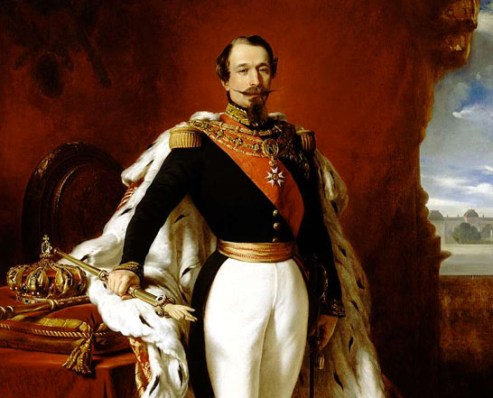
Peraino conveys a great deal of interesting and informative details concerning Lincoln’s diplomatic escapades and sprinkles his narrative with some pointed analysis.  The book is thoroughly researched and posses an impressive bibliography.  Further the endnotes that are provided are exceptional resources for materials and information that are not present in the main narrative.  However, the author’s approach contain a number of drawbacks principally the way the chapters are sectioned.  The chapters are divided by pitting Lincoln against a different subject, be it English Prime Minister Lord Palmerston, Secretary of State William Seward, Karl Marx, Louis Napoleon III, and Lincoln himself.  The book makes no attempt at presenting itself as a comprehensive history of Civil War diplomacy as it focuses totally on Lincoln, but the detailed mini-biographies of each of the president’s “opponents” shifts attention away from the president and the author also has an annoying technique of trying to link each “oppositional” relationship by providing a ‘tease’ in the last paragraph of each chapter.

I agree with Peraino that the Mexican War was a turning point in Lincoln’s maturity as a diplomatic thinker and in a larger sense America’s place in the world.  Nothing in Lincoln’s background prepared him for the “donnybrook” that developed over his war views.  The election of 1844 was a referendum on American expansionism and a foreign policy awakening for Lincoln who would later favor the war effort when he later ran for Congress.  The major changes in technology preceding this period proved to be the” facilitator of American nationalism and continental ambition” that seemed to dominate the political discourse throughout the 1840s.(35)  Lincoln found himself in a quandary as he did not want to upset the sectional balance that existed between the free and slave states, but he could not ignore the war’s popularity.  Upon his election Lincoln joined the congressional opposition to the war.  He believed that the Mexicans had not done anything to provoke war and that President James Polk’s actions were unconstitutional as the power to declare war rested with the legislative branch.  Lincoln introduced his controversial “Spot Resolution” to determine exactly where the incident that launched the war was located, strongly suggesting that the war was caused by an American provocation.  For Lincoln the war resulted in a major problem, the addition of new territory that the south could claim for slavery thus undoing the balance of free and slave states, and the continued heated debate that over slavery that preceded the Civil War.  By the time Lincoln left Congress after one term he had learned a series of lessons.  He realized he needed a more nuanced approach to foreign affairs because territorial expansion would continue thus fostering the need to constantly rebalance the ratio of free and slave states.  Further, Lincoln believed that Polk had overstepped the bounds of executive authority in going to war.  It would take the Civil War for Lincoln to realize that in extraordinary circumstances the president must employ a strong hand.

When Lincoln assumed office European foreign ministers held a very low opinion of the new American president.  In fact the Russian envoy to the United States, Eduard de Stoeckl’s view of Lincoln was quite representative of his colleagues when he said, “Mr. Lincoln does not seem to posses the talent and energy that his party attributed to him when it named him its candidate for the presidency….Even his supporters admit that he is a man of unimpeachable integrity but of a poor capacity.”(103)  Opinions of Lincoln did not change his approach to foreign affairs as he was immediately faced with the issue of foreign intervention or recognition once the Confederacy was launched. The southern cotton trade was a delicate issue since Britain was so dependent on southern cotton for its mills.  Lincoln chose to blockade the southern coast and do nothing to aggravate any European power as a means of promoting their neutrality.

(Lincoln’s Secretary of State, William Henry Seward)

Lincoln’s Secretary of State William Seward agreed with this policy though Lincoln tended to have to reign in his remarks at times.  Peraino’s depiction of the Lincoln-Seward relationship does not really add anything new to the history of the period.  When Lincoln assumed office he needed Seward for the State Department as he viewed the office as critical for his cabinet to have legitimacy.  At the outset Seward believed that he should have been elected president and he was superior to Lincoln in experience and that he would make policy through the president.  With so many issues to confront almost immediately, i.e., instituting a blockade of the south, pursuing neutrality with Spain over Santo Domingo, reigning in abolitionists in order not to cause the border states to secede, the president and Secretary of State’s views began to converge and in a relatively short period of time Seward grew to respect Lincoln, and Lincoln’s trust in Seward increased markedly.

Perhaps the most interesting chapter in the book involves Lincoln’s relationship with Lord Palmerston.  Lincoln believed that swift military success would block any British attempt at interference in American affairs.  However, this was not to be and Lincoln’s fallback position was to develop a strong navy and institute a firm blockade to send a message to the British Prime Minister.  Peraino provides a brief biography of Palmerston and elaborates on his low opinion of Americans and Lincoln in particular.  The situation was exacerbated when an American ship stopped the HMS Trent in Caribbean waters and seized two Confederate diplomats, John Slidell and James Mason.  Lincoln’s approach was to calm the situation by drawing it out and letting the British let off steam.  This episode is presented in detail and both sides came to the realization that a war between the two would prove disasterous to both nations.  Lincoln had decided to release the two men, but took his time to prepare those in the United States who wanted to stand up to the British no matter the consequences.  Peraino’s analysis is dead on in quoting Oxford scholar, Jay Sexton in that “the creditor-debtor relationship of Britain and the United States bonded the two nations together and gave them the common interest of avoiding war.  Succumbing to momentary passions or old grudges would prove counterproductive.”(127)

(British Prime Minister Lord Palmerston)

Peraino correctly credits Lincoln with a number of innovations that contributed to the Union victory.  With the North facing bleak finances by the second year of the war and with European banks refusing to grant credit, Lincoln and his cabinet decided to issue a national paper currency, that Congress eventually approved by passing the Legal tender Act.  Further a national income tax was implemented easing monetary issues as well as the creation of a new National Bank in 1863.  “These sweeping modernizations of the nation’s financial system were critical prerequisites to America’s rise to world power.”(163)  The other major innovation was the building of the Monitor, the first iron clad naval vessel that the United States launched causing “the London Times [to worry] that the innovation had made Britain’s fleet of 149 ‘first class warships’ obsolete.”(165)

The chapter dealing with Karl Marx is really a stretch since the two never interacted directly.  Lincoln may have read some of Marx’s articles in the New York Herald Tribune for whom he wrote opinion pieces but it was not necessary to bring in a mini-Marx biography and integrate his views on slavery and revolution into the narrative.  At the outset of the war Lincoln was concerned with keeping border states neutral.  This concern also helped formulate his views on free labor and American commerce.  Comparing Marx’s views to Lincoln does not enhance the narrative nor do events that lead up to the Emancipation Proclamation.  Marx had no influence on Lincoln’s decision making leading up to the issuing of the document.  The “pseudo” Union success at Antietam as a vehicle to exhibit Northern military prowess for Britain to keep her neutral was much more important.  Lincoln came to view the Emancipation Proclamation as a vehicle to gain the support of British workers who believed that they worked for slave wages.  Lincoln went so far as sending funds to help organize British worker rallies in support of the northern cause.  Any fears that the proclamation might provoke intervention were really offset by events in Europe as Prussia invaded the duchies of Schleswig and Holstein,  Austria and Italy were in the midst of a major conflict, and Polish revolutionaries were active with the support of the French against Russian rule, but this does not stop Peraino from insisting that the proclamation led Louis Napoleon III to intervene in Mexico in 1863.  Linking the proclamation and the French Emperor’s actions is another connection that does not measure up to sound historical analysis.

(French Emperor, Louis Napoleon III)

Peraino’s chapter that deals with Louis Napoleon III’s unfortunate attempt to revisit French holdings in the new world by placing Austrian Arch Duke Maximlian on a Mexican throne has little if any relationship to Lincoln’s issuance of the Emancipation Proclamation.  The author’s discussion of Louis’s ego and delusions concerning French power is spot on though there is an over reliance on Jasper Ridley’s dual biography of Louis and his wife, Eugenie in cataloguing his life before he seized power.*  Louis never believed that the North could force the South to return to the federal union so he decided to take advantage of the Mexican debt situation to rekindle his long held goal of reestablishing French colonies in the new world.  What is most interesting is that Louis’ actions fostered a movement to bring the Confederacy back into the fold through a joint expedition to evict the French from Mexico.  This actually led to a meeting between Lincoln, Seward, and Alexander Stephens, the Confederate Vice President on February 2, 1865 that came to naught.  These types of details make Peraino’s narrative exciting, but overall his linkage to Lincoln’s emancipation announcement on January 1, 1863 does little to foster historical accuracy.  The key for Lincoln and the Union was success on the battlefield, which Sherman’s March through Georgia provided, leading to Lincoln’s reelection which forced Louis’ to reduce his support for his Mexican venture.  In fact, by this time Louis had almost totally abandoned Maximilian as he began to withdraw French troops, and ultimately the Austrian Arch Duke was captured and shot by Mexican forces.

(Lincoln and his secretary and confidante, John Hay)

Peraino’s final chapter is a misnomer, Lincoln v. Lincoln is a summary of Lincoln’s legacy through the post Civil War career of John Hay.  The chapter examines John Hay’s career in some detail and concludes with Hay’s belief that the roots of American power lay in a healthy economy and a brisk trade,” an idea that was consistently held by Henry Clay, Abraham Lincoln, and of course William McKinley’s Secretary of State.  My one suggestion for Mr. Peraino would be to consult the latest biography of Hay written by John Taliaferro, ALL THE GREAT PRIZES: THE LIFE OF JOHN HAY FROM LINCOLN T0 ROOSEVELT  for the latest analysis  concerning Hay’s growth as a diplomat and foreign policy thinker.

Lincoln’s handling of the Mexican fiasco reflects his command of the diplomatic game.  Peraino’s analysis is accurate as he points out that there was a natural tension in “Lincolnian foreign policy.  On the one hand, Lincoln’s moral vision represented American idealism” as he realized that slavery diminished American prestige abroad.  But at the same time he instituted a patient and cautious approach, a middle ground in his pursuit of diplomatic advantages.  Lincoln was a diplomat who knew when to threaten and then soften his pronouncements.  He knew when to be magnanimous, but at the same time putting his foot down and letting his opponent know what he would not continence as in his dealing with Louis Napoleon III.  Lincoln was the consummate balancer, effectively controlling domestic interference in the conduct of his foreign policy by members of his own party and the copperheads who sought to make peace with the south enabling them to maintain slavery.  Lincoln did an excellent job taking the measure of and preparing the American public for changes that were about to take place in administration actions, i.e., dealing with Palmerston over the Trent Affair or dealing with the French incursion into Mexico.  Lincoln should be a role model for future presidents to study how to deal with domestic and foreign policy crises and to Peraino’s credit he provides a narrative that would allow our politicians to study and learn from.

*Peraino also relies heavily on Jasper Ridley’s LORD PALMERSTON for background on the English Prime Minister.

ON HIS OWN TERMS: A LIFE OF NELSON ROCKEFELLER by Richard Norton Smith

Original caption: 9/16/1976– Binghamton, NY- Vice President Nelson Rockefeller gives a crowd of young hecklers an upraised middle finger gesture at the Broome County Airport during a brief stop here Sept. 16, while on a campaign trip with Vice Presidential candidate Bob Dole (L, Background, out of focus)

Today the term “Rockefeller Republican” is still considered a negative characterization to most members of the Republican Party.  The term stands for moderate republicanism that calls for fiscal prudence, but also a social conscience.  In the current political environment when a large number of Republicans are calling for the disassembling of major components of the federal government and are trying to limit people’s voting rights the ideas of Nelson Rockefeller fall on deaf ears.  For the former four time governor of New York bipartisanship and an all inclusive party were a major part of his political agenda for most of his time in office.  As most of the Rockefeller platform is unacceptable today, it suffered a similar fate in 1964 as Barry Goldwater became the Republican standard bearer against Lyndon Johnson.  Many would argue that the hatred for “Rockefeller Republicanism” by Goldwater voters was the precursor of today’s Tea Party.  If so a number of important questions must be asked.  First, how did Rockefeller’s brand of moderate Republicanism come to the fore? Second, why was it so successful in New York and rejected nationwide? Lastly, why did it provoke such an extreme reaction in 1964 that continues to this day?  In his new book, IN HIS OWN TERMS, a major new biography of Nelson Rockefeller, Richard North Smith attempts to answer these and other questions as he explores a career that included the governorship of New York, the Vice Presidency, coordinator of Inter-American affairs under Franklin Roosevelt, and one of the most generous and widely renown philanthropists of his era.

(New York Governor Nelson Rockefeller trying to address the 1964 Republican National Convention)

The portrait that Smith presents is a complex one.  Rockefeller comes across as an ideological follower of Franklin D. Roosevelt’s New Deal for a major part of his political career.   Later he would adopt a more conservative political agenda as he continued to seek the presidency on at least three separate occasions.  He comes across as a generous individual who uses his wealth to reward and assist others, but at the same time he could be a stubborn vindictive person who set out to get even with those who disagreed with him.  Domestically, Rockefeller pursued a liberal agenda, but in foreign policy he was a cold warrior, fearful of the communist threat he supported the Vietnam War for most of his political career.  On a personal level Smith describes a man who could be a caring father, but at the same time he appears as a serial philanderer.  His first marriage failed after thirty years, and after remarrying, he seemed to dote on the children of his second marriage angering those of his first.  The author explores in detail these aspects of the Rockefeller persona and career, and has written an almost encyclopedic biography of one of the most interesting political figures of the twentieth century.

Smith describes his thirteen year odyssey in writing this biography.  Its coverage is impressive as he conducted numerous interviews and thoroughly mined the attendant secondary and primary sources.  The result is extensive coverage of his subject that brings the reader into the Rockefeller family dating back to its founder John D. Rockefeller.  We witness the wealth that was available to Nelson Rockefeller and how he employed it to satisfy his almost obsessive need to acquire art, design and build numerous residences and public buildings, caring for his many associates and friends when they were in need, and of course, procure his own election as governor on four separate occasions.  Rockefeller was a “serial” believer in forming committees and/or commissions made up of the leading experts on whatever topic was of interest to him.  Each role he was tasked, be it, as coordinator for Latin American affairs under FDR, an emissary for Richard Nixon to Latin America, a study to ascertain the best way to rebuild Albany, NY, develop a way to improve the welfare system in New York as well as well as nationally, along with numerous others, Rockefeller in most cases funded these activities with his own money and many of the solutions that emerged, i.e., revenue sharing and enhancing John F. Kennedy’s Alliance for Progress were adopted by different presidential administrations.

In a book of this length there are many themes and storylines.  One that seems to dominate is the evolution of Nelson Rockefeller from a liberal approach to social policy, whereby he was willing to push through increases in taxes, fees and other sources of revenue to implement them.  Rockefeller supported a myriad of social programs from improvements in Medicaid, purification of water resources, women’s rights, the first state minimum wage law, to the implementation of civil rights legislation.  Rockefeller’s approach to executive leadership and legislative tactics are reviewed as well as his philosophy of government.  What emerges is the type of governor that New York hadn’t seen since FDR.  With the message of taking responsibility for developing problems for the future, he would tackle issues in the present so they would not become problems down the road.  The issue was his overly ambitious approach to executive leadership always risked alienating conservatives west of the Hudson River.  With a strategy that would evolve from a “pay as you go” philosophy that would bring revenues into line with expenditures, “thereby eliminating costly borrowing and setting the stage for renewed economic growth,” Rockefeller evolved into to a governor who blew up the state budget to meet the needs of his massive infrastructure and building expenses in addition to the budget shortfalls of New York City by borrowing and floating different bond proposals.  By the time Rockefeller reached the end of his third term in office and was elected to his fourth term he became increasingly fiscally conservative as he faced opposition from the state legislature and probably realized that the political current of the late sixties and early seventies would not help any presidential ambitions he might have if he did not change.  Another major storyline that dominated Rockefeller his entire life that permeates the book was his life long battle with dyslexia.  The governor was not aware that he suffered from this affliction, but whether he was attending the Lincoln School in New York, Dartmouth College, or just trying to keep up with the massive amount of reading that a state executive engaged in it was always a battle.  With his wealth as a cushion, Rockefeller was able to employ numerous individuals to assist in this process whether in preparation of legislation or developing auditory strategies to overcome his reading difficulties.

There are a number of fascinating aspects to Smith’s approach to his subject as he prepared  expansive footnotes at the bottom of each page providing the reader with ancillary information that was not available in the text.  Rockefeller’s private opinions of the likes of John Lindsay and Richard Nixon emerge in a very “colorful” fashion which made the mining of these footnotes quite entertaining.  Smith’s discussion of deeply personal issues is not blanched over.  The breakup of Rockefeller’s marriage to Mary Todhunter Clark (Tod) was detailed and very fair as was the coverage of his remarriage to Margaretta “Happy” Murphy.  The loss of his son Michael during an expedition to collect primitive art in a remote part of New Guinea shows a father who has to deal emotionally with a loss of a son.  The relationship of the Rockefeller brothers and their children receives a great deal of attention and produces many interesting insights into the dynamic of such a public family.  Importantly, Smith does not mince words or coverage in dealing with Rockefeller’s numerous extracurricular activities with numerous women throughout his marriages.  In fact we witness a scandal at the site of Rockefeller’s death as to how his body was treated by those who were with him and the medical papers that were prepared to spare the family any embarrassment.

Aside from the personal aspects of the Rockefeller story, Smith devotes a great deal of effort in explaining what drove Rockefeller.  He was an avid and meticulous collector of modern and primitive art and he set as a goal the creation of a museum to house modern art that he would proudly help establish with the creation of the Museum of Modern Art (MoMA).  The second area that fascinated Rockefeller was politics and how it could be used to help people and better his country, a career path that would dominate his life for over forty years.  The fact that Rockefeller realized that as a scion of wealth he did not have to worry about “ordinary things,” therefore he was motivated to pursue the extraordinary.  Rockefeller’s battles to create MoMA were his trial by fire, a learning course in the art of political infighting.  This would also be the case in the creative process and building of Rockefeller Center as he would take lessons  learned from these confrontations and apply them in the future in his fights with the legislature, opponents such as New York Mayors John Lindsay and Robert Wagner, as well as national political battles.  In dealing with transit and garbage strikes, prison issues including the riots and death at Attica, infrastructure and other building projects, Rockefeller’s learning curve was applied to many crises.

Rockefeller’s other area of interest was foreign policy, and Latin America in particular.  His approach to western hemispheric issues was ahead of his time.  It began as a strategy to block Nazi Germany’s inroads in Mexico and South America.  He agreed with FDR that hemispheric solidarity was the key to changing the perception that the United States was seen as a colonizer in the region.  In 1942 Rockefeller unveiled his “Basic Economy Program” that called for improvement in the region’s public health problems.  Rockefeller arranged training for hundreds of professional nurses to assist in creating medical clinics in outlying areas.  Further,  he worked to export penicillin to offset disease in the region.  “In four years, Rockefeller agents trained more than ten thousand in-service workers, nurses, doctors, midwives, sanitary engineers, and home demonstration agents.”(164)  Rockefeller engaged in a fierce bureaucratic battle with “Wild” Bill Donavan, the head of the Office of Strategic Services at the end of the war over policy toward Latin America.  After the war facing the fight against communism, Rockefeller was a proponent of foreign aid to the region, but his approach was geared to offset the sensibilities of the countries receiving it to avoid the charactiture of “Yankee Imperialism” that OSS policy seemed to engender.  Rockefeller’s sensitivity toward third world countries should not take away from his fervent anticommunism, particularly in dealing with Vietnam where he was a strong supporter of Lyndon Johnson and was able to develop a close working relationship with the president.

Smith does yeoman’s work in describing Rockefeller’s campaigns for governor and president.  In both areas Rockefeller’s wealth and ability to obtain the necessary support for his candidacies was ever present.  The elective success he experienced in New York could not be replicated on the national stage as the Republican Party shifted to the right throughout the nineteen sixties.  His battle against Goldwater in 1964 made him an enemy to conservative republicans and his indecision in 1968 cost him any hope of wresting the republican nomination away from Richard Nixon, which also destroyed any candidacy for 1972.  His hopes improved after he was chosen vice-president by Gerald Ford following the resignation of Richard Nixon, but any hope of influencing the Ford presidency was offset by major disagreements with Ford’s Chief of Staff, Donald Rumsfeld who would block Rockefeller at every turn over policy and political decisions.  Any hope of higher office was dashed in 1976 as Rockefeller’s support for civil rights and the Voting Rights Act made him a political liability with conservative republicans in the south and resulted in the candidacy of Robert Dole for Vice-President on the 1976 Republican presidential ticket.

Overall, Nelson Rockefeller enjoyed an amazing life.  Art connoisseur, benefactor to countless individuals, a mostly progressive governor, and an influential and sometimes polarizing national figure for decades.  Richard Norton Smith gives attention to all these aspects of Rockefeller’s life and has written an in depth and informative biography that I am certain will be the definitive work on an illustrious career for many years to come.

BLUE-EYED BOY: A MEMOIR by Robert Timberg

(Author Robert Timberg during a book presentation)

As most are aware the Vietnam War has left many scars on those who fought the war and the American people in general.  With 58,000 men dead and roughly 270,000 wounded, many like the author, Robert Timberg suffered life changing injuries that affect them psychologically and physically to this day.  Mr. Timberg, a graduate of the United States Naval Academy, and a Marine Corps officer suffered second and third degree burns to his face and parts of his body on January 18, 1967 when his armored vehicle went over a North Vietnamese land mine in the vicinity of Da Dang, just thirteen days before he was to be cycled out of the war theater as his thirteen month tour was drawing to a close.  Mr. Timberg has written a long delayed memoir dealing with his experiences in Vietnam, his recovery, and his career which was a major component in trying to recapture some sort of normality.

(Timberg writing a letter home from Vietnam)

The book, BLUE-EYED BOY: A MEMOIR is written on multiple levels.  It is an emotionally captivating story by an individual who wages a courageous battle to regain some semblance of what he lost on that fateful day when delivering a payroll to another unit his vehicle hit a land mine.  The book is also a personal journey that takes him through numerous hospitals and thirty five operations with the support of two wonderful women, his first wife, Janie, who Timberg credits for his level of recovery and the family and career he is most proud of.  He readily admits that he was responsible for the end of their marriage and how poorly he treated her.  The other woman, his second wife, Kelly, allowed him to continue his recovery and develop a successful journalism career.  Unfortunately for Timberg, they too could not keep their marriage together.  The last major thread is how Timberg repeatedly lashes out against those individuals that did not go to Vietnam and as he states found, “legal and illegal ways” to avoid doing their duties as Americans.  Despite repeated denials that he is past those negative feelings and no matter how much he pushes his bitterness below the surface employing the correct verbiage of an excellent writer, his ill feelings towards a good part of his generation repeatedly bubbles to the surface.

(Timberg being evacuated from Da Nang area after his vehicle hit a land mine, January 18, 1967)

This memoir is very timely in light of the type of injuries that American soldiers have sustained in Iraq and Afghanistan for the last twelve years.  It brings a message of hope for the future based on Timberg’s remarkable recovery and the success he has enjoyed as a reporter and a writer.  Our wounded veterans face a long road to recovery and Timberg’s story could be a wonderful model that they can try to emulate.  The first two-thirds of the book for me were the most interesting.  Timberg lays his life out for all to see.  His emotions which seemed to rise and fall with each sunrise and sunset are heart rendering.  His descriptions of his treatment with multiple skin grafts and surgeries are a testament to his perseverance.  His tenacity and ability to overcome most of the obstacles that were placed in front of him are truly amazing.  We learn a great deal about the Naval Academy and the United States Marine Corps and what they stand for.  Timberg takes the reader through many stages of recovery by interspersing his relationships with those who are most responsible for his making him whole, his first wife, Janie, and Dr. Lynn Ketchum, the surgeon who like a sculptor put Timberg’s facial features back together as best he could.  Despite his recovery, throughout this period his loss of identity constantly tugged at him, even as he earned the satisfaction of a successful career, but the loss of identity seemed to always be under the surface.  Once Timberg reaches the end of his period of recovery, he must leave “the cocoon of the hospital to home cycle” of constantly undergoing surgery and recovery.  For Timberg it was very difficult, but finally with Janie’s assistance he is able to overcome his fears and earn a Master’s Degree in Journalism at Stanford University and begin his career as a reporter in Annapolis.  That career would lead to a Nieman Fellowship, positions at the Baltimore Evening Standard, and the Baltimore Sun.  Timberg became a leading White House correspondent, and the author of three very important books.

The one area of the book I have difficulty accepting is the sections that deal with the germination of the ideas for the book THE NIGHTENGALE’S SONG, and how the book was finally conceived and reached fruition.  It was fascinating how Timberg pulled together such disparate personalities as John McCain, James Webb, John Poindexter, Robert McFarlane, and Oliver North to create narrative dynamic that made sense.  What sparked this dynamic was the Iran-Contra scandal that rocked President Reagan’s second term in office.  Timberg was able to parlay the scandal and the personalities just mentioned into a coherent and interesting monograph.  I remember when the book was published and after reading it I wondered if Timberg had an agenda that called for damning those who were able to avoid serving in Vietnam, and blaming the prosecution of the Iran-Contra scandal on the media and members of Congress who figured out ways to remain out of the military during the war.

Timberg’s judgment is deeply flawed in attacking, what seems to be everyone who did not fight in Vietnam for pursuing the Iran-Contra scandal.  I understand that he suffered unbelievable horrors as a result of his military service and significant emotional issues remain.  However, his inner drive to become the person he was before he was seriously wounded has clouded his judgment to the point where he deeply hurt, Janie, his first wife, the woman who was mostly responsible for making himself whole as he recovered.  His comments dealing with the need to find another woman to have sex with aside from his wife to see if he could find another person who was attracted to him is deeply troublesome.  It was thoughts like this and leaving her alone with three children for a great deal of time reflects poorly on Timberg no matter how courageous he was.  As Timberg researches and writes THE NIGHTENGALE’S SONG, his obsession with those who did not fight in Vietnam comes to the fore completely.  Though there are repeated denials in the book his understandable prejudice against “draft dodgers,” etc. is readily apparent, i.e., his convoluted logic of going after people who believe that Iran-Contra was a major crime and resulted in violation of the constitutional and legislative prerogatives of Congress, aside from the cover-up and outright lying the of the Reagan administration with a vengeance.  By explaining away the scandal by raising the question; “was Iran-Contra the bill for Vietnam finally coming due?” for me, is a bit much and cannot explain away the illegal acts that North, Poindexter, and McFarlane committed no matter how hard Timberg tries.  For the author it seems like everyone who did not go to Vietnam used money and connections to avoid serving.  Further, those who did not serve, “much of the rest of that generation came up with novel ways to leave the fighting and dying to others.”(213)  Timberg quotes from Lawrence M. Baskir and William A. Srauss’ excellent analysis of the draft, CHANCE AND CIRCUMSTANCE to buttress his arguments, however if he revisits objectively the Pentagon statistics that the authors quote he will find that not all who did not serve in Vietnam committed acts that Timberg finds reprehensible  There are millions who were involved in defense related jobs, duty in the United State Army Reserves and the National Guard, had legitimate medical deferments, or were conscientious objectors.  I agree a significant numbers did avoid service and Baskir and Strauss put the number of draft offenders at about 570,000, accused draft offenders at 209, 517, with about 3250 actually imprisoned.  We must also keep in mind that of the 26,800,000 men of the Vietnam generation, 6,465,000 served but never went to Southeast Asia, and of the 15,980,000 who never served in the military 15,410,000 were deferred, exempted or disqualified -all cannot be painted with the broad brush of being draft dodgers as Timberg seems to strongly intimate.*

Overall, Timberg is correct, Vietnam is still a raw nerve for a generation that witnessed men rallying to the flag, and men who felt the war was wrong.  As history has borne out the American people were lied to by the Johnson administration and the government in general.  I respect Mr. Timberg’s service, the wonderful career he used as a vehicle to become whole again, and I find that he is an exceptional author, who at times goes a bit overboard in his attempt to rationalize why people avoided service in the war.  The book is a superb read, deeply emotional and for my generation dredges up a great deal and provokes deep thought concerning how the experience of the Vietnam War still affects American foreign policy and the conduct of combat to this day.

*See Lawrence M. Baskir & William A. Strauss CHANCE AND CIRCUMSTANCE. New York: Alfred A. Knopf, 1978, p. 5 for an excellent chart that is reflected in the figures presented.

LIAR TEMPTRESS SOLDIER SPY: FOUR WOMEN UNDERCOVER DURING THE CIVIL WAR by Karen Abbott


(Photo of Belle Boyd, the rabid secessionist and successful Civil War spy)

When I read a title that sounds like a John Le Carre novel, I am always intrigued. Karen Abbott’s new book, LIAR TEMPTRESS SOLDIER SPY: FOUR WOMEN UNDERCOVER IN THE CIVIL WAR has many elements of the espionage master’s work and she weaves a series of wonderful stories into a historical narrative that could pass for fiction.  The book Abbott has written explores the role of women during the Civil War, an area that has not been addressed sufficiently by historians.  Her work is less about the contribution of women in general who performed domestic tasks for confederate and union forces, but mostly about the lives of four women who played prominent roles during the war; Rose O’Neal Greenhow and Belle Boyd who supported secession, and Elizabeth Van Lew and Emma Edmonds who remained loyal to the union.  All four women engaged in espionage during the war, and their lives reflect their own personal dangers in addition to the death and destruction that they witnessed during the “war between the states.”  In telling the stories of these heroines, Abbott integrates important aspects of the political and military history of the war into her narrative very effectively as each statement or document that appears is supported by by her research, though there are a number of places in the narrative when she appears to take some poetic license as she quotes from works of fiction as if they were accurate sources.

For the reader who sets out to read Abbott’s historical monograph they will find that, at times, it reads like an espionage thriller.  As they progress in the book they will meet many important historical characters, including; General Stonewall Jackson, General George McClellan, Detective Alan Pinkerton, Abraham Lincoln, Louis Napoleon III among many others.  The book is organized chronologically with alternating chapters dealing with each of the subject women.  At times this approach can be confusing, and perhaps each woman could have been dealt with separately to create greater cohesion and then a chapter or two discussing how their lives may have interacted.  None the less the book is a quick and interesting read and focuses attention on four unsung heroes who can now be seen in a new light.

(Photo of Sarah Emma Edmonds, Union spy who changed her sex identity during the Civil War)

What separates Abbott’s account of the war is her in depth portrayal of her subjects and how they used their own inner resources to place themselves at risk in promoting the cause they believed in and were willing to die for.  The first, Belle Boyd, a charismatic character, who loved the limelight and had a force of personality that dominated most situations she found herself in.  Raised in Martinsburg, Va. she was a staunch secessionist who abhorred the union.  She engaged in numerous plots to acquire intelligence for the confederacy and employed her saucy, feminine whiles with men to gain whatever she needed.  Her life is fascinating and is worthy of her own biography.  Perhaps her lowest moment in the war, aside from the defeat the south suffered was the secession of western Virginia, including her own home county of Berkley, forming the state of West Virginia.  Second we meet Emma Edmondson, Canadian women who wanted to join the union army.  The strategy she adopted was to assume the identity of a man named Frank Thompson and when she survived her physical exam she joined Company F, 2nd Michigan infantry.  She began as a male nurse and soon became a mail currier and  spy for the union.  She kept her identity secret from everyone but two soldiers she served with that she fell in love with.  She survived a great deal of combat and was very effective.  Throughout the war she feared someone above her in rank would discover her true sex more than she feared death.  Her life is also an amazing story and she did write her own memoir entitled; MEMOIRS OF A SOLDIER, NURSE AND SPY! A WOMAN’S ADVENTURES IN THE UNION ARMY.  Third, is the life of Rose O’Neal Greenhow who lived in Washington, DC and was counted on by the Confederacy to obtain as much intelligence as possible.  She was friends with Confederate General P.G.T. Beauregard and headed a spy ring prone to “indiscretions” with men.  She worshiped Southern senator, John C. Calhoun of South Carolina and mirrored his political views.  She had a number of lovers, the most important of which was Henry P. Wilson, an abolitionist Republican who was  the union Chairman of the Military Affairs Committee.  She has been credited with providing the intelligence that allowed the confederacy to defeat the union army at the first Battle of Bull Run (Manassas).  During the course of her career she was arrested a few times and served short prison sentences in Washington at the Capitol Prison.  After being exiled to the south she was sent by Jefferson Davis to England and France to try and gain recognition of the Confederacy by these nations.  On her return to the United States her blockade running ship was intercepted by the Union Navy. Lastly, and probably the most impactful of the four women on the course of the war was Elizabeth Van Lew, a wealthy society woman, and a strong unionist who lived in Richmond.  Her career as a spy was fraught with danger since most of her neighbors and politicians in the confederate capitol knew her wartime sympathies.  There were numerous attempts to try and catch her, by searching her mansion which became a union safe house, constant searches by detectives, and numerous attempts at entrapment.  Despite all of these obstacles she organized and ran the Richmond spy ring and its conduit to the Underground Railroad for escaped slaves and union soldiers to the north, and maintained a “secret room” upstairs in her mansion as a transshipment point for those fleeing the south.  General Grant, grateful for her work sent her a personal note: “you have sent me the most valuable information received from Richmond during  the war.”  Grant awarded her the position of Postmaster General of Richmond during his presidency to try and compensate her for all the  wealth that was poured into the northern cause during the war.

(Photo of Rose Greenhow, a Confederate spy during the Civil War and her daughter and part time currier, “Little Rose”)

It is not my purpose to recapitulate Abbott’s narrative but they are a myriad of interesting and surprising revelation that she brings to the fore.  Since women were not allowed to serve in the union army and there really was no military legal precedent for what to charge them should they be caught, union military officials would kick them out of the army under the charge of prostitution.  There were about 300-400 women in the union army during the Civil War, and Abbott tells a number of stories dealing with their plight.  In addition, the author relates the activities of Detective Alan Pinkerton who was in charge of union espionage for part of the war.  The role of detectives emerges throughout the narrative and how they interacted with Boyd, Greenhow, and Van Lew.  We witness a blend of societal graciousness and hospitality on all sides, but at the same time Abbott is letting the reader know what each character thought.  The chapter that deals with Pinkerton’s arrest of Rose Greenhow is priceless.  Abbott describes in detail the house search and how Greenhow was able to finagle documents into the hands of her eight year old daughter, “Little Rose,” as the conduit to avoid detection by Pinkerton’s agents and getting the intelligence to sources outside her home.  Even under constant surveillance Greenhow continue to spy for the Confederacy employing her daughter as her currier.  Another important vignette that Abbott discusses is how Elizabeth Van Lew, a friend of Confederate President Jefferson Davis’ wife is able to convince her to take on one of her freed slaves as a servant in the Confederate White House.  As the war turns against the Confederacy, Davis, for a time, is at a loss as to how Union spies seem to know military plans soon after he had conferred with General Robert E. Lee,  or other southern generals.  The work of Van Lew’s servant, Mary Jane, was certainly an important contribution to the Union cause.

(Photo of Elizabeth Van Lew, a Richmond socialite who spied for the Union during the Civil War.  A woman who was widely praised by General U.S. Grant)

Karen Abbott has certainly done a service to the memory of four women who were under cover during the Civil War.  It makes for an excellent read and I recommend it to Civil War buffs and those interested in an aspect of women’s history that few are familiar with.  As Elizabeth Van Lew alluded to after the war, women made major contributions to the northern victory but when it came for them to receive military pensions they had to beg men for what was due them, because they did not have the vote.

CHASING SHADOWS: THE NIXON TAPES, THE CHENNAULT AFFAIR, AND THE ORIGINS OF WATERGATE by Ken Hughes

(Richard M. Nixon boarding a helicopter at the White House on August 9, 1974 after he resigned the presidency)

During the summer of 1973, while in graduate school, I found myself transfixed by the Watergate hearings that were broadcast live each day.  For me it became almost a soap opera with the revelations of Nixon administration misdeeds.  Once Nixon resigned, the battle for the Watergate tapes continued. After the 37th president passed away, the federal government gradually released more of the Nixon tapes resulting in a thorough record of what went on in the Nixon White House between February 16, 1971 and July 12, 1973 when over 3432 hours of tapes were produced.  What we learned before Ken Hughes new book CHASING SHADOWS: THE NIXON TAPES, THE CHENNAULT AFFAIR, AND THE ORIGINS OF WATERGATE was disconcerting enough for the American public, but now as Mr. Hughes, a journalist who is a researcher at the University of Virginia’s Miller Center Presidential Program, since 2000 culled these documents reaching the conclusion that is even more damning concerning Nixon’s abuse of power than the original tapes that were released in the 1970s.  In October, 1969, Joseph McGuinnis wrote in his book, THE SELLING OF THE PRESIDENT 1968 about the “new” Nixon, and the “old Nixon.”  According to Mr. McGinnis, the “new” Nixon was prepackaged as a candidate to avoid the “out bursts” and other political errors the former Vice-President had made in past elections that represented the “old” Nixon.  What emerges from Hughes detailed study is the reemergence of the “old Nixon on steroids,” as his political paranoia, hatred for those who made him look bad, anti-Semitism, and general nastiness is invariably documented on each page.

At the outset the author asks the question that after 40 years what we could possibly not have been exposed to concerning Watergate.  Hughes concludes “that the origins of Watergate extend deeper than we previously knew to encompass a crime committed to elect Nixon in the first place.” (x)  The first section of the book focuses on the Chennault Affair which by any standard was an act of treason against the American people.  At the time rumors abounded in Washington after the election of 1968 that there were members of the Nixon campaign, and probably Nixon himself who interfered with the Vietnam peace negotiations then in progress in Paris.   President Johnson wrestled with the idea of an unconditional bombing halt since March 31, 1968 when he announced he would not seek reelection.  Negotiations in Paris focused on the details of such a bombing halt and the Nixon campaign feared an “October Surprise,”[i] a few days before the election that would allow Vice-President Hubert Humphrey to defeat Nixon, who had led by 18 points in the polls in September, 1968.  According to Hughes, who produces records of conversations and other damning evidence describing meetings and phone calls between members of the Nixon campaign staff and Bui Diem, the South Vietnamese Ambassador to the United States, whereby they promised South Vietnam’s President, Nguyen Van Thieu a better deal if he would muck up the negotiations and wait until Nixon was President.  During the week before the election North Vietnamese negotiators in Paris actually move slightly closer to the Johnson administration position on the bombing pause and it seemed as if a deal was at hand.  Suddenly, Thieu informed Washington that there were aspects of the deal he could not support thus causing the deal to collapse.  Hughes provides proof that the emissary between the Nixon campaign and the South Vietnamese government was Anna Chan Chennault, (the spouse of Lt. General Claire L. Chennault who during World War II was the American leader of a volunteer air group, the Flying Tigers that defended China against Japanese invaders) whose relationship with Nixon went back to the China Lobby of the late 1940s and 1950s when Republicans accused the Truman administration of losing China to the Communists, a charge that the then Congressman Nixon used to vault himself into the Senate in 1948.  Hughes offers an almost daily description of the Paris peace talks with North Vietnam from right after Labor Day until the election.  The reader will learn from the documentary evidence the details of Johnson’s conversations with candidates Humphrey and Nixon.  What emerges is LBJ’s disappointment with the Democratic candidate who he feels is soft concerning a bombing halt and belief that despite Nixon’s duplicitous nature he would be a stronger president concerning Vietnam.  Late in the campaign Johnson learned of Nixon campaign machinations concerning talks in Paris, but he held back releasing it which would have most likely thrown the election to Humphrey.  Johnson warned Nixon very subtly that he knew what was occurring and the Republican candidate feigned surprise and reaffirmed support for the president’s policies.  Throughout the book, Hughes integrates verbatim transcripts to support his points, and there can be no doubt of Nixon and his staff’s culpability in treasonous activities.  The question remains why didn’t LBJ expose the actions of the Nixon campaign.  The answer probably rests with LBJ’s national security concerns, fear of weakening the presidency, and prolonging a war he desperately wanted to end to assure his historical legacy.

(Anna Chennault, the conduit for the Nixon campaign to the South Vietnamese government flanked by Richard Nixon and Henry Kissinger)

If Hughes description of the Chennault Affair is not disturbing enough then his exploration of other aspects of Nixon administration internal policy certainly is.  When Nixon arrives in the White House he immediately ordered his Chief of Staff, H.R. Haldeman to get hold of all the documents that LBJ had accumulated during the presidential campaign, i.e.; NSA intercepts from Ambassador Diem to Saigon, wiretaps of Chennault, CIA bugs overseas etc.  Haldeman tasked Tom Charles Huston to obtain the material.  Huston claimed that the Department of Defense Office of Internal Security Affairs had a report of all events leading to the bombing halt and it was located at the Brookings Institution.  Nixon obviously was concerned that should these documents become public his campaign organization and he himself personally would appear to have violated the Logan Act of 1799 that “prohibits as treasonous activity any interference by American citizens with the negotiations of the US government.” (38)  Nixon’s concern is readily apparent as he stated on June 17, 1971 in reference to the Brookings file.  “Now you remember the Huston’s Plan?[ii]  Implement it; I want it implemented on a thievery basis.  Goddamn it, get in and get those files.  Blow the safe and get it.” (68)

As one reads on it becomes surreal as Nixon becomes obsessed with anyone that appears to be his enemy.  His reaction to the leaking of the Pentagon Papers and the actions of Daniel Ellsberg reflect a heightened paranoia on the part of Nixon as he created the Special Investigative Unit (SIU), known as the “Plumbers” to deal with leaks and what he perceived to be domestic terrorism located in the basement of the White House. “The creation of the SIU violated both criminal law and the US Constitution.”  Nixon created a unit to commit crimes-like burglarizing the Brookings Institution, Daniel Ellsberg’s psychiatrist’s office, and later Democratic Party Headquarters at the Watergate Hotel.  Further, it specifically violated the Fourth Amendment that protected “the right of the people to be secure in their persons, houses, papers, and effects, against unreasonable searches and seizures.” (130)  

What was most disturbing to me apart from Nixon’s criminal offenses was his rationale for his actions and his virulent anti-Semitism.  “The leading conspiracy theorist in the White House was the President.  Nixon’s theory centered on three groups: Jews, intellectuals, and Ivy Leaguers.” (122)  He feared a “Jewish cabal” was out to get him arguing that Ellsberg, Morton Halperin (a member of Henry Kissinger’s staff who was wiretapped), and Leslie Gelb all who opposed him were Jews.  Hughes concludes that Nixon spoke about Jews in the NSC and the defense and State Departments as if they were security risks simply because of their religious background.  National security policy was not the only area that the Jews in Nixon’s eyes were out to get him.  Harold Goldstein who was an employment analyst at the Bureau of Labor Statistics for over twenty four years and served democratic and republic presidents going back to Truman, in Nixon’s view was publicizing unemployment statistics to make him look bad as he approached reelection.  This for Nixon was part of the “cabal” and he had Goldstein exiled to a regional office in Montana.   In dealing with Arthur Burns, the Head of the Federal Reserve Board, Nixon believed that Burns monetary and fiscal policy did not support his reelection, and  on July 24, 1971, he remarked to Haldeman, “there’s a Jewish cabal, you know, running through this, working with people like Burns and the rest, and they all-they all only talk to Jews.” (143)

(Daniel Elleberg, who leaked the Pentagon Papers)

Hughes develops his story that culminates in Watergate and includes some new documents concerning the break-in that had not been previously released.  It really does not change the outcome or the course of history it just reaffirms Nixon’s acute paranoia and as Bruce Mazlish wrote before the 1968 election in his psychological analysis, IN SEARCH OF NIXON, that there was a personality flaw that existed and no matter what success Nixon might have achieved, his self-destructive mechanism would undo it.  When Nixon resigned the presidency on August 8, 1974 and left the White House the next day, Mazlish’s prediction came true.


(What would a review of a book on Richard Nixon be without a picture of the Watergate Hotel?)

[i] The title of a book by Gary Sick written after the election of Ronald Reagan accusing the Reagan campaign of interfering with negotiations to obtain the release of American hostages in Iran between the Carter administration and the Iranian government.  The Reagan people were very concerned that Iran would agree to release the hostage’s right before the election, thus swinging the American electorate over to President Carter.

[ii] In June, 1971 the secret Huston Plan was designed to expand government break-ins, wiretaps, and mail openings in the name of fighting domestic terror.