FIERCE PATRIOT: THE TANGLED LIVES OF WILLIAM TECUMSEH SHERMAN by Robert L. O’Connell


(The Shermanesque  Stance!)

According to Robert L. O’Connell in his new book AMERICAN PATRIOT: THE TANGLED LIVES OF WILLIAM TECUMSEH SHERMAN, the life of the Civil War hero should not be portrayed in the traditional fashion by preparing a chronological narrative because its results would be too cumbersome.  Instead, the author has produced a fascinating book that consists of three parts that add up to a biography, but is organized in a rather confusing manner.  What the author has written is a “pseudo-biography” that covers Sherman’s life in excellent detail with a great deal of analysis.  I understand that historians are always looking for a fresh approach toward their subjects that have been dealt with previously, but at times they should not try and reinvent the wheel.  Again, let me reiterate, I enjoyed the book and took away a great deal, but at times I would have hoped the material in the last section of the narrative could have been included in the lengthy first section to form greater coherence.

O’Connell begins by arguing that Sherman’s life brings with it an enormous amount of documentary material stemming from his own writing, an extensive oral record of his statements, and the voluminous material produced by the Civil War.  The author concludes that it is almost impossible to produce a definitive one volume biography of Sherman.  In addition, the difficulty is enhanced because of the many myths associated with Sherman from the accusation of being a war criminal, a racist, and a very class conscious individual who supported the business classes.  The author concludes that there is evidence for each of these myths, but there is also material that disproves them, particularly when we apply twenty-first century standards to nineteenth century figures.  For O’Connell, Sherman falls into a category below Washington, Jefferson, Lincoln, and FDR as individuals who were responsible for furthering American growth and making transcontinental consolidation possible, and the author’s resulting effort accurately proves that point.

In preparing the book O’Connell has decided to portray three story lines.  The first, “if Jefferson was the architect of continental expansion, Sherman would become his general contractor.” (xviii)  By the time Sherman retired from the army in 1884, he “had become virtually a human embodiment of Manifest destiny.  Florida, California, reclaiming the Confederacy, winning the west.” (xix)  Second, the co-evolution of the army of the west and Sherman as its commander as he taught legions of men “the most valued of military skills: the ability to adapt,” and the ability to adjust on the fly after much trial and error.  Thirdly, Sherman created a model “of how to grab and hold on to fame in America, one that still works today.” (xx)  For O’Connell, Sherman’s life boils down to a three ring circus, each fascinating, but they must be dealt with separately or components of his life become too distracting.  As a result he sticks to a section describing Sherman as a military strategist, another as a general, and he concludes with a section of Sherman as a human being after retirement.  My problem is that these sections continuously overlap and there are parts of the book that the reader is told that what he is writing about will become much clearer later.  I admire O’Connell’s effort, but John F. Marszalek’s SHERMAN: A SOLDIER’S PASSION FOR ORDER did an admirable job of creating what O’Connell discounts.

O’Connell begins by lecturing the reader on the concept of military strategy and concludes that Sherman’s ultimate career goal was national consolidation of the central bond of the North American continent and Manifest Destiny.  He further concludes that he never wanted to be in total command during his military career, as it was difficult enough being in charge of strategy.  These conclusions are well supported in the first two-thirds of the book that make up section one.  O’Connell is on firm ground with his theme and goes on to support his argument as he takes the reader through Sherman’s career at West Point, the Second Seminole War of 1835-1842, a stint at on the Sullivan Islands across the harbor from Charleston, South Carolina, as a recruiting officer in the Pittsburgh region, a stationing in California, and investigating corruption in New Orleans.  What should be apparent is that the most important activity of this time period was the Mexican War, which Sherman missed out on, while others from his graduating class at West Point began to earn their reputations.  As a strategist what was most important for Sherman at this juncture of his life was his discovery of the importance of the Mississippi which fit his world view as he would describe the region as the “spinal column of America.”  Sherman’s love for geography and topography was born at this time and along with a photographic memory for detail.  This would allow him to remember almost every aspect from each area that he transverses in his career fostering the development of a data base that in part explains his success as a strategist during the Civil War.

(The Union siege of Vicksburg, July, 1863)

It is O’Connell’s discussion of the Civil War that is the strongest part of the book.  O’Connell does pepper this section with details concerning his upbringing, his relationship with the Ewing family, his marriage and raising a family all of which are important enough, but detail later in the book clarifies a great deal of what is discussed here.  In a sense the Civil War saved Sherman’s career.  By the early 1850s Sherman leaves the army and tries his hand in the private sector.  His father-in-law, Thomas Ewing, a cabinet officer, politician, and wealthy individual wanted him to take over  a Salt Mine he owned near his home in Lancaster, Ohio which became part of a tug of war between the Ewing family and his wife Ellen, and what Sherman wanted to do with his life.  The Ewing-Sherman relationship at times dominates the narrative as Sherman tries to be his own man and continually win over his wife.  The period preceding the Civil War was probably the worst period for Sherman.  His career as a New York banker ended with the crash of 1857.  He returned to California as a banker but due to the economy the venture was a failure.  He finally gives into Thomas Ewing’s urging and runs one of the the family businesses in Leavenworth, Ka.  It became increasingly clear to Sherman the only arena that he felt comfortable in was the military and after the election of Lincoln he rejoins the army and with secession his career is saved.

The author spends a prodigious amount of time discussing the major battles that Sherman was involved in.  The reader witnesses how Sherman trains and develops the army of the west and making it into one of the best fighting forces in American history by the end of the war.  We witness how Sherman cultivated his soldiers to believe in him and how he developed his command.  The knowledge of American geography is applied and we see his strategy unfold.  O’Connell delves into the egos of the period, be it Sherman, Henry Halleck, Simon Cameron, Edwin Stanton, Ulysses S. Grant and others and the personality conflicts that were readily apparent.  Sherman’s logistical genius greatly assisted Grant in Tennessee resulting in the Sherman-Grant relationship that was based on mutual trust.  Sherman was content to being Grant’s “wing man” or second in command and the relationship flourished.  Sherman suffered from depression and Grant tended to imbibe a bit too much as Sherman described their relationship, “he stood by me when I was crazy and I stood by him when he was drunk, now sir we stand by each other always.” (95)

For Sherman the battle of Shiloh in April, 1862 was a major turning point.  Shiloh was a success because Sherman was able to blunt the south’s effort to recover the initiative in the Mississippi Valley and opened the way for a rendering of the military balance in the west and securing Sherman’s reputation.  The theme of securing the Mississippi so crucial to Sherman’s thinking is explored in the run up to and final battle at Vicksburg a year later, culminating in a union victory in July, 1863.  Sherman’s audacious strategy was key and as 1864 approached Sherman was aware of the south’s tenacity so he convinced Grant that the best way to defeat the south was “to attack southern morale and its relationship to crushing the rebellion….Both understood the psychological effect of their blue-clad armies barging across the landscape, taking what they wanted, and wrecking anything that looked Confederate,” (132) they would engage the Confederate field armies and destroy them, killing rebels, and getting into their heads.  Grant would be the battering ram in the East, and Sherman would employ his mastery of operations and strategy as he marched toward Atlanta.  O’Connell’s discussion of the march to the sea is excellent.  We are placed inside Sherman’s mind as well as the Confederates he fought.  The detail is exquisite and is one of the major highlights of the book.  The burning of Atlanta, the seizure of Savannah, and the march into South Carolina for revenge against the heart of the enemy as it burns Columbia rather than Charleston and the move into North Carolina where Sherman softens his approach are all described.  The success was based on foraging and living off the land as well as engineering genius, but as with other topics there is greater detail about the “bummers” (foragers) in a later part of the book.  The author concludes this section of the book with a discussion of Sherman’s post war role in implementing the transcontinental rail road, a goal that he had set earlier in his career and fit right in with his belief of continental expansion.

The final third of the book is broken down into two parts.  The first explores Sherman’s soldiers and their relationship to him.  O’Connell describes the intricacies of the army of the west and its conduct during the Civil War.  We learn what fighting was like at Shiloh and Vicksburg.  We learn what it was like marching 120 miles on the way to Atlanta, and fighting an insurgency through the eyes of the participants.  Shiloh is explained through the vision of a seventeen year old drummer boy, and the life of a “bummer” is explored through their own eyes as they faced the difficulty of locating food for an entire army.  The author also explains the role of the new technology developed during the war and how it affected Sherman’s strategy and how his soldiers adapted to it.  Basically, this section is a history of the army of the west from its inception, training, skill set and application in battle, all information that could have been integrated more effectively in the first section of the book.

(Statue of William T. Sherman, by Augustus Saint-Gaudens, located at 59th Street and 5th Avenue entrance to Central Park, NYC)

O’Connell brings his narrative to a close by describing the difficulties that marrying into the Ewing family presented.  His wife Ellen’s constant pressure to have Sherman convert to Catholicism irked the general and made him feel as if there was a papist plot against him.  Ellen’s need to spend meant that throughout their marriage there was always pressure on Sherman to make a great deal of money.  The competition between the legacy of Thomas Ewing and Sherman’s career path is a key component as to what drove Sherman a good part of his life, when finally after the Civil War he could feel that he was finally the dominant figure in the eyes of his wife.  O’Connell weaves in at least two of the affairs that Sherman was involved in during his marriage, but concludes the thirty year bond between Ellen and her husband always remained strong.  The author closes with a discussion of Sherman’s “rock star” career after the Civil War and how the public fed his need for approval.  There are components in the book that border on “psychohistory,” but the author’s conclusions in that area are a bit flimsy.  Overall the book is quite interesting and if one can deal with its organizational flaws it is well worth reading.
THE BOYS IN THE BOAT by Daniel James Brown

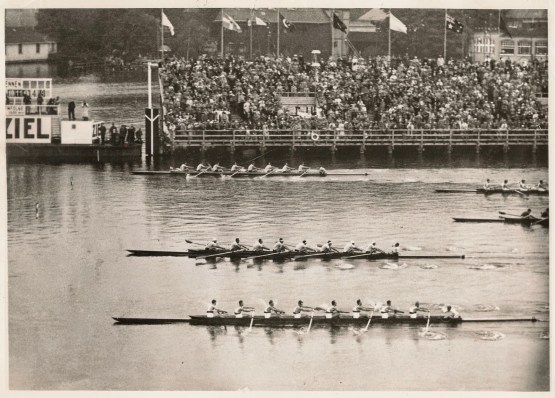
(1936 University of Washington rowers who won gold at the Berlin Olympics)

THE BOYS IN THE BOAT by Daniel James Brown is nothing short of a labor of love.  In describing the journey of the University of Washington rowing team from their blue collar origins, facing numerous financial obstacles, and confronting well funded opponents as they sought to represent the United States in the 1936 Olympic games in Berlin, the author has presented a riveting narrative that will touch the reader on many levels.  In addition to the personal stories that are described, Brown writes of the poetry that is a necessity for a rowing team to be successful.  The story is told through the eyes of many of the participants in their quest for rowing perfection, but a number of characters stand out.  The coaches;  Al Ulbrickson, a quiet taskmaster who keeps his emotions inside, his freshman coach, Tom Bolles, who develops many of the rowers; to Joe Rantz, who must overcome poverty and abandonment by his family, to George Pocock, the British craftsman who lovingly constructed the shells that the rowers would use on their way to Berlin and after.   The story begins in the Seattle area in the midst of the Great Depression and its impact on the region in general and the young men whose futures depend on making the University of Washington’s rowing team.

The story focuses on the life of Joe Rantz whose mother died of throat cancer when he was a nine and was sent to Pennsylvania to live with an aunt.  Later, his father remarries and when Joe returns to his family he does not get along with his knew step mother.  Eventually Joe’s father must make a choice between his son and his second wife and the family they were building.  After the family home burns down Joe is exiled to live in a school house away from the family for a period of time, when finally Joe’s father informs him that the family was moving away and that he had to remain and fend for himself at the age of fifteen.  For the next few years Joe employs the survival skills his father has taught him, and skills he developed on his own like poaching salmon and stealing alcohol for resale to overcome the obstacles he faces.  Finally, he is taken in by his married older brother and is able to graduate from high school and gain admittance to the University of Washington.  After being recruited by the freshman rowing coach, Joe realizes the ticket to his future was to make the rowing team.  Joe had little money and few clothes and lived in a room at the YMCA.  He took a number of menial jobs and fit them in around his studies and the torturous grind that was college rowing.  Brown follows the trials that Joe must overcome as he draws the reader into the narrative to the point that you do not want to put the book down.

I have read a number of books of the 1936 Berlin Olympics.  David Clay Large’s, THE NAZI GAMES: THE OLYMPICS OF 1936, and BERLIN GAMES: HOW THE NAZIS STOLE THE OLYMPIC DREAM by Guy Walters stand out, but Brown’s effort surpasses anything I have read for its detail, understanding the human emotion of sport, and how world events, particularly the rise of Nazi Germany impinged on the athletic stage.  Brown does a wonderful job of integrating the history of the time period into his narrative.  The reader is exposed to the devastation caused by the depression in the mid 1930s.  The unemployment and resulting poverty and their effect on families as fathers are forced to leave their children in order to seek a job elsewhere.  The Dust Bowl that blankets the Midwest at first and then destroys top soil throughout the United States resulting in the destruction of a major part of American agricultural production is reviewed in detail.  Overseas, the rise of Adolf Hitler to power is explained and the resulting violence against Gypsies, Jews, and Catholics is presented.  On a more personal level, Brown discusses the hatred between Joseph Goebbels, the Nazi Minister of Propaganda, and Leni Riefenstahl, Hitler’s chosen film maker as they fight over how the message of the Nazi ideal should be presented to the world.  The reader witnesses the laying of the foundation of what will grow into the Holocaust after the Olympic Games are completed.  The reader is made aware of the political infighting in the United States as President Roosevelt tries to deal with the problem of Nazi expansion.  In exploring these avenues, Brown places the Olympic Games in their proper historical context, and the importance of a Jesse Owens and the many athletes who sought to show Nazi racial theory for what it really was.

Apart from the personal stories of the nine men who will emerge from the rowing competitions from 1933 to 1936 in regattas such those on the Pacific coast, Poughkeepsie, New York, and the Olympic trials in Princeton, New Jersey what truly surprised me was the training that the rowers were exposed to.  I confess my knowledge of rowing is nil, but after reading Brown’s narrative I at least have some understanding of what the athletes went through.  The author’s description of “pain” cuts to the core of what these men accomplished.  For Brown the common denominator for the rower is that pain is “part and parcel” of the learning experience.  “It’s not a question of whether you will hurt, or how much you will hurt; it’s a question of what you will do, and how well you will do it, while pain has her wanton way with you.” (40) Brown’s discussion of the mechanics of rowing is important for the novice reader to understand what it means to have a successful “boat.”  In the case of the University of Washington’s first boat, “every one of them had come from humble origins or had been humbled by the ravages of the hard times in which they had grown up.  Each in his own way had learned that nothing could be taken for granted in life…..The challenges they had faced together had taught them humility—the need to subsume their individual egos for the sake of the boat as a whole—humility was the common gateway through which they were able to come together and begin to do what they had not been able to do before.” (241)

(US rowers win gold at the 1936 Berlin Olympic games)

The unbelievable demands of training, the fear of not having enough money for tuition each semester, feeling of anxiety, were among the many things that each rower had to overcome.  They knew the odds were stacked against them as their chief western competitor; the University of California had better facilities and financial support as did the eastern Ivy League schools.  Brown raises the important issue of social class in explaining the opponents the rowers had to contend with.  The ivy rowers mostly came from prep schools, had parents who were bankers and lawyers, and did not have to worry about their futures.  On the other hand, as Brown eloquently describes Joe Rantz and his team mates were blue collar in origin, and poverty was their life’s norm.  Brown’s rendition of the important characters in his narrative is sensitive and honest and as the story progresses the reader is rooting for “U Wash,” and as the author explains strategy, motivation, and the details of each race you feel as if you are sitting in the shell with the rowers, or you are inside the head of Bobby Moch, the coxswain, planning his next move as the rowing process has a very important cerebral component.

The author presents the pageantry and ostentation that was the 1936 Nazi Olympics in great detail.  He describes the hiding of any evidence of what Nazism was in reality; from removing the Gypsies, to taking down all evidence of anti-Semitism, and the vicious articles in the Nazi newspaper Der Sturmer, magically disappearing.  Brown describes the first six rowing competitions in which the Germans won five gold medals.  He reserves his best for the final race involving the nine on nine competition that all looked forward to.  It is interesting how the US boat was placed in the worst lane, when having won the preliminary race they should have had the best one.  Needless to say, the US rowers were at a disadvantage from the outset.  Brown’s overall description of the race is amazing as the reader can hear his voice as if he were rendering the race’s description vocally as a play by play on the radio that millions across America were listening to.  The US would win the race by six-tenths of a second over Italy and one second over Germany as Hitler stood up and immediately walked out.  After reading Brown’s rendition of the race I immediately found a You Tube film on my lap top and watched the emotion of the rowers at the race’s conclusion over and over.  THE BOYS IN THE BOAT is a wonderful story, and what makes it better is that it is shows the triumph of the human spirit and though it is a “sports” book, it is one that can be enjoyed by all.

THE MAN WHO BROKE INTO AUSCHWITZ by Denis Avey with Rob Broomby

Picture of the sign at the entrance of Auschwitz that reads Arbeit Macht Frei.

(The entrance to Auschwitz)

THE MAN WHO BROKE INTO AUSCHWITZ by Denis Avey with Rob Broomby is not an easy book to review.  It is a memoir of a former British soldier who decided after his capture and incarceration in a German POW camp, located next to the outskirts of Auschwitz, to switch clothing and identity with a Jewish inmate, so he could witness what went on inside the death camps.  These actions take place about halfway through the memoir and from that point on the reader is riveted to Denis Avey’s story.  The first third of the book recounts his early years in England and his boredom that led him to join the British army in 1939.  We are taken through his training and finally his experiences fighting first against the Italians in North Africa and then once the Italians lost Tobruk the Germans led by Erwin Rommel’s Afrika Corp.  It is during the battle against the Germans at Sidi  Rezegh that he is captured and the essence of what he would experience is recounted.

Evaluating this type of memoir places the reviewer in a quandary.  You can comment on style and language and the demeanor of the author, but based on what he has survived and overcome, is that fair?  For me, Avey’s story is an emotional journey that takes him through the savagery of warfare in the Libyan dessert as a driver of a carrier vehicle with a mounted Bren gun on top.  He sees his friends blown to bits by Italian and German artillery and bombers.  He himself is wounded and contracts malaria and in the end winds up in a German field hospital where he miraculously recovers.  The first question that must be asked is why Avey, who did not have to enlist, join the army.  Avey states that “I hadn’t joined up for King and country but youthful adventure,” but what began as somewhat of a lark morphed into “a moral conflict for me at the very time I could do little about it.” (128)  Avey matured as a person because of his experiences and for him morality dominated his mindset.

Avey’s survival can be explained through luck, but also a state of mind.  Throughout the memoir he describes the abhorrent conditions he experienced but as he states, “my body was in a shocking state, but in my head, I wasn’t a prisoner at all.  The enemy had done many things to me but they hadn’t captured my mind.” (98)  After being captured in North Africa he attempted to escape a number of times and he was labeled as a “habitual troublemaker” which led to his transfer to a POW labor camp in the Polish town of Oswiecim where he noticed people who looked starved with shaved heads wearing “ill fitting striped shirts and trousers that were more like pyjamas.” (105)  Avey worked on a massive factory that was being built by I.G. Farben to manufacture “buna,” or synthetic rubber.  Avey realized earlier that “everywhere, in the nooks and crannies of this industrial nightmare, were poor creatures in their filthy zebra uniforms, many too weak to stand, led alone shift and carry.  I knew by now this was no ordinary labour camp.  They were deliberately worked to death.” (107)  For Avey, the knowledge that as a British POW he was not going to be worked to death allowed him to contemplate how he could assist these Jewish inmates.  He was able to get a letter out to the sister of a Jew named Ernst that allowed a package to be returned to him that assisted Ernst’s survival of what is referred to as Auschwitz III, the Nazi death camp.

Avey who became obsessed with the immorality of the Holocaust decided to change places with Ernst.  This was accomplished on two separate occasions where Avey experienced the barracks, the smell from the crematoria, the beatings, and the total inhumanity that was the “Final Solution.”  For Avey he wanted to bear witness to the plight of the Jews.  He wanted to tell the world of their suffering and the savagery of Auschwitz I, II, and III.  Throughout his experiences Avey was careful not to establish close relations with anyone, except for Hans a Dutch Jew he assisted, and Ernst, because you never knew how quickly you would be chosen for a detail to bury them.  As the Russians moved in from the east, Avey and thousands of others were forced to March westward in the middle of a frozen winter.  Avey broke away and miraculously made his way through Silesia, Czechoslovakia, and Germany.  Finally after passing through Nuremburg he came across the American army where he was taken to an officer whose description sounded like George S. Patton.

(Head to Head with Prime Minister Gordon Brown at 10 Downing Street on January 22, 2010.  In March 2010 Avey was presented with a medal as one of 27 British heroes of the Holocaust.  All but two received the award posthumously)

From this point Avey describes his post war struggle with Post Traumatic Stress Disorder (PTSD) at a time when no one knew what it was and people were interested in talking about victory not the calamity facing soldiers who fought in the war and who were victims that people did not recognize.  Avey describes his battles with nightmares, jumpiness, his inability to speak about his experiences, his violent temper, stomach pains, and loss of memory.  These symptoms as well as the loss of vision in one I that grew cancerous from a beating during his incarceration plagued him for years after the war.  Eventually he would overcome them and lead a very successful life, as Avery says during the day, but at night it was a different story.  The most heartwarming and emotionally wrenching part of the book is the last third as he describes how a reporter Rob Broomby traced Avey’s experiences for a news story and he located Ernst’s sister, leading to a reunion with Avey.  Further they uncovered a DVD of Ernst’s life in the United States after the war.  Avey never knew what happened to him and this emotional catharsis allowed him to open up and went a long way in his own recovery.  The book is sad in parts, uplifting at the same time, but it serves as another voice, a witness to man’s inhumanity to man, and as Avey points out by recounting his experiences hopefully people will gain an understanding of genocide and will not allow it to take place again.

HARD CHOICES by Hillary Rodham Clinton

(Hillary Clinton testifying before the Senate Foreign Relations Committee on Benghazi)

When Hillary Clinton launched her recent book tour promoting her memoir of her State Department tenure the political pundits concluded that this was the launch of her 2016 presidential campaign.  While that may be accurate the book, HARD CHOICES should be evaluated as to whether it provides greater understanding of American foreign policy during the first Obama administration.  The answer lies somewhere in the middle.  The book has many components.  It is Clinton’s attempt to justify the course of action taken during her years as Secretary of State, provide explanations to counter the myriad Republican criticisms that seem to emerge no matter what the issue or situation at that time, project a softer image for the American public, offer advice as to what tools American diplomacy should employ during the “digital age,” and discuss non-traditional topics that normally do not take up a great deal of space in political memoirs, i.e.; environmental and economic policy.  For Clinton the conduct of foreign policy seeks a balance of “smart” and the hard power of projecting military might.  For the former Secretary “smart power” needs to be “integrated with the traditional tools of foreign policy—diplomacy, developmental assistance, and military force—while tapping the energy and ideas of the private sector and empowering citizens, especially the activists, organizers, and problem solvers we call civil society, to meet their own challenges and shape their own futures.”  (pp. x-xi)  In doing so America’s strengths can be employed to develop more partners and fewer adversaries by sharing responsibility and becoming involved in fewer conflicts.  This includes reaching out to the people of whatever country policy is being developed, promoting jobs and less poverty, and expanding the middle class to lift people up with less damage to the environment.

At a time when President Obama’s foreign policy decision making is under attack, especially over events in Iraq, Afghanistan, and the Ukraine, Clinton’s memoir is a useful tool to see how decisions were reached, particularly the background considerations.  The “pivot” toward Asia was pronounced as soon as Clinton entered the State Department and currently it is seen by opponents as a failure because of the unrest in the Middle East.  The other major pronouncement was a “reset” with Russia that has fallen under scrutiny as Vladimir Putin has used events in the Ukraine to seize the Crimea and threaten the eastern part of the former Soviet republic.  Clinton spends a great deal of time providing the rational for these policy changes and makes the case that the results have not been perfect but were worth the effort.  In the case of the “pivot” toward Asia, Clinton called for broadening our relationship with China.  To accomplish this a sophisticated strategy was needed to encourage China to be “a responsible member of the international community, while [we] stood firm in defense of our values and interests.” (42)  At the same time the United States needed to strengthen our treaty alliances in the region to provide a counterbalance to China’s growing power.  A third goal was to “elevate and harmonize the alphabet soup of regional multilateral organizations” and use these venues “for all nations of the region to work together on shared challenges, resolve disagreements, establish rules and standards of behavior, reward responsible countries with legitimacy and respect, and help hold accountable those who violated the rules.” (44)  Clinton admits that the jury is still out as to whether this emphasis on Asia was a success, but with the growing influence the region has on the world economy, demand for energy, and the many disagreements on trade, human rights, boundaries, and the environment, the effort was well worth it and in the long run should yield positive results.  In the case of the reset with Russia the jury remains out.  When Putin left office and was replaced by Dmitry Medvedev as Russian Prime Minister in 2009 the world witnessed greater cooperation between Moscow and Washington.  The “reset” produced a strategic arms agreement, use of Russian soil to supply American forces in Afghanistan, Russian support for a no-fly zone in Libya, bringing Russia into the World Trade Organization, the expansion of counterterrorism cooperation, and Russian support for economic sanctions against Iran and North Korea.  This was in contrast to the intransigence of US-Russian relations under Putin that returned when the former KGB officer returned to his role as Prime Minster after Medvedev served his term.  Putin believes in restoring Russia to its preeminent role in world politics that it experienced before the collapse of the Soviet Union.  He is a Slavic nationalist who does not believe in the concept of “smart power,” for him it is a reflection of weakness.  Further, he blames the United States for the economic crisis begun in 2008 and believes the United States hood winked Moscow in gaining support for a UN resolution in dealing with Libya and then turned into strong military action that resulted in the overthrow of Muammar Qaddafi.  Many of President Obama’s critics blame him for events in the Ukraine and the Russian seizure of the Crimea, but based on Putin’s belief system and ambitions there was little that could have been done to deter him.  The question remains what should the United States do in response and Clinton is clear that economic sanctions can work as they did with Iran, but for those who want immediate gratification the time it takes to have an impact will not be satisfied.


(Vladimir Putin contemplates the next step for the Ukraine)

Clinton organizes her memoir around specific issues and problems rather than a chronological approach to her term as Secretary of State.  She does an effective job of providing the background history of the subjects she chooses to address and to her credit she continues to explain her viewpoint pertaining to those issues during the period after she resigned. The most interesting chapters deal with events in Afghanistan, the ongoing crisis in Syria, the difficulties dealing with Pakistan, the inability to achieve any progress in the Israeli-Palestinian conflict, the effects of the Arab spring, relations with Iran, and of course Benghazi. It was fascinating to read about the internal discussions in the Obama administration in deciding whether to launch a “surge” in Afghanistan the way President Bush had done in Iraq.  Vice President Biden was against the “surge,” and Richard Holbrooke who was in charge of the Afghanistan-Pakistan portfolio in the State Department was very skeptical that a surge could prove effective.  Clinton supported President Obama’s decision to send another 30,000 troops to Afghanistan believing that if nothing was done the Taliban would continue to seize more of the country, making it harder for the United States to conduct counterterrorism operations.

The Obama administration has been very careful in dealing with Syrian rebels who oppose the Assad regime and has drawn a great deal of criticism.  The fear has always been if weapons were supplied how we could guarantee that they would reach the moderate elements in the fractious grouping of rebels who were fighting Damascus and eventually would be used against the United States as occurred in Afghanistan.  I disagree with the pronouncement of “red lines” that once crossed would produce American military action, if none was intended. However, the United States has provided a tremendous amount of non-military aide, and it is obvious from polling that the American people do not want to intervene with “boots on the ground.”

Pakistan also presents a difficult problem and an obstacle to peace.  Clinton supports the conclusions of Carlotta Gall in her recent book, THE WRONG ENEMY that the Pakistani intelligence service (ISI) which has had a long running relationship with the Taliban is one of the major obstacles for peace.  They have provided safe haven for insurgents inside Pakistan and worked behind the scenes to prevent President Karzai from making a separate peace with the Taliban.  Clinton is right on the mark when she argues that the Pakistanis need to become invested in the future of Afghanistan and that they have more to gain from peace than a continuation of the current military conflict.  Pakistan has its own national security fears in dealing with India and events and its attitude toward Afghanistan must be seen from that perspective.  As in all cases Clinton provides comments about the individuals she is dealing with especially Afghani President Hamid Karzai who she describes as a proud man who believed that the Taliban was not his primary opponent, it was Pakistan and he was reluctant to use his own forces against the Taliban.  He believed the United States and coalition forces should conduct the “lion’s share of the fighting against Pakistan, while he negotiated with his fellow Pashtuns in the Taliban. (145)

(Clinton and Netanyahu in Israel)

In dealing with the Middle East Clinton provides a detailed history of the Israeli-Palestinian conflict and her relationships with the main players, particularly Benjamin Netanyahu and Ehud Barack in Israel and Mahmoud Abbas the leader of the Palestinian Authority.  Since the memoir appears to be the launching of a presidential campaign the reader will witness the obligatory support for Israel that is a necessity for any Democratic candidate.  Clinton chooses her words very carefully in supporting a two-state solution for the conflict and her opposition to Hamas and the role of Hezbollah in Lebanon in dealing with Israeli security needs.  I commend Clinton’s attempt to mediate a solution to the conflict but from the outset it was apparent that the odds of success were remote.  With Netanyahu’s support for the continued construction of settlements on the West Bank, being hamstrung by the religious right of his own governing coalition, success was doubtful.  Clinton’s advice to Netanyahu concerning the burgeoning Palestinian birth rate as being the greatest threat to Israeli security in the future was also very timely.

As soon as excerpts of the book were released in advance of publication the pundit world jumped on the Benghazi episode.  There is really nothing new presented here that has not come out in the numerous congressional hearings dealing with the crisis.  Clinton correctly points out that “the total elimination of risk is a non-starter for U.S. diplomacy, given the need for the U.S. government to be present in places where stability and security are often most profoundly lacking and host government support is sometimes minimal to non-existent.” (385)  The criticism dealing whether the attack was incited by a disrespectful video dealing with Mohammad should not be the center piece of what might have gone wrong.  State Department and Congressional investigations have shown that the mob was provoked by the video and terrorists took advantage of the situation to launch its attack.  Another criticism of Clinton centers around her leaving her office the night of the crisis and going home, a home that was outfitted with the same intelligence and communication equipment as her State Department office.  Clinton took responsibility for events before a Senate committee; perhaps others who have created many of the issues in the region today might do the same.

Clinton is at her best when she is describing the reality of the diplomatic process.  The machinations behind the scene are ever present and some of her details are fascinating.  A good example was the attempt to create a coalition of NATO and Arab League members to thwart Qaddafi’s troops as they marched on Benghazi.  Maintaining relations with the United Arab Emirates after Bahrain was criticized for using Saudi troops to help crush domestic descent, Franco-Turkish relations were sour because French President Sarkozy had opposed Turkey’s membership in NATO, Italian-French competition to lead the coalition against Libya, gaining Russian and Chinese support for a UN resolution, and President Obama’s goal of having the US take a more limited role in any action all had to be balanced.  Opponents called this “leading from behind,” Clinton answers her critics by stating, “That’s a silly phrase.  It took a great deal of leading from the front, side, and every other direction, to authorize and accomplish the mission and to prevent what might have been the loss of tens of thousands of lives.” (375)

Clinton concentrates a great deal on her experiences in Africa and Latin America.  She details crises in Kenya and Somalia in Africa, and crises in Honduras and El Salvador in Latin America.  Her discussion of the future role of Brazil is important as is her poignant chapter dealing with the earthquake in Haiti that took place on January 12, 2010.  Her coverage of poverty sets her memoir apart from others.  She devotes a significant part of her book to the role of American foreign aid as a vehicle to assist those countries in need.  She debunks the view that foreign aid is a significant part of the federal budget, some believing it is as high as 25%, when in reality it is less than 1%.  Clinton’s emphasis on assisting countries through economic aid, education, human rights, and medical assistance is part of her goal of using what she terms as “soft power” to improve the lives of those in need and uplifting America’s image in the world.

Apart from the traditional discussion of policy and planning, Clinton lets the reader see her softer side.  Whether it is to improve her image as a presidential candidate or not her she is able to integrate personal moments into her narrative.  Her emotions related to her daughter Chelsea’s marriage and her moniker “M.O.T.B,” short for mother of the bride while negotiating with the Chinese is revealing.  Her feelings dealing with Chelsea’s pregnancy and her new role as a grandmother are very heartening.  She talks about her own honeymoon a number of times and refers to her husband as her best friend. Her emphasis on the role of woman in diplomacy is important as she argues that women pursue a different approach than men and are less likely to employ the military in solving crises.  Clinton has an excellent chapter on the role of the environment and its relation to current economic issues and the health of future generations is well put.  Pundits search for differences with President Obama, but in large part they agreed on policy and when disagreements took place her views were aired and any issues going back to the 2008 presidential campaign were easily overcome.  If she strongly disagreed with policy she had no difficulty in saying so, i.e.; when asked to attack Sarah Palin during the 2008 campaign she refused arguing she would not criticize a woman for trying to attract women voters.  Clinton, unlike other politicians admitted her vote to support the war in Iraq was wrong and she realizes how that war has hurt the United States, particularly with events in Iraq as of this writing.

(Chelsea Clinton’s wedding Photo!)

If one reads HARD CHOICES you should come to the conclusion that Clinton has wide-ranging experience on national security and foreign policy issues, however, if one followed the news carefully during her time at the State Department there is very little that is new in the book.  If you are interested in a female perspective on world events during her tenure as Secretary of State, the book will come across as fascinating and informative and will provide you with the background for events, explain why certain policies were pursued, and suggest what might occur in the future.

IN THE HANDS OF PROVIDENCE: JOSHUA L. CHAMBERLAIN & THE AMERICAN CIVIL WAR by Alice Rains Trulock

(statue of Joshua L. Chamberlain at Gettysburg Battlefield)

Recently my daughter earned a position a position at Bowdoin College and when I visited the campus I was struck by the statue of Joshua Lawrence Chamberlain, an individual who I was familiar with but had not read much about.  A week before visiting the Bowdoin campus my wife and I celebrated our anniversary traveling up and down the Maine coast, and for those who know me, they could predict I would find a few books, and in this case they were two biographies of Chamberlain, one of which was Alice  Rains Trulock’s IN THE HANDS OF PROVIDENCE: JOSHUA L. CHAMBERLAIN AND THE AMERICAN CIVIL WAR, the subject of this review.   I knew in advance that Chamberlain’s life story was remarkable, and perhaps, the book should have been titled, “The Professor turned General.”  In any case students of the Civil War should become familiar with his exploits; a hero at Gettysburg, a hero during the run up to the siege of Petersburg, a hero at the final battle of the war that led to Lee’s surrender at Appomattox; achieving the rank of major-general, and having his horse shot out from under him six times.  His amazing career also included a professorship and presidency of Bowdoin College, and a four term governorship of the state of Maine.  There is no question that Joshua Lawrence Chamberlain deserves a full length biography depicting his many exploits and accomplishments, but I must ask, has Alice Rains Trulock done Chamberlain’s life justice?  Trulock has written a comprehensive biography, but it lacks the incisive analysis that a major work of historical biography calls for.  Trulock spends two-thirds of the book detailing Chamberlain’s role in the Civil War and the remaining third on his pre and post-war career.  I wonder whether the book is an improvement over Willard M. Wallace’s biography, SOUL OF THE LION, written over thirty years earlier.

To Trulock’s credit she mines the documents carefully and does an exceptional job integrating Chamberlain’s own writings throughout the narrative.  Her discussion of the attack and eventual siege of Petersburg and Chamberlain’s role in planning and carrying out orders is perhaps the author’s best section of the book, surpassing her very solid description of the Battle of Gettysburg.  Her blend of  the course of the many battles she describes, as well as her human interest approach provides the reader with the feel that they were riding along side Chamberlain as he was constantly under fire and repeatedly wounded.  The major drawback to the narrative is the paucity of analysis, something that is not expected from a work of this type.  Her approach is as a reporter and less so a historian.  Her observations of Chamberlain’s bravery and the respect that the troops had for him is well and good, but beyond this and intricate details of a myriad of battles, I expected further discussion of the whys and wherefores of decision making and the historical significance of what transpired.

(General Joshua L. Chamberlain during the Civil War)

Trulock’s political observations are more interesting than her military ones.  Her discussion of the Election of 1864 that saw President Lincoln defeat General George McClellan was astute.  Arguing that it “was one of the most important victories of the war” for union forces, it belied the myth of McClellan’s popularity with the troops as Lincoln garnered a 3-1 advantage among the military. (221)  The author also does a credible job as she portrays the important commanders during the war.  In particular, her description of the self-serving Philip Sheridan, by providing examples of his egotistical nature is well put.  I also enjoyed her discussion of the soldiers and the cross they had to bear.  Her short biography of Sgt. Patrick DeLacey and his interaction with Chamberlain is poignant and reflects the raw courage of the men who fought for the union.

Aside from matters relating to the Civil War the reader is exposed to Chamberlain’s early years in Brewer, ME, his staunch moralism, and his early years at Bowdoin.  After the war the narrative concentrates on Chamberlain’s presidency of Bowdoin, his governorship, military reunions, business ventures, his health, and family issues.  An example of the analysis that may be missing is seen with the ruckus over the mandatory military drilling that Chamberlain called for at Bowdoin.  When students opposed the order and rebelled, he suspended the entire student body as his solution for the “drill rebellion.”  Trulock could have related this episode to Chamberlain’s own suspension from college when he thought his stand was a matter of honor to defend his beliefs, but she does not.  Further, she does not really address why Chamberlain was able to be such a success in the military arts with little combat training.  Perhaps it was the discipline he forged during his earlier life.

Overall, despite its flaws, Trulock’s biography is comprehensive and is a useful addition to any Civil War library.  There are areas that should have been addressed, perhaps greater clarity of the “fog of war,” but to her credit she does address his depression, physical issues related to the war (he was wounded “by shot and shell” six times), and alludes to a probable case of PTSD from his wartime experiences.  One wonders how he accomplished so much as he had to deal with so many personal issues.  It reaffirms that Joshua Lawrence Chamberlain is a worthy subject, and those with an interest in the topics that encompass his life might want to pursue Trulock’s biography.

SEYMOUR HERSH: SCOOP ARTIST by Robert Miraldi

When Robert Miraldi sat down to choose the title of his new book, SEYMOUR HERSH: SCOOP ARTIST, he might have thought about a different title to describe one of the most important investigative reporters of his generation.  Seymour Hersh was more than a scoop artist, to use Theodore Roosevelt’s term to describe the likes of Ida Tarbell, Upton Sinclair and others during the Progressive Era, he was more of a muckraker, a writer who thrives in the muck to locate and develop a story.  This was Seymour Hersh, a reporter whose tactics were unconventional to say the least, which developed his own stories no matter where they took him, and became a thorn in the side of any person with power who he set his sights on.  Hersh was a Pulitzer Prize winner and a recipient of the George S. Polk award for distinguished journalism, and the author of numerous books.  In exploring Hersh’s career, Robert Miraldi has not produced a traditional biography, but an examination of Hersh’s methodology in tracking down stories, and he provides numerous insights into his subject’s character and relationship to the people and topics he is drawn to.  What emerges is a flawed Seymour Hersh, who fights for justice and righteousness, but at times, allows his larger than life ego take hold of him, resulting in great praise from the public, but also denigration, and enemies from the protectors of his targets.

Having read most of Hersh’s books over the years I had little insight into the type of individual that he was on a personal level.  I always believed after reading a book or article written by Hersh that he was a person who let the public peer into the halls of power and was driven to seek justice whether it be the My Lai massacre, the downing of flight 007 by the Soviet Union, the torture of prisoners at Abu Ghraib, or any of the myriad of causes he took up.   Miraldi opens a window into Hersh’s work that is both personal and analytical.  Resting on numerous interviews, documents, and an encyclopedic knowledge of Hersh’s writings, Miraldi has produced a useful narrative that seems to track his subject’s life from book to book, and article to article that he has written.  By adopting this approach the reader is exposed to a history of the United States from 1960 through the present, through the eyes of Seymour Hersh.

If Hersh had you in your cross hairs it meant you were a very powerful individual or a government agency that had overstepped its constitutional limits as seen by Miraldi’s, “scoop artist.”  After an early career at the Chicago City News Bureau and UPI, Hersh latched on to the AP Chicago bureau by 1965 proclaiming that David Habersham, the award winning New York Times reporter as his role model and would soon pursue similar investigative subjects.  Early on Hersh was interested in civil rights and the military and after being transferred to Washington, D.C. Hersh began his first investigation of the military confronting the truth behind General William Westmoreland’s thirty hour bombing freeze in December, 1965.  Hersh’s first major crusade dealt with the inequalities of the draft.  We witness Hersh’s standard writing technique as he refused to name sources as his articles are sprinkled with “unnamed sources,” informants, anonymous citations which led many to question the veracity of his approach.  One of the most important parts of Miraldi’s book is his description of Hersh’s tactics which were very successful, but as he correctly points out, at times, are over bearing and based on falsehoods and bullying.  For Hersh, the investigation meant the ends justified the means.  The My Lai massacre investigation that Hersh turned into a book, MY LAI MASSACRE: A REPORT ON THE MASSACRE AND ITS AFTERMATH made him nationally known figure, and created a reputation as a tenacious investigator who knew how to uncover information better than any of his peers.  If he wanted to talk to you, he had a way to extract what he needed even if you did not want to provide the information.  From the outset the “Hersh treatment” was ever present.  First, Hersh is a voracious reader.  No matter the subject if it dealt with an ongoing investigation he would consume books, articles, and documents so that he was as well versed, or more in the subject matter than the person he wanted to interview.  To get to a source Hersh was extremely disingenuous and outright lied, bullied, or threatened a target until they succumbed to a conversation.  Most of this took place on the phone and at times in person.  Jay Peterzell, a researcher at the Center for National Security Studies, an advocacy group in Washington had a “bird’s eye view of the telephone terrorist” as Hersh conducted over a thousand interviews for his book on Kissinger.  He would “overwhelm you with his verbal barrage” and bait his target into finally granting his wishes, as “they got caught in the enthusiasm, the importance, his energy.” (237)  This approach was evident in all of his research but especially when dealing with Henry Kissinger, who Hersh despised, at one point stating that he would “love to get that son of a bitch.”  The question must be asked is Hersh’s approach too over the top, or did his mantra of “terrible things happen in war, [but] the responsibility of the press…to find, verify, and publish the truth” justifies everything. (32)  Hersh was able to alienate his targets as well as his colleagues who resented his success, but in many cases felt that he was very biased in his approach and he could not “fairly evaluate reality.” (95)

bodies of civilians killed in My Lai massacre

Bodies of Vietnamese villagers killed at My Lai, March 16, 1968

One of the most surprising things that I learned from Miraldi’s book is that Hersh worked for Senator Eugene McCarthy’s campaign in 1968 as its Public Relations director.  This brought two imposing personalities head to head, as McCarthy, who hated publicity that he did not control, and Hersh who was overbearing and controlling, it was obvious that after a short period of time they could not coexist.  After Hersh quit or was fired from the campaign he published CHEMICAL AND BIOLOGICAL WARFARE: THE HIDDEN ARSENAL making him the “Ralph Nader of the bio-chemical industry” and helped to push the Nixon administration to stop building biological weapons.  Nixon had his own reasons apart from what Hersh exposed, but Hersh must get some of the credit for Nixon’s actions.  Hersh followed this success by becoming involved with the POW issue in Vietnam.  He even visited Hanoi and after joining the New York Times he continued to get under Richard Nixon’s skin.  Another surprising aspect of the book is Miraldi’s discussion of Hersh’s view of Bob Woodward and the Watergate investigation.  Woodward and his partner at that time, Carl Bernstein were out front in the investigation from the outset.  Hersh was caught up in the New York Times, Washington Post competition and grew jealous of Woodward’s success and growing reputation.  Throughout the book this competition remains in the background as Hersh wanted to be considered the number one investigative reporter in the American press, and though he praised Woodward’s work, and became his friend, he never truly accepted him as his equal.  Hersh was able to enter the “Watergate competition” late and eventually the Nixon White House became “scared to death of this guy…We don’t know what he can prove or can’t prove,” (158) as stated by an unidentified White House source during the investigation into the illegal bombing of Cambodia.

What was shocking to me was Miraldi’s discussion of how many top governmental figures, be it political or military that spoke with Hersh and leaked important information to him.  For example subjects as diverse as Senate Armed Services Committee head, John Stennis, a conservative Democrat during hearings concerning U.S. bombing of Cambodia; Frank Sturgis, a Watergate co-conspirator, dealing with hush money paid by the Nixon White House; to CIA Director William Colby who became a Hersh “phone mate” during the investigation dealing with the coup against Salvatore Allende in Chile.  Hersh always sought out new sources, particularly in the Pentagon, and according to Miraldi when Hersh called declaring, “Hi I’m Sy Hersh and you probably want to talk with me,” retired generals, in particular liked to hear from him.” (171) The book is also useful for shedding light on the inner workings of the New York Times editorial board and how the “paper of record…did not seek to create or make that record.” (233) The reader also witnesses the competition between staff and board members and the volatile nature of the Hersh-Abe Rosenthal relationship.  The two sides tolerated each other for six years but after Hersh’s articles dealing with Gulf and Western Industries in 1979 they went their separate ways.  Perhaps the most interesting aspect of the book is Miraldi’s description of how Hersh went about writing his work on Kissinger, THE PRICE OF POWER.  Having read the book I agree with the author’s critique that the book is difficult to read and Hersh is probably guilty of overwriting, particularly certain topics, i.e., SALT negotiations with the Soviet Union.  On a more positive note, historian, Stanley Hoffman has written, “this is a book that through its factual density avoids the typically hectoring tone of the investigative reporter or the ideologue with an ax to grind.” (252)  This cannot also be said of THE DARK SIDE OF CAMELOT where Hersh ran up against the myth of JFK and the family that tried to protect the image of Camelot.  As Hersh uncovered some of the more salacious details of Kennedy’s private life he fell for some doctored documents and his reputation suffered and in the end he wound up mentally exhausted.

Hersh would recover and he latched on with the New Yorker, under the influence of its editor David Remnick who supported Hersh’s work and gave him the leeway and resources that reenergized him.  This resulted in Hersh becoming a “war correspondent” after 9/11.  Hersh was truly shaken by the attack and over the next three years “Hersh produced twenty stories and over 110,000 words.” (319)  Hersh concluded that the intelligence community was not prepared to stop the terrorists as government agencies and the military lacked the training and communication to be successful.  Once the United States invaded Iraq, Hersh concluded that President Bush had lost control of his foreign policy to the cabal of neocons inside and outside his administration.  Hersh argued that “the intelligence community had ignored the sacrosanct ‘stove piping’ rule-that only carefully vetted information should go up the chain of command.” (323)  Hersh was once again faced criticism of his sourcing as most of his sources were anonymous, but he felt the neocons were now out of the closet.  This would lead to his book, CHAIN OF COMMAND: THE ROAD FROM 9/11 TO ABU GHRAIB, which took advantage of over thirty years of sources who were at the Pentagon, the CIA, and other places to critique US policy on Afghanistan, Iraq, and terrorism.  Donald Rumsfeld became part of the center piece of Hersh’s narrative in the book and articles written based on his own research dealing with the torture at Abu Ghraib.  Hersh’s presentation has proven very accurate during the last ten years since the book was written. PHOTOGRAPH: ABU GHRAIB PRISONER ABUSE Abu Ghraib prison, site of US torture and demeaning of prisoners in Iraq

Whether Seymour Hersh uses unethical tactics to obtain information, whether he is a bully who extracts the necessary documents he needs, what is important for Miraldi is that Hersh presents the facts and lets others ponder the consequences.  If you are a fan of Hersh’s raison ‘detre, or believe he has gone too far, Miraldi’s book is comprehensive and provides the best portrait of one of the most important journalistic figure of his age.

HITLER’S SPY CHIEF: THE WILHELM CANARIS BETRAYAL by Richard Bassett

Wilhelm Canaris’ role as the head of the Abwehr, German military espionage, before and during World War II has been openly debated since his execution by the Nazis in 1945. Some historians argue that he supported the Nazi regime when it was convenient and others who argue he was always in opposition to Adolf Hitler and saw himself as trying to save western civilization from the twin evils of Nazism and Communism. Richard Bassett posits in HITLER’S SPY CHIEF: THE WILHELM CANARIS BETRAYAL that Canaris had a tremendous impact on the course of the war by building an efficient intelligence system that refused to engage in the evil practices of the Gestapo and SS; further he should be credited for altering the course of the war through his support of General Franco against Hitler’s goal of seizing Gibraltar, thereby saving the Mediterranean Sea for the British navy; and lastly, his deliberate over-estimation of British forces available in his intelligence estimates after Dunkirk being the vital factor in delaying and cancelling the Nazi invasion of England and ultimately causing the defeat of Germany. There is an element of truth in all of these assertions, however they rest on somewhat dated sources and should be grounded in further research. The author presents many theories in the form of conjecture, and to his credit he tries to present both points of view, but then does not reach totally viable conclusions, i.e.; Canaris’ role in possibly achieving an Anglo-German demarche in 1943. After reading the book I am not certain how pro-Nazi Canaris really was and to what level did his anti-Semitism reach. Despite these drawbacks there are aspects of the book that are praiseworthy.

Bassett does an excellent job exploring the ideological and policy fissures that developed between Carnais and the Head of the SD, Reinhard Heydrich. Their relationship takes up a significant portion of the book ranging from Heydrich’s attempt to foment military purges in the Soviet Union in 1937 that resulted in Carnaris questioning the goals and tactics employed by the Nazis. Bassett follows their competition for control of the German military intelligence community that pitted the Abwehr against the SD closely as Carnaris saw himself as the antithesis of “the Butcher of Prague” who would be assassinated by Czech and Slovak agents working for the British in 1942. The author’s discussion of Canaris’ relationship with Winston Churchill is important and the conclusion seems to be had the British Prime Minister followed Carnaris’ lead perhaps the war could have been prevented in 1938 or at least ended in 1943. These suggestions are supported somewhat, but are not totally convincing. Another area of interest is Canaris’ interactions with “C,” Sir Stewart Menzies, the Head of British Intelligence during the war. Bassett alludes to a close relationship that impacted strategy, but does put forth enough supporting evidence to make his assumptions totally viable. Overall the book is an interesting read, but the author should rely on more up to date secondary sources and greater primary materials in support of his theories to gain further credibility.

WHITEY by Dick Lehr and Gerard O’Neill

On a day when the US Senate has bowed to the pressure of the NRA and turned its back on making our world a little safer I find it apropos to review a book that deals in part with gun running and murder. I am not going to suggest that these esteemed politicians are in any way are as morally corrupt as some have suggested in the media, but when first responders in Boston run toward an explosion to save people, can’t our elected officials take “the risk” of opposing the NRA and do what is right and is supported by 90% of the American people, in addition to over 80% of NRA members…..come on, get real, they could not pass a watered down bill to enhance background checks that still makes it illegal to create a national gun data base! Now that I have had my rant here is an interesting book;

In Black Mass Dick Lehr and Gerard O’Neill recounted the deal between James “Whitey” Bolger and FBI agent John Connolly that resulted in the unprecedented relationship that saw the nation’s leading law enforcement agency in bed with Boston’s Irish mob leader. In their new book WHITEY, Lehr and O’Neill cover similar material in the context of a biography of Bolger bringing the story up to his arrest in 2011 and the onset of his prosecution in federal court. The book is well researched and rests on strict documentation enhanced by numerous interviews. The entire gamut of Bolger’s life, from his beginnings in crime in “Southie,” through his nine year imprisonment, and emergence as the top crime boss in Boston whose tentacles reached throughout New England and further south is presented. Bolger’s relationships with loan sharks, drug runners, hit men, etc. are discussed in detail as are his relationships with his own family and women. What is especially interesting are the author’s attempts to analyze Bolger and his criminal mind and behavior attributing it to his relationship with his father and other causes. Also of interest is his relationship with his brother Billy who presents himself as the epitome of the law abiding politician, educator, and family man, but based on his actions he should probably have been prosecuted for base his work behind the scenes in support of his brother. Another startling angle deals with John McCormack, a Boston Congressman, who later became Speaker of the House of Representatives during the John Administration who worked the levers of power to assist Bolger during his prison stay and ultimate release. The book reads like a crime novel, but in the end it is the true story of an unrepentant murderer who ruined the lives of many and dominated the Boston crime scene for decades.

TIP AND THE GIPPER: WHEN POLITICS WORKED by Chris Matthews


As an avid viewer of MSNBC’s Hardball program each evening with Chris Matthews I am very familiar with his views and style, and usually agree with him.  I have read his previous books and looked forward to reading his latest, TIP AND THE GIPPER: WHEN POLITICS WORKED.  After reading the book and digesting his final thoughts as he states that “We need leaders able to balance large purpose with equally large awareness of the electorate, what message the voters have sent.  In a worthy contest this goes for those who’ve won but especially for those who haven’t. The rules of fair play can’t be simply cast aside.” (371) Reading TIP AND THE GIPPER I got the feeling I was having an intimate conversation with the author and his subjects.  Matthews lets the reader in to his inner most thoughts and cannot but admire both men he writes about and the relationship they forged.  Obviously, Matthews wants their relationship to be a model for today’s politicians who have given us a new concept, “partisanship on steroids!”

Matthews is a superb writer and his narrative flows like a literary work.  He is able to subtly integrate his own political education, first as a speech writer for Jimmy Carter and then as Tip O’Neill’s administrative assistant, as he develops the relationship between his two larger than life subjects.  As the historical narrative unfolds the reader would have to be blind not to think about our current state of government by stalemate.  Today, Reagan would probably be labeled a liberal Republican by Tea Party elements and his legislative accomplishments, particularly the 1983 Social Security legislation and the 1986 Tax Reform Law, would have been forcefully opposed by the likes of Cruz, Lee, and Paul.

Matthews is very insightful in a number of areas.  Early on he points out the weakness of the Carter presidency, the aloofness of the man from Plains, Ga.  When Reagan assumes the presidency in 1981 “his plan was to charm rivals and potential allies alike,” and Tip O’ Neill was his first major target.  By pointing out the political problem that aloofness in the Presidency can create, it is obvious who Matthews is pointing to.  From the outset O’Neill rejected an obstructionist strategy in dealing with Reagan’s proposed economic plan as he realized that the American people had spoken at the polls.  He decided that he would assist Reagan in achieving his agenda as much as he could, as it was his duty as an American patriot.  O’Neill’s biggest problem in dealing with Reagan was his “star power,” as the President was the consummate actor in addition to being shrewd and cunning in dealing with the Speaker.  Matthews’ role in the Speaker’s office was to assist O’Neill in adapting to using the media as a tool in dealing with Reagan.  It is from this vantage point that Matthews presents his narrative.

If O’Neill had considered any thoughts of creating roadblocks for Reagan’s legislative agenda they would have been immediately cast aside after the assassination attempt on the President.  Reagan’s handling of the attempt on his life was out of a Hollywood script and after being closer to death than the American people were led to believe he emerged as a “true American hero.”  For O’Neill this meant doing his best to lessen the assault on his liberal self, and in 1981 and 1982 Reagan was able to work with O’Neill and gain congressional approval for his tax cut, increase in military spending, all of which was to lead to a balanced budget by 1984.  It was very clear that what Vice President George H. W. Bush termed “voodoo economics” during the 1980 presidential campaign was not going to work and because of that O’Neill was able to gain Reagan’s cooperation in reforming the Social Security system and putting it on a firm financial footing for the future.

The most interesting aspects of Matthews’ book center around his description of the how the O’Neill-Reagan relationship developed and how they were able to work with each other despite their divergent political philosophies.  Matthews quotes freely from Reagan’s diaries and O’Neill’s memoir, and statements and speeches he was privy to.  In so doing he seems to create a conversation between the two men which reflected anger at times, but always mutual respect for each other.  The mutual respect was the key and they both believed that after 6:00pm politics would be set aside as they met frequently and seemed to enjoy each other’s company.  What is amazing is that despite their ideological differences and their battles over the budget and spending and tax issues they never lost their affection for each other.

The first third of book is a comparative biography of both men where Matthews does not present any new material that has not been gone over by the likes of Lou Cannon in his book on Reagan entitled, PRESIDENT REAGAN: THE ROLE OF A LIFETIME and John A. Farrell’s excellent biography, TIP O’NEILL ANDTHE DEMOCRATIC CENTURY.  After completing this section of the book, Matthews begins his account of the legislative battles between the two men and their disagreements on foreign policy.

Matthew’s description of O’Neill’s mood swings as he dealt with Reagan is fascinating.  In particular the Speaker’s anger when Reagan characterizes his liberal principles as demagoguery.  As a result he finally realized he had to graduate to the media age against a president who had mastered it for years.  Despite his periodic anger at Reagan, O’Neill always realized that no matter how weak the economy became after the Reagan agenda became law, the president always remained popular.  In addition, O’Neill was always wary of being seen as an obstructionist.  For Matthews, his role was to make O’Neill relevant again despite legislative defeats and not appear as “over the hill” as Republican strategists tried to make him out to be.  His media “remake” of O’Neill was successful and it forced the public to begin to question Reagan’s economic program and resulted in Democratic gains in 1982.  By 1983 Reagan began gearing up for his reelection and did not want Social Security to be an issue for the Democrats.  Hence, Reagan and O’Neill realized there was a political center in American politics that would benefit the entire country.

On foreign policy O’Neill took the position that the President needed Democratic support in dealing with the Soviet Union and events in Lebanon.  But Reagan’s position on the Sandinistas in Nicaragua reminded the Speaker of the slippery slope that led to the Vietnam War.  O’Neill was a major force in limiting the administration’s action in Latin America through the Boland Amendment and greatly resenting being “told” about the invasion of Grenada which he saw as an attempt to turn the focus of the American people away from the terrorist bomb that led to the death of 241 Marines.  Matthews is correct in pointing out that Reagan could not escape the Cold War paradigm that he believed in and accept the idea that there were numerous confessional rivalries in Lebanon as well as ignoring the history of resentment against American imperialism in the Americas. (276)

O’Neill’s final year in office was highlighted by the 1986 Tax Reform Bill as once again he and the President moved to the center in compromising their goals in the name of the American people.  Obviously many of the examples that Matthews presents seemed designed as lessons for today’s politicians many of whom only know how to say no instead of doing what is in the best interests of the nation as a whole.  Every day pundits reinforce the idea that nothing will can accomplished due to the current political environment, but Matthews has provided an honest historical portrait of two men who showed despite their differences what could be accomplished.

THE SECRETARY: A JOURNAL WITH HILLARY CLINTON FROM BEIRUT TO THE HEART OF AMERICAN POWER by Kim Ghattas

At a time when the rumors surrounding the candidacy of Hillary Clinton for president in 2016 seems to permeate every news cycle Kim Ghattas presents the public with a marvelous book that describes not only her personal journey from the civil war in Lebanon in the 1980s to the present, but allows the reader to enter the decision making process of the State Department. THE SECRETARY: A JOURNAL WITH HILLARY CLINTON FROM BEIRUT TO THE HEART OF AMERICAN POWER provides a unique perspective as the author, the BBC State Department correspondent shares with the reader her world- wide travels over hundreds of thousands of miles with Secretary of State Clinton. What emerges is an understanding of the motivations and the limitations of American power. Entering office the Obama administration set as one of its major goals a corrective foreign policy designed to repair the damage caused to America’s reputation abroad that resulted from Bush administration policies. In the book Ghattas described Clinton’s strategy, which at times differed from President Obama, in trying to restore trust in the United States among allies, and improve relations with those countries that were skeptical about working with Washington. Interwoven in this journey are the author’s memories and emotions related to her upbringing in war torn BeIRUT and how she relates her personal observations and emotions to American actions be they in Libya, Syria, dealing with China, or a myriad of other topics. The conclusion that Ghattas has reached is that Clinton has been successful in laying the foundation for the reorientation of American policy where “working with the United States is once again desirable” (333) It is no longer “you are with us or against us,” the mantra of the previous administration. I recommend this book to anyone interested in the intricacies of the development of American “smart power,” and the implementation of Hillary Clinton’s style of personal diplomacy.