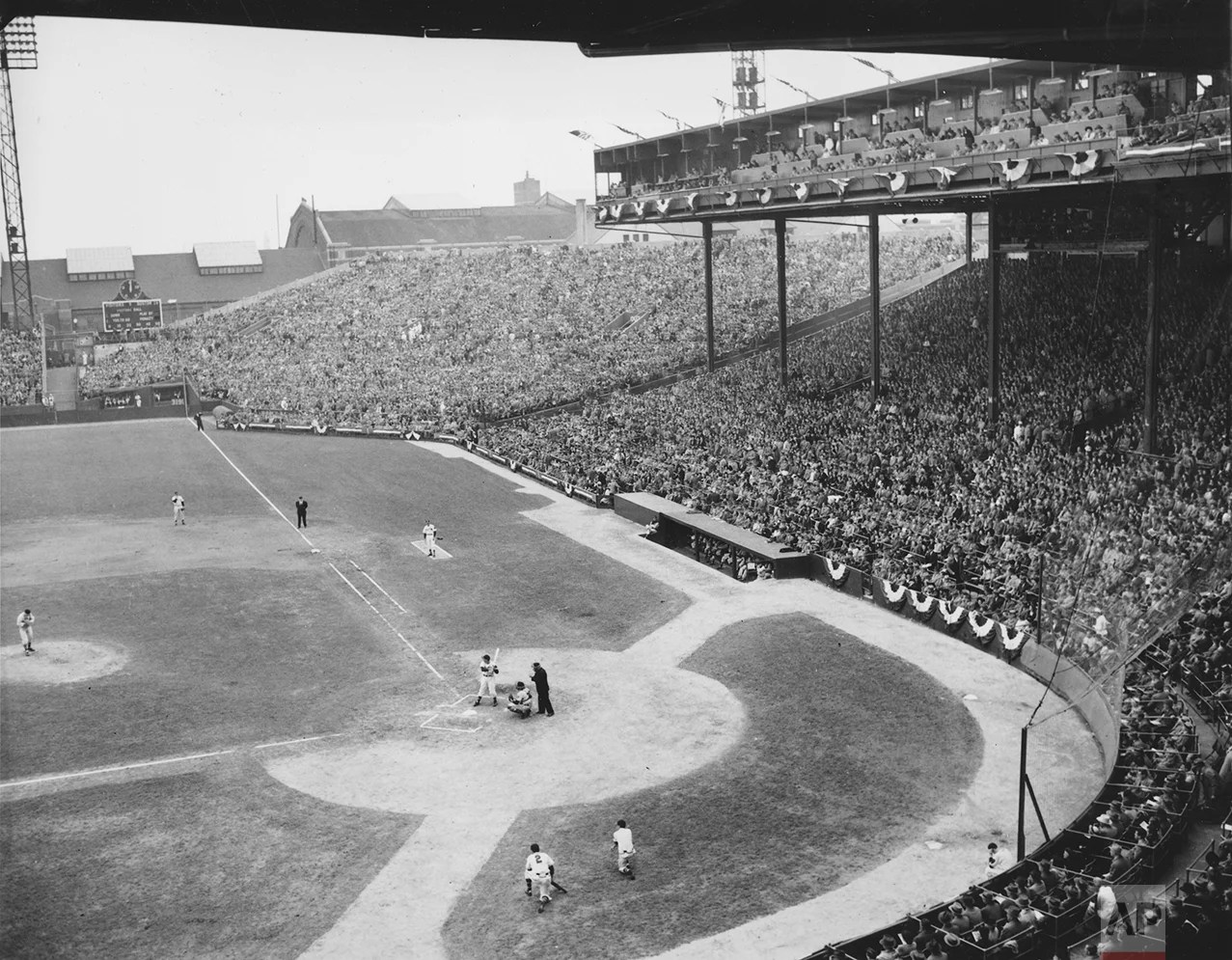
(The Boston Braves meet the Cleveland Indians in the first game of the World Series before 40,135 spectators at Braves Field in Boston, Ma., Oct. 6, 1948. Boston won, 1-0).
When I find a seasoned historian authoring a book on baseball history it spikes my interest. In the past I have enjoyed the works of Charles Alexander, an Ohio University professor who wrote biographies of Ty Cobb, Rogers Hornsby, Tris Speaker, and John McGraw, in addition to the impact of the Great Depression on baseball among other historians. The books were deeply researched and insightful. John Ferling who taught history at West Georgia University has been noted for these traits in his many books dealing with the American Revolutionary period and when I learned he had tackled baseball history I was intrigued. His effort entitled, BASEBALL AS IT WAS: BUILDING CHAMPIONS BEFORE FREE AGENCY CHANGED EVERYTHING was a wonderful stroll down memory lane..
Ferling’s work focuses on the twelve years following the end of World War II when baseball was in a period of transition highlighted by integration, the movement of franchises, to new cities, and owners dominating labor, or the lives of their players. Ferling’s interest rests on how baseball rosters evolved to effectively challenge for a place in the World Series. His main focus is on the Boston Braves who would move to Milwaukee and the Cleveland Indians providing intricate details and many astute observations.
One of the key themes in Ferling’s work is today’s game and how it has changed from the post war decade. It was a time when baseball was truly the national pastime – a transformative period before players obtained a great deal of labor freedom with the end of the reserve clause that owners used to dominate their playing chattel. Ferling states that he chose the Braves and Indians because after years of mediocrity they rapidly developed into championship contenders. The author focuses on General managers like John Quinn and Hank Greenberg and how they approached building a winning roster, why they succeeded at times, and why some of their moves failed.
The 1940s and 50s produced players that are viewed as iconic even from today’s perspective. The names Jackie Robinson, Mickey Mantle, Ted Williams, Joe Di Maggio, Henry Aaron, Bob Feller, Willie Mays and a host of others easily come to mind. It was also a period when baseball finally integrated with only one team waiting until the early 1960s – the Boston Red Sox with Pumpsie Green.
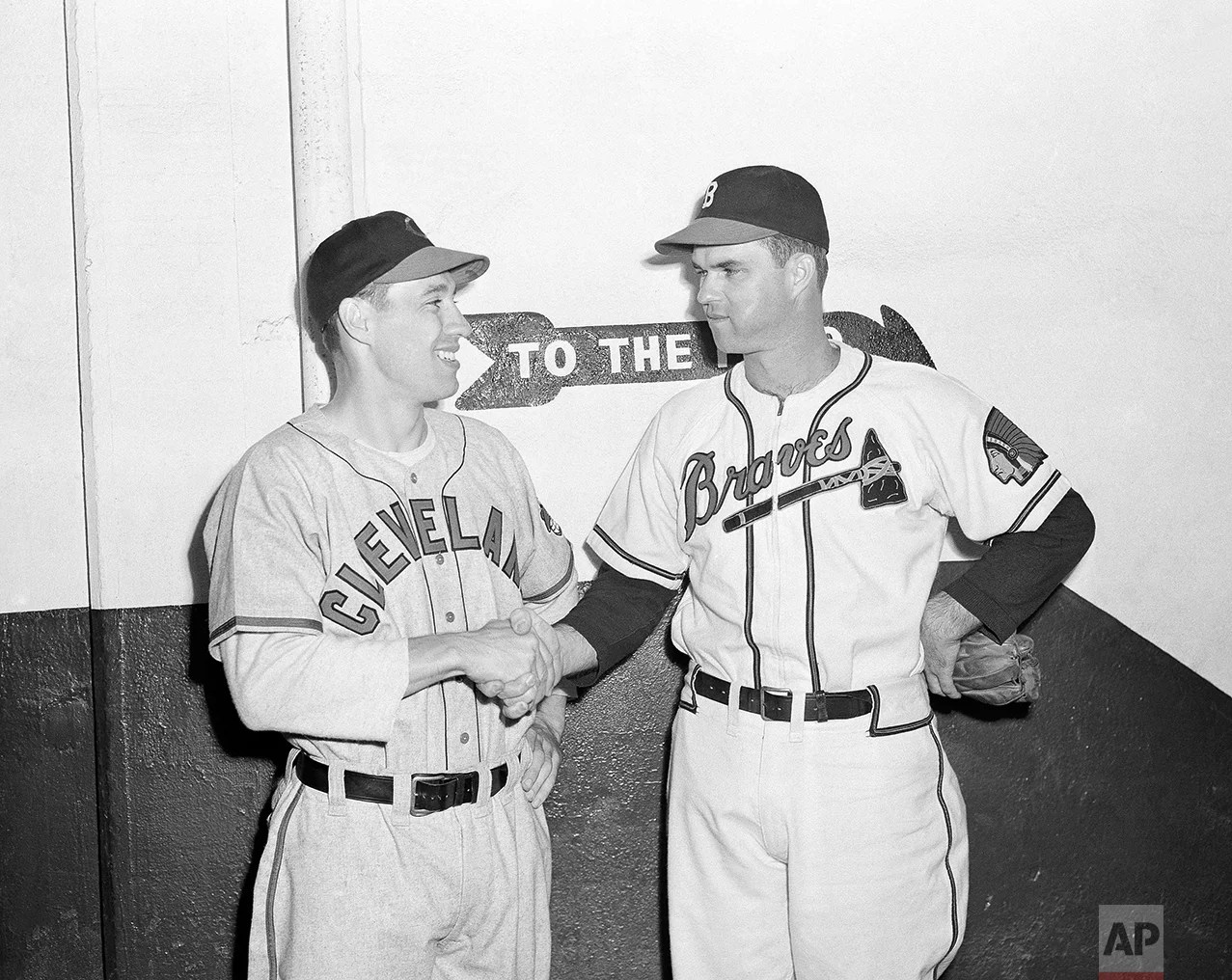
(Johnny Sain, right, of the Boston Braves, shakes hands with Cleveland’s Bob Feller, before the two hurling aces took mound, Oct. 6, 1948 at Braves Field, Boston, for the opening game of the 1948 World Series)
After a brief history of the pre-war period Ferling develops a number of important themes. First, the sport would enjoy a boom in popularity and attendance after the war as players returned and the quality of baseball lacking during the war improved immensely. Second, the author constantly discusses his topic in the larger context of American history. Third, Ferling integrates many topics that are not generally discussed by most books of this genre. For example, attempts by the Mexican League to lure players from the Major Leagues. Commissioner Albert “Happy” Chandler threatened any player who made the move to Mexico and later tried to return to the major leagues they would be blackballed for five years. Ferling also delves into the failed attempts by players to unionize succumbing to threats by baseball owners. Perhaps the best book on this topic is John Helyar’s LORDS OF THE REALM.
Ferling successfully examines the lives of many of the payers and how they dealt with the environment with which they were often confronted. Larry Doby’s struggle with racism even after Jackie Robinson broke the color barrier; Ted Williams loss of at least five seasons to fly bombers during World War II and the Korean War; Satchel Paige’s elevation to the majors after years in the Negro Leagues are among the many portraits offered.
The author develops many interesting points. One in particular stands out in that most players were not homegrown – “they were acquired hither and yon.” The reason for this is that many men who would have grown up playing baseball were off fighting in Europe and Asia resulting in a lack of experienced players. Interestingly, pitchers who stood out for the Braves and Indians during the 40s and 50s fought in the war – Warren Spahn, Johnny Sain, Bob Feller, and Bob Lemon.
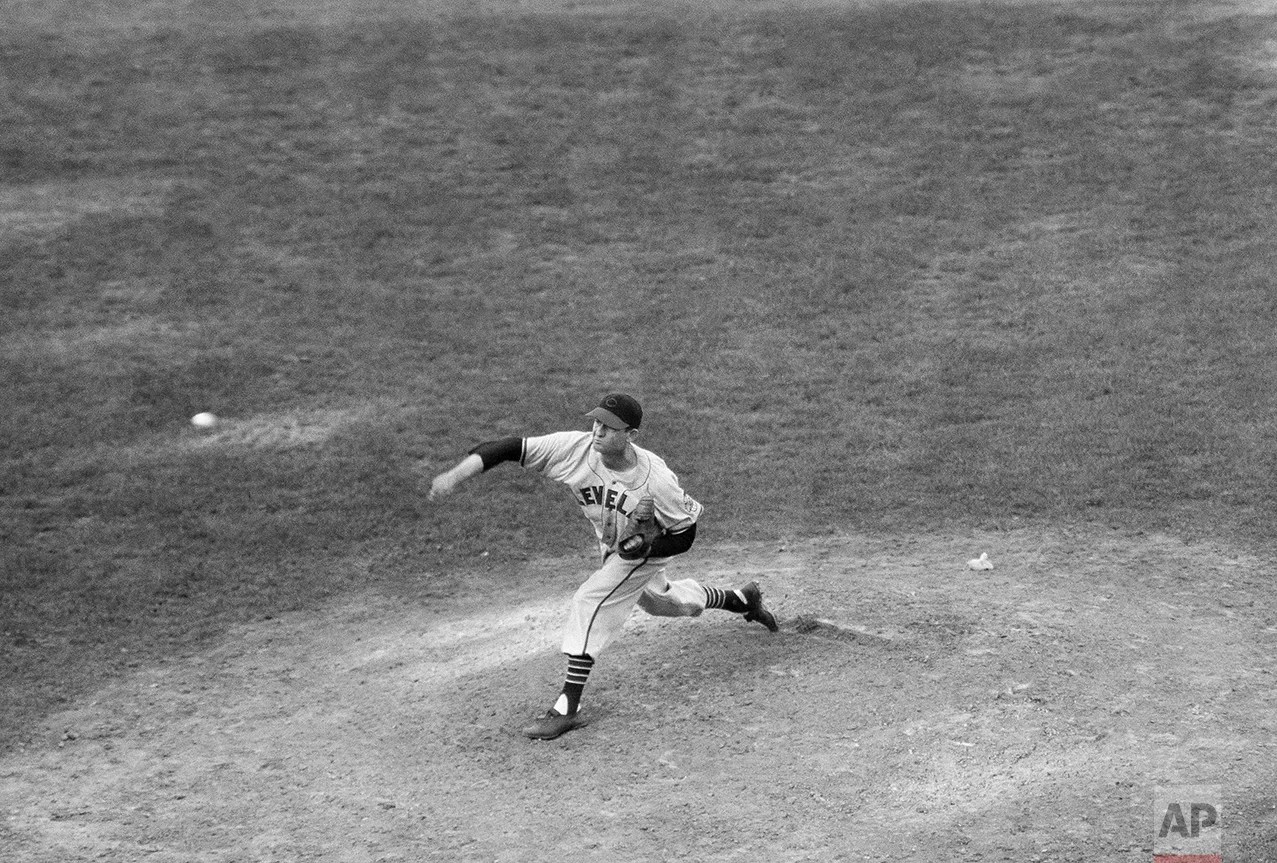
(Bob Lemon Cleveland Indian pitching in World Series game, Oct. 7, 1948)
Ferling dissects each season by following the pennant races and the performance of key players examining their strengths and weaknesses of the most important teams. In the late 1940s Cleveland was in a race with the New York Yankees and Boston Red Sox for the American League pennant. By the early 1950s the Yankees dominated except for the Indians unseating them in 1954. For the remainder of the decade, they went to the World Series except for 1959 when the Chicago White Sox met the Los Angeles Dodgers in the World Series. For the Boston/Milwaukee Braves their main opponents were the St. Louis Cardinals in the 40s and in the 50s it was the Brooklyn Dodgers and New York Giants (before they moved to California). The Dodgers would dominate the decade until the Braves emerged on top in 1957 and 1958, and the Dodgers won the World Series in 1959.
The issue of race is an underlying theme throughout the book. Even as late as 1955 with the arrival of Henry Aaron in the Braves locker room had an invisible line in the clubhouse that white and black players would not cross. Ferling explores the attitude of certain General Managers and managers toward race. George Wiess of the Yankees was known for not allowing the team to sign black players. He would succumb to pressure and bring in Elston Howard, a young catcher in 1955 which would spark their manager Casey Stengel to remark, “when I finally get a nigger, I get the only one who can’t run.”
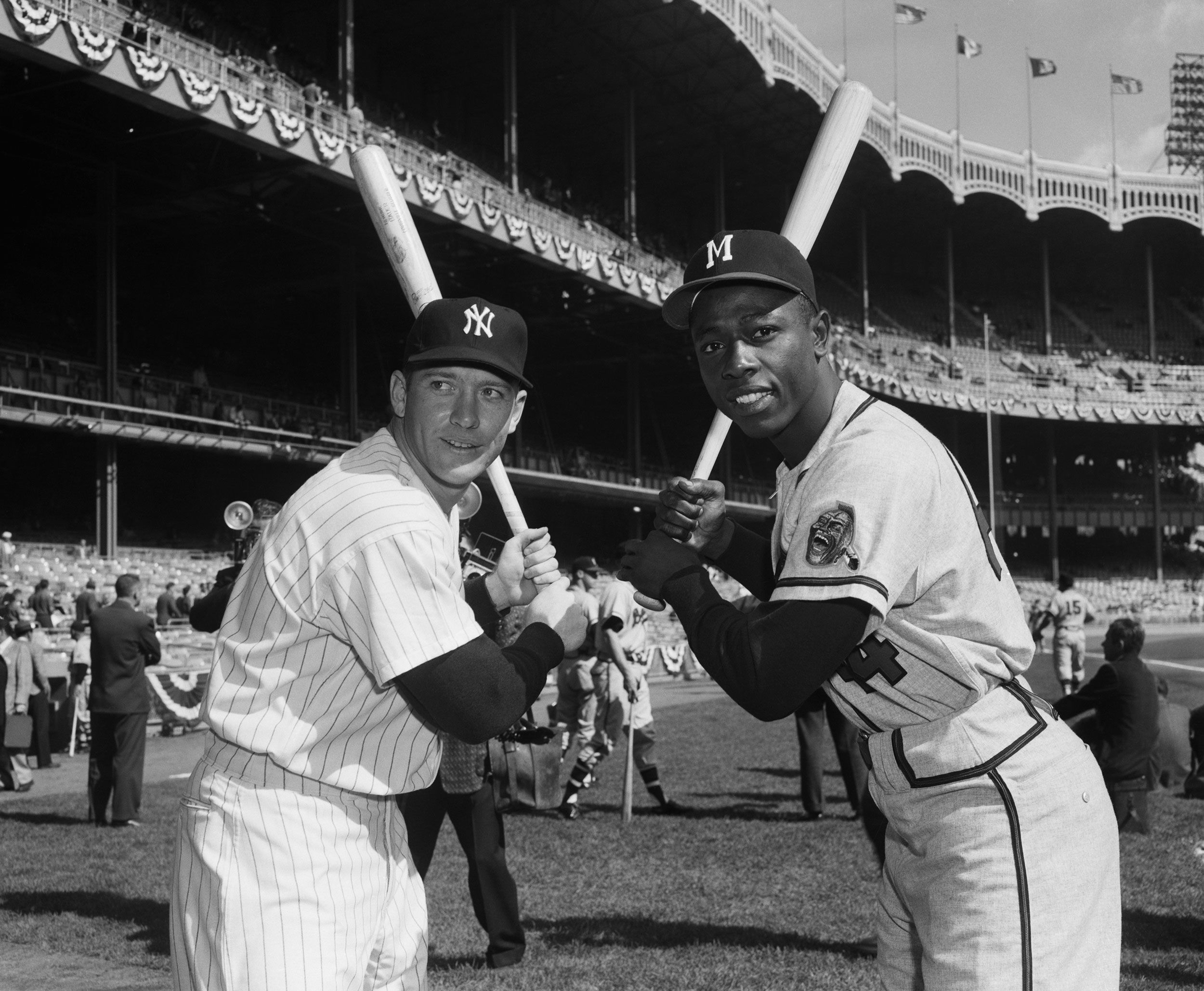
(Henry Aaron poses with New York Yankees slugger Mickey Mantle in 1957. That season, Aaron was named the National League’s Most Valuable Player and his team defeated the Yankees to win the World Series)
Ferling concentrates on the building of the Braves through the lens of John Quinn, their General Manager who was able to combine trades for opposing players with signing and developing prospects. Names like Lew Burdette, Billy Burton, Eddie Matthews, Hank Aaron come to mind who would lay the foundation for the World Series teams of 1957 and 1958. Quinn comes across much better than Cleveland General Manager Hank Greenberg. Quinn knew had to build a team and make important trades, two trades stand out; the acquisition of Joe Adcock from Cincinnati in 1953, and one that probably brought the Braves the pennant in 1957 by acquiring Red Schoendienst from St. Louis Cardinals. Greenberg, a former all-star slugger in his own right, his eight years in Cleveland only produced one World Series appearance. Ferling’s evaluation of Greenberg’s reign is dead on as he was seen as inflexible, cheap in rewarding players; fearful in making trades especially any of his top pitches like Mike Garcia, Bib Lemon, Early Wynn, or Bob Feller. The trades he did make did not pan out like trading Larry Doby, who was black, trading Minnie Minoso, and trading for Chico Carrasquel to the White Sox. One incident beyond Greenberg’s control should be mentioned, the unfortunate injury of Herb Score, who at the time, was probably the best pitcher in the American League was struck in the eye by a line drive by Gil McDougald of the Yankees. He would not return to the mound in 1957 and never was quite the same pitcher. As a result, attendance continued to decline and he eventually was forced to resign. One of the reasons the Indians could not catch the Yankees was that the Kansas City Athletics who had moved from Philadelphia constantly traded players to the Yankees who allowed them to fill holes in their roster. A case in point is Bobby Shantz and Art Ditmar to New York in 1957. Interestingly, Parke Caroll, the Athletics General manager had worked for George Wiess and saw his as a close friend! In 1959 Roger Maris was traded to the Yankees who would go on to break Babe Ruth’s home run record of sixty-one in 1961. Lane would be fired after three years before he could do any more damage.
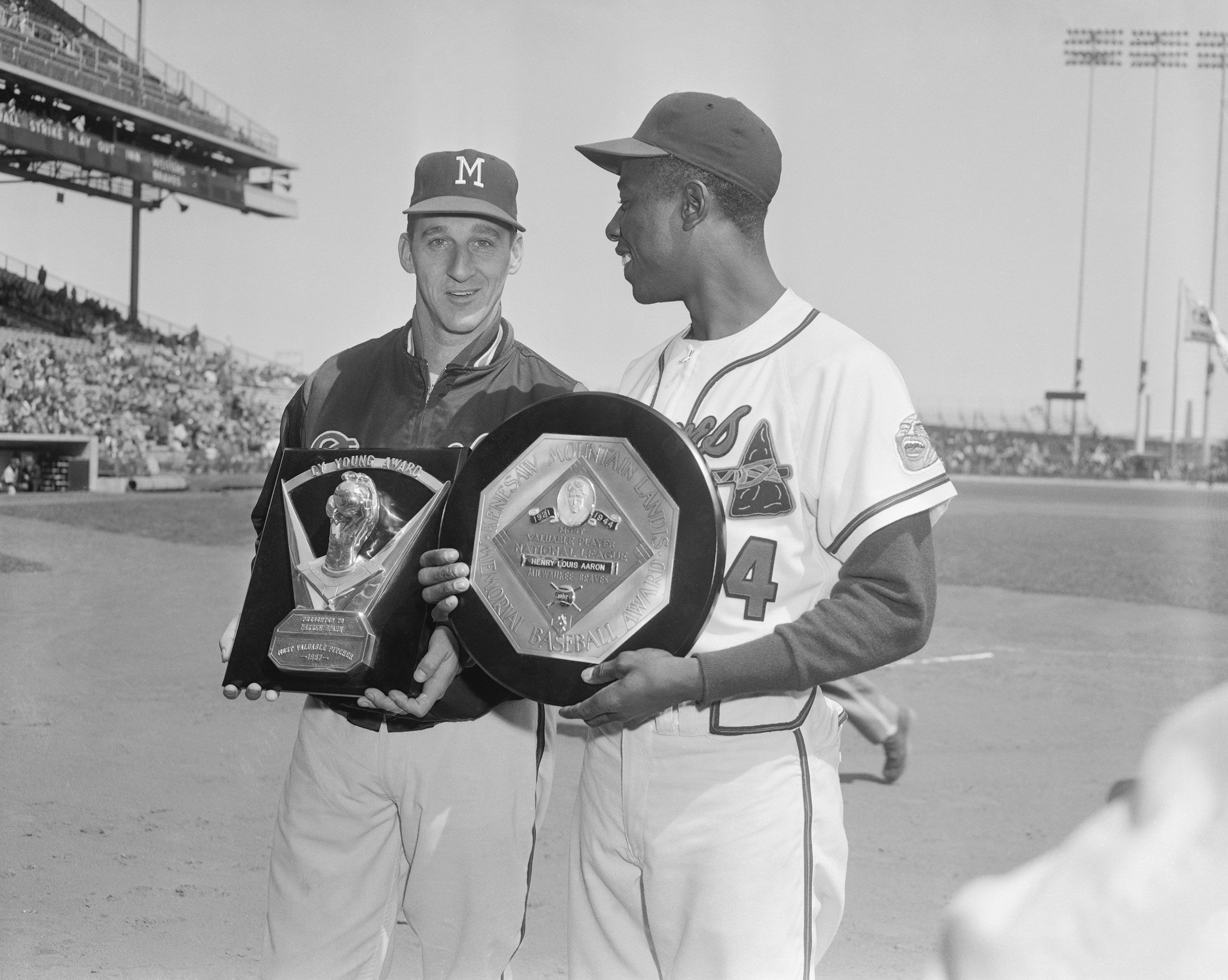
(Henry Aaron holds his MVP award with Braves pitcher Warren Spahn, who won the Cy Young Award that year).
The decline of both franchises after the 1958 season resulted from the dismissals of their General Managers. In the case of Cleveland, they would hire “Trader” Frank Lane who would ruin team prospects by living up to his nickname by dispersing Norm Cash, Rocky Colavito, Early Wynn, Al Smith, and Roger Maris. If you are knowledgeable about this period in baseball history you are aware of the later accomplishments of these players. In the case of the Braves, team owner Lou Perini forced Quinn out of his job even though the team made the 1958 World Series in which they lost to the Yankees in seven games. Ferling goes on to describe the machinations of the sale of the team and its move to Atlanta in 1966. Interestingly, Perini’s reason for selling, low attendance +-would reemerge in the southern mecca of baseball!
Overall, Ferling has created a wonderful walk down memory lane for a “senior” baseball fan. Though I was familiar with most of what the author had to say there are a few important vignettes of which I was not aware. If there is a criticism of the book it is that at times too many facts and numbers are thrown at the reader. I for one have no problem with that approach, but others who might want a more general account could. In conclusion, Ferling’s work provides an updated history of the period by an exceptional historian.
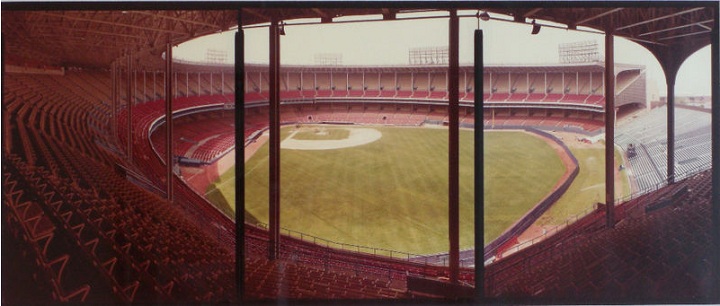
(Cleveland’s Municipal Stadium)
 Doc's Books