
(Mad money)
To begin with I usually find books on economic history difficult to process and complete. However, at a time when the United States national debt has surpassed $40 trillion it is incumbent upon us to try and understand what is taking place and what are the implications of our current economic policies. An administration which has increased the debt more than any in American history apart for spending during World War II with its “Big Beautiful Bill,” tariff policies that make no sense in our interconnected world and only increases the costs to consumers, and launching a war which was not correctly planned out and budgeted for does not bode well for the future if something is not done. The result of this thought process brought me to Liaquat Ahamed’s latest book 1873: THE ROTHSCHILDS, THE FIRST GREAT DEPRESSION, AND THE MAKING OF THE MODERN WORLD. Ahamed, a Pulitzer Prize winner for his previous work, LORDS OF FINANCE: THE BANKERS WHO BROKE THE WORLD about the lead up to the 1929 Great Depression, previously an economist at the World Bank and is uniquely positioned to tackle his latest topic and integrate certain aspects of our current economic plight.
There are many watershed dates in world history, but few are as important as 1873 from an economic vantage point. When we think of the economic crisis we tend to focus on 1929 and the Great Depression which was only overcome by massive government spending accompanied by World War II, and the 2008 economic downturn, widely known as the Great Recession, officially lasting from December 2007 to June 2009. It was the longest and deepest U.S. recession since World War II, triggered by the collapse of the housing market, subprime mortgage defaults, and a severe global financial crisis. As Ahamed points out, he “Crisis of 1873” is important to explore because of the similarities of the preceding stories. “The real estate bubble, stock market mania, careless lending, cascade of defaults, financial disruptions ricocheting across the ocean, drastic austerity programs and ensuing social unrest carry a familiar ring.” The economic events of 1873, like 1929 and 2008, were preceded by an extraordinary boom and were followed by a period of economic instability and political and social upheaval.
| Alphonse James de Rothschild | |
|---|---|
.png) |
The similarities of these crises to 1873 rests on self-inflicted wounds. Ahamed explores the pre and post 1873 period in great detail integrating commentary that relates to our contemporary economic world. In his focus on 1873 he correctly points out that the economic implications of what occurred should not have been as drastic and lasted for over two decades. In his view it was due to the major economic powers blundering into a totally unnecessary reordering of the global currency system. This resulted in a giant squeeze in the volume of global liquidity and had many unintended consequences.
According to Ahamed the major error occurred in Europe as the major economic powers abandoned silver as a foundation of its monetary system at the same time the United States suspended the use of silver as a form of money. This resulted in half the world’s monetary reserves being under a cloud of uncertainty as bimetallism ended. The situation was exacerbated as the decision was made during the 1873 crisis creating a long period of deflation, severely reducing profits and incentives for investment creating a malaise in the world economy. Further a massive redistribution of wealth occurred from debtors to creditors, businessmen and farmers to bankers and financiers inflaming populist anger. Further repercussions included the discarding of free trade replaced by protectionism, and the Grant administration’s feckless response to the economic crisis in the United States and the resulting political and social implications.
As Ahamed’s title suggests one family emerged as dominant during this period – the Rothschilds. The author takes the reader through the family history throughout the 19th century focusing on certain family members, their economic expertise, how they accumulated their enormous wealth, and how they impacted governmental policies in the countries where the different branches of the family were deployed. The Rothschilds were spread across Europe, from London, Paris, Vienna, Berlin, to Naples, and in each office they were able to avoid or temper governmental policy errors and avoid decisions that would detract from their wealth. Ahamed delves into the attitudes of family members and their influence on the major politicians and policy makers of the period and concludes they were not always shaping global markets. They made no great push to get off silver, and they avoided bad bets on Cairo and Constantinople. They would emerge from the crashes in Berlin and Vienna unscathed, because Anselm von Rotschild cautiously avoided buying into the boom. At the same time Ahamed points to the errors the family mostly avoided and their impact on populations in general.

Ahamed delves deeply into the most important decisions that individual Rotschild bankers made which greatly impacted history. Beginning with Nathan Mayer Rotschild’s accumulation of a fortune through smuggling to evade the Napoleonic blockade of England to Alphonse Rotschild’s influence on the negotiation of reparation payments following the Franco-Prussian War to Lionel de Rothschilds loans to control Egyptian debt to the purchase of a controlling interest in the Suez Canal Company the author provides important commentary that the general reader will easily absorb.
The key events were brought about by the losses suffered by hundreds of thousands of novice investors who lost their savings in the Berlin and Viennese stock markets who then sought scapegoats for their losses leading to a wave of antisemitism. The role of the Rothschild family is interesting here in that they were substantial players in this period, but they were deliberately conservative in their loans and largely hidden from public view. But over and over, when markets crashed, when economies collapsed, there were always people making their fame or fortune by accusing the Jews. Meanwhile the debt defaults by the Ottoman Empire and Egypt, were not due to Jewish bankers but the incompetence and avarice of Sultans in the Ottoman Empire and Pashas in Egypt which upended the strategic map of Europe which in the end resulted in the spread of the British Empire into the area as it took control of the Suez Canal Company.
| Gerson von Bleichröder | |
|---|---|
 Gerson von Bleichröder Gerson von Bleichröder |
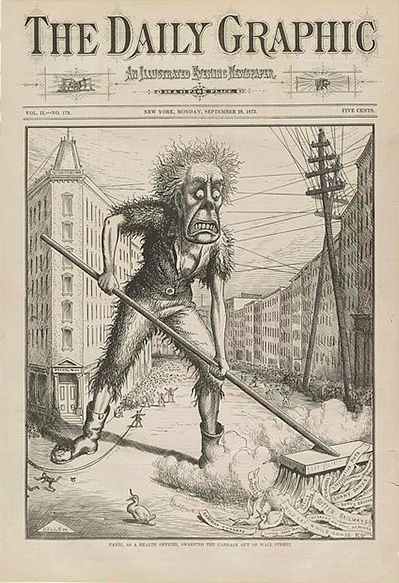
The impact of the post-Civil War railroad expansion in the United States plays an especially important role in the boom and bust cycle which will emerge. The financing of the transcontinental railroad in the United States and the machinations of Jay Gould and James Fiske to build a Northern route are delved into as these men mirrored the actions of the Rothschilds in Europe turned to the low margin business of underwriting government bonds in order to finance railroad construction. Scandals such as the Credit Mobilier receive their just do. Ahamed discussion of Mark Twain is priceless as the American writer coined the term the “Gilded Age” to describe this period of opulence and corruption.
Personality studies abound, some have been told before and offer little that is new, for example, German policy under Otto von Bismarck and how he relied on a Jewish banker for decisions, then turned to antisemitism when it was politically expedient, or how English Prime Minister William Gladstone, a liberal anti-imperialist agreed to send troops to Egypt to protect the Suez Canal to protect his own personal financial investments which helped touch off the “Scramble for Africa.” President Ulyssess S. Grant does not escape Ahamed’s microscope though once again little that has not been presented previously is discussed. However, a strong synthesis of Grant’s inability to make the proper decisions, his fecklessness in appointing cronies to important positions, and the resulting corruption are all discussed. In the end the American political system would suffer with the “Corrupt Bargain of 1876” ending Reconstruction and harboring the return of southern racism towards blacks as the region recaptured much of its influence lost because of the Civil War.
The author possesses a unique ability to make economic history interesting and almost fascinating! His ability rests on his command of history, though he relies too much on secondary sources, insightful analysis and easy to digest writing style. Further he has the ability to integrate statistics to support his conclusions without becoming overly pedantic. If there is one drawback to the narrative is that Ahamed never really conveys proof that the Great Depression of 1873 made the modern world as he strongly implies, however he presents fascinating details about important historical decisions that make his work of economics interesting and understandable for the general reader.


/https://tf-cmsv2-smithsonianmag-media.s3.amazonaws.com/filer/Mount-Rushmore-South-Dakota-631.jpg)