IN EXTREMIS: THE LIFE AND DEATH OF WAR CORRESPONDENT MARIE COLVIN by Lindsey Hilsum

Image result for images of marie colvin

(Marie Colvin in the Chechen Mountains, 1999)

“Why do I cover wars…. It is a difficult question to answer.  I did not set out to become a war correspondent.  It has always seemed to me what I write about is humanity in extremis, pushed to the unendurable, and that it is important to tell people what really happens in war—declared and undeclared.” (Marie Colvin, The Sunday Times, Sri Lanka, April 22, 2001)


Lindsey Hilsum’s new biography of Marie Colvin is a stark reminder of the plight of journalists in our ever-dangerous world.  According to the Washington Post at least 43 journalists were killed in 2018 with another 12 deaths whose causes are not totally clear.  The role of a journalist is to report the news as accurately as possible so citizens can make intelligent judgements about world events.  The life of Colvin presented in IN EXTREMIS: THE LIFE AND DEATH OF THE WAR CORRESPONDENT MARIE COLVIN reflects that dedication and commitment to that truth.  Hilsum, international editor for Channel 4 News in England is the perfect candidate to write about Colvin’s life as she herself covered wars and conflicts in the Middle East, the former Soviet Union, and Africa.  The recent murder of Washington Post reporter Jamal Khashoggi by the Saudi Arabian government reflects the danger journalists face.  The evidence points to the murder being ordered by the Saudi Royal Prince, Mohammed Bin Salman because of Khashoggi’s negative reporting of Saudi policies.  In this case a journalist was not killed on the battlefield, though in a sense he was.  In Colvin’s case she would give her life reporting from Homs, Syria district of Baba Amir, killed by an artillery attack in 2012 during the civil war that continues to this day.
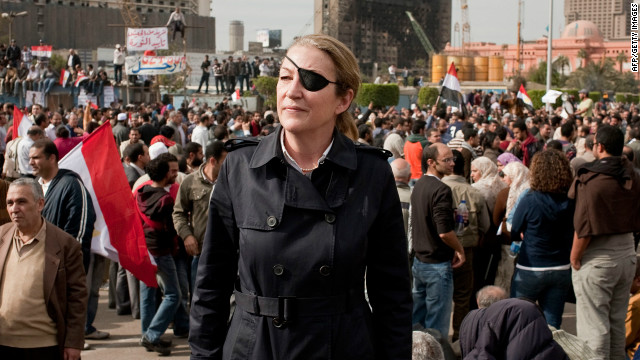
Image result for images of marie colvin

(Colvin in Cairo during the Arab Spring, 2011)

Colvin was raised in a comfortable middle-class Catholic family on Long Island, a lifestyle she would totally reject after studying with legendary journalist John Hersey at Yale and move on to a dangerous yet rewarding career as a war correspondent.   Hersey was one of the first individuals who impacted Colvin’s life and work.  Another, her role model, Martha Gellhorn whose work during World War II was exemplary.  Hilsum meticulously chronicles Colvin’s relationships and how they affected her love life and career.  Perhaps the most important being Sunday Times correspondent, David Blundy.  This bond was less sexual and more of a lifetime friendship as they shared the same approach to their work, humor, and the way they approached the world.  Hilsum details other important relationships pointing out their importance to Colvin’s life and work which both seemed conceived as a war zone.  Colvin was married twice to husbands who repeatedly lied to her, had her own series of affairs and one-night stands, suffered miscarriages, and would resort to alcohol to deal with her pain.

Colvin’s big break came in 1985 as a UPI reporter she was sent to Morocco with other journalists to witness the celebration of King Hassan’s twenty-five-year reign.  This morphed into an assignment in Libya as its leader, Muammar Gaddafi, the self-declared revolutionary and supporter of terrorism decided to engage the United States in a manner that could only bring President Reagan to respond with overwhelming force.  During their relationship Colvin was able to score several interviews with the Libyan strong man, and while avoiding his sexual advances enabling her to explore his rogue ideology and what he might do next.  Hilsum delves into how Colvin conducted interviews and developed her approach to revolutionaries, terrorists, or as they described themselves, freedom fighters.   For Colvin, her reporting was designed to focus on “the role and feelings of the individual in the collective violence of war.” (56)
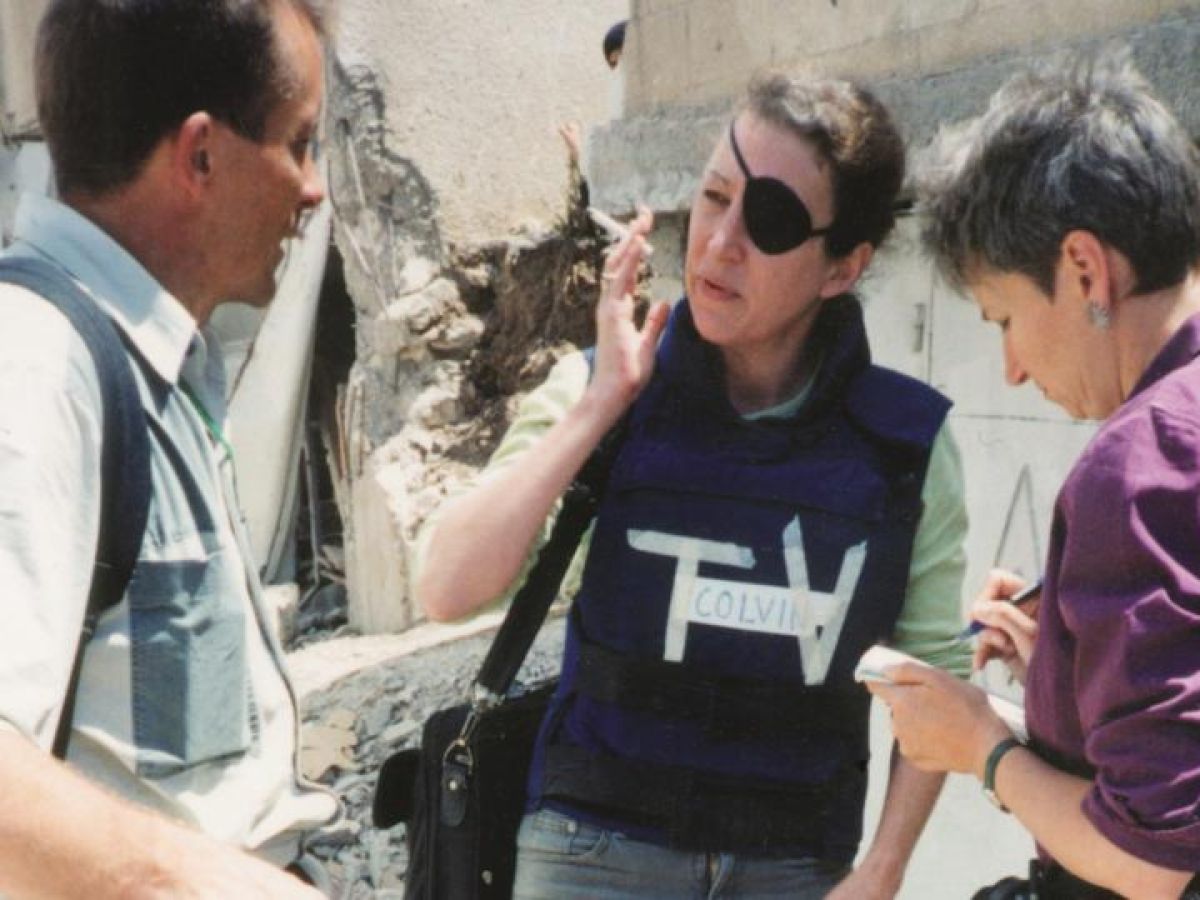
Image result for images of marie colvin

Hilsum’s approach reflects Colvin’s dedication to her craft and the dangers she faced on a regular basis.  Be it confronting Muammar Gaddafi, her special relationship with Yasir Arafat, or interviewing other individuals who rebelled against existing power structures.  The reader is presented with an inside look at the pitfalls and obstacles journalists like Colvin faced each day in Libya, Iraq, Israel, Kosovo, Chechnya, East Timor, Afghanistan, and finally in Syria over the last three decades.  Hilsum relies on over three hundred journals maintained by Colvin, interviews with her peers, and impeccable research to construct a fascinating picture of Colvin’s private life and career which she had difficulty keeping separate.

Image result for images of marie colvin

Hilsum does a nice job presenting the background history of each conflict area Colvin explores.  The author tries to explain the myriad factions in Lebanon as Beirut is divided at a green line with Maronite Christians, Amal,  Palestinian groups, bourgeoning Hezbollah all backed by different powers be it Iran, Russia or Syria.  In dealing with the Israeli-Palestinian conflict, Hilsum bores down deep to explain its origins, the constant explosion into violence be it the Intifadas, the wars against Hamas, and the attempts at peace.  Hilsum describes Colvin’s approach to reporting as other journalists would file from the relative safety of Paris and Cyprus when covering Middle East tension, Colvin would get up close and want to experience events before she reported.  Danger be damned, as her journalism was distinguished  by her personal experience and she would become part of the nomadic group of journalists who wandered the landscape of the Middle East.

For Colvin the Middle East held a tremendous fascination which explains many of her stories.  She was able to develop a trusting relationship with the elusive Yasir Arafat and interviewed him over twenty times.  Hilsum describes the arcane nature of Palestinian politics and the reclusive nature of the Palestinian Chairman.  Arafat is the perfect example to study as Colvin had the uncanny ability to get people to speak to her.  Colvin’s reputation was secured as she was able to sneak into Basra in 1986 during the Iran-Iraq war, Beirut during the 163-day siege of the Bourj al-Barajneh refugee camp in 1987, and her reporting helped create world pressure to get the Syrians to force their surrogates to stop the fighting.  The following year her stories describing the first Intifada against Israel reaffirmed her status as a war correspondent.  Colvin was not known for her stylistic approach to writing, but she got the facts and the human-interest component, at times leaving it to her editors in London to fit the puzzle of her reporting together in a more coherent whole.
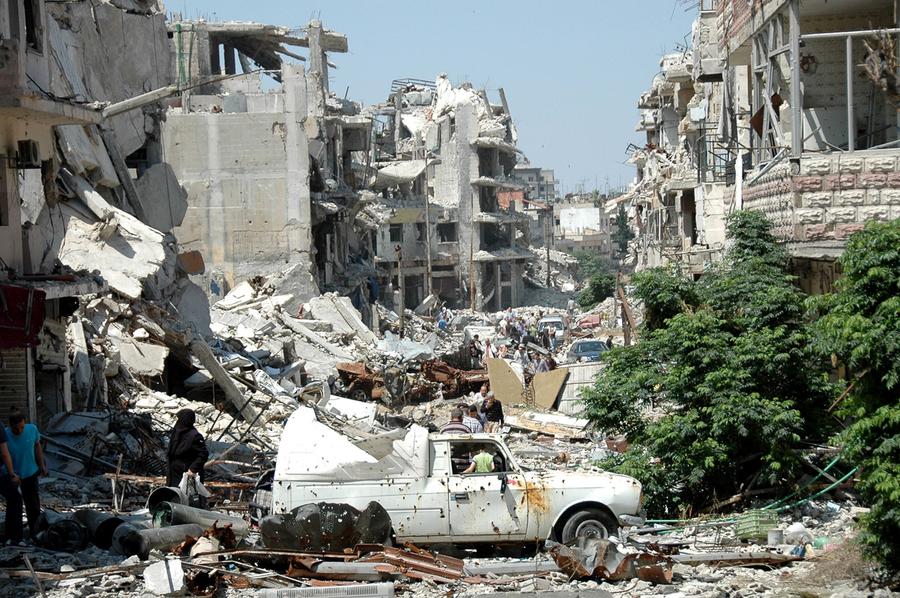
Image result for photos of homs syria

(Homs, Syria where Colvin was targeted and killed by Syrian intelligence in 2012

The years 1998 through 2001 found Colvin moving from what area of conflict to another with seemingly no time in between.  1998 saw her in Kosovo reporting on the devastation caused by Serbian nationalists. 1999 revolved around Indonesia as rebels in East Timor declared their independence.  Later that same year Colvin moved on to Chechnya as the new President of Russia, Vladimir Putin decided to crush Chechen rebels who had broken away from Russia during the collapse of the Soviet Union.  Finally, becoming involved in the Sri Lankan Civil War where she was shot trying to leave a Tamil rebel held area, resulting in a loss of her eye, and a deep depression as she tried to recover physically as well as emotionally.

Hilsum chronicles Colvin’s eventual psychological spiral as she was diagnosed with post-traumatic stress disorder for which she received treatment.  But her developing alcoholism was never treated.  As Hilsum vividly explains, “She could not unseen what she had seen, and he [a colleague] feared she was losing her ability to distance herself from horror.”  (Washington Post, December 21, 2018)  As Colvin describes herself in a November 12, 2010 piece it was difficult to distinguish between bravery and bravado. (294)

Colvin was a remarkable woman who had many irreconcilables demons within, but she found herself to a large extent as a war correspondent that made life, at times tolerable.  She witnessed and personally suffered a great deal of sadness and joy in her life, but her work is a testament for what journalism can accomplish, and the hope that those in power will care when reporting reaches the newspapers, websites, or television.  Hilsum has done an excellent job capturing the essence of who Colvin was and how she made her life meaningful.

Image result for images of marie colvin

(Marie Colvin on assignment)

THE PERILOUS ADVENTURES OF THE COWBOY KING, A NOVEL OF TEDDY ROOSEVELT AND HIS TIMES by Jerome Charyn

Image result for photo of teddy roosevelt

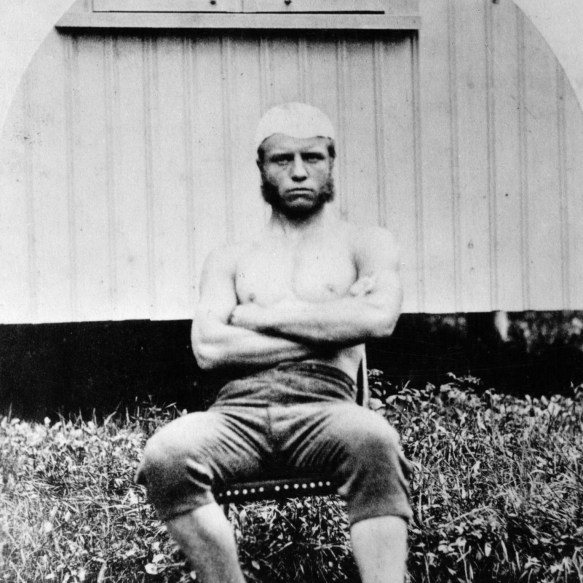
(Theodore Roosevelt in the Dakota Badlands)

In Jerome Charyn’s last book I AM ABRAHAM the author presents an unforgettable portrait of Lincoln and the Civil War.  He boldly narrates his story in the first person and mixes his brand of humor with Shakespearean like tragedy.  In his current effort Charyn takes on the character of Theodore Roosevelt,  entitled, THE PERILOUS ADVENTURES OF THE COWBOY KING: A NOVEL OF TEDDY ROOSEVELT AND HIS TIMES. As he has done in the past, Charyn speaks in the first person beginning with Roosevelt’s relationship with his father, “Braveheart” as a boy during the Civil War and follows his career as an Assemblyman in the New York State legislature, serving as New York City Police Commissioner and Governor of New York, organizing the Rough Riders, to the precipice of the presidency.  As in most of his books when he resorts to a first-person narrative, Charyn possess the uncanny ability to get inside the mind of his protagonist and speak in very accurate historical terms, adding a dash of humor and sarcasm, in conjunction with an exceptional imagination.

Image result for photo of teddy roosevelt

Charyn’s first book was published in 1964 and he has not lost any of his verve for writing, particularly entertaining, but meaningful historical fiction.  There are numerous biographies of Theodore Roosevelt ranging from Edmund Morris’ trilogy, single volumes by H.W. Brands, Kathleen Dalton, David McCulloch, and of course Roosevelt’s autobiography.  Reading a novel about Roosevelt is like riding an unbroken horse.  It usually proceeds at a gallop, then a canter, resulting in a full sprint.  Numerous characters appear, and thankfully Charyn has prepared a “Dramatis Personae” at the outset delineating all the major and secondary characters with a brief sentence or two for each. This is a great tool for the general reader who is not familiar with the Jay Gould’s, Roscoe Conklin’s, Dr. Leonard Wood, William Winters-White, Boss Thomas Platt, J.P. Morgan, Buffalo Bill Cody, and Josephine, Roosevelt’s pet cougar among the many historical figures that are recreated that appear in rapid-fire fashion throughout the novel.

Image result for photo of teddy roosevelt

(The Rough Rider)

The Roosevelt family is accurately portrayed, particularly the roles of Bamie, his sister who became his mother, overseer, and confidante after the deaths of his mother and young wife Alice.  Whether it is conversations within the Roosevelt family or “Robber Barons,” political hacks, or other important historical figures Charyn’s dialogue and commentary reflect the author’s knack of gaining entrance into Roosevelt’s thought process.  It seems as if the author has obtained an intimacy with Roosevelt’s mind that allows the reader to feel as if he is in a private conversation with “Teddy.”  The reader can touch Roosevelt’s emotional pain as his beloved Alice and mother pass away the same night or the reemergence of his relationship with his childhood friend Edith Carow who he goes on to marry.  The emotional torture Roosevelt deals with as he must decide to forgo widowhood as its implications for his sister Bamie and his daughter Baby Alice is on full display and is indicative of Charyn’s ability to present the emotional torture that Roosevelt experiences, but at the same time exhibit the talent to describe it in a sensitive and meaningful manner.

Image result for pictures of edith roosevelt

(Edith and Theodore Roosevelt)

Charyn is correct that Roosevelt was never without a cause, and once he was committed it was full speed ahead be it the corruption he dealt with as New York Police Commissioner, trying to push the United States into war with Spain as Undersecretary of the Navy, or his formation and financing of the Rough Riders for the war over Cuba.  In all these situations Charyn’s descriptions, scene recreation and dialogue are priceless as Roosevelt confronts the corrupt Pinkertons as Police Commissioner, his approach to training men for war, and the Battle for Kettle and San Juan Hills during the Spanish-American War.

Charyn’s Roosevelt is an obstreperous, emotional, and generous person who cared about those stricken by poverty, his soldiers, and it seemed anyone down on their luck.  We gain insights into the family man and his softer side.  However, this is not a hagiographical approach to fiction as Roosevelt’s flaws are readily apparent from his temper, racism, and intolerance for those who opposed him.  Overall, an entertaining read and a remarkable success as it could not have been easy writing a fictional account of a man whose actual  life fostered so many examples that seem made up.

Related image

THE LIBRARIAN OF AUSCHWITZ by Antonio Iturbe; translated by Lilit Zekulin Thwaites


Image result for photo of the gate of auschwitz(The approach to Auschwitz)

The horrors of the Holocaust are well known and the figure of 6,000,000 is imbedded in our memory.  However, another figure that emerges that is just as repugnant to human consciousness is 1.5-1.6 million.  This is the figure associated with the number of children who perished in the Holocaust.  The Nazis had no compunction about killing children be it for ideological reasons that made them a danger to the 1000-year Reich or the fact they were unwanted.  Some were killed in retaliation for partisan attacks or others were part of the Action T4, the eradication of children with disabilities.  No matter the cause of death; Joseph Mengele’s medical experiments, clearing ghettos, the Nazis deemed that children needed to be eliminated.  Of the 6,000,000 that perished over 1,000,000 lost their lives at Auschwitz-Birkenau, of that figure it is hard to determine exactly how many were children.  Whatever the figure their existence at Auschwitz left them vulnerable to medical experiments, hard labor, and the constant fear of death.  To survive, any activity that seemed to be a hint of normalcy was important.  In Auschwitz a small school with a tiny library was allowed for children which becomes the focal point of Antonio Iturbe’s wonderous book, THE LIBRARIAN OF AUSCHWITZ. Translated by Lilit Thwaites.

Image result for photo of dita kraus

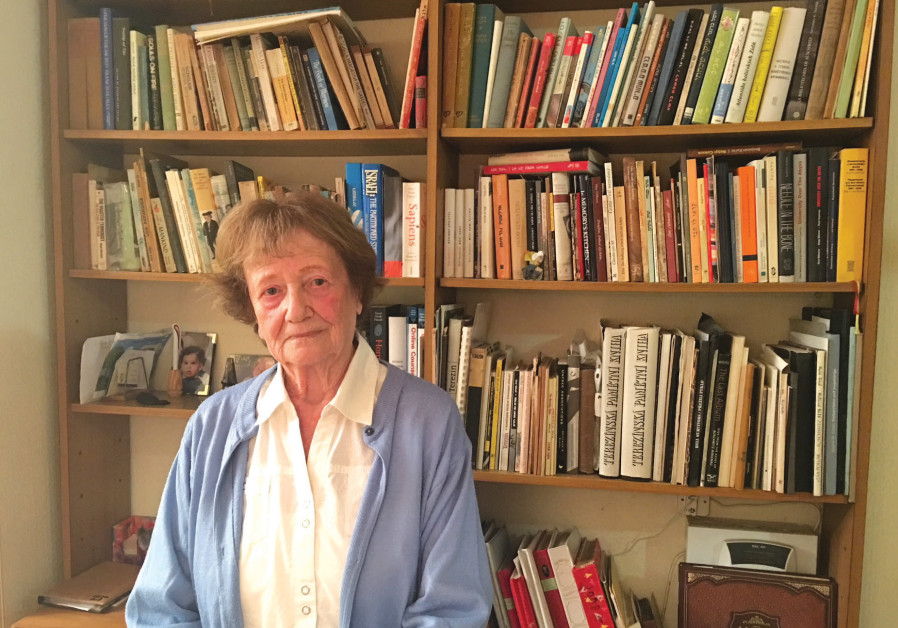
(Dita Polachova [Kraus])

The book is reminiscent of Markus Zusak’s THE BOOK THIEF for the tone that it sets.  The book is based on the experience of Dita Kraus who along with her parents was deported to Terezin in 1942, later in December of 1943 they were sent to Auschwitz where Dita was separated from her parents.  She would serve as the librarian in the block set up for children in Birkenau, with only a handful of books. Fredy Hirsch, a sports instructor from Prague ran the children’s block, and he along with a handful of teachers filled the children’s time with educational and cultural activities. One of these young educators was Otto (Ota) Kraus, Dita’s future husband.

“In March 1944, half of the children living at the children’s block were murdered, and their beloved Fredy Hirsch also died. In May, Dita and her mother were sent to Hamburg, Germany, where they were put to back-breaking labor. From Hamburg, the two women were transported to labor camps, and then in March 1945 to Bergen-Belsen, which was liberated several weeks later by the British Army.” (www.yadvashem.org/remembrance/archive/2014/torchlighters/kraus.html)

Image result for photo of josef mengele

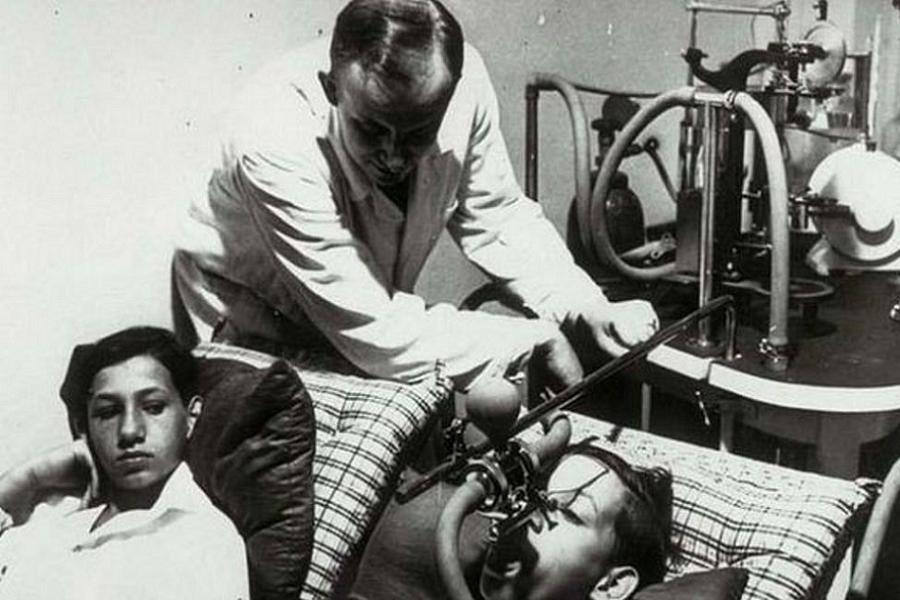
(Dr. Josef Mengele and his experiments)

Kraus describes Iturbe’s work as being based on extensive conversations with her, along with other research and sources.  “It is a story born both from my own experiences and the rich imagination of the author.”  Though the narrative mirrors what Kraus experienced it stands on its own as literary witness to what she, her family, and so many others had to cope with each day, and the final toll it took on its victims.

Image result for photo of dita kraus

(Dita Kraus)

For the children who attend Alfred Hirsch’s school in Block 31 the question that dominates their world is why they should study when there’s little chance they will leave Auschwitz alive?  Hirsch’s rationalization is that Block 31 should be an oasis for children as they had little hope each day.  The reality is that 521 children received somewhat of an education in Block 31, but they live in constant fear of becoming a specimen in one of Dr. Josef Mengele’s morbid experiments.  For the children, the location of Block 31 is on the path of deportees walking from their transport to the showers and their death reinforced their plight.  For the teachers, how do you teach children when they can hear the noise attendant to victims who will shortly be gassed?

Image result for photo of dita kraus

(Dita and Raja Engländerová-Žádníková, Hagibor 1941)

Iturbe presents many characters who either suffer from tortured relationships or they torture themselves through anxiety and fear of what the future holds.  The author has a nose for detail and the sensibilities of his characters. Each character has their own way of coping.  For Dita, the protagonist it is being a librarian for the inmates and the danger that is part of her existence.  Dita treats her library which consists of eight paper books and six living books as if she is a doctor, perhaps a surgeon as each time a book needs repair, she stitches them back to life. For Rudi Rosenberg, who is the camp registrar, exposing him to the numbers associated with death he begins a relationship with Alice Munk, a young desperate Jewess.  Then there is Victor Pestek, a member of the SS, who develops a friendship with Renee Neumann.  For Fredy Hirsch it is to allow the children to focus on something other than their situation, for him when a child smiles it was an act of defiance.  For Ota Kelle, it was to teach children about Palestine and the future.  For Liesl Adler, Dita’s mother she must deal with the void that the the death of her husband has caused, and poor Professor Morgenstern, it was to act like a fool. As Iturbe develops these characters he integrates a historically accurate picture of what transpired in Terezin and Auschwitz, and brings along important historical figures like Mengele, Adolph Eichmann, Johann Schwarzhuber, Elisabeth Volkenrath, and Rudolf Hoss.  The language and behavior of the Kapos and SS, the description of the clothing and work of the inmates, the Wagnerian music in the background are all true to history.

Image result for photo of dita kraus

(Ota B. Kraus)

For Dita to survive, Iturbe describes her relationship with books that she treats as if they were sacred texts. She immerses herself into H.G. Wells’ A SHORT HISTORY OF THE WORLD, Thomas Mann’s THE MAGIC MOUNTAIN, Alexandre Dumas’ THE COUNT OF MONTE CRISTO, and Jaroslav Hasek’s THE ADVENTURES OF GOOD SOLDIER SVEJK in order to understand the world in which she lives, and as a means of surviving each day.  As Dita communes with the book’s characters she questions many things including who she can trust in a world where rumors and lies dominate.  One of the survival  tools that Dita develops is creating a photo album in her head, something the Nazis could not take away from her as they worked to deprive children of their childhoods.

Aside from telling Dita’s story Iturbe engages in several philosophical aspects of life and survival, particularly in a concentration camp.  The human capacity and spirit for overcoming all obstacles emerges as does the importance of books in our everyday lives.  The book’s audience should be wide, and I encourage all to invest the time to experience it.

Image result for photo of the gate of auschwitz

(The gate to Auschwitz)

MARY QUEEN OF SCOTS by Stefan Zweig

Related image

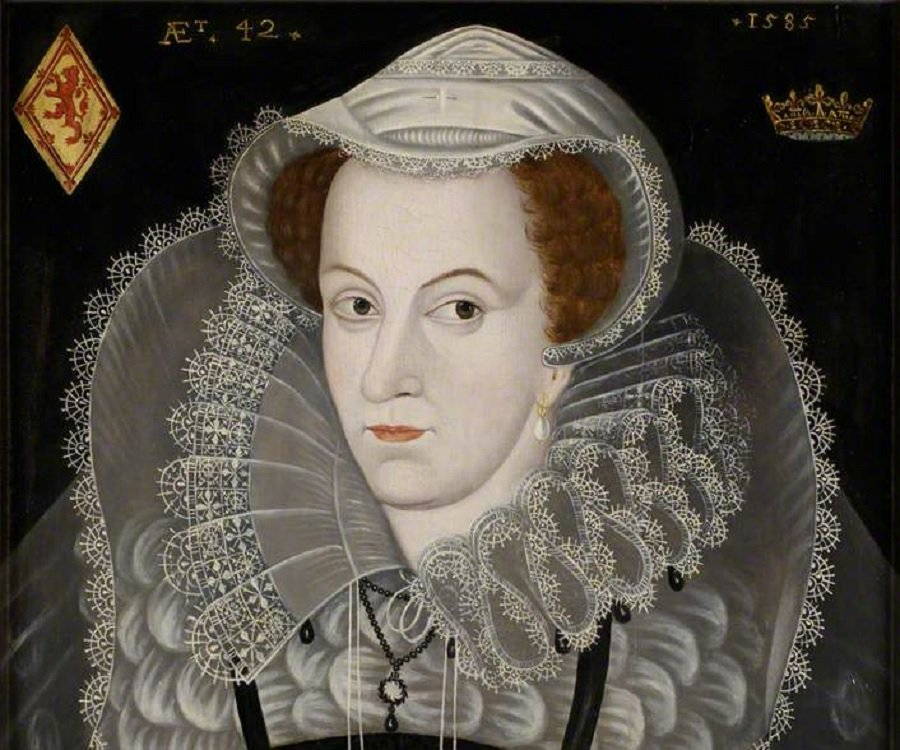
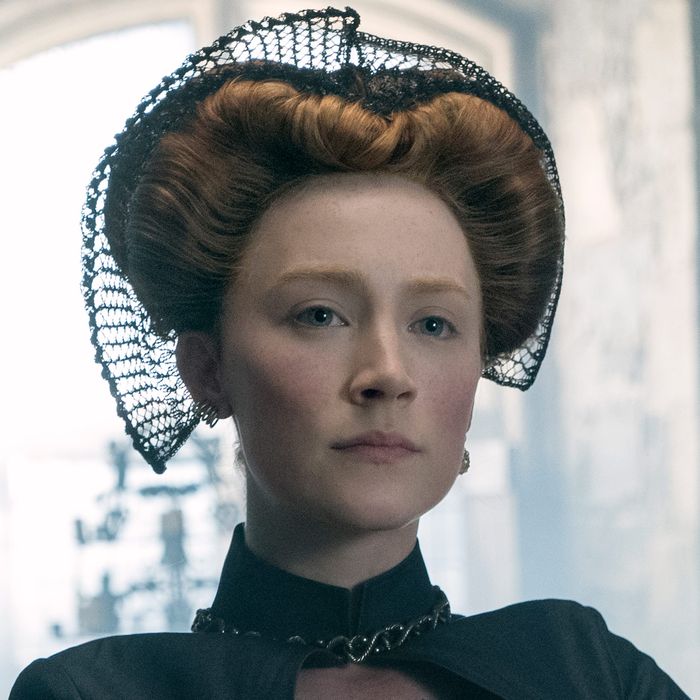
(Mary Queen of Scots)

The other day I went to see the film, Mary Queen of Scots  and as I do with most historical films, I wondered how historically accurate it was.  I vaguely recalled the biography of the Scottish Queen written over forty years ago by Antonia Fraser and it seemed there was a great deal of artistic license employed.  Since the most recent biography of Mary was written by John Guy it seemed like the best choice to read, however the film was based on that monograph. I decided to read an older classic account of the Queen written by Stefan Zweig in 1935 which has withstood the test of time.

Zweig, a prolific short story writer has written several biographies of major historical and literary figures that made him one of the most popular European writers in the 1920s and 30s.  Zweig delivers  a solid biography that encompasses her life begun during the time of Henry VIII who tried to pressure Mary’s father, James V to reject Catholicism and accept Protestantism.  James V would die six days after Mary’s birth (though Zweig seems to say they died on the same day), resulting in the ascension of Mary to the Scottish throne at birth.

Image result for pictures of lord darnley

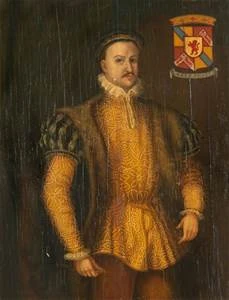
(Lord Henry Darnley)

What is clear about Scottish history is that it was very difficult for any monarch to rule Scotland effectively due to the marauding and jealous clans, led by lords who had difficulty projecting fealty to any monarch.  These lords were arrogant and greedy and were part of a somewhat narcissistic nobility.  Any wealth the monarchy might posses apart from sheep herds were gifts and grants from the French king or the Pope.  Historically Scotland was a pawn in the battle between France and England, and when war would break out, the English would land at Normandy, and the French would foment problems with their Scottish allies in the rear.

Zweig writes in a pleasant literary style that most historians can not match.  He writes with a scent of sarcasm whether discussing dynastic politics or diplomacy, and his monograph reads like a novel.  A prime example are the negotiations between Henry VIII and the Scots to marry his son Edward to the six-year-old Mary.  However, even after the negotiations are successful, she is spirited away by the French King Henry II to marry his son Francis.

Image result for photo of elizabeth i

(Elizabeth I)

The basic problem is that Mary had a legitimate claim to the English throne once Henry VIII died and his heirs Edward and Mary died.  The Scottish Mary was the great grand daughter of Henry VII of England, and Elizabeth, the daughter of Henry VIII and Anne Boleyn was deemed a bastard.  Henry II would paint the English coat of arms on Francis and Mary’s blazon in 1559 thus fostering the enmity and creating a rival for Elizabeth I.  For the remainder of her life, Mary was seen by Elizabeth as a threat to her throne and eventually it would not end well for Mary.

Zweig will lay out the history of Mary’s short marriage to the sickly Francis and describe in detail her unwanted departure from France and return to Scotland.   Zweig effectively relates Mary’s emotional state as she departs France.  Zweig integrates Mary’s state of mind throughout the book and incorporates Mary’s own writings and words into the narrative.  When Mary departs for Scotland on August 14, 1561, she is traveling to a country that is totally strange and foreign to her.  She faces several obstacles before she arrives that will dog her for her entire reign.  She is to rule over a poverty-stricken country, she must deal with a corrupt nobility that seems to make war at the slightest provocation, she must confront a clergy that is equally divided between Catholicism and Protestantism, and must deal with foreign neighbors who are waiting to benefit from the fratricidal disputes that seem to occur regularly.

Image result for photo of Lord Bothwell

(Lord Bothwell)

Zweig lays out the barriers that Mary must face when she assumes the throne.  She is poor as her mother; Mary of Guise left no inheritance.  Further, she must deal with wars of religion where the towns support Protestantism, and the countryside Catholicism.  In addition, she must deal with fanatical priests and foreign powers, and lastly nobles who convert to Calvinism as a means of seizing Church wealth.  Mary learned fast and decided that perpetual warfare was the way to preserve her Stuart heritage.  The question that dominants is how does one rule when more than half of your kingdom believes in a different religion.

Several important figures emerge that influence the course of Mary’s reign.  Her half-brother James Stuart, the bastard son of James V was her Prime Minister, and a Protestant.  A patient practitioner of the Machiavellian arts, he would have made the perfect king of Scotland.  James was wealthy in his own right and was always willing to accept subsidies to carry out the desires of Elizabeth I.  Another major figure was John Knox, the fanatical Calvinist preacher who refused to accept Mary as the legitimate ruler of Scotland.  His merciless antagonism and demagogic speeches designed to spread his dictatorial religious beliefs was a threat to Mary her entire reign.  When they finally meet for the first time, Zweig presents a wonderful description of their debate that demeaned Mary, who stood up to Knox but realized the difficulty that he presented.

Throughout Zweig allows the reader to experience Renaissance culture through the poets and their poetry of the period.  Mary who grew up during the French Renaissance was a cultured individual who did not fit in Scotland.  Zweig shifts his narrative to the social and cultural mores and norms whenever the situation warrants, and it is a pleasant change from the constant lack of decency and back stabbing that dominates Mary’s reign.

Image result for photo of Lord Bothwell
Any biography of Mary must concentrate on her relationship with Elizabeth I.  Zweig
does an exceptional job and his narrative is based on facts presented or debated with a scholar’s enthusiasm.  There is a psychological dimension to the relationship between the two Queens and Zweig does his best to explore it and reach his own psychohistorical conclusions.  He possesses a deep admiration for Mary and her refusal to give into a destiny that she should have been able to predict.  Reading this monograph at a time of the “me-too” movement one must not take out any sexist frustrations one might feel in regard to Zweig’s comments, i.e.; “In spite of their superlative traits these two women remained women throughout and were unable to overcome the weaknesses inherent in their sex.”  The narrative concerning the monarchial cousins centered on their differences that led to the ruin of Mary and victory for Elizabeth.

Zweig correctly points out that the Treaty of Edinburgh was at the center of their inability to reach a rapprochement despite the flowery letters between the two.  Mary would not sign the treaty recognizing Elizabeth’s reign until Elizabeth had accorded the succession to Mary – but to Elizabeth that would be signing her death warrant.  Zweig points out the strengths and weaknesses of the cousins as well as their similarities and differences.  Mary possessed a madly heroic self-confidence that led to her doom.  Elizabeth suffered from a lack of decision making, but she would still be victorious.  Mary was the champion of the old Catholic faith and was a character out of the Middle Ages believing in chivalry which was dying out.  Elizabeth was the more modern monarch who was defending the reformation.  The approach to their individual kingdoms also sets them apart.  Mary’s kingdom belonged to her on a personal level and she was interested in territorial expansion of her realm, only if it would benefit her personally.  For Elizabeth everything she did was to expand her kingdom and add to the glory of England, not her personal possessions.  The resulting engagement in wars, colonial expansion, and spreading England’s influence around the world was the result.

Perhaps Zweig’s most fascinating chapters deal with marriage diplomacy between the two Queens.  The narrative is priceless as negotiations between the two go back and forth and characters like Lord Henry Darnley and Robert Dudley become pawns between the two women.  Zweig’s presentation is almost like a comedic sketch resulting in the secret marriage of Darnley to Mary that has grave repercussions as Elizabeth and James Stuart are shunned to the side and the result is war that at first Mary is victorious, but in the end creates tensions that could only result in her defeat.

Zweig constantly offers a lens into the human condition throughout the narrative.  He delves into the psychological imperative that drives Mary and provides a wonderful soliloquy encompassing her infatuation for Lord Bothwell and the repercussions of the murder plot to kill her husband and her almost immediate marriage to her husband’s murderer.  Zweig’s analysis is deep and carefully thought out and certain historical scenes are presented as if  from a Shakespearean play as there are constant comparisons to the Bard’s characters.  The result is that Mary’s psyche has deteriorated to the point that she is unable to face what she has done and how dark were her deeds.  A major component of the book is the decline in Mary’s psychological well being as her behavior is detrimental to her political position and her own happiness resulting in her self-inflicted downfall.

Image result for photo mary queen of scots

(The execution of Mary Queen of Scots)

This decline is readily apparent as Zweig describes the negotiations between the cousins once she leaves Scotland and is “detained” in England in 1567.  Elizabeth wanted Mary to renounce her rights to the English throne and retire quietly.  Further, she wanted Mary to be cleared of involvement in the regicidal plot involving Bothwell and the death of her husband, Lord Darnley.  Zweig reproduces a great deal of documentation of the Westminster Conference which investigated the murder.  As in several cases dealing with Mary the results were not clear, but no matter the result Mary once again let her pride stand in the way of her safety as she lamented her situation and refused to give into Elizabeth’s demands.  The situation could easily have been resolved had Elizabeth, who at times had difficulty making major decisions just had Mary found guilty and executed in 1568 and not let the situation drag on for years with the same results.

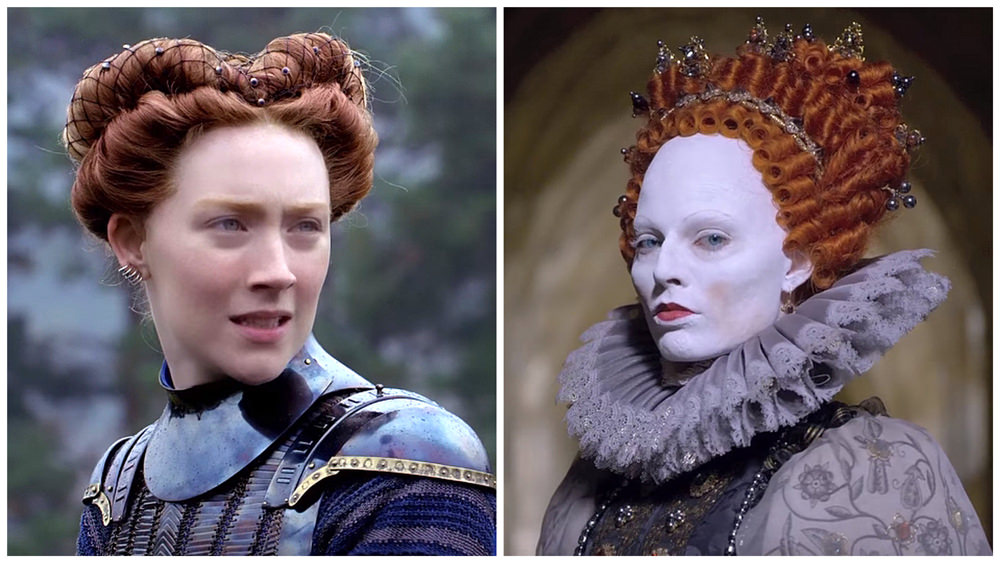
As an aside, if one compares the film, Mary Queen of Scots to Zweig’s or other historical monographs it becomes clear there are several inaccuracies.  First, Mary and Elizabeth never met face to face as takes place toward the end of the film.  Second, the brutal murder of David Rizzio, Mary’s confidante does not take place in front of the Queen as is shown in the film as he was dragged into another stateroom for the deed to transpire.  Third, it is debatable to assert that Darnley and Rizzio were lovers as is reflected in the film.  Fourth,  Mary did not have a Scottish accent as reflected in the film as she was raised in France, and lastly Lord Darnley probably raped Mary the first time they had sex.  The film overall is well done with a diverse cast, which of course did not exist in the 16th century, but the gist of historical accuracy does come across and one must remember a film is made to make money – not bring true history  to the screen.

Image result for photo mary queen of scots

(Mary Queen of Scots and Elizabeth I as portrayed in the film)

Zweig has written a somewhat entertaining and literary biography of Mary Queen of Scots.  In reading the book one must realize the time period in which it was written and Zweig’s background as a writer.  It may not meet the criteria that today’s historians might call for, i.e.; a full bibliography and endnotes, but it is a legitimate work of history and I would recommend it for those who seek clarification, those  who have seen the film, or those who are just curious about one of the most enigmatic figures in history.

Image result for photo mary queen of scots

(Mary Queen of Scots as portrayed in the film)


GRAND IMPROVISATION: AMERICA CONFRONTS THE BRITISH SUPER POWER, 1945-1957 by Derek Leebaert

Image result for map of british empire 1945

“Americans don’t do grand strategy.”

(Oliver Franks, British Ambassador to the United States, 1953)

From the outset of his new work, GRAND IMPROVISATION: AMERICA CONFRONTS THE BRITISH SUPER POWER, 1945-1957 Derek Leebaert puts forth the premise that the idea that the British were about to liquidate their empire because of financial and military weakness after World War II was fallacious.  Further, that the United States was fully prepared to assume the leadership of the west and would do so while creating an American led international order that we’ve lived with ever since was equally false.  Leebaert’s conclusions are boldly stated as he reevaluates the historical community that for the most part has disagreed with his assumptions over the years.  The author rests his case on assiduous research (just check the endnotes) and uncovering documents that have not been available or used previously.  Leebaert argues his case very carefully that American foreign policy in the post war era was very improvisational as it tried to develop a consistent policy to confront what it perceived be a world-wide communist surge.  Leebaert argues that it took at least until 1957 at the conclusion of the Suez Crisis for London to finally let go of their position as a first-rate power with a dominant empire, allowing the United States to fill the vacuum that it created.  No matter how strong Leebaert believes his argument to be I would point out that events in India, Pakistan, Palestine, the Marshall Plan, the Truman Doctrine, the creation of NATO, and the American loan of $3.75 billion all of which occurred before 1948 should raise a few questions concerning his conclusions.

Image result for photo of winston churchill

(British Prime Minister Winston Churchill)

Despite the assuredness with which Leebaert presents his case there are merits to his argument and the standard interpretation that has long been gospel deserves a rethinking.  His thesis rests on a series of documents that he has uncovered.  The most important of which is National Security Document 75 that was presented to President Truman on July 15, 1950.  Leebaert contends that this 40-page analysis has never been seen by historians and its conclusions are extremely important.  NSC 75’s purpose was to conduct an audit of the far-flung British Empire concentrating on its ability to meet its military commitments and determine how strong the United Kingdom really was, as men including John J. McCloy, Paul Nitze, David K. Bruce, and Lewis Douglas feared what would happen if the British Empire collapsed.   All important agencies in the American government took part in this analysis; the CIA, the Pentagon, the Treasury and State Departments and reached some very interesting judgments.  The document concluded that “the British Empire and Commonwealth” still had the capacity to meet its military obligations with an army of close to a million men.  Leebaert argues that “there had been no retreat that anyone could categorize, in contrast to adjustment, and no need was expected for replacement.  Nor could American energy and goodwill substitute for the British Empire’s experienced global presence.  As for the need to vastly expand US forces overseas, that wasn’t necessary.  Instead the United States should support its formidable ally, which included backing its reserve currency.” (234)  For Leebaert this document alone changes years of Cold War historiography.

Image result for photo of Harry Truman and George Marshall

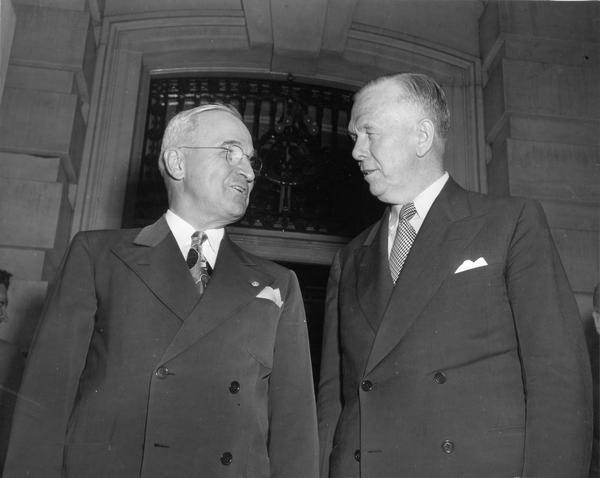
(President Harry S. Truman and Secretary of State George C. Marshall)

Harold Evans points out in his October 18, New York Times review that Leebaert offers other persuasive points that mitigate any American take over from the British due to their perceived weakness.  First, British military and related industries produced higher proportions of wartime output than the United States well into the 1950s.  Second, Britain was ahead in life sciences, civil nuclear energy, and jet aviation than America.  Third, England maintained the largest military presence on the Rhine once the United States withdrew its forces at the end of the war.  Fourth, British intelligence outshone “American amateurs.”  This being the case Leebaert’s thesis has considerable merit, but there are areas that his thesis does not hold water, particularly that of the condition of the English economy, dollar reserves, and how British trade was affected by the weakness of the pound sterling.

Image result for Photo of British Foreign Secretary E Bevin

(British Foreign Secretary Ernest Bevin)

Leebaert’s revisionist approach centers on a few historical figures; some he tries to resurrect their reputations, others to bring them to the fore having been seemingly ignored previously.  The author’s portrayal of British Foreign Secretary Ernest Bevin is a key to his presentation.  As the leader of the Labour Party, Bevin held leftist anti-colonial beliefs, but once in power the realities of empire, economics, and politics brought about a marked change particularly as it involved the Middle East, London’s role in any attempt at a European federation, the devaluation of the pound sterling, the need to create an Anglo-American bond, and numerous other areas.  Leebaert goes out of his way to defend Bevin in several areas, especially charges that he was anti-Semitic in dealing with the situation in Palestine.  Other individuals discussed include John Wesley Snyder who had strong relationships with President Truman and Secretary of State Marshall, who as Secretary of the Treasury oversaw the transition of the US economy to peacetime and was the driving force behind the Marshall Plan.  The American Ambassador to Great Britain, Lewis Douglas also fits this category as does Commissioner General Malcom MacDonald, who oversaw British policy in the Pacific from his position in Singapore, the hub of British Pacific power.

Leebaert’s narrative includes the history of the major Cold War events of the 1945-1950.  His discussion of the situation in Greece and Turkey including Bevin and US Admiral Leahy’s bluffs in negotiations that resulted in the Truman Doctrine and $400 million in aid to Greece and Turkey.  The Berlin Crisis, the Soviet murder of Jan Masaryk, Mao’s victory in China and what it meant for Hong Kong and Taiwan, and the Korean War are all presented in detail.

Image result for photo of george f kennan

(George of Kennan, Ambassador to Russia; Head of the State Department Policy Planning Staff)

Perhaps Leebaert’s favorite character in supporting his thesis is Walter Lippmann, the American journalist who had difficulty deciding whether the British were using the United States as a foil against the Soviet Union, or as a vehicle to fill any vacuums that might avail themselves should England retrench.  But eventually Lippmann concluded that Washington believed that the British Empire would contain the Soviet Union all by itself, not the actions of an empire that was about to fold and pass the torch to the United States.

Leebaert is not shy about putting certain historical figures on the carpet and shattering their reputations.  Chief among these people is George F. Kennan, who was Ambassador to the Soviet Union, Head of the State Department Policy Planning staff among his many diplomatic positions.  For Leebaert the idea that Kennan was a “giant of diplomacy” as he was described by Henry Kissinger is a misnomer to say the least.  He finds Kennan to be emotional, careless, impulsive, and “frequently amateurish.”  Further, he believes Kennan was often ignorant about certain areas, particularly the Middle East and Japan, and lacked a rudimentary knowledge of economics.  But for Leebaert this did not stop Kennan from offering his opinions and interfering in areas that he lacked any type of expertise.

Image result for photo of Malcolm Macdonald

(British Commissioner General Malcom MacDonald)

The situation in Southeast Asia was crucial for the British as seen through the eyes of Malcom MacDonald.  He firmly believed that if Indochina fell Thailand would follow as would the British stronghold of Malaya.  British trade and investment would be cut and wouldn’t be able to strengthen their recovering European allies, thus ending any American hope of a self-reliant North-Atlantic partnership. According to Leebaert, it was imperative to get Washington to support Bao Dai as leader of Vietnam and MacDonald made the case to the Americans better than the French.  If nothing was done the entire area would be lost to the communists.  Leebaert interestingly points out that in the 1930s when it appeared, he might become Prime Minister some day he backed Neville Chamberlain at Munich, now in the early 1950s he did not want to be seen as an appeaser once again.

At the same time disaster was unfolding on the Korean peninsula and Washington kept calling for British troops to assist MacArthur’s forces at Pusan.  The Atlee government did not respond quickly, and with British recognition of Mao’s regime and continued trade with Beijing, along with its attitude toward Taiwan, resulting in fissures between the British and the United States.  With Bevin ill, Kenneth Younger, the Minister of State argued that London could not be spread too thin because they could not leave Iran, Suez, Malaya, or Hong Kong unguarded.  Interestingly, Leebaert points out at the time the only real Soviet military plan was geared against Tito’s Yugoslavia.  The difference between Washington and London was clear – the British had global concerns, the Americans were obsessed with Korea.  Finally, by the end of August 1950 London dispatched 1500 soldiers, a year later 20,000 Commonwealth soldiers would be involved in combat operations.

Image result for photo of Eisenhower and J F Dulles

(President Dwight D. Eisenhower and Secretary of State John Foster Dulles)

Leebaert’s premise that the British would not forgo empire until the results of the Suez Crisis was a few years off.  By 1951 strong signals emerged that the empire was about to experience further decline with events in Iran and Egypt taking precedence.  If Islamists focused on anti-communism in these areas the British were safe, but when they began to turn their focus to nationalism London would be in trouble.  Domestically, Britain was also in difficulty as financial news was very dispiriting. Due to the Korean War and the US demand for industrial goods the total cost for imports shot up markedly.  This caused a balance of payments problem and the pound sterling plummeted once again.  The cold winter exacerbated the economy even further as another coal shortage took place.  It seemed that the British people had to deal with the rationing of certain items, but the defeated Germany did not.  Further, by 1952 Mau Mau uprisings in Kenya began to take their toll causing London to face another external challenge.

The British strategy toward the United States was to stress the anti-communism fear in dealing with Egypt and Iran.  In Egypt, King Farouk was a disaster and the British feared for the Suez Canal.  In Iran, the English fear centered around the Anglo-Iranian Oil Company which had been ripping off Teheran for decades.  An attempt to ameliorate the situation came to naught as the company was nationalized and eventually in 1953 the British and American staged a coup that overthrew the elected Prime Minister, Mohamed Mossadegh.  In Egypt nationalism would also become a major force that London could not contain resulting in the 1952 Free Officers Movement that brought to power Gamel Abdul Nasser.  In each instance Washington took on an even more important role, and some have argued that the CIA was complicit in fostering a change in the Egyptian government.  In addition, Dwight Eisenhower became president and John Foster Dulles, Secretary of State.  Despite newly elected Prime Minister Winston Churchill’s hope that the World War II relationship could be rekindled, Eisenhower saw the British as colonialists who were hindering US foreign policy, in addition the relationship between Dulles and British Foreign Minister Anthony Eden was at rock bottom.  It became increasingly clear that the Eisenhower administration wanted to avoid being perceived as acting in concert with Britain in dealing with colonial issues, except in the case of Iran which the United States is still paying for because of its actions.

Image result for photo of anthony eden

(British Prime Minister Sir Anthony Eden)

Regarding Indochina, the United States and England could not reach any demarche as regards the plight of the French visa vie the Vietminh, particularly as the battle of Dienbienphu played out.  Leebaert does an excellent job recounting the play by play between Dulles and Eden, Eisenhower and Churchill as the US and England saw their relations splintering as negotiations and the resulting recriminations proved fruitless. This inability to come together over Southeast Asia would have grave implications in other areas.

Image result for photo of churchill and eden

(British Foreign Secretary Sir Anthony Eden and Prime Minister Winston S. Churchill)

In another region, the Eisenhower administration would embark on a strategy to create some sort of Middle East Defense Organization to hinder Soviet penetration.  This strategy, whether called a “Northern Tier” or the “Baghdad Pact” of Turkey, Pakistan, and Iran or other nomenclatures created difficulties with Britain who sought to use such an alliance as a vehicle to maintain their influence in the region, particularly in Jordan and Iraq.  British machinations would irritate Washington as Eden and company resented American pressure to withdraw from the Suez Canal Base and other issues.  The result would be an alliance between England, France, and Israel to topple Nasser in Egypt.  The alliance was misconceived and would evolve into a break between the United States and its Atlantic allies even to the effect of the Eisenhower administration working behind the scenes to topple the Eden government and bring about the Eisenhower Doctrine signaling that the British had lost its leadership position and was no longer considered a “major power.”

Image result for photos of gamal abdel nasser

(Egyptian President Gamal Abdul Nasser)

I must point out that I have written my own monograph that deals with major aspects of Leebaert’s thesis, DAWN OVER SUEZ: THE RISE OF AMERICAN POWER IN THE MIDDLE EAST 1953-1957.  My own research concludes that the United States actively worked to replace Britain as the dominant force in the Middle East as early as May 1953 when John F. Dulles visited the region and came back appalled by British colonialism.  Leebaert leaves out a great deal in discussing the period; the role of the US in forcing Churchill into agreeing to the Heads of Agreement to withdraw from the Suez Canal Base; the failure of secret project Alpha and the Anderson Mission to bring about a rapprochement between Israel and Egypt and its implications for US policy; the disdain that the Americans viewed Eden, the extent of American ire at the British for undercutting their attempts at a Middle East Defense Organization by their actions in Iraq and Jordan; the role of US anger over the Suez invasion because it ruined  a coup set to take place in Syria; and the Eisenhower administrations machinations behind the scenes to remove Eden as Prime Minister to be replaced by Harold Macmillan.  In addition, the author makes a series of statements that are not supported by any citations; i.e.; Eisenhower’s support for finding a way to fund the Aswan Dam after Nasser had nationalized the Suez Canal; attempts to poison Nasser etc.

Overall however, Leebaert has written a monograph that should raise many eyebrows for those who have accepted the Cold War narrative of the last six decades.  There are many instances where he raises questions, provides answers that force the reader to conclude that these issues should be reexamined considering his work.  At a time when the United States is struggling to implement a consistent worldview in the realm of foreign policy it is important for policy makers to consider the plight of the British Empire following World War II and how Washington’s inability  to confront world issues in a reasoned and measured way and develop a long term strategy fostered a pattern that has created many difficulties that continue to dog us today.

Image result for map of british empire 1945

THE LIBRARY BOOK by Susan Orlean

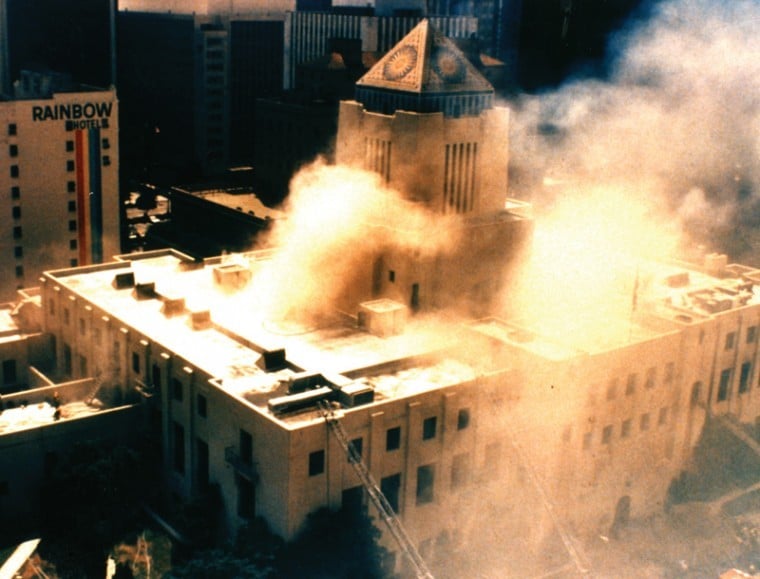
Image result for photo of la central library fire 1986

(April 28, 1986 Los Angeles Central Library City Fire)

“Writing a book, just like building a library, is an act of sheer defiance.

It is a declaration that you believe in the persistence of memory.” (93)


People can acquire many types of addictions.  Mine, happens to be books and libraries and it is a very difficult “affliction” to accommodate.  Despite the digital age, there are books everywhere.  New, old, they seem to proliferate mercilessly, the temptation seems to rise each day.  When I came across Susan Orlean’s new book, THE LIBRARY BOOK I knew that I once again had to confront my disease.  In the end, Orlean has written a wonderful ode to libraries and books.  Her subject revolves around the April 28, 1986 fire that destroyed about 500,000 volumes and damaged another 700,000 books, in addition to microfilm, special collections, and an unsettling amount of other materials at the Los Angeles Central Library.  Her narrative is a combination of historical fact, and a deeply personal emotional experience as she describes her own childhood visiting libraries with her mother and doing the same with her son.  Orleans provides a concise history of the Central Library and how the city of Los Angeles responded to the crisis the day of the fire, and how it tried to cope and rebuild from the loss.  As Billie Connor, a children’s librarian described after she and others entered the building immediately after the LAFD put the fire out; “they felt like they died and gone to see if Dante knew what he was writing about.” (34)

Image result for photo of la central library fire 1986

For Orlean the motivating factor in writing THE LIBRARY BOOK was emotive as she realized she was losing her mother to dementia.  Her mother who had imbued her with the love of libraries is recognized as Orlean composes her narrative to try and preserve her memories of her mother from when she was a child.

Orlean’s approach is rather eclectic and comprehensive at the same time.  She provides wonderful character portraits which add to our understanding of the role that libraries play in our communities.  One individual stands out, that of John Szabol, the head of the Central Library system of Los Angeles who early in his career acquired the nickname,  “Conan the Librarian.”  Szabol views libraries as serving many functions in addition to the dissemination of books.  During disasters they serve as a community center to assist displaced people.  Libraries are one of the few places where the homeless are welcomed and given access to computers, the internet, and if they want “dally” all day.  Szabol dispatch of mobile bookmobiles to homeless areas are among the many programs to assist the public that went beyond the traditional library.

Image result for photo of la central library fire 1986

Character portraits abound in the book.  Apart from Szabol is Orlean’s description of Charles Fletcher Lumis who became the head of the Central Library in 1905 because the library board fired his predecessor because she was a woman.  Lumis’ life is an amazing story in of itself.  Traveler, poet, historian, journalist his talents and life are a fascinating story.  Despite his unusual approach to administration he was responsible for many library components that exist today, i.e.; the photography and autograph collections; the California and Spanish history collections; among his many innovations.  Another library character that stands out is Glen Creason who began taking courses in library science in 1979 and is currently the longest serving librarian in the history of the Central Library.  He has become the library’s institutional memory and his career has spanned surviving the 1986 fire, the AIDS epidemic in which thirteen librarians died, the reopening of the building, and the adjustment to the internet.  Orlean’s approach is to discuss these somewhat obscure figures in a deeply personal manner and she gives them an enthusiasm and zest for what they have done and continue to do that is unimaginable.

Image result for central library los angeles today photos

(The library today)

Focusing on a different aspect of her study of libraries, Orlean presents a history of book burning that appears to be the norm, rather than the exception throughout the centuries.  Orlean begins her discourse with a discussion of the destruction of the great Library of Alexandria, carrying forth through the 20th century as the Nazis committed libricide with their Feurspruches and Brenn Kommandos designed to snuff out all Jewish learning.  It seems that Heinrich Heine was correct, “Where they burn books, they will, in the end, burn human beings too.”  Hitler was not the only practitioner of libricide; Mao, the Khmer Rouge, Saddam, and the Taliban who continue the practice to this day. Further, Orlean even tries to replicate burning books by trying to ignite her copy of FARENEIHT 451, a task that was difficult and painful.

Image result for central library los angeles today photos

Before the fire the library contained over 2 million volumes.  Orleans’ initial focus is how so many volunteers and businesses responded to try and salvage the 700,000 damaged books.  She describes amazing people and procedures to save them.  From freeze drying the books, to packing them up and transporting them to freezers at the fish market, hotel kitchens, and other food warehouses in order to stop the spread of mold.  The city’s response was incredible. Human chains of hundreds of people were formed as strangers worked together to save “knowledge.”  The fire itself was deemed as suspicious from the outset, and in a short time it became clear it was arson.  Since Harry Peake, an actor wanna be, fit the profile of an arsonist; white male between seventeen and twenty-five; in addition to being present at the library at the time of the fire he was immediately considered a suspect.  A month later, when someone identified him from a composite photo it reaffirmed that suspicion.

Orlean does a wonderful job integrating American history and its impact on the Central Library’s own progression.  There are numerous examples to support that conclusion.  Some of the most interesting is how the library administration responded to the demographic growth of Los Angeles, particularly after World War II.  New programs were added to meet the needs of the people, i.e.; microfilm and microfiche, teen departments and other innovations.  The library also tried to meet the concerns of the government as Sputnik and returning veterans created concerns for the public that needed to be met.  Finally, Orlean’s history reflects the sexism that was dominant in all libraries.  For decades only, men were allowed top administrative positions. That began to change with the appointment of Mary Jones, Mary Foy, Harriet Wadleigh, and Althea Warren over the years.

Image result for central library los angeles today photos

By the last third of the book, Orlean began to alternate chapters dealing with the library’s history and the case against Harry Peake. The investigation of Peake’s actions at the time of the fire  was drawn out over a long period as Harry was a fabulist who could not keep his story straight.  With seven different iterations of where he was the morning of the fire, investigators had a difficult time creating other than a circumstantial case against him.  The bizarre case resulted in Peake’s law suit against the city, and the city’s counter suit against Peake.  The result was inconclusive and to this day one wonders how the fire came to be.

If there is a theme that emerges from reading Orlean’s work, it is how the Central Library has maintained its relevance throughout the last hundred years or so.  The ability to reinvent itself to meet the needs of their community and constituency whether rich or poor, or even homeless is truly amazing.  Reading Orlean is to travel and immerse oneself in the problems faced by libraries, and how miraculously in the case of the central Library it has overcome disaster and continues to flourish to this day.

Image result for central library los angeles today photos

Perhaps  the most wonderful aspect of Orlean’s narrative is how she navigates the Central library and its branches and explain how they operate. Along the way she imparts numerous pearls of information to acquaint the reader of the wonderful world of libraries.  Her observations are priceless as she states that a library is the perfect place to become invisible.  It also has its own rhythms and sounds that are unique.  The Los Angeles system is best described “as if the city has a bloodstream flowing through it, oxygenated by books.”  Orlean has written a wonderful book that should satisfy the interests for all who frequent libraries and wonder how they evolved, and how they are constantly working to meet our needs.

Image result for photo of la central library fire 1986

(Fire damage from April 28, 1986)

THE CARTEL by Don Winslow

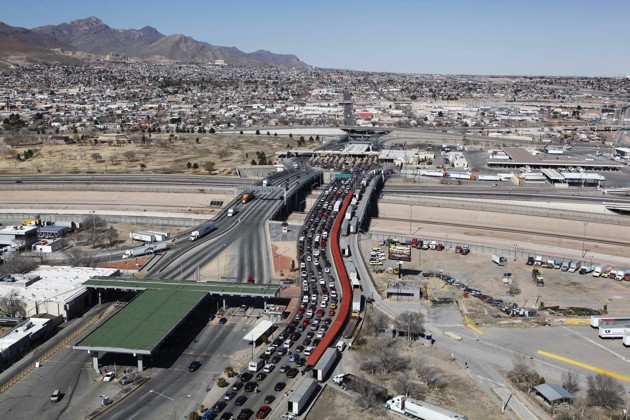
Image result for photo of juarez, mexico border

(Jaurez, Mexico border with the US)

“Mexico, the land of pyramids and palaces, deserts, jungles, mountains and beaches, markets and gardens, boulevards and cobblestoned streets, broad plazas and hidden courtyards, is now known as a slaughter ground.

And for what?

So North Americans can get high.” (THE CARTEL, 314)


“Hard to believe that 2010, the annus horribiis of the Mexican drug war, has finally come to an end.

The final tally of drug related deaths in Mexico in 2010 comes to 15,273.

That’s what we count now, Pablo thinks, instead of counting down to midnight.

We count deaths.” (481)


Don Winslow’s second installment of his narco trafficking trilogy, THE CARTEL seems nastier than THE POWER OF THE DOG.  The cast of characters is similar, but new ones are introduced that seem to be derived from the depths of humanity, and in this case the pit that is known for its violent drug culture.  However, Winslow’s opening leads the reader to believe that the story line might go in a different direction as the reader is introduced to a bee keeper tending his bees in a monastery and during his free time he is at prayer.  One should not be fooled as the bee keeper is Art Keller, the hero of THE POWER OF THE DOG, a former CIA operative and DEA agent who has been fighting narco traffickers for over thirty years.  Once Keller is reintroduced so is Adan Barrera, narco kingpin and the bane of Keller’s and the DEA’s existence.  In fact, Winslow points out that Barrera is even rated 67th most powerful man in the world by Forbes  magazine. The latest version of Winslow’s trilogy has all the elements of the first, but it might be my imagination, but it feels more violent and a steeper climb into the underworld of drugs that seem to seep into every crevice of Mexican society, government, and justice.  In addition, it is also a tale of two major business organizations that fight to the death for market share – it is eerie how this story unravels.

The hatred between Keller and Barrera is heightened as Keller fakes the funeral of Barrera’s daughter to lure him into a trap that results in his arrest and imprisonment.  THE CARTEL is the perfect sequel as Barrera puts out a $2 million contract on Keller who is forced to live like a fugitive in Mexico and America.  From inside Puente Grande Prison, supposedly Mexico’s harshest maximum facility, Barrera is treated as a “king” and begins to rebuild his drug empire.  Business is booming, which fosters envy from all those narco kingpin wan bees who believed he was out of the picture – the result is civil war, revenge, violence, torture, all emanating from within the narco world, but also outside as many innocent people are killed.  The civil war becomes extremely convoluted as the cartels keep switching sides, making it difficult to follow who is killing who, and for what reason.

Image result for photo of juarez, mexico border

(Mexico border at El Paso, TX)

While inside prison Barrera meets Magna Beltran, who becomes his mistress.  Beltran is just one example of the new characters that Winslow creates to carry his new novel.  She was arrested for drug running when she meets Barrera and he courts her as if they were on the outside.  She is an ambitious woman who realizes once her looks are gone, she will be discarded.  She worms her way into Barrera’s good graces and develops a drug business of her own and becomes a major narco player.  Other important characters include Osiel Contreras who heads the Gulf Cartel and the Zeta army made up of former special forces soldiers, deserters,  and police that is trained and led by a former soldier, Heriberto Ochoa.  Ochoa oversees the Zetas as they try and infringe upon other cartel territories.  Eddie Ruiz, a former high school football star who, as with most characters in the book becomes involved in the drug trade as he builds himself a small empire but is forced to join Barrera for protection from Contreras’ Zeta army.  It appears that each narco head has his own private army with the latest weaponry to go after each other and protect their investments.  Winslow is very astute or sarcastic as he points out that in the old days, the narco leaders would be at the forefront of the fighting, but now they send their own private forces to do their dirty work.  The violence becomes so bad that as cartel armies go against each other one gets the feeling they are in Iraq,  Syria, or Afghanistan.  In fact, the drug wars became terror wars with indiscriminate killing to intimidate and sow fear, rather than conquer targets.

Winslow uses Barrera’s desire to expand into the Juarez cartel as a vehicle to explore the socio-economic problems of Juarez, a city that lies across the river from El Paso as well as the inability of the authorities to provide protection for its citizenry.  Using Pablo Mora, a reporter for El Periodico as a tool to explain how the police have a difficult time solving crimes, the reporter explains why the structure of policing is inefficient, and why duties are distributed in such a manner that they overlap creating redundancy and incompetence.  With combinations of city police, state prosecutors and police, federal prosecutors and police, a grab bag of intelligence agencies from the city, state, and national governments, and of course the influence of the cartels which have their own police forces made up of current and retired officers it is amazing that the police can accomplish anything for the public good.  Mora’s work provides insights into cartel policies and their impact on Mexican and American society.  Mora is an important character as Winslow tries to integrate somewhat of a “normal” individual into the story, but he too suffers as his four-year-old son moves to Mexico City due to divorce.

Image result for photo of juarez, mexico border

(supposed caravans unwelcome at US border)

Another exceptional character is Marisol  Cisneros, a physician who Keller falls in love with.  She is stubborn to the point that she puts her safety in question.  Refusing to back down to the violence wrought by the cartels in Valverde, her home village where she runs a medical clinic for the poor, her story provides further evidence for the ruthless behavior employed by the sociopaths that head the cartels.

Image result for photo of don winslow author

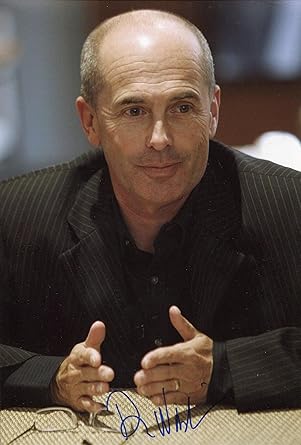
(The Author)

Winslow’s ability to invent unusual characters that capture the reader’s attention is limitless.  Two Mexican government officials, Louis Aguilar and Gerardo Veras begin working with Keller, but their loyalties are questioned making it hard to determine what their agendas are, and which one can be trusted.  Keller’s relationship with DEA head Tim Taylor reemerges and the results are interesting to say the least. Eddie Ruiz acquires the nickname of “Crazy Eddie,” or “Narc o Polo” and he eventually allies with Jesus “Chuy” Barajos, an eleven-year-old boy from the barrio who is trained as an elite soldier by the Zetas.  After a series of events he switches sides, joins Ruiz, and acquires the nickname “Jesus the Kid.”  It seems that Chuy found religion when he was picked up by a religious cult called La Familia Michoacana, led by a cult figure, named Nazario. The cult engages in good works for Jesus providing food, medical care, and housing throughout the barrios of Mexico and American border regions.  The problem of course is how this is funded, and you can guess it was paid for by the “meth trade,” whereby the family had built its own drug empire which of course had intruded on another cartel’s area of control.  Another family/cartel is headed by Diego Tapia, who along with his two brothers are allied with Barrera, until they aren’t.  If there is a common theme to many of the characters it is their fear of going to sleep, which brings them dreams about all the murders they have witnessed, covered, implicated, or for a few committed.  For Pablo it is “the dead, the dying, the grieving.  The dismembered, the decapitated, the flayed.” (559)

There are other characters and story lines that emerge for the reader to discover, but they all revolve around the drug trade, the domination of supply and distribution, particularly the burgeoning heroine epidemic in the United States, corruption of the Mexican government and law enforcement, and the violence as the cartels go to war with each other, with certain personalities continuing their vendettas.

At times Winslow’s sense of humor emerges as he points out that NAFTA, does not stand for the North American Free Trade Agreement, but “the North American Free Drug Trade Agreement.”  THE CARTEL  is a bit longer that THE POWER OF THE DOG, but it packs an even greater punch and will keep the reader riveted as it expands its exploration of the drug trade from Central and South America feeding the habits of American citizens.  Winslow is a master of numerous story lines that eventually converge.  The reader needs to be on their toes not to miss a step as the author unveils his plot very carefully, i.e.; Keller’s off book investigation of the Mexican justice system after he helped ignite the cartel civil war.  The book is an eye opener and difficult to put down.  After I finished reading, I can only imagine what new twists and turns Winslow will introduce in the third installment of his trilogy due out this February, entitled, THE BORDER.

Image result for photo of juarez, mexico border

TRUMP SUCCUMBS TO THE DIRECTORATE OF DICTATORSHIP (as opposed to the “Axis of Evil!)


I have been studying the balance of power in the Middle East since 1967. That being said, I believe I have some perspective as to what is in play in the region and how it affects American national security. Trump’s decision by tweet yesterday can only be seen as based on total ignorance(he probably thinks Lebanon is the city in Pennsylvania) and one has to wonder how the Directorate of Dictatorship, Putin, Assad, and Erdogan factor into the move. To say Trump is Putin’s “poodle” goes without saying, but to abandon our Kurdish allies who have fought and died to defeat ISIS is sad and extremely consequential. Historically, we have “screwed/abandoned” the Kurds before be it in dealing with Saddam Hussein or other parties, but because the Turks hate the PKK we have to kowtow to our supposed NATO ally. If any evidence is needed to see how Trump feels about his Turkish bro just look at how General Flynn tried to gain the extradition of Turkish cleric Fethullah Gulen, who Erdogan blames for the coup against him, to Ankara.

Maybe I am reading too much into this. Perhaps it is Trump being Trump as he tries to remove the Russia probe, the disbanding of his foundation by the state of New York, and the parade of his former associates before the legal system and flipping from the headlines. By pulling troops out of Syria he somewhat removes his domestic legal problems from newspaper bylines as Pentagon officials, foreign policy experts, and even Republicans speak out against his inability to comprehend the needs of US national security. Trump can send two thousand troops to the southern border to meet the non-existent caravans of “drug runners and rapists” (by the way we don’t hear much about this since the midterm elections except when a seven year old girl dies), but we cannot maintain our presence in Syria to prevent a resurgence of ISIS. Trump has declared victory, I seem to remember another American president did the same thing on an air craft carrier a number of years ago.

Who is the winner here – very simple; The Directorate of Dictatorship, and by the way I believe the Iranians are having a chuckle. Who are the losers? American allies, the Kurdish people, and in the long run the American people.

Putin backs Trump’s move to withdraw U.S. troops from Syria, says Islamic State dealt ‘serious blows’


Russian President Vladimir Putin speaks during his annual news conference in Moscow on December 20, 2018. (Alexander Nemenov/AFP/Getty Images)

December 20 at 7:45 AM

 Russian President Vladimir Putin praised President Trump’s decision to withdraw U.S. troops from Syria, describing the American presence there as illegitimate and the Islamic State as largely defeated on the ground.

Putin told journalists at his annual year-end news conference that the Islamic State has suffered “serious blows” in Syria.

“On this, Donald is right. I agree with him,” Putin said.

Trump said Wednesday that the Islamic State has been defeated in Syria, although analysts say the militant group remains a deadly force. Russia — Syrian President Bashar al-Assad’s most powerful ally — turned the tide in the civil war in Assad’s favor and has maintained its military presence there.

Moments after Putin’s statement, Trump tweeted about his decision to withdraw troops. He noted the presence of Russian, Iranian and Syrian forces, also enemies of the Islamic State, and said the United States was doing their work for them.

“Time for others to finally fight,” he said in a follow up tweet.

Days before Trump announces victory over ISIS, officials were preparing for a long engagement

The Trump administration is planning to withdraw all U.S. troops from Syria immediately. The president tweeted Dec. 19 that the U.S. had defeated ISIS in Syria. 


Putin said the U.S. troop deployment to Syria, by contrast, was illegitimate because neither Assad’s government nor the United Nations had approved the U.S. mission.

“If the United States decided to withdraw its force, then this would be proper,” Putin said.

Russia has been negotiating a political settlement to the civil war in Syria with Assad, neighboring Turkey and Russia’s ally Iran. The presence of U.S. troops was not helpful for achieving such a settlement, Putin said.

He cautioned, however, that Russia was not yet seeing signs of a U.S. troop withdrawal.

“The United States has been in Afghanistan already for 17 years, and almost every year they say they’re withdrawing their troops,” Putin said.

INF Treaty walked U.S., Russia back from a Cold War nuclear showdown

The United States’ plan to scrap this Cold War treaty raises fears of another nuclear arms buildup. 

Putin also — again — took Trump’s side in defending his 2016 election victory, which critics say was tainted by Russian interference (which Russia denies). He drew a parallel to Britain, where politicians are in a bitter fight over how to implement the referendum vote in 2016 to exit the European Union.

The result, Putin suggested, was a crisis of democracy across the West. Western officials say that fomenting such a crisis is in fact the goal of Russian propaganda and influence efforts in Europe and the United States.

“People don’t want to acknowledge this victory — isn’t that disrespect for the voters?” Putin said of Trump’s success in the 2016 election. “Or in Britain, Brexit passed and no one wants to implement it. They’re not accepting the results of elections. Democratic procedures are being weakened, they’re being destroyed.”

Putin was tougher on Trump on the issue of arms control. He said there are currently no negotiations with the United States on extending a soon-to-expire nuclear arms control treaty, raising the risk of a situation that would be “very bad for humanity.”

The New START treaty limits the numbers of nuclear warheads deployed by Russia and the United States, and it is set to expire in 2021.

“There are no negotiations on extending it,” Putin said at the wide-ranging news conference. “It’s not interesting or not needed — fine then.”

Putin has long sought to bring the United States to the table on nuclear arms control talks. Analysts say that is in part because it is one of the only international issues on which Moscow and Washington can face each other as equals.

But Trump and his national security adviser, John Bolton, have expressed skepticism of the existing arms control architecture. Trump has already announced plans to withdraw from the Intermediate-Range Nuclear Forces (INF) Treaty, which bans the United States and Russia from having missiles with a range between 300 and 3,500 miles.

With the likely demise of the INF Treaty, New START would be the last major agreement limiting the world’s two biggest nuclear arsenals. If New START expires, “we will ensure our security,” Putin said. “We know how to do it. But this is very bad for humanity because it leads us to a very dangerous line.”

Opinion An Antidote to Idiocy in ‘Churchill’ In this season of giving, get (and give) Andrew Roberts’s brilliant new biography.

As a former educator and historian, though I do not think the term “former” should ever apply in this context, I have become more and more amazed at our lack of historical knowledge and how it impacts us on a daily basis. All we have to do is examine the first eighteen years of the 21st century to realize that the errors our leaders committed, could have been prevented had we explored history, and in particular cultures of areas we became involved in. What is even more disconcerting is to read Bret Stephens opinion in the NYT as he points to a 2008 survey in Britain that states that 20% of teenagers thought Winston Churchill was a fictional character, and that 58% believed that Sherlock Holmes was a historical figure. Further, I understand that the same survey produced results that authenticated Eleanor Rigby as real! This is scary. Perhaps we should all choose a history book, sit back and read and try and create a barrier that prevents the ignorance that our society seems to suffer from. Computers, technology, and the internet are wondefull, but I would ask educational administrators to think about the role of teaching history and the contribution it might make to “make America great (not again, because we are great)!”

Opinion

An Antidote to Idiocy in ‘Churchill’

In this season of giving, get (and give) Andrew Roberts’s brilliant new biography.

By Bret Stephens

Opinion Columnist /  New York Times

This year, the retired astronaut Scott Kelly posted a harmless tweet quoting Winston Churchill’s famous line, “In victory, magnanimity.” Left-wing Twitter went berserk, and Kelly felt obliged to grovel.

“Did not mean to offend by quoting Churchill,” he wrote. “My apologies. I will go and educate myself further on his atrocities, racist views which I do not support.”

We live in a time in which decent and otherwise sensible people are surrendering too easily to the hectoring of morons or extremists. Think of Prime Minister Theresa May of Britain and the hard-core Brexiteers. Or of what used to be called the Republican establishment and Donald Trump.

We also live in an era in which the counterexamples are few and far between. “In defeat, defiance” is another great Churchillian maxim, and it’s hard to name a single political figure today who embodies it — as opposed to, say, “in defeat, early retirement to avoid a difficult primary.”

So maybe it’s time to acquaint (or reacquaint) ourselves with the original, and there’s no better way of doing it than to read the historian Andrew Roberts’s “Churchill: Walking With Destiny.” A review last month in The Times called it “the best single-volume biography of Churchill yet written,” but it’s more than that. It’s an antidote to the reigning conceits, self-deceptions, half-truths and clichés of our day.

For instance: Being born into “privilege” is ipso facto a privilege.

For Churchill — who suffered as a child under the remote glare of a contemptuous father and a self-indulgent mother; fought valiantly in four wars by the time he was 25; and earned his own living through prodigious literary efforts that ultimately earned him a Nobel Prize — the main privilege was the opportunity to bear up under the immense weight of inner expectation that came with being born to a historic name.

Or: To be a member of the establishment is to be a creature of it.

Churchill championed free trade to the consternation of Tory protectionists. He supported super-taxes on the rich and pensions for the old to the infuriation of his aristocratic peers. He called for rearmament before both world wars against the hopes and convictions of the pacifists and appeasers in power. His great, unfulfilled political ambition was to create a party of the sensible center. Being at the center of the establishment is what allowed him to be indifferent to — and better than — it.

Or: To be a champion of empire is to be a bigot.

In 1899, Churchill envisioned a future South Africa in which “Black is to be proclaimed the same as white … to be constituted his legal equal, to be armed with political rights.” He denounced the 1919 British massacre of Indian demonstrators at Amritsar as “a monstrous event.” He promoted social reform at home so that Britain could be a worthy leader of its dominions abroad. Churchill was a patriot, a paternalist, a product of his time — and, by those standards, a progressive.

Or: The moral judgments of the present are superior to those of the past.

One of the alleged crimes for which Churchill is now blamed is the perpetration of a “genocide” in India after a cyclone-caused famine in 1943. Evidence for this is that he used racially insensitive humor during the crisis. Except that Churchill did send whatever food he could spare, Japan was threatening India from Burma, the rest of world was at war, and difficult choices had to be made.

It is because Churchill made the judgments he did that his latter-day detractors live in a world free to make judgments about him.

Or: In politics, what counts are actions, not words.

“After those speeches, we wanted the Germans to come,” Roberts quotes one R.A.F. squadron leader as saying of Churchill’s speech of June 1940, following the deliverance at Dunkirk. “He makes them feel they are living their history,” a Canadian diplomat said of the effect of his words on the public. “It’s precisely the resolute and definite character of the British Government’s stance which has done so much to help the masses overcome their initial fright,” was the Russian ambassador’s conclusion.

“He mobilized the English language and sent it into battle,” John F. Kennedy said (stealing a line from Edward Murrow) in awarding Churchill honorary United States citizenship in 1963. Of which leader now in office could that be said today — in any language?

Finally: Churchill, notes Roberts, was able to rouse Britain “because the battles and struggles of the Elizabethan and Napoleonic wars were then taught in schools, so the stories of Drake and Nelson were well known to his listeners.” That also cannot be said of us today. In Britain, a 2008 survey found that 20 percent of teenagers thought Churchill was a fictional character but 58 percent thought Sherlock Holmes was real.

It doesn’t have to be that way. We reconcile ourselves to the decadence of the present only if we choose to remain ignorant of the achievements of the past.

has been an Opinion columnist with The Times since April 2017. He won a Pulitzer Prize for commentary at The Wall Street Journal in 2013 and was previously editor in chief of The Jerusalem Post. @BretStephensNYT • Facebook


THE POWER OF THE DOG by Don Winslow

Image result for photo of check point from tijuana to San Diego

(Border checkpoint between Tijuana and the United States)


“A war on terrorism, a war on communism, a war on drugs.

There’s always a war on something.”  That is the human condition I am                                  afraid……”

Art Keller, San Diego, 1999


Don Winslow begins THE POWER OF THE DOG with the murder of nineteen people by Mexican narco-traffickers in the nation’s capital in 1997.  This is a signal to the reader that the tale that is about to unravel will not be for the squeamish, but also it provides a hint of what is to come.  In addition, it reflects how the drug trade operates, and it feels extremely contemporary.  If you choose to continue, Winslow will take you on an unbelievable thirty ride inside American law enforcement and narco traffickers as the drug trade in South and Central America is presented in a brutal fashion.

Winslow’s protagonist, Art Keller, is a DEA agent who had moved over to the agency from the CIA with a background in the Phoenix (assassination) Program during the Vietnam War. Keller’s presence in the DEA is controversial as the agency dislikes what they perceive to be “CIA Cowboys,” that results in a consistent theme of shutting Keller out from DEA policies.  Keller witnesses the murders of the men, women, and children, and blames himself for what has occurred because he had recruited the perpetrators of the murders, Adan Barrera.

Image result for map of sinaloa mexico

Winslow will turn the clock back to 1975 to provide context and a path to understanding for the reader by introducing Operation Condor, a plan to take down Don Pedro Aviles and his narco empire.  The novel focuses on the Sinaloa cartel at the outset and a joint US-Mexican operation to destroy the poppy fields and Aviles’ operation to take down the Mexican drug trade.

Keller’s background from growing up in the San Diego barrio without a father, his time in the CIA, and the attitude of DEA hire ups toward him help form his worldview.  For Keller, his goals are clear and the government bureaucracies that seems to get in the way are just obstacles to overcome.  When the DEA shuns him, he strikes up a relationship with the Barrera family; first with Adan and his brother Raul, then with their uncle, Miguel Angel Barrera (known as Tio) of the Sinaloa State Police.  These relationships form the core of Winslow’s narrative as Keller feels that Tio who he worked with to stop the drug trade used him as a means of taking out the Aviles network and create his own under the guise of the federacion.  Keller works diligently to rectify that wrong and assuage his guilt because of the murders.  However, since this is about Mexico and the narco trade they are not the only murders, and not the only examples of Keller’s revenge, a major theme of the novel.  Other themes include the narco civil wars between competing cartel factions, the corruption of the Mexican government, and the American obsession with anti-communism.

Image result for map of sinaloa mexico

From the outset Winslow fosters a narrative of distrust – who are the good guys?  Winslow also manufactures a realism as he describes the drug trade that seems right from the front pages of current newspapers.  His story line development is taught as he introduces people who seem very believable in the roles they are assigned.  Characters like Tim Taylor, Keller’s DEA boss; Bishop Jan Parada, whose life’s work is to help the poor and believes in liberation theology; the Barreras; the Piccone Brothers, who add an Italian mob element to the story; John Hobbs, CIA Station Chief for Central America who oversaw US pseudo enforcement and cooperation with the Cartels; Salvatore Scachi, a Special Forces Colonel, CIA asset, made Mafia wise guy, and a participant in the Phoenix program in Vietnam;  Fabian Martinez, a Tijuana narco wanna be;  Obop and Sean Callan who emerge as focal characters in the Irish mob in New York’s Hell’s Kitchen and assassination experts; and Nora Hayden, sometime prostitute, sometime mistress, sometime US intelligence source who are all fascinating keys in what Winslow is trying to convey.  With a myriad of characters, the reader needs to pay close attention, particularly the juxtaposition of Keller and Anan Barreras as they begin as “friends,” but the relationship rests on each using the other to achieve their agendas.

Image result for map of tijuana mexico

Winslow has excellent command of history and he integrates important events to enhance his story.  The discussion of the September 19, 1985 Mexican earthquake (8.0 on the Richter scale) that resulted in over 5000 deaths reflected the weakness of the Mexican government and emphasizes that apart from the US, the main source of aid would come from the Vatican and Narco bosses.  The insights fostered by Winslow’s discussion of the earthquake are important as it took pressure off the Cartel as Mexico City had to rebuild.  Another important historical theme is the role of communism and American foreign policy to Central America.  The Reagan administration was obsessed with the rise of the Sandinistas in Nicaragua fearing the spread of its socialist ideology throughout the region.  Reagan did not want to see another Cuban model  and supported the Contra movement to defeat the Sandinista’s.  The funding of the Contras would lead to the Iran-Contra affair later, but in 1985 the model was clear, the Mexican Trampoline where coke was flown up from Columbia to El Salvador, then transported to Mexico where it was shipped to Mafia bosses in the United States for distribution.  The Mafia paid for the drugs with weapons and military hardware for the Contras with the full knowledge of the CIA.  It is interesting that Barrera was funding Contra training camps in El Salvador for the CIA!

Image result for map of tijuana mexico

The pseudo alliance between the CIA and the cartels to block leftist politicians and union leaders from achieving power is historically accurate.  Winslow points to programs like “Red Mist,” that applied assassination as a means of getting rid of any opposition, ostensibly creating a Phoenix program for South and Central America, and Operation Cerberus, a conspiracy to equip, fund, and train the Contras through the sale of cocaine.  Coordination involved hundreds of right-wing militias and their drug lord sponsors, a thousand army officers, a few hundred thousand troops, dozens of separate intelligence agencies, police forces, and the church.  American funding allowed the militias to carry out their mission that would lead to Death Squads in El Salvador and Guatemala resulting in the death of over 200,000 people. Later,  A disgusted President Bush finally withdrew US support for a program he was deeply involved with as Vice-President.  It is also interesting how Winslow blends the approval of NAFTA by the US congress to help bring Mexico out of poverty, so the drug trade needed to be kept off the front pages.

Image result for photo of cartel shootouts

(cartel drug deal gone bad in Mexico)

Winslow also takes the reader inside the cartels as they compete for “market share,” sources for product, and distribution networks.  The narco kingpins try and make it sound like a normal capitalist enterprise, however the corruption, violence, intimidation, extortion, murder is all part of their business model.  They own segments of the police, the justice system, cooperation of elements in the Catholic Church, and government powerbrokers as they bribe and coerce all components of society to achieve their ends.  Throughout the book there are numerous plot shifts and alliances that seem to change at the whim of the characters.  Each change is unpredictable and keeps the reader paying rapt attention.  The bottom line is that these interactions are despicable and produce feelings of disgust with American intelligence operatives and the deals they make – though in their own minds their rationalizations are completely justified.

Winslow has written a scary novel with a very believable scenario.  It is thoughtful, well written, and eye opening for those who are unaware of the depth of the drug trade.  For those who have become hooked on the subject matter, Winslow has written a sequel, THE CARTEL, with a third volume due out in February 2019, called THE FORCE.

Image result for photo of check point from tijuana to San Diego

(border checkpoint between Tijuana and the United States)