THE SCARRED WOMAN by Jussi Adler-Olsen

Image result for photo of copenhagen denmark

(Copenhagen, Denmark)

Anne-Line Svendsen is a very unhappy individual who is entering the mid-life doldrums.  She is employed in the Danish Social Security office and has developed a tremendous hostility for the clients she deals with on a daily basis.  She does not have any empathy for the people she is supposed to help, in particular a woman named Denise Zimmermann whose grandfather had been a member of the Nazi SS during World War II, a mother who is totally without any redeeming qualities, and an abusive grandmother.  At the outset of Jussi Adler-Olsen’s seventh installment of his Department Q of the Danish Police Department series, THE SCARRED WOMAN, Anne-Line begins to contemplate what it would be like to murder some of those who are taking advantage of the Danish social safety net.   As the plot develops Adler-Olsen’s usual panoply of characters appears; Detective Carl Morck of Copenhagen’s cold cases division; his side kick, Assad, a refugee from Syria who is slowly becoming a competent detective; Gordon Taylor another assistant, and Rose Knudsen, Morck’s administrative assistant, who after an earlier breakdown is still struggling to deal with the reemergence of her past.

What makes Adler-Olsen’s latest effort so inviting is that the complex web that he creates making it is very difficult to figure out a series of murders over different time periods.  There are a number of candidates aside from Svendsen and a plethora of scenarios are presented to confuse the reader further.  Along with the mental exercise that is presented, there is a great deal of comic relief.  Every chapter or two there is a scene involving Assad who’s English and/or Danish leaves a lot to be desired.  Morck continuously corrects him leading to much laughter.  Morck’s feud with the Head of Homicide, Lars Bjorn begun in previous books is continued, as is the dysfunction of his command, and the lack of competence among certain detectives.  In addition, a number of characters seem to reemerge, the most important of which are retired homicide detective Marcus Jacobsen, Morck’s old boss, and Tomas Laursen, an investigative technician.

Image result for photo of police headquarters, Copenhagen, Denmark

(Copenhagen policemen at a crime scene)

Adler-Olsen does a wonderful job developing a number of plot threads that converge at times.  First, there is Anneli Svendsen who is determined to be rid of women who are soaking the Danish social welfare system.  Second, is Denise Zimmermann who supports herself through a number of sugar daddies and finally resorts to robbery with Jasmine Jorgensen, another woman approaching thirty who is concerned that she can no longer rely on her body as her chief means of support as she continued to get pregnant in order to collect more money from social services.  Third, is Morck’s valiant attempts along with other members of Section Q to solve the murder of Denise’s grandmother Rigmor, and a cold case that is twelve years old that appears similar.  Fourth, and most distressing for Section Q is the condition of Rose.  She has a checkered past of psychiatric care, a father who mentally abused her and her three sisters.  Rose’s diaries are discovered and they are a cry for help as she recommits herself to a psychiatric hospital.  For Morck and company this is all a revelation and their relationship with Rose takes on new meaning after being kept in the dark concerning her mental condition for a number of years.

As the story evolves Morck’s priorities become confused.  He has the twelve year old murder, a three week old murder, Rose’s condition, and a number of breaking issues, and he is torn as to what he should concentrate on.  Adler-Olsen plays on his dilemma, but also creates a plot that in some way links all of these disparate elements by the end of the book.

In THE SCARRED WOMAN Adler-Olsen displays a great deal of empathy and personal emotion that is much stronger that previous Section Q tales.  We see a more mature Assad, and a Carl Morck who seems to review previous relationships and faces up to a number of personal mistakes.  If you have read previous renditions of Section Q, or about to try Adler-Olsen’s craft for the first time you will not be disappointed.  Adler-Olsen is a master story teller and his latest is difficult to put down until the last sentence.
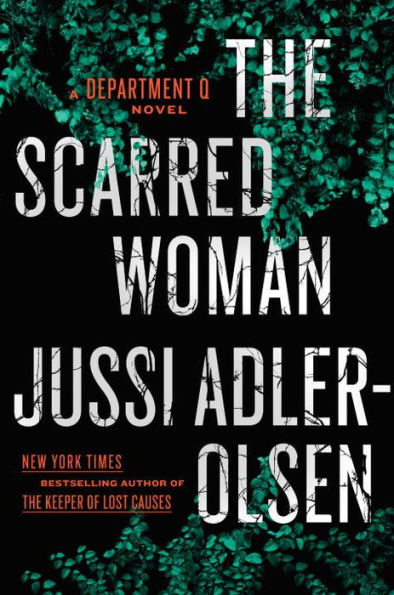
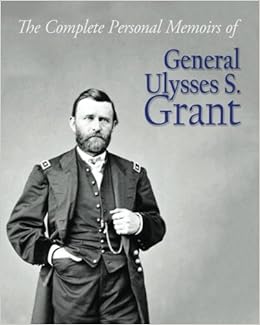
GRANT by Ron Chernow

Image result for photo of U.S. Grant

Recently Ron Chernow was asked on the CBS morning news program if his new biography, GRANT could become a Broadway musical as his previous book HAMILTON had.  His response was clearly no, but he left open the possibility of a movie.  Whatever the case, Chernow has written the most comprehensive biography of the man credited with changing the course of, and winning the Civil War, then went on to support Lincoln’s reconstruction program, and assumed the presidency.  The book is quite long, to the point that Chernow dedicated the book to his readers, as he stated in a New York Times interview he himself would have difficulty dealing with the length of his own books.  As far as a film is concerned it is easy to contemplate such a complex life story that experienced numerous successes and failures.  Before the Civil War his private life was riddled with failed businesses and depression.  He had to deal with a father-in-law who thought very little of him, and a father who was rather intrusive.  Troubled by alcoholism he would lead the North to victory over the Confederacy, was a proponent of civil rights for freed slaves, and guided the United States through the perilous years following the Civil War.

Every high school student is taught that there was a great deal of corruption linked to the Grant administration, but in truth noting ever involved him on a personal level.  The historiography dealing with Grant’s life and career beginning with William A. Dunning at the turn of the twentieth century has been rather negative, but Chernow’s effort has continued the new strain of thought reflected in recent biographies by Ronald C. White and Jean Edward Smith who argue that Grant was a great military leader and a better president than he has been given credit for.

Image result for photo of U.S. Grant

Chernow’s portrait of GRANT is all consuming beginning with a boyhood that witnesses a grandstanding father and a stubbornly private son.  Along with his over-bearing father, Grant had to cope with a painfully retiring mother resulting in a young man who kept a world of buried feelings locked inside, a trait he would carry his entire life.  Chernow follows his subject through his formative years and West Point until his marriage to Julia Dent, a southern woman who lived on a plantation.  Since the Grants were rabid abolitionists it created tremendous pressure on the young couple, particularly Ulysses who could never measure up in terms of wealth to his father-in-law.

Chernow is a wonderful writer of narrative history, but he also centers on the motivations and consequences of people’s actions.  Employing his analytical skills to Grant’s intellectual development in dealing with American expansion during and following the Mexican War, and the problem of Texas we witness a man who realizes early on that the war incited by President James K. Polk could only exacerbate domestic tension by adding territories that the south would try and turn into slave states.  Grant’s pre-presidential views are in a constant state of evolution; whether dealing with military strategy during the Civil War, his dealings with Union generals such as George McClellan, William T. Sherman, Philip Sheridan, and Henry Halleck; how to deal with the problem of “contraband” slaves and whether they should be employed by Union armies against the south; what approach to take against Robert E. Lee; and his developing relationship with Abraham Lincoln.

Image result for picture of julia dent grant

Chernow’s Grant has a facile mind who was able to control his emotions and weigh his decisions.  Grant realized that his reputation was one that stressed his problem with alcohol and the fact that casualties under his command were very high.  Chernow spends a great deal of time dealing with the alcohol issue and concludes that Grant was the type of drunk who could control when to start and stop drinking.  The evidence presented reflects the belief that Grant never drank during periods involving the preparation of and actual combat.  The stress of battle needed an outlet, and when Julia was not around or his Chief of Staff John Rawlins was not present to manage him, Grant did resort to alcohol.  As far as casualties were concerned, Grant unlike McClellan and George C. Meade did not pursue an offensive approach to war.   Once Grant experienced success in the western theater, particularly at Vicksburg, his relationship with Lincoln was solidified as the president finally found a general who wanted to destroy the Confederate army, and not just concentrate on acquiring territory.  Another major point that Chernow develops is that historians tend to concentrate on the Army of the Potomac and events in the east, with Grant’s life story the west comes into focus particularly its strategic value during the Civil War.

Image result for photo of lincoln at gettysburg

(Lincoln’s Gettysburg Address)

Grant’s relationship with Lincoln was the key to victory.  The strength of their bond can be seen with all the “presidential talk” surrounding Grant as the war wound down as he assured Lincoln he had no presidential aspirations.  In dealing with the social issues that emerged with the Emancipation Proclamation we witness the further evolution of Grant’s thinking as he proposed what would come to be known as the Freedman’s Bureau to take care of freed slaves.  Lincoln’s assassination hit Grant very hard, as he lost his partner in trying to bring the south back into the union without the former Confederates loosing total face.  Once Lincoln was gone, Grant as General in Chief had to deal with Andrew Johnson, an avowed racist who went to war with radical Republicans in Congress.  By wars end the “erstwhile goods clerk” from Galena, Illinois was in command of over one million men which could compete with any army in the world.  For Grant that army would be reduced appreciatively, but was to be used to control southern rejectionists who committed numerous atrocities against freed blacks, and wanted to reinstitute the status quo ante bellum.

Image result for photos of william tecumseh sherman

(General William T. Sherman)

Chernow provides a historically accurate portrayal of the Reconstruction period.  Beginning with the presidency of Andrew Johnson the author dwells on the former Tennessee governor’s blatant racism and goal of restoring Confederate ideals as soon as possible.  Grant, then General in Chief and temporary Secretary of War with Johnson’s suspension of Edwin M. Stanton challenged the new president on issues ranging from the Freedman’s Bureau, constitutional amendments, racist inspired riots and murder in Memphis and New Orleans, and the impeachment process.  It is clear from Chernow’s analysis that Grant became the foremost protector of persecuted blacks in the south as his disgust with Johnson continually increased.  With this process his world view moved closer to Radical Republicans.  Grant believed that Johnson “had subverted the will of Congress in a way that bordered on treason.”(589)  Grant grew very uncomfortable as he found himself in the middle between Johnson and the Radical Republicans over the interpretation of the Tenure of Office Act.  For Grant military rule in the south should be terminated as soon as possible, but also believed that withdrawal should take place without sacrificing the welfare of blacks.

Image result for photo of general philip sheridan

(General Philip Sheridan)

It came as no surprise that Grant was easily elected to the presidency, a job he never really sought, but once in office seemed to enjoy.  The problem was that Grant tended to view rich businessmen through rose colored glasses leading to weak and corrupt appointees.  Grant, who during the war had a knack for choosing superb talent proved to have lost that skill as president.  Men like Jay Gould and John Fiske tried to corner the gold market; Orville Babcock spied for whisky distillers within the administration along with General John McDonald, the Supervisor for Internal Revenue in Arkansas and Missouri; Secretary of War William M. Belknap made money selling trading posts that provided goods to Native-Americans; and of course the Credit Mobilier – all personified the looser morals of the Gilded Age which greatly detracted from his presidency.  Grant was a victim of the disease of patronage as he repeatedly handed out positions to family and friends.  Many of his problems resulted from the lack of a true civil service system.

In his defense, Chernow argues that Grant was the first president to oversee a continental economy which led to the rise of big business, particularly the expansion of railroads that required government assistance providing fresh opportunities for graft.  “With the federal government bound up in new moneymaking activities, there arose a gigantic grab for filthy lucre that affected statehouses as well and saturated the political system with corruption.”(645)  Grant had to cope with a strong Congress whose powers had been amplified as the death of Lincoln and the actions of Johnson greatly reduced the power of the Executive branch.  Overall, Grant’s problem was that after the Civil War the Republican Party evolved from a party of abolitionism to a more business oriented one.

Image result for photo of general john rawlins civil war

(General John A. Rawlins)

Chernow stresses the role of John Rawlins in helping Grant become the hero of the Civil War, but with his death a vacuum was created that no one could fill.  Without Rawlins to help Grant control his drinking problems, act as a sounding board for decisions, and choosing the proper person for a position, it became easier for people to take advantage of Grant.  The result was once Rawlins died, Grant’s presidency became a victim of “crafty, cynical politicians for whom the credulous Grant was no match.”  Later in life Grant would admit his character flaws and blamed himself for choosing and working with individuals that helped contribute to the negative view of his presidency.

Despite the corruption that hovered around the Grant presidency there are areas to admire.  During his administration Grant faced a clandestine Civil War in the south.  Remnants of the Confederacy morphed into the Klu Klux Klan and other racist groups that reigned murder and violence against blacks or any whites who supported them.  Grant used the newly created Department of Justice and the military to prosecute offenders and safeguard possible victims.  Though he could not totally eradicate the violence and hatred by 1872 he had destroyed the Klan in the south.  However, by his second administration acts of violence against blacks in Louisiana, South Carolina, and Mississippi increased culminating in the Colfax massacre and others.  When Grant sought to use federal troops to protect black voting rights he ran into northern opposition that had grown tired of Reconstruction.

Another area that Grant should be commended for was the negotiations resulting in the Treaty of Washington that settled the “Alabama claims” issue with the British dating back to the Civil War.   As a result Anglo-American cooperation would replace years of controversy and ill-feelings.  Further, it allowed for the influx of British capital which greatly enhanced American industrial development.

Image result for photo of U S Grant in old age

(Grant working on his memoirs right before he died)

It is interesting to note the current manipulation of the “Civil War Monuments Issue” by politicians in light of Chernow’s analysis.  The author explains Grant’s resentments against those who argued that he was only successful because of superior resources and men as opposed to the strategy he employed in defeating Lee’s army.  Further, it vexed him that after the Civil War “the North denigrated its generals while southern generals were idealized.”  Grant remarked that Southern generals were [seen as] models of chivalry and valor—our generals were venal, incompetent and course…Everything our opponents did was perfect.  Lee was a demigod, Jackson was a demigod, while our generals were brutal butchers.” (516)  Grant is probably turning over in his grave today as statues of the treasonous Lee are used as a vehicle to exploit the feelings of many individuals who still refuse to honor the 13th,14th,  and 15th  amendments to the Constitution.

Chernow’s work is masterful, well written, and the epitome of how history should be presented.  Chernow does not miss a beat; from Grant’s military career, family life, battle to overcome alcoholism, to the trust in mankind that led to so many financial losses.  If you have the time, GRANT is a major commitment, but if you choose to accept the challenge of engaging a book that weighs between two and three pounds you will not be disappointed.

Image result for photo of U.S. Grant

THE PRAGUE SONATA by Bradford Morrow

Image result for historic photos of prague

(Prague, Czech Republic)

At the end of World War I Jaromir Laska is killed on the battlefield leaving an orphaned daughter with his most prized possession, an old music manuscript.  The daughter, Otylie was packed off to live with an aunt in Prague where she remained until 1939 when the Nazis seized control of her country.  So begins Bradford Morrow’s brilliant new novel, THE PRAGUE SONATA where the music manuscript became the centerpiece of Otylie’s memory of her father.  Its origin and composer would become an obsession for Otylie and her husband Jakub who owned a small shop that was a mishmash of Jewish and Czech culture.  Otylie feared that the manuscript/sonata would be lost to the Nazis, and to save it she would disperse it in three parts; one to herself, one to her husband Jakub, and the final piece to their friend Irena Dorfman. The story line will begin at what appears to be an academic search, but it evolves into a mystery that will grip anyone with a sense of hope.

Morrow presents a remarkable story within a larger narrative.  The key character is Meta Taverner, a musicologist who lives in New York who years later comes into contact with Irena Dorfman.  Meta was quickly taken by Dorfman who was ninety years old when they met.  Dorfman tells Meta the story of the missing sonata pieces and gains a promise from Meta that she will try to track down the pieces and reunite them.  Meta’s search and life form the core of the novel, but the characters past and present are also of extreme importance.  For Meta the sonata is an authentic 18th century work, hauntingly beautiful, and the work of a master composer, but the question is which composer.

Image result for historic photos of prague

(The north-western, Old Town side of Na Příkopě Street)

Morrow exposes the reader to a panorama of Czech history; from the end of World War I, the Nazi occupation, the Allied liberation, the arrival of the Soviet Union and its repression, to the Velvet Revolution of 1989, and finally freedom.  Each character is placed in the proper course of events and their reactions become part of the accurate historical flow of the novel.  Morrow has an excellent grasp of history and the scenes he creates conform nicely to the historical record, except for one minor error in dealing with the assassination of Reinhard Heydrich.

The most important characters include Jakub Batos, Otylie’s husband who joins the Czech resistance against the Nazis; Daniel Hajek who would make Otylie’s life whole again, Paul Mandelbaum, Meta’s mentor at Columbia University; a pair of Czech musicologists, Professors Petr Wittmann and Karel Kohut who appear to have their own agendas that are ego driven; Tomas Lang whose sister Johana had part of the sonata in her possession; Johana herself who seemed to despise everyone; Gerrit Mills, a newspaper stringer who develops a personal interest into Meta’s work and person; and a number of others.  All characters are well developed and have their own specific identities and needs, particularly Meta who appears to be going through a severe identity crisis at the time that Irena Dorfman provides the story of the manuscript.  For Meta, who was training to be a concert pianist before an accident severely injured her right hand, Irena’s request provides her with an opportunity to provide meaning to her new career as a musicologist, as well as solving a very important question that deals with music, and the legacy of a family that was broken apart by war.

Image result for historic photos of prague

(End of Charles Bridge leading to Old Town Prague)

Morrow follows Meta’s quest in detail and integrates a great deal of Czech, and in general European music history and their composers, throughout the novel.  Further, Morrow takes the reader on a wonderful tour of Prague featuring local flavor, neighborhoods, and succeeds very nicely in examining human memory, music, and need.   If you are familiar with Lauren Belfer’s AND AFTER THE FIRE: A NOVEL Morrow’s work will be just as satisfying, but on another level it is more of a humanely epic tale.

Image result for historic photos of prague

(Prague, Czech Republic)

STANTON: LINCOLN’S WAR SECRETARY by Walter Stahr

Image result for photo of Stanton and Lincoln

(Edwin M. Stanton)

When one thinks of impactful figures in American history few would come up with the name, Edwin M. Stanton.  However, without Stanton the North would have had a much more difficult time defeating the South in the Civil War, the night Abraham Lincoln was assassinated someone else would have had to step forward to round up the conspirators and capture John Wilkes Booth and Jefferson Davis, and perhaps Andrew Johnson might not have been brought before the Senate for an impeachment trial.  Lincoln’s Secretary of War is the subject of Walter Stahr’s latest biography, STANTON: LINCOLN’S WAR SECRETARY, a smartly written, intimate, and incisive portrait of Stanton’s role in the Civil War and American history in general.  As he did in his previous biographies of John Jay and William Seward, Stahr has mined the available sources reaffirming many of the standard opinions of his subject, but also evaluating new sources and developing new perspectives.

Born in Steubenville, Ohio in 1814 Stanton was raised near the dividing line between the slave and non-slave states of Virginia and Ohio in a period when abolitionism was beginning to take root.  Stanton would attend Kenyon College, but never graduate.  He went on to study law under the auspices of a Steubenville attorney, Daniel Collier and began his practice of law in the spring of 1837.  Soon Judge Benjamin Tappan, a staunch Democrat would become his law partner and mentor.  At this point in time Stanton grew increasingly interested in politics in large part due to the depression that would last over five years.  Stanton’s involvement in Democratic Party politics increased and he was soon elected Prosecutor for Harrison County, Ohio.  Judge Tappan would soon be appointed to the US Senate and Stanton was well on his way as a partisan Democrat developing a “no holds barred” approach to politics.

Image result for photo of Stanton and Lincoln

(Stanton and Lincoln’s cabinet)

Stahr has full command of primary materials as he repeatedly points out what documents pertaining to Stanton’s views were available and those that were missing.  This allows him to compare diverse viewpoints and sources to determine what Stanton actually wrote, said, or acted upon during his law and political career.  Stahr attacks the many myths associated with Stanton and he does his best to straighten out discrepancies in the historical record.  In Stahr’s study we follow the evolution of Stanton from an important member of the Ohio Democratic Party to becoming the cornerstone of Lincoln’s Republican administration.  During this later process, in particular, we witness the liberalization of Stanton’s views dealing with race.

Stanton’s personal life was wrought with tragedy leading to a strong sense of religiosity.  As a boy he would lose his father, a brother would commit suicide, and a sister would pass at a young age.  Further, in March, 1844 he would lose his first wife to tuberculosis and during the war years he would lose his infant son James.  These experiences made him appear decidedly older than he actually was.

Stahr correctly stresses that though he was known for his service to a Republican president, Stanton was a staunch Democrat who had supported Martin Van Buren as President, and later James K. Polk’s annexationist policies.  Though he had a very low opinion of James Buchanan whose presidency directly preceded the Civil War, he did not think that highly of Abraham Lincoln either during the pre-war period.

An area that Stahr should have developed much further were Stanton’s views on race and abolitionism.  The author seems to skirt these issues and based on his later beliefs an earlier intellectual roadmap for Stanton’s thinking is warranted.  In Stahr’s defense,  he does give the appropriate amount of attention to Stanton’s views and handling of the use of blacks as soldiers in the union army and what prerequisites it demanded and how it would be implemented, especially the Freedman’s Bureau.  Further, the care and treatment of former slaves is examined and the reader gains a more complete picture of where Stanton stood on these issues especially constitutional amendments.   Stahr does spend an inordinate amount of time detailing Stanton’s legal career, seemingly case by case ranging from the Pennsylvania v. Wheeling and Belmont Bridge case arguing that the bridge blocked commerce on the Ohio River designated for Pittsburgh, to land cases in California, patent claims, labor riots, medical body-snatching, death from duels, and electoral chicanery.  Stanton would argue many cases before the Supreme Court, and many thought he was the leading lawyer of the period.

Image result for photo of Stanton and Lincoln

(Lincoln’s signing of the Emancipation Proclamation, January, 1863)

One of the strengths of Stahr’s effort are his descriptions of American society, culture, and geography in areas in which Stanton lived and influenced.  Stahr provides numerous insights particularly concerning California in the 1850s where he argued numerous land claims, and Washington DC before, during, and after the Civil War.

Stahr stresses how Stanton seems to always claim the moral higher ground no matter the situation.  It is difficult to sustain that approach by supporting the weak President Buchanan and the corruption that surrounded him.  Stanton became a member of the Buchanan administration because of his legal work and with a few months remaining in office Buchannan appointed Stanton Attorney-General.  The most important issue that was at hand was whether to supply Fort Sumter after South Carolina seceded.  Buchanan’s cabinet was split by secessionists and those loyal to the union, and Stanton did his best to stiffen Buchanan’s back and get him to support resupply.  Once out of office Stanton’s view of cabinet meetings stressed positions that Republicans would support as a means of strengthening his position with Lincoln.  Stahr is on firm ground as he argues that Stanton’s view of Lincoln at this time was not much better than Buchanan.  Stahr quotes Stanton’s letter to Buchanan after Lincoln assumes office, “the imbecility of this administration.… [is]…. a national disgrace never to be forgotten….as the result of Lincoln’s ‘running the machine’ for five months.”  Stanton’s bonifides are also to be questioned as he was close with General George McClellan and seemed to share the same views.  It appeared too many inside and outside the press that they were “confidential friends.”  Simon Cameron as Secretary of War advocated arming slaves which McClellan abhorred.  With Congress upset over the course of the war by January, 1862 it should not have come as a surprise that Cameron would be fired.  What was surprising is that Lincoln chose Stanton as his replacement.

Image result for photo of Stanton and Lincoln

Stahr is accurate in his assessment that Lincoln chose Stanton because of his organizational ability, his workaholic approach, and his ability to get things done.  Critics, particularly the northern democratic press pointed to Stanton’s extensive use of military commissions that tried civilians for military offenses, suspension of habeas corpus, and cutting telegraph privileges to opposing newspapers.  These criticisms of Stanton must be weighed against the crucible of war since the Militia and Conscription Acts did deprive numerous individuals’ due process and civil rights.  But one caveat to Stanton’s record on civil rights were the virulent attacks on the Secretary of War which a good part of the time were unmerciful.

Stahr does a workmanlike job reporting on the McClellan-Lincoln/Stanton imbroglio.  McClellan’s ego is explored in detail and the author makes excellent use of the available correspondence.  Stahr performs equally as well in detailing Stanton’s relationship with other generals including; Grant, Sherman, Hooker, Halleck, Meade, and Burnside.  The Stanton-Lincoln relationship is analyzed and the author like many historians before him concludes that personalities and demeanors may have been opposite in many cases, but as A.E. Johnson, Stanton’s private secretary wrote “they supplemented each other’s nature, and they fully recognized the fact that they were necessary to each other.”

Image result for photo of Stanton and Lincoln

Stahr does a commendable job revisiting the Andrew Johnson-Edwin Stanton relationship and the deterioration that led to Johnson’s trial in the Senate.  As with other examples in the book this aspect is well documented and the “large” personalities and issues involved are careful dissected.  The result is that Stahr has captured the essence of Stanton as a man who could be deceitful, arbitrary, capricious, as well as vindictive.  However, he was a superb Secretary of War who galvanized Union forces as well as President Lincoln with his energy, organizational skills, ability to learn and adapt, and overwhelming will to defeat the south.  Stahr characterizes Stanton as the “Implementer of Emancipation,” as opposed to the “Great Emancipator,” that was Lincoln.  But for all intents and purposes Stanton must be seen as the equal to Lincoln and Grant in earning accolades for their work during the Civil War.

Related image

(Edwin M. Stanton)

CALL FOR THE DEAD by John Le Carre

Image result for photo of john le carre

(the author)

Listening to David Cornwell, a.k.a. John Le Carre on 60 Minutes a few weeks ago was fascinating.  It raised questions about his life and how much of his own experiences in the British intelligence community is replicated in his novels.  From the interview, like the good spy, it was difficult to ascertain what Cornwell’s life was and what was fiction.  Whatever the truth, it peaked my interest and after having avoided Le Carre’s work for decades I decided to take the plunge with his first novel, CALL FOR THE DEAD.

The story begins with a description of George Smiley by his ex-wife and a few others, a character who is at the center of many of Le Carre’s books.  He is described as boring, short, fat, and possessing a quiet disposition, and a person who spent a great deal of money on “really bad clothes, which hung about that squat frame like skin on a shrunken toad.”  The perfect non-descript person who could excel as a spy.

Smiley appears unconcerned about his divorce, and as an intelligence officer, according to the narrator, his job provided him access to the mystery of human behavior and an outlet for his strong deductive reasoning abilities.  Le Carre provides a great deal of background concerning Smiley’s life that provides much insight into his behavior and thought processes throughout the novel.  Before World War II Smiley had been a weak student at Oxford, but was recruited anyway by the British intelligence service, which was attractive to Smiley who liked to work alone.

Image result for photo of john le carre

Smiley began his career at a German university recommending certain students for the “secret service.”  After World War II he became the Minister’s Advisor on Intelligence at the Cambridge Circus.  A number of years later the issue at hand was one, Samuel Arthur Fennan of the Foreign Office who committed suicide shortly after being interviewed by Smiley.  It appears that Fennan may have been denounced as a member of the Communist Party, which he had been in the 1930s when the world seem to be unraveling.  The central focus of the novel is the investigation into Fennan’s death.  A number of important characters emerge that include Sparrow Inspector Mendel, who Smiley works with on the case; Matson, a career bureaucrat at the “Circus,” a man Smiley despises; Elsa Fennan, the widow; and Dieter Frey, who may be an East German spy master.  After a number of killings and an attempt on Smiley’s life the novel becomes more interesting as the plot comes into clearer focus; was Fennan a spy, was Mrs. Fennan a spy, and if they were, what damage did their work do to British national security?

Le Carre writes in a sarcastic literary style, if one such style actually exists.  His description of the mundane is entertaining as his view of mankind.  Le Carre has created an amoral universe for Smiley to function in and his philosophy of life seems to meander throughout the novel.  I am glad to finally discover Le Carre and I hope to continue to do so.

Image result for photo of john le carre

THE PRIDE OF THE YANKEES: LOU GEHRIG , GARY COOPER AND THE MAKING OF A CLASSIC by Richard Sandomir

Image result for photos of lou gehrig

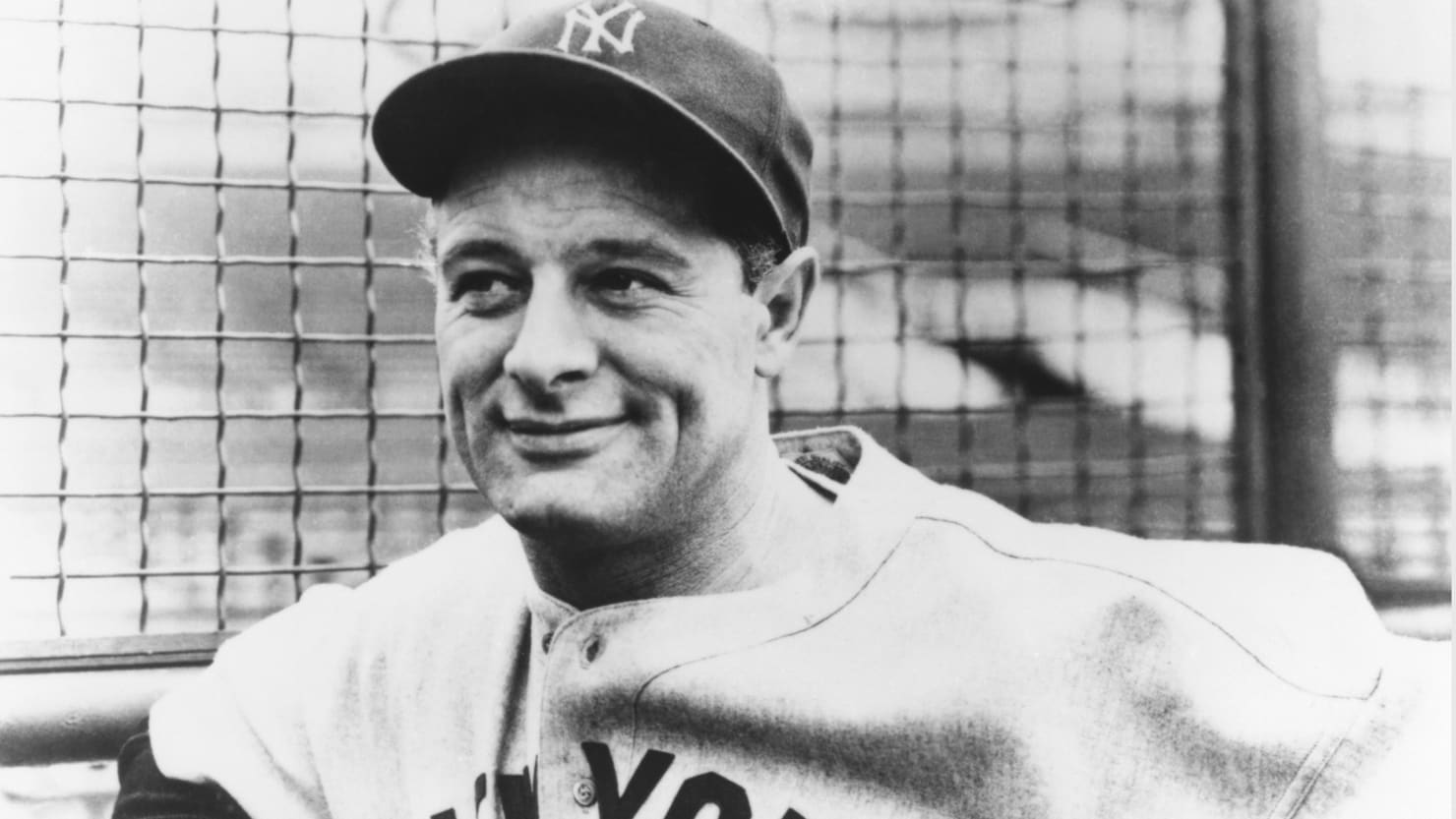
(Lou Gehrig)

After reading Richard Sandomir’s THE PRIDE OF THE YANKEES: LOU GEHRIG, GARY COOPER AND THE MAKING OF A CLASSIC I cannot decide whether I have read a sports book, or a critique of how the film “Pride of the Yankees” was created and finalized.  I guess Sandomir has elements of both, but I wish he would have chosen one path rather than moving back and forth between the two approaches.  The book itself is informative and presents a number of surprising and interesting details of how Samuel Goldwyn, Eleanor Gehrig and others went about the conception of the script, how it was be transferred to the screen, and the diverse group of people who were involved.

Image result for photos of lou gehrig

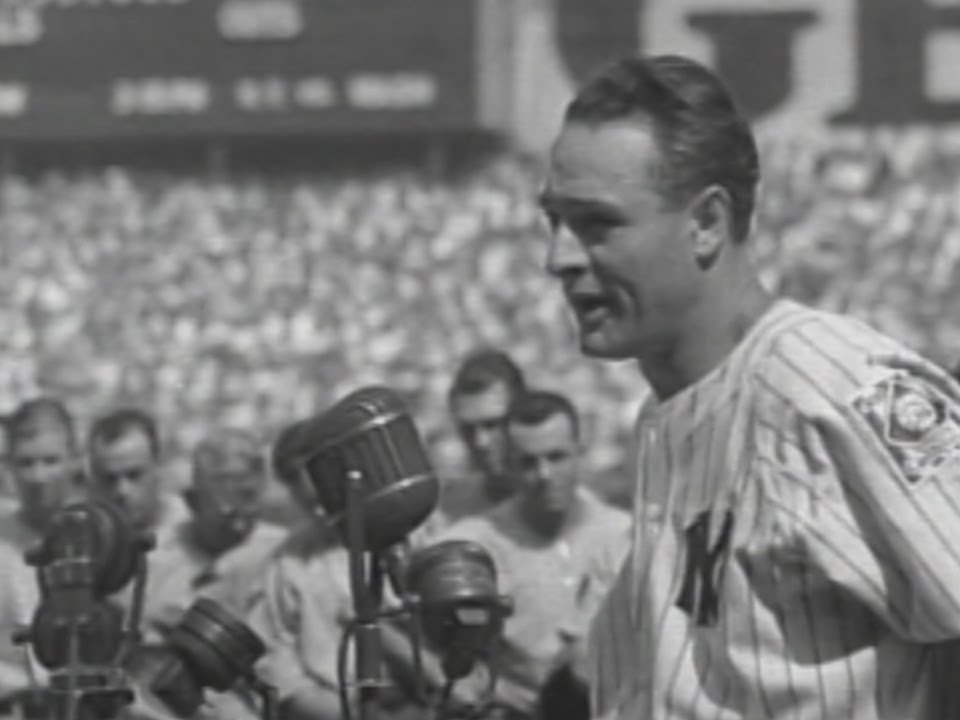
(Gary Cooper in the film, “Pride of the Yankees” making Gehrig’s farewell speech)

Image result for photos of lou gehrig

(Lou Gehrig making his Farewell Speech at Yankee Stadium on July 4, 1939)

Sandomir provides background on all the major characters.  We witness the courtship
and marriage of Lou and Eleanor Gehrig and the stresses in their marriage.  The main problem was that Lou was a “mama’s boy” and he had difficulty separating from his mother.  Eleanor describes her marriage as a triangle between her, her husband, and her mother-in-law.  This difficulty would continue after Lou’s death as his mother sued to contest Lou’s will.  A great deal of biographical information is presented dealing with Gary Cooper and Theresa Wright the stars of the movie which are interesting and a number of career insights are brought forward.  Samuel Goldwyn whose studio produced the film is presented as a man who cared mostly about profits from his film.  He did have a soft spot for Gehrig, particularly after Gehrig’s July 4, 1939, “I am the luckiest man in the world” speech given at Yankee Stadium shortly before he died of Amyotrophic Lateral Sclerosis (ALS).

For Goldwyn the story revolved around patriotism and capturing a shy, decent, selfless, and sincere individual who possessed the character traits of what the American male stood for.  The year 1942 when the film was released is very important.  World War II was not going well, and Goldwyn saw the film as a means of entertainment, profit, but also providing American society an uplifting experience.  The story about a man who was struck down in the prime of his life by an insidious disease is heartwarming.  Gehrig’s own response reflects a brave individual who could be held up as a role model for the World War II generation.  What makes Sandomir’s new book, and Goldwyn’s film so effective is that they are able to translate Gehrig’s life through the prism of film and how that film has preserved his legendary career and his personal integrity for seventy-five years.

Image result for photos of lou gehrig

(Lou and Eleanor Gehrig)

The chapter on teaching Gary Cooper to become a “passable” baseball player was one of the most interesting in the book.  Sandomir does a fine job introducing former major leaguers like Lefty O’Doul and Babe Herman, baseball stars in their own right, and how they went about teaching Cooper how to appear realistic as a player on film.  The author provides surprising detail on how this was accomplished.  Especially interesting in the discussion on how the right handed Cooper could play the left handed Gehrig.  The analysis of how film techniques i.e., camera reversals-Cooper would run to third, but on film he ran to first, or uniform names and numbers were reversed were especially interesting.

Sandomir is correct in arguing that the film itself has created a conundrum in that it is difficult to ascertain what is real in terms of Gehrig’s life story and what is a Hollywood creation.  It is fascinating that Goldwyn, Cooper, and others knew very little, if anything about baseball and yet they created a classic film on the sport.  For Goldwyn baseball was tangential to how he wanted the film presented.  The film was to be about Gehrig and Goldwyn “craved commercial success, not fidelity to a sport he had no affinity for.”  Goldwyn’s main problem was one of authenticity-how would the film convince its audience that what they were viewing was historical accurate.  Goldwyn’s staff employs artistic license repeatedly raising questions as to how effective the film was in replicating the truth.

Related image

(Gehrig and Babe Ruth following his Farewell Speech)

A major issue is whether Sandomir delves into issues he uncovers as an investigative reporter or are they dealt with in a superficial manner, for example, Eleanor’s relationship with Lou’s mother; the Gehrig-Ruth relationship; the Gehrig marriage; and the background for each character in the film.  The feeling emerges that this is more of a sports book about Gehrig’s life and how a film was made to glorify it, rather than a study of filmmaking that lacked the cultural and social components of the period.  Sandomir is correct in arguing that in the end “the film left people to accept the truths that were created, which did not stick too many of the facts.”

The book is a comprehensive study of Gehrig’s life on film and the problems that arose from that undertaking.  However, at times the book lacks flow as it becomes somewhat tedious as the author seems to over analyze each aspect of the film, i.e.; chapters dealing with Gehrig’s Farewell Speech, and training Gary Cooper to replicate Gehrig.  If you are interested in this topic I would suggest viewing the film before reading Sandomir’s narrative.  It would create context for the reader and might produce a more positive result once the book is digested.

Image result for photos of lou gehrig

(Lou Gehrig)

FILM AND GENOCIDE: READINGS

FILM AND GENOCIDE:

Armenian Genocide:

Akcam, Tanker  A SHAMEFUL ACT: THE ARMENIAN GENOCIDE AND THE QUESTION
OF TURKISH RESPONSIBILITY.

Balakian, Gregoris  ARMENIAN GOLOTHA: A MEMOIR OF THE ARENIAN GENOCIDE,

1915-1918

Balakian, Peter  THE BURNING TIGRIS: THE ARMENIAN GENOCIDE AND AMERICA’S
RESPONSE.

Bloxham, Donald  THE GREAT GAME OF GENOCIDE

de Bellaigue, Christopher  REBEL LAND: UNRAVELING THE RIDDLE OF HISTORY IN A
TURKISH TOWN.

Kiernan, Ben  BLOOD AND SOIL: A WORLD HISTORY OF GENOCIDE AND EXTERMINATION
FROM SPARTA TO DARFUR.

Lowy, Guenther  THE ARMENIAN MASSACRE IN THE OTTOMAN EMPIRE:  A DISPUTED
GENOCIDE.

Molson, Robert F.  REVOLUTION AND GENOCIDE: ON THE ORIGINS OF THE ARMENIAN
GEOCIDE AND THE HOLOAUST.

Power, Samantha  A PROBLEM FROM HELL: AMERICA IN THE AGE OF GENOCIDE.

The Holocaust:

Anderson, Alan, Ed. THE DIARY OF DAWID SIERAKOWIAK: FIVE NOTEBOOKS FROM THE
LODZ GHETTO.

…………………………….  LODZ GHETTO: INSIDE A COMMUNITY UNDER SIEGE.

Burleigh, Michael THE THIRD REICH: A NEW HISTORY.

Cesarean, David  FINAL SOLUTION: THE FATE OF THE JEWS 1933-1949.

Crowe, David M. OSKAR SCHINDLER

Dawidowicz, Lucy  THE WAR AGAINST THE JEWS: 1933-1945.

Dobroszycki, Lucian  THE CHRONICLE OF THE LOD GHETTO 1941-1944.

Evans, Richard  THE THIRD REICH AT WAR

Friedlander, Saul  NAZI GERMANY AND THE JEWS 1939-1945, THE YEARS OF EXTERMINATION.

Hackett, David A.  THE BUCHENWALD REPORT.

Hilberg, Raul, Ed. THE DIARY OF ADAM CERNIAKOW: PRELUDE TO DOOM.

Ihrig, Stefan  ATATURK IN THE NAZI IAGINATION.

Kath, Abraham Ed. THE WARSAW DIARY OF CHAIM A. KAPLAN.

Kielar, Westlaw  ANUS MUNDI 1500 DAYS IN AUSCHWITZ AND BIRKENAU.

Lanzmann, Claude  SHOAH: AN ORAL HISTORY OF THE HOLOCAUST.

Mark, Ben  UPRISING IN THE WARSAW GHETTO.

Rotem, Simha  MEMOIRS OF A WARSAW GHETTO FIGHTER.

Sloan, Jacob Ed.  NOTES FROM THE WARSAW GHETTO: THE JOURNAL OF EMANUEL
RINGELBLUM.

Tory, Avraham  SURVIVING THE HOLOCAUST: THE KOVNO GHETTO DIARY.

Wachsmann, Nicokolaus  KL: A HISTORY OF THE NAZI CONCENTRTION CAMPS.

Wentz, Eric D.  A CENTURY OF GENOCIDE: UTOPIAS OF RACE AND NATION.

The Killing Fields:

Brinkley, Joel  CAMBODIA’S CURSE: THE HISTORY OF A TROUBLED LAND.

Karnow, Stanley  VIETNAM: A HISTORY.

Kiernan, Ben  THE POL POT REGIME: RACE, POWER AND GENOCIDE IN CAMBODIA UNDER THE KHMER ROUGE, 1975-1979

Logevall, Fredrik  EMBERS OF WAR: THE FALL OF AN EMPIRE AND THE MAKINGS OF
AMERICA’S VIETNAM.

Ngor, Haing  SURVIVAL IN THE KILLING FIELDS.

Pran, Dith  CHILDREN OF CAMBODIA’S KILLING FIELDS.

Schanberg, Sydney H. THE DEATH AND LIFE OF DITH PRAN.

Shawcross, William  SIDESHOW: KISSINGER, NIXON, AND THE DESTRUCTION OF
CAMBODIA.

Short, Philip  POL POT: ANATOMY OF A NIGHTMARE.

Ung, Loung  FIRST THEY KILLED MY FATHER: A DAUGHTER OF CAMBODIA REMEMBERS.

Rwanda:

Dallaire, Romeo  SHAKE HANDS WITH THE DEVIL: THE FAILURE OF HUMANITY IN RWANDA.

Editor, Gail THE RWANDAN GENOCIDE.

Gourevitch, Philip  WE WISH TO INFORM YOU THAT TOMORROW WE WILL BE KILLED WITH OUR FAMILIES: STORIES FROM RWANDA.

Hatzfeld, Joseph  MACHETE SEASON: THE KILLERS IN RWANDA SPEAK.

Kinzer, Stephen  A THOUSAND HILLS: RWANDA’S REBIRTH AND THE MAN WHO DREAMED IT.

Prunier, Gerard  AFRICA’S WORLD WAR: THE CONGO, THE RWANDAN GENOCIDE AND THE MAKING OF A CONTINENTAL CATASTROPHE.

FILM AND GENOCIDE: SUGGESTED READINGS

FILM AND GENOCIDE: Suggested Readings

Armenian Genocide:

Akcam, Tanker  A SHAMEFUL ACT: THE ARMENIAN GENOCIDE AND THE QUSTION
OF TURKISH RESPONSIBILITY.

Balakian, Gregoris  ARMENIAN GOLOTHA: A MEMOIR OF THE ARENIAN GENOCIDE,

1915-1918

Balakian, Peter  THE BURNING TIGRIS: THE ARMENIAN GENOCIDE AND AMERICA’S
RESPONSE.

Bloxham, Donald  THE GREAT GAME OF GENOCIDE

de Bellaigue, Christopher  REBEL LAND: UNRAVELING THE RIDDLE OF HISTORY IN A
TURKISH TOWN.

Kiernan, Ben  BLOOD AND SOIL: A WORLD HISTORY OF GENOCIDE AND EXTERMINATION
FROM SPARTA TO DARFUR.

Lowy, Guenther  THE ARMENIAN MASSACRE IN THE OTTOMAN EMPIRE:  A DISPUTED
GENOCIDE.

Molson, Robert F.  REVOLUTION AND GENOCIDE: ON THE ORIGINS OF THE ARMENIAN
GEOCIDE AND THE HOLOAUST.

Power, Samantha  A PROBLEM FROM HELL: AMERICA IN THE AGE OF GENOCIDE.

The Holocaust:

Anderson, Alan, Ed. THE DIARY OF DAWID SIERAKOWIAK: FIVE NOTEBOOKS FROM THE
LODZ GHETTO.

…………………………….  LODZ GHETTO: INSIDE A COMMUNITY UNDER SIEGE.

Burleigh, Michael THE THIRD REICH: A NEW HISTORY.

Cesarean, David  FINAL SOLUTION: THE FATE OF THE JEWS 1933-1949.

Crowe, David M. OSKAR SCHINDLER

Dawidowicz, Lucy  THE WAR AGAINST THE JEWS: 1933-1945.

Dobroszycki, Lucian  THE CHRONICLE OF THE LOD GHETTO 1941-1944.

Evans, Richard  THE THIRD REICH AT WAR

Friedlander, Saul  NAZI GERMANY AND THE JEWS 1939-1945, THE YEARS OF EXTERMINATION.

Hackett, David A.  THE BUCHENWALD REPORT.

Hilberg, Raul, Ed. THE DIARY OF ADAM CERNIAKOW: PRELUDE TO DOOM.

Ihrig, Stefan  ATATURK IN THE NAZI IAGINATION.

Kath, Abraham Ed. THE WARSAW DIARY OF CHAIM A. KAPLAN.

Kielar, Westlaw  ANUS MUNDI 1500 DAYS IN AUSCHWITZ AND BIRKENAU.

Lanzmann, Claude  SHOAH: AN ORAL HISTORY OF THE HOLOCAUST.

Mark, Ben  UPRISING IN THE WARSAW GHETTO.

Rotem, Simha  MEMOIRS OF A WARSAW GHETTO FIGHTER.

Sloan, Jacob Ed.  NOTES FROM THE WARSAW GHETTO: THE JOURNAL OF EMANUEL
RINGELBLUM.

Tory, Avraham  SURVIVING THE HOLOCAUST: THE KOVNO GHETTO DIARY.

Wachsmann, Nicokolaus  KL: A HISTORY OF THE NAZI CONCENTRTION CAMPS.

Wentz, Eric D.  A CENTURY OF GENOCIDE: UTOPIAS OF RACE AND NATION.

The Killing Fields:

Brinkley, Joel  CAMBODIA’S CURSE: THE HISTORY OF A TROUBLED LAND.

Karnow, Stanley  VIETNAM: A HISTORY.

Kiernan, Ben  THE POL POT REGIME: RACE, POWER AND GENOCIDE IN CAMBODIA UNDER THE

KHMER ROUGE, 1975-1979

Logevall, Fredrik  EMBERS OF WAR: THE FALL OF AN EMPIRE AND THE MAKINGS OF
AMERICA’S VIETNAM.

Ngor, Haing  SURVIVAL IN THE KILLING FIELDS.

Pran, Dith  CHILDREN OF CAMBODIA’S KILLING FIELDS.

Schanberg, Sydney H. THE DEATH AND LIFE OF DITH PRAN.

Shawcross, William  SIDESHOW: KISSINGER, NIXON, AND THE DESTRUCTION OF
CAMBODIA.

Short, Philip  POL POT: ANATOMY OF A NIGHTMARE.

Ung, Loung  FIRST THEY KILLED MY FATHER: A DAUGHTER OF CAMBODIA REMEMBERS.

Rwanda:

Dallaire, Romeo  SHAKE HANDS WITH THE DEVIL: THE FAILURE OF HUMANITY IN RWANDA.

Editor, Gail THE RWANDAN GENOCIDE.

Gourevitch, Philip  WE WISH TO INFORM YOU THAT TOMORROW WE WILL BE KILLED WITH OUR

FAMILIES: STORIES FROM RWANDA.

Hatzfeld, Joseph  MACHETE SEASON: THE KILLERS IN RWANDA SPEAK.

Kinzer, Stephen  A THOUSAND HILLS: RWANDA’S REBIRTH AND THE MAN WHO DREAMED IT.

Prunier, Gerard  AFRICA’S WORLD WAR: THE CONGO, THE RWANDAN GENOCIDE AND THE MAKING OF A

CONTINENTAL CATASTROPHE.

A COLUMN OF FIRE by Ken Follett

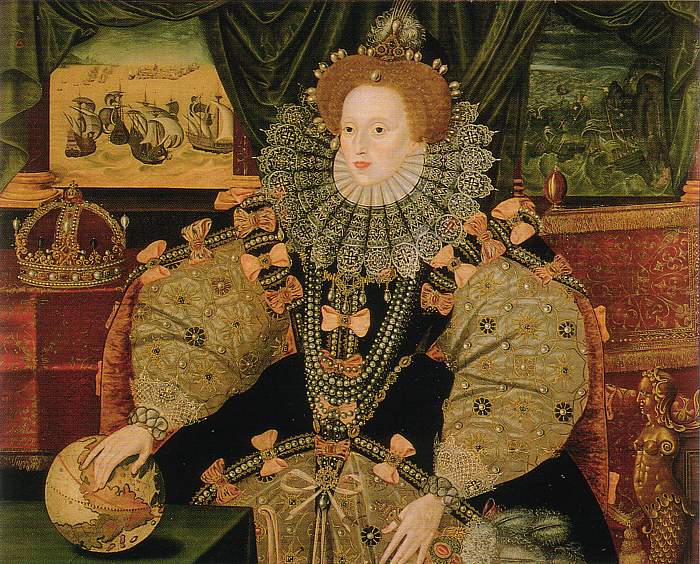
Image result for picture of queen elizabeth i

(Queen Elizabeth I of England)

At the outset I feel obligated to provide a disclaimer for the reader; Ken Follett is one of my favorite authors of historical fiction that being said his latest novel, A COLUMN OF FIRE, which follows PILLARS OF THE EARTH, and WORLD WITHOUT END in his popular Kingsbridge series is the work of a master story teller.  Set in 16th century Kingsbridge, England the novel travels through Hispaniola, Spain, France and Scotland as Follett integrates the political and religious strife of that period.  At first it seems Follett has written a love story between Ned Willard who is returning from a year abroad tending to the family business in Calais, and Margery Fitzgerald, the daughter of the mayor of Kingsbridge.  Their relationship comes to symbolize the religious divide that has overtaken England and the rest of Europe.  Margery’s father is Reginald Fitzgerald and is an ardent Catholic, while the Willards lean towards Reformation.  The conflict goes beyond religion as it carries over to a fierce commercial and political competition between the families.  Margery’s parents refuse to allow her to marry Ned, and force her into a marriage for economic and social advancement.

Image result for picture of mary queen of scots

(Mary Queen of Scots)

Follett immediately lays out the historical landscape facing England in 1558 in a conversation between Ned and his mother Alice, Reginald Fitzgerald and his son Rollo, the Earl of Swithin and Margery’s future husband Bart.  The conversation is mediated by Sir William Cecil, the future Elizabeth I’s estate manager and Secretary of State under Henry VIII.  After the death of Francis II, Cecil’s goal is to prevent violence since Mary Tudor was childless and arrange a peaceful transition for Elizabeth I.  For Catholics like Rollo and his family, Elizabeth is illegitimate and they favored Mary Queen of Scots to assume the English throne.  For the Fitzgerald family if Elizabeth I, who they strongly believed was Protestant assumed the throne she would undo all of Mary’s reforms, and they would lose a great deal of their wealth.  From this brief description it is obvious Follett has written a novel full of deception, avarice, and the will to power as conspiracies abound that seem to involve almost every character.

Follett introduces many historical characters as he seamlessly integrates them into his narrative.  Mary Stuart, Mary Queen of Scots, Catherine de Medici, Henri III, Francis II, John Calvin, Sir William Cecil, Sir Francis Drake, Elizabeth I, Sir Francis Walsingham, Elizabeth’s spy master;  James I who succeeded Elizabeth on the throne in 1603; King Philip II of Spain, and Guy Fawkes.  He also creates a number of interesting fictional individuals.  Aside from the Willards and Fitzgeralds, especially Rollo, Margery’s brother, Follett offers Pierre Arumande de Guise a dangerous schemer and social climber; Alison McKay, a childhood friend of Mary Stuart who becomes her aide; Sylvia Palot, a Protestant bookseller; and Barney Willard, Ned’s brother.

Image result for pictures of philip ii of spain

(King Philip II of Spain)

The novel seems to have a number of themes and stories that run parallel to each other whether they take place in England, France, Scotland, Spain, and Hispaniola.  Follett’s talent as a writer and story teller are on full display as he arranges for Ned Willard and Pierre Arumande de Guise to meet and become rivals as the French component of the story collides with that of the English.  The author has an excellent command of historical events and personalities and he effectively weaves his fictional characters in such a seamless manner that you actually believe they might be real.  Further, Follett’s misogynistic dialogue is emblematic of the time period as are other dialects that are presented.

Image result for picture of st bartholomew's day massacre

(St. Bartholomew’s Day Massacre, 1572)

Many significant historical events are replicated in the book particularly the St. Bartholomew’s Day Massacre of 1572; the execution of Mary, Queen of Scots; the English defeat of the Spanish Armada in 1588; and the Gunpowder Plot of 1605.

Image result for picture of the spanish armada

(The defeat of the Spanish Armada, 1588)

A COLUMN OF FIRE is an educational and enjoyable read as we follow the course of English and European history over a period of fifty years.  Follett has so much material to work with and it is a joy to see the results of his voluminous research.  The current novel is part of a trilogy but can be read independently as any allusions to the pre-1588 period are easily explained.  Follett is a wonderful writer and if you choose to engage his current work it is sure to be entertaining.

Image result for picture of elizabeth i

(Queen Elizabeth I at Court)

LAST HOPE ISLAND: BRITAIN, OCCUPIED EUROPE AND THE BROTHERHOOD THAT HELPED TURN THE TIDE OF WAR by Lynne Olson

Image result for photo of queen wilhelmina during wwii

(Queen Wilhelmina of Holland broadcasting over the BBC from London to her country during WWII)

England has had a long and tortured history as she related to the European continent – always asking the question: should we become involved or not?  We can see it after World War II and the developing Common Market, and of course with the recent Brexit vote.  The dark days during the spring of 1940 when the Nazis rolled over France and the Low countries presented the problem anew, but this time after sitting back in the late 1930s allowing Hitler carte blanche it decided to support a “community of nations” as London was made available as a sanctuary for governments overrun by the Nazis.  London would become the home for the exiled governments of Poland, Norway, France, Belgium, Holland, and Czechoslovakia.  These governments would band together with England to defeat Nazism and lay the basis for European cooperation after the war.  One of Olson’s major themes rests with the exile communities.  She affirms without the exiles work as pilots, mathematicians, intelligence operators, scientists, physicists, and soldiers who knows how the war might have turned out.  Today, with the European Union under attack on the continent by certain right wing parties it is useful to explore Lynne Olson’s latest work dealing with World War II entitled, LAST HOPE ISLAND: BRITAIN, OCCUPIED EUROPE AND THE BROTHERHOOD THAT HELPED TURN THE TIDE OF WAR.

Image result for photo of Charles de Gaulle

(Charles de Gaulle, leader of Free French forces during WWII)

Olson covers a great deal of material in her book, much is new, but some of it has appeared in past books.  For example, the chapter dealing with the Battle of Britain and the London Blitz has a similar narrative that appears in  A QUESTION OF HONOR: THE KOSCIUSZKO SQUADRON: THE FORGOTTEN HEROES OF WORLD WAR II as she writes about Squadron 303 made up of Polish airmen who accomplished remarkable things at a time of England’s greatest need.  Other examples can be found in TROUBLESOME YOUNG MEN: THE REBELS WHO BROUGHT CHURCHILL TO POWER AND HELPED SAVE ENGLAND and CITIZENS OF LONDON: THE AMERICANS WHO STOOD WITH BRITAIN IN ITS DARKEST, FINEST HOUR. The integration of past research enhances her current effort particularly when she writes about the early part of the war.  To her credit she has an amazing knowledge of the leading secondary works and historians dealing with her topic which just enhances the narrative.

Olson employs a wonderful wit as part of her approach to writing.  For example she quotes the novelist and former MI6 member, John le Carre as he noted how devoted MI6 had been to “the conspiracies of self-protection, of using the skirts of official secrecy in order to protect incompetence, of gross class privilege, of amazing credulity,” then remarks that “the years immediately preceding the war MI6, as it happened, had a considerable amount of incompetence to protect.”

Image result for photo of winston churchill

(British Prime Minister Winston Churchill)

The author breaks the narrative into two separate parts. The first being the prewar period through the end of 1941 as the Germans rolled through France and the Low countries and we find a number of governments in exile stationed in London. In that section of the book Olson successfully narrates the relationship of these governments in exile first with the Chamberlain government, then that of Churchill.  She explores the important personalities that include King Haakon of Norway, Queen Wilhelmina of Holland, Charles de Gaulle of the Free French, and Edvard Benes of Czechoslovakia.  The problems of each are explained as well as how the British responded to their needs.  Olson accurately points out the humiliation and frustration experienced by Benes who was forced not to fight during the Munich conference, then was pilloried for not fighting when Hitler seized Czechoslovakia in March, 1939.  Further she explores the difficult relationship between the British and the French particularly during the evacuation from Dunkirk, as well as with de Gaulle once France fell.  For the British de Gaulle could be described as the self-appointed French leader who exhibited “extreme weakness that required extreme intransigence.”  King Haakon and Queen Wilhelmina got along much better with the British as each had merchant marine fleets that English needed, as well as natural resources.  Olson points out the complexity of the relationship with the Polish government in exile.  Of all these governments it was the Poles who fought, wanted to continue to fight, and developed the Home Army to do so.  They made tremendous contributions as pilots, intelligence sources, and creating a resistance against Nazi Germany.

Image result for photo of exiled polish fighters

(Exiled Polish pilots from Squadron 303 who assisted England during the Battle of Britain)

Olson does a commendable job explaining the incompetence of the British and French military leadership who instead of accepting responsibility for events that led to Dunkirk used Belgium as their scapegoat for their own failures and defeat.  Showering King Leopold as a “Quisling” was blasphemy for the king whose army fought as well as possible based on the resources at his command, and further, refused to surrender to the Germans.  Olson also argues that the myth that the French just gave up was unfair based on the lack of support the British provided as the Germans goose-stepped into Paris.

The importance of the BBC is given its own chapter which is important because the radio broadcasts had an important role to play.  First, it allowed exiled leaders the opportunity to broadcast their own message to their people.  Second, it provided the various resistance movements accurate information as to the course of the war. Third, they broadcasted in over forty languages.   Lastly, it gave hope to demoralized population, particularly in France as they told the truth.

Image result for photo of King Haakon of Norway

(King Haakon VII of Norway)

By December 1941 the governments in exile came to the realization that with the entrance of the United States and the Soviet Union the entire diplomatic formula was dramatically altered.  With the Americans and Russians now in the war, their early closeness with Great Britain was about to give way to power politics, and perhaps a European Union might be in the offering.  From this point on Olson’s focus begins to change.

Olson spends a great deal of time taking apart the reputations of British MI6 and their Special Operations Executive.  She delves into the lack of competence exhibited by MI6 head Stewart Menzies and his battle with SOE leadership whose task was to foment sabotage, subversion and resistance in Europe.  In chapters dealing with Holland and France, Olson points out the errors that SOE leaders engaged in including a lack of security and simplistic coding, and foolish field decisions involving their agents.  London’s poor decision making would prove disastrous for Dutch agents who were easily rounded up by the Germans as they parachuted into Holland.  Olson is meticulous as she undermines the myth of the excellence of British secret services and the negative impact on events in Holland and France.  Two men stand out in her narrative, Leo Marks and Frances Cammaerts who were “passionate, skeptical, and [possessed] fiercely independent traits unappreciated by the SOE brass.”  The problem was this weak intelligence infrastructure created issues for the French resistance that was to play a major role in D Day planning and the early stages of the invasion as many suffered horrendous death at the hands of the SS.  Further complicating things was the split between the French resistance and de Gaulle, and the British and de Gaulle.  In both cases endangering the overall invasion.

Image result for photo of Edvard Benes

(Czechoslovakia’s leader Edvard Benes)

Olson is at her best when she integrates stories about certain figures who seem to be on the periphery of the main narrative, but are involved in important actions.  For example Andree de Vongh, an independent woman who decided to ignore SOE objections and developed the “Comet Line” an escape route for British airmen and paratroopers that began in Brussels, snaked its way through France, and crossed the Pyrenees into Spain.  She organized safe houses along the route and when MI9 refused to give her funds she raised them on her own.  She personally escorted 118 servicemen to freedom out of 7000 total for all networks during the war.  If reading about de Vongh is not interesting enough, Audrey Kathleen Ruston, a thirteen year old aspiring dancer and Dutch resistance member emerges, a.k.a Audrey Hepburn.

One of the major debates that historians seem to engage in is how valuable were resistance movements in winning the war.  Though some argue not as much as one might think, Olson makes the case throughout that they were very consequential.  The Poles in particular who contributed to breaking the Enigma code and intelligence collected by their spies throughout Europe were of great importance to the Allied victory.  The Poles who seemed to have given so much received very little as the war wound to a close, and in the postwar world.  It was unfortunate that they became pawns between Stalin’s strategic view of Soviet national security in Eastern Europe, and Roosevelt’s desire not to upset the Russian dictator whose army suffered an inordinate number of casualties compared to England and the United States.  When Polish exile leaders appealed to Churchill, no matter what the English Prime Minister believed, he could do little to convince his allies to assist the Poles as the Nazis were about to destroy what remained of Warsaw in May, 1944.  As far as the French are concerned General Eisenhower argues that the resistance was “of inestimable value…without their great assistance, the liberation of France would have consumed a much longer time and meant greater losses to ourselves.”  Olson summarizes her view nicely as she quotes historian Julian Jackson, “there was indeed a Resistance myth which needed to be punctured, but that does not mean that the Resistance was a myth.”

(British General Bernard Montgomery, 1943)

When evaluating the Dutch contribution Olson correctly takes General Bernard Montgomery to task.   Montgomery had a large sense of self, arrogant and stubborn as he refused to take into account Dutch intelligence concerning the retaking of the port of Antwerp.  Rather than securing the Scheldt River estuary before moving on to Operation Market Basket, Montgomery had his eye on racing to Berlin before the Americans or Russians arrived.  As a result the Germans lay in wait, and Arnhem would become a trap leading to a fiasco which Montgomery’s over-sized ego caused..  “As a result, many more people would die, soldiers, and civilians alike.  For the Netherlands, the consequences would be dire” as the Allies controlled southern Holland, but the Nazis the northern cities and they took out their retribution on the populations of Rotterdam, Amsterdam, the Hague, Utrecht, and others.

The latter part of the book evolves into a narrative of the last year of the war.  Olson covers the salient facts and personalities as she tries to maintain to her “exile” theme.  If one were to pick which character she was most impressed with it would be Queen Wilhelmina and the Dutch people.  Olson points out the errors that politicians made and how their decisions impacted the post war world particularly Czechoslovakia as Patton’s Third Army stood outside Prague and waited to allow the Soviet army march in.  This along with Poland plight reflects Roosevelt, Truman, and Eisenhower’s desire not to allow political implications affect how they decided to deploy American soldiers.  Olson’s new book is an excellent read, a combination of straight narrative, interpretive, and empathetic history that all can enjoy.

Image result for photo of queen wilhelmina during wwii

(Holland’s Queen Wilhelmina returning to her country after WWII)