THE ASSOCIATION OF SMALL BOMBS by Karan Mahajan

Image result for photo of a Delhi neighborhood

(A New Delhi market that is central to the novel)

It is safe to say that most of us accept the fact that we live in a world where terrorists can plant bombs or blow themselves up at any time and probably any place.  When these events occur we are horrified whether it is in Boston, Paris, Istanbul, or elsewhere.   We tend to devote our attention to the victims of terror, and less so to the thoughts and appeal that is exerted on the terrorists themselves.  In Karan Mahajan’s powerful second novel, THE ASSOCIATION OF SMALL BOMBS the reader experiences the usual grief and psychological impact of the victims of an attack in a market in Delhi, but also insights into the inner lives of the terrorists themselves.  The novel begins rather casually when Vikas Khurana, a documentary filmmaker sends his two boys, Tushar and Nakul, ages 11 and 13 to pick up a television at a repair shop in the Lajpat Najar neighborhood along with their friend Mansoor Ahmed.  While walking in the neighborhood a bomb explodes killing the Khurana boys with Mansoor surviving with injuries to his wrist and arm.  The core of the novel focuses on the Khuranas and Mansoor’s feelings of grief as a result of the attack, the psychological effects of the violence on Mansoor and how he copes, the lack of trust and hatred between Hindus and Muslims, and the battle between the corrupt values of the west represented by India and the purity of Islam.

Title: The Association of Small Bombs, Author: Karan Mahajan

The range of emotions by the main characters is profound.  Mansoor suffered from post-traumatic stress disorder almost immediately as he expressed his survivor’s guilt.  Vikas was filled with self-loathing, doubt, and bitterness because of the decisions he had made previously, particularly remaining in the family house in Delhi and not moving to Bombay where this documentary filmmaker could have been more successful, or perhaps continuing his career as an accountant and giving up film.  Deepa, the dead boy’s mother was filled with grief and did not know how to channel her revenge and wanted to meet the terrorists face to face.   Mahajan even explores the emotional world of the terrorists in examining the relationship of the bomb maker, Shaukat “Shockie” Guru and that of Malik Aziz said to be the ideologue of the JKIF (Jammu Kashmir Islamic Force) responsible for the attack, who in reality was his intellectual friend who was against the use of terror.  Once Malik is arrested by the police and is tortured, Shockie wonders what has become of him.

Each of Mahajam’s characters goes on a separate journey in order to try and recover from the blast.  For the Khuranas it is personal and difficult as they try to maintain their own relationship and gain insights into themselves and their new situation.  Vikas is more introspective as he relives his life before the attack through dreams at night and during the day.  The result is despair as he tries to keep his wife Deepa from going over the edge.  In their attempt to emerge whole they produce a daughter, Anusha as Mahajam has a poigniont scene where they think back to how they all slept together in one bed, and with the boys gone, they refuse to sleep in the large bed and place a mattress on the floor instead where their daughter is conceived.  For Mansoor’s parents there are accusations against Vikas who they blame for the plight of their son, who survived the bombing, but inscurs nerve and psychological damage as a result.  They become overprotective and the end result causes more damage to Mansoor, rather than providing him the freedom and support that he needed.

Mansoor’s journey is ironic and complex as Mahajam develops his novel.  The journey is one of self-discovery as Mansoor who survived the 1996 blast perpetuated by Islamic terrorists that causes excrutiating nerve pain in his wrists that will eventually preclude him from pursuing his main interest in computer science.  The nerve pain develops immediately after the blast, but subsides as he travels to the United States for college.  However, at Santa Ckara University his condition deteriorates as he has the freedom to surf the internet resulting in increased physical pain to his wrists and arm and an addiction to porn.  When he returns to Delhi he becomes involved with a Non-Governmental Organization (NGO) called “Peace For All” that is involved in assisting the men who have been charged with carrying out the 1996 attack.

The problem is that the authorities have arrested and tortured the wrong men and “Peace For All” leaders try and get Mansoor to join them in fighting the authorities.  One of the NGO members, Ayub convinces Mansoor to read a book, Religion of Pain and inside he learns of the concepts of introspection and visualization that help him overcome the psychological component that contributes to his pain threshold.  In so doing he allows himself to pursue Islam, a religion that he had not practiced in years.  Through the theology of Islam and attending the Mosque with Ayub he finds a cure for his addiction to porn and reduces his pain level substantially.  Mansoor comes to the realization that his body had imploded since 1996, and that he himself had become the bomb.

Mahajan’s evocative and deeply personal approach to his characters allows the reader to develop an understanding of the emotional depths they explore, allowing them to look at their own lives, decisions they have made in the past, and consider a somewhat different approach to the future.  However, despite progress, Mansoor suddenly takes a step back and the self-loathing returns.

The story meanders and grows fascinating as the lives of the characters become intertwined and by the end of the novel it seems everyone comes full circle.  What amazed me while reading the book is how Mahajan pulls together all aspects of the story on many levels and creates an ending that one could not have imagined.  The novel’s conclusion is tragic for all involved, victims and their perpetrators, leaving the reader wondering if this is a true reality.  The title, THE ASSOCIATION OF SMALL BOMBS may refer to a self-help organization for victims of terrorism, but in reality it is all of us as we try to navigate what our world has become.  The book is a meditation on how we cope with everyday life as the Delhi neighborhood where most of the novel takes place can be anywhere.

Image result for photo of a Delhi neighborhood

(A New Delhi neighborhood that could be central to the novel)

CONCLAVE by Robert Harris

 photo Cardinals_zpsdlpqwv84.jpg

Robert Harris’ new novel, CONCLAVE takes the reader inside the world of the Vatican and its byzantine politics.  Set in Rome, the Pope has died and there is a question of what he said to certain Cardinals upon his passing and what impact it might have on the impending election of a new Pope.  Harris’ moderator is the seventy-five year old Jacobo Lomeli, the Dean of the College of Cardinals, but a person who would like to return to a religious order to live out his life in prayer.  With the death of his holiness, Lomeli finds himself as the overseer of the Conclave to choose the next leader of the Catholic Church.  As is true with any large organization that must choose a new leader, there is a great deal of intrigue and power brokering.  As I read the novel all I could think of was the American Congress and its inability to come to fruition on something substantive.

Image result for images of the sistine chapel ceiling

The factions within the College of Cardinals is somewhat traditional.  On one side we have the liberal wing that is coalescing around its intellectual Secretary of State Aldo Bellini; the Confessor-in-Chief Joshua Adeymi, who hopes to be the first black Pope; the Chamberlain of the Holy See, Joseph Tremblay, a Canadian with strong links to the Third World, and the Patriarch of Venice, Goffredo Tedesco, the hope of conservatives who are against the ordination of women and wants to move away from Italian to the use of Latin in all areas.  Lomeli immediately faces two challenges aside from assuaging the egos of these cardinals.  It seems that before the Pope passed away he created a new Cardinal, Vincent Benitez, the Archbishop of Baghdad and he did it “in pectore” (only the Pope knows) and did not inform anyone.  Benitez appears unannounced at the Conclave and is recognized for his work in Africa dealing with victims of terrorists like Boko Haram and the dangers of leading the Catholic Church in Iraq.  The second challenge occurs when he chooses to forgo part of his prepared oration to the Conclave and speaks extemporaneously.  As a result of what he calls for in the church, many Cardinals now see him as a candidate.

The tradition, ritual, and pageantry of the Catholic Church is on full display as Harris develops his novel.  The ceremonies are intricate as Lomeli leads the 118 member College of Cardinals in choosing the next Pope.  But what dominates the plot is the contending factions and the behind the scenes actions taking place.  Harris takes the reader through each ballot with intrigue and deal making paramount.  The first four ballots are dominated by scandals and stress for Lomeli, but then events take place that the Conclave cannot control.  Those who are fans of Robert Harris, be it because of his books FATHERLAND, ARCHANGEL, or his trilogy dealing with the struggle for power in ancient Rome will not be disappointed, particularly with the ending!

Image result for photo of the College of Cardinals

SURRENDER, NEW YORK by Caleb Carr

Image result for photo of taconic region of NY

(Taconic region of New York State)

For those who enjoyed Caleb Carr’s THE ALIENIST and THE ANGEL OF DARKNESS his latest effort is something to look forward to.  It takes place up in the Taconic area of New York state called Surrender, hence the title SURRENDER, NEW YORK.   The novel’s narrator is Dr. Trajan Jones, a former criminal psychologist and profiler for the NYPD, who suffers from the effects of childhood osteosarcoma that forces him to be bent over while working on his online forensic course that he teaches for SUNY Albany with his partner Dr. Michael Li, a trace evidence expert.  Their classroom is an old fuselage of a pre-World War Two Junker that Jones’ father purchased and flew to his sister’s farm in Burgoyne County, NY.  Dr. Li is about to begin Skyping with his class when Deputy Sheriff Pete Stienbrecher pulls up in his patrol car and asks them for their assistance in a murder case.  Jones and Li had been run out of New York because of their unorthodox methods and opposition to “forensic corruption” that has dominated some news cycles.  Both men have a low opinion of CSI types who are so popular on television.  When they arrive at the crime scene, there is a lot that is unspoken by Sheriff Steve Spinetti, particularly what is meant by “a series of murders” involving teenage girls.  When Dr. Ernest Weaver, the Medical Examiner pronounces that the death of the fifteen year old girl “is cut and dried, murder of a teenage runaway, with possible sexual implications,” Jones and Li are very skeptical, as Weaver’s conclusions make little sense.

As Carr develops his plot his own views of the criminal investigative system emerge.  Through Jones and Li, Carr complains that bullying, incompetent collection and observation of evidence made the chain of forensic investigation fatal to the field’s ascension to a true science.  He argues that investigators have “careerist ambition” that leads to “tunnel vision” whereby supposed experts see and hear only those facts and theories that reinforce their initial impressions and suspicions in order to satisfy their law enforcement superiors to solve the case quickly.  Carr calls this “cognitive shortcuts, that make ones initial; instincts, prejudices, and simple hunches appear the result of legitimate intellectual processes.”  It is obvious that the author has a distaste for CSI television programs as they create expectations in investigating real crimes that are not achievable.  For Jones and Li their work is hampered by serious political and turf battles as people above the Sheriff and his Deputy have political ambitions and are willing to “select, blend and pervert evidence in these murder cases to suit their own agendas.”  Throughout the book there is a great deal of social commentary that is both caustic and thoughtful that enhances the flow of the novel.  Another important area of concern deals with children that are abandoned by their parents so they have to make way all by themselves with little or no resources.  Jones analyzes and has great sympathy for these “throwaway children,” especially when all the murder victims seem to fit that description.

The novel revolves around Dr. Jones and Dr. Li becoming drawn deeper and deeper into the investigation until it becomes extremely dangerous.  It appears that there is a force that does not like where their investigation is leading them.  The political powers that the doctors are up against want to blame the murders on a serial killer, but Jones and Li believe it has more to do with the actions of the “throwaway children” which is seen as an embarrassment to state officials, and evidence that leads back to New York City.    When people who work with Jones and Li are attacked, the doctors realize how precarious their position is, and from this point on the novel becomes addicting.

The relationship between Jones and Li is very similar to Sherlock Holmes and Dr. John Watson.  Their banter throughout the novel is fascinating as they conjecture about the victims they investigate as well as the state of forensic pathology as they apply it to their current and past cases.  They seem to mirror each other’s thought patterns and apply deductive logic in reaching similar conclusions.  Their interactions are unique and entertaining as they are masters of wit and sarcasm as their dialogue contains many important conclusions for the murders they are trying to solve.  Their approach is very flexible and resilient as they try and incorporate new methods and ideas to assist them, for example Li’s use of a portable X ray unit developed for veterinarians and the military for their cases.  Their flexibility is also reflected with their relationship to a fifteen year old boy named Lucas Kurtz.  Kurtz is another example of the “throwaway children,” but in his case he runs into Jones on his property and the doctor is impressed with the young man’s precocious nature and intelligence and as a result makes him a junior partner in their investigation as a junior investigative trainee.  Jones’ reasoning is clear, he and Li are investigating the murder of fifteen year olds, why not use an expert of that age group.  In addition to Lucas, Carr introduces a number of interesting characters.  Derek Franco, Lucas’ autistic friend, also a “throwaway child” who has been adopted by Lucas’ sister Ambyr, a twenty year old blind women who is exceptionally bright, caring, and ultimately cunning.  Adding to this group is Jones’ aunt Clarissa, who took him in when he was recovering from cancer, along with Li to live on her farm, and Jones’ large pet, an “African hunting dog” named Marcianna.

According to Michael Connelly, Carr’s work “is charming and eloquent between the horrors it captures,” further by linking his story and “making Jones the world’s leading authority on Laszlo Kreizler – the Alienist,” Carr is celebrating “the dawning era in the application of science to crime detection, from fingerprinting to other means of physically and psychologically identifying suspects [as] Carr now uses Jones to sound the warning that things may be going awry.  Forensics should not be treated as faith.” (NYT, August 15, 2016)  Dr. Trajan Jones is a wonderful character to build the novel around.  He is an empathetic figure with a sense of what is wrong with society and how it might be improved.  His engaging manner will capture the reader’s attention, and the result will be a very satisfying few days immersed in a painful, but real story.

Image result for photo of taconic region of NYTitle: Surrender, New York, Author: Caleb Carr

(Taconic region of New York State)


Steve Berry Novels

(Author, Steve Berry)

Over the years I have developed a proclivity towards certain authors.  In the realm of historical fiction one of my favorites is Steve Berry.  Mr. Berry has published eleven novels in his Cotton Malone series.  Each is a thrilling read as they develop like a puzzle as each character, historical conundrum, and a suspenseful plot fits together like a glove.  I have recently read three of Berry’s novels, THE VENETIAN BETRAYAL, THE CHARLEMAGNE PURSUIT, AND THE PARIS VENDETTA all are stimulating for those who enjoy this genre and are thoughtful as the personal backgrounds of the characters and the historical context that is explored emerges.  The reader travels to Venice, Central Asia, and France as each mystery unfolds whether characters deal with the legacy of Alexander the Great, Charlemagne, or Napoleon as each plot builds on the past to the current issues of terrorism, world finance, or the world balance of power.

Berry’s protagonist Cotton Malone is a former naval officer, US Justice Department agent in the Magellin Billet that specialized in international cases who retired from the government and purchased a bookstore in Copenhagen.  Malone served as a government agent for twelve years and retired at a fairly young age for an individual with his skills.  He was on a case in Mexico City two years before he quit and witnessed the shooting of Mexican prosecutor Elena Ramirez Rico and her significant other Cai Thorvalsen, a Danish diplomat serving in Mexico City, and the son of Malone’s close friend the reclusive billionaire Henrik Thorvalsen.  Malone was wounded during the shooting and for him that was enough.  Thorvalsen approached Malone and offered to sell him the bookstore and the friendship flourished.  They became involved in a number of important situations and they become best friends.  Thorvalsen never gets over the murder of his son and his character is dominated by his feelings of loss and revenge.  Other important characters include Cassiopeia Vitt, an archeologist, scholar, and a women of many martial talents.  In addition, the reader will become familiar with Stephanie Nell who heads the Magellen Billet, and was Malone’s boss at the Justice Department.  Other characters that are included range from National Security advisors to the president, the president himself, other government agents, and a series of terrorists, financial wizards, and other unscrupulous individuals.  Alongside these people are historical personages that Berry relies on to enhance his story lines.

One of my favorite Berry novels is THE ALEXANDRA LINK where the reader is presented with a series of questions; what if the biblical basis for the Israeli state was incorrect?  What if the real evidence for the creation of the Jewish state was in western Saudi Arabia?  What if the ancient translations that led to the writing of the Old Testament from old Hebrew and Greek were open to an interpretation that could destabilize both Israel and Saudi Arabia and reorient the geopolitics of the Middle East?  Intertwine the writings of St. Augustine and St. Jerome; add some nefarious characters that would stand to enhance their power and monetary profit, and sprinkle in American politics and you have a stunning novel.

Another favorite is THE LINCOLN MYTH which has as its main theme the concept of secession and whether the Founding Fathers may have supported the idea that the union of the United States was not a perpetual one.  Berry develops a scenario for Malone to solve that focuses on Brigham Young, the leader of the Mormon Church in 1854 predicting that the Civil War would occur and that would end the persecution of Mormonism.  Young will inform Lincoln where Mormon gold was stored, and Lincoln will provide a document, signed by the Founding Fathers, that said individual states possessed the right to leave the union.  There are six more novels in the Cotton Malone series and I look forward to reading the few I have missed including his latest THE 14TH COLONY that deals with Canada, an American constitutional crisis, and a former KGB officer.

If you enjoy counterfactual history, in depth character development, and being kept on the edge of your seat Berry’s Cotton Malone series is for you.   For in depth reviews of Steve Berry’s books visit http://www.docs-books.com.

THE PARIS VENDETTA by Steve Berry

Image result for photo of the louvre paris

(The Louvre Museum, Paris)

Steve Berry’s novel, THE PARIS VENDETTA provides his usual blend of wonderful primary and secondary characters, intensity, reflecting a firm grasp of history, and the ability to bring the reader to the edge of their seats.  The book is the fifth installment of the Cotton Malone series.  Malone is a former naval officer, US Justice Department agent in the Magellin Billet that specialized in international cases who retired from the government and purchased a bookstore in Copenhagen.  For the first time we learn the details as to why Malone retired at a fairly young age for an agent with his skills.  He was on a case in Mexico City two years before he quit and witnessed the shooting of Mexican prosecutor Elena Ramirez Rico and her significant other Cai Thorvalsen, a Danish diplomat serving in Mexico City, and the son of Malone’s close friend the reclusive billionaire Henrik Thorvalsen.  Malone was wounded during the shooting and for him that was enough.  Thorvalsen approached Malone and offered to sell him the bookstore and the friendship flourished.  They became involved in a number of important situations that have been told in earlier novels.  In the current case it seems that after two years Thorvalsen has identified who killed his son, an action that had devastated the Danish aristocrat and for him revenge and the humiliation of the man responsible was foremost in his mind.  It seems that two men Amando Cabral and Lord Graham Ashby, men who traded in stolen antiquities were about to be charged in a Mexican court for their activities when the killings took place.  Malone was able to kill Cabral, but Ashby, the man who Thorvalsen blamed remained free.

Image result for map of corsica

It would not be acceptable for a Berry mystery to just be about murder and revenge and THE PARIS VENDETTA is no exception.  Berry’s novels immediately create a puzzle with each component of the story carefully crafted to arouse the reader’s curiosity, and the current volume is no exception.  At the onset of the plot Berry introduces Napoleon Bonaparte into the equation.  We meet the French dictator in Cairo fourteen months after he has conquered Lower Egypt.  While examining the Pyramids Napoleon decides he must return to Paris because the ruling Directory is not following the revolutionary agenda and has made enemies of most of Europe.  Napoleon’s supposed wealth becomes a major factor in the story’s development.  We are led to Corsica and other environs as Ashby and others seek the deposed dictator’s cache, if in fact it exists.  Further, the Napoleon’s writings become important because according to Thorvalsen the key to uncovering Napoleon’s wealth is in his personal library.  For Ashby the cache is extremely important because of financial difficulties and he is hell bent to locate it.  It seems that Lord Ashby, a “rich” English banker, a possible double agent for the United States, and investor in one of England’s most important financial institutions has made a number of poor decisions and even though his situation has improved by uncovering Edwin Rommel’s gold hidden in Corsica in 1943 he needs further funds.

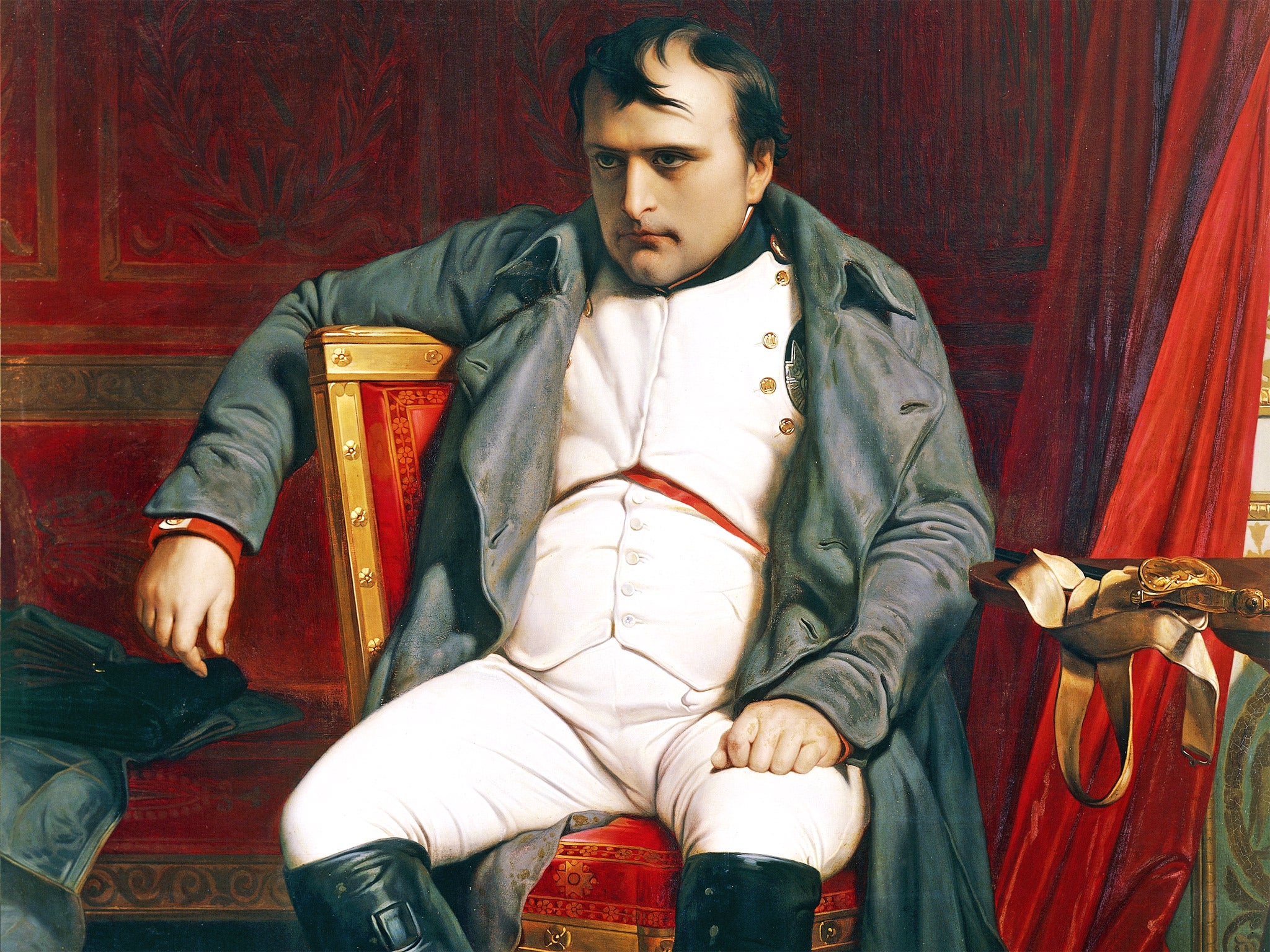
Image result for photo of napoleon

(a defeated Napoleon)

Another thread in the story is seen through the character of Eliza LaRocque, a rich woman who has maintained a vendetta against the Bonaparte’s since the time of the French emperor’s reign due to how her ancestors were treated.  She has gone on to create the Paris Club, a group of billionaires whose main goal is to influence world markets and financial institutions as a vehicle to enhance their wealth, even if she exploits the terrorist threats.  She joins forces with Ashby, but each have their own agenda in uncovering Napoleon’s cache of wealth.  In addition, Berry introduces the reader to Sonny Collins, an American secret service agent whose bosses have questioned his quest to expose financiers who continue to enhance their wealth financing debt, and wars in particular.  Thorvalsen introduces Collins to Malone and after laying the groundwork in the first part of the book the plot is enhanced, particularly when the international terrorist Peter Lyon is introduced. The question that must be asked is how do all of these characters fit together, and how does Malone navigate the complex situations he finds himself in because of his friendship with Thorvalsen.

Berry’s observations and historical background presented ring very true, especially his remarks about Napoleon and contemporary French society.  Berry’s astute remarks regarding religious and ethnic polarization in today’s France, keeping in mind that THE PARIS VENDETTA is published in 2009, points to the marginalization of France’s Moslem population and the rise of the political right.  If one is looking for a reason why ISIS has been able to create such havoc in France during the last calendar year all one has to do is look to how people of the Islamic faith have been treated in France.

Overall, Berry maintains the quality of knowledge and plot that pulse through the entire Cotton Malone series, and if you are interested the next installment is THE EMPEROR’S TOMB.

Image result for photo of the louvre paris

(The Louvre Museum in Paris)

THE CHARLEMAGNE PURSUIT by Steve Berry

Image result for photo of charlemagne

(Charles the Great-Charlemagne king of the Franks and Holy Roman Emperor)

I have been searching for a post-election tonic as I contemplate the future.  My solution has been Steve Berry novels.  Having just completed THE VENETIAN BETRAYAL I have moved on to THE CHARLEMAGNE PURSUIT to keep my mind from contemplating what a Trump administration might produce.  Mr. Berry did not let me down as he weaves “historical license” with an imaginative mystery to keep me grounded.  Berry’s protagonist remains Cotton Malone, a former naval officer and a member of the Justice Department’s top secret overseas Magellan Billet.  In THE CHARLEMAGNE PURSUIT, the fourth in the Malone series we meet a more personal and introspective character as the novel begins in November, 1971, where Commander Forrest Malone of the USS Blazek, a nuclear powered submarine operating under Antarctica is confronted by a number of issues, the most dangerous of which is a leak of potassium hydroxide fluid that poisons the air on board and Malone’s twenty six year naval career, along with his crew comes to an end.  Cotton was ten years old when his father died aboard the submarine and the government never offered a detailed explanation of what had gone wrong.  Later in life during his naval and Justice Department careers Cotton tried to learn the truth to no avail.  After a nasty situation in Mexico had transpired, Malone decided to retire and purchased a bookstore in Copenhagen.  A few years later the death of his father and the lack of information continued to gnaw at Malone and he convinces his former boss at the Magellan Billet, Stephanie Heller to provide him with naval documents that might lead to the truth.  After receiving an envelope while in Gamisch, Germany with a report on the USS Belzak, Malone is attacked and escapes.  The report from the US Navy Court of Inquiry is nothing more than the navy’s varnished version of what occurred and the misinformation enclosed drives Malone to continue his quest.

Image result for photo of Charlemagne

As is usual in a Berry novel the plot includes a version of history that is suggestive of a counterfactual approach.  In this case it involves Charles the Great, a.k.a. Charlemagne the King of the Franks and Holy Roman Emperor.  Berry would have the reader believe that in 1000 AD Otto III wanted to try and reconstitute Charlemagne’s empire, and proof is offered by a small volume that was taken from Charlemagne’s mausoleum.  The volume is in the possession of Dorothea Lindauer, a woman who claims that her grandfather was also killed on the USS Belzak.  The plot becomes very complex in that her grandfather was a Nazi, Hermann Oberhauser, who Heinrich Himmler had placed in charge of the German Ancestral Heritage – the society for the study of the history of primeval ideas designed to unearth evidence of Germany’s ancestors back to the stone age and reinforce many of Himmler’s peculiar racial beliefs.  It seems that Lindauer has a twin sister Christl Falk who approaches Malone to try and learn the truth of what took place in 1971 under the ice in Antarctica.  Further complicating the story is the fact that Oberhauser took part in a Nazi expedition to Antarctica in December, 1938 designed to see if Charlemagne’s teacher and biographer, Einhard’s book was in fact correct.

Image result for photo of antarctica

(Antacrtica)

If this is not confusing enough US Naval Intelligence head, Admiral Langford C. Ramsay has his own agenda when it comes to the USS Belzak.  Ramsay, a man who has further career ambitions dispatches an assassin to take care of anyone who is digging into the events of November, 1971.  It also seems that Edwin Davis, a deputy national security advisor to the president has an interest in learning the truth and despises Ramsay making for a series of interesting alliances among all the players involved.  The question is why does Ramsay go to such extremes after thirty eight years to maintain the navy’s cover-up of the sinking of the USS Belzak?  The story has reverberations of the Cold War with the Soviet Union, the pursuit of justice, the concerns of an ancient historian, the plight of the USS Belzak, the belief in the “Watchers” or the “first civilization” that the Nazis believed was Aryan in origin, and the death of Malone’s father, but what do they have to do with each other?

In addition to the above, Berry’s complex plot involves a German family with three interesting characters whose centuries old family legacy is at stake.  Also, two deputy national security advisors to the president each with their own agenda, and of course the president.  All of these components are blended together nicely as Berry tries to keep the reader off balance.  Mission accomplished, and the result is an excellent foray into what could be a past civilization, the interests of Nazi Germany, a major cover-up by the US government, and a group of egos that cannot continence each other.  Try this book and enjoy – the next one up in the series is THE PARIS VENDETTA.

Image result for photo of Charlemagne

THE VENETIAN BETRAYAL by Steve Berry

Image result for map of central asia

THE VENETIAN BETRAYAL opens in true Steve Berry fashion with a historical scene that lends to the background of the plot.  In this case we find Alexander of Macedonia (the Great) brooding over the loss of Hephaestion, his friend, warrior, and possibly lover who has died.  In his grief he blames Glaucias, the physician for his death, and is executed, but not before we learn that Alexander is ill.  Berry immediately shifts to Cotton Malone, the main character for the author’s series of historical novels.  Malone is a former US Justice Department covert operative who retired two years ago and purchased a bookstore in Copenhagen.  Malone notices a door to a Greco-Roman museum is open so he enters only to find himself in grave danger and is saved from an arsonist’s work by Cassiopeia Vitt, an archeologist, scholar, and a women of many martial talents.  Vitt and Henrik Thorvaldsen, a Danish philanthropist among his many interests have appeared in previous novels as has Stephanie Nell who was a member of the Magellen Billet, an undercover Justice Department operation, and with similar agendas they work well with Malone.

The story is a complicated one.  It seems that when Alexander the Great tried to conquer India around 323 BCE he was met by soldiers riding elephants which he and his army had never experienced and were decimated.  It appears elephant medallions were created and minted to highlight this episode and a number of individuals want to acquire the eight or nine that still exist.  The characters that are developed include Enrico Vincenti, the leader of the Council of Ten that governed the Venetian League, a group of 432 powerful men and women who resented the obtrusiveness of the Italian government.  The Council replicated the 14th century version of this governing body and their membership had their own concept of wealth and government.  Vincenti is a wealthy man who is the largest stockholder in Philogen Pharmaceutique, a Luxemburg corporation headquartered in Venice but has a complex in Xingyang located in western China.  Philogen’s chief scientist, Grant Lyndsey has developed important viruses and their antiagents that may be weaponized.  The other major character is Supreme Minister Irina Zovastina, the leader of the Central Asian Federation, a grouping of former republics of the Soviet Union that have formed their own political entity, and is obsessed with Alexander the Great.   Vincenti and Zovastina are deeply ambitious and it is interesting to see how their relationship unfolds and how they deal with each other’s goals that do not totally dove tail.  Further confusing the plot line is Viktor Tomas, a double or possibly a triple agent who seems to be in the pay of all sides that appear in the novel.  The question that underlies the novel is how these characters relate to each other and how does the elephant medallions, Lyndsey’s work, and the divergent agendas of the main characters come together to form a suspenseful thriller.

A further plot line which overshadows the first part of the book has to do with the final resting place of Alexander the Great.  Zovastina is convinced that if she can find his remains she can use it as a symbol to spread her federation westward to defeat Iran, Pakistan and Afghanistan before she made a move into the Middle East.  She saw herself as replicating Alexander the Great who originated in the west and moved east, Zovastina wanted to reverse the process by moving from the east toward the west.  Enhancing this line of the plot is a secret cure called the “draught” that was used in antiquity to conquer disease.  Further, is the work of Ely Lund, a researcher in a museum in Samarkand, who uncovered a number of important ancient manuscript pages that were linked to the medallions and Alexander the Great’s final resting place.   Malone and company are drawn into this entanglement which includes the Vatican, the president of the United States, biological weapons, and a host of unsavory characters.

Berry does a remarkable job shifting scenes and creating tension.  His historical and Bill Bryson like descriptions are to be commended as HIV research becomes a major component of the story, in addition to the “Greek fire,” an arsonist’s solution that seems to engulf museums across Europe.  If you enjoy fast action, counterfactual history, and strong character development you will enjoy Berry’s work.  For myself I look forward to THE CHARLEMAGNE PURSUIT, the next installment of Berry’s Cotton Malone series.

Gur-i-Emir Mausoleum in Samarkand

(Samarkand, Uzbekistan)

AMONG THE LIVING by Jonathan Rabb

Image result for photo of savannah ga

(Savannah, GA)

Jonathan Rabb’s new novel, AMONG THE LIVING begins as a feel good story.  Holocaust survivor and former Prague journalist, Yitzchak Goldah arrives in Savannah in July, 1947 sponsored by his cousins Abe and Pearl Jesler.  The Jesler’s are very sensitive to Ike, the nickname Pearl creates, and his situation.  They invite him into their home and take care of all of his needs.  Ike has lost his entire family to the Nazi genocide and his mindset grows confused as he tries to adapt to new surroundings at the same time dealing with flashbacks from the camps.  It appears to be the making of a wonderful story, until different layers of the novel unravel.  Abe Jesler owns a shoe store in the Savannah business district and he invites Ike to learn the trade and work for him.  Along with Ike, Abe has a number of “negro” workers that include Calvin and Raymond.  As the story progresses, Abe who grew up in one of Savannah’s poorer sections needs to make a significant amount of money to satisfy his overly neurotic and loving spouse, Pearl.  Unbeknownst to Ike, Abe is involved with smuggling shoes from Italy through a southern organized syndicate, and over time he is drawn deeper and deeper into the mob’s machinations that call for increasing monetary payments and cooperation.  When Abe falls behind in his obligations a message is sent resulting in the brutal beating of Raymond.

The smuggling component is just one storyline.  Ike will met a World War II widow, Eva De La Parra, and against her mother’s wishes they begin a relationship.  Both Ike, the survivor, and Eva, the mother of a five year old boy, whose husband was killed in Germany in 1945 suffer from a deep emotional void and seem meant for each other.  As their relationship progresses a number of fissures emerge in Savannah society.  Then we learn that a person from Ike’s past seems to return from the dead.  Malke Posner, who survived Theresienstadt, the Nazi “model” concentration camp, turns up at the Jesler’s doorstep claiming to be Ike’s fiancée.

What dominates Rabb’s fine novel is social class inequality and prejudice.  At a time when “Jim Crow” dominates the Deep South we find a Jewish community where social circles seem to form around the type of Judaism that religious adherents aspire to.  First, are the somewhat religious conservatives that the Jeslers exemplify.  The second are Eva’s parents, the Weiss’s whose father is the editor of the town newspaper who are seen as “Temple Jews,” or as they are called, reformed.  This “ideological” conflict forms part of the background for a story that takes place at a time when Jews are finally leaving the displaced persons camps in Europe following their liberation from Hitler’s death camps, and in the Middle East Palestine is about to explode into a war between Jews and Arabs.  To highlight this, Rabb creates a scene during the Jewish New Year where both groups of Jews confront each other at the beach as they are about to engage in a Jewish cleansing tradition. Another fissure centers on race relations in the south.  The Jeslers, as do most wealthy members of the Savannah community employ Negro maids, in this case Mary Royal.  Her actions act out the subservient stereotypical maid as does the common language spoken by Raymond and Calvin.  In addition, Raymond confronts Abe Jesler concerning his rightful place in a business that he has worked in for over twenty years.

Rabb develops his plot through these dynamics and integrates well developed characters and a story whose highs and lows provoke many compelling questions.  This is Rabb’s sixth novel, and perhaps his best.

Image result for photo of savannah ga

(Savannah, GA)

MISCHLING by Affinity Konar

Mischling
Most of us are aware of the horrific policies implemented by the Nazis during the Holocaust, but one area that seems further and further beyond the pale in terms of their barbarity and horror is in the realm of medical experiments.  The name that comes to the fore when thinking of such perverse behavior is that of Dr. Josef Mengele who conducted experiments on about 1500 pairs of twins in his laboratories at Auschwitz, of which maybe 200 survived the war.  Mengele was obsessed with the behavior and genetic makeup of twins which forms the infrastructure of Affinity Konar’s new novel, MISCHLING.  Mischling in German means “mixed blood” or “half breed,” and was the legal term employed by the Nazis to denote people with Jewish or Aryan ancestry.  There were different categories as delineated by the 1935 Nuremberg Blood Laws that the Nazis developed to determine whether a person was a Jew or of mixed blood.  This determination affected Jews on many levels and for far too many led to their ultimate extinction.

Konor develops her story through the eyes of Pearl and Stasha Zagorski, twin girls who at the age of twelve are seized and transported to Auschwitz in the fall of 1944.  Konor alternates her narration between the twins and begins with Stasha as she describes a white coated man walking over to the girls and their mother and grandfather as classical music plays in the background.  The man known as “Uncle” throughout the novel is Dr. Josef Mengele and after examining the girls separates them from their mother and grandfather and sends them to the Zoo, the name for the facility for Mengele to conduct his research.

Konor’s novel draws heavily on CHILDREN OF FLAMES by Lucette Matalon Lagnado and Sheila Cohn Dekel, and THE NAZI DOCTORS by psychiatrist, Robert Jay Lifton.  Despite her reliance on these works Konor is able to create two personalities that are hauntingly real as it is expressed by the continual dialogue between Pearl and Stasha, and their narration upon their separation from each other.  At the outset it appears that the twins are special and have a certain status, but once the experiments begin they are tossed aside just like any other Holocaust victim.  They may live longer, but if one of the twins happens to die, the other will follow almost immediately.  It was uncanny how Pearl and Stasha shared each other’s pain.  Pearl could be undergoing a certain experiment on one part of her body, and unbeknownst to Stasha she would feel pain in the same part of her anatomy.  Pearl would curse herself because her veins stood out and it made it easier for Mengele to inject what germs, viruses or poison he desired.  As awareness of what was occurring to them became evident the twins developed a new maturity and in Pearl’s case she went from being the more outgoing of the sisters before their incarceration, to becoming more methodical, and focused on her memories to survive each day; while Stasha grew feistier and more cunning in trying to cope with the evil that surrounded her.

The girls had been inseparable in their previous life, now found that as they grew apart they were no longer as devoted to each other.  It is heart breaking to visualize Pearl, who believed she was dying from the medical experiments that were conducted, tried to push Stasha away so she would not be so dependent; so when Pearl would eventually die, Stasha could move on.  The pain and anguish is palatable on each page as each of the twins feels less than whole, as each believes in their own way that their better half has been stolen from them, and they are surviving in a vacuum.  The experiments that were conducted were bizarre and the concoction of a demented mind; sewing twins together so they could not see each other, placing one twin in a cage and allowing the other to survive in the laboratory, and on and on.  Konar’s research allows her to reconstruct an alternate reality that was Mengele’s world and can only bring tears to the reader.

The second half of the book is not as focused as the first half and at times comes across as a bit disjointed.  The story revolves around the approach and the final arrival of Russian troops to liberate Auschwitz.  From there we follow the twins on their journey with a number of projections into the future.  Konar drills down into actual events and how the Russians treated the newly freed victims and follows Pearl and Stasha’s different paths.  We witness the Nazi attempt to destroy all evidence of what they had perpetrated.  The emotions and feelings of the newly released seem straight out of Robert Jay Lifton’s work as they suffer from “without self,” “survival guilt,” and other diagnostic terms.  The Soviets make a propaganda film of what they find in the camps and Pearl wonders what is actually taking place.  Stasha and Feliks, another survivor are committed to seeking revenge and travel toward Warsaw in the hope of killing Dr. Mengele.  We also experience the story of Dr. Miri, a Jewish doctor forced to assist Mengele’s work and how she seeks redemption and tries to deal with her guilt.

Overall, MISCHLING is a difficult read.  It is the type of novel that must be taken in small doses.  Though it reveals nothing new in terms of what we know of Mengele’s tortuous work, imagining what has occurred through the eyes of twin sisters and their perceptions separates Konor’s effort from much of the material that has appeared before.  If you choose to tackle Konor’s novel be prepared for the world you about to enter.


THE DEVILS OF CARDONA by Matthew Carr

(Philip II of Spain and Hapsburg Emperor)

Toward the end of the late 16th century the reign of Philip II of Spain and ruler of the Hapsburg lands of Central Europe seemed threatened by external and domestic forces.  Externally, Queen Elizabeth of England worked to undermine his kingdom by supporting pirates and the armies of William of Orange as the Dutch continued their revolt against the Spanish monarch.  Across the Pyrenees, the King of France also did his best to cause difficulties for Philip.  Internally, Phillip had to deal with Moriscos, Moslems or Moors who had converted to Catholicism to avoid the punishment of the Inquisition.  This time period serves as the backdrop for Matthew Carr’s wonderful new novel, THE DEVILS OF CARDONA, an exploration of the social, economic, and political forces at work in Philip II’s kingdom through a plot centering on the murder of a despised Catholic priest, Padre Juan Panalle in the Belmar de la Sierra, an area in north eastern Spain near the French border.  Panalle was a despicable character who used his flock, mostly converted Moslems, to meet his sexual and economic needs.  Officials in Madrid had grown increasingly concerned about the Moslem threat and ordered Licenciado Bernardo Francisco Baldini de Mendoza a young judicial official to travel from his home in Valladolid in Castile to the site of the murder in Aragon and arrest and convict the guilty party.

Mendoza is a fascinating character who had witnessed the work of the Inquisition as a youngster and was still subjected to nightmares as an adult.  He never imagined that he would be part of the legal system that the Inquisition dominated during his career.  The instructions he received seemed clear, but as his work began his charge seemed much more complex than he was led to believe.  First, he had to deal with the goals of the Inquisition and its emissary, Mercader.  Second, was the government’s jurisdiction in Belmar, which fell under the auspices of the Countess of Cardona who had full jurisdiction over her kingdom that included Inquisitors and his Majesty’s own officials dating back to 1085, and recently renewed by Charles V in 1519.  Many of her vassals were Moriscos and she believed in bringing her subjects to Catholicism through acts of kindness, not the hammer blows of the Inquisition.  Mercader is convinced that the Countess is secretly allowing her subjects to maintain their Islamic faith, a charge that she vehemently denies.  Third, upon traveling to Cardona, Mendoza learned of the murder of three brothers which seemed to be an act of revenge perpetrated by Moslems. Fourth, a vicious plot perpetuated by one of Philip II’s counselors who sought to enrich himself by acquiring the Cardona estates.  Lastly, Mendoza was exposed to the threat of a supposed Moslem “redeemer,” who sought to avenge the work of the Inquisition and retake Spain from Philip II and reinstitute Islamic rule.

Carr does a magnificent job of capturing the essence of late 16th century Spain.  The cultural conflict between the Castilian and Aragonese regions is presented accurately as is the corrupt nature of the clergy, as well as the political and religious machinations of Philip II’s kingdom that greatly contribute to the novel’s plot.  The religious conflict between the Catholic Church and Islam dating back to the first half of the 16th century and the political problems between Castile and Aragon in particular are explored nicely through the many colorful characters Carr creates.  The plot is further enhanced as the Countess of Cardona, a widow whose extensive holdings are sought by many men who see their own power and wealth threatened by her marriage status.  By integrating “marriage diplomacy” into his story line, Carr heightens the reader’s understanding of events by placing them in their proper historical context.

As the novel progresses Mendoza finds himself in a jurisdictional fight with Mercader and the Inquisition.  Mercader has his own agenda that would allow him to rid Spain of the Moriscos and elevate himself in the eyes of Philip II.  Murders keep piling up and the conflicts between vested interests dominate the novel as evidence of a real redeemer emerge, particularly when  a Moslem family is massacred by a Catholic smuggling ring, creating further confusion.  As Mendoza’s investigation continues it takes a number of unexpected turns that will capture the reader’s attention to the point they cannot put the book down.  If you enjoy a good mystery enhanced by the sights and sounds of 16th century Spain, Carr’s effort will fascinate you.

The Devils of Cardona