Over the years I have developed a proclivity towards certain authors. In the realm of historical fiction one of my favorites is Steve Berry. Mr. Berry has published eleven novels in his Cotton Malone series. Each is a thrilling read as they develop like a puzzle as each character, historical conundrum, and a suspenseful plot fits together like a glove. I have recently read three of Berry’s novels, THE VENETIAN BETRAYAL, THE CHARLEMAGNE PURSUIT, AND THE PARIS VENDETTA all are stimulating for those who enjoy this genre and are thoughtful as the personal backgrounds of the characters and the historical context that is explored emerges. The reader travels to Venice, Central Asia, and France as each mystery unfolds whether characters deal with the legacy of Alexander the Great, Charlemagne, or Napoleon as each plot builds on the past to the current issues of terrorism, world finance, or the world balance of power.
Berry’s protagonist Cotton Malone is a former naval officer, US Justice Department agent in the Magellin Billet that specialized in international cases who retired from the government and purchased a bookstore in Copenhagen. Malone served as a government agent for twelve years and retired at a fairly young age for an individual with his skills. He was on a case in Mexico City two years before he quit and witnessed the shooting of Mexican prosecutor Elena Ramirez Rico and her significant other Cai Thorvalsen, a Danish diplomat serving in Mexico City, and the son of Malone’s close friend the reclusive billionaire Henrik Thorvalsen. Malone was wounded during the shooting and for him that was enough. Thorvalsen approached Malone and offered to sell him the bookstore and the friendship flourished. They became involved in a number of important situations and they become best friends. Thorvalsen never gets over the murder of his son and his character is dominated by his feelings of loss and revenge. Other important characters include Cassiopeia Vitt, an archeologist, scholar, and a women of many martial talents. In addition, the reader will become familiar with Stephanie Nell who heads the Magellen Billet, and was Malone’s boss at the Justice Department. Other characters that are included range from National Security advisors to the president, the president himself, other government agents, and a series of terrorists, financial wizards, and other unscrupulous individuals. Alongside these people are historical personages that Berry relies on to enhance his story lines.
One of my favorite Berry novels is THE ALEXANDRA LINK where the reader is presented with a series of questions; what if the biblical basis for the Israeli state was incorrect? What if the real evidence for the creation of the Jewish state was in western Saudi Arabia? What if the ancient translations that led to the writing of the Old Testament from old Hebrew and Greek were open to an interpretation that could destabilize both Israel and Saudi Arabia and reorient the geopolitics of the Middle East? Intertwine the writings of St. Augustine and St. Jerome; add some nefarious characters that would stand to enhance their power and monetary profit, and sprinkle in American politics and you have a stunning novel.
Another favorite is THE LINCOLN MYTH which has as its main theme the concept of secession and whether the Founding Fathers may have supported the idea that the union of the United States was not a perpetual one. Berry develops a scenario for Malone to solve that focuses on Brigham Young, the leader of the Mormon Church in 1854 predicting that the Civil War would occur and that would end the persecution of Mormonism. Young will inform Lincoln where Mormon gold was stored, and Lincoln will provide a document, signed by the Founding Fathers, that said individual states possessed the right to leave the union. There are six more novels in the Cotton Malone series and I look forward to reading the few I have missed including his latest THE 14TH COLONY that deals with Canada, an American constitutional crisis, and a former KGB officer.
If you enjoy counterfactual history, in depth character development, and being kept on the edge of your seat Berry’s Cotton Malone series is for you. For in depth reviews of Steve Berry’s books visit http://www.docs-books.com.
Steve Berry’s novel, THE PARIS VENDETTA provides his usual blend of wonderful primary and secondary characters, intensity, reflecting a firm grasp of history, and the ability to bring the reader to the edge of their seats. The book is the fifth installment of the Cotton Malone series. Malone is a former naval officer, US Justice Department agent in the Magellin Billet that specialized in international cases who retired from the government and purchased a bookstore in Copenhagen. For the first time we learn the details as to why Malone retired at a fairly young age for an agent with his skills. He was on a case in Mexico City two years before he quit and witnessed the shooting of Mexican prosecutor Elena Ramirez Rico and her significant other Cai Thorvalsen, a Danish diplomat serving in Mexico City, and the son of Malone’s close friend the reclusive billionaire Henrik Thorvalsen. Malone was wounded during the shooting and for him that was enough. Thorvalsen approached Malone and offered to sell him the bookstore and the friendship flourished. They became involved in a number of important situations that have been told in earlier novels. In the current case it seems that after two years Thorvalsen has identified who killed his son, an action that had devastated the Danish aristocrat and for him revenge and the humiliation of the man responsible was foremost in his mind. It seems that two men Amando Cabral and Lord Graham Ashby, men who traded in stolen antiquities were about to be charged in a Mexican court for their activities when the killings took place. Malone was able to kill Cabral, but Ashby, the man who Thorvalsen blamed remained free.
It would not be acceptable for a Berry mystery to just be about murder and revenge and THE PARIS VENDETTA is no exception. Berry’s novels immediately create a puzzle with each component of the story carefully crafted to arouse the reader’s curiosity, and the current volume is no exception. At the onset of the plot Berry introduces Napoleon Bonaparte into the equation. We meet the French dictator in Cairo fourteen months after he has conquered Lower Egypt. While examining the Pyramids Napoleon decides he must return to Paris because the ruling Directory is not following the revolutionary agenda and has made enemies of most of Europe. Napoleon’s supposed wealth becomes a major factor in the story’s development. We are led to Corsica and other environs as Ashby and others seek the deposed dictator’s cache, if in fact it exists. Further, the Napoleon’s writings become important because according to Thorvalsen the key to uncovering Napoleon’s wealth is in his personal library. For Ashby the cache is extremely important because of financial difficulties and he is hell bent to locate it. It seems that Lord Ashby, a “rich” English banker, a possible double agent for the United States, and investor in one of England’s most important financial institutions has made a number of poor decisions and even though his situation has improved by uncovering Edwin Rommel’s gold hidden in Corsica in 1943 he needs further funds.
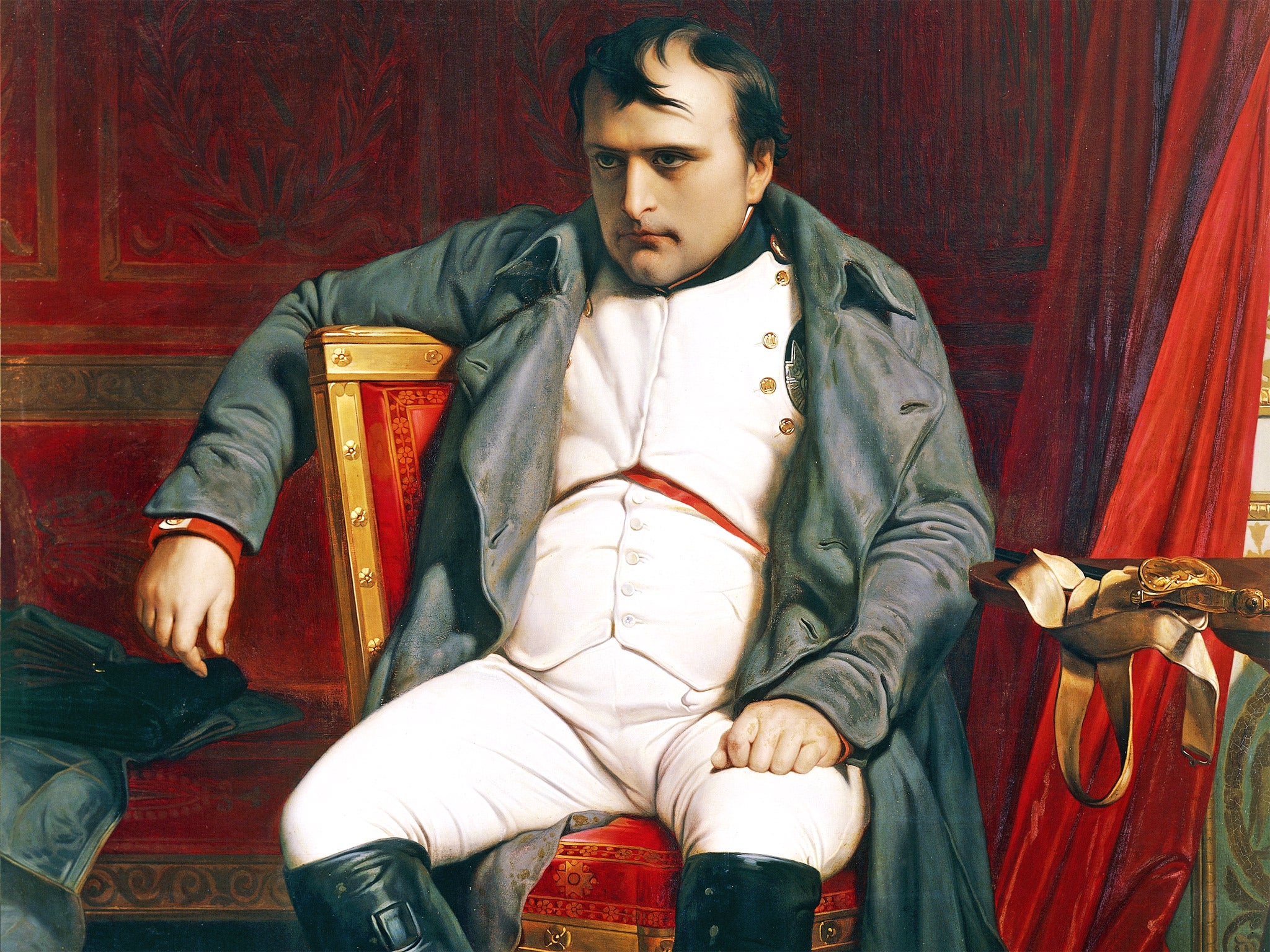
(a defeated Napoleon)
Another thread in the story is seen through the character of Eliza LaRocque, a rich woman who has maintained a vendetta against the Bonaparte’s since the time of the French emperor’s reign due to how her ancestors were treated. She has gone on to create the Paris Club, a group of billionaires whose main goal is to influence world markets and financial institutions as a vehicle to enhance their wealth, even if she exploits the terrorist threats. She joins forces with Ashby, but each have their own agenda in uncovering Napoleon’s cache of wealth. In addition, Berry introduces the reader to Sonny Collins, an American secret service agent whose bosses have questioned his quest to expose financiers who continue to enhance their wealth financing debt, and wars in particular. Thorvalsen introduces Collins to Malone and after laying the groundwork in the first part of the book the plot is enhanced, particularly when the international terrorist Peter Lyon is introduced. The question that must be asked is how do all of these characters fit together, and how does Malone navigate the complex situations he finds himself in because of his friendship with Thorvalsen.
Berry’s observations and historical background presented ring very true, especially his remarks about Napoleon and contemporary French society. Berry’s astute remarks regarding religious and ethnic polarization in today’s France, keeping in mind that THE PARIS VENDETTA is published in 2009, points to the marginalization of France’s Moslem population and the rise of the political right. If one is looking for a reason why ISIS has been able to create such havoc in France during the last calendar year all one has to do is look to how people of the Islamic faith have been treated in France.
Overall, Berry maintains the quality of knowledge and plot that pulse through the entire Cotton Malone series, and if you are interested the next installment is THE EMPEROR’S TOMB.
(Charles the Great-Charlemagne king of the Franks and Holy Roman Emperor)
I have been searching for a post-election tonic as I contemplate the future. My solution has been Steve Berry novels. Having just completed THE VENETIAN BETRAYAL I have moved on to THE CHARLEMAGNE PURSUIT to keep my mind from contemplating what a Trump administration might produce. Mr. Berry did not let me down as he weaves “historical license” with an imaginative mystery to keep me grounded. Berry’s protagonist remains Cotton Malone, a former naval officer and a member of the Justice Department’s top secret overseas Magellan Billet. In THE CHARLEMAGNE PURSUIT, the fourth in the Malone series we meet a more personal and introspective character as the novel begins in November, 1971, where Commander Forrest Malone of the USS Blazek, a nuclear powered submarine operating under Antarctica is confronted by a number of issues, the most dangerous of which is a leak of potassium hydroxide fluid that poisons the air on board and Malone’s twenty six year naval career, along with his crew comes to an end. Cotton was ten years old when his father died aboard the submarine and the government never offered a detailed explanation of what had gone wrong. Later in life during his naval and Justice Department careers Cotton tried to learn the truth to no avail. After a nasty situation in Mexico had transpired, Malone decided to retire and purchased a bookstore in Copenhagen. A few years later the death of his father and the lack of information continued to gnaw at Malone and he convinces his former boss at the Magellan Billet, Stephanie Heller to provide him with naval documents that might lead to the truth. After receiving an envelope while in Gamisch, Germany with a report on the USS Belzak, Malone is attacked and escapes. The report from the US Navy Court of Inquiry is nothing more than the navy’s varnished version of what occurred and the misinformation enclosed drives Malone to continue his quest.
As is usual in a Berry novel the plot includes a version of history that is suggestive of a counterfactual approach. In this case it involves Charles the Great, a.k.a. Charlemagne the King of the Franks and Holy Roman Emperor. Berry would have the reader believe that in 1000 AD Otto III wanted to try and reconstitute Charlemagne’s empire, and proof is offered by a small volume that was taken from Charlemagne’s mausoleum. The volume is in the possession of Dorothea Lindauer, a woman who claims that her grandfather was also killed on the USS Belzak. The plot becomes very complex in that her grandfather was a Nazi, Hermann Oberhauser, who Heinrich Himmler had placed in charge of the German Ancestral Heritage – the society for the study of the history of primeval ideas designed to unearth evidence of Germany’s ancestors back to the stone age and reinforce many of Himmler’s peculiar racial beliefs. It seems that Lindauer has a twin sister Christl Falk who approaches Malone to try and learn the truth of what took place in 1971 under the ice in Antarctica. Further complicating the story is the fact that Oberhauser took part in a Nazi expedition to Antarctica in December, 1938 designed to see if Charlemagne’s teacher and biographer, Einhard’s book was in fact correct.
(Antacrtica)
If this is not confusing enough US Naval Intelligence head, Admiral Langford C. Ramsay has his own agenda when it comes to the USS Belzak. Ramsay, a man who has further career ambitions dispatches an assassin to take care of anyone who is digging into the events of November, 1971. It also seems that Edwin Davis, a deputy national security advisor to the president has an interest in learning the truth and despises Ramsay making for a series of interesting alliances among all the players involved. The question is why does Ramsay go to such extremes after thirty eight years to maintain the navy’s cover-up of the sinking of the USS Belzak? The story has reverberations of the Cold War with the Soviet Union, the pursuit of justice, the concerns of an ancient historian, the plight of the USS Belzak, the belief in the “Watchers” or the “first civilization” that the Nazis believed was Aryan in origin, and the death of Malone’s father, but what do they have to do with each other?
In addition to the above, Berry’s complex plot involves a German family with three interesting characters whose centuries old family legacy is at stake. Also, two deputy national security advisors to the president each with their own agenda, and of course the president. All of these components are blended together nicely as Berry tries to keep the reader off balance. Mission accomplished, and the result is an excellent foray into what could be a past civilization, the interests of Nazi Germany, a major cover-up by the US government, and a group of egos that cannot continence each other. Try this book and enjoy – the next one up in the series is THE PARIS VENDETTA.
THE VENETIAN BETRAYAL opens in true Steve Berry fashion with a historical scene that lends to the background of the plot. In this case we find Alexander of Macedonia (the Great) brooding over the loss of Hephaestion, his friend, warrior, and possibly lover who has died. In his grief he blames Glaucias, the physician for his death, and is executed, but not before we learn that Alexander is ill. Berry immediately shifts to Cotton Malone, the main character for the author’s series of historical novels. Malone is a former US Justice Department covert operative who retired two years ago and purchased a bookstore in Copenhagen. Malone notices a door to a Greco-Roman museum is open so he enters only to find himself in grave danger and is saved from an arsonist’s work by Cassiopeia Vitt, an archeologist, scholar, and a women of many martial talents. Vitt and Henrik Thorvaldsen, a Danish philanthropist among his many interests have appeared in previous novels as has Stephanie Nell who was a member of the Magellen Billet, an undercover Justice Department operation, and with similar agendas they work well with Malone.
The story is a complicated one. It seems that when Alexander the Great tried to conquer India around 323 BCE he was met by soldiers riding elephants which he and his army had never experienced and were decimated. It appears elephant medallions were created and minted to highlight this episode and a number of individuals want to acquire the eight or nine that still exist. The characters that are developed include Enrico Vincenti, the leader of the Council of Ten that governed the Venetian League, a group of 432 powerful men and women who resented the obtrusiveness of the Italian government. The Council replicated the 14th century version of this governing body and their membership had their own concept of wealth and government. Vincenti is a wealthy man who is the largest stockholder in Philogen Pharmaceutique, a Luxemburg corporation headquartered in Venice but has a complex in Xingyang located in western China. Philogen’s chief scientist, Grant Lyndsey has developed important viruses and their antiagents that may be weaponized. The other major character is Supreme Minister Irina Zovastina, the leader of the Central Asian Federation, a grouping of former republics of the Soviet Union that have formed their own political entity, and is obsessed with Alexander the Great. Vincenti and Zovastina are deeply ambitious and it is interesting to see how their relationship unfolds and how they deal with each other’s goals that do not totally dove tail. Further confusing the plot line is Viktor Tomas, a double or possibly a triple agent who seems to be in the pay of all sides that appear in the novel. The question that underlies the novel is how these characters relate to each other and how does the elephant medallions, Lyndsey’s work, and the divergent agendas of the main characters come together to form a suspenseful thriller.
A further plot line which overshadows the first part of the book has to do with the final resting place of Alexander the Great. Zovastina is convinced that if she can find his remains she can use it as a symbol to spread her federation westward to defeat Iran, Pakistan and Afghanistan before she made a move into the Middle East. She saw herself as replicating Alexander the Great who originated in the west and moved east, Zovastina wanted to reverse the process by moving from the east toward the west. Enhancing this line of the plot is a secret cure called the “draught” that was used in antiquity to conquer disease. Further, is the work of Ely Lund, a researcher in a museum in Samarkand, who uncovered a number of important ancient manuscript pages that were linked to the medallions and Alexander the Great’s final resting place. Malone and company are drawn into this entanglement which includes the Vatican, the president of the United States, biological weapons, and a host of unsavory characters.
Berry does a remarkable job shifting scenes and creating tension. His historical and Bill Bryson like descriptions are to be commended as HIV research becomes a major component of the story, in addition to the “Greek fire,” an arsonist’s solution that seems to engulf museums across Europe. If you enjoy fast action, counterfactual history, and strong character development you will enjoy Berry’s work. For myself I look forward to THE CHARLEMAGNE PURSUIT, the next installment of Berry’s Cotton Malone series.
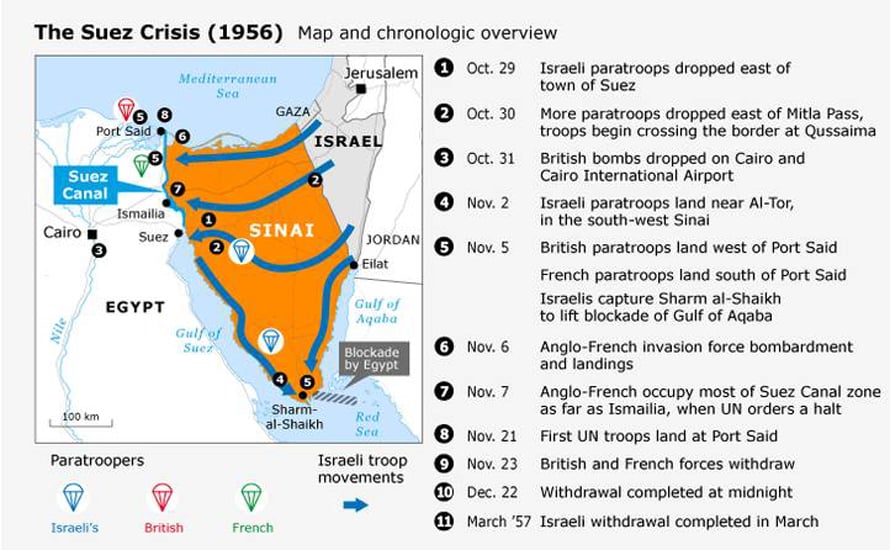
Last week was the 60th anniversary of the 1956 Suez Crisis as well as the Soviet invasion of Hungary. Both events had a tremendous impact on the geo-strategic balance in the Middle East and Eastern Europe. The Eisenhower administration was confronted by overlapping crises that brought the United States in opposition to its allies England and France at a time when it seemed to President Eisenhower and Secretary of State John F. Dulles that allied actions in Suez had provided cover for Soviet tanks to roll in to Budapest. The interfacing of these two crises is the subject of Alex von Tunzelmann’s new book, BLOOD AND SAND: SUEZ, HUNGARY, AND EISENHOWER’S CAMPAIGN FOR PEACE. Von Tunzelmann has a unique approach to her narrative and analysis as she chooses certain dates leading up to the crisis, from October 22 to November 6, 1956 and within each date she explains events and delves into the background history of the issues that are raised. In so doing she effectively examines how decisions were reached by the major actors, and the impact of how those decisions influenced the contemporary world order. The only drawback to this approach is that a sense of chronology is sometimes lost, and with so much taking place across the Middle East and Eastern Europe it can be confusing for the general reader.
(British Foreign Secretary and then Prime Minister during Suez, Sir Anthony Eden)
Von Tunzelmann begins by providing the history that led up to British control of the Suez Canal. She goes on to examine the major players in the conflict; Anthony Eden, British Foreign Secretary and later Prime Minister who despised Egyptian President Gamal Abdul Nasser and basically “wanted him dead” as he blamed him for all of England’s ills, domestic and foreign. President Dwight Eisenhower, who had grown tired of British colonialism and its impact on American foreign policy, and provided the guidelines that Secretary of State Dulles implemented. Gamal Abdul Nasser, the Egyptian President who rose to power in 1954 and was bent on achieving the removal of the British from the Suez Canal Base, and spreading his Pan Arabist ideology throughout the region. It is fascinating as the author delves into the role of the CIA in Egypt and the relationship between Kermit Roosevelt, the author of the 1953 Iranian coup, and Miles Copeland with Nasser taking the reader into an area than is usually forbidden. Other profiles are provided including Israeli Prime Minister David Ben-Gurion, French President Guy Mollet, Imre Nagy, the leader of Hungary, and the troika that controlled the Kremlin.
(French President Guy Mollet)
Each country had its own agenda. In England neo-imperialist forces believed that “if they could no longer dominate colonies openly, they must try to foster a secret British Empire club….a powerful hidden empire of money and control,” this was apart from the “Commonwealth.” (23) This was the overall strategy that revolved around access and transportation of oil. An example of Von Tunzelmann’s approach is her March 1, 1956 section where she concentrates on Jordan’s King Hussein’s firing of John Glubb Pasha, a British serving officer who headed the Arab Legion. For Eden, Nasser was the cause and his actions were a roadblock to achieve a Middle Eastern defense pact (Baghdad Pact), and Jordanian membership. Eradicating Nasser became Eden’s life’s mission. In her discussion of March, 1956 the author raises the role of American policy, but she only mentions in passing American attempts to bring about peace between Israel and Egypt, i.e.; Project Alpha and the Anderson Mission. She presents a number of reasons why the US withdrew its offer to fund the Aswan Dam project on July 19, 1956, forgoing that Washington had already decided as early as March 28, 1956 that Nasser was an impediment to peace and the US launched Operation Omega designed to take Nasser down a peg or two, and once the presidential election was over more drastic action could be taken. For the French, Mollet blamed Nasser for all Paris’ difficulties in Algeria. When FLN leader Ahmed Ben Bella, a World War II hero in France left for Cairo it confirmed that Nasser was providing Ben Bella weapons and a safe exile. To the author’s credit throughout the narrative she whittles down all of the information in expert fashion and she sums up the interests of all concerned as the crisis approaches.
Von Tunzelmann provides many interesting details as she delves into individual motivations. For Ben-Gurion, the Straits of Tiran were the key. Many have speculated why Israel would ally with England under the Sevres Agreement, a country that had been a thorn in the side of Jews for decades. The key was an oil pipeline that was to be built from the southern Israeli port of Eilat to Ashkelon in the north (Trans Israel pipeline or Tipline) that would bring Iranian oil to Europe. In 1957, Israel brokered a deal with Iran, and the Suez Canal, by then under Egyptian control, would be bypassed. This deal would also make the Jewish state a strategic ally of Europe.
The most important parts of the narrative deal with the October 23-24, 1956 dates. It is during those few days that Von Tunzelmann provides intimate details of the negotiations between Israel, France and England at Servres. All the important players from Eden, whose health is explored in relation to his decision-making; Ben-Gurion, who exemplifies what she calls “muscular Judaism,” who wanted a preventive war before the Egyptians could absorb Soviet weapons; Guy Mollet, who agrees with Israel and promises aid in building a nuclear reactor for the Jewish state, and others. Within each chapter Von Tunzelmann switches to the machinations involving events in Hungary and how precarious the situation has become. As machinations were taking place Von Tunzelmann describes events that are evolving in Hungary. With demonstrations against Soviet encroachment in Poland and the visit of the Soviet leadership to Warsaw to make sure that the Poles remained in the Russian orbit, the aura of revolution was in the air and it spread to neighboring Hungary. With mass demonstrations led by Hungarian students, workers, and intellectuals, Moscow dispatched the head of the KGB, Ivan Seroy. Von Tunzelmann examines the thinking of Soviet leadership, the role of Imre Nagy, hardly a revolutionary, but a reformist acceptable to the people, as the situation reaches a breaking point. Finally, on October 24, 1956 Soviet troops and tanks roll into Budapest sparking further demonstrations allowing an excuse for Russian forces to crush the demonstrators. The end results vary from 60-80 killed and 100-150 seriously wounded. The proximity of Soviet actions with the Israeli invasion of the 29th would make Eisenhower apoplectic, in part because the CIA had a coup set to go in effect in Syria on the same day as the Israel attack.
(President Eisenhower and Egyptian President Gamal Abdul Nasser)
One of the most conjectured part of this period is whether the United States was aware of the Sevres conspiracy and what was the role of the CIA. Von Tunzelmann approach to these questions is fair and plausible. After reviewing the available documentation she reaches the conclusion that Allen W. Dulles, the Head of the CIA, who destroyed his documentation knew about the plot in advance and kept the president in the dark because if Eisenhower had known he might have pressured England and France to call it off. The CIA had so much invested in Nasser, with the relationship fostered by Miles Copeland and Kermit Roosevelt that they wanted to protect him, in fact according to the author the CIA warned Nasser that the British wanted to kill him. According to Israeli historian and later politician, Michael Bar-Zohar the CIA was fully aware of what was going on and Allen Dulles informed his brother of the conspiracy. For the CIA “plausible deniability” was the key. Whatever the case it is clear that crucial information was withheld from Eisenhower. However, the president was fully aware of the Anglo-American plot to overthrow Syrian leader Shukri al-Kuwatty, who was developing closer ties with the Soviet Union. Explaining CIA and MI6 machinations is one of the strongest aspects of Von Tunzelmann’s work. Reading about the British obsession to kill Nasser, reminded me how Washington pursued Fidel Castro few years later.
At the same time she discusses Suez, Von Tunzelmann shifts to Hungary and analyzes Moscow’s hesitancy to invade. Her portrayal of Imre Nagy’s difficulty in controlling the uprising is solid as the demonstrations spirals out of control inside and outside of Budapest. However, once Imre Nagy decides to withdraw Hungary from the Warsaw Pact and claims neutrality for his country it is a forgone conclusion in the Kremlin that despite some hesitation they must invade. The Suez situation provided Moscow with excellent cover at the United Nations. As the French and British dithered in delivering their forces to Egypt, Moscow became emboldened. Von Tunzelmann does an excellent job following communications between Dulles and Eisenhower on the American side, Mollet and Pineau for the French, Eden and the Foreign Office, and within Imre Nagy’s circle in Budapest, as it is clear in the eyes of Washington that the allies really have made a mess of things. The author’s insights and command of the material are remarkable and her new book stands with Keith Kyles’ SUEZ as the most important work on the topic. What enhances her effort is her ability to compare events in Suez and Hungary during the first week of November shifting back and forth reflecting how each crisis was dealt with, and how the final outcome in part depended on the evolution of each crisis.
(Israeli Prime Minister David Ben-Gurion with Israeli Foreign Secretary Golda Meir)
One of the major aspects of the Suez Crises that many books do not deal with which BLOOD AND SAND discusses is that once war was unleashed the Palestinian-Israeli conflict could only be exacerbated. Israeli actions in Gaza stayed with those who were displaced and suffered and it would contribute to the hatred that remains today. Once the crisis played itself out and Eisenhower forced the British and French to withdraw from Egyptian territory in early November, using oil and currency pressure; threatening the Israelis, who finally withdrew in March, 1957, it seemed that American standing in the Arab world would improve. However, the United States gave away the opportunity to furthering relations in the Arab world with the introduction of the Eisenhower Doctrine which was geared against the communist threat. Von Tunzelmann makes the case that Eisenhower was the hero of Suez, but within a few years his doctrine led to dispatching US troops to Lebanon and the overthrow of the Iraqi government. By 1958 the Arab world began to view the United States through the same colonialist lens that they evaluated England and France, tarnishing the image of Eisenhower as the hero of Suez.
On September 9, 1971 the Attica Correctional Facility in upstate New York forced its way into newspaper headlines across the United States. On that day roughly 1300 prisoners took control of the facility in response to years of mistreatment and harassment. In American history there have been many violent protests that have led to the death or wounding of those who took part. Whether they involved Native-Americans, Vietnam anti-war demonstrators, organized labor, or Afro-Americans the causes and results of these events were documented and analyzed carefully by historians. In the case of Attica, where 40 individuals, prisoners and hostages were killed and hundreds wounded, government officials placed immediate road blocks to thwart an objective investigation. Government officials did not want the truth to come out, particularly New York Governor Nelson Rockefeller and his administration because of errors in judgement and outright incompetence when hundreds of poorly trained New York State troopers and prison guards were sent into the facility with shotguns blazing. The Rockefeller administration immediately put out misinformation about what occurred, particularly when autopsies showed that the hostages were killed by indiscriminate gun fire, and not by prisoners. Coroners were pressured to bury the truth as were other officials who disagreed with prison administrators and Rockefeller and his cohorts. It took many years to overcome the opposition to releasing what actually took place. Finally historian Heather Ann Thompson in her comprehensive history, BLOOD IN THE WATER: THE ATTICA PRISON UPRISING OF 1971 AND ITS LEGACY has addressed all the major issues and individuals involved through her doggedness and refusal to accept no for an answer as she rummaged, researched, filed numerous freedom of information requests, interviewed participants and survivors in her quest to uncover the truth.
(Bodies and wounded hostages and prisoners after New York State troopers and Correctional guards stormed the prison)
According to Thompson the gap in the historiography pertaining to Attica existed because of the obstruction by those who knew what really occurred and were concerned with the backlash that would result if the truth came to the fore. Part of that truth were the conditions that existed in Attica as well as many other prisons nationwide. Thompson describes a system overseen by Attica’s Superintendent Vincent Mancusi that suffered from overcrowding, lack of medical care, poor training of correctional officers, using prisoners as free labor to the tune of $12 million per year, no visitation for common law families, which effected one quarter of the inmate population, a capricious and arbitrary parole system, censorship of reading material and letters, medical experiments, and an overall atmosphere of racism. The prison itself was built in 1930 and by 1971 its facilities had never been updated to accommodate an increasing number of prisoners whose racial makeup was no longer predominantly white, and the crimes they were incarcerated for did not fit the patina of the 1930s.
(Prisoners vote on whether to accept demands of prison officials after riots)
Thompson’s book is very disturbing and the events of September, 1971 were greatly affected by the political climate of the 1960s. At that time politicians moved toward “law and order” planks as demonstrated by the Nixon administration in 1968 and as the 1972 election moved closer. The “law and order” approach greatly affected the funding and operation of America’s prisons. As politicians in the north and south saw crime as the greatest problem in society, they decided to wage war against it. This would lead to the imprisonment of more inmates than in any country in the world. In New York state Governor Rockefeller, known as a “liberal Republican saw Nixon’s crime agenda as an impediment to his own quest for the presidency. By 1970 he began to change his image to a more conservative politician who was tough on crime.
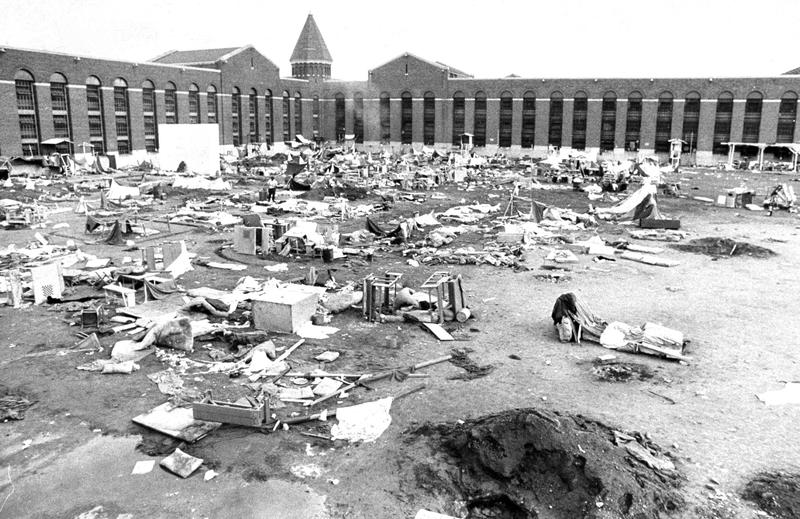
(the remnants of Yard D after the prison was retaken by troopers and guards)
An uprising at the state prison at Auburn, NY was a precursor to events at Attica. What occurred at Auburn should have served as a wakeup for New York State Prison Commissioner Russell Oswald to investigate inmate grievances, because prisoner reform advocates, New York ACLU lawyers and others were becoming very involved and wanted to investigate prisoner complaints. The prison population was younger and more politically aware than previous generations. Members of the Black Panthers, Young Lords, Black Muslims, and Weather Underground placed an emphasis on acquiring knowledge as they worked for improved educational programs. For them, knowledge meant power and it was used to convince prisoners that what occurred to them on the inside mirrored what was occurring in the outside world. From that perspective Thompson is correct that Attica was a prison that was about to explode in September, 1971.
The first half of the narrative concentrates on prisoner frustration concerning their treatment and the lack of response by prison officials to their concerns, the seizure of the facility by inmates, the negotiations that were conducted to try and resolve the situation, and the final storming of the facility by New York State troopers and correctional officers. In so doing Thompson provides intimate details of every important aspect of the crisis. Thompson takes the reader inside the lives of inmates, negotiators, administrators, correctional officers taken hostage, and individuals brought in from the outside to try and alleviate the situation. In each section Thompson introduces important individuals to highlight what was about to be covered. A few of the most powerful are portraits of Michael Smith, a correctional officer who is severely wounded by gunfire; Tom Wicker, a New York Times reporter who was brought in as an observer; Tony Strollo, a New York State trooper whose brother Frank was a correctional officer inside the facility; Elizabeth Fink, a lawyer who defended the prisoners and tried to gain compensation for them and their families; and Malcom Bell, an investigative lawyer who turned whistleblower against the state. The reader will witness the motives that laid behind the actions of the major participants and how it influenced their behavior. Thompson leaves no rock unturned as she explores every aspect of her story and reaches the conclusion the massacre that takes place at Attica did not have to happen, but for Rockefeller’s selfish concern for his political career and the party line that “black revolutionaries” and outside agitators were responsible for the uprising, the lack of training provided for the New York State Police for this type of operation, and the seeming stubbornness and vindictiveness of prison officials and many correctional officers in dealing with a situation that had gotten totally out of hand.
(New York Governor Nelson Rockefeller who refused to entertain prisoner demands)
The second half of the narrative encompasses the attempts to cover-up the truth by the Rockefeller administration and statewide prison officials, the brutal treatment of prisoners by correctional officers following the retaking of the prison, the attempts by inmate families, and families of correctional officers (hostages) that were killed to learn the truth. The obfuscation, misinformation, direct interference to learning the truth, and outright lies dominate the experience of anyone who disagreed with the findings that the leaders of the cover-up who feared what would happen should the truth emerge dominates the narrative. The atmosphere that the different investigative commissions operated under created a very difficult situation as Thompson is correct in pointing out that “the nation’s most powerful politicians viewed Attica as part and parcel of a revolutionary plot to destabilize the nation as a whole would have profound consequences for how officials, both state and federal, handled official investigations.” (267) A further impediment to learning the truth were the actions taken by Governor Rockefeller, his staff, prison officials, New York State Police officials and correctional officers to corroborate their stories to make sure they would achieve the outcome they desired from any investigation.
Thompson examines each investigation and then goes on to the legal effort by the families involved to learn the truth and gain compensation and better treatment for those who perished and those who survived. Overall, it took three years for the state to bring inmates to trial for the uprising. The most common theme dealt with those who were prosecuted, those who was not, the coercion of inmates to testify, and the uneven field that was created for prisoner defense lawyers. As Malcom Bell, a lawyer recruited to Special Prosecutor Anthony Simonetti’s team pointed out when he became a “whistle blower” after experiencing the abuses of the prosecution, “it struck [me] as odd that so much effort was going into prosecuting prisoners from Attica when the officers had killed ten times as many people as the inmates had.” (403) Bell tried to gain support for his findings, even writing a report for Hugh Carey, then the recently elected governor of New York. After waiting months Bell grew tired and contacted Tom Wicker and the story ran in the New York Times creating a firestorm. The overall approach was clear, the prosecution of inmates was of the utmost importance and the case against law enforcement was a much lower priority. What followed was an investigation of the investigation and perhaps Thompson’s best chapter.
Thompson discusses the prosecution of the prisoners in a very clear and concise manner. The key conviction that Simonetti’s team sought was the murderer of corrections officer William Quinn. The Quinn case as with other prosecution cases produced witnesses that were not very credible. Most had not even been at the scene of the supposed crimes, they had been coerced into testifying, or they were promised early parole, reduced sentences, or total release. Prejudiced judges in the first two cases gained convictions but once Bell became a whistle blower prosecution tactics began to change particularly when going after New York State police officials where increasing evidence that they interfered with the collection of materials and issued orders designed to protect troopers and themselves emerged. Men in Simonetti’s office were fully aware that the top brass in the NYSP were hiding and destroying evidence. Bell grew angrier and sent numerous letter to Simonetti pressuring him to go after State Police officials like Lt. Colonel George Infante, Captain Henry Williams, and Major John Monahan, but the Special Prosecutor chose to ignore Bell’s requests over and over.
The theme of culpability for the Attica uprisings pervades Thompson’s narrative, and like a fish that rots from the head down we see the interference and strategy of the Rockefeller administration throughout. By the time a number of these cases finally reached trial, Nelson Rockefeller was undergoing Congressional hearings to be approved as Vice President once Richard Nixon resigned. Angela Davis made the correct comparison when she pleaded before the committee not to approve Rockefeller. Here was a man who refused any empathy toward the prisoners. He would not go to the prison, he would not grant any paroles or pardons. However, President Gerald Ford pardoned Richard Nixon for his crimes, why couldn’t the Governor of New York do a little of the same?
(New York Attorney General Louis Lefkowitz
Thompson completes her history of Attica by exploring the long road taken by inmates to seek redress in the New York State courts. Led by attorney Elizabeth Fink they fought for years to overcome a new round of legal stalling and machinations as inmates, and families of inmates who had passed away fought “the system.” As in other parts of the narrative Thompson provide minute details as the years passed until the trial of prison administrators in the early 1990s. Partially successful the next battle would be over monetary damages to the inmates. Fink led the former prisoners through the labyrinth that was the New York court system and finally in 2000, almost thirty years later a settlement was reached. This created tension with the families of the forgotten hostages who received nothing from the state despite promises. They would begin their own war to receive compensation that was somewhat successful, but just as with the prisoner settlement New York State refused to grant them an apology or any admission of wrongdoing for the massacre at Attica.
Reading Thompson’s study can be exhausting due to the detail and the emotion in which the author presents her material. However, she has done a wondrous job of research and picking apart the documentation that she uncovered. For those who lived through the Attica uprising you will be amazed at what Thompson has uncovered. If you are younger and have never heard or thought about Attica and prison reform this book will be a revelation.
Jonathan Rabb’s new novel, AMONG THE LIVING begins as a feel good story. Holocaust survivor and former Prague journalist, Yitzchak Goldah arrives in Savannah in July, 1947 sponsored by his cousins Abe and Pearl Jesler. The Jesler’s are very sensitive to Ike, the nickname Pearl creates, and his situation. They invite him into their home and take care of all of his needs. Ike has lost his entire family to the Nazi genocide and his mindset grows confused as he tries to adapt to new surroundings at the same time dealing with flashbacks from the camps. It appears to be the making of a wonderful story, until different layers of the novel unravel. Abe Jesler owns a shoe store in the Savannah business district and he invites Ike to learn the trade and work for him. Along with Ike, Abe has a number of “negro” workers that include Calvin and Raymond. As the story progresses, Abe who grew up in one of Savannah’s poorer sections needs to make a significant amount of money to satisfy his overly neurotic and loving spouse, Pearl. Unbeknownst to Ike, Abe is involved with smuggling shoes from Italy through a southern organized syndicate, and over time he is drawn deeper and deeper into the mob’s machinations that call for increasing monetary payments and cooperation. When Abe falls behind in his obligations a message is sent resulting in the brutal beating of Raymond.
The smuggling component is just one storyline. Ike will met a World War II widow, Eva De La Parra, and against her mother’s wishes they begin a relationship. Both Ike, the survivor, and Eva, the mother of a five year old boy, whose husband was killed in Germany in 1945 suffer from a deep emotional void and seem meant for each other. As their relationship progresses a number of fissures emerge in Savannah society. Then we learn that a person from Ike’s past seems to return from the dead. Malke Posner, who survived Theresienstadt, the Nazi “model” concentration camp, turns up at the Jesler’s doorstep claiming to be Ike’s fiancée.
What dominates Rabb’s fine novel is social class inequality and prejudice. At a time when “Jim Crow” dominates the Deep South we find a Jewish community where social circles seem to form around the type of Judaism that religious adherents aspire to. First, are the somewhat religious conservatives that the Jeslers exemplify. The second are Eva’s parents, the Weiss’s whose father is the editor of the town newspaper who are seen as “Temple Jews,” or as they are called, reformed. This “ideological” conflict forms part of the background for a story that takes place at a time when Jews are finally leaving the displaced persons camps in Europe following their liberation from Hitler’s death camps, and in the Middle East Palestine is about to explode into a war between Jews and Arabs. To highlight this, Rabb creates a scene during the Jewish New Year where both groups of Jews confront each other at the beach as they are about to engage in a Jewish cleansing tradition. Another fissure centers on race relations in the south. The Jeslers, as do most wealthy members of the Savannah community employ Negro maids, in this case Mary Royal. Her actions act out the subservient stereotypical maid as does the common language spoken by Raymond and Calvin. In addition, Raymond confronts Abe Jesler concerning his rightful place in a business that he has worked in for over twenty years.
Rabb develops his plot through these dynamics and integrates well developed characters and a story whose highs and lows provoke many compelling questions. This is Rabb’s sixth novel, and perhaps his best.
(President Dwight D. Eisenhower and Egyptian President Gamal Abdul Nasser)
Today we witness a Middle East in crisis. In Iraq, ISIS remains a power though the current operation to reconquer Mosul could be the beginning of the end of the supposed caliphate. Syria is a humanitarian disaster as Russia and Iran continue to prop up Bashir Assad and keep him in power. As the Syrian Civil War continues, war in Yemen involving Saudi Arabia, an American strategic ally evolves further. The seeming winner in this juxtaposition of events is Iran which has taken advantage of the American invasion of Iraq, and how the region has since unraveled. Once ISIS is removed from Iraq it will be interesting to see how Kurdish, Shiite, and Sunni factions “might” try to reconstitute their country. It seems an afterthought to this untenable situation that the Israeli-Palestinian conflict featuring Hamas, an intransigent Israeli government, and Hezbollah in the north has somewhat faded into the background. As we contemplate the morass that is the current Middle East it is interesting to return to the by gone days of the region in the 1950s when Arab nationalism/Pan Arabism was in vogue as opposed to the religious ideological road blocks of today. In IKE”S GAMBLE: AMERICA’S RISE TO DOMINANCE IN THE MIDDLE EAST, senior director of the National Security Council under George W. Bush, Michael Doran has revisited an American strategy to deal with the myriad of problems then in the region, that laid the foundation for America’s role in the area that we continue to grapple with today.
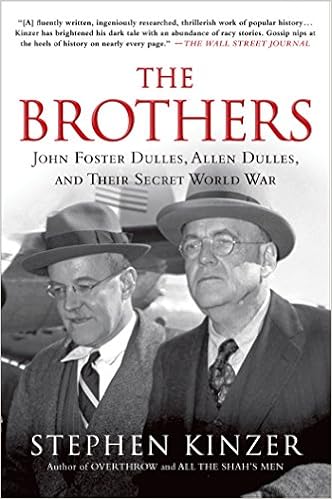
(President Dwight D. Eisenhower and Secretary of State John Foster Dulles)
According to Doran when President Dwight D. Eisenhower assumed the presidency, he and his Secretary of State John Foster Dulles decided to offer the president as “an honest broker” in the Middle East to try and settle intra-Arab, and the Arab-Israeli conflict. The term “honest broker” is an interesting one unless you think of it as a realpolitik based on power politics designed to drive the British from the region and replace it with American influence and control. In 1952, Egypt had undergone a revolution and replaced King Farouk’s government with one based on a “Free Officers Movement” dominated by Colonel Gamal Abdul Nasser, an Egyptian nationalist and believer in uniting the Arab world under Egyptian leadership. The British position in the region was tenuous, despite the presence of 100,000 troops at their Suez Canal base. Their Hashemite allies in Jordan and Iraq feared what was termed as “Nasserism,” the Arab-Israeli conflict was punctuated with “Fedayeen” attacks against Israel, and retaliation by the Jewish state all served to make the region a powder keg. For incoming President Eisenhower he was concerned with dealing with a region that was ripe for communist expansion in the guise of anti-colonialism. Dulles learned firsthand about these tensions when he visited the region in May, 1953 and upon his return he and the president decided on a strategy to remove the British from their Suez base by brokering a treaty that was accomplished by October, 1954, and trying to settle issues between Egypt and Israel that were getting out of hand. For the British it was a series of frustrations with the Eisenhower administration that dominated. Prime Minister Winston Churchill refused to pass leadership of the Conservative party to Foreign Secretary Anthony Eden despite a stroke that left him partially paralyzed on his left side as he would not give in to Egyptian demands and sacrifice the last remaining bulwark of the British Empire. For the United States their ties to British and French imperialism and the closeness of American-Israeli relations were seen as preventing any progress in the Middle East toward peace. This resulted in a policy which set as its goal supporting Nasser in the belief he would cooperate with the United States once a treaty with Israel was arrived at, the end result of which for the Eisenhower administration would be his leadership and gaining the support of the Arab states for a Middle East Defense Organization designed to block Soviet penetration of the region. The United States would woo Nasser with economic aid and promises of military largesse for over four years, a policy that would fail as the Egyptian president was able to dupe his American counterparts.
(British Foreign Secretary and Prime Minister Sir Anthony Eden)
With the above as background, Doran begins to unravel events that resulted in the 1956 Suez War that he describes as Eisenhower’s gamble, a gamble which ended in failure. Doran takes us through the intricacies of Anglo-Egyptian negotiations over the Suez Canal base and the American role in pressuring London to give in to most of Nasser’s demands. He follows that up with a rather long discussion of the “Northern Tier,” an American policy of developing an alternative to a Middle East Defense Organization. The “tier” involved Pakistan and Turkey and theoretically other nations would be added. Doran argues that Nasser’s opposition to the pact and his hatred of Iraqi leader Nuri al-Said, his goal of receiving Soviet arms, and deceiving the United States were all tied together reflecting how Nasser manipulated Washington. Relying on one secondary source to bind all of this together Doran believes that he has gone where no other historian has gone. This is part of his rather condescending approach to historians who have previously studied this topic. On more than one occasion Doran starts out by stating, “most historians have failed to understand how significant….,” or “failed to realize,” in this case the importance of the Turco-Iraqi Pact, or in presenting the role of Eisenhower and Dulles in the Heads of Agreement negotiations dealing with the Suez Canal base, and the role of Jordan in Nasser’s plan to seize the leadership in the Arab world. I would point out that instead of repeated self-serving comments, the author should reflect some objectivity for those who have written previously on the background to the Suez crisis.
(Israeli Prime Minister David Ben-Gurion)
Doran also has a habit of twisting facts to suit his arguments. A case in point is a memo prepared by Dulles in 1958 looking back on issues that led to Suez. In the memo that Doran uses to support his narrative the Secretary of State argues there was little the United States could do to move Israel from its entrenched positions because of the influence of Jews domestically and internationally. If this was so, how come Eisenhower pressured Israeli Prime Minister David Ben-Gurion with threats in March, 1957 to gain Israeli withdrawal from the Sinai? Further he claims that the Soviet Union, “while consistently hinting to the Arab states that it will agree to dismember Israel, has never actually come out with a statement of support.” If that is correct what do we make of Soviet threats concerning the use of nuclear weapons after Israel, France, and Britain implemented the Sevres conspiracy and attacked Egypt at the end of October, 1956?
I do agree with Doran that Washington’s “blind pursuit of an illusionary Arab-Israeli peace” strengthened Nasser’s position in the Arab world, at the same time he was trying to undermine the western position in the region. Nasser deceived the State Department, raising the hopes for peace through the secret Alpha Plan. The Egyptian leaders stalling tactics and disingenuousness would continue until the Eisenhower administration would call Nasser’s bluff following the Anderson peace mission in early 1956, a mission that would lead to the Omega plan designed to pressure Nasser to be more accommodating. Doran points out that the new plan was designed to deal with Nasser and achieve behavioral change, not regime change. I would point out that the document also alluded to strong action particularly if a soft covert approach did not work as Dulles’ March 28, 1956 memo stated that “planning should be undertaken at once with a view to possibly more drastic action in the event that the above courses of action do not have the desired effect.”* For Eisenhower, whose frustration with Nasser finally took effect there were suggestions that a strong move against the Egyptian president would have to wait until after the American presidential election in November.
Doran continues his narrative by taking the reader through the immediate causes of the Suez War, the machinations that occurred after the Israeli invasion, and the final withdrawal of Israeli, French, and British troops from Sinai. The author then goes on to discuss the anti-colonial purity of the Eisenhower administration which was short lived with the announcement of the Eisenhower Doctrine in January, 1957, designed to protect Arab states from communist encroachment. The reality was total failure of American policy with the overthrow of the Iraqi government and the dispatch of American marines to Lebanon. In addition, the goal of turning the Saudi monarchy into a substitute for Nasser as an Arab leader that would bring about a coalescing of Arab states in support of U.S. policy in the region never transpired. In the end I would agree with Doran that Ike’s gamble did more harm than good and by 1958 resulted in the president questioning his policies that led to the 1956 war and beyond. These musings by Eisenhower and the counterfactual scenarios presented by the author are interesting, but it does not change the fact that the team of Eisenhower and Dulles did create a popular Arab leader who was able to create strong Pan Arabist sentiment in the Middle East and left the United States with two weak allies in Jordan and Lebanon. Further, they created a “doctrine” for the Middle East that was viewed in the Arab world as the same type of colonialism that had been previously practiced by England and France. Doran completes his narrative by admonishing American policy makers that we should be careful not to make the same errors today that we made in the height of the Cold War.
*Steven Z. Freiberger. DAWN OVER SUEZ: THE RISE OF AMERICAN POWER IN THE MIDDLE EAST 1953-1957 (Chicago: Ivan R. Dee, 1992), p. 149.
(President Dwight D. Eisenhower and Egyptian President Gamal Abdul Nasser)
(General Douglas MacArthur and President Harry Truman at the Wake Island Conference, October 15, 1950)
On June 25, 1950 North Korea unleashed an attack against its southern neighbor that set off a war that resulted in 36,914 American casualties. Many Americans are aware of the role of General Douglas MacArthur in the conflict, in particular his brilliant, but risky landing at Inchon that beat back the North Korean attack, and later in the war pursuing a strategy that led to Chinese intervention. MacArthur’s actions were very controversial and once the Chinese crossed the Yalu River with over 100,000 troops and the military situation deteriorated, America’s allies grew concerned when MacArthur suggested the use of atomic weapons against the Chinese. President Harry S. Truman did his best to reign in his commander to no avail and most historians believe that MacArthur overstepped his authority and allowed his strong belief system guide his actions. Others like the British historian Robert Harvey and the American historian Arthur Herman believe the situation was much more nuanced. The topic has again been explored in H.W. Brands new book, THE GENERAL VS. THE PRESIDENT: MACARTHUR AND TRUMAN AT THE BRINK OF NUCLEAR WAR. Brands position is very clear that Truman’s firing of MacArthur was a “bold stroke” that may have headed off a much wider war with the Chinese.
(US Secretary of State, Dean Acheson)
Brands juxtaposes two personalities with totally different backgrounds and agendas. Truman, reelected president in his own right in 1948 stood up to Stalin after World War II implementing the Truman Doctrine, the Marshall Plan, and stood fast over Berlin as he pursued the policy of containment of the Soviet Union. With the North Korean attack he was able to blunt their progress until the Chinese crossed the Yalu River in force, but he was faced with a commander who wanted to employ nuclear weapons to send a message to the communist world. On the other hand, MacArthur, the “all knowing general” who held politicians in contempt, especially a “novice” president like Truman. MacArthur saw himself as having saved the Pacific in World War II, rebuilt postwar Japan, and now believed he had the communists right where he wanted them, but a feckless president stood in his way. Brands does his best to explain the issues between the two men in the context of the Cold War in which they lived. Brands has written a general history of their relationship and its ultimate outcome, but does not really add anything new that has not been uncovered by previous works on the topic.
Brands smooth narrative style, refined through the many books he has written is present throughout. Brands is a master story teller who is able to present his narrative and analysis in a concise fashion that the general reader should enjoy, which at times will also satisfy an academic audience. A case in point is how MacArthur gained the support of the Japanese people as he totally reoriented their society away from the militaristic emperor worship to a nation based on liberal democracy. In the constitution he prepared he did away with all pre-war institutions, except the emperor, that had dominated Japan and resulted in World War II. Further evidence of this approach can be seen as Brands reviews Truman’s career that spans his election to the Senate in 1940, his assumption of the presidency in 1945, and Cold War events to the onset of the Korean War. Brands effectively relies on Truman’s correspondence with his daughter Margaret who served as a remarkable conduit into his thoughts and concerns.
(General Matthew Ridgeway who took over command in Korea after MacArthur was relieved)
A major strength of the book are the character studies that are presented. Discussions of people like Secretary of State Dean Acheson, a rather arrogant individual; General Omar T. Bradley, whose insights into Truman and MacArthur’s personalities are fascinating; General Matthew Ridgeway, a hero at the Battle of the Bulge during World War II whose leadership helped turn around the military balance in Korea; and Marguerite Higgins, a wartime correspondent add to the narrative. Other strengths of the book include Brands’ description of the plight and final breakout of US Marines at the Chosin Reservoir and their two week trek battling the elements which were more dangerous than the Chinese communists to reach Hamhung. Brands coverage of Truman and MacArthur rationalizations when confronted by Congress and the press is eye opening in trying to gain insights into their dysfunctional relationship after the Chinese communists crossed the Yalu into North Korea. MacArthur’s statements at this time concerning administration restraints in dealing with bombing Chinese airfields in Manchuria and other issues is very similar to his rhetoric leaked to the American press after Matthew Ridgeway’s forces saved MacArthur’s reputation in April, 1951. Brands coverage of Truman and the Joint Chiefs of Staff finally reaching the conclusion to relieve MacArthur of his command points to the final realization that MacArthur’s insubordination and egocentrism could no longer be tolerated. Especially enlightening was the inclusion of a great deal of the testimony of MacArthur and Secretary of Defense George C. Marshall before Congress following MacArthur’s dismissal. However, the report of the hearings would have been enhanced if excerpts of Secretary of State Dean Acheson’s testimony had also been included. This along with the geopolitical analysis of the region and domestic politics in the United States that included the role of Chiang Kai-Shek, Republicans in Congress, and the coming 1952 presidential election are all important pieces in understanding the war and its domestic implications.
(President elect Dwight Eisenhower visits South Korea after his election)
Despite the strengths of the book there are a number of areas that could be improved. The bibliography is rather sparse and the endnotes could be enhanced. In the area of analysis, Brands chooses to deal with a number of major issues in a rather superficial manner. His exploration of Soviet motives behind the North Korean attack is weak. His excuse that the Russians were protesting the seating of Formosa over mainland China in the UN Security Council as the reason for their absence to block an American/UN force to stop the North Korean advance does not go far enough. Is it possible that Moscow tried to draw the United States into the conflict in the hope it would cause difficulties with the Chinese at a time when the Sino-Soviet split was emerging is a main motivation? Brands covers all the major topics that come under the umbrella of his overall subject, but he needs to dig down further, or just state up front that he is preparing a general history of the topic, then the reader will not expect more. For example, the Wake Island meeting between Truman and MacArthur covers the basics. Further, he does not drill down far enough when discussing events that led up to the Chinese overrunning UN forces in November, 1950. To his credit he does list the signs of possible Chinese actions that MacArthur missed, but he needs to explore the reaction of America’s allies further, as well as the interaction between MacArthur and the Joint Chiefs of Staff.
Overall, Brands has written a very readable account of the Truman-MacArthur relationship in the context of the Cold War. I would agree with Francis P. Sempa’s view published in the New York Journal of Books* that Brands does not present a very clear legacy of the Korean War in terms of future American foreign policy. Truman wanted to have a “police action” or “limited war,” in Korea, MacArthur sought total victory, something the United States has achieved only once since World War II in the first Gulf War in 1990-91, but failed to accomplish in Vietnam, and currently in Iraq and Afghanistan. There are a number of lessons that could have been discussed that relate to future American foreign policy, an important area, which Brands chooses to ignore.
A murder that takes place at the 42nd Street Public Library in Manhattan is an unusual venue for a mystery concept. However, this is exactly what Con Lehane has created in his new and very effective novel, MURDER AT THE 42ND STREET LIBRARY. One afternoon, Dr. James Donnelly enters the office of Harry Larkin, the Director of Special Collections at the library and is shot dead. Larkin, a medieval historian and former Jesuit priest becomes very defensive about the murder he has witnessed when questioned by his friend Raymond Ambler, the curator in the collection of crime fiction, and a Tai Chi aficionado. Ambler, who dabbles in solving real crimes is friends with Mike Cosgrove, the NYPD detective who is in charge of the new investigation. It seems that the elderly author, Nelson Yates, who suffers from dementia, has donated his papers to the library and a number of characters cross paths over the new collection. There is Donnelley’s ex-wife, Kay; biographer, Maximilian Wagner; Wagner’s wife, Laura Lee McGlynn; Adele Morgan, a colleague of Amblers at the library; Benny Barone, a library researcher; Yates’ young wife Mary, the elderly Yates, and Dominic Salerno, a mob type. All of these people are key to the web Lehane creates as he spins his tale, particularly when feelings are ruffled when Yates decided to give his collection to the library as opposed to other bidders.
Yates is very concerned about his collection because there are letters he has written to his estranged daughter Emily who left home at fifteen. Yates fears that if Wagner, who is writing a new biography of him gets hold of the letters it will destroy any hope of a reconciliation with his daughter, as well as his literary reputation. The library staff has not followed library protocol and has allowed Wagner access to Yates’ papers before they were catalogued. The papers, the intermingling of a number of characters, and their personal secrets form the basis of an extremely well-conceived and entertaining plot, particularly when Yates is murdered outside the library.
It is extremely interesting as Lehane lays out the different characters and how their pasts intersect. It seems that at one time Yates was a visiting professor at Hudson Highlands University in Rockledge, at the same time Max Wagner was an assistant professor of English, as was James Donnelley. Further, Kay Donnelly was an English graduate student along with Laura Lee McGlynn who was married to an English professor whose death is linked to Yates’ daughter Emily. Just this brief snapshot in time raises some interesting questions about the two murders that have taken place and what these past relationships expose. By this juncture Lehane’s plot should captivate the reader and lead to a very satisfying murder mystery experience.
Lehane writes in a very smooth prose and has not created the overly sarcastic main characters that other mystery writers rely on. Ray Ambler is a sensitive and somewhat intellectual type, and Mike Cosgrove is career NYPD who is trying to get his private life in order. As the novel progresses Lehane has the ability to drop a number of bombshells in a very subtle manner that the reader would never expect, and this approach adds to the story. My only criticism of the novel is that the final ending is somewhat farfetched but it does lend itself to another installment of Ambler and Cosgrove’s approach to crime, which I look forward to.










 Doc's Books